Interleukin-1β (C-511T) Genetic Variant and Major Depressive Disorder: A Systematic Review
 , , ,
, , ,  and
and
Abstract
1. Introduction
2. Methods
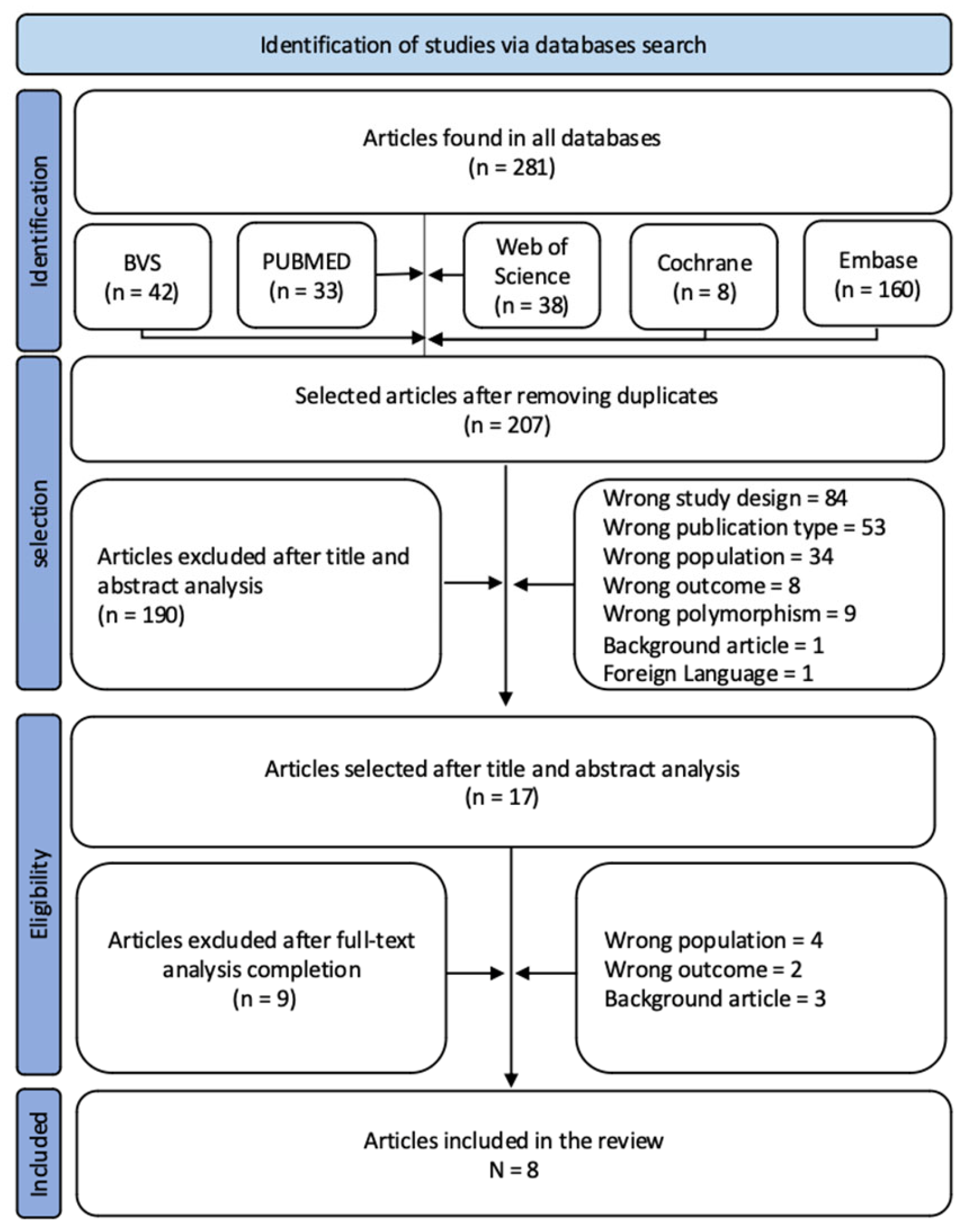
2.1. Research Strategy and Selection Criteria
2.2. Study Selection and Data Extraction
2.3. Bias Risk in Each Study
3. Results
4. Discussion
4.1. Inflammation, HPA Axis Dysregulation, and Neuroimmune Mechanisms in Major Depressive Disorder
4.2. IL1B −511C/T (rs16944) Variant and Its Genotypic Frequency in Major Depressive Disorder
4.3. IL-1β −511C/T Variant (rs16944) and Pharmacotherapy
4.4. Selected Articles’ Quality Assessment and Limitations
5. Conclusions
Supplementary Materials
Author Contributions
Funding
Institutional Review Board Statement
Informed Consent Statement
Data Availability Statement
Acknowledgments
Conflicts of Interest
References
- Marx, W.; Penninx, B.W.J.H.; Solmi, M.; Furukawa, T.A.; Firth, J.; Carvalho, A.F.; Berk, M. Major Depressive Disorder. Nat. Rev. Dis. Primers 2023, 9, 44. [Google Scholar] [CrossRef] [PubMed]
- Dean, J.; Keshavan, M. The Neurobiology of Depression: An Integrated View. Asian J. Psychiatr. 2017, 27, 101–111. [Google Scholar] [CrossRef] [PubMed]
- Li, Z.; Ruan, M.; Chen, J.; Fang, Y. Major Depressive Disorder: Advances in Neuroscience Research and Translational Applications. Neurosci. Bull. 2021, 37, 863–880, Correction in Neurosci. Bull. 2021, 37, 904. [Google Scholar] [CrossRef] [PubMed]
- World Health Organization. Depression and Other Common Mental Disorders: Global Health Estimates; World Health Organization: Geneva, Switzerland, 2017. [Google Scholar]
- Greenberg, P.E.; Fournier, A.A.; Sisitsky, T.; Simes, M.; Berman, R.; Koenigsberg, S.H.; Kessler, R.C. The Economic Burden of Adults with Major Depressive Disorder in the United States (2010 and 2018). Pharmacoeconomics 2021, 39, 653–665. [Google Scholar] [CrossRef]
- Malhi, G.S.; Mann, J.J. Depression. Lancet 2018, 392, 2299–2312. [Google Scholar] [CrossRef]
- Vitali, E.; Cattane, N.; D’Aprile, I.; Petrillo, G.; Cattaneo, A. Systemic Inflammation at the Crossroad of Major Depressive Disorder and Comorbidities: A Narrative Review. Int. J. Mol. Sci. 2025, 26, 9382. [Google Scholar] [CrossRef]
- Brasso, C.; Cisotto, M.; Del Favero, E.; Giordano, B.; Villari, V.; Rocca, P. Impact of COVID-19 Pandemic on Major Depressive Disorder in Acute Psychiatric Inpatients. Front. Psychol. 2023, 14, 1181832. [Google Scholar] [CrossRef]
- Cai, H.; Xie, X.M.; Zhang, Q.; Cui, X.; Lin, J.X.; Sim, K.; Ungvari, G.S.; Zhang, L.; Xiang, Y.T. Prevalence of Suicidality in Major Depressive Disorder: A Systematic Review and Meta-Analysis of Comparative Studies. Front. Psychiatry 2021, 12, 690130. [Google Scholar] [CrossRef]
- Orsolini, L.; Latini, R.; Pompili, M.; Serafini, G.; Volpe, U.; Vellante, F.; Fornaro, M.; Valchera, A.; Tomasetti, C.; Fraticelli, S.; et al. Understanding the Complex of Suicide in Depression: From Research to Clinics. Psychiatry Investig. 2020, 17, 207–221. [Google Scholar] [CrossRef]
- Shadrina, M.; Bondarenko, E.A.; Slominsky, P.A. Genetics Factors in Major Depression Disease. Front. Psychiatry 2018, 9, 334. [Google Scholar] [CrossRef]
- Toma, F.M.; Kalam, K.T.; Haque, M.A.; Reza, S.; Akter, R.; Islam, M.S.; Islam, M.R.; Nahar, Z. Interleukin-1β Rs16944 and Rs1143627 Polymorphisms and Risk of Developing Major Depressive Disorder: A Case-Control Study among Bangladeshi Population. PLoS ONE 2025, 20, e0317665. [Google Scholar] [CrossRef]
- Young, J.J.; Bruno, D.; Pomara, N. A Review of the Relationship between Proinflammatory Cytokines and Major Depressive Disorder. J. Affect. Disord. 2014, 169, 15–20. [Google Scholar] [CrossRef]
- Lezheiko, T.V.; Andryushchenko, A.V.; Korovaitseva, G.I.; Kondratiev, N.V.; Gabaeva, M.V.; Krikova, E.V.; Golimbet, V.E. Association of Genes for Proinflammatory Cytokines and Depression. Neurosci. Behav. Physiol. 2019, 49, 749–753. [Google Scholar] [CrossRef]
- Martin, C.; Tansey, K.E.; Schalkwyk, L.C.; Powell, T.R. The Inflammatory Cytokines: Molecular Biomarkers for Major Depressive Disorder? Biomark. Med. 2015, 9, 169–180. [Google Scholar] [CrossRef] [PubMed]
- Duncan, L.E.; Ostacher, M.; Ballon, J. How Genome-Wide Association Studies (GWAS) Made Traditional Candidate Gene Studies Obsolete. Neuropsychopharmacology 2019, 44, 1518–1523. [Google Scholar] [CrossRef] [PubMed]
- Nishino, J.; Ochi, H.; Kochi, Y.; Tsunoda, T.; Matsui, S. Sample Size for Successful Genome-Wide Association Study of Major Depressive Disorder. Front. Genet. 2018, 9, 227. [Google Scholar] [CrossRef] [PubMed]
- Milaneschi, Y.; Lamers, F.; Peyrot, W.J.; Abdellaoui, A.; Willemsen, G.; Hottenga, J.J.; Jansen, R.; Mbarek, H.; Dehghan, A.; Lu, C.; et al. Polygenic Dissection of Major Depression Clinical Heterogeneity. Mol. Psychiatry 2016, 21, 516–522. [Google Scholar] [CrossRef]
- Barnes, J.; Mondelli, V.; Pariante, C.M. Genetic Contributions of Inflammation to Depression. Neuropsychopharmacology 2017, 42, 81–98. [Google Scholar] [CrossRef]
- Mikhalitskaya, E.V.; Vyalova, N.M.; Ermakov, E.A.; Levchuk, L.A.; Simutkin, G.G.; Bokhan, N.A.; Ivanova, S.A. Association of Single Nucleotide Polymorphisms of Cytokine Genes with Depression, Schizophrenia and Bipolar Disorder. Genes 2023, 14, 1460. [Google Scholar] [CrossRef]
- Ellul, P.; Boyer, L.; Groc, L.; Leboyer, M.; Fond, G. Interleukin-1 β-Targeted Treatment Strategies in Inflammatory Depression: Toward Personalized Care. Acta Psychiatr. Scand. 2016, 134, 469–484. [Google Scholar] [CrossRef]
- Janssens, A.C.J.W.; Ioannidis, J.P.A.; van Duijn, C.M.; Little, J.; Khoury, M.J. Strengthening the Reporting of Genetic Risk Prediction Studies: The GRIPS Statement. PLoS Med. 2011, 8, 6–9. [Google Scholar] [CrossRef]
- Tadić, A.; Rujescu, D.; Müller, M.J.; Kohnen, R.; Stassen, H.H.; Szegedi, A.; Dahmen, N. Association Analysis between Variants of the Interleukin-1β and the Interleukin-1 Receptor Antagonist Gene and Antidepressant Treatment Response in Major Depression. Neuropsychiatr. Dis. Treat. 2008, 4, 269–276. [Google Scholar] [CrossRef]
- Hwang, J.P.; Tsai, S.J.; Hong, C.J.; Yang, C.H.; Hsu, C.D.; Liou, Y.J. Interleukin-1 Beta -511C/T Genetic Polymorphism Is Associated with Age of Onset of Geriatric Depression. Neuromol. Med. 2009, 11, 322–327. [Google Scholar] [CrossRef] [PubMed]
- Baune, B.T.; Dannlowski, U.; Domschke, K.; Janssen, D.G.A.; Jordan, M.A.; Ohrmann, P.; Bauer, J.; Biros, E.; Arolt, V.; Kugel, H.; et al. The Interleukin 1 Beta (IL1B) Gene Is Associated with Failure to Achieve Remission and Impaired Emotion Processing in Major Depression. Biol. Psychiatry 2010, 67, 543–549. [Google Scholar] [CrossRef] [PubMed]
- Maciukiewicz, M.; Marshe, V.S.; Tiwari, A.K.; Fonseka, T.M.; Freeman, N.; Rotzinger, S.; Foster, J.A.; Kennedy, J.L.; Kennedy, S.H.; Müller, D.J. Genetic Variation in IL-1β, IL-2, IL-6, TSPO and BDNF and Response to Duloxetine or Placebo Treatment in Major Depressive Disorder. Pharmacogenomics 2015, 16, 1919–1929. [Google Scholar] [CrossRef] [PubMed]
- Yu, Y.W.Y.; Chen, T.J.; Hong, C.J.; Chen, H.M.; Tsai, S.J. Association Study of the Interieukin-Ibeta (C-5I IT) Genetic Polymorphism with Major Depressive Disorder, Associated Symptomatology, and Antidepressant Response. Neuropsychopharmacology 2003, 28, 1182–1185. [Google Scholar] [CrossRef]
- Chi, M.-H.; Lee, S.-Y.; Chang, H.-H.; Yang, Y.-K.; Lin, E.; Chen, P.-S. Comparison of Antidepressant Efficacy-related SNPs Among Taiwanese and Four Populations in the HapMap Database. J. Formos. Med. Assoc. 2011, 110, 478–482. [Google Scholar]
- Borkowska, P.; Kucia, K.; Rzezniczek, S.; Paul-Samojedny, M.; Kowalczyk, M.; Owczarek, A.; Suchanek, R.; Medrala, T.; Kowalski, J. Interleukin-1beta Promoter (-31T/C and -511C/T) Polymorphisms in Major Recurrent Depression. J. Mol. Neurosci. 2011, 44, 12–16. [Google Scholar] [CrossRef]
- Grillo, A.R. Polygene by Environment Interactions Predicting Depressive Outcomes. Am. J. Med. Genet. Part B Neuropsychiatr. Genet. 2025, 198, e33000. [Google Scholar] [CrossRef]
- Tsai, S.J. Effects of Interleukin-1beta Polymorphisms on Brain Function and Behavior in Healthy and Psychiatric Disease Conditions. Cytokine Growth Factor Rev. 2017, 37, 89–97. [Google Scholar] [CrossRef]
- Kouba, B.R.; de Araujo Borba, L.; Borges de Souza, P.; Gil-Mohapel, J.; Rodrigues, A.L.S. Role of Inflammatory Mechanisms in Major Depressive Disorder: From Etiology to Potential Pharmacological Targets. Cells 2024, 13, 423. [Google Scholar] [CrossRef] [PubMed]
- Cui, L.; Li, S.; Wang, S.; Wu, X.; Liu, Y.; Yu, W.; Wang, Y.; Tang, Y.; Xia, M.; Li, B. Major Depressive Disorder: Hypothesis, Mechanism, Prevention and Treatment. Signal Transduct. Target. Ther. 2024, 9, 30. [Google Scholar] [CrossRef] [PubMed]
- Ruiz, N.A.L.; Del Ángel, D.S.; Brizuela, N.O.; Peraza, A.V.; Olguín, H.J.; Soto, M.P.; Guzmán, D.C. Inflammatory Process and Immune System in Major Depressive Disorder. Int. J. Neuropsychopharmacol. 2022, 25, 46–53. [Google Scholar] [CrossRef] [PubMed]
- Cavaleri, D.; Moretti, F.; Bartoccetti, A.; Mauro, S.; Crocamo, C.; Carrà, G.; Bartoli, F. The Role of BDNF in Major Depressive Disorder, Related Clinical Features, and Antidepressant Treatment: Insight from Meta-Analyses. Neurosci. Biobehav. Rev. 2023, 149, 105159. [Google Scholar] [CrossRef]
- Min, X.; Wang, G.; Cui, Y.; Meng, P.; Hu, X.; Liu, S.; Wang, Y. Association between Inflammatory Cytokines and Symptoms of Major Depressive Disorder in Adults. Front. Immunol. 2023, 14, 1110775. [Google Scholar] [CrossRef]
- Innes, S.; Pariante, C.M.; Borsini, A. Microglial-Driven Changes in Synaptic Plasticity: A Possible Role in Major Depressive Disorder. Psychoneuroendocrinology 2019, 102, 236–247. [Google Scholar] [CrossRef]
- Alcocer-Gómez, E.; Cordero, M.D. NLRP3 Inflammasome: A New Target in Major Depressive Disorder. CNS Neurosci. Ther. 2014, 20, 294–295. [Google Scholar] [CrossRef]
- Anisman, H. Cascading Effects of Stressors and Inflammatory Immune System Activation: Implications for Major Depressive Disorder. J. Psychiatry Neurosci. 2009, 34, 4–20. [Google Scholar] [CrossRef]
- Chen, X.; Yao, T.; Cai, J.; Fu, X.; Li, H.; Wu, J. Systemic Inflammatory Regulators and 7 Major Psychiatric Disorders: A Two-Sample Mendelian Randomization Study. Prog. Neuropsychopharmacol. Biol. Psychiatry 2022, 116, 110534. [Google Scholar] [CrossRef]
- Šalamon Arčan, I.; Kouter, K.; Videtič Paska, A. Depressive Disorder and Antidepressants from an Epigenetic Point of View. World J. Psychiatry 2022, 12, 1150–1168. [Google Scholar] [CrossRef]
- Fatjó-Vilas, M.; Pomarol-Clotet, E.; Salvador, R.; Monté, G.C.; Gomar, J.J.; Sarró, S.; Ortiz-Gil, J.; Aguirre, C.; Landín-Romero, R.; Guerrero-Pedraza, A.; et al. Effect of the Interleukin-1β Gene on Dorsolateral Prefrontal Cortex Function in Schizophrenia: A Genetic Neuroimaging Study. Biol. Psychiatry 2012, 72, 758–765. [Google Scholar] [CrossRef] [PubMed]
- Lezheiko, T.V.; Andryushchenko, A.V.; Korovaitseva, G.I.; Kondratiev, N.V.; Gabaeva, M.V.; Krikova, E.V.; Golimbet, V.E. A Study on the Association of Genes for Pro-Inflammatory Cytokines and Depression. Zhurnal Nevrol. I Psihiatr. Im. S.S. Korsakova 2018, 118, 89–93. [Google Scholar] [CrossRef] [PubMed]
- Misener, V.L.; Gomez, L.; Wigg, K.G.; King, N.; Kiss, E.; Daróczi, G.; Kapornai, K.; Tamás, Z.; Mayer, L.; Gádoros, J.; et al. Tagging SNP Association Study of the IL-1β Gene (IL1B) and Childhood-Onset Mood Disorders. Am. J. Med. Genet. Part B Neuropsychiatr. Genet. 2009, 150, 653–659. [Google Scholar] [CrossRef] [PubMed]
- Ridout, K.K.; Parade, S.H.; Seifer, R.; Price, L.H.; Gelernter, J.; Feliz, P.; Tyrka, A.R. Interleukin 1B Gene (IL1B) Variation and Internalizing Symptoms in Maltreated Preschoolers. Dev. Psychopathol. 2014, 26, 1277–1287. [Google Scholar] [CrossRef]
- Mueller, D.J. Genetic Variation of Inflammatory Markers (IL-1beta, IL-2, IL6, TSPO) and BDNF in Response to Treatment with Duloxetine and Placebo. Biol. Psychiatry 2015, 77, 224S. [Google Scholar]
- Kovacs, D.; Eszlari, N.; Petschner, P.; Pap, D.; Vas, S.; Kovacs, P.; Gonda, X.; Juhasz, G.; Bagdy, G. Effects of IL1B Single Nucleotide Polymorphisms on Depressive and Anxiety Symptoms Are Determined by Severity and Type of Life Stress. Brain Behav. Immun. 2016, 56, 96–104. [Google Scholar] [CrossRef]
- Cohen-Woods, S.; Fisher, H.L.; Ahmetspahic, D.; Douroudis, K.; Stacey, D.; Hosang, G.M.; Korszun, A.; Owen, M.; Craddock, N.; Arolt, V.; et al. Interaction between Childhood Maltreatment on Immunogenetic Risk in Depression: Discovery and Replication in Clinical Case-Control Samples. Brain Behav. Immun. 2018, 67, 203–210. [Google Scholar] [CrossRef]
- Marshe, V.; Maciukiewicz, M.; Tiwari, A.K.; Freeman, N.; Kennedy, J.L.; Rotzinger, S.; Kennedy, S.; Müller, D. Investigating associations between IL-1β, IL-2, IL-6, TSPO and BDNF variants and response to duloxetine or placebo treatment in patients with major depression. Eur. Neuropsychopharmacol. 2017, 27, S139–S356, (Abstract Sa77). [Google Scholar]
- Draganov, M.; Arranz, M.J.; De Diego-Adelino, J.; Jubero, M.; Puigdemont, D.; Alvarez, E.; Portella, M.J. Puigdemont Association Study of Polymorphisms within In- FLammatory Genes and Treatment Resistant Depression. Eur. Neuropsychopharmacol. 2018, 29, S54–S55. [Google Scholar] [CrossRef]
- Draganov, M.; Arranz, M.J.; Salazar, J.; de Diego-Adeliño, J.; Gallego-Fabrega, C.; Jubero, M.; Carceller-Sindreu, M.; Portella, M.J. Association Study of Polymorphisms within Inflammatory Genes and Methylation Status in Treatment Response in Major Depression. Eur. Psychiatry 2019, 60, 7–13. [Google Scholar] [CrossRef]
- McQuaid, R.J.; Gabrys, R.L.; McInnis, O.A.; Anisman, H.; Matheson, K. Understanding the Relation between Early-Life Adversity and Depression Symptoms: The Moderating Role of Sex and an Interleukin-1β Gene Variant. Front. Psychiatry 2019, 10, 151. [Google Scholar] [CrossRef]


| Exclusion Category | Operational Definition |
|---|---|
| Wrong outcome | Studies that evaluated IL-1β levels, inflammatory markers, neurobiological mechanisms, treatment response, pharmacodynamics, safety outcomes, or theoretical constructs without assessing the association between the IL1B −511C/T (rs16944) polymorphism and clinical outcomes of Major Depressive Disorder (MDD). |
| Wrong study design | Studies with methodological designs not aligned with the PECOS protocol, including clinical intervention trials, transdiagnostic analyses, and other non-observational designs. |
| Wrong publication type | Publications without original human data, such as narrative or systematic reviews, meta-analyses, consensus statements, editorials, theoretical papers, or translational/experimental studies. |
| Wrong population | Studies conducted in populations not meeting the inclusion criteria, including individuals without a clinical diagnosis of MDD, other psychiatric disorders, transdiagnostic samples, pediatric populations, non-human samples, or patients with non-psychiatric medical conditions. |
| Wrong polymorphism | Studies that investigated genetic variants other than IL1B −511C/T (rs16944) or focused on different inflammatory or pharmacogenetic genes without direct analysis of this specific polymorphism. |
| Background article | Articles used exclusively for theoretical contextualization that discussed inflammation, IL-1β, or genetic aspects of depression in general, without directly evaluating the association between IL1B −511C/T (rs16944) and MDD. |
| Foreign language | Studies published in languages other than English or Portuguese, with no full-text version available in these languages. |
| Author | Title | Objective | Year | Country | Sample (n) | Results | p-Value | Genotypic Frequency |
|---|---|---|---|---|---|---|---|---|
| Younger W-Y Yu et al. [27] | Association study of the interleukin-1 beta (C-511T) genetic polymorphism with major depressive disorder, associated symptomatology, and antidepressant response. | This study investigated a possible association of the IL1B gene’s biallelic (C/T) polymorphism in the promoter region (position -511) with MDD and its clinical symptoms, as well as its therapeutic response. | 2003 | Taiwan | MDD Group: n = 157 M = 70 F = 49 Control Group: n = 112 | No significant differences were found between any of the genotypes and allele frequencies when comparing the case and control groups. | Frequencies: Genotypes (p = 0.240) Alleles (p = 0.134) | MDD C/C = 31.8% (n = 50) C/T = 53.5% (n = 84) T/T = 14.6% (n = 23) Control C/C = 23.2% (n = 26) C/T = 57.1% (n = 64) T/T = 19.6% (n = 22) |
| Tadić et al. [23] | Association analysis between variants of the interleukin-1β and the interleukin-1 receptor antagonist gene and antidepressant treatment response in major depression | To verify the possible effect of two polymorphisms, including the IL1B C-511T gene, on the result of the antidepressant response to treatment with the antidepressants paroxetine and mirtazapine in patients with major depression. | 2008 | Germany | MDD group 1 n = 116 M = 27 F = 74 | Patients homozygous for the T allele responded more quickly and strongly to paroxetine treatment compared to those with the other alleles. A significant interaction was also observed between time and genotype using a mixed-effects model for repeated measures (MMRM) 2. TT carriers showed lower mean scores on the Hamilton Rating Scale for Depression (HAMD-17) compared to CT or CC carriers, starting from day 14, with statistically significant differences on days 21 and 28. | Time × Genotype Interaction (MMRM) (p = 0.017) Difference in HAMD-17 scores on day 21 (p = 0.028) Difference in HAMD-17 scores on day 28 (p = 0.025) | Paroxetine CC = 30.6% (n = 15) CT = 55.1% (n = 27) TT = 14.3% (n = 7) Mirtazapine CC = 38.5% (n = 20) CT = 51.9% (n = 27) TT = 9.6% (n = 5) |
| Jen-Ping Hwang et al. [24] | Interleukin-1 beta −511C/T genetic polymorphism is associated with age of onset of geriatric depression | Determine whether the IL1B gene’s biallelic functional −511C/T polymorphism in the promoter region affects vulnerability to geriatric depression and its manifestations, including age of onset, depression severity, and cognitive function. | 2009 | China | Older adults with MDD: n = 125 M = 76 F = 49 Control Group: n = 282 M = 193 F = 89 | There was no significant association between the genotypes of this genetic variant and susceptibility to geriatric depression, depression severity, or cognitive function. The only finding suggests that the IL1B −511C/T polymorphism may be related to the later age of onset, being 7 years later. | IL1B −511C/T genotypes and susceptibility to geriatric depression (p = 0.213) Age of onset of depression across genotypes (p = 0.021) | MDD C/C = 32.8% (n = 41) C/T = 45.6% (n = 57) T/T = 21.6% (n = 27) Control C/C = 24.8% (n = 70) C/T = 53.5% (n = 151) T/T = 21.6% (n = 61) |
| Bernhard T. Baune et al. [25] | The Interleukin 1 Beta (IL1B) Gene Is Associated with Failure to Achieve Remission and Impaired Emotion Processing in Major Depression | Investigate the association between IL1B genetic variants, including −511C/T, and the responsiveness of the amygdala and anterior cingulate cortex (ACC) to emotional stimuli and the response to antidepressant treatment. | 2010 | Germany | MDD Group: n = 256 M = 111 F = 145 | Although the IL1B rs16944 genetic variation’s genotype distribution did not differ significantly (p = 0.23), the CC rs16944 genotype was significantly associated with non-remission after 6 weeks of treatment (p = 0.02). Imaging analyses also revealed a significant positive association, showing that the C rs16944 allele was linked to reduced responsiveness of the amygdala and anterior cingulate cortex (ACC) to emotional stimuli. | Genotypes (p = 0.23) Significant associations of the CC rs16944 genotype with non-remission after 6 weeks of antidepressant treatment (p = 0.034). | MDD: TT: 25.8% (n = 66) TC: 45.7% (n = 117) CC: 28.5% (n = 73) 2 |
| Mei-Hung Chi et al. [28] | Comparison of Antidepressant Efficacy-related SNPs Among Taiwanese and Four Populations in the HapMap Database | The allele frequencies of related SNPs, including IL1B −511C/T, to antidepressant efficacy were compared between the Taiwanese population and other populations in the HapMap database. | 2011 | Taiwan | MDD Group: n = 198 Control Group: n = 106 M = 35 F = 71 | No significant differences were observed between Taiwanese patients (TWN-P) and Taiwanese controls (TWN-C). However, significant differences emerged when comparing TWN-C to the other four ethnic groups: (1) Han Chinese in Beijing (CHB), (2) individuals of European ancestry residing in the USA (CEU), (3) Japanese in Tokyo (JPT), and (4) Yoruba in Ibadan (YRI). Notably, a statistically significant difference in the IL1B gene SNPs’ allele frequency was found only between TWN-C and YRI (p = 0.048). | TWN-P vs. TWN-C (p = 0.886) TWN-C vs. JPT (p = 0.887) TWN-C vs. CHB (p = 0.478) TWN-C vs. CEU (p = 0.225) TWN-C vs. YRI (p = 0.048) | TWN-P T: 0.420 C: 0.580 TWP-C T: 0.429 C: 0.571 CHB T: 0.477 C: 0.523 CEU T: 0.345 C: 0.655 JPT T: 0.444 C: 0.556 YRI T: 0.566 C: 0.434 2 |
| Paulina Borkowska et al. [29] | Interleukin-1beta Promoter (−31T/C and −511C/T) Polymorphisms in Major Recurrent Depression | This study aimed to conduct a case–control study, verifying two IL1B polymorphisms (−31T/C and −511C/T) in the promoter region in patients suffering from severe recurrent depression. | 2011 | Poland | MDD Group: n = 121 F: 94 M: 27 Control Group: n = 206 M = 131 F = 75 | A specific haplotype containing the T allele at position -511 showed a trend towards statistical significance in patients compared to controls. Furthermore, correspondence analysis revealed that the C/C genotype at-511 is associated with recurrent major depressive disorder. | Haplotype frequencies in the patient and control groups (p = 0.064) | MDD C/C = 44.7% (n = 42) C/T = 49% (n = 52) T/T = 3.3% (n = 3) Control C/C = 36.9% (n = 76) C/T = 58.3% (n = 120) T/T = 4.8% (n = 10) |
| Malgorzata Maciukiewicz et al. [26] | Genetic variation in IL-1β, IL-2, IL-6, TSPO and BDNF and response to duloxetine or placebo treatment in major depressive disorder | This study investigated polymorphisms of five inflammation-related genes, including IL1B −511C/T, for association with response to duloxetine and placebo in patients with major depression. | 2015 | Canada | All patients n = 411 F: 275 M: 136 Placebo group n = 215 F: 142 M: 73 Duloxetine n = 196 F: 133 M: 63 | No significant associations were observed between this SNP and response to duloxetine or placebo treatment in MDD patients. The minor allele frequency was 36% in the analyzed sample. | Duloxetine 0.367 (ΔMADRS), 0.172 (resp.) Placebo 0.388 (ΔMADRS), 0.577 (resp.) | Genotypic frequency not reported. Minor allele frequency (MAF): 36%. |
| Faria Mehreen Toma et al. [12] | Interleukin-1β rs16944 and rs1143627 polymorphisms and risk of developing major depressive disorder: A case–control study among Bangladeshi population | The authors’ objective is to verify the correlation between IL1B rs16944 and rs1143627 polymorphisms and susceptibility to MDD. | 2025 | Bangladesh | MDD Group: n = 100 F: 73 M: 27 Control Group: n = 70 M = 19 F = 51 | The IL1B rs16944 polymorphisms revealed that the combined TC + CC genotype in the dominant model showed a 2.06-fold increased risk of developing MDD compared with the common homozygous TT (OR = 2.06). | Dominant model (TC + CC vs. TT) (p = 0.032) | MDD C/C = 4% (n = 4) C/T = 40% (n = 40) T/T = 56% (n = 56) Control C/C = 0% (n = 0) C/T = 27.1% (n = 19) T/T = 72.9% (n = 51) |
| Study | Diagnostic Criteria | Structured Interview | Depression Severity Scale | Longitudinal Assessment | DNA Source | Genotyping Method |
|---|---|---|---|---|---|---|
| Yu et al., 2003 [27] | DSM-IV | No (clinical interview by senior psychiatrist) | HAM-D 1 (21 items) | No | Blood | PCR–RFLP |
| Tadić et al., 2008 [23] | DSM-IV | No (clinical interview by trained raters) | HAM-D (17 items) MADRS used only for suicide risk exclusion | Yes | Blood | PCR–RFLP |
| Hwang et al., 2009 [24] | DSM-IV | Yes (Mini-International Neuropsychiatric Interview—MINI) | HAM-D (17 items) | No | Not explicitly reported | PCR–RFLP |
| Baune et al., 2010 [25] | DSM-IV | Yes (Structured clinical interview—SCID-I) | HAM-D (21 items) | Yes | Not explicitly reported | MassARRAY iPLEX® |
| Borkowska et al., 2011 [29] | DSM-IV-TR | Yes (SCID-I) | HAM-D(cross-sectional) | No | Blood | PCR–RFLP |
| Chi et al., 2011 [28] | DSM-IV | Yes (Chinese version of the Mini International Neuropsychiatric Interview (MINI) for controls) | HAM-D (baseline) | No | Blood | SNaPshot Multiplex + LightCycler |
| Maciukiewicz et al., 2015 [26] | DSM-IV-TR | Yes (clinical trial setting) | MADRS 2 | Yes | Blood | TaqMan OpenArray® |
| Toma et al., 2025 [12] | DSM-5 | No | HAM-D (baseline) | No | Blood | PCR–RFLP |
| Feature | CC Genotype | TT Genotype |
|---|---|---|
| Primary Association | Higher Symptom Severity | Improved Treatment Response |
| IL-1β Levels | Generally Lower | Generally Higher |
| Clinical Impact | Poorer prognosis/Early onset | Better response to SSRIs |
Disclaimer/Publisher’s Note: The statements, opinions and data contained in all publications are solely those of the individual author(s) and contributor(s) and not of MDPI and/or the editor(s). MDPI and/or the editor(s) disclaim responsibility for any injury to people or property resulting from any ideas, methods, instructions or products referred to in the content. |
© 2026 by the authors. Licensee MDPI, Basel, Switzerland. This article is an open access article distributed under the terms and conditions of the Creative Commons Attribution (CC BY) license.
Share and Cite
Rodrigues Gontijo, B.; Ferreira Fratelli, C.; Sousa Silva Bonasser, L.; de Souza Silva, C.M.; Rodrigues da Silva, I.C. Interleukin-1β (C-511T) Genetic Variant and Major Depressive Disorder: A Systematic Review. Int. J. Mol. Sci. 2026, 27, 5974. https://doi.org/10.3390/ijms27135974
Rodrigues Gontijo B, Ferreira Fratelli C, Sousa Silva Bonasser L, de Souza Silva CM, Rodrigues da Silva IC. Interleukin-1β (C-511T) Genetic Variant and Major Depressive Disorder: A Systematic Review. International Journal of Molecular Sciences. 2026; 27(13):5974. https://doi.org/10.3390/ijms27135974
Chicago/Turabian StyleRodrigues Gontijo, Bruna, Caroline Ferreira Fratelli, Larissa Sousa Silva Bonasser, Calliandra Maria de Souza Silva, and Izabel Cristina Rodrigues da Silva. 2026. "Interleukin-1β (C-511T) Genetic Variant and Major Depressive Disorder: A Systematic Review" International Journal of Molecular Sciences 27, no. 13: 5974. https://doi.org/10.3390/ijms27135974
APA StyleRodrigues Gontijo, B., Ferreira Fratelli, C., Sousa Silva Bonasser, L., de Souza Silva, C. M., & Rodrigues da Silva, I. C. (2026). Interleukin-1β (C-511T) Genetic Variant and Major Depressive Disorder: A Systematic Review. International Journal of Molecular Sciences, 27(13), 5974. https://doi.org/10.3390/ijms27135974