Ophthalmic Immune-Related Adverse Events in Cancer Immunotherapy: Tissue-Specific Mechanisms, Clinical Phenotypes, and Consensus-Based Management
 , , ,
, , ,
Abstract
1. Introduction
2. Overview of Immune Checkpoint Inhibitors
3. Molecular Mechanisms Underlying the Tissue Specificity of Ocular Immune-Related Adverse Events
3.1. PD-L1 Expression Across Ocular Tissues as a Determinant of Immune Privilege
3.2. Disruption of Ocular Immune Privilege by Immune Checkpoint Inhibitors
3.3. T-Cell Subset Activation and Clonal Expansion in Ocular irAEs
3.4. Cytokine and Chemokine Effector Profiles in Ocular Fluids
3.5. Autoantibody-Mediated Mechanisms and Paraneoplastic Associations
3.6. Synthesis and Clinical Implications
4. Incidence and Risk Factors of Ocular Immune-Related Adverse Events: Epidemiology and Classification
ICI-Related Uveitis: Epidemiology, Risk Factors and Clinical Manifestations
5. Other Ocular Immune-Related Adverse Events
5.1. Neuro-Ophthalmic Events
5.2. Dry Eye
- (a)
- T-cell-mediated inflammation: Activated autoreactive T cells may infiltrate conjunctival tissues, releasing proinflammatory cytokines that induce conjunctival inflammation.
- (b)
- Glandular dysfunction: ICIs may target lacrimal and meibomian glands, resulting in reduced tear secretion and compromised tear film stability, thereby precipitating dry eye disease. Patrinely et al. [73] observed xerostomia as a frequent manifestation of chronic irAEs with an incidence rate of 2.4%, in their long-term follow-up study, suggesting that ICIs may impair glandular function, including that of the lacrimal glands.
- (c)
- Autoantibody involvement: Although direct evidence remains limited, autoantibodies may theoretically attack conjunctival or lacrimal gland tissues.
5.3. Corneal Disorders
- (a)
- Direct immune-mediated attack: ICI-activated autoreactive T cells may directly target corneal cells, particularly epithelial cells, inducing inflammation and tissue damage. Since corneal epithelial cells express PD-L1, blockade of the PD-1/PD-L1 pathway could compromise corneal immune privilege, rendering it vulnerable to immune attack.
- (b)
- Secondary to dry eye disease: Severe ICI-induced dry eye may lead to tear film instability and ocular surface desiccation, increasing susceptibility to corneal epithelial damage and secondary infections, thereby predisposing to keratitis or ulcer formation.
- (c)
- Drug toxicity: Although ICIs primarily exert their effects through immunomodulation, direct cytotoxic effects on corneal cells or induction of proinflammatory mediators may also contribute to corneal pathology.
5.4. Retinopathy
- (a)
- Autoimmune targeting: The retina harbors numerous specific antigens, including retinal S-antigen and interphotoreceptor retinoid-binding protein (IRBP), which may become susceptible to attack by autoreactive T cells under ICI therapy. Retinal pigment epithelial (RPE) cells express PD-L1, and disruption of their immunosuppressive function by ICIs may precipitate RPE cell damage and retinal inflammation.
- (b)
- Retinal vascular inflammation: ICIs may induce systemic vasculitis with retinal vascular involvement, leading to retinal vasculitis, vascular occlusion, and ischemic retinopathy. Au et al. (2023) [77] documented a case of nivolumab-associated peripheral vasculitis and digital gangrene, suggesting that ICIs could potentially trigger systemic vasculitis that may theoretically extend to retinal vasculature.
- (c)
- Cytokine-mediated injury: Proinflammatory cytokines induced by ICIs may directly or indirectly compromise retinal cellular integrity, resulting in macular edema or retinal dysfunction.
6. Treatment Strategies
- (i)
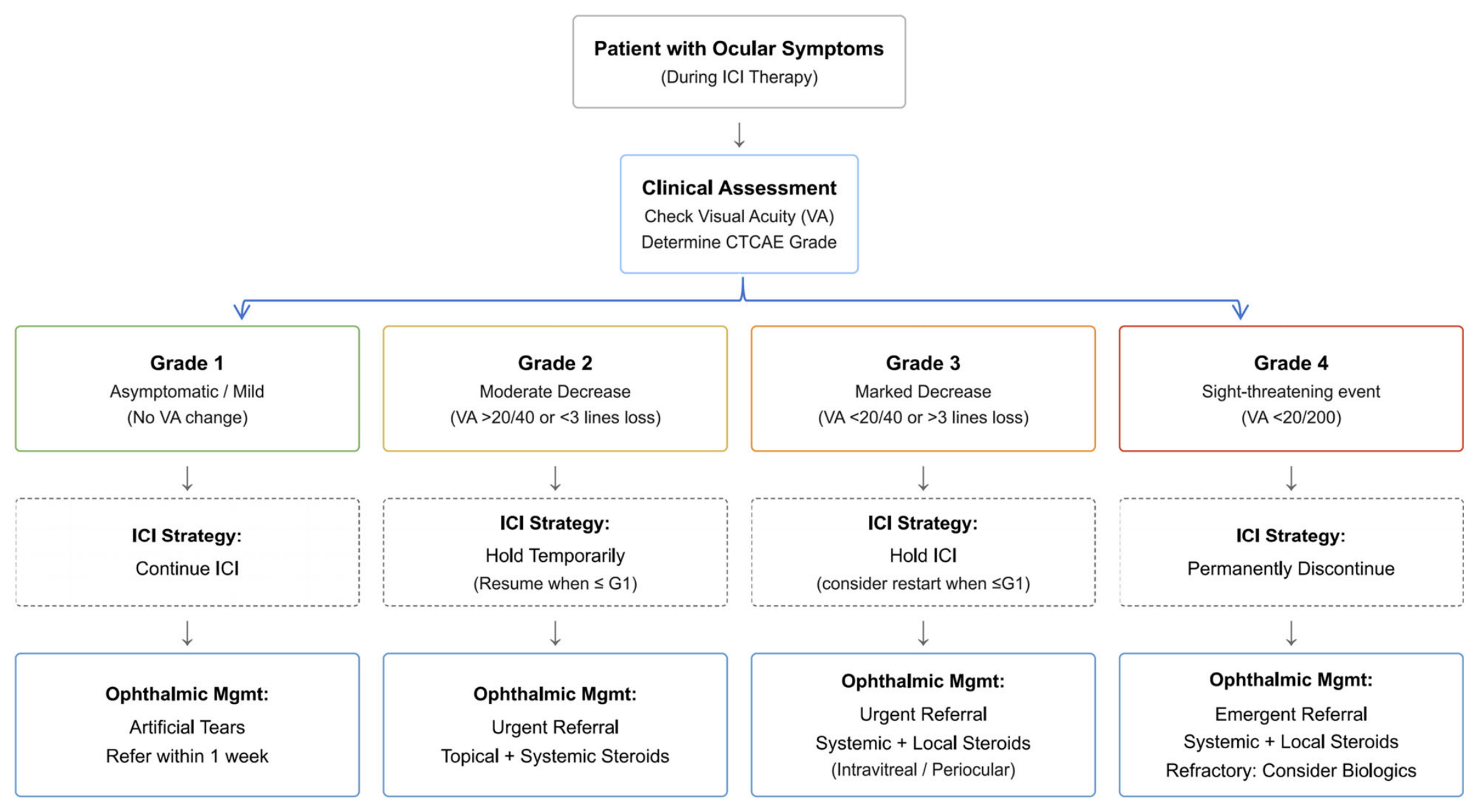
- Consensus-based recommendations (Grade C). Derived from the 2025 international consensus and ASCO irAE guidelines: local corticosteroids for Grade 1–2 events, systemic corticosteroids for Grade ≥ 3 events, and the ICI management algorithm shown in Figure 4.
- (ii)
- Case-report-supported strategies (Grade D). Supported by published case reports or small case series in the OirAE setting, IL-6 receptor blockade (e.g., tocilizumab) has emerging supportive evidence in non-infectious uveitis and selected irAEs during anti-PD-1 therapy, but dedicated OirAE data remain limited to case reports. Anti-TNF-α therapy (infliximab, adalimumab) has been used for refractory ocular inflammation in the non-ICI setting; its use in ICI-associated uveitis is supported by isolated case reports and should be weighed carefully against the potential impact on systemic antitumour immunity.
- (iii)
- Extrapolated from non-ICI uveitis practice. These strategies are supported by rigorous clinical trials or large observational studies in non-ICI uveitis populations. For adalimumab, a phase 3 randomized controlled trial (VISUAL I) [80] demonstrated efficacy in active non-infectious intermediate, posterior, and panuveitis. For tocilizumab, retrospective data in Birdshot retinochoroiditis and refractory non-anterior uveitis suggest potential benefit, but controlled trials in the ICI setting are lacking [81,82].
- (iv)
- Speculative mechanism-based therapies. IL-17A inhibition, JAK inhibitors, and FcRn inhibition are biologically plausible based on the mechanistic framework outlined in Section 3, but clinical evidence in OirAEs is currently absent. These approaches require prospective evaluation before clinical recommendation.
7. Future Research Directions and Challenges
8. Conclusions
Author Contributions
Funding
Institutional Review Board Statement
Informed Consent Statement
Data Availability Statement
Conflicts of Interest
Abbreviations
| AEPVM | Acute Exudative Paraneoplastic Vitelliform Maculopathy |
| APCs | Antigen-Presenting Cells |
| ASCO | American Society of Clinical Oncology |
| CAR | Cancer-Associated Retinopathy |
| CK | Creatine Kinase |
| CT | Computed Tomography |
| CTCAE | Common Terminology Criteria for Adverse Events |
| CTLA-4 | Cytotoxic T-Lymphocyte-Associated Protein 4 |
| CXCL10 | C-X -C Motif Chemokine Ligand 10 |
| ERG | Electroretinography |
| FDA | U.S. Food and Drug Administration |
| FcRn | Neonatal Fc Receptor |
| FA | Fluorescein Angiography |
| G-CSF | Granulocyte Colony-Stimulating Factor |
| ICGA | Indocyanine Green Angiography |
| ICIs | Immune Checkpoint Inhibitors |
| IFN-γ | Interferon-Gamma |
| IL-2 | Interleukin-2 |
| IL-6 | Interleukin-6 |
| IRBP | Interphotoreceptor Retinoid-Binding Protein |
| IPT | Ice Pack Test |
| irAEs | Immune-Related Adverse Events |
| IOP | Intraocular Pressure |
| LAG-3 | Lymphocyte-Activation Gene 3 |
| MAR | Melanoma-Associated Retinopathy |
| MG | Myasthenia Gravis |
| MRI | Magnetic Resonance Imaging |
| NSCLC | Non-Small Cell Lung Cancer |
| OCT | Optical Coherence Tomography |
| OR | Odds Ratio |
| OirAEs | Ocular Immune-Related Adverse Events |
| PD-1 | Programmed Cell Death Protein 1 |
| PD-L1 | Programmed Death-Ligand 1 |
| RAPD | Relative Afferent Pupillary Defect |
| RPE | Retinal Pigment Epithelium |
| RNS | Repetitive Nerve Stimulation |
| SFEMG | Single-Fiber Electromyography |
| TIM-3 | T-Cell Immunoglobulin and Mucin-Domain Containing-3 |
| TIGIT | T-Cell Immunoglobulin and ITIM Domain |
| TNF-α | Tumor Necrosis Factor-Alpha |
| Tregs | Regulatory T Cells |
| TRP-1 | Tyrosinase-Related Protein-1 |
| VISTA | V Domain Ig Inhibitory Factor Activated by T Cells |
| VKH | Vogt–Koyanagi–Harada Syndrome |
| VSIG-3 | V-Set and Immunoglobulin Domain Containing 3 |
| VEP | Visual Evoked Potential |
References
- Kroemer, G.; Zitvogel, L. Immune checkpoint inhibitors. J. Exp. Med. 2021, 218, e20201979. [Google Scholar] [CrossRef] [PubMed]
- Ameri, M.; Al-Zubidi, N.; Lee, A.G. Immune checkpoint monoclonal antibody-related adverse effects in neuro-ophthalmology. Saudi J. Ophthalmol. 2024, 38, 25–28. [Google Scholar] [CrossRef] [PubMed]
- Nagai, R.; Yamamoto, A.; Yoshida, A.; Mikawa, A. Outcome of Nivolumab-Induced Vogt-Koyanagi-Harada Disease-like Uveitis in a Patient Managed without Intravenous Methylprednisolone Therapy. Case Rep. Ophthalmol. Med. 2023, 2023, 9565205. [Google Scholar] [PubMed]
- Huang, Y.; Khan, F.; Saraiya, N.V.; Punjabi, O.S.; Gulati, V.; Erickson, A.R.; Yeh, S. Vogt-Koyanagi-Harada-like Syndrome Induced by Checkpoint Inhibitor Cemiplimab. J. Immunother. 2023, 46, 295–298. [Google Scholar] [PubMed]
- Zhou, Y.W.; Xu, Q.; Wang, Y.; Xia, R.L.; Liu, J.Y.; Ma, X.L. Immune checkpoint inhibitor-associated ophthalmic adverse events: Current understanding of its mechanisms, diagnosis, and management. Int. J. Ophthalmol. 2022, 15, 646–656. [Google Scholar] [CrossRef] [PubMed]
- Francis, J.H.; Jaben, K.; Santomasso, B.D.; Canestraro, J.; Abramson, D.H.; Chapman, P.B.; Berkenstock, M.; Aronow, M.E. Immune Checkpoint Inhibitor-Associated Optic Neuritis. Ophthalmology 2020, 127, 1585–1589. [Google Scholar] [CrossRef] [PubMed]
- Martens, A.; Schauwvlieghe, P.P.; Madoe, A.; Casteels, I.; Aspeslagh, S. Ocular adverse events associated with immune checkpoint inhibitors, a scoping review. J. Ophthalmic Inflamm. Infect. 2023, 13, 5. [Google Scholar] [CrossRef] [PubMed]
- Buchbinder, E.I.; Desai, A. CTLA-4 and PD-1 Pathways: Similarities, Differences, and Implications of Their Inhibition. Am. J. Clin. Oncol. 2016, 39, 98–106. [Google Scholar] [PubMed]
- Seidel, J.A.; Otsuka, A.; Kabashima, K. Anti-PD-1 and Anti-CTLA-4 Therapies in Cancer: Mechanisms of Action, Efficacy, and Limitations. Front. Oncol. 2018, 8, 86. [Google Scholar] [PubMed]
- Sharpe, A.H.; Pauken, K.E. The diverse functions of the PD1 inhibitory pathway. Nat. Rev. Immunol. 2018, 18, 153–167. [Google Scholar] [PubMed]
- Sun, C.; Mezzadra, R.; Schumacher, T.N. Regulation and Function of the PD-L1 Checkpoint. Immunity 2018, 48, 434–452. [Google Scholar] [CrossRef] [PubMed]
- Long, L.; Zhang, X.; Chen, F.; Pan, Q.; Phiphatwatchara, P.; Zeng, Y.; Chen, H. The promising immune checkpoint LAG-3: From tumor microenvironment to cancer immunotherapy. Genes Cancer 2018, 9, 176–189. [Google Scholar] [CrossRef] [PubMed]
- Delyon, J.; Mateus, C.; Lefeuvre, D.; Lanoy, E.; Zitvogel, L.; Chaput, N.; Roy, S.; Eggermont, A.M.; Routier, E.; Robert, C. Experience in daily practice with ipilimumab for the treatment of patients with metastatic melanoma: An early increase in lymphocyte and eosinophil counts is associated with improved survival. Ann. Oncol. 2013, 24, 1697–1703. [Google Scholar] [CrossRef] [PubMed]
- Keam, S.J. Tremelimumab: First Approval. Drugs 2023, 83, 93–102. [Google Scholar] [PubMed]
- Scott, L.J. Nivolumab: A Review in Advanced Melanoma. Drugs 2015, 75, 1413–1424. [Google Scholar] [CrossRef] [PubMed]
- Deeks, E.D. Pembrolizumab: A Review in Advanced Melanoma. Drugs 2016, 76, 375–386. [Google Scholar] [CrossRef] [PubMed]
- Lee, A.; Duggan, S.; Deeks, E.D. Cemiplimab: A Review in Advanced Cutaneous Squamous Cell Carcinoma. Drugs 2020, 80, 813–819, Correction in Drugs 2020, 80, 939. [Google Scholar] [CrossRef] [PubMed]
- Mai, H.Q.; Chen, Q.Y.; Chen, D.; Hu, C.; Yang, K.; Wen, J.; Li, J.; Shi, Y.; Jin, F.; Xu, R.; et al. Toripalimab Plus Chemotherapy for Recurrent or Metastatic Nasopharyngeal Carcinoma: The JUPITER-02 Randomized Clinical Trial. JAMA 2023, 330, 1961–1970. [Google Scholar] [PubMed]
- Andre, T.; Berton, D.; Curigliano, G.; Sabatier, R.; Tinker, A.V.; Oaknin, A.; Ellard, S.; de Braud, F.; Arkenau, H.T.; Trigo, J.; et al. Antitumor Activity and Safety of Dostarlimab Monotherapy in Patients with Mismatch Repair Deficient Solid Tumors: A Nonrandomized Controlled Trial. JAMA Netw. Open 2023, 6, e2341165. [Google Scholar] [PubMed]
- Powles, T.; Kockx, M.; Rodriguez-Vida, A.; Duran, I.; Crabb, S.J.; Van Der Heijden, M.S.; Szabados, B.; Pous, A.F.; Gravis, G.; Herranz, U.A.; et al. Clinical efficacy and biomarker analysis of neoadjuvant atezolizumab in operable urothelial carcinoma in the ABACUS trial. Nat. Med. 2019, 25, 1706–1714, Correction in Nat. Med. 2023, 29, 3271. [Google Scholar] [CrossRef] [PubMed]
- Iacovelli, R.; Ciccarese, C.; Brunelli, M.; Battelli, N.; Buttigliero, C.; Caserta, C.; Buti, S.; Santini, D.; Carella, C.; Galli, L.; et al. First-line avelumab for patients with PD-L1-positive metastatic or locally advanced urothelial cancer who are unfit for cisplatin. Ann. Oncol. 2022, 33, 1179–1185. [Google Scholar] [PubMed]
- Powles, T.; van der Heijden, M.S.; Castellano, D.; Galsky, M.D.; Loriot, Y.; Petrylak, D.P.; Ogawa, O.; Park, S.H.; Lee, J.L.; De Giorgi, U.; et al. Durvalumab alone and durvalumab plus tremelimumab versus chemotherapy in previously untreated patients with unresectable, locally advanced or metastatic urothelial carcinoma (DANUBE): A randomised, open-label, multicentre, phase 3 trial. Lancet Oncol. 2020, 21, 1574–1588, Correction in Lancet Oncol. 2021, 22, E5. [Google Scholar] [CrossRef] [PubMed]
- Markham, A. Envafolimab: First Approval. Drugs 2022, 82, 235–240. [Google Scholar] [CrossRef] [PubMed]
- Zhou, C.; Wang, Z.; Sun, M.; Cao, L.; Ma, Z.; Wu, R.; Yu, Y.; Yao, W.; Sun, S.; Chen, J.; et al. Interim survival analysis of the randomized phase III GEMSTONE-302 trial: Sugemalimab or placebo plus chemotherapy as first-line treatment for metastatic NSCLC. Nat. Cancer 2023, 4, 860–871, Correction in Nat. Cancer 2024, 5, 209. [Google Scholar] [CrossRef] [PubMed]
- Seth, R.; Agarwala, S.S.; Messersmith, H.; Alluri, K.C.; Ascierto, P.A.; Atkins, M.B.; Bollin, K.; Chacon, M.; Davis, N.; Faries, M.B.; et al. Systemic Therapy for Melanoma: ASCO Guideline Update. J. Clin. Oncol. 2023, 41, 4794–4820. [Google Scholar] [CrossRef] [PubMed]
- Brown, A.C.; Quiroz, J.; Parikh, D.A.; Li, Y.; Ritzer, L.; Rosen, R.; Deobhakta, A. Cytokines in PD-1 immune checkpoint inhibitor adverse events and implications for the treatment of uveitis. BMC Ophthalmol. 2024, 24, 312. [Google Scholar] [CrossRef] [PubMed]
- Gong, Y.; Liu, Y.; Jiang, F.; Wang, X. Ocular Immune-Related Adverse Events Associated with PD-1 Inhibitors: From Molecular Mechanisms to Clinical Management. Semin. Ophthalmol. 2025, 40, 288–305. [Google Scholar] [PubMed]
- Hori, J.; Yamaguchi, T.; Keino, H.; Hamrah, P.; Maruyama, K. Immune privilege in corneal transplantation. Prog. Retin. Eye Res. 2019, 72, 100758. [Google Scholar] [CrossRef] [PubMed]
- Yang, W.; Li, H.; Chen, P.W.; Alizadeh, H.; He, Y.; Hogan, R.N.; Niederkorn, J.Y. PD-L1 expression on human ocular cells and its possible role in regulating immune-mediated ocular inflammation. Investig. Ophthalmol. Vis. Sci. 2009, 50, 273–280. [Google Scholar]
- Chen, K.Y.; Chan, H.C.; Chan, C.M. Can Immune Checkpoint Modulation Redefine Ocular Immunotherapy? Emerging Mechanisms, Challenges, and Translational Opportunities-A Comprehensive Review. Investig. Ophthalmol. Vis. Sci. 2025, 66, 53. [Google Scholar]
- Sharabi, A.; Tsokos, M.G.; Ding, Y.; Malek, T.R.; Klatzmann, D.; Tsokos, G.C. Regulatory T cells in the treatment of disease. Nat. Rev. Drug Discov. 2018, 17, 823–844. [Google Scholar] [CrossRef] [PubMed]
- Park, B.C.; Stone, C.A., Jr.; Dewan, A.K.; Johnson, D.B. Hypersensitivity Reactions and Immune-Related Adverse Events to Immune Checkpoint Inhibitors: Approaches, Mechanisms, and Models. Immunol. Allergy Clin. N. Am. 2022, 42, 285–305. [Google Scholar] [CrossRef]
- Giguelay, A.M.; Maschmeyer, P.; Müller-Jensen, L.; Schinke, C.; Maierhof, S.K.; Nambiar, N.; Meyer, M.; Huehnchen, P.; Boehmerle, W.; Endres, M.; et al. Clonally expanded effector CD4(+) cytotoxic T lymphocytes are associated with severe neurological adverse events after immune checkpoint inhibitor therapy. J. Immunother. Cancer 2025, 13, e012350. [Google Scholar] [PubMed]
- Klein, O.; Ebert, L.M.; Nicholaou, T.; Browning, J.; Russell, S.E.; Zuber, M.; Jackson, H.M.; Dimopoulos, N.; Tan, B.S.; Hoos, A.; et al. Melan-A-specific cytotoxic T cells are associated with tumor regression and autoimmunity following treatment with anti-CTLA-4. Clin. Cancer Res. 2009, 15, 2507–2513. [Google Scholar] [PubMed]
- Sun, M.M.; Kelly, S.P.; Mylavarapu, A.L.; Holland, G.N.; Coleman, A.L.; Yu, F.; Hsu, S.; Lum, F.; Gordon, L.K. Ophthalmic Immune-Related Adverse Events after Anti-CTLA-4 or PD-1 Therapy Recorded in the American Academy of Ophthalmology Intelligent Research in Sight Registry. Ophthalmology 2021, 128, 910–919. [Google Scholar] [PubMed]
- Yoshida, M.; Kunikata, H.; Nakazawa, T. Intraocular Concentrations of Cytokines and Chemokines in a Unique Case of Nivolumab-Induced Uveitis. Ocul. Immunol. Inflamm. 2020, 28, 850–853. [Google Scholar] [PubMed]
- Xiao, J.; Zhao, C.; Cheng, G.; Song, H.; Zhang, Y.; Zhang, M. Multiple cytokine analysis of aqueous humor in uveitis with or without secondary glaucoma. BMC Ophthalmol. 2024, 24, 451. [Google Scholar] [CrossRef] [PubMed]
- Berson, E.L.; Lessell, S. Paraneoplastic night blindness with malignant melanoma. Am. J. Ophthalmol. 1988, 106, 307–311. [Google Scholar] [CrossRef] [PubMed]
- Polans, A.S.; Witkowska, D.; Haley, T.L.; Amundson, D.; Baizer, L.; Adamus, G. Recoverin, a photoreceptor-specific calcium-binding protein, is expressed by the tumor of a patient with cancer-associated retinopathy. Proc. Natl. Acad. Sci. USA 1995, 92, 9176–9180. [Google Scholar] [PubMed]
- Chauhan, M.Z.; Mansour, H.A.; Zafar, M.K.; Uwaydat, S.H. Anti-Programmed Death Ligand-1 Induced Acute Vision Loss in a Patient with Cancer-Associated Retinopathy. Cureus 2022, 14, e21709. [Google Scholar] [PubMed]
- Roberts, P.; Fishman, G.A.; Joshi, K.; Jampol, L.M. Chorioretinal Lesions in a Case of Melanoma-Associated Retinopathy Treated with Pembrolizumab. JAMA Ophthalmol. 2016, 134, 1184–1188. [Google Scholar] [CrossRef] [PubMed]
- Comin-Anduix, B.; Escuin-Ordinas, H.; Ibarrondo, F.J. Tremelimumab: Research and clinical development. Onco Targets Ther. 2016, 9, 1767–1776. [Google Scholar] [CrossRef] [PubMed]
- Iwama, S.; De Remigis, A.; Callahan, M.K.; Slovin, S.F.; Wolchok, J.D.; Caturegli, P. Pituitary expression of CTLA-4 mediates hypophysitis secondary to administration of CTLA-4 blocking antibody. Sci. Transl. Med. 2014, 6, 230ra245. [Google Scholar] [CrossRef]
- Sarkar, P.; Mehtani, A.; Gandhi, H.C.; Bhalla, J.S.; Tapariya, S. Paraneoplastic ocular syndrome: A pandora’s box of underlying malignancies. Eye 2022, 36, 1355–1367. [Google Scholar] [PubMed]
- Graus, F.; Dalmau, J. Paraneoplastic neurological syndromes in the era of immune-checkpoint inhibitors. Nat. Rev. Clin. Oncol. 2019, 16, 535–548. [Google Scholar] [CrossRef] [PubMed]
- Jiang, S.; Li, H.; Zhang, L.; Mu, W.; Zhang, Y.; Chen, T.; Wu, J.; Tang, H.; Zheng, S.; Liu, Y.; et al. Generic Diagramming Platform (GDP): A comprehensive database of high-quality biomedical graphics. Nucleic Acids Res. 2025, 53, D1670–D1676. [Google Scholar] [PubMed]
- Abdel-Rahman, O.; Oweira, H.; Petrausch, U.; Helbling, D.; Schmidt, J.; Mannhart, M.; Mehrabi, A.; Schob, O.; Giryes, A. Immune-related ocular toxicities in solid tumor patients treated with immune checkpoint inhibitors: A systematic review. Expert Rev. Anticancer Ther. 2017, 17, 387–394. [Google Scholar] [CrossRef] [PubMed]
- Bomze, D.; Meirson, T.; Hasan Ali, O.; Goldman, A.; Flatz, L.; Habot-Wilner, Z. Ocular Adverse Events Induced by Immune Checkpoint Inhibitors: A Comprehensive Pharmacovigilance Analysis. Ocul. Immunol. Inflamm. 2022, 30, 191–197. [Google Scholar] [PubMed]
- Wu, K.Y.; Yakobi, Y.; Gueorguieva, D.D.; Mazerolle, É. Emerging Ocular Side Effects of Immune Checkpoint Inhibitors: A Comprehensive Review. Biomedicines 2024, 12, 2547. [Google Scholar] [CrossRef] [PubMed]
- Kumar, V.; Chaudhary, N.; Garg, M.; Floudas, C.S.; Soni, P.; Chandra, A.B. Current Diagnosis and Management of Immune Related Adverse Events (irAEs) Induced by Immune Checkpoint Inhibitor Therapy. Front. Pharmacol. 2017, 8, 49, Correction in Front. Pharmacol. 2017, 8, 311. [Google Scholar] [CrossRef] [PubMed]
- Zhou, L.; Wei, X. Ocular Immune-Related Adverse Events Associated with Immune Checkpoint Inhibitors in Lung Cancer. Front. Immunol. 2021, 12, 701951. [Google Scholar] [CrossRef] [PubMed]
- Mazharuddin, A.A.; Whyte, A.T.; Gombos, D.S.; Patel, N.; Razmandi, A.; Chaudhry, A.L.; Al-Zubidi, N.S. Highlights on Ocular Toxicity of Immune Checkpoint Inhibitors at a US Tertiary Cancer Center. J. Immunother. Precis. Oncol. 2022, 5, 98–104. [Google Scholar] [CrossRef] [PubMed]
- Kim, Y.J.; Lee, J.S.; Lee, J.; Lee, S.C.; Kim, T.I.; Byeon, S.H.; Lee, C.S. Factors associated with ocular adverse event after immune checkpoint inhibitor treatment. Cancer Immunol. Immunother. 2020, 69, 2441–2452. [Google Scholar] [CrossRef] [PubMed]
- Xia, T.; Brucker, A.J.; McGeehan, B.; VanderBeek, B.L. Risk of non-infectious uveitis or myasthenia gravis in patients on checkpoint inhibitors in a large healthcare claims database. Br. J. Ophthalmol. 2022, 106, 87–90. [Google Scholar] [PubMed]
- Fortes, B.H.; Liou, H.; Dalvin, L.A. Ophthalmic adverse effects of immune checkpoint inhibitors: The Mayo Clinic experience. Br. J. Ophthalmol. 2021, 105, 1263–1271. [Google Scholar] [PubMed]
- Quandt, Z.; Lucas, A.; Liang, S.I.; Yang, E.; Stone, S.; Fadlullah, M.Z.H.; Bayless, N.L.; Marr, S.S.; Thompson, M.A.; Padron, L.J.; et al. Associations between immune checkpoint inhibitor response, immune-related adverse events, and steroid use in RADIOHEAD: A prospective pan-tumor cohort study. J. Immunother. Cancer 2025, 13, e011545. [Google Scholar] [PubMed]
- Alba-Linero, C.; Alba, E. Ocular side effects of checkpoint inhibitors. Surv. Ophthalmol. 2021, 66, 951–959. [Google Scholar] [CrossRef] [PubMed]
- Iranzo, P.; Callejo, A.; Assaf, J.D.; Molina, G.; Lopez, D.E.; Garcia-Illescas, D.; Pardo, N.; Navarro, A.; Martinez-Marti, A.; Cedres, S.; et al. Overview of Checkpoint Inhibitors Mechanism of Action: Role of Immune-Related Adverse Events and Their Treatment on Progression of Underlying Cancer. Front. Med. 2022, 9, 875974. [Google Scholar] [CrossRef]
- Braun, D.; Getahun, D.; Chiu, V.Y.; Coleman, A.L.; Holland, G.N.; Yu, F.; Gordon, L.K.; Sun, M.M. Population-Based Frequency of Ophthalmic Adverse Events in Melanoma, Other Cancers, and After Immune Checkpoint Inhibitor Treatment. Am. J. Ophthalmol. 2021, 224, 282–291. [Google Scholar] [CrossRef] [PubMed]
- Kartolo, A.; Sattar, J.; Sahai, V.; Baetz, T.; Lakoff, J.M. Predictors of immunotherapy-induced immune-related adverse events. Curr. Oncol. 2018, 25, e403–e410. [Google Scholar] [PubMed]
- Chang, E.L.; Liu, R.; Keyhanian, K.; Huynh, K.; Berkenstock, M.; Bhatti, M.T.; Chen, J.J.; Chodosh, J.; Costello, F.; Dalvin, L.A.; et al. Consensus disease definitions for ophthalmic immune-related adverse events of immune checkpoint inhibitors. J. Immunother. Cancer 2025, 13, e011049. [Google Scholar] [CrossRef] [PubMed]
- Dow, E.R.; Yung, M.; Tsui, E. Immune Checkpoint Inhibitor-associated Uveitis: Review of Treatments and Outcomes. Ocul. Immunol. Inflamm. 2021, 29, 203–211. [Google Scholar] [PubMed]
- Parikh, R.A.; Chaon, B.C.; Berkenstock, M.K. Ocular Complications of Checkpoint Inhibitors and Immunotherapeutic Agents: A Case Series. Ocul. Immunol. Inflamm. 2021, 29, 1585–1590. [Google Scholar] [PubMed]
- Hanna, K.S. A Rare Case of Pembrolizumab-Induced Uveitis in a Patient with Metastatic Melanoma. Pharmacotherapy 2016, 36, e183–e188. [Google Scholar] [PubMed]
- Hahn, L.; Pepple, K.L. Bilateral neuroretinitis and anterior uveitis following ipilimumab treatment for metastatic melanoma. J. Ophthalmic Inflamm. Infect. 2016, 6, 14. [Google Scholar] [CrossRef] [PubMed]
- Rali, A.; Huang, Y.; Yeh, S. Cancer Immunotherapy and Uveitis: Balancing Anti-Tumor Immunity and Ocular Autoimmunity. Int. Ophthalmol. Clin. 2022, 62, 49–63. [Google Scholar] [CrossRef] [PubMed]
- Thurau, S.; Engelke, H.; McCluskey, P.; Symes, R.J.; Whist, E.; Teuchner, B.; Haas, G.; Allegri, P.; Cimino, L.; Bolletta, E.; et al. Uveitis in Tumor Patients Treated with Immunological Checkpoint- and Signal Transduction Pathway-Inhibitors. Ocul. Immunol. Inflamm. 2022, 30, 1588–1594. [Google Scholar] [PubMed]
- Levinson, R.D.; Brezin, A.; Rothova, A.; Accorinti, M.; Holland, G.N. Research criteria for the diagnosis of birdshot chorioretinopathy: Results of an international consensus conference. Am. J. Ophthalmol. 2006, 141, 185–187. [Google Scholar] [CrossRef] [PubMed]
- Chang, C.J.; Chen, S.J.; Hwang, D.K.; Liu, C.J. Bilateral anterior uveitis after immunotherapy for malignant melanoma. Taiwan J. Ophthalmol. 2018, 8, 173–175. [Google Scholar] [CrossRef] [PubMed]
- Gan, L.; Chen, H.; Liu, X.; Zhang, L. Ophthalmic immune-related adverse events associated with immune checkpoint inhibitors. Front. Immunol. 2023, 14, 1130238. [Google Scholar] [CrossRef] [PubMed]
- Souri, Z.; Pakdel, F. Immune Checkpoints and Graves’ Disease, Thyroid Eye Disease, and Orbital Myopathy: A Comprehensive Review. J. Ophthalmic Vis. Res. 2024, 19, 368–380. [Google Scholar] [CrossRef] [PubMed]
- Zahid, A.; Thatikonda, N.; Amador, D.; Saeed, M.; Tummala, S. NCMP-02. Utility of Ice Pack Test for Early Recognition of Immune Checkpoint Inhibitor Mediated Ocular Weakness. Neuro-Oncology 2024, 26, viii217. [Google Scholar] [CrossRef]
- Patrinely, J.R., Jr.; Johnson, R.; Lawless, A.R.; Bhave, P.; Sawyers, A.; Dimitrova, M.; Yeoh, H.L.; Palmeri, M.; Ye, F.; Fan, R.; et al. Chronic Immune-Related Adverse Events Following Adjuvant Anti–PD-1 Therapy for High-risk Resected Melanoma. JAMA Oncol. 2021, 7, 744–748, Correction in JAMA Oncol. 2021, 7, 785. [Google Scholar] [PubMed]
- Xie, K.; Kong, C.; Mehta, M.C. A Case of Melanoma-Associated Retinopathy, Uveitis, and Optic Neuritis Associated with Pembrolizumab, Managed with Topical, Intravitreal, and Intravenous Steroids. J. Vitreoretin. Dis. 2020, 4, 220–226. [Google Scholar] [PubMed]
- Poujade, L.; Samaran, Q.; Mura, F.; Guillot, B.; Meunier, I.; Du-Thanh, A. Melanoma-associated retinopathy during pembrolizumab treatment probably controlled by intravitreal injections of dexamethasone. Doc. Ophthalmol. 2021, 142, 257–263. [Google Scholar] [PubMed]
- Mimura, C.; Tachihara, M.; Kusuhara, S.; Fukuoka, H.; Nishimura, Y. Complete response in a patient with lung cancer suffering from three pembrolizumab-induced immune-related adverse events including retinal vasculitis. Respirol. Case Rep. 2021, 9, e00730. [Google Scholar] [PubMed]
- Au, M.; Faher, A.; Htut, E.E.P. P027 Immune checkpoint inhibitor associated vasculitis: A limitation to cancer therapy. Rheumatology 2023, 62, kead104.069. [Google Scholar] [CrossRef]
- Schneider, B.J.; Naidoo, J.; Santomasso, B.D.; Lacchetti, C.; Adkins, S.; Anadkat, M.; Atkins, M.B.; Brassil, K.J.; Caterino, J.M.; Chau, I.; et al. Management of Immune-Related Adverse Events in Patients Treated with Immune Checkpoint Inhibitor Therapy: ASCO Guideline Update. J. Clin. Oncol. 2021, 39, 4073–4126, Erratum in J. Clin. Oncol. 2022, 40, 315. [Google Scholar] [CrossRef] [PubMed]
- Chen, K.Y.; Chan, H.C.; Chan, C.M. Cyclosporine in uveitis: A game changer or a risky choice? A systematic review and meta-analysis of its efficacy and safety. Br. J. Ophthalmol. 2025, 110, 8–16. [Google Scholar] [CrossRef] [PubMed]
- Jaffe, G.J.; Dick, A.D.; Brézin, A.P.; Nguyen, Q.D.; Thorne, J.E.; Kestelyn, P.; Barisani-Asenbauer, T.; Franco, P.; Heiligenhaus, A.; Scales, D.; et al. Adalimumab in Patients with Active Noninfectious Uveitis. N. Engl. J. Med. 2016, 375, 932–943. [Google Scholar] [CrossRef] [PubMed]
- Zur Bonsen, L.S.; Schulze, D.; Künzel, S.E.; Rübsam, A.; Pleyer, U.; Pohlmann, D. Long-term effects of tocilizumab on retinal and choroidal inflammation in Birdshot uveitis. J. Ophthalmic Inflamm. Infect. 2024, 14, 61. [Google Scholar] [CrossRef] [PubMed]
- Leclercq, M.; Le Besnerais, M.; Langlois, V.; Girszyn, N.; Benhamou, Y.; Ngo, C.; Levesque, H.; Muraine, M.; Gueudry, J. Tocilizumab for the treatment of birdshot uveitis that failed interferon alpha and anti-tumor necrosis factor-alpha therapy: Two cases report and literature review. Clin. Rheumatol. 2018, 37, 849–853. [Google Scholar] [PubMed]
- Hogarth, P.M.; Pietersz, G.A. Fc receptor-targeted therapies for the treatment of inflammation, cancer and beyond. Nat. Rev. Drug Discov. 2012, 11, 311–331. [Google Scholar] [CrossRef] [PubMed]
- Wu, K.Y.; Fujioka, J.K.; Gholamian, T.; Zaharia, M.; Tran, S.D. Suprachoroidal Injection: A Novel Approach for Targeted Drug Delivery. Pharmaceuticals 2023, 16, 1241. [Google Scholar] [CrossRef] [PubMed]



| Class | Drug Name | Initial Approved Indication | First Approved Year | Regional Approval (as of 2026) |
|---|---|---|---|---|
| CTLA-4 inhibitors | Ipilimumab (Yervoy) | Melanoma [13] | 2011 | US, EU, JP |
| Tremelimumab (Imjudo) | Hepatocellular carcinoma (in combination with durvalumab) [14] | 2022 | US, EU, JP | |
| PD-1 inhibitors | Nivolumab (Opdivo) | Melanoma [15] | 2014 | US, EU, JP, CN |
| Pembrolizumab (Keytruda) | Melanoma [16] | 2014 | US, EU, JP, CN | |
| Cemiplimab (Libtayo) | Cutaneous squamous cell carcinoma [17] | 2018 | US, EU | |
| Toripalimab (Tuoyi) | Melanoma (China-approved) [18] | 2018 | CN | |
| Dostarlimab (Jemperli) | Endometrial cancer (dMMR) [19] | 2021 | US, EU | |
| PD-L1 inhibitors | Atezolizumab (Tecentriq) | Urothelial carcinoma [20] | 2016 | US, EU, JP, CN |
| Avelumab (Bavencio) | Merkel cell carcinoma [21] | 2017 | US, EU | |
| Durvalumab (Imfinzi) | Urothelial carcinoma [22] | 2017 | US, EU, JP, CN | |
| Envafolimab | MSI-H/dMMR solid tumors (China-approved, first subcutaneous PD-L1) [23] | 2021 | CN | |
| Sugemalimab | NSCLC (chemotherapy combination) (China-approved) [24] | 2021 | CN, EU | |
| LAG-3 inhibitors | Relatlimab (Opdualag) | Melanoma (combination with nivolumab) [25] | 2022 | US, EU, JP |
| OirAE Type | Clinical Presentation | Diagnostic Approach | Representative References |
|---|---|---|---|
| Uveitis (Anterior) | Ocular pain, photophobia, redness, decreased vision, keratic precipitates, anterior chamber cells/flare | Slit-lamp examination, intraocular pressure (IOP) measurement | [62,66,69] |
| Uveitis (Intermediate/Posterior/Panuveitis) | Floaters, decreased vision, vitritis, chorioretinal lesions, serous retinal detachment (VKH-like) | Dilated fundoscopy, optical coherence tomography (OCT), fluorescein angiography (FA), indocyanine green angiography (ICGA), B-scan ultrasonography | [62,64,66] |
| Ocular Myopathy/Extraocular Muscle Inflammation | Diplopia, ptosis, limited eye movement, ocular pain | Neuro-ophthalmologic exam, ice pack test (IPT), creatine kinase (CK), autoantibodies, repetitive nerve stimulation (RNS)/single-fiber electromyography (SFEMG), orbital MRI/CT | [27,51] |
| Conjunctivitis | Eye redness, foreign body sensation, tearing, discharge, itching | Slit-lamp examination (conjunctival hyperemia, edema, follicles) | [51,70] |
| Dry Eye Disease | Ocular dryness, burning sensation, foreign body sensation, photophobia, fluctuating vision | Tear break-up time, Schirmer test, corneal staining | [51,70] |
| Corneal Disorders | Eye pain, photophobia, blurred vision, corneal inflammation/ulceration/erosion | Slit-lamp examination (corneal epithelial/stromal lesions), corneal staining | [70] |
| Retinal Disorders | Decreased vision, metamorphopsia, visual field defects, photopsia | Visual acuity, fundus examination, OCT, FA, electroretinography (ERG) | [27,51] |
| Optic Neuritis | Acute visual loss, visual field defects, eye pain, color vision defects | Neuro-ophthalmologic examination, relative afferent pupillary defect (RAPD), visual evoked potential (VEP), orbital MRI | [51] |
| Orbital Inflammation/Orbital Lesions | Proptosis, eye pain, eyelid edema, diplopia, decreased vision | Ophthalmic examination, orbital CT/MRI, blood inflammatory markers, orbital biopsy | [51,70] |
Disclaimer/Publisher’s Note: The statements, opinions and data contained in all publications are solely those of the individual author(s) and contributor(s) and not of MDPI and/or the editor(s). MDPI and/or the editor(s) disclaim responsibility for any injury to people or property resulting from any ideas, methods, instructions or products referred to in the content. |
© 2026 by the authors. Licensee MDPI, Basel, Switzerland. This article is an open access article distributed under the terms and conditions of the Creative Commons Attribution (CC BY) license.
Share and Cite
Zong, Y.; Yang, M.; Zhang, J.; Zou, Y.; Ye, Z.; Deng, J.; Gu, W.; Ohno-Matsui, K.; Kamoi, K. Ophthalmic Immune-Related Adverse Events in Cancer Immunotherapy: Tissue-Specific Mechanisms, Clinical Phenotypes, and Consensus-Based Management. Int. J. Mol. Sci. 2026, 27, 5944. https://doi.org/10.3390/ijms27135944
Zong Y, Yang M, Zhang J, Zou Y, Ye Z, Deng J, Gu W, Ohno-Matsui K, Kamoi K. Ophthalmic Immune-Related Adverse Events in Cancer Immunotherapy: Tissue-Specific Mechanisms, Clinical Phenotypes, and Consensus-Based Management. International Journal of Molecular Sciences. 2026; 27(13):5944. https://doi.org/10.3390/ijms27135944
Chicago/Turabian StyleZong, Yuan, Mingming Yang, Jing Zhang, Yaru Zou, Zizhen Ye, Jiaxin Deng, Wendong Gu, Kyoko Ohno-Matsui, and Koju Kamoi. 2026. "Ophthalmic Immune-Related Adverse Events in Cancer Immunotherapy: Tissue-Specific Mechanisms, Clinical Phenotypes, and Consensus-Based Management" International Journal of Molecular Sciences 27, no. 13: 5944. https://doi.org/10.3390/ijms27135944
APA StyleZong, Y., Yang, M., Zhang, J., Zou, Y., Ye, Z., Deng, J., Gu, W., Ohno-Matsui, K., & Kamoi, K. (2026). Ophthalmic Immune-Related Adverse Events in Cancer Immunotherapy: Tissue-Specific Mechanisms, Clinical Phenotypes, and Consensus-Based Management. International Journal of Molecular Sciences, 27(13), 5944. https://doi.org/10.3390/ijms27135944