From Monomers to Aggregates: The Influence of Redox State and Structure on the First Excited States of Eumelanin and Pheomelanin




Abstract
1. Introduction
2. Results and Discussion
2.1. Eumelanin Building Units
2.1.1. DHI- and DHICA-Based Monomers
2.1.2. DHI- and DHICA-Based Dimers
2.1.3. Non-Covalently Bonded Dimers
2.1.4. Larger Covalently Bonded Systems
2.1.5. Larger Non-Covalently Bonded Systems
2.2. Pheomelanin Building Units
2.2.1. BT- and BZ-Based Monomers
2.2.2. BT- and BZ-Based Dimers
2.2.3. Larger Non-Covalently Bonded Systems
2.3. Melanin Degradation Products, Retinal Carotenoids and Selected Reference Probes
3. Materials and Methods
3.1. Determination of the First Singlet and Triplet Excited States
3.2. Characterization of Intermolecular Interactions
3.3. ETS-NOCV Method
4. Conclusions
Supplementary Materials
Author Contributions
Funding
Institutional Review Board Statement
Informed Consent Statement
Data Availability Statement
Acknowledgments
Conflicts of Interest
Abbreviations
| AHP | Aminohydroxyphenylalanine |
| ALA | Alanine |
| ASP | Agouti Signaling Protein |
| BT | 2-amino-2-carboxyethyl)-4-hydrobenzothiazine |
| BT-TIQ | Dimeric Benzothiazolylthiazinodihydroisoquinoline Intermediate |
| BTCA | 7-(2-Amino-2-carboxyethyl)-5-hydroxy-2H-1,4-benzothiazine-3-carboxylic Acid |
| BZ | 6-(2-Amino-2-carboxyethyl)-4-hydroxybenzothiazole |
| BZox | 6-(2-Amino-2-carboxyethyl)-4-oxo-4H-1,3-benzothiazole |
| DHI | 5,6-Dihydroxyindole |
| DHBTCA | 7-(2-Amino-2-carboxyethyl)-1,4-dihydrobenzothiazine-3-carboxylic Acid |
| DHICA | 5,6-Dihydroxyindole-2-carboxylic Acid |
| EPR | Electron Paramagnetic Resonance |
| ETS | Extended Transition State |
| GOAT | Global Optimizer Algorithm |
| H2Q | Hydroquinone |
| IQ | Quinone |
| ISC | Intersystem Crossing |
| L-DOPA | 3,4-Dihydroxyphenylalanine |
| NOCV | Natural Orbitals for Chemical Valence |
| ODHBT | 7-(2-Amino-2-carboxyethyl)-5-hydroxy-3-oxo-3,4-dihydro-2H-1,4-benzothiazine |
| PDCA | Pyrrole-2,3-dicarboxylic Acid |
| PMEL17 | Premelanosome Protein 17 |
| PTCA | Pyrrole-2,3,5-tricarboxylic Acid |
| PTeCA | Pyrrole-2,3,4,5-tetracarboxylic Acid |
| QI | Quinone Imine |
| RPE | Retinal Pigment Epithelium |
| ROS | Reactive Oxygen Species |
| S0 | Ground State (Singlet) |
| S1 | First Excited Singlet State |
| T1 | First Excited Triplet State |
| TD-DFT | Time-Dependent Density Functional Theory |
| TDCA | Thiazole-4,5-dicarboxylic Acid |
| TTCA | Thiazole-2,4,5-tricarboxylic Acid |
| UV | Ultraviolet |
References
- Ito, S.; Wakamatsu, K.; Sarna, T. Photodegradation of Eumelanin and Pheomelanin and Its Pathophysiological Implications. Photochem. Photobiol. 2018, 94, 409–420. [Google Scholar] [CrossRef] [Scilit]
- Xie, W.; Dhinojwala, A.; Gianneschi, N.C.; Shawkey, M.D. Interactions of Melanin with Electromagnetic Radiation: From Fundamentals to Applications. Chem. Rev. 2024, 124, 7165–7213. [Google Scholar] [CrossRef] [Scilit]
- Solano, F. Photoprotection and Skin Pigmentation: Melanin-Related Molecules and Some Other New Agents Obtained from Natural Sources. Molecules 2020, 25, 1537. [Google Scholar] [CrossRef] [Scilit]
- Mokrzynski, K.; Wojtala, M.; Sulkowski, M.; Ito, S.; Wakamatsu, K.; Zadlo, A.; Majka, M.; Sarna, T.; Sarna, M. Photoreactive Properties of Melanin Obtained from Human Induced Pluripotent Stem Cell-Derived Melanocytes. Int. J. Mol. Sci. 2025, 26, 4119. [Google Scholar] [CrossRef] [Scilit] [PubMed]
- Kim, E.; Wang, Z.; Phua, J.W.; Bentley, W.E.; Dadachova, E.; Napolitano, A.; Payne, G.F. Enlisting Electrochemistry to Reveal Melanin’s Redox-Related Properties. Mater. Adv. 2024, 5, 3082–3093. [Google Scholar] [CrossRef] [Scilit]
- Ito, S.; Pilat, A.; Gerwat, W.; Skumatz, C.M.B.; Ito, M.; Kiyono, A.; Zadlo, A.; Nakanishi, Y.; Kolbe, L.; Burke, J.M.; et al. Photoaging of Human Retinal Pigment Epithelium Is Accompanied by Oxidative Modifications of Its Eumelanin. Pigment Cell Melanoma Res. 2013, 26, 357–366. [Google Scholar] [CrossRef] [Scilit] [PubMed]
- Sarna, T. Photodynamics of Melanin Radicals: Contribution to Photoprotection by Melanin. Photochem. Photobiol. 2023, 99, 866–868. [Google Scholar] [CrossRef] [Scilit] [PubMed]
- Sarna, T.; Swartz, H.M.; Zadlo, A. Interaction of Melanin with Metal Ions Modulates Their Cytotoxic Potential. Appl. Magn. Reson. 2022, 53, 105–121. [Google Scholar] [CrossRef] [Scilit]
- Ito, S.; Napolitano, A.; Sarna, T.; Wakamatsu, K. Iron and Copper Ions Accelerate and Modify Dopamine Oxidation to Eumelanin: Implications for Neuromelanin Genesis. J. Neural Transm. 2023, 130, 29–42. [Google Scholar] [CrossRef] [Scilit] [PubMed]
- Slominski, R.M.; Sarna, T.; Płonka, P.M.; Raman, C.; Brożyna, A.A.; Slominski, A.T. Melanoma, Melanin, and Melanogenesis: The Yin and Yang Relationship. Front. Oncol. 2022, 12, 842496. [Google Scholar] [CrossRef] [Scilit] [PubMed]
- Mokrzyński, K.; Sarna, M.; Sarna, T. Photoreactivity and Phototoxicity of Experimentally Photodegraded Hair Melanosomes from Individuals of Different Skin Phototypes. J. Photochem. Photobiol. B Biol. 2023, 243, 112704. [Google Scholar] [CrossRef] [Scilit] [PubMed]
- Kaufmann, M.; Han, Z. RPE Melanin and Its Influence on the Progression of AMD. Ageing Res. Rev. 2024, 99, 102358. [Google Scholar] [CrossRef] [Scilit] [PubMed]
- Żądto, A.; Ito, S.; Sarna, M.; Wakamatsu, K.; Mokrzyński, K.; Sarna, T. The Role of Hydrogen Peroxide and Singlet Oxygen in the Photodegradation of Melanin. Photochem. Photobiol. Sci. 2020, 19, 654–667. [Google Scholar] [CrossRef] [Scilit] [PubMed]
- Mokrzyński, K.; Żądło, A.; Szewczyk, G.; Sarna, M.; Camenisch, T.G.; Ito, S.; Wakamatsu, K.; Sarna, T. The Effect of Oxidative Degradation of Dopa-melanin on Its Basic Physicochemical Properties and Photoreactivity. Pigment Cell Melanoma Res. 2024, 37, 769–782. [Google Scholar] [CrossRef] [Scilit] [PubMed]
- Nofsinger, J.B.; Ye, T.; Simon, J.D. Ultrafast Nonradiative Relaxation Dynamics of Eumelanin. J. Phys. Chem. B 2001, 105, 2864–2866. [Google Scholar] [CrossRef] [Scilit]
- Najder-Kozdrowska, L.; Pilawa, B.; Buszman, E.; Więckowski, A.B.; Świątkowska, L.; Wrześniok, D.; Wojtowicz, W. Triplet States in DOPA-Melanin and in Its Complexes with Kanamycin and Copper Cu(II) Ions. Acta Phys. Pol. A 2010, 118, 613–618. [Google Scholar] [CrossRef] [Scilit]
- Zadlo, A.; Szewczyk, G.; Sarna, M.; Camenisch, T.G.; Sidabras, J.W.; Ito, S.; Wakamatsu, K.; Sagan, F.; Mitoraj, M.; Sarna, T. Photobleaching of Pheomelanin Increases Its Phototoxic Potential: Physicochemical Studies of Synthetic Pheomelanin Subjected to Aerobic Photolysis. Pigment Cell Melanoma Res. 2019, 32, 359–372. [Google Scholar] [CrossRef] [Scilit] [PubMed]
- Wilkinson, F.; Helman, W.P.; Ross, A.B. Quantum Yields for the Photosensitized Formation of the Lowest Electronically Excited Singlet State of Molecular Oxygen in Solution. J. Phys. Chem. Ref. Data 1993, 22, 113–262. [Google Scholar] [CrossRef] [Scilit]
- Różanowska, M.B.; Czuba-Pelech, B.; Landrum, J.T.; Różanowski, B. Comparison of Antioxidant Properties of Dehydrolutein with Lutein and Zeaxanthin, and Their Effects on Cultured Retinal Pigment Epithelial Cells. Antioxidants 2021, 10, 753. [Google Scholar] [CrossRef] [Scilit] [PubMed]
- Burakowska, M.; Sarna, T.; Pawlak, A.M. Comparison of Photodynamic Efficiency of Cholesterol, Selected Cholesterol Esters, Metabolites and Oxidation Products on Lipid Peroxidation Processes. Acta Biochim. Pol. 2021, 68, 527–533. [Google Scholar] [CrossRef] [Scilit] [PubMed]
- Micillo, R.; Panzella, L.; Koike, K.; Monfrecola, G.; Napolitano, A.; D’Ischia, M. “Fifty Shades” of Black and Red or How Carboxyl Groups Fine Tune Eumelanin and Pheomelanin Properties. Int. J. Mol. Sci. 2016, 17, 746. [Google Scholar] [CrossRef] [Scilit] [PubMed]
- Chen, C.-T.; Buehler, M.J. Polydopamine and Eumelanin Models in Various Oxidation States. Phys. Chem. Chem. Phys. 2018, 20, 28135–28143. [Google Scholar] [CrossRef] [Scilit] [PubMed]
- Soltani, S.; Sowlati-Hashjin, S.; Tetsassi Feugmo, C.G.; Karttunen, M. Free Energy and Stacking of Eumelanin Nanoaggregates. J. Phys. Chem. B 2022, 126, 1805–1818. [Google Scholar] [CrossRef] [Scilit] [PubMed]
- Soltani, S.; Sowlati-Hashjin, S.; Tetsassi Feugmo, C.G.; Karttunen, M. Structural Investigation of DHICA Eumelanin Using Density Functional Theory and Classical Molecular Dynamics Simulations. Molecules 2022, 27, 8417. [Google Scholar] [CrossRef] [Scilit] [PubMed]
- Soltani, S.; Roy, A.; Urtti, A.; Karttunen, M. A Computational Investigation of Eumelanin–Drug Binding in Aqueous Solutions. Mater. Adv. 2024, 5, 5494–5513. [Google Scholar] [CrossRef] [Scilit]
- Micillo, R.; Panzella, L.; Iacomino, M.; Prampolini, G.; Cacelli, I.; Ferretti, A.; Crescenzi, O.; Koike, K.; Napolitano, A.; d’Ischia, M. Eumelanin Broadband Absorption Develops from Aggregation-Modulated Chromophore Interactions under Structural and Redox Control. Sci. Rep. 2017, 7, 41532. [Google Scholar] [CrossRef] [Scilit] [PubMed]
- Meredith, P.; Sarna, T. The Physical and Chemical Properties of Eumelanin. Pigment Cell Res. 2006, 19, 572–594. [Google Scholar] [CrossRef] [Scilit] [PubMed]
- Wang, J.-S.; Wu, K.; Yin, C.; Li, K.; Huang, Y.; Ruan, J.; Feng, X.; Hu, P.; Su, C.-Y. Cage-Confined Photocatalysis for Wide-Scope Unusually Selective [2 + 2] Cycloaddition through Visible-Light Triplet Sensitization. Nat. Commun. 2020, 11, 4675. [Google Scholar] [CrossRef] [Scilit] [PubMed]
- Xue, N.; Zhou, H.-Y.; Han, Y.; Li, M.; Lu, H.-Y.; Chen, C.-F. A General Supramolecular Strategy for Fabricating Full-Color-Tunable Thermally Activated Delayed Fluorescence Materials. Nat. Commun. 2024, 15, 1425. [Google Scholar] [CrossRef] [Scilit] [PubMed]
- Ramamurthy, V.; Sivaguru, J. Supramolecular Photochemistry as a Potential Synthetic Tool: Photocycloaddition. Chem. Rev. 2016, 116, 9914–9993. [Google Scholar] [CrossRef] [Scilit] [PubMed]
- Ghosal, S.; Das, A.; Roy, D.; Dasgupta, J. Tuning Light-Driven Oxidation of Styrene inside Water-Soluble Nanocages. Nat. Commun. 2024, 15, 1810. [Google Scholar] [CrossRef] [Scilit] [PubMed]
- Naskar, B.; Dhara, A.; Maiti, D.K.; Kukułka, M.; Mitoraj, M.P.; Srebro-Hooper, M.; Prodhan, C.; Chaudhuri, K.; Goswami, S. Aggregation-Induced Emission-Based Sensing Platform for Selective Detection of Zn2+: Experimental and Theoretical Investigations. ChemPhysChem 2019, 20, 1630–1639. [Google Scholar] [CrossRef] [Scilit] [PubMed]
- Schallreuter, K.U.; Hasse, S.; Rokos, H.; Chavan, B.; Shalbaf, M.; Spencer, J.D.; Wood, J.M. Cholesterol Regulates Melanogenesis in Human Epidermal Melanocytes and Melanoma Cells. Exp. Dermatol. 2009, 18, 680–688. [Google Scholar] [CrossRef] [Scilit] [PubMed]
- Schallreuter, K.U.; Wood, J.M.; Pittelkow, M.R.; Gütlich, M.; Lemke, K.R.; Rödl, W.; Swanson, N.N.; Hitzemann, K.; Ziegler, I. Regulation of Melanin Biosynthesis in the Human Epidermis by Tetrahydrobiopterin. Science 1994, 263, 1444–1446. [Google Scholar] [CrossRef] [Scilit] [PubMed]
- Schallreuter, K.U.; Kothari, S.; Chavan, B.; Spencer, J.D. Regulation of Melanogenesis—Controversies and New Concepts. Exp. Dermatol. 2008, 17, 395–404. [Google Scholar] [CrossRef] [Scilit] [PubMed]
- Kishida, R. Melanin Chemistry Explored by Quantum Mechanics: Investigations for Mechanism Identification and Reaction Design; Springer: Singapore, 2021; ISBN 978-981-16-1314-2. [Google Scholar]
- Kishida, R.; Ito, S.; Sugumaran, M.; Arevalo, R.L.; Nakanishi, H.; Kasai, H. Density Functional Theory-Based Calculation Shed New Light on the Bizarre Addition of Cysteine Thiol to Dopaquinone. Int. J. Mol. Sci. 2021, 22, 1373. [Google Scholar] [CrossRef] [Scilit] [PubMed]
- Paulin, J.V.; Fernandes, S.L.; Graeff, C.F.O. Solid-State Electrochemical Energy Storage Based on Soluble Melanin. Electrochem 2021, 2, 264–273. [Google Scholar] [CrossRef] [Scilit]
- Mbonyiryivuze, A.; Mwakikunga, B.; Dhlamini, S.M.; Maaza, M. Fourier Transform Infrared Spectroscopy for Sepia Melanin. Phys. Mater. Chem. 2015, 3, 25–29. [Google Scholar] [CrossRef]
- Koirala, M.; Shashikala, H.B.M.; Jeffries, J.; Wu, B.; Loftus, S.K.; Zippin, J.H.; Alexov, E. Computational Investigation of the pH Dependence of Stability of Melanosome Proteins: Implication for Melanosome Formation and Disease. Int. J. Mol. Sci. 2021, 22, 8273. [Google Scholar] [CrossRef] [Scilit] [PubMed]
- Forsyth, W.R.; Antosiewicz, J.M.; Robertson, A.D. Empirical Relationships between Protein Structure and Carboxyl pKa Values in Proteins. Proteins 2002, 48, 388–403. [Google Scholar] [CrossRef] [Scilit] [PubMed]
- Różanowska, M.B. Lipofuscin, Its Origin, Properties, and Contribution to Retinal Fluorescence as a Potential Biomarker of Oxidative Damage to the Retina. Antioxidants 2023, 12, 2111. [Google Scholar] [CrossRef] [Scilit] [PubMed]
- Zajac, G.W.; Gallas, J.M.; Cheng, J.; Eisner, M.; Moss, S.C.; Alvarado-Swaisgood, A.E. The Fundamental Unit of Synthetic Melanin: A Verification by Tunneling Microscopy of X-Ray Scattering Results. Biochim. Biophys. Acta (BBA)-Gen. Subj. 1994, 1199, 271–278. [Google Scholar] [CrossRef] [Scilit] [PubMed]
- Cheng, J.; Moss, S.C.; Eisner, M.; Zschack, P. X-Ray Characterization of Melanins—I. Pigment Cell Res. 1994, 7, 255–262. [Google Scholar] [CrossRef] [Scilit] [PubMed]
- Cheng, J.; Moss, S.C.; Eisner, M. X-Ray Characterization of Melanins—II. Pigment Cell Res. 1994, 7, 263–273. [Google Scholar] [CrossRef] [Scilit] [PubMed]
- Fuentes-López, D.; Ortega-Zambrano, D.; Fernández-Herrera, M.A.; Mercado-Uribe, H. The Growth of Escherichia Coli Cultures under the Influence of Pheomelanin Nanoparticles and a Chelant Agent in the Presence of Light. PLoS ONE 2022, 17, e0265277. [Google Scholar] [CrossRef] [Scilit] [PubMed]
- Gauden, M.; Pezzella, A.; Panzella, L.; Neves-Petersen, M.T.; Skovsen, E.; Petersen, S.B.; Mullen, K.M.; Napolitano, A.; d’Ischia, M.; Sundström, V. Role of Solvent, pH, and Molecular Size in Excited-State Deactivation of Key Eumelanin Building Blocks: Implications for Melanin Pigment Photostability. J. Am. Chem. Soc. 2008, 130, 17038–17043. [Google Scholar] [CrossRef] [Scilit] [PubMed]
- Tanaka, H.; Yamashita, Y.; Umezawa, K.; Hirobe, T.; Ito, S.; Wakamatsu, K. The Pro-Oxidant Activity of Pheomelanin Is Significantly Enhanced by UVA Irradiation: Benzothiazole Moieties Are More Reactive than Benzothiazine Moieties. Int. J. Mol. Sci. 2018, 19, 2889. [Google Scholar] [CrossRef] [Scilit] [PubMed]
- Galván, I.; Solano, F. Bird Integumentary Melanins: Biosynthesis, Forms, Function and Evolution. Int. J. Mol. Sci. 2016, 17, 520. [Google Scholar] [CrossRef] [Scilit] [PubMed]
- Greco, G.; Panzella, L.; Napolitano, A.; d’Ischia, M. The Fundamental Building Blocks of Red Human Hair Pheomelanin Are Isoquinoline-containing Dimers. Pigment Cell Melanoma Res. 2012, 25, 110–112. [Google Scholar] [CrossRef] [Scilit] [PubMed]
- Mokrzynski, K.; Ito, S.; Wakamatsu, K.; Camenish, T.G.; Sarna, T.; Sarna, M. Photoreactivity of Hair Melanin from Different Skin Phototypes—Contribution of Melanin Subunits to the Pigments Photoreactive Properties. Int. J. Mol. Sci. 2021, 22, 4465. [Google Scholar] [CrossRef] [Scilit] [PubMed]
- Ju, K.-Y.; Degan, S.; Fischer, M.C.; Zhou, K.C.; Jia, X.; Yu, J.; Warren, W.S. Unraveling the Molecular Nature of Melanin Changes in Metastatic Cancer. J. Biomed. Opt. 2019, 24, 1. [Google Scholar] [CrossRef] [Scilit] [PubMed]
- Ye, T.; Pawlak, A.; Sarna, T.; Simon, J.D. Different Molecular Constituents in Pheomelanin Are Responsible for Emission, Transient Absorption and Oxygen Photoconsumption. Photochem. Photobiol. 2008, 84, 437–443. [Google Scholar] [CrossRef] [Scilit] [PubMed]
- Ye, T.; Lamb, L.E.; Wakamatsu, K.; Ito, S.; Simon, J.D. Ultrafast Absorption and Photothermal Studies of Decarboxytrichochrome C in Solution. Photochem. Photobiol. Sci. 2003, 2, 821–823. [Google Scholar] [CrossRef] [Scilit] [PubMed]
- Napolitano, A.; Panzella, L.; Monfrecola, G.; d’Ischia, M. Pheomelanin-induced Oxidative Stress: Bright and Dark Chemistry Bridging Red Hair Phenotype and Melanoma. Pigment Cell Melanoma Res. 2014, 27, 721–733. [Google Scholar] [CrossRef] [Scilit]
- Hellström, A.R.; Watt, B.; Fard, S.S.; Tenza, D.; Mannström, P.; Narfström, K.; Ekesten, B.; Ito, S.; Wakamatsu, K.; Larsson, J.; et al. Inactivation of Pmel Alters Melanosome Shape But Has Only a Subtle Effect on Visible Pigmentation. PLoS Genet. 2011, 7, e1002285. [Google Scholar] [CrossRef] [Scilit] [PubMed]
- D’Alba, L.; Shawkey, M.D. Melanosomes: Biogenesis, Properties, and Evolution of an Ancient Organelle. Physiol. Rev. 2019, 99, 1–19. [Google Scholar] [CrossRef] [Scilit] [PubMed]
- Bernstein, P.S.; Li, B.; Vachali, P.P.; Gorusupudi, A.; Shyam, R.; Henriksen, B.S.; Nolan, J.M. Lutein, Zeaxanthin, and Meso-Zeaxanthin: The Basic and Clinical Science Underlying Carotenoid-Based Nutritional Interventions against Ocular Disease. Prog. Retin. Eye Res. 2016, 50, 34–66. [Google Scholar] [CrossRef] [Scilit] [PubMed]
- Kruk, J.; Szymańska, R. Singlet Oxygen Oxidation Products of Carotenoids, Fatty Acids and Phenolic Prenyllipids. J. Photochem. Photobiol. B Biol. 2021, 216, 112148. [Google Scholar] [CrossRef] [Scilit] [PubMed]
- Kleinschmidt, M.; Marian, C.M.; Waletzke, M.; Grimme, S. Parallel Multireference Configuration Interaction Calculations on Mini-β-Carotenes and β-Carotene. J. Chem. Phys. 2009, 130, 044708. [Google Scholar] [CrossRef] [Scilit] [PubMed]
- Wakamatsu, K.; Ito, S. Recent Advances in Characterization of Melanin Pigments in Biological Samples. Int. J. Mol. Sci. 2023, 24, 8305. [Google Scholar] [CrossRef] [Scilit] [PubMed]
- Zhou, H.; Yan, S.; Lian, L.; Song, W. Triplet-State Photochemistry of Dissolved Organic Matter: Triplet-State Energy Distribution and Surface Electric Charge Conditions. Environ. Sci. Technol. 2019, 53, 2482–2490. [Google Scholar] [CrossRef] [Scilit] [PubMed]
- Moor, K.J.; Schmitt, M.; Erickson, P.R.; McNeill, K. Sorbic Acid as a Triplet Probe: Triplet Energy and Reactivity with Triplet-State Dissolved Organic Matter via1 O2 Phosphorescence. Environ. Sci. Technol. 2019, 53, 8078–8086. [Google Scholar] [CrossRef] [Scilit] [PubMed]
- Bollinger, J.-C.; Lima, E.C.; Mouni, L.; Salvestrini, S.; Tran, H.N. Molecular Properties of Methylene Blue, a Common Probe in Sorption and Degradation Studies: A Review. Env. Chem. Lett. 2025, 23, 1403–1424. [Google Scholar] [CrossRef] [Scilit]
- Chambers, R.W.; Kearns, D.R. Triplet States of Some Common Photosensitizing Dyes. Photochem. Photobiol. 1969, 10, 215–219. [Google Scholar] [CrossRef] [Scilit] [PubMed]
- Shen, L.; Ji, H.-F. A Theoretical Study on the Quenching Mechanisms of Triplet State Riboflavin by Tryptophan and Tyrosine. J. Photochem. Photobiol. B Biol. 2008, 92, 10–12. [Google Scholar] [CrossRef] [Scilit] [PubMed]
- Szewczyk, G.; Mokrzyński, K. Concentration-Dependent Photoproduction of Singlet Oxygen by Common Photosensitizers. Molecules 2025, 30, 1130. [Google Scholar] [CrossRef] [Scilit] [PubMed]
- Double, K.L.; Gerlach, M.; Schünemann, V.; Trautwein, A.X.; Zecca, L.; Gallorini, M.; Youdim, M.B.H.; Riederer, P.; Ben-Shachar, D. Iron-Binding Characteristics of Neuromelanin of the Human Substantia Nigra. Biochem. Pharmacol. 2003, 66, 489–494. [Google Scholar] [CrossRef] [Scilit] [PubMed]
- Hong, L.; Simon, J.D. Current Understanding of the Binding Sites, Capacity, Affinity, and Biological Significance of Metals in Melanin. J. Phys. Chem. B 2007, 111, 7938–7947. [Google Scholar] [CrossRef] [Scilit] [PubMed]
- Marian, C.M. Understanding and Controlling Intersystem Crossing in Molecules. Annu. Rev. Phys. Chem. 2021, 72, 617–640. [Google Scholar] [CrossRef] [Scilit] [PubMed]
- Neese, F. Software Update: The ORCA Program System—Version 6.0. WIREs Comput. Mol. Sci. 2025, 15, e70019. [Google Scholar] [CrossRef] [Scilit]
- Bannwarth, C.; Ehlert, S.; Grimme, S. GFN2-xTB—An Accurate and Broadly Parametrized Self-Consistent Tight-Binding Quantum Chemical Method with Multipole Electrostatics and Density-Dependent Dispersion Contributions. J. Chem. Theory Comput. 2019, 15, 1652–1671. [Google Scholar] [CrossRef] [Scilit] [PubMed]
- Baerends, E.J.; Aguirre, N.F.; Austin, N.D.; Autschbach, J.; Bickelhaupt, F.M.; Bulo, R.; Cappelli, C.; Van Duin, A.C.T.; Egidi, F.; Fonseca Guerra, C.; et al. The Amsterdam Modeling Suite. J. Chem. Phys. 2025, 162, 162501. [Google Scholar] [CrossRef] [Scilit] [PubMed]
- Mitoraj, M.P.; Michalak, A.; Ziegler, T. A Combined Charge and Energy Decomposition Scheme for Bond Analysis. J. Chem. Theory Comput. 2009, 5, 962–975. [Google Scholar] [CrossRef] [Scilit] [PubMed]
- Ziegler, T.; Rauk, A. On the Calculation of Bonding Energies by the Hartree Fock Slater Method: I. The Transition State Method. Theor. Chim. Acta 1977, 46, 1–10. [Google Scholar] [CrossRef] [Scilit]
- Mitoraj, M.; Michalak, A. Natural Orbitals for Chemical Valence as Descriptors of Chemical Bonding in Transition Metal Complexes. J. Mol. Model. 2007, 13, 347–355. [Google Scholar] [CrossRef] [Scilit] [PubMed]
- Różanowska, M.B.; Pawlak, A.; Różanowski, B. Products of Docosahexaenoate Oxidation as Contributors to Photosensitising Properties of Retinal Lipofuscin. Int. J. Mol. Sci. 2021, 22, 3525. [Google Scholar] [CrossRef] [Scilit] [PubMed]
- Broniec, A.; Pawlak, A.; Sarna, T.; Wielgus, A.; Roberts, J.E.; Land, E.J.; Truscott, T.G.; Edge, R.; Navaratnam, S. Spectroscopic Properties and Reactivity of Free Radical Forms of A2E. Free Radic. Biol. Med. 2005, 38, 1037–1046. [Google Scholar] [CrossRef] [Scilit] [PubMed]
- Frenking, G.; Shaik, S. (Eds.) The Chemical Bond: Fundamental Aspects of Chemical Bonding, 1st ed.; Wiley: Hoboken, NJ, USA, 2014; ISBN 978-3-527-33315-8. [Google Scholar]



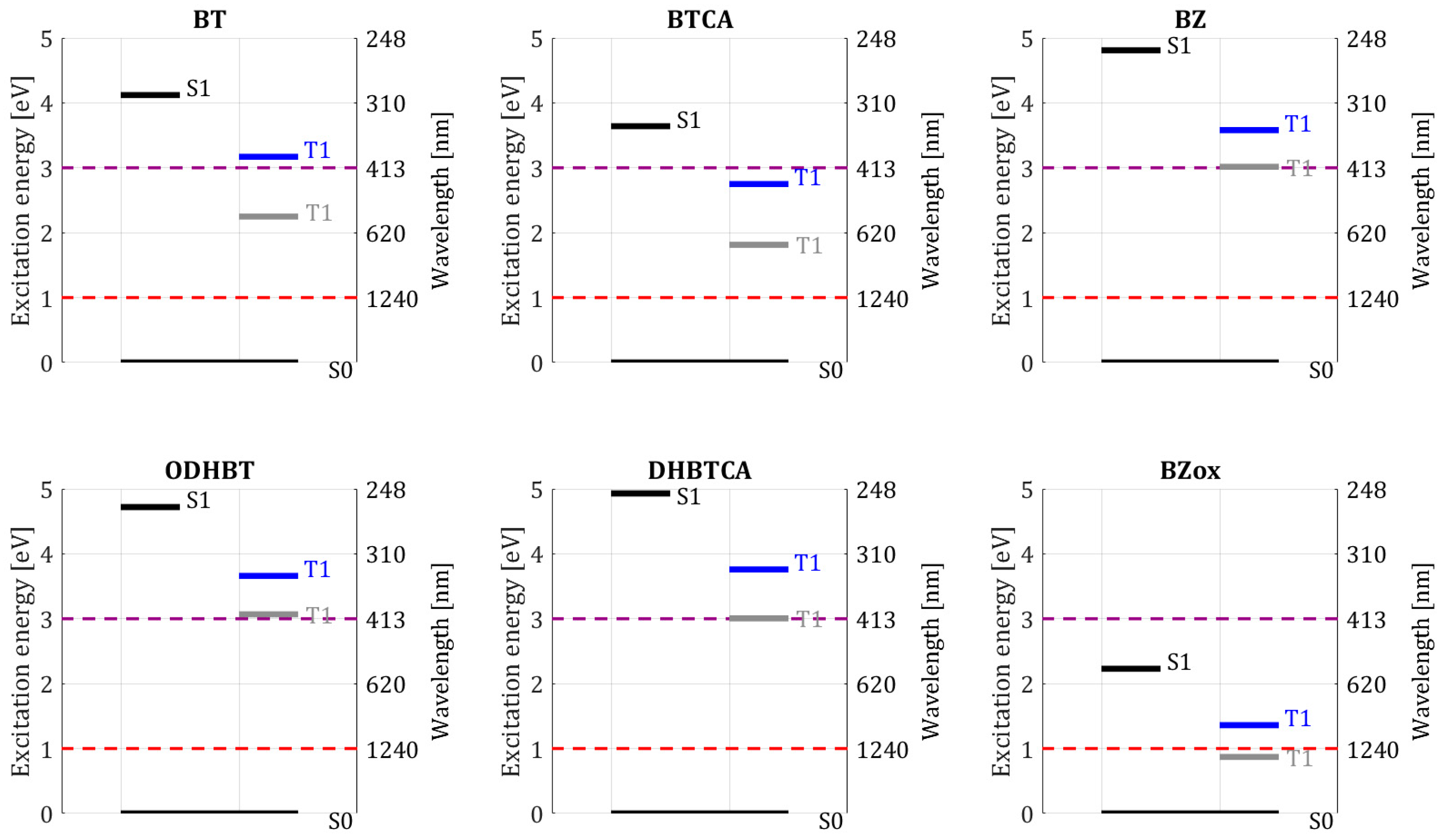
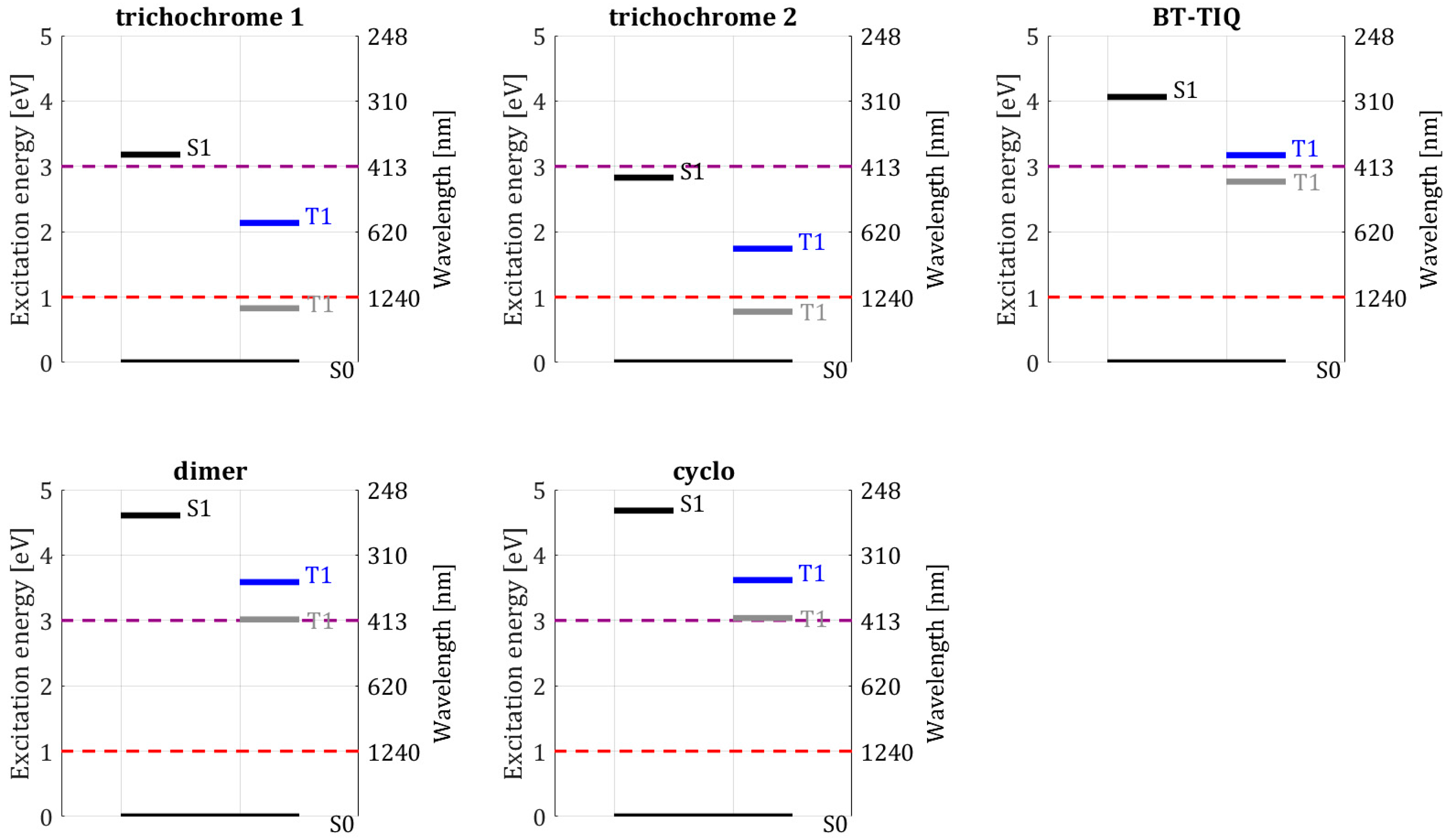
| System | Vertical Transition [kJ/mol] | Adiabatic Transition [kJ/mol] | ||
|---|---|---|---|---|
| Monomers | ||||
| Eumelanin | H2Q | DHI | 339 | 294 |
| DHICA | 289 | 244 | ||
| DHICA ch | 311 | x | ||
| IQ | DHI | 101 | 62 | |
| DHICA | 96 | 55 | ||
| DHICA ch | 89 | x | ||
| QI | DHI | 117 | 28 | |
| DHICA | 118 | 33 | ||
| DHICA ch | 112 | x | ||
| Pheomelanin | Benzothiazine subunits | BT | 306 | 217 |
| BTCA | 265 | 175 | ||
| ODHBT | 353 | 291 | ||
| DHBTCA | 362 | 296 | ||
| Benzothiazole subunits | BZ | 345 | 290 | |
| BZox | 132 | 84 | ||
| Dimers | ||||
| Eumelanin | H2Q | 22 DHI | 272 | 236 |
| 24 DHI | 306 | 243 | ||
| 27 DHI | 288 | 242 | ||
| 27 DHI (NH) | 306 | 252 | ||
| 44 DHICA | 282 | 241 | ||
| IQ | 22 DHI | 90 | 55 | |
| 24 DHI | 78 | 22 | ||
| 27 DHI | 96 | 45 | ||
| 44 DHICA | 88 | 43 | ||
| QI | 22 DHI | 92 | 66 | |
| 24 DHI | 109 | 15 | ||
| 27 DHI | 110 | 32 | ||
| 44 DHICA | 82 | 36 | ||
| H2Q-IQ | 22 DHI | 100 | x | |
| 24 DHI | 71 | x | ||
| 27 DHI | 84 | x | ||
| Pheomelanin | BTCA product oxidation | Trichochrome 1 | 206 | 80 |
| Trichochrome 2 | 168 | 75 | ||
| BT-TIQ | 306 | 267 | ||
| BT product oxidation | Dimer | 346 | 291 | |
| Cyclo | 349 | 293 | ||
| Trimers | ||||
| Eumelanin | H2Q | Trimer DHI | 267 | 231 |
| Trimer DHICA | 280 | 249 | ||
| IQ | Trimer DHI | 90 | 6 | |
| Trimer DHICA | 93 | 47 | ||
| QI | Trimer DHI | 106 | 24 | |
| Trimer DHICA | 119 | 38 | ||
| Other structures | ||||
| Retinal carotenoids | Lutein | x | 57 | |
| Zeaxantin | x | 64 | ||
| Sensitizers | Methylene blue | 138 | 120 | |
| Riboflavin | 227 | 195 | ||
| Sorbic alcohol | 317 | 226 | ||
Disclaimer/Publisher’s Note: The statements, opinions and data contained in all publications are solely those of the individual author(s) and contributor(s) and not of MDPI and/or the editor(s). MDPI and/or the editor(s) disclaim responsibility for any injury to people or property resulting from any ideas, methods, instructions or products referred to in the content. |
© 2026 by the authors. Licensee MDPI, Basel, Switzerland. This article is an open access article distributed under the terms and conditions of the Creative Commons Attribution (CC BY) license.
Share and Cite
Waresiak, J.; Sagan, F.; Mitoraj, M.P.; Sarna, T. From Monomers to Aggregates: The Influence of Redox State and Structure on the First Excited States of Eumelanin and Pheomelanin. Int. J. Mol. Sci. 2026, 27, 5886. https://doi.org/10.3390/ijms27135886
Waresiak J, Sagan F, Mitoraj MP, Sarna T. From Monomers to Aggregates: The Influence of Redox State and Structure on the First Excited States of Eumelanin and Pheomelanin. International Journal of Molecular Sciences. 2026; 27(13):5886. https://doi.org/10.3390/ijms27135886
Chicago/Turabian StyleWaresiak, Joanna, Filip Sagan, Mariusz Paweł Mitoraj, and Tadeusz Sarna. 2026. "From Monomers to Aggregates: The Influence of Redox State and Structure on the First Excited States of Eumelanin and Pheomelanin" International Journal of Molecular Sciences 27, no. 13: 5886. https://doi.org/10.3390/ijms27135886
APA StyleWaresiak, J., Sagan, F., Mitoraj, M. P., & Sarna, T. (2026). From Monomers to Aggregates: The Influence of Redox State and Structure on the First Excited States of Eumelanin and Pheomelanin. International Journal of Molecular Sciences, 27(13), 5886. https://doi.org/10.3390/ijms27135886