1. Introduction
Ion channels are among the largest and most pharmacologically tractable classes of membrane proteins. They translate chemical, electrical, mechanical, and osmotic cues into changes in membrane potential, ionic flux, and downstream cellular behavior [
1,
2,
3]. Given that these processes are positioned at the interface between extracellular stimuli and intracellular pathways, channel modulators can precisely influence excitability, secretion, immune activation, epithelial transport, and cell motility.
The therapeutic potential of ion channels is further supported by broader drug–target analyses. Classical surveys have emphasized membrane proteins, including ion channels, as major components of clinically actionable biology [
4,
5]. Subsequent focused reviews argued that ion channels could become a major class of small-molecule targets if screening platforms and safety profiling advanced sufficiently to address their biophysical complexity [
6,
7]. Accordingly, modern ion-channel discovery now extends beyond neurophysiology and cardiology into oncology, immunology, epithelial biology, and mechanobiology.
The same features that make ion channels attractive drug targets also make them technically difficult to investigate. Channel activity is not a static binding event but a time-dependent conductance process shaped by voltage, ligand binding, lipid environment, accessory proteins, gating history, and cellular context [
8,
9,
10,
11]. Therefore, a compound that appears inactive under one protocol may prove potent under another that favors an open, inactivated, or desensitized state. This protocol dependence is a central reason ion-channel screening cannot rely solely on simple endpoint assays.
Structural biology has transformed this challenge into an opportunity for discovery. Structures of voltage-gated sodium and potassium channels have revealed how pores, selectivity filters, voltage sensors, and intracellular gates cooperate to regulate ion flow [
12,
13,
14,
15]. Subsequent studies linked these structural insights to channelopathies, subtype selectivity, and mechanisms of drug binding [
16,
17,
18,
19]. A modern review of ion-channel discovery must therefore integrate target biology, conformational pharmacology, and translational validation.
Cancer and inflammatory disorders illustrate why this integrated view matters. Tumors remodel ion-channel expression and activity in response to hypoxia, acidosis, growth factors, extracellular matrix stiffness, and treatment pressure [
20,
21,
22]. These changes can promote calcium-dependent transcription, proliferation, migration, invasion, and survival. In parallel, immune and epithelial cells use ion channels to regulate activation thresholds, cytokine release, barrier function, and tissue repair [
23,
24]. The key pharmacological question is therefore not only whether a compound blocks a recombinant channel, but whether it alters disease-relevant channel behavior in a setting that resembles the human lesion.
Ion-channel pharmacology has also become a platform challenge. Optical high-throughput screening (HTS) can provide scalable functional screening, automated patch-clamp (APC) can verify ionic currents and state dependence, and computational methods can enrich libraries before experimental testing [
25,
26,
27,
28,
29]. These approaches complement rather than replace each other. This review argues that selective, translatable ion-channel therapeutics require a staged evidence framework that integrates throughput, mechanism, safety, and human-relevant disease models.
Unlike previous reviews that have focused primarily on individual ion-channel families, electrophysiological methods, disease-specific channel biology, or cardiac safety assessment, this review proposes an integrated decision architecture for ion-channel drug discovery. The central premise is that candidate progression should be based on staged evidence across complementary dimensions: structural and computational plausibility, scalable functional activity, direct electrophysiological confirmation, safety and selectivity de-risking, DMPK and exposure assessment, and human-context translational validation. This framework is intended to reduce assay-driven false positives, distinguish direct channel modulation from broader cellular effects, and improve the translational relevance of ion-channel lead selection.
2. Why Ion Channels Remain Difficult Drug Targets
2.1. Conformational Dynamics and State Dependence
The first barrier is conformational dynamics. Ion channels transition among resting, open, inactivated, desensitized, ligand-bound, lipid-bound, and drug-bound states. These transitions occur over timescales from microseconds to minutes and determine whether a ligand can access its binding site or stabilize a specific gating state [
8,
9,
10,
11]. Consequently, equilibrium potency values alone rarely capture the full pharmacology of a channel modulator.
Use dependence and state dependence are especially important in drug discovery. A use-dependent blocker may preferentially inhibit hyperactive cells, as repeated depolarization increases occupancy of open or inactivated states [
30,
31]. This may confer disease-state selectivity; however, assays restricted to a single time point under a uniform stimulus may fail to detect it. Conversely, compounds that perturb membranes or intracellular calcium stores can generate optical signals that mimic channel block without directly acting on channel pores [
32,
33].
2.2. Subtype Selectivity and Channel-Family Conservation
The second major barrier is subtype selectivity. Closely related channel paralogs often preserve conserved pore-lining residues, voltage-sensing motifs, and ion-conduction pathways. Potassium channels exemplify this challenge: related Kv family members may share a highly similar pore architecture yet differ substantially in tissue distribution, auxiliary subunit composition, and functional roles in immune regulation or cellular proliferation [
7,
15]. Accordingly, drug-discovery efforts must assess not only potency at the intended target but also selectivity across closely related members of the channel family.
Transient receptor potential (TRP) channels, sodium channels, calcium-activated chloride channels, and mechanosensitive channels present analogous selectivity challenges. TRP channels function as cellular sensors of temperature, mechanical stress, irritants, osmotic pressure, and inflammatory signaling [
34,
35,
36,
37,
38]. Although this functional diversity creates substantial therapeutic opportunity, inadequate selectivity may perturb multiple sensory or inflammatory pathways simultaneously. In oncology, this challenge is further compounded by channel expression patterns that vary across tumor subtypes, stages, microenvironmental niches, and prior treatment histories [
20,
21,
22,
39,
40,
41,
42].
2.3. Safety Liabilities and Proarrhythmic Risk
The third barrier is safety. Blocking hERG (human Ether-à-go-go-Related Gene)/Kv11.1 can delay ventricular repolarization and increase proarrhythmic risk, a liability that has affected multiple drug classes [
33,
43]. Given that many ion-channel-active chemotypes are sufficiently hydrophobic and basic to interact with cardiac channels, early hERG and broader multi-channel profiling should be treated as essential parts of discovery, not as late-stage checks.
Modern cardiac safety assessment extends beyond a hERG-centric paradigm. The CiPA framework integrates multi-ion-channel data, in silico models of human ventricular action potential, and human induced pluripotent stem cell-derived cardiomyocytes [
44,
45,
46,
47]. This approach is important for ion-channel programs because proarrhythmia is shaped not only by hERG inhibition, but by the integrated balance of inward and outward currents, repolarization reserve, drug exposure, and clinical context [
48,
49,
50,
51,
52,
53,
54].
2.4. Disease-Context Translation
The fourth barrier is disease-context translation. Recombinant systems are indispensable for clean mechanistic studies, but they often omit the membrane microenvironment, accessory proteins, paracrine cues, matrix tension, inflammatory priming, and heterocellular interactions that shape channel behavior in disease [
55,
56]. As a result, a blocker that appears potent in a simplified cell line may fail in organoids if the relevant channel is confined to a differentiated or polarized compartment that the screening system does not reproduce.
Human organoids and MPS platforms partially bridge this gap by preserving tissue architecture, donor variability, flow, mechanical forces, and tissue–tissue interfaces [
57,
58,
59,
60,
61]. They are most informative after the mechanism is established, because in complex models, a phenotype may reflect direct channel modulation, cytotoxicity, altered differentiation, or indirect signaling. For ion channels, translational validation should therefore be hypothesis-driven rather than purely phenotypic.
A general principle across the cascade is that direct channel modulation must be distinguished from indirect phenotypic effects. A compound may reduce proliferation, migration, invasion, cytokine release, barrier dysfunction, or organoid growth without directly modulating the intended ion channel. Such effects may arise from cytotoxicity, altered metabolism, upstream receptor inhibition, membrane perturbation, changes in differentiation state, or off-target signaling. Therefore, disease-context phenotypes should be interpreted together with direct current measurements, orthogonal flux or voltage assays, target expression, genetic perturbation, rescue experiments, and exposure controls. This distinction is particularly important in cancer and inflammatory models, where cellular phenotypes are influenced by multicellular signaling and microenvironmental stress in addition to channel conductance.
A second general principle is that acute modulation of channel conductance should be separated from longer-term channel remodeling. Acute inhibition refers to rapid changes in ionic current that occur before detectable changes in channel abundance, localization, trafficking, or cell state. In contrast, channel remodeling may involve altered transcription, translation, membrane trafficking, degradation, subcellular localization, accessory-subunit composition, or differentiation-dependent expression. These mechanisms may produce similar phenotypic outcomes but require different assays and different medicinal chemistry decisions. For this reason, ion-channel discovery programs should specify whether a candidate acts as an acute blocker, gating modifier, allosteric modulator, expression-level regulator, trafficking corrector, or broader cellular perturbant.
4. Disease-Linked Channel Remodeling in Cancer and Inflammatory Disease
4.1. Cancer-Associated Channel Remodeling
Cancer-associated channel remodeling is a network-level process rather than a single-target event. TRP channels can regulate calcium entry, stress sensing, migration, invasion, angiogenesis, and drug response [
20,
34,
35,
36,
37]. Potassium channels shape membrane potential, calcium signaling, proliferation, and immune interactions [
21,
22]. Sodium channels and other conductance pathways can also promote invasive behavior and metastatic traits in selected tumor settings [
39,
40].
The concept of “oncochannelopathy” posits that malignant phenotypes may arise from altered channel expression, subcellular localization, or gating behavior, rather than exclusively from canonical kinase signaling [
20]. Ion channels also interact with transporters, cytoskeletal regulators, cell volume control pathways, and the molecular machinery that governs cell migration [
41,
42]. Accordingly, cancer-oriented ion-channel screening strategies should integrate direct measurements of channel activity with disease-relevant phenotypic endpoints, including migration, invasion, stress survival, and pathway modulation.
Piezo channels further underscore the importance of mechanobiology in cancer. Piezo1 and Piezo2 are mechanically activated cation channels that connect membrane tension and tissue-level forces to calcium-dependent signaling [
96,
97,
98]. Piezo1 has established roles in vascular development and mechanotransduction, and chemical probes such as Yoda1 have facilitated functional interrogation of Piezo1-dependent responses [
99,
100,
101,
102]. In tumors, these channels may link extracellular-matrix stiffness, stromal tension, and invasive behavior to a pharmacologically tractable conductance pathway.
From an assay-design perspective, cancer-associated channel remodeling means that recombinant current inhibition is necessary but not sufficient. TRP- or potassium-channel activity may need to be tested under inflammatory priming, hypoxia, acidosis, or growth-factor stimulation. Mechanosensitive channels such as Piezo1 require stimulation protocols that reproduce membrane tension, matrix stiffness, shear stress, or stretch. Sodium-channel- or chloride-channel-associated invasion phenotypes should be linked to direct current modulation, genetic knockdown or rescue, and non-cytotoxic concentration ranges. Thus, cancer-oriented ion-channel screening should combine direct electrophysiological or flux-based readouts with phenotypic assays for migration, invasion, survival, and pathway modulation, while controlling for nonspecific cytotoxicity and indirect pathway effects.
4.2. Immune and Inflammatory Remodeling of Ion-Channel Function
Inflammatory disorders are characterized by remodeling of the channelome across T cells, macrophages, dendritic cells, epithelial cells, sensory neurons, and stromal populations. In immune cells, potassium and calcium channels are required to maintain membrane potential, sustain calcium influx, and regulate cytokine production [
23,
24]. Kv1.3 is a prototypical therapeutic target because effector memory T cells depend on potassium conductance to maintain the electrical driving force required for calcium entry during activation [
103,
104].
Kv1.3 pharmacology further illustrates the extent to which selectivity and therapeutic modality determine translational feasibility. Peptide blockers and venom-derived ligands may achieve high potency and selectivity, yet their development can be constrained by delivery limitations and immunogenicity [
105,
106]. Consequently, small-molecule programs have emphasized the need to balance potency, selectivity, pharmacokinetics, and safety [
107]. For inflammatory models, Kv1.3 should be considered within a broader immune-channel network rather than as an isolated conductance pathway. Kv1.3 and KCa3.1 both contribute to the maintenance of membrane potential required for sustained calcium entry during lymphocyte activation, and their relative importance may vary according to T-cell differentiation state, activation history, and disease context [
23,
24,
103,
104,
108]. This distinction is pharmacologically important because a compound that appears effective in one immune-cell state may be less active in another if compensatory potassium conductances preserve calcium signaling. Accordingly, immune-cell screening should include activation-state-defined assays, relevant cytokine readouts, and selectivity profiling across functionally related potassium channels. More broadly, therapeutic strategies directed at inflammatory ion-channel targets must align biological relevance with a practically deployable modality.
TRP and Piezo channels provide complementary mechanistic links among inflammation, pain, mechanosensation, and tissue remodeling [
34,
96]. In epithelial inflammatory states, ion channels can influence secretion, barrier integrity, mucosal hydration, and tissue repair. Given that these processes are highly context-dependent, primary epithelial cultures, organoids, and inflammatory co-culture systems can provide substantial translational value once the underlying electrophysiological mechanisms have been established.
For inflammatory disease screening, assay design should define the immune-cell state being modeled. Resting, recently activated, chronically stimulated, effector-memory, and tissue-resident immune cells may differ in channel expression, membrane potential, calcium dependence, cytokine output, and sensitivity to Kv1.3 or KCa3.1 modulation. Functional screening should therefore combine current or membrane-potential measurements with activation-state markers, cytokine readouts, viability controls, and selectivity profiling across related potassium and calcium channels. In epithelial inflammatory models, secretion, barrier integrity, repair, and inflammatory signaling should similarly be interpreted together with target expression and direct functional confirmation.
4.3. TMEM16A/ANO1 and Chloride-Channel Pharmacology
Transmembrane member 16A (TMEM16A)/anoctamin-1 (ANO1) exemplifies why ion-channel analyses must distinguish acute channel block from expression-level downregulation and bona fide degradation [
109,
110,
111]. Acute inhibition refers to the rapid suppression of calcium-activated chloride current and is most rigorously demonstrated by electrophysiological recordings or direct chloride-flux assays conducted before changes in protein abundance can occur.
TMEM16A was identified as a calcium-activated chloride channel through convergent molecular cloning and functional studies [
112,
113,
114]. Subsequent reviews and disease-oriented investigations have implicated ANO1/TMEM16A in secretion, smooth muscle physiology, epithelial transport, cancer signaling, and related pathological contexts [
115,
116]. Collectively, these findings establish ANO1 as an attractive therapeutic target while simultaneously underscoring the need for precise classification of pharmacological mechanisms.
Expression-level downregulation is mechanistically distinct from acute channel inhibition. A compound may reduce ANO1 protein abundance following prolonged exposure by altering transcription, translation, trafficking, or protein stability. In cancer models, ANO1 overexpression has been associated with invasion, prognosis, and growth-factor signaling [
117,
118]. Accordingly, drug-discovery claims should specify whether a compound blocks conductance, reduces protein abundance, alters localization, or modulates downstream signaling.
Other chloride channels and transport pathways provide an important contextual perspective. Bestrophin channels and CFTR-related pathways contribute to bicarbonate and chloride transport, epithelial physiology, and therapeutic development [
119,
120]. The development of CFTR correctors, such as VX-809, demonstrates that channel and transporter programs may require distinct assays to evaluate function, folding, trafficking, and cellular rescue [
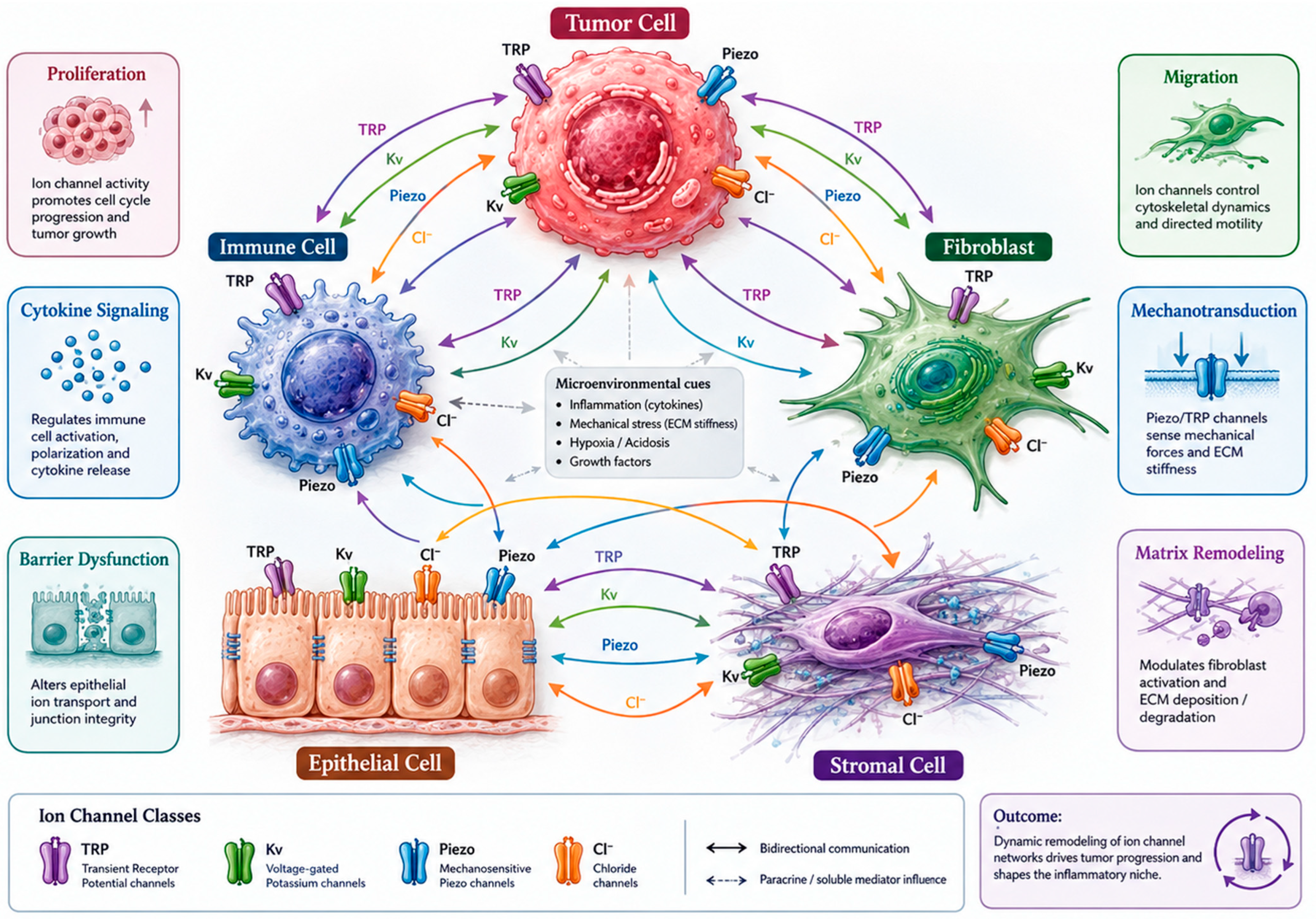
121]. For ANO1 and related channels, protein-level modulation therefore cannot be inferred solely from acute functional block. Operationally, acute inhibition and protein-level regulation should be distinguished by concentration, exposure time, normalization strategy, and orthogonal controls. Acute channel inhibition should be assessed over short exposures, typically minutes to less than 1 h, using electrophysiology or direct ion-flux assays at concentrations that do not reduce cell viability or membrane integrity. In contrast, expression-level downregulation or degradation should be evaluated after longer incubations, typically 4–48 h depending on the biological system, using immunoblotting, immunofluorescence, flow cytometry, surface biotinylation, or proteomic approaches. Current inhibition should be normalized to cell capacitance, baseline current density, and recording quality, whereas protein-level changes should be normalized to total protein, loading controls, cell number, viability, and, where appropriate, surface expression. Mechanistic classification is most robust when time-course experiments, washout/reversibility testing, transcriptional analyses, trafficking assays, proteasome or lysosome inhibition, cycloheximide-chase experiments, and genetic rescue or knockdown studies converge on the same interpretation. This multicellular channel-remodeling concept is illustrated in
Figure 1.
Representative disease-linked channel classes and their screening implications are summarized in
Table 2.
Publicly available reports rarely disclose complete end-to-end ion-channel discovery cascades from docking through organoid or MPS validation, because many such workflows are proprietary. Nevertheless, several well-established examples illustrate why cascade-dependent decision-making is necessary. These examples do not imply universal pass/fail thresholds; rather, they illustrate how potency, mechanism, exposure, selectivity, safety, and disease-context data should be interpreted together. For instance, hERG/Kv11.1 potency should be assessed in relation to unbound exposure and multi-channel effects; Kv1.3 potency should be interpreted together with immune-cell state and KCa3.1 compensation; CFTR modulators require separate assays for folding, trafficking, gating, and epithelial rescue; and TMEM16A/ANO1 pharmacology requires differentiation between acute current block and protein-level regulation and cytotoxicity. Representative examples include CFTR correction and potentiation [
122,
123,
124], hERG/Kv11.1 liability and CiPA-aligned modeling [
43,
44,
45,
46,
47,
48,
49,
50,
51,
52,
53,
54,
125], Kv1.3-directed immunomodulation [
23,
24,
105,
106,
107,
109,
110,
111], TMEM16A/ANO1 pharmacology [
112,
113,
114,
115,
116,
117,
118,
119,
120,
121], and MPS exposure/material effects [
87,
88,
89,
90,
91,
92,
93,
94,
126] (
Table 3).
5. Integrated Hybrid Screening Cascade and Translational Decision Architecture
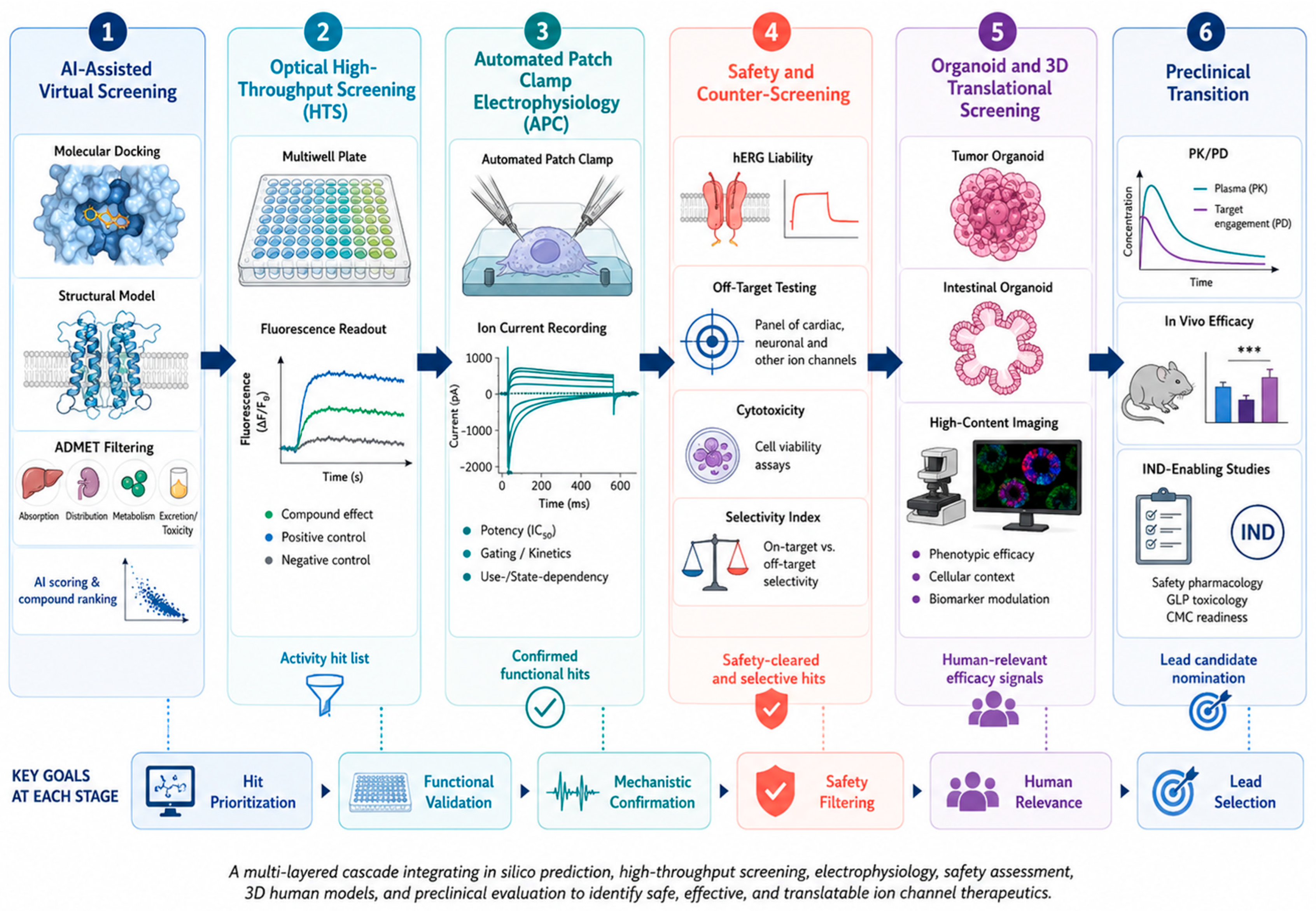
The following section translates the conceptual framework into a series of practical decision points. Each stage is organized around a specific question that determines whether a compound should progress, be deprioritized, or return for assay redesign or medicinal chemistry optimization. Accordingly, the cascade should be viewed as an iterative decision system rather than as a fixed linear workflow. Each stage answers a distinct pharmacological question. Computational triage asks whether a compound is plausible and developable; optical HTS asks whether it produces scalable functional activity; APC asks whether the activity reflects direct modulation of ionic current; safety profiling asks whether the pharmacology is selective enough to avoid unacceptable electrophysiological liabilities; and organoid or MPS testing asks whether the mechanism remains relevant in a human-like tissue context. Therefore, the value of the cascade lies not in the superiority of any single platform, but in the progressive conversion of weak, indirect, or context-dependent evidence into a coherent translational argument.
5.1. Stage 1: Structure and AI-Assisted Triage
The first stage of a hybrid cascade is computational triage. Structural models, docking, ligand similarity, target-family knowledge, and ADMET prediction can reduce a large library to a smaller set of tractable candidates [
66,
67,
68,
69,
70,
71,
72,
73,
74,
75,
76,
77,
78,
79,
80]. In ion-channel programs, this stage should not merely rank docking scores. It should also identify pan-assay interference compounds, reactive chemotypes, likely hERG liabilities, poor solubility, membrane-disruptive structures, and compounds prone to fluorescence interference.
Triage should remain experimentally cautious. A docking pose in a pore, fenestration, voltage-sensor pocket, or lipid-exposed groove is a hypothesis rather than proof of mechanism. Accordingly, Stage 1 should deliver a prioritized, annotated library for functional testing, not a claim of confirmed binding.
5.2. Stage 2: Optical HTS and Primary Activity Screening
The second stage is scalable activity screening. Optical HTS can test whether prioritized compounds alter calcium entry, membrane potential, chloride flux, or disease-relevant imaging phenotypes [
26,
27]. This stage provides an initial functional profile of chemical activity and helps define concentration ranges for follow-up assays.
Primary hits should then proceed through orthogonal counter-screens. For example, a calcium-flux hit should be evaluated for autofluorescence, quenching, cytotoxicity, and effects on upstream receptors or calcium stores [
62,
63,
64,
65]. A chloride-flux hit should be assessed for dye artifacts, transporter effects, and changes in cell number. This step is essential because it prevents assay-interference artifacts from advancing through the cascade. At this stage, chemical interference should be treated as a major source of false-positive activity. In addition to autofluorescence, quenching, dye-loading artifacts, transporter effects, and cytotoxicity, screening cascades should consider pan-assay interference compounds, colloidal aggregation, reactive chemotypes, and nonspecific membrane perturbation [
127,
128]. These liabilities are particularly relevant for ion-channel assays because changes in membrane potential, intracellular calcium, chloride flux, or fluorescence intensity can arise from indirect effects rather than direct channel modulation. Therefore, primary optical hits should be triaged using orthogonal counter-screens, cytotoxicity normalization, dye-free or label-free assays, detergent-sensitivity or aggregation controls when appropriate, and direct electrophysiological confirmation before mechanistic claims are made.
5.3. Stage 3: APC Confirmation and State-Aware Pharmacology
The third stage is APC confirmation. Here, hits are evaluated for direct current modulation, concentration dependence, voltage dependence, kinetics, reversibility, and use or state dependence [
25,
26,
27,
28,
29]. The aim is to determine whether a compound acts as a pore blocker, allosteric modulator, gating modifier, kinetic stabilizer, or indirect perturbant.
State-aware protocols are essential when disease relevance depends on altered excitability or repeated stimulation. In sodium and potassium channels, depolarization frequency and holding potential can change apparent potency. In calcium-activated chloride channels, intracellular calcium, voltage, splice context, and regulatory domains can shape activity. In mechanosensitive channels, stimulus waveform and membrane tension are integral parts of the pharmacological protocol. These parameters should be specified because they determine whether SAR data can be interpreted reliably.
5.4. Stage 4: Safety Pharmacology and Attrition Control
The fourth stage is early safety pharmacology. hERG, Nav1.5, Cav, and other cardiac or neuronal channels should be profiled early when chemical features or target class suggest electrophysiological risk [
33,
43,
44,
45,
46,
47,
48,
49,
50,
51,
52,
53,
54]. This is particularly important in ion-channel discovery because on-target potency and off-target channel activity often occupy similar physicochemical space.
CiPA-aligned thinking improves safety interpretation. Instead of treating hERG inhibition as a binary stop/go criterion, integrated risk assessment considers multi-channel effects, action-potential simulations, hiPSC-cardiomyocyte behavior, and exposure margins [
44,
45,
46,
47,
48,
49]. For medicinal chemistry, this framework can distinguish compounds that require structural redesign from those whose risk may be considered manageable due to counterbalancing channel effects or low exposure, reducing proarrhythmic liability. An important component of CiPA-aligned interpretation is the translation of in vitro ion-channel inhibition data into in silico human ventricular action-potential models. Multi-channel data can be incorporated into mathematical cardiomyocyte models to estimate how simultaneous effects on IKr, INa, ICa, L, IKs, and other currents influence repolarization reserve, action-potential duration, and torsadogenic risk [
44,
45,
46,
47,
48,
49,
129]. This modeling step is particularly valuable because hERG inhibition alone does not always predict clinical proarrhythmia, and some compounds may show counterbalancing effects on inward or outward currents. Therefore, cardiac safety profiling in ion-channel discovery should integrate concentration-dependent channel inhibition, exposure margins, in silico action-potential simulation, and hiPSC-cardiomyocyte assays rather than relying on a single hERG IC50 threshold.
Safety pharmacology for ion-channel modulators should also extend beyond hERG/Kv11.1 and formal proarrhythmia prediction. Depending on the target and chemotype, relevant liabilities may include Nav1.5-associated conduction slowing, Cav1.2-associated effects on cardiac or vascular contractility, neuronal excitability changes, smooth-muscle effects, epithelial secretion or barrier disruption, immune suppression, mitochondrial toxicity, and nonspecific membrane perturbation. Importantly, some liabilities may arise from on-target effects in non-disease tissues rather than from classical off-target activity. Therefore, safety profiling should be selected according to target distribution, disease indication, expected exposure, physicochemical properties, and the therapeutic window required for the intended patient population. Broader safety liabilities relevant to ion-channel modulators are summarized in
Table 4.
5.5. Stage 5: DMPK, Exposure, and Developability Integration
DMPK and exposure assessment should be integrated into the ion-channel screening cascade rather than treated as a late-stage developability check. Ion-channel modulators are often lipophilic, amphiphilic, or weakly basic molecules, properties that may improve membrane access but can also increase plasma protein binding, tissue accumulation, nonspecific membrane interactions, metabolic liability, and slow clearance. Therefore, apparent potency should be interpreted in relation to unbound exposure, permeability, metabolic stability, transporter liability, and the expected therapeutic window. A compound with attractive electrophysiological potency may still be deprioritized if it exhibits poor solubility, high nonspecific binding, a low free fraction, rapid metabolic turnover, reactive-metabolite formation, excessive tissue accumulation, or a high risk of drug–drug interactions. DMPK and exposure-related decision points for ion-channel modulators are summarized in
Table 5.
DMPK considerations are also directly linked to safety pharmacology. For example, hERG/Kv11.1 or Nav1.5 inhibition should be interpreted relative to free plasma concentration, tissue exposure, and predicted clinical dosing rather than as an isolated IC50 value. Similarly, organoid or MPS inactivity may reflect insufficient free exposure, protein binding, matrix binding, poor penetration, or absorption by device materials rather than the absence of target relevance. Thus, DMPK data should inform compound prioritization at multiple stages: early chemical triage, APC concentration selection, safety-margin estimation, organoid/MPS exposure interpretation, and candidate nomination.
5.6. Stage 6: Organoid and MPS Translational Validation
The fifth stage tests whether a mechanistically confirmed modulator alters a disease-relevant phenotype in a human-context model. Patient-derived tumor organoids can be used to assess whether channel modulation affects viability, invasion, differentiation, or treatment response [
60,
61,
82,
83,
84]. Epithelial organoids can assess barrier function, secretion, repair, and inflammatory responses. These assays are most informative when the measured phenotype is explicitly linked to channel mechanisms.
MPS platforms add flow, stretch, shear stress, compartmentalization, and tissue–tissue interfaces [
85,
86,
87,
88,
89,
90,
91,
92]. For mechanosensitive or barrier-associated channels, these physical variables may be essential rather than optional. A modulator that fails in a static two-dimensional assay may become relevant under mechanical load, while a potent recombinant blocker may fail in MPS due to limited exposure, protein binding, or poor tissue penetration. A practical limitation of MPS platforms is that device materials can alter compound exposure. Polydimethylsiloxane (PDMS), which has been widely used in microfluidic devices because of its transparency, gas permeability, and ease of fabrication, can absorb hydrophobic small molecules and thereby reduce the free concentration available to cells [
130]. This issue is particularly relevant for ion-channel modulators, many of which are lipophilic and membrane-associated. As a result, a compound that is active in electrophysiological assays may appear weak or inactive in an MPS device if its effective exposure is reduced by material absorption. Whenever possible, MPS studies should therefore consider compound recovery, free-fraction measurement, material controls, alternative device materials, or exposure correction before negative results are interpreted as a lack of biological activity.
5.7. Stage 7: Candidate Selection and Evidence Integration
The final stage integrates potency, selectivity, safety, exposure, mechanism, and disease-model efficacy into a candidate-selection decision. A credible ion-channel lead should show orthogonal functional activity, direct current modulation, interpretable kinetics, acceptable selectivity, a manageable safety margin, and evidence of disease-context activity. No single assay can provide all of this information.
This decision architecture should also be iterative. Safety findings may send a compound back to medicinal chemistry, organoid failure may trigger exposure or target-engagement studies, and APC results may require revised optical protocols. The strength of a hybrid cascade lies not in its linearity but in its explicit, evidence-based decision points. The proposed staged decision architecture is summarized schematically in
Figure 2.
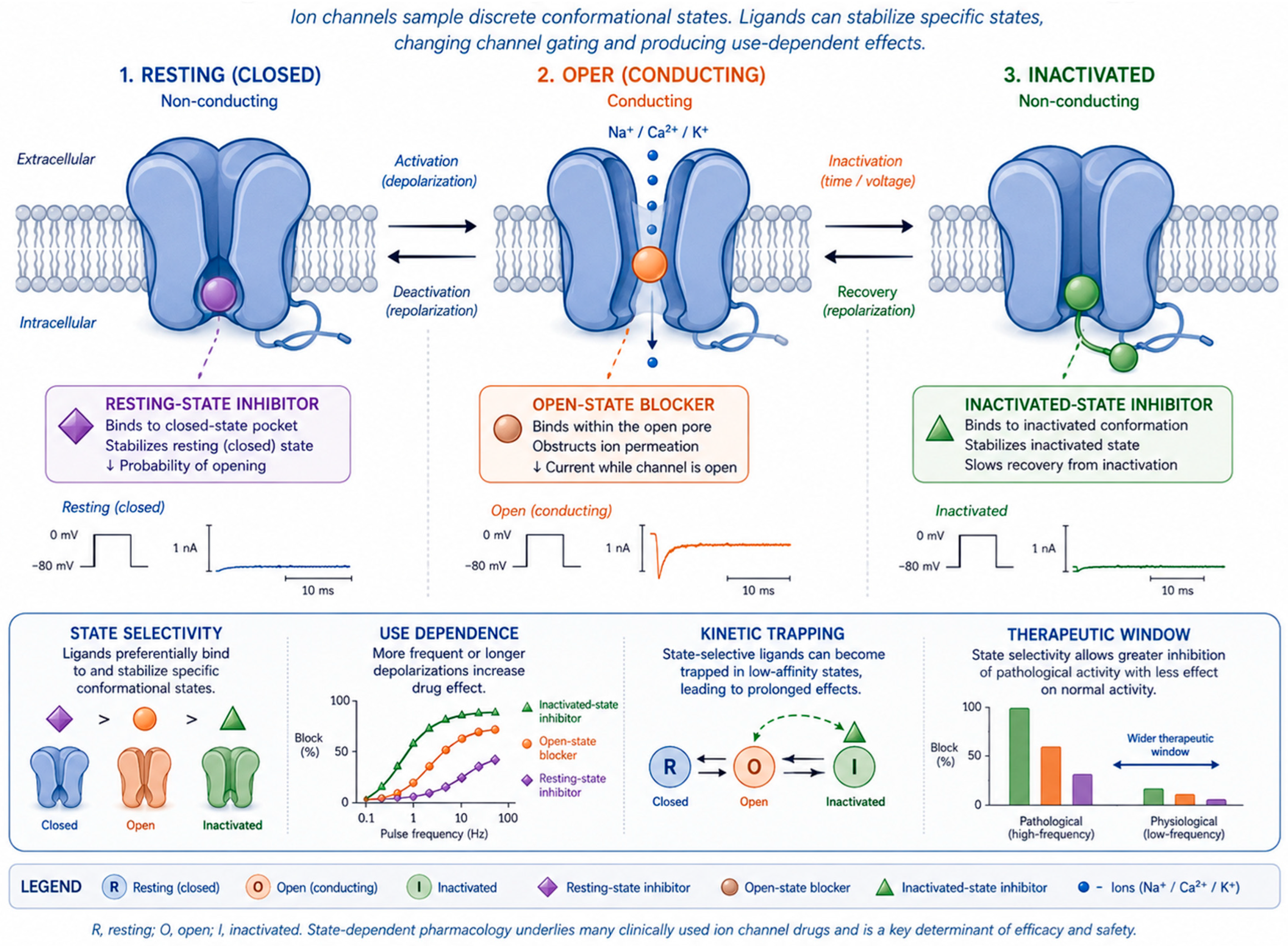
The pharmacological importance of channel-state occupancy is illustrated in
Figure 3.
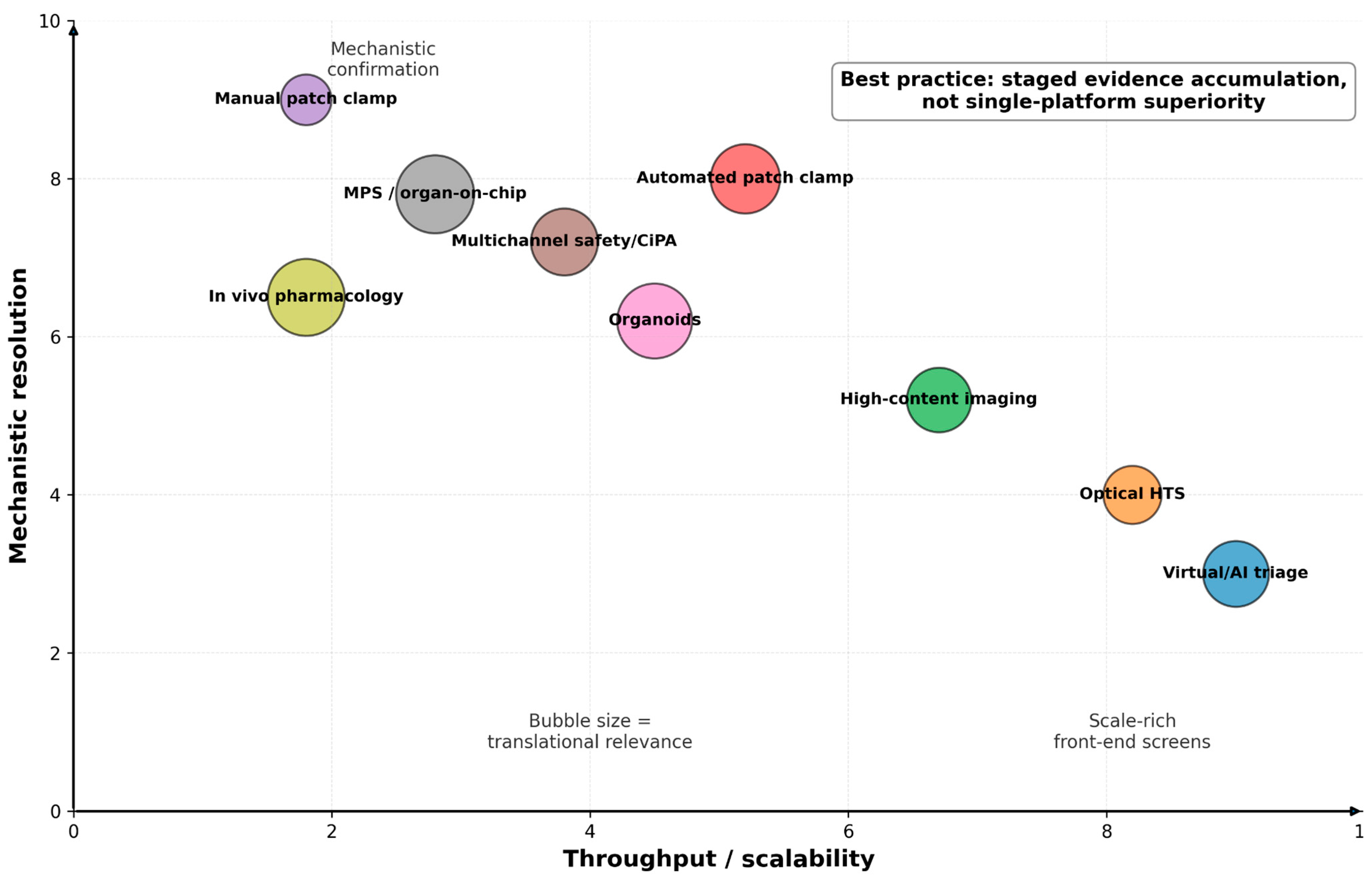
A qualitative comparison of screening platforms according to throughput, mechanistic resolution, and translational relevance is shown in
Figure 4.
Figure 4.
Qualitative evidence map of ion-channel discovery platforms. Platforms are positioned according to two conceptual axes: throughput/scalability and mechanistic resolution. Bubble size represents approximate translational relevance, defined by the extent to which a platform captures disease-relevant cellular context, safety-relevant physiology, or human tissue complexity. The map is intended as a heuristic framework rather than a quantitative ranking system. Its purpose is to illustrate complementarity among platforms: high-throughput approaches are efficient for front-end discovery, electrophysiological methods provide direct mechanistic confirmation, safety panels reduce attrition risk, and organoid/MPS or in vivo models increase translational confidence. The key message is staged evidence accumulation, not single-platform superiority. Practical criteria for distinguishing acute channel inhibition from protein-level channel remodeling are summarized in
Table 6.
Figure 4.
Qualitative evidence map of ion-channel discovery platforms. Platforms are positioned according to two conceptual axes: throughput/scalability and mechanistic resolution. Bubble size represents approximate translational relevance, defined by the extent to which a platform captures disease-relevant cellular context, safety-relevant physiology, or human tissue complexity. The map is intended as a heuristic framework rather than a quantitative ranking system. Its purpose is to illustrate complementarity among platforms: high-throughput approaches are efficient for front-end discovery, electrophysiological methods provide direct mechanistic confirmation, safety panels reduce attrition risk, and organoid/MPS or in vivo models increase translational confidence. The key message is staged evidence accumulation, not single-platform superiority. Practical criteria for distinguishing acute channel inhibition from protein-level channel remodeling are summarized in
Table 6.
Table 6.
Practical criteria for distinguishing acute channel inhibition from protein-level channel remodeling.
Table 6.
Practical criteria for distinguishing acute channel inhibition from protein-level channel remodeling.
| Mechanistic Category | Typical Experimental Window | Primary Readout | Key Normalization | Essential Controls |
|---|
| Acute channel inhibition | Minutes to less than 1 h | Patch-clamp current, current density, and direct ion-flux or voltage readouts | Baseline current, cell capacitance, seal quality, recording stability, non-cytotoxic concentration | Vehicle control, washout/reversibility, viability, membrane integrity, off-target channel or pathway counterscreen |
| State- or use-dependent block | Seconds to minutes during defined stimulation protocols | Voltage-, ligand-, frequency-, or use-dependent changes in current | Holding potential, pulse frequency, recovery interval, current rundown correction | Protocol variation, recovery analysis, repeated-pulse control, rundown control |
| Expression-level downregulation | Several hours to days | Total protein abundance, mRNA, immunofluorescence, flow cytometry | Total protein, housekeeping markers, cell number, viability, passage and differentiation state | qPCR, immunoblotting, imaging, non-cytotoxic exposure, transcriptional control |
| Altered trafficking or localization | Hours to days | Surface protein abundance, subcellular localization, and membrane abundance | Surface/total protein ratio, membrane marker, cell number, viability | Surface biotinylation, confocal imaging, trafficking marker, washout or rescue |
| Degradation | Hours to days | Protein half-life and degradation-pathway markers | Loading controls, total protein, cell viability | Cycloheximide chase, proteasome/lysosome inhibitor rescue, ubiquitination or degradation marker analysis |
| Indirect phenotypic effect | Variable | Viability, migration, invasion, cytokine output, organoid growth | Cell number, viability, exposure, target expression | Genetic knockdown/rescue, orthogonal channel assay, cytotoxicity and mitochondrial controls |
5.8. Practical Decision Points in an Integrated Ion-Channel Screening Cascade
A practical cascade should define not only which platforms are used, but also what decision each platform supports. Computational triage should generate a prioritized and annotated library, not a claim of confirmed binding. Optical HTS should identify reproducible functional activity while excluding assay interference. APC should determine whether the compound directly modulates ionic current under defined voltage, ligand, mechanical, or calcium-dependent protocols. Safety and DMPK profiling should define whether on-target and off-target channel activities are compatible with the intended exposure and therapeutic window. Organoid and MPS assays should test whether the mechanism remains relevant in a human-like tissue context while controlling for exposure, viability, penetration, and model heterogeneity. Discordant results should not automatically terminate a program; rather, they should trigger predefined feedback actions such as assay redesign, medicinal chemistry optimization, exposure analysis, genetic validation, or target-engagement studies.
6. Limitations and Future Directions
The proposed framework has several limitations. First, AI- and structure-enabled methods depend on training data, model quality, conformational sampling, and assumptions about ligand-binding states [
66,
67,
68,
69]. In ion channels, lipid interactions, auxiliary subunits, splice variants, glycosylation, phosphorylation, and voltage-dependent conformational changes can all influence ligand recognition. Static models cannot fully capture this complexity.
Second, optical HTS can overestimate activity when compounds interfere with fluorescent dyes, compromise cell health, perturb intracellular stores, or alter upstream signaling [
62,
63,
64,
65]. Reports should therefore include assay-quality metrics, concentration–response behavior, and orthogonal confirmation. Without these controls, an apparently strong high-throughput signal may not reflect direct channel pharmacology.
Third, APC is mechanistically powerful but still prone to artifacts. Seal quality, cell-line background currents, series resistance, rundown, voltage-control limits, and protocol design can influence apparent potency. These issues are manageable, but they require transparent reporting of voltage protocols, stimulus timing, holding potentials, compound exposure, and acceptance criteria.
Fourth, organoid and MPS models improve translational relevance but also introduce variability. Matrix composition, passage number, tissue source, differentiation state, immune components, vascularization, and mechanical inputs can alter channel expression and drug response [
55,
56,
57,
58,
59,
60,
61,
82,
83,
84,
85,
86,
87,
88,
89,
90,
91,
92,
93,
94,
95]. Standardization is improving, but these platforms are best used as defined translational filters rather than universal replacement assays.
Future directions include closed-loop systems that link AI-generated hypotheses to APC confirmation and organoid or MPS phenotyping. Patient-derived organoids, engineered immune co-cultures, microfluidic mechanical stimulation, and digital-twin pharmacology may enable indication-specific selection of channel modulators. The next major advance will likely arise from integrating temporal electrophysiology, spatial cell biology, and human-context disease models, rather than from further optimization of any single assay in isolation [
122,
123,
124,
125,
126]. Recent advances in structural prediction may further support hypothesis generation for ion-channel complexes and ligand-accessibility questions. For example, AlphaFold 3 extends structure prediction beyond single proteins toward biomolecular complexes containing proteins, nucleic acids, small molecules, ions, and modified residues [
131]. Nevertheless, in ion-channel drug discovery, such predictions are most useful when treated as experimentally testable hypotheses and integrated with electrophysiological, kinetic, safety, DMPK, and disease-context validation.
7. Conclusions
Ion channels are validated but challenging drug targets. Their discovery is complicated by dynamic gating, state dependence, subtype similarity, membrane context, disease-specific remodeling, and safety-relevant off-target effects [
1,
2,
3,
4,
5,
6,
7]. These features explain why ion-channel pharmacology cannot be defined by potency values from a single assay alone.
A modern ion-channel program should begin with structure-informed and AI-assisted prioritization, advance through scalable optical screening, confirm mechanism with APC current recordings, de-risk off-target electrophysiology early, and test disease relevance in human-like organoid or MPSs [
25,
26,
27,
28,
29]. This staged workflow ensures that each assay answers a specific question.
This hybrid cascade is particularly important in cancer and inflammatory disease, where ion-channel function is reshaped by microenvironmental stress, immune activation, epithelial polarization, mechanical input, and therapeutic pressure [
20,
21,
22,
23,
24,
34,
35,
36,
37,
39,
40,
41,
42,
96,
97,
98,
99,
100,
103,
104,
105,
106,
107]. These disease contexts illustrate why ion-channel pharmacology cannot be reduced to potency values from a single assay. Selective and translatable ion-channel therapeutics require integrated evidence across computational prediction, functional screening, electrophysiological confirmation, safety pharmacology, and human-relevant disease models. The next generation of ion-channel therapeutics will likely emerge from disciplined decision cascades that connect state-aware pharmacology with disease-context biology.