Editorial

Special Issue “Role of Immune Cells in Non-Infectious Inflammatory Diseases and Cancers” †

by
Evgeny E. Bezsonov
1,2
1
Laboratory of Molecular Virology, Sechenov First Moscow State Medical University (Sechenov University), Moscow 119435, Russia
2
Department of Biology and General Genetics, Sechenov First Moscow State Medical University (Sechenov University), Moscow 105043, Russia
Editorial to Special Issue https://www.mdpi.com/journal/ijms/special_issues/X7986750VB (accessed on 16 June 2026).
Int. J. Mol. Sci. 2026, 27(12), 5603; https://doi.org/10.3390/ijms27125603 (registering DOI)
Submission received: 30 April 2026 / Revised: 16 June 2026 / Accepted: 17 June 2026 / Published: 21 June 2026

1. Introduction

Inflammation is at the heart of many different non-infectious diseases, including cancer. The roles of different immune cells are highly context-dependent. They drive chronic inflammation and tissue damage in the case of inflammatory and autoimmune diseases, and they can also be used to mediate immune surveillance and eliminate tumors in cancer patients [1]. Nevertheless, when the tumor microenvironment is subverted, identical immune cell lineages can also drive malignancy and aid in evading immune surveillance [2]. Consequently, deciphering the diversity, adaptive versatility, and functional polarization states of immune cells is critical for developing precision therapeutics and improving patient prognoses across both pathological contexts [3].
Different immune cell types and their functional heterogeneity contribute to inflammation in different diseases.
Innate immune cells such as macrophages, neutrophils, mast cells, dendritic cells, and natural killer cells are directly connected with inflammatory response. Macrophages exhibit a high degree of plasticity, enabling their polarization into either the M1 (pro-inflammatory, anti-tumor) or M2 (anti-inflammatory, pro-tumor) subtype. In autoimmunity, M1 macrophages exacerbate tissue destruction, yet they are instrumental to anti-tumor immunity. In contrast, M2 macrophages, known as tumor-associated macrophages (TAMs), foster tumor growth, angiogenesis, and immune suppression [1,4,5,6]. By releasing reactive oxygen species (ROS) and proteases, neutrophils not only participate in acute inflammation but can also facilitate tumor advancement. Mast cells serve as key modulators of inflammation and angiogenesis, with established functions in chronic inflammatory conditions as well as in tumor development. Dendritic cells (DCs) are critical antigen-presenting cells whose maturation status dictates whether they promote effector T-cell activation or enforce immune tolerance. In the context of cancer, DCs frequently display defective antigen presentation as a result of tumor-mediated immunosuppression [1,4,5,6]. While natural killer (NK) cells are capable of killing tumor and virally infected cells, their anti-tumor activity is often dampened by the tumor microenvironment. Conversely, in autoimmune settings, NK cells can actively contribute to tissue damage [1,4,5,6].
Another type of cells, adaptive immune cells, include T and B lymphocyte subsets. Among CD4+ T cells, several functional subsets have been identified: Th1 (pro-inflammatory, anti-tumor), Th2 (involved in humoral immunity), Th17 (pro-angiogenic and pro-inflammatory), and regulatory T cells (Tregs), which exert immunosuppressive effects. Tregs are of particular significance due to their capacity to inhibit anti-tumor immunity and promote neoplastic growth [6,7]. CD8+ T cells serve as the primary mediators of anti-tumor immunity through their cytotoxic function. B cells are responsible for antibody secretion and immune response modulation; their contributions to cancer and inflammation are multifaceted and vary according to the pathological context.
Innate lymphoid cells (ILCs) are tissue-resident regulators of immune homeostasis and inflammation at barrier surfaces. When dysregulated, ILC subsets can promote both chronic inflammatory diseases and tumor progression [8,9,10]. Myeloid-derived suppressor cells (MDSCs) inhibit T cell function in cancer, thereby enabling immune evasion. Conversely, in autoimmune diseases, they can paradoxically exacerbate inflammation [8,9,10]. Both inflammatory conditions and neoplastic diseases feature an immune landscape defined by a wide array of innate and adaptive leukocytes, whose functions are highly dependent on the local context. Their inherent heterogeneity—at both the phenotypic and functional levels—governs the balance between host protection and pathogenic injury, thereby emphasizing the importance of precise immunological characterization for understanding disease mechanisms and guiding therapeutic strategies [1,4,5,6].
Different molecular and cellular pathways participate in immune cell-mediated disease progression. Key cytokines such as IL-6, TNF-α, and IL-10 are pivotal in modulating immune responses, angiogenesis, and immunosuppression. IL-6 and TNF-α promote tumor growth and neovascularization by activating STAT3 and NF-κB signaling, while IL-10 augments the immunosuppressive functions of T cells [11,12,13,14]. NF-κB pathway is activated by inflammatory signals and controls genes governing proliferation, survival, and immune responses. When activated within immune cells, NF-κB promotes both tumor progression and chronic inflammation [15,16,17,18]. The JAK-STAT pathway—particularly STAT3—plays a critical role in reprogramming immune cells within the tumor microenvironment. Inhibitors targeting this pathway can restore immune homeostasis and reverse tumor-induced immunosuppression [15,16,17,18]. During chronic inflammation, immune cells produce reactive oxygen species (ROS) and reactive nitrogen species (RNS), which cause DNA damage, promote genomic instability, and trigger mutations—events that fuel both the onset and advancement of cancer [19,20,21]. Dynamic crosstalk between immune cells, stromal cells, and cancer stem cells plays a pivotal role in driving disease progression and conferring therapy resistance. Such interactions reshape the tumor microenvironment, with consequential effects on immune cell infiltration, angiogenic responses, and the capacity for immune evasion [4,22,23].
DAMPs (Damage-Associated Molecular Patterns) and PAMPs (Pathogen-Associated Molecular Patterns) serve as key molecular signals that engage pattern recognition receptors (PRRs) on immune cells, thereby regulating inflammation and immune responses [24,25].
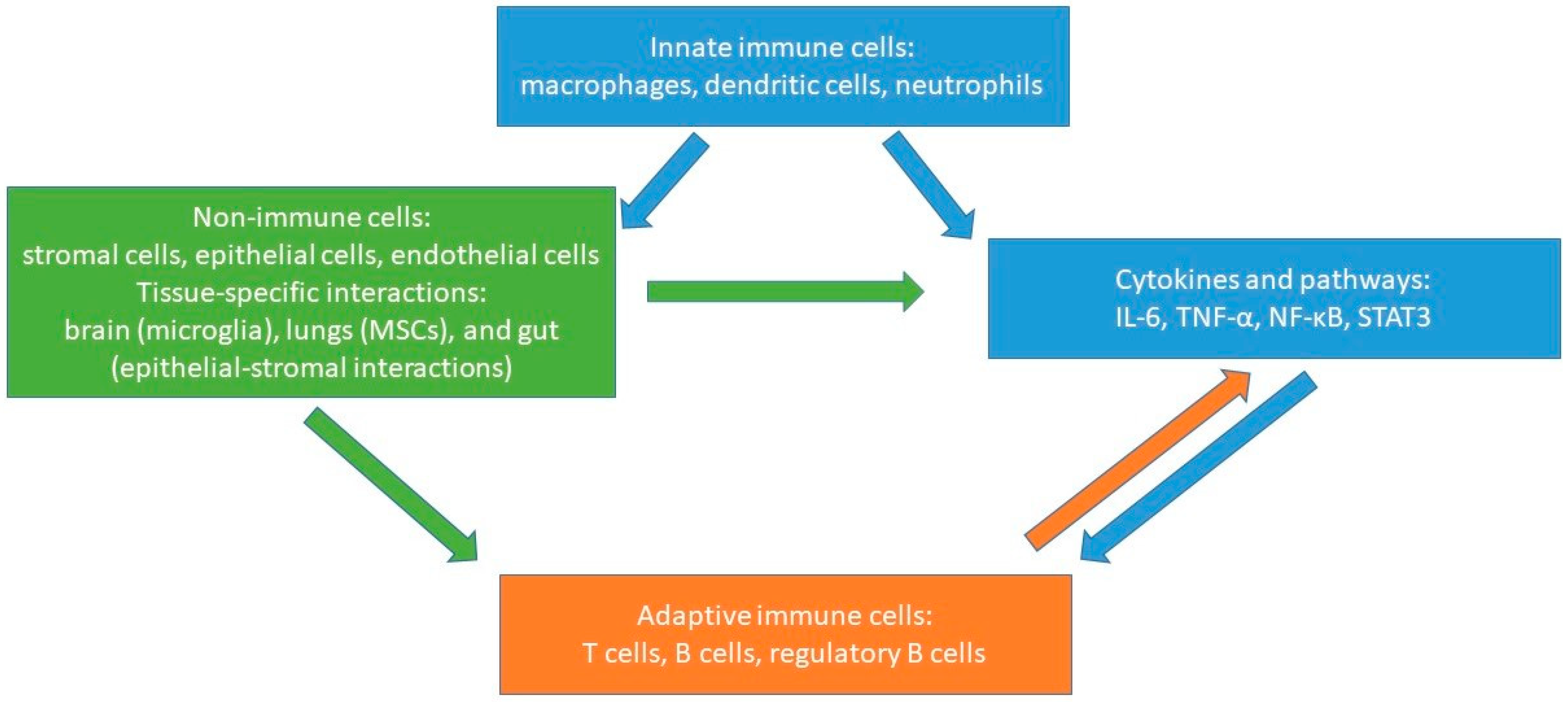
The interaction between immune cells in case of non-infectious diseases can be seen in Figure 1.
Macrophages, dendritic cells, and neutrophils—key constituents of the innate immune system—are the first to respond during inflammation. By producing cytokines and chemokines, they both initiate and sustain the inflammatory response, thereby recruiting adaptive immune effectors such as T and B cells [26,27]. Dendritic cells (DCs) engage in bidirectional crosstalk with epithelial cells to sustain immune homeostasis and initiate appropriate immune reactions. Dysregulation of this intercellular dialogue is a contributing factor to chronic inflammatory diseases, most notably within the pulmonary compartment [28]. Chronic inflammation is sustained largely by T and B lymphocytes. Within inflamed tissues, T cells release inflammatory cytokines, whereas B cells produce autoantibodies and function as antigen-presenting cells. This coordinated crosstalk generates a positive feedback mechanism that maintains long-term inflammation [29,30]. Non-immune cells—including stromal, epithelial, and endothelial cells—actively contribute to inflammation by secreting cytokines and chemokines. Through interactions with immune cells, these non-hematopoietic cells help to modulate the inflammatory response [31,32]. Stromal cells undergo a phenotypic switch toward a pathogenic state under chronic inflammatory conditions, thereby influencing the function of T and B lymphocytes and contributing to the chronicity of the disease [29,30]. Cytokines such as IL-6, TNF-α, and IL-1β are central mediators of inflammation. The IL-6 amplifier (IL-6 Amp), which engages the NF-κB and STAT3 signaling pathways, establishes a positive feedback loop between immune and non-immune cells that drives chronic inflammation [26].
Despite the large amount of available information on this topic, many blind spots remain, some of which will be addressed in this Special Issue.

2. An Overview of Published Articles

Angel Yordanov’s article (contribution 1) is devoted to studying the expression of CD68 and CD47 in patients with differing tumor characteristics, histological variants of cervical cancer, and disease burden.
Dzhalilova et al. (contribution 2) focused on the morphology and molecular biology of hypoxia-tolerant and -susceptible colon tumors based on an assessment of colitis-associated colorectal cancer.
The third article, written by Pamonsupornwichit et al. (contribution 3), is devoted to the creation and investigation of a THP-1 cell line that is deficient in extracellular matrix metalloproteinase inducer (CD147), which is upregulated in different types of cancer, including T-cell acute lymphoblastic leukemia.
Jiménez-Gómez et al. (contribution 4) investigated B cells, T cells, and natural killer cells using multiparameter flow cytometry in silicosis caused by engineered stone patients and healthy controls.
The article by de Silva et al. (contribution 5) is devoted to identifying a positive correlation between T cell populations in peripheral blood and lung fluid of transplant recipients, with the CD8+Granzyme B+ effector T cell to regulatory T cell ratio emerging as a promising, minimally invasive blood-based biomarker for monitoring inflammation and chronic lung allograft dysfunction.
Khilwani et al. (contribution 6) studied IL-6 and IL-17, which promote lung cancer progression by polarizing macrophages toward an immunosuppressive M2 phenotype involving autophagy and inflammasome pathways. This information may help with the development of new therapeutic strategy for non-small cell lung cancer.
Four review articles were published in this Special Issue, addressing topics ranging from chronic inflammation, the role of immune cells in hepatic diseases and acute appendicitis to new approaches for coping with celiac disease.
The review by Miao et al. (contribution 7) is devoted to the current information on the role of CD4+T cells in nonalcoholic steatohepatitis (NASH) and hepatocellular carcinoma (HCC) progression. It discusses potential therapeutic approaches, including the targeting of CD4+T cells for the treatment of HCC and NASH.
Carvalho et al. (contribution 8) reviewed papers that explored the role of allergic response and Th2 reaction in the development of acute appendicitis.
The review by Liu et al. (contribution 9) is related to the role of high-temperature demand protein A2 and mitochondrial quality control in chronic inflammation.
The tenth article by Camarca et al. (contribution 10) is a review devoted to the effects of immunomodulating cytokines of celiac disease with a focus on Treg cells as potential therapeutic agents.
The Special Issue also includes a case report by Ioachim et al. (contribution 11), which describes a patient suffering from rare inflammatory disease—Riedel thyroiditis (RT). It also contains a literature review devoted to the variability of clinical manifestations of RT.
This Special Issue has covered the role of immune cells (T cells, B cells, NK cells, macrophages), cytokines (IL-6, IL-17), signaling molecules (CD68, CD47, CD147), and inflammatory mechanisms across a range of diseases, including cancers (cervical, colon, leukemia, liver, lung), inflammatory conditions (silicosis, appendicitis, chronic inflammation, celiac disease, Riedel thyroiditis), and transplantation-related complications.

3. Conclusions

Though there have been some achievements in the field, additional work is needed in order to uncover all the pathological details of sterile inflammation and the associated diseases. A complete understanding of the exact mechanisms governing immune cell plasticity and the dynamic modulation of immune checkpoints in the tumor microenvironment has yet to be achieved. Advancing techniques for long-term, non-invasive monitoring of adoptively transferred immune cells and establishing standardized manufacturing and quality control processes for cell-based therapies are essential topics for future investigation.

Funding

This study was supported by the Academic Leadership Program Priority 2030 by the Federal State Autonomous Educational Institution of Higher Education I.M. Sechenov, First Moscow State Medical University of the Ministry of Health of the Russian Federation (Sechenov University).

Institutional Review Board Statement

Not applicable.

Informed Consent Statement

Not applicable.

Data Availability Statement

Not applicable.

Conflicts of Interest

The author declares no conflicts of interest.

List of Contributions

  • Yordanov, A.; Damyanova, P.; Vasileva-Slaveva, M.; Hasan, I.; Kostov, S.; Shivarov, V. Integrated Analysis of Phagocytic and Immunomodulatory Markers in Cervical Cancer Reveals Constellations of Potential Prognostic Relevance. Int. J. Mol. Sci. 2024, 25, 9117. https://doi.org/10.3390/ijms25169117.
  • Dzhalilova, D.; Silina, M.; Tsvetkov, I.; Kosyreva, A.; Zolotova, N.; Gantsova, E.; Kirillov, V.; Fokichev, N.; Makarova, O. Changes in the Expression of Genes Regulating the Response to Hypoxia, Inflammation, Cell Cycle, Apoptosis, and Epithelial Barrier Functioning during Colitis-Associated Colorectal Cancer Depend on Individual Hypoxia Tolerance. Int. J. Mol. Sci. 2024, 25, 7801. https://doi.org/10.3390/ijms25147801.
  • Pamonsupornwichit, T.; Sornsuwan, K.; Juntit, O.-a.; Yasamut, U.; Takheaw, N.; Kasinrerk, W.; Wanachantararak, P.; Kodchakorn, K.; Nimmanpipug, P.; Intasai, N.; et al. Engineered CD147-Deficient THP-1 Impairs Monocytic Myeloid-Derived Suppressor Cell Differentiation but Maintains Antibody-Dependent Cellular Phagocytosis Function for Jurkat T-ALL Cells with Humanized Anti-CD147 Antibody. Int. J. Mol. Sci. 2024, 25, 6626. https://doi.org/10.3390/ijms25126626.
  • Jiménez-Gómez, G.; Campos-Caro, A.; García-Núñez, A.; Gallardo-García, A.; Molina-Hidalgo, A.; León-Jiménez, A. Analysis of Immune Cell Subsets in Peripheral Blood from Patients with Engineered Stone Silica-Induced Lung Inflammation. Int. J. Mol. Sci. 2024, 25, 5722. https://doi.org/10.3390/ijms25115722.
  • de Silva, T.A.; Apte, S.; Voisey, J.; Spann, K.; Tan, M.; Chambers, D.; O’Sullivan, B. Immunological Landscapes in Lung Transplantation: Insights from T Cell Profiling in BAL and PBMC. Int. J. Mol. Sci. 2024, 25, 2476. https://doi.org/10.3390/ijms25052476.
  • Khilwani, R.; Singh, S. Traversing through the Mechanistic Event Analysis in IL-6 and IL-17 Signaling for a New Therapeutic Paradigm in NSCLC. Int. J. Mol. Sci. 2024, 25, 1216. https://doi.org/10.3390/ijms25021216.
  • Miao, Y.; Li, Z.; Feng, J.; Lei, X.; Shan, J.; Qian, C.; Li, J. The Role of CD4+T Cells in Nonalcoholic Steatohepatitis and Hepatocellular Carcinoma. Int. J. Mol. Sci. 2024, 25, 6895. https://doi.org/10.3390/ijms25136895.
  • Carvalho, N.; Barreira, A.L.; Henriques, S.; Ferreira, M.; Cardoso, C.; Luz, C.; Costa, P.M. Compilation of Evidence Supporting the Role of a T Helper 2 Reaction in the Pathogenesis of Acute Appendicitis. Int. J. Mol. Sci. 2024, 25, 4216. https://doi.org/10.3390/ijms25084216.
  • Liu, Q.; Yan, X.; Yuan, Y.; Li, R.; Zhao, Y.; Fu, J.; Wang, J.; Su, J. HTRA2/OMI-Mediated Mitochondrial Quality Control Alters Macrophage Polarization Affecting Systemic Chronic Inflammation. Int. J. Mol. Sci. 2024, 25, 1577. https://doi.org/10.3390/ijms25031577.
  • Camarca, A.; Rotondi Aufiero, V.; Mazzarella, G. Role of Regulatory T Cells and Their Potential Therapeutic Applications in Celiac Disease. Int. J. Mol. Sci. 2023, 24, 14434. https://doi.org/10.3390/ijms241914434.
  • Ioachim, D.; Publik, M.A.; Terzea, D.; Cristea, C.A.; Ghemigian, A.M.; Dumitrascu, A.; Petrova, E.; Voinea, A.; Smarandache, R.; Ceausu, M. IgG4-Mediated Sclerosing Riedel Thyroiditis: A Multidisciplinary Case Study and Literature Review. Int. J. Mol. Sci. 2025, 26, 7786. https://doi.org/10.3390/ijms26167786.

References

  1. Kushekhar, K.; Chellappa, S.; Aandahl, E.M.; Taskén, K. Role of Lymphocytes in Cancer Immunity and Immune Evasion Mechanisms. In Biomarkers of the Tumor Microenvironment, 2nd ed.; Springer: Cham, Switzerland, 2022; pp. 159–182. [Google Scholar]
  2. DeNardo, D.G.; Coussens, L.M. Inflammation and Breast Cancer. Balancing Immune Response: Crosstalk Between Adaptive and Innate Immune Cells during Breast Cancer Progression. Breast Cancer Res. 2007, 9, 212. [Google Scholar] [CrossRef] [PubMed]
  3. Pusztaszeri, M.P.; Faquin, W.C.; Sadow, P.M. Tumor-Associated Inflammatory Cells in Thyroid Carcinomas. Surg. Pathol. Clin. 2014, 7, 501–514. [Google Scholar] [CrossRef] [PubMed]
  4. Faa, G.; Pretta, A.; Suri, J.S.; Castagnola, M.; Saba, L.; Scartozzi, M. Cancer-Associated Fibroblasts (Cafs): A New Challenge for Pathologists and Oncologists, and a Promising Target for a Modern Oncotherapy. Ann. Res. Oncol. 2024, 4, 66–83. [Google Scholar] [CrossRef]
  5. Zhang, J.; Späth, S.S.; Weissman, S.M.; Katz, S.G. An Overview of Advances in Cell-Based Cancer Immunotherapies Based on the Multiple Immune-Cancer Cell Interactions. In Methods in Molecular Biology; Humana Press: New York, NY, USA, 2020; Volume 2097, pp. 139–171. [Google Scholar]
  6. Aghapour, S.A.; Torabizadeh, M.; Bahreiny, S.S.; Saki, N.; Jalali Far, M.A.; Yousefi-Avarvand, A.; Dost Mohammad Ghasemi, K.; Aghaei, M.; Abolhasani, M.M.; Sharifani, M.S.; et al. Investigating the Dynamic Interplay Between Cellular Immunity and Tumor Cells in the Fight Against Cancer: An Updated Comprehensive Review. Iran. J. Blood Cancer 2024, 16, 84–101. [Google Scholar] [CrossRef]
  7. Homa, I.; Wojas-Krawczyk, K.; Mlak, R.; Krawczyk, P.; Milanowski, J. Role of Different Subpopulations of T Helper Lymphocytes in Neoplastic Diseases. Onkol. Pol. 2013, 16, 33–40. [Google Scholar]
  8. Kumar, V. Innate Lymphoid Cells and Adaptive Immune Cells Cross-Talk: A Secret Talk Revealed in Immune Homeostasis and Different Inflammatory Conditions. Int. Rev. Immunol. 2021, 40, 217–251. [Google Scholar] [CrossRef] [PubMed]
  9. Youn, J.-I.; Gabrilovich, D.I. The Biology of Myeloid-Derived Suppressor Cells: The Blessing and the Curse of Morphological and Functional Heterogeneity. Eur. J. Immunol. 2010, 40, 2969–2975. [Google Scholar] [CrossRef] [PubMed]
  10. McKenzie, A.; Spits, H.; Eberl, G. Innate Lymphoid Cells in Inflammation and Immunity. Immunity 2014, 41, 366–374. [Google Scholar] [CrossRef] [PubMed]
  11. Lederle, W.; Depner, S.; Schnur, S.; Obermueller, E.; Catone, N.; Just, A.; Fusenig, N.E.; Mueller, M.M. IL-6 Promotes Malignant Growth of Skin SCCs by Regulating a Network of Autocrine and Paracrine Cytokines. Int. J. Cancer 2011, 128, 2803–2814. [Google Scholar] [CrossRef] [PubMed]
  12. Nadir, F.A.; Ali, Z.A. Evaluating the Levels of Tumor Necrosis Factor-α, Interleukin-6 and Vascular Endothelial Growth Factor in Patients with Colorectal Cancer. Iraqi J. Sci. 2023, 64, 4902–4910. [Google Scholar] [CrossRef]
  13. Grivennikov, S.I.; Karin, M. Inflammatory Cytokines in Cancer: Tumour Necrosis Factor and Interleukin 6 Take the Stage. Ann. Rheum. Dis. 2011, 70, i104–i108. [Google Scholar] [CrossRef] [PubMed]
  14. Plaumann, J.; Engelhardt, M.; Awwad, M.H.S.; Echchannaoui, H.; Amman, E.; Raab, M.S.; Hillengass, J.; Halama, N.; Neuber, B.; Müller-Tidow, C.; et al. IL-10 Inducible CD8+ Regulatory T-Cells Are Enriched in Patients with Multiple Myeloma and Impact the Generation of Antigen-Specific T-Cells. Cancer Immunol. Immunother. 2018, 67, 1695–1707. [Google Scholar] [CrossRef] [PubMed]
  15. Chauhan, A.; Chauhan, S.B. Inflammation and Cancer. In Inflammation and Chronic Disorders: The Secret Connection; Nova Science Publishers: Hauppauge, NY, USA, 2023; pp. 29–61. [Google Scholar]
  16. Wang, H.; He, K.; Liu, Y.; Yang, L.; Wang, Z.; Wang, H.; Bai, C.; Liu, J.; Zhao, L.; Ma, D.; et al. Expression and Immune Infiltration Studies of IL-33-ST2-NF-κB Signaling Pathway in Prostate Cancer. Prostate 2024, 84, 1398–1410. [Google Scholar] [CrossRef] [PubMed]
  17. González-Suárez, E.; Sanz-Moreno, A. RANK as a Therapeutic Target in Cancer. FEBS J. 2016, 283, 2018–2033. [Google Scholar] [CrossRef] [PubMed]
  18. Norek, K.; Kennard, J.; Fuh, K.; Shepherd, R.D.; Rinker, K.D.; Kharenko, O.A. Tumor–Immune Cell Crosstalk Drives Immune Cell Reprogramming Towards a Pro-Tumor Proliferative State Involving STAT3 Activation. Cancers 2026, 18, 116. [Google Scholar] [CrossRef]
  19. Kawanishi, S.; Wang, G.; Ma, N.; Murata, M. Cancer Development and Progression Through a Vicious Cycle of DNA Damage and Inflammation. Int. J. Mol. Sci. 2025, 26, 3352. [Google Scholar] [CrossRef] [PubMed]
  20. Nilsson, R.; Liu, N.-A. Nuclear DNA Damages Generated by Reactive Oxygen Molecules (ROS) Under Oxidative Stress and Their Relevance to Human Cancers, Including Ionizing Radiation-Induced Neoplasia Part I: Physical, Chemical and Molecular Biology Aspects. Radiat. Med. Prot. 2020, 1, 140–152. [Google Scholar] [CrossRef]
  21. Dharshini, L.C.P.; Rasmi, R.R.; Kathirvelan, C.; Kumar, K.M.; Saradhadevi, K.M.; Sakthivel, K.M. Regulatory Components of Oxidative Stress and Inflammation and Their Complex Interplay in Carcinogenesis. Appl. Biochem. Biotechnol. 2023, 195, 2893–2916. [Google Scholar] [CrossRef] [PubMed]
  22. Jinushi, M. Immune Regulation of Cancer Stem Cells. Nihon Rinsho Jpn. J. Clin. Med. 2015, 73, 795–799. [Google Scholar]
  23. Honan, A.M.; Chen, Z. Stromal Cells Underlining the Paths From Autoimmunity, Inflammation to Cancer with Roles Beyond Structural and Nutritional Support. Front. Cell Dev. Biol. 2021, 9, 658984. [Google Scholar] [CrossRef] [PubMed]
  24. Ma, M.; Jiang, W.; Zhou, R. DAMPs and DAMP-Sensing Receptors in Inflammation and Diseases. Immunity 2024, 57, 752–771. [Google Scholar] [CrossRef] [PubMed]
  25. Ravindran, B. Innate Immunity and Inflammation: Conuersim Between PAMPS and DAMPS. Scand. J. Immunol. 2025, 102, e70060. [Google Scholar] [CrossRef] [PubMed]
  26. Hirano, T. IL-6 in Inflammation, Autoimmunity and Cancer. Int. Immunol. 2021, 33, 127–148. [Google Scholar] [CrossRef] [PubMed]
  27. Li, Y.; Chen, W.; Koo, S.; Liu, H.; Saiding, Q.; Xie, A.; Kong, N.; Cao, Y.; Abdi, R.; Serhan, C.N.; et al. Innate Immunity-Modulating Nanobiomaterials for Controlling Inflammation Resolution. Matter 2024, 7, 3811–3844. [Google Scholar] [CrossRef] [PubMed]
  28. Agrawal, A. Dendritic Cell-Airway Epithelial Cell Cross-Talk Changes with Age and Contributes to Chronic Lung Inflammatory Diseases in the Elderly. Int. J. Mol. Sci. 2017, 18, 1206. [Google Scholar] [CrossRef] [PubMed]
  29. Noack, M.; Miossec, P. Importance of Lymphocyte–Stromal Cell Interactions in Autoimmune and Inflammatory Rheumatic Diseases. Nat. Rev. Rheumatol. 2021, 17, 550–564. [Google Scholar] [CrossRef] [PubMed]
  30. Tout, I.; Miossec, P. The Role of B Cells and Their Interactions with Stromal Cells in the Context of Inflammatory Autoimmune Diseases. Autoimmun. Rev. 2022, 21, 103098. [Google Scholar] [CrossRef] [PubMed]
  31. Danese, S. Immune and Nonimmune Components Orchestrate the Pathogenesis of Inflamm Atory Bowel Disease. Am. J. Physiol.-Gastrointest. Liver Physiol. 2011, 300, G716–G722. [Google Scholar] [CrossRef] [PubMed]
  32. Bai, A.-P. Role of Non-Immune Cells in the Intestinal Mucosa in the Pathogenesis of Inflammatory Bowel Disease. World Chin. J. Dig. 2010, 18, 2020–2023. [Google Scholar] [CrossRef]
Figure 1. Interaction between immune cells in case of non-infectious diseases leading to chronic inflammation. Arrows of corresponding colors represent that the interaction is being initiated from the box with the corresponding color. MSCs—mesenchymal stem cells.
Ijms 27 05603 g001
Disclaimer/Publisher’s Note: The statements, opinions and data contained in all publications are solely those of the individual author(s) and contributor(s) and not of MDPI and/or the editor(s). MDPI and/or the editor(s) disclaim responsibility for any injury to people or property resulting from any ideas, methods, instructions or products referred to in the content.