Article

17-DMAG-Loaded HER2-Targeted Extracellular Vesicles Induce PARP/Caspase3-Mediated Apoptosis in Gastric Carcinoma


1
Department of Gastrointestinal Surgery, Eunpyeong St. Mary’s Hospital, College of Medicine, The Catholic University of Korea, Seoul 03312, Republic of Korea
2
Central Institute of Surgery, Seoul St. Mary’s Hospital, College of Medicine, The Catholic University of Korea, Seoul 06591, Republic of Korea
*
Author to whom correspondence should be addressed.
Int. J. Mol. Sci. 2026, 27(12), 5377; https://doi.org/10.3390/ijms27125377 (registering DOI)
Submission received: 23 April 2026 / Revised: 11 June 2026 / Accepted: 12 June 2026 / Published: 15 June 2026
(This article belongs to the Section Molecular Oncology)

Abstract

Gastric cancer remains a major clinical challenge, underscoring the need for more effective drug delivery strategies. Approximately 10–20% of gastric cancers overexpress HER2, conferring aggressive tumor characteristics and poor survival, yet resistance to trastuzumab-based targeted therapy and limited intratumoral antibody penetration continue to restrict clinical outcomes. This study evaluated HER2-targeted exosomes as a delivery platform. Exosomes were engineered to express the p51 peptide, a high-affinity HER2-binding ligand, and loaded with 17-dimethylaminoethylamino-17-demethoxygeldanamycin (17-DMAG), a potent HSP90 inhibitor. The cellular uptake and antitumor efficacy of p51-Exo17-DMAG were assessed in vitro using NCI-N87 and AGS cells and in vivo using a mouse xenograft model. p51-modified exosomes exhibited superior HER2 specific uptake. Treatment with p51-Exo17-DMAG significantly increased apoptosis, as demonstrated by elevated PARP and caspase3 cleavage, and downregulated oncogenic signaling molecules, including p-AKT, CDK2, VEGF, and c-Myc. Furthermore, p51-Exo17-DMAG increased the number of TUNEL-positive cells. In the NCI-N87 xenograft model, systemic administration of p51-Exo17-DMAG significantly inhibited tumor growth without toxicity or histological damage to major organs. Tumor analysis confirmed increased apoptosis and reduced proliferation in vivo. These findings demonstrate that p51-engineered exosomes provide an efficient, selective, and safe platform for HER2-targeted delivery of 17-DMAG, offering a promising precision medicine strategy for HER2-positive gastric cancer.

1. Introduction

Gastric carcinoma is the fifth most common malignant cancer and the fifth leading cause of cancer-related mortality worldwide [1]. Current treatment strategies include surgery, chemotherapy, immunotherapy, and targeted therapy [2,3]. For patients with unresectable advanced or metastatic gastric cancer, fluoropyrimidine- and platinum-based doublet chemotherapy has long been the standard first-line backbone; however, it yields a median overall survival of less than one year, highlighting the limited efficacy of cytotoxic regimens alone [4,5]. Recent phase 3 trials have demonstrated that the addition of PD-1 inhibitors to standard chemotherapy significantly improves progression-free and overall survival in patients with HER2-negative advanced gastric cancer [5,6]. Nevertheless, durable responses remain limited, in part due to the heterogeneous and immunosuppressive tumor microenvironment that characterizes this disease [7]. Therefore, the development of novel therapeutic approaches that enhance antitumor efficacy while minimizing systemic toxicity remains a critical need.
Human epidermal growth factor receptor 2 (HER2) is an important biomarker and therapeutic target in gastric cancer [8]. Approximately 10–20% of patients with gastric cancer exhibit HER2 overexpression, which is often associated with more aggressive tumor behavior including higher rates of lymph node metastasis and distant metastasis, which contribute to poor overall prognosis [9,10]. The ToGA trial established trastuzumab, a monoclonal antibody targeting HER2, as the first-line targeted therapy for patients with HER2-positive advanced gastric cancer [11]. Despite the clinical success of trastuzumab, several patients eventually develop resistance to the treatment [12,13], and the limited penetration of large monoclonal antibodies into tumor tissues remains a major limitation [14,15]. These challenges underscore the need for advanced delivery systems that can bypass or overcome resistance mechanisms.
Exosomes are one of the smallest natural extracellular vesicles (30–150 nm) [16]. They are secreted by most cell types and play critical roles in intercellular communication by transferring proteins, lipids, and nucleic acids between cells [17]. Due to high biocompatibility, low immunogenicity, and intrinsic cargo-protective properties of the exosomes, they have emerged as promising next-generation drug delivery vehicles [18,19,20]. Surface modification or ligand engineering of exosomes enables tumor-specific targeting and enhances cellular uptake, improving their therapeutic efficacy [21]. To enhance their therapeutic potential in HER2-positive tumors, we engineered exosomes to express the p51 peptide (CDTFPYLGWWNPNEYRY), a high-affinity HER2-binding ligand [22]. This modification enables selective delivery of therapeutic cargo to HER2-overexpressing gastric cancer cells while minimizing off-target effects.
To exploit this platform, 17-dimethylaminoethylamino-17-demethoxygeldanamycin (17-DMAG), a potent inhibitor of heat shock protein 90 (HSP90), was selected as a therapeutic agent. HSP90 stabilizes multiple oncogenic client proteins [23], and its inhibition induces apoptosis [24], cell cycle arrest [25], and the suppression of migration and invasion [26], thereby inhibiting gastric cancer progression [27]. Also, 17-DMAG was selected because it is a potent, water-soluble HSP90 inhibitor known to target key oncogenic pathways in various cancers [28]. To our knowledge, no prior study has investigated the antitumor mechanisms of 17-DMAG delivered via HER2-targeted exosomes. Therefore, this study investigated whether p51-engineered exosomes loaded with 17-DMAG enhance targeted delivery, promote apoptosis, and suppress tumor progression in HER2-positive gastric cancer models.

2. Results

2.1. Characterization of HER2-Targeted Exosomes

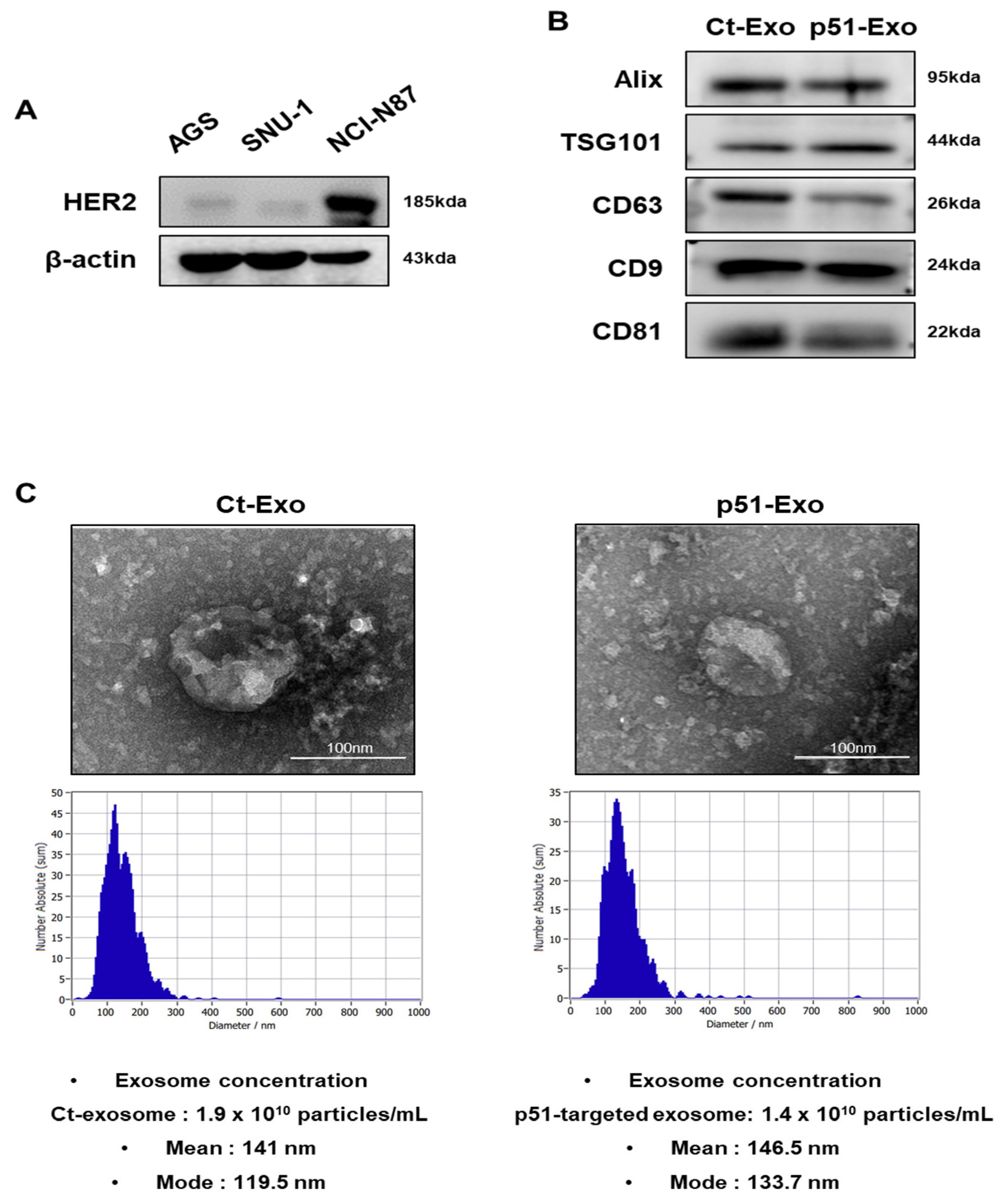
HER2-targeted exosomes were generated by engineering HEK-293T cells to express the HER2-binding p51 peptide. Basal HER2 expression was evaluated in AGS, SNU-1, and NCI-N87 gastric cancer cell lines. Among these, NCI-N87 cells exhibited the highest HER2 expression (Figure 1A). Therefore, NCI-N87 cells were selected for subsequent experiments. The expression of canonical exosome markers (Alix, TSG101, CD63, CD9, and CD81) was analyzed by Western blot analysis. The expression levels of these markers were compared in control exosomes (Ct-Exo) and HER2-targeted exosomes (p51-Exo), indicating that p51 modification did not alter exosomal marker expression (Figure 1B). Transmission electron microscopy (TEM) revealed similar nanoscale vesicular morphology in both groups (Figure 1C). Nanoparticle tracking analysis showed a mean diameter of 141 nm and a concentration of 1.9 × 10¹⁰ particles/mL for Ct-Exo, and 146.5 nm with a concentration of 1.4 × 10¹⁰ particles/mL for p51-Exo. These findings confirm the successful generation and isolation of HER2-targeted exosomes.

2.2. Cellular Uptake of HER2-Targeted Exosomes in Gastric Cancer Cells

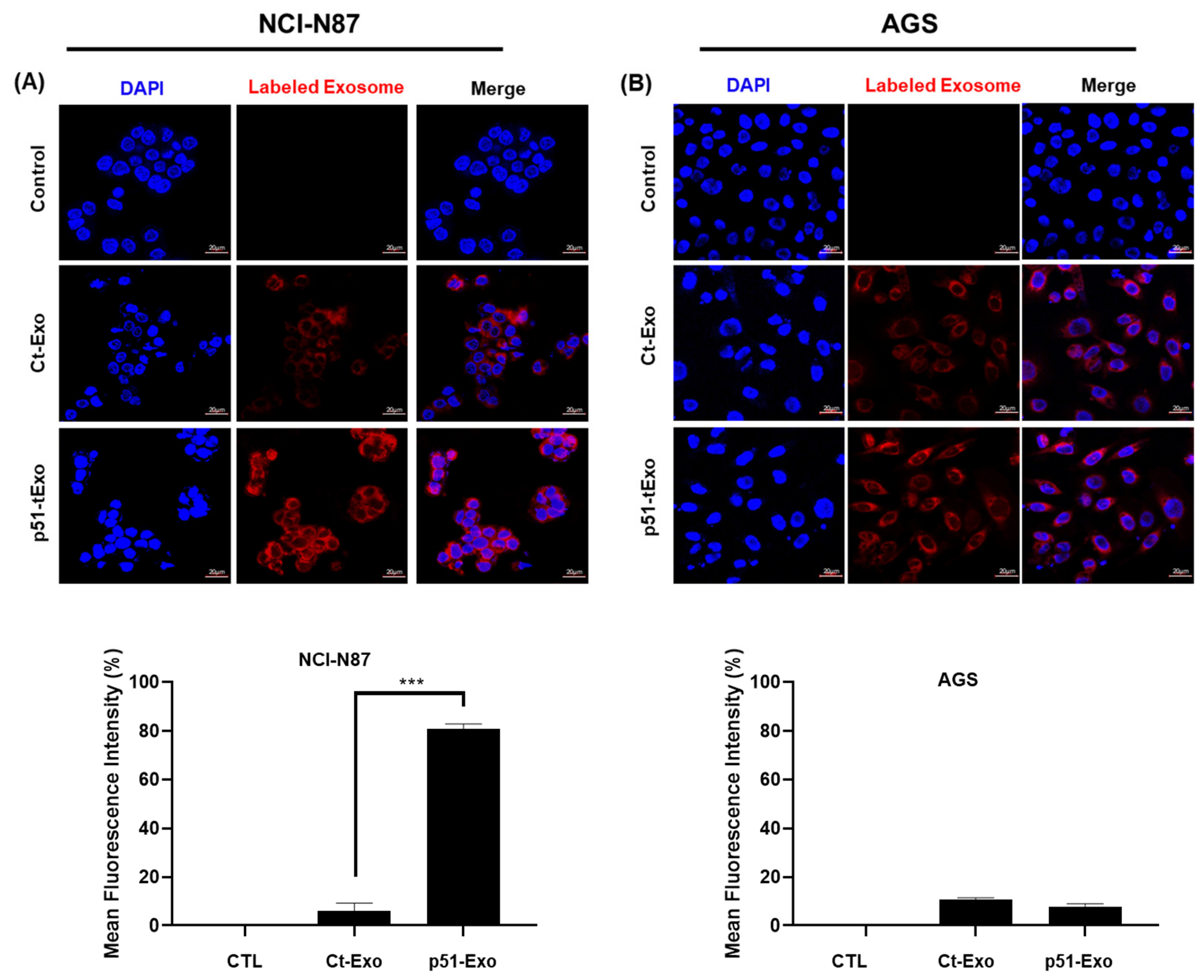
The cellular uptake of exosomes was evaluated using 1,1′-dioctadecyl-3,3,3′,3′-tetramethylindocarbocyanine perchlorate (DiI)-labeled Ct-Exo and p51-Exo in gastric cancer cells. In AGS cells with low HER2 expression, no significant difference in DiI fluorescence was observed between Ct-Exo and p51-Exo. In contrast, NCI-N87 cells exhibited markedly increased DiI fluorescence following treatment with p51-Exo compared with Ct-Exo, indicating enhanced uptake of targeted exosomes (Figure 2A,B). These findings demonstrate preferential accumulation of HER2-targeted exosomes in HER2-overexpressing gastric cancer cells, supporting effective HER2-specific targeting.

2.3. p51-Exo17-DMAG Induced Apoptosis and Suppressed Proliferation in NCI-N87 Cells

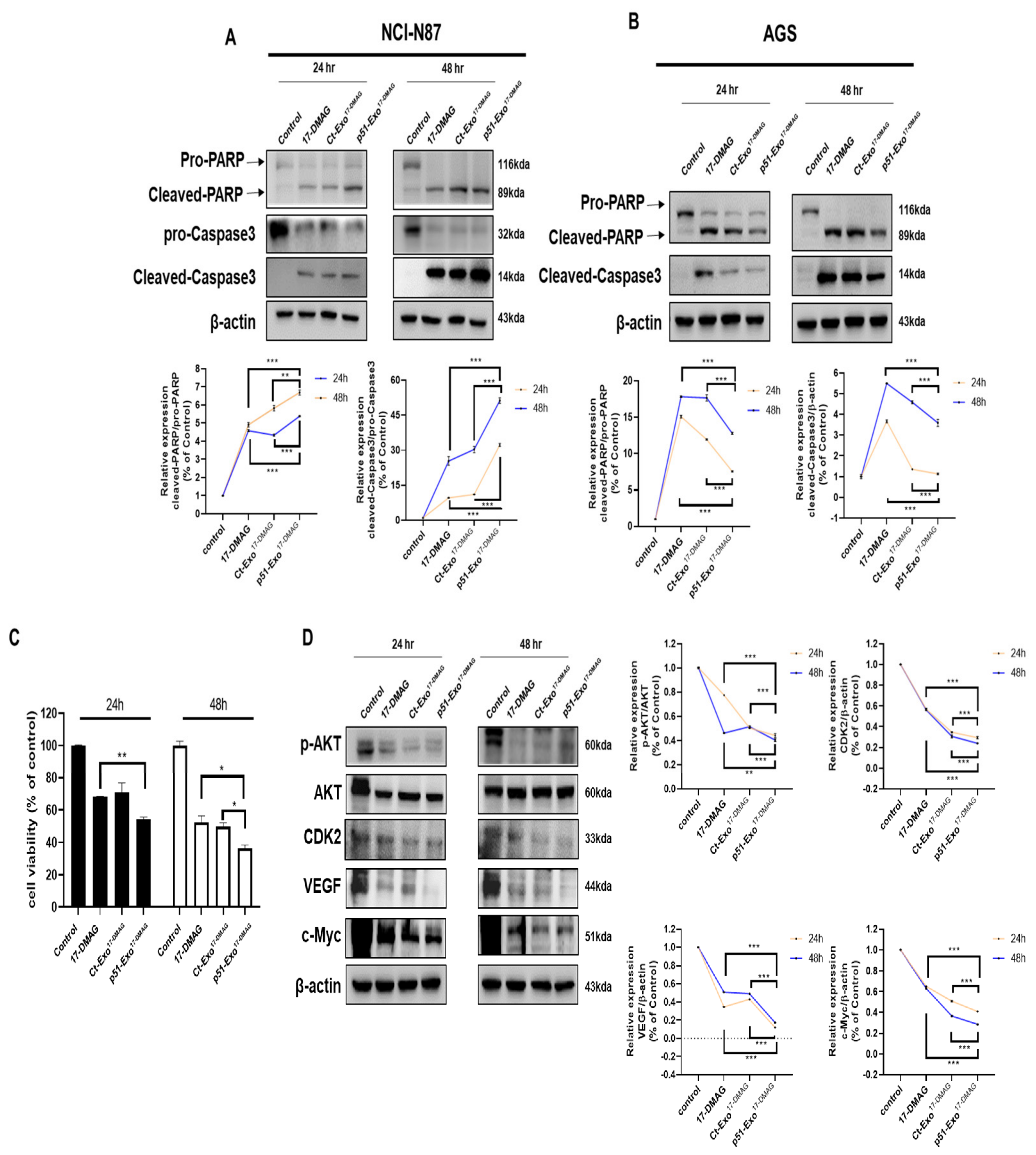
Ct-Exo and p51-Exo loaded with 100 nM 17-DMAG were designated as Ct-Exo17-DMAG and p51-Exo17-DMAG, respectively; this specific concentration was chosen based on the optimal cytotoxic and apoptotic efficacy observed in Supplementary Figure S1. Western blot analysis was performed following treatment with 17-DMAG, Ct-Exo17-DMAG, and p51-Exo17-DMAG for 24 and 48 h in NCI-N87 and AGS gastric cancer cells. Treatment with p51-Exo17-DMAG significantly increased cleaved-PARP and cleaved-caspase3 levels and reduced pro-PARP and pro-caspase3 in a time-dependent manner compared with other groups in HER2-overexpressing NCI-N87 cells (all p < 0.05; Figure 3A). Conversely, in AGS cells with low HER2 expression, p51-Exo17−DMAG did not exhibit enhanced apoptotic effects compared to free 17-DMAG or non-targeted Ct-Exo17−DMAG (Figure 3B). These results indicate that the therapeutic enhancement of p51-Exo17−DMAG is strictly dependent on HER2 expression, confirming the target-specific cell death induced by our engineered exosome platform.
To evaluate the impact of p51-Exo17-DMAG on key oncogenic signaling pathways downstream of HER2, we examined the expression of p-AKT, CDK2, VEGF, and c-Myc markers representing the major survival, proliferative, and angiogenic axes activated by HER2 overexpression in gastric cancer. p51-Exo17-DMAG markedly reduced cell viability in a time-dependent manner in NCI-N87 cells (Figure 3C). Furthermore, p51-Exo17-DMAG markedly reduced the expression of survival- and proliferation-associated proteins, including phosphorylated protein kinase B (p-AKT), cyclin-dependent kinase 2 (CDK2), vascular endothelial growth factor (VEGF), and c-Myc (all p < 0.05; Figure 3D). These results indicate that HER2-targeted delivery of 17-DMAG enhances apoptotic signaling and suppresses oncogenic pathways in NCI-N87 cells.

2.4. p51-Exo17-DMAG Significantly Enhanced the Number of TUNEL Green-Fluorescent Cells in NCI-N87 Cells

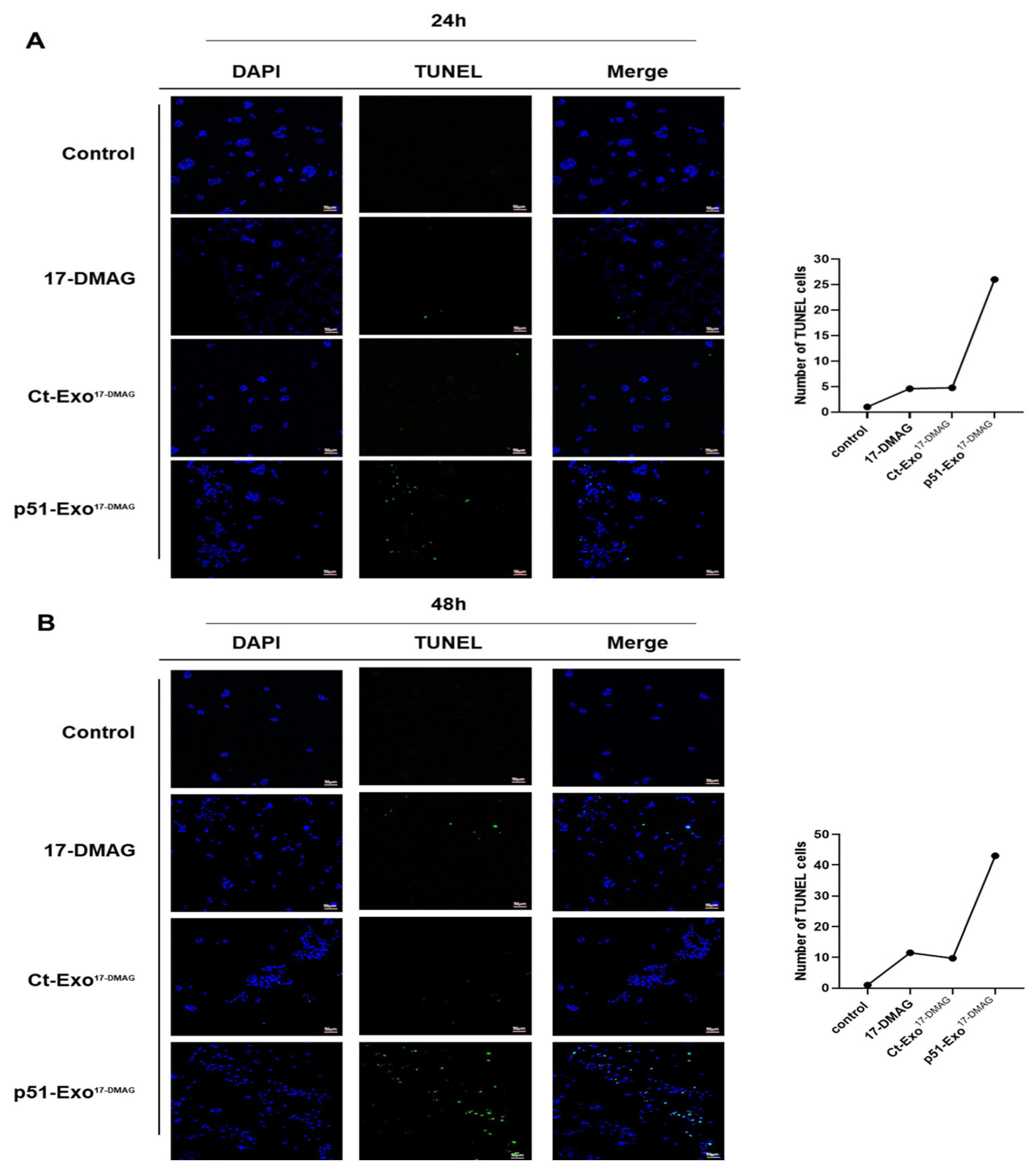
To examine whether the cytotoxic effect of p51-Exo17-DMAG is exerted by apoptosis, TUNEL assay was conducted in NCI-N87 cells Here, p51-Exo17-DMAG significantly enhanced the number of TUNEL green-fluorescent cells compared to untreated control for 24 and 48 h in NCI-N87 cells (Figure 4A,B).

2.5. p51-Exo17-DMAG Suppressed the Growth of NCI-N87 Cells in a Xenograft Tumor Model

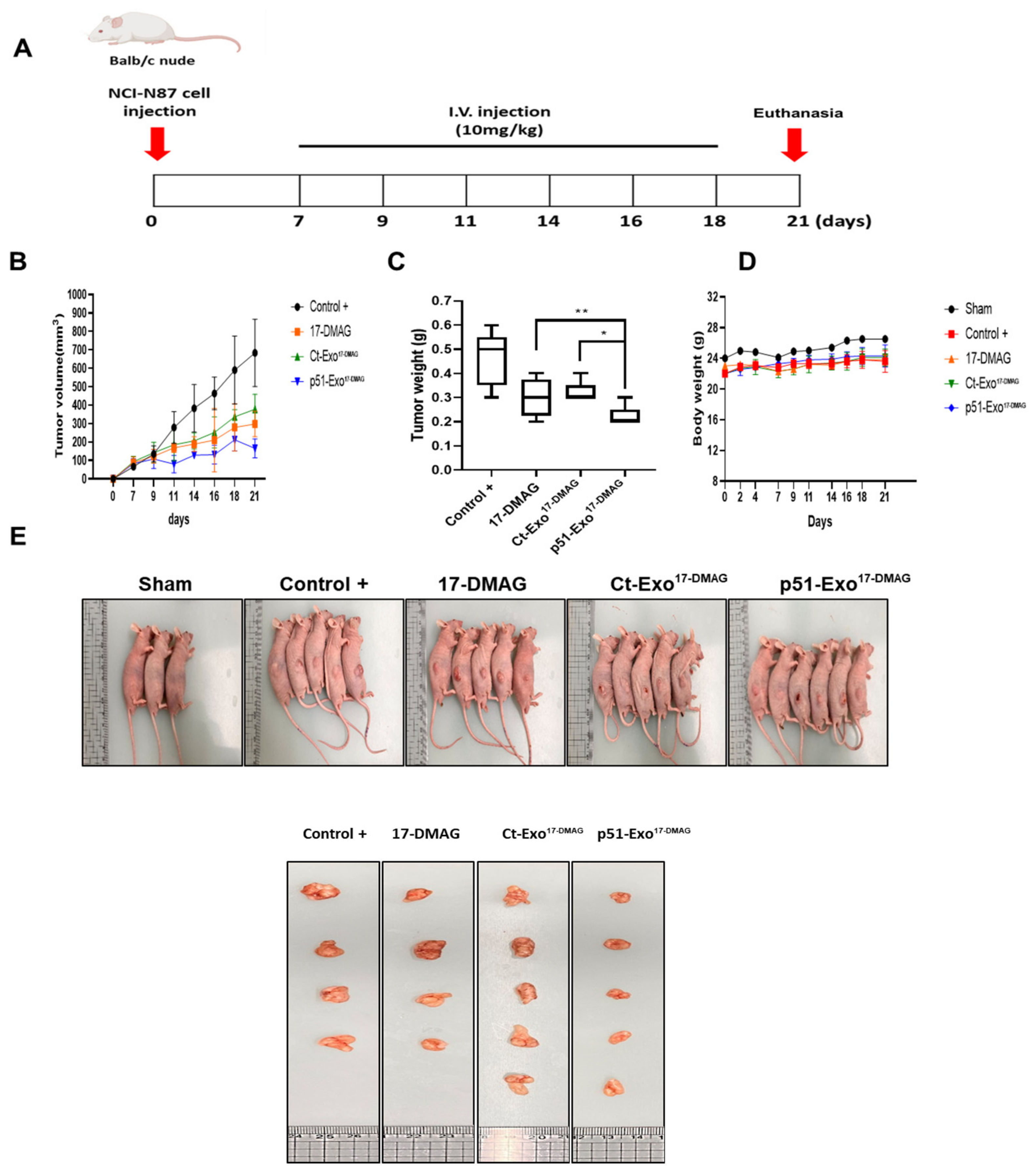
An NCI-N87 xenograft model was established in BALB/c male athymic nude mice (Figure 5A). Tumor-bearing mice received intravenous (IV) tail vein administration of 17-DMAG, Ct-Exo17-DMAG, and p51-Exo17-DMAG. Treatment with p51-Exo17-DMAG significantly suppressed tumor growth compared with control, 17-DMAG (p < 0.01), and Ct-Exo17-DMAG groups (p < 0.05; Figure 5B,E). Consistently, tumor volume was also significantly reduced in the p51-Exo17-DMAG group (Figure 5C). Importantly, no significant changes in body weight were observed, indicating minimal systemic toxicity (Figure 5D). Histological analysis of major organs showed no pathological alterations in liver or spleen tissues (Supplementary Figure S2). These findings demonstrate effective tumor suppression by p51-Exo17-DMAG without detectable toxicity.

2.6. p51-Exo17-DMAG Increased Apoptosis in Xenograft Tumor Model

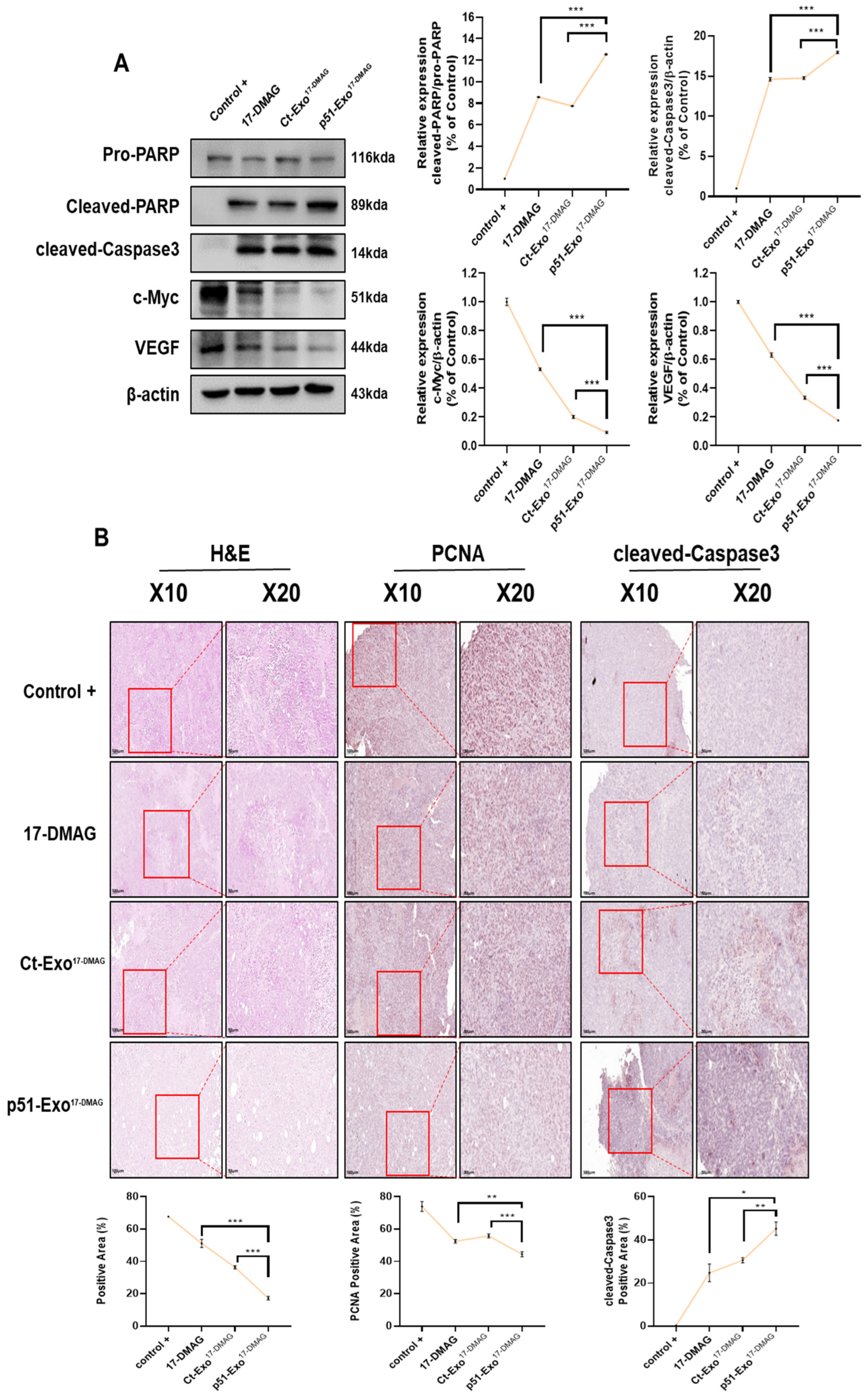
Tumor tissues from xenograft models were analyzed to assess apoptotic signaling following treatment. Western blot analysis showed reduced expression of pro-PARP, c-Myc, and VEGF, along with increased cleaved-PARP and cleaved-caspase3 in the p51-Exo17-DMAG group compared with other groups (all p < 0.05; Figure 6A). Immunohistochemical analysis demonstrated decreased proliferating cell nuclear antigen (PCNA) expression and increased cleaved-caspase3 staining in tumors treated with p51-Exo17-DMAG, compared to other groups (Figure 6B). These findings indicate that HER2-targeted delivery of 17-DMAG increased apoptosis and suppressed tumor proliferation in vivo.

3. Discussion

Gastric cancer remains a leading cause of cancer-related mortality worldwide, with limited therapeutic options and poor prognosis for patients with advanced or metastatic disease. Although advances in cytotoxic chemotherapy and targeted therapy, including trastuzumab, have improved survival in selected patients, drug resistance and inefficient tumor delivery continue to limit complete responses. Therefore, the development of targeted delivery systems capable of selective intracellular drug delivery while minimizing systemic toxicity in HER2-overexpressing tumors remains essential.
Selective targeting of HER2-positive tumor cells is critical for improving therapeutic efficacy. The p51 peptide, which exhibits high affinity and specificity for the extracellular domain of HER2, was utilized for exosome surface engineering [22]. The results of the present study demonstrated that p51-modified exosomes were preferentially internalized by HER2-overexpressing NCI-N87 cells compared with HER2-low AGS cells, indicating enhanced targeting efficiency. These findings suggest that p51-modified exosomes could provide a more efficient route for intracellular drug delivery than conventional chemotherapy or monoclonal antibodies. Although the ToGA trial established trastuzumab-based therapy as the standard of care for HER2-positive gastric cancer [8], resistance development and limited tumor penetration of large antibodies remain significant clinical obstacles. Furthermore, despite the survival benefit conferred by PD-1 inhibitor-based combination regimens in HER2-negative disease [5,6], a substantial proportion of patients fail to achieve durable responses, reflecting the immunosuppressive and heterogeneous tumor microenvironment [7]. In this context, exosome-based targeted delivery represents a complementary strategy to enhance intratumoral drug concentration.
Exosomes are promising nanocarriers due to intrinsic biocompatibility, low immunogenicity, membrane fusion capability, and protection of therapeutic cargo from degradation [20,21,29]. Surface engineering strategies, including peptide modification, enhance tumor-selective uptake and delivery efficiency in various cancers [30,31]. In addition, peptide-functionalized exosomes, such as those incorporating p51, may improve pharmacokinetics by promoting tumor accumulation while reducing systemic exposure [32]. In the context of the tumor microenvironment, the small size of exosomes further improves tumor penetration, which is a limiting factor for large monoclonal antibodies, such as trastuzumab.
Previous studies have demonstrated that 17-DMAG induces apoptosis through HSP90 inhibition, leading to destabilization and proteasomal degradation of oncogenic client proteins in gastric cancer cells [33,34,35]. Consistent with these findings, 17-DMAG treatment increased cleaved-PARP and cleaved-caspase3 levels in gastric cancer cells (Supplementary Figure S1) and decreased p-AKT, CDK2, VEGF, and c-Myc expression in HER2-overexpressing NCI-N87 cells. Notably, HER2-targeted exosomes more effectively upregulated apoptosis-related proteins and suppressed proliferation-associated proteins, including p-AKT, CDK2, VEGF, and c-Myc, compared with 17-DMAG alone. To further clarify the molecular mechanism underlying this enhanced therapeutic efficacy, we investigated the alterations in these key downstream effectors of the HER2 signaling pathway. Persistent activation of HER2 triggers the PI3K/AKT cascade [36,37], where p-AKT serves as a central hub promoting cell survival and metabolic reprogramming [38]. Downstream of this axis, c-Myc, a potent oncogenic transcription factor [39,40,41], is stabilized to accelerate tumor growth and drive the cell cycle transition through the activation of CDK2 [42,43]. Furthermore, aberrant HER2 signaling is well-known to upregulate VEGF [44,45], a master regulator of tumor angiogenesis that facilitates hypervascularization and metastasis [46,47,48,49].
Therefore, the simultaneous downregulation of p-AKT, CDK2, VEGF, and c-Myc following p51-exosome treatment provides strong molecular evidence that our extracellular vesicle-based platform successfully blocks the HER2 receptor, leading to a multi-pronged suppression of cancer cell survival, cell cycle progression, and angiogenic potential.
These findings suggest that targeted exosome delivery enhances local drug concentration within tumors, thereby maximizing the modulation of multiple signaling pathways.
Furthermore, the in vivo results of this study highlight a strong clinical potential of the exosomes. Significant inhibition of tumor growth in the xenograft model, accompanied by stable body weights and the absence of histological toxicity in major organs including the liver and spleen (Supplementary Figure S2), supports the safety and efficacy of p51-Exo17-DMAG. Although 17-DMAG has demonstrated promising outcomes in clinical studies, its application has been limited by dose-limiting toxicities [50]. These data suggest that exosome-based delivery may broaden the therapeutic window by enhancing tumor-specific drug accumulation while minimizing off-target effects.
Consistent with these findings, tumor tissue analysis showed increased cleaved-caspase3 expression and reduced PCNA levels following p51-Exo17-DMAG treatment, demonstrating effective in vivo delivery. These results demonstrate that the p51-Exo17-DMAG enhances proapoptotic and antiproliferative effects in vivo. Collectively, the HER2-targeted exosome platform shows promise as a therapeutic agent that enhances treatment precision and efficacy in HER2-overexpressing gastric cancer.
There are several limitations in this study. First, although 17-DMAG loading was achieved by passive incubation, quantitative assessment of encapsulation efficiency and comparison with alternative loading methods (e.g., electroporation or sonication) are required to optimize the delivery system. Second, the release profile of 17-DMAG from the exosomal carrier under physiological conditions remains unclear, and detailed characterization of release kinetics is necessary to inform dosing strategies and predict sustained therapeutic effects. Third, validation in patient-derived xenograft models is warranted to further elucidate the tumor heterogeneity and microenvironment of human gastric cancer. Fourth, the use of athymic nude mice limits the evaluation of the potential immunogenicity of engineered exosomes and their interaction with a functional immune system. Therefore, comprehensive evaluations in immunocompetent models are necessary to assess the long-term safety, half-life, and potential pro-inflammatory effects of these engineered vesicles before clinical translation. Fifth, the mechanistic characterization of apoptosis in this study was focused on cleaved PARP and cleaved caspase-3 as executioner markers. The potential contribution of upstream mitochondrial pathway effectors including ROS generation, mitochondrial membrane potential changes, and Bcl-2 family protein regulation was not directly assessed. Prior studies have demonstrated that anticancer agents induce apoptosis in gastrointestinal cancer cells through these mitochondrial mechanisms [51,52,53,54], suggesting that similar pathways may contribute to the antitumor activity of p51-Exo17-DMAG. Future studies incorporating these measurements would provide a more comprehensive understanding of the underlying cell death mechanisms.
Overall, HER2-targeted exosomes represent an effective platform for the selective delivery of small-molecule anticancer agents. Although 17-DMAG was used as a model cargo in this study, the findings support the broader clinical potential of engineered exosomes in precision oncology.

4. Materials and Methods

4.1. Cell Culture

Human gastric carcinoma cell lines NCI-N87 (No. 60113) and AGS (No. 21739), obtained from Korean Cell Line Bank (Seoul, Republic of Korea), were cultured in RPMI-1640 supplemented with 10% fetal bovine serum (FBS) and 1% penicillin in a humidified incubator at 37 °C with 5% CO2.

4.2. Preparation of Exosomes

HEK-293T cells were used for the production of HER2-targeted exosomes. Cells were seeded at a density of 3 × 10⁶ cells in 100 mm culture dishes. After 24 h of incubation, the pDisplay-p51 vector encoding the HER2-binding peptide p51 (CDTFPYLGWWNPNEYRY) was transfected into the cells using Lipofectamine 3000 (Invitrogen, Carlsbad, CA, USA) according to the manufacturer’s protocol. Briefly, 4 μg of plasmid DNA was mixed with transfection reagent at a 1:2 (μg:μL) ratio and incubated for 15 min at room temperature before adding to the cells. After 6 h, the medium was replaced with fresh DMEM containing 10% FBS. Cells were cultured for an additional 24 and 48 h to allow exosome production. Conditioned medium was then collected and centrifuged to remove cells and debris, followed by ultracentrifugation at 120,000× g for 120 min at 4 °C using a Beckman Coulter Optima ultracentrifuge. Exosome pellets were washed once with phosphate-buffered saline (PBS), resuspended in PBS, and stored at −80 °C until further use. For drug loading, purified exosomes were incubated with 17-DMAG at 36 °C for 2 h.

4.3. Transmission Electron Microscopy

Control and p51-modified exosomes were fixed in 2% paraformaldehyde. Morphological characterization was performed using a Hitachi HT7800 transmission electron microscope (Hitachi, Tokyo, Japan) with support from a skilled technician at The Catholic University.

4.4. Nanoparticle Tracking Analysis

Extracellular vesicles derived from HEK-293T cells were diluted 1:10 in PBS and analyzed using a ZetaView instrument (Particle Metrix, Wildmoos, Germany). After stabilizing the flow rate, particle Brownian motion was recorded using the instrument’s automatic tracking mode. Measurements were performed in triplicate, and the mean particle size distribution and concentration were calculated.

4.5. Exosome Uptake Assays

NCI-N87 and AGS cells were seeded at a density of 5 × 10⁵ cells per well in 8-well chamber slides (SPL Life Sciences, Gyeonggi, Republic of Korea) and cultured overnight. Cells were treated with DiI-labeled exosomes (1 × 10⁸ particles/mL) for 24 h at 37 °C in 5% CO2. Following incubation, cells were washed twice with PBS and fixed with 4% paraformaldehyde for 10 min at room temperature. Nuclei were stained with DAPI-containing mounting medium (Vector Laboratories, Burlingame, CA, USA). The cellular uptake of DiI-labeled exosomes was visualized using a confocal laser scanning microscope (LSM700; Carl Zeiss, Oberkochen, Germany), and fluorescence intensity was qualitatively compared between groups.

4.6. Cell Viability Assay

The cytotoxicity of 17-DMAG and 17-DMAG-loaded exosomes was evaluated using a CCK-8 assay (DOJINDO Laboratories, Kumamoto, Japan) according to the manufacturer’s instructions.
For the drug treatment groups, NCI-N87, AGS, and SNU-1 gastric cancer cells (5  ×  103 cells/well) were seeded in 96-well plates and treated with varying concentrations of 17-DMAG for 24 and 48 h. For the exosome treatment group, NCI-N87 cells were treated with different concentrations of exosomes for the specified time periods. Following incubation, the cells were exposed to the CCK-8 solution for 40 min. Absorbance was then measured at 450 nm using a BioTek Synergy HTX Multi-Mode Microplate Reader (Agilent, BioTek Instruments, Winooski, VT, USA). Cell viability was calculated and expressed as a percentage relative to the respective untreated controls.

4.7. Western Blot Analysis

NCI-N87 cells, exosomes, or xenograft tumor tissues were lysed in RIPA buffer (Thermo Scientific, Rockford, IL, USA) supplemented with protease inhibitor cocktail and phosphatase inhibitors (Roche, Mannheim, Germany). Protein concentrations were determined using a PierceTM BCA protein assay kit (Thermo Scientific). Equal amounts of protein samples were separated by 8–15% sodium dodecyl sulfate–polyacrylamide gel electrophoresis and transferred to nitrocellulose membranes. Membranes were blocked with tris-buffered saline, supplemented with 0.1% Tween 20 (TBST) diluted 5% skim milk, for 1 h at room temperature. Membranes were incubated overnight at 4 °C with primary antibodies against PARP (Cat. No. 9542, Cell Signaling Technology, Danvers, MA, USA), caspase3 (Cat. No. ab13585, Abcam, Waltham, MA, USA), HER2 (Cat. No. 2242, Cell Signaling Technology), Alix (Cat. No. 2171, Cell Signaling Technology), TSG101 (Cat. No. ab77671, Abcam), CD63 (Cat No sc-365604, Santa Cruz Biotechnology, Dallas, TX, USA), CD9 (Cat. No. 13403, Cell Signaling Technology), CD81 (Cat. No. 56039, Cell Signaling Technology), p-AKT (Cat. No. 9271, Cell Signaling Technology), CDK2 (Cat. No. ab77671, Abcam), VEGF (Cat No ab1316, Abcam), c-Myc (Cat No ab32072, Abcam), and β-actin (Cat No sc-47778, Santa Cruz Biotechnology, Dallas, TX, USA), diluted in 3% bovine serum albumin in TBST. Membranes were washed thrice with TBST (10 min each time) and incubated with HRP-conjugated secondary antibodies for 2 h at room temperature. Protein expression was visualized using Western BLoT Hyper HRP Substrate (Takara, Kusatsu, Japan).

4.8. TUNEL Assay

TUNEL was considered as a feature of apoptosis [55]. Cell death was assessed using the DeadEndTM Fluorometric TUNEL system kit according to Promega’s instructions (Cat No G3250, Promega, Madison, WI, USA). In brief, NCI-N87 cells treated with 17-DMAG, Ct-Exo17-DMAG, and p51-Exo17-DMAG for 24 and 48h were exposed to 4% paraformaldehyde, permeabilization solution and TUNEL assay mixture. Finally, the TUNEL-stained cells were photographed using a FLUOVIEW FV10i confocal microscope (Olympus, Tokyo, Japan).

4.9. Xenograft Models and Immunohistochemistry

All animal experiments were approved by the Institutional Animal Care and Use Committee of the Catholic University of Korea (CMCIBC-2024-055-02). For the xenograft model, NCI-N87 cells were suspended in serum-free medium and mixed with Matrigel (Corning, Bedford, MA, USA) in a 1:1 ratio. The cell (1 × 10⁷ in l00 μL) suspension was injected subcutaneously into the right flank of athymic BALB/c nude mice. In vivo antitumor effects were evaluated across five groups: sham (n = 3), control (n = 5), 17-DMAG (n = 5), Ct-EXO17-DMAG (n = 5), and p51-EXO17-DMAG (n = 6). Treatments were administered via intravenous injections through the tail vein every 2 days for 3 weeks, with a total injection volume of 120 µL. Tumor growth was monitored for 21 days. All mice were euthanized 21 days after tumor implantation. Tumors were excised, photographed, and weighed. Histological analysis was performed using hematoxylin and eosin staining. Immunohistochemistry was conducted on tumor sections using antibodies against PCNA (Cat No. sc-376228, Santa Cruz Biotechnology) and cleaved- caspase3 (Cat no. sc-40, Santacruz Biotechnology).

4.10. Statistical Analysis

All data were expressed as means ± standard deviation. Statistical significance was evaluated using one-way analysis of variance with the GraphPad Prism 8 software. A p-value of <0.05 was considered statistically significant. All experiments were performed in triplicate and independently repeated thrice.

5. Conclusions

In conclusion, a novel HER2-targeted exosomal delivery system was developed to enhance the therapeutic efficacy and safety of 17-DMAG in gastric cancer. Engineering exosomes with the p51 peptide enabled selective targeting of HER2-overexpressing cancer cells, resulting in markedly increased intracellular drug uptake. This targeted approach enhanced PARP/caspase3-mediated apoptosis and suppressed oncogenic pathways, including p-AKT and c-Myc in vitro, and induced significant tumor growth inhibition in vivo without detectable systemic toxicity.

Supplementary Materials

The following supporting information can be downloaded at: https://www.mdpi.com/article/10.3390/ijms27125377/s1.

Author Contributions

Conceptualization, S.H.P., D.Y.S. and D.J.K.; methodology, D.S.L. and J.W.C.; validation, S.H.P. and C.M.L.; investigation, D.J.K.; data curation, D.Y.S. and J.W.M.; writing—original draft preparation, S.H.P., D.Y.S. and D.J.K.; writing—review and editing, S.H.P.; supervision, D.J.K. All authors have read and agreed to the published version of the manuscript.

Funding

This work was supported by a National Research Foundation of Korea (NRF) grant funded by the Korea government (MSIT) (No. 2022R1C1C1011459).

Institutional Review Board Statement

Not applicable.

Informed Consent Statement

Not applicable.

Data Availability Statement

The original contributions presented in this study are included in the article/Supplementary Material. Further inquiries can be directed to the corresponding author.

Conflicts of Interest

The authors declare no conflicts of interest.

Abbreviations

The following abbreviations are used in this manuscript:
HER2human epidermal growth factor receptor 2
17-DMAG17-dimethylaminoethylamino-17-demethoxygeldanamycin
CCK-8cell counting kit 8
TEMtransmission electron blot microscopy
NTAnanoparticle tracking analysis
Dil1,1′-dioctadecyl-3,3,3′,3′-tetramethylindocarbocyanine perchlorate
AKTphosphorylated protein kinase B
CDK2cyclin-dependent kinase 2
VEGFvascular endothelial growth factor
IVintravenous
PCNAproliferating cell nuclear antigen

References

  1. Sung, H.; Ferlay, J.; Siegel, R.L.; Laversanne, M.; Soerjomataram, I.; Jemal, A.; Bray, F. Global Cancer Statistics 2020: GLOBOCAN Estimates of Incidence and Mortality Worldwide for 36 Cancers in 185 Countries. CA Cancer J. Clin. 2021, 71, 209–249. [Google Scholar] [CrossRef]
  2. Kim, I.H.; Kang, S.J.; Choi, W.; Seo, A.N.; Eom, B.W.; Kang, B.; Kim, B.J.; Min, B.H.; Tae, C.H.; Choi, C.I.; et al. Korean Practice Guidelines for Gastric Cancer 2024: An Evidence-based, Multidisciplinary Approach (Update of 2022 Guideline). J. Gastric Cancer 2025, 25, 5–114. [Google Scholar] [CrossRef]
  3. Guan, W.L.; He, Y.; Xu, R.H. Gastric cancer treatment: Recent progress and future perspectives. J. Hematol. Oncol. 2023, 16, 57. [Google Scholar] [CrossRef] [PubMed]
  4. Wagner, A.D.; Syn, N.L.; Moehler, M.; Grothe, W.; Yong, W.P.; Tai, B.C.; Ho, J.; Unverzagt, S. Chemotherapy for advanced gastric cancer. Cochrane Database Syst. Rev. 2017, 8, CD004064. [Google Scholar] [CrossRef]
  5. Kang, Y.K.; Chen, L.T.; Ryu, M.H.; Oh, D.Y.; Oh, S.C.; Chung, H.C.; Lee, K.W.; Omori, T.; Shitara, K.; Sakuramoto, S.; et al. Nivolumab plus chemotherapy versus placebo plus chemotherapy in patients with HER2-negative, untreated, unresectable advanced or recurrent gastric or gastro-oesophageal junction cancer (ATTRACTION-4): A randomised, multicentre, double-blind, placebo-controlled, phase 3 trial. Lancet Oncol. 2022, 23, 234–247. [Google Scholar] [CrossRef] [PubMed]
  6. Janjigian, Y.Y.; Shitara, K.; Moehler, M.; Garrido, M.; Salman, P.; Shen, L.; Wyrwicz, L.; Yamaguchi, K.; Skoczylas, T.; Campos Bragagnoli, A.; et al. First-line nivolumab plus chemotherapy versus chemotherapy alone for advanced gastric, gastro-oesophageal junction, and oesophageal adenocarcinoma (CheckMate 649): A randomised, open-label, phase 3 trial. Lancet 2021, 398, 27–40. [Google Scholar] [CrossRef]
  7. Yasuda, T.; Wang, Y.A. Gastric cancer immunosuppressive microenvironment heterogeneity: Implications for therapy development. Trends Cancer 2024, 10, 627–642. [Google Scholar] [CrossRef]
  8. Boku, N. HER2-positive gastric cancer. Gastric Cancer 2014, 17, 1–12. [Google Scholar] [CrossRef]
  9. Lei, Y.Y.; Huang, J.Y.; Zhao, Q.R.; Jiang, N.; Xu, H.M.; Wang, Z.N.; Li, H.Q.; Zhang, S.B.; Sun, Z. The clinicopathological parameters and prognostic significance of HER2 expression in gastric cancer patients: A meta-analysis of literature. World J. Surg. Oncol. 2017, 15, 68. [Google Scholar] [CrossRef]
  10. Jorgensen, J.T.; Hersom, M. HER2 as a Prognostic Marker in Gastric Cancer—A Systematic Analysis of Data from the Literature. J. Cancer 2012, 3, 137–144. [Google Scholar] [CrossRef] [PubMed]
  11. Bang, Y.J.; Van Cutsem, E.; Feyereislova, A.; Chung, H.C.; Shen, L.; Sawaki, A.; Lordick, F.; Ohtsu, A.; Omuro, Y.; Satoh, T.; et al. Trastuzumab in combination with chemotherapy versus chemotherapy alone for treatment of HER2-positive advanced gastric or gastro-oesophageal junction cancer (ToGA): A phase 3, open-label, randomised controlled trial. Lancet 2010, 376, 687–697. [Google Scholar] [CrossRef]
  12. Arienti, C.; Zanoni, M.; Pignatta, S.; Del Rio, A.; Carloni, S.; Tebaldi, M.; Tedaldi, G.; Tesei, A. Preclinical evidence of multiple mechanisms underlying trastuzumab resistance in gastric cancer. Oncotarget 2016, 7, 18424–18439. [Google Scholar] [CrossRef]
  13. Li, Z.; Zhao, H.; Hu, H.; Shang, H.; Ren, Y.; Qiu, W.; Su, H.; Lyu, H.; Chen, X. Mechanisms of resistance to trastuzumab in HER2-positive gastric cancer. Chin. J. Cancer Res. 2024, 36, 306–321. [Google Scholar] [CrossRef] [PubMed]
  14. Cruz, E.; Kayser, V. Monoclonal antibody therapy of solid tumors: Clinical limitations and novel strategies to enhance treatment efficacy. Biologics 2019, 13, 33–51. [Google Scholar] [CrossRef]
  15. Bordeau, B.M.; Balthasar, J.P. Strategies to enhance monoclonal antibody uptake and distribution in solid tumors. Cancer Biol. Med. 2021, 18, 649–664. [Google Scholar] [CrossRef] [PubMed]
  16. Ghosh, A.; Davey, M.; Chute, I.C.; Griffiths, S.G.; Lewis, S.; Chacko, S.; Barnett, D.; Crapoulet, N.; Fournier, S.; Joy, A.; et al. Rapid isolation of extracellular vesicles from cell culture and biological fluids using a synthetic peptide with specific affinity for heat shock proteins. PLoS ONE 2014, 9, e110443. [Google Scholar] [CrossRef] [PubMed]
  17. Thery, C. Exosomes: Secreted vesicles and intercellular communications. F1000 Biol. Rep. 2011, 3, 15. [Google Scholar] [CrossRef]
  18. Li, J.; Wang, J.; Chen, Z. Emerging role of exosomes in cancer therapy: Progress and challenges. Mol. Cancer 2025, 24, 13. [Google Scholar] [CrossRef]
  19. Xia, L.; Zhang, C.; Lv, N.; Liang, Z.; Ma, T.; Cheng, H.; Xia, Y.; Shi, L. AdMSC-derived exosomes alleviate acute lung injury via transferring mitochondrial component to improve homeostasis of alveolar macrophages. Theranostics 2022, 12, 2928–2947. [Google Scholar] [CrossRef]
  20. Gorshkov, A.; Purvinsh, L.; Brodskaia, A.; Vasin, A. Exosomes as Natural Nanocarriers for RNA-Based Therapy and Prophylaxis. Nanomaterials 2022, 12, 524. [Google Scholar] [CrossRef]
  21. Yang, Q.; Li, S.; Ou, H.; Zhang, Y.; Zhu, G.; Li, S.; Lei, L. Exosome-based delivery strategies for tumor therapy: An update on modification, loading, and clinical application. J. Nanobiotechnol. 2024, 22, 41. [Google Scholar] [CrossRef] [PubMed]
  22. Geng, L.; Wang, Z.; Jia, X.; Han, Q.; Xiang, Z.; Li, D.; Yang, X.; Zhang, D.; Bu, X.; Wang, W.; et al. HER2 Targeting Peptides Screening and Applications in Tumor Imaging and Drug Delivery. Theranostics 2016, 6, 1261–1273. [Google Scholar] [CrossRef]
  23. Neckers, L.; Ivy, S.P. Heat shock protein 90. Curr. Opin. Oncol. 2003, 15, 419–424. [Google Scholar] [CrossRef]
  24. Okamoto, J.; Mikami, I.; Tominaga, Y.; Kuchenbecker, K.M.; Lin, Y.C.; Bravo, D.T.; Clement, G.; Yagui-Beltran, A.; Ray, M.R.; Koizumi, K.; et al. Inhibition of Hsp90 leads to cell cycle arrest and apoptosis in human malignant pleural mesothelioma. J. Thorac. Oncol. 2008, 3, 1089–1095. [Google Scholar] [CrossRef]
  25. Isermann, T.; Schneider, K.L.; Wegwitz, F.; De Oliveira, T.; Conradi, L.C.; Volk, V.; Feuerhake, F.; Papke, B.; Stintzing, S.; Mundt, B.; et al. Enhancement of colorectal cancer therapy through interruption of the HSF1-HSP90 axis by p53 activation or cell cycle inhibition. Cell Death Differ. 2025, 32, 1734–1749. [Google Scholar] [CrossRef]
  26. Snigireva, A.V.; Vrublevskaya, V.V.; Skarga, Y.Y.; Morenkov, O.S. Cell surface heparan sulfate proteoglycans are involved in the extracellular Hsp90-stimulated migration and invasion of cancer cells. Cell Stress Chaperones 2019, 24, 309–322. [Google Scholar] [CrossRef]
  27. Liu, S.; Shen, G.; Zhou, X.; Sun, L.; Yu, L.; Cao, Y.; Shu, X.; Ran, Y. Hsp90 Promotes Gastric Cancer Cell Metastasis and Stemness by Regulating the Regional Distribution of Glycolysis-Related Metabolic Enzymes in the Cytoplasm. Adv. Sci. 2024, 11, e2310109. [Google Scholar] [CrossRef]
  28. Li, Y.; Zhang, T.; Schwartz, S.J.; Sun, D. New developments in Hsp90 inhibitors as anti-cancer therapeutics: Mechanisms, clinical perspective and more potential. Drug Resist. Updates 2009, 12, 17–27. [Google Scholar] [CrossRef]
  29. Kalluri, R.; LeBleu, V.S. The biology, function, and biomedical applications of exosomes. Science 2020, 367, eaau6977. [Google Scholar] [CrossRef] [PubMed]
  30. Liang, Y.; Duan, L.; Lu, J.; Xia, J. Engineering exosomes for targeted drug delivery. Theranostics 2021, 11, 3183–3195. [Google Scholar] [CrossRef] [PubMed]
  31. Vader, P.; Mol, E.A.; Pasterkamp, G.; Schiffelers, R.M. Extracellular vesicles for drug delivery. Adv. Drug Deliv. Rev. 2016, 106, 148–156. [Google Scholar] [CrossRef] [PubMed]
  32. Kim, B.; Shin, J.; Wu, J.; Omstead, D.T.; Kiziltepe, T.; Littlepage, L.E.; Bilgicer, B. Engineering peptide-targeted liposomal nanoparticles optimized for improved selectivity for HER2-positive breast cancer cells to achieve enhanced in vivo efficacy. J. Control. Release 2020, 322, 530–541. [Google Scholar] [CrossRef]
  33. Lang, S.A.; Klein, D.; Moser, C.; Gaumann, A.; Glockzin, G.; Dahlke, M.H.; Dietmaier, W.; Bolder, U.; Schlitt, H.J.; Geissler, E.K.; et al. Inhibition of heat shock protein 90 impairs epidermal growth factor-mediated signaling in gastric cancer cells and reduces tumor growth and vascularization in vivo. Mol. Cancer Ther. 2007, 6, 1123–1132. [Google Scholar] [CrossRef]
  34. Moser, C.; Lang, S.A.; Kainz, S.; Gaumann, A.; Fichtner-Feigl, S.; Koehl, G.E.; Schlitt, H.J.; Geissler, E.K.; Stoeltzing, O. Blocking heat shock protein-90 inhibits the invasive properties and hepatic growth of human colon cancer cells and improves the efficacy of oxaliplatin in p53-deficient colon cancer tumors in vivo. Mol. Cancer Ther. 2007, 6, 2868–2878. [Google Scholar] [CrossRef]
  35. Kim, J.G.; Lee, S.C.; Kim, O.H.; Kim, K.H.; Song, K.Y.; Lee, S.K.; Choi, B.J.; Jeong, W.; Kim, S.J. HSP90 inhibitor 17-DMAG exerts anticancer effects against gastric cancer cells principally by altering oxidant-antioxidant balance. Oncotarget 2017, 8, 56473–56489. [Google Scholar] [CrossRef]
  36. Pan, L.; Li, J.; Xu, Q.; Gao, Z.; Yang, M.; Wu, X.; Li, X. HER2/PI3K/AKT pathway in HER2-positive breast cancer: A review. Medicine 2024, 103, e38508. [Google Scholar] [CrossRef] [PubMed]
  37. Fujimoto, Y.; Morita, T.Y.; Ohashi, A.; Haeno, H.; Hakozaki, Y.; Fujii, M.; Kashima, Y.; Kobayashi, S.S.; Mukohara, T. Combination treatment with a PI3K/Akt/mTOR pathway inhibitor overcomes resistance to anti-HER2 therapy in PIK3CA-mutant HER2-positive breast cancer cells. Sci. Rep. 2020, 10, 21762. [Google Scholar] [CrossRef]
  38. Brunet, A.; Bonni, A.; Zigmond, M.J.; Lin, M.Z.; Juo, P.; Hu, L.S.; Anderson, M.J.; Arden, K.C.; Blenis, J.; Greenberg, M.E. Akt promotes cell survival by phosphorylating and inhibiting a Forkhead transcription factor. Cell 1999, 96, 857–868. [Google Scholar] [CrossRef]
  39. Dang, C.V.; Resar, L.M.; Emison, E.; Kim, S.; Li, Q.; Prescott, J.E.; Wonsey, D.; Zeller, K. Function of the c-Myc oncogenic transcription factor. Exp. Cell Res. 1999, 253, 63–77. [Google Scholar] [CrossRef]
  40. Dong, Y.; Tu, R.; Liu, H.; Qing, G. Regulation of cancer cell metabolism: Oncogenic MYC in the driver’s seat. Signal Transduct. Target. Ther. 2020, 5, 124. [Google Scholar] [CrossRef] [PubMed]
  41. Madden, S.K.; de Araujo, A.D.; Gerhardt, M.; Fairlie, D.P.; Mason, J.M. Taking the Myc out of cancer: Toward therapeutic strategies to directly inhibit c-Myc. Mol. Cancer 2021, 20, 3. [Google Scholar] [CrossRef]
  42. Wang, J.; Yang, T.; Xu, G.; Liu, H.; Ren, C.; Xie, W.; Wang, M. Cyclin-Dependent Kinase 2 Promotes Tumor Proliferation and Induces Radio Resistance in Glioblastoma. Transl. Oncol. 2016, 9, 548–556. [Google Scholar] [CrossRef]
  43. Tadesse, S.; Anshabo, A.T.; Portman, N.; Lim, E.; Tilley, W.; Caldon, C.E.; Wang, S. Targeting CDK2 in cancer: Challenges and opportunities for therapy. Drug Discov. Today 2020, 25, 406–413. [Google Scholar] [CrossRef]
  44. Singh, R.; Kim, W.J.; Kim, P.H.; Hong, H.J. Combined blockade of HER2 and VEGF exerts greater growth inhibition of HER2-overexpressing gastric cancer xenografts than individual blockade. Exp. Mol. Med. 2013, 45, e52. [Google Scholar] [CrossRef] [PubMed]
  45. Le, X.F.; Mao, W.; Lu, C.; Thornton, A.; Heymach, J.V.; Sood, A.K.; Bast, R.C., Jr. Specific blockade of VEGF and HER2 pathways results in greater growth inhibition of breast cancer xenografts that overexpress HER2. Cell Cycle 2008, 7, 3747–3758. [Google Scholar] [CrossRef]
  46. Flamme, I.; von Reutern, M.; Drexler, H.C.; Syed-Ali, S.; Risau, W. Overexpression of vascular endothelial growth factor in the avian embryo induces hypervascularization and increased vascular permeability without alterations of embryonic pattern formation. Dev. Biol. 1995, 171, 399–414. [Google Scholar] [CrossRef]
  47. Ghalehbandi, S.; Yuzugulen, J.; Pranjol, M.Z.I.; Pourgholami, M.H. The role of VEGF in cancer-induced angiogenesis and research progress of drugs targeting VEGF. Eur. J. Pharmacol. 2023, 949, 175586. [Google Scholar] [CrossRef] [PubMed]
  48. Shibuya, M. Vascular Endothelial Growth Factor (VEGF) and Its Receptor (VEGFR) Signaling in Angiogenesis: A Crucial Target for Anti- and Pro-Angiogenic Therapies. Genes Cancer 2011, 2, 1097–1105. [Google Scholar] [CrossRef]
  49. Lee, S.L.; Rouhi, P.; Dahl Jensen, L.; Zhang, D.; Ji, H.; Hauptmann, G.; Ingham, P.; Cao, Y. Hypoxia-induced pathological angiogenesis mediates tumor cell dissemination, invasion, and metastasis in a zebrafish tumor model. Proc. Natl. Acad. Sci. USA 2009, 106, 19485–19490. [Google Scholar] [CrossRef] [PubMed]
  50. Pacey, S.; Wilson, R.H.; Walton, M.; Eatock, M.M.; Hardcastle, A.; Zetterlund, A.; Arkenau, H.T.; Moreno-Farre, J.; Banerji, U.; Roels, B.; et al. A phase I study of the heat shock protein 90 inhibitor alvespimycin (17-DMAG) given intravenously to patients with advanced solid tumors. Clin. Cancer Res. 2011, 17, 1561–1570. [Google Scholar] [CrossRef]
  51. Alcala, S.; Villarino, L.; Ruiz-Canas, L.; Couceiro, J.R.; Martinez-Calvo, M.; Palencia-Campos, A.; Navarro, D.; Cabezas-Sainz, P.; Rodriguez-Arabaolaza, I.; Cordero-Barreal, A.; et al. Targeting cancer stem cell OXPHOS with tailored ruthenium complexes as a new anti-cancer strategy. J. Exp. Clin. Cancer Res. 2024, 43, 33. [Google Scholar] [CrossRef]
  52. Melones-Herrero, J.; Alcala, S.; Ruiz-Canas, L.; Benitez-Buelga, C.; Batres-Ramos, S.; Cales, C.; Lorenzo, O.; Perona, R.; Quiroga, A.G.; Sainz, B., Jr.; et al. Platinum iodido drugs show potential anti-tumor activity, affecting cancer cell metabolism and inducing ROS and senescence in gastrointestinal cancer cells. Commun. Biol. 2024, 7, 353. [Google Scholar] [CrossRef]
  53. Lie, Q.; Jiang, H.; Lu, X.; Chen, Z.; Liang, J.; Zhang, Y.; Chao, H. Photo-Activated Ferrocene-Iridium(III) Prodrug Induces Immunogenic Cell Death in Melanoma Stem Cells. J. Med. Chem. 2025, 68, 8894–8906. [Google Scholar] [CrossRef] [PubMed]
  54. Melones-Herrero, J.; Delgado-Aliseda, P.; Figueiras, S.; Velázquez-Gutiérrez, J.; Quiroga, A.G.; Calés, C.; Sánchez-Pérez, I. Trans-[Pt(amine)Cl2(PPh3)] Complexes Target Mitochondria and Endoplasmic Reticulum in Gastric Cancer Cells. Int. J. Mol. Sci. 2024, 25, 7739. [Google Scholar] [CrossRef] [PubMed]
  55. Koo, J.I.; Sim, D.Y.; Lee, H.J.; Ahn, C.H.; Park, J.; Park, S.Y.; Lee, D.; Shim, B.S.; Kim, B.; Kim, S.H. Apoptotic and anti-Warburg effect of Morusin via ROS mediated inhibition of FOXM1/c-Myc signaling in prostate cancer cells. Phytother. Res. 2023, 37, 4473–4487. [Google Scholar] [CrossRef] [PubMed]
Figure 1. Characterization of HER2-targeted exosomes. (A) HER2 expression in AGS, SNU-1, and NCI-N87 gastric cancer cell lines. (B) Western blot analysis of exosomal markers Alix, TSG101, CD63, CD9, and CD81 in control exosomes (Ct-Exo) and HER2-targeted exosomes (p51-Exo). (C) Size distribution of nanoparticles determined by ZetaView analysis and transmission electron microscopy (TEM) images of Ct-Exo and p51-Exo, revealing round-to-ovoid vesicles with diameters of approximately 100–200 nm. Scale bar = 100 nm.
Ijms 27 05377 g001
Figure 2. Cellular uptake of HER2-targeted exosomes in gastric cancer cells. (A,B) Uptake of DiL-labeled Ct-Exo and p51-Exo in NCI-N87 and AGS cells assessed by fluorescence microscopy. Red fluorescence indicates DiL-labeled exosomes, and blue fluorescence indicates DAPI stained nuclei. Quantitative analysis of the mean fluorescence intensity (MFI) of internalized exosomes per cell. Scale bar = 20 μm. *** p < 0.001 versus untreated control.
Ijms 27 05377 g002
Figure 3. Effects of 17-DMAG-loaded p51-targeted exosomes on apoptosis and proliferation in NCI-N87 cells. (A,B) Expression of PARP, pro-caspase3, and cleaved-Caspase3 in NCI-N87 and AGS cells. (C) Cytotoxic effects of 17-DMAG, Ct-Exo17-DMAG, and p51-Exo17-DMAG in NCI-N87 cells assessed by CCK-8 assay following 24 and 48 h of treatment. * p < 0.05, ** p < 0.01, *** p < 0.001 versus untreated control. (D) Expression of p-AKT, CDK2, VEGF, and c-Myc. Cells were treated with 17-DMAG, Ct-Exo17-DMAG, and p51-Exo17-DMAG for 24 and 48 h and analyzed by Western blot analysis. Protein levels were normalized to β-actin, and experiments were performed in triplicate.
Ijms 27 05377 g003
Figure 4. Effect of 17-DMAG-loaded p51-targeted exosomes on the number of TUNEL-positive cells in NCI-N87 cells. NCI-N87 cells treated with 17-DMAG, Ct-Exo17-DMAG, and p51-Exo17-DMAG for 24 (A) and 48 h (B) were subjected to TUNEL staining and then were observed using an Olympus FLUOVIEW FV10i Confocal microscope. Scale bar = 20 μm.
Ijms 27 05377 g004
Figure 5. 17-DMAG-loaded p51-targeted exosomes suppress tumor growth in an NCI-N87 xenograft model. (A) Schematic of the animal study design. The schematic diagram was created with BioRender.com. (B) Body weight changes. (C) Tumor volume. (D) Tumor weight. Groups include sham (n = 3), control (n = 5), 17-DMAG (n = 5), Ct-Exo17-DMAG (n = 5), and p51-Exo17-DMAG (n = 6). * p < 0.05, ** p < 0.01 versus untreated control. (E) Representative images of tumor-bearing BALB/c athymic nude mice.
Ijms 27 05377 g005
Figure 6. Effects of 17-DMAG-loaded p51-targeted exosomes on apoptosis in NCI-N87 xenograft tumors. (A) Western blot analysis of tumor lysates from control, 17-DMAG, Ct-Exo17-DMAG, and p51-Exo17-DMAG groups showing expression of PARP, cleaved-caspase3, c-Myc and VEGF. *** p < 0.001 versus untreated control. (B) Representative hematoxylin and eosin staining and immunohistochemistry for PCNA and cleaved-caspase3 in xenograft tumor tissues. * p < 0.05, ** p < 0.01, and *** p < 0.001 versus untreated control. Scale bars = 50 and 100 μm.
Ijms 27 05377 g006
Disclaimer/Publisher’s Note: The statements, opinions and data contained in all publications are solely those of the individual author(s) and contributor(s) and not of MDPI and/or the editor(s). MDPI and/or the editor(s) disclaim responsibility for any injury to people or property resulting from any ideas, methods, instructions or products referred to in the content.