Circulating Cell-Free DNA in Psychiatric Disorders: Current Evidence, Inflammation-Based Stratification, and Future Perspectives

 , , and
Abstract
1. Introduction
2. cfDNA, Psychological Stress, and Childhood Trauma
3. Circulating Cell-Free DNA Across Psychiatric Disorders
3.1. Major Depressive Disorder
3.2. Bipolar Disorder
3.3. Schizophrenia

| Reference | Year | Diagnosis | Sample | DNA Type | Detection Method | DNA Levels |
|---|---|---|---|---|---|---|
| Depressive Disorder | ||||||
| [60] Fernström et al. | 2021 | MDD | Plasma | cf-mtDNA | qRT-PCR | ↓ |
| [61] Kageyama et al. | 2018 | MDD, BD, SCZ | Plasma | cf-mtDNA | qRT-PCR | ↓ |
| [62] Gonçalves et al. | 2021 | Late-life depression | Plasma | cf-mtDNA | qRT-PCR | ↑ |
| [63] Ampo et al. | 2022 | Late-life depression | Plasma | cf-mtDNA | qRT-PCR | ↑ |
| [64] Lindqvist et al. | 2018 | MDD | Plasma | cf-mtDNA | Multiplex RT-PCR | ↑ |
| [37] Lindqvist et al. | 2016 | Suicide attempters with and without MDD | Plasma | cf-mtDNA | qRT-PCR | ↑ |
| [69] Behnke et al. | 2023 | MDD | Serum | cf-mtDNA | Modular RT-PCR | ↔ |
| [70] Jiang et al. | 2018 | MDD, BD, SCZ | Plasma | cfDNA | FCS, Fluorometric quantification, qRT-PCR | ↔ |
| Bipolar Disorder | ||||||
| [75] Teng et al. | 2024 | BD | Plasma | cf-mtDNA | qRT-PCR | ↑ |
| [76] Stertz et al. | 2015 | BD | Serum | cfDNA | qRT-PCR | ↑ |
| [78] Shao et al. | 2024 | BD | Serum | cf-mtDNA | qRT-PCR | ↔ |
| [79] Jeong et al. | 2020 | BD | Serum | cf-mtDNA | qRT-PCR | ↔ |
| [70] Jiang et al. | 2018 | MDD, BD, SCZ | Plasma | cfDNA | FCS, Fluorometric quantification, qRT-PCR | ↔ |
| [61] Kageyama et al. | 2018 | MDD, BD, SCZ | Plasma | cf-mtDNA | qRT-PCR | ↓ |
| Schizophrenia | ||||||
| [70] Jiang et al. | 2018 | MDD, BD, SCZ | Plasma | cfDNA | FCS, Fluorometric quantification, qRT-PCR | ↑ |
| [88] Ershova et al. | 2019 | SCZ | Plasma | cfDNA | NQH | ↑ |
| [89] Chen et al. | 2021 | SCZ | Plasma | cfDNA | qRT-PCR | ↑ |
| [90] Xue et al. | 2025 | SCZ | Plasma | cfDNA | cfDNA Sequencing | ↑ |
| [91] Li et al. | 2024 | SCZ | Plasma | cfDNA | FCS, qRT-PCR | ↑ |
| [92] Ouyang et al. | 2021 | SCZ | Plasma | cf-mtDNA | qRT-PCR | ↔ |
| [61] Kageyama et al. | 2018 | MDD, BD, SCZ | Plasma | cf-mtDNA | qRT-PCR | ↔ |
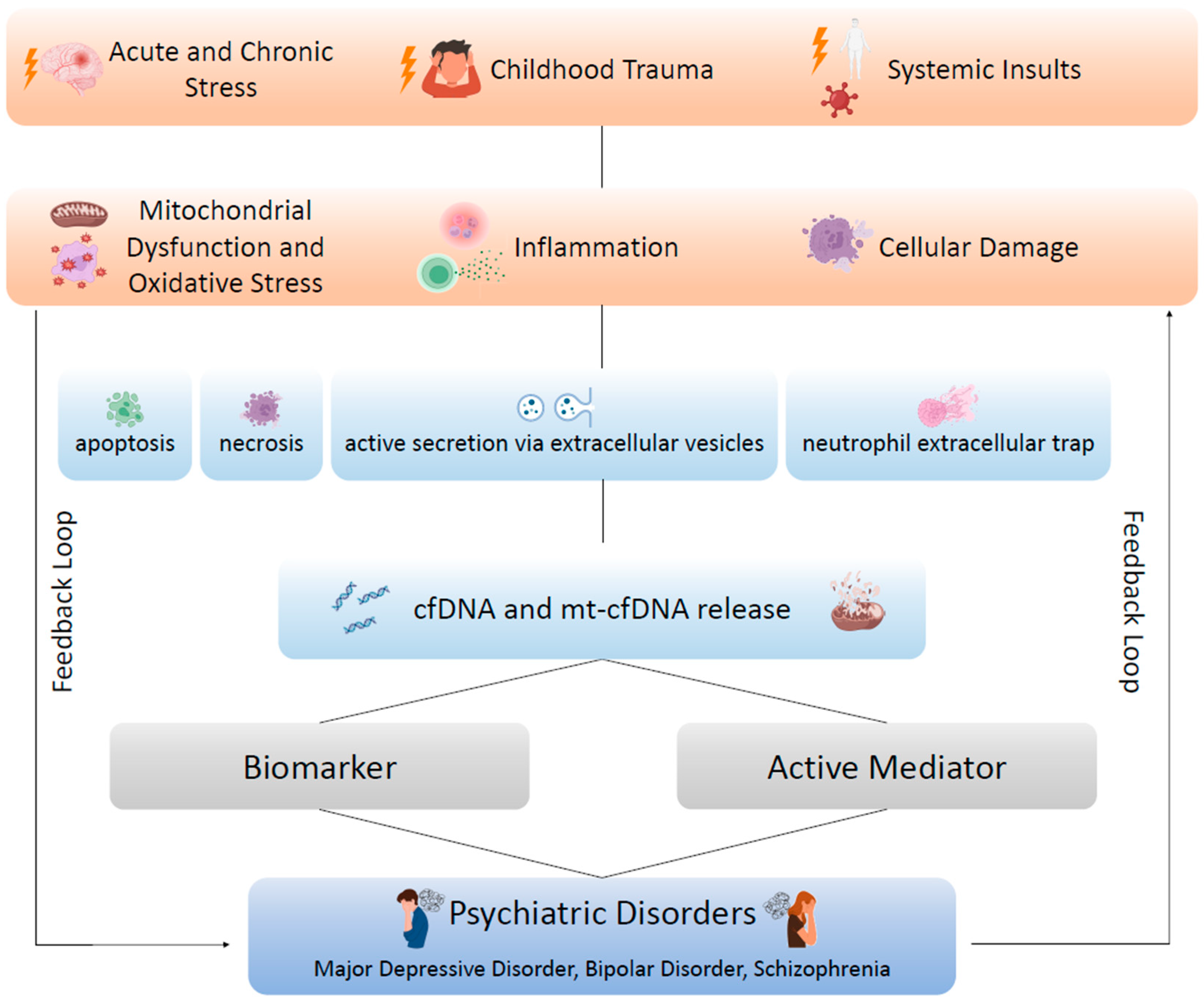
3.4. cfDNA as a Biomarker for Inflammation-Based Stratification in Psychiatric Disorders
4. Conclusions and Future Directions
Author Contributions
Funding
Data Availability Statement
Conflicts of Interest
Abbreviations
| cfDNA | Circulating cell-free DNA |
| DAMP | Damage-associated molecular pattern |
| Cf-mtDNA | Mitochondrial cell-free DNA |
| MDD | Major Depressive Disorder |
| BD | Bipolar Disorder |
| SCZ | Schizophrenia |
| HPA | Hypothalamic–pituitary–adrenal |
| TLR | Toll-like receptor |
| ROS | Reactive oxygen species |
| SNS | Sympathetic nervous system |
| PTSD | Post-traumatic stress disorder |
| STING | Stimulator of interferon genes |
References
- García-Gutiérrez, M.S.; Navarrete, F.; Sala, F.; Gasparyan, A.; Austrich-Olivares, A.; Manzanares, J. Biomarkers in Psychiatry: Concept, Definition, Types and Relevance to the Clinical Reality. Front. Psychiatry 2020, 11, 432. [Google Scholar] [CrossRef]
- Abi-Dargham, A.; Moeller, S.J.; Ali, F.; DeLorenzo, C.; Domschke, K.; Horga, G.; Jutla, A.; Kotov, R.; Paulus, M.P.; Rubio, J.M.; et al. Candidate biomarkers in psychiatric disorders: State of the field. World Psychiatry 2023, 22, 236–262. [Google Scholar] [CrossRef] [PubMed]
- Hole, C.; Dhamsania, A.; Brown, C.; Ryznar, R. Immune Dysregulation in Depression and Anxiety: A Review of the Immune Response in Disease and Treatment. Cells 2025, 14, 607. [Google Scholar] [CrossRef] [PubMed]
- Pinzi, M.; Fagiolini, A.; Koukouna, D.; Gualtieri, G.; Rescalli, M.B.; Pierini, C.; Pardossi, S.; Patrizio, B.; Cuomo, A. Inflammatory and Immune Biomarkers in Mood Disorders: From Mechanistic Pathways to Clinical Translation. Cells 2025, 14, 1558. [Google Scholar] [CrossRef] [PubMed]
- Mandal, P.K.; Gaur, S.; Roy, R.G.; Samkaria, A.; Ingole, R.; Goel, A. Schizophrenia, Bipolar and Major Depressive Disorders: Overview of Clinical Features, Neurotransmitter Alterations, Pharmacological Interventions, and Impact of Oxidative Stress in the Disease Process. ACS Chem. Neurosci. 2022, 13, 2784–2802. [Google Scholar] [CrossRef]
- Ni, P.; Ma, Y.; Chung, S. Mitochondrial dysfunction in psychiatric disorders. Schizophr. Res. 2024, 273, 62–77. [Google Scholar] [CrossRef]
- Penninx, B.W.J.H.; Lange, S.M.M. Metabolic syndrome in psychiatric patients: Overview, mechanisms, and implications. Dialog-Clin. Neurosci. 2018, 20, 63–73. [Google Scholar] [CrossRef]
- Cescon, D.W.; Bratman, S.V.; Chan, S.M.; Siu, L.L. Circulating tumor DNA and liquid biopsy in oncology. Nat. Cancer 2020, 1, 276–290. [Google Scholar] [CrossRef]
- Szilágyi, M.; Pös, O.; Márton, É.; Buglyó, G.; Soltész, B.; Keserű, J.; Penyige, A.; Szemes, T.; Nagy, B. Circulating Cell-Free Nucleic Acids: Main Characteristics and Clinical Application. Int. J. Mol. Sci. 2020, 21, 6827. [Google Scholar] [CrossRef]
- Pollastri, A.; Kovacs, P.; Keller, M. Circulating Cell-Free DNA in Metabolic Diseases. J. Endocr. Soc. 2025, 9, bvaf006. [Google Scholar] [CrossRef]
- Ghanam, J.; Lichá, K.; Chetty, V.K.; Pour, O.A.; Reinhardt, D.; Tamášová, B.; Hoyer, P.; Lötvall, J.; Thakur, B.K. Unravelling the Significance of Extracellular Vesicle-Associated DNA in Cancer Biology and Its Potential Clinical Applications. J. Extracell. Vesicles 2025, 14, e70047. [Google Scholar] [CrossRef]
- Pisareva, E.; Mihalovičová, L.; Pastor, B.; Kudriavtsev, A.; Mirandola, A.; Mazard, T.; Badiou, S.; Maus, U.; Ostermann, L.; Weinmann-Menke, J.; et al. Neutrophil extracellular traps have auto-catabolic activity and produce mononucleosome-associated circulating DNA. Genome Med. 2022, 14, 135. [Google Scholar] [CrossRef]
- Boyapati, R.K.; Tamborska, A.; Dorward, D.A.; Ho, G.-T. Advances in the understanding of mitochondrial DNA as a pathogenic factor in inflammatory diseases. F1000Research 2017, 6, 169. [Google Scholar] [CrossRef] [PubMed]
- Ma, M.; Jiang, W.; Zhou, R. DAMPs and DAMP-sensing receptors in inflammation and diseases. Immunity 2024, 57, 752–771. [Google Scholar] [CrossRef]
- Roth, S.; Wernsdorf, S.R.; Liesz, A. The role of circulating cell-free DNA as an inflammatory mediator after stroke. Semin. Immunopathol. 2023, 45, 411–425. [Google Scholar] [CrossRef]
- Shmarina, G.V.; Ershova, E.S.; Simashkova, N.V.; Nikitina, S.G.; Chudakova, J.M.; Veiko, N.N.; Porokhovnik, L.N.; Basova, A.Y.; Shaposhnikova, A.F.; Pukhalskaya, D.A.; et al. Oxidized cell-free DNA as a stress-signaling factor activating the chronic inflammatory process in patients with autism spectrum disorders. J. Neuroinflamm. 2020, 17, 212. [Google Scholar] [CrossRef]
- Kostyuk, S.V.; Porokhovnik, L.N.; Ershova, E.S.; Malinovskaya, E.M.; Konkova, M.S.; Kameneva, L.V.; Dolgikh, O.A.; Veiko, V.P.; Pisarev, V.M.; Martynov, A.V.; et al. Changes of KEAP1/NRF2 and IKB/NF-κB Expression Levels Induced by Cell-Free DNA in Different Cell Types. Oxidative Med. Cell. Longev. 2018, 2018, 1052413. [Google Scholar] [CrossRef]
- Lee, J.-S.; Kim, M.; Seong, M.-W.; Kim, H.-S.; Lee, Y.K.; Kang, H.J. Plasma vs. serum in circulating tumor DNA measurement: Characterization by DNA fragment sizing and digital droplet polymerase chain reaction. Clin. Chem. Lab. Med. 2020, 58, 527–532. [Google Scholar] [CrossRef] [PubMed]
- Yuwono, N.L.; Warton, K.; Ford, C.E. The influence of biological and lifestyle factors on circulating cell-free DNA in blood plasma. eLife 2021, 10, e69679. [Google Scholar] [CrossRef]
- Mazereel, V.; Detraux, J.; Vancampfort, D.; van Winkel, R.; De Hert, M. Impact of Psychotropic Medication Effects on Obesity and the Metabolic Syndrome in People With Serious Mental Illness. Front. Endocrinol. 2020, 11, 573479. [Google Scholar] [CrossRef] [PubMed]
- Ferreira, T.; Rodriguez, S. Mitochondrial DNA: Inherent Complexities Relevant to Genetic Analyses. Genes 2024, 15, 617. [Google Scholar] [CrossRef]
- Kumar, M.; Shelly, A.; Dahiya, P.; Ray, A.; Mazumder, S. Aeromonas hydrophila inhibits autophagy triggering cytosolic translocation of mtDNA which activates the pro-apoptotic caspase-1/IL-1β-nitric oxide axis in headkidney macrophages. Virulence 2022, 13, 60–76. [Google Scholar] [CrossRef]
- Kausar, S.; Yang, L.; Abbas, M.N.; Hu, X.; Zhao, Y.; Zhu, Y.; Cui, H. Mitochondrial DNA: A Key Regulator of Anti-Microbial Innate Immunity. Genes 2020, 11, 86. [Google Scholar] [CrossRef]
- De Gaetano, A.; Solodka, K.; Zanini, G.; Selleri, V.; Mattioli, A.V.; Nasi, M.; Pinti, M. Molecular Mechanisms of mtDNA-Mediated Inflammation. Cells 2021, 10, 2898. [Google Scholar] [CrossRef]
- Kubli, D.A.; Gustafsson, Å.B. Mitochondria and mitophagy: The yin and yang of cell death control. Circ. Res. 2012, 111, 1208–1221. [Google Scholar] [CrossRef]
- Zhang, G.; Cong, J.; Feng, X.; Xin, H.; Zhu, W.; Shi, R.; Li, C.; Wang, Y.; Ma, R.; Li, Y.; et al. NR3C1/PRKACG-mediated impairment of mitochondrial quality control underlies stress-induced hypothalamic neuronal injury. Commun. Biol. 2025. [Google Scholar] [CrossRef]
- Muftuoglu, M.; Mori, M.P.; de Souza-Pinto, N.C. Formation and repair of oxidative damage in the mitochondrial DNA. Mitochondrion 2014, 17, 164–181. [Google Scholar] [CrossRef] [PubMed]
- Xu, X.; Pang, Y.; Fan, X. Mitochondria in oxidative stress, inflammation and aging: From mechanisms to therapeutic advances. Signal Transduct. Target. Ther. 2025, 10, 190. [Google Scholar] [CrossRef] [PubMed]
- Limberg, A.S.; Berg, F.; Köper, E.; Lindgraf, C.; Gevers, C.; Kumsta, R.; Hummel, E.M.; Moser, D.A. Cell-free DNA release following psychosocial and physical stress in women and men. Transl. Psychiatry 2025, 15, 26. [Google Scholar] [CrossRef]
- Hummel, E.M.; Hessas, E.; Müller, S.; Beiter, T.; Fisch, M.; Eibl, A.; Wolf, O.T.; Giebel, B.; Platen, P.; Kumsta, R.; et al. Cell-free DNA release under psychosocial and physical stress conditions. Transl. Psychiatry 2018, 8, 236. [Google Scholar] [CrossRef] [PubMed]
- Chattopadhyay, A.; Tak, H.; B Naick, H. Evaluating cell-free circulatory mitochondrial DNA as a comprehensive biomarker for stress: Meta-analysis of psychological and physiological stress responses. Biomarkers 2025, 30, 295–303. [Google Scholar] [CrossRef] [PubMed]
- Herhaus, B.; Neuberger, E.; Juškevičiūtė, E.; Simon, P.; Petrowski, K. Kinetics of Plasma Cell-Free DNA under a Highly Standardized and Controlled Stress Induction. Cells 2023, 12, 564. [Google Scholar] [CrossRef]
- Filev, A.D.; Shmarina, G.V.; Ershova, E.S.; Veiko, N.N.; Martynov, A.V.; Borzikova, M.A.; Poletkina, A.A.; Dolgikh, O.A.; Veiko, V.P.; Bekker, A.A.; et al. Oxidized Cell-Free DNA Role in the Antioxidant Defense Mechanisms under Stress. Oxidative Med. Cell. Longev. 2019, 2019, 1245749. [Google Scholar] [CrossRef]
- Çelik, E.; Köksal, M.B.; Akbulut, H.M.; Aydın, S.A.; Kurt, Y.E.; Okan, C.; Çetinkaya, S. Assessment of cfDNA Levels in Saliva Samples of Stressed Young Adults: Preliminary Study. Ahi Evran Med. J. 2025, 9, 12–16. [Google Scholar] [CrossRef]
- Shan, M.A.; Ishtiaq, W.; Kanwal, S.; Khan, M.U.; Iftikhar, A.; Khan, S. Cell-free DNA as a potential diagnostic biomarker in academic stress: A case-control study in young adults. Saudi J. Biol. Sci. 2024, 31, 103933. [Google Scholar] [CrossRef]
- Zhang, W.Z.; Zhang, J. Stress-Induced Metabolic Disorders: Mechanisms, Pathologies, and Prospects. Am. J. Biomed. Sci. Res. 2025, 26, 2025041086. [Google Scholar] [CrossRef]
- Lindqvist, D.; Fernström, J.; Grudet, C.; Ljunggren, L.; Träskman-Bendz, L.; Ohlsson, L.; Westrin, Å. Increased plasma levels of circulating cell-free mitochondrial DNA in suicide attempters: Associations with HPA-axis hyperactivity. Transl. Psychiatry 2016, 6, e971. [Google Scholar] [CrossRef]
- Czamanski-Cohen, J.; Sarid, O.; Cwikel, J.; Levitas, E.; Lunenfeld, E.; Douvdevani, A.; Har-Vardi, I. Decrease in cell free DNA levels following participation in stress reduction techniques among women undergoing infertility treatment. Arch. Women’s Ment. Health 2014, 17, 251–253. [Google Scholar] [CrossRef] [PubMed]
- Moya, G.E.; Rivera, P.D.; Dittenhafer-Reed, K.E. Evidence for the Role of Mitochondrial DNA Release in the Inflammatory Response in Neurological Disorders. Int. J. Mol. Sci. 2021, 22, 7030. [Google Scholar] [CrossRef]
- Trumpff, C.; Michelson, J.; Lagranha, C.J.; Taleon, V.; Karan, K.R.; Sturm, G.; Lindqvist, D.; Fernström, J.; Moser, D.; Kaufman, B.A.; et al. Stress and circulating cell-free mitochondrial DNA: A systematic review of human studies, physiological considerations, and technical recommendations. Mitochondrion 2021, 59, 225–245. [Google Scholar] [CrossRef] [PubMed]
- Trumpff, C.; Marsland, A.L.; Basualto-Alarcón, C.; Martin, J.L.; Carroll, J.E.; Sturm, G.; Vincent, A.E.; Mosharov, E.V.; Gu, Z.; Kaufman, B.A.; et al. Acute psychological stress increases serum circulating cell-free mitochondrial DNA. Psychoneuroendocrinology 2019, 106, 268–276. [Google Scholar] [CrossRef]
- Trumpff, C.; Shire, D.; Lee, S.; Stanko, K.; Park, A.; Wilson, A.; Scudder, M.R.; Gianaros, P.J.; Kaufman, B.A.; Picard, M.; et al. Effects of acute psychological stress on blood cell-free mitochondrial DNA (cf-mtDNA): A crossover experimental study. Psychoneuroendocrinology 2025, 182, 107644. [Google Scholar] [CrossRef]
- Tyrka, A.R.; Parade, S.H.; Welch, E.S.; Ridout, K.K.; Price, L.H.; Marsit, C.; Philip, N.S.; Carpenter, L.L. Methylation of the leukocyte glucocorticoid receptor gene promoter in adults: Associations with early adversity and depressive, anxiety and substance-use disorders. Transl. Psychiatry 2016, 6, e848. [Google Scholar] [CrossRef]
- Hakamata, Y.; Suzuki, Y.; Kobashikawa, H.; Hori, H. Neurobiology of early life adversity: A systematic review of meta-analyses towards an integrative account of its neurobiological trajectories to mental disorders. Front. Neuroendocr. 2022, 65, 100994. [Google Scholar] [CrossRef] [PubMed]
- Shin, S.H.; Kim, Y.-K. Early Life Stress, Neuroinflammation, and Psychiatric Illness of Adulthood. Adv. Exp. Med. Biol. 2023, 1411, 105–134. [Google Scholar] [CrossRef]
- Danese, A.; McEwen, B.S. Adverse childhood experiences, allostasis, allostatic load, and age-related disease. Physiol. Behav. 2012, 106, 29–39. [Google Scholar] [CrossRef] [PubMed]
- Shalev, I.; E Moffitt, T.; Sugden, K.; Williams, B.; Houts, R.M.; Danese, A.; Mill, J.; Arseneault, L.; Caspi, A. Exposure to violence during childhood is associated with telomere erosion from 5 to 10 years of age: A longitudinal study. Mol. Psychiatry 2013, 18, 576–581. [Google Scholar] [CrossRef]
- Aucamp, J.; Bronkhorst, A.J.; Badenhorst, C.P.S.; Pretorius, P.J. The diverse origins of circulating cell-free DNA in the human body: A critical re-evaluation of the literature. Biol. Rev. 2018, 93, 1649–1683. [Google Scholar] [CrossRef]
- Morrison, K.E.; Stenson, A.F.; Marx-Rattner, R.; Carter, S.; Michopoulos, V.; Gillespie, C.F.; Powers, A.; Huang, W.; Kane, M.A.; Jovanovic, T.; et al. Developmental Timing of Trauma in Women Predicts Unique Extracellular Vesicle Proteome Signatures. Biol. Psychiatry 2022, 91, 273–282. [Google Scholar] [CrossRef]
- Blalock, Z.N.; Wu, G.W.Y.; Lindqvist, D.; Trumpff, C.; Flory, J.D.; Lin, J.; Reus, V.I.; Rampersaud, R.; Hammamieh, R.; Gautam, A.; et al. Circulating cell-free mitochondrial DNA levels and glucocorticoid sensitivity in a cohort of male veterans with and without combat-related PTSD. Transl. Psychiatry 2024, 14, 22. [Google Scholar] [CrossRef] [PubMed]
- Aw, E.; Zhang, Y.; Yalcin, E.; Herrmann, U.S.; Carroll, M.C. Neuropsychiatric disorders: An immunological perspective. Adv. Immunol. 2021, 152, 83–155. [Google Scholar] [CrossRef]
- George, M.Y.; Mageed, S.S.A.; Mansour, D.E.; Fawzi, S.F. The cortisol axis and psychiatric disorders: An updated review. Pharmacol. Rep. 2025, 77, 1573–1599. [Google Scholar] [CrossRef] [PubMed]
- Khier, S.; Lohan, L. Kinetics of circulating cell-free DNA for biomedical applications: Critical appraisal of the literature. Futur. Sci. OA 2018, 4, FSO295. [Google Scholar] [CrossRef] [PubMed]
- Korabecna, M.; Zinkova, A.; Brynychova, I.; Chylikova, B.; Prikryl, P.; Sedova, L.; Neuzil, P.; Seda, O. Cell-free DNA in plasma as an essential immune system regulator. Sci. Rep. 2020, 10, 17478. [Google Scholar] [CrossRef] [PubMed]
- Ferrera, F.; Altosole, T.; Tardito, S.; Astone, G.; Bernardi, C.; Parodi, A.; Marini, C.; Conteduca, G.; Cichero, E.; Salis, A.; et al. Immunoregulatory properties of cell free DNA. Cell. Mol. Life Sci. 2025, 82, 320. [Google Scholar] [CrossRef]
- Verebi, C.; Nectoux, J.; Gorwood, P.; Le Strat, Y.; Duriez, P.; Ramoz, N.; Bienvenu, T. A systematic literature review and meta-analysis of circulating nucleic acids as biomarkers in psychiatry. Prog. Neuro-Psychopharmacol. Biol. Psychiatry 2023, 125, 110770. [Google Scholar] [CrossRef]
- Melamud, M.M.; Buneva, V.N.; Ermakov, E.A. Circulating Cell-Free DNA Levels in Psychiatric Diseases: A Systematic Review and Meta-Analysis. Int. J. Mol. Sci. 2023, 24, 3402. [Google Scholar] [CrossRef]
- Maes, M.; Almulla, A.F.; You, Z.; Zhang, Y. Neuroimmune, metabolic and oxidative stress pathways in major depressive disorder. Nat. Rev. Neurol. 2025, 21, 473–489. [Google Scholar] [CrossRef]
- Jiao, W.; Lin, J.; Deng, Y.; Ji, Y.; Liang, C.; Wei, S.; Jing, X.; Yan, F. The immunological perspective of major depressive disorder: Unveiling the interactions between central and peripheral immune mechanisms. J. Neuroinflamm. 2025, 22, 10. [Google Scholar] [CrossRef]
- Fernström, J.; Ohlsson, L.; Asp, M.; Lavant, E.; Holck, A.; Grudet, C.; Westrin, Å.; Lindqvist, D. Plasma circulating cell-free mitochondrial DNA in depressive disorders. PLoS ONE 2021, 16, e0259591. [Google Scholar] [CrossRef]
- Kageyama, Y.; Kasahara, T.; Kato, M.; Sakai, S.; Deguchi, Y.; Tani, M.; Kuroda, K.; Hattori, K.; Yoshida, S.; Goto, Y.; et al. The relationship between circulating mitochondrial DNA and inflammatory cytokines in patients with major depression. J. Affect. Disord. 2018, 233, 15–20. [Google Scholar] [CrossRef] [PubMed]
- Gonçalves, V.F.; Mendes-Silva, A.P.; Koyama, E.; Vieira, E.; Kennedy, J.L.; Diniz, B. Increased levels of circulating cell-free mtDNA in plasma of late life depression subjects. J. Psychiatr. Res. 2021, 139, 25–29. [Google Scholar] [CrossRef]
- Ampo, E.; Mendes-Silva, A.P.; Goncalves, V.; Bartley, J.M.; Kuchel, G.A.; Diniz, B.S. Increased Levels of Circulating Cell-Free mtDNA in the Plasma of Subjects With Late-Life Depression and Frailty: A Preliminary Study. Am. J. Geriatr. Psychiatry 2022, 30, 332–337. [Google Scholar] [CrossRef] [PubMed]
- Lindqvist, D.; Wolkowitz, O.M.; Picard, M.; Ohlsson, L.; Bersani, F.S.; Fernström, J.; Westrin, Å.; Hough, C.M.; Lin, J.; Reus, V.I.; et al. Circulating cell-free mitochondrial DNA, but not leukocyte mitochondrial DNA copy number, is elevated in major depressive disorder. Neuropsychopharmacology 2018, 43, 1557–1564. [Google Scholar] [CrossRef]
- Li, S.-J.; Gao, X.; Wang, Z.-H.; Li, J.; Zeng, L.-T.; Dang, Y.-M.; Ma, Y.-Q.; Zhang, L.-Q.; Wang, Q.-Y.; Zhang, Y.-M.; et al. Cell-free DNA methylation patterns in aging and their association with inflamm-aging. Epigenomics 2024, 16, 715–731. [Google Scholar] [CrossRef]
- Pinti, M.; Cevenini, E.; Nasi, M.; De Biasi, S.; Salvioli, S.; Monti, D.; Benatti, S.; Gibellini, L.; Cotichini, R.; Stazi, M.A.; et al. Circulating mitochondrial DNA increases with age and is a familiar trait: Implications for “inflamm-aging”. Eur. J. Immunol. 2014, 44, 1552–1562. [Google Scholar] [CrossRef]
- Humphreys, K.L.; Sisk, L.M.; Manczak, E.M.; Lin, J.; Gotlib, I.H. Depressive Symptoms Predict Change in Telomere Length and Mitochondrial DNA Copy Number Across Adolescence. J. Am. Acad. Child Adolesc. Psychiatry 2020, 59, 1364–1370.e2. [Google Scholar] [CrossRef]
- E Verhoeven, J.; Révész, D.; Epel, E.S.; Lin, J.; Wolkowitz, O.M.; Penninx, B.W.J.H. Major depressive disorder and accelerated cellular aging: Results from a large psychiatric cohort study. Mol. Psychiatry 2014, 19, 895–901. [Google Scholar] [CrossRef]
- Behnke, A.; Gumpp, A.M.; Rojas, R.; Sänger, T.; Lutz-Bonengel, S.; Moser, D.; Schelling, G.; Krumbholz, A.; Kolassa, I.-T. Circulating inflammatory markers, cell-free mitochondrial DNA, cortisol, endocannabinoids, and N-acylethanolamines in female depressed outpatients. World J. Biol. Psychiatry 2023, 24, 58–69. [Google Scholar] [CrossRef]
- Jiang, J.; Chen, X.; Sun, L.; Qing, Y.; Yang, X.; Hu, X.; Yang, C.; Xu, T.; Wang, J.; Wang, P.; et al. Analysis of the concentrations and size distributions of cell-free DNA in schizophrenia using fluorescence correlation spectroscopy. Transl. Psychiatry 2018, 8, 104. [Google Scholar] [CrossRef] [PubMed]
- Chang, H.-M.; Chen, C.; Lu, M.-L.; Jou, S.; Santos, V.H.J.; Goh, K.K. The interplay of childhood trauma, oxytocin, and impulsivity in predicting the onset of methamphetamine use. Child Abus. Negl. 2024, 147, 106579. [Google Scholar] [CrossRef]
- Tayeb, A.E.K.A.; Poinsignon, V.; Chappell, K.; Bouligand, J.; Becquemont, L.; Verstuyft, C. Major Depressive Disorder and Oxidative Stress: A Review of Peripheral and Genetic Biomarkers According to Clinical Characteristics and Disease Stages. Antioxidants 2023, 12, 942. [Google Scholar] [CrossRef]
- Sanchez-Moreno, J.; Martinez-Aran, A.; Tabarés-Seisdedos, R.; Torrent, C.; Vieta, E.; Ayuso-Mateos, J. Functioning and disability in bipolar disorder: An extensive review. Psychother. Psychosom. 2009, 78, 285–297. [Google Scholar] [CrossRef] [PubMed]
- Muneer, A. Bipolar Disorder: Role of Inflammation and the Development of Disease Biomarkers. Psychiatry Investig. 2016, 13, 18–33. [Google Scholar] [CrossRef]
- Teng, Z.; Xu, X.; Chen, X.; Qiu, Y.; Li, S.; Chen, J.; Tang, H.; Xiang, H.; Wang, B.; Tan, Y.; et al. Increased circulating cell-free mitochondrial DNA in plasma of first-diagnosed drug-naïve bipolar disorder patients: A case-control and 4-week follow-up study. J. Affect. Disord. 2024, 355, 378–384. [Google Scholar] [CrossRef]
- Stertz, L.; Fries, G.R.; Rosa, A.R.; Kauer-Sant’Anna, M.; Ferrari, P.; Paz, A.V.C.; Green, C.; Cunha, Â.B.M.; Dal-Pizzol, F.; Gottfried, C.; et al. Damage-associated molecular patterns and immune activation in bipolar disorder. Acta Psychiatr. Scand. 2015, 132, 211–217. [Google Scholar] [CrossRef]
- Lam, X.-J.; Xu, B.; Yeo, P.-L.; Cheah, P.-S.; Ling, K.-H. Mitochondria dysfunction and bipolar disorder: From pathology to therapy. IBRO Neurosci. Rep. 2023, 14, 407–418. [Google Scholar] [CrossRef]
- Shao, S.; Zou, Y.; Kennedy, K.G.; Dimick, M.K.; Andreazza, A.C.; Young, L.T.; Goncalves, V.F.; MacIntosh, B.J.; Goldstein, B.I. Pilot study of circulating cell-free mitochondrial DNA in relation to brain structure in youth bipolar disorder. Int. J. Bipolar Disord. 2024, 12, 21. [Google Scholar] [CrossRef] [PubMed]
- Jeong, H.; Dimick, M.K.; Sultan, A.; Duong, A.; Park, S.S.; Sabbagh, D.E.S.E.; Goldstein, B.I.; Andreazza, A.C. Peripheral biomarkers of mitochondrial dysfunction in adolescents with bipolar disorder. J. Psychiatr. Res. 2020, 123, 187–193. [Google Scholar] [CrossRef] [PubMed]
- Riley, J.S.; Tait, S.W. Mitochondrial DNA in inflammation and immunity. Embo Rep. 2020, 21, e49799. [Google Scholar] [CrossRef]
- Serafini, G.; Pardini, M.; Monacelli, F.; Orso, B.; Girtler, N.; Brugnolo, A.; Amore, M.; Nobili, F.; Disease Management Team on Dementia of the IRCCS Ospedale Policlinico San Martino. Neuroprogression as an Illness Trajectory in Bipolar Disorder: A Selective Review of the Current Literature. Brain Sci. 2021, 11, 276. [Google Scholar] [CrossRef]
- Soeiro-De-Souza, M.G.; Andreazza, A.C.; Carvalho, A.F.; Machado-Vieira, R.; Young, L.T.; Moreno, R.A. Number of manic episodes is associated with elevated DNA oxidation in bipolar I disorder. Int. J. Neuropsychopharmacol. 2013, 16, 1505–1512. [Google Scholar] [CrossRef] [PubMed]
- Won, E.; Kim, Y.-K. An Oldie but Goodie: Lithium in the Treatment of Bipolar Disorder through Neuroprotective and Neurotrophic Mechanisms. Int. J. Mol. Sci. 2017, 18, 2679. [Google Scholar] [CrossRef] [PubMed]
- Damri, O.; Agam, G. Lithium, Inflammation and Neuroinflammation with Emphasis on Bipolar Disorder—A Narrative Review. Int. J. Mol. Sci. 2024, 25, 13277. [Google Scholar] [CrossRef] [PubMed]
- Ghanaatfar, F.; Ghanaatfar, A.; Isapour, P.; Farokhi, N.; Bozorgniahosseini, S.; Javadi, M.; Gholami, M.; Ulloa, L.; Coleman-Fuller, N.; Motaghinejad, M. Is lithium neuroprotective? An updated mechanistic illustrated review. Fundam. Clin. Pharmacol. 2023, 37, 4–30. [Google Scholar] [CrossRef]
- Ermakov, E.A.; Dmitrieva, E.M.; Parshukova, D.A.; Kazantseva, D.V.; Vasilieva, A.R.; Smirnova, L.P. Oxidative Stress-Related Mechanisms in Schizophrenia Pathogenesis and New Treatment Perspectives. Oxidative Med. Cell. Longev. 2021, 2021, 8881770. [Google Scholar] [CrossRef]
- Zhang, F.; Zhang, J.; Wang, X.; Han, M.; Fei, Y.; Wang, J. Blood–Brain Barrier Disruption in Schizophrenia: Insights, Mechanisms, and Future Directions. Int. J. Mol. Sci. 2025, 26, 873. [Google Scholar] [CrossRef]
- Ershova, E.S.; Jestkova, E.M.; Martynov, A.V.; Shmarina, G.V.; Umriukhin, P.E.; Bravve, L.V.; Zakharova, N.V.; Kostyuk, G.P.; Saveliev, D.V.; Orlova, M.D.; et al. Accumulation of Circulating Cell-Free CpG-Enriched Ribosomal DNA Fragments on the Background of High Endonuclease Activity of Blood Plasma in Schizophrenic Patients. Int. J. Genom. 2019, 2019, 8390585. [Google Scholar] [CrossRef]
- Chen, L.-Y.; Qi, J.; Xu, H.-L.; Lin, X.-Y.; Sun, Y.-J.; Ju, S.-Q. The Value of Serum Cell-Free DNA Levels in Patients With Schizophrenia. Front. Psychiatry 2021, 12, 637789. [Google Scholar] [CrossRef]
- Xue, G.; Wei, X.; Li, L.; Zhang, Q.; Liu, S.; Zhang, J.; Hu, W.; Zhao, Q.; Zhang, W.; Luo, C.; et al. Genome-Wide 5-Methylcytosine and 5-Hydroxymethylcytosine Signatures Analysis of Plasma Cell-Free DNA in Schizophrenia. Medcomm 2025, 6, e70293. [Google Scholar] [CrossRef]
- Li, S.; Jiang, J.; Zhu, W.; Wang, D.; Dong, C.; Bu, Y.; Zhang, J.; Gao, D.; Hu, X.; Wan, C. Increased cell-free DNA is associated with oxidative damage in patients with schizophrenia. J. Psychiatr. Res. 2024, 175, 20–28. [Google Scholar] [CrossRef]
- Ouyang, H.; Huang, M.; Xu, Y.; Yao, Q.; Wu, X.; Zhou, D. Reduced Cell-Free Mitochondrial DNA Levels Were Induced by Antipsychotics Treatment in First-Episode Patients With Schizophrenia. Front. Psychiatry 2021, 12, 652314. [Google Scholar] [CrossRef]
- Khandaker, G.M.; Cousins, L.; Deakin, J.; Lennox, B.R.; Yolken, R.; Jones, P.B. Inflammation and immunity in schizophrenia: Implications for pathophysiology and treatment. Lancet Psychiatry 2015, 2, 258–270. [Google Scholar] [CrossRef] [PubMed]
- Lv, H.; Guo, M.; Guo, C.; He, K. The Interrelationships between Cytokines and Schizophrenia: A Systematic Review. Int. J. Mol. Sci. 2024, 25, 8477. [Google Scholar] [CrossRef] [PubMed]
- Al-Kuraishy, H.M.; Mohammed, H.A.; Sulaiman, G.M.; Jabir, M.S.; Al-Gareeb, A.I.; Albuhadily, A.K. Targeting of inflammation and prostaglandins by nonsteroidal anti-inflammatory drugs in schizophrenia: A narrative review. Psychiatry Res. 2025, 351, 116575. [Google Scholar] [CrossRef]
- van der Meer, A.J.; Kroeze, A.; Hoogendijk, A.J.; Soussan, A.A.; van der Schoot, C.E.; Wuillemin, W.A.; Voermans, C.; van der Poll, T.; Zeerleder, S. Systemic inflammation induces release of cell-free DNA from hematopoietic and parenchymal cells in mice and humans. Blood Adv. 2019, 3, 724–728. [Google Scholar] [CrossRef]
- Ershova, E.S.; Shmarina, G.V.; Porokhovnik, L.N.; Zakharova, N.V.; Kostyuk, G.P.; Umriukhin, P.E.; Kutsev, S.I.; Sergeeva, V.A.; Veiko, N.N.; Kostyuk, S.V. In Vitro Analysis of Biological Activity of Circulating Cell-Free DNA Isolated from Blood Plasma of Schizophrenic Patients and Healthy Controls. Genes 2022, 13, 551. [Google Scholar] [CrossRef]
- Ermakov, E.A.; Melamud, M.M.; Buneva, V.N.; Ivanova, S.A. Immune System Abnormalities in Schizophrenia: An Integrative View and Translational Perspectives. Front. Psychiatry 2022, 13, 880568. [Google Scholar] [CrossRef]
- Nishioka, N.; Arnold, S.E. Evidence for Oxidative DNA Damage in the Hippocampus of Elderly Patients With Chronic Schizophrenia. Am. J. Geriatr. Psychiatry 2004, 12, 167–175. [Google Scholar] [CrossRef] [PubMed]
- Copoglu, U.S.; Virit, O.; Kokacya, M.H.; Orkmez, M.; Bulbul, F.; Erbagci, A.B.; Semiz, M.; Alpak, G.; Unal, A.; Ari, M.; et al. Increased oxidative stress and oxidative DNA damage in non-remission schizophrenia patients. Psychiatry Res. 2015, 229, 200–205. [Google Scholar] [CrossRef]
- Jarskog, L.F. Apoptosis in schizophrenia: Pathophysiologic and therapeutic considerations. Curr. Opin. Psychiatry 2006, 19, 307–312. [Google Scholar] [CrossRef]
- Roberts, R.C. Mitochondrial dysfunction in schizophrenia: With a focus on postmortem studies. Mitochondrion 2021, 56, 91–101. [Google Scholar] [CrossRef] [PubMed]
- Prabakaran, S.; Swatton, J.E.; Ryan, M.M.; Huffaker, S.J.; Huang, J.T.-J.; Griffin, J.L.; Wayland, M.; Freeman, T.; Dudbridge, F.; Lilley, K.S.; et al. Mitochondrial dysfunction in schizophrenia: Evidence for compromised brain metabolism and oxidative stress. Mol. Psychiatry 2004, 9, 684–697. [Google Scholar] [CrossRef]
- Altar, C.A.; Jurata, L.W.; Charles, V.; Lemire, A.; Liu, P.; Bukhman, Y.; Young, T.A.; Bullard, J.; Yokoe, H.; Webster, M.J.; et al. Deficient hippocampal neuron expression of proteasome, ubiquitin, and mitochondrial genes in multiple schizophrenia cohorts. Biol. Psychiatry 2005, 58, 85–96. [Google Scholar] [CrossRef] [PubMed]
- Hjelm, B.E.; Rollins, B.; Mamdani, F.; Lauterborn, J.C.; Kirov, G.; Lynch, G.; Gall, C.M.; Sequeira, A.; Vawter, M.P. Evidence of Mitochondrial Dysfunction within the Complex Genetic Etiology of Schizophrenia. Complex Psychiatry 2015, 1, 201–219, Erratum in Mol. Neuropsychiatry 2016, 1, 201–219. [Google Scholar] [CrossRef]
- Vikhreva, O.; Rakhmanova, V.; Orlovskaya, D.; Uranova, N. Ultrastructural alterations of oligodendrocytes in prefrontal white matter in schizophrenia: A post-mortem morphometric study. Schizophr. Res. 2016, 177, 28–36. [Google Scholar] [CrossRef]
- Bar-Yosef, T.; Hussein, W.; Yitzhaki, O.; Damri, O.; Givon, L.; Marom, C.; Gurman, V.; Levine, J.; Bersudsky, Y.; Agam, G.; et al. Mitochondrial function parameters as a tool for tailored drug treatment of an individual with psychosis: A proof of concept study. Sci. Rep. 2020, 10, 12258. [Google Scholar] [CrossRef]
- Burschinski, A.; Schneider-Thoma, J.; Chiocchia, V.; Schestag, K.; Wang, D.; Siafis, S.; Bighelli, I.; Wu, H.; Hansen, W.; Priller, J.; et al. Metabolic side effects in persons with schizophrenia during mid- to long-term treatment with antipsychotics: A network meta-analysis of randomized controlled trials. World Psychiatry 2023, 22, 116–128. [Google Scholar] [CrossRef]
- Burghardt, K.J.; Seyoum, B.; Mallisho, A.; Burghardt, P.R.; Kowluru, R.A.; Yi, Z. Atypical antipsychotics, insulin resistance and weight; a meta-analysis of healthy volunteer studies. Prog. Neuro-Psychopharmacol. Biol. Psychiatry 2018, 83, 55–63. [Google Scholar] [CrossRef]
- Pereira, S.; Au, E.; Agarwal, S.M.; Wright, D.C.; Hahn, M.K. Antipsychotic-Induced Alterations in Lipid Turnover. Endocrinology 2023, 164, bqad025. [Google Scholar] [CrossRef] [PubMed]
- Rotella, F.; Cassioli, E.; Calderani, E.; Lazzeretti, L.; Ragghianti, B.; Ricca, V.; Mannucci, E. Long-term metabolic and cardiovascular effects of antipsychotic drugs. A meta-analysis of randomized controlled trials. Eur. Neuropsychopharmacol. 2020, 32, 56–65. [Google Scholar] [CrossRef] [PubMed]
- Qian, B.; Li, K.; Lou, X.; Guo, Y.; Wang, Y.; Wu, L.; Zhang, D. Plasma Cell-Free DNA as a Novel Biomarker for the Diagnosis and Monitoring of Atherosclerosis. Cells 2022, 11, 3248. [Google Scholar] [CrossRef]
- Bae, J.H.; Jo, S.; Kim, S.J.; Lee, J.M.; Jeong, J.H.; Kang, J.S.; Cho, N.-J.; Kim, S.S.; Lee, E.Y.; Moon, J.-S. Circulating Cell-Free mtDNA Contributes to AIM2 Inflammasome-Mediated Chronic Inflammation in Patients with Type 2 Diabetes. Cells 2019, 8, 328. [Google Scholar] [CrossRef]
- Almulla, A.F.; Maes, M. Peripheral Immune-Inflammatory Pathways in Major Depressive Disorder, Bipolar Disorder, and Schizophrenia: Exploring Their Potential as Treatment Targets. CNS Drugs 2025, 39, 739–762. [Google Scholar] [CrossRef]
- Hughes, H.; Ashwood, P. Overlapping evidence of innate immune dysfunction in psychotic and affective disorders. Brain Behav. Immun.-Health 2020, 2, 100038. [Google Scholar] [CrossRef]
- Sforzini, L.; Marizzoni, M.; Bottanelli, C.; Kunšteková, V.; Zonca, V.; Saleri, S.; Kose, M.; Lombardo, G.; Mariani, N.; Nettis, M.A.; et al. Transcriptomic profiles in major depressive disorder: The role of immunometabolic and cell-cycle-related pathways in depression with different levels of inflammation. Mol. Psychiatry 2024, 30, 1308–1318. [Google Scholar] [CrossRef] [PubMed]
- Noto, C.; Maes, M.; Ota, V.K.; Teixeira, A.L.; Bressan, R.A.; Gadelha, A.; Brietzke, E. High predictive value of immune-inflammatory biomarkers for schizophrenia diagnosis and association with treatment resistance. World J. Biol. Psychiatry 2015, 16, 422–429. [Google Scholar] [CrossRef] [PubMed]
- Hu, Z.; Chen, H.; Long, Y.; Li, P.; Gu, Y. The main sources of circulating cell-free DNA: Apoptosis, necrosis and active secretion. Crit. Rev. Oncol. 2021, 157, 103166. [Google Scholar] [CrossRef]
- Zhao, Y.; Wu, C.; Liang, X.; Yang, M. Cell-free mitochondrial DNA as a pro-inflammatory agent in blood circulation: Mechanisms, therapeutic implications, and clinical challenges in immune dysregulation. Front. Immunol. 2025, 16, 1640748. [Google Scholar] [CrossRef]
- Liang, H.; Peng, B.; Dong, C.; Liu, L.; Mao, J.; Wei, S.; Wang, X.; Xu, H.; Shen, J.; Mao, H.-Q.; et al. Cationic nanoparticle as an inhibitor of cell-free DNA-induced inflammation. Nat. Commun. 2018, 9, 4291. [Google Scholar] [CrossRef] [PubMed]
- Zhu, H.; Kong, B.; Che, J.; Zhao, Y.; Sun, L. Bioinspired nanogels as cell-free DNA trapping and scavenging organelles for rheumatoid arthritis treatment. Proc. Natl. Acad. Sci. USA 2023, 120, e2303385120, Erratum in Proc. Natl. Acad. Sci. USA 2025, 122, e2500091122. [Google Scholar] [CrossRef]
- Solomon, P.; Budde, M.; Kohshour, M.O.; Adorjan, K.; Heilbronner, M.; Navarro-Flores, A.; Papiol, S.; Reich-Erkelenz, D.; Schulte, E.C.; Senner, F.; et al. Disease Severity Across Psychiatric Disorders is Linked to Pro-Inflammatory Cytokines. Brain Behav. Immun. 2025, 129, 359–372. [Google Scholar] [CrossRef] [PubMed]
- Bronkhorst, A.J.; Ungerer, V.; Oberhofer, A.; Gabriel, S.; Polatoglou, E.; Randeu, H.; Uhlig, C.; Pfister, H.; Mayer, Z.; Holdenrieder, S. New Perspectives on the Importance of Cell-Free DNA Biology. Diagnostics 2022, 12, 2147. [Google Scholar] [CrossRef] [PubMed]
- Polina, I.A.; Ilatovskaya, D.V.; DeLeon-Pennell, K.Y. Cell free DNA as a diagnostic and prognostic marker for cardiovascular diseases. Clin. Chim. Acta 2020, 503, 145–150. [Google Scholar] [CrossRef]
- Yang, L.; Gu, Y.; Shao, J.; Zhang, L.; Wang, C. Expanding role of cell-free DNA for the early diagnosis and monitoring of pulmonary diseases. Chin. Med. J. 2026, 139, 1168–1180. [Google Scholar] [CrossRef]
- Strawbridge, R.; Marwood, L.; King, S.; Young, A.H.; Pariante, C.M.; Colasanti, A.; Cleare, A.J. Inflammatory Proteins and Clinical Response to Psychological Therapy in Patients with Depression: An Exploratory Study. J. Clin. Med. 2020, 9, 3918. [Google Scholar] [CrossRef] [PubMed]
- Fitton, R.; Sweetman, J.; Heseltine-Carp, W.; van der Feltz-Cornelis, C. Anti-inflammatory medications for the treatment of mental disorders: A scoping review. Brain Behav. Immun.-Health 2022, 26, 100518. [Google Scholar] [CrossRef]
- Dionisie, V.; Filip, G.A.; Manea, M.C.; Manea, M.; Riga, S. The anti-inflammatory role of SSRI and SNRI in the treatment of depression: A review of human and rodent research studies. Inflammopharmacology 2021, 29, 75–90. [Google Scholar] [CrossRef]

Disclaimer/Publisher’s Note: The statements, opinions and data contained in all publications are solely those of the individual author(s) and contributor(s) and not of MDPI and/or the editor(s). MDPI and/or the editor(s) disclaim responsibility for any injury to people or property resulting from any ideas, methods, instructions or products referred to in the content. |
© 2026 by the authors. Licensee MDPI, Basel, Switzerland. This article is an open access article distributed under the terms and conditions of the Creative Commons Attribution (CC BY) license.
Share and Cite
Galbiati, C.; Vitali, E.; Bonvicini, C.; Ghidoni, R.; Cattaneo, A. Circulating Cell-Free DNA in Psychiatric Disorders: Current Evidence, Inflammation-Based Stratification, and Future Perspectives. Int. J. Mol. Sci. 2026, 27, 5285. https://doi.org/10.3390/ijms27125285
Galbiati C, Vitali E, Bonvicini C, Ghidoni R, Cattaneo A. Circulating Cell-Free DNA in Psychiatric Disorders: Current Evidence, Inflammation-Based Stratification, and Future Perspectives. International Journal of Molecular Sciences. 2026; 27(12):5285. https://doi.org/10.3390/ijms27125285
Chicago/Turabian StyleGalbiati, Chiara, Erika Vitali, Cristian Bonvicini, Roberta Ghidoni, and Annamaria Cattaneo. 2026. "Circulating Cell-Free DNA in Psychiatric Disorders: Current Evidence, Inflammation-Based Stratification, and Future Perspectives" International Journal of Molecular Sciences 27, no. 12: 5285. https://doi.org/10.3390/ijms27125285
APA StyleGalbiati, C., Vitali, E., Bonvicini, C., Ghidoni, R., & Cattaneo, A. (2026). Circulating Cell-Free DNA in Psychiatric Disorders: Current Evidence, Inflammation-Based Stratification, and Future Perspectives. International Journal of Molecular Sciences, 27(12), 5285. https://doi.org/10.3390/ijms27125285