Integrative Multi-Omics Reveals Microbiome and Genome Streamlining Underlie Ecological Divergence in Chinese and Xinjiang Cordyceps: A Preliminary Study

 ,
,
Abstract
1. Introduction
2. Results
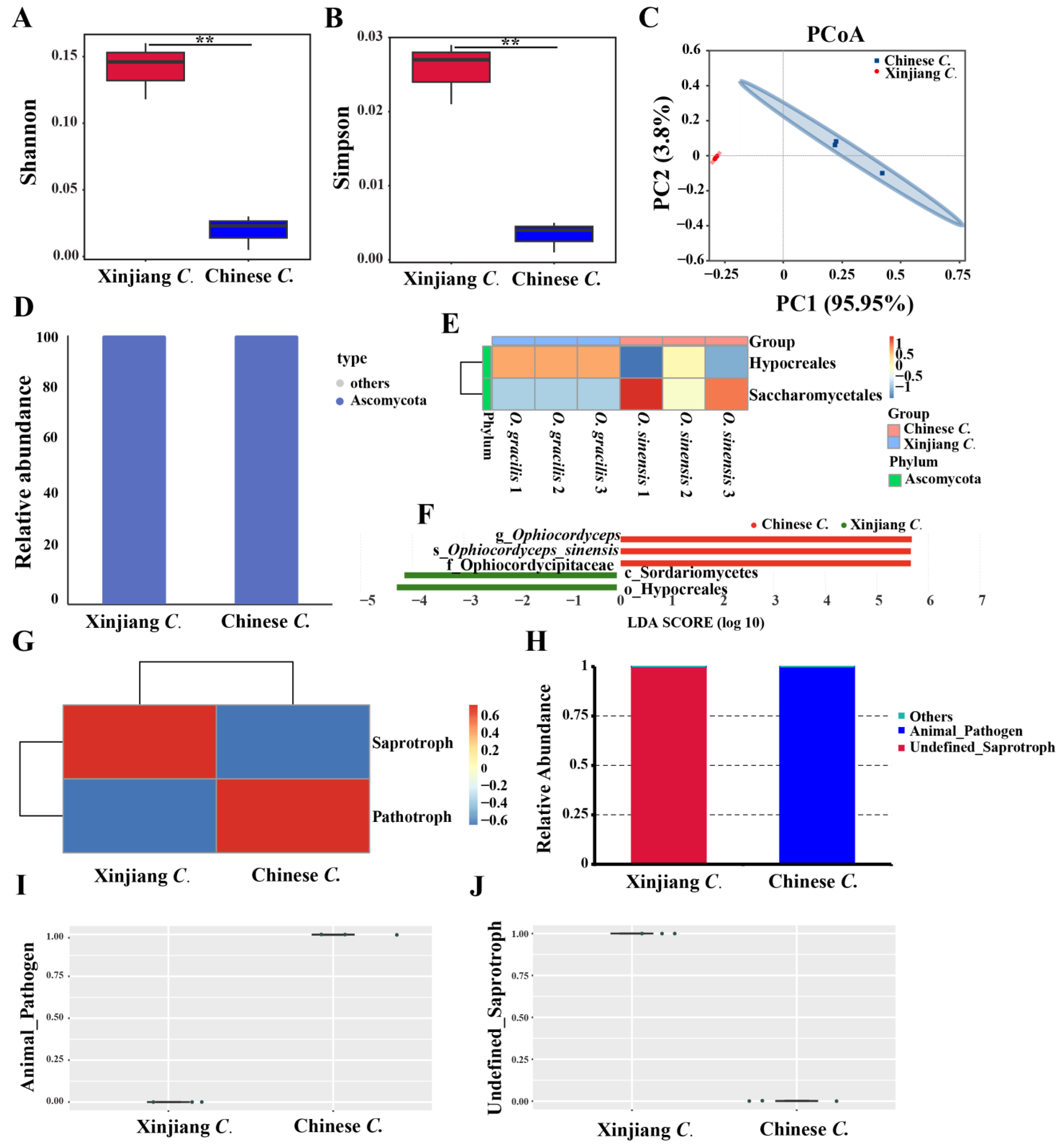
2.1. Comparative Analysis of Fungal Communities
2.2. Comparative Analysis of Bacterial Communities
2.3. Metabolic Variations Between Xinjiang and Chinese Cordyceps
2.4. Integrative Analysis of Microbiome and Metabolome
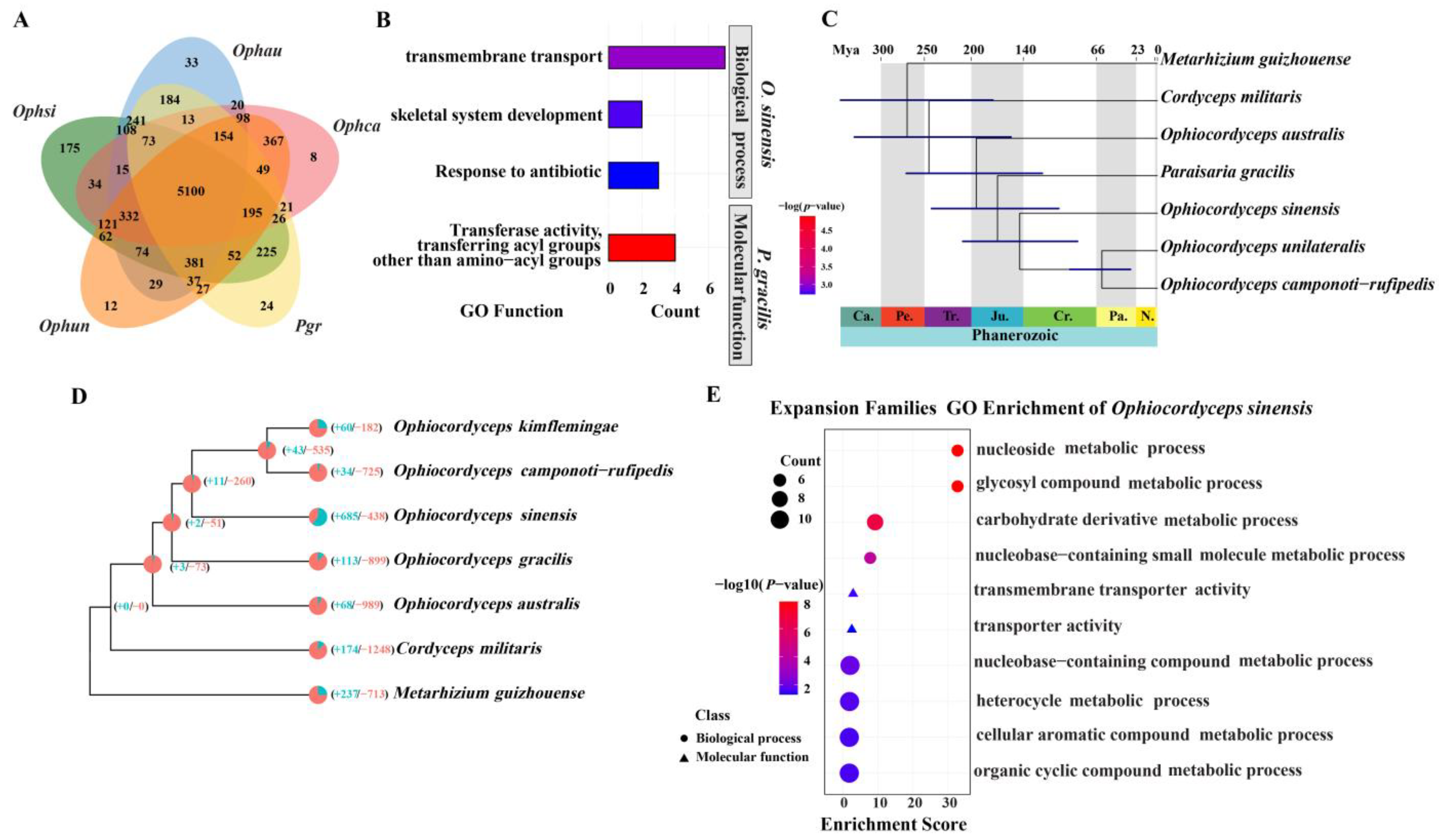
2.5. Comparative Genomic Analysis of P. gracilis and O. sinensis
3. Discussion
3.1. Microbial Communities Underpin Ecological Divergence of Xinjiang Cordyceps in the Sampled Populations
3.2. Genomic Basis for Divergent Host Adaptation Strategies in the Sampled Genomes
3.3. Metabolic Signatures of Ecological Divergence and Microbial Synergy in the Sampled Populations
3.4. Implications for Understanding Host–Microbe Coadaptation: Insights from Single-Site Samples
3.5. Limitations and Future Directions
4. Materials and Methods
4.1. Sample Collection
4.2. DNA Extraction and Amplicon Sequencing
4.3. Untargeted Metabolomics Analysis
4.4. Integrated Microbiome-Metabolome Analysis
4.5. Comparative Genomics Analysis
4.6. Statistical Analysis
5. Conclusions
Supplementary Materials
Author Contributions
Funding
Institutional Review Board Statement
Informed Consent Statement
Data Availability Statement
Acknowledgments
Conflicts of Interest
References
- Kaushik, V.; Singh, A.; Arya, A.; Sindhu, S.C.; Sindhu, A.; Singh, A. Enhanced production of cordycepin in Ophiocordyceps sinensis using growth supplements under submerged conditions. Biotechnol. Rep. 2020, 28, e00557. [Google Scholar] [CrossRef]
- Kepler, R.; Ban, S.; Nakagiri, A.; Bischoff, J.; Hywel-Jones, N.; Owensby, C.A.; Spatafora, J.W. The phylogenetic placement of hypocrealean insect pathogens in the genus Polycephalomyces: An application of One Fungus One Name. Fungal Biol. 2013, 117, 611–622. [Google Scholar] [CrossRef]
- Kepler, R.M.; Sung, G.H.; Harada, Y.; Tanaka, K.; Tanaka, E.; Hosoya, T.; Bischoff, J.F.; Spatafora, J.W. Host jumping onto close relatives and across kingdoms by Tyrannicordyceps (Clavicipitaceae) gen. nov. and Ustilaginoidea_(Clavicipitaceae). Am. J. Bot. 2012, 99, 552–561. [Google Scholar] [CrossRef]
- Li, X.; Liu, Q.; Li, W.; Li, Q.; Qian, Z.; Liu, X.; Dong, C. A breakthrough in the artificial cultivation of Chinese cordyceps on a large-scale and its impact on science, the economy, and industry. Crit. Rev. Biotechnol. 2019, 39, 181–191. [Google Scholar] [CrossRef] [PubMed]
- Wang, Y.; Tong, L.L.; Yuan, L.; Liu, M.Z.; Du, Y.H.; Yang, L.H.; Ren, B.; Guo, D.S. Integration of physiological, transcriptomic and metabolomic reveals molecular mechanism of Paraisaria dubia response to Zn2+ stress. J. Fungi 2023, 9, 693. [Google Scholar] [CrossRef] [PubMed]
- Li, W.; Xia, J.; Li, Q.; Zhang, Z.; Zhang, W.; Dong, C.; Wei, J.; Liu, X. Developmental recording of the ghost-moth larvae after ex situ infection by Ophiocordyceps sinensis. Sci. China Life Sci. 2020, 63, 1093–1095, Erratum in Sci. China Life Sci. 2023, 66, 892. [Google Scholar] [CrossRef] [PubMed]
- Zhang, J.; Yu, H.; Li, S.; Zhong, X.; Wang, H.; Liu, X. Comparative metabolic profiling of Ophiocordyceps sinensis and its cultured mycelia using GC-MS. Food Res. Int. 2020, 134, 109241. [Google Scholar] [CrossRef]
- Wang, Y.; Wei, S.; Lian, H.; Tong, L.; Yang, L.; Ren, B.; Guo, D.; Huang, H. A neutral polysaccharide from spores of Ophiocordyceps gracilis regulates oxidative stress via NRF2/FNIP1 pathway. Int. J. Mol. Sci. 2023, 24, 14721. [Google Scholar] [CrossRef]
- Wang, Y.; Tong, L.; Yang, L.; Ren, B.; Guo, D. Metabolite profiling and antioxidant capacity of natural Ophiocordyceps gracilis and its cultures using LC-MS/MS-based metabolomics: Comparison with Ophiocordyceps sinensis. Phytochem. Anal. 2024, 35, 308–320. [Google Scholar] [CrossRef]
- Sung, G.H.; Hywel-Jones, N.L.; Sung, J.M.; Luangsa-Ard, J.J.; Shrestha, B.; Spatafora, J.W. Phylogenetic classification of Cordyceps and the clavicipitaceous fungi. Stud. Mycol. 2007, 57, 5–59. [Google Scholar] [CrossRef]
- Wu, F.; Zhou, L.W.; Yang, Z.L.; Bau, T.; Lim, T.H.; Dai, Y.C. Resource diversity of Chinese macrofungi: Edible, medicinal and poisonous species. Fungal Divers. 2019, 98, 1–76. [Google Scholar] [CrossRef]
- Abuduaini, A.; Wang, Y.B.; Zhou, H.Y.; Kang, R.P.; Ding, M.L.; Jiang, Y.; Suo, F.Y.; Huang, L.D. The complete mitochondrial genome of Ophiocordyceps gracilis and its comparison with related species. IMA Fungus 2021, 12, 31. [Google Scholar] [CrossRef]
- Wang, Y.; Yang, L.H.; Tong, L.L.; Yuan, L.; Ren, B.; Guo, D.S. Comparative metabolic profiling of mycelia, fermentation broth, spore powder and fruiting bodies of Ophiocordyceps gracilis by LC-MS/MS. Phytochem. Anal. 2023, 34, 984–996. [Google Scholar] [CrossRef]
- Huang, L.D.; Ma, Y.F.; Wang, Y.; Manzilamu, Z.; Suo, F.Y. Research progress on resources, exploitation and utilization of Ophiocordyceps gracilis. Acta Edulis Fungi 2019, 26, 141–151. (In Chinese) [Google Scholar]
- Zhang, J.Z.; Fan, C.Z.; Qiu, Y.J.; Zhao, Y.Q.; Wang, G.P.; Li, X.J. Research progress on the Kazakh traditional medicinal material Ophiocordyceps gracilis from Xinjiang. Edible Med. Mushrooms 2020, 30, 405–411. (In Chinese) [Google Scholar]
- Xu, Y.; Cui, K.; Zhang, X.; Diwu, G.; Zhu, Y.; Deng, L.; Zhong, Y.; Yan, W. Shifts in fungal communities drive soil profile nutrient cycling during grassland restoration. mBio 2025, 16, e0283424. [Google Scholar] [CrossRef]
- Zhang, J.; Zhang, W.; Wu, X.; Fu, W.; Yang, C.; Long, N. Insights into the mycosphere fungal community and its association with nucleoside accumulation in Ophiocordyceps sinensis. J. Fungi 2025, 11, 696. [Google Scholar] [CrossRef] [PubMed]
- Zhang, L.; Yue, Q.; Wang, C.; Xu, Y.; Molnár, I. Secondary metabolites from hypocrealean entomopathogenic fungi: Genomics as a tool to elucidate the encoded parvome. Nat. Prod. Rep. 2020, 37, 1164–1180. [Google Scholar] [CrossRef] [PubMed]
- Xia, F.; Liu, Y.; Guo, M.Y.; Shen, G.R.; Lin, J.; Zhou, X.W. Pyrosequencing analysis revealed complex endogenetic microorganism community from natural DongChong XiaCao and its microhabitat. BMC Microbiol. 2016, 16, 196. [Google Scholar] [CrossRef]
- Sun, J.; Lu, F.; Luo, Y.; Bie, L.; Xu, L.; Wang, Y. OrthoVenn3: An integrated platform for exploring and visualizing orthologous data across genomes. Nucleic Acids Res. 2023, 51, W397–W403. [Google Scholar] [CrossRef] [PubMed]
- Li, N.; Li, J.; Feng, Z.; Wu, Z.; Gao, Q.; Wang, J.; Zhang, Y.; Chen, S.L.; Xing, R. Culture-dependent and -independent analyses reveal unique community structure and function in the external mycelial cortices of Ophiocordyceps sinensis. BMC Microbiol. 2025, 25, 78. [Google Scholar] [CrossRef] [PubMed]
- Yu, H.; Wang, Z.; Liu, L.; Xia, Y.; Cao, Y.; Yin, Y. Analysis of the intestinal microflora in Hepialus gonggaensis larvae Using 16S rRNA sequences. Curr. Microbiol. 2008, 48, 616–622. (In Chinese) [Google Scholar] [CrossRef]
- Xu, M.; Li, R.Q. Research progress on key scientific issues in the biology and ecology of Ophiocordyceps sinensis. Acta Ecol. Sin. 2019, 39, 1853–1862. (In Chinese) [Google Scholar]
- Santoyo, G.; Urtis-Flores, C.A.; Loeza-Lara, P.D.; Orozco-Mosqueda, M.D.C.; Glick, B.R. Rhizosphere colonization determinants by plant growth-promoting rhizobacteria (PGPR). Biology 2021, 10, 475. [Google Scholar] [CrossRef]
- Eren Eroğlu, A.E.; Eroğlu, V.; Yaşa, İ. Genomic insights into the symbiotic and plant growth-promoting traits of “Candidatus Phyllobacterium onerii” sp. nov. isolated from endemic astragalus flavescens. Microorganisms 2024, 12, 336. [Google Scholar] [CrossRef]
- Chandola, U.; Manirakiza, E.; Maillard, M.; Lavier Aydat, L.J.; Camuel, A.; Trottier, C.; Tanaka, A.; Chaumier, T.; Giraud, E.; Tirichine, L. A Bradyrhizobium isolate from a marine diatom induces nitrogen-fixing nodules in a terrestrial legume. Nat. Microbiol. 2025, 10, 2486–2497. [Google Scholar] [CrossRef]
- Takeguchi, Y.; Shibuya, R.; Kondo, M.; Betsuyaku, E.; Itakura, M.; Minamisawa, K.; Sugawara, M.; Betsuyaku, S. Unipolar polysaccharide-mediated attachment of the N2O-reducing bacterium Bradyrhizobium ottawaense SG09 to plant roots. Microbes Environ. 2025, 40, ME250433. [Google Scholar] [CrossRef] [PubMed]
- Yu, J.R.; Li, S.A.; Zhao, D.X.; Martin, F.M.; Yuan, H.S. Host adaptation is driving genome evolution and ecological speciation in the ectomycorrhizal basidiomycete Tricholoma. J. Syst. Evol. 2025, 63, 1344–1357. [Google Scholar] [CrossRef]
- Wei, Y.; Zhang, L.; Wang, J.; Wang, W.; Niyati, N.; Guo, Y.; Wang, X. Chinese caterpillar fungus (Ophiocordyceps sinensis) in China: Current distribution, trading, and futures under climate change and overexploitation. Sci. Total Environ. 2021, 755, 142548. [Google Scholar] [CrossRef] [PubMed]
- Xing, X.K.; Guo, S.X. The structure and histochemistry of sclerotia of Ophiocordyceps sinensis. Mycologia 2008, 100, 616–625. [Google Scholar] [CrossRef]
- Tong, X.; Peng, T.; Liu, S.; Zhang, D.; Guo, J. Transcriptomic analysis insight into the immune modulation during the interaction of Ophiocordyceps sinensis and Hepialus xiaojinensis. Insects 2022, 13, 1119. [Google Scholar] [CrossRef] [PubMed]
- Wei, Q.Y.; Yue, Y.; He, Y.C.; Chen, S.J. Research on the impact of Ophiocordyceps sinensis fungus colonization on the transmembrane transport efficiency of energy substances in the larvae of Hepialus Xiaojinensis. Asia-Pac. Tradit. Med. 2025, 21, 17–22. [Google Scholar]
- Guo, L.X.; Hong, Y.H.; Zhou, Q.Z.; Zhu, Q.; Xu, X.M.; Wang, J.H. Fungus-larva relation in the formation of Cordyceps sinensis as revealed by stable carbon isotope analysis. Sci. Rep. 2017, 7, 7789, Correction in Sci. Rep. 2018, 8, 5028. [Google Scholar] [CrossRef]
- Sun, T.; Jin, Y.; Rao, Z.; Liyan, W.; Tang, R.; Zaryab, K.M.; Li, M.; Li, Z.; Wang, Y.; Xu, J.; et al. Knockdown of Thitarodes host genes influences dimorphic transition of Ophiocordyceps sinensis in the host hemolymph. Front. Cell Infect. Microbiol. 2024, 14, 1451628. [Google Scholar] [CrossRef]
- Zhao, X.; Yu, Y.; Clapham, M.E.; Yan, E.; Chen, J.; Jarzembowski, E.A.; Zhao, X.; Wang, B. Early evolution of beetles regulated by the end-Permian deforestation. eLife 2021, 10, e72692. [Google Scholar] [CrossRef]
- Prokop, J.; Nel, A.; Engel, M.S. Diversity, form, and postembryonic development of paleozoic insects. Annu. Rev. Entomol. 2023, 68, 401–429. [Google Scholar] [CrossRef]
- Dal Corso, J.; Newton, R.J.; Zerkle, A.L.; Chu, D.; Song, H.; Song, H.; Tian, L.; Tong, J.; Di Rocco, T.; Claire, M.W.; et al. Repeated pulses of volcanism drove the end-Permian terrestrial crisis in northwest China. Nat. Commun. 2024, 15, 7628. [Google Scholar] [CrossRef]
- Zheng, D.; Chang, S.C.; Wang, H.; Fang, Y.; Wang, J.; Feng, C.; Xie, G.; Jarzembowski, E.A.; Zhang, H.; Wang, B. Middle-Late triassic insect radiation revealed by diverse fossils and isotopic ages from China. Sci. Adv. 2018, 4, eaat1380. [Google Scholar] [CrossRef] [PubMed]
- Holländer-Czytko, H.; Grabowski, J.; Sandorf, I.; Weckermann, K.; Weiler, E.W. Tocopherol content and activities of tyrosine aminotransferase and cystine lyase in Arabidopsis under stress conditions. J. Plant Physiol. 2005, 162, 767–770. [Google Scholar] [CrossRef] [PubMed]
- Phung, T.H.; Jung, S. Differential antioxidant defense and detoxification mechanisms in photodynamically stressed rice plants treated with the deregulators of porphyrin biosynthesis, 5-aminolevulinic acid and oxyfluorfen. Biochem. Biophys. Res. Commun. 2015, 459, 346–351. [Google Scholar] [CrossRef]
- Ciacka, K.; Tyminski, M.; Wal, A.; Gniazdowska, A.; Krasuska, U. Nitric oxide-an antidote to seed aging modifies meta-tyrosine content and expression of aging-linked genes in apple embryos. Front. Plant Sci. 2022, 13, 929245. [Google Scholar] [CrossRef]
- Arias-Barrau, E.; Olivera, E.R.; Luengo, J.M.; Fernández, C.; Galán, B.; García, J.L.; Díaz, E.; Miñambres, B. The homogentisate pathway: A central catabolic pathway involved in the degradation of L-phenylalanine, L-tyrosine, and 3-hydroxyphenylacetate in Pseudomonas putida. J. Bacteriol. 2004, 186, 5062–5077. [Google Scholar] [CrossRef]
- Norman, B.P.; Davison, A.S.; Hughes, J.H.; Sutherland, H.; Wilson, P.J.; Berry, N.G.; Hughes, A.T.; Milan, A.M.; Jarvis, J.C.; Roberts, N.B.; et al. Metabolomic studies in the inborn error of metabolism alkaptonuria reveal new biotransformations in tyrosine metabolism. Genes. Dis. 2021, 9, 1129–1142. [Google Scholar] [CrossRef]
- Molnár, G.A.; Kun, S.; Sélley, E.; Kertész, M.; Szélig, L.; Csontos, C.; Böddi, K.; Bogár, L.; Miseta, A.; Wittmann, I. Role of tyrosine isomers in acute and chronic diseases leading to oxidative stress—A review. Curr. Med. Chem. 2016, 23, 667–685. [Google Scholar] [CrossRef]
- Staszek, P.; Krasuska, U.; Ciacka, K.; Gniazdowska, A. ROS metabolism perturbation as an element of mode of action of allelochemicals. Antioxidants 2021, 10, 1648. [Google Scholar] [CrossRef]
- Nazemi, M.; Yanes, B.; Martinez, M.L.; Walker, H.J.; Pham, K.; Collins, M.O.; Bard, F.; Rainero, E. The extracellular matrix supports breast cancer cell growth under amino acid starvation by promoting tyrosine catabolism. PLoS Biol. 2024, 22, e3002406. [Google Scholar] [CrossRef]
- Sasidharan, S.; Saudagar, P. Biochemical and structural characterization of tyrosine aminotransferase suggests broad substrate specificity and a two-state folding mechanism in Leishmania donovani. FEBS Open Bio 2019, 9, 1769–1783. [Google Scholar] [CrossRef]
- Chass, G.; Lovas, S.; Murphy, R.; Csizmadia, I. The role of enhanced aromatic -electron donating aptitude of the tyrosyl sidechain with respect to that of phenylalanyl in intramolecular interactions. Eur. Phys. J. D 2002, 20, 481–497. [Google Scholar] [CrossRef]
- Belot, A.; Puy, H.; Hamza, I.; Bonkovsky, H.L. Update on heme biosynthesis, tissue-specific regulation, heme transport, relation to iron metabolism and cellular energy. Liver Int. 2024, 44, 2235–2250. [Google Scholar] [CrossRef]
- Yu, F.; Wang, Z.; Zhang, Z.; Zhou, J.; Li, J.; Chen, J.; Du, G.; Zhao, X. Biosynthesis, acquisition, regulation, and upcycling of heme: Recent advances. Crit. Rev. Biotechnol. 2024, 44, 1422–1438. [Google Scholar] [CrossRef]
- Arab, B.; Moo-Young, M.; Liu, Y.; Chou, C.P. Manipulating intracellular oxidative conditions to enhance porphyrin production in Escherichia coli. Bioengineering 2025, 12, 83. [Google Scholar] [CrossRef]
- Phung, T.H.; Jung, H.I.; Park, J.H.; Kim, J.G.; Back, K.; Jung, S. Porphyrin biosynthesis control under water stress: Sustained porphyrin status correlates with drought tolerance in transgenic rice. Plant Physiol. 2011, 157, 1746–1764. [Google Scholar] [CrossRef]
- Ramos-Martín, F.; D’Amelio, N. Biomembrane lipids: When physics and chemistry join to shape biological activity. Biochimie 2022, 203, 118–138. [Google Scholar] [CrossRef]
- Zhang, Y.; Li, H.; Yuan, S.; Wu, H.; Liu, X.; Zhang, J. NADPH-cytochrome P450 reductase knockdown decreases the response to precocene I in the migratory locust Locusta migratoria. Pestic. Biochem. Physiol. 2023, 190, 105337. [Google Scholar] [CrossRef]
- Monteiro, K.K.A.C.; Shiroma, M.E.; Damous, L.L.; Simões, M.J.; Simões, R.D.S.; Cipolla-Neto, J.; Baracat, E.C.; Soares-Jr, J.M. Antioxidant sctions of melatonin: A systematic review of animal studies. Antioxidants 2024, 13, 439. [Google Scholar] [CrossRef]
- Olatunji, O.J.; Tang, J.; Tola, A.; Auberon, F.; Oluwaniyi, O.; Ouyang, Z. The genus Cordyceps: An extensive review of its traditional uses, phytochemistry and pharmacology. Fitoterapia 2018, 129, 293–316. [Google Scholar] [CrossRef]
- Krishna, K.V.; Ulhas, R.S.; Malaviya, A. Bioactive compounds from Cordyceps and their therapeutic potential. Crit. Rev. Biotechnol. 2024, 44, 753–773. [Google Scholar] [CrossRef]
- Wieder, C.; Frainay, C.; Poupin, N.; Rodríguez-Mier, P.; Vinson, F.; Cooke, J.; Lai, R.P.; Bundy, J.G.; Jourdan, F.; Ebbels, T. Pathway analysis in metabolomics: Recommendations for the use of over-representation analysis. PLoS Comput. Biol. 2021, 17, e1009105. [Google Scholar] [CrossRef]
- Jansma, J.; El Aidy, S. Understanding the host-microbe interactions using metabolic modeling. Microbiome 2021, 9, 16. [Google Scholar] [CrossRef]
- Zuffa, S.; Schmid, R.; Bauermeister, A.; Gomes, P.W.P.; Caraballo-Rodriguez, A.M.; El Abiead, Y.; Aron, A.T.; Gentry, E.C.; Zemlin, J.; Meehan, M.J.; et al. microbeMASST: A taxonomically informed mass spectrometry search tool for microbial metabolomics data. Nat. Microbiol. 2024, 9, 336–345. [Google Scholar] [CrossRef]
- Liu, X.; Zhao, J.; Liu, J.; Deng, W.; Yan, L.; Huang, Y.; Zhang, L.; Liu, Z.; Cui, M.; Xiao, H.; et al. Ganoderma lucidum sporoderm-broken spore powder alleviates kidney aging by modulating gut microbiota. J. Ethnopharmacol. 2025, 353, 120344. [Google Scholar] [CrossRef]
- Law, S.K.; Au, D.C.T. A review of medicine and food homology on traditional Chinese medicine as functional food. Food Med. Homol. 2026, 3, 9420091. [Google Scholar] [CrossRef]
- Sun, T.; Zou, W.; Luo, R.; Li, C.; Zhang, C.; Yu, H. Compositional and functional diversities of core microbial communities in wild and artificial Ophiocordyceps sinensis. Int. Microbiol. 2023, 26, 791–806. [Google Scholar] [CrossRef]
- de Bekker, C.; Ohm, R.A.; Loreto, R.G.; Sebastian, A.; Albert, I.; Merrow, M.; Brachmann, A.; Hughes, D.P. Gene expression during zombie ant biting behavior reflects the complexity underlying fungal parasitic behavioral manipulation. BMC Genom. 2015, 16, 620. [Google Scholar] [CrossRef]
- de Bekker, C.; Ohm, R.A.; Evans, H.C.; Brachmann, A.; Hughes, D.P. Ant-infecting Ophiocordyceps genomes reveal a high diversity of potential behavioral manipulation genes and a possible major role for enterotoxins. Sci. Rep. 2017, 7, 12508. [Google Scholar] [CrossRef]
- Shu, R.; Zhang, J.; Meng, Q.; Zhang, H.; Zhou, G.; Li, M.; Wu, P.; Zhao, Y.; Chen, C.; Qin, Q. A new high-quality draft genome assembly of the Chinese Cordyceps Ophiocordyceps sinensis. Genome Biol. Evol. 2020, 12, 1074–1079. [Google Scholar] [CrossRef]
- Emms, D.M.; Kelly, S. OrthoFinder: Phylogenetic orthology inference for comparative genomics. Genome Biol. 2019, 20, 238. [Google Scholar] [CrossRef]
- Yang, Z. PAML 4: Phylogenetic analysis by maximum likelihood. Mol. Biol. Evol. 2007, 24, 1586–1591. [Google Scholar] [CrossRef]
- Kumar, S.; Suleski, M.; Craig, J.M.; Kasprowicz, A.E.; Sanderford, M.; Li, M.; Stecher, G.; Hedges, S.B. TimeTree 5: An expanded resource for species divergence times. Mol. Biol. Evol. 2022, 39, msac174. [Google Scholar] [CrossRef]
- Sung, G.H.; Poinar, G.O.; Spatafora, J.W., Jr. The oldest fossil evidence of animal parasitism by fungi supports a Cretaceous diversification of fungal-arthropod symbioses. Mol. Phylogenet Evol. 2008, 49, 495–502. [Google Scholar] [CrossRef]
- Shen, X.X.; Steenwyk, J.L.; LaBella, A.L.; Opulente, D.A.; Zhou, X.; Kominek, J.; Li, Y.; Groenewald, M.; Hittinger, C.T.; Rokas, A. Genome-scale phylogeny and contrasting modes of genome evolution in the fungal phylum Ascomycota. Sci. Adv. 2020, 6, eabd0079. [Google Scholar] [CrossRef] [PubMed]
- Mendes, F.K.; Vanderpool, D.; Fulton, B.; Hahn, M.W. CAFE 5 models variation in evolutionary rates among gene families. Bioinformatics 2021, 36, 5516–5518. [Google Scholar] [CrossRef]



| Node | Expansion Genes | Decrease Genes | Remain Genes | Expansion Genes (p < 0.05) | Decrease Genes (p < 0.05) | Expansion Families (p < 0.05) | Decrease Families (p < 0.05) |
|---|---|---|---|---|---|---|---|
| Cordyceps militaris (1) | 174 | 1248 | 5828 | 41 | 8 | 16 | 4 |
| Paraisaria gracilis (2) | 113 | 899 | 6238 | 33 | 6 | 11 | 3 |
| O. sinensis (3) | 685 | 438 | 6127 | 98 | 2 | 39 | 1 |
| O. camponoti-rufipedis (4) | 34 | 725 | 6491 | 2 | 6 | 1 | 3 |
| O. unilateralis (5) | 60 | 182 | 7008 | 8 | 4 | 4 | 2 |
| O.australis (6) | 69 | 989 | 6192 | 14 | 8 | 6 | 4 |
| Metarhizium guizhouense (7) | 237 | 713 | 6300 | 60 | 0 | 20 | 0 |
| 8 | Null | Null | Null | Null | Null | Null | Null |
| 9 | 0 | 0 | 7250 | 0 | 0 | 0 | 0 |
| 10 | 3 | 73 | 7174 | 1 | 20 | 1 | 8 |
| 11 | 2 | 51 | 7197 | 2 | 2 | 2 | 1 |
| 12 | 11 | 260 | 6979 | 5 | 2 | 4 | 1 |
| 13 | 43 | 535 | 6672 | 5 | 4 | 2 | 2 |
| Species | Stain | Host | GenBank |
|---|---|---|---|
| Ophiocordyceps unilateralis | SC16a | Camponotus castaneus | GCA_001272575.2 |
| Ophiocordyceps camponoti-rufipedis | Map16 | Camponotus rufipes | GCA_002591395.1 |
| Ophiocordyceps australis | Map64 | Ponerinae sp. | GCA_002591415.1 |
| Ophiocordyceps sinensis | IOZ07 | Hepialus xiaojinensis | GCA_012934285.1 |
| Paraisaria gracilis | MB504277 | Lepidoptera | GCA_051529295.1 |
| Cordyceps militaris | CM01 | Lepidoptera | GCA_000225605.1 |
| Metarhizium guizhouense | ARSEF977 | Widespread in insects and nematodes | GCA_000814955.1 |
Disclaimer/Publisher’s Note: The statements, opinions and data contained in all publications are solely those of the individual author(s) and contributor(s) and not of MDPI and/or the editor(s). MDPI and/or the editor(s) disclaim responsibility for any injury to people or property resulting from any ideas, methods, instructions or products referred to in the content. |
© 2026 by the authors. Licensee MDPI, Basel, Switzerland. This article is an open access article distributed under the terms and conditions of the Creative Commons Attribution (CC BY) license.
Share and Cite
Ding, Y.; Liu, T.; Guo, S.; Zhu, J.; Zhu, J.; Tang, Q.; Jia, Q.; Li, J.; Zhang, Z.; Liu, X. Integrative Multi-Omics Reveals Microbiome and Genome Streamlining Underlie Ecological Divergence in Chinese and Xinjiang Cordyceps: A Preliminary Study. Int. J. Mol. Sci. 2026, 27, 5241. https://doi.org/10.3390/ijms27125241
Ding Y, Liu T, Guo S, Zhu J, Zhu J, Tang Q, Jia Q, Li J, Zhang Z, Liu X. Integrative Multi-Omics Reveals Microbiome and Genome Streamlining Underlie Ecological Divergence in Chinese and Xinjiang Cordyceps: A Preliminary Study. International Journal of Molecular Sciences. 2026; 27(12):5241. https://doi.org/10.3390/ijms27125241
Chicago/Turabian StyleDing, Yanpeng, Tongyao Liu, Shengting Guo, Jieying Zhu, Jing Zhu, Qiyong Tang, Qiong Jia, Jianlong Li, Zhidong Zhang, and Xiaojing Liu. 2026. "Integrative Multi-Omics Reveals Microbiome and Genome Streamlining Underlie Ecological Divergence in Chinese and Xinjiang Cordyceps: A Preliminary Study" International Journal of Molecular Sciences 27, no. 12: 5241. https://doi.org/10.3390/ijms27125241
APA StyleDing, Y., Liu, T., Guo, S., Zhu, J., Zhu, J., Tang, Q., Jia, Q., Li, J., Zhang, Z., & Liu, X. (2026). Integrative Multi-Omics Reveals Microbiome and Genome Streamlining Underlie Ecological Divergence in Chinese and Xinjiang Cordyceps: A Preliminary Study. International Journal of Molecular Sciences, 27(12), 5241. https://doi.org/10.3390/ijms27125241