Review

Modeling the Clockwork of Bone: A Narrative Review of Experimental Approaches to Circadian Rhythm in Bone Metabolism


Siegfried Weller Research Institute, BG Unfallklinik Tuebingen, Department of Trauma and Reconstructive Surgery, University of Tuebingen, Schnarrenbergstr. 95, D-72076 Tuebingen, Germany
*
Author to whom correspondence should be addressed.
Int. J. Mol. Sci. 2026, 27(12), 5167; https://doi.org/10.3390/ijms27125167 (registering DOI)
Submission received: 21 April 2026 / Revised: 29 May 2026 / Accepted: 4 June 2026 / Published: 7 June 2026

Abstract

Circadian rhythms are fundamental regulators of skeletal homeostasis, coordinating osteoblast and osteoclast activity through tightly controlled temporal programs. Disruption of these rhythms, whether through environmental misalignment or genetic perturbation of core clock components, alters bone formation, enhances resorption, and contributes to skeletal fragility. This review synthesizes current knowledge on circadian regulation of bone biology across in vivo, ex vivo, and in vitro model systems, highlighting how each platform reveals distinct aspects of rhythmic gene expression, cellular function, and tissue-level remodeling. We critically evaluate the strengths and limitations of these models, outline key controversies such as the interpretation of global clock-gene knockouts, and discuss the emerging relevance of human-derived systems including iPSC-based models, organoids, and microphysiological “bone-on-chip” platforms. Integrative approaches that combine multiple model systems provide the most reliable framework for understanding circadian control of bone and for identifying targets for chronotherapeutic intervention. Advancing human-relevant models and refining temporal experimental design will be essential for translating circadian biology into clinical strategies for metabolic bone diseases.

1. Introduction

Circadian rhythms are fundamental regulators of physiological homeostasis, coordinating metabolic, endocrine, immune, and behavioral processes across multiple organ systems [1,2,3,4,5,6,7]. Recent evidence has demonstrated that these rhythms also play a direct and mechanistically relevant role in skeletal biology, influencing the temporal coordination of osteoblast, osteoclast, and osteocyte activity [8,9,10,11,12]. Despite growing interest in this field, the mechanistic pathways linking circadian oscillations to bone remodeling remain only partially defined, and existing studies often differ in experimental design, model selection, and temporal resolution. Disruptions of circadian homeostasis arising from shift work, jet lag, aging, or genetic alterations have been associated with impaired bone mineral density, delayed fracture healing, and increased skeletal fragility [10,11,12,13,14]. At the molecular level, core clock genes such as Bmal1, Clock, Per1/2, and Cry1/2 exhibit rhythmic expression in bone tissue and regulate key markers of bone formation and resorption, including RANKL, OPG, CTX, PINP, ALP, and TRAP [15,16]. Misalignment of these pathways may alter the temporal coupling of bone formation and resorption, thereby contributing to metabolic bone disorders. To provide a more integrated and mechanistically informative perspective, this review critically evaluates the experimental approaches used to investigate circadian regulation in bone metabolism, including in vivo, ex vivo, and in vitro systems. We highlight their respective strengths, limitations, and translational relevance, and we synthesize key findings that illuminate how circadian rhythms shape skeletal homeostasis.
In response to recent advances in the field, we further incorporate emerging human-relevant platforms, 3D co-culture systems, and microphysiological models, and we discuss unresolved controversies, methodological challenges, and opportunities for chronotherapeutic applications.

2. Search Strategy

A comprehensive literature search was conducted using the PubMed database to identify studies investigating the interplay between circadian rhythms and bone biology.
To enhance methodological transparency and reproducibility, we refined the search workflow and explicitly defined the review as a narrative review with systematic elements.
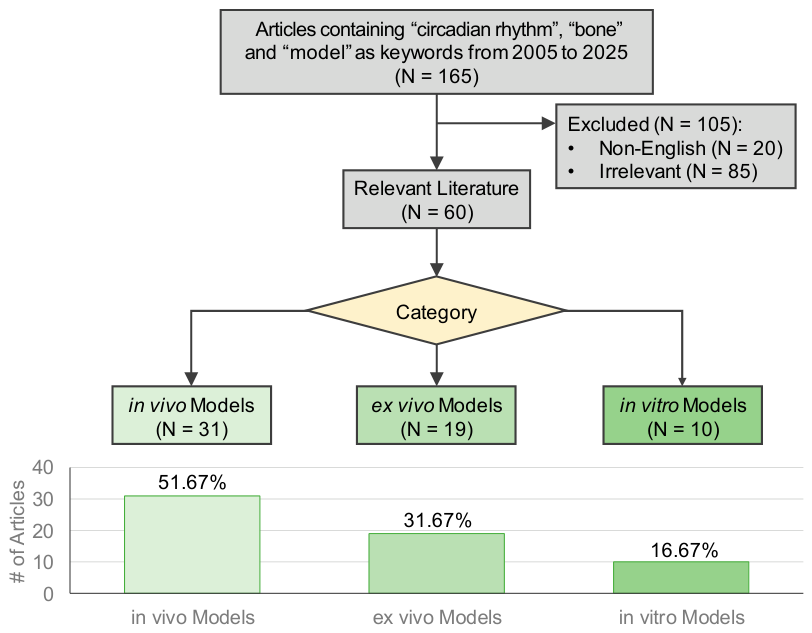
The search covered the period from July 2005 to July 2025 and used the keywords “circadian rhythm”, “bone”, and “model”. All article types, including original research and reviews, were considered. The initial search yielded 165 records.
The search covered the period from July 2005 to July 2025 and used the keywords “circadian rhythm”, “bone”, and “model”. All article types, including original research and reviews, were considered. The initial search yielded 165 records. Inclusion criteria were: (1) explicit investigation of circadian regulation in bone or bone-related cells; (2) use of an identifiable experimental model (in vivo, ex vivo, or in vitro); and (3) availability of full text in English. Exclusion criteria included (1) studies addressing only circadian biology without skeletal relevance; (2) studies on bone biology without circadian endpoints; and (3) non-English publications.
After screening, 60 articles met the criteria, comprising 48 original research papers and 12 reviews. Duplicate entries were removed. A PRISMA-style flow diagram has been added to illustrate the search workflow and study selection process (Figure 1).

3. Model Systems

3.1. In Vivo Model Systems

In vivo models are indispensable for exploring the interplay between circadian rhythms and bone metabolism. By preserving the physiological context of a living organism, these models enable the study of bone remodeling processes under the influence of systemic factors such as hormonal signaling, immune responses, neural regulation, and mechanical loading. Rodents, particularly mice, are commonly employed in this field due to their genetic tractability and physiological similarities to the human circadian system.
Murine in vivo systems can be broadly categorized into (1) environmental disruption models and (2) genetic manipulation models, each providing distinct insights into circadian regulation of skeletal physiology.
Environmental disruption models frequently employ jet-lag–like protocols, such as shifting the light–dark cycle by eight hours every three days [17] or exposing animals to weekly alternating bright/dim cycles [18,19]. While continuous inversion of the bright–dim cycle primarily exacerbates inflammation-associated bone degradation [19], repeated weekly shifts induce pronounced trabecular and cortical bone loss, highlighting the sensitivity of skeletal tissue to chronic circadian misalignment [18,19]. Importantly, gestational exposure to circadian disruption has been shown to impair bone development in offspring, suggesting transgenerational effects of rhythm perturbation [17]. Similar findings have been reported in periodontal disease models, where circadian disruption exacerbates alveolar bone loss and alters macrophage-mediated inflammatory responses [20,21,22,23].
To counter these effects, therapeutic interventions have been explored, notably melatonin, a hormone closely linked to circadian regulation. In experimental models, melatonin has been reported to restore rhythmic stability and attenuate bone degeneration, suggesting potential utility as an adjunctive strategy for conditions such as osteoporosis—for review see [24,25]. However, the magnitude and timing of melatonin’s skeletal effects remain variable across studies, underscoring the need for standardized temporal dosing paradigms.
Genetic knockout models provide deeper insight into the molecular basis of skeletal health. For example, removal of BMAL1, a core clock gene, has been shown to interfere with osteoblast maturation [26], resulting in reduced bone formation and an osteoporosis-like phenotype—for review see [27]. However, global Bmal1 knockouts also exhibit premature aging, sarcopenia, altered feeding behavior, and hormonal dysregulation, complicating the interpretation of bone-specific phenotypes. To address this, conditional knockouts (e.g., Bmal1fl/fl; Ocn-Cre or Bmal1fl/fl; LysM-Cre) have been developed to isolate cell-type-specific circadian effects on osteoblasts and osteoclasts.
In addition to mouse models, researchers have employed other species to investigate circadian effects on bone metabolism, including laying hens. Dietary phosphate feeding regimens showed circadian effects on eggshell deposition and thus eggshell quality [28]. Simultaneously, medullary bone samples collected showed inverse regulation of bone metabolism (eggshell strengthening led to bone weakening), as detected by osteoblast and osteoclast function [28]. These findings illustrate how circadian-driven mineral mobilization can differentially affect skeletal compartments.
A major strength of in vivo systems is their capacity to preserve endogenous circadian synchronization across multiple tissues. This feature enables the study of complex intercellular and inter-organ interactions and facilitates modeling of bone-related pathologies such as osteoporosis, diabetes, and periodontitis [6,21,23,25,29,30]. Advanced genetic tools, including transgenic reporter lines (e.g., Per1: Luc mice), further enhance the precision of these investigations by enabling real-time monitoring of clock gene activity in bone cells [31,32].
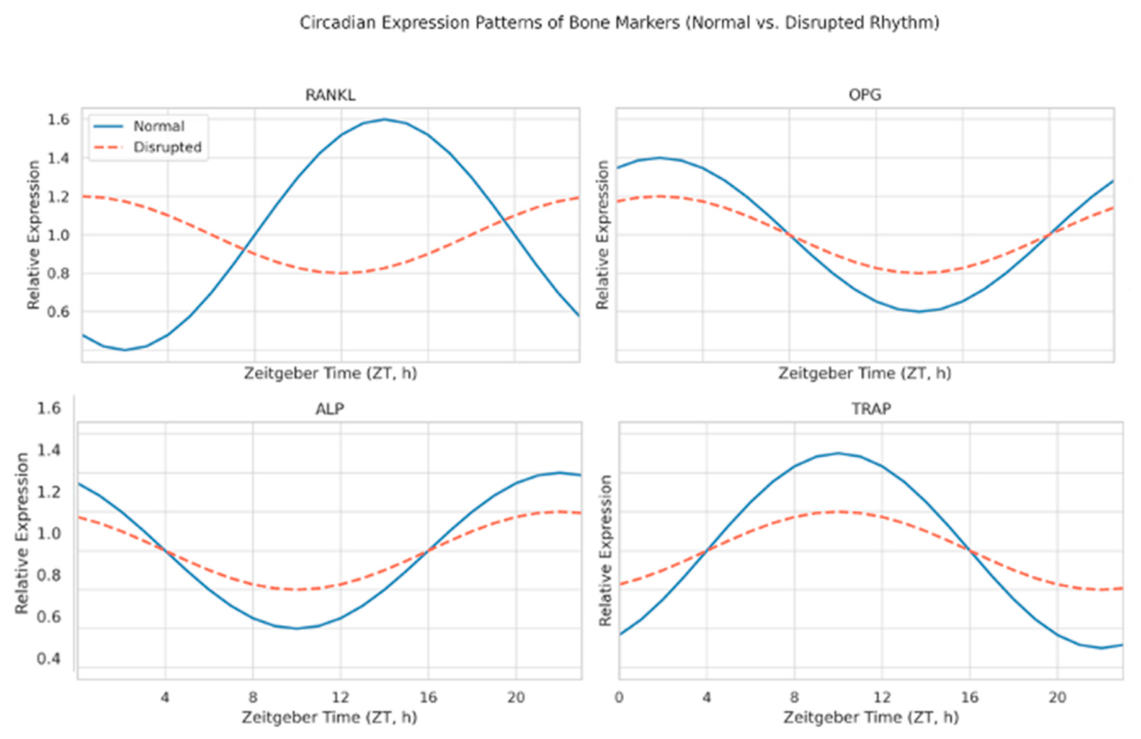
Rhythmic bone cell function is typically assessed by measuring serum biomarkers of bone formation and resorption, as well as regulatory markers [16,33,34] (Figure 2). Bone formation markers: PINP, PICP, osteocalcin (OCN), bone-specific ALP, Bone resorption markers: CTX, NTX, CAII, TRAP, cathepsin K, Bone metabolism regulatory markers: RANKL, OPG, fibroblast growth factor 23, leptin.
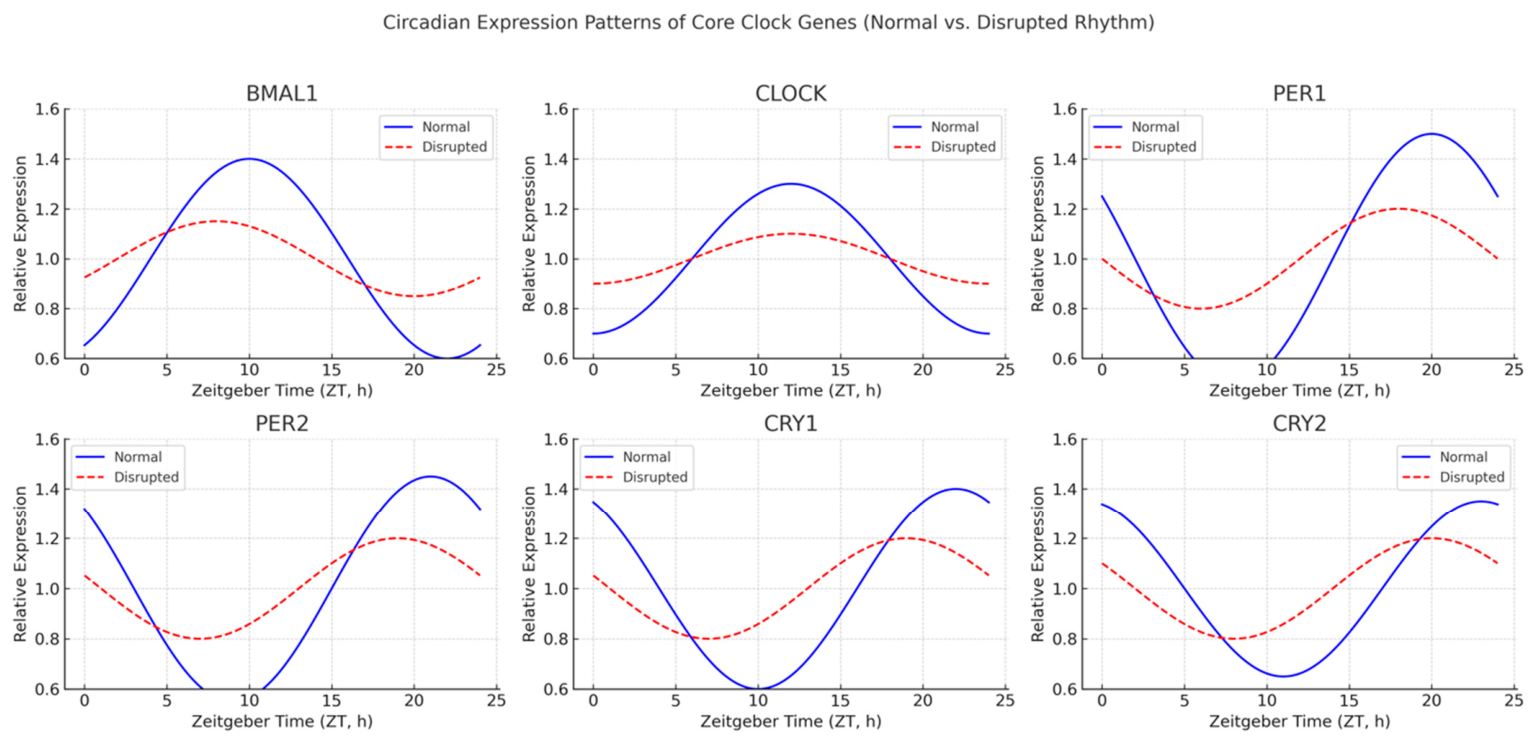
Additionally, expression levels of core circadian genes (Bmal1, Clock, Per1/2, Cry1/2) can be quantified in bone tissue using qRT-PCR, in situ hybridization, or bioluminescence imaging. Hormones with circadian variation, such as melatonin, are also monitored through timed blood sampling to evaluate endocrine influences on bone remodeling—for review see [24,25,36]. The oscillatory behavior of core clock genes in bone tissue is illustrated in Figure 3.
Despite their advantages, in vivo models face several challenges. Their systemic complexity introduces confounding factors (e.g., altered locomotor activity, feeding behavior, hormonal rhythms), making it difficult to attribute skeletal changes solely to circadian mechanisms. Moreover, these studies are resource-intensive and must comply with rigorous ethical standards. Collecting samples at multiple time-points, which is essential for circadian analysis, is technically demanding and may itself disrupt physiological rhythms. Furthermore, anesthesia, euthanasia timing (ZT vs. CT), and stress responses can significantly bias gene expression and biomarker measurements, a methodological issue often underreported in the literature.
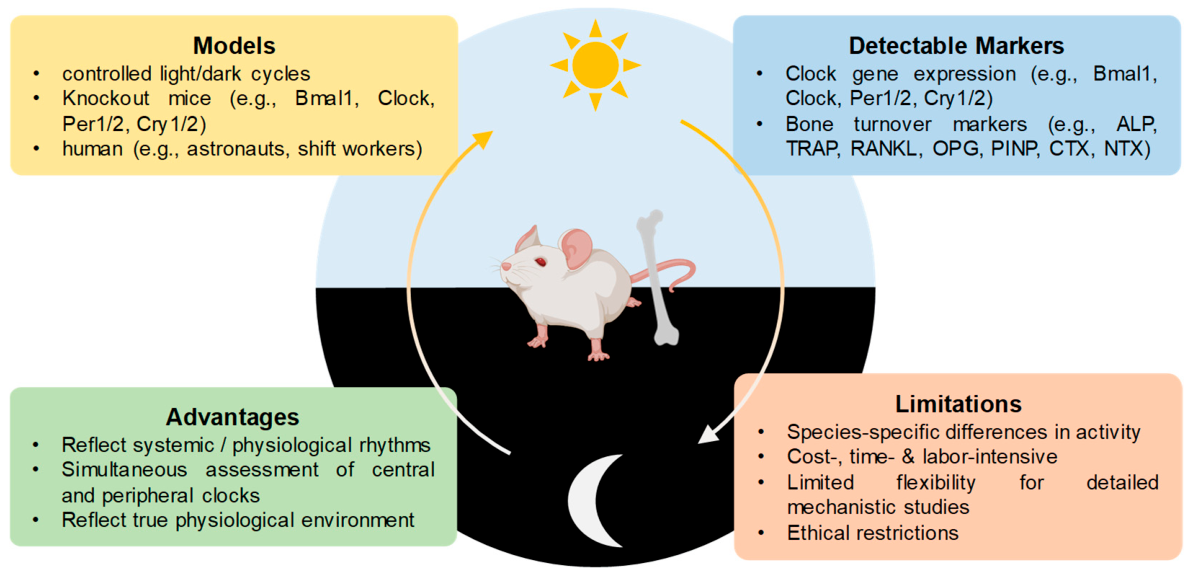
In summary, in vivo models remain the cornerstone of circadian bone research due to their physiological relevance, but careful experimental design and temporal control are essential to avoid misinterpretation of systemic versus bone-intrinsic circadian effects (Figure 4).

3.2. Ex Vivo Model Systems

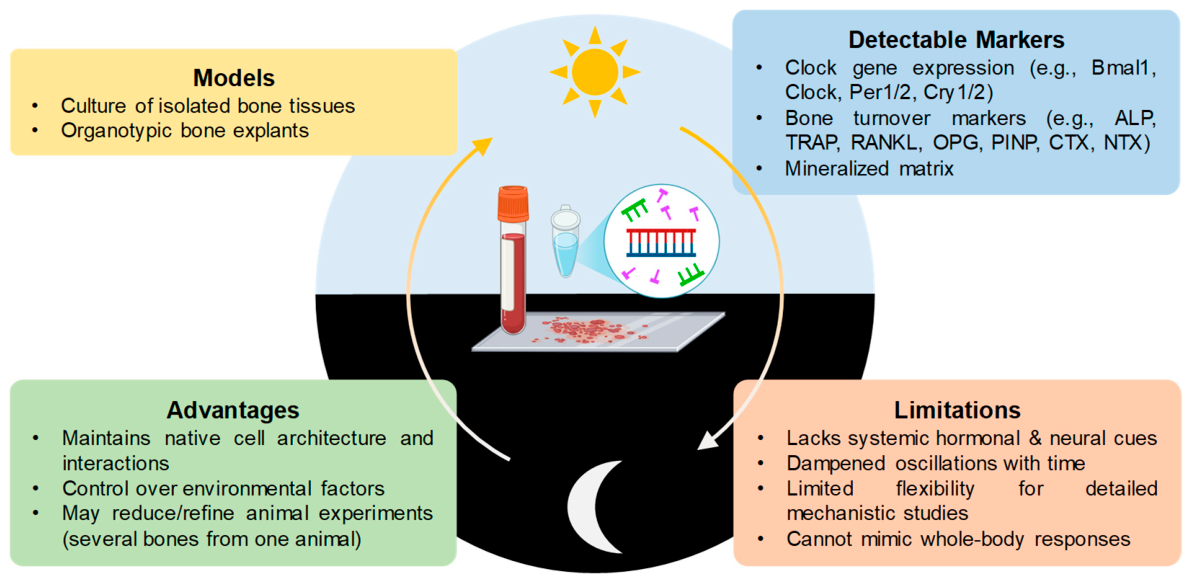
Ex vivo models represent an intermediate platform between in vivo and in vitro systems for investigating circadian regulation in bone biology. These models typically involve the extraction of intact tissues such as bone slices, periodontal segments, or intervertebral discs from animal or human sources at defined circadian time points, followed by short-term culture under controlled environmental conditions [37]. This strategy allows the investigation of intrinsic rhythmic activity in bone cells outside the organism, while maintaining native tissue architecture and intercellular interactions.
Although recent literature reports on circadian studies using transgenic Per1: Luc mice are limited, this model remains one of the most widely adopted ex vivo systems for circadian research. In Per1: Luc and Per2: Luc mice, the real-time expression of the core clock genes Per1 and Per2 can be visualized through bioluminescence imaging in bone explants [31,38,39]. These studies have demonstrated that peripheral tissues, including bone, retain autonomous circadian oscillations ex vivo for several days, allowing time-resolved analysis of clock gene expression and bone cell function. However, oscillatory amplitude typically dampens after 48–72 h, reflecting the absence of systemic synchronizing cues.
Beyond luminescent reporters, ex vivo systems allow the quantification of various circadian genes and bone-related markers. Clock genes such as Bmal1, Clock, Per1/2, NR1D1, and Cry1/2, as well as osteoblast and osteoclast markers, are commonly assessed using qRT-PCR, ELISA, Western blot, or dot blot techniques [40,41]. Specific bone markers secreted into the culture supernatant may also be detected by ELISA or dot blot [41]. Extracellular calcium matrix and bone tissue morphology are routinely assessed by (immuno-histological staining, scanning electron microscopy, or Raman spectroscopy [38,40,42,43]. These multimodal readouts enable the simultaneous evaluation of circadian gene oscillations and functional bone remodeling endpoints. Key circadian readouts commonly used in bone research are summarized in Table 1.
In addition to classical ex vivo methodologies, ex vivo models frequently incorporate transgenic mice or rats as cell or tissue sources, offering valuable translational insights into the potential clinical consequences of circadian misalignment on bone physiology. One study showed that surgical procedures were performed on the hind limbs of transgenic mice to induce femoral fractures, followed by external fixation of the fracture site. After a defined period of stabilization, the fractured femoral tissue was excised and subsequently cultured in vitro. The expression of circadian rhythm-related genes in the bone tissue was first assessed under baseline culture conditions. Thereafter, stimulating factors such as parathyroid hormone (PTH) were introduced, and gene expression was reevaluated to determine the regulatory effects of these stimuli on circadian gene expression in bone. The results showed that PTH may have a potential role in promoting fracture healing [38]. This approach illustrates how ex vivo systems can be used to dissect time-dependent responses to therapeutic interventions.
In another ex vivo experiment, the role of Rev-erbα in growth plate cartilage was investigated. Metatarsal tissue was isolated from mice and cultured under controlled conditions, after which a Rev-erbα antagonist was introduced into the culture medium. Subsequent analyses assessed bone tissue proliferation, differentiation, and mineralization. The findings demonstrated that inhibition of Rev-erbα suppressed growth plate development and longitudinal elongation of metatarsals, primarily through upregulation of the MAPK–ERK1/2 signaling pathway [40]. These results highlight the potential of ex vivo systems to evaluate pharmacological modulation of circadian regulators in bone.
Ex vivo systems offer distinct advantages for circadian research in bone: they reduce the systemic variability inherent in whole-animal models, permit high-resolution temporal sampling, and preserve native tissue architecture and cell–cell interactions that are absent in traditional monolayer cultures. Nonetheless, these models are constrained by the lack of systemic regulatory inputs, such as hormonal and neural signals, and by the limited viability of tissue outside the organism, which restricts long-term rhythmic analysis [44]. Moreover, circadian oscillations in ex vivo bone tissue typically dampen rapidly, and synchronization protocols (e.g., serum shock, temperature cycles, or pharmacological cues) may be required to maintain rhythmicity. These methodological limitations must be carefully considered when interpreting ex vivo circadian data.
Taken together, ex vivo models provide a powerful yet temporally constrained platform for studying intrinsic circadian properties of bone tissue. When combined with genetic manipulation, pharmacological perturbation, and advanced imaging techniques, they offer valuable mechanistic insights that complement both in vivo and in vitro approaches (Figure 5).

3.3. In Vitro Model Systems

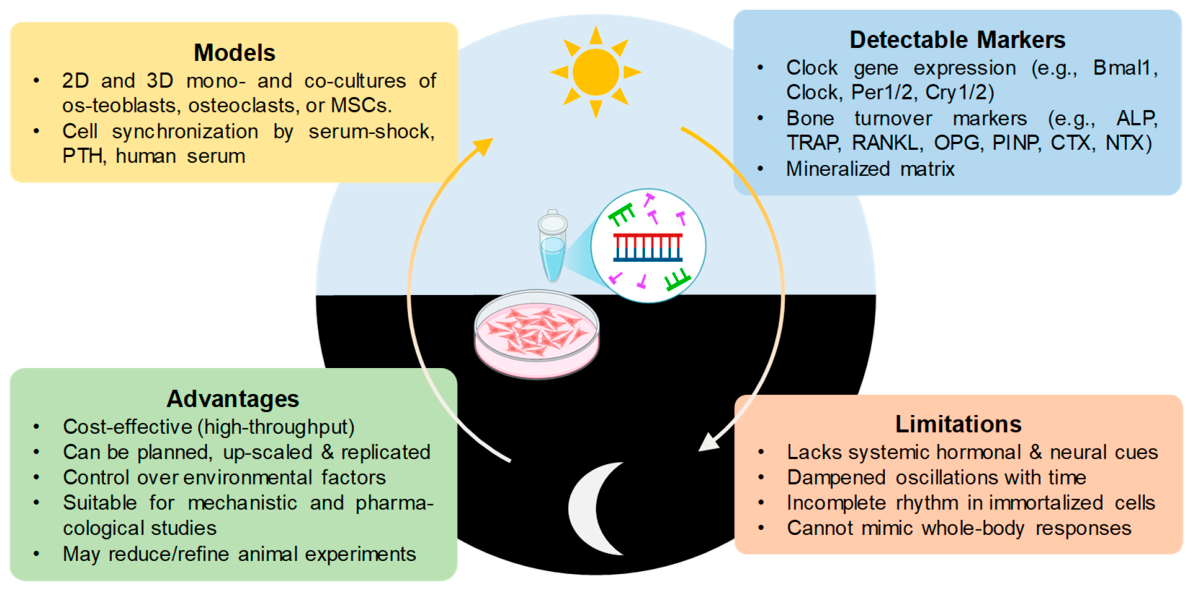
In vitro systems provide a flexible and controlled framework for exploring the molecular and cellular dynamics of circadian rhythms in bone biology. These models typically involve culturing isolated bone cell types such as osteoblasts, osteoclasts, or mesenchymal stromal cells (MSCs) under well-defined laboratory conditions. This setup enables researchers to examine intrinsic circadian oscillations and functional responses without interference from systemic physiological factors. In vitro approaches can be broadly divided into mono-culture, co-culture, and advanced 3D or microphysiological systems, each offering distinct advantages for dissecting cell-intrinsic circadian mechanisms.

3.3.1. Simulating Circadian Rhythms In Vitro

To mimic circadian fluctuations in vitro, cells must be synchronized using external cues known as zeitgebers. Commonly employed zeitgebers include serum starvation followed by serum shock (e.g., 50% fetal bovine serum for 2 h) [45] or PTH stimulation [38]. Once synchronized, the oscillatory expression of core clock genes such as Bmal1, Clock, Per1/2, and Cry1/2 can be tracked over 24 to 72 h using qRT-PCR, ELISA, Western blot, dot blotting, or bioluminescence-based real-time reporting in luciferase-tagged cell lines or primary cultures [46]. However, circadian oscillations in vitro typically dampen rapidly, often within 2–3 cycles, due to the absence of systemic entrainment cues. This limitation necessitates repeated synchronization or the use of perfusion-based culture systems to maintain rhythmicity.

3.3.2. Functional Insights into Circadian Gene Regulation

In vitro platforms are instrumental in uncovering how circadian genes influence bone cell behavior. For example, knockdown or gene editing of Bmal1 or Clock in osteoblasts has been shown to influence apoptosis, proliferation, differentiation, and matrix mineralization. These effects are often mediated through pathways such as Wnt, Sirt1, MAPK, and ERK1/2 [47,48,49,50]. In osteoclast precursors derived from Bmal1-deficient mice, studies have reported an increase in bone-loss phenotype [51], partly due to altered expression of key osteoclast markers such as TRAP and carbonic anhydrase II (CAII) [31]. Recent CRISPR-based screens have further identified additional circadian regulators in osteoblasts and osteoclasts, highlighting the complexity of clock-controlled transcriptional networks in bone.
One noteworthy investigation employed human periodontal ligament fibroblast (PDLF)-like cells cultured under mechanical stress, supplemented with 10% fetal calf serum and varying concentrations of melatonin, a hormone known to modulate circadian rhythms. The study revealed that PDLFs differentiated into osteoclast-like cells, which was suggested to be mediated by melatonin-induced activation of the core clock gene Bmal1 [52]. Such findings underscore the potential of in vitro systems to model both mechanotransduction and hormonal entrainment of circadian pathways in bone cells.

3.3.3. Advanced Co-Culture and 3D Systems

Advanced co-culture systems, including osteoblast–osteoclast co-cultures, MSC-derived 3D constructs, and microphysiological “bone-on-chip” platforms, provide more physiologically relevant environments for studying circadian regulation. These systems allow researchers to observe temporal gene expression and dynamic interactions under controlled conditions, providing a more integrated perspective on circadian regulation in bone. 3D scaffolds and perfused microfluidic systems can sustain circadian oscillations longer than traditional monolayers, reduce damping, and enable high-resolution temporal sampling of both gene expression and functional remodeling markers (Figure 6).

3.3.4. Limitations of In Vitro Systems

Despite their advantages, in vitro models face several limitations. Traditional 2D cultures lack the mechanical, biochemical, and spatial cues required for physiological circadian entrainment. Moreover, immortalized cell lines often exhibit weaker or unstable circadian rhythms compared to primary human cells, raising concerns about model validity. Additionally, the absence of systemic hormonal rhythms (e.g., melatonin, cortisol) limits the translational relevance of in vitro findings unless supplemented experimentally.
Nevertheless, when combined with genetic manipulation, pharmacological perturbation, and advanced culture technologies, in vitro systems remain indispensable for mechanistic circadian research in bone biology. A comparative summary of the strengths, limitations, and typical readouts of each model system is provided in Table 2.

4. Discussion

The present review provides a comprehensive synthesis of experimental approaches used to investigate circadian regulation in bone biology. By evaluating in vivo, ex vivo, and in vitro systems, we highlight how each model contributes unique but complementary perspectives on the temporal regulation of skeletal homeostasis.
Across model systems, a consistent theme emerges, such as circadian rhythms exerting a profound influence on bone remodeling, affecting osteoblast differentiation, osteoclast activity, and the balance between bone formation and resorption [10,11,12,15,16]. Environmental disruption models demonstrate that misalignment of light-dark cycles leads to measurable bone loss [17,18,19], while genetic models reveal that core clock genes such as Bmal1, Clock, Per, and Cry regulate key pathways involved in osteogenesis and osteoclastogenesis [18,26,27,31,53]. However, the magnitude and direction of these effects vary across studies, reflecting differences in model design, sampling time, and species-specific physiology.
Ex vivo systems confirm that bone tissue retains intrinsic circadian oscillations [31,38,39], yet rapid damping of rhythms and the absence of systemic entrainment cues limit long-term analysis [44]. In vitro models provide mechanistic resolution, enabling targeted manipulation of clock genes and signaling pathways [47,48,49,50]. Nevertheless, the circadian robustness of immortalized cell lines remains questionable, and primary human cells exhibit donor-dependent variability that complicates interpretation [54].
A key insight from this review is that no single model can fully capture the complexity of circadian regulation in bone. In vivo models provide physiological relevance but are confounded by systemic factors such as hormonal rhythms, feeding behavior, and locomotor activity [6,21,23,25,29,30]. Ex vivo models preserve tissue architecture but lack endocrine and neural inputs [37,40,41,42,43]. In vitro models offer mechanistic precision but oversimplify the biological environment [45,46]. Integrative approaches that combine these systems are therefore essential for generating reliable and translationally meaningful conclusions.
Finally, the translational implications of circadian bone biology remain underexplored. While clinical studies suggest associations between circadian disruption and skeletal fragility [14,16,33,55,56], the potential for chronotherapeutic interventions such as time-optimized dosing of osteoporosis medications or melatonin supplementation requires further investigation [24,25,29].

5. Limitation

This review has several limitations that should be acknowledged. First, although we aimed to provide a comprehensive overview, the rapidly expanding nature of circadian research means that newly published studies may not be captured. Second, the heterogeneity of experimental designs across studies, including differences in sampling intervals, zeitgeber conditions, genetic backgrounds, and analytical methods, limits direct comparability [17,18,19,31,38,40]. Standardized protocols for circadian bone research are lacking, making it difficult to draw definitive conclusions across model systems.
Third, many studies rely on rodent models, which exhibit nocturnal behavior and species-specific differences in bone turnover rhythms [18,19,28]. This raises concerns about the translatability of preclinical findings to humans, particularly in the context of clinical chronotherapy. Fourth, ex vivo and in vitro systems are constrained by rapid damping of circadian oscillations, limited tissue viability, and the absence of systemic hormonal cues [38,39,40,44,45]. These limitations may lead to underestimation of circadian effects or misinterpretation of rhythmic patterns.
Finally, the field lacks consensus on appropriate statistical methods for analyzing circadian data. While tools such as cosinor analysis, JTK_CYCLE, and CircaCompare are increasingly used, differences in analytical pipelines can yield divergent interpretations of rhythmicity [57].

6. Controversies, Human-Relevant Models, and Integrative Approaches

6.1. Controversies and Unresolved Questions

Despite substantial progress, several controversies remain unresolved. In reality, skeletal circadian phenotypes vary widely depending on species, genetic background, environmental conditions, and methodological choices.
A major point of debate concerns the interpretation of global clock-gene knockout models. These models exhibit systemic alterations, including metabolic dysregulation, hormonal imbalance, reduced locomotor activity, and premature aging that complicate th attribution of skeletal phenotypes to bone-intrinsic circadian mechanisms [26,27,51]. Whether bone phenotypes arise from intrinsic clock disruption or secondary systemic effects remains an open question.
Another unresolved issue is the stability of circadian rhythms in primary human bone cells. Emerging evidence suggests that human osteoblasts and osteoclasts may exhibit weaker or more variable oscillations than immortalized cell lines [16,58]. Donor-specific factors such as age, sex, metabolic status, and medication history may further influence rhythmicity.

6.2. Human-Relevant Models

Human-relevant models are essential for bridging the translational gap. Bone biopsies and surgical waste samples provide direct access to human skeletal tissue [16,33,55,56], but sampling time is difficult to control, and donor variability introduces significant noise. iPSC-derived osteoblasts and osteoclasts offer standardized differentiation and patient-specific modeling, yet their circadian robustness and maturation state require further validation [58].
Emerging platforms such as bone organoids and microphysiological ‘bone-on-chip’ systems enable multi-cellular interactions, mechanical stimulation, and controlled entrainment. These systems hold promise for modeling human-specific circadian dynamics but remain technically demanding and not yet widely adopted.

6.3. Integrative Approaches Across Model Systems

Circadian regulation of bone is a multi-scale process involving molecular, cellular, tissue-level, and systemic interactions. Integrative workflows that combine in vivo, ex vivo, and in vitro models can overcome the limitations of individual systems.
For example:
  • In vivo models identify physiologically relevant rhythms and systemic influences [17,18,19,29].
  • Ex vivo systems test whether these rhythms persist in isolated tissue [31,38,39,40].
  • In vitro models dissect molecular pathways and enable targeted manipulation [45,46,47,48,50,51].
Such multi-tiered strategies reduce model-specific bias, enhance reproducibility, and support the development of translationally relevant chronotherapeutic interventions.

7. Conclusions

Circadian rhythms play a fundamental role in coordinating bone remodeling, influencing osteoblast and osteoclast activity, and shaping skeletal homeostasis across molecular, cellular, and systemic levels. Evidence from in vivo, ex vivo, and in vitro studies demonstrates that both environmental circadian disruption and genetic perturbation of core clock components can impair bone formation, enhance resorption, and alter tissue-level remodeling dynamics. Although each model system provides unique insights, their inherent limitations underscore the need for integrative, multi-scale approaches to fully understand circadian control of bone biology. Advancing human-relevant platforms and refining temporal experimental design will be essential for translating these findings into clinical strategies, including the development of chronotherapeutic interventions for metabolic bone diseases.

Author Contributions

Conceptualization, X.G. and A.K.N.; literature research and analysis, X.G. and X.C.; validation, A.K.N.; writing—original draft preparation, X.G.; writing—review and editing, all authors; visualization, X.C.; supervision, A.K.N.; project administration, A.K.N. All authors have read and agreed to the published version of the manuscript.

Funding

X.G. and X.C. are supported by the China Scholarship Council (grant numbers: 202208410090 (X.G) and 202306380049 (X.C.)).

Institutional Review Board Statement

Not applicable.

Informed Consent Statement

Not applicable.

Data Availability Statement

No new data were created or analyzed in this study. Data sharing is not applicable to this article.

Acknowledgments

English language editing was supported by AI-based tools, including Microsoft Copilot (1.25103.107.0) and ChatGPT (5.0), which were used to refine grammar and phrasing. We acknowledge support from the Open Access Publishing Fund of the University of Tübingen. We would also like to thank Sabrina Ehnert (University of Tübingen) for her critical review of the manuscript.

Conflicts of Interest

The authors declare no conflicts of interest.

Abbreviations

ALPalkaline phosphatase
CAIIcarbonic anhydrase II
CTXcollagen type I C-telopeptide
ERKextracellular signal-regulated protein kinases
MSCmesenchymal stromal cells
NTXn-terminal cross-linked telopeptide of type I collagen
MAPKmitogen-activated protein kinase
OPGosteoprotegerin
OCNosteocalcin
PICPcarboxy-terminal propeptide of type I procollagen
PINPprocollagen type I N-terminal propeptide
PTHparathyroid hormone
PDLFperiodontal ligament fibroblast
qRT-PCRquantitative reverse-transcription polymerase-chain reaction
RANKLreceptor activator of nuclear factor kappa-Β ligand
TRAPtartrate-resistant acidic phosphatase
ZTzeitgeber time

References

  1. Gentry, N.W.; Ashbrook, L.H.; Fu, Y.H.; Ptacek, L.J. Human circadian variations. J. Clin. Investig. 2021, 131, e148282. [Google Scholar] [CrossRef]
  2. Rijo-Ferreira, F.; Takahashi, J.S. Genomics of circadian rhythms in health and disease. Genome Med. 2019, 11, 82. [Google Scholar] [CrossRef]
  3. Vitaterna, M.H.; Takahashi, J.S.; Turek, F.W. Overview of circadian rhythms. Alcohol Res. Health 2001, 25, 85–93. [Google Scholar] [PubMed]
  4. Rudic, R.D.; McNamara, P.; Curtis, A.M.; Boston, R.C.; Panda, S.; Hogenesch, J.B.; Fitzgerald, G.A. BMAL1 and CLOCK, two essential components of the circadian clock, are involved in glucose homeostasis. PLoS Biol. 2004, 2, e377. [Google Scholar] [CrossRef]
  5. Shimba, S.; Ishii, N.; Ohta, Y.; Ohno, T.; Watabe, Y.; Hayashi, M.; Wada, T.; Aoyagi, T.; Tezuka, M. Brain and muscle Arnt-like protein-1 (BMAL1), a component of the molecular clock, regulates adipogenesis. Proc. Natl. Acad. Sci. USA 2005, 102, 12071–12076. [Google Scholar] [CrossRef]
  6. Marcheva, B.; Ramsey, K.M.; Buhr, E.D.; Kobayashi, Y.; Su, H.; Ko, C.H.; Ivanova, G.; Omura, C.; Mo, S.; Vitaterna, M.H.; et al. Disruption of the clock components CLOCK and BMAL1 leads to hypoinsulinaemia and diabetes. Nature 2010, 466, 627–631. [Google Scholar] [CrossRef]
  7. Curtis, A.M.; Bellet, M.M.; Sassone-Corsi, P.; O’Neill, L.A. Circadian clock proteins and immunity. Immunity 2014, 40, 178–186. [Google Scholar] [CrossRef]
  8. Yu, S.; Tang, Q.; Chen, G.; Lu, X.; Yin, Y.; Xie, M.; Long, Y.; Zheng, W.; Guo, F.; Shao, L.; et al. Circadian rhythm modulates endochondral bone formation via MTR1/AMPKbeta1/BMAL1 signaling axis. Cell Death Differ. 2022, 29, 874–887. [Google Scholar] [CrossRef] [PubMed]
  9. Chen, G.; Tang, Q.; Yu, S.; Xie, Y.; Sun, J.; Li, S.; Chen, L. The biological function of BMAL1 in skeleton development and disorders. Life Sci. 2020, 253, 117636. [Google Scholar] [CrossRef] [PubMed]
  10. Tian, Y.; Ming, J. The role of circadian rhythm in osteoporosis; a review. Front. Cell Dev. Biol. 2022, 10, 960456. [Google Scholar] [CrossRef]
  11. Qin, Y.; Chen, Z.H.; Wu, J.J.; Zhang, Z.Y.; Yuan, Z.D.; Guo, D.Y.; Chen, M.N.; Li, X.; Yuan, F.L. Circadian clock genes as promising therapeutic targets for bone loss. Biomed. Pharmacother. 2023, 157, 114019. [Google Scholar] [CrossRef]
  12. Luo, B.; Zhou, X.; Tang, Q.; Yin, Y.; Feng, G.; Li, S.; Chen, L. Circadian rhythms affect bone reconstruction by regulating bone energy metabolism. J. Transl. Med. 2021, 19, 410. [Google Scholar] [CrossRef] [PubMed]
  13. Bukowska-Damska, A.; Skowronska-Jozwiak, E.; Kaluzny, P.; Lewinski, A. Night shift work and osteoporosis—Bone turnover markers among female blue-collar workers in Poland. Chronobiol. Int. 2022, 39, 818–825. [Google Scholar] [CrossRef]
  14. Bukowska-Damska, A.; Skowronska-Jozwiak, E.; Peplonska, B. Night shift work and osteoporosis: Evidence and hypothesis. Chronobiol. Int. 2019, 36, 171–180. [Google Scholar] [CrossRef]
  15. Zvonic, S.; Ptitsyn, A.A.; Kilroy, G.; Wu, X.; Conrad, S.A.; Scott, L.K.; Guilak, F.; Pelled, G.; Gazit, D.; Gimble, J.M. Circadian oscillation of gene expression in murine calvarial bone. J. Bone Miner. Res. 2007, 22, 357–365. [Google Scholar] [CrossRef]
  16. Diemar, S.S.; Dahl, S.S.; West, A.S.; Simonsen, S.A.; Iversen, H.K.; Jorgensen, N.R. A Systematic Review of the Circadian Rhythm of Bone Markers in Blood. Calcif. Tissue Int. 2023, 112, 126–147. [Google Scholar] [CrossRef] [PubMed]
  17. Chaves, I.; van der Eerden, B.; Boers, R.; Boers, J.; Streng, A.A.; Ridwan, Y.; Schreuders-Koedam, M.; Vermeulen, M.; van der Pluijm, I.; Essers, J.; et al. Gestational jet lag predisposes to later-life skeletal and cardiac disease. Chronobiol. Int. 2019, 36, 657–671. [Google Scholar] [CrossRef]
  18. Schilperoort, M.; Bravenboer, N.; Lim, J.; Mletzko, K.; Busse, B.; van Ruijven, L.; Kroon, J.; Rensen, P.C.N.; Kooijman, S.; Winter, E.M. Circadian disruption by shifting the light-dark cycle negatively affects bone health in mice. FASEB J. 2020, 34, 1052–1064. [Google Scholar] [CrossRef]
  19. Song, X.; Zhao, M.; Tang, J.; Ma, T.; Bai, H.; Wang, X.; Liu, L.; Li, T.; Xu, X.; Sheng, X.; et al. Dark-light cycle disrupts bone metabolism and suppresses joint deterioration in osteoarthritic rats. Arthritis Res. Ther. 2022, 24, 158. [Google Scholar] [CrossRef]
  20. Zhang, C.; Tan, L.; Li, J.; Shen, Z.; Yao, J.; Huang, Y.; Wu, L.; Yu, C.; Gao, L.; Zhao, C. REV-ERBα Inhibits Osteoclastogenesis and Protects against Alveolar Bone Loss. J. Dent. Res. 2025, 104, 193–203. [Google Scholar] [CrossRef] [PubMed]
  21. Ye, L.; Mei, G.; Liu, H.; Zhong, R.; Tang, Q.; Yuan, Z. Circadian rhythm disruption aggravates alveolar bone loss in rat apical periodontitis. Int. Endod. J. 2025, 58, 744–756. [Google Scholar] [CrossRef] [PubMed]
  22. Ma, X.; Chen, X.; Duan, Z.; Wu, Y.; Shu, J.; Wu, P.; Zhao, Y.; Wang, X.; Wang, Y. Circadian rhythm disruption exacerbates the progression of macrophage dysfunction and alveolar bone loss in periodontitis. Int. Immunopharmacol. 2023, 116, 109796. [Google Scholar] [CrossRef]
  23. Liu, X.; Cao, N.; Liu, X.; Deng, Y.; Xin, Y.; Fu, R.; Xin, X.; Hou, Y.; Yu, W. Circadian Rhythm Disorders Aggravate Periodontitis by Modulating BMAL1. Int. J. Mol. Sci. 2022, 24, 374. [Google Scholar] [CrossRef]
  24. Lu, K.H.; Hsieh, Y.H.; Lin, R.C.; Tsai, M.Y.; Yang, S.F. Melatonin: A Potential Therapy for Osteoporosis with Insights into Molecular Mechanisms. J. Pineal Res. 2025, 77, e70062. [Google Scholar] [CrossRef]
  25. Lu, X.; Yu, S.; Chen, G.; Zheng, W.; Peng, J.; Huang, X.; Chen, L. Insight into the roles of melatonin in bone tissue and bone-related diseases (Review). Int. J. Mol. Med. 2021, 47, 82. [Google Scholar] [CrossRef]
  26. Tsang, K.; Liu, H.; Yang, Y.; Charles, J.F.; Ermann, J. Defective circadian control in mesenchymal cells reduces adult bone mass in mice by promoting osteoclast function. Bone 2019, 121, 172–180. [Google Scholar] [CrossRef] [PubMed]
  27. Ze, Y.; Wu, Y.; Tan, Z.; Li, R.; Li, R.; Gao, W.; Zhao, Q. Signaling pathway mechanisms of circadian clock gene Bmal1 regulating bone and cartilage metabolism: A review. Bone Res. 2025, 13, 19. [Google Scholar] [CrossRef]
  28. Yan, J.; Wang, J.; Chen, J.; Shi, H.; Liao, X.; Pan, C.; Liu, Y.; Yang, X.; Ren, Z.; Yang, X. Adjusting phosphate feeding regimen according to daily rhythm increases eggshell quality via enhancing medullary bone remodeling in laying hens. J. Anim. Sci. Biotechnol. 2023, 14, 17. [Google Scholar] [CrossRef]
  29. Winter, E.M.; Kooijman, S.; Appelman-Dijkstra, N.M.; Meijer, O.C.; Rensen, P.C.; Schilperoort, M. Chronobiology and Chronotherapy of Osteoporosis. JBMR Plus 2021, 5, e10504. [Google Scholar] [CrossRef] [PubMed]
  30. Swanson, C.M.; Kohrt, W.M.; Buxton, O.M.; Everson, C.A.; Wright, K.P., Jr.; Orwoll, E.S.; Shea, S.A. The importance of the circadian system & sleep for bone health. Metabolism 2018, 84, 28–43. [Google Scholar] [CrossRef]
  31. Takarada, T.; Xu, C.; Ochi, H.; Nakazato, R.; Yamada, D.; Nakamura, S.; Kodama, A.; Shimba, S.; Mieda, M.; Fukasawa, K.; et al. Bone Resorption Is Regulated by Circadian Clock in Osteoblasts. J. Bone Miner. Res. 2017, 32, 872–881. [Google Scholar] [CrossRef]
  32. Wilsbacher, L.D.; Yamazaki, S.; Herzog, E.D.; Song, E.J.; Radcliffe, L.A.; Abe, M.; Block, G.; Spitznagel, E.; Menaker, M.; Takahashi, J.S. Photic and circadian expression of luciferase in mPeriod1-luc transgenic mice invivo. Proc. Natl. Acad. Sci. USA 2002, 99, 489–494. [Google Scholar] [CrossRef]
  33. van der Spoel, E.; Oei, N.; Cachucho, R.; Roelfsema, F.; Berbee, J.F.P.; Blauw, G.J.; Pijl, H.; Appelman-Dijkstra, N.M.; van Heemst, D. The 24-hour serum profiles of bone markers in healthy older men and women. Bone 2019, 120, 61–69. [Google Scholar] [CrossRef]
  34. Fu, L.; Patel, M.S.; Bradley, A.; Wagner, E.F.; Karsenty, G. The molecular clock mediates leptin-regulated bone formation. Cell 2005, 122, 803–815. [Google Scholar] [CrossRef]
  35. Dovio, A.; Generali, D.; Tampellini, M.; Berruti, A.; Tedoldi, S.; Torta, M.; Bonardi, S.; Tucci, M.; Allevi, G.; Aguggini, S.; et al. Variations along the 24-hour cycle of circulating osteoprotegerin and soluble RANKL: A rhythmometric analysis. Osteoporos. Int. 2008, 19, 113–117. [Google Scholar] [CrossRef]
  36. Zhang, J.; Wu, S.; Xing, F.; Kong, N.; Zhao, Y.; Duan, X.; Li, Y.; Wang, K.; Tian, R.; Yang, P. Unveiling the role of melatonin-related gene CSNK1D in osteoclastogenesis and its implications for osteoporosis treatment. Exp. Physiol. 2025, 110, 261–276. [Google Scholar] [CrossRef] [PubMed]
  37. Szczesny, S.E. Ex vivo models of musculoskeletal tissues. Connect. Tissue Res. 2020, 61, 245–247. [Google Scholar] [CrossRef]
  38. Kunimoto, T.; Okubo, N.; Minami, Y.; Fujiwara, H.; Hosokawa, T.; Asada, M.; Oda, R.; Kubo, T.; Yagita, K. A PTH-responsive circadian clock operates in ex vivo mouse femur fracture healing site. Sci. Rep. 2016, 6, 22409. [Google Scholar] [CrossRef] [PubMed]
  39. Okubo, N.; Minami, Y.; Fujiwara, H.; Umemura, Y.; Tsuchiya, Y.; Shirai, T.; Oda, R.; Inokawa, H.; Kubo, T.; Yagita, K. Prolonged bioluminescence monitoring in mouse ex vivo bone culture revealed persistent circadian rhythms in articular cartilages and growth plates. PLoS ONE 2013, 8, e78306. [Google Scholar] [CrossRef]
  40. Qian, Z.; Liu, Z.; Feng, Z.; Cai, Z.; Qiu, Y.; Zhu, Z. Blocking circadian clock factor Rev-erbα inhibits growth plate chondrogenesis via up-regulating MAPK-ERK1/2 pathway. Cell Cycle 2023, 22, 73–84. [Google Scholar] [CrossRef] [PubMed]
  41. Tian, Y.; Liu, X.; Lu, Q.; Li, J.; Wang, T.; Tian, M.; Ding, Y.; Li, J. Bmal1 knockout aggravates Porphyromonas gingivalis-induced periodontitis by activating the NF-kappaB pathway. J. Appl. Oral Sci. 2025, 33, e20240388. [Google Scholar] [CrossRef]
  42. McElderry, J.-D.P.; Zhao, G.; Khmaladze, A.; Wilson, C.G.; Franceschi, R.T.; Morris, M.D. Tracking circadian rhythms of bone mineral deposition in murine calvarial organ cultures. J. Bone Miner. Res. 2013, 28, 1846–1854. [Google Scholar] [CrossRef]
  43. Kikyo, N. Circadian Regulation of Bone Remodeling. Int. J. Mol. Sci. 2024, 25, 4717. [Google Scholar] [CrossRef] [PubMed]
  44. Liu, A.C.; Welsh, D.K.; Ko, C.H.; Tran, H.G.; Zhang, E.E.; Priest, A.A.; Buhr, E.D.; Singer, O.; Meeker, K.; Verma, I.M.; et al. Intercellular coupling confers robustness against mutations in the SCN circadian clock network. Cell 2007, 129, 605–616. [Google Scholar] [CrossRef] [PubMed]
  45. Balsalobre, A.; Damiola, F.; Schibler, U. A serum shock induces circadian gene expression in mammalian tissue culture cells. Cell 1998, 93, 929–937. [Google Scholar] [CrossRef]
  46. Abe, Y.O.; Yoshitane, H.; Kim, D.W.; Kawakami, S.; Koebis, M.; Nakao, K.; Aiba, A.; Kim, J.K.; Fukada, Y. Rhythmic transcription of Bmal1 stabilizes the circadian timekeeping system in mammals. Nat. Commun. 2022, 13, 4652. [Google Scholar] [CrossRef]
  47. Li, L.; Zhang, M.; Zhao, C.; Cheng, Y.; Liu, C.; Shi, M. Circadian clock gene Clock-Bmal1 regulates cellular senescence in Chronic obstructive pulmonary disease. BMC Pulm. Med. 2022, 22, 435. [Google Scholar] [CrossRef]
  48. Yang, W.; Kang, X.; Liu, J.; Li, H.; Ma, Z.; Jin, X.; Qian, Z.; Xie, T.; Qin, N.; Feng, D.; et al. Clock Gene Bmal1 Modulates Human Cartilage Gene Expression by Crosstalk with Sirt1. Endocrinology 2016, 157, 3096–3107. [Google Scholar] [CrossRef]
  49. Soejima, Y.; Iwata, N.; Nakano, Y.; Yamamoto, K.; Suyama, A.; Nada, T.; Otsuka, F. Biphasic Roles of Clock Genes and Bone Morphogenetic Proteins in Gonadotropin Expression by Mouse Gonadotrope Cells. Int. J. Mol. Sci. 2021, 22, 11186. [Google Scholar] [CrossRef]
  50. Min, H.Y.; Kim, K.M.; Wee, G.; Kim, E.J.; Jang, W.G. Bmal1 induces osteoblast differentiation via regulation of BMP2 expression in MC3T3-E1 cells. Life Sci. 2016, 162, 41–46. [Google Scholar] [CrossRef] [PubMed]
  51. Samsa, W.E.; Vasanji, A.; Midura, R.J.; Kondratov, R.V. Deficiency of circadian clock protein BMAL1 in mice results in a low bone mass phenotype. Bone 2016, 84, 194–203. [Google Scholar] [CrossRef]
  52. Schroder, A.; Alefeld, A.; Forneck, A.; Spanier, G.; Deschner, J.; Proff, P.; Kirschneck, C. Impact of melatonin on periodontal ligament fibroblasts during mechanical strain. Eur. J. Orthod. 2022, 44, 659–668. [Google Scholar] [CrossRef] [PubMed]
  53. Xu, C.; Ochi, H.; Fukuda, T.; Sato, S.; Sunamura, S.; Takarada, T.; Hinoi, E.; Okawa, A.; Takeda, S. Circadian Clock Regulates Bone Resorption in Mice. J. Bone Miner. Res. 2016, 31, 1344–1355. [Google Scholar] [CrossRef]
  54. Gaspar, L.; Brown, S.A. Measuring circadian clock function in human cells. Methods Enzymol. 2015, 552, 231–256. [Google Scholar] [CrossRef]
  55. Joseph, F.; Chan, B.Y.; Durham, B.H.; Ahmad, A.M.; Vinjamuri, S.; Gallagher, J.A.; Vora, J.P.; Fraser, W.D. The circadian rhythm of osteoprotegerin and its association with parathyroid hormone secretion. J. Clin. Endocrinol. Metab. 2007, 92, 3230–3238. [Google Scholar] [CrossRef] [PubMed]
  56. Swanson, C.; Shea, S.A.; Wolfe, P.; Markwardt, S.; Cain, S.W.; Munch, M.; Czeisler, C.A.; Orwoll, E.S.; Buxton, O.M. 24-hour profile of serum sclerostin and its association with bone biomarkers in men. Osteoporos. Int. 2017, 28, 3205–3213. [Google Scholar] [CrossRef]
  57. Zhu, X.; Han, X.; Li, Z.; Zhou, X.; Yoo, S.H.; Chen, Z.; Ji, Z. CircaKB: A comprehensive knowledgebase of circadian genes across multiple species. Nucleic Acids Res. 2025, 53, D67–D78. [Google Scholar] [CrossRef]
  58. Ehnert, S.; Gao, X.; Heßlinger, M.; Braun, N.R.; Schulz, K.A.; Jahn, D.; Springer, F.; Nussler, A.K. In Vitro Modeling of Diurnal Changes in Bone Metabolism. Int. J. Mol. Sci. 2025, 26, 7699. [Google Scholar] [CrossRef] [PubMed]
Figure 1. This PRISMA-style diagram summarizes the structured search workflow used to identify studies investigating circadian regulation in bone biology. The initial PubMed search (July 2005–July 2025) using the keywords “circadian rhythm”, “bone”, and “model” yielded 165 records. After removal of duplicates and application of predefined inclusion criteria (studies addressing circadian rhythm, bone biology, and an identifiable experimental model), 60 articles were retained for qualitative synthesis. Exclusion criteria included non-English publications, studies lacking full text, and studies addressing only one or two of the three core topics. The final dataset comprised 31 in vivo studies (51.67%), 19 ex vivo studies (31.67%), and 10 in vitro studies (16.67%). This workflow reflects the narrative-review design with systematic elements and provides transparency regarding study identification, screening, and eligibility assessment.
Ijms 27 05167 g001
Figure 2. Conceptual summary of circadian expression patterns of bone markers. The figure depicts the 24 h Zeitgeber Time (ZT) rhythmicity of major bone-remodeling markers during physiological (blue) and disrupted (red, dashed) circadian conditions. The oscillatory patterns are adapted from the findings of Dovio et al. [35] and Diemar et al. [16]. Under normal circadian alignment, RANKL, OPG, ALP, and TRAP display coordinated, high-amplitude rhythms that reflect tightly regulated bone turnover. Circadian disruption leads to attenuated oscillatory amplitude, altered phase timing, and loss of rhythmic coherence, indicating compromised temporal control of bone formation and resorption. The schematic diagram was visualized using ChatGPT (5.0). Xiang Gao (2025).
Ijms 27 05167 g002
Figure 3. Conceptual summary of circadian expression patterns of core clock genes. The figure depicts the 24 h ZT oscillatory profiles of the core clock genes Bmal1, Clock, Per1, Per2, Cry1, and Cry2 in mice during normal (blue) and disrupted (red, dashed) circadian conditions. The expression patterns are adapted from Schilperoort et al. [18] and Zvonic et al. [15]. Under physiological entrainment, these genes exhibit coordinated, high-amplitude rhythms that maintain temporal order within peripheral tissues. Circadian misalignment results in attenuated oscillations, altered phase timing, and reduced rhythmic coherence, which may impair downstream pathways involved in bone remodeling. The schematic diagram was visualized using ChatGPT (5.0). Xiang Gao (2025).
Ijms 27 05167 g003
Figure 4. Visualization of in vivo models. In vivo models are instrumental in elucidating the dynamic interplay between circadian rhythms and bone remodeling processes. These models typically involve rodents, especially mice, maintained under controlled light–dark cycles or genetically engineered to lack key circadian genes such as Bmal1, Clock, Per1/2, and Cry1/2. Such setups allow researchers to investigate the systemic and tissue-specific effects of circadian disruption on skeletal physiology. However, animal models also have their limitations, such as high costs and ethical concerns. Image was created in BioRender. Xiang Gao (2025) (https://app.biorender.com/illustrations/69ca989269f3c9dfd83ad093, accessed on 1 June 2026).
Ijms 27 05167 g004
Figure 5. Visualization of ex vivo models. Ex vivo models are useful for studying circadian regulation in bone tissues while preserving some native structure and cell–cell interactions. These models typically involve culturing bone or bone marrow-derived samples to monitor time-dependent changes in clock genes (e.g., Bmal1, Clock, Per1/2, Cry1/2) and bone markers like PICP, PINP, ALP, CTX, TRAP, OPG, RANKL, OCN, and NTX. Common methods include qRT-PCR, ELISA, Western blot or dot blot, luciferase assays, and immunostaining. While these systems offer precise control over environmental factors, the absence of systemic cues may limit sustained circadian rhythms compared to in vivo models. Image was created in BioRender. Xiang Gao (2025) (https://app.biorender.com/illustrations/69ca989269f3c9dfd83ad093, accessed on 1 June 2026).
Ijms 27 05167 g005
Figure 6. Visualization of in vitro models. In vitro models rely on cultured osteoblasts, osteoclasts, or their co-cultures to investigate circadian regulation at the cellular level. Serum shock is commonly used to synchronize rhythms, allowing analysis of clock genes (Bmal1, Clock, Per1/2, Cry1/2) and functional markers such as mitochondrial activity, ALP, TRAP, CAII, and Alizarin Red. These systems are low-cost, scalable, and highly controllable, ideal for mechanistic and drug screening studies. However, they lack systemic inputs, and circadian rhythms may weaken over time, especially in immortalized cell lines. Image was created in BioRender. Xiang Gao (2025) (https://app.biorender.com/illustrations/69ca989269f3c9dfd83ad093, accessed on 1 June 2026).
Ijms 27 05167 g006
Table 1. Circadian Readouts Commonly Used in Bone Research.
Marker/GeneCell Type/ProcessInterpretation
PINP, PICPOsteoblast activityBone formation
CTX, NTXOsteoclast activityBone resorption
RANKL/OPGOsteoblast–osteoclast couplingResorption/formation balance
Bmal1, Clock, Per1/2, Cry1/2Core clock genesCircadian rhythmicity
Table 2. Comparative Overview of Model Systems.
Model SystemStrengthsLimitationsTypical Readouts
In vivoPhysiological relevance; systemic entrainment; hormonal and neural inputsConfounding systemic factors; species differences; time-point sampling difficultSerum markers (PINP, CTX), bone histomorphometry, gene expression
Ex vivoPreserves tissue architecture; high temporal resolutionRapid damping; no systemic cues; limited viabilityPer1/Per2 bioluminescence, qPCR, histology
In vitroMechanistic precision; genetic manipulation; controlled entrainmentOversimplified environment; weak rhythms in some cell linesqPCR, Western blot, luciferase reporters
Disclaimer/Publisher’s Note: The statements, opinions and data contained in all publications are solely those of the individual author(s) and contributor(s) and not of MDPI and/or the editor(s). MDPI and/or the editor(s) disclaim responsibility for any injury to people or property resulting from any ideas, methods, instructions or products referred to in the content.