Novel Potential Risk Loci for Migraine in the Portuguese Population

 , , ,
, , ,
Abstract
1. Introduction
2. Results
2.1. Characterization of Sample Study
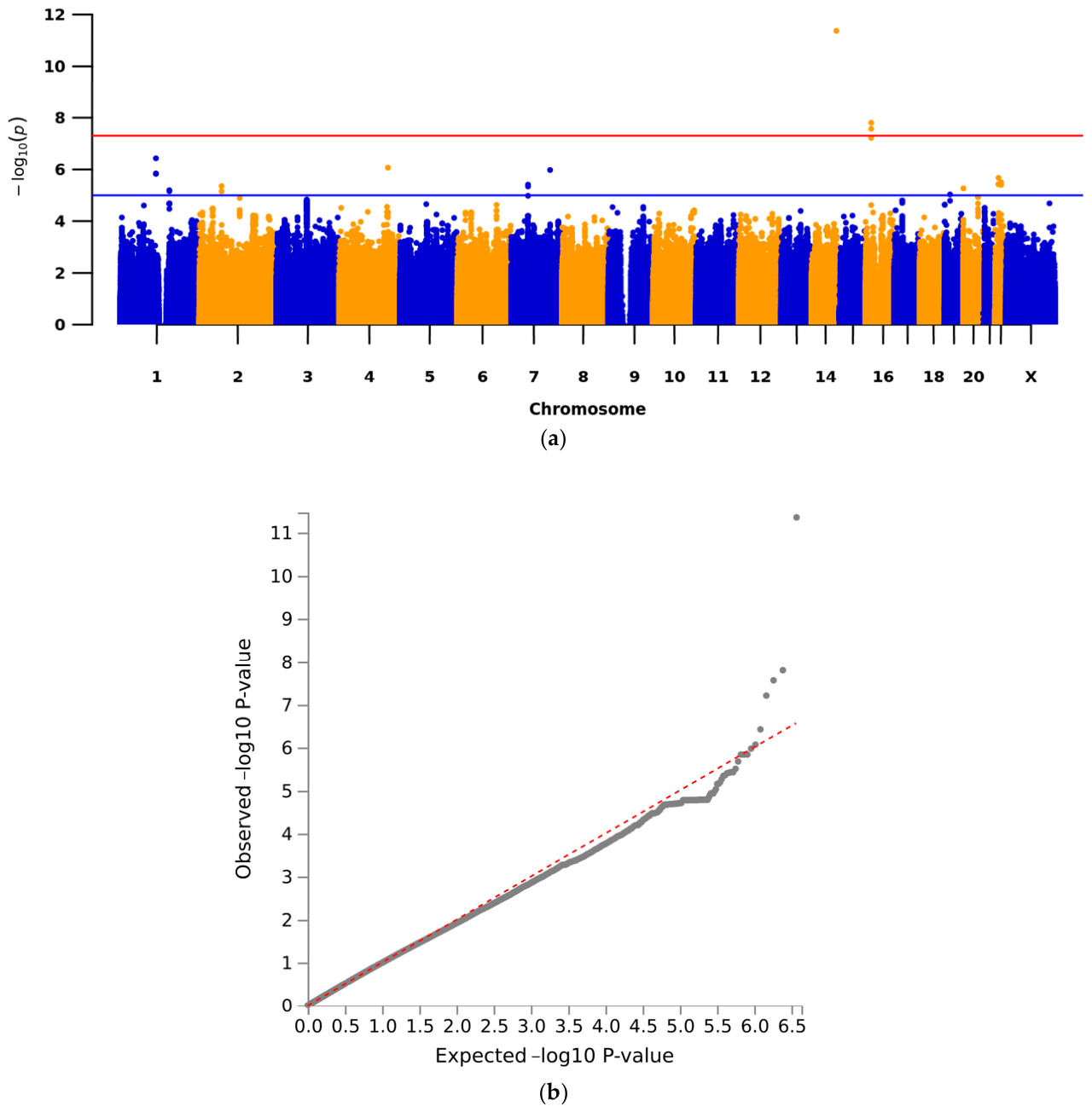
2.2. Identification and Characterization of Potential Migraine Risk Loci
2.3. Enrichment Analysis
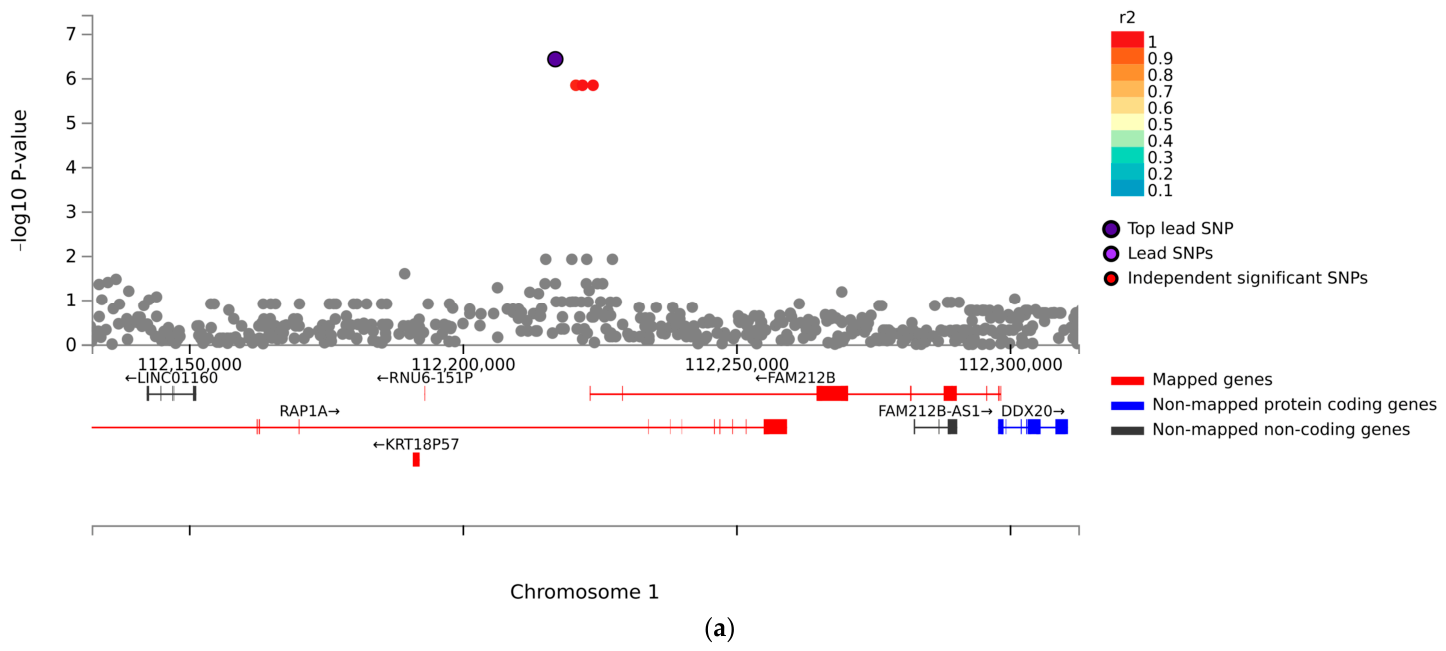
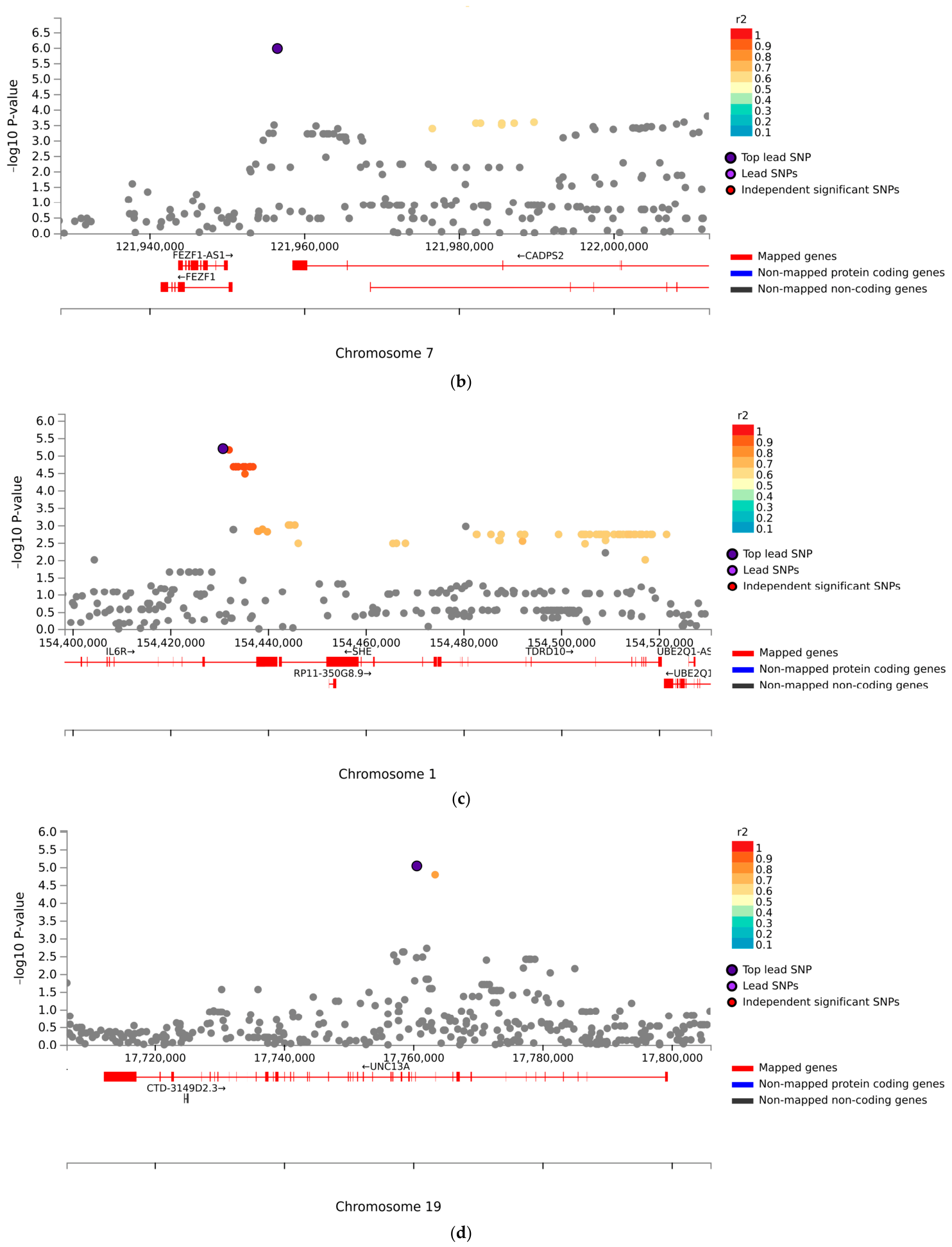
2.4. Notable Potential Risk Loci of Migraine Susceptibility
2.5. Polygenic Risk Score
3. Discussion
3.1. RAP1A Is Involved in Synapse Plasticity and Inflammation
3.2. CADPS2 and UNC13A—Complementary Presynaptic Orchestrators
3.2.1. CADPS2
3.2.2. UNC13A
3.3. Additional Noteworthy Variants
3.4. Limitations
4. Materials and Methods
4.1. Subjects and Study Design
4.2. DNA Extraction and Genome-Wide Array Genotyping
4.3. Imputation and Quality Control
4.4. GWAS and Statistical Analysis
4.5. Identification of Lead and Candidate SNPs Associated with Migraine
4.6. Gene Mapping
4.7. Enrichment Analysis
4.8. Protein Interactions
4.9. Polygenic Risk Score
5. Conclusions
Supplementary Materials
Author Contributions
Funding
Institutional Review Board Statement
Informed Consent Statement
Data Availability Statement
Acknowledgments
Conflicts of Interest
Abbreviations
| AD | Alzheimer’s disease |
| AUC | Area under curve |
| CGRP | Calcitonin gene-related peptide |
| EFO | Experimental Factor Ontology |
| eQTL | Expression quantitative trait loci |
| GO | Gene ontology |
| GWAS | Genome-wide association study |
| HWE | Hardy-Weinberg equilibrium |
| KEGG | Kyoto Encyclopaedia of Genes and Genomes |
| LD | Linkage disequilibrium |
| MAF | Minor allele frequency |
| MwA | Migraine with aura |
| MwoA | Migraine without aura |
| OR | Odds ratio |
| PACAP | Pituitary adenylate cyclase-activating peptide |
| PCA | Principal component analysis |
| PRS | Polygenic risk score |
| QC | Quality control |
| Q–Q | Quantile–quantile |
| RDB | RegulomeDB |
| SNP | Single nucleotide polymorphism |
| TF | Transcription factor |
| TVS | Trigeminovascular system |
References
- Allan, W. The inheritance of migraine. Arch. Intern. Med. 1928, 42, 590–599. [Google Scholar] [CrossRef]
- Fila, M.; Derwich, M.; Pawlowska, E.; Blasiak, J. Neural Plasticity in Migraine Chronification. Eur. J. Neurosci. 2025, 61, e70007. [Google Scholar] [CrossRef]
- Dias, A.; Mariz, T.; Sousa, A.; Lemos, C.; Alves-Ferreira, M. A review of migraine genetics: Gathering genomic and transcriptomic factors. Hum. Genet. 2022, 141, 1–14. [Google Scholar] [CrossRef]
- May, A.; Goadsby, P.J. Substance P receptor antagonists in the therapy of migraine. Expert Opin. Investig. Drugs 2001, 10, 673–678. [Google Scholar] [CrossRef]
- Puledda, F.; Silva, E.M.; Suwanlaong, K.; Goadsby, P.J. Migraine: From pathophysiology to treatment. J. Neurol. 2023, 270, 3654–3666. [Google Scholar] [CrossRef]
- Van Den Maagdenberg, A.M.J.M.; Nyholt, D.R.; Anttila, V. Novel hypotheses emerging from GWAS in migraine? J. Headache Pain 2019, 20, 5. [Google Scholar] [CrossRef]
- Hautakangas, H.; Winsvold, B.S.; Ruotsalainen, S.E.; Bjornsdottir, G.; Harder, A.V.E.; Kogelman, L.J.A.; Thomas, L.F.; Noordam, R.; Benner, C.; Gormley, P.; et al. Genome-wide analysis of 102,084 migraine cases identifies 123 risk loci and subtype-specific risk alleles. Nat. Genet. 2022, 54, 152–160. [Google Scholar] [CrossRef]
- Sirugo, G.; Williams, S.M.; Tishkoff, S.A. The Missing Diversity in Human Genetic Studies. Cell 2019, 177, 26–31. [Google Scholar] [CrossRef]
- Dudbridge, F. Power and Predictive Accuracy of Polygenic Risk Scores. PLoS Genet. 2013, 9, e1003348, Erratum in PLoS Genet. 2013, 9. https://doi.org/10.1371/annotation/b91ba224-10be-409d-93f4-7423d502cba0. [Google Scholar] [CrossRef]
- Grangeon, L.; Lange, K.S.; Waliszewska-Prosół, M.; Onan, D.; Marschollek, K.; Wiels, W.; Mikulenka, P.; Farham, F.; Gollion, C.; Ducros, A. Genetics of migraine: Where are we now? J. Headache Pain 2023, 24, 12. [Google Scholar] [CrossRef] [PubMed]
- Kogelman, L.J.A.; Esserlind, A.-L.; Francke Christensen, A.; Awasthi, S.; Ripke, S.; Ingason, A.; Davidsson, O.B.; Erikstrup, C.; Hjalgrim, H.; Ullum, H.; et al. Migraine polygenic risk score associates with efficacy of migraine-specific drugs. Neurol. Genet. 2019, 5, e364. [Google Scholar] [CrossRef] [PubMed]
- Watanabe, K.; Taskesen, E.; Van Bochoven, A.; Posthuma, D. Functional mapping and annotation of genetic associations with FUMA. Nat. Commun. 2017, 8, 1826. [Google Scholar] [CrossRef] [PubMed]
- Rifino, N.; Aamodt, A.H.; Wiedmann, M.; Kramer, M.; Becker, J.; Guey, S.; Acerbi, F.; Herve, D.; Bersano, A. The Spectrum of Headaches in Moyamoya Angiopathy: From Mechanisms to Management Strategies—A Consensus Review From the NEUROVASC Working Group. Eur. J. Neurol. 2025, 32, e70316. [Google Scholar] [CrossRef] [PubMed]
- GWAS Catalog. Variant: rs7525578. Available online: https://www.ebi.ac.uk/gwas/variants/rs7525578 (accessed on 30 April 2026).
- Stewart, W.F.; Lipton, R.B.; Simon, D. Work-related disability: Results from the American migraine study. Cephalalgia 1996, 16, 231–238. [Google Scholar] [CrossRef]
- Zhang, L.; Zhang, P.; Wang, G.; Zhang, H.; Zhang, Y.; Yu, Y.; Zhang, M.; Xiao, J.; Crespo, P.; Hell, J.W.; et al. Ras and Rap Signal Bidirectional Synaptic Plasticity via Distinct Subcellular Microdomains. Neuron 2018, 98, 783–800.e4. [Google Scholar] [CrossRef]
- Cherra, S.J.; Lamb, R. Interactions between Ras and Rap signaling pathways during neurodevelopment in health and disease. Front. Mol. Neurosci. 2024, 17, 1352731. [Google Scholar] [CrossRef]
- Guo, S.; Jansen-Olesen, I.; Olesen, J.; Christensen, S.L. Role of PACAP in migraine: An alternative to CGRP? Neurobiol. Dis. 2023, 176, 105946. [Google Scholar] [CrossRef]
- Stornetta, R.L.; Zhu, J.J. Ras and Rap signaling in synaptic plasticity and mental disorders. Neuroscientist 2011, 17, 54–78. [Google Scholar] [CrossRef]
- Ahmed, S.M.; Daulat, A.M.; Meunier, A.; Angers, S. G protein βγ subunits regulate cell adhesion through Rap1a and its effector Radil. J. Biol. Chem. 2010, 285, 6538–6551. [Google Scholar] [CrossRef]
- Jeon, J.P.; Hong, E.P.; Ha, E.J.; Kim, B.J.; Youn, D.H.; Lee, S.; Lee, H.C.; Kim, K.M.; Lee, S.H.; Cho, W.-S.; et al. Genome-wide association study identifies novel susceptibilities to adult moyamoya disease. J. Hum. Genet. 2023, 68, 713–720. [Google Scholar] [CrossRef]
- Lee, G.W.; Chen, J.J.; Wang, C.H.; Chang, S.N.; Chiu, F.C.; Huang, P.S.; Chua, S.K.; Chuang, E.Y.; Tsai, C.T. Identification of a new genetic locus associated with atrial fibrillation in the Taiwanese population by genome-wide and transcriptome-wide association studies. Europace 2025, 27, euaf042. [Google Scholar] [CrossRef]
- Mohammad, S.; Bussu, G.; Rukh, G.; Schiöth, H.B.; Mwinyi, J. Migraine and its major subtypes—With and without aura are associated with polygenic scores for autism. Cephalalgia 2025, 45. [Google Scholar] [CrossRef]
- Bahrami, S.; Hindley, G.; Winsvold, B.S.; O’Connell, K.S.; Frei, O.; Shadrin, A.; Cheng, W.; Bettella, F.; Rødevand, L.; Odegaard, K.J.; et al. Dissecting the shared genetic basis of migraine and mental disorders using novel statistical tools. Brain 2022, 145, 142–153. [Google Scholar] [CrossRef] [PubMed]
- Malik, R.; Winsvold, B.; Auffenberg, E.; Dichgans, M.; Freilinger, T. The migraine-stroke connection: A genetic perspective. Cephalalgia 2016, 36, 658–668. [Google Scholar] [CrossRef]
- Sadakata, T.; Mizoguchi, A.; Sato, Y.; Katoh-Semba, R.; Fukuda, M.; Mikoshiba, K.; Furuichi, T. The Secretory Granule-Associated Protein CAPS2 Regulates Neurotrophin Release and Cell Survival. J. Neurosci. 2004, 24, 43–52. [Google Scholar] [CrossRef]
- Sadakata, T.; Kakegawa, W.; Mizoguchi, A.; Washida, M.; Katoh-Semba, R.; Shutoh, F.; Okamoto, T.; Nakashima, H.; Kimura, K.; Tanaka, M.; et al. Impaired cerebellar development and function in mice lacking CAPS2, a protein involved in neurotrophin release. J. Neurosci. 2007, 27, 2472–2482. [Google Scholar] [CrossRef] [PubMed]
- Sadakata, T.; Washida, M.; Iwayama, Y.; Shoji, S.; Sato, Y.; Ohkura, T.; Katoh-Semba, R.; Nakajima, M.; Sekine, Y.; Tanaka, M.; et al. Autistic-like phenotypes in Cadps2-knockout mice and aberrant CADPS2 splicing in autistic patients. J. Clin. Investig. 2007, 117, 931–943. [Google Scholar] [CrossRef] [PubMed]
- Bonora, E.; Graziano, C.; Minopoli, F.; Bacchelli, E.; Magini, P.; Diquigiovanni, C.; Lomartire, S.; Bianco, F.; Vargiolu, M.; Parchi, P.; et al. Maternally inherited genetic variants of CADPS2 are present in Autism Spectrum Disorders and Intellectual Disability patients. EMBO Mol. Med. 2014, 6, 795–809. [Google Scholar] [CrossRef]
- Obergasteiger, J.; Überbacher, C.; Pramstaller, P.P.; Hicks, A.A.; Corti, C.; Volta, M. CADPS2 gene expression is oppositely regulated by LRRK2 and alpha-synuclein. Biochem. Biophys. Res. Commun. 2017, 490, 876–881. [Google Scholar] [CrossRef]
- Varoqueaux, F.; Sigler, A.; Rhee, J.S.; Brose, N.; Enk, C.; Reim, K.; Rosenmund, C. Total arrest of spontaneous and evoked synaptic transmission but normal synaptogenesis in the absence of Munc13-mediated vesicle priming. Proc. Natl. Acad. Sci. USA 2002, 99, 9037–9042. [Google Scholar] [CrossRef]
- Lemos, C.; Pereira-Monteiro, J.; Mendonça, D.; Ramos, E.M.; Barros, J.; Sequeiros, J.; Alonso, I.; Sousa, A. Evidence of syntaxin 1A involvement in migraine susceptibility: A Portuguese study. Arch. Neurol. 2010, 67, 422–427. [Google Scholar] [CrossRef]
- Felício, D.; Dias, A.; Martins, S.; Carvalho, E.; Lopes, A.M.; Pinto, N.; Lemos, C.; Santos, M.; Alves-Ferreira, M. Non-coding variants in VAMP2 and SNAP25 affect gene expression: Potential implications in migraine susceptibility. J. Headache Pain 2023, 24, 78. [Google Scholar] [CrossRef]
- Van Rheenen, W.; Shatunov, A.; Dekker, A.M.; McLaughlin, R.L.; Diekstra, F.P.; Pulit, S.L.; Van Der Spek, R.A.A.; Võsa, U.; De Jong, S.; Robinson, M.R.; et al. Genome-wide association analyses identify new risk variants and the genetic architecture of amyotrophic lateral sclerosis. Nat. Genet. 2016, 48, 1043–1048. [Google Scholar] [CrossRef]
- Diekstra, F.P.; van Vught, P.W.J.; van Rheenen, W.; Koppers, M.; Pasterkamp, R.J.; van Es, M.A.; Schelhaas, H.J.; de Visser, M.; Robberecht, W.; Van Damme, P.; et al. UNC13A is a modifier of survival in amyotrophic lateral sclerosis. Neurobiol. Aging 2012, 33, 630.e3–630.e8. [Google Scholar] [CrossRef]
- Brown, A.L.; Wilkins, O.G.; Keuss, M.J.; Hill, S.E.; Zanovello, M.; Lee, W.C.; Bampton, A.; Lee, F.C.Y.; Masino, L.; Qi, Y.A.; et al. TDP-43 loss and ALS-risk SNPs drive mis-splicing and depletion of UNC13A. Nature 2022, 603, 131–137, Erratum in Nature 2024, 631, E7. https://doi.org/10.1038/s41586-024-07577-9. [Google Scholar] [CrossRef]
- Ma, X.R.; Prudencio, M.; Koike, Y.; Vatsavayai, S.C.; Kim, G.; Harbinski, F.; Briner, A.; Rodriguez, C.M.; Guo, C.; Akiyama, T.; et al. TDP-43 represses cryptic exon inclusion in the FTD–ALS gene UNC13A. Nature 2022, 603, 124–130. [Google Scholar] [CrossRef]
- Willemse, S.W.; Harley, P.; Van Eijk, R.P.A.; Demaegd, K.C.; Zelina, P.; Pasterkamp, R.J.; Van Damme, P.; Ingre, C.; Van Rheenen, W.; Veldink, J.H.; et al. UNC13A in amyotrophic lateral sclerosis: From genetic association to therapeutic target. J. Neurol. Neurosurg. Psychiatry 2023, 94, 649–656. [Google Scholar] [CrossRef]
- Su, K.; Ma, Y.; Zhou, M.; Liu, Y.; Li, C.; Jiang, Y.; Wu, Q.; Peng, G.; Wang, Y.; Fan, S. De novo missense variants of UNC13A are implicated in epileptic encephalopathies and neurodevelopmental disorders. Genes Dis. 2025, 12, 101315. [Google Scholar] [CrossRef] [PubMed]
- Engel, A.G.; Selcen, D.; Shen, X.M.; Milone, M.; Harper, C.M. Loss of MUNC13-1 function causes microcephaly, cortical hyperexcitability, and fatal myasthenia. Neurol. Genet. 2016, 2, e105. [Google Scholar] [CrossRef] [PubMed]
- Gollion, C. Cortical excitability in migraine: Contributions of magnetic resonance imaging. Rev. Neurol. 2021, 177, 809–815. [Google Scholar] [CrossRef] [PubMed]
- Zhao-Fleming, H.H.; Decker, P.A.; Kosel, M.L.; Drucker, K.L.; Kollmeyer, T.; Lachance, D.H.; Clarkson, B.D.; Howe, C.L.; Jenkins, R.; Tobin, W.O.; et al. Genomewide association study of a homogeneous multiple sclerosis cohort: Tumefactive demyelination. Mult. Scler. J. 2025, 31, 1167–1174. [Google Scholar] [CrossRef]
- He, Z.; Chen, L.; Zhang, W. LncRNA PCBP1-AS1 Induces Cerebral Ischemia/Reperfusion Injury via the miR-506-3p/CCL2 Axis. Ann. Clin. Lab. Sci. 2023, 53, 438–447. [Google Scholar] [PubMed]
- Tang, G.; Zhang, T.; Wang, X.; Song, Z.; Liu, F.; Zhang, Q.; Huo, R. Sub-pathway analysis for severe burns injury patients: Identification of potential key lncRNAs by analyzing lncRNA-mRNA profile. Exp. Ther. Med. 2018, 15, 5281–5287. [Google Scholar] [CrossRef] [PubMed]
- Wen, S.; Yu, C.; Kelsey, M.M.G.; Pereira, M.; Alaimo, H.; Teixeira, E.; Pracht, J.; Daiello, L.A.; Drake, J.; Sedivy, J.M.; et al. RNA transcripts in salivary extracellular vesicle cargo isolated from aged populations. Front. Aging 2026, 6, 1707720. [Google Scholar] [CrossRef]
- Garbers, C.; Thaiss, W.; Jones, G.W.; Waetzig, G.H.; Lorenzen, I.; Guilhot, F.; Lissilaa, R.; Ferlin, W.G.; Grötzinger, J.; Jones, S.A.; et al. Inhibition of classic signaling is a novel function of soluble glycoprotein 130 (sgp130), which is controlled by the ratio of interleukin 6 and soluble interleukin 6 receptor. J. Biol. Chem. 2011, 286, 42959–42970. [Google Scholar] [CrossRef] [PubMed]
- Siciliano, B.; Henkel, N.D.; Ryan, V.W.G.; Imami, A.S.; Vergis, J.M.; Xu, C.; Arvay, T.O.; Sahay, S.; Pulvender, P.; Hamoud, A.R.; et al. Proinflammatory transcriptomic and kinomic alterations in astrocytes derived from patients with familial Alzheimer’s disease. Brain Behav. Immun. Health 2025, 47, 101044. [Google Scholar] [CrossRef]
- Li, X.; Zhao, C. Interleukin-6 in neuroimmunological disorders: Pathophysiology and therapeutic advances with satralizumab. Autoimmun. Rev. 2025, 24, 103826. [Google Scholar] [CrossRef]
- Xiao, R.; Boehnke, M. Quantifying and correcting for the winner’s curse in genetic association studies. Genet. Epidemiol. 2009, 33, 453–462. [Google Scholar] [CrossRef]
- Choi, S.W.; Mak, T.S.-H.; O’Reilly, P.F. Tutorial: A guide to performing polygenic risk score analyses. Nat. Protoc. 2020, 15, 2759–2772. [Google Scholar] [CrossRef]
- Dickson, S.P.; Wang, K.; Krantz, I.; Hakonarson, H.; Goldstein, D.B. Rare Variants Create Synthetic Genome-Wide Associations. PLoS Biol. 2010, 8, e1000294. [Google Scholar] [CrossRef]
- Headache Classification Committee of the International Headache Society (IHS). The International Classification of Headache Disorders, 3rd edition. Cephalalgia 2018, 38, 1–211. [Google Scholar] [CrossRef]



| Migraineurs (n = 167) | Controls (n = 174) | ||
|---|---|---|---|
| MwoA (n = 80) | MwA (n = 87) | ||
| Female (n) | 73 | 71 | 91 |
| Male (n) | 7 | 16 | 83 |
| Age in years (mean ± SD) | 35.75 ± 10.40 | 38.49 ± 12.51 | 39.33 ± 13.98 |
| 37.18 ± 11.59 | |||
| Locus | SNP | CHR | Position (GRCh37) | A1 | A2 | MAF | p-Value | OR |
|---|---|---|---|---|---|---|---|---|
| near RP11-204N11.2 | rs117797734 | 14 | 98284326 | T | C | 0.01193 | 4.268 × 10⁻¹² | 7.404 [4.202 13.05] |
| CTA-481E9.4 CTA-481E9.3 | rs62044126 | 16 | 18170199 | A | C | 0.1998 | 1.575 × 10⁻⁸ | 3.437 [2.240 5.273] |
| RAP1A | rs7525578 | 1 | 112216961 | T | C | 0.07853 | 3.765 × 10⁻⁷ | 3.463 [2.144 5.591] |
| near TIGD4 | rs6826890 | 4 | 153647589 | G | C | 0.341 | 8.54 × 10⁻⁷ | 2.628 [1.789 3.862] |
| near CADPS2 | rs10240812 | 7 | 121956540 | C | G | 0.3638 | 1.057 × 10⁻⁶ | 0.3733 [0.2513 0.5545] |
| near RP11-46E17.6 | rs11913002 | 22 | 27886736 | A | G | 0.4165 | 2.11 × 10⁻⁶ | 2.388 [1.666 3.421] |
| near RP4-569D19.5 | rs28571767 | 22 | 35866387 | T | C | 0.2773 | 3.109 × 10⁻⁶ | 2.654 [1.761 4.000] |
| near RP11-398K14.1 | rs10224317 | 7 | 52748202 | A | G | 0.3976 | 3.847 × 10⁻⁶ | 2.401 [1.656 3.482] |
| PCBP1-AS1 | rs114557033 | 2 | 70205075 | A | G | 0.04473 | 4.38 × 10⁻⁶ | 6.424 [2.904 14.21] |
| near TCF15 | rs1964858 | 20 | 600260 | A | G | 0.4006 | 5.381 × 10⁻⁶ | 0.4192 [0.2882 0.6097] |
| IL6R | rs10908839 | 1 | 154430798 | C | G | 0.2664 | 6.331 × 10⁻⁶ | 2.616 [1.723 3.971] |
| UNC13A | rs11665951 | 19 | 17760561 | C | T | 0.1451 | 9.213 × 10⁻⁶ | 0.3417 [0.2126 0.5492] |
| Locus | SNP | RDB Score | Description |
|---|---|---|---|
| near RP11-204N11.2 | rs117797734 | 7 | No evidence |
| CTA-481E9.4 CTA-481E9.3 | rs62044126 | 5 | TF binding or DNase peak |
| RAP1A | rs7525578 | 5 | TF binding or DNase peak |
| near TIGD4 | rs6826890 | 5 | TF binding or DNase peak |
| near CADPS2 | rs10240812 | 2b | TF binding + any motif + DNase footprint + DNase peak |
| near RP11-46E17.6 | rs11913002 | 7 | No evidence |
| near RP4-569D19.5 | rs28571767 | 6 | Motif hit |
| near RP11-398K14.1 | rs10224317 | 6 | Motif hit |
| PCBP1-AS1 | rs114557033 | 5 | TF binding or DNase peak |
| near TCF15 | rs1964858 | 6 | Motif hit |
| IL6R | rs10908839 | 5 | TF binding or DNase peak |
| UNC13A | rs11665951 | 5 | TF binding or DNase peak |
| SNP | P | OR | Folds (%) | EFO ID (GWAS Catalog) | Functional Consequence |
|---|---|---|---|---|---|
| rs117797734 | 1.42 × 10⁻⁹ | 7.257 [3.857 13.65] | 80 | N/A | Intergenic variant |
| rs62044126 | 1.00 × 10⁻⁶ | 3.325 [2.069 5.343] | 80 | N/A | CTA-481E9.4/CTA-481E9.3 ncRNA intronic variant |
| rs7525578 | 4.05 × 10⁻⁶ | 3.658 [2.127 6.293] | 80 | MONDO_0016820 | RAP1A intronic variant |
Disclaimer/Publisher’s Note: The statements, opinions and data contained in all publications are solely those of the individual author(s) and contributor(s) and not of MDPI and/or the editor(s). MDPI and/or the editor(s) disclaim responsibility for any injury to people or property resulting from any ideas, methods, instructions or products referred to in the content. |
© 2026 by the authors. Licensee MDPI, Basel, Switzerland. This article is an open access article distributed under the terms and conditions of the Creative Commons Attribution (CC BY) license.
Share and Cite
De Marco, R.; Pucci, K.; Santos, M.; Gil-Gouveia, R.; Cavadas, B.; Sousa, A.; Alves-Ferreira, M.; Azevedo, L.; Lemos, C.; Dias, A. Novel Potential Risk Loci for Migraine in the Portuguese Population. Int. J. Mol. Sci. 2026, 27, 5165. https://doi.org/10.3390/ijms27125165
De Marco R, Pucci K, Santos M, Gil-Gouveia R, Cavadas B, Sousa A, Alves-Ferreira M, Azevedo L, Lemos C, Dias A. Novel Potential Risk Loci for Migraine in the Portuguese Population. International Journal of Molecular Sciences. 2026; 27(12):5165. https://doi.org/10.3390/ijms27125165
Chicago/Turabian StyleDe Marco, Rodrigo, Kevin Pucci, Mariana Santos, Raquel Gil-Gouveia, Bruno Cavadas, Alda Sousa, Miguel Alves-Ferreira, Luísa Azevedo, Carolina Lemos, and Andreia Dias. 2026. "Novel Potential Risk Loci for Migraine in the Portuguese Population" International Journal of Molecular Sciences 27, no. 12: 5165. https://doi.org/10.3390/ijms27125165
APA StyleDe Marco, R., Pucci, K., Santos, M., Gil-Gouveia, R., Cavadas, B., Sousa, A., Alves-Ferreira, M., Azevedo, L., Lemos, C., & Dias, A. (2026). Novel Potential Risk Loci for Migraine in the Portuguese Population. International Journal of Molecular Sciences, 27(12), 5165. https://doi.org/10.3390/ijms27125165