Article

A Multi-Locus and Machine Learning-Based Assessment of SNCA Variants in Alzheimer’s Disease

1
Department of Neurology, Kanuni Sultan Suleyman Training and Research Hospital, Saglik Bilimleri University, 34303 Istanbul, Türkiye
2
Faculty of Medicine, Department of Biophysics, Trakya University, 22030 Edirne, Türkiye
*
Author to whom correspondence should be addressed.
Int. J. Mol. Sci. 2026, 27(11), 5143; https://doi.org/10.3390/ijms27115143
Submission received: 15 April 2026 / Revised: 3 June 2026 / Accepted: 4 June 2026 / Published: 5 June 2026

Abstract

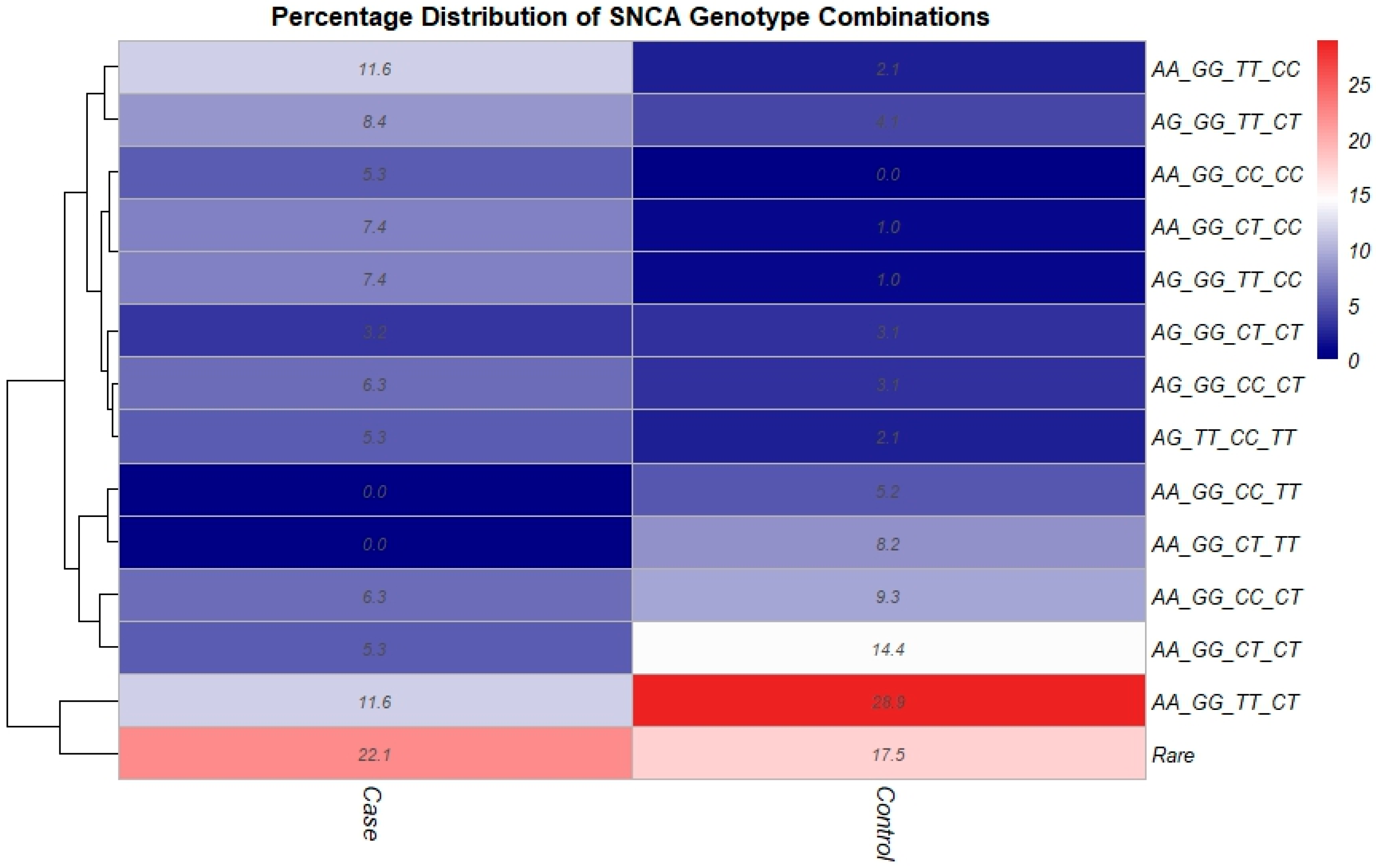
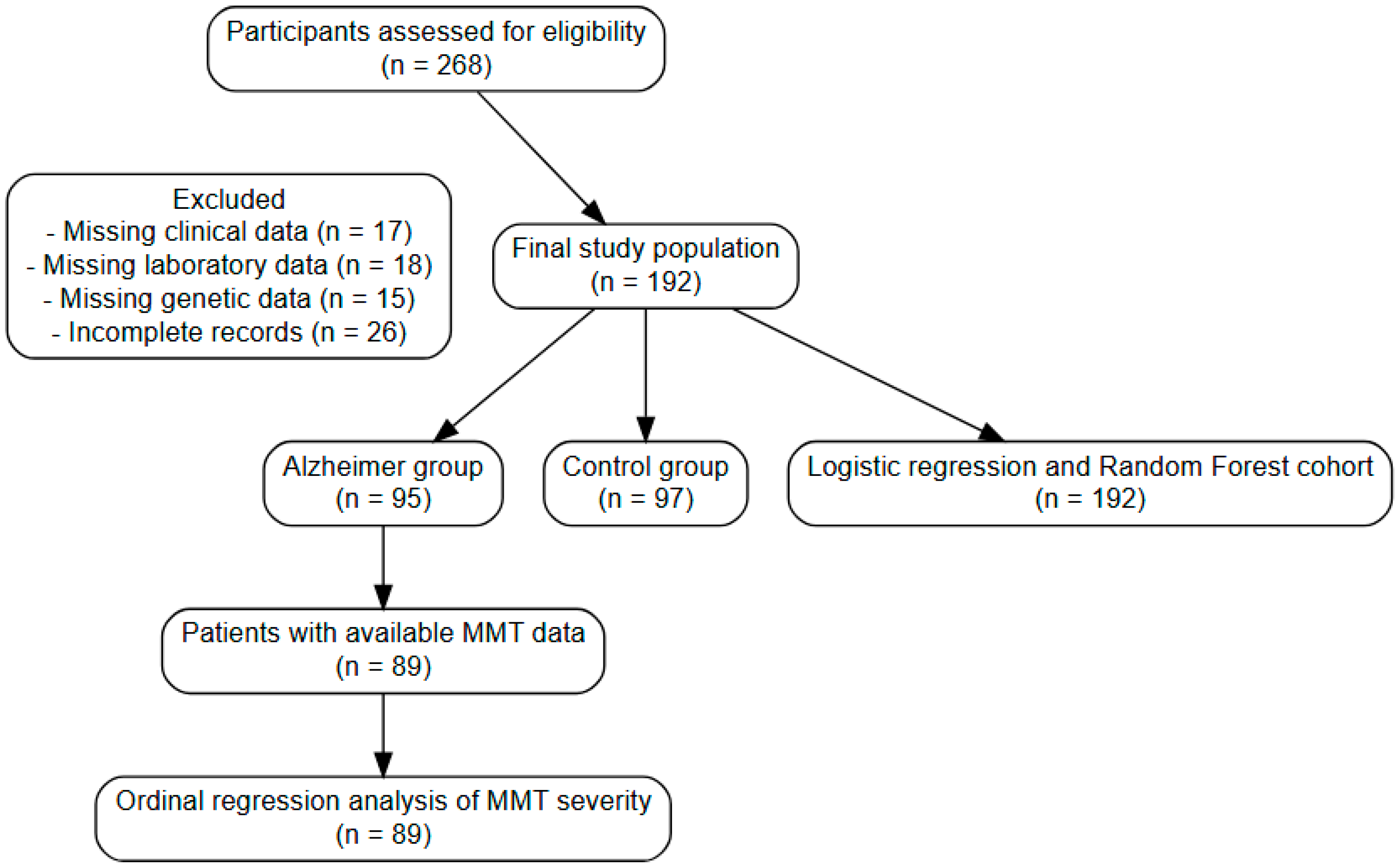
This study investigates the role of single nucleotide polymorphisms (SNPs) in the SNCA gene, encoding alpha-synuclein, in Alzheimer’s disease (AD). A case–control study was conducted including 95 AD patients and 97 healthy controls. Four SNCA polymorphisms (rs2583988, rs2619363, rs2619364, rs10005233) were analyzed using logistic regression, haplotype estimation, genotype combination analysis, and Random Forest modeling. Significant associations were identified for rs2583988, rs2619364, and rs2619363, while rs10005233 showed no association. The rs2583988 C allele and rs2619364 G allele were more frequent in patients, suggesting increased disease risk. Linkage disequilibrium analysis revealed weak correlations (low r2), indicating largely independent genetic effects. Multivariate logistic regression showed that clinical parameters, rather than genetic variants, were independently associated with AD. Multi-locus genotype analysis demonstrated that specific SNP combinations were linked to increased disease risk. Firth regression confirmed associations in low-frequency genotypes. The outcomes derived from the Random Forest methodology were classified as exploratory and not as proof of clinical predictive utility, attributed to the limited sample size, the absence of external validation, and the educational imbalance. Ordinal logistic regression indicated no association between SNCA variants and cognitive severity, while education had a protective effect. The selected SNCA variants showed exploratory associations with AD in this cohort; however, they failed to maintain their validity as independent predictors in multivariate logistic regression analysis. Before drawing any conclusions regarding screening or risk stratification, these findings require independent replication, correction for multiple testing and functional validation.
Keywords: Alzheimer’s disease; alpha-synuclein; SNCA gene; rs2583988; rs2619363; rs2619364; rs10005233 Alzheimer’s disease; alpha-synuclein; SNCA gene; rs2583988; rs2619363; rs2619364; rs10005233