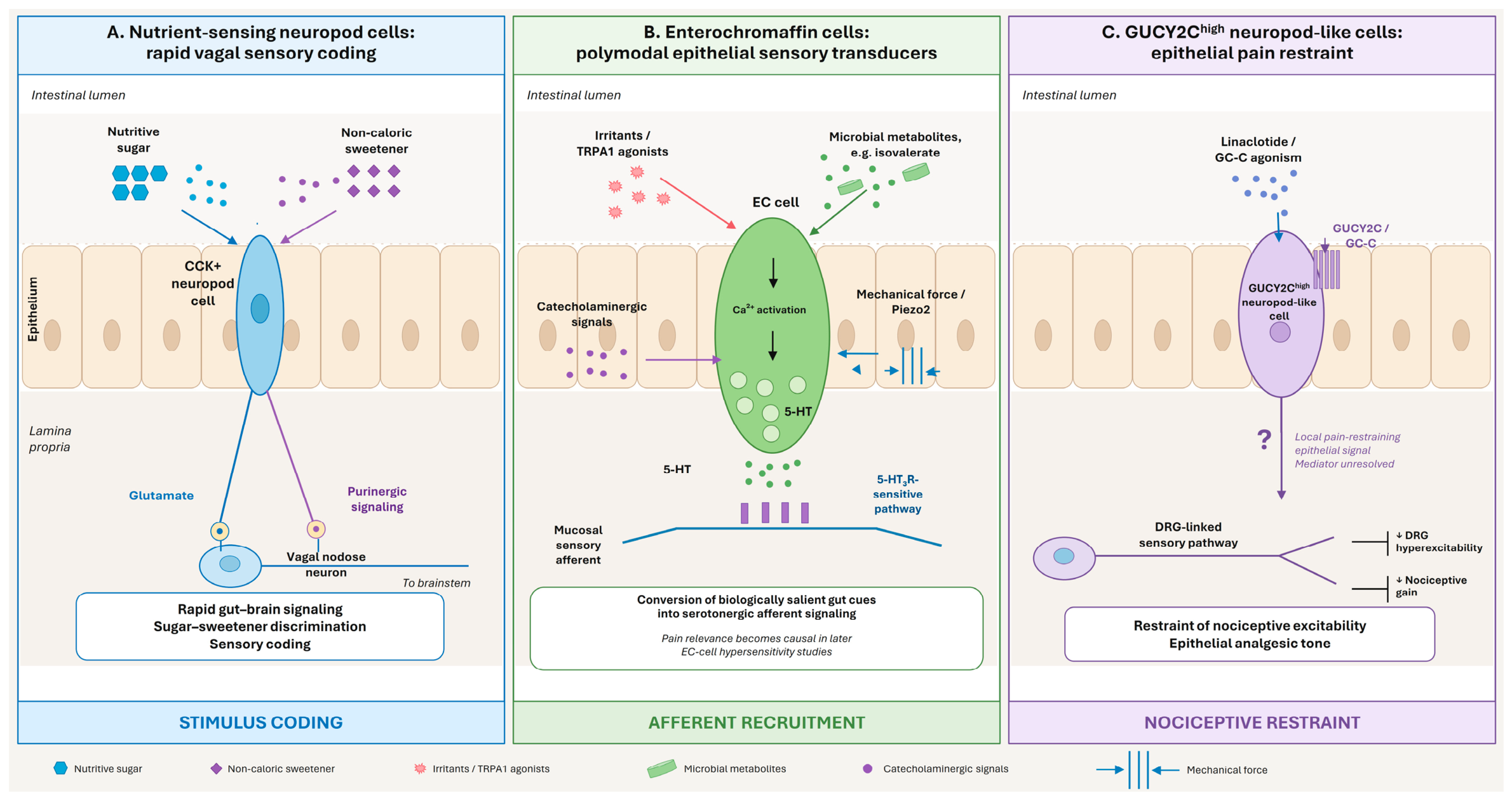
From Epithelial Sensing to Visceral Pain: Neuropod and Enterochromaffin Cells in Gut Neuroepithelial Circuits




Abstract
1. Introduction
2. The Gut Epithelium as a Sensory Neural Interface: From Endocrine Signaling to Neuroepithelial Communication
2.1. Classical Enteroendocrine Signaling: Endocrine and Paracrine Regulation of Luminal Information
2.2. From Basal Cytoplasmic Processes to Neuropods: Anatomical Evidence for Epithelial Neural Specialization
2.3. From Neuropod Morphology to Neuroepithelial Circuits: Molecular and Cellular Evidence for Direct Nerve-Oriented Communication
2.4. Terminological Clarification: Enteroendocrine Cells, Enterochromaffin Cells, Neuropod Cells, and Neuropod-like Cells
3. Neuropod Cells and the Establishment of Rapid Gut–Brain Sensory Circuits
3.1. From Neuroepithelial Architecture to Rapid Sensory Transmission
3.2. Rapid Synaptic Gut–Brain Transmission: Neuropod Cells as Glutamatergic Epithelial Sensory Transducers
3.3. Neuropod Cells Encode Luminal Identity Through Transmitter-Selective Output
3.4. Why Neuropod-Cell Sensory Biology Matters for Visceral Pain
4. Enterochromaffin Cells as Polymodal Epithelial Sensory Transducers
4.1. Enterochromaffin Cells Are Electrically Excitable Epithelial Sensory Cells
4.2. Chemical Input Coding in EC Cells: Irritants, Microbial Metabolites, and Catecholaminergic Stress Signals
4.3. Serotonin-Dependent Coupling of EC-Cell Activation to Sensory Afferent Pathways
4.4. Mechanosensory EC-Cell Signaling: Piezo2 as a Force-to-Serotonin Transducer
4.5. Human Enterochromaffin Cells as Multimodal Sensory Integrators: Luminal, Neuronal, and Paracrine Control of Serotonin Release
5. From Epithelial Sensory Transduction to Visceral Nociception
5.1. Direct Epithelial Activation Is Sufficient to Recruit Extrinsic Afferent Firing and Visceromotor Output
5.2. Enterochromaffin Cells as Causal Drivers of Acute and Persistent Visceral Hypersensitivity
5.3. Pathway Specificity in Neuroepithelial Pain Signaling: Vagal, Mucosal, and Spinal Afferent Circuits
6. Neuropod Cells as Direct Modulators of Visceral Pain: The GUCY2C Paradigm
6.1. Before Neuropod Cells: Linaclotide Reveals a GC-C-Dependent Antinociceptive Axis
6.2. Epithelial GC-C Signaling Suppresses Colonic Nociceptor Activity: The Castro Model
6.3. GUCY2C-Enriched Neuropod Cells as Specialized Pain-Regulatory Epithelial Nodes
6.4. Neuropod-Cell GUCY2C Signaling Controls DRG Neuron Excitability
6.5. Genetic Evidence That Neuropod-Cell GUCY2C Restrains Visceral Nociception
6.6. The GUCY2C Model as a New Neuroepithelial Pain Framework: Unresolved Mechanisms and Translational Questions
7. Integrative Model: Epithelial Circuits as Amplifiers, Filters, and Brakes of Visceral Pain
7.1. Two Complementary Epithelial Pain Modules: Amplification Versus Restraint
7.2. From Signal Detection to Sensory Coding: Epithelial Cells as Classifiers of Biological Meaning
7.3. Toward a Functional Model of Epithelial Control over Visceral Nociception
8. Translational Implications: Epithelial Sensory Circuits in Chronic Visceral Pain Disorders
8.1. Disorders of Gut–Brain Interaction as the Principal Clinical Framework for Neuroepithelial Pain Biology
8.2. Microbial Metabolites as Modulators of Epithelial Sensory Tone and Pain-Relevant Signaling
8.3. Therapeutic Tractability of Epithelial Pain Circuits: Established Proof of Principle and Emerging Targets
9. Outstanding Questions and Experimental Priorities
9.1. Synaptic, Paracrine, or Hybrid Communication? Defining the Mode of Epithelial–Neuronal Signaling
9.2. Resolving Pathway Specificity: Vagal, Mucosal, and DRG-Linked Neuroepithelial Circuits
9.3. Defining Epithelial Sensory Cell Identity: What Qualifies as a Neuropod Cell?
9.4. Human Validation and Disease-Relevant Neuroepithelial Models
10. Conclusions
Author Contributions
Funding
Data Availability Statement
Conflicts of Interest
References
- Barton, J.R.; Londregan, A.; Alexander, T.D.; Entezari, A.A.; Covarrubias, M.; Waldman, S.A. Enteroendocrine Cell Regulation of the Gut-Brain Axis. Front. Neurosci. 2023, 17, 1272955. [Google Scholar] [CrossRef]
- de Hoyos-Vega, J.M.; Yu, X.; Gonzalez-Suarez, A.M.; Chen, S.; Mercado-Perez, A.; Krueger, E.W.; Hernandez, J.; Fedyshyn, Y.; Druliner, B.R.; Linden, D.R.; et al. Modeling Gut Neuro-Epithelial Connections in a Novel Microfluidic Device. Microsyst. Nanoeng. 2023, 9, 144. [Google Scholar] [CrossRef]
- Rossen, N.D.; Touhara, K.K.; Castro, J.; Harrington, A.M.; Garcia-Caraballo, S.; Deng, F.; Li, Y.; Brierley, S.M.; Julius, D. Population Imaging of Enterochromaffin Cell Activity Reveals Regulation by Somatostatin. Proc. Natl. Acad. Sci. USA 2025, 122, e2501525122. [Google Scholar] [CrossRef]
- Black, C.J.; Drossman, D.A.; Talley, N.J.; Ruddy, J.; Ford, A.C. Functional Gastrointestinal Disorders: Advances in Understanding and Management. Lancet 2020, 396, 1664–1674. [Google Scholar] [CrossRef] [PubMed]
- Holland, A.M.; Bon-Frauches, A.C.; Keszthelyi, D.; Melotte, V.; Boesmans, W. The Enteric Nervous System in Gastrointestinal Disease Etiology. Cell. Mol. Life Sci. 2021, 78, 4713–4733. [Google Scholar] [CrossRef]
- Mayer, E.A.; Ryu, H.J.; Bhatt, R.R. The Neurobiology of Irritable Bowel Syndrome. Mol. Psychiatry 2023, 28, 1451–1465. [Google Scholar] [CrossRef] [PubMed]
- Alam, M.J.; Chen, J.D.Z. Non-Invasive Neuromodulation: An Emerging Intervention for Visceral Pain in Gastrointestinal Disorders. Bioelectron. Med. 2023, 9, 27. [Google Scholar] [CrossRef] [PubMed]
- Aulenkamp, J.; Icenhour, A.; Elsenbruch, S. Nocebo Effects in Visceral Pain: Concept and Design of the Experimental Randomized-Controlled Pain Study ‘NoVis’. Front. Psychiatry 2023, 14, 1270189. [Google Scholar] [CrossRef]
- Veldman, F.; Black, C.J.; Shin, A.; Keszthelyi, D. Novel Therapeutic Targets for Chronic Visceral Pain in Gastrointestinal Disorders. Br. J. Pharmacol. 2026. ahead of print. [Google Scholar] [CrossRef]
- Barton, J.R.; Londregran, A.K.; Alexander, T.D.; Entezari, A.A.; Bar-Ad, S.; Cheng, L.; Lepore, A.C.; Snook, A.E.; Covarrubias, M.; Waldman, S.A. Intestinal Neuropod Cell GUCY2C Regulates Visceral Pain. J. Clin. Investig. 2022, 133, e165578. [Google Scholar] [CrossRef]
- Chang, X.; Zhang, H.; Chen, S. Neural Circuits Regulating Visceral Pain. Commun. Biol. 2024, 7, 457. [Google Scholar] [CrossRef] [PubMed]
- Zhou, Q.; Verne, G.N. Molecular Mechanisms and Pathways in Visceral Pain. Cells 2025, 14, 1146. [Google Scholar] [CrossRef]
- Tang, W.; Wang, J.; Wang, W.; Xue, J.; Wang, Y.; Jiang, F.; Kechiyerunda, D.C.; Gao, S.; Yuan, T.; Guo, F. Reviewing the Peripheral and Central Mechanisms of Visceral Hypersensitivity in Intestinal Disorders. Int. J. Med. Sci. 2026, 23, 1121–1143. [Google Scholar] [CrossRef]
- Malykhina, A.P. Shaping the Future of Abdominal and Pelvic Pain Research with Novel Scientific and Technological Advances. Front. Pain Res. 2026, 7, 1738762. [Google Scholar] [CrossRef]
- Palma, G.D.; Reed, D.E.; Berčík, P. Diet–Microbial Cross–Talk Underlying Increased Visceral Perception. Gut Microbes 2023, 15, 2166780. [Google Scholar] [CrossRef] [PubMed]
- Wolfson, R.L.; Abdelaziz, A.; Rankin, G.; Kushner, S.; Qi, L.; Mazor, O.; Choi, S.; Sharma, N.; Ginty, D.D. DRG Afferents That Mediate Physiologic and Pathologic Mechanosensation from the Distal Colon. Cell 2023, 186, 3368–3385.e18. [Google Scholar] [CrossRef]
- Kulkarni, S.; Ganz, J.; Bayrer, J.R.; Becker, L.; Bogunovic, M.; Rao, M. Advances in Enteric Neurobiology: The “Brain” in the Gut in Health and Disease. J. Neurosci. 2018, 38, 9346–9354. [Google Scholar] [CrossRef] [PubMed]
- Najjar, S.A.; Ejoh, L.L.; Loeza-Alcocer, E.; Edwards, B.S.; Smith, K.; Epouhe, A.Y.; Gold, M.S.; Davis, B.M.; Albers, K.M. Optogenetic Inhibition of Colon Epithelium Reduces Hypersensitivity in a Mouse Model of Inflammatory Bowel Disease. bioRxiv 2020. [Google Scholar] [CrossRef]
- Najjar, S.A.; Davis, B.M.; Albers, K.M. Epithelial-Neuronal Communication in the Colon: Implications for Visceral Pain. Trends Neurosci. 2020, 43, 170–181. [Google Scholar] [CrossRef]
- Jones, L.A.; Coleman, R.; Allman, C.; Humenick, A.; Martin, A.M.; Thorpe, D.W.; Eyre, N.; Keating, D.J. The Neuroepithelial Landscape of Enterochromaffin Cells Varies Across Gastrointestinal Location. Neurogastroenterol. Motil. 2026, 38, e70221. [Google Scholar] [CrossRef]
- Bohórquez, D.V.; Shahid, R.A.; Erdmann, A.; Kreger, A.M.; Wang, Y.; Calakos, N.; Wang, F.; Liddle, R.A. Neuroepithelial Circuit Formed by Innervation of Sensory Enteroendocrine Cells. J. Clin. Investig. 2015, 125, 782–786. [Google Scholar] [CrossRef]
- Kaelberer, M.M.; Buchanan, K.; Klein, M.E.; Barth, B.B.; Montoya, M.M.; Shen, X.; Bohórquez, D.V. A Gut-Brain Neural Circuit for Nutrient Sensory Transduction. Science 2018, 361, eaat5236. [Google Scholar] [CrossRef]
- Bellono, N.W.; Bayrer, J.R.; Leitch, D.B.; Castro, J.; Zhang, C.; O’Donnell, T.A.; Brierley, S.M.; Ingraham, H.A.; Julius, D. Enterochromaffin Cells Are Gut Chemosensors That Couple to Sensory Neural Pathways. Cell 2017, 170, 185–198.e16. [Google Scholar] [CrossRef]
- Davison, A.; Reimann, F.; Gribble, F.M. Molecular Mechanisms of Stimulus Detection and Secretion in Enteroendocrine Cells. Curr. Opin. Neurobiol. 2025, 92, 103045. [Google Scholar] [CrossRef]
- Grundeken, E.; Aidy, S.E. Enteroendocrine Cells: The Gatekeepers of Microbiome-Gut-Brain Communication. npj Biofilms Microbiomes 2025, 11, 179. [Google Scholar] [CrossRef]
- Beumer, J.; Geurts, M.H.; Geurts, V.; Andersson-Rolf, A.; Akkerman, N.; Voellmy, F.; Krueger, D.; Busslinger, G.; Martínez-Silgado, A.; Boot, C.; et al. Description and Functional Validation of Human Enteroendocrine Cell Sensors. Science 2024, 386, 341–348. [Google Scholar] [CrossRef]
- Bellampalli, S.S.; Joshi, V.; Fonar, G.; Beyder, A. Integration of Signal Transduction Pathways in Sensory Epithelial Enteroendocrine Cells. Mol. Biol. Cell 2025, 36, re3. [Google Scholar] [CrossRef] [PubMed]
- Atanga, R.; Singh, V.; In, J. Intestinal Enteroendocrine Cells: Present and Future Druggable Targets. Int. J. Mol. Sci. 2023, 24, 8836. [Google Scholar] [CrossRef] [PubMed]
- Bohórquez, D.V.; Liddle, R.A. Axon-Like Basal Processes in Enteroendocrine Cells: Characteristics and Potential Targets. Clin. Transl. Sci. 2011, 4, 387–391. [Google Scholar] [CrossRef] [PubMed]
- Kaelberer, M.M.; Rupprecht, L.E.; Liu, W.; Weng, P.; Bohórquez, D.V. Neuropod Cells: The Emerging Biology of Gut-Brain Sensory Transduction. Annu. Rev. Neurosci. 2020, 43, 337–353. [Google Scholar] [CrossRef]
- Faniyi, A.A.; Wijanarko, K.; Tollitt, J.; Worthington, J.J. Helminth Sensing at the Intestinal Epithelial Barrier—A Taste of Things to Come. Front. Immunol. 2020, 11, 1489. [Google Scholar] [CrossRef]
- Spencer, N.J.; Kyloh, M.; Travis, L.E.; Hibberd, T.J. Identification of Vagal Afferent Nerve Endings in the Mouse Colon and Their Spatial Relationship with Enterochromaffin Cells. Cell Tissue Res. 2024, 396, 313–327. [Google Scholar] [CrossRef]
- Hasnah, R.; Makhlouf, M.; Zambon, M.; Arietti, M.; Altún, Y.G.K.; Scialdone, A.; Saraiva, L.R.; Kaelberer, M.M. A Sensory Map of the Gastrointestinal Tract. Doctoral Dissertation, Hamad Bin Khalifa University, Al-Rayyan, Qatar, 2025. [Google Scholar] [CrossRef]
- Fung, C.; Venneman, T.; Holland, A.M.; Martens, T.; Alata, M.; Hao, M.M.; Alar, C.; Obata, Y.; Tack, J.; Sifrim, A.; et al. Nutrients Activate Distinct Patterns of Small-Intestinal Enteric Neurons. Nature 2025, 644, 1069–1077. [Google Scholar] [CrossRef]
- Bohórquez, D.V.; Samsa, L.A.; Roholt, A.; Medicetty, S.; Chandra, R.; Liddle, R.A. An Enteroendocrine Cell—Enteric Glia Connection Revealed by 3D Electron Microscopy. PLoS ONE 2014, 9, e89881. [Google Scholar] [CrossRef]
- Rich, S.K.; Terman, J.R. Axon Formation, Extension, and Navigation: Only a Neuroscience Phenomenon? Curr. Opin. Neurobiol. 2018, 53, 174–182. [Google Scholar] [CrossRef]
- Wang, J.; Hidaka, T.; Sasaki, Y.; Tanaka, E.; Takagi, M.; Shibata, T.; Kubo, A.; Trejo, J.A.O.; Wang, L.; Asanuma, K.; et al. Neurofilament Heavy Polypeptide Protects against Reduction in Synaptopodin Expression and Prevents Podocyte Detachment. Sci. Rep. 2018, 8, 17157. [Google Scholar] [CrossRef]
- Moore, R.E.; Clarke, J.; Alexandre, P. Protrusion-Mediated Signaling Regulates Patterning of the Developing Nervous System. Front. Cell Dev. Biol. 2020, 8, 579073. [Google Scholar] [CrossRef] [PubMed]
- Buckley, M.M.; O’Brien, R.L.; Brosnan, E.; Ross, R.P.; Stanton, C.; Buckley, J.M.; O’Malley, D. Glucagon-Like Peptide-1 Secreting L-Cells Coupled to Sensory Nerves Translate Microbial Signals to the Host Rat Nervous System. Front. Cell. Neurosci. 2020, 14, 95. [Google Scholar] [CrossRef] [PubMed]
- Fung, C.; Berghe, P.V. Functional Circuits and Signal Processing in the Enteric Nervous System. Cell. Mol. Life Sci. 2020, 77, 4505–4522. [Google Scholar] [CrossRef] [PubMed]
- Buchanan, K.; Rupprecht, L.E.; Kaelberer, M.M.; Sahasrabudhe, A.; Klein, M.E.; Villalobos, J.; Liu, W.; Yang, A.; Gelman, J.; Park, S.; et al. The Preference for Sugar over Sweetener Depends on a Gut Sensor Cell. Nat. Neurosci. 2022, 25, 191–200. [Google Scholar] [CrossRef]
- Kreuch, D.; Keating, D.J.; Wu, T.; Horowitz, M.; Rayner, C.K.; Young, R.L. Gut Mechanisms Linking Intestinal Sweet Sensing to Glycemic Control. Front. Endocrinol. 2018, 9, 741. [Google Scholar] [CrossRef]
- Roura, E.; Depoortere, I.; Navarro, M. Review: Chemosensing of Nutrients and Non-Nutrients in the Human and Porcine Gastrointestinal Tract. Animal 2019, 13, 2714–2726. [Google Scholar] [CrossRef]
- Buchanan, K.; Rupprecht, L.E.; Sahasrabudhe, A.; Kaelberer, M.M.; Klein, M.E.; Villalobos, J.; Liu, W.; Yang, A.; Gelman, J.; Park, S.; et al. A Gut Sensor for Sugar Preference. bioRxiv 2020. [Google Scholar] [CrossRef]
- Moran, A.W.; Al-Rammahi, M.; Daly, K.; Weatherburn, D.; Ionescu, C.; Blanchard, A.; Shirazi-Beechey, S.P. Luminal Sweet Sensing and Enteric Nervous System Participate in Regulation of Intestinal Glucose Transporter, GLUT2. Nutrients 2025, 17, 1547. [Google Scholar] [CrossRef]
- Palmer, R.K.; Nechiporenko, A.B.; Ilies, M.A.; Winnig, M.; Gravina, S.A.; Tiwari, R.; Prakash, I. Sodium-Dependent Glucose Co-Transport Proteins (SGLTs) Are Not Involved in Human Glucose Taste Detection. PLoS ONE 2024, 19, e0313128. [Google Scholar] [CrossRef] [PubMed]
- Rodriguez, Y.A.; Hayoz, S.; Dvoryanchikov, G.; Roper, S.D.; Chaudhari, N. Noncanonical Taste Transduction of Sugars Elicits Responses in a Dedicated Subset of Gustatory Afferent Neurons. J. Neurosci. 2025, 46, e1217252025. [Google Scholar] [CrossRef] [PubMed]
- Song, Y.; Fothergill, L.J.; Lee, K.; Liu, B.Y.; Koo, A.; Perelis, M.; Diwakarla, S.; Callaghan, B.; Huang, J.; Wykosky, J.; et al. Stratification of Enterochromaffin Cells by Single-Cell Expression Analysis. eLife 2023, 12, RP90596. [Google Scholar] [CrossRef]
- Koo, A.; Fothergill, L.J.; Kuramoto, H.; Furness, J.B. 5-HT containing enteroendocrine cells characterised by morphologies, patterns of hormone co-expression, and relationships with nerve fibres in the mouse gastrointestinal tract. Histochem. Cell Biol. 2021, 155, 623–636. [Google Scholar] [CrossRef]
- Shaaban, A.; Maaß, F.; Schwarze, V.; Lund, M.L.; Beuermann, S.; Chan, M.; Harenberg, C.; Bewick, G.A.; Keating, D.J.; Benseler, F.; et al. Dissecting Functional, Structural, and Molecular Requirements for Serotonin Release from Mouse Enterochromaffin Cells. bioRxiv 2021. [Google Scholar] [CrossRef]
- Touhara, K.K.; Xu, J.; Castro, J.; Liang, H.-E.; Li, G.; Brizuela, M.; Harrington, A.M.; Garcia-Caraballo, S.; O’Donnell, T.A.; Neumann, D.; et al. Parasites Trigger Epithelial Cell Crosstalk to Drive Gut–Brain Signalling. Nature 2026, 653, 465–473. [Google Scholar] [CrossRef] [PubMed]
- Bertrand, P. The Cornucopia of Intestinal Chemosensory Transduction. Front. Neurosci. 2009, 3, 48. [Google Scholar] [CrossRef] [PubMed]
- Pan, H.; Gershon, M.D. Activation of Intrinsic Afferent Pathways in Submucosal Ganglia of the Guinea Pig Small Intestine. J. Neurosci. 2000, 20, 3295–3309. [Google Scholar] [CrossRef]
- Akiba, Y.; Hashimoto, S.; Kaunitz, J.D. Duodenal Chemosensory System: Enterocytes, Enteroendocrine Cells, and Tuft Cells. Curr. Opin. Gastroenterol. 2020, 36, 501–508. [Google Scholar] [CrossRef]
- Xu, X.; Chen, R.; Zhan, G.; Wang, D.; Tan, X.; Xu, H. Enterochromaffin Cells: Sentinels to Gut Microbiota in Hyperalgesia? Front. Cell. Infect. Microbiol. 2021, 11, 760076. [Google Scholar] [CrossRef]
- Nozawa, K.; Kawabata-Shoda, E.; Doihara, H.; Kojima, R.; Okada, H.; Mochizuki, S.; Sano, Y.; Inamura, K.; Matsushime, H.; Koizumi, T.; et al. TRPA1 Regulates Gastrointestinal Motility through Serotonin Release from Enterochromaffin Cells. Proc. Natl. Acad. Sci. USA 2009, 106, 3408–3413. [Google Scholar] [CrossRef] [PubMed]
- Alcaino, C.; Knutson, K.R.; Treichel, A.J.; Yildiz, G.; Strege, P.R.; Linden, D.R.; Li, J.H.; Leiter, A.B.; Szurszewski, J.H.; Farrugia, G.; et al. A Population of Gut Epithelial Enterochromaffin Cells Is Mechanosensitive and Requires Piezo2 to Convert Force into Serotonin Release. Proc. Natl. Acad. Sci. USA 2018, 115, E7632–E7641. [Google Scholar] [CrossRef]
- Alcaino, C.; Guccio, N.; Miedzybrodzka, E.L.; Quale, J.R.; Lu, T.; Davison, A.; Smith, C.A.; Overington, E.; Hernández, M.S.-; Tabbada, M.; et al. Mechanisms of Activation and Serotonin Release from Human Enterochromaffin Cells. Cell. Mol. Gastroenterol. Hepatol. 2025, 19, 101610. [Google Scholar] [CrossRef] [PubMed]
- Morrow, N.M.; Hanson, A.A.; Mulvihill, E.E. Distinct Identity of GLP-1R, GLP-2R, and GIPR Expressing Cells and Signaling Circuits Within the Gastrointestinal Tract. Front. Cell Dev. Biol. 2021, 9, 703966. [Google Scholar] [CrossRef]
- Thorens, B. Neuronal Glucose Sensing Mechanisms and Circuits in the Control of Insulin and Glucagon Secretion. Physiol. Rev. 2024, 104, 1461–1486. [Google Scholar] [CrossRef]
- Smith, C.A.; Lu, V.B.; Bakar, R.B.; Miedzybrodzka, E.L.; Davison, A.; Goldspink, D.A.; Reimann, F.; Gribble, F.M. Single-cell Transcriptomics of Human Organoid-derived Enteroendocrine Cell Populations from the Small Intestine. J. Physiol. 2024, 603, 7751–7763. [Google Scholar] [CrossRef]
- Wang, T.; Bonnavion, R.; Piesker, J.; Günther, S.; Wettschureck, N. GPRC5B Preserves a Mature β-Cell State in Obesity by Controlling MafA Expression. JCI Insight 2025, 10, e194115. [Google Scholar] [CrossRef]
- Makadia, P.A.; Najjar, S.A.; Saloman, J.L.; Adelman, P.C.; Feng, B.; Margiotta, J.F.; Albers, K.M.; Davis, B.M. Optogenetic Activation of Colon Epithelium of the Mouse Produces High-Frequency Bursting in Extrinsic Colon Afferents and Engages Visceromotor Responses. J. Neurosci. 2018, 38, 5788–5798. [Google Scholar] [CrossRef] [PubMed]
- Bayrer, J.R.; Castro, J.; Venkataraman, A.; Touhara, K.K.; Rossen, N.D.; Morrie, R.D.; Maddern, J.; Hendry, A.; Braverman, K.N.; Garcia-Caraballo, S.; et al. Gut Enterochromaffin Cells Drive Visceral Pain and Anxiety. Nature 2023, 616, 137–142. [Google Scholar] [CrossRef] [PubMed]
- Bontonou, G.; Saint-Leandre, B.; Kafle, T.; Baticle, T.; Hassan, A.; Sánchez-Alcañiz, J.A.; Arguello, J.R. Evolution of Chemosensory Tissues and Cells across Ecologically Diverse Drosophilids. Nat. Commun. 2024, 15, 1047. [Google Scholar] [CrossRef] [PubMed]
- Jo, Y. Differential Transcriptional Profiles of Vagal Sensory Neurons in Female and Male Mice. Front. Neurosci. 2024, 18, 1393196. [Google Scholar] [CrossRef]
- Londregan, A.; Alexander, T.D.; Covarrubias, M.; Waldman, S.A. Fundamental Neurochemistry Review: The Role of Enteroendocrine Cells in Visceral Pain. J. Neurochem. 2023, 167, 719–732. [Google Scholar] [CrossRef]
- Margiotta, F.; Lucarini, E.; Toti, A.; Curti, L.; Masi, A.; Mello, T.; Gall, G.L.; Mattei, G.; Magi, A.; Vauzour, D.; et al. Gut Microbiota Dysbiosis Affects Intestinal Sensitivity through Epithelium-to-Neuron Signaling: Novel Insights from a Colon Organoid-Based Model to Improve Visceral Pain Therapy. Gut Microbes 2025, 17, 2547029. [Google Scholar] [CrossRef]
- Cappelli, K.; Gialletti, R.; Tesei, B.; Bassotti, G.; Fettucciari, K.; Capomaccio, S.; Bonfili, L.; Cuccioloni, M.; Eleuteri, A.M.; Spaterna, A.; et al. Guanylin, Uroguanylin and Guanylate Cyclase-C Are Expressed in the Gastrointestinal Tract of Horses. Front. Physiol. 2019, 10, 1237. [Google Scholar] [CrossRef]
- Barton, J.R.; Alexander, T.D.; Covarrubias, M.; Waldman, S.A. GUCY2C-Enriched Intestinal Neuropod Cells Modulate Visceral Pain. FASEB J. 2022, 36, R4761. [Google Scholar] [CrossRef]
- Prasad, H.; Mathew, J.K.K.; Visweswariah, S.S. Receptor Guanylyl Cyclase C and Cyclic GMP in Health and Disease: Perspectives and Therapeutic Opportunities. Front. Endocrinol. 2022, 13, 911459. [Google Scholar] [CrossRef]
- Liddle, R.A. Guanylyl Cyclase C Ameliorates Visceral Pain: An Unsuspected Link. J. Clin. Investig. 2023, 133, e166703. [Google Scholar] [CrossRef] [PubMed]
- Cabri, W.; Cantelmi, P.; Corbisiero, D.; Fantoni, T.; Ferrazzano, L.; Martelli, G.; Mattellone, A.; Tolomelli, A. Therapeutic Peptides Targeting PPI in Clinical Development: Overview, Mechanism of Action and Perspectives. Front. Mol. Biosci. 2021, 8, 697586. [Google Scholar] [CrossRef]
- Mishra, V.; Bose, A.; Kiran, S.; Banerjee, S.; Shah, I.A.; Chaukimath, P.; Reshi, M.M.; Srinivas, S.; Barman, A.; Visweswariah, S.S. Gut-Associated cGMP Mediates Colitis and Dysbiosis in a Mouse Model of an Activating Mutation in GUCY2C. J. Exp. Med. 2021, 218, e20210479, Erratum in J. Exp. Med. 2021, 218, e2021047909292021c. https://doi.org/10.1084/jem.2021047909292021c. [Google Scholar] [CrossRef]
- Eutamène, H.; Bradesi, S.; Larauche, M.; Théodorou, V.; Beaufrand, C.; Ohning, G.; Fioramonti, J.; Cohen, M.B.; Bryant, A.; Kurtz, C.B.; et al. Guanylate Cyclase C-Mediated Antinociceptive Effects of Linaclotide in Rodent Models of Visceral Pain. Neurogastroenterol. Motil. 2009, 22, 312-e84. [Google Scholar] [CrossRef] [PubMed]
- Castro, J.; Harrington, A.M.; Hughes, P.A.; Martin, C.M.; Ge, P.; Shea, C.; Jin, H.; Jacobson, S.; Hannig, G.; Mann, E.A.; et al. Linaclotide Inhibits Colonic Nociceptors and Relieves Abdominal Pain via Guanylate Cyclase-C and Extracellular Cyclic Guanosine 3′,5′-Monophosphate. Gastroenterology 2013, 145, 1334–1346.e11. [Google Scholar] [CrossRef]
- dos Reis, D.C.; Jin, J.; Santos, A.K.; Dastoor, P.K.; Muiler, C.; Zagoren, E.; Donnelley, M.; Parsons, D.; Cmielewski, P.; Reyne, N.; et al. CFTR High Expresser BEST4+ Cells Are pH-Sensing Neuropod Cells: New Implications for Intestinal Physiology and Cystic Fibrosis Disease. Am. J. Physiol.-Cell Physiol. 2025, 329, C1411–C1428. [Google Scholar] [CrossRef] [PubMed]
- Wang, Y.B.; de Lartigue, G.; Page, A.J. Dissecting the Role of Subtypes of Gastrointestinal Vagal Afferents. Front. Physiol. 2020, 11, 643. [Google Scholar] [CrossRef]
- Williams, E.K.; Chang, R.B.; Strochlic, D.E.; Umans, B.D.; Lowell, B.B.; Liberles, S.D. Sensory Neurons That Detect Stretch and Nutrients in the Digestive System. Cell 2025, 188, 3623–3624. [Google Scholar] [CrossRef]
- Ye, L.; Liddle, R.A. Gastrointestinal Hormones and the Gut Connectome. Curr. Opin. Endocrinol. Diabetes Obes. 2016, 24, 9–14. [Google Scholar] [CrossRef]
- Latorre, R.; Sternini, C.; De Giorgio, R.; Greenwood-Van Meerveld, B. Enteroendocrine Cells: A Review of Their Role in Brain–Gut Communication. Neurogastroenterol. Motil. 2016, 28, 620–630. [Google Scholar] [CrossRef]
- Bohórquez, D.V.; Liddle, R.A. The Gut Connectome: Making Sense of What You Eat. J. Clin. Investig. 2015, 125, 888–890. [Google Scholar] [CrossRef]
- Yano, J.M.; Yu, K.B.; Donaldson, G.P.; Shastri, G.G.; Ann, P.; Ma, L.; Nagler, C.R.; Ismagilov, R.F.; Mazmanian, S.K.; Hsiao, E.Y. Indigenous Bacteria from the Gut Microbiota Regulate Host Serotonin Biosynthesis. Cell 2015, 161, 264–276. [Google Scholar] [CrossRef] [PubMed]
- Mayer, E.A.; Labus, J.S.; Tillisch, K.; Cole, S.W.; Baldi, P. Towards a Systems View of IBS. Nat. Rev. Gastroenterol. Hepatol. 2015, 12, 592–605. [Google Scholar] [CrossRef]
- Simrén, M.; Törnblom, H.; Palsson, O.S.; van Tilburg, M.A.L.; Oudenhove, L.V.; Tack, J.; Whitehead, W.E. Visceral Hypersensitivity Is Associated with GI Symptom Severity in Functional GI Disorders: Consistent Findings from Five Different Patient Cohorts. Gut 2017, 67, 255–262. [Google Scholar] [CrossRef] [PubMed]
- Grundy, L.; Harrington, A.M.; Castro, J.; Garcia-Caraballo, S.; Deiteren, A.; Maddern, J.; Rychkov, G.Y.; Ge, P.; Peters, S.; Feil, R.; et al. Chronic Linaclotide Treatment Reduces Colitis-Induced Neuroplasticity and Reverses Persistent Bladder Dysfunction. JCI Insight 2018, 3, e121841. [Google Scholar] [CrossRef]
- Simrén, M.; Törnblom, H.; Palsson, O.S.; Oudenhove, L.V.; Whitehead, W.E.; Tack, J. Cumulative Effects of Psychologic Distress, Visceral Hypersensitivity, and Abnormal Transit on Patient-Reported Outcomes in Irritable Bowel Syndrome. Gastroenterology 2019, 157, 391–402.e2. [Google Scholar] [CrossRef] [PubMed]
- Bárdos, G. Irritable Bowel Syndrome (IBS): Could We Decide What Is Behind? Biol. Futur. 2024, 75, 61–71. [Google Scholar] [CrossRef]
- Toti, A.; Lucarini, E.; Margiotta, F.; Micheli, L.; Ferrara, V.; Ciampi, C.; Venturi, D.; Adamo, E.; Curti, L.; Mannelli, L.D.C.; et al. DRG neurons sensitization is induced by altered colon organoids: A novel in vitro model to mimic dysbiosis-associated pain. IBRO Neurosci. Rep. 2023, 15, S208–S209. [Google Scholar] [CrossRef]
- Margiotta, F.; Mannelli, L.D.C.; Morabito, A.; Ghelardini, C.; Lucarini, E. Investigating Epithelial-Neuronal Signaling Contribution in Visceral Pain through Colon Organoid-Dorsal Root Ganglion Neuron Co-Cultures. Neural Regen. Res. 2023, 19, 1199–1200. [Google Scholar] [CrossRef]
- Wang, Z.; Song, K.; Kim, B.; Manion, J. Sensory Neuroimmune Interactions at the Barrier. Mucosal Immunol. 2024, 17, 1151–1160. [Google Scholar] [CrossRef]
- Emanuel, E.; Zhang, W.; Yano, H.; Gaudino, S.; Uddin, J.; Lyu, M.; Artis, D. A Neuronal-Epithelial Circuit Promotes Intestinal Immunity 2891. J. Immunol. 2025, 214, vkaf283.755. [Google Scholar] [CrossRef]
- Chong, P.P.; Chin, V.K.; Looi, C.Y.; Wong, W.F.; Madhavan, P.; Yong, P.V.C. The Microbiome and Irritable Bowel Syndrome—A Review on the Pathophysiology, Current Research and Future Therapy. Front. Microbiol. 2019, 10, 1136, Erratum in Front. Microbiol. 2019, 10, 1870. https://doi.org/10.3389/fmicb.2019.01870. [Google Scholar] [CrossRef] [PubMed]
- Brenner, D.M.; Sharma, A.; Rao, S.S.C.; Laitman, A.P.; Heimanson, Z.; Allen, C.; Sayuk, G.S. Plecanatide Improves Abdominal Bloating and Bowel Symptoms of Irritable Bowel Syndrome with Constipation. Dig. Dis. Sci. 2024, 69, 1731–1738. [Google Scholar] [CrossRef] [PubMed]
- Eshleman, E.M.; Alenghat, T. Epithelial Sensing of Microbiota-Derived Signals. Genes Immun. 2021, 22, 237–246. [Google Scholar] [CrossRef]
- Sittipo, P.; Choi, J.; Lee, S.; Lee, Y.K. The Function of Gut Microbiota in Immune-Related Neurological Disorders: A Review. J. Neuroinflamm. 2022, 19, 154. [Google Scholar] [CrossRef] [PubMed]
- Kaur, H.; Ali, S.A.; Yan, F. Interactions between the Gut Microbiota-Derived Functional Factors and Intestinal Epithelial Cells—Implication in the Microbiota-Host Mutualism. Front. Immunol. 2022, 13, 1006081. [Google Scholar] [CrossRef]
- Masse, K.E.; Lu, V.B. Short-Chain Fatty Acids, Secondary Bile Acids and Indoles: Gut Microbial Metabolites with Effects on Enteroendocrine Cell Function and Their Potential as Therapies for Metabolic Disease. Front. Endocrinol. 2023, 14, 1169624. [Google Scholar] [CrossRef]
- Yang, S.; Liu, H.; Liu, Y. Advances in Intestinal Epithelium and Gut Microbiota Interaction. Front. Microbiol. 2025, 16, 1499202. [Google Scholar] [CrossRef]
- Comba, I.Y.; Louwies, T.; Mars, R.A.; Xiao, Y.; Sekhon, P.K.; Edwards, B.S.; Willits, A.; Shields-Cutler, R.; Bellampalli, S.S.; Mercado-Perez, A.; et al. Distinct Human Small Intestinal Microbiome Communities Underlie Visceral Hypersensitivity in a Humanized Mouse Model. J. Clin. Investig. 2025, 135, e190638. [Google Scholar] [CrossRef]
- Ye, L.; Bae, M.; Cassilly, C.D.; Jabba, S.V.; Thorpe, D.; Martin, A.M.; Lu, H.-Y.; Wang, J.; Thompson, J.; Lickwar, C.R.; et al. Enteroendocrine Cells Sense Bacterial Tryptophan Catabolites to Activate Enteric and Vagal Neuronal Pathways. Cell Host Microbe 2020, 29, 179–196.e9. [Google Scholar] [CrossRef]
- Geesala, R.; Lin, Y.-M.; Zhang, K.; Shi, X. Targeting Mechano-Transcription Process as Therapeutic Intervention in Gastrointestinal Disorders. Front. Pharmacol. 2021, 12, 809350. [Google Scholar] [CrossRef] [PubMed]
- Spencer, N.J.; Hibberd, T.J.; Xie, Z.; Hu, H. How Should We Define a Nociceptor in the Gut-Brain Axis? Front. Neurosci. 2022, 16, 1096405. [Google Scholar] [CrossRef]
- Li, Y.; Zhang, F.; Xu, T.W.; Weng, R.; Zhang, H.; Chen, Q.; Hu, S.; Gao, R.; Li, R.; Xu, G.-Y. Advances in the Pathological Mechanisms and Clinical Treatments of Chronic Visceral Pain. Mol. Pain 2024, 20, 17448069241305942. [Google Scholar] [CrossRef]


| Study | Year | Model/System | Epithelial Population | Neural Partner/Pathway | Key Mechanistic Advance | Direct Pain Relevance |
|---|---|---|---|---|---|---|
| Eutamene et al. [75] | 2010 | Rodent visceral hypersensitivity models; GC-C-null mice | GC-C-expressing intestinal epithelium | Not directly resolved | Linaclotide produces GC-C-dependent antinociception | Direct experimental visceral hypersensitivity |
| Castro et al. [76] | 2013 | Mouse nociceptor recordings; dorsal horn pERK; epithelial cGMP assays; IBS-C post hoc analysis | GC-C-expressing mucosa | High-threshold colonic nociceptors; spinal nociceptive signaling | GC-C → extracellular cGMP → nociceptor inhibition | Clinically concordant analgesic relevance |
| Bohórquez et al. [35] | 2014 | Mouse intestine; 3D electron microscopy; organoids | Neuropod-bearing EECs | Enteric glial association; neuronal pathway not directly demonstrated | Neuropods identified as vesicle-rich basal projections | None—foundational sensory biology |
| Bohórquez et al. [21] | 2015 | Reporter mice; nerve mapping; coculture; rabies tracing | Sensory EECs with neuropods | Mucosal nerve fibers/traceable epithelial-to-neural circuit | Neuroepithelial circuit concept established | None—foundational sensory biology |
| Yano et al. [83] | 2015 | Germ-free mice; microbial recolonization; metabolite exposure | Colonic EC cells | Not directly tested; microbiota-dependent EC-cell serotonergic tone | Microbiota regulate EC-cell 5-HT biosynthesis | Indirect/conceptual |
| Bellono et al. [23] | 2017 | Murine organoids; electrophysiology; Ca2+ imaging; 5-HT biosensors; afferent recordings | EC cells | 5-HT3R-sensitive primary afferent fibers; mucosal sensory pathways | EC cells defined as polymodal chemosensors coupled to afferents | Pain-relevant afferent modulation |
| Kaelberer et al. [22] | 2018 | Mouse tissue; organoid–nodose coculture; optogenetics; iGluSnFR | Neuropod cells | Vagal nodose neurons; gut–brainstem sensory pathway | Rapid glutamatergic epithelial-to-vagal signaling | None—foundational sensory biology |
| Alcaino et al. [57] | 2018 | Mouse epithelial cultures/organoids; force stimulation; Piezo2 manipulation | Piezo2-positive EC/EEC subset | Neural pathway not directly tested | Piezo2 converts epithelial force into 5-HT release | Indirect/conceptual |
| Makadia et al. [63] | 2018 | Vil-ChR2 mice; epithelial optogenetics; afferent recordings; VMR assays | Broad villin-positive colonic epithelium | Extrinsic pelvic colon afferents; visceromotor reflex circuitry | Epithelial activation is sufficient to evoke afferent firing and VMR | Pain-relevant afferent modulation |
| Buchanan et al. [41] | 2022 | Duodenal stimulation; vagal recordings; CCK-lineage manipulation; behavior | CCK-labeled duodenal neuropod cells | Vagal nodose sensory pathway | Sugar vs. sweetener discrimination via transmitter-selective output | None—foundational sensory biology |
| Barton et al. [10] | 2022 | Mouse/human tissue; epithelial–DRG coculture; Gucy2c loss-of-function; linaclotide assays | GUCY2Chigh neuropod-like epithelial cells | DRG sensory neurons; visceral nociceptive pathways | Neuropod-cell GUCY2C restrains DRG excitability and nociceptive signaling | Direct experimental visceral hypersensitivity |
| Bayrer et al. [64] | 2023 | Gut–nerve preparations; DRG Ca2+ imaging; VMR assays; EC-cell silencing/activation | EC cells | Mucosal afferents; lumbosacral DRG sensory neurons; visceral hypersensitivity circuitry | EC cells are necessary and sufficient for visceral hypersensitivity | Direct experimental visceral hypersensitivity |
| Alcaino et al. [58] | 2025 | Human duodenal organoids; TPH1 reporter; electrophysiology; Ca2+/cAMP imaging; 5-HT assays | Human duodenal EC cells | Neural partner not directly tested | Human EC cells show multimodal sensory and secretory control | Indirect/conceptual |
| Epithelial Population | Defining Features/Markers | Input/Output | Neural Target (s) | Functional Role | Pain Relevance/Key Caveat |
|---|---|---|---|---|---|
| CCK-labeled nutrient-sensing neuropod cells [21,22,41] | CCK-lineage EEC sensory cells with basal neuropods and rapid synaptic coupling to vagal nodose neurons | Nutritive sugars and non-caloric sweeteners; glutamate for sugar signaling, purinergic output for sweetener-associated signaling | Vagal nodose neurons. | Rapid epithelial coding of luminal nutrient identity; sugar–sweetener discrimination | Conceptual relevance only; no direct pain evidence. Relationship to pain-regulatory neuropod-like cells remains unresolved |
| GUCY2Chigh neuropod-like epithelial cells [10] | Rare GUCY2Chigh epithelial cells with basal pseudopod-like projections, neuroendocrine identity, and synaptic gene enrichment | GUCY2C/GC-C agonism, including linaclotide; local pain-restraining epithelial signal, mediator unresolved | DRG sensory neurons/DRG-linked visceral afferent pathways. | Restraint of sensory-neuron hyperexcitability; preservation of linaclotide-responsive nociceptive suppression | Direct experimental pain relevance in mice. Mediator, communication mode, regional organization, and relationship to other neuropod subtypes remain unresolved |
| Murine enterochromaffin cells [23,56,57,64] | TPH1/5-HT-positive, electrically excitable epithelial sensory cells with chemosensory and mechanosensory programs | TRPA1 irritants, isovalerate, catecholaminergic signals, Piezo2-dependent force sensing; serotonin output | 5-HT3R-sensitive mucosal sensory afferents; DRG-linked pain pathways in the Bayrer context. | Polymodal epithelial transduction; serotonergic afferent recruitment; amplification of afferent gain under pain-relevant conditions | Direct experimental pain relevance. EC cell–afferent communication mode, sex-dependent baseline states, and translational generalizability remain incompletely defined |
| Human enterochromaffin cells [58] | CRISPR-labeled TPH1-positive EC cells from human duodenal organoids | Bacterial metabolites, aromatic amino acids, adrenergic agonists, gut hormones; regulated serotonin release | Not directly established in pain-relevant human epithelial–neuronal systems. | Human multimodal EC-cell sensory integration and secretory control | Translational platform; human pain relevance unproven. Direct coupling to human sensory neurons and disease relevance in IBS remain unresolved |
| Broad villin-positive colonic epithelium in the Makadia model [63] | Villin-Cre–targeted ChR2-positive colonic epithelium; broad epithelial activation, subtype unresolved | Optogenetic epithelial activation; partially purinergic output consistent with ATP/UTP-sensitive afferent recruitment | Extrinsic pelvic colonic afferents. | Epithelial activation is sufficient to evoke afferent firing and visceromotor output | Direct nociception-relevant epithelial sufficiency; responsible epithelial subtype and full mediator profile remain unresolved |
| Evidence Level | Biological Claim | Directly Demonstrated | Still Unresolved | Representative Studies |
|---|---|---|---|---|
| Level 1. Structural basis for neuroepithelial communication | Specialized epithelial sensory cells are anatomically organized for nerve-oriented signaling | Neuropod-bearing EECs show vesicle-rich basal projections, neuron-like cytoskeletal features, glial association, mucosal nerve contact, synaptic-associated machinery, and traceable epithelial–neuronal connectivity | Functional transmission speed, transmitter logic, and nociceptive relevance were not tested; anatomy alone does not prove pain-related signaling | [21,35] |
| Level 2. Functional epithelial-to-neural sensory transmission | Specialized epithelial cells can transmit biologically meaningful gut signals to neural pathways | Neuropod cells rapidly signal to vagal nodose neurons; CCK-labeled duodenal neuropod cells discriminate sugar from sweetener; EC cells release 5-HT and modulate serotonin-sensitive afferents | Vagal nutrient circuits are not spinal/DRG nociceptive circuits; chronic pain or persistent hypersensitivity was not directly demonstrated | [22,23,41] |
| Level 3. Epithelial activity is sufficient to recruit pain-relevant afferent/reflex output | Epithelial activation alone can evoke nociception-relevant afferent and reflex activity | Broad optogenetic activation of villin-positive colonic epithelium evokes extrinsic pelvic afferent firing and visceromotor responses; purinergic blockade reduces part of the response | Responsible epithelial subtype, full mediator profile, and relevance to chronic hypersensitivity remain unresolved | [63] |
| Level 4. Defined epithelial sensory lineages causally regulate visceral hypersensitivity | Specific epithelial sensory lineages can amplify or restrain pain-related signaling | EC-cell signaling recruits DRG activity, enhances VMRs, and is necessary/sufficient for experimental hypersensitivity; GUCY2Chigh neuropod-like cells regulate DRG excitability and restrain nociceptive output | GUCY2Chigh mediator and communication mode remain unknown; EC-cell disease relevance in human chronic pain disorders requires validation | [10,64] |
| Level 5. Clinically anchored epithelial analgesic relevance | Epithelial signaling pathways are therapeutically tractable and clinically concordant with abdominal pain modulation | Linaclotide reduces GC-C-dependent experimental hypersensitivity, suppresses colonic nociceptor firing, reduces dorsal horn pERK, and is clinically associated with abdominal pain improvement in IBS-C analyses | Human epithelial GC-C/GUCY2C analgesic mechanism is not fully proven; contribution of GUCY2Chigh neuropod-like cells to human IBS-C pain relief remains untested | [10,75,76] |
Disclaimer/Publisher’s Note: The statements, opinions and data contained in all publications are solely those of the individual author(s) and contributor(s) and not of MDPI and/or the editor(s). MDPI and/or the editor(s) disclaim responsibility for any injury to people or property resulting from any ideas, methods, instructions or products referred to in the content. |
© 2026 by the authors. Licensee MDPI, Basel, Switzerland. This article is an open access article distributed under the terms and conditions of the Creative Commons Attribution (CC BY) license.
Share and Cite
Nowacka, A.; Śniegocki, M.; Ziółkowska, E.A. From Epithelial Sensing to Visceral Pain: Neuropod and Enterochromaffin Cells in Gut Neuroepithelial Circuits. Int. J. Mol. Sci. 2026, 27, 5109. https://doi.org/10.3390/ijms27115109
Nowacka A, Śniegocki M, Ziółkowska EA. From Epithelial Sensing to Visceral Pain: Neuropod and Enterochromaffin Cells in Gut Neuroepithelial Circuits. International Journal of Molecular Sciences. 2026; 27(11):5109. https://doi.org/10.3390/ijms27115109
Chicago/Turabian StyleNowacka, Agnieszka, Maciej Śniegocki, and Ewa A. Ziółkowska. 2026. "From Epithelial Sensing to Visceral Pain: Neuropod and Enterochromaffin Cells in Gut Neuroepithelial Circuits" International Journal of Molecular Sciences 27, no. 11: 5109. https://doi.org/10.3390/ijms27115109
APA StyleNowacka, A., Śniegocki, M., & Ziółkowska, E. A. (2026). From Epithelial Sensing to Visceral Pain: Neuropod and Enterochromaffin Cells in Gut Neuroepithelial Circuits. International Journal of Molecular Sciences, 27(11), 5109. https://doi.org/10.3390/ijms27115109