The Prognostic Value of Circulating Tumor DNA for Clinical Outcomes in Patients Undergoing Hematopoietic Cell Transplantation: A Systematic Review and Meta-Analysis




Abstract
1. Introduction
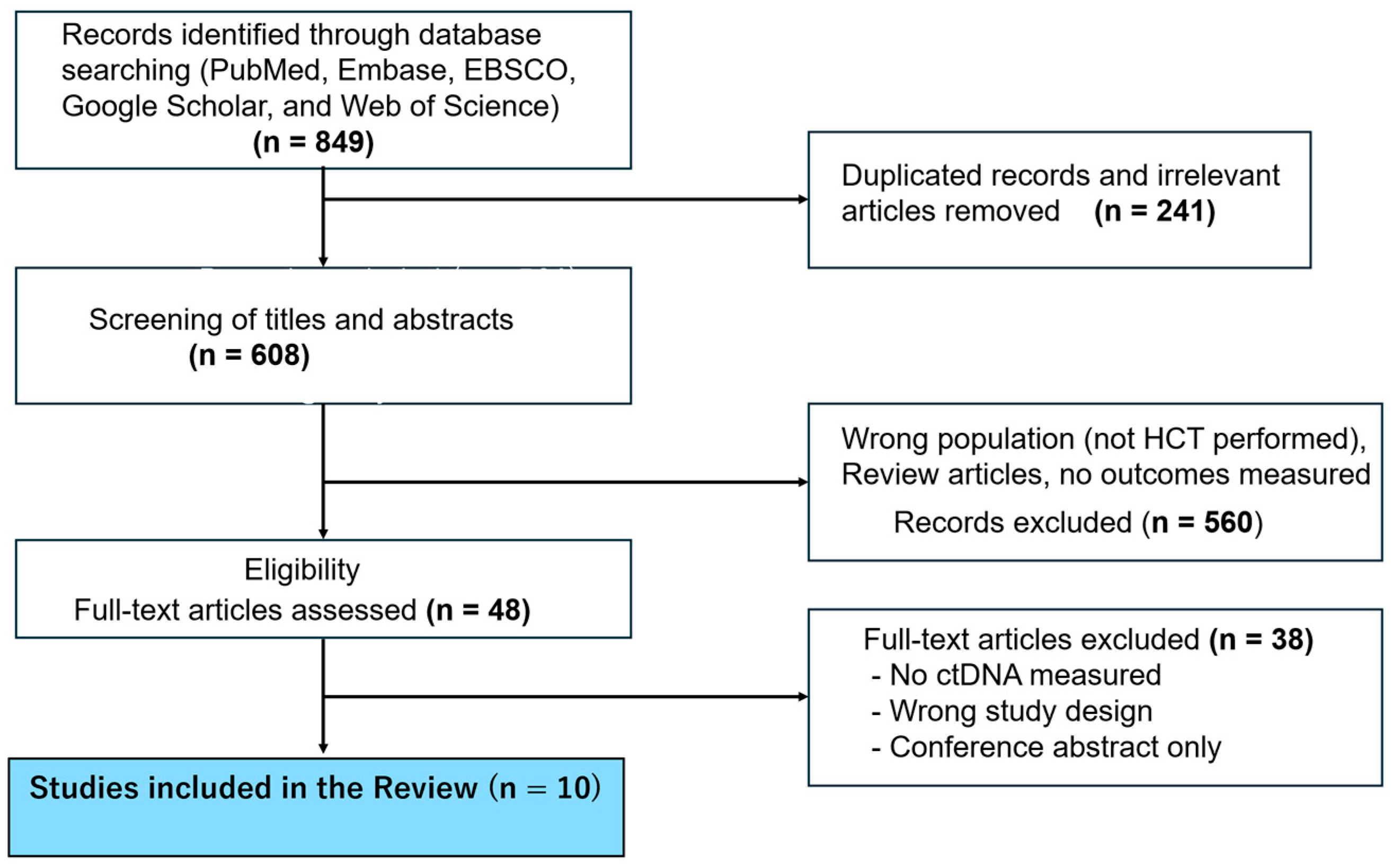
2. Materials and Methods
2.1. Study Design and Reporting Standards
- Population: Patients of any age with hematologic malignancies undergoing allogeneic or autologous HCT, including AML, ALL, malignant lymphoma, MDS, MM, and related disorders.
- Index prognostic factor: Detection of tumor-specific ctDNA or tumor-informed/tumor-associated cfDNA for MRD assessment at any time point before or after HCT.
- Comparator: Patients with undetectable ctDNA/cfDNA at the same assessment time point.
- Outcomes: Primary outcomes included relapse, cumulative incidence of relapse (CIR), RFS, and PFS. Secondary outcomes included OS, graft-versus-host disease (GVHD), graft failure, transplant-related mortality (TRM), and other post-transplant complications.
- Study design: Prospective or retrospective observational cohort studies reporting hazard ratios (HRs) with 95% confidence intervals (CIs), or providing sufficient data for HR reconstruction. Reviews, editorials, conference abstracts without sufficient data, case reports, and non-English studies were excluded.
2.2. Information Sources and Search Strategy
- PubMed/MEDLINE;
- Embase;
- Web of Science;
- EBSCO;
- Cochrane Central Register of Controlled Trials (CENTRAL).
- Circulating tumor DNA and liquid biopsy;
- Measurable residual disease;
- Hematopoietic cell transplantation;
- Relapse and survival outcomes.
2.3. Study Selection and Data Extraction
- Study characteristics (author, year, country, design);
- Patient demographics and disease subtype;
- Transplant characteristics;
- ctDNA/cfDNA assay methodology;
- Sampling time points;
- Outcome measures;
- HRs and corresponding 95% CIs.
2.4. Risk of Bias Assessment
- Study participation;
- Study attrition;
- Prognostic factor measurement;
- Outcome measurement;
- Study confounding;
- Statistical analysis and reporting.
2.5. Data Synthesis and Statistical Analysis
3. Results
3.1. Characteristics of Included Studies
3.2. Survival Outcomes
3.3. Prediction of Graft-Versus-Host Disease and Other Complications
3.4. Engraftment and Transplant-Related Mortality
3.5. Relapse Prediction
3.6. Risk of Bias Assessment
- Study Participation;
- Study Attrition;
- Prognostic Factor Measurement;
- Outcome Measurement;
- Study Confounding;
- Statistical Analysis and Reporting.
3.7. Meta-Analysis of ctDNA Positivity and Survival Outcomes
4. Discussion
5. Conclusions
Author Contributions
Funding
Institutional Review Board Statement
Informed Consent Statement
Data Availability Statement
Conflicts of Interest
Abbreviations
| Disease and Clinical Terms | |
| ALL | Acute lymphoblastic leukemia |
| AML | Acute myeloid leukemia |
| CLL | Chronic lymphocytic leukemia |
| CMML | Chronic myelomonocytic leukemia |
| DLBCL | Diffuse large B-cell lymphoma |
| HL | Hodgkin lymphoma |
| MDS | Myelodysplastic syndromes |
| MM | Multiple myeloma |
| MPN | Myeloproliferative neoplasm |
| NHL | non-Hodgkin lymphoma |
| Transplant-Related Terms | |
| Allo-HCT | Allogeneic hematopoietic cell transplantation |
| GVHD | Graft-versus-host disease |
| GVL | Graft-versus-leukemia |
| HCT | Hematopoietic cell transplantation |
| NRM | non-relapse mortality |
| TRM | Transplant-related mortality |
| Molecular and Laboratory Terms | |
| cfDNA | Cell-free DNA |
| cfRNA | Cell-free RNA |
| ctDNA | Circulating tumor DNA |
| ddPCR | Droplet digital polymerase chain reaction |
| MFC | Multiparameter flow cytometry |
| MRD | Minimal residual disease |
| NGS | Next-generation sequencing |
| PCR | Polymerase chain reaction |
| RQ-PCR | Real-time quantitative polymerase chain reaction |
| TA-cfDNA | Tumor-associated cell-free DNA |
| WGBS | Whole-genome bisulfite sequencing |
| Statistical and Methodological Terms | |
| AUC | Area under the curve |
| CI | Confidence interval |
| CIR | Cumulative incidence of relapse |
| HR | Hazard ratio |
| NR | Not reported |
| OS | Overall survival |
| PFS | Progression-free survival |
| PRISMA | Preferred Reporting Items for Systematic Reviews and Meta-Analyses |
| QUIPS | Quality in Prognosis Studies |
| RFS | Relapse-free survival |
| Other | |
| APC | Article processing charges |
| CAR-T | Chimeric antigen receptor T-cell |
References
- Greco, R.; Ruggeri, A.; McLornan, D.P.; Snowden, J.A.; Alexander, T.; Angelucci, E.; Averbuch, D.; Bazarbachi, A.; Hazenberg, M.D.; Kalwak, K.; et al. Indications for haematopoietic cell transplantation and CAR-T for haematological diseases, solid tumours and immune disorders: 2025 EBMT practice recommendations. Bone Marrow Transplant. 2025, 60, 1499–1525. [Google Scholar] [CrossRef]
- Rieger, M.J.; Stolz, S.M.; Müller, A.M.; Schwotzer, R.; Nair, G.; Schneidawind, D.; Manz, M.G.; Schanz, U. Haploidentical transplant with posttransplant cyclophosphamide vs matched related and unrelated donor transplant in acute myeloid leukemia and myelodysplastic neoplasm. Bone Marrow Transplant. 2023, 58, 1121–1129. [Google Scholar] [CrossRef]
- Akhmedov, M.; Espinoza, J.L. Addressing the surge of infections by multidrug-resistant Enterobacterales in hematopoietic cell transplantation. Blood Rev. 2024, 68, 101229. [Google Scholar] [CrossRef]
- Sauerer, T.; Velázquez, G.F.; Schmid, C. Relapse of acute myeloid leukemia after allogeneic stem cell transplantation: Immune escape mechanisms and current implications for therapy. Mol. Cancer 2023, 22, 180. [Google Scholar] [CrossRef] [PubMed]
- Heuser, M.; Freeman, S.D.; Ossenkoppele, G.J.; Buccisano, F.; Hourigan, C.S.; Ngai, L.L.; Tettero, J.M.; Bachas, C.; Baer, C.; Béné, M.-C.; et al. 2021 Update on MRD in acute myeloid leukemia: A consensus document from the European LeukemiaNet MRD Working Party. Blood 2021, 138, 2753–2767. [Google Scholar] [CrossRef] [PubMed]
- Sorror, M.L. The use of prognostic models in allogeneic transplants: A perspective guide for clinicians and investigators. Blood 2023, 141, 2173–2186. [Google Scholar] [CrossRef] [PubMed]
- Wan, J.C.M.; Massie, C.; Garcia-Corbacho, J.; Mouliere, F.; Brenton, J.D.; Caldas, C.; Pacey, S.; Baird, R.; Rosenfeld, N. Liquid biopsies come of age: Towards implementation of circulating tumour DNA. Nat. Rev. Cancer 2017, 17, 223–238. [Google Scholar] [CrossRef]
- Martínez-Castedo, B.; Camblor, D.; Martín-Arana, J.; Carbonell-Asins, J.; García-Micó, B.; Gambardella, V.; Huerta, M.; Roselló, S.; Roda, D.; Gimeno-Valiente, F.; et al. Minimal residual disease in colorectal cancer. Tumor-informed versus tumor-agnostic approaches: Unraveling the optimal strategy. Ann. Oncol. 2025, 36, 263–276. [Google Scholar] [CrossRef]
- Sorbini, M.; Carradori, T.; Togliatto, G.M.; Vaisitti, T.; Deaglio, S. Technical Advances in Circulating Cell-Free DNA Detection and Analysis for Personalized Medicine in Patients’ Care. Biomolecules 2024, 14, 498. [Google Scholar] [CrossRef]
- Kurtz, D.M.; Esfahani, M.S.; Scherer, F.; Soo, J.; Jin, M.C.; Liu, C.L.; Newman, A.M.; Dührsen, U.; Hüttmann, A.; Casasnovas, O.; et al. Dynamic Risk Profiling Using Serial Tumor Biomarkers for Personalized Outcome Prediction. Cell 2019, 178, 699–713.e19. [Google Scholar] [CrossRef]
- Martello, M.; Solli, V.; Mazzocchetti, G.; Solimando, A.G.; Bezzi, D.; Taurisano, B.; Kanapari, A.; Poletti, A.; Borsi, E.; Armuzzi, S.; et al. High level of circulating cell-free tumor DNA at diagnosis correlates with disease spreading and defines multiple myeloma patients with poor prognosis. Blood Cancer J. 2024, 14, 208. [Google Scholar] [CrossRef]
- Zou, H.; Liu, W.; Wang, X.; Wang, Y.; Wang, C.; Qiu, C.; Liu, H.; Shan, D.; Xie, T.; Huang, W.; et al. Dynamic monitoring of circulating tumor DNA reveals outcomes and genomic alterations in patients with relapsed or refractory large B-cell lymphoma undergoing CAR T-cell therapy. J. Immunother. Cancer 2024, 12, e008450. [Google Scholar] [CrossRef]
- Frank, M.J.; Hossain, N.M.; Bukhari, A.; Dean, E.; Spiegel, J.Y.; Claire, G.K.; Kirsch, I.; Jacob, A.P.; Mullins, C.D.; Lee, L.W.; et al. Monitoring of Circulating Tumor DNA Improves Early Relapse Detection After Axicabtagene Ciloleucel Infusion in Large B-Cell Lymphoma: Results of a Prospective Multi-Institutional Trial. J. Clin. Oncol. 2021, 39, 3034–3043. [Google Scholar] [CrossRef] [PubMed]
- Zhou, X.; Lang, W.; Mei, C.; Ren, Y.; Ma, L.; Jiang, L.; Ye, L.; Xu, G.; Luo, Y.; Liu, L.; et al. Serial monitoring of circulating tumour DNA on clinical outcome in myelodysplastic syndromes and acute myeloid leukaemia. Clin. Transl. Med. 2023, 13, e1349. [Google Scholar] [CrossRef]
- Shastri, T.; Trabolsi, A.; Arumov, A.; Schatz, J.H. Bispecific Antibodies in Hematologic Malignancies: Attacking the Frontline. BioDrugs 2025, 39, 793–814. [Google Scholar] [CrossRef]
- Tan, X.; Yan, H.; Chen, L.; Zhang, Y.; Sun, C. Clinical Value of ctDNA in Hematological Malignancies (Lymphomas, Multiple Myeloma, Myelodysplastic Syndrome, and Leukemia): A Meta-Analysis. Front. Oncol. 2021, 11, 632910. [Google Scholar] [CrossRef]
- Lee, J.S.; Cho, E.H.; Kim, B.; Hong, J.; Kim, Y.-G.; Kim, Y.; Jang, J.-H.; Lee, S.-T.; Kong, S.-Y.; Lee, W.; et al. Clinical Practice Guideline for Blood-based Circulating Tumor DNA Assays. Ann. Lab. Med. 2024, 44, 195–209. [Google Scholar] [CrossRef] [PubMed]
- Tierney, J.F.; Stewart, L.A.; Ghersi, D.; Burdett, S.; Sydes, M.R. Practical methods for incorporating summary time-to-event data into meta-analysis. Trials 2007, 8, 16. [Google Scholar] [CrossRef]
- Hayden, J.A.; Van Der Windt, D.A.; Cartwright, J.L.; Côté, P.; Bombardier, C. Assessing bias in studies of prognostic factors. Ann. Intern. Med. 2013, 158, 280–286. [Google Scholar] [CrossRef]
- Dhakal, B.; Sharma, S.; Balcioglu, M.; Shchegrova, S.; Malhotra, M.; Zimmermann, B.; Billings, P.R.; Harrington, A.; Sethi, H.; Aleshin, A.; et al. Assessment of Molecular Residual Disease Using Circulating Tumor DNA to Identify Multiple Myeloma Patients at High Risk of Relapse. Front. Oncol. 2022, 12, 786451. [Google Scholar] [CrossRef] [PubMed]
- Patel, V.; Kabat, M.; Ip, A.; Kaur, S.; Suh, H.C.; Cho, C.; Vesole, D.; Donato, M.; Albitar, M.; Rowley, S.D. Peripheral Blood Tumor Associated Cell-Free DNA Testing as a Predictor for Relapse Postallogeneic Stem Cell Transplant for Acute Myelogenous Leukemia. Transpl. Cell Ther. 2025, 31, 1010–1019. [Google Scholar] [CrossRef]
- Herrera, A.F.; Kim, H.T.; Kong, K.A.; Faham, M.; Sun, H.; Sohani, A.R.; Alyea, E.P.; Carlton, V.E.; Chen, Y.; Cutler, C.S.; et al. Next-generation sequencing-based detection of circulating tumour DNA After allogeneic stem cell transplantation for lymphoma. Br. J. Haematol. 2016, 175, 841–850. [Google Scholar] [CrossRef]
- Cheng, A.P.; Cheng, M.P.; Loy, C.J.; Lenz, J.S.; Chen, K.; Smalling, S.; Burnham, P.; Timblin, K.M.; Orejas, J.L.; Silverman, E.; et al. Cell-free DNA profiling informs all major complications of hematopoietic cell transplantation. Proc. Natl. Acad. Sci. USA 2022, 119, e2113476118. [Google Scholar] [CrossRef]
- Pasca, S.; Guo, M.Z.; Wang, S.; Stokvis, K.; Shedeck, A.; Pallavajjala, A.; Shams, C.; Pallavajjala, R.; DeZern, A.E.; Varadhan, R.; et al. Cell-free DNA measurable residual disease as a predictor of postallogeneic hematopoietic cell transplant outcomes. Blood Adv. 2023, 7, 4660–4670. [Google Scholar] [CrossRef]
- Nakamura, S.; Yokoyama, K.; Shimizu, E.; Yusa, N.; Kondoh, K.; Ogawa, M.; Takei, T.; Kobayashi, A.; Ito, M.; Isobe, M.; et al. Prognostic impact of circulating tumor DNA status post-allogeneic hematopoietic stem cell transplantation in AML and MDS. Blood 2019, 133, 2682–2695. [Google Scholar] [CrossRef]
- Haugaard, A.K.; Madsen, H.O.; Marquart, H.V.; Rosthøj, S.; Masmas, T.N.; Heilmann, C.; Müller, K.G.; Ifversen, M. Highly sensitive chimerism detection in blood is associated with increased risk of relapse after allogeneic hematopoietic cell transplantation in childhood leukemia. Pediatr. Transpl. 2019, 23, e13549. [Google Scholar] [CrossRef]
- Yegin, Z.A.; Can, F.; Gökçen, S.; Sadioğlu, R.E.; Özkurt, Z.N.; İlHan, Ç.; Yağcı, M. The Impact of Pre-transplant Cell-free DNA Levels on Leukemia Relapse and Transplant-related Complications in Allogeneic Hematopoietic Stem Cell Transplant Recipients. Balk. Med. J. 2020, 37, 138–143. [Google Scholar] [CrossRef] [PubMed]
- Kim, J.; Le, T.M.; Lee, D.; Nguyen, H.D.T.; Cho, H.J.; Sohn, S.K.; Kim, J.G.; Jeong, S.-Y.; Ham, J.Y.; Jeong, J.Y.; et al. Circulating-tumor DNA Assessment in Diffuse Large B-cell Lymphoma to Determine Up-front Stem Cell Transplantation: A Pilot Study. In Vivo 2024, 38, 372–379. [Google Scholar] [CrossRef] [PubMed]
- Waterhouse, M.; Pennisi, S.; Pfeifer, D.; Scherer, F.; Zeiser, R.; Duyster, J.; Bertz, H.; Finke, J.; Duque-Afonso, J. Monitoring of Measurable Residual Disease Using Circulating DNA after Allogeneic Hematopoietic Cell Transplantation. Cancers 2022, 14, 3307. [Google Scholar] [CrossRef] [PubMed]
- Abdulmawjood, B.; Roma-Rodrigues, C.; Fernandes, A.R.; Baptista, P.V. Liquid biopsies in myeloid malignancies. Cancer Drug Resist. 2019, 2, 1044–1061. [Google Scholar] [CrossRef]
- Kolb, H.-J. Graft-versus-leukemia effects of transplantation and donor lymphocytes. Blood 2008, 112, 4371–4383. [Google Scholar] [CrossRef] [PubMed]
- Liang, E.C.; Dekker, S.E.; Sabile, J.M.G.; Torelli, S.; Zhang, A.; Miller, K.; Shiraz, P.; Hayes-Lattin, B.; Leonard, J.T.; Muffly, L. Next-generation sequencing–based MRD in adults with ALL undergoing hematopoietic cell transplantation. Blood Adv. 2023, 7, 3395–3402. [Google Scholar] [CrossRef] [PubMed]
- Muffly, L.; Liang, E.C.; Dolan, J.G.; Pulsipher, M.A. How I use next-generation sequencing–MRD to plan approach and prevent relapse after HCT for children and adults with ALL. Blood 2024, 144, 253–261. [Google Scholar] [CrossRef] [PubMed]
- Medina, A.; Puig, N.; Flores-Montero, J.; Jimenez, C.; Sarasquete, M.-E.; Garcia-Alvarez, M.; Prieto-Conde, I.; Chillon, C.; Alcoceba, M.; Gutierrez, N.C.; et al. Comparison of next-generation sequencing (NGS) and next-generation flow (NGF) for minimal residual disease (MRD) assessment in multiple myeloma. Blood Cancer J. 2020, 10, 108. [Google Scholar] [CrossRef]
- Maffini, E.; Ursi, M.; Barbato, F.; Dicataldo, M.; Roberto, M.; Campanini, E.; Dan, E.; De Felice, F.; De Matteis, S.; Storci, G.; et al. The prevention of disease relapse after allogeneic hematopoietic cell transplantation in acute myeloid leukemia. Front. Oncol. 2022, 12, 1066285. [Google Scholar] [CrossRef]




| Author Year Journal Country | Study Design | Patient -Count -Age -Gender | Underlying Disease/HCT Procedure | Main Findings |
|---|---|---|---|---|
| ctDNA | ||||
| Binod Dhakal et al. [20] 2022 Frontiers in Oncology USA | Retrospective cohort study | 28 patients 67 years (41–70) 57.1% male | MM Autologous HCT | ctDNA positivity at 3 months post-ASCT in MM strongly predicted relapse and shorter PFS, outperforming MFC. |
| Sousuke Nakamura et al. [25] 2019 Blood Japan | Retrospective cohort study | 53 enrolled, 51 analyzed for ctDNA Median 53 years (range: 17–68) 29 males (56.9%) | AML MDS Allo-HCT | ctDNA at 1 and 3 months post-alloSCT for AML/MDS predicted relapse and OS; increasing levels (kinetics) were a sensitive predictor. |
| Juhyung Kim et al. [28] 2024 In Vivo Republic of Korea | Prospective pilot study | 10 patients 50–60 years 8 males | DLBCL Autologous HCT | ctDNA monitoring identified high-risk DLBCL patients who may benefit from upfront ASCT, especially with emergent poor-prognosis mutations. |
| Alex F. Herrera et al. [21] 2016 British Journal of Haematology USA | Retrospective cohort study | 139 patients (68 for ctDNA) 59 years (27–69) 43 male (63.2%) | B-cell NHL T-cell NHL HL CLL Allo-HCT | ctDNA detection post-allo-HSCT in lymphoma predicted relapse, with positivity linked to increased progression risk and inferior PFS. |
| cfDNA | ||||
| Vanisha Patel et al. [22] 2025 Transplantation and Cellular Therapy USA | Single-center retrospective cohort study | 90 patients Median 56 years (range 22–77) 49 males (54.4%) | AML allo-HCT | Detection of TA-cfDNA post-allo-HCT in AML was strongly associated with increased relapse and mortality. |
| Zeynep Arzu Yegin et al. [27] 2020 Balkan Medical Journal Turkey | Retrospective cohort study | 177 patients 36 years (16–66) 111 male | AML ALL Mixed-phenotype acute leukemia Blastic plasmacytoid dendritic cell neoplasm Allo-HCT | Low pre-transplant cfDNA levels were associated with higher transplant-related complications and relapse in AML. |
| Alexandre Pellan Cheng et al. [23] 2022 Proceedings of the National Academy of Sciences of the United States of America (PNAS) USA | Prospective cohort study | 27 patients Age: Not specified Gender: Not specified | Malignant hematologic disorders (n = 25) and non-malignant blood disorders (n = 2) Allo-HCT | Low-coverage bisulfite sequencing of cfDNA could simultaneously inform multiple post-HCT complications (GVHD, infection, relapse). |
| Sergiu Pasca et al. [24] 2023 Blood Advances USA | Prospective cohort study | 82 patients median 45 years (range 33–50) 46.3% male | AML MDS MDS/MPN overlap syndrome Allo-HCT | cfDNA-MRD positivity at day 90 post-alloHCT in myeloid malignancies was strongly associated with increased relapse and inferior survival. |
| Miguel Waterhouse et al. [29] 2022 Cancers Germany | Prospective observational cohort study | 62 patients 57 years (21–76) 37 males | AML, MDS, MPN, CMML, Aplastic Anemia Allo-HCT | Longitudinal cfDNA monitoring for MRD and chimerism enabled early relapse detection post-allo-HSCT, including extramedullary relapse. |
| Chimerism | ||||
| Anna Karen Haugaard et al. [26] 2019 Pediatric Transplantation Denmark | Retrospective cohort study | 56 children (61 transplants included) Median 8.5 years (range 0.6–17.9) 41 male (67%) | ALL AML Allo-HCT | Highly sensitive RQ-PCR chimerism in pediatric ALL/AML predicted relapse ~7 months before morphological relapse, enabling early intervention |
| Author (Year) | HCT Type | Disease | Outcome Measured | p-Value | Key Findings |
|---|---|---|---|---|---|
| ctDNA | |||||
| Dhakal et al. (2022) [20] | Autologous HCT | MM | PFS | 0.0003 | ctDNA+ at 3 months post-ASCT independently predicted shorter PFS |
| Nakamura et al. (2019) [25] | Allo-HCT | AML, MDS | OS | <0.01 | ctDNA at 3 months predicted OS |
| Herrera et al. (2016) [21] | Allo-HCT | Lymphoma | PFS | 0.003 | ctDNA+ linked to inferior PFS |
| cfDNA | |||||
| Pasca et al. (2023) [24] | Allo-HCT | Myeloid malignancies | OS/RFS | <0.001 | Day 90 cfDNA-MRD+ is strongly associated with worse OS/RFS |
| Patel et al. (2025) [22] | Allo-HCT | AML | OS/RFS | <0.0001 | TA-cfDNA+ is associated with increased mortality |
| Yegin et al. (2020) [27] | Allo-HCT | AML, ALL, others | OS | 0.821 | No significant association |
| Waterhouse et al. (2022) [29] | Allo-HCT | AML, MDS, MPN, others | OS | <0.05 | Longitudinal cfDNA enabled early relapse detection, impacting survival |
| Chimerism | |||||
| Haugaard et al. (2019) [26] | Allo-HCT | ALL, AML | OS | <0.05 | Chimerism-based MRD predicted OS in pediatric patients |
| Author (Year) | Timing of Assessment | Biomarker | Outcome | Association with ctDNA/cfDNA | Notes |
|---|---|---|---|---|---|
| Yegin et al. (2020) [27] | Pre-transplant | Total cfDNA (spectrophotometry) | Transplant-related complications, mortality | Inverse: Low cfDNA is associated with higher complications/mortality | Measured total cfDNA, not tumor-specific; may reflect a different biological phenomenon |
| Haugaard et al. (2019) [26] | Post-transplant | RQ-PCR chimerism | Relapse, TRM | Positive: Detectable MRD associated with TRM | Pediatric population; RQ-PCR used for chimerism-based MRD |
| Herrera et al. (2016) [21] | Post-transplant | Targeted NGS (ctDNA) | NRM | Positive: ctDNA+ is associated with increased NRM | Lymphoma patients post-alloHCT |
| Author (Year) | HCT Type | Disease | Sample Size | ctDNA Assay | Timing of Assessment | Association with Relapse? | Key Finding |
|---|---|---|---|---|---|---|---|
| ctDNA | |||||||
| Dhakal et al. (2022) [20] | Autologous HCT | MM | 28 | ddPCR (tumor-informed) | 3 months post-ASCT | Yes | ctDNA positivity strongly predicted relapse, outperforming MFC |
| Nakamura et al. (2019) [25] | Allo-HCT | AML, MDS | 51 | Targeted NGS (patient-specific) | 1 and 3 months post-alloHCT | Yes | ctDNA levels predictive of relapse; increasing kinetics offered high sensitivity |
| Herrera et al. (2016) [21] | Allo-HCT | Lymphoma (NHL, HL, CLL) | 68 | Targeted NGS (panel-based) | Post-alloHCT (median day +100) | Yes | ctDNA detection linked to significantly higher risk of disease progression |
| Kim et al. (2024) [28] | Autologous HCT | DLBCL | 10 | Targeted NGS | Pre-ASCT and post-ASCT | Yes | ctDNA monitoring identified high-risk patients who may benefit from upfront ASCT |
| cfDNA | |||||||
| Pasca et al. (2023) [24] | Allo-HCT | Myeloid malignancies (AML, MDS, MDS/MPN) | 82 | cfDNA-MRD (targeted NGS) | Day 90 post-alloHCT | Yes | cfDNA-MRD positivity was associated with 76% 2-year CIR vs. 21% in negative patients |
| Patel et al. (2025) [22] | Allo-HCT | AML | 90 | TA-cfDNA (targeted NGS) | Post-alloHCT | Yes | TA-cfDNA positivity is strongly associated with increased cumulative incidence of relapse |
| Yegin et al. (2020) [27] | Allo-HCT | AML, ALL, mixed-phenotype acute leukemia, others | 177 | Total cfDNA (spectrophotometry) | Pre-transplant | Yes | Lower cfDNA is significantly associated with higher relapse risk in AML |
| Cheng et al. (2022) [23] | Allo-HCT | Malignant hematologic disorders (n = 25) | 27 | Low-coverage bisulfite sequencing (cfDNA) | Serial post-HCT | Yes | cfDNA profiling informed relapse among other complications; not the primary focus |
| Waterhouse et al. (2022) [29] | Allo-HCT | AML, MDS, MPN, CMML, aplastic anemia | 62 | Targeted NGS (patient-specific) | Longitudinal (serial) | Yes | Longitudinal ctDNA monitoring enabled early relapse detection, including extramedullary relapse |
| Chimerism | |||||||
| Haugaard et al. (2019) [26] | Allo-HCT | ALL, AML | 56 (61 transplants) | RQ-PCR chimerism | Post-transplant (serial) | Yes | Chimerism-based MRD predicted relapse ~7 months before morphological evidence |
| Study | Study Participation | Study Attrition | Prognostic Factor Measurement | Outcome Measurement | Study Confounding | Statistical Analysis & Reporting | Overall Risk |
|---|---|---|---|---|---|---|---|
| Dhakal et al. (2022) [20] | Low | Low | Moderate | Low | Moderate | Low | Moderate |
| Patel et al. (2025) [22] | Low | Low | Moderate | Low | Moderate | Low | Moderate |
| Nakamura et al. (2019) [25] | Low | Moderate | Moderate | Low | Moderate | Low | Moderate |
| Kim et al. (2024) [28] | Low | Low | Moderate | Low | Low | Low | Low |
| Herrera et al. (2016) [21] | Moderate | High | High | Low | High | Low | High |
| Haugaard et al. (2019) [26] | Low | Moderate | Moderate | Low | Moderate | Low | Moderate |
| Yegin et al. (2020) [27] | High | High | High | Low | Moderate | Low | High |
| Cheng et al. (2022) [23] | Low | Low | Moderate | Low | Low | Low | Low |
| Pasca et al. (2023) [24] | Low | Low | Moderate | Low | Moderate | Low | Moderate |
| Waterhouse et al. (2022) [29] | Low | Low | Moderate | Low | Moderate | Low | Moderate |
| Study | Biomarker Type | Disease | Outcome Included in Meta-analysis | HR Source | Adjusted Analysis | Main Covariates Included | Included in Quantitative Synthesis | Notes |
|---|---|---|---|---|---|---|---|---|
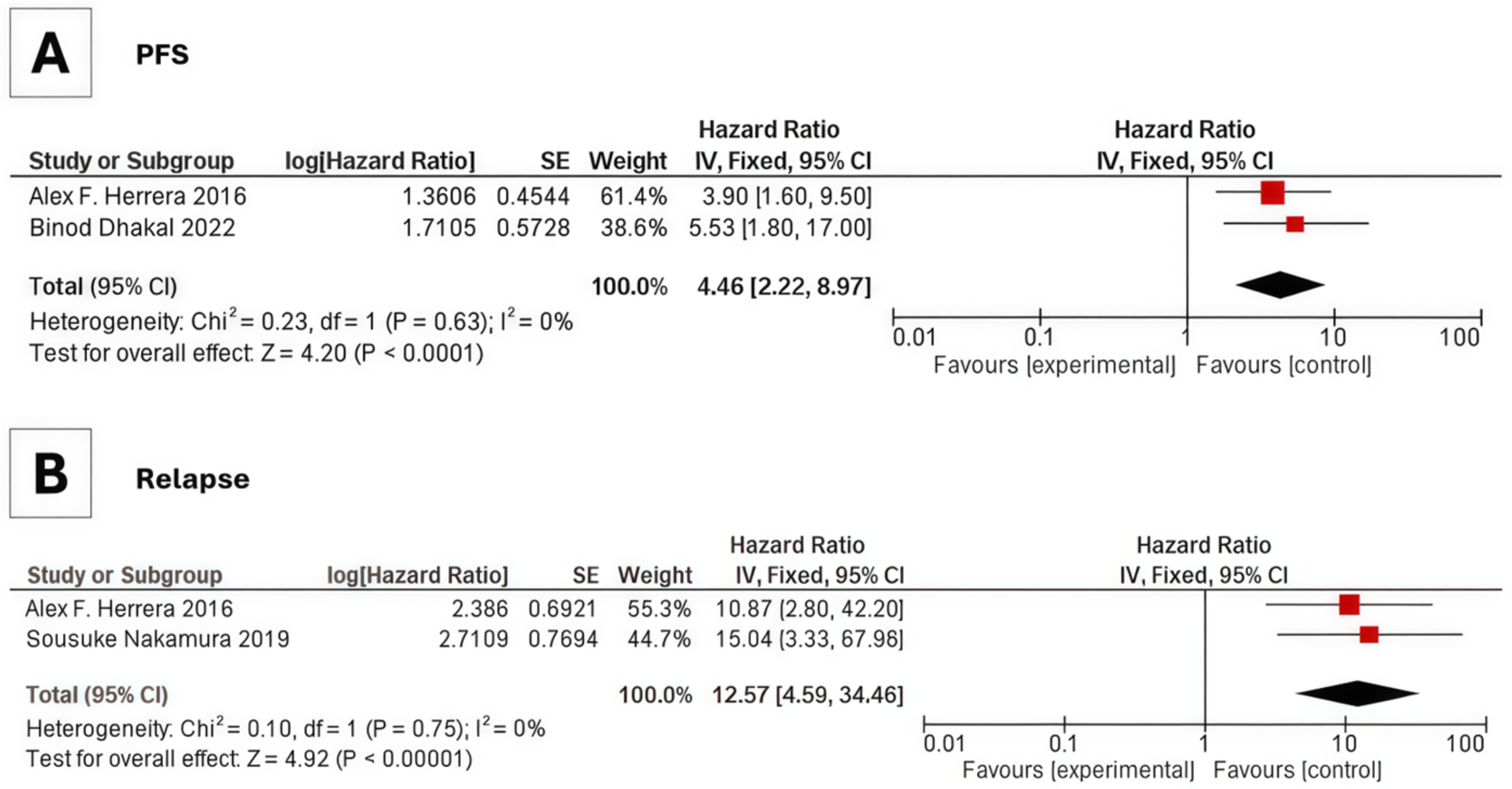
| Dhakal et al. (2022) [20] | Tumor-informed ctDNA (ddPCR/mPCR-NGS) | Multiple myeloma | PFS | Directly reported HR | Yes | Age, FISH risk, MFC MRD | Yes | Post-ASCT ctDNA positivity independently predicted relapse |
| Nakamura et al. (2019) [25] | Tumor-specific ctDNA (targeted NGS/ddPCR) | AML/MDS | OS, relapse | Directly reported HR | No | Univariable only | Yes | Serial kinetics highly predictive of relapse |
| Herrera et al. (2016) [21] | ctDNA (targeted NGS) | Lymphoma | PFS | Directly reported HR | Partial | Limited adjustment | Yes | Post-alloHCT ctDNA associated with inferior PFS |
| Patel et al. (2025) [22] | Tumor-associated cfDNA (targeted NGS) | AML | OS, RFS, relapse | Directly reported HR | Yes | Age, donor type, CMV, conditioning, GVHD prophylaxis | Yes | Strong association with relapse and mortality |
| Pasca et al. (2023) [24] | Tumor-informed cfDNA-MRD (error-corrected NGS) | AML/MDS/MPN | OS, RFS, relapse | Directly reported HR | Yes | Clinical and transplant variables | Yes | Day +90 positivity is strongly associated with relapse |
| Waterhouse et al. (2022) [29] | Patient-specific cfDNA (targeted NGS) | AML/MDS/MPN/CMML | OS, relapse | HR was partially reconstructed from KM curves | No | Not fully adjusted | Yes | Longitudinal monitoring detected relapse early |
| Kim et al. (2024) [28] | ctDNA (targeted NGS/CAPP-seq) | DLBCL | Relapse | Descriptive only | No | None | No | Pilot study with insufficient HR data |
| Cheng et al. (2022) [23] | Methylation/WGBS cfDNA profiling | Mixed malignant/non-malignant disorders | GVHD/infection/relapse | No HR available | No | N/A | No | Included only in qualitative synthesis |
| Haugaard et al. (2019) [26] | RQ-PCR chimerism MRD | Pediatric ALL/AML | Relapse/TRM | Directly reported HR | No | Univariable only | No | Chimerism-based MRD analyzed narratively |
| Yegin et al. (2020) [27] | Total cfDNA quantity (spectrophotometry) | Acute leukemias | OS/complications | No extractable HR | Limited | Partial adjustment | No | Total cfDNA not considered tumor-specific |
Disclaimer/Publisher’s Note: The statements, opinions and data contained in all publications are solely those of the individual author(s) and contributor(s) and not of MDPI and/or the editor(s). MDPI and/or the editor(s) disclaim responsibility for any injury to people or property resulting from any ideas, methods, instructions or products referred to in the content. |
© 2026 by the authors. Licensee MDPI, Basel, Switzerland. This article is an open access article distributed under the terms and conditions of the Creative Commons Attribution (CC BY) license.
Share and Cite
Dac, D.T.; Tanaka, H.; Takami, A.; Espinoza, J.L. The Prognostic Value of Circulating Tumor DNA for Clinical Outcomes in Patients Undergoing Hematopoietic Cell Transplantation: A Systematic Review and Meta-Analysis. Int. J. Mol. Sci. 2026, 27, 5076. https://doi.org/10.3390/ijms27115076
Dac DT, Tanaka H, Takami A, Espinoza JL. The Prognostic Value of Circulating Tumor DNA for Clinical Outcomes in Patients Undergoing Hematopoietic Cell Transplantation: A Systematic Review and Meta-Analysis. International Journal of Molecular Sciences. 2026; 27(11):5076. https://doi.org/10.3390/ijms27115076
Chicago/Turabian StyleDac, Do Tung, Hirokazu Tanaka, Akiyoshi Takami, and Jorge Luis Espinoza. 2026. "The Prognostic Value of Circulating Tumor DNA for Clinical Outcomes in Patients Undergoing Hematopoietic Cell Transplantation: A Systematic Review and Meta-Analysis" International Journal of Molecular Sciences 27, no. 11: 5076. https://doi.org/10.3390/ijms27115076
APA StyleDac, D. T., Tanaka, H., Takami, A., & Espinoza, J. L. (2026). The Prognostic Value of Circulating Tumor DNA for Clinical Outcomes in Patients Undergoing Hematopoietic Cell Transplantation: A Systematic Review and Meta-Analysis. International Journal of Molecular Sciences, 27(11), 5076. https://doi.org/10.3390/ijms27115076