PCB 118 Exposure Modulates Chromatin Organization, Ribosome Biogenesis, and Autophagy-Related Pathways in Neuron-like: A Transcriptomic Analysis
 , , ,
, , ,  and
and
Abstract
1. Introduction
2. Results
2.1. Cell Viability Assay
2.2. Transcriptomic Data
2.3. Western Blot Analysis of Selected Autophagy-Associated and Oxidative-Stress-Related Markers
3. Discussion
4. Materials and Methods
4.1. Chemical Reagents
4.2. SH-SY5Y Differentiation and PCB 118 Treatment
4.3. MTT-Based Cell Viability Assay
4.4. Total RNA Processing and cDNA Library Generation
4.5. RNA-Seq–Based Transcriptomic Analysis
4.6. Protein Isolation and Western Blotting Procedures
4.7. Statistical Analysis
5. Conclusions
Supplementary Materials
Author Contributions
Funding
Institutional Review Board Statement
Informed Consent Statement
Data Availability Statement
Conflicts of Interest
Abbreviations
| PCBs | Polychlorinated biphenyls |
| POPs | persistent organic pollutants |
| CNS | central nervous system |
| NDL-PCBs | non-dioxin-like PCBs |
| DL-PCBs | dioxin-like PCBs |
| AhR | aryl hydrocarbon receptor |
| TCDD | 2,3,7,8-tetrachlorodibenzo-p-dioxin |
| AD | Alzheimer Disease |
| RNA-seq | RNA sequencing |
| DMSO | Dimethyl sulfoxide |
| RA | retinoic acid |
| DEGs | differentially expressed genes |
| GLM | generalized linear models |
| FDR | False Discovery Rate |
| GO | Gene Ontology |
| ORA | Over-Representation Analysis |
| STRING | Search Tool for the Retrieval of Interacting Genes/Proteins |
| PPI | protein-protein interaction |
| CTRL | untreated control |
| PCA | Principal Component Analysis |
| FC | Fold Change |
| BP | Biological processes |
| MF | molecular function |
| CC | cellular component |
| UPS | ubiquitin-proteasome system |
| ALP | autophagy-lysosome pathway |
| sHSPs | small heat-shock proteins |
| ATG | autophagy-related proteins |
| MTT | 3-(4,5-dimethylthiazol-2-yl)-2,5-diphenyltetrazolium bromide assay |
References
- Montano, L.; Pironti, C.; Pinto, G.; Ricciardi, M.; Buono, A.; Brogna, C.; Venier, M.; Piscopo, M.; Amoresano, A.; Motta, O. Polychlorinated Biphenyls (PCBs) in the Environment: Occupational and Exposure Events, Effects on Human Health and Fertility. Toxics 2022, 10, 365. [Google Scholar] [CrossRef]
- Vasseghian, Y.; Hosseinzadeh, S.; Khataee, A.; Dragoi, E.N. The concentration of persistent organic pollutants in water resources: A global systematic review, meta-analysis and probabilistic risk assessment. Sci. Total Environ. 2021, 796, 149000. [Google Scholar] [CrossRef]
- Peixoto-Rodrigues, M.C.; Monteiro-Neto, J.R.; Teglas, T.; Toborek, M.; Soares Quinete, N.; Hauser-Davis, R.A.; Adesse, D. Early-life exposure to PCBs and PFAS exerts negative effects on the developing central nervous system. J. Hazard. Mater. 2025, 485, 136832. [Google Scholar] [CrossRef]
- Lehmann, G.M.; Christensen, K.; Maddaloni, M.; Phillips, L.J. Evaluating health risks from inhaled polychlorinated biphenyls: Research needs for addressing uncertainty. Environ. Health Perspect. 2015, 123, 109–113. [Google Scholar] [CrossRef] [PubMed]
- Saktrakulkla, P.; Lan, T.; Hua, J.; Marek, R.F.; Thorne, P.S.; Hornbuckle, K.C. Polychlorinated Biphenyls in Food. Environ. Sci. Technol. 2020, 54, 11443–11452. [Google Scholar] [CrossRef]
- Herrick, R.F.; Stewart, J.H.; Allen, J.G. Review of PCBs in US schools: A brief history, an estimate of the number of impacted schools, and an approach for evaluating indoor air samples. Environ. Sci. Pollut. Res. Int. 2016, 23, 1975–1985. [Google Scholar] [CrossRef]
- Mandalakis, M.; Stephanou, E.G. Wet deposition of polychlorinated biphenyls in the eastern Mediterranean. Environ. Sci. Technol. 2004, 38, 3011–3018. [Google Scholar] [CrossRef]
- Hu, D.; Hornbuckle, K.C. Inadvertent polychlorinated biphenyls in commercial paint pigments. Environ. Sci. Technol. 2010, 44, 2822–2827. [Google Scholar] [CrossRef] [PubMed]
- Shanahan, C.E.; Spak, S.N.; Martinez, A.; Hornbuckle, K.C. Inventory of PCBs in Chicago and Opportunities for Reduction in Airborne Emissions and Human Exposure. Environ. Sci. Technol. 2015, 49, 13878–13888. [Google Scholar] [CrossRef] [PubMed]
- Liu, Y.; Wang, S.; McDonough, C.A.; Khairy, M.; Muir, D.C.; Helm, P.A.; Lohmann, R. Gaseous and Freely-Dissolved PCBs in the Lower Great Lakes Based on Passive Sampling: Spatial Trends and Air-Water Exchange. Environ. Sci. Technol. 2016, 50, 4932–4939. [Google Scholar] [CrossRef]
- Meijer, S.N.; Ockenden, W.A.; Sweetman, A.; Breivik, K.; Grimalt, J.O.; Jones, K.C. Global distribution and budget of PCBs and HCB in background surface soils: Implications for sources and environmental processes. Environ. Sci. Technol. 2003, 37, 667–672. [Google Scholar] [CrossRef]
- Bell, M.R. Endocrine-disrupting actions of PCBs on brain development and social and reproductive behaviors. Curr. Opin. Pharmacol. 2014, 19, 134–144. [Google Scholar] [CrossRef] [PubMed]
- Kartiosuo, N.; Auranen, K.; Mansell, T.; Novakovic, B.; Nevalainen, J.; Pahkala, K.; Rovio, S.; Mykkanen, J.; Viikari, J.; Juonala, M.; et al. The effect of polychlorinated biphenyls on type 2 diabetes risk is mediated via DNA methylation. Environ. Int. 2025, 203, 109779. [Google Scholar] [CrossRef]
- Liu, J.; Shan, Q.; Yang, Y.; He, W. Uncovering the Potential Link Between Polychlorinated Biphenyls and Cardiovascular Diseases: A Comprehensive Analysis. Toxics 2025, 13, 71. [Google Scholar] [CrossRef]
- Chetrit, L.; Frenoy, P.; Artaud, F.; Marques, C.; Ren, X.; Severi, G.; Mancini, F.R. Evidence of a positive association between dietary exposure to polychlorinated biphenyl (PCB) and weight gain among women in the E3N prospective cohort. Sci. Total Environ. 2024, 957, 177587. [Google Scholar] [CrossRef] [PubMed]
- Wahlang, B.; Perkins, J.T.; Petriello, M.C.; Hoffman, J.B.; Stromberg, A.J.; Hennig, B. A compromised liver alters polychlorinated biphenyl-mediated toxicity. Toxicology 2017, 380, 11–22. [Google Scholar] [CrossRef]
- Pessah, I.N.; Lein, P.J.; Seegal, R.F.; Sagiv, S.K. Neurotoxicity of polychlorinated biphenyls and related organohalogens. Acta Neuropathol. 2019, 138, 363–387. [Google Scholar] [CrossRef]
- Del Piano, F.; Monnolo, A.; Lama, A.; Pirozzi, C.; Comella, F.; Melini, S.; Naccari, C.; Pelagalli, A.; Meli, R.; Ferrante, M.C. Non-dioxin-like polychlorinated biphenyls (PCB 101, 153, and 180) and adipocyte lipid dysfunctions: Involvement of glycerol and role of aquaglyceroporins in mature 3T3-L1 cells. Toxicology 2025, 511, 154050. [Google Scholar] [CrossRef] [PubMed]
- Vermeir, G.; Covaci, A.; Van Larebeke, N.; Schoeters, G.; Nelen, V.; Koppen, G.; Viaene, M. Neurobehavioural and cognitive effects of prenatal exposure to organochlorine compounds in three year old children. BMC Pediatr. 2021, 21, 99. [Google Scholar] [CrossRef]
- Goutman, S.A.; Boss, J.; Patterson, A.; Mukherjee, B.; Batterman, S.; Feldman, E.L. High plasma concentrations of organic pollutants negatively impact survival in amyotrophic lateral sclerosis. J. Neurol. Neurosurg. Psychiatry 2019, 90, 907–912. [Google Scholar] [CrossRef]
- Tilson, H.A.; Jacobson, J.L.; Rogan, W.J. Polychlorinated biphenyls and the developing nervous system: Cross-species comparisons. Neurotoxicology Teratol. 1990, 12, 239–248. [Google Scholar] [CrossRef]
- Hatcher-Martin, J.M.; Gearing, M.; Steenland, K.; Levey, A.I.; Miller, G.W.; Pennell, K.D. Association between polychlorinated biphenyls and Parkinson’s disease neuropathology. Neurotoxicology 2012, 33, 1298–1304. [Google Scholar] [CrossRef]
- Raffetti, E.; Donato, F.; De Palma, G.; Leonardi, L.; Sileo, C.; Magoni, M. Polychlorinated biphenyls (PCBs) and risk of dementia and Parkinson disease: A population-based cohort study in a North Italian highly polluted area. Chemosphere 2020, 261, 127522. [Google Scholar] [CrossRef]
- Grimm, F.A.; Hu, D.; Kania-Korwel, I.; Lehmler, H.J.; Ludewig, G.; Hornbuckle, K.C.; Duffel, M.W.; Bergman, A.; Robertson, L.W. Metabolism and metabolites of polychlorinated biphenyls. Crit. Rev. Toxicol. 2015, 45, 245–272. [Google Scholar] [CrossRef]
- Ash, P.E.A.; Stanford, E.A.; Al Abdulatif, A.; Ramirez-Cardenas, A.; Ballance, H.I.; Boudeau, S.; Jeh, A.; Murithi, J.M.; Tripodis, Y.; Murphy, G.J.; et al. Dioxins and related environmental contaminants increase TDP-43 levels. Mol. Neurodegener. 2017, 12, 35. [Google Scholar] [CrossRef] [PubMed]
- Haarmann-Stemmann, T.; Abel, J. The arylhydrocarbon receptor repressor (AhRR): Structure, expression, and function. Biol. Chem. 2006, 387, 1195–1199. [Google Scholar] [CrossRef] [PubMed]
- Ruggeri, R.M.; Minuti, A.; Giani, F.; Masto, R.; Romano, D.; Aliquo, F.; Campenni, A.; Campo, S.; Cannavo, S.; D’Ascola, A. Polychlorinated Biphenyls (PCBS)-induced oxidative stress and inflammation in human thyrocytes: Involvement of AhR and NRF-2/HO-1 pathway. Endocrine 2025, 87, 252–261. [Google Scholar] [CrossRef]
- Wang, C.; Xu, J.; Pan, K.; Xu, Y.; Yu, J. Relationship between endocrine disruptors and neurodegenerative diseases: Systematic review and meta-analysis. iScience 2025, 28, 112779. [Google Scholar] [CrossRef]
- Schantz, S.L.; Gasior, D.M.; Polverejan, E.; McCaffrey, R.J.; Sweeney, A.M.; Humphrey, H.E.; Gardiner, J.C. Impairments of memory and learning in older adults exposed to polychlorinated biphenyls via consumption of Great Lakes fish. Environ. Health Perspect. 2001, 109, 605–611. [Google Scholar] [CrossRef] [PubMed]
- Jacobson, J.L.; Jacobson, S.W. Intellectual impairment in children exposed to polychlorinated biphenyls in utero. New Engl. J. Med. 1996, 335, 783–789. [Google Scholar] [CrossRef]
- Arrebola, J.P.; Fernandez, M.F.; Martin-Olmedo, P.; Bonde, J.P.; Martin-Rodriguez, J.L.; Exposito, J.; Rubio-Dominguez, A.; Olea, N. Historical exposure to persistent organic pollutants and risk of incident hypertension. Environ. Res. 2015, 138, 217–223. [Google Scholar] [CrossRef] [PubMed]
- Valera, B.; Ayotte, P.; Poirier, P.; Dewailly, E. Associations between plasma persistent organic pollutant levels and blood pressure in Inuit adults from Nunavik. Environ. Int. 2013, 59, 282–289. [Google Scholar] [CrossRef]
- Minuti, A.; Silvestro, S.; Muscara, C.; Scuruchi, M.; D’Angiolini, S. PCB 153 Modulates Genes Involved in Proteasome and Neurodegeneration-Related Pathways in Differentiated SH-SY5Y Cells: A Transcriptomic Study. Cells 2026, 15, 217. [Google Scholar] [CrossRef] [PubMed]
- Peng, Y.; Chu, S.; Yang, Y.; Zhang, Z.; Pang, Z.; Chen, N. Neuroinflammatory In Vitro Cell Culture Models and the Potential Applications for Neurological Disorders. Front. Pharmacol. 2021, 12, 671734. [Google Scholar] [CrossRef]
- Bell, M.; Zempel, H. SH-SY5Y-derived neurons: A human neuronal model system for investigating TAU sorting and neuronal subtype-specific TAU vulnerability. Rev. Neurosci. 2022, 33, 1–15. [Google Scholar] [CrossRef] [PubMed]
- Bullert, A.J.; Wang, H.; Valenzuela, A.E.; Neier, K.; Wilson, R.J.; Badley, J.R.; LaSalle, J.M.; Hu, X.; Lein, P.J.; Lehmler, H.J. Interactions of Polychlorinated Biphenyls and Their Metabolites with the Brain and Liver Transcriptome of Female Mice. ACS Chem. Neurosci. 2024, 15, 3991–4009. [Google Scholar] [CrossRef]
- Curran, C.P.; Altenhofen, E.; Ashworth, A.; Brown, A.; Kamau-Cheggeh, C.; Curran, M.; Evans, A.; Floyd, R.; Fowler, J.; Garber, H.; et al. Ahrd Cyp1a2(−/−) mice show increased susceptibility to PCB-induced developmental neurotoxicity. Neurotoxicology 2012, 33, 1436–1442. [Google Scholar] [CrossRef]
- Borlak, J.; Thum, T. PCBs alter gene expression of nuclear transcription factors and other heart-specific genes in cultures of primary cardiomyocytes: Possible implications for cardiotoxicity. Xenobiotica Fate Foreign Compd. Biol. Syst. 2002, 32, 1173–1183. [Google Scholar] [CrossRef]
- Lopez-Suarez, L.; Awabdh, S.A.; Coumoul, X.; Chauvet, C. The SH-SY5Y human neuroblastoma cell line, a relevant in vitro cell model for investigating neurotoxicology in human: Focus on organic pollutants. Neurotoxicology 2022, 92, 131–155. [Google Scholar] [CrossRef] [PubMed]
- Chen, Y.; Liang, R.; Li, Y.; Jiang, L.; Ma, D.; Luo, Q.; Song, G. Chromatin accessibility: Biological functions, molecular mechanisms and therapeutic application. Signal Transduct. Target. Ther. 2024, 9, 340. [Google Scholar] [CrossRef]
- Kaplan, N.; Moore, I.K.; Fondufe-Mittendorf, Y.; Gossett, A.J.; Tillo, D.; Field, Y.; LeProust, E.M.; Hughes, T.R.; Lieb, J.D.; Widom, J.; et al. The DNA-encoded nucleosome organization of a eukaryotic genome. Nature 2009, 458, 362–366. [Google Scholar] [CrossRef]
- Maze, I.; Noh, K.M.; Allis, C.D. Histone regulation in the CNS: Basic principles of epigenetic plasticity. Neuropsychopharmacol. Off. Publ. Am. Coll. Neuropsychopharmacol. 2013, 38, 3–22. [Google Scholar] [CrossRef]
- Shi, F.; He, Y.; Chen, Y.; Yin, X.; Sha, X.; Wang, Y. Comparative Analysis of Multiple Neurodegenerative Diseases Based on Advanced Epigenetic Aging Brain. Front. Genet. 2021, 12, 657636. [Google Scholar] [CrossRef] [PubMed]
- Wang, W.; Bu, B.; Xie, M.; Zhang, M.; Yu, Z.; Tao, D. Neural cell cycle dysregulation and central nervous system diseases. Prog. Neurobiol. 2009, 89, 1–17. [Google Scholar] [CrossRef] [PubMed]
- Phillips, E.O.N.; Gunjan, A. Histone variants: The unsung guardians of the genome. DNA Repair 2022, 112, 103301. [Google Scholar] [CrossRef]
- Suraweera, A.; Gandhi, N.S.; Beard, S.; Burgess, J.T.; Croft, L.V.; Bolderson, E.; Naqi, A.; Ashton, N.W.; Adams, M.N.; Savage, K.I.; et al. COMMD4 functions with the histone H2A-H2B dimer for the timely repair of DNA double-strand breaks. Commun. Biol. 2021, 4, 484. [Google Scholar] [CrossRef]
- Fernandez-Capetillo, O.; Allis, C.D.; Nussenzweig, A. Phosphorylation of histone H2B at DNA double-strand breaks. J. Exp. Med. 2004, 199, 1671–1677. [Google Scholar] [CrossRef] [PubMed]
- Moyal, L.; Lerenthal, Y.; Gana-Weisz, M.; Mass, G.; So, S.; Wang, S.Y.; Eppink, B.; Chung, Y.M.; Shalev, G.; Shema, E.; et al. Requirement of ATM-dependent monoubiquitylation of histone H2B for timely repair of DNA double-strand breaks. Mol. Cell 2011, 41, 529–542, Erratum in Mol. Cell 2011, 42, 137. https://doi.org/10.1016/j.molcel.2011.03.009. [Google Scholar] [CrossRef]
- Nakamura, K.; Kato, A.; Kobayashi, J.; Yanagihara, H.; Sakamoto, S.; Oliveira, D.V.; Shimada, M.; Tauchi, H.; Suzuki, H.; Tashiro, S.; et al. Regulation of homologous recombination by RNF20-dependent H2B ubiquitination. Mol. Cell 2011, 41, 515–528. [Google Scholar] [CrossRef]
- Wang, H.; Qiu, P.; Zhu, S.; Zhang, M.; Li, Y.; Zhang, M.; Wang, X.; Shang, J.; Qu, B.; Liu, J.; et al. SET nuclear proto-oncogene gene expression is associated with microsatellite instability in human colorectal cancer identified by co-expression analysis. Dig. Liver Dis. 2020, 52, 339–346. [Google Scholar] [CrossRef]
- Bergamasco, M.I.; Ozturk, E.; Casillas-Espinosa, P.M.; Garnham, A.L.; Abeysekera, W.; Wimmer, V.C.; Rajasekhar, P.; Vanyai, H.K.; Whitehead, L.; Blewitt, M.E.; et al. KAT6B overexpression in mice causes aggression, anxiety, and epilepsy. iScience 2025, 28, 111953. [Google Scholar] [CrossRef]
- Hatoum, D.; Haddadi, N.; Lin, Y.; Nassif, N.T.; McGowan, E.M. Mammalian sphingosine kinase (SphK) isoenzymes and isoform expression: Challenges for SphK as an oncotarget. Oncotarget 2017, 8, 36898–36929. [Google Scholar] [CrossRef]
- Jiang, H.; Liu, X.; Li, Y.; Zhang, R.; Liu, H.; Ma, X.; Wu, L.; Qiao, Z.; Li, X. Identification of ribosomal protein L24 (RPL24) from the oriental river prawn, Macrobrachium nipponense, and its roles in ovarian development. Comp. Biochem. Physiol. Part A Mol. Integr. Physiol. 2022, 266, 111154. [Google Scholar] [CrossRef]
- Sutjita, P.; Musalgaonkar, S.; Recchia-Rife, J.; Huang, L.; Xhemalce, B.; Johnson, A.W. The Ribosome Assembly Factor LSG1 Interacts with Vesicle-Associated Membrane Protein-Associated Proteins (VAPs). Mol. Cell. Biol. 2024, 44, 345–357. [Google Scholar] [CrossRef]
- Bousquet-Antonelli, C.; Vanrobays, E.; Gelugne, J.P.; Caizergues-Ferrer, M.; Henry, Y. Rrp8p is a yeast nucleolar protein functionally linked to Gar1p and involved in pre-rRNA cleavage at site A2. Rna 2000, 6, 826–843. [Google Scholar] [CrossRef]
- D’Angiolini, S.; Gugliandolo, A.; Cali, G.; Chiricosta, L. Early Dysregulation of RNA Splicing and Translation Processes Are Key Markers from Mild Cognitive Impairment to Alzheimer’s Disease: An In Silico Transcriptomic Analysis. Int. J. Mol. Sci. 2025, 26, 7303. [Google Scholar] [CrossRef]
- Balch, W.E.; Morimoto, R.I.; Dillin, A.; Kelly, J.W. Adapting proteostasis for disease intervention. Science 2008, 319, 916–919. [Google Scholar] [CrossRef] [PubMed]
- Labbadia, J.; Morimoto, R.I. The biology of proteostasis in aging and disease. Annu. Rev. Biochem. 2015, 84, 435–464. [Google Scholar] [CrossRef]
- Kim, Y.E.; Hipp, M.S.; Bracher, A.; Hayer-Hartl, M.; Hartl, F.U. Molecular chaperone functions in protein folding and proteostasis. Annu. Rev. Biochem. 2013, 82, 323–355. [Google Scholar] [CrossRef] [PubMed]
- Nixon, R.A.; Rubinsztein, D.C. Mechanisms of autophagy-lysosome dysfunction in neurodegenerative diseases. Nat. Rev. Mol. Cell Biol. 2024, 25, 926–946. [Google Scholar] [CrossRef]
- Magalhaes, J.D.; Fao, L.; Vilaca, R.; Cardoso, S.M.; Rego, A.C. Macroautophagy and Mitophagy in Neurodegenerative Disorders: Focus on Therapeutic Interventions. Biomedicines 2021, 9, 1625. [Google Scholar] [CrossRef]
- Egan, D.; Kim, J.; Shaw, R.J.; Guan, K.L. The autophagy initiating kinase ULK1 is regulated via opposing phosphorylation by AMPK and mTOR. Autophagy 2011, 7, 643–644. [Google Scholar] [CrossRef]
- Lienard, C.; Pintart, A.; Bomont, P. Neuronal Autophagy: Regulations and Implications in Health and Disease. Cells 2024, 13, 103. [Google Scholar] [CrossRef]
- Kim, B.W.; Jin, Y.; Kim, J.; Kim, J.H.; Jung, J.; Kang, S.; Kim, I.Y.; Kim, J.; Cheong, H.; Song, H.K. The C-terminal region of ATG101 bridges ULK1 and PtdIns3K complex in autophagy initiation. Autophagy 2018, 14, 2104–2116. [Google Scholar] [CrossRef]
- Mizushima, N.; Noda, T.; Yoshimori, T.; Tanaka, Y.; Ishii, T.; George, M.D.; Klionsky, D.J.; Ohsumi, M.; Ohsumi, Y. A protein conjugation system essential for autophagy. Nature 1998, 395, 395–398. [Google Scholar] [CrossRef]
- Ptak, G.; Zacchini, F.; Czernik, M.; Fidanza, A.; Palmieri, C.; Della Salda, L.; Scapolo, P.A.; Loi, P. A short exposure to polychlorinated biphenyls deregulates cellular autophagy in mammalian blastocyst in vitro. Hum. Reprod. 2012, 27, 1034–1042. [Google Scholar] [CrossRef] [PubMed]
- Shi, Q.; Song, X.; Liu, Z.; Wang, Y.; Wang, Y.; Fu, J.; Su, C.; Xia, X.; Song, E.; Song, Y. Quinones Derived from Polychlorinated Biphenyls Induce ROS-Dependent Autophagy by Evoking an Autophagic Flux and Inhibition of mTOR/p70S6k. Chem. Res. Toxicol. 2016, 29, 1160–1171. [Google Scholar] [CrossRef]
- Liu, Z.; Huang, Y.; Jin, X.; Liu, L.; Gu, H. PCB153 suppressed autophagy via PI3K/Akt/mTOR and RICTOR/Akt/mTOR signaling by the upregulation of microRNA-155 in rat primary chondrocytes. Toxicol. Appl. Pharmacol. 2022, 449, 116135. [Google Scholar] [CrossRef] [PubMed]
- Peixoto-Rodrigues, M.C.; Peralva Borges-Martins, V.P.; Monteiro-Neto, J.R.; Vicente, B.; Guimaraes, L.J.; Fernandes-Carvalho, C.; Galina, A.; Midlej, V.; Toborek, M.; Hauser-Davis, R.A.; et al. Exposure to an environmentally relevant mixture of polychlorinated biphenyls affects mitochondrial bioenergetics and plasticity. Redox Biol. 2025, 87, 103862. [Google Scholar] [CrossRef] [PubMed]
- Diaz-Villanueva, J.F.; Diaz-Molina, R.; Garcia-Gonzalez, V. Protein Folding and Mechanisms of Proteostasis. Int. J. Mol. Sci. 2015, 16, 17193–17230. [Google Scholar] [CrossRef]
- Coleman, R.A.; Johnson, M.E.; Konopka, A.; Chew, Y.L. Proteostasis, disease and the ageing neuron: Compartmental complexity in non-renewing cells. Ageing Res. Rev. 2026, 118, 103073. [Google Scholar] [CrossRef]
- Bolger, A.M.; Lohse, M.; Usadel, B. Trimmomatic: A flexible trimmer for Illumina sequence data. Bioinformatics 2014, 30, 2114–2120. [Google Scholar] [CrossRef] [PubMed]
- Dobin, A.; Davis, C.A.; Schlesinger, F.; Drenkow, J.; Zaleski, C.; Jha, S.; Batut, P.; Chaisson, M.; Gingeras, T.R. STAR: Ultrafast universal RNA-seq aligner. Bioinformatics 2013, 29, 15–21. [Google Scholar] [CrossRef]
- Anders, S.; Pyl, P.T.; Huber, W. HTSeq—A Python framework to work with high-throughput sequencing data. Bioinformatics 2015, 31, 166–169. [Google Scholar] [CrossRef]
- Love, M.I.; Huber, W.; Anders, S. Moderated estimation of fold change and dispersion for RNA-seq data with DESeq2. Genome Biol. 2014, 15, 550. [Google Scholar] [CrossRef] [PubMed]
- Wu, T.; Hu, E.; Xu, S.; Chen, M.; Guo, P.; Dai, Z.; Feng, T.; Zhou, L.; Tang, W.; Zhan, L.; et al. clusterProfiler 4.0: A universal enrichment tool for interpreting omics data. Innovation 2021, 2, 100141. [Google Scholar] [CrossRef] [PubMed]
- Szklarczyk, D.; Kirsch, R.; Koutrouli, M.; Nastou, K.; Mehryary, F.; Hachilif, R.; Gable, A.L.; Fang, T.; Doncheva, N.T.; Pyysalo, S.; et al. The STRING database in 2023: Protein-protein association networks and functional enrichment analyses for any sequenced genome of interest. Nucleic Acids Res. 2023, 51, D638–D646. [Google Scholar] [CrossRef]
- Shannon, P.; Markiel, A.; Ozier, O.; Baliga, N.S.; Wang, J.T.; Ramage, D.; Amin, N.; Schwikowski, B.; Ideker, T. Cytoscape: A software environment for integrated models of biomolecular interaction networks. Genome Res. 2003, 13, 2498–2504. [Google Scholar] [CrossRef] [PubMed]



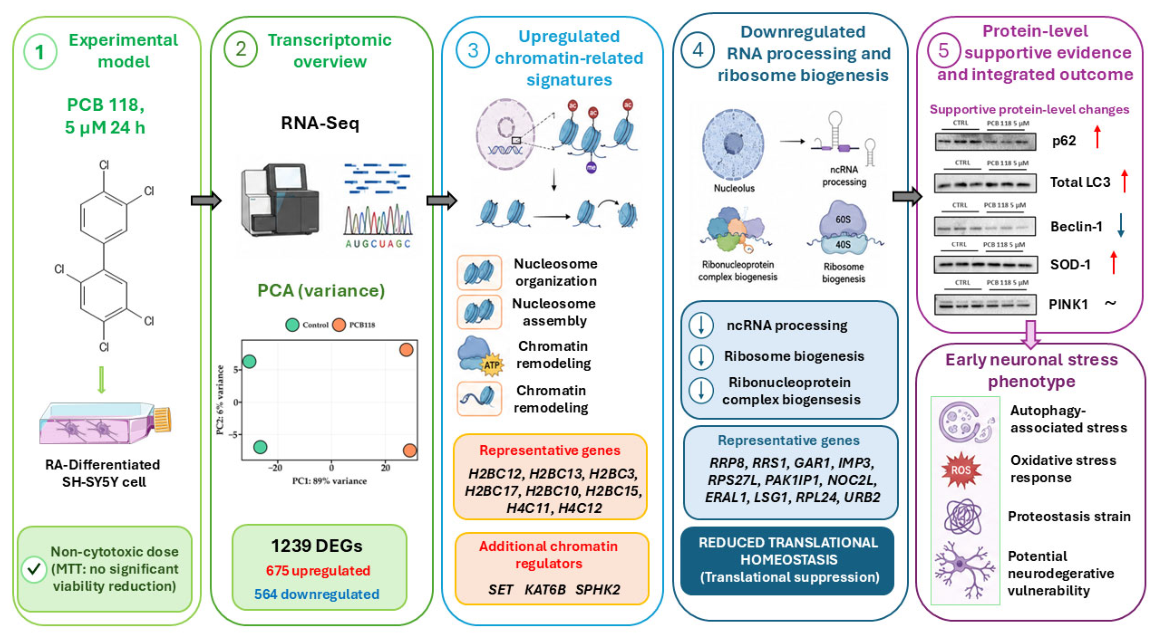
| Ontology | Description | q-Value | N. of DEGs |
|---|---|---|---|
| BP | ncRNA processing | 8.3 × 10⁻³ | 37 |
| BP | Ribonucleoprotein complex biogenesis | 8.3 × 10⁻³ | 39 |
| BP | Ribosome biogenesis | 3.9 × 10⁻² | 28 |
| Ontology | Description | q-Value | N. of DEGs |
|---|---|---|---|
| BP | Nucleosome organization | 1.8 × 10⁻² | 27 |
| BP | Nucleosome assembly | 1.8 × 10⁻² | 22 |
| BP | Chromatin remodeling | 3.1 × 10⁻² | 50 |
| CC | Nucleosome | 9.1 × 10⁻³ | 23 |
| CC | Protein–DNA complex | 1.7 × 10⁻² | 32 |
| MF | Structural constituent of chromatin | 1.1 × 10⁻² | 19 |
Disclaimer/Publisher’s Note: The statements, opinions and data contained in all publications are solely those of the individual author(s) and contributor(s) and not of MDPI and/or the editor(s). MDPI and/or the editor(s) disclaim responsibility for any injury to people or property resulting from any ideas, methods, instructions or products referred to in the content. |
© 2026 by the authors. Licensee MDPI, Basel, Switzerland. This article is an open access article distributed under the terms and conditions of the Creative Commons Attribution (CC BY) license.
Share and Cite
D’Angiolini, S.; Silvestro, S.; Chiricosta, L.; Scuruchi, M.; Minuti, A. PCB 118 Exposure Modulates Chromatin Organization, Ribosome Biogenesis, and Autophagy-Related Pathways in Neuron-like: A Transcriptomic Analysis. Int. J. Mol. Sci. 2026, 27, 5058. https://doi.org/10.3390/ijms27115058
D’Angiolini S, Silvestro S, Chiricosta L, Scuruchi M, Minuti A. PCB 118 Exposure Modulates Chromatin Organization, Ribosome Biogenesis, and Autophagy-Related Pathways in Neuron-like: A Transcriptomic Analysis. International Journal of Molecular Sciences. 2026; 27(11):5058. https://doi.org/10.3390/ijms27115058
Chicago/Turabian StyleD’Angiolini, Simone, Serena Silvestro, Luigi Chiricosta, Michele Scuruchi, and Aurelio Minuti. 2026. "PCB 118 Exposure Modulates Chromatin Organization, Ribosome Biogenesis, and Autophagy-Related Pathways in Neuron-like: A Transcriptomic Analysis" International Journal of Molecular Sciences 27, no. 11: 5058. https://doi.org/10.3390/ijms27115058
APA StyleD’Angiolini, S., Silvestro, S., Chiricosta, L., Scuruchi, M., & Minuti, A. (2026). PCB 118 Exposure Modulates Chromatin Organization, Ribosome Biogenesis, and Autophagy-Related Pathways in Neuron-like: A Transcriptomic Analysis. International Journal of Molecular Sciences, 27(11), 5058. https://doi.org/10.3390/ijms27115058