Lubricin Levels in Temporomandibular Joint Disorders: A Scoping Review

 ,
,  , , and
Abstract
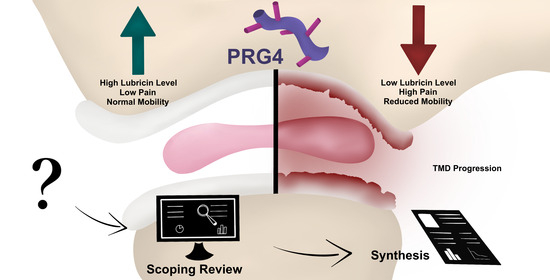
1. Introduction
1.1. Rationale
1.2. Objectives
2. Materials and Methods
2.1. Protocol and Registration
2.2. Eligibility Criteria
2.3. Information Sources
2.4. Search
2.5. Selection of Sources of Evidence
2.6. Data Charting Process
2.7. Data Items
2.8. Critical Appraisal of Individual Sources of Evidence
2.9. Synthesis of Results
3. Results and Discussion
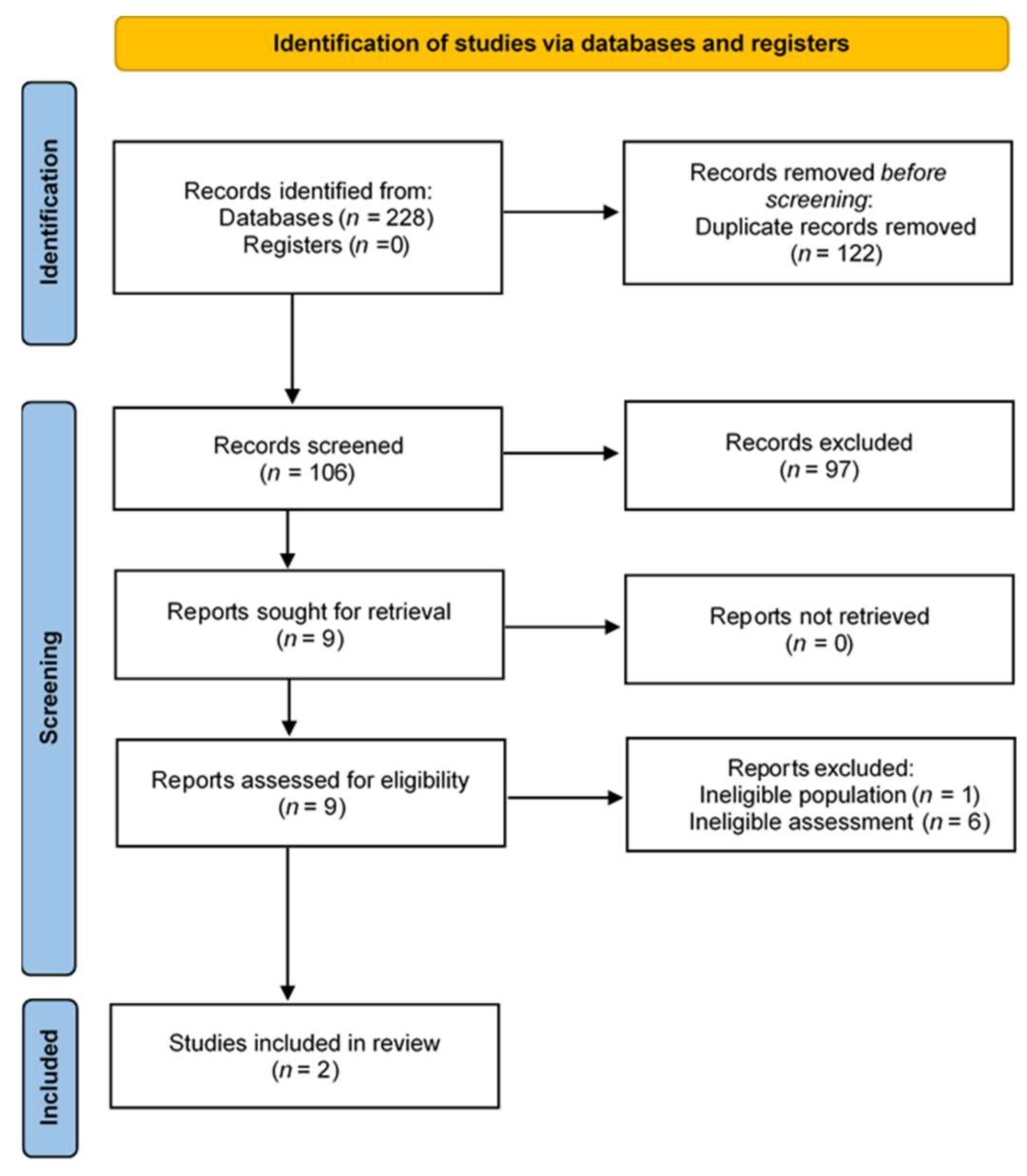
3.1. Selection of Sources of Evidence
3.2. Characteristics of Sources of Evidence
3.3. Critical Appraisal Within Sources of Evidence
3.4. Results of Individual Sources of Evidence
3.5. Synthesis of Results
3.6. Summary of Evidence
3.7. Strengths
3.8. Limitations
3.9. Implications
3.10. Future Research
4. Conclusions
Author Contributions
Funding
Institutional Review Board Statement
Informed Consent Statement
Data Availability Statement
Conflicts of Interest
Abbreviations
| ACM | Association for Computing Machinery |
| BASE | Bielefeld Academic Search Engine |
| COF | Coefficient of Friction |
| DDNR | Disc Displacement without Reduction |
| DDR | Disc Displacement with Reduction |
| ELISA | Enzyme-Linked Immunosorbent Assay |
| HA | Hyaluronic Acid |
| MIO | Maximal Interincisal Opening |
| mL | Milliliter |
| mm | Millimeters |
| MMO | Maximum Mouth Opening |
| ng | Nanogram |
| OA | Osteoarthritis |
| OSF | Open Science Framework |
| PICOTS | Population, Intervention, Comparison, Outcomes, Timeframe, Study Design |
| PRG4 | Proteoglycan 4 |
| PRISMA | Preferred Reporting Items for Systematic Reviews and Meta-Analyses |
| SF | Synovial Fluid |
| TMD/TMDs | Temporomandibular Joint Disorders |
| TMJ | Temporomandibular Joint |
Appendix A

| Search Engine | Total Available Records | Records Identified by Search |
|---|---|---|
| ACM [19] | 3,798,395 | 29 |
| BASE [20] | 404,802,253 | 78 |
| Clinicaltrials.gov [21] | 517,703 | 0 |
| Cochrane [22] | 2,203,247 | 0 |
| Google Scholar [23] | 389,000,000 | 23 |
| PubMed [24] | 37,000,000 | 47 |
| Scopus [25] | 97,300,000 | 51 |
| First Author, Publication Year | Title | Reason for Exclusion |
|---|---|---|
| Kao, 2024 [32] | Chondroid Synoviocytic Neoplasm: A Clinicopathologic, Immunohistochemical, and Molecular Genetic Study of a Distinctive Tumor of Synoviocytes | Ineligible population |
| Qadri, 2023 [33] | Targeting CD44 Receptor Pathways in Degenerative Joint Diseases: Involvement of Proteoglycan-4 (PRG4) | Ineligible assessment |
| Balenton, 2018 [34] | Lubricin: Toward a Molecular Mechanism for Temporomandibular Joint Disorders | Ineligible assessment |
| Cen, 2018 [35] | Glucosamine oral administration as an adjunct to hyaluronic acid injection in treating temporomandibular joint osteoarthritis | Ineligible assessment |
| Leonardi, 2011 [36] | Lubricin immunohistochemical expression in human temporomandibular joint disc with internal derangement | Ineligible assessment |
| Tang, 2010 [37] | Effects of intra-articular administration of sodium hyaluronate on plasminogen activator system in temporomandibular joints with osteoarthritis | Ineligible assessment |
| Nitzan, 2003 [38] | ‘Friction and Adhesive Forces’ Possible Underlying Causes for Temporomandibular Joint Internal Derangement | Ineligible assessment |
References
- Szychlinska, M.A.; Leonardi, R.; Al-Qahtani, M.; Mobasheri, A.; Musumeci, G. Altered joint tribology in osteoarthritis: Reduced lubricin synthesis due to the inflammatory process. New horizons for therapeutic approaches. Ann. Phys. Rehabil. Med. 2016, 59, 149–156. [Google Scholar] [CrossRef] [Scilit]
- Elsaid, K.A.; Fleming, B.C.; Oksendahl, H.L.; Machan, J.T.; Fadale, P.D.; Hulstyn, M.J.; Shalvoy, R.; Jay, G.D. Decreased lubricin concentrations and markers of joint inflammation in the synovial fluid of patients with anterior cruciate ligament injury. Arthritis Rheum. 2008, 58, 1707–1715. [Google Scholar] [CrossRef] [Scilit]
- Hill, A.; Duran, J.; Purcell, P. Lubricin Protects the Temporomandibular Joint Surfaces from Degeneration. PLoS ONE 2014, 9, e106497. [Google Scholar] [CrossRef] [Scilit]
- Fu, P.-J.; Zheng, S.-Y.; Luo, Y.; Ren, Z.-Q.; Li, Z.-H.; Wang, Y.-P.; Lu, B.-B. Prg4 and Osteoarthritis: Functions, Regulatory Factors, and Treatment Strategies. Biomedicines 2025, 13, 693. [Google Scholar] [CrossRef] [Scilit]
- Boushehri, S.; Holey, H.; Brosz, M.; Gumbsch, P.; Pastewka, L.; Aponte-Santamaría, C.; Gräter, F. O-Glycans Expand Lubricin and Attenuate Its Viscosity and Shear Thinning. Biomacromolecules 2024, 25, 3893–3908. [Google Scholar] [CrossRef] [Scilit]
- McDaniel, J.S.; Akula Suresh Babu, R.; Navarro, M.M.; LeBaron, R.G. Transcriptional Regulation of Proteoglycan 4 by 17β-Estradiol in Immortalized Baboon Temporomandibular Joint Disc Cells. Eur. J. Oral Sci. 2014, 122, 100–108. [Google Scholar] [CrossRef] [Scilit]
- An, H.; Liu, Y.; Yi, J.; Xie, H.; Li, C.; Wang, X.; Chai, W. Research Progress of Cartilage Lubrication and Biomimetic Cartilage Lubrication Materials. Front. Bioeng. Biotechnol. 2022, 10, 1012653. [Google Scholar] [CrossRef] [Scilit]
- Bayer, I.S. Advances in Tribology of Lubricin and Lubricin-Like Synthetic Polymer Nanostructures. Lubricants 2018, 6, 30. [Google Scholar] [CrossRef] [Scilit]
- Ninkovic, N.; Corpuz, J.M.; Stahl, A.; Olsen, A.; Unger, C.M.; Ardebili, A.A.; Sun, H.; Cha, J.; Kaketsis, D.; Manske, S.L.; et al. Mesenchymal Progenitor–Derived Proteoglycan 4 Regulates the Transdifferentiation of Chondrocytes into Osteoblasts during Fracture Healing. Stem Cells Transl. Med. 2025, 14, szaf043. [Google Scholar] [CrossRef] [Scilit]
- Guo, H.; Fang, W.; Li, Y.; Ke, J.; Deng, M.; Meng, Q.; Li, J.; Long, X. Up-Regulation of Proteoglycan 4 in Temporomandibular Osteoarthritic Synovial Cells by Hyaluronic Acid. J. Oral Pathol. Med. 2015, 44, 622–627. [Google Scholar] [CrossRef] [Scilit]
- Leonardi, R.; Perrotta, R.E.; Almeida, L.-E.; Loreto, C.; Musumeci, G. Lubricin in Synovial Fluid of Mild and Severe Temporomandibular Joint Internal Derangements. Med. Oral Patol. Oral Cir. Bucal 2016, 21, e793–e799. [Google Scholar] [CrossRef] [Scilit]
- Wei, L.; Xiong, H.; Li, B.; Cheng, Y.; Long, X. Boundary-Lubricating Ability and Lubricin in Synovial Fluid of Patients with Temporomandibular Joint Disorders. J. Oral Maxillofac. Surg. 2010, 68, 2478–2483. [Google Scholar] [CrossRef] [Scilit]
- Colville, M.J.; Huang, L.-T.; Schmidt, S.; Chen, K.; Vishwanath, K.; Su, J.; Williams, R.M.; Bonassar, L.J.; Reesink, H.L.; Paszek, M.J. Recombinant Manufacturing of Multispecies Biolubricants. bioRxiv 2024. [Google Scholar] [CrossRef] [Scilit]
- Iturriaga, V.; Vásquez, B.; Wen, S.; Bornhardt, T.; Navarrete, J.; Sol, M. del Intra-Articular Administration of Recombinant Human Proteoglycan 4 (rhPRG4) as a Potential Therapy for Temporomandibular Joint Osteoarthritis: A Preclinical Histopathological Study. Int. J. Mol. Sci. 2025, 26, 9305. [Google Scholar] [CrossRef] [Scilit]
- Larson, K.M.; Zhang, L.; Elsaid, K.A.; Schmidt, T.A.; Fleming, B.C.; Badger, G.J.; Jay, G.D. Reduction of Friction by Recombinant Human Proteoglycan 4 in IL-1α Stimulated Bovine Cartilage Explants. J. Orthop. Res. 2017, 35, 580–589. [Google Scholar] [CrossRef] [Scilit]
- Yuan, H.; Mears, L.L.E.; Liu, X.; Qi, W.; Su, R.; Valtiner, M. Recombinant Lubricin Improves Anti-Adhesive, Wear Protection, and Lubrication of Collagen II Surface. Colloids Surf. B Biointerfaces 2022, 220, 112906. [Google Scholar] [CrossRef] [Scilit] [PubMed]
- Oh, J.; Kuan, K.G.; Tiong, L.U.; Trochsler, M.I.; Jay, G.; Schmidt, T.A.; Barnett, H.; Maddern, G.J. Recombinant Human Lubricin for Prevention of Postoperative Intra-Abdominal Adhesions in a Rat Model. J. Surg. Res. 2017, 208, 20–25. [Google Scholar] [CrossRef] [Scilit]
- Negishi, S.; Shibusaka, K.; Maemura, M.; Tsukasaki, M.; Ohba, S.; Tanaka, S.; Saito, T.; Suzuki, Y.; Okada, H.; Yano, F. Lubricin Maintains Temporomandibular Joint Homeostasis by Regulating Synovial Inflammation. Regen. Ther. 2025, 31, 101051. [Google Scholar] [CrossRef] [Scilit] [PubMed]
- ACM Digital Library. Available online: https://dl.acm.org/ (accessed on 9 April 2026).
- BASE—Bielefeld Academic Search Engine|Services. Available online: https://api.base-search.net/ (accessed on 9 April 2026).
- Home|ClinicalTrials.Gov. Available online: https://clinicaltrials.gov/ (accessed on 9 April 2026).
- Cochrane. Available online: https://www.cochrane.org/ (accessed on 9 April 2026).
- Google Scholar. Available online: https://scholar.google.com/ (accessed on 9 April 2026).
- PubMed. Available online: https://pubmed.ncbi.nlm.nih.gov/ (accessed on 9 April 2026).
- Scopus—Sources. Available online: https://www.scopus.com/sources (accessed on 9 April 2026).
- Downes, M.J.; Brennan, M.L.; Williams, H.C.; Dean, R.S. Development of a Critical Appraisal Tool to Assess the Quality of Cross-Sectional Studies (AXIS). BMJ Open 2016, 6, e011458. [Google Scholar] [CrossRef] [Scilit]
- Roggio, F.; Petrigna, L.; Trovato, B.; Di Rosa, M.; Musumeci, G. The Role of Lubricin, Irisin and Exercise in the Prevention and Treatment of Osteoarthritis. Int. J. Mol. Sci. 2023, 24, 5126. [Google Scholar] [CrossRef] [Scilit] [PubMed]
- Stańczak, M.; Swinnen, B.; Surmacz, J.; Bielenda, B.; Febbi, M.; Trybulski, R.; Hagner-Derengowska, M. Knee Joint Response to Mechanical Loading: Bounding Mechanotransduction with Rehabilitation. Cell. Physiol. Biochem. 2025, 59, 666–729. [Google Scholar] [CrossRef] [Scilit]
- Jay, G.D.; Torres, J.R.; Warman, M.L.; Laderer, M.C.; Breuer, K.S. The Role of Lubricin in the Mechanical Behavior of Synovial Fluid. Proc. Natl. Acad. Sci. USA 2007, 104, 6194–6199. [Google Scholar] [CrossRef] [Scilit]
- Waller, K.A.; Zhang, L.X.; Elsaid, K.A.; Fleming, B.C.; Warman, M.L.; Jay, G.D. Role of lubricin and boundary lubrication in the prevention of chondrocyte apoptosis. Proc. Natl. Acad. Sci. USA 2013, 110, 5852–5857. [Google Scholar] [CrossRef] [Scilit]
- Waller, K.A.; Chin, K.E.; Jay, G.D.; Zhang, L.X.; Teeple, E.; McAllister, S.; Badger, G.J.; Schmidt, T.A.; Fleming, B.C. Intra-articular recombinant human proteoglycan 4 mitigates cartilage damage after destabilization of the medial meniscus in the Yucatan minipig. Am. J. Sports Med. 2017, 45, 1512–1521. [Google Scholar] [CrossRef] [Scilit]
- Kao, E.Y.; Ardic, F.; Fadra, N.; Hohenstein, J.D.; Mopuri, R.; Wenger, D.E.; Streich, L.; Hines, L.M.; Folpe, A.L. Chondroid Synoviocytic Neoplasm: A Clinicopathologic, Immunohistochemical, and Molecular Genetic Study of a Distinctive Tumor of Synoviocytes. Mod. Pathol. 2024, 37, 100598. [Google Scholar] [CrossRef] [Scilit]
- Qadri, M.M. Targeting CD44 Receptor Pathways in Degenerative Joint Diseases: Involvement of Proteoglycan-4 (PRG4). Pharmaceuticals 2023, 16, 1425. [Google Scholar] [CrossRef] [Scilit]
- Balenton, N.; Khakshooy, A.; Chiappelli, F. Lubricin: Toward a Molecular Mechanism for Temporomandibular Joint Disorders. In Temporomandibular Joint and Airway Disorders; Demerjian, G.G., Barkhordarian, A., Chiappelli, F., Eds.; Springer International Publishing: Cham, Switzerland, 2018; pp. 61–70. ISBN 978-3-319-76365-1. [Google Scholar]
- Cen, X.; Liu, Y.; Wang, S.; Yang, X.; Shi, Z.; Liang, X. Glucosamine Oral Administration as an Adjunct to Hyaluronic Acid Injection in Treating Temporomandibular Joint Osteoarthritis. Oral Dis. 2018, 24, 404–411. [Google Scholar] [CrossRef] [Scilit] [PubMed]
- Leonardi, R.; Almeida, L.E.; Loreto, C. Lubricin Immunohistochemical Expression in Human Temporomandibular Joint Disc with Internal Derangement. J. Oral Pathol. Med. 2011, 40, 587–592. [Google Scholar] [CrossRef] [Scilit]
- Tang, Y.; Zhu, G.; Hu, L.; Zheng, M.; Zhang, J.; Shi, Z.; Liang, X. Effects of Intra-Articular Administration of Sodium Hyaluronate on Plasminogen Activator System in Temporomandibular Joints with Osteoarthritis. Oral Surg. Oral Med. Oral Pathol. Oral Radiol. Endodontol. 2010, 109, 541–547. [Google Scholar] [CrossRef] [Scilit] [PubMed]
- Nitzan, D.W. ‘Friction and Adhesive Forces’—Possible Underlying Causes for Temporomandibular Joint Internal Derangement. Cells Tissues Organs 2003, 174, 6–16. [Google Scholar] [CrossRef] [Scilit] [PubMed]


| Domain | Criteria for Inclusion | Criteria for Exclusion |
|---|---|---|
| Population | Patients diagnosed with TMD | Human cadavers or any animal tissues |
| Assessment | Synovial-fluid lubricin assessment | None |
| Comparison | Healthy controls or none | None |
| Outcomes | Lubricin levels, health-related quality of life, joint pain, or mandibular mobility | Unquantifiable results |
| Timeframe | Any | Unpublished reports |
| Settings | Clinical studies in humans | Non-clinical studies, non-journal reports |
| First Author, Year | Study Design | Participants (n) | Joints (n) | Diagnosis Groups | Control Group | Assay Characteristic | Outcomes | Main Findings | Synovial Fluid Collection Procedures | Exclusion Criteria | Statistical Approaches |
|---|---|---|---|---|---|---|---|---|---|---|---|
| Leonardi et al., 2016 [11] | Cross-sectional study | 32 patients, mean age: 34 ± 11.04 (27 females + 5 males) + controls, mean age: 42.3 ± 9.5 (6 females + 2 males) | 34 TMD joints + 8 control joints | Wilkes stage III, IV, V | Yes (orthognathic patients without TMJ pathology) | ELISA (Pierce Biotechnology, Waltham, MA, USA); sensitivity: 3.25 pg/mL; calculated per mg of total protein. | Lubricin (ng/mL): control 7425 ± 340; stage III 7029 ± 210; stage IV 5640 ± 100; stage V 4780 ± 110; correlations with age, VAS, Maximum Interincisal Opening (MIO) | Progressive decrease with severity; significantly lower in IV–V vs. control; inverse correlation with age and VAS; no correlation with MIO | Aspiration with dilution (1.0 mL saline) during arthrocentesis; 21G needle; “push-and-pull” technique | a diagnosis of Wilkes stage I or II, systemic arthropathy, use of nonsteroidal anti-inflammatory drugs, and/ or history of trauma | Shapiro–Wilk, Mann–Whitney U test, Spearman correlation |
| Wei et al., 2010 [12] | Cross-sectional study | 34 TMD patients, mean age: 31 (29 females + 5 males) + 7 controls, mean age: 27 (4 females + 3 males) | Not reported | DDR, DDNR, OA | Yes (healthy controls) | ELISA (Yope Biotechnology, Shanghai, China); total protein quantified via Micro BCA assay (Pierce Biotechnology, Waltham, MA, USA) | Lubricin (ng/mL): control 7496 ± 468; DDR 7160 ± 1249; DDNR 7215 ± 1117; OA 5689 ± 1313; COF: control 0.247 ± 0.006; DDR 0.266 ± 0.011; DDNR 0.268 ± 0.010; OA 0.275 ± 0.009 | Lubricin reduced only in OA; COF higher in all TMD groups; no correlation between lubricin and COF | Aspiration with dilution (1.0 mL saline) during local anesthesia; superior joint compartment; 5-fold “push-and-pull” technique | Prior TMJ treatment; any medication (including NSAIDs) within 2 weeks prior to synovial fluid sampling | 1-way analysis of variance test, Bonferroni test and correlation coefficient calculation |
| Leonardi et al. [11] | Wei et al. [12] | |
|---|---|---|
| Introduction | ||
| 1. Were the aims/objectives of the study clear? | Yes | Yes |
| Methods | ||
| 2. Was the study design appropriate for the stated aim(s)? | Yes | Yes |
| 3. Was the sample size justified? | No | No |
| 4. Was the target/reference population clearly defined? (Is it clear who the research was about?) | Yes | Yes |
| 5. Was the sample frame taken from an appropriate population base so that it closely represented the target/reference population under investigation? | Unclear | Unclear |
| 6. Was the selection process likely to select subjects/participants that were representative of the target/reference population under investigation? | Unclear | Unclear |
| 7. Were measures undertaken to address and categorize non-responders? | No | No |
| 8. Were the risk factor and outcome variables measured appropriate for the aims of the study? | Yes | Yes |
| 9. Were the risk factor and outcome variables measured correctly using instruments/ measurements that had been trialed, piloted or published previously? | Yes | Yes |
| 10. Is it clear what was used to determine statistical significance and/or precision estimates? (e.g., p values, CIs) | Yes | Yes |
| 11. Were the methods (including statistical methods) sufficiently described to enable them to be repeated? | Yes | Yes |
| Results | ||
| 12. Were the basic data adequately described? | Yes | Yes |
| 13. Does the response rate raise concerns about non-response bias? | Unclear | Unclear |
| 14. If appropriate, was information about non-responders described? | No | No |
| 15. Were the results internally consistent? | Yes | Yes |
| 16. Were the results presented for the analyses described in the methods? | Yes | Yes |
| Discussion | ||
| 17. Were the authors’ discussions and conclusions justified by the results? | Yes | Yes |
| 18. Were the limitations of the study discussed? | No | Yes |
| Other | ||
| 19. Were there any funding sources or conflicts of interest that may affect the authors’ interpretation of the results? | Yes | Yes |
| 20. Was ethical approval or consent of participants attained? | Yes | Yes |
Disclaimer/Publisher’s Note: The statements, opinions and data contained in all publications are solely those of the individual author(s) and contributor(s) and not of MDPI and/or the editor(s). MDPI and/or the editor(s) disclaim responsibility for any injury to people or property resulting from any ideas, methods, instructions or products referred to in the content. |
© 2026 by the authors. Licensee MDPI, Basel, Switzerland. This article is an open access article distributed under the terms and conditions of the Creative Commons Attribution (CC BY) license.
Share and Cite
Sikora, P.; Chęciński, M.; Horodniczy, T.; Chęcińska, K.; Turosz, N.; Romańczyk, K.; Hoppe, A.; Sikora, M. Lubricin Levels in Temporomandibular Joint Disorders: A Scoping Review. Int. J. Mol. Sci. 2026, 27, 5035. https://doi.org/10.3390/ijms27115035
Sikora P, Chęciński M, Horodniczy T, Chęcińska K, Turosz N, Romańczyk K, Hoppe A, Sikora M. Lubricin Levels in Temporomandibular Joint Disorders: A Scoping Review. International Journal of Molecular Sciences. 2026; 27(11):5035. https://doi.org/10.3390/ijms27115035
Chicago/Turabian StyleSikora, Paweł, Maciej Chęciński, Tomasz Horodniczy, Kamila Chęcińska, Natalia Turosz, Kalina Romańczyk, Amelia Hoppe, and Maciej Sikora. 2026. "Lubricin Levels in Temporomandibular Joint Disorders: A Scoping Review" International Journal of Molecular Sciences 27, no. 11: 5035. https://doi.org/10.3390/ijms27115035
APA StyleSikora, P., Chęciński, M., Horodniczy, T., Chęcińska, K., Turosz, N., Romańczyk, K., Hoppe, A., & Sikora, M. (2026). Lubricin Levels in Temporomandibular Joint Disorders: A Scoping Review. International Journal of Molecular Sciences, 27(11), 5035. https://doi.org/10.3390/ijms27115035