Molecular Insights and Novel Therapies for Lymphoproliferative Disorders

Abstract
1. Introduction
2. Molecular Mechanisms of Hematological Malignancies
2.1. Oncogenic Driver Mutations and Chromosomal Translocations
2.2. Epigenetic Dysregulation
2.3. BCR and Kinase Signaling Pathway Activation
2.4. Tumor Microenvironment and Immune Evasion
2.5. Clonal Evolution and Therapeutic Resistance
3. Diffuse Large B-Cell Lymphoma (DLBCL)
4. Follicular Lymphoma (FL)
5. Mantle Cell Lymphoma (MCL)
6. Post-Transplant Lymphoproliferative Disorders (PTLDs)
7. Future Directions in Immunotherapy of Hematological Malignancies
8. Conclusions
Funding
Data Availability Statement
Conflicts of Interest
Abbreviations
References
- Kwon, R.; Yeung, C.C. Advances in next-generation sequencing and emerging technologies for hematologic malignancies. Haematologica 2024, 109, 379. [Google Scholar] [CrossRef] [PubMed]
- Rashidi, A.; Meybodi, M.A.; Cao, W.; Chu, H.; Warlick, E.D.; Devine, S.; Pasquini, M.C.; Weisdorf, D.J.; Hamadani, M. Myeloablative versus Reduced-Intensity Hematopoietic Cell Transplantation in Myelodysplastic Syndromes: Systematic Review and Meta-analysis. Biol. Blood Marrow Transplant. 2020, 26, e138–e141. [Google Scholar] [CrossRef] [PubMed]
- Campillo-Marcos, I.; Alvarez-Errico, D.; Alandes, R.A.; Mereu, E.; Esteller, M. Single-cell technologies and analyses in hematopoiesis and hematological malignancies. Exp. Hematol. 2021, 98, 1–13. [Google Scholar] [CrossRef]
- Larsson, L.; Frisén, J.; Lundeberg, J. Spatially resolved transcriptomics adds a new dimension to genomics. Nat. Methods 2021, 18, 15–18. [Google Scholar] [CrossRef] [PubMed]
- Talotta, D.; Almasri, M.; Cosentino, C.; Gaidano, G.; Moia, R. Liquid biopsy in hematological malignancies: Current and future applications. Front. Oncol. 2023, 13, 1164517. [Google Scholar] [CrossRef]
- Parghane, R.V.; Basu, S. Role of novel quantitative imaging techniques in hematological malignancies. PET Clin. 2024, 19, 543–559. [Google Scholar] [CrossRef]
- Arber, D.A.; Orazi, A.; Hasserjian, R.P.; Borowitz, M.J.; Calvo, K.R.; Kvasnicka, H.-M.; Wang, S.A.; Bagg, A.; Barbui, T.; Branford, S.; et al. International Consensus Classification of Myeloid Neoplasms and Acute Leukemias: Integrating morphologic, clinical, and genomic data. Blood 2022, 140, 1200–1228. [Google Scholar] [CrossRef]
- Cazzola, M.; Sehn, L.H. Developing a classification of hematologic neoplasms in the era of precision medicine. Blood 2022, 140, 1193–1199. [Google Scholar] [CrossRef]
- de Leval, L.; Alizadeh, A.A.; Bergsagel, P.L.; Campo, E.; Davies, A.; Dogan, A.; Fitzgibbon, J.; Horwitz, S.M.; Melnick, A.M.; Morice, W.G.; et al. Genomic profiling for clinical decision making in lymphoid neoplasms. Blood 2022, 140, 2193–2227. [Google Scholar] [CrossRef]
- Khoury, J.D.; Solary, E.; Abla, O.; Akkari, Y.; Alaggio, R.; Apperley, J.F.; Bejar, R.; Berti, E.; Busque, L.; Chan, J.K.C.; et al. The 5th edition of the World Health Organization Classification of Haematolymphoid Tumours: Myeloid and Histiocytic/Dendritic Neoplasms. Leukemia 2022, 36, 1703–1719. [Google Scholar] [CrossRef]
- Sartori, G.; Tarantelli, C.; Spriano, F.; Gaudio, E.; Cascione, L.; Mascia, M.; Barreca, M.; Arribas, A.J.; Licenziato, L.; Golino, G. The ATR inhibitor elimusertib exhibits anti-lymphoma activity and synergizes with the PI3K inhibitor copanlisib. Br. J. Haematol. 2024, 204, 191–205. [Google Scholar] [CrossRef]
- Hu, B.; Reagan, P.M.; Sehn, L.H.; Sharman, J.P.; Hertzberg, M.; Zhang, H.; Kim, A.; Herbaux, C.; Molina, L.; Maruyama, D.; et al. Subgroup analysis of older patients ≥60 years with diffuse large B-cell lymphoma in the phase 3 POLARIX study. Blood Adv. 2025, 9, 2489–2499. [Google Scholar] [CrossRef]
- Morschhauser, F.; Salles, G.; Sehn, L.H.; Herrera, A.F.; Friedberg, J.W.; Trněný, M.; Lenz, G.; Sharman, J.P.; Herbaux, C.; Burke, J.M.; et al. Five-Year Outcomes of the POLARIX Study Comparing Pola-R-CHP and R-CHOP in Patients With Diffuse Large B-Cell Lymphoma. J. Clin. Oncol. 2025, 43, 3698–3705, Erratum in J. Clin. Oncol. 2026, 44, 71. [Google Scholar] [CrossRef]
- Jain, N.; Keating, M.; Thompson, P.; Ferrajoli, A.; Burger, J.; Borthakur, G.; Takahashi, K.; Estrov, Z.; Fowler, N.; Kadia, T.; et al. Ibrutinib and Venetoclax for First-Line Treatment of CLL. N. Engl. J. Med. 2019, 380, 2095–2103. [Google Scholar] [CrossRef] [PubMed]
- Fürstenau, M.; Kater, A.P.; Robrecht, S.; von Tresckow, J.; Zhang, C.; Gregor, M.; Thornton, P.; Staber, P.B.; Tadmor, T.; Lindström, V. First-line venetoclax combinations versus chemoimmunotherapy in fit patients with chronic lymphocytic leukaemia (GAIA/CLL13): 4-year follow-up from a multicentre, open-label, randomised, phase 3 trial. Lancet Oncol. 2024, 25, 744–759, Correction in Lancet Oncol. 2024, 25, e284. [Google Scholar] [CrossRef]
- Melani, C.; Lakhotia, R.; Pittaluga, S.; Phelan, J.D.; Huang, D.W.; Wright, G.; Simard, J.; Muppidi, J.; Thomas, C.J.; Ceribelli, M.; et al. Combination Targeted Therapy in Relapsed Diffuse Large B-Cell Lymphoma. N. Engl. J. Med. 2024, 390, 2143–2155. [Google Scholar] [CrossRef] [PubMed]
- Chaudhari, J.; Shah, N.N. Targeted Therapies and Immunotherapies for Diffuse Large B-Cell Lymphoma. Cancers 2025, 17, 2517. [Google Scholar] [CrossRef]
- Lica, J.J.; Pradhan, B.; Safi, K.; Jakóbkiewicz-Banecka, J.; Hellmann, A. Promising therapeutic strategies for hematologic malignancies: Innovations and potential. Molecules 2024, 29, 4280. [Google Scholar] [CrossRef] [PubMed]
- Cappell, K.M.; Kochenderfer, J.N. Long-term outcomes following CAR T cell therapy: What we know so far. Nat. Rev. Clin. Oncol. 2023, 20, 359–371. [Google Scholar] [CrossRef]
- Goebeler, M.-E.; Bargou, R.C. T cell-engaging therapies—BiTEs and beyond. Nat. Rev. Clin. Oncol. 2020, 17, 418–434. [Google Scholar] [CrossRef]
- Kamakura, D.; Asano, R.; Yasunaga, M. T Cell Bispecific Antibodies: An Antibody-Based Delivery System for Inducing Antitumor Immunity. Pharmaceuticals 2021, 14, 1172. [Google Scholar] [CrossRef]
- Abdar Esfahani, M.; Servatian, N.; Al-Athari, A.J.H.; Khafaja, E.S.M.; Rahmani Seraji, H.; Soleimani Samarkhazan, H. The epigenetic revolution in hematology: From benchside breakthroughs to clinical transformations. Clin. Exp. Med. 2025, 25, 230. [Google Scholar] [CrossRef]
- Shahid, A.M.; Vainchenker, W.; Constantinescu, S.N. JCMM Annual Review on Advances in Biotechnology for the Treatment of Haematological Malignancies: A Review of the Latest In-Patient Developments 2024–2025. J. Cell. Mol. Med. 2025, 29, e70700. [Google Scholar] [CrossRef]
- Mitelman, F.; Johansson, B.; Mertens, F. The impact of translocations and gene fusions on cancer causation. Nat. Rev. Cancer 2007, 7, 233–245. [Google Scholar] [CrossRef] [PubMed]
- Pane, F.; Intrieri, M.; Quintarelli, C.; Izzo, B.; Muccioli, G.C.; Salvatore, F. BCR/ABL genes and leukemic phenotype: From molecular mechanisms to clinical correlations. Oncogene 2002, 21, 8652–8667. [Google Scholar] [CrossRef] [PubMed]
- Jares, P.; Colomer, D.; Campo, E. Molecular pathogenesis of mantle cell lymphoma. J. Clin. Investig. 2012, 122, 3416–3423. [Google Scholar] [CrossRef] [PubMed]
- Yunis, J.J.; Oken, M.M.; Kaplan, M.E.; Ensrud, K.M.; Howe, R.R.; Theologides, A. Distinctive chromosomal abnormalities in histologic subtypes of non-Hodgkin’s lymphoma. N. Engl. J. Med. 1982, 307, 1231–1236. [Google Scholar] [CrossRef]
- Döhner, H.; Wei, A.H.; Appelbaum, F.R.; Craddock, C.; DiNardo, C.D.; Dombret, H.; Ebert, B.L.; Fenaux, P.; Godley, L.A.; Hasserjian, R.P.; et al. Diagnosis and management of AML in adults: 2022 recommendations from an international expert panel on behalf of the ELN. Blood 2022, 140, 1345–1377. [Google Scholar] [CrossRef]
- Zenz, T.; Eichhorst, B.; Busch, R.; Denzel, T.; Häbe, S.; Winkler, D.; Bühler, A.; Edelmann, J.; Bergmann, M.; Hopfinger, G. TP53 mutation and survival in chronic lymphocytic leukemia. J. Clin. Oncol. 2010, 28, 4473–4479. [Google Scholar] [CrossRef]
- Carazzolo, M.E.; Moioli, A.; Visco, C. TP53 Mutations in Mantle Cell Lymphoma: From Backup to Game Changer. J. Clin. Med. 2025, 14, 8480. [Google Scholar] [CrossRef]
- Landau, D.A.; Tausch, E.; Taylor-Weiner, A.N.; Stewart, C.; Reiter, J.G.; Bahlo, J.; Kluth, S.; Bozic, I.; Lawrence, M.; Böttcher, S. Mutations driving CLL and their evolution in progression and relapse. Nature 2015, 526, 525–530. [Google Scholar] [CrossRef]
- Puente, X.S.; Pinyol, M.; Quesada, V.; Conde, L.; Ordóñez, G.R.; Villamor, N.; Escaramis, G.; Jares, P.; Beà, S.; González-Díaz, M. Whole-genome sequencing identifies recurrent mutations in chronic lymphocytic leukaemia. Nature 2011, 475, 101–105. [Google Scholar] [CrossRef]
- Puente, X.S.; Beà, S.; Valdés-Mas, R.; Villamor, N.; Gutiérrez-Abril, J.; Martín-Subero, J.I.; Munar, M.; Rubio-Pérez, C.; Jares, P.; Aymerich, M. Non-coding recurrent mutations in chronic lymphocytic leukaemia. Nature 2015, 526, 519–524. [Google Scholar] [CrossRef]
- Byrd, J.C.; Hillmen, P.; Ghia, P.; Kater, A.P.; Chanan-Khan, A.; Furman, R.R.; O’Brien, S.; Yenerel, M.N.; Illés, A.; Kay, N.; et al. Acalabrutinib Versus Ibrutinib in Previously Treated Chronic Lymphocytic Leukemia: Results of the First Randomized Phase III Trial. J. Clin. Oncol. 2021, 39, 3441–3452. [Google Scholar] [CrossRef]
- Figueroa, M.E.; Lugthart, S.; Li, Y.; Erpelinck-Verschueren, C.; Deng, X.; Christos, P.J.; Schifano, E.; Booth, J.; van Putten, W.; Skrabanek, L.; et al. DNA methylation signatures identify biologically distinct subtypes in acute myeloid leukemia. Cancer Cell 2010, 17, 13–27. [Google Scholar] [CrossRef]
- Ley, T.J.; Miller, C.; Ding, L.; Raphael, B.J.; Mungall, A.J.; Robertson, A.; Hoadley, K.; Triche, T.J., Jr.; Laird, P.W.; Baty, J.D.; et al. Genomic and epigenomic landscapes of adult de novo acute myeloid leukemia. N. Engl. J. Med. 2013, 368, 2059–2074. [Google Scholar] [CrossRef] [PubMed]
- Morin, R.D.; Johnson, N.A.; Severson, T.M.; Mungall, A.J.; An, J.; Goya, R.; Paul, J.E.; Boyle, M.; Woolcock, B.W.; Kuchenbauer, F.; et al. Somatic mutations altering EZH2 (Tyr641) in follicular and diffuse large B-cell lymphomas of germinal-center origin. Nat. Genet. 2010, 42, 181–185. [Google Scholar] [CrossRef] [PubMed]
- Romero, P.; Richart, L.; Aflaki, S.; Petitalot, A.; Burton, M.; Michaud, A.; Masliah-Planchon, J.; Kuhnowski, F.; Le Cam, S.; Baliñas-Gavira, C.; et al. EZH2 mutations in follicular lymphoma distort H3K27me3 profiles and alter transcriptional responses to PRC2 inhibition. Nat. Commun. 2024, 15, 3452. [Google Scholar] [CrossRef] [PubMed]
- Li, J.; Chin, C.R.; Ying, H.-Y.; Meydan, C.; Teater, M.R.; Xia, M.; Farinha, P.; Takata, K.; Chu, C.-S.; Jiang, Y.; et al. Loss of CREBBP and KMT2D cooperate to accelerate lymphomagenesis and shape the lymphoma immune microenvironment. Nat. Commun. 2024, 15, 2879. [Google Scholar] [CrossRef]
- Huang, Y.-H.; Cai, K.; Xu, P.-P.; Wang, L.; Huang, C.-X.; Fang, Y.; Cheng, S.; Sun, X.-J.; Liu, F.; Huang, J.-Y.; et al. CREBBP/EP300 mutations promoted tumor progression in diffuse large B-cell lymphoma through altering tumor-associated macrophage polarization via FBXW7-NOTCH-CCL2/CSF1 axis. Signal Transduct. Target. Ther. 2021, 6, 10. [Google Scholar] [CrossRef]
- Moreno, C.S.; Beresford, G.W.; Louis-Plence, P.; Morris, A.C.; Boss, J.M. CREB Regulates MHC Class II Expression in a CIITA-Dependent Manner. Immunity 1999, 10, 143–151. [Google Scholar] [CrossRef]
- Schmid, V.K.; Hobeika, E. B cell receptor signaling and associated pathways in the pathogenesis of chronic lymphocytic leukemia. Front. Oncol. 2024, 14, 1339620. [Google Scholar] [CrossRef]
- Wiestner, A. Emerging role of kinase-targeted strategies in chronic lymphocytic leukemia. Blood 2012, 120, 4684–4691. [Google Scholar] [CrossRef] [PubMed]
- Quaglia, F.M.; Gambino, S.; Galasso, M.; Vegliante, M.C.; Visco, C.; Scupoli, M.T. B-cell receptor signaling and microenvironment crosstalk in mantle cell lymphoma. Cell Commun. Signal. 2025, 23, 486. [Google Scholar] [CrossRef] [PubMed]
- Deng, T.; Zhang, S.; Xiao, M.; Gu, J.; Huang, L.; Zhou, X. A single-centre, real-world study of BTK inhibitors for the initial treatment of MYD88mut/CD79Bmut diffuse large B-cell lymphoma. Cancer Med. 2024, 13, e7005. [Google Scholar] [CrossRef]
- Feng, D.; Bai, S.; Liang, D.; Chen, X.; Xia, Z.; Liang, Y.; Wang, H. RCHOP plus BTK inhibitor improves clinical outcomes in double expressor diffuse large B-cell lymphoma, unlike RCHOP plus lenalidomide. Leuk. Res. 2025, 148, 107622. [Google Scholar] [CrossRef] [PubMed]
- Strati, P.; Feng, L.; Westin, J.R.; Nair, R.; Fayad, L.E.; Rodriguez, M.A.; Chihara, D.; Malpica, L.; Henderson, J.; Gallardo, M.; et al. Frontline acalabrutinib, lenalidomide and rituximab for advanced stage follicular lymphoma with high tumor burden: Phase II trial. Nat. Commun. 2025, 16, 7300. [Google Scholar] [CrossRef]
- Daver, N.; Schlenk, R.F.; Russell, N.H.; Levis, M.J. Targeting FLT3 mutations in AML: Review of current knowledge and evidence. Leukemia 2019, 33, 299–312. [Google Scholar] [CrossRef]
- Moliterno, A.R.; Kaizer, H.; Reeves, B.N. JAK2V617F allele burden in polycythemia vera: Burden of proof. Blood 2023, 141, 1934–1942. [Google Scholar] [CrossRef]
- Levine, R.L.; Wadleigh, M.; Cools, J.; Ebert, B.L.; Wernig, G.; Huntly, B.J.; Boggon, T.J.; Wlodarska, I.; Clark, J.J.; Moore, S.; et al. Activating mutation in the tyrosine kinase JAK2 in polycythemia vera, essential thrombocythemia, and myeloid metaplasia with myelofibrosis. Cancer Cell 2005, 7, 387–397. [Google Scholar] [CrossRef]
- Tufail, M.; Jiang, C.-H.; Li, N. Immune evasion in cancer: Mechanisms and cutting-edge therapeutic approaches. Signal Transduct. Target. Ther. 2025, 10, 227. [Google Scholar] [CrossRef]
- Kretz-Rommel, A.; Bowdish, K.S. Rationale for anti-CD200 immunotherapy in B-CLL and other hematologic malignancies: New concepts in blocking immune suppression. Expert Opin. Biol. Ther. 2008, 8, 5–15. [Google Scholar] [CrossRef]
- Fiorcari, S.; Maffei, R.; Atene, C.G.; Potenza, L.; Luppi, M.; Marasca, R. Nurse-Like Cells and Chronic Lymphocytic Leukemia B Cells: A Mutualistic Crosstalk inside Tissue Microenvironments. Cells 2021, 10, 217. [Google Scholar] [CrossRef]
- Wei, G.; Li, B.; Huang, M.; Lv, M.; Liang, Z.; Zhu, C.; Ge, L.; Chen, J. Polarization of Tumor Cells and Tumor-Associated Macrophages: Molecular Mechanisms and Therapeutic Targets. MedComm 2025, 6, e70372. [Google Scholar] [CrossRef]
- Zhang, Q.; Sioud, M. Tumor-Associated Macrophage Subsets: Shaping Polarization and Targeting. Int. J. Mol. Sci. 2023, 24, 7493. [Google Scholar] [CrossRef]
- Shen, L.; Li, H.; Shi, Y.; Wang, D.; Gong, J.; Xun, J.; Zhou, S.; Xiang, R.; Tan, X. M2 tumour-associated macrophages contribute to tumour progression via legumain remodelling the extracellular matrix in diffuse large B cell lymphoma. Sci. Rep. 2016, 6, 30347. [Google Scholar] [CrossRef]
- Ribatti, D.; Tamma, R.; Annese, T.; Ingravallo, G.; Specchia, G. Macrophages and angiogenesis in human lymphomas. Clin. Exp. Med. 2024, 24, 26. [Google Scholar] [CrossRef]
- Maute, R.; Xu, J.; Weissman, I.L. CD47-SIRPα-targeted therapeutics: Status and prospects. Immuno-Oncol. Technol. 2022, 13, 100070. [Google Scholar] [CrossRef]
- Biedermann, A.; Patra-Kneuer, M.; Mougiakakos, D.; Büttner-Herold, M.; Mangelberger-Eberl, D.; Berges, J.; Kellner, C.; Altmeyer, S.; Bittenbring, J.T.; Augsberger, C. Blockade of the CD47/SIRPα checkpoint axis potentiates the macrophage-mediated antitumor efficacy of tafasitamab. Haematologica 2024, 109, 3928. [Google Scholar]
- Liu, Y.; Weng, L.; Wang, Y.; Zhang, J.; Wu, Q.; Zhao, P.; Shi, Y.; Wang, P.; Fang, L. Deciphering the role of CD47 in cancer immunotherapy. J. Adv. Res. 2024, 63, 129–158. [Google Scholar] [CrossRef]
- Lin, M.; Ma, S.; Sun, L.; Qin, Z. The prognostic value of tumor-associated macrophages detected by immunostaining in diffuse large B cell lymphoma: A meta-analysis. Front. Oncol. 2022, 12, 1094400. [Google Scholar] [CrossRef]
- Panda, R.; Mohan, S.; Vellapandian, C. Harnessing Epigenetic Mechanisms to Overcome Immune Evasion in Cancer: The Current Strategies and Future Directions. Cureus 2024, 16, e70631. [Google Scholar] [CrossRef]
- Dubois, N.; Crompot, E.; Meuleman, N.; Bron, D.; Lagneaux, L.; Stamatopoulos, B. Importance of crosstalk between chronic lymphocytic leukemia cells and the stromal microenvironment: Direct contact, soluble factors, and extracellular vesicles. Front. Oncol. 2020, 10, 1422. [Google Scholar] [CrossRef]
- Woyach, J.A.; Ruppert, A.S.; Guinn, D.; Lehman, A.; Blachly, J.S.; Lozanski, A.; Heerema, N.A.; Zhao, W.; Coleman, J.; Jones, D. BTK C481S-mediated resistance to ibrutinib in chronic lymphocytic leukemia. J. Clin. Oncol. 2017, 35, 1437–1443. [Google Scholar] [CrossRef]
- Woyach, J.A.; Jones, D.; Jurczak, W.; Robak, T.; Illés, Á.; Kater, A.P.; Ghia, P.; Byrd, J.C.; Seymour, J.F.; Long, S.; et al. Mutational profile in previously treated patients with chronic lymphocytic leukemia progression on acalabrutinib or ibrutinib. Blood 2024, 144, 1061–1068. [Google Scholar] [CrossRef]
- Keats, J.J.; Chesi, M.; Egan, J.B.; Garbitt, V.M.; Palmer, S.E.; Braggio, E.; Van Wier, S.; Blackburn, P.R.; Baker, A.S.; Dispenzieri, A. Clonal competition with alternating dominance in multiple myeloma. Blood J. Am. Soc. Hematol. 2012, 120, 1067–1076. [Google Scholar] [CrossRef]
- Deng, X.; Zhang, M.; Zhou, J.; Xiao, M. Next-generation sequencing for MRD monitoring in B-lineage malignancies: From bench to bedside. Exp. Hematol. Oncol. 2022, 11, 50. [Google Scholar] [CrossRef]
- Sperotto, A.; Bochicchio, M.T.; Simonetti, G.; Buccisano, F.; Peccatori, J.; Piemontese, S.; Calistri, E.; Ciotti, G.; Pierdomenico, E.; De Marchi, R.; et al. Measurable Residual Disease and Clonal Evolution in Acute Myeloid Leukemia from Diagnosis to Post-Transplant Follow-Up: The Role of Next-Generation Sequencing. Biomedicines 2023, 11, 359. [Google Scholar] [CrossRef]
- Del Giudice, I.; Della Starza, I.; De Falco, F.; Gaidano, G.; Sportoletti, P. Monitoring Response and Resistance to Treatment in Chronic Lymphocytic Leukemia. Cancers 2024, 16, 2049. [Google Scholar] [CrossRef]
- Munshi, N.C.; Avet-Loiseau, H.; Anderson, K.C.; Neri, P.; Paiva, B.; Samur, M.; Dimopoulos, M.; Kulakova, M.; Lam, A.; Hashim, M.; et al. A large meta-analysis establishes the role of MRD negativity in long-term survival outcomes in patients with multiple myeloma. Blood Adv. 2020, 4, 5988–5999. [Google Scholar] [CrossRef]
- Alizadeh, A.A.; Eisen, M.B.; Davis, R.E.; Ma, C.; Lossos, I.S.; Rosenwald, A.; Boldrick, J.C.; Sabet, H.; Tran, T.; Yu, X. Distinct types of diffuse large B-cell lymphoma identified by gene expression profiling. Nature 2000, 403, 503–511. [Google Scholar] [CrossRef]
- Swerdlow, S.H.; Campo, E.; Pileri, S.A.; Harris, N.L.; Stein, H.; Siebert, R.; Advani, R.; Ghielmini, M.; Salles, G.A.; Zelenetz, A.D.; et al. The 2016 revision of the World Health Organization classification of lymphoid neoplasms. Blood 2016, 127, 2375–2390. [Google Scholar] [CrossRef]
- Lakshminarayanan, R.; Priyathersini, N.; Shanmugam, S.G.; Mohanendran, A.; Moganavalli Giridhar, V.V. An Insight into Clinicopathological Parameters and Prognostic Significance of Double Expressor Diffuse Large B-Cell Lymphoma in a Tertiary Care Center. Cureus 2025, 17, e97806. [Google Scholar] [CrossRef]
- Hwang, J.; Suh, C.; Kim, K.; Kim, H.; Kim, A.I.; Craig, J.W.; Chen, K.X.; Roberson, J.; Guenette, J.P.; Huang, R.Y. The Incidence and Treatment Response of Double Expression of MYC and BCL2 in Patients with Diffuse Large B-Cell Lymphoma: A Systematic Review and Meta-Analysis. Cancers 2021, 13, 3369. [Google Scholar] [CrossRef] [PubMed]
- Zhuo, Y.; Zhang, D. Recent advancements in double-expressor lymphoma: Novel therapeutic approaches and prospects. Oncologist 2025, 30, oyaf085. [Google Scholar] [CrossRef] [PubMed]
- Chapuy, B.; Stewart, C.; Dunford, A.J.; Kim, J.; Kamburov, A.; Redd, R.A.; Lawrence, M.S.; Roemer, M.G.M.; Li, A.J.; Ziepert, M.; et al. Molecular subtypes of diffuse large B cell lymphoma are associated with distinct pathogenic mechanisms and outcomes. Nat. Med. 2018, 24, 679–690, Correction in Nat. Med. 2018, 24, 1292. [Google Scholar] [CrossRef]
- Schmitz, R.; Wright George, W.; Huang Da, W.; Johnson Calvin, A.; Phelan James, D.; Wang James, Q.; Roulland, S.; Kasbekar, M.; Young Ryan, M.; Shaffer Arthur, L.; et al. Genetics and Pathogenesis of Diffuse Large B-Cell Lymphoma. N. Engl. J. Med. 2018, 378, 1396–1407. [Google Scholar] [CrossRef]
- Wright, G.W.; Huang, D.W.; Phelan, J.D.; Coulibaly, Z.A.; Roulland, S.; Young, R.M.; Wang, J.Q.; Schmitz, R.; Morin, R.D.; Tang, J.; et al. A Probabilistic Classification Tool for Genetic Subtypes of Diffuse Large B Cell Lymphoma with Therapeutic Implications. Cancer Cell 2020, 37, 551–568.e514. [Google Scholar] [CrossRef] [PubMed]
- Young, R.M.; Phelan, J.D.; Wilson, W.H.; Staudt, L.M. Pathogenic B-cell receptor signaling in lymphoid malignancies: New insights to improve treatment. Immunol. Rev. 2019, 291, 190–213. [Google Scholar] [CrossRef]
- Wilson, W.H.; Wright, G.W.; Huang, D.W.; Hodkinson, B.; Balasubramanian, S.; Fan, Y.; Vermeulen, J.; Shreeve, M.; Staudt, L.M. Effect of ibrutinib with R-CHOP chemotherapy in genetic subtypes of DLBCL. Cancer Cell 2021, 39, 1643–1653.e3. [Google Scholar] [CrossRef]
- Hartert, K.T.; Wenzl, K.; Krull, J.E.; Manske, M.; Sarangi, V.; Asmann, Y.; Larson, M.C.; Maurer, M.J.; Slager, S.; Macon, W.R.; et al. Targeting of inflammatory pathways with R2CHOP in high-risk DLBCL. Leukemia 2021, 35, 522–533. [Google Scholar] [CrossRef]
- Davies, A.J.; Barrans, S.; Stanton, L.; Caddy, J.; Wilding, S.; Saunders, G.; Mamot, C.; Novak, U.; McMillan, A.; Fields, P.; et al. Differential Efficacy From the Addition of Bortezomib to R-CHOP in Diffuse Large B-Cell Lymphoma According to the Molecular Subgroup in the REMoDL-B Study With a 5-Year Follow-Up. J. Clin. Oncol. 2023, 41, 2718–2723. [Google Scholar] [CrossRef]
- Abramson, J.S.; Geyer, S.M.; Pederson, L.D.; Giri, S.; Hsi, E.D.; Little, R.F.; Gore, S.; Landsburg, D.J.; Cherng, H.-J.J.; Kahl, B.S.; et al. Randomized phase II/III study of R-CHOP +/− venetoclax in previously untreated MYC/BCL2 double expressor diffuse large B cell lymphoma (DLBCL): Alliance A051701. J. Clin. Oncol. 2024, 42, 7012. [Google Scholar] [CrossRef]
- Zhang, M.-C.; Tian, S.; Fu, D.; Wang, L.; Cheng, S.; Yi, H.-M.; Jiang, X.-F.; Song, Q.; Zhao, Y.; He, Y. Genetic subtype-guided immunochemotherapy in diffuse large B cell lymphoma: The randomized GUIDANCE-01 trial. Cancer Cell 2023, 41, 1705–1716.e1705. [Google Scholar] [CrossRef] [PubMed]
- Hahn, C.K.; Palmer, A.C.; Weinstock, D.M. Genetically informed therapy for lymphoma: The discomfiting benefit of lumping splits. Cancer Cell 2023, 41, 1696–1698. [Google Scholar] [CrossRef] [PubMed]
- Shen, R.; Fu, D.; Dong, L.; Zhang, M.-C.; Shi, Q.; Shi, Z.-Y.; Cheng, S.; Wang, L.; Xu, P.-P.; Zhao, W.-L. Simplified algorithm for genetic subtyping in diffuse large B-cell lymphoma. Signal Transduct. Target. Ther. 2023, 8, 145. [Google Scholar] [CrossRef] [PubMed]
- Akkad, N.; Feng, L.; Westin, J.R.; Hagemeister, F.B.; Lee, H.J.; Fayad, L.; Ahmed, S.; Nair, R.; Rodriguez, M.A.; Strati, P.; et al. A phase 2 study of obinutuzumab combined with lenalidomide in previously untreated high tumor burden follicular lymphoma. Blood Adv. 2025, 9, 4396–4404. [Google Scholar] [CrossRef]
- Cheson, B.D.; Chua, N.; Mayer, J.; Dueck, G.; Trněný, M.; Bouabdallah, K.; Fowler, N.; Delwail, V.; Deceased, O.P.; Salles, G.; et al. Overall Survival Benefit in Patients With Rituximab-Refractory Indolent Non-Hodgkin Lymphoma Who Received Obinutuzumab Plus Bendamustine Induction and Obinutuzumab Maintenance in the GADOLIN Study. J. Clin. Oncol. 2018, 36, 2259–2266, Erratum in J. Clin. Oncol. 2018, 36, 2748. [Google Scholar] [CrossRef]
- Morschhauser, F.; Le Gouill, S.; Feugier, P.; Bailly, S.; Nicolas-Virelizier, E.; Bijou, F.; Salles, G.A.; Tilly, H.; Fruchart, C.; Van Eygen, K. Obinutuzumab combined with lenalidomide for relapsed or refractory follicular B-cell lymphoma (GALEN): A multicentre, single-arm, phase 2 study. Lancet Haematol. 2019, 6, e429–e437. [Google Scholar] [CrossRef]
- Zinzani, P.L.; Mayer, J.; Auer, R.; Bijou, F.; De Oliveira, A.C.; Flowers, C.; Merli, M.; Bouabdallah, K.; Ganly, P.S.; Johnson, R. Zanubrutinib plus obinutuzumab (ZO) versus obinutuzumab (O) monotherapy in patients (pts) with relapsed or refractory (R/R) follicular lymphoma (FL): Primary analysis of the phase 2 randomized ROSEWOOD trial. J. Clin. Oncol. 2022, 40, 7510. [Google Scholar] [CrossRef]
- Morschhauser, F.; Tilly, H.; Chaidos, A.; McKay, P.; Phillips, T.; Assouline, S.; Batlevi, C.L.; Campbell, P.; Ribrag, V.; Damaj, G.L. Tazemetostat for patients with relapsed or refractory follicular lymphoma: An open-label, single-arm, multicentre, phase 2 trial. Lancet Oncol. 2020, 21, 1433–1442. [Google Scholar] [CrossRef] [PubMed]
- Budde, L.E.; Sehn, L.H.; Matasar, M.; Schuster, S.J.; Assouline, S.; Giri, P.; Kuruvilla, J.; Canales, M.; Dietrich, S.; Fay, K. Safety and efficacy of mosunetuzumab, a bispecific antibody, in patients with relapsed or refractory follicular lymphoma: A single-arm, multicentre, phase 2 study. Lancet Oncol. 2022, 23, 1055–1065. [Google Scholar] [CrossRef]
- Hutchings, M.; Mous, R.; Clausen, M.R.; Johnson, P.; Linton, K.M.; Chamuleau, M.E.; Lewis, D.J.; Balari, A.S.; Cunningham, D.; Oliveri, R.S. Dose escalation of subcutaneous epcoritamab in patients with relapsed or refractory B-cell non-Hodgkin lymphoma: An open-label, phase 1/2 study. Lancet 2021, 398, 1157–1169. [Google Scholar] [CrossRef]
- Hutchings, M.; Morschhauser, F.; Iacoboni, G.; Carlo-Stella, C.; Offner, F.C.; Sureda, A.; Salles, G.; Martínez-Lopez, J.; Crump, M.; Thomas, D.N. Glofitamab, a novel, bivalent CD20-targeting T-cell–engaging bispecific antibody, induces durable complete remissions in relapsed or refractory B-cell lymphoma: A phase I trial. J. Clin. Oncol. 2021, 39, 1959–1970. [Google Scholar] [CrossRef] [PubMed]
- Morschhauser, F.; Carlo-Stella, C.; Dickinson, M.; Phillips, T.; Houot, R.; Offner, F.; Haioun, C.; Corradini, P.; Hutchings, M.; Sureda, A. Glofitamab as monotherapy and in combination with obinutuzumab induces high complete response rates in patients (pts) with multiple relapsed or refractory (R/R) follicular lymphoma (FL). Blood 2021, 138, 128. [Google Scholar] [CrossRef]
- Kim, T.M.; Taszner, M.; Cho, S.-G.; Novelli, S.; Le Gouill, S.; Poon, M.L.; Villasboas, J.C.; Champion, R.; Bachy, E.; Guidez, S. Odronextamab in patients with relapsed/refractory (R/R) follicular lymphoma (FL) grade 1-3a: Results from a prespecified analysis of the pivotal phase II study ELM-2. Blood 2022, 140, 2280–2282. [Google Scholar] [CrossRef]
- Fowler, N.H.; Dickinson, M.; Dreyling, M.; Martinez-Lopez, J.; Kolstad, A.; Butler, J.; Ghosh, M.; Popplewell, L.; Chavez, J.C.; Bachy, E. Tisagenlecleucel in adult relapsed or refractory follicular lymphoma: The phase 2 ELARA trial. Nat. Med. 2022, 28, 325–332. [Google Scholar] [CrossRef]
- Jacobson, C.A.; Chavez, J.C.; Sehgal, A.R.; William, B.M.; Munoz, J.; Salles, G.; Munshi, P.N.; Casulo, C.; Maloney, D.G.; de Vos, S. Axicabtagene ciloleucel in relapsed or refractory indolent non-Hodgkin lymphoma (ZUMA-5): A single-arm, multicentre, phase 2 trial. Lancet Oncol. 2022, 23, 91–103. [Google Scholar] [CrossRef]
- Wang, M.; Siddiqi, T.; Gordon, L.I.; Kamdar, M.; Lunning, M.; Hirayama, A.V.; Abramson, J.S.; Arnason, J.; Ghosh, N.; Mehta, A. Lisocabtagene maraleucel in relapsed/refractory mantle cell lymphoma: Primary analysis of the mantle cell lymphoma cohort from TRANSCEND NHL 001, a phase I multicenter seamless design study. J. Clin. Oncol. 2024, 42, 1146–1157. [Google Scholar] [CrossRef]
- Alhejaily, A.; Day, A.G.; Feilotter, H.E.; Baetz, T.; LeBrun, D.P. Inactivation of the CDKN2A Tumor-Suppressor Gene by Deletion or Methylation Is Common at Diagnosis in Follicular Lymphoma and Associated with Poor Clinical Outcome. Clin. Cancer Res. 2014, 20, 1676–1686. [Google Scholar] [CrossRef]
- Shimono, J.; Miyoshi, H.; Yoshida, N.; Kato, T.; Sato, K.; Sugio, T.; Miyawaki, K.; Kurita, D.; Sasaki, Y.; Kawamoto, K.; et al. Analysis of GNA13 Protein in Follicular Lymphoma and its Association With Poor Prognosis. Am. J. Surg. Pathol. 2018, 42, 1466–1471. [Google Scholar] [CrossRef] [PubMed]
- Shin, D.M.; Lee, C.H.; Morse, H.C., 3rd. IRF8 governs expression of genes involved in innate and adaptive immunity in human and mouse germinal center B cells. PLoS ONE 2011, 6, e27384. [Google Scholar] [CrossRef]
- Qiu, Z.; Khalife, J.; Ethiraj, P.; Jaafar, C.; Lin, A.-P.; Holder, K.N.; Ritter, J.P.; Chiou, L.; Huelgas-Morales, G.; Aslam, S.; et al. IRF8-mutant B cell lymphoma evades immunity through a CD74-dependent deregulation of antigen processing and presentation in MHCII complexes. Sci. Adv. 2024, 10, eadk2091. [Google Scholar] [CrossRef]
- Healy, J.A.; Nugent, A.; Rempel, R.E.; Moffitt, A.B.; Davis, N.S.; Jiang, X.; Shingleton, J.R.; Zhang, J.; Love, C.; Datta, J.; et al. GNA13 loss in germinal center B cells leads to impaired apoptosis and promotes lymphoma in vivo. Blood 2016, 127, 2723–2731. [Google Scholar] [CrossRef]
- Muppidi, J.R.; Schmitz, R.; Green, J.A.; Xiao, W.; Larsen, A.B.; Braun, S.E.; An, J.; Xu, Y.; Rosenwald, A.; Ott, G. Loss of signalling via Gα13 in germinal centre B-cell-derived lymphoma. Nature 2014, 516, 254–258. [Google Scholar] [CrossRef] [PubMed]
- Nizamuddin, I.A.; Bartlett, N.L. Bispecific antibodies in follicular lymphoma. Haematologica 2024, 110, 1472. [Google Scholar] [CrossRef]
- Wang, J.; Zeng, L.; Ma, X.; Xu, T.; Wu, D.; Li, C. A retrospective cohort study of chimeric antigen receptor T-Cell therapy in follicular lymphoma patients with or without histological transformation. Ann. Hematol. 2025, 104, 3309–3317. [Google Scholar] [CrossRef]
- Mehta, M.; Fernandes, B.C.A.; Fernandes, W.; Ganesan, A.V.; Chemarthi, V.S.; Pugazhendi, I.; Aiman, W.; Ali, M.A.; Pathiyil, M.M.; Maroules, M. Meta-analysis of CAR-T and bispecific antibodies in follicular lymphoma: A comparative efficacy assessment. J. Clin. Oncol. 2025, 43, e19070. [Google Scholar] [CrossRef]
- Testa, U.; Castelli, G.; Pelosi, E.; Galli, E.; Chiusolo, P. Toxicities Associated with CAR-T Cell Therapies. Mediterr. J. Hematol. Infect. Dis. 2025, 17, e2025039. [Google Scholar] [CrossRef] [PubMed]
- Ow, K.V. CAR T-Cell Therapy Unveiled: Navigating Beyond CRS and ICANS to Address Delayed Complications and Optimize Management Strategies. J. Adv. Pract. Oncol. 2025, 16, 1–15. [Google Scholar] [CrossRef]
- Chohan, K.L.; Siegler, E.L.; Kenderian, S.S. CAR-T Cell Therapy: The Efficacy and Toxicity Balance. Curr. Hematol. Malig. Rep. 2023, 18, 9–18. [Google Scholar] [CrossRef] [PubMed]
- McKeague, S.; Thompson, P.; Seymour, J.F. Current state-of-the-art of immunotherapy in follicular lymphoma. Expert Rev. Hematol. 2025, 18, 605–617. [Google Scholar] [CrossRef] [PubMed]
- Lesokhin, A.M.; Ansell, S.M.; Armand, P.; Scott, E.C.; Halwani, A.; Gutierrez, M.; Millenson, M.M.; Cohen, A.D.; Schuster, S.J.; Lebovic, D. Nivolumab in patients with relapsed or refractory hematologic malignancy: Preliminary results of a phase Ib study. J. Clin. Oncol. 2016, 34, 2698–2704. [Google Scholar] [CrossRef] [PubMed]
- Armand, P.; Janssens, A.; Gritti, G.; Radford, J.; Timmerman, J.; Pinto, A.; Mercadal Vilchez, S.; Johnson, P.; Cunningham, D.; Leonard, J.P. Efficacy and safety results from CheckMate 140, a phase 2 study of nivolumab for relapsed/refractory follicular lymphoma. Blood J. Am. Soc. Hematol. 2021, 137, 637–645. [Google Scholar] [CrossRef]
- Ding, W.; Laplant, B.; Witzig, T.E.; Johnston, P.B.; Colgan, J.P.; Rech, K.L.; Leis, J.F.; Feldman, A.L.; He, R.; Nowakowski, G.S. PD-1 blockade with pembrolizumab in relapsed low grade non-Hodgkin lymphoma. Blood 2017, 130, 4055. [Google Scholar]
- Nastoupil, L.J.; Chin, C.K.; Westin, J.R.; Fowler, N.H.; Samaniego, F.; Cheng, X.; Ma, M.C.J.; Wang, Z.; Chu, F.; Dsouza, L. Safety and activity of pembrolizumab in combination with rituximab in relapsed or refractory follicular lymphoma. Blood Adv. 2022, 6, 1143–1151. [Google Scholar] [CrossRef]
- Palomba, M.L.; Till, B.G.; Park, S.I.; Morschhauser, F.; Cartron, G.; Marks, R.; Shivhare, M.; Hong, W.-J.; Raval, A.; Chang, A.C. Combination of atezolizumab and obinutuzumab in patients with relapsed/refractory follicular lymphoma and diffuse large B-cell lymphoma: Results from a phase 1b study. Clin. Lymphoma Myeloma Leuk. 2022, 22, e443–e451. [Google Scholar] [CrossRef]
- Morschhauser, F.; Ghosh, N.; Lossos, I.S.; Palomba, M.L.; Mehta, A.; Casasnovas, O.; Stevens, D.; Katakam, S.; Knapp, A.; Nielsen, T. Obinutuzumab-atezolizumab-lenalidomide for the treatment of patients with relapsed/refractory follicular lymphoma: Final analysis of a Phase Ib/II trial. Blood Cancer J. 2021, 11, 147. [Google Scholar] [CrossRef]
- Topp, M.S.; Eradat, H.; Florschütz, A.; Hochhaus, A.; Wrobel, T.; Walewski, J.; Knopinska-Posluszny, W.; Kanate, A.S.; Lech-Maranda, E.; Brunnberg, U. Anti-CD20–atezolizumab–polatuzumab vedotin in relapsed/refractory follicular and diffuse large B-cell lymphoma. J. Cancer Res. Clin. Oncol. 2023, 149, 811–817. [Google Scholar] [CrossRef]
- Bhella, S.; Varela, N.P.; Aw, A.; Bredeson, C.; Cheung, M.; Crump, M.; Fraser, G.; Sajkowski, S.; Kouroukis, T. First-line therapy, autologous stem-cell transplantation, and post-transplantation maintenance in the management of newly diagnosed mantle cell lymphoma. Curr. Oncol. 2020, 27, e632. [Google Scholar] [CrossRef]
- Wang, M.; Rule, S.; Zinzani, P.L.; Goy, A.; Casasnovas, O.; Smith, S.D.; Damaj, G.; Doorduijn, J.; Lamy, T.; Morschhauser, F. Acalabrutinib in relapsed or refractory mantle cell lymphoma (ACE-LY-004): A single-arm, multicentre, phase 2 trial. Lancet 2018, 391, 659–667. [Google Scholar] [CrossRef]
- Song, Y.; Zhou, K.; Zou, D.; Zhou, J.; Hu, J.; Yang, H.; Zhang, H.; Ji, J.; Xu, W.; Jin, J. Zanubrutinib in relapsed/refractory mantle cell lymphoma: Long-term efficacy and safety results from a phase 2 study. Blood J. Am. Soc. Hematol. 2022, 139, 3148–3158. [Google Scholar] [CrossRef]
- Fernàndez, V.; Hartmann, E.; Ott, G.; Campo, E.; Rosenwald, A. Pathogenesis of mantle-cell lymphoma: All oncogenic roads lead to dysregulation of cell cycle and DNA damage response pathways. J. Clin. Oncol. 2005, 23, 6364–6369. [Google Scholar] [CrossRef]
- Khouja, M.; Jiang, L.; Pal, K.; Stewart, P.J.; Regmi, B.; Schwarz, M.; Klapper, W.; Alig, S.K.; Darzentas, N.; Kluin-Nelemans, H.C.; et al. Comprehensive genetic analysis by targeted sequencing identifies risk factors and predicts patient outcome in Mantle Cell Lymphoma: Results from the EU-MCL network trials. Leukemia 2024, 38, 2675–2684. [Google Scholar] [CrossRef]
- Rahal, R.; Frick, M.; Romero, R.; Korn, J.M.; Kridel, R.; Chun Chan, F.; Meissner, B.; Bhang, H.-e.; Ruddy, D.; Kauffmann, A.; et al. Pharmacological and genomic profiling identifies NF-κB–targeted treatment strategies for mantle cell lymphoma. Nat. Med. 2014, 20, 87–92. [Google Scholar] [CrossRef]
- Mozos, A.; Royo, C.; Hartmann, E.; De Jong, D.; Baró, C.; Valera, A.; Fu, K.; Weisenburger, D.D.; Delabie, J.; Chuang, S.S.; et al. SOX11 expression is highly specific for mantle cell lymphoma and identifies the cyclin D1-negative subtype. Haematologica 2009, 94, 1555–1562. [Google Scholar] [CrossRef]
- Kuo, P.-Y.; Jatiani, S.S.; Rahman, A.H.; Edwards, D.; Jiang, Z.; Ahr, K.; Perumal, D.; Leshchenko, V.V.; Brody, J.; Shaknovich, R. SOX11 augments BCR signaling to drive MCL-like tumor development. Blood J. Am. Soc. Hematol. 2018, 131, 2247–2255. [Google Scholar] [CrossRef]
- Veloza, L.; Ribera-Cortada, I.; Campo, E. Mantle cell lymphoma pathology update in the 2016 WHO classification. Ann. Lymphoma 2019, 3, 3. [Google Scholar] [CrossRef]
- Nadeu, F.; Martin-Garcia, D.; Clot, G.; Díaz-Navarro, A.; Duran-Ferrer, M.; Navarro, A.; Vilarrasa-Blasi, R.; Kulis, M.; Royo, R.; Gutiérrez-Abril, J. Genomic and epigenomic insights into the origin, pathogenesis, and clinical behavior of mantle cell lymphoma subtypes. Blood J. Am. Soc. Hematol. 2020, 136, 1419–1432. [Google Scholar] [CrossRef]
- Puente, X.S.; Jares, P.; Campo, E. Chronic lymphocytic leukemia and mantle cell lymphoma: Crossroads of genetic and microenvironment interactions. Blood J. Am. Soc. Hematol. 2018, 131, 2283–2296. [Google Scholar] [CrossRef]
- Navarro, A.; Clot, G.; Royo, C.; Jares, P.; Hadzidimitriou, A.; Agathangelidis, A.; Bikos, V.; Darzentas, N.; Papadaki, T.; Salaverria, I. Molecular subsets of mantle cell lymphoma defined by the IGHV mutational status and SOX11 expression have distinct biologic and clinical features. Cancer Res. 2012, 72, 5307–5316. [Google Scholar] [CrossRef]
- Ek, S.; Dictor, M.; Jerkeman, M.; Jirström, K.; Borrebaeck, C.A. Nuclear expression of the non–B-cell lineage Sox11 transcription factor identifies mantle cell lymphoma. Blood J. Am. Soc. Hematol. 2008, 111, 800–805. [Google Scholar] [CrossRef]
- Royo, C.; Navarro, A.; Clot, G.; Salaverria, I.; Giné, E.; Jares, P.; Colomer, D.; Wiestner, A.; Wilson, W.H.; Vegliante, M.C. Non-nodal type of mantle cell lymphoma is a specific biological and clinical subgroup of the disease. Leukemia 2012, 26, 1895–1898. [Google Scholar] [CrossRef]
- Clot, G.; Jares, P.; Gine, E.; Navarro, A.; Royo, C.; Pinyol, M.; Martin-Garcia, D.; Demajo, S.; Espinet, B.; Salar, A. A gene signature that distinguishes conventional and leukemic nonnodal mantle cell lymphoma helps predict outcome. Blood J. Am. Soc. Hematol. 2018, 132, 413–422. [Google Scholar] [CrossRef]
- Wang, M.; Munoz, J.; Goy, A.; Locke, F.L.; Jacobson, C.A.; Hill, B.T.; Timmerman, J.M.; Holmes, H.; Jaglowski, S.; Flinn, I.W. KTE-X19 CAR T-cell therapy in relapsed or refractory mantle-cell lymphoma. N. Engl. J. Med. 2020, 382, 1331–1342. [Google Scholar] [CrossRef]
- Wang, M.; Munoz, J.; Goy, A.; Locke, F.L.; Jacobson, C.A.; Hill, B.T.; Timmerman, J.M.; Holmes, H.; Jaglowski, S.; Flinn, I.W. Three-year follow-up of KTE-X19 in patients with relapsed/refractory mantle cell lymphoma, including high-risk subgroups, in the ZUMA-2 study. J. Clin. Oncol. 2023, 41, 555–567. [Google Scholar] [CrossRef]
- Phillips, T.J.; Dickinson, M.; Morschhauser, F.; Bachy, E.; Crump, M.; Trněný, M.; Bartlett, N.L.; Zaucha, J.; Wrobel, T.; Offner, F. Glofitamab Monotherapy Induces High Complete Response Rates in Patients with Heavily Pretreated Relapsed or Refractory Mantle Cell Lymphoma; American Society of Hematology: Washington, DC, USA, 2022. [Google Scholar]
- Phillips, T.; Carlo-Stella, C.; Morschhauser, F.; Bachy, E.; Crump, M.; Trneny, M. Glofitamab Monotherapy in Patients with Heavily Pretreated Relapsed/Refractory (R/R) Mantle Cell Lymphoma (MCL): Updated analysis from a phase I/II study. J. Clin. Oncol. 2024, 42, 7008. [Google Scholar] [CrossRef]
- Budde, L.E.; Assouline, S.; Sehn, L.H.; Schuster, S.J.; Yoon, S.-S.; Yoon, D.H.; Matasar, M.J.; Bosch, F.; Kim, W.S.; Nastoupil, L.J. Durable responses with mosunetuzumab in relapsed/refractory indolent and aggressive B-cell non-Hodgkin lymphomas: Extended follow-up of a phase I/II study. J. Clin. Oncol. 2024, 42, 2250–2256. [Google Scholar] [CrossRef]
- Wang, M.L.; Assouline, S.; Kamdar, M.; Ghosh, N.; Naik, S.; Nakhoda, S.K.; Chavez, J.C.; Jia, T.; Pham, S.; Huw, L.-Y. Fixed duration mosunetuzumab plus polatuzumab vedotin has promising efficacy and a manageable safety profile in patients with BTKi relapsed/refractory mantle cell lymphoma: Initial results from a phase Ib/II study. Blood 2023, 142, 734. [Google Scholar] [CrossRef]
- de Oliveira Canedo, G.; Roddie, C.; Amrolia, P.J. Dual-targeting CAR T cells for B-cell acute lymphoblastic leukemia and B-cell non-Hodgkin lymphoma. Blood Adv. 2025, 9, 704–721. [Google Scholar] [CrossRef]
- Mansoori, S.; Noei, A.; Maali, A.; Seyed-Motahari, S.S.; Sharifzadeh, Z. Recent updates on allogeneic CAR-T cells in hematological malignancies. Cancer Cell Int. 2024, 24, 304. [Google Scholar] [CrossRef]
- Huang, R.; Li, X.; He, Y.; Zhu, W.; Gao, L.; Liu, Y.; Gao, L.; Wen, Q.; Zhong, J.F.; Zhang, C. Recent advances in CAR-T cell engineering. J. Hematol. Oncol. 2020, 13, 86. [Google Scholar] [CrossRef]
- Kagoya, Y.; Tanaka, S.; Guo, T.; Anczurowski, M.; Wang, C.-H.; Saso, K.; Butler, M.O.; Minden, M.D.; Hirano, N. A novel chimeric antigen receptor containing a JAK–STAT signaling domain mediates superior antitumor effects. Nat. Med. 2018, 24, 352–359. [Google Scholar] [CrossRef]
- Liu, E.; Marin, D.; Banerjee, P.; Macapinlac, H.A.; Thompson, P.; Basar, R.; Nassif Kerbauy, L.; Overman, B.; Thall, P.; Kaplan, M. Use of CAR-transduced natural killer cells in CD19-positive lymphoid tumors. N. Engl. J. Med. 2020, 382, 545–553. [Google Scholar] [CrossRef]


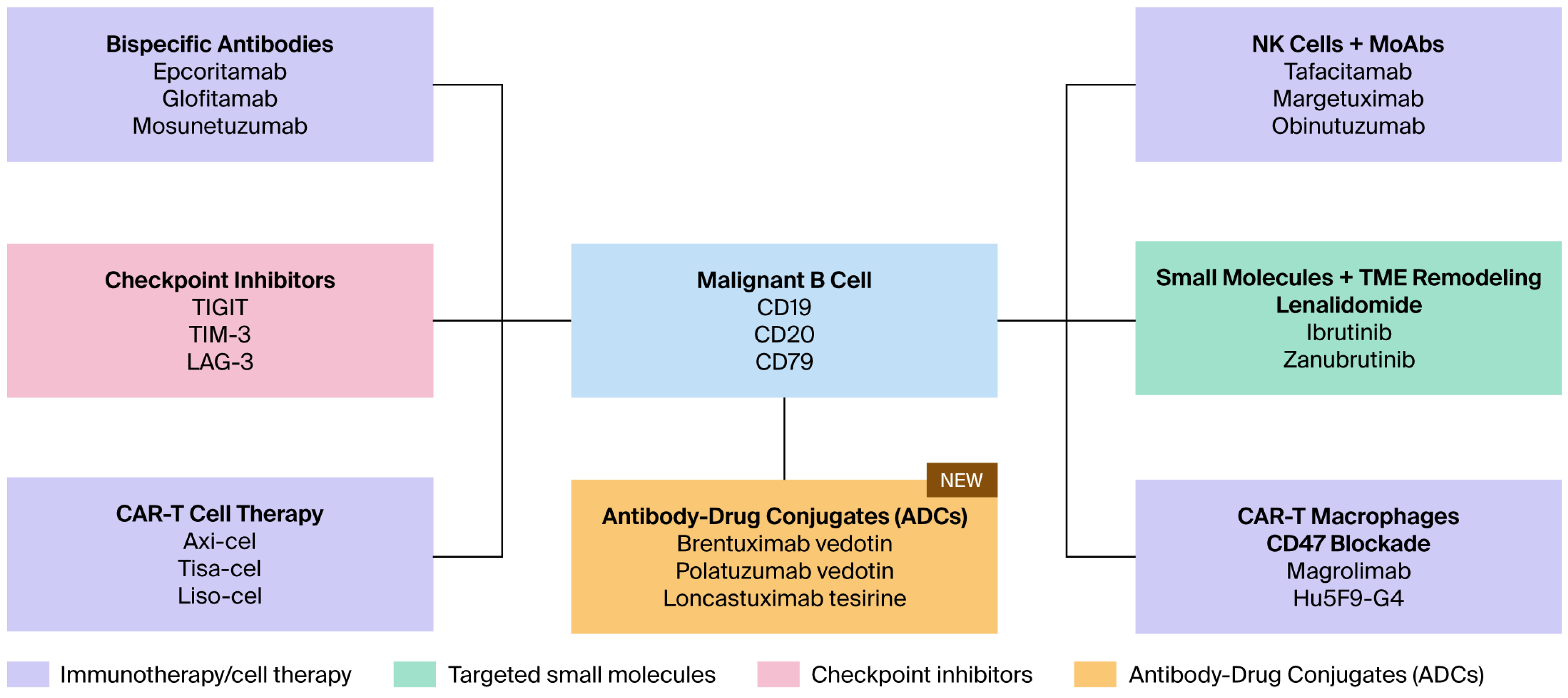
| T-Cell-Engaging or -Derived Immunotherapies | |
|---|---|
| CAR-T-cell therapy | Axicabtagene ciloleucel, Tisagenlecleucel, Lisocabtagene maraleucel |
| Bispecific antibodies | Epcoritamab (CD20 × CD3), Glofitamab (CD20 × CD3), Mosunetuzumab, Odronextamab, TNB-486 |
| Trispecific antibodies | CD19 × CD3 × CD2 formats (in development) |
| NK-Cell- and Myeloid Cell-Engaging Therapies | |
| Monoclonal antibodies | Tafasitamab (anti-CD19) |
| NK-cell therapy | Unmodified (allogeneic) NK cells, CAR-engineered NK cells |
| CD47/SIRPα axis blockade | Anti-CD47 or anti-SIRPα agents |
| CAR macrophages | CAR-M constructs targeting CD19/CD20 |
| Combination Therapies (Immunotherapy + Oncogenic Pathway Inhibitors) | |
| B-cell surface marker combinations | CD19-directed: Tafasitamab, Loncastuximab tesirine; CD20-directed: Rituximab; CD79b-directed: Polatuzumab vedotin; CD20 × CD3: Glofitamab, Mosunetuzumab, Epcoritamab, Odronextamab |
| Immune checkpoint inhibition | Targets: PD-1/PD-L1, TIGIT, LAG-3, TIM-3 |
| TME reprogramming/remodeling | Myeloid-targeting agents, T-cell-based approaches |
| Small molecules for combination | Lenalidomide, Ibrutinib |
| No. | Approval Date | Drug/Regimen | Drug Class | Indication | Disease/Condition |
|---|---|---|---|---|---|
| Drugs 1–13 of 26|November 1997–October 2017 | |||||
| 1 | November 1997 | Rituximab | mAb (anti-CD20) | R/R low-grade lymphoma | B-cell Lymphoma |
| 2 | February 2006 | Rituximab + CHOP | mAb + Chemotherapy | TN DLBCL | Diffuse Large B-cell Lymphoma |
| 3 | October 2009 | Ofatumumab | mAb (anti-CD20) | R/R CLL | Chronic Lymphocytic Leukemia |
| 4 | August 2011 | Brentuximab Vedotin | ADC (anti-CD30) | R/R HL or ALCL | Hodgkin Lymphoma/ALCL |
| 5 | June 2013 | Lenalidomide | Immunomodulatory | R/R MCL | Mantle Cell Lymphoma |
| 6 | November 2013 | Obinutuzumab + Chlorambucil | mAb (anti-CD20) + Chemo | TN CLL | Chronic Lymphocytic Leukemia |
| 7 | November 2013 | Ibrutinib | BTK Inhibitor | R/R MCL | Mantle Cell Lymphoma |
| 8 | July 2014 | Rituximab + Idelalisib | mAb + PI3K Inhibitor | R/R CLL | Chronic Lymphocytic Leukemia |
| 9 | April 2016 | Venetoclax | BCL-2 Inhibitor | R/R CLL | Chronic Lymphocytic Leukemia |
| 10 | May 2016 | Nivolumab | PD-1 Inhibitor (mAb) | R/R HL | Hodgkin Lymphoma |
| 11 | March 2017 | Pembrolizumab | PD-1 Inhibitor (mAb) | R/R HL | Hodgkin Lymphoma |
| 12 | October 2017 | Acalabrutinib | BTK Inhibitor | R/R MCL | Mantle Cell Lymphoma |
| 13 | October 2017 | Axi-cel (Axicabtagene Ciloleucel) | CAR-T-cell Therapy | R/R NHL | Non-Hodgkin Lymphoma |
| Drugs 14–26 of 26|May 2018–June 2023 | |||||
| 14 | May 2018 | Tisa-cel (Tisagenlecleucel) | CAR-T-cell Therapy | R/R LBCL | Large B-cell Lymphoma |
| 15 | June 2018 | Rituximab + Venetoclax | mAb + BCL-2 Inhibitor | R/R CLL | Chronic Lymphocytic Leukemia |
| 16 | August 2018 | Mogamulizumab | mAb (anti-CCR4) | MF or SS | Mycosis Fungoides/Sezary Syndrome |
| 17 | August 2018 | Rituximab + Ibrutinib | mAb + BTK Inhibitor | R/R WM | Waldenstrom Macroglobulinemia |
| 18 | January 2019 | Obinutuzumab + Ibrutinib | mAb + BTK Inhibitor | TN CLL | Chronic Lymphocytic Leukemia |
| 19 | May 2019 | Rituximab + Lenalidomide | mAb + Immunomodulatory | R/R FL or MZL | Follicular/Marginal Zone Lymphoma |
| 20 | November 2019 | Obinutuzumab + Acalabrutinib | mAb + BTK Inhibitor | CLL | Chronic Lymphocytic Leukemia |
| 21 | November 2019 | Zanubrutinib | BTK Inhibitor | R/R MCL | Mantle Cell Lymphoma |
| 22 | July 2020 | Brexu-cel (Brexucabtagene Autoleucel) | CAR-T-cell Therapy | R/R MCL | Mantle Cell Lymphoma |
| 23 | February 2021 | Liso-cel (Lisocabtagene Maraleucel) | CAR-T-cell Therapy | R/R LBCL | Large B-cell Lymphoma |
| 24 | January 2023 | Pirtobrutinib | BTK Inhibitor (non-covalent) | R/R MCL | Mantle Cell Lymphoma |
| 25 | May 2023 | Epcoritamab | Bispecific Ab (CD3xCD20) | R/R DLBCL | Diffuse Large B-cell Lymphoma |
| 26 | June 2023 | Glofitamab | Bispecific Ab (CD3xCD20) | R/R DLBCL | Diffuse Large B-cell Lymphoma |
| Disease | Genetic Alteration/Chromosomal Change | Pathway/Mechanism Affected | Clinical Relevance |
|---|---|---|---|
| CML | t(9;22) → BCR-ABL1 fusion (Philadelphia chromosome) | Persistent tyrosine kinase activity → uncontrolled proliferation | Defining marker; imatinib/TKI target |
| B-ALL | t(9;22) → BCR-ABL1 fusion | Aberrant kinase signaling | Poor-risk subset; TKI-responsive |
| MCL | t(11;14)(q13;q32) → CCND1 overexpression | Cell cycle dysregulation (G1/S checkpoint) | Defining translocation; malignant transformation |
| MCL | TP53 mutation/del(17p) | DNA damage response failure | Chemo & BTK inhibitor resistance; poor prognosis |
| Follicular Lymphoma | BCL-2 upregulation via t(14;18) | Apoptosis resistance | Malignant cell survival; venetoclax target |
| Follicular Lymphoma | KMT2D, CREBBP, EZH2 loss-of-function | Histone modification; germinal center dysregulation | Lymphomagenesis; immunotherapy resistance |
| DLBCL | EZH2 gain-of-function (~20% of cases) | ↑ H3K27me3 → suppressed differentiation, immune evasion | Tazemetostat target; immunotherapy resistance |
| DLBCL | CREBBP loss-of-function mutations | MHC class II transcriptional silencing | Resistance to immunotherapy |
| AML | FLT3-ITD/FLT3-TKD mutations (~25–33%) | STAT5, PI3K, MAPK activation | Adverse prognosis; midostaurin/gilteritinib target |
| AML | NPM1, IDH1/2, DNMT3A, TET2, TP53 mutations | Epigenetic reprogramming; aberrant transcription | Define subgroups; guide risk stratification & therapy |
| AML/MDS | IDH1/IDH2 mutations | Widespread CpG methylation gains | IDH inhibitor target (enasidenib, ivosidenib) |
| CLL | TP53 mutation/del(17p) | DNA damage response; apoptosis failure | Highest adverse prognosis; BTK/BCL-2 inhibitor indication |
| CLL | NOTCH1, SF3B1, ATM, BIRC3 mutations | BCR signaling, NF-κB, RNA splicing | Unmutated IGHV; shorter TTT, worse PFS/OS |
| CLL | BTK C481S/PLCG2 mutations | Non-covalent BTK binding; BCR signaling escape | Ibrutinib resistance; non-covalent BTK inhibitor rationale |
| CLL/MCL | Chronic active BCR signaling | SYK → PI3K → BTK → NF-κB/MAPK/AKT-mTOR | Validated target; BTK inhibitor-sensitive |
| PV | JAK2V617F mutation (>95%) | Constitutive JAK-STAT activation | Proliferative phenotype; ruxolitinib target |
| ET/MF | JAK2V617F mutation | JAK-STAT pathway activation | Myeloproliferative phenotype; JAK inhibitor-responsive |
Disclaimer/Publisher’s Note: The statements, opinions and data contained in all publications are solely those of the individual author(s) and contributor(s) and not of MDPI and/or the editor(s). MDPI and/or the editor(s) disclaim responsibility for any injury to people or property resulting from any ideas, methods, instructions or products referred to in the content. |
© 2026 by the authors. Licensee MDPI, Basel, Switzerland. This article is an open access article distributed under the terms and conditions of the Creative Commons Attribution (CC BY) license.
Share and Cite
Wan, S.; Naik, S. Molecular Insights and Novel Therapies for Lymphoproliferative Disorders. Int. J. Mol. Sci. 2026, 27, 5026. https://doi.org/10.3390/ijms27115026
Wan S, Naik S. Molecular Insights and Novel Therapies for Lymphoproliferative Disorders. International Journal of Molecular Sciences. 2026; 27(11):5026. https://doi.org/10.3390/ijms27115026
Chicago/Turabian StyleWan, Shucen, and Seema Naik. 2026. "Molecular Insights and Novel Therapies for Lymphoproliferative Disorders" International Journal of Molecular Sciences 27, no. 11: 5026. https://doi.org/10.3390/ijms27115026
APA StyleWan, S., & Naik, S. (2026). Molecular Insights and Novel Therapies for Lymphoproliferative Disorders. International Journal of Molecular Sciences, 27(11), 5026. https://doi.org/10.3390/ijms27115026