Cerebrospinal Fluid in Pediatric Neuro-Oncology: Molecular Diagnosis, Disease Monitoring, and Clinical Translation
 ,
,
Abstract
1. Introduction
Literature Search Strategy
2. Current Clinical Uses of CSF in Pediatric Neuro-Oncology
3. Biological Rationale for CSF-Based Tumor Assessment
4. Pre-Analytical and Technical Determinants of CSF Biomarker Performance
5. CSF Analyte Classes in Pediatric Brain Tumors
5.1. Conventional CSF Assessment: Cytology and Established Markers
5.2. Cell-Based and DNA-Based Analytes: CTCs and cfDNA/ctDNA
5.3. RNA, miRNA, Extracellular Vesicles, Proteins, and Metabolites
6. Tumor-Specific Applications of CSF Liquid Biopsy in Pediatric Brain Tumors
6.1. Embryonal Tumors
6.2. Pediatric Gliomas
6.3. Ependymoma and Intracranial Germ Cell Tumors
7. Clinical Applications of CSF Liquid Biopsy in Pediatric Brain Tumors: A Decision-Point Framework
7.1. When Is CSF Liquid Biopsy Justified?
7.2. Diagnosis When Tissue Biopsy Is Unsafe or Anatomically Prohibitive
7.3. Molecular Classification When Tissue Is Insufficient or Ambiguous
7.4. Baseline Risk Stratification
7.5. Measurable Residual Disease During and After Treatment
7.6. Relapse Detection and Augmentation of Radiographic Surveillance
7.7. Treatment-Response Monitoring as a Pharmacodynamic Biomarker
7.8. Clonal Evolution and Resistance Tracking
8. Barriers to Clinical Implementation and Future Directions
Implementation Requirements for Routine Clinical Translation
9. Conclusions
Author Contributions
Funding
Institutional Review Board Statement
Informed Consent Statement
Data Availability Statement
Acknowledgments
Conflicts of Interest
Abbreviations
| AFP | Alpha-fetoprotein |
| AT/RT | Atypical teratoid/rhabdoid tumor |
| β-hCG | Beta subunit of human chorionic gonadotropin |
| BCOR | BCL6 corepressor |
| cfDNA | Cell-free DNA |
| cfRNA | Cell-free RNA |
| CNA | Copy-number alteration |
| CNS | Central nervous system |
| CSF | Cerebrospinal fluid |
| CTC(s) | Circulating tumor cell(s) |
| ctDNA | Circulating tumor DNA |
| ddPCR | Droplet digital PCR |
| DIPG | Diffuse intrinsic pontine glioma |
| DMG | Diffuse midline glioma |
| DNET | Dysembryoplastic neuroepithelial tumor |
| EM-seq | Enzymatic methylation sequencing |
| ETMR | Embryonal tumor with multilayered rosettes |
| EV(s) | Extracellular vesicle(s) |
| HGG | High-grade glioma |
| iGCT | Intracranial germ cell tumor |
| LDH | Lactate dehydrogenase |
| LMD | Leptomeningeal dissemination |
| LP | Lumbar puncture |
| LP-WGS | Low-pass whole-genome sequencing |
| MB | Medulloblastoma |
| miRNA | MicroRNA |
| MRI | Magnetic resonance imaging |
| MRD | Measurable residual disease |
| NGGCT | Non-germinomatous germ cell tumor |
| NGS | Next-generation sequencing |
| PFA | Posterior fossa group A |
| pHGG | Pediatric high-grade glioma |
| PLAP | Placental alkaline phosphatase |
| pLGG | Pediatric low-grade glioma |
| SHH | Sonic hedgehog |
| WHO | World Health Organization |
| WNT | Wingless-related integration site |
References
- Price, M.; Ballard, C.A.P.; Benedetti, J.R.; Kruchko, C.; Barnholtz-Sloan, J.S.; Ostrom, Q.T. CBTRUS Statistical Report: Pediatric Brain Tumor Foundation Childhood and Adolescent Primary Brain and Other Central Nervous System Tumors Diagnosed in the United States in 2017-2021. Neuro-Oncology 2025, 27, i1–i42, Corrigendum in Neuro-Oncology 2025, 28, e19–e20. [Google Scholar] [CrossRef] [PubMed]
- O’Halloran, K.; Crotty, E.E.; Christodoulou, E.; Leary, S.E.; Miller, A.; Paulson, V.A.; Lockwood, C.M.; Margol, A.S.; Biegel, J.A. Targeted detection of sequence variants in cell-free DNA from cerebrospinal fluid in pediatric central nervous system tumors. Front. Oncol. 2025, 14, 1513073. [Google Scholar] [CrossRef] [PubMed]
- Diaz, M.; Chudsky, S.; Pentsova, E.; Miller, A.M. Clinical applications of cerebrospinal fluid liquid biopsies in central nervous system tumors. Transl. Oncol. 2024, 41, 101881. [Google Scholar] [CrossRef]
- Pérez-Alfayate, R.; Paz-Cabezas, M.; Pérez-Segura, P.; Sanchez Del Hoyo, R.; Cabezas-Camarero, S. Cerebrospinal fluid ctDNA as a diagnostic and prognostic tool in gliomas: A systematic review and meta-analysis. Front. Oncol. 2025, 15, 1714287. [Google Scholar] [CrossRef] [PubMed]
- Lehner, K.R.; Jiang, K.; Rincon-Torroella, J.; Perera, R.; Bettegowda, C. Cerebrospinal Fluid biomarkers in pediatric brain tumors: A systematic review. Neoplasia 2023, 35, 100852. [Google Scholar] [CrossRef]
- Crotty, E.E.; Paulson, V.A.; Ronsley, R.; Vitanza, N.A.; Lee, A.; Hauptman, J.; Goldstein, H.E.; Lockwood, C.M.; Leary, S.E.S.; Cole, B.L. Cerebrospinal fluid liquid biopsy by low-pass whole genome sequencing for clinical disease monitoring in pediatric embryonal tumors. Neuro-Oncol. Adv. 2024, 6, vdae126. [Google Scholar] [CrossRef]
- Cornelli, L.; Van Paemel, R.; Ferro Dos Santos, M.R.; Roelandt, S.; Willems, L.; Vandersteene, J.; Baert, E.; Mus, L.M.; Van Roy, N.; De Wilde, B.; et al. Diagnosis of pediatric central nervous system tumors using methylation profiling of cfDNA from cerebrospinal fluid. Clin. Epigenet. 2024, 16, 87. [Google Scholar] [CrossRef]
- O’Halloran, K.; Christodoulou, E.; Paulson, V.A.; Cole, B.L.; Margol, A.S.; Biegel, J.A.; Leary, S.E.S.; Lockwood, C.M.; Crotty, E.E. Low-Pass Whole Genome Sequencing of Cell-Free DNA from Cerebrospinal Fluid: A Focus on Pediatric Central Nervous System Tumors. Clin. Chem. 2025, 71, 87–96. [Google Scholar] [CrossRef]
- Fischer, T.T.; Maaß, K.K.; Puranachot, P.; Mieskolainen, M.; Sill, M.; Schad, P.S.; Volz, S.; Rosing, F.; Wedig, T.; Schwarz, N.; et al. Ultra-low-input cell-free DNA sequencing for tumor detection and characterization in a real-world pediatric brain tumor cohort. Acta Neuropathol. Commun. 2025, 13, 134. [Google Scholar] [CrossRef]
- Smith, K.S.; Fischer, T.T.; Han, K.; Kostecka, A.; Lin, H.; Senfter, D.; Soliman, T.; Stepien, N.; Volz, S.; Schwarz, N.; et al. M-PACT leverages cell-free DNA methylomes to achieve robust classification of pediatric brain tumors. Nat. Cancer 2026, 7, 667–683. [Google Scholar] [CrossRef]
- Gajjar, A.; Chintagumpala, M.; Ashley, D.; Kellie, S.; Kun, L.E.; Merchant, T.E.; Woo, S.; Wheeler, G.; Ahern, V.; Krasin, M.J.; et al. Risk-adapted craniospinal radiotherapy followed by high-dose chemotherapy and stem-cell rescue in children with newly diagnosed medulloblastoma (St Jude Medulloblastoma-96): Long-term results from a prospective, multicentre trial. Lancet Oncol. 2006, 7, 813–820, Erratum in Lancet Oncol. 2006, 7, 797. [Google Scholar] [CrossRef] [PubMed]
- Packer, R.J.; Gajjar, A.; Vezina, G.; Rorke-Adams, L.; Burger, P.C.; Robertson, P.L.; Bayer, L.; LaFond, D.; Donahue, B.R.; Marymont, M.H.; et al. Phase III study of craniospinal radiation therapy followed by adjuvant chemotherapy for newly diagnosed average-risk medulloblastoma. J. Clin. Oncol. Off. J. Am. Soc. Clin. Oncol. 2006, 24, 4202–4208. [Google Scholar] [CrossRef]
- Merchant, T.E.; Li, C.; Xiong, X.; Kun, L.E.; Boop, F.A.; Sanford, R.A. Conformal radiotherapy after surgery for paediatric ependymoma: A prospective study. Lancet. Oncol. 2009, 10, 258–266. [Google Scholar] [CrossRef]
- Pajtler, K.W.; Witt, H.; Sill, M.; Jones, D.T.; Hovestadt, V.; Kratochwil, F.; Wani, K.; Tatevossian, R.; Punchihewa, C.; Johann, P.; et al. Molecular Classification of Ependymal Tumors across All CNS Compartments, Histopathological Grades, and Age Groups. Cancer Cell 2015, 27, 728–743. [Google Scholar] [CrossRef]
- Ginn, K.F.; Gajjar, A. Atypical teratoid rhabdoid tumor: Current therapy and future directions. Front. Oncol. 2012, 2, 114. [Google Scholar] [CrossRef] [PubMed]
- Nemes, K.; Johann, P.D.; Steinbügl, M.; Gruhle, M.; Bens, S.; Kachanov, D.; Teleshova, M.; Hauser, P.; Simon, T.; Tippelt, S.; et al. Infants and Newborns with Atypical Teratoid Rhabdoid Tumors (ATRT) and Extracranial Malignant Rhabdoid Tumors (eMRT) in the EU-RHAB Registry: A Unique and Challenging Population. Cancers 2022, 14, 2185. [Google Scholar] [CrossRef]
- Cocito, C.; Martin, B.; Giantini-Larsen, A.M.; Valcarce-Aspegren, M.; Souweidane, M.M.; Szalontay, L.; Dahmane, N.; Greenfield, J.P. Leptomeningeal dissemination in pediatric brain tumors. Neoplasia 2023, 39, 100898. [Google Scholar] [CrossRef]
- Warren, K.E.; Vezina, G.; Poussaint, T.Y.; Warmuth-Metz, M.; Chamberlain, M.C.; Packer, R.J.; Brandes, A.A.; Reiss, M.; Goldman, S.; Fisher, M.J.; et al. Response assessment in medulloblastoma and leptomeningeal seeding tumors: Recommendations from the Response Assessment in Pediatric Neuro-Oncology committee. Neuro-Oncology 2018, 20, 13–23. [Google Scholar] [CrossRef] [PubMed]
- Lindsay, H.B.; Massimino, M.; Avula, S.; Stivaros, S.; Grundy, R.; Metrock, K.; Bhatia, A.; Fernández-Teijeiro, A.; Chiapparini, L.; Bennett, J.; et al. Response assessment in paediatric intracranial ependymoma: Recommendations from the Response Assessment in Pediatric Neuro-Oncology (RAPNO) working group. Lancet. Oncol. 2022, 23, e393–e401. [Google Scholar] [CrossRef] [PubMed]
- Gajjar, A.; Mahajan, A.; Bale, T.; Bowers, D.C.; Canan, L.; Chi, S.; Cluster, A.; Cohen, K.; Cole, B.; Coven, S.; et al. Pediatric Central Nervous System Cancers, Version 2.2025, NCCN Clinical Practice Guidelines in Oncology. J. Natl. Compr. Cancer Netw. 2025, 23, 113–130. [Google Scholar] [CrossRef]
- Bailey, S.; Jacobs, S.; Kourti, M.; Massimino, M.; Andre, N.; Doz, F.; Clifford, S.C. Medulloblastoma therapy: Consensus treatment recommendations from SIOP-Europe and the European Research Network. EJC Paediatr. Oncol. 2025, 5, 100205. [Google Scholar] [CrossRef]
- Rudà, R.; Reifenberger, G.; Frappaz, D.; Pfister, S.M.; Laprie, A.; Santarius, T.; Moyal, E.C.J. EANO guidelines for the diagnosis and treatment of ependymal tumors. Neuro-Oncology 2018, 20, 445–456. [Google Scholar] [CrossRef]
- SIOPEHigh-Grade Glioma Working Group Standard Clinical Practice Recommendations for Paediatric High-Grade Glioma (Version 513), S.I.O.P.E. September 2023. Available online: https://siope.eu/media/documents/escp-paediatrichigh-grade-glioma.pdf (accessed on 21 March 2026).
- Frappaz, D.; Dhall, G.; Murray, M.J.; Goldman, S.; Faure Conter, C.; Allen, J.; Bouffet, E. EANO, SNO and Euracan consensus review on the current management and future development of intracranial germ cell tumors in adolescents and young adults. Neuro-Oncology 2022, 24, 516–527. [Google Scholar] [CrossRef]
- Taylor, M.D.; Northcott, P.A.; Korshunov, A.; Remke, M.; Cho, Y.J.; Clifford, S.C.; Eberhart, C.G.; Parsons, D.W.; Rutkowski, S.; Gajjar, A.; et al. Molecular subgroups of medulloblastoma: The current consensus. Acta Neuropathol. 2012, 123, 465–472. [Google Scholar] [CrossRef] [PubMed]
- Damiani, D.; Suciu, V.; Andreiuolo, F.; Calderaro, J.; Vielh, P. Young investigator challenge: Cytomorphologic analysis of cerebrospinal fluid in 70 pediatric patients with medulloblastoma and review of the literature focusing on novel diagnostic and prognostic tests. Cancer Cytopathol. 2015, 123, 644–649. [Google Scholar] [CrossRef] [PubMed]
- Huddart, R.A.; Gabe, R.; Cafferty, F.H.; Pollock, P.; White, J.D.; Shamash, J.; Cullen, M.H.; Stenning, S.P.; TE23 Trial Management Group and Collaborators, & National Cancer Research Institute Testis Cancer Clinical Studies Group. A randomised phase 2 trial of intensive induction chemotherapy (CBOP/BEP) and standard BEP in poor-prognosis germ cell tumours (MRC TE23, CRUK 05/014, ISRCTN 53643604). Eur. Urol. 2015, 67, 534–543. [Google Scholar] [CrossRef]
- Głowska-Ciemny, J.; Szymanski, M.; Kuszerska, A.; Rzepka, R.; von Kaisenberg, C.S.; Kocyłowski, R. Role of Alpha-Fetoprotein (AFP) in Diagnosing Childhood Cancers and Genetic-Related Chronic Diseases. Cancers 2023, 15, 4302. [Google Scholar] [CrossRef]
- Hoffman, L.M.; Veldhuijzen van Zanten, S.E.M.; Colditz, N.; Baugh, J.; Chaney, B.; Hoffmann, M.; Lane, A.; Fuller, C.; Miles, L.; Hawkins, C.; et al. Clinical, Radiologic, Pathologic, and Molecular Characteristics of Long-Term Survivors of Diffuse Intrinsic Pontine Glioma (DIPG): A Collaborative Report From the International and European Society for Pediatric Oncology DIPG Registries. J. Clin. Oncol. Off. J. Am. Soc. Clin. Oncol. 2018, 36, 1963–1972. [Google Scholar] [CrossRef]
- Kline, C.N.; Joseph, N.M.; Grenert, J.P.; van Ziffle, J.; Talevich, E.; Onodera, C.; Aboian, M.; Cha, S.; Raleigh, D.R.; Braunstein, S.; et al. Targeted next-generation sequencing of pediatric neuro-oncology patients improves diagnosis, identifies pathogenic germline mutations, and directs targeted therapy. Neuro-Oncology 2017, 19, 699–709, Corrigendum in Neuro-Oncology 2017, 19, 601. [Google Scholar] [CrossRef]
- Reddy, A.T.; Strother, D.R.; Judkins, A.R.; Burger, P.C.; Pollack, I.F.; Krailo, M.D.; Buxton, A.B.; Williams-Hughes, C.; Fouladi, M.; Mahajan, A.; et al. Efficacy of High-Dose Chemotherapy and Three-Dimensional Conformal Radiation for Atypical Teratoid/Rhabdoid Tumor: A Report from the Children’s Oncology Group Trial ACNS0333. J. Clin. Oncol. Off. J. Am. Soc. Clin. Oncol. 2020, 38, 1175–1185. [Google Scholar] [CrossRef]
- Kwon, J.-E.; Hwang, K.; Go, K.-O.; Wee, C.W.; Kim, I.A.; Kim, Y.J.; Kim, C.-Y. Clinical Characteristics of High-Grade Glioma with Primary Leptomeningeal Seeding at Initial Diagnosis in a Single Center Study. Brain Tumor Res. Treat. 2020, 8, 77. [Google Scholar] [CrossRef]
- Gajjar, A.; Fouladi, M.; Walter, A.W.; Thompson, S.J.; Reardon, D.A.; Merchant, T.E.; Jenkins, J.J.; Liu, A.; Boyett, J.M.; Kun, L.E.; et al. Comparison of lumbar and shunt cerebrospinal fluid specimens for cytologic detection of leptomeningeal disease in pediatric patients with brain tumors. J. Clin. Oncol. Off. J. Am. Soc. Clin. Oncol. 1999, 17, 1825–1828. [Google Scholar] [CrossRef]
- Hagel, C.; Sloman, V.; Mynarek, M.; Petrasch, K.; Obrecht, D.; Kühl, J.; Deinlein, F.; Schmid, R.; von Bueren, A.O.; Friedrich, C.; et al. Refining M1 stage in medulloblastoma: Criteria for cerebrospinal fluid cytology and implications for improved risk stratification from the HIT-2000 trial. Eur. J. Cancer 2022, 164, 30–38. [Google Scholar] [CrossRef] [PubMed]
- Terterov, S.; Krieger, M.D.; Bowen, I.; McComb, J.G. Evaluation of intracranial cerebrospinal fluid cytology in staging pediatric medulloblastomas, supratentorial primitive neuroectodermal tumors, and ependymomas. J. Neurosurg. Pediatr. 2010, 6, 131–136. [Google Scholar] [CrossRef]
- Low, S.Y.Y.; Wei, C.M.; Chang, K.T.E.; Huak, C.Y.; Ping, N.L.; Tew, S.W.; Low, D.C.Y. Intra-operative cerebrospinal fluid sampling versus post-operative lumbar puncture for detection of leptomeningeal disease in malignant paediatric brain tumours. PLoS ONE 2018, 13, e0196696. [Google Scholar] [CrossRef] [PubMed]
- Chun, N.; Edelbach, B.; Baig, M.; Kagami, L.A.T.; Robison, R.A.; Choung, E.; Kremsky, I.; Leeper, K.; Ferguson, B.; Ostrow, D.G.; et al. Cell-free DNA from cerebrospinal fluid cytology specimens as a novel liquid biopsy approach for pediatric patients with primary central nervous system tumors. Acta Neuropathol. Commun. 2026, 14, 44. [Google Scholar] [CrossRef]
- Escudero, L.; Llort, A.; Arias, A.; Diaz-Navarro, A.; Martínez-Ricarte, F.; Rubio-Perez, C.; Mayor, R.; Caratù, G.; Martínez-Sáez, E.; Vázquez-Méndez, É.; et al. Circulating tumour DNA from the cerebrospinal fluid allows the characterisation and monitoring of medulloblastoma. Nat. Commun. 2020, 11, 5376. [Google Scholar] [CrossRef] [PubMed]
- Wu, J.; Liu, Z.; Huang, T.; Wang, Y.; Yu, J.; Li, S.; Xie, K.; Kuang, S.; Liu, C.; Zhang, L. Cerebrospinal fluid cfDNA-based molecular assessment of resection extent and prognosis in glioma. Commun. Med. 2026, 6, 206. [Google Scholar] [CrossRef]
- Boire, A.; Zou, Y.; Shieh, J.; Macalinao, D.G.; Pentsova, E.; Massagué, J. Complement Component 3 Adapts the Cerebrospinal Fluid for Leptomeningeal Metastasis. Cell 2017, 168, 1101–1113.e13. [Google Scholar] [CrossRef]
- Pan, W.; Gu, W.; Nagpal, S.; Gephart, M.H.; Quake, S.R. Brain tumor mutations detected in cerebral spinal fluid. Clin. Chem. 2015, 61, 514–522. [Google Scholar] [CrossRef]
- Pagès, M.; Rotem, D.; Gydush, G.; Reed, S.; Rhoades, J.; Ha, G.; Lo, C.; Fleharty, M.; Duran, M.; Jones, R.; et al. Liquid biopsy detection of genomic alterations in pediatric brain tumors from cell-free DNA in peripheral blood, CSF, and urine. Neuro-oncology 2022, 24, 1352–1363. [Google Scholar] [CrossRef]
- Dufour, C.; Beaugrand, A.; Le Deley, M.C.; Bourdeaut, F.; André, N.; Leblond, P.; Bertozzi, A.I.; Frappaz, D.; Rialland, X.; Fouyssac, F.; et al. Clinicopathologic prognostic factors in childhood atypical teratoid and rhabdoid tumor of the central nervous system: A multicenter study. Cancer 2012, 118, 3812–3821. [Google Scholar] [CrossRef]
- Louis, D.N.; Perry, A.; Wesseling, P.; Brat, D.J.; Cree, I.A.; Figarella-Branger, D.; Hawkins, C.; Ng, H.K.; Pfister, S.M.; Reifenberger, G.; et al. The 2021 WHO Classification of Tumors of the Central Nervous System: A summary. Neuro-Oncology 2021, 23, 1231–1251. [Google Scholar] [CrossRef] [PubMed]
- Stejskal, P.; Goodarzi, H.; Srovnal, J.; Hajdúch, M.; van ’t Veer, L.J.; Magbanua, M.J.M. Circulating tumor nucleic acids: Biology, release mechanisms, and clinical relevance. Mol. Cancer 2023, 22, 15. [Google Scholar] [CrossRef]
- Collins, V.P.; Jones, D.T.; Giannini, C. Pilocytic astrocytoma: Pathology, molecular mechanisms and markers. Acta Neuropathol. 2015, 129, 775–788. [Google Scholar] [CrossRef] [PubMed]
- Usami, K.; Mizuno, T.; Shirai, R.; Yoshioka, T.; Terashima, K.; Kiyotani, C.; Ogiwara, H.; Kato, M. Detection of Tumor-Specific Variants in CSF of Children with Brain Tumors, Including Low-Grade and Cytology-Negative Cases. Pediatr. Blood Cancer 2026, 73, e70069. [Google Scholar] [CrossRef]
- Buccilli, B.; Rodriguez Molina, M.A.; Redrovan Palomeque, D.P.; Herrera Sabán, C.A.; CCaliwag, F.M.; Contreras Flores, C.J.S.; Abeysiriwardana, C.W.J.; Diarte, E.; Arruarana, V.S.; Calderon Martinez, E. Liquid Biopsies for Monitoring Medulloblastoma: Circulating Tumor DNA as a Biomarker for Disease Progression and Treatment Response. Cureus 2024, 16, e51712. [Google Scholar] [CrossRef] [PubMed]
- Mouliere, F.; Robert, B.; Arnau Peyrotte, E.; Del Rio, M.; Ychou, M.; Molina, F.; Gongora, C.; Thierry, A.R. High fragmentation characterizes tumour-derived circulating DNA. PLoS ONE 2011, 6, e23418. [Google Scholar] [CrossRef] [PubMed]
- Riviere-Cazaux, C.; Keough, M.B.; Zuccato, J.A.; Kumar, R.; Schulz, S.; Warrington, A.E.; Ruff, M.W.; Ellingson, B.M.; Sanai, N.; Campian, J.L.; et al. A hitchhiker’s guide to cerebrospinal fluid biomarkers for neuro-oncology. Neuro-Oncology 2025, 27, 1165–1179, Erratum in Neuro-Oncology 2025, 28, e13. [Google Scholar] [CrossRef]
- Miller, A.M.; Karajannis, M.A. Current Role and Future Potential of CSF ctDNA for the Diagnosis and Clinical Management of Pediatric Central Nervous System Tumors. J. Natl. Compr. Cancer Netw. 2022, 20, 1363–1369. [Google Scholar] [CrossRef]
- Mikolajewicz, N.; Yee, P.P.; Bhanja, D.; Trifoi, M.; Miller, A.M.; Metellus, P.; Bagley, S.J.; Balaj, L.; de Macedo Filho, L.J.M.; Zacharia, B.E.; et al. Systematic Review of Cerebrospinal Fluid Biomarker Discovery in Neuro-Oncology: A Roadmap to Standardization and Clinical Application. J. Clin. Oncol. Off. J. Am. Soc. Clin. Oncol. 2024, 42, 1961–1974. [Google Scholar] [CrossRef]
- Hickman, R.A.; Miller, A.M.; Arcila, M.E. Cerebrospinal fluid: A unique source of circulating tumor DNA with broad clinical applications. Transl. Oncol. 2023, 33, 101688. [Google Scholar] [CrossRef]
- Nakano, Y.; Burns, I.; Nobre, L.; Siddaway, R.; Rana, M.; Nesvick, C.; Bondoc, A.; Ku, M.; Yuditskiy, R.; Ku, D.T.L.; et al. High detection rate of circulating-tumor DNA from cerebrospinal fluid of children with central nervous system germ cell tumors. Acta Neuropathol. Commun. 2024, 12, 178. [Google Scholar] [CrossRef] [PubMed]
- Vanderstichele, H.; Bibl, M.; Engelborghs, S.; Le Bastard, N.; Lewczuk, P.; Molinuevo, J.L.; Parnetti, L.; Perret-Liaudet, A.; Shaw, L.M.; Teunissen, C.; et al. Standardization of preanalytical aspects of cerebrospinal fluid biomarker testing for Alzheimer’s disease diagnosis: A consensus paper from the Alzheimer’s Biomarkers Standardization Initiative. Alzheimer’s Dement. J. Alzheimer’s Assoc. 2012, 8, 65–73. [Google Scholar] [CrossRef] [PubMed]
- Barkovits, K.; Kruse, N.; Linden, A.; Tönges, L.; Pfeiffer, K.; Mollenhauer, B.; Marcus, K. Blood Contamination in CSF and Its Impact on Quantitative Analysis of Alpha-Synuclein. Cells 2020, 9, 370. [Google Scholar] [CrossRef]
- Bale, T.A.; Yang, S.R.; Solomon, J.P.; Nafa, K.; Middha, S.; Casanova, J.; Sadowska, J.; Skakodub, A.; Ahmad, H.; Yu, H.A.; et al. Clinical Experience of Cerebrospinal Fluid-Based Liquid Biopsy Demonstrates Superiority of Cell-Free DNA over Cell Pellet Genomic DNA for Molecular Profiling. J. Mol. Diagn. 2021, 23, 742–752. [Google Scholar] [CrossRef] [PubMed]
- Kwon, H.S.; Kim, G.H.; Park, S.A.; Moon, S.Y.; Jang, J.W.; Park, K.H.; Park, Y.H.; Lim, J.S.; Yang, D.W.; Choi, S.H.; et al. Standardized Procedures for Blood and Cerebrospinal Fluid Collection and Storage in Neurodegenerative Biomarker Research: A Comprehensive Review. Dement. Neurocognitive Disord. 2025, 24, 162–173. [Google Scholar] [CrossRef]
- Sandau, U.S.; Magaña, S.M.; Costa, J.; Nolan, J.P.; Ikezu, T.; Vella, L.J.; Saugstad, J.A. Recommendations for reproducibility of cerebrospinal fluid extracellular vesicle studies. J. Extracell. Vesicles 2024, 13, e12397, Correction in J. Extracell. Vesicles 2024, 13, 12405. [Google Scholar] [CrossRef]
- Ahmadian, S.; Jafari, N.; Tamadon, A.; Ghaffarzadeh, A.; Rahbarghazi, R.; Mahdipour, M. Different storage and freezing protocols for extracellular vesicles: A systematic review. Stem Cell Res. Ther. 2024, 15, 453. [Google Scholar] [CrossRef]
- Sun, M.; Jiang, S.; Xu, H.; Zeng, Y.; Liu, B.; Wang, Y.; Li, Z.; Guan, Y.; Chen, J.; Zhu, R.; et al. Integrated detection of cerebrospinal fluid cfDNA/cfRNA and molecular concordance with glioma characteristics. Neuro-Oncol. Adv. 2026, 8, vdag039. [Google Scholar] [CrossRef]
- Miller, A.M.; Szalontay, L.; Bouvier, N.; Hill, K.; Ahmad, H.; Rafailov, J.; Lee, A.J.; Rodriguez-Sanchez, M.I.; Yildirim, O.; Patel, A.; et al. Next-generation sequencing of cerebrospinal fluid for clinical molecular diagnostics in pediatric, adolescent and young adult brain tumor patients. Neuro-Oncology 2022, 24, 1763–1772. [Google Scholar] [CrossRef]
- Liu, A.P.Y.; Smith, K.S.; Kumar, R.; Paul, L.; Bihannic, L.; Lin, T.; Maass, K.K.; Pajtler, K.W.; Chintagumpala, M.; Su, J.M.; et al. Serial assessment of measurable residual disease in medulloblastoma liquid biopsies. Cancer Cell 2021, 39, 1519–1530.e4. [Google Scholar] [CrossRef] [PubMed]
- Chang, C.H.; Housepian, E.M.; Herbert, C. An operative staging system and a megavoltage radiotherapeutic technic for cerebellar medulloblastomas. Radiology 1969, 93, 1351–1359. [Google Scholar] [CrossRef]
- Zeltzer, P.M.; Boyett, J.M.; Finlay, J.L.; Albright, A.L.; Rorke, L.B.; Milstein, J.M.; Packer, R.J. Metastasis stage, adjuvant treatment, and residual tumor are prognostic factors for medulloblastoma in children: Conclusions from the Children’s Cancer Group 921 randomized phase III study. J. Clin. Oncol. 1999, 17, 832–845. [Google Scholar] [CrossRef]
- Obrecht, D.; Mynarek, M.; Hagel, C.; Kwiecien, R.; Spohn, M.; Bockmayr, M.; Bison, B.; Pfister, S.M.; Jones, D.T.W.; Sturm, D.; et al. Clinical and molecular characterization of isolated M1 disease in pediatric medulloblastoma: Experience from the German HIT-MED studies. J. Neuro-Oncol. 2022, 157, 37–48. [Google Scholar] [CrossRef]
- Moreno, L.; Pollack, I.F.; Duffner, P.K.; Geyer, J.R.; Grill, J.; Massimino, M.; Finlay, J.L.; Zacharoulis, S. Utility of cerebrospinal fluid cytology in newly diagnosed childhood ependymoma. J. Pediatr. Hematol. 2010, 32, 515–518. [Google Scholar] [CrossRef]
- Salimian, M.; Viaene, A.N.; Chiang, J.; Ho, C.Y. CSF cytology of common primary CNS neoplasms categorized by CNS WHO 2021. Cytopathol. Off. J. Br. Soc. Clin. Cytol. 2024, 35, 608–615. [Google Scholar] [CrossRef]
- Remsik, J.; Boire, A. The path to leptomeningeal metastasis. Nat. Rev. Cancer 2024, 24, 448–460. [Google Scholar] [CrossRef] [PubMed]
- Batool, A.; Kasi, A. Leptomeningeal Carcinomatosis. In StatPearls [Internet]; StatPearls Publishing: Treasure Island, FL, USA, 2023. Available online: https://www.ncbi.nlm.nih.gov/books/NBK499862/ (accessed on 21 March 2026).
- Allen, J.; Chacko, J.; Donahue, B.; Dhall, G.; Kretschmar, C.; Jakacki, R.; Holmes, E.; Pollack, I. Diagnostic sensitivity of serum and lumbar CSF bHCG in newly diagnosed CNS germinoma. Pediatr. Blood Cancer 2012, 59, 1180–1182. [Google Scholar] [CrossRef]
- Baroni, L.V.; Huang, M.A.; Abdelbaki, M.S. Central nervous system germ cell tumors: Discrepancies in diagnosis and management across the world. Neuro-Oncol. Pediatr. 2025, 1, wuaf007. [Google Scholar] [CrossRef]
- Shalaby, T.; Achini, F.; Grotzer, M.A. Targeting cerebrospinal fluid for discovery of brain cancer biomarkers. J. Cancer Metastasis Treat. 2016, 2, 176. [Google Scholar] [CrossRef]
- Twijnstra, A.; van Zanten, A.P.; Hart, A.A.; Ongerboer de Visser, B.W. Serial lumbar and ventricle cerebrospinal fluid lactate dehydrogenase activities in patients with leptomeningeal metastases from solid and haematological tumours. J. Neurol. Neurosurg. Psychiatry 1987, 50, 313–320. [Google Scholar] [CrossRef]
- Cacho-Díaz, B.; Lorenzana-Mendoza, N.A.; Reyes-Soto, G.; Hernández-Estrada, A.; Monroy-Sosa, A.; Guraieb-Chahin, P.; Cantu-de-León, D. Lactate dehydrogenase as a prognostic marker in neoplastic meningitis. J. Clin. Neurosci. Off. J. Neurosurg. Soc. Australas. 2018, 51, 39–42. [Google Scholar] [CrossRef] [PubMed]
- Weston, C.L.; Glantz, M.J.; Connor, J.R. Detection of cancer cells in the cerebrospinal fluid: Current methods and future directions. Fluids Barriers CNS 2011, 8, 14. [Google Scholar] [CrossRef]
- Lin, X.; Fleisher, M.; Rosenblum, M.; Lin, O.; Boire, A.; Briggs, S.; Pentsova, E.I. Cerebrospinal fluid circulating tumor cells: A novel tool to diagnose leptomeningeal metastases from epithelial tumors. Neuro-Oncology 2017, 19, 1248–1254. [Google Scholar] [CrossRef]
- Nayak, L.; Fleisher, M.; Gonzalez-Espinoza, R.; Lin, O.; Panageas, K.; Reiner, A.; Liu, C.M.; Deangelis, L.M.; Omuro, A. Rare cell capture technology for the diagnosis of leptomeningeal metastasis in solid tumors. Neurology 2013, 80, 1598–1603. [Google Scholar] [CrossRef] [PubMed]
- van Bussel, M.T.J.; Pluim, D.; Milojkovic Kerklaan, B.; Bol, M.; Sikorska, K.; Linders, D.T.C.; van den Broek, D.; Beijnen, J.H.; Schellens, J.H.M.; Brandsma, D. Circulating epithelial tumor cell analysis in CSF in patients with leptomeningeal metastases. Neurology 2020, 94, e521–e528. [Google Scholar] [CrossRef]
- Patel, A.S.; Allen, J.E.; Dicker, D.T.; Peters, K.L.; Sheehan, J.M.; Glantz, M.J.; El-Deiry, W.S. Identification and enumeration of circulating tumor cells in the cerebrospinal fluid of breast cancer patients with central nervous system metastases. Oncotarget 2011, 2, 752–760. [Google Scholar] [CrossRef]
- Malani, R.; Fleisher, M.; Kumthekar, P.; Lin, X.; Omuro, A.; Groves, M.D.; Lin, N.U.; Melisko, M.; Lassman, A.B.; Jeyapalan, S.; et al. Cerebrospinal fluid circulating tumor cells as a quantifiable measurement of leptomeningeal metastases in patients with HER2 positive cancer. J. Neuro-Oncol. 2020, 148, 599–606. [Google Scholar] [CrossRef]
- Kayo, A.; Yogi, A.; Hamada, S.; Nakanishi, K.; Kinjo, S.; Sugawara, K.; Ishiuchi, S.; Nishie, A. Primary diffuse leptomeningeal atypical teratoid rhabdoid tumor (AT/RT) demonstrating atypical imaging findings in an adolescent patient. Radiol. Case Rep. 2021, 17, 485–488. [Google Scholar] [CrossRef]
- Tomomasa, R.; Nakata, S.; Nobusawa, S.; Horiguchi, K.; Matsumura, N.; Ikota, H.; Yokoo, H. Primary diffuse leptomeningeal atypical teratoid/rhabdoid tumor diagnosed by cerebrospinal fluid cytology: Case report with molecular genetic analysis. Hum. Pathol. 2018, 77, 116–120. [Google Scholar] [CrossRef]
- Güner, G.; Önder, S.; Söylemezoʇlu, F. Cytomorphological features of atypical teratoid/rhabdoid tumor: An account of 12 years’ experience. Diagn. Cytopathol. 2014, 42, 856–862. [Google Scholar] [CrossRef]
- Choi, J.; Kim, H.; Kim, S.H. Atypical teratoid/rhabdoid tumor: Analysis of cytomorphologic features in CSF, focused on the differential diagnosis from mimickers. Diagn. Cytopathol. 2012, 40, 592–596. [Google Scholar] [CrossRef]
- Mayoh, C.; Li, W.; Toumari, M.; Bazaz, S.R.; Gerard, A.-L.; Lowe, A.; Barahona, P.; Lau, L.M.S.; Staunton, J.; Jacobson, E.; et al. Single-cell RNA-sequencing of cerebral spinal fluid identifies circulating tumour cells in children with brain cancer. bioRxiv 2025. [Google Scholar] [CrossRef]
- Rahbarlayegh, E.; Wojcinski, A.; Nomura, N.; Juarez, T.M.; Blouw, B.; Kesari, S. Multimodal evaluation of cerebrospinal fluid from breast cancer leptomeningeal metastases using circulating tumor cell detection, single-cell sequencing, and proteomics. J. Transl. Med. 2025, 23, 773. [Google Scholar] [CrossRef] [PubMed]
- Wang, Y.; Springer, S.; Zhang, M.; McMahon, K.W.; Kinde, I.; Dobbyn, L.; Ptak, J.; Brem, H.; Chaichana, K.; Gallia, G.L.; et al. Detection of tumor-derived DNA in cerebrospinal fluid of patients with primary tumors of the brain and spinal cord. Proc. Natl. Acad. Sci. USA 2015, 112, 9704–9709. [Google Scholar] [CrossRef]
- Kojic, M.; Maybury, M.K.; Waddell, N.; Koufariotis, L.T.; Addala, V.; Millar, A.; Wood, S.; Pearson, J.V.; Hansford, J.R.; Hassall, T.; et al. Efficient detection and monitoring of pediatric brain malignancies with liquid biopsy based on patient-specific somatic mutation screening. Neuro-Oncology 2023, 25, 1507–1517. [Google Scholar] [CrossRef] [PubMed]
- Panditharatna, E.; Kilburn, L.B.; Aboian, M.S.; Kambhampati, M.; Gordish-Dressman, H.; Magge, S.N.; Gupta, N.; Myseros, J.S.; Hwang, E.I.; Kline, C.; et al. Clinically Relevant and Minimally Invasive Tumor Surveillance of Pediatric Diffuse Midline Gliomas Using Patient-Derived Liquid Biopsy. Clin. Cancer Res. Off. J. Am. Assoc. Cancer Res. 2018, 24, 5850–5859. [Google Scholar] [CrossRef]
- Bruzek, A.K.; Ravi, K.; Muruganand, A.; Wadden, J.; Babila, C.M.; Cantor, E.; Tunkle, L.; Wierzbicki, K.; Stallard, S.; Dickson, R.P.; et al. Electronic DNA Analysis of CSF Cell-free Tumor DNA to Quantify Multi-gene Molecular Response in Pediatric High-grade Glioma. Clin. Cancer Res. Off. J. Am. Assoc. Cancer Res. 2020, 26, 6266–6276. [Google Scholar] [CrossRef]
- Cantor, E.; Wierzbicki, K.; Tarapore, R.S.; Ravi, K.; Thomas, C.; Cartaxo, R.; Nand Yadav, V.; Ravindran, R.; Bruzek, A.K.; Wadden, J.; et al. Serial H3K27M cell-free tumor DNA (cf-tDNA) tracking predicts ONC201 treatment response and progression in diffuse midline glioma. Neuro-Oncology 2022, 24, 1366–1374. [Google Scholar] [CrossRef] [PubMed]
- Bonner, E.R.; Harrington, R.; Eze, A.; Bornhorst, M.; Kline, C.N.; Gordish-Dressman, H.; Dawood, A.; Das, B.; Chen, L.; Pauly, R.; et al. Circulating tumor DNA sequencing provides comprehensive mutation profiling for pediatric central nervous system tumors. npj Precis. Oncol. 2022, 6, 63. [Google Scholar] [CrossRef]
- Ronsley, R.; Karvonen, K.A.; Cole, B.; Paulson, V.; Stevens, J.; Crotty, E.E.; Hauptman, J.; Lee, A.; Stasi, S.M.; Lockwood, C.M.; et al. Detection of tumor-derived cell-free DNA in cerebrospinal fluid using a clinically validated targeted sequencing panel for pediatric brain tumors. J. Neuro-Oncol. 2024, 168, 215–224. [Google Scholar] [CrossRef]
- Krynina, O.; de Ståhl, T.D.; Jylhä, C.; Arthur, C.; Giraud, G.; Nyman, P.; Fritzberg, A.; Sandgren, J.; Tham, E.; Sandvik, U. The potential of liquid biopsy for detection of the KIAA1549-BRAF fusion in circulating tumor DNA from children with pilocytic astrocytoma. Neuro-Oncol. Adv. 2024, 6, vdae008. [Google Scholar] [CrossRef]
- Christodoulou, E.; Yellapantula, V.; O’Halloran, K.; Xu, L.; Berry, J.L.; Cotter, J.A.; Zdanowicz, A.; Mascarenhas, L.; Amatruda, J.F.; Ostrow, D.; et al. Combined low-pass whole genome and targeted sequencing in liquid biopsies for pediatric solid tumors. npj Precis. Oncol. 2023, 7, 21. [Google Scholar] [CrossRef]
- Maass, K.K.; Schad, P.S.; Finster, A.M.E.; Puranachot, P.; Rosing, F.; Wedig, T.; Schwarz, N.; Stumpf, N.; Pfister, S.M.; Pajtler, K.W. From Sampling to Sequencing: A Liquid Biopsy Pre-Analytic Workflow to Maximize Multi-Layer Genomic Information from a Single Tube. Cancers 2021, 13, 3002. [Google Scholar] [CrossRef]
- Teplyuk, N.M.; Mollenhauer, B.; Gabriely, G.; Giese, A.; Kim, E.; Smolsky, M.; Kim, R.Y.; Saria, M.G.; Pastorino, S.; Kesari, S.; et al. MicroRNAs in cerebrospinal fluid identify glioblastoma and metastatic brain cancers and reflect disease activity. Neuro-Oncology 2012, 14, 689–700. [Google Scholar] [CrossRef]
- Lee, B.; Mahmud, I.; Pokhrel, R.; Murad, R.; Yuan, M.; Stapleton, S.; Bettegowda, C.; Jallo, G.; Eberhart, C.G.; Garrett, T.; et al. Medulloblastoma cerebrospinal fluid reveals metabolites and lipids indicative of hypoxia and cancer-specific RNAs. Acta Neuropathol. Commun. 2022, 10, 25, Correction in Acta Neuropathol. Commun. 2022, 10, 58. [Google Scholar] [CrossRef]
- Akers, J.C.; Ramakrishnan, V.; Kim, R.; Skog, J.; Nakano, I.; Pingle, S.; Chen, C.C. miR-21 in the Extracellular Vesicles (EVs) of Cerebrospinal Fluid (CSF): A Platform for Glioblastoma Biomarker Development. PLoS ONE 2013, 8, e78115. [Google Scholar] [CrossRef]
- Akers, J.C.; Hua, W.; Li, H.; Ramakrishnan, V.; Yang, Z.; Quan, K.; Chen, C.C. A cerebrospinal fluid microRNA signature as biomarker for glioblastoma. Oncotarget 2017, 8, 68769–68779. [Google Scholar] [CrossRef]
- Kopkova, A.; Sana, J.; Machackova, T.; Vecera, M.; Radova, L.; Trachtova, K.; Fadrus, P. Cerebrospinal fluid microRNA signatures as diagnostic biomarkers in brain tumors. Cancers 2019, 11, 1546. [Google Scholar] [CrossRef]
- Théry, C.; Witwer, K.W.; Aikawa, E.; Alcaraz, M.J.; Anderson, J.D.; Andriantsitohaina, R.; Zuba-Surma, E.K. Minimal information for studies of extracellular vesicles 2018 (MISEV2018): A position statement of the International Society for Extracellular Vesicles and update of the MISEV2014 guidelines. J. Extracell. Vesicles 2018, 7, 1535750. [Google Scholar] [CrossRef]
- Skog, J.; Würdinger, T.; van Rijn, S.; Meijer, D.H.; Gainche, L.; Curry, W.T.; Breakefield, X.O. Glioblastoma microvesicles transport RNA and proteins that promote tumour growth and provide diagnostic biomarkers. Nat. Cell Biol. 2008, 10, 1470–1476. [Google Scholar] [CrossRef]
- Chen, W.W.; Balaj, L.; Liau, L.M.; Samuels, M.L.; Kotsopoulos, S.K.; Maguire, C.A.; Skog, J. Beaming and droplet digital pcr analysis of mutant idh1 mrna in glioma patient serum and cerebrospinal fluid extracellular vesicles. Mol. Ther. Nucleic Acids 2013, 2, e109. [Google Scholar] [CrossRef]
- Figueroa, J.M.; Skog, J.; Akers, J.; Li, H.; Komotar, R.; Jensen, R.; Carter, B.S. Detection of wild-Type EGFR amplification and EGFRvIII mutation in CSF-derived extracellular vesicles of glioblastoma patients. Neuro-Oncology 2017, 19, 1494–1502. [Google Scholar] [CrossRef]
- Balaj, L.; Lessard, R.; Dai, L.; Cho, Y.J.; Pomeroy, S.L.; Breakefield, X.O.; Skog, J. Tumour microvesicles contain retrotransposon elements and amplified oncogene sequences. Nat. Commun. 2011, 2, 180. [Google Scholar] [CrossRef]
- Kim, J.W.; Choi, S.A.; Dan, K.; Koh, E.J.; Ha, S.; Phi, J.H.; Kim, S.K. Proteomic profiling of cerebrospinal fluid reveals TKT as a potential biomarker for medulloblastoma. Sci. Rep. 2024, 14, 21053. [Google Scholar] [CrossRef]
- Rajagopal, M.U.; Hathout, Y.; MacDonald, T.J.; Kieran, M.W.; Gururangan, S.; Blaney, S.M.; Phillips, P.; Packer, R.; Gordish-Dressman, H.; Rood, B.R. Proteomic profiling of cerebrospinal fluid identifies prostaglandin D2 synthase as a putative biomarker for pediatric medulloblastoma: A pediatric brain tumor consortium study. Proteomics 2011, 11, 935–943. [Google Scholar] [CrossRef]
- Samuel, N.; Remke, M.; Rutka, J.T.; Raught, B.; Malkin, D. Proteomic analyses of CSF aimed at biomarker development for pediatric brain tumors. J. Neuro-Oncol. 2014, 118, 225–238. [Google Scholar] [CrossRef]
- Chesney, K.M.; Whiteaker, J.R.; Hood, B.; Zhou, M.; Zhang, H.; Rivero-Hinojosa, S.; Paulovich, A.G.; Conrads, T.P.; Rood, B.R. Longitudinal Detection of Tumor-Specific Peptides in Cerebrospinal Fluid for Pediatric Brain Tumor Surveillance. Cells 2026, 15, 474. [Google Scholar] [CrossRef]
- Locasale, J.W.; Melman, T.; Song, S.; Yang, X.; Swanson, K.D.; Cantley, L.C.; Wong, E.T.; Asara, J.M. Metabolomics of human cerebrospinal fluid identifies signatures of malignant glioma. Mol. Cell. Proteom. 2012, 11, M111.014688. [Google Scholar] [CrossRef]
- Im, J.H.; Yoo, B.C.; Lee, J.H.; Kim, K.H.; Kim, T.H.; Lee, K.Y.; Kim, J.H.; Park, J.B.; Kwon, J.W.; Shin, S.H.; et al. Comparative cerebrospinal fluid metabolites profiling in glioma patients to predict malignant transformation and leptomeningeal metastasis with a potential for preventive personalized medicine. EPMA J. 2020, 11, 469–484. [Google Scholar] [CrossRef]
- Venneti, S.; Kawakibi, A.R.; Ji, S.; Waszak, S.M.; Sweha, S.R.; Mota, M.; Pun, M.; Deogharkar, A.; Chung, C.; Tarapore, R.S.; et al. Clinical Efficacy of ONC201 in H3K27M-Mutant Diffuse Midline Gliomas Is Driven by Disruption of Integrated Metabolic and Epigenetic Pathways. Cancer Discov. 2023, 13, 2370–2393, Correction in Cancer Discov. 2025, 15, 657.. [Google Scholar] [CrossRef]
- Soffietti, R.; Bettegowda, C.; Mellinghoff, I.K.; Warren, K.E.; Ahluwalia, M.S.; De Groot, J.F.; Galanis, E.; Gilbert, M.R.; Jaeckle, K.A.; Le Rhun, E.; et al. Liquid biopsy in gliomas: A RANO review and proposals for clinical applications. Neuro-Oncology 2022, 24, 855–871. [Google Scholar] [CrossRef]
- De Mattos-Arruda, L.; Mayor, R.; Ng, C.K.Y.; Weigelt, B.; Martínez-Ricarte, F.; Torrejon, D.; Oliveira, M.; Arias, A.; Raventos, C.; Tang, J.; et al. Cerebrospinal fluid-derived circulating tumour DNA better represents the genomic alterations of brain tumours than plasma. Nat. Commun. 2015, 6, 8839. [Google Scholar] [CrossRef]
- Liu, A.P.Y.; Dhanda, S.K.; Lin, T.; Sioson, E.; Vasilyeva, A.; Gudenas, B.; Tatevossian, R.G.; Jia, S.; Neale, G.; Bowers, D.C.; et al. Molecular classification and outcome of children with rare CNS embryonal tumors: Results from St. Jude Children’s Research Hospital including the multi-center SJYC07 and SJMB03 clinical trials. Acta Neuropathol. 2022, 144, 733–746. [Google Scholar] [CrossRef]
- Mynarek, M.; Milde, T.; Padovani, L.; Janssens, G.O.; Kwiecien, R.; Mosseri, V.; Clifford, S.C.; Doz, F.; Rutkowski, S. SIOP PNET5 MB Trial: History and Concept of a Molecularly Stratified Clinical Trial of Risk-Adapted Therapies for Standard-Risk Medulloblastoma. Cancers 2021, 13, 6077. [Google Scholar] [CrossRef]
- Li, J.; Zhao, S.; Lee, M.; Yin, Y.; Li, J.; Zhou, Y.; Sun, D. Reliable tumor detection by whole-genome methylation sequencing of cell-free DNA in cerebrospinal fluid of pediatric medulloblastoma. Sci. Adv. 2020, 6, eabb5427. [Google Scholar] [CrossRef]
- Taylor, A.M.; Lombardi, J.T.; Patel, A.; Tamariz, A.; Martin, J.; Bookland, M.J.; Hersh, D.S.; Cantor, E.; Song, X.; Sahm, F.; et al. A feasibility study of enzymatic methylation sequencing of cell-free DNA from cerebrospinal fluid of pediatric central nervous system tumor patients for molecular classification. Neuro-Oncol. Adv. 2025, 7, vdaf159. [Google Scholar] [CrossRef]
- O’Halloran, K.; Margol, A.; Davidson, T.B.; Estrine, D.; Tamrazi, B.; Cotter, J.A.; Biegel, J.A. Disease Evolution Monitored by Serial Cerebrospinal Fluid Liquid Biopsies in Two Cases of Recurrent Medulloblastoma. Int. J. Mol. Sci. 2024, 25, 4882. [Google Scholar] [CrossRef]
- Stepien, N.; Senfter, D.; Furtner, J.; Haberler, C.; Dorfer, C.; Czech, T.; Gojo, J. Proof-of-Concept for Liquid Biopsy Disease Monitoring of MYC-Amplified Group 3 Medulloblastoma by Droplet Digital PCR. Cancers 2023, 15, 2525. [Google Scholar] [CrossRef]
- Sun, Y.; Li, M.; Ren, S.; Liu, Y.; Zhang, J.; Li, S.; Tian, Y. Exploring genetic alterations in circulating tumor DNA from cerebrospinal fluid of pediatric medulloblastoma. Sci. Rep. 2021, 11, 5638. [Google Scholar] [CrossRef]
- Arthur, C.; Jylhä, C.; de Ståhl, T.D.; Shamikh, A.; Sandgren, J.; Rosenquist, R.; Tham, E. Simultaneous Ultra-Sensitive Detection of Structural and Single Nucleotide Variants Using Multiplex Droplet Digital PCR in Liquid Biopsies from Children with Medulloblastoma. Cancers 2023, 15, 1972. [Google Scholar] [CrossRef]
- Eibl, R.H.; Schneemann, M. Liquid biopsy for monitoring medulloblastoma. In Extracellular Vesicles and Circulating Nucleic Acids; OAE Publishing Inc.: Alhambra, CA, USA, 2022. [Google Scholar] [CrossRef]
- Afflerbach, A.K.; Rohrandt, C.; Brändl, B.; Sönksen, M.; Hench, J.; Frank, S.; Börnigen, D.; Alawi, M.; Mynarek, M.; Winkler, B.; et al. Classification of Brain Tumors by Nanopore Sequencing of Cell-Free DNA from Cerebrospinal Fluid. Clin. Chem. 2024, 70, 250–260. [Google Scholar] [CrossRef]
- Müller, Y.; Bühner, S.; Fincke, V.; Mauch-Mücke, K.; Riemenschneider, M.J.; Manea, S.; Johann, P. A rare case of atypical teratoid rhabdoid tumor (AT/RT) with homozygous SMARCB1 loss and one concurrent somatic heterozygous SMARCA4 variant. Acta Neuropathol. Commun. 2025, 13, 219. [Google Scholar] [CrossRef]
- Liu, A.P.Y.; Smith, K.S.; Kumar, R.; Robinson, G.W.; Northcott, P.A. Low-coverage whole-genome sequencing of cerebrospinal-fluid-derived cell-free DNA in brain tumor patients. STAR Protoc. 2022, 3, 101292. [Google Scholar] [CrossRef]
- Lambo, S.; von Hoff, K.; Korshunov, A.; Pfister, S.M.; Kool, M. ETMR: A tumor entity in its infancy. Acta Neuropathol. 2020, 140, 249–266. [Google Scholar] [CrossRef]
- Khan, S.; Solano-Paez, P.; Suwal, T.; Lu, M.; Al-Karmi, S.; Ho, B.; Fouladi, M. Clinical phenotypes and prognostic features of embryonal tumours with multi-layered rosettes: A Rare Brain Tumor Registry study. Lancet Child. Adolesc. Health 2021, 5, 800–813. [Google Scholar] [CrossRef]
- Lambo, S.; Gröbner, S.N.; Rausch, T.; Waszak, S.M.; Schmidt, C.; Gorthi, A.; Kool, M. The molecular landscape of ETMR at diagnosis and relapse. Nature 2019, 576, 274–280. [Google Scholar] [CrossRef]
- Madlener, S.; Furtner, J.; Stepien, N.; Senfter, D.; Mayr, L.; Zeyda, M.; Gojo, J. Clinical applicability of miR517a detection in liquid biopsies of ETMR patients. Acta Neuropathol. 2023, 145, 843–846. [Google Scholar] [CrossRef]
- Hanson, D.; Chi, S.; Braunstein, S.; Elhalawani, H.; Kool, M.; Filbin, M.; Mueller, S. ETMR-06. PNOC031—INTERNATIONAL TRIAL FOR EMBRYONAL TUMOR WITH MULTILAYERED ROSETTES. Neuro-Oncology 2024, 26. [Google Scholar] [CrossRef]
- Beck, A.; Gabler-Pamer, L.; Alencastro Veiga Cruzeiro, G.; Lambo, S.; Englinger, B.; Shaw, M.L.; Hack, O.A.; Liu, I.; Haase, R.D.; de Biagi, C.A.O., Jr.; et al. Cellular hierarchies of embryonal tumors with multilayered rosettes are shaped by oncogenic microRNAs and receptor-ligand interactions. Nat. Cancer 2025, 6, 1035–1055. [Google Scholar] [CrossRef]
- Arthur, C.; Carlson, L.M.; Svoboda, J.; Sandvik, U.; Jylhä, C.; Nordenskjöld, M.; Tham, E. Liquid biopsy guides successful molecular targeted therapy of an inoperable pediatric brainstem neoplasm. npj Precis. Oncol. 2024, 8, 44. [Google Scholar] [CrossRef]
- Sultan, H.; Faury, D.; Weil, A.G.; Westwick, H.J.; Jabado, N.; Perreault, S. Cerebrospinal Fluid Liquid Biopsy Enables Targeted Therapy Without Tissue Diagnosis in Pediatric Low-Grade Gliomas with BRAF V600E Mutation. Pediatr. Blood Cancer 2026, 73, e70093. [Google Scholar] [CrossRef]
- Stankunaite, R.; Marshall, L.V.; Carceller, F.; Chesler, L.; Hubank, M.; George, S.L. Liquid biopsy for children with central nervous system tumours: Clinical integration and technical considerations. Front. Pediatr. 2022, 10, 957944. [Google Scholar] [CrossRef]
- Karremann, M.; Gielen, G.H.; Hoffmann, M.; Wiese, M.; Colditz, N.; Warmuth-Metz, M.; Kramm, C.M. Diffuse high-grade gliomas with H3 K27M mutations carry a dismal prognosis independent of tumor location. Neuro-Oncology 2018, 20, 123–131. [Google Scholar] [CrossRef]
- Patel, J.; Aittaleb, R.; Doherty, R.; Gera, A.; Lau, B.; Messinger, D.; Koschmann, C. Liquid biopsy in H3K27M diffuse midline glioma. Neuro-Oncology 2024, 26, S101–S109. [Google Scholar] [CrossRef]
- Izquierdo, E.; Proszek, P.; Pericoli, G.; Temelso, S.; Clarke, M.; Carvalho, D.M.; Jones, C. Droplet digital PCR-based detection of circulating tumor DNA from pediatric high grade and diffuse midline glioma patients. Neuro-Oncol. Adv. 2021, 3, vdab013. [Google Scholar] [CrossRef]
- Gavrjushin, A.V.; Papusha, L.I.; Veselkov, A.A.; Zaitseva, M.A.; Khukhlaeva, E.A.; Konovalov, A.N.; Druy, A.E. Liquid biopsy for the detection of H3K27m in patients with brainstem tumors. Neurosurg. Rev. 2025, 48, 442. [Google Scholar] [CrossRef]
- Shibuma, S.; On, J.; Natsumeda, M.; Koyama, A.; Takahashi, H.; Watanabe, J.; Mitobe, M.; Nakata, S.; Tanaka, Y.; Tsukamoto, Y.; et al. Diagnosis of Leptomeningeal Disease in Diffuse Midline Gliomas by Detection of H3F3A K27M Mutation in Circulating Tumor DNA of Cerebrospinal Fluid. Pediatr. Blood Cancer 2025, 72, e31535. [Google Scholar] [CrossRef]
- Pajtler, K.W.; Mack, S.C.; Ramaswamy, V.; Smith, C.A.; Witt, H.; Smith, A.; Hansford, J.R.; von Hoff, K.; Wright, K.D.; Hwang, E.; et al. The current consensus on the clinical management of intracranial ependymoma and its distinct molecular variants. Acta Neuropathol. 2017, 133, 5–12. [Google Scholar] [CrossRef]
- Mu, W.; Dahmoush, H. Classification and neuroimaging of ependymal tumors. Front. Pediatr. 2023, 11, 1181211. [Google Scholar] [CrossRef]
- Donson, A.M.; Bertrand, K.C.; Riemondy, K.A.; Gao, D.; Zhuang, Y.; Sanford, B.; Norris, G.A.; Chapman, R.J.; Fu, R.; Willard, N.; et al. Significant increase of high-risk chromosome 1q gain and 6q loss at recurrence in posterior fossa group A ependymoma: A multicenter study. Neuro-Oncology 2023, 25, 1854–1867. [Google Scholar] [CrossRef] [PubMed]
- Zheng, T.; Ghasemi, D.R.; Okonechnikov, K.; Korshunov, A.; Sill, M.; Maass, K.K.; Pajtler, K.W. Cross-species genomics reveals oncogenic dependencies in ZFTA/C11orf95 fusion– positive supratentorial ependymomas. Cancer Discov. 2021, 11, 2230–2247. [Google Scholar] [CrossRef]
- Murray, M.J.; Bartels, U.; Nishikawa, R.; Fangusaro, J.; Matsutani, M.; Nicholson, J.C. Consensus on the management of intracranial germ-cell tumours. Lancet Oncol. 2015, 16, e470–e477. [Google Scholar] [CrossRef]
- Zhang, Y.T.; Jin, X.M.; Zhong, X.D.; Chang, J. Monitoring pediatric CNS non-germinomatous germ cell tumors via cerebrospinal fluid circulating tumor DNA. Pediatr. Blood Cancer 2024, 71, e31288. [Google Scholar] [CrossRef]
- Takayasu, T.; Shah, M.; Dono, A.; Yan, Y.; Borkar, R.; Putluri, N.; Ballester, L.Y. Cerebrospinal fluid ctDNA and metabolites are informative biomarkers for the evaluation of CNS germ cell tumors. Sci. Rep. 2020, 10, 14326. [Google Scholar] [CrossRef]
- Yeo, K.K.; Gell, J.; Dhall, G.; Lau, C. Intracranial germ cell tumors: Advancement in genomic diagnostics and the need for novel therapeutics. Front. Oncol. 2025, 15, 1513258. [Google Scholar] [CrossRef]
- Friedman, J.S.; Hertz, C.A.J.; Karajannis, M.A.; Miller, A.M. Tapping into the genome: The role of CSF ctDNA liquid biopsy in glioma. Neuro-Oncol. Adv. 2022, 4, ii33–ii40. [Google Scholar] [CrossRef]
- Tripathy, A.; John, V.; Wadden, J.; Kong, S.; Sharba, S.; Koschmann, C. Liquid biopsy in pediatric brain tumors. Front. Genet. 2023, 13, 1114762. [Google Scholar] [CrossRef]
- Greuter, L.; Frank, N.; Guzman, R.; Soleman, J. The Clinical Applications of Liquid Biopsies in Pediatric Brain Tumors: A Systematic Literature Review. Cancers 2022, 14, 2683. [Google Scholar] [CrossRef]
- Hickman, R.A.; Miller, A.M.; Holle, B.M.; Jee, J.; Liu, S.Y.; Ross, D.; Arcila, M.E. Real-world experience with circulating tumor DNA in cerebrospinal fluid from patients with central nervous system tumors. Acta Neuropathol. Commun. 2024, 12, 151. [Google Scholar] [CrossRef]
- Gajjar, A.; Robinson, G.W.; Smith, K.S.; Lin, T.; Merchant, T.E.; Chintagumpala, M.; Mahajan, A.; Su, J.; Bouffet, E.; Bartels, U.; et al. Outcomes by Clinical and Molecular Features in Children With Medulloblastoma Treated With Risk-Adapted Therapy: Results of an International Phase III Trial (SJMB03). J. Clin. Oncol. Off. J. Am. Soc. Clin. Oncol. 2021, 39, 822–835. [Google Scholar] [CrossRef] [PubMed]
- Azad, T.D.; Bettegowda, C. Longitudinal monitoring of diffuse midline glioma using liquid biopsy. Neuro-Oncology 2022, 24, 1375–1376. [Google Scholar] [CrossRef] [PubMed]
- Miller, A.M.; Shah, R.H.; Pentsova, E.I.; Pourmaleki, M.; Briggs, S.; Distefano, N.; Mellinghoff, I.K. Tracking tumour evolution in glioma through liquid biopsies of cerebrospinal fluid. Nature 2019, 565, 654–658. [Google Scholar] [CrossRef]
- Wen, P.Y.; Chang, S.M.; Van Den Bent, M.J.; Vogelbaum, M.A.; Macdonald, D.R.; Lee, E.Q. Response assessment in neuro-oncology clinical trials. J. Clin. Oncol. 2017, 35, 2439–2449. [Google Scholar] [CrossRef]
- Han, K.; Kostecka, A.; Smith, K.S.; Dhanda, S.; Lin, H.; Mikkelsen, M.; Robinson, G.W.; Northcott, P.A. BIOM-02. DISSECTING CDK4/6 INHIBITOR RESISTANCE MECHANISMS IN RECURRENT PEDIATRIC BRAIN TUMORS WITH LONGITUDINAL CSF LIQUID BIOPSIES FROM THE SJDAWN CLINICAL TRIAL. Neuro-Oncology 2024, 26. [Google Scholar] [CrossRef]
- Bagley, S.J.; Beaubier, N.; Balaj, L.; Bettegowda, C.; Carpenter, E.; Carter, B.S.; Corner, A.; Dittamore, R.; Grossman, R.L.; Hickman, R.A.; et al. Minimum Technical Preanalytical, Patient, and Clinical Context Data Elements for Cerebrospinal Fluid Liquid Biopsy: Recommendations for Public Database Submissions. JCO Precis. Oncol. 2025, 9, e2400921. [Google Scholar] [CrossRef] [PubMed]
- Bayanova, M.; Saliev, T.; Zhakupov, A.; Abdikadirova, A.; Sapargaliyeva, M.; Ibraimov, B.; Bolatov, A. Biomarkers of Treatment Response in Paediatric Medulloblastoma. Diagnostics 2026, 16, 1089. [Google Scholar] [CrossRef]



| Tumor Type | Current Standard CSF Use | Main Conventional Analyte | Role in Staging/Risk | Key Limitations |
|---|---|---|---|---|
| Medulloblastoma All molecular subgroups | LP for cytology, performed post-operatively (≥14 days) and at diagnosis; combined with neuraxis MRI for Chang staging | Cytology Protein/glucose | Positive cytology (M1) upstages to high-risk disease; drives craniospinal irradiation dose and adjuvant chemotherapy intensity | Cytology sensitivity ~30–70%; false negatives common. Pre-operative LP contraindicated (herniation risk). Post-surgical blood contamination confounds interpretation. Molecular subgroup not captured [11,12,25,26] |
| Ependymoma Intracranial & spinal | LP for leptomeningeal staging at diagnosis and relapse; routine use varies by center and spine MRI findings | Cytology | M-stage classification; positive CSF cytology shifts management toward craniospinal irradiation. Overall M+ rate low (~5–10%) at diagnosis | Very low clinical yield at diagnosis; cytology rarely positive when spine MRI is negative. Molecular subtype (e.g., ZFTA-fusion) not detectable by conventional CSF [13,14] |
| CNS germ cell tumors Germinoma & non-germinomatous | CSF tumor marker measurement is essential for diagnosis, disease classification, baseline risk assessment, and response assessment during treatment; LP also for cytology when clinically appropriate | AFP, β-hCG, PLAP (cytology) | Elevated CSF AFP or β-hCG supports diagnosis of non-germinomatous GCT and informs disease classification and treatment intensity; CSF-to-serum ratio may aid localization; marker decline or normalization during therapy supports response assessment | Normal markers do not exclude GCT, particularly pure germinoma. AFP elevation may be physiologic in infants < 1 year. CSF PLAP lacks standardization across laboratories. CSF tumor markers are not routinely used for surveillance after completion of therapy in all patients and should be interpreted according to protocol, tumor subtype, and clinical context [24,27,28]. |
| Diffuse midline glioma H3 K27M-altered (incl. DIPG) | LP not routinely performed; diagnosis based on MRI ± biopsy. CSF cytology has no established staging role; LP may be contraindicated in brainstem location | None (standard) | No validated role in current standard of care; leptomeningeal dissemination occurs but is not routinely staged by CSF | LP carries herniation risk in brainstem/posterior fossa tumors. No biomarker approved for routine clinical CSF analysis. Emerging ctDNA/cfDNA approaches remain investigational [29,30] |
| AT/RT SMARCB1/SMARCA4-deficient | LP for cytology at diagnosis; leptomeningeal dissemination present in ~30% at diagnosis and drives upfront craniospinal therapy decisions | Cytology | M-stage is a key prognostic variable; M+ disease is associated with inferior survival and influences inclusion of craniospinal irradiation and intensified chemotherapy, including high-dose chemotherapy-based approaches | High false-negative rate of cytology despite radiologic dissemination. Very young age (most <3 years) complicates LP safety and CSF interpretation. Rapid disease progression limits utility of sequential sampling [15,16,31] |
| Pediatric high-grade glioma Non-DMG (e.g., HGG, GBM) | LP not routinely used for staging; performed if leptomeningeal spread suspected clinically or radiologically at relapse | Cytology (when performed) | No validated CSF-based staging system exists for pediatric non-DMG HGG/GBM. Leptomeningeal dissemination is uncommon at diagnosis but may occur during disease progression and is generally associated with poor prognosis | CSF cytology has limited sensitivity for sparse leptomeningeal tumor cells and may be negative despite radiologic leptomeningeal spread. LP may be unsafe in patients with mass effect, edema, or raised intracranial pressure. No tumor-specific CSF biomarker is currently used in routine care for pediatric non-DMG HGG/GBM [17,32] |
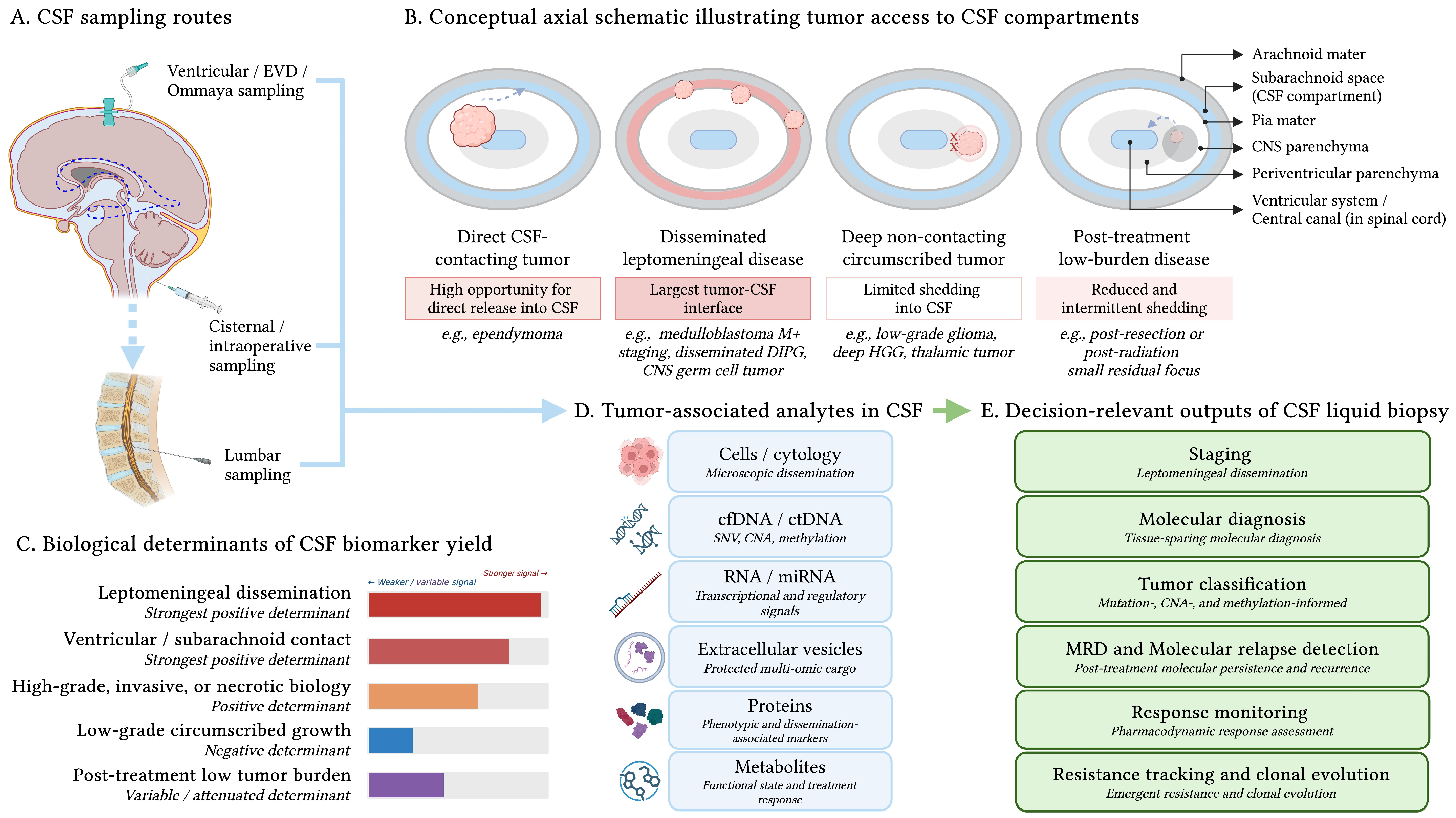
| Factor | Expected Effect on CSF Signal | Example Tumor Contexts |
|---|---|---|
| Ventricular/subarachnoid contact Tumor interface with CSF compartment | ↑ Signal 1 Direct shedding of tumor cells, DNA, proteins, and EVs into CSF is facilitated by physical proximity to the ependymal surface or subarachnoid space. Detection rates of ctDNA and tumor-derived protein are significantly higher when the tumor abuts a CSF-contiguous surface | Intraventricular ependymoma; choroid plexus tumors; tectal/pineal region tumors; third-ventricular craniopharyngioma [14,40,41] |
| Leptomeningeal dissemination M2–M3 spread | ↑↑ Signal LMD provides a large, diffuse tumor-CSF interface, substantially amplifying shedding of all analyte classes (cells, ctDNA, protein, EVs). Detection sensitivity for liquid biopsy analytes peaks in the context of macroscopic dissemination. Even conventional cytology sensitivity rises with higher M-stage | Metastatic MB (M2–M3); AT/RT with spinal drop mets; disseminated CNS GCTs; leptomeningeal relapse of HGG [11,42,43] |
| High-grade biology Aggressive, invasive phenotype | ↑ Signal Tumors with high mitotic activity, angiogenic disruption, and invasive growth patterns release more cfDNA and protein per unit mass. High-grade histology correlates with greater CSF ctDNA fraction independent of tumor location. Elevated CSF protein is more frequently observed in high- vs. low-grade pediatric CNS tumors | Pediatric GBM; H3 K27M-altered DMG; Group 3 MB; AT/RT; ETMR [30,37,44] |
| Necrosis/high cellular turnover Tumor cell death and lysis | ↑ Signal Rapid tumor-cell turnover, treatment-related cell death, and necrotic tumor regions may increase release of fragmented DNA, intracellular proteins, and membrane-bound particles into the CSF compartment. This mechanism is most relevant in aggressive or treatment-exposed tumors, but the relationship between radiologic necrosis and measurable CSF signal remains context- and assay-dependent | GBM with central necrosis; progressive DMG/DIPG post-radiotherapy; post-treatment AT/RT; recurrent Group 3 MB [37,45] |
| Low-grade circumscribed growth Indolent, compact lesion | ↓ Signal Slow proliferation and intact blood–brain/tumor barriers limit shedding into CSF. Cytology, ctDNA, and protein analytes are frequently undetectable or at background levels. The intact capsule of circumscribed tumors acts as a physical barrier to CSF egress. False-negative rates for all CSF analytes are highest in this category | Cerebellar pilocytic astrocytoma (WHO grade 1); DNET; ganglioglioma; hypothalamic pilocytic astrocytoma [46,47] |
| Post-treatment low-burden disease MRD/surveillance context | ↓↓ Variable Following effective therapy, tumor mass and shedding both decrease, often rendering conventional analytes undetectable. Residual or recurrent micro-disease may escape cytology and imaging but may be detectable by ultrasensitive ctDNA or methylation-based approaches. Signal is highly dependent on residual tumor volume, clonal architecture, and the sensitivity of the assay platform | Post-HDCT MB surveillance; DIPG on ONC201; residual ependymoma after RT; AT/RT in maintenance phase [48,49] |
| Analyte Class | Principal Clinical/Research Utility | Major Strengths | Major Limitations | Pediatric CNS Tumors with Strongest Current Relevance | References |
|---|---|---|---|---|---|
| Conventional cytology | Detection of microscopic leptomeningeal dissemination; staging; risk assignment | Widely available; highly specific when clearly positive; already embedded in clinical pathways | Limited sensitivity; binary and morphologic; strongly influenced by timing, site, and specimen quality; no molecular information | MB, other embryonal tumors, ependymoma, AT/RT, iGCT | [17,18,20,22,26,64,65,66,67,68] |
| Routine CSF chemistry/established markers | Supportive assessment of dissemination; diagnosis and monitoring in iGCT | Rapid, inexpensive; AFP/β-hCG clinically actionable in iGCT | Mostly nonspecific outside iGCT; limited molecular resolution | iGCT | [24,69,70,71,72,73,74,75] |
| CTCs | Quantitative cell detection; potential single-cell genomics/transcriptomics; monitoring | Preserves intact cells; CSF CTC assays can exceed cytology sensitivity in epithelial leptomeningeal metastasis; potentially high information yield | Low yields in pediatric CNS tumors; EpCAM bias; highly handling-sensitive; no validated pediatric thresholds | Currently strongest conceptually in dissemination-prone tumors; pediatric primary CNS tumor application still limited | [3,38,62,76,77,78,79,80,81,82,83,84,85,86,87] |
| cfDNA/ctDNA—targeted assays (ddPCR, targeted NGS) | Mutation detection; actionable variant profiling; serial response monitoring | Highly sensitive for known variants; clinically actionable; feasible in low-input CSF | Target dependence; low shedding in some tumors; false negatives with low input or poor tumor-CSF contact | DMG (H3K27M), MB, selected pHGG and pLGG | [2,8,38,62,88,89,90,91,92,93,94,95] |
| cfDNA/ctDNA –LP-WGS/methylation workflows | MRD assessment; molecular classification; genome-wide profiling | Strong for CNA-rich tumors; can work at very low input; broad information yield | Requires optimized low-input workflows; lower sensitivity in low-shedding tumors; interpretation depends on tumor biology and compartment | Embryonal tumors, ependymoma, CNS GCT; broader pediatric cohorts | [6,8,9,10,57,63,96,97] |
| Cell-free RNA/miRNA | Expression-state profiling; response monitoring; classification support | Can reflect viable-cell states and pathway activity; biologically complementary to DNA | Pre-analytically fragile; lower standardization; mostly discovery-stage in pediatrics | MB, HGG, DIPG/DMG (emerging) | [5,98,99,100,101,102] |
| Extracellular vesicles (EVs) | Multi-layer biomarker discovery; mutation/amplification detection; proteomic and signaling readouts | Protects cargo; may enrich tumor-associated signal; multi-omics potential | Isolation and reporting heterogeneity; strong dependence on handling and workflow | Glioma framework established; pediatric MB and other tumors emerging | [59,103,104,105,106,107,108] |
| Proteins/proteomics | Candidate biomarker discovery; dissemination biology; personalized peptide tracking | Biologically interpretable; complements nucleic-acid assays | Cohort heterogeneity; age effects; limited reproducibility and validation | MB; selected pediatric CNS tumors in discovery cohorts | [108,109,110,111] |
| Metabolites/metabolomics | Diagnostic signatures; pharmacodynamic monitoring; multi-omics integration | Captures functional metabolic state; strong mechanistic relevance | Sensitive to pre-analytics and sampling context; limited pediatric validation | DMG pharmacodynamic studies; MB multi-omics; glioma framework | [50,99,112,113,114] |
| Tumor Type | Most Informative CSF Analyte(s) | Current Strongest Use Case | Best-Supported Molecular Target(s) | Sampling Feasibility/Procedural Burden | Current Level of Maturity/Clinical Readiness |
|---|---|---|---|---|---|
| Medulloblastoma [7,38,63,117,118,119,120,121,122,123,124,125] | cfDNA/ctDNA; methylation-based cfDNA profiling; targeted ddPCR | Molecular subgroup inference; MRD assessment; serial monitoring of relapse/evolution | CTNNB1; PTCH1/BCOR; monosomy 6; 9q loss; i17q; MYC/MYCN amplification | Often feasible because lumbar CSF is already obtained for staging, but postoperative timing, blood contamination, and repeated surveillance sampling remain important constraints | Most mature pediatric CSF ctDNA application. MRD and molecular monitoring are supported by strong translational evidence, but broad routine use still requires prospective standardization, entity-specific thresholds, and harmonized serial sampling protocols |
| AT/RT [63,117,126,127,128] | cfDNA/ctDNA; targeted sequencing; CNA profiling | Diagnostic clarification when cytology/imaging are equivocal; serial monitoring; relapse characterization | SMARCB1 loss/mutation; chromosome 22q-associated loss; less commonly SMARCA4 | Feasibility is limited by very young age, rapid disease course, need for sedation/anesthesia, and difficulty of repeated sampling. Opportunistic sampling during clinically indicated staging is most realistic | Biologically compelling but still early-stage. Current evidence is mainly case-based or derived from small embryonal-tumor cohorts; analytical thresholds, sampling intervals, and management-changing utility remain unstandardized |
| ETMR [129,130,131,132,133,134] | miRNA (especially CSF-enriched/CSF-relevant circulating miRNA); multi-omics CSF profiling; potentially cfDNA | Tumor-specific biomarker detection; future diagnosis/monitoring in ultra-rare disease | C19MC amplification; miR-517a; LIN28A-associated biology; minority DICER1-altered cases | Procedural feasibility is challenging because patients are often very young and disease is ultra-rare; CSF sampling is most defensible when clinically indicated or integrated into prospective protocols | Proof-of-concept/exploratory stage. The strongest signal comes from tumor-associated miRNA biology, but CSF-based analytical validity and clinical utility remain unvalidated |
| Pineoblastoma/rare embryonal tumors [9] | cfDNA/ctDNA; ultra-low-input sequencing | Molecular surveillance; differential diagnosis in pineal-region tumors; rare-tumor profiling | Tumor-associated CNA patterns; entity-specific rare molecular alterations depending on subtype | Feasibility depends on tumor location, staging needs, and access to diagnostic CSF; repeated sampling is limited by rarity, age, and uncertain management impact | Preliminary rare-disease stage. Evidence is mainly from mixed embryonal cohorts and real-world sequencing studies; tumor-specific validation, sampling feasibility, and clinical thresholds remain lacking |
| pLGG [8,9,42,94,135,136,137] | Targeted ctDNA/cfDNA; selected targeted NGS; potentially fusion-oriented cfRNA/RNA assays | Tissue-sparing molecular diagnosis in surgically inaccessible tumors; selected treatment selection | BRAF V600E; KIAA1549::BRAF; less often other MAPK-pathway alterations | Sampling is usually difficult to justify unless tissue biopsy is unsafe and molecular results would alter targeted therapy; low shedding increases false-negative risk | Selective clinical use/investigational. Potentially useful for detecting actionable drivers when tissue biopsy is unsafe or impractical, but limited by low shedding, low overall sensitivity, variable tumor–CSF contact, and risk of false-negative results |
| DMG/pHGG [8,9,62,90,92,114,135,136,137,138,139,140] | Targeted ctDNA/cfDNA (especially ddPCR); targeted NGS; complementary metabolomics | Serial molecular monitoring; pharmacodynamic response assessment; early progression detection; pseudo-progression adjudication | H3K27M; broader pHGG alterations including BRAF V600E, IDH1, TP53, PIK3CA, PDGFRA amplification | Procedural burden is substantial because LP may be unsafe or difficult in brainstem/posterior fossa disease; sampling is best when opportunistic, protocol-driven, or clearly linked to treatment monitoring | Strongest glioma evidence base. H3K27M CSF ctDNA monitoring is analytically promising and trial-integrated in selected contexts, but it is not yet a universal standard-of-care assay; safe sampling feasibility and validated longitudinal thresholds remain key barriers |
| Ependymoma [9,37,141,142,143,144] | cfDNA/ctDNA; CNA profiling; future cfRNA/EV-RNA for fusions | Detection of high-risk CNA states; serial monitoring at recurrence; future molecular classification support | 1q gain (especially PFA); potential ZFTA::RELA and related ZFTA fusions by RNA-based assays | Feasible when CSF is already obtained for staging or relapse evaluation, but low diagnostic yield and variable shedding limit routine repeated sampling | Moderate biological rationale but limited clinical validation. The strongest near-term role is recurrence monitoring or high-risk CNA detection rather than routine diagnosis; prospective validation and fusion/CNA-specific workflows are still needed |
| iGCT [24,54,145,146,147,148] | Conventional CSF protein markers; cfDNA/ctDNA; metabolites; miRNAs | Diagnosis, risk stratification, treatment monitoring; extension of marker-based care with molecular layers | AFP, β-hCG; CNA patterns by ctDNA; emerging miR-371-373 cluster; metabolomic signatures | Often feasible in selected diagnostic contexts because CSF markers may already be clinically indicated; molecular extensions should be added only when they provide incremental value beyond AFP/β-hCG | Established conventional CSF biomarker framework for AFP/β-hCG. Molecular extensions using ctDNA, metabolites, and miRNAs are promising but remain emerging and are not yet routinely validated for standard clinical decision-making |
Disclaimer/Publisher’s Note: The statements, opinions and data contained in all publications are solely those of the individual author(s) and contributor(s) and not of MDPI and/or the editor(s). MDPI and/or the editor(s) disclaim responsibility for any injury to people or property resulting from any ideas, methods, instructions or products referred to in the content. |
© 2026 by the authors. Licensee MDPI, Basel, Switzerland. This article is an open access article distributed under the terms and conditions of the Creative Commons Attribution (CC BY) license.
Share and Cite
Bolatov, A.; Zhakupov, A.; Sapargaliyeva, M.; Abdikadirova, A.; Xu, X.; Bayanova, M. Cerebrospinal Fluid in Pediatric Neuro-Oncology: Molecular Diagnosis, Disease Monitoring, and Clinical Translation. Int. J. Mol. Sci. 2026, 27, 5010. https://doi.org/10.3390/ijms27115010
Bolatov A, Zhakupov A, Sapargaliyeva M, Abdikadirova A, Xu X, Bayanova M. Cerebrospinal Fluid in Pediatric Neuro-Oncology: Molecular Diagnosis, Disease Monitoring, and Clinical Translation. International Journal of Molecular Sciences. 2026; 27(11):5010. https://doi.org/10.3390/ijms27115010
Chicago/Turabian StyleBolatov, Aidos, Askhat Zhakupov, Malika Sapargaliyeva, Aizhan Abdikadirova, Xingzhi Xu, and Mirgul Bayanova. 2026. "Cerebrospinal Fluid in Pediatric Neuro-Oncology: Molecular Diagnosis, Disease Monitoring, and Clinical Translation" International Journal of Molecular Sciences 27, no. 11: 5010. https://doi.org/10.3390/ijms27115010
APA StyleBolatov, A., Zhakupov, A., Sapargaliyeva, M., Abdikadirova, A., Xu, X., & Bayanova, M. (2026). Cerebrospinal Fluid in Pediatric Neuro-Oncology: Molecular Diagnosis, Disease Monitoring, and Clinical Translation. International Journal of Molecular Sciences, 27(11), 5010. https://doi.org/10.3390/ijms27115010