GABA-Producing Bacteria as Potential Psychobiotics in Gut–Brain Axis Regulation

 , and
, and 
Abstract
1. Introduction
2. Gut Microbiota and Gut–Brain Axis
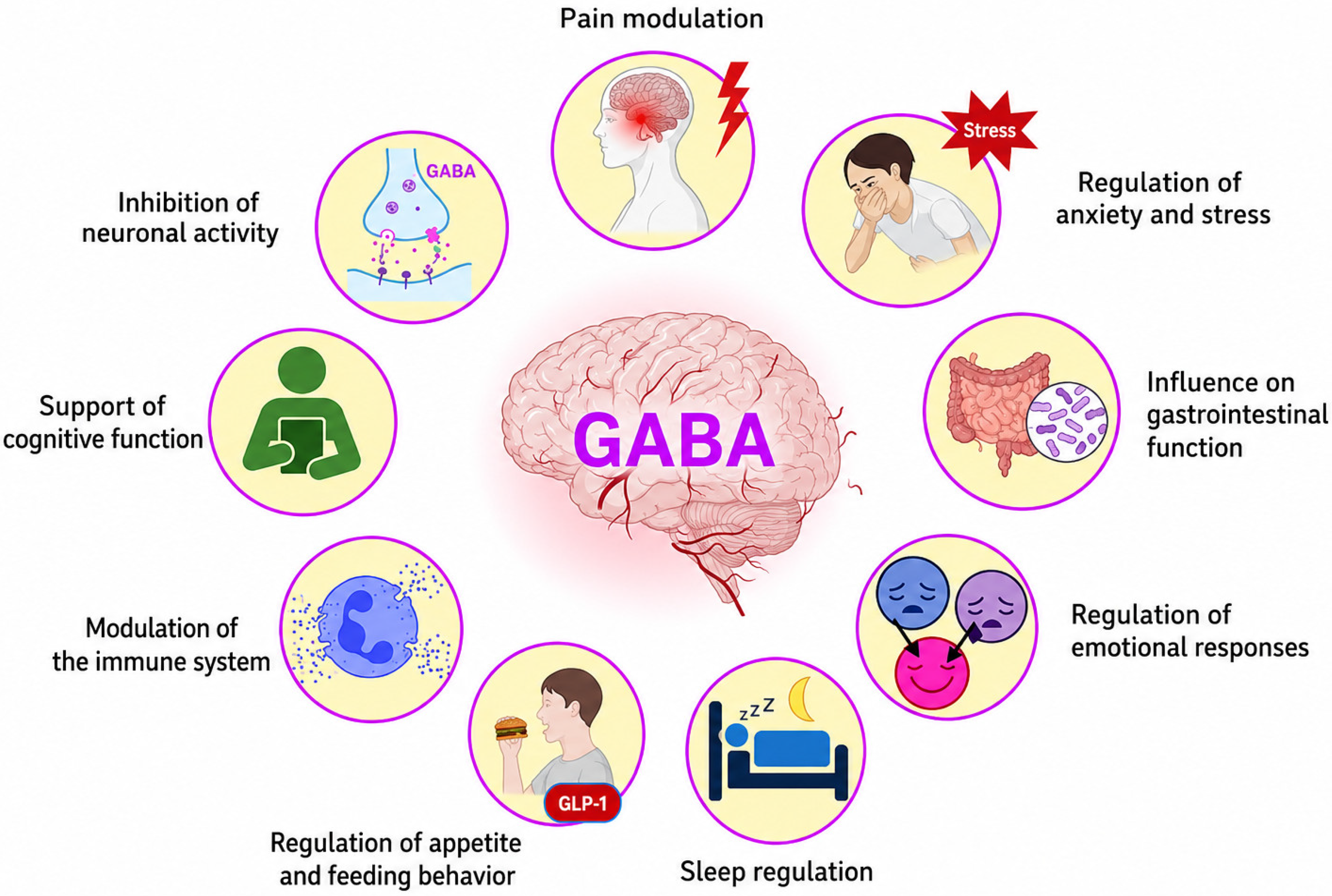
3. GABA: Functional Role in the Central and Enteric Nervous Systems
3.1. GABA in the Central Nervous System (CNS)
3.2. GABA in the Enteric Nervous System (ENS)
4. GABA-Producing Bacterial Strains
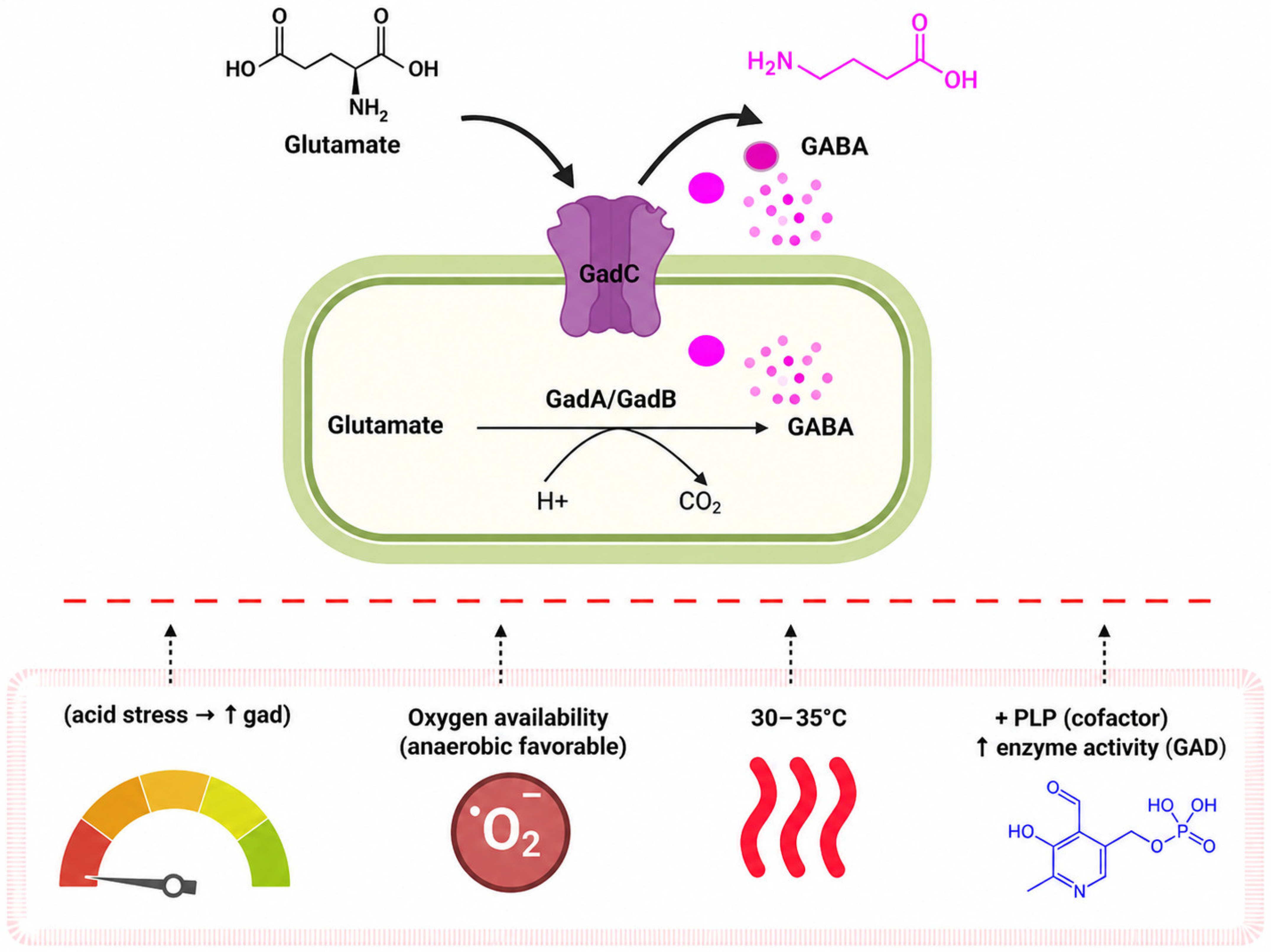
4.1. Bacterial GAD System and GABA Biosynthesis Ability
4.2. GABA-Producing Bacterial Strains Isolated from Gut Microbiota

| Bacterial Strain | Characterization | References |
|---|---|---|
| Lactiplantibacillus plantarum 299v (DSM 9843) | Isolated from healthy intestinal mucosa; GABA production: 5.81 mM (pH 5.7, 24 h incubation in MRS supplemented with 1% MSG) | [112] |
| Lactiplantibacillus plantarum 90sk | Isolated from the human gastrointestinal tract; GABA production: 200 mg/L (~1.94 mM) in MRS supplemented with 1% MSG; increased to 843 mg/L (~8.18 mM) upon PLP addition in the late stationary phase; exhibits antibiotic resistance and antioxidant activity. | [108] |
| Levilactobacillus brevis DPC6108 | Isolated from infant faeces; convert 100% MSG (10–20 mg/mL) to 11.03 and 20.47 mg/mL GABA (~107.0 mM and ~198.5 mM); higher MSG concentrations (30–50 mg/mL) reduce conversion to 64.6–94.4%, yielding 28.02–32.32 mg/mL GABA (~271.8–313.5 mM); increased GABA production observed in fermented faecal slurry | [112] |
| Bifidobacterium adolescentis PRL2019 | Isolated from the human intestine; in vivo GABA production: 7.06 mM; MSG-to-GABA conversion: 64.97% after 24 h incubation. | [100] |
| Bifidobacterium adolescetis HD17T2H | Isolated from human faeces; in vivo GABA production: 9.43 mM; MSG-to-GABA conversion: 86.80% after 24 h incubation. | [100] |
| Bifidobacterium adolescentis DPC6044 Bifidobacterium dentium DPC6333 Bifidobacterium infantis UCC3562 | Isolated from infant faeces; MSG-to-GABA conversion ranged from 22–60.9% (2.2–6.09 mg/mL; ~21.3–59.1 mM) at 10 mg/mL MSG and 15.9–61.6% (3.17–12.32 mg/mL; ~30.7–119.5 mM) at 20 mg/mL MSG | [107] |
| Bifidobacterium adolescentis 150 | Isolated from the human gastrointestinal tract; GABA production: 5.6 g/L (~54.3 mM). | [15] |
| Bacteroides faecis PB-SESWS Bacteroides fragilis PB-SZSJC Bacteroides ovatus DSM 1896 Bacteroides xylanisolvens DSM 18836 | Isolated from human faeces; GABA production ranged from 46.59 to 60.84 mM after 48 h incubation in mY-CFA-Glu medium. | [106] |
| Lactococcus garvieae MJF010 | Isolated from human faeces; high GABA-producing activity at 35 °C and pH 5; PLP did not affect GAD activity | [111] |
4.3. GABA-Producing Bacterial Strains Isolated from Food Products
| Microorganism | Source | GABA Production | References |
|---|---|---|---|
| Levilactobacillus brevis CECT 8183/CECT 8181/CECT 8182 Lactococcus lactis CECT 8184 | Goat cheese; sheep cheese; goat cheese; goat cheese | 0.96, 0.94, 0.99, 0.93 mM, respectively (in a wheat flour solution after 24 h incubation) | [128] |
| Lactiplantibacillus plantarum FNCC 260 | Fermented cassava | 1226.5 mg/L (~11.9 mM) (in MRS supplemented with 100 mM MSG after 60 h of cultivation) | [102] |
| Lactiplantibacillus plantarum DRBA1/DVBA1 Lactococcus lactis IBA Levilactobacillus brevis CRAR Levilactobacillus brevis CRAI | Organic tomatoes (cherry red, plum, grape green, grape red) | 2.91, 2.25, 36.21, 165.24, and 179.15 mM, respectively (in MRS with 4% MSG after 48 h of cultivation) | [123] |
| Lentilactobacillus buchneri MS Levilactobacillus brevis K203/L-32/HY1/877 GLactococcus lactis subsp. lactis B | Kimchi, yoghurt | 251, 430.57, 349.1, 18.76, 18.94, 62.16 mM, respectively; cultivation conditions: MRS with 5% MSG (38 h, MS); MRS with 6% glutamate (72 h, K2023); MRS with 118 mM MSG (58 h, L-32); MRS with 2.38% MSG (48 h, HY1); MRS with 59.13 mM/L MSG (15 h, 877 G); GM17 with 5mM MSG (5 days, lactis B) | [120,121,123,127,129,130] |
| Lacticaseibacillus paracasei 15 C Lacticaseibacillus rhamnosus 21D-B Streptococcus thermophilus 84 C | Raw milk cheese | 14.8, 11.3, 80 mg/kg, respectively (in M17 for 15C) and MRS for 21D-B and 84C, supplemented with 7.0 mM L-glutamate, after 24 h of incubation) | [131] |
| Lacticaseibacillus paracasei NFRI 7415 | Japanese fermented fish (funazushi) | 161 mM (after 144 h of cultivation) | [99] |
| Levilactobacillus brevis NCL912 | Chinese paocai | 149 mM (in MRS supplemented with 3% MSG after 48 h of cultivation) | [132] |
| Levilactobacillus brevis MG5552/MG5405/MG5261/MG5522 | Fermented food (Republic of Korea) | 0.624, 0.585, 0.591, 0.979 mg/mL (~6.05 mM, ~5.67 mM, ~5.73 mM, ~9.50 mM), respectively (in MRS supplemented with 1% MSG) | [133] |
| Lactiplantibacillus plantarum subsp. plantarum LSI2-1 | Thai fermented food | 22.94 g/L (~222.5 mM) (in GYP broth with 3% MSG after 72 h of cultivation) | [134] |
| Lactiplantibacillus plantarum 45a/44d | Cambodian fermented foods (paork kampeus) | 20.34 and 16.47 mM (in MRS supplemented with 2% MSG after 48 h of cultivation) | [135] |
| Companilactobacillus futsaii CS3 | Thai fermented shrimp (kung-som) | 242.44 mM (in MRS supplemented with 1% MSG after 72 h of cultivation) | [136] |
| Lactococcus lactis BIOTEC008 | Mexican milk kefir grain | 0.29 mM (in MRS supplemented with 5 mM MSG after 48 h of cultivation) | [126] |
| Lactococcus lactis LEY6/LEY7/LEY12/LEY13 | Raw camel milk | 1.74, 1.8, 1.32 and 1.22 mM, respectively (in medium supplemented with 5 mM MSG after 5 days of cultivation) | [127] |
| Lentilactobacillus buchneri WPZ001 | Chinese fermented sausage | 1250.97 mM (in MRS supplemented with 100 g/L MSG and 30 g/L xylose after 96 h of cultivation) | [137] |
| Latilactobacillus curvatus N-19 Furfurilactobacillus rossiae ED-1 Lactiplantibacillus plantarum ED-10 Levilactobacillus brevis E-25 | Sourdough | 14.17, 11.04, 15.47 and 11.92 mM, respectively (in MRS supplemented with 53 mM MSG after 96 h of cultivation) | [138] |
| Lactococcus lactis | Yam pickles | 10.7 mM (in MRS supplemented with 5% MSG after 48 h of cultivation | [139] |
5. Mechanisms of Psychobiotic Action in the Microbiota–Gut–Brain Axis
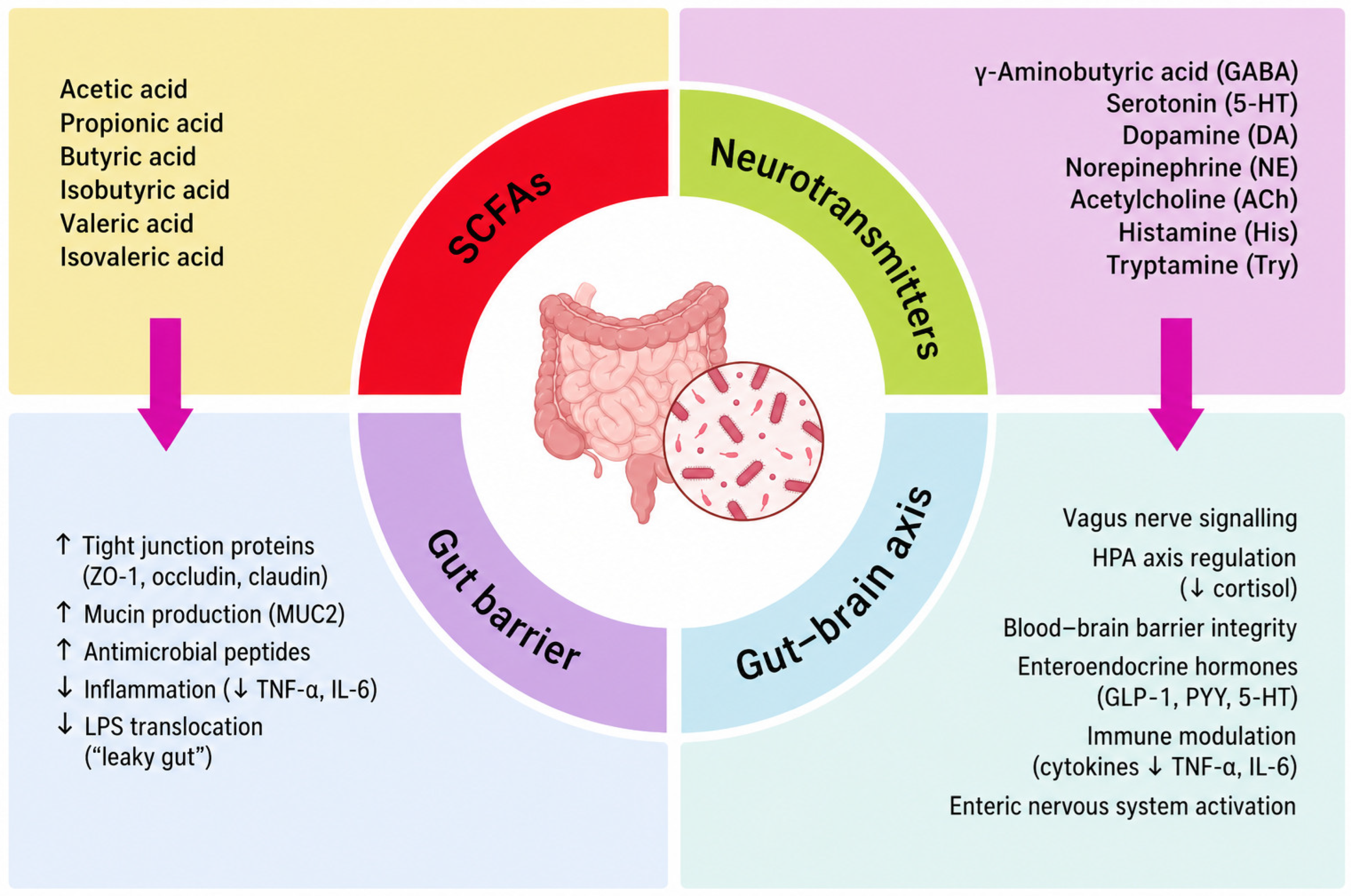
5.1. Microbial Metabolites and Signalling Pathways in the Microbiota–Gut–Brain Axis
5.1.1. Role of SCFAs in the Microbiota–Gut–Brain (MGB) Axis
5.1.2. Modulation of Neurotransmitter Biosynthesis and Signalling in the Microbiota–Gut–Brain (MGB) Axis
5.1.3. Regulation of Intestinal Barrier Integrity in the Microbiota–Gut–Brain (MGB) Axis
5.1.4. Regulation of Intestinal Inflammation in the Microbiota–Gut–Brain (MGB) Axis
6. Beneficial Effects of GABA-Producing Psychobiotics in Mental Health
6.1. Preclinical Studies on Animal Models
6.2. Clinical Human Studies on Psychobiotics
| Psychobiotic | Dose | Type of Study | Number of Participants | Duration | Evaluated Outcome | Reference |
|---|---|---|---|---|---|---|
| Lactiplantibacillus plantarum JYLP-326 | 1 g of lyophilized JYLP-326 powder at a fixed dosage of 1.5 × 10¹⁰ CFU | 60 students with depression, anxiety and sleeping problems | 3 weeks | Alleviated anxiety and depression | [236] | |
| Lactobacillus acidophilus LA-5 Lacticaseibacillus paracasei L. CASEI-01 | Cultured milk drinks containing 109 CFU | 110 participants with IBS and depression | 12 weeks | Reduced depression (both groups); increased serotonin (probiotic only) | [237] | |
| Bifidobacterium animalis subsp. lactis LMG P-21384 [BS01] Bifidobacterium breve DSM 16604 [BR03] Bifidobacterium longum DSM 16603 [BL04] Lacticaseibacillus rhamnosus ATCC 53103 [GG] | 21,384–2.50 × 10¹⁰ CFU/dose, 16,604–1.00 × 10¹⁰ cfu/dose, 16,603–8.00 × 10⁹ cfu/dose, 53,103–4.50 × 10¹⁰ CFU/dose | Randomized, double- masked, and placebo-controlled trial | 266 chemotherapy patients post-surgery for gastrointestinal cancer | 4 weeks | Improvement in probiotic groups: depression 60.4%, anxiety by 57.0%, stress by 60.4%. Placebo group: deterioration in all parameters | [238] |
| Lactiplantibacillus plantarum Lp815 | 1 or 5 billion CFU/day | 105 participants with mild or severe anxiety | 6 weeks | Improvement in more than one anxiety category: 26% in placebo, to 37% with 1 billion CFU, to 68% with 5 billion CFU. | [239] | |
| Levilactobacillus brevis P30021 Lactiplantibacillus plantarum P30025 | >2 × 10⁹ CFU/day | Randomized, double-blind, placebo-controlled, crossover study | Probiotic group: 44 adults Placebo group: 43 adults | 12 weeks | Reduced depressive symptoms and rumination; no effect on subjective stress; increased probiotic abundance in responders | [201] |
| Streptococcus thermophilus NCIMB 30438 Bifidobacterium breve NCIMB 30441 Bifidobacterium longum NCIMB 30435 Bifidobacterium infantis NCIMB 30436 Lactobacillus acidophilus NCIMB 30442 Lactiplantibacillus plantarum NCIMB 30437 Lacticaseibacillus paracasei NCIMB 30439 Lactobacillus delbrueckii subsp. bulgaricus NCIMB 30440 | 9 × 10¹⁰ colony-forming units (CFU)/g bifidobacteria, 8 × 10¹⁰ lactobacilli, and 20 × 1010 of S. salivarius subsp. thermophilus, resulting in a daily dose of 900 billion CFU/d | 60 patients with major depressive disorder (MDD) | 4 weeks | Improved immediate memory and hippocampal function; increased hippocampal activation during working memory tasks | [240] | |
| Bifidobacterium breve CCFM1025 Bifidobacterium longum CCFM687 Pediococcus acidilactici CCFM6432 | 4 × 10⁹ CFU/g each strain | Two-arm parallel design, placebo-controlled, double-blinded, randomised controlled trial | 28 MDD patients | 4 weeks | Reduced depressive symptoms; improved gastrointestinal function; modulation of the serotonergic system | [217] |
| Sanprobi Barrier: Bifidobacterium bifidum W23 Bifidobacterium lactis W51 Bifidobacterium lactis W52 Lactobacillus acidophilus W37 Levilactobacillus brevis W63 Lacticaseibacillus casei W56 Ligilactobacillus salivarius W24 Lactococcus lactis W19 Lactococcus lactis W58 | 4 capsules (2 × 10⁹ CFU)/day | Randomized Double-Blind Placebo-Controlled Pilot Study | 38 patients after bariatric surgery with depressive symptoms | 5 weeks | No significant differences after probiotic therapy | [241] |
| Bacillus subtilis Bifidobacterium bifidum Bifidobacterium breve Bifidobacterium infantis Bifidobacterium longum Lactobacillus acidophilus Lactobacillus delbrueckii subsp. bulgaricus Lacticaseibacillus casei Lactiplantibacillus plantarum Lacticaseibacillus rhamnosus Lactobacillus helveticus Ligilactobacillus salivarius Lactococcus lactis Streptococcus thermophilus | 4 capsules daily of probiotic (2 × 10⁹ colony-forming units per capsule) | Single-centre, double-blind, placebo-controlled pilot randomized clinical trial | 49 patients with MDD showing incomplete response to antidepressant treatment | 8 weeks | No significant changes after probiotics treatment | [242] |
| Limosilactobacillus reuteri Lactobacillus acidophilus Limosilactobacillus fermentum Bifidobacterium bifidum | Powdered probiotics in a sachet, taken orally (2 × 10⁹ CFU each) | Double-blinded, placebo-controlled, randomized trial | 34 children aged 8–12 years old with a diagnosis of ADHD | 8 weeks | Decreased ADHD-RS (β −3.31, p = 0.006) and HAM-A (β −1.91, p = 0.01) scores in the probiotic group, along with reduced serum high-sensitivity C-reactive protein (hs-CRP) and increased plasma total antioxidant capacity (TAC). | [243] |
| Bifidobacterium bifidum W23 Bifidobacterium lactis W51 Lactobacillus acidophilus W22 Lacticaseibacillus casei W56 Lacticaseibacillus paracasei W20 Lactiplantibacillus plantarum W62 Ligilactobacillus salivarius W24 Lactococcus lactis W19 | Orally administered as a drink (7.5 × 10⁹ CFU in total) | Double-blinded placebo-controlled randomized trail | 61 inpatients with major depressive disorder (MDD) | 4 weeks | Decrease in IL-6 gene expression in the treated group | [244] |
| NVP-1704 probiotic: Limosilactobacillus reuteri NK33 Bifidobacterium adolescentis NK98 | 500 mg capsule contained 2.5 × 10⁹ colony-forming units of microorganisms (2.0 × 10⁹ CFU for Lactobacillus reuteri NK33), (0.5 × 10⁹ CFU for Bifidobacterium adolescentis NK98). | Double-blind randomized, placebo-controlled trial | 177 healthy adults with subclinical symptoms of depression, anxiety, insomnia | 8 weeks | Reduced depression (weeks 4 and 8) and anxiety (week 4), improved sleep quality, and decreased serum IL-6 levels in the treated group. | [245] |
7. Prospects and Conclusions
Author Contributions
Funding
Institutional Review Board Statement
Informed Consent Statement
Data Availability Statement
Conflicts of Interest
References
- Kho, Z.Y.; Lal, S.K. The Human Gut Microbiome—A potential controller of wellness and Ddsease. Front. Microbiol. 2018, 9, 1835. [Google Scholar] [CrossRef]
- Fan, Y.; Pedersen, O. Gut microbiota in human metabolic health and disease. Nat. Rev. Microbiol. 2021, 19, 55–71. [Google Scholar] [CrossRef]
- Van Hul, M.; Cani, P.D.; Petitfils, C.; De Vos, W.M.; Tilg, H.; El-Omar, E.M. What defines a healthy gut microbiome? Gut 2024, 73, 1893–1908. [Google Scholar] [CrossRef]
- Govender, P.; Ghai, M. Population-specific differences in the human microbiome: Factors defining the diversity. Gene 2025, 933, 148923. [Google Scholar] [CrossRef] [PubMed]
- Garofalo, C.; Cristiani, C.M.; Ilari, S.; Passacatini, L.C.; Malafoglia, V.; Viglietto, G.; Maiuolo, J.; Oppedisano, F.; Palma, E.; Tomino, C.; et al. Fibromyalgia and irritable bowel syndrome interaction: A possible role for gut microbiota and gut-brain axis. Biomedicines 2023, 11, 1701. [Google Scholar] [CrossRef]
- McBurney, M.I.; Davis, C.; Fraser, C.M.; Schneeman, B.O.; Huttenhower, C.; Verbeke, K.; Walter, J.; Latulippe, M.E. Establishing what constitutes a healthy human gut microbiome: State of the science, regulatory considerations, and future directions. J. Nutr. 2019, 149, 1882–1895. [Google Scholar] [CrossRef]
- Martin, C.R.; Osadchiy, V.; Kalani, A.; Mayer, E.A. The brain-gut-microbiome Axis. Cell Mol. Gastroenterol. Hepatol. 2018, 6, 133–148. [Google Scholar] [CrossRef]
- Shen, Y.; Fan, N.; Ma, S.; Cheng, X.; Yang, X.; Wang, G. Gut microbiota dysbiosis: Pathogenesis, diseases, prevention, and therapy. Med. Comm. 2025, 6, e70168. [Google Scholar] [CrossRef]
- Fakharian, F.; Thirugnanam, S.; Welsh, D.A.; Kim, W.-K.; Rappaport, J.; Bittinger, K.; Rout, N. The role of gut dysbiosis in the loss of intestinal immune cell functions and viral pathogenesis. Microorganisms 2023, 11, 1849. [Google Scholar] [CrossRef] [PubMed]
- O’Riordan, K.J.; Moloney, G.M.; Keane, L.; Clarke, G.; Cryan, J.F. The gut microbiota-immune-brain axis: Therapeutic implications. Cell Rep. Med. 2025, 6, 101982. [Google Scholar] [CrossRef] [PubMed]
- Cheng, Y.; Zhu, Z.; Yang, Z.; Liu, X.; Qian, X.; Zhu, J.; Hu, X.; Jiang, P.; Cui, T.; Wang, Y.; et al. Alterations in fecal microbiota composition and cytokine expression profiles in adolescents with depression: A case-control study. Sci. Rep. 2025, 15, 12177. [Google Scholar] [CrossRef] [PubMed]
- Sears, S.M.; Hewett, S.J. Influence of glutamate and GABA transport on brain excitatory/inhibitory balance. Exp. Biol. Med. 2021, 246, 1069–1083. [Google Scholar] [CrossRef]
- Bhandage, A.K.; Barragan, A. GABAergic signaling by cells of the immune system: More the rule than the exception. Cell. Mol. Life Sci. 2021, 78, 5667–5679. [Google Scholar] [CrossRef]
- Li, H.; Rodríguez-Nieto, G.; Chalavi, S.; Seer, C.; Mikkelsen, M.; Edden, R.A.E.; Swinnen, S.P. MRS-assessed brain GABA modulation in response to task performance and learning. Behav. Brain Funct. 2024, 20, 22. [Google Scholar] [CrossRef]
- Yunes, R.A.; Poluektova, E.U.; Dyachkova, M.S.; Klimina, K.M.; Kovtun, A.S.; Averina, O.V.; Orlova, V.S.; Danilenko, V.N. GABA production and structure of gadB/gadC genes in Lactobacillus and Bifidobacterium strains from human microbiota. Anaerobe 2016, 42, 197–204. [Google Scholar] [CrossRef]
- Dinan, T.G.; Stanton, C.; Cryan, J.F. Psychobiotics: A novel class of psychotropic. Biol. Psychiatry 2013, 74, 720–726. [Google Scholar] [CrossRef] [PubMed]
- Faraji, N.; Payami, B.; Ebadpour, N.; Gorji, A. Vagus nerve stimulation and gut microbiota interactions: A novel therapeutic avenue for neuropsychiatric disorders. Neurosci. Biobehav. Rev. 2025, 169, 105990. [Google Scholar] [CrossRef] [PubMed]
- Venkataraja, R.R.; Meghwal, P.K.; Lalchawimawia, B. Microbiome-driven regulation of brain function: Molecular pathways linking gut and neuropsychiatric health. J. Adv. Biol. Biotechnol. 2026, 29, 231–244. [Google Scholar] [CrossRef]
- Wang, M.; Ma, Y.; Zeng, B.; Yang, W.; Huang, C.; Tang, B. Influence of the gut microbiota, metabolism and environment on neuropsychiatric disorders. Curr. Rev. Clin. Exp. Pharmacol. 2025, 20, 334–348. [Google Scholar] [CrossRef]
- Interino, N.; Vitagliano, R.; D’Amico, F.; Lodi, R.; Porru, E.; Turroni, S.; Fiori, J. Microbiota–gut–brain axis: Mass-spectrometry-based metabolomics in the study of microbiome mediators—Stress relationship. Biomolecules 2025, 15, 243. [Google Scholar] [CrossRef]
- Tingler, A.M.; Packirisamy, C.; Gutierrez, A.; Horvath, A.E.; Grozis, M.; Haidacher, S.J.; Hoch, K.M.; Haag, A.M.; Oezguen, N.; Engevik, K.A.; et al. Commensal human gut microbes produce species specific neuroactive compounds. iScience 2026, 29, 114424. [Google Scholar] [CrossRef] [PubMed]
- Caspani, G.; Swann, J. Small Talk: Microbial metabolites involved in the signaling from microbiota to brain. Curr. Opin. Pharmacol. 2019, 48, 99–106. [Google Scholar] [CrossRef] [PubMed]
- Lee, B.; Lee, S.M.; Song, J.W.; Choi, J.W. Gut microbiota metabolite messengers in brain function and pathology at a view of cell type-based receptor and enzyme reaction. Biomol. Ther. 2024, 32, 403–423. [Google Scholar] [CrossRef]
- Fung, T.C.; Olson, C.A.; Hsiao, E.Y. Interactions between the microbiota, immune and nervous systems in health and disease. Nat. Neurosci. 2017, 20, 145–155. [Google Scholar] [CrossRef]
- Savulescu-Fiedler, I.; Benea, S.-N.; Căruntu, C.; Nancoff, A.-S.; Homentcovschi, C.; Bucurica, S. Rewiring the brain through the gut: Insights into microbiota–nervous system interactions. Curr. Issues Mol. Biol. 2025, 47, 489. [Google Scholar] [CrossRef]
- Yang, L.; Fan, S.; Sun, L.; Han, J.; Wang, M.; Yu, T. The Role of vagus nerve stimulation in modulating Parkinson’s disease via the microbiota-gut-brain axis: A comprehensive review. Front. Neurol. 2025, 16, 1643305. [Google Scholar] [CrossRef]
- Ouyang, H.; Yang, Y.; Zhang, X.; Cui, Y.; Zhang, Y. Microbial orchestration of neuroimmune crosstalk: From homeostasis to disease. Front. Immunol. 2025, 16, 1679286. [Google Scholar] [CrossRef] [PubMed]
- Zhang, X.; He, X.; Zhao, Y.; Zou, Q.; Liang, Y.; Zhang, J.; Feng, B.; Rong, P.; Wang, Y. Transcutaneous auricular vagus nerve stimulation regulates gut microbiota mediated peripheral inflammation and metabolic disorders to suppress depressive-like behaviors in CUMS rats. Front. Microbiol. 2025, 16, 1576686. [Google Scholar] [CrossRef]
- Jameson, K.G.; Kazmi, S.A.; Ohara, T.E.; Son, C.; Yu, K.B.; Mazdeyasnan, D.; Leshan, E.; Vuong, H.E.; Paramo, J.; Lopez-Romero, A.; et al. Select microbial metabolites in the small intestinal lumen regulate vagal activity via receptor-mediated signaling. iScience 2025, 28, 111699. [Google Scholar] [CrossRef]
- Olasunkanmi, O.I.; Zheng, L.; Zheng, P. Gut–brain axis in health and brain disease. Chin. Med. J. 2026, 139, 799–827. [Google Scholar] [CrossRef]
- Zhang, F.; Ding, K.; Zhang, L.-M.; Liu, D.-Y.; Dong, X.; Wang, M.-N.; Zhou, F.-L.; Sun, Y.-W.; Zhang, W.-K.; Yan, Y.; et al. The Role of the gut microbiota in neuropsychiatric disorders and therapy. Ageing Res. Rev. 2025, 112, 102894. [Google Scholar] [CrossRef] [PubMed]
- Snodgrass, J.L.; Velayudhan, B.T. Butyrate-producing bacteria as a keystone species of the gut microbiome: A systematic review of dietary impact on gut–brain and host health. Int. J. Mol. Sci. 2026, 27, 1289. [Google Scholar] [CrossRef] [PubMed]
- Boldyreva, L.V.; Evtushenko, A.A.; Lvova, M.N.; Morozova, K.N.; Kiseleva, E.V. Underneath the gut–brain axis in IBD—Evidence of the non-obvious. Int. J. Mol. Sci. 2024, 25, 12125. [Google Scholar] [CrossRef]
- Deleemans, J.M.; Chleilat, F.; Reimer, R.A.; Henning, J.-W.; Baydoun, M.; Piedalue, K.-A.; McLennan, A.; Carlson, L.E. The chemo-gut study: Investigating the long-term effects of chemotherapy on gut microbiota, metabolic, immune, psychological and cognitive parameters in young adult cancer survivors; study protocol. BMC Cancer 2019, 19, 1243. [Google Scholar] [CrossRef]
- Francavilla, M.; Facchetti, S.; Demartini, C.; Zanaboni, A.M.; Amoroso, C.; Bottiroli, S.; Tassorelli, C.; Greco, R. A Narrative review of intestinal microbiota’s impact on migraine with psychopathologies. Int. J. Mol. Sci. 2024, 25, 6655. [Google Scholar] [CrossRef]
- Khazaei, M.; Bahar, A.; Porbaran, M.; Tahmasebi, H. Diet and gut microbiota during depression and stress. Discov. Food 2026, 6, 111. [Google Scholar] [CrossRef]
- Ataei, P.; Kalantari, H.; Bodnar, T.S.; Turner, R.J. The gut–brain connection: Microbes’ influence on mental health and psychological disorders. Front. Microbiomes 2026, 4, 1701608. [Google Scholar] [CrossRef]
- Lambiase, C.; Rettura, F.; Sciumè, G.D.; Tedeschi, R.; Grosso, A.; Cancelli, L.; Bottari, A.; Fornai, M.; Antonioli, L.; De Bortoli, N.; et al. Targeting γ-aminobutyric acid pathways in irritable bowel syndrome: Bridging central nervous system, enteric dysfunction, and the microbiota-gut-brain Axis. Front. Pharmacol. 2025, 16, 1677037. [Google Scholar] [CrossRef]
- Jiang, C.; Chen, Y.; Sun, T. From the gut to the brain, mechanisms and clinical applications of γ-aminobutyric acid (GABA) on the treatment of anxiety and insomnia. Front. Neurosci. 2025, 19, 1570173. [Google Scholar] [CrossRef] [PubMed]
- Marilovtseva, E.V.; Abdurazakov, A.; Kurishev, A.O.; Mikhailova, V.A.; Golimbet, V.E. The role of GABA pathway components in pathogenesis of neurodevelopmental disorders. Int. J. Mol. Sci. 2025, 26, 9492. [Google Scholar] [CrossRef]
- Taj, T.; Kaushik, M.; Islam, A.; Das, J.; Kumar, B.; Hussain, M.S.; Ramzan, M.; Ashique, S.; Tariq, M.; Sridhar, S.B.; et al. Microbiota-brain interaction: The role of gut-derived proteins in addressing various neurological disorders including Parkinson’s (PD) and Alzheimer’s diseases (AD). Biomed. Pharmacother. 2025, 193, 118861. [Google Scholar] [CrossRef] [PubMed]
- Conn, K.A.; Borsom, E.M.; Cope, E.K. Implications of microbe-derived ɣ-aminobutyric acid (GABA) in gut and brain barrier integrity and GABAergic signaling in Alzheimer’s disease. Gut Microbes 2024, 16, 2371950. [Google Scholar] [CrossRef] [PubMed]
- Ochoa-de La Paz, L.D.; Gulias-Cañizo, R.; D’Abril Ruíz-Leyja, E.; Sánchez-Castillo, H.; Parodí, J. The role of GABA neurotransmitter in the human central nervous system, physiology, and pathophysiology. Rev. Mex. Neurocienc. 2021, 22, 5355. [Google Scholar] [CrossRef]
- Varinthra, P.; Anwar, S.N.M.N.; Shih, S.-C.; Liu, I.Y. The Role of the GABAergic system on insomnia. Tzu Chi. Med. J. 2024, 36, 103–109. [Google Scholar] [CrossRef]
- Qian, X.; Zhao, X.; Yu, L.; Yin, Y.; Zhang, X.-D.; Wang, L.; Li, J.-X.; Zhu, Q.; Luo, J.-L. Current status of GABA receptor subtypes in analgesia. Biomed. Pharmacother. 2023, 168, 115800. [Google Scholar] [CrossRef]
- Shaye, H.; Stauch, B.; Gati, C.; Cherezov, V. Molecular mechanisms of metabotropic GABAB receptor function. Sci. Adv. 2021, 7, eabg3362. [Google Scholar] [CrossRef]
- Zhu, L.; Wang, Z.; Gao, L.; Chen, X. Unraveling the potential of γ-aminobutyric acid:insights into its biosynthesis and biotechnological applications. Nutrients 2024, 16, 2760. [Google Scholar] [CrossRef]
- Dade, M.; Berzero, G.; Izquierdo, C.; Giry, M.; Benazra, M.; Delattre, J.-Y.; Psimaras, D.; Alentorn, A. Neurological syndromes associated with anti-GAD antibodies. Int. J. Mol. Sci. 2020, 21, 3701. [Google Scholar] [CrossRef]
- Tavazzani, E.; Tritto, S.; Spaiardi, P.; Botta, L.; Manca, M.; Prigioni, I.; Masetto, S.; Russo, G. Glutamic acid decarboxylase 67 expression by a distinct population of mouse vestibular supporting Cells. Front. Cell. Neurosci. 2014, 8, 428, Erratum in Front. Cell. Neurosci. 2015, 9, 101. [Google Scholar] [CrossRef]
- Ständer, S.H.D.; Reboul, C.F.; Le, S.N.; Williams, D.E.; Chandler, P.G.; Costa, M.G.S.; Hoke, D.E.; Jimma, J.D.T.; Fodor, J.; Fenalti, G.; et al. Structure and dynamics of GAD65 in complex with an autoimmune polyendocrine syndrome type 2-associated autoantibody. Nat. Commun. 2025, 16, 2275. [Google Scholar] [CrossRef]
- McArdle, C.J.; Arnone, A.A.; Heaney, C.F.; Raab-Graham, K.F. A Paradoxical switch: The implications of excitatory GABAergic signaling in neurological disorders. Front. Psychiatry 2024, 14, 1296527. [Google Scholar] [CrossRef]
- Algaidi, S.A. Chronic stress-induced neuroplasticity in the prefrontal cortex: Structural, functional, and molecular mechanisms from development to Aging. Brain Res. 2025, 1851, 149461. [Google Scholar] [CrossRef]
- Zhao, Y.; Wu, J.-T.; Feng, J.-B.; Cai, X.-Y.; Wang, X.-T.; Wang, L.; Xie, W.; Gu, Y.; Liu, J.; Chen, W.; et al. Dual and plasticity-dependent regulation of cerebello-zona incerta circuits on anxiety-like behaviors. Nat. Commun. 2025, 16, 3339. [Google Scholar] [CrossRef] [PubMed]
- Perucca, E.; Bialer, M.; White, H.S. New GABA-targeting therapies for the treatment of seizures and epilepsy: I. Role of GABA as a modulator of seizure activity and recently approved medications acting on the GABA System. CNS Drugs 2023, 37, 755–779. [Google Scholar] [CrossRef]
- Makkar, S.R.; Zhang, S.Q.; Cranney, J. Behavioral and neural analysis of GABA in the acquisition, consolidation, reconsolidation, and extinction of fear memory. Neuropsychopharmacology 2010, 35, 1625–1652, Erratum in Neuropsychopharmacology 2012, 37, 1793–1794. [Google Scholar] [CrossRef]
- Liu, Z.-P.; Song, C.; Wang, M.; He, Y.; Xu, X.-B.; Pan, H.-Q.; Chen, W.-B.; Peng, W.-J.; Pan, B.-X. Chronic stress impairs GABAergic control of amygdala through suppressing the tonic GABAA receptor currents. Mol. Brain 2014, 7, 32. [Google Scholar] [CrossRef]
- Huang, J.; Xu, F.; Yang, L.; Tuolihong, L.; Wang, X.; Du, Z.; Zhang, Y.; Yin, X.; Li, Y.; Lu, K.; et al. Corrigendum: Involvement of the GABAergic system in PTSD and its therapeutic significance. Front. Mol. Neurosci. 2023, 16, 1158825. [Google Scholar] [CrossRef]
- Schneider, S.; Wright, C.M.; Heuckeroth, R.O. Unexpected roles for the second brain: Enteric nervous system as master regulator of bowel function. Annu. Rev. Physiol. 2019, 81, 235–259. [Google Scholar] [CrossRef] [PubMed]
- Wang, X.; Zhang, W.; Wang, H.; Zhao, Y.; Wang, P.; Wang, R.; Sun, Y.; Ren, F.; Li, Y. Dietary modulation of the enteric nervous system: From molecular mechanisms to therapeutic applications. Nutrients 2025, 17, 3519. [Google Scholar] [CrossRef] [PubMed]
- Nikolla, E.; Grandberry, A.; Jamerson, D.; Flynn, C.R.; Sundaresan, S. The enteric neuronal circuitry: A key ignored player in nutrient sensing along the gut–brain axis. FASEB J. 2025, 39, e70586. [Google Scholar] [CrossRef]
- Belelli, D.; Lambert, J.J.; Wan, M.L.Y.; Monteiro, A.R.; Nutt, D.J.; Swinny, J.D. From bugs to brain: Unravelling the GABA signalling networks in the brain–gut–microbiome Axis. Brain 2025, 148, 1479–1506. [Google Scholar] [CrossRef] [PubMed]
- Seifi, M.; Brown, J.F.; Mills, J.; Bhandari, P.; Belelli, D.; Lambert, J.J.; Rudolph, U.; Swinny, J.D. Molecular and functional diversity of GABA-A receptors in the enteric nervous system of the mouse colon. J. Neurosci. 2014, 34, 10361–10378. [Google Scholar] [CrossRef]
- Auteri, M.; Zizzo, M.G.; Serio, R. GABA and GABA Receptors in the gastrointestinal tract: From motility to inflammation. Pharmacol. Res. 2015, 93, 11–21. [Google Scholar] [CrossRef]
- Schäfermeyer, A.; Gratzl, M.; Rad, R.; Dossumbekova, A.; Sachs, G.; Prinz, C. Isolation and receptor profiling of ileal enterochromaffin cells. Acta Physiol. Scand. 2004, 182, 53–62. [Google Scholar] [CrossRef]
- Khan, M.T.; Zohair, M.; Khan, A.; Kashif, A.; Mumtaz, S.; Muskan, F. From Gut to Brain: The roles of intestinal microbiota, immune system, and hormones in intestinal physiology and gut–brain–axis. Mol. Cell Endocrinol. 2025, 607, 112599. [Google Scholar] [CrossRef]
- Jena, R.; Choudhury, P.K. Lactic acid bacteria in fermented dairy foods: Gamma-Aminobutyric Acid (GABA) Production and Its Therapeutic Implications. Food Biosci. 2024, 62, 105276. [Google Scholar] [CrossRef]
- Matta, T.; Bhatia, R.; Joshi, S.R.; Bishnoi, M.; Chopra, K.; Kondepudi, K.K. GABA synthesizing lactic acid bacteria and genomic analysis of Levilactobacillus brevis LAB6. 3 Biotech. 2024, 14, 62. [Google Scholar] [CrossRef]
- Shawky, E.; Surendran, S.; El-Khair, R.M.A. Fermented vegetables as a source of psychobiotics: A review of the evidence for mental health benefits. Probiotics Antimicrob. Proteins 2026, 18, 1587–1601. [Google Scholar] [CrossRef]
- Seguella, L.; Gulbransen, B.D. Enteric Glial Biology, Intercellular signalling and roles in gastrointestinal disease. Nat. Rev. Gastroenterol. Hepatol. 2021, 18, 571–587. [Google Scholar] [CrossRef] [PubMed]
- Sharkey, K.A.; Mawe, G.M. The enteric nervous system. Physiol. Rev. 2023, 103, 1487–1564. [Google Scholar] [CrossRef] [PubMed]
- Sokovic Bajic, S.; Djokic, J.; Dinic, M.; Veljovic, K.; Golic, N.; Mihajlovic, S.; Tolinacki, M. GABA-producing natural dairy isolate from artisanal zlatar cheese attenuates gut inflammation and strengthens gut epithelial barrier in vitro. Front. Microbiol. 2019, 10, 527. [Google Scholar] [CrossRef]
- Li, S.; Li, Y.; Xue, C.; Zhang, Y.; Tong, T.; Ouyang, Z.; Liu, D.; Cai, J.; Sun, H. Progress in research on the mechanism of GABA in improving sleep. Foods 2025, 14, 3856. [Google Scholar] [CrossRef]
- Li, Y.; Li, T.; Zhang, Y.; Wang, Y.; Wu, G.; Tan, Y. Microbial metabolites in the gut-brain axis: Their impact on depression pathophysiology and treatment. Neuroscience 2026, 593, 1–7. [Google Scholar] [CrossRef]
- Kurhaluk, N.; Kołodziejska, R.; Kamiński, P.; Tkaczenko, H. Integrative neuroimmune role of the parasympathetic nervous system, vagus nerve and gut microbiota in stress modulation: A narrative review. Int. J. Mol. Sci. 2025, 26, 11706. [Google Scholar] [CrossRef]
- Qiu, Y.; Fan, D.; Wang, J.; Zhou, X.; Teng, X.; Rao, C. High throughput construction of species characterized bacterial biobank for functional bacteria screening: Demonstration with gaba-producing bacteria. Front. Microbiol. 2025, 16, 1545877. [Google Scholar] [CrossRef]
- Mousavi, R.; Mottawea, W.; Hassan, H.; Gomaa, A.; Audet, M.-C.; Hammami, R. Screening, characterization and growth of γ-aminobutyric acid-producing probiotic candidates from food origin under simulated colonic conditions. J. Appl. Microbiol. 2022, 132, 4452–4465. [Google Scholar] [CrossRef]
- Kaur, S.; Sharma, P.; Mayer, M.J.; Neuert, S.; Narbad, A.; Kaur, S. Beneficial effects of GABA-producing potential probiotic Limosilactobacillus fermentum L18 of human origin on intestinal permeability and human gut microbiota. Microb. Cell Fact. 2023, 22, 256. [Google Scholar] [CrossRef] [PubMed]
- Yogeswara, I.B.A.; Maneerat, S.; Haltrich, D. Glutamate decarboxylase from lactic acid bacteria—A key enzyme in GABA synthesis. Microorganisms 2020, 8, 1923. [Google Scholar] [CrossRef] [PubMed]
- Ham, S.; Bhatia, S.K.; Gurav, R.; Choi, Y.-K.; Jeon, J.-M.; Yoon, J.-J.; Choi, K.-Y.; Ahn, J.; Kim, H.T.; Yang, Y.-H. Gamma aminobutyric acid (GABA) production in Escherichia coli with pyridoxal kinase (pdxY)-based regeneration system. Enzym. Microb. Technol. 2022, 155, 109994. [Google Scholar] [CrossRef]
- Watanabe, Y.; Kawata, K.; Watanabe, S. Monitoring technology for gamma-aminobutyric acid production in polished Mochi barley grains using a carbon dioxide sensor. J. Food Sci. 2015, 80, H1418–H1424. [Google Scholar] [CrossRef] [PubMed]
- Ma, D.; Lu, P.; Yan, C.; Fan, C.; Yin, P.; Wang, J.; Shi, Y. structure and mechanism of a glutamate–GABA antiporter. Nature 2012, 483, 632–636. [Google Scholar] [CrossRef]
- Cotter, P.D.; Hill, C. Surviving the acid test: Responses of gram-positive bacteria to low pH. Microbiol. Mol. Biol. Rev. 2003, 67, 429–453. [Google Scholar] [CrossRef] [PubMed]
- Bermúdez-Humarán, L.G.; Salinas, E.; Ortiz, G.G.; Ramirez-Jirano, L.J.; Morales, J.A.; Bitzer-Quintero, O.K. From probiotics to psychobiotics: Live beneficial bacteria which act on the brain-gut axis. Nutrients 2019, 11, 890. [Google Scholar] [CrossRef] [PubMed]
- Ross, K. Psychobiotics: Are they the future intervention for managing depression and anxiety? A literature review. Explore 2023, 19, 669–680. [Google Scholar] [CrossRef] [PubMed]
- Wu, Q.; Tun, H.M.; Law, Y.-S.; Khafipour, E.; Shah, N.P. Common distribution of gad operon in Lactobacillus brevis and its GadA contributes to efficient GABA synthesis toward cytosolic near-neutral pH. Front. Microbiol. 2017, 8, 206. [Google Scholar] [CrossRef]
- Laroute, V.; Aubry, N.; Audonnet, M.; Mercier-Bonin, M.; Daveran-Mingot, M.-L.; Cocaign-Bousquet, M. Natural diversity of Lactococci in γ-aminobutyric acid (GABA) production and genetic and phenotypic determinants. Microb. Cell Fact. 2023, 22, 178. [Google Scholar] [CrossRef]
- Gong, L.; Ren, C.; Xu, Y. Deciphering the crucial roles of transcriptional regulator GadR on gamma-aminobutyric acid production and acid resistance in Lactobacillus brevis. Microb. Cell Fact. 2019, 18, 108. [Google Scholar] [CrossRef]
- Gong, L.; Ren, C.; Xu, Y. GlnR Negatively regulates glutamate-dependent acid resistance in Lactobacillus brevis. Appl. Environ. Microbiol. 2020, 86, e02615-19. [Google Scholar] [CrossRef]
- Roura Padrosa, D.; Alaux, R.; Smith, P.; Dreveny, I.; López-Gallego, F.; Paradisi, F. Enhancing PLP-binding capacity of class-III ω-transaminase by single residue substitution. Front. Bioeng. Biotechnol. 2019, 7, 282. [Google Scholar] [CrossRef]
- Cui, Y.; Miao, K.; Niyaphorn, S.; Qu, X. Production of gamma-aminobutyric acid from lactic acid bacteria: A Systematic Review. Int. J. Mol. Sci. 2020, 21, 995. [Google Scholar] [CrossRef]
- Sezgin, E.; Tekin, B. Molecular evolution and population genetics of glutamate decarboxylase acid resistance pathway in lactic acid bacteria. Front. Genet. 2023, 14, 1027156. [Google Scholar] [CrossRef] [PubMed]
- Sanders, J.W.; Leenhouts, K.; Burghoorn, J.; Brands, J.R.; Venema, G.; Kok, J. A Chloride-inducible acid resistance mechanism in Lactococcus lactis and its regulation. Mol. Microbiol. 1998, 27, 299–310. [Google Scholar] [CrossRef] [PubMed]
- Li, H.; Li, W.; Liu, X.; Cao, Y. gadA Gene locus in Lactobacillus brevis NCL912 and Its expression during fed-batch fermentation. FEMS Microbiol. Lett. 2013, 349, 108–116. [Google Scholar] [CrossRef][Green Version]
- Langa, S.; Santos, S.; Flores, J.A.; Peirotén, Á.; Rodríguez, S.; Curiel, J.A.; Landete, J.M. Selection of GABA-Producing Lactic Acid Bacteria Strains by Polymerase Chain Reaction Using Novel gadB and gadC Multispecies Primers for the Development of New Functional Foods. Int. J. Mol. Sci. 2024, 25, 13696. [Google Scholar] [CrossRef]
- Fan, C.; Cao, Z.; Liu, X.; Hao, Y.; Zhai, Z.; Hao, Y. A Plasmid-borne gadRCB operon contributes to acid tolerance in Lactiplantibacillus plantarum ZR79. Appl. Microbiol. Biotechnol. 2025, 109, 251. [Google Scholar] [CrossRef]
- Li, H.; Qiu, T.; Huang, G.; Cao, Y. Production of gamma-aminobutyric acid by Lactobacillus brevis NCL912 Using fed-batch fermentation. Microb. Cell Fact. 2010, 9, 85. [Google Scholar] [CrossRef]
- Di Cagno, R.; Mazzacane, F.; Rizzello, C.G.; De Angelis, M.; Giuliani, G.; Meloni, M.; De Servi, B.; Gobbetti, M. Synthesis of γ-aminobutyric acid (GABA) by Lactobacillus plantarum DSM19463: Functional grape must beverage and dermatological applications. Appl. Microbiol. Biotechnol. 2010, 86, 731–741. [Google Scholar] [CrossRef]
- Kumar, S.; Punekar, N.S.; Satya Narayan, V.; Venkatesh, K.V. Metabolic fate of glutamate and evaluation of flux through the 4-aminobutyrate (GABA) shunt in aspergillus niger. Biotechnol. Bioeng. 2000, 67, 575–584. [Google Scholar] [CrossRef]
- Komatsuzaki, N.; Shima, J.; Kawamoto, S.; Momose, H.; Kimura, T. Production of γ-aminobutyric acid (GABA) by Lactobacillus paracasei isolated from traditional fermented foods. Food Microbiol. 2005, 22, 497–504. [Google Scholar] [CrossRef]
- Duranti, S.; Ruiz, L.; Lugli, G.A.; Tames, H.; Milani, C.; Mancabelli, L.; Mancino, W.; Longhi, G.; Carnevali, L.; Sgoifo, A.; et al. Bifidobacterium adolescentis as a key member of the human gut microbiota in the production of GABA. Sci. Rep. 2020, 10, 14112. [Google Scholar] [CrossRef]
- Yang, S.-Y.; Lü, F.-X.; Bie, X.-M.; Jiao, Y.; Sun, L.-J.; Yu, B. Production of gamma-aminobutyric acid by Streptococcus salivarius subsp. thermophilus Y2 under submerged fermentation. Amino Acids 2008, 34, 473–478. [Google Scholar] [CrossRef]
- Yogeswara, I.B.A.; Kittibunchakul, S.; Rahayu, E.S.; Domig, K.J.; Haltrich, D.; Nguyen, T.H. Microbial production and enzymatic biosynthesis of γ-aminobutyric acid (GABA) using Lactobacillus plantarum FNCC 260 Isolated from Indonesian Fermented Foods. Processes 2020, 9, 22. [Google Scholar] [CrossRef]
- Cai, H.; Li, X.; Li, D.; Liu, W.; Han, Y.; Xu, X.; Yang, P.; Meng, K. Optimization of gamma-aminobutyric acid production by Lactiplantibacillus plantarum FRT7 from Chinese paocai. Foods 2023, 12, 3034. [Google Scholar] [CrossRef]
- Pokusaeva, K.; Johnson, C.; Luk, B.; Uribe, G.; Fu, Y.; Oezguen, N.; Matsunami, R.K.; Lugo, M.; Major, A.; Mori-Akiyama, Y.; et al. GABA-producing Bifidobacterium dentium modulates visceral sensitivity in the intestine. Neurogastroenterol. Motil. 2017, 29, e12904. [Google Scholar] [CrossRef] [PubMed]
- Strandwitz, P.; Kim, K.H.; Terekhova, D.; Liu, J.K.; Sharma, A.; Levering, J.; McDonald, D.; Dietrich, D.; Ramadhar, T.R.; Lekbua, A.; et al. GABA-modulating bacteria of the human gut microbiota. Nat. Microbiol. 2018, 4, 396–403. [Google Scholar] [CrossRef] [PubMed]
- Otaru, N.; Ye, K.; Mujezinovic, D.; Berchtold, L.; Constancias, F.; Cornejo, F.A.; Krzystek, A.; De Wouters, T.; Braegger, C.; Lacroix, C.; et al. GABA Production by human intestinal Bacteroides spp.: Prevalence, regulation, and role in acid stress tolerance. Front. Microbiol. 2021, 12, 656895. [Google Scholar] [CrossRef] [PubMed]
- Barrett, E.; Ross, R.P.; O’Toole, P.W.; Fitzgerald, G.F.; Stanton, C. γ-aminobutyric acid production by culturable bacteria from the human intestine. J. Appl. Microbiol. 2012, 113, 411–417. [Google Scholar] [CrossRef]
- Yunes, R.A.; Klimina, K.M.; Emelyanov, K.V.; Zakharevich, N.V.; Poluektova, E.U.; Danilenko, V.N. Draft Genome sequences of Lactobacillus plantarum strain 90sk and Lactobacillus brevis strain 15f: Focusing on neurotransmitter genes. Genome Announc. 2015, 3, e00261-15. [Google Scholar] [CrossRef]
- Yunes, R.A.; Poluektova, E.U.; Vasileva, E.V.; Odorskaya, M.V.; Marsova, M.V.; Kovalev, G.I.; Danilenko, V.N. A Multi-strain potential probiotic formulation of GABA-producing Lactobacillus plantarum 90sk and Bifidobacterium adolescentis 150 with antidepressant effects. Probiotics Antimicrob. Proteins 2020, 12, 973–979. [Google Scholar] [CrossRef]
- Kaur, H.; Gupta, T.; Kapila, S.; Kapila, R. Lactobacillus fermentum (MTCC-5898) based fermented whey renders prophylactic action against colitis by strengthening the gut barrier function and maintaining immune homeostasis. Microb. Pathog. 2022, 173, 105887. [Google Scholar] [CrossRef]
- Lim, H.J.; Jung, D.-H.; Cho, E.-S.; Seo, M.-J. Expression, purification, and characterization of glutamate decarboxylase from human gut-originated Lactococcus garvieae MJF010. World J. Microbiol. Biotechnol. 2022, 38, 69. [Google Scholar] [CrossRef] [PubMed]
- Monteagudo-Mera, A.; Fanti, V.; Rodriguez-Sobstel, C.; Gibson, G.; Wijeyesekera, A.; Karatzas, K.-A.; Chakrabarti, B. Gamma aminobutyric acid production by commercially available probiotic strains. J. Appl. Microbiol. 2023, 134, lxac066. [Google Scholar] [CrossRef]
- Sarasa, S.B.; Mahendran, R.; Muthusamy, G.; Thankappan, B.; Selta, D.R.F.; Angayarkanni, J. A Brief review on the non-protein amino acid, gamma-amino butyric acid (GABA): Its production and role in microbes. Curr. Microbiol. 2020, 77, 534–544. [Google Scholar] [CrossRef]
- Braga, J.D.; Thongngam, M.; Kumrungsee, T. Gamma-aminobutyric acid as a potential postbiotic mediator in the gut–brain axis. npj Sci. Food 2024, 8, 16. [Google Scholar] [CrossRef]
- Siragusa, S.; De Angelis, M.; Di Cagno, R.; Rizzello, C.G.; Coda, R.; Gobbetti, M. Synthesis of γ-aminobutyric acid by lactic acid bacteria isolated from a variety of italian cheeses. Appl. Environ. Microbiol. 2007, 73, 7283–7290. [Google Scholar] [CrossRef] [PubMed]
- Bao, W.; Huang, X.; Liu, J.; Han, B.; Chen, J. Influence of Lactobacillus brevis on metabolite changes in bacteria-fermented sufu. J. Food Sci. 2020, 85, 165–172. [Google Scholar] [CrossRef]
- Fashogbon, R.O.; Samson, O.J.; Awotundun, T.A.; Olanbiwoninu, A.A.; Adebayo-Tayo, B.C. Microbial gamma-aminobutyric acid synthesis: A promising approach for functional food and pharmaceutical applications. Lett. Appl. Microbiol. 2024, 77, ovae122. [Google Scholar] [CrossRef]
- Hernandez-Tenorio, F.; Mejía-Rúa, M.; Marín-Palacio, L.D.; Klotz-Ceberio, B.; Orrego, D.; Giraldo-Estrada, C. Advances in biotechnological GABA production: Exploring microbial diversity, novel food substrates, and emerging market opportunities. Int. J. Mol. Sci. 2025, 27, 306. [Google Scholar] [CrossRef]
- Santos-Espinosa, A.; Beltrán-Barrientos, L.M.; Reyes-Díaz, R.; Mazorra-Manzano, M.Á.; Hernández-Mendoza, A.; González-Aguilar, G.A.; Sáyago-Ayerdi, S.G.; Vallejo-Cordoba, B.; González-Córdova, A.F. Gamma-aminobutyric acid (GABA) production in milk fermented by specific wild lactic acid bacteria strains isolated from artisanal Mexican cheeses. Ann. Microbiol. 2020, 70, 12. [Google Scholar] [CrossRef]
- Binh, T.T.T.; Ju, W.-T.; Jung, W.-J.; Park, R.-D. Optimization of γ-amino butyric acid production in a newly isolated Lactobacillus brevis. Biotechnol. Lett. 2014, 36, 93–98. [Google Scholar] [CrossRef] [PubMed]
- Lim, H.S.; Cha, I.-T.; Roh, S.W.; Shin, H.-H.; Seo, M.-J. Enhanced production of gamma-aminobutyric acid by optimizing culture conditions of Lactobacillus brevis HYE1 isolated from kimchi, a Korean fermented food. J. Microbiol. Biotechnol. 2017, 27, 450–459. [Google Scholar] [CrossRef]
- Villegas, J.M.; Brown, L.; Savoy De Giori, G.; Hebert, E.M. Optimization of batch culture conditions for GABA production by Lactobacillus brevis CRL 1942, isolated from quinoa sourdough. LWT 2016, 67, 22–26. [Google Scholar] [CrossRef]
- Pizzi, A.; Parolin, C.; Gottardi, D.; Ricci, A.; Parpinello, G.P.; Lanciotti, R.; Patrignani, F.; Vitali, B. A novel GABA-producing Levilactobacillus brevis strain isolated from organic tomato as a promising probiotic. Biomolecules 2025, 15, 979. [Google Scholar] [CrossRef] [PubMed]
- Watanabe, Y.; Hayakawa, K.; Ueno, H. Effects of co-culturing LAB on GABA production. Int. J. Biol. Macromol. 2011, 11, 3–13. [Google Scholar]
- Gomaa, E.Z. Enhancement of γ-amminobutyric acid production by co-culturing of two Lactobacilli strains. Asian J. Biotechnol. 2015, 7, 108–118. [Google Scholar] [CrossRef]
- Hurtado, A.; Toro-Barbosa, M.; Gradilla-Hernández, M.; Garcia-Amezquita, L.; García-Cayuela, T. Probiotic properties, prebiotic fermentability, and GABA-producing capacity of microorganisms isolated from Mexican milk kefir grains: A clustering evaluation for functional dairy food applications. Foods 2021, 10, 2275. [Google Scholar] [CrossRef]
- Redruello, B.; Saidi, Y.; Sampedro, L.; Ladero, V.; Del Rio, B.; Alvarez, M.A. GABA-producing Lactococcus lactis strains isolated from camel’s milk as starters for the production of GABA-enriched cheese. Foods 2021, 10, 633. [Google Scholar] [CrossRef]
- Diana, M.; Tres, A.; Quílez, J.; Llombart, M.; Rafecas, M. Spanish cheese screening and selection of lactic acid bacteria with high gamma-aminobutyric acid production. LWT 2014, 56, 351–355. [Google Scholar] [CrossRef]
- Han, S.H.; Hong, K.B.; Suh, H.J. Biotransformation of monosodium glutamate to gamma-aminobutyric acid by isolated strain Lactobacillus brevis L-32 for potentiation of pentobarbital-induced sleep in mice. Food Biotechnol. 2017, 31, 80–93. [Google Scholar] [CrossRef]
- Seo, M.-J.; Nam, Y.-D.; Park, S.-L.; Lee, S.-Y.; Yi, S.-H.; Lim, S.-I. γ-aminobutyric acid production in skim milk co-fermented with Lactobacillus brevis 877G and Lactobacillus sakei 795. Food Sci. Biotechnol. 2013, 22, 751–755. [Google Scholar] [CrossRef]
- Franciosi, E.; Carafa, I.; Nardin, T.; Schiavon, S.; Poznanski, E.; Cavazza, A.; Larcher, R.; Tuohy, K.M. Biodiversity and γ-aminobutyric acid production by lactic acid bacteria isolated from traditional alpine raw cow’s milk cheeses. Biomed. Res. Int. 2015, 2015, 625740. [Google Scholar] [CrossRef]
- Li, H.; Gao, D.; Cao, Y.; Xu, H. A High γ-aminobutyric acid-producing Lactobacillus brevis isolated from Chinese traditional paocai. Ann. Microbiol. 2008, 58, 649–653. [Google Scholar] [CrossRef]
- Kim, Y.-L.; Nguyen, T.H.; Kim, J.-S.; Park, J.-Y.; Kang, C.-H. Isolation of γ-aminobutyric acid (GABA)-producing lactic acid bacteria with anti-inflammatory effects from fermented foods in Korea. Fermentation 2023, 9, 612. [Google Scholar] [CrossRef]
- Phuengjayaem, S.; Booncharoen, A.; Tanasupawat, S. Characterization and comparative genomic analysis of gamma-aminobutyric acid (GABA)-producing lactic acid bacteria from Thai fermented foods. Biotechnol. Lett. 2021, 43, 1637–1648. [Google Scholar] [CrossRef]
- Ly, D.; Mayrhofer, S.; Agung Yogeswara, I.; Nguyen, T.-H.; Domig, K. Identification, classification and screening for γ-amino-butyric acid production in lactic acid bacteria from Cambodian fermented foods. Biomolecules 2019, 9, 768. [Google Scholar] [CrossRef]
- Sanchart, C.; Rattanaporn, O.; Haltrich, D.; Phukpattaranont, P.; Maneerat, S. Lactobacillus futsaii CS3, a new GABA-producing strain isolated from Thai fermented shrimp (Kung-Som). Indian J. Microbiol. 2017, 57, 211–217. [Google Scholar] [CrossRef] [PubMed]
- Zhao, A.; Hu, X.; Pan, L.; Wang, X. Isolation and characterization of a gamma-aminobutyric acid producing strain Lactobacillus buchneri WPZ001 that could efficiently utilize xylose and corncob hydrolysate. Appl. Microbiol. Biotechnol. 2015, 99, 3191–3200. [Google Scholar] [CrossRef] [PubMed]
- Demirbaş, F.; İspirli, H.; Kurnaz, A.A.; Yilmaz, M.T.; Dertli, E. Antimicrobial and functional properties of lactic acid bacteria isolated from sourdoughs. LWT 2017, 79, 361–366. [Google Scholar] [CrossRef]
- Bhanwar, S.; Bamnia, M.; Ghosh, M.; Ganguli, A. Use of Lactococcus lactis to enrich sourdough bread with γ-aminobutyric acid. Int. J. Food Sci. Nutr. 2013, 64, 77–81. [Google Scholar] [CrossRef]
- Agriopoulou, S.; Tarapoulouzi, M.; Varzakas, T.; Jafari, S.M. Application of encapsulation strategies for probiotics: From individual loading to co-encapsulation. Microorganisms 2023, 11, 2896. [Google Scholar] [CrossRef]
- Kandasamy, S.; Lee, K.-H.; Yoo, J.; Yun, J.; Kang, H.B.; Kim, J.E.; Oh, M.-H.; Ham, J.-S. Whole genome sequencing of Lacticaseibacillus casei KACC92338 strain with strong antioxidant activity, reveals genes and gene clusters of probiotic and antimicrobial potential. Front. Microbiol. 2024, 15, 1458221. [Google Scholar] [CrossRef]
- Nishiyama, K.; Sugiyama, M.; Mukai, T. Adhesion properties of lactic acid bacteria on intestinal mucin. Microorganisms 2016, 4, 34. [Google Scholar] [CrossRef]
- Dejene, F.; Regasa Dadi, B.; Tadesse, D. In vitro antagonistic effect of lactic acid bacteria isolated from fermented beverage and finfish on pathogenic and foodborne pathogenic microorganisms in Ethiopia. Int. J. Microbiol. 2021, 2021, 5370556. [Google Scholar] [CrossRef]
- Mohiuddin, M.; Asghar, T.; Hameed, H.; Din, A.M.; Siddique, A.; Younas, S.; Mohi Ud Din, M.; Ara, R. The psychobiotic revolution: Comprehending the optimistic role of gut microbiota on gut-brain axis during neurological and gastrointestinal (GI) disorders. World J. Microbiol. Biotechnol. 2025, 41, 401. [Google Scholar] [CrossRef]
- Zainal Abidin, Z.; Hein, Z.M.; Che Mohd Nassir, C.M.N.; Shari, N.; Che Ramli, M.D. Pharmacological modulation of the gut-brain axis: Psychobiotics in focus for depression therapy. Front. Pharmacol. 2025, 16, 1665419. [Google Scholar] [CrossRef]
- Gurow, K.; Joshi, D.C.; Gwasikoti, J.; Joshi, N. Gut microbial control of neurotransmitters and their relation to neurological disorders: A comprehensive review. Horm. Metab. Res. 2025, 57, 315–325. [Google Scholar] [CrossRef]
- Nami, Y.; Shaghaghi Ranjbar, M.; Modarres Aval, M.; Haghshenas, B. Harnessing lactobacillus-derived SCFAs for food and health: Pathways, genes, and functional implications. Curr. Res. Microb. Sci. 2025, 9, 100496. [Google Scholar] [CrossRef]
- Dong, Y.; Cui, C. The role of short-chain fatty acids in central nervous system diseases. Mol. Cell Biochem. 2022, 477, 2595–2607. [Google Scholar] [CrossRef] [PubMed]
- Tabernero, M.; Gómez De Cedrón, M. Microbial metabolites derived from colonic fermentation of non-digestible compounds. Curr. Opin. Food Sci. 2017, 13, 91–96. [Google Scholar] [CrossRef]
- Liu, X.; Shao, J.; Liao, Y.-T.; Wang, L.-N.; Jia, Y.; Dong, P.; Liu, Z.; He, D.; Li, C.; Zhang, X. Regulation of Short-chain fatty acids in the immune system. Front. Immunol. 2023, 14, 1186892. [Google Scholar] [CrossRef] [PubMed]
- Topping, D.L.; Clifton, P.M. Short-chain fatty acids and human colonic function: Roles of resistant starch and nonstarch polysaccharides. Physiol. Rev. 2001, 81, 1031–1064. [Google Scholar] [CrossRef]
- Gurav, A.; Sivaprakasam, S.; Bhutia, Y.D.; Boettger, T.; Singh, N.; Ganapathy, V. Slc5a8, a Na+-coupled high-affinity transporter for short-chain fatty acids, is a conditional tumour suppressor in colon that protects against colitis and colon cancer under low-fibre dietary conditions. Biochem. J. 2015, 469, 267–278. [Google Scholar] [CrossRef]
- Martin, P.M.; Dun, Y.; Mysona, B.; Ananth, S.; Roon, P.; Smith, S.B.; Ganapathy, V. Expression of the sodium-coupled monocarboxylate transporters SMCT1 (SLC5A8) and SMCT2 (SLC5A12) in retina. Investig. Ophthalmol. Vis. Sci. 2007, 48, 3356. [Google Scholar] [CrossRef] [PubMed]
- Ghosh, T.S.; Shanahan, F.; O’Toole, P.W. The Gut microbiome as a modulator of healthy ageing. Nat. Rev. Gastroenterol. Hepatol. 2022, 19, 565–584. [Google Scholar] [CrossRef] [PubMed]
- Fusco, W.; Lorenzo, M.B.; Cintoni, M.; Porcari, S.; Rinninella, E.; Kaitsas, F.; Lener, E.; Mele, M.C.; Gasbarrini, A.; Collado, M.C.; et al. Short-chain fatty-acid-producing bacteria: Key components of the human gut microbiota. Nutrients 2023, 15, 2211. [Google Scholar] [CrossRef]
- Thananimit, S.; Pahumunto, N.; Teanpaisan, R. Characterization of short chain fatty acids produced by selected potential probiotic Lactobacillus strains. Biomolecules 2022, 12, 1829. [Google Scholar] [CrossRef]
- Chang, P.V.; Hao, L.; Offermanns, S.; Medzhitov, R. The Microbial metabolite butyrate regulates intestinal macrophage function via histone deacetylase inhibition. Proc. Natl. Acad. Sci. USA 2014, 111, 2247–2252. [Google Scholar] [CrossRef]
- Xu, X.; Cheng, Y.; Liu, X.; Ding, W.; Zhu, Z.; Wu, L.; Ling, Z.; Gao, Y.; Yue, J. Microbial SCFAs as epigenetic mediators: Fine-tuning the gut-brain axis in neurodegenerative disorders. Curr. Res. Microb. Sci. 2026, 10, 100574. [Google Scholar] [CrossRef] [PubMed]
- Miyamoto, K.; Sujino, T.; Kanai, T. The tryptophan metabolic pathway of the microbiome and host cells in health and disease. Int. Immunol. 2024, 36, 601–616. [Google Scholar] [CrossRef]
- Sanidad, K.Z.; Rager, S.L.; Carrow, H.C.; Ananthanarayanan, A.; Callaghan, R.; Hart, L.R.; Li, T.; Ravisankar, P.; Brown, J.A.; Amir, M.; et al. Gut bacteria-derived serotonin promotes immune tolerance in early life. Sci. Immunol. 2024, 9, eadj4775. [Google Scholar] [CrossRef]
- Mir, H.D.; Milman, A.; Monnover, M.; Douard, V.; Philippe, C.; Aubert, A.; Castanon, N.; Vancassel, S.; Guérineau, N.C.; Naudon, L.; et al. The gut microbiota metabolite indole increases emotional responses and adrenal medulla activity in chronically stressed male mice. Psychoneuroendocrinology 2020, 119, 104750. [Google Scholar] [CrossRef]
- Dong, T.S.; Mayer, E. Advances in brain–gut–microbiome interactions: A comprehensive update on signaling mechanisms, disorders, and therapeutic implications. Cell Mol. Gastroenterol. Hepatol. 2024, 8, 1–13. [Google Scholar] [CrossRef]
- Myung, W.; Jang, S.J.; Lee, G.; Lee, C.; Lee, K.; Moon, S.H.; Jeong, Y.; Kim, W.-K.; Park, S.; Lee, H.; et al. Oral administration of Lactiplantibacillus plantarum KBL396 regulates serum 5-hydroxytryptamine and gut microbiota: Evidence from a preclinical mouse model and a randomized controlled human trial. Probiotics Antimicrob. Proteins 2025. [Google Scholar] [CrossRef]
- Oh, N.S.; Joung, J.Y.; Lee, J.Y.; Song, J.G.; Oh, S.; Kim, Y.; Kim, H.W.; Kim, S.H. Glycated milk protein fermented with Lactobacillus rhamnosus ameliorates the cognitive health of mice under mild-stress conditions. Gut Microbes 2020, 11, 1643–1661. [Google Scholar] [CrossRef]
- Zhang, J.; Li, Q.; Liu, S.; Wang, N.; Song, Y.; Wu, T.; Zhang, M. Lactobacillus rhamnosus LRa05 alleviates constipation via triaxial modulation of gut motility, microbiota dynamics, and SCFA metabolism. Foods 2025, 14, 2293. [Google Scholar] [CrossRef]
- Beretta, E.; Cuboni, G.; Deidda, G. Unveiling GABA and serotonin interactions during neurodevelopment to re-open adult critical periods for neuropsychiatric disorders. Int. J. Mol. Sci. 2025, 26, 5508. [Google Scholar] [CrossRef]
- Chapman, T.M.; Plosker, G.L.; Figgitt, D.P. Spotlight on VSL#3 probiotic mixture in chronic inflammatory bowel diseases. BioDrugs 2007, 21, 61–63. [Google Scholar] [CrossRef] [PubMed]
- Han, X.; Lee, A.; Huang, S.; Gao, J.; Spence, J.R.; Owyang, C. Lactobacillus rhamnosus GG prevents epithelial barrier dysfunction induced by interferon-gamma and fecal supernatants from irritable bowel syndrome patients in human intestinal enteroids and colonoids. Gut Microbes 2019, 10, 59–76. [Google Scholar] [CrossRef] [PubMed]
- Ceccherini, C.; Daniotti, S.; Bearzi, C.; Re, I. Evaluating the efficacy of probiotics in IBS treatment using a systematic review of clinical trials and multi-criteria decision analysis. Nutrients 2022, 14, 2689. [Google Scholar] [CrossRef] [PubMed]
- Shi, X.; Li, Y.; Cheng, Y.; Liu, W.; Li, Z.; Jin, H.; Kwok, L.; Sun, Z. Emerging roles of lactic acid bacteria in health management: Insights from fermented foods to microbiota. Food Biosci. 2026, 75, 108088. [Google Scholar] [CrossRef]
- Bron, P.A.; Van Baarlen, P.; Kleerebezem, M. Emerging molecular insights into the interaction between probiotics and the host intestinal mucosa. Nat. Rev. Microbiol. 2012, 10, 66–78. [Google Scholar] [CrossRef] [PubMed]
- Neagu, A.I.; Bostan, M.; Ionescu, V.A.; Gheorghe, G.; Hotnog, C.M.; Roman, V.; Mihaila, M.; Stoica, S.I.; Diaconu, C.C.; Diaconu, C.C.; et al. The Impact of the microbiota on the immune response modulation in colorectal cancer. Biomolecules 2025, 15, 1005. [Google Scholar] [CrossRef]
- Al-Sadi, R.; Nighot, P.; Nighot, M.; Haque, M.; Rawat, M.; Ma, T.Y. Lactobacillus acidophilus induces a strain-specific and toll-like receptor 2–dependent enhancement of intestinal epithelial tight junction barrier and protection against intestinal inflammation. Am. J. Pathol. 2021, 191, 872–884. [Google Scholar] [CrossRef]
- Wang, W.; Li, Q.; Geng, X.; Zhou, F.; Wang, Z.; Wang, Y.; Tang, X.; Cheng, X.; Sun, J.; Qi, C. Supplementing Limosilactobacillus reuteri FN041 alleviates hypercholesterolemia via promoting indole-3-carboxaldehyde production by gut microbiota in high-fat diet mice. Food Biosci. 2025, 68, 106393. [Google Scholar] [CrossRef]
- Ho, S.W.; El-Nezami, H.; Shah, N.P. The Protective Effects of enriched citrulline fermented milk with Lactobacillus belveticus on the intestinal epithelium integrity against Escherichia coli infection. Sci. Rep. 2020, 10, 499. [Google Scholar] [CrossRef]
- Miyauchi, E.; O’Callaghan, J.; Buttó, L.F.; Hurley, G.; Melgar, S.; Tanabe, S.; Shanahan, F.; Nally, K.; O’Toole, P.W. Mechanism of Protection of transepithelial barrier function by Lactobacillus salivarius: Strain dependence and attenuation by bacteriocin production. Am. J. Physiol. Gastrointest. Liver Physiol. 2012, 303, G1029–G1041. [Google Scholar] [CrossRef]
- Lépine, A.F.P.; De Wit, N.; Oosterink, E.; Wichers, H.; Mes, J.; De Vos, P. Lactobacillus acidophilus attenuates Salmonella-induced stress of epithelial cells by modulating tight-junction genes and cytokine responses. Front. Microbiol. 2018, 9, 1439. [Google Scholar] [CrossRef] [PubMed]
- Kainulainen, V.; Tang, Y.; Spillmann, T.; Kilpinen, S.; Reunanen, J.; Saris, P.; Satokari, R. The canine isolate Lactobacillus acidophilus LAB20 adheres to intestinal epithelium and attenuates LPS-induced IL-8 secretion of enterocytes in vitro. BMC Microbiol. 2015, 15, 4. [Google Scholar] [CrossRef]
- Zhao, L.; Xie, Q.; Etareri Evivie, S.; Liu, D.; Dong, J.; Ping, L.; Liu, F.; Li, B.; Huo, G. Bifidobacterium dentium N8 with potential probiotic characteristics prevents LPS-induced intestinal barrier injury by alleviating the inflammatory response and regulating the tight junction in caco-2 cell monolayers. Food Funct. 2021, 12, 7171–7184. [Google Scholar] [CrossRef]
- Peran, L.; Sierra, S.; Comalada, M.; Lara-Villoslada, F.; Bailón, E.; Nieto, A.; Concha, Á.; Olivares, M.; Zarzuelo, A.; Xaus, J.; et al. A Comparative study of the preventative effects exerted by two probiotics, Lactobacillus reuteri and Lactobacillus fermentum in the trinitrobenzenesulfonic acid model of rat colitis. Br. J. Nutr. 2007, 97, 96–103. [Google Scholar] [CrossRef] [PubMed]
- Yang, Y.; Qiao, Y.; Liu, G.; Yi, G.; Liu, H.; Zhang, T.; Tong, M. Protective effect of a newly probiotic Lactobacillus reuteri LY2-2 on DSS-induced colitis. Eur. J. Nutr. 2025, 64, 5. [Google Scholar] [CrossRef]
- Wang, T.; Zheng, N.; Luo, Q.; Jiang, L.; He, B.; Yuan, X.; Shen, L. Probiotics Lactobacillus reuteri abrogates immune checkpoint blockade-associated colitis by inhibiting group 3 innate lymphoid cells. Front. Immunol. 2019, 10, 1235. [Google Scholar] [CrossRef]
- Kaur, H.; Gupta, T.; Kapila, S.; Kapila, R. Protective effects of potential probiotic Lactobacillus rhamnosus (MTCC-5897) fermented whey on reinforcement of intestinal epithelial barrier function in a colitis-induced murine model. Food Funct. 2021, 12, 6102–6116. [Google Scholar] [CrossRef]
- Nazari, M.; Goodarzi, R.; Yazdan Panah, A.; Amiri, I.; Bagheri, Y.; Asghari, B. The Protective role of Lactobacillus reuteri in a DSS-Induced ulcerative colitis mouse model. PLoS ONE 2025, 20, e0335942. [Google Scholar] [CrossRef]
- Yi, H.; Wang, L.; Xiong, Y.; Wang, Z.; Qiu, Y.; Wen, X.; Jiang, Z.; Yang, X.; Ma, X. Lactobacillus reuteri LR1 improved expression of genes of tight junction proteins via the MLCK pathway in IPEC-1 cells during infection with enterotoxigenic Escherichia coli K88. Mediat. Inflamm. 2018, 2018, 6434910. [Google Scholar] [CrossRef]
- Shin, M.-Y.; Yong, C.-C.; Oh, S. Regulatory effect of Lactobacillus brevis Bmb6 on gut barrier functions in experimental colitis. Foods 2020, 9, 864. [Google Scholar] [CrossRef] [PubMed]
- Han, H.; You, Y.; Cha, S.; Kim, T.-R.; Sohn, M.; Park, J. Multi-species probiotic strain mixture enhances intestinal barrier function by regulating inflammation and tight junctions in lipopolysaccharides stimulated Caco-2 cells. Microorganisms 2023, 11, 656. [Google Scholar] [CrossRef] [PubMed]
- Al-Sadi, R.; Dharmaprakash, V.; Nighot, P.; Guo, S.; Nighot, M.; Do, T.; Ma, T.Y. Bifidobacterium bifidum enhances the intestinal epithelial tight junction barrier and protects against intestinal inflammation by targeting the toll-like receptor-2 pathway in an NF-κB-independent manner. Int. J. Mol. Sci. 2021, 22, 8070. [Google Scholar] [CrossRef] [PubMed]
- Abrantes, F.A.; Nascimento, B.B.; Andrade, M.E.R.; De Barros, P.A.V.; Cartelle, C.T.; Martins, F.S.; Nicoli, J.R.; Arantes, R.M.E.; Generoso, S.V.; Fernandes, S.O.A.; et al. Treatment with Bifidobacterium longum 51A attenuates intestinal damage and inflammatory response in experimental colitis. Benef. Microbes 2020, 11, 47–58. [Google Scholar] [CrossRef]
- Jang, S.-E.; Jeong, J.-J.; Kim, J.-K.; Han, M.J.; Kim, D.-H. Simultaneous amelioration of colitis and liver injury in mice by Bifidobacterium longum LC67 and Lactobacillus plantarum LC27. Sci. Rep. 2018, 8, 7500. [Google Scholar] [CrossRef] [PubMed]
- Yan, S.; Yang, B.; Ross, R.P.; Stanton, C.; Zhang, H.; Zhao, J.; Chen, W. Bifidobacterium longum subsp. longum YS108R fermented milk alleviates DSS-induced colitis via anti-inflammation, mucosal barrier maintenance and gut microbiota modulation. J. Funct. Foods 2020, 73, 104153. [Google Scholar] [CrossRef]
- Kang, S.; Lin, Z.; Xu, Y.; Park, M.; Ji, G.E.; Johnston, T.V.; Ku, S.; Park, M.S. A Recombinant Bifidobacterium bifidum BGN4 strain expressing the streptococcal superoxide dismutase gene ameliorates inflammatory bowel disease. Microb. Cell Fact. 2022, 21, 113. [Google Scholar] [CrossRef] [PubMed]
- Huang, C.; Hao, W.; Wang, X.; Zhou, R.; Lin, Q. Probiotics for the Treatment of ulcerative colitis: A review of experimental research from 2018 to 2022. Front. Microbiol. 2023, 14, 1211271. [Google Scholar] [CrossRef] [PubMed]
- Borrego-Ruiz, A.; Borrego, J.J. An Updated Overview on the Relationship between human gut microbiome dysbiosis and psychiatric and psychological disorders. Prog. Neuropsychopharmacol. Biol. Psychiatry 2024, 128, 110861. [Google Scholar] [CrossRef]
- Singh, J.; Vanlallawmzuali; Singh, A.; Biswal, S.; Zomuansangi, R.; Lalbiaktluangi, C.; Singh, B.P.; Singh, P.K.; Vellingiri, B.; Iyer, M.; et al. Microbiota-brain axis: Exploring the role of gut microbiota in psychiatric disorders—A comprehensive review. Asian J. Psychiatry 2024, 97, 104068. [Google Scholar] [CrossRef]
- Li, J.; Fan, C.; Wang, J.; Tang, B.; Cao, J.; Hu, X.; Zhao, X.; Feng, C. Association between gut microbiota and anxiety disorders: A bidirectional two-sample mendelian randomization study. BMC Psychiatry 2024, 24, 398. [Google Scholar] [CrossRef]
- Delanote, J.; Correa Rojo, A.; Wells, P.M.; Steves, C.J.; Ertaylan, G. Systematic identification of the role of gut microbiota in mental disorders: A twins UK cohort study. Sci. Rep. 2024, 14, 3626. [Google Scholar] [CrossRef]
- Hernández-Cacho, A.; Ni, J.; García-Gavilán, J.F.; Konstanti, P.; Belzer, C.; Vioque, J.; Corella, D.; Fitó, M.; Vidal, J.; Torres-Collado, L.; et al. The gut microbiota as a mediator in the relationship between dietary patterns and depression. MedComm 2026, 7, e70562. [Google Scholar] [CrossRef]
- Kihara, A.H. GABA Signaling in health and disease in the nervous system. Int. J. Mol. Sci. 2024, 25, 11193. [Google Scholar] [CrossRef]
- Cryan, J.F.; Kaupmann, K. Don’t Worry ‘B’ Happy!: A Role for GABAB receptors in anxiety and depression. Trends Pharmacol. Sci. 2005, 26, 36–43. [Google Scholar] [CrossRef]
- Casertano, M.; Dekker, M.; Valentino, V.; De Filippis, F.; Fogliano, V.; Ercolini, D. Gaba-Producing Lactobacilli boost cognitive reactivity to negative mood without improving cognitive performance: A human double-blind placebo-controlled cross-over study. Brain Behav. Immun. 2024, 122, 256–265. [Google Scholar] [CrossRef]
- Bartos, A.; Weinerova, J.; Diondet, S. Effects of human probiotics on memory and psychological and physical measures in community-dwelling older adults with normal and mildly impaired cognition: Results of a bi-center, double-blind, randomized, and placebo-controlled clinical trial (CleverAge Biota). Front. Aging Neurosci. 2023, 15, 1163727. [Google Scholar] [CrossRef]
- Bai, X.; Shi, P.; Chu, W. Probiotic attributes, antioxidant and neuromodulatory effects of GABA-producing Lactiplantibacillus pSY1 and optimization of GABA production. BMC Microbiol. 2025, 25, 341. [Google Scholar] [CrossRef] [PubMed]
- Ruiz-Gonzalez, C.; Cardona, D.; Rueda-Ruzafa, L.; Rodriguez-Arrastia, M.; Ropero-Padilla, C.; Roman, P. Cognitive and emotional effect of a multi-species probiotic containing Lactobacillus rhamnosus and Bifidobacterium lactis in healthy older adults: A double-blind randomized placebo-controlled crossover trial. Probiotics Antimicro. Prot. 2025, 17, 3525–3537. [Google Scholar] [CrossRef]
- Calzada-Gonzales, N.; Moreno-Colina, I.; Chu-Fuentes, L.; Andrade-Girón, D.; Tito-Chura, H.E.; Quispe-Vicuña, C.; Torres-Balarezo, P.I.; Bautista-Pariona, A.; Barboza, J.J. Efficacy and safety of probiotic supplements on cognitive function: A systematic review and meta-analysis of randomized clinical trials. BMC Complement Med. Ther. 2025, 25, 432. [Google Scholar] [CrossRef] [PubMed]
- Liu, G.; Khan, I.; Li, Y.; Yang, Y.; Lu, X.; Wang, Y.; Li, J.; Zhang, C. Overcoming anxiety disorder by probiotic Lactiplantibacillus plantarum LZU-J-TSL6 through regulating intestinal homeostasis. Foods 2022, 11, 3596. [Google Scholar] [CrossRef] [PubMed]
- Lozano, J.; Fabius, S.; Fernández-Ciganda, S.; Urbanavicius, J.; Piccini, C.; Scorza, C.; Zunino, P. Beneficial effect of GABA-producing Lactiplantibacillus strain LPB145 isolated from cheese starters evaluated in anxiety- and depression-like behaviours in rats. Benef. Microbes 2024, 15, 465–479. [Google Scholar] [CrossRef]
- Kim, H.; Kim, H.; Suh, H.J.; Choi, H.-S. Lactobacillus brevis-fermented gamma-aminobutyric acid ameliorates depression- and anxiety-like behaviors by activating the brain-derived neurotrophic factor-tropomyosin receptor kinase B signaling pathway in BALB/C mice. J. Agric. Food Chem. 2024, 72, 2977–2988. [Google Scholar] [CrossRef]
- Liu, Y.-W.; Liu, W.-H.; Wu, C.-C.; Juan, Y.-C.; Wu, Y.-C.; Tsai, H.-P.; Wang, S.; Tsai, Y.-C. Psychotropic effects of Lactobacillus plantarum PS128 in early life-stressed and naïve adult mice. Brain Res. 2016, 1631, 1–12. [Google Scholar] [CrossRef]
- Cheng, L.-H.; Liu, Y.-W.; Wu, C.-C.; Wang, S.; Tsai, Y.-C. Psychobiotics in mental health, neurodegenerative and neurodevelopmental disorders. J. Food Drug Anal. 2019, 27, 632–648. [Google Scholar] [CrossRef]
- Liao, J.-F.; Cheng, Y.-F.; Li, S.-W.; Lee, W.-T.; Hsu, C.-C.; Wu, C.-C.; Jeng, O.-J.; Wang, S.; Tsai, Y.-C. Lactobacillus plantarum PS128 ameliorates 2,5-dimethoxy-4-iodoamphetamine-induced tic-like behaviors via its influences on the microbiota–gut-brain-axis. Brain Res. Bull. 2019, 153, 59–73. [Google Scholar] [CrossRef]
- Cowan, C.S.M.; Callaghan, B.L.; Richardson, R. The effects of a probiotic formulation (Lactobacillus rhamnosus and L. helveticus) on developmental trajectories of emotional learning in stressed infant rats. Transl. Psychiatry 2016, 6, e823. [Google Scholar] [CrossRef] [PubMed]
- Lonstein, J.S.; Meinhardt, T.A.; Pavlidi, P.; Kokras, N.; Dalla, C.; Charlier, T.D.; Pawluski, L. Maternal probiotic Lactocaseibacillus rhamnosus HN001 treatment alters postpartum anxiety, cortical monoamines, and the gut microbiome. Psychoneuroendocrinology 2024, 165, 107033. [Google Scholar] [CrossRef]
- Luo, J.; Wang, T.; Liang, S.; Hu, X.; Li, W.; Jin, F. Ingestion of Lactobacillus strain reduces anxiety and improves cognitive function in the hyperammonemia rat. Sci. China Life Sci. 2014, 57, 327–335. [Google Scholar] [CrossRef]
- Corpuz, H.M.; Ichikawa, S.; Arimura, M.; Mihara, T.; Kumagai, T.; Mitani, T.; Nakamura, S.; Katayama, S. Long-term diet supplementation with Lactobacillus paracasei K71 prevents age-related cognitive decline in senescence-accelerated mouse prone 8. Nutrients 2018, 10, 762. [Google Scholar] [CrossRef]
- Ma, J.; Wang, J.; Wang, G.; Wan, Y.; Li, N.; Luo, L.; Gou, H.; Gu, J. The potential beneficial effects of Lactobacillus plantarum GM11 on rats with chronic unpredictable mild stress-induced depression. Nutr. Neurosci. 2024, 27, 413–424. [Google Scholar] [CrossRef] [PubMed]
- Tian, P.; Chen, Y.; Zhu, H.; Wang, L.; Qian, X.; Zou, R.; Zhao, J.; Zhang, H.; Qian, L.; Wang, Q.; et al. Bifidobacterium breve CCFM1025 attenuates major depression disorder via regulating gut microbiome and tryptophan metabolism: A randomized clinical trial. Brain Behav. Immun. 2022, 100, 233–241. [Google Scholar] [CrossRef] [PubMed]
- Ait-Belgnaoui, A.; Colom, A.; Braniste, V.; Ramalho, L.; Marrot, A.; Cartier, C.; Houdeau, E.; Theodorou, V.; Tompkins, T. Probiotic gut effect prevents the chronic psychological stress-induced brain activity abnormality in mice. Neurogastroenterol. Motil. 2014, 26, 510–520. [Google Scholar] [CrossRef]
- Jarosz, Ł.S.; Socała, K.; Michalak, K.; Wiater, A.; Ciszewski, A.; Majewska, M.; Marek, A.; Grądzki, Z.; Wlaź, P. The Effect of psychoactive bacteria, Bifidobacterium longum Rosell®-175 and Lactobacillus rhamnosus JB-1, on brain proteome profiles in mice. Psychopharmacology 2024, 241, 925–945. [Google Scholar] [CrossRef]
- Dziedzic, A.; Maciak, K.; Bliźniewska-Kowalska, K.; Gałecka, M.; Kobierecka, W.; Saluk, J. The power of psychobiotics in depression: A modern approach through the microbiota–gut–brain axis: A literature review. Nutrients 2024, 16, 1054. [Google Scholar] [CrossRef]
- Zhang, X.; Chen, S.; Zhang, M.; Ren, F.; Ren, Y.; Li, Y.; Liu, N.; Zhang, Y.; Zhang, Q.; Wang, R. Effects of fermented milk containing Lacticaseibacillus paracasei strain Shirota on constipation in patients with depression: A randomized, double-blind, placebo-controlled trial. Nutrients 2021, 13, 2238. [Google Scholar] [CrossRef]
- Ng, Q.X.; Peters, C.; Ho, C.Y.X.; Lim, D.Y.; Yeo, W.-S. A Meta-analysis of the use of probiotics to alleviate depressive symptoms. J. Affect. Disord. 2018, 228, 13–19. [Google Scholar] [CrossRef] [PubMed]
- Chao, L.; Liu, C.; Sutthawongwadee, S.; Li, Y.; Lv, W.; Chen, W.; Yu, L.; Zhou, J.; Guo, A.; Li, Z.; et al. Effects of probiotics on depressive or anxiety variables in healthy participants under stress conditions or with a depressive or anxiety diagnosis: A meta-analysis of randomized controlled trials. Front. Neurol. 2020, 11, 421. [Google Scholar] [CrossRef]
- Gao, J.; Zhao, L.; Cheng, Y.; Lei, W.; Wang, Y.; Liu, X.; Zheng, N.; Shao, L.; Chen, X.; Sun, Y.; et al. Probiotics for the treatment of depression and its comorbidities: A systemic review. Front. Cell. Infect. Microbiol. 2023, 13, 1167116. [Google Scholar] [CrossRef]
- Ferrari, S.; Mulè, S.; Parini, F.; Galla, R.; Ruga, S.; Rosso, G.; Brovero, A.; Molinari, C.; Uberti, F. The influence of the gut-brain axis on anxiety and depression: A review of the literature on the use of probiotics. J. Tradit. Complement. Med. 2024, 14, 237–255. [Google Scholar] [CrossRef]
- Akkasheh, G.; Kashani-Poor, Z.; Tajabadi-Ebrahimi, M.; Jafari, P.; Akbari, H.; Taghizadeh, M.; Memarzadeh, M.R.; Asemi, Z.; Esmaillzadeh, A. Clinical and metabolic response to probiotic administration in patients with major depressive disorder: A randomized, double-blind, placebo-controlled trial. Nutrition 2016, 32, 315–320. [Google Scholar] [CrossRef]
- Kazemi, A.; Noorbala, A.A.; Azam, K.; Eskandari, M.H.; Djafarian, K. Effect of Probiotic and prebiotic vs placebo on psychological outcomes in patients with major depressive disorder: A randomized clinical trial. Clin. Nutr. 2019, 38, 522–528. [Google Scholar] [CrossRef] [PubMed]
- Moludi, J.; Khedmatgozar, H.; Nachvak, S.M.; Abdollahzad, H.; Moradinazar, M.; Sadeghpour Tabaei, A. The effects of co-administration of probiotics and prebiotics on chronic inflammation, and depression symptoms in patients with coronary artery diseases: A randomized clinical trial. Nutr. Neurosci. 2022, 25, 1659–1668. [Google Scholar] [CrossRef] [PubMed]
- Steenbergen, L.; Sellaro, R.; van Hemert, S.; Bosch, J.A.; Colato, L.S. Randomized controlled trial to test the effect of multispecies probiotics on cognitive reactivity to sad mood. Brain Behav. Immun. 2015, 48, 258–264. [Google Scholar] [CrossRef]
- Chahwan, B.; Kwan, S.; Isik, A.; Van Hemert, S.; Burke, C.; Roberts, L. Gut feelings: A randomised, triple-blind, placebo-controlled trial of probiotics for depressive symptoms. J. Affect. Disord. 2019, 253, 317–326. [Google Scholar] [CrossRef]
- Kim, C.-S.; Cha, J.; Sim, M.; Jung, S.; Chun, W.Y.; Baik, H.W.; Shin, D.-M. Probiotic supplementation improves cognitive function and mood with changes in gut microbiota in community-dwelling older adults: A randomized, double-blind, placebo-controlled, multicenter trial. J. Gerontol. A Biol. Sci. Med. Sci. 2021, 76, 32–40. [Google Scholar] [CrossRef]
- Moschonis, G.; Sarapis, K.; Resciniti, S.; Hall, R.; Yim, K.; Tonkovic, M.; Fitzgerald, C.; Anixiadis, F.; Vinh, A.; Dinh, Q.N.; et al. Evaluation of a probiotic blend on psychosocial health and biomarkers of inflammatory, immune and stress response in adults with subthreshold depression: A double-blind, randomised, placebo-controlled trial. Br. J. Nutr. 2024, 135, 481–495. [Google Scholar] [CrossRef]
- Schaub, A.-C.; Schneider, E.; Vazquez-Castellanos, J.F.; Schweinfurth, N.; Kettelhack, C.; Doll, J.P.K.; Yamanbaeva, G.; Mählmann, L.; Brand, S.; Beglinger, C.; et al. Clinical, gut microbial and neural effects of a probiotic add-on therapy in depressed patients: A randomized contreolled trial. Transl. Psychiatry 2022, 12, 227. [Google Scholar] [CrossRef]
- Takada, M.; Nishida, K.; Gondo, Y.; Kikuchi-Hayakawa, H.; Ishikawa, H.; Suda, K.; Kawai, M.; Hoshi, R.; Kuwano, Y.; Miyazaki, K.; et al. Beneficial effects of Lactobacillus casei strain Shirota on academic stress-induced sleep disturbance in healthy adults: A double-blind, randomised, placebo-controlled trial. Benef. Microbes 2017, 8, 153–162. [Google Scholar] [CrossRef]
- Adikari, A.M.G.C.P.; Appukutty, M.; Kuan, G. Effects of daily probiotic supplementation on football player’s stress and anxiety. In Proceedings of the 5th International Conference on Physical Education, Sport, and Health (ACPES 2019), Semarang, Indonesia, 10–13 September 2019; Atlantis Press: Semarang, Indonesia, 2019. [Google Scholar]
- Zhu, R.; Fang, Y.; Li, H.; Liu, Y.; Wei, J.; Zhang, S.; Wang, L.; Fan, R.; Wang, L.; Li, S.; et al. Psychobiotic Lactobacillus plantarum JYLP-326 relieves anxiety, depression, and insomnia symptoms in test anxious college via modulating the gut microbiota and its metabolism. Front. Immunol. 2023, 14, 1158137. [Google Scholar] [CrossRef]
- Sarkawi, M.; Raja Ali, R.A.; Abdul Wahab, N.; Abdul Rathi, N.D.; Mokhtar, N.M. A Randomized, double-blinded, placebo-controlled clinical trial on Lactobacillus-containing cultured milk drink as adjuvant therapy for depression in irritable bowel syndrome. Sci. Rep. 2024, 14, 9478. [Google Scholar] [CrossRef]
- Tzikos, G.; Chamalidou, E.; Christopoulou, D.; Apostolopoulou, A.; Gkarmiri, S.; Pertsikapa, M.; Menni, A.-E.; Theodorou, I.M.; Stavrou, G.; Doutsini, N.-D.; et al. psychobiotics ameliorate depression and anxiety status in surgical oncology patients: Results from the ProDeCa study. Nutrients 2025, 17, 857. [Google Scholar] [CrossRef]
- Grant, A.D.; Erfe, M.C.B.; Delebecque, C.J.; Keller, D.; Zimmerman, N.P.; Oliver, P.L.; Youssef, B.; Moos, J.; Luna, V.; Craft, N. Lactiplantibacillus plantarum Lp815 decreases anxiety in people with mild to moderate anxiety: A direct-to-consumer, randomised, double-blind, placebo-controlled study. Benef. Microbes 2025, 16, 521–532. [Google Scholar] [CrossRef] [PubMed]
- Schneider, E.; Doll, J.P.K.; Schweinfurth, N.; Kettelhack, C.; Schaub, A.-C.; Yamanbaeva, G.; Varghese, N.; Mählmann, L.; Brand, S.; Eckert, A.; et al. Effect of short-term, high-dose probiotic supplementation on cognition, related brain functions and BDNF in patients with depression: A secondary analysis of a randomized controlled trial. J. Psychiatry Neurosci. 2023, 48, E23–E33. [Google Scholar] [CrossRef] [PubMed]
- Komorniak, N.; Kaczmarczyk, M.; Łoniewski, I.; Martynova-Van Kley, A.; Nalian, A.; Wroński, M.; Kaseja, K.; Kowalewski, B.; Folwarski, M.; Stachowska, E. Analysis of the efficacy of diet and short-term probiotic intervention on depressive symptoms in patients after bariatric surgery: A randomized double-blind placebo controlled pilot study. Nutrients 2023, 15, 4905. [Google Scholar] [CrossRef] [PubMed]
- Nikolova, V.L.; Cleare, A.J.; Young, A.H.; Stone, J.M. Acceptability, tolerability, and estimates of putative treatment effects of probiotics as adjunctive treatment in patients with depression: A randomized clinical trial. JAMA Psychiatry 2023, 80, 842. [Google Scholar] [CrossRef]
- Sepehrmanesh, Z.; Shahzeidi, A.; Mansournia, M.; Ghaderi, A.; Ahmadvand, A. Clinical and metabolic reaction to probiotic supplement in children suffering attention-deficit hyperactivity disorder: A randomized, double-blind, placebo-controlled experiment. Int. Arch. Health Sci. 2021, 8, 90. [Google Scholar] [CrossRef]
- Reiter, A.; Bengesser, S.A.; Hauschild, A.-C.; Birkl-Töglhofer, A.-M.; Fellendorf, F.T.; Platzer, M.; Färber, T.; Seidl, M.; Mendel, L.-M.; Unterweger, R.; et al. Interleukin-6 gene expression changes after a 4-week intake of a multispecies probiotic in major depressive disorder—Preliminary results of the PROVIT study. Nutrients 2020, 12, 2575. [Google Scholar] [CrossRef]
- Lee, H.J.; Hong, J.K.; Kim, J.-K.; Kim, D.-H.; Jang, S.W.; Han, S.-W.; Yoon, I.-Y. Effects of probiotic NVP-1704 on mental health and sleep in healthy adults: An 8-week randomized, double-blind, placebo-controlled trial. Nutrients 2021, 13, 2660. [Google Scholar] [CrossRef] [PubMed]
- Madabushi, J.S.; Khurana, P.; Gupta, N.; Gupta, M. Gut Biome and Mental Health: Do Probiotics Work? Cureus 2023, 15, e40293. [Google Scholar] [CrossRef]
- Ng, Q.X.; Lim, Y.L.; Yaow, C.Y.L.; Ng, W.K.; Thumboo, J.; Liew, T.M. Effect of probiotic supplementation on gut microbiota in patients with major depressive disorders: A systematic review. Nutrients 2023, 15, 1351. [Google Scholar] [CrossRef]
- Cohen Kadosh, K.; Basso, M.; Knytl, P.; Johnstone, N.; Lau, J.Y.; Gibson, G.R. Psychobiotic interventions for anxiety in young people: A systematic review and meta-analysis, with youth consultation. Transl. Psychiatry 2021, 11, 352. [Google Scholar] [CrossRef] [PubMed]
- Tran, N.; Zhebrak, M.; Yacoub, C.; Pelletier, J.; Hawley, D. The gut-brain relationship: Investigating the effect of multispecies probiotics on anxiety in a randomized placebo-controlled trial of healthy young adults. J. Affect. Disord. 2019, 252, 271–277. [Google Scholar] [CrossRef]
- Karbownik, M.S.; Kręczyńska, J.; Kwarta, P.; Cybula, M.; Wiktorowska-Owczarek, A.; Kowalczyk, E.; Pietras, T.; Szemraj, J. Effect of supplementation with Saccharomyces boulardii on academic examination performance and related stress in healthy medical students: A randomized, double-blind, placebo-controlled trial. Nutrients 2020, 12, 1469. [Google Scholar] [CrossRef]
- Kelly, J.R.; Allen, A.P.; Temko, A.; Hutch, W.; Kennedy, P.J.; Niloufar, F.; Murphy, E.; Boylan, G.; Bienenstock, J.; Cryan, J.F.; et al. Lost in translation? The potential psychobiotic Lactobacillus rhamnosus (JB-1) fails to modulate stress or cognitive performance in healthy male subjects. Brain Behav. Immun. 2017, 61, 50. [Google Scholar] [CrossRef]
- Du, Q.; Li, Q.; Liu, C.; Liao, G.; Li, J.; Yang, J.; Zhang, Q.; Gong, X.; Li, K. Probiotics/prebiotics/synbiotics and human neuropsychiatric outcomes: An umbrella review. Benef. Microbes 2024, 15, 589–608. [Google Scholar] [CrossRef] [PubMed]
- Marcìa-Fuentes, J.A.; Aleman, R.S.; Areche, F.O.; Flores, D.C.; Roman, A.V.; Martín-Vertedor, D.; Montero-Fernández, I. Functional foods: A review of foods ingredient and their health benefits. Food Humanit. 2026, 6, 100953. [Google Scholar] [CrossRef]
- Topolska, K.; Florkiewicz, A.; Filipiak-Florkiewicz, A. Functional food—Consumer motivations and expectations. Int. J. Environ. Res. Public Health 2021, 18, 5327. [Google Scholar] [CrossRef] [PubMed]
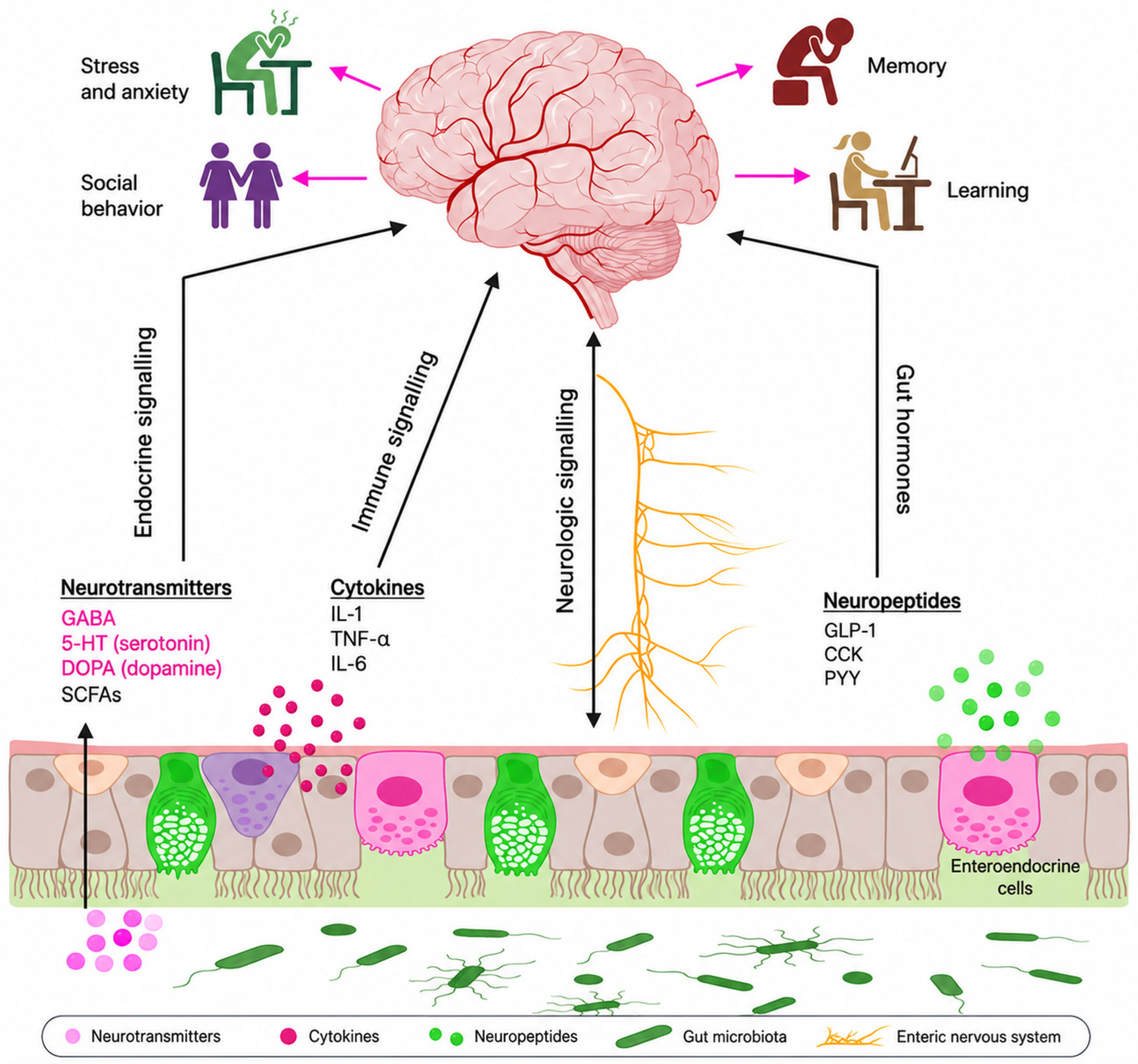
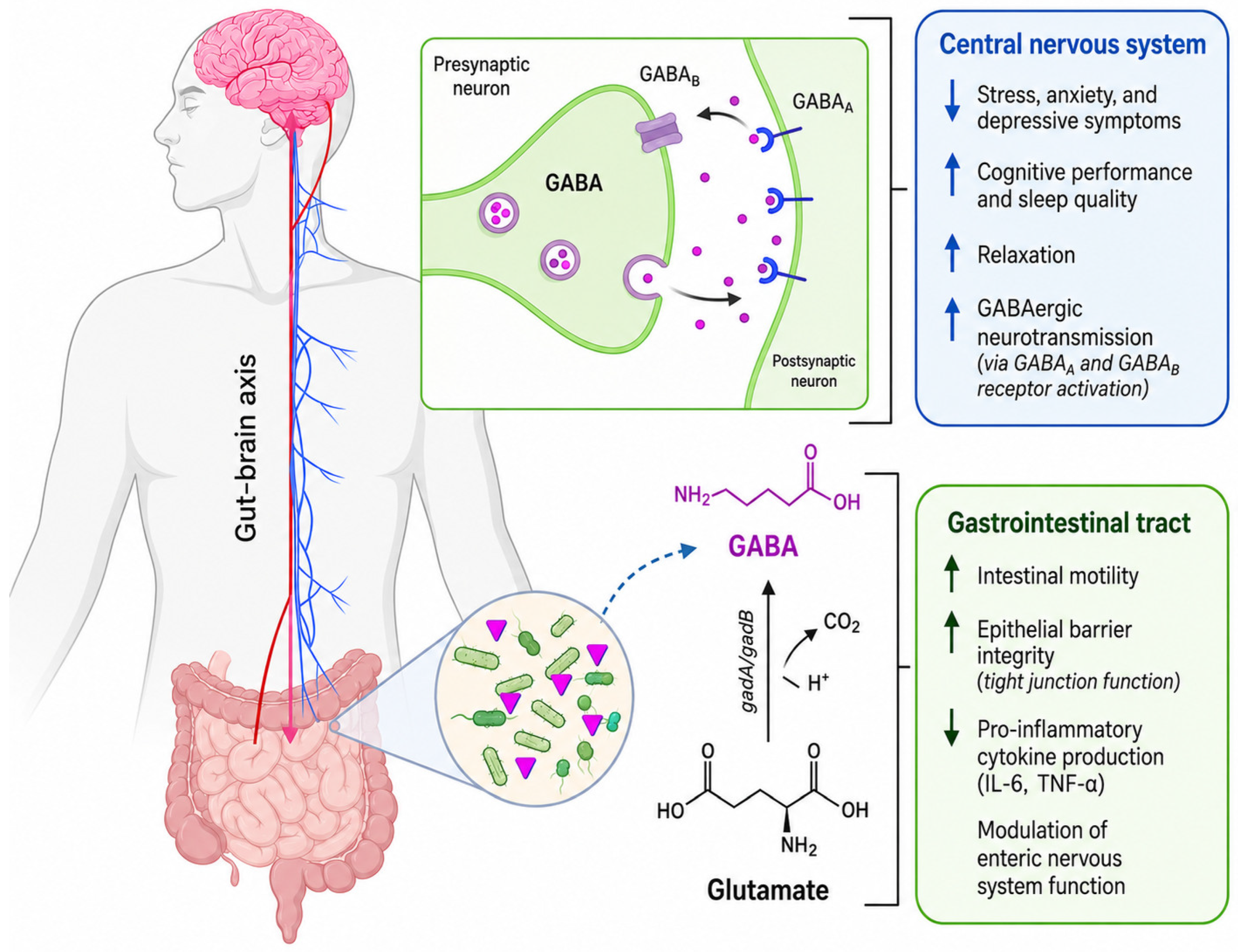


Disclaimer/Publisher’s Note: The statements, opinions and data contained in all publications are solely those of the individual author(s) and contributor(s) and not of MDPI and/or the editor(s). MDPI and/or the editor(s) disclaim responsibility for any injury to people or property resulting from any ideas, methods, instructions or products referred to in the content. |
© 2026 by the authors. Licensee MDPI, Basel, Switzerland. This article is an open access article distributed under the terms and conditions of the Creative Commons Attribution (CC BY) license.
Share and Cite
Zielińska, E.; Kycia, K.; Mikołajczuk-Szczyrba, A.; Piłka, N.; Juszczuk-Kubiak, E. GABA-Producing Bacteria as Potential Psychobiotics in Gut–Brain Axis Regulation. Int. J. Mol. Sci. 2026, 27, 4969. https://doi.org/10.3390/ijms27114969
Zielińska E, Kycia K, Mikołajczuk-Szczyrba A, Piłka N, Juszczuk-Kubiak E. GABA-Producing Bacteria as Potential Psychobiotics in Gut–Brain Axis Regulation. International Journal of Molecular Sciences. 2026; 27(11):4969. https://doi.org/10.3390/ijms27114969
Chicago/Turabian StyleZielińska, Ewelina, Katarzyna Kycia, Anna Mikołajczuk-Szczyrba, Natalia Piłka, and Edyta Juszczuk-Kubiak. 2026. "GABA-Producing Bacteria as Potential Psychobiotics in Gut–Brain Axis Regulation" International Journal of Molecular Sciences 27, no. 11: 4969. https://doi.org/10.3390/ijms27114969
APA StyleZielińska, E., Kycia, K., Mikołajczuk-Szczyrba, A., Piłka, N., & Juszczuk-Kubiak, E. (2026). GABA-Producing Bacteria as Potential Psychobiotics in Gut–Brain Axis Regulation. International Journal of Molecular Sciences, 27(11), 4969. https://doi.org/10.3390/ijms27114969