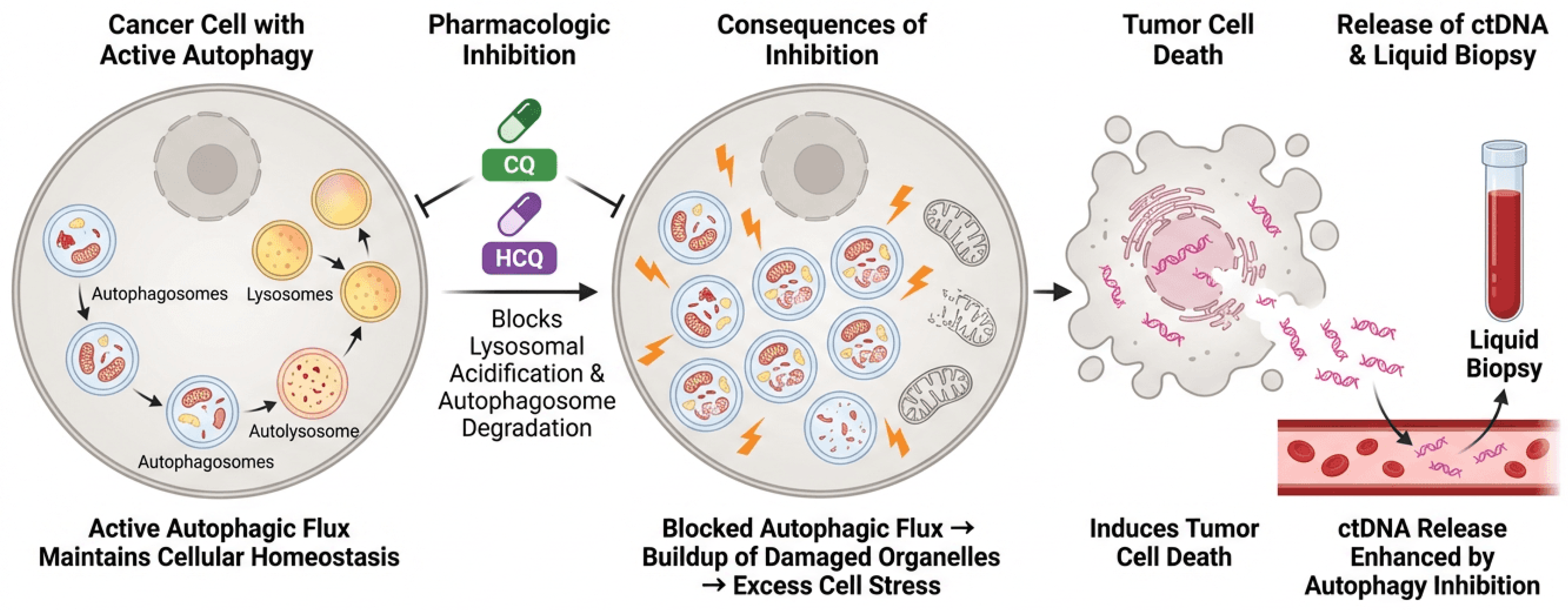
Autophagy–Circulating Tumor DNA Axis in Molecular Cancer Research: Emerging Mechanisms, Therapeutic Targeting, and Translational Opportunities




Abstract
1. Introduction
2. Molecular Biology of Autophagy in Cancer
3. Circulating Tumor DNA: Origin and Clinical Applications
3.1. Mechanisms of ctDNA Release
3.2. ctDNA Characteristics and Detection Technologies
3.3. Clinical Applications in Diagnosis, Prognosis, and Monitoring
4. Mechanistic Interplay Between Autophagy and ctDNA
4.1. Autophagy-Regulated Cell Death and DNA Release
4.2. Genomic Instability and DNA Fragmentation
4.3. Impact of Tumor Microenvironment (Hypoxia, ROS)
4.4. Secretory Autophagy and Active ctDNA Release Through Extracellular Vesicles
4.5. Autophagy Interactions with Regulated Cell Death Pathways and Their Impact on ctDNA Release
5. Role of the cGAS–STING Pathway in the Autophagy–ctDNA Relationship
6. Autophagy, ctDNA, and Therapeutic Resistance
6.1. Role in Chemoresistance and Tumor Adaptation
6.2. ctDNA as a Biomarker of Treatment Response
6.3. Evidence from Preclinical and Clinical Studies
7. Therapeutic Targeting of the Autophagy–ctDNA Axis
7.1. Autophagy Modulators (Chloroquine, Hydroxychloroquine, mTOR Inhibitors)
7.2. Combination Therapies and Precision Medicine Approaches
7.3. Potential to Enhance ctDNA-Based Monitoring
8. Translational and Clinical Perspectives
9. Limitations and Future Directions
10. Conclusions
Author Contributions
Funding
Institutional Review Board Statement
Informed Consent Statement
Data Availability Statement
Conflicts of Interest
References
- Wu, J.; Jin, Q.; Zhang, Y.; Ji, Y.; Li, J.; Liu, X.; Duan, H.; Feng, Z.; Liu, Y.; Zhang, Y.; et al. Global burden of cervical cancer: Current estimates, temporal trend and future projections based on the GLOBOCAN 2022. J. Natl. Cancer Cent. 2025, 5, 322–329. [Google Scholar] [CrossRef]
- Sun, K.-X.; Liang, X.; Zhu, Q.; Wu, H.-L.; Zhang, G.-Y.; Yao, Y.-F.; Li, X.; Zheng, R.-S.; Zuo, J.; Wei, W.-Q. Global patterns and trends in cancer-related premature death and their impact on life expectancy across 185 countries: A population-based analysis. Mil. Med. Res. 2025, 12, 56. [Google Scholar] [CrossRef] [PubMed]
- Soda, N.; Rehm, B.H.A.; Sonar, P.; Nguyen, N.-T.; Shiddiky, M.J.A. Advanced liquid biopsy technologies for circulating biomarker detection. J. Mater. Chem. B 2019, 7, 6670–6704. [Google Scholar] [CrossRef]
- DeLouize, A.M.; Eick, G.; Karam, S.D.; Snodgrass, J.J. Current and future applications of biomarkers in samples collected through minimally invasive methods for cancer medicine and population-based research. Am. J. Hum. Biol. 2021, 34, e23665. [Google Scholar] [CrossRef] [PubMed]
- Adhit, K.K.; Wanjari, A.; Menon, S.; K, S. Liquid Biopsy: An Evolving Paradigm for Non-invasive Disease Diagnosis and Monitoring in Medicine. Cureus 2023, 15, e50176. [Google Scholar] [CrossRef]
- Rahman, M.A.; Rahman, M.S.; Parvez, M.A.K.; Kim, B. The Emerging Role of Autophagy as a Target of Environmental Pollutants: An Update on Mechanisms. Toxics 2023, 11, 135. [Google Scholar] [CrossRef]
- Feng, Y.; Chen, Y.; Wu, X.; Chen, J.; Zhou, Q.; Liu, B.; Zhang, L.; Yi, C. Interplay of energy metabolism and autophagy. Autophagy 2023, 20, 4–14. [Google Scholar] [CrossRef]
- Rahman, A.; Ahmed, K.R.; Haque, F.; Park, M.N.; Kim, B. Recent Advances in Cellular Signaling Interplay between Redox Metabolism and Autophagy Modulation in Cancer: An Overview of Molecular Mechanisms and Therapeutic Interventions. Antioxidants 2023, 12, 428. [Google Scholar] [CrossRef] [PubMed]
- Taucher, E.; Mykoliuk, I.; Fediuk, M.; Smolle-Juettner, F.-M. Autophagy, Oxidative Stress and Cancer Development. Cancers 2022, 14, 1637. [Google Scholar] [CrossRef]
- Rahman, M.A.; Jalouli, M.; Bhajan, S.K.; Al-Zharani, M.; Harrath, A.H. A Comprehensive Review of Nanoparticle-Based Drug Delivery for Modulating PI3K/AKT/mTOR-Mediated Autophagy in Cancer. Int. J. Mol. Sci. 2025, 26, 1868. [Google Scholar] [CrossRef]
- Pang, F.; Xu, W.; Zhao, H.; Chen, S.; Tian, Y.; Fu, J.; You, Z.; Song, P.; Xian, Q.; Zhao, Q.; et al. Comprehensive evaluation of plasma microbial cell-free DNA sequencing for predicting bloodstream and local infections in clinical practice: A multicenter retrospective study. Front. Cell. Infect. Microbiol. 2024, 13, 1256099. [Google Scholar] [CrossRef] [PubMed]
- Sánchez-Herrero, E.; Serna-Blasco, R.; de Lope, L.R.; González-Rumayor, V.; Romero, A.; Provencio, M. Circulating Tumor DNA as a Cancer Biomarker: An Overview of Biological Features and Factors That may Impact on ctDNA Analysis. Front. Oncol. 2022, 12, 943253. [Google Scholar] [CrossRef]
- Duffy, M.J.; Crown, J. Use of circulating tumour DNA (ctDNA) for measurement of therapy predictive biomarkers in patients with cancer. J. Pers. Med. 2022, 12, 99. [Google Scholar] [CrossRef]
- Pellini, B.; Chaudhuri, A.A. Circulating tumor DNA minimal residual disease detection of non–small-cell lung cancer treated with curative intent. J. Clin. Oncol. 2022, 40, 567–575. [Google Scholar] [CrossRef]
- Wang, X.; Wang, L.; Lin, H.; Zhu, Y.; Huang, D.; Lai, M.; Xi, X.; Huang, J.; Zhang, W.; Zhong, T. Research progress of CTC, ctDNA, and EVs in cancer liquid biopsy. Front. Oncol. 2024, 14, 1303335. [Google Scholar] [CrossRef]
- Rahman, A.; Hwang, H.; Nah, S.-Y.; Rhim, H. Gintonin stimulates autophagic flux in primary cortical astrocytes. J. Ginseng Res. 2020, 44, 67–78. [Google Scholar] [CrossRef]
- Wang, Y.; Zhang, H. Regulation of Autophagy by mTOR Signaling Pathway. In Autophagy: Biology and Diseases; Advances in Experimental Medicine and Biology; Springer: Singapore, 2019; Volume 1206, pp. 67–83. [Google Scholar] [CrossRef]
- Huynh, C.; Ryu, J.; Lee, J.; Inoki, A.; Inoki, K. Nutrient-sensing mTORC1 and AMPK pathways in chronic kidney diseases. Nat. Rev. Nephrol. 2022, 19, 102–122. [Google Scholar] [CrossRef]
- Park, J.S.; Lee, D.H.; Lee, Y.S.; Oh, E.; Bae, K.-H.; Oh, K.-J.; Kim, H.; Bae, S.H. Dual roles of ULK1 (unc-51 like autophagy activating kinase 1) in cytoprotection against lipotoxicity. Autophagy 2019, 16, 86–105. [Google Scholar] [CrossRef] [PubMed]
- Rahman, A.; Bishayee, K.; Habib, K.; Sadra, A.; Huh, S.-O. 18α-Glycyrrhetinic acid lethality for neuroblastoma cells via de-regulating the Beclin-1/Bcl-2 complex and inducing apoptosis. Biochem. Pharmacol. 2016, 117, 97–112. [Google Scholar] [CrossRef] [PubMed]
- Zhu, J.; Lv, L.; Yan, Y.; Wang, S.; Lu, X.; Ma, X.; Sun, X.; Qin, Y.; Wu, H.; Yu, G.; et al. Role of autophagy in tumorigenesis and drug resistance: Molecular mechanisms and therapeutic targets. Mol. Biomed. 2026, 7, 28. [Google Scholar] [CrossRef]
- Jalali, P.; Shahmoradi, A.; Samii, A.; Mazloomnejad, R.; Hatamnejad, M.R.; Saeed, A.; Namdar, A.; Salehi, Z. The role of autophagy in cancer: From molecular mechanism to therapeutic window. Front. Immunol. 2025, 16, 1528230. [Google Scholar] [CrossRef] [PubMed]
- Jia, H.; Wei, J.; Zheng, W.; Li, Z. The dual role of autophagy in cancer stem cells: Implications for tumor progression and therapy resistance. J. Transl. Med. 2025, 23, 583. [Google Scholar] [CrossRef] [PubMed]
- Harrath, A.H.; Rahman, A.; Bhajan, S.K.; Bishwas, A.K.; Rahman, H.; Alwasel, S.; Jalouli, M.; Kang, S.; Park, M.N.; Kim, B. Autophagy and Female Fertility: Mechanisms, Clinical Implications, and Emerging Therapies. Cells 2024, 13, 1354. [Google Scholar] [CrossRef] [PubMed]
- Rahman, A.; Jalouli, M.; Al-Zharani, M.; Rahaman, K.A.; Harrath, A.H. Interplay between hypoxia-inducible factors and apoptosis in glioblastoma. Biochem. Pharmacol. 2025, 244, 117619. [Google Scholar] [CrossRef]
- White, E.; Mehnert, J.M.; Chan, C.S. Autophagy, metabolism, and cancer. Clin. Cancer Res. 2015, 21, 5037–5046. [Google Scholar] [CrossRef]
- Gerada, C.; Ryan, K.M. Autophagy, the innate immune response and cancer. Mol. Oncol. 2020, 14, 1913–1929. [Google Scholar] [CrossRef]
- Kim, H.; Park, K.U. Clinical Circulating Tumor DNA Testing for Precision Oncology. Cancer Res. Treat. 2023, 55, 351–366. [Google Scholar] [CrossRef]
- Fiala, O.; Baxa, J.; Svaton, M.; Benesova, L.; Ptackova, R.; Halkova, T.; Minarik, M.; Hosek, P.; Buresova, M.; Finek, J.; et al. Combination of Circulating Tumour DNA and 18F-FDG PET/CT for Precision Monitoring of Therapy Response in Patients with Advanced Non-Small Cell Lung Cancer: A Prospective Study. Cancer Genom.-Proteom. 2022, 19, 270–281. [Google Scholar] [CrossRef]
- Hong, T.H.; Hwang, S.; Dasgupta, A.; Abbosh, C.; Hung, T.; Bredno, J.; Walker, J.; Shi, X.; Milenkova, T.; Horn, L.; et al. Clinical Utility of Tumor-Naïve Presurgical Circulating Tumor DNA Detection in Early-Stage NSCLC. J. Thorac. Oncol. 2024, 19, 1512–1524. [Google Scholar] [CrossRef]
- Matassov, D.; Kagan, T.; Leblanc, J.; Sikorska, M.; Zakeri, Z.; Brady, H.J.M. Measurement of Apoptosis by DNA Fragmentation. In Apoptosis Methods and Protocols; Humana Press: Totowa, NJ, USA, 2004; Volume 282, pp. 1–18. [Google Scholar]
- Zapletal, E.; Vasiljevic, T.; Busson, P.; Glavan, T.M. Dialog beyond the Grave: Necrosis in the Tumor Microenvironment and Its Contribution to Tumor Growth. Int. J. Mol. Sci. 2023, 24, 5278. [Google Scholar] [CrossRef]
- Malkin, E.Z.; Bratman, S.V. Bioactive DNA from extracellular vesicles and particles. Cell Death Dis. 2020, 11, 584. [Google Scholar] [CrossRef]
- Avanzini, S.; Kurtz, D.M.; Chabon, J.J.; Moding, E.J.; Hori, S.S.; Gambhir, S.S.; Alizadeh, A.A.; Diehn, M.; Reiter, J.G. A mathematical model of ctDNA shedding predicts tumor detection size. Sci. Adv. 2020, 6, eabc4308. [Google Scholar] [CrossRef]
- Markus, H.; Chandrananda, D.; Moore, E.; Mouliere, F.; Morris, J.; Brenton, J.D.; Smith, C.G.; Rosenfeld, N. Refined characterization of circulating tumor DNA through biological feature integration. Sci. Rep. 2022, 12, 1928. [Google Scholar] [CrossRef]
- Gorgannezhad, L.; Umer, M.; Islam, M.N.; Nguyen, N.-T.; Shiddiky, M.J.A. Circulating tumor DNA and liquid biopsy: Opportunities, challenges, and recent advances in detection technologies. Lab Chip 2018, 18, 1174–1196. [Google Scholar] [CrossRef]
- Zhang, H.; Liu, R.; Yan, C.; Liu, L.; Tong, Z.; Jiang, W.; Yao, M.; Fang, W.; Chen, Z. Advantage of Next-Generation Sequencing in Dynamic Monitoring of Circulating Tumor DNA over Droplet Digital PCR in Cetuximab Treated Colorectal Cancer Patients. Transl. Oncol. 2019, 12, 426–431. [Google Scholar] [CrossRef]
- Guibert, N.; Hu, Y.; Feeney, N.; Kuang, Y.; Plagnol, V.; Jones, G.; Howarth, K.; Beeler, J.; Paweletz, C.; Oxnard, G. Amplicon-based next-generation sequencing of plasma cell-free DNA for detection of driver and resistance mutations in advanced non-small cell lung cancer. Ann. Oncol. 2018, 29, 1049–1055. [Google Scholar] [CrossRef]
- Kamli, H.; Khan, N.U. Emerging Role of ctDNA Fragmentomics and Epigenetic Signatures in the Early Detection, Minimal Residual Disease Assessment, and Precision Monitoring of Renal Cell Carcinoma. J. Cell Mol. Med. 2026, 30, e71019. [Google Scholar] [CrossRef] [PubMed]
- Dang, D.K.; Park, B.H. Circulating tumor DNA: Current challenges for clinical utility. J. Clin. Investig. 2022, 132, e154941. [Google Scholar] [CrossRef] [PubMed]
- Hu, Q.; Chen, L.; Li, K.; Liu, R.; Sun, L.; Han, T. Circulating tumor DNA: Current implementation issues and future challenges for clinical utility. Clin. Chem. Lab. Med. 2023, 62, 2094–2110. [Google Scholar] [CrossRef]
- Parums, D.V. A Review of Circulating Tumor DNA (ctDNA) and the Liquid Biopsy in Cancer Diagnosis, Screening, and Monitoring Treatment Response. Med. Sci. Monit. 2025, 31, e949300. [Google Scholar] [CrossRef] [PubMed]
- Oliveira, K.C.S.; Ramos, I.B.; Silva, J.M.C.; Barra, W.F.; Riggins, G.J.; Palande, V.; Pinho, C.T.; Frenkel-Morgenstern, M.; Santos, S.E.; Assumpcao, P.P.; et al. Current Perspectives on Circulating Tumor DNA, Precision Medicine, and Personalized Clinical Management of Cancer. Mol. Cancer Res. 2020, 18, 517–528. [Google Scholar] [CrossRef]
- Shifa, J.; Amin, T.; Fakruddin, M.; Rahman, K.; Islam, S.M.B.U. Unveiling the Paradoxical Nature of Autophagy in Cancer Cell Fate. Cancer Control 2025, 32, 10732748251384365. [Google Scholar] [CrossRef]
- Rostami, A.; Lambie, M.; Yu, C.W.; Stambolic, V.; Waldron, J.N.; Bratman, S.V. Senescence, Necrosis, and Apoptosis Govern Circulating Cell-free DNA Release Kinetics. Cell Rep. 2020, 31, 107830. [Google Scholar] [CrossRef]
- Altman, B.J.; Rathmell, J.C. Metabolic stress in autophagy and cell death pathways. Cold Spring Harb. Perspect. Biol. 2012, 4, a008763. [Google Scholar] [CrossRef] [PubMed]
- Deng, X.; Li, Y.; Chen, Y.; Hu, Q.; Zhang, W.; Chen, L.; Lu, X.; Zeng, J.; Ma, X.; Efferth, T. Paeoniflorin protects hepatocytes from APAP-induced damage through launching autophagy via the MAPK/mTOR signaling pathway. Cell. Mol. Biol. Lett. 2024, 29, 119. [Google Scholar] [CrossRef]
- Zhang, Y.; Guo, R.; Wang, S.-S.; Jiang, X.-Y.; Cui, H.-Y.; Guo, Y.; Song, X.-Y.; Guo, Q.-Q.; Cao, L. Autophagy-related Proteins in Genome Stability: Autophagy-Dependent and Independent Actions. Int. J. Biol. Sci. 2022, 18, 5329–5344. [Google Scholar] [CrossRef] [PubMed]
- Zhou, J.; Li, X.-Y.; Liu, Y.-J.; Feng, J.; Wu, Y.; Shen, H.-M.; Lu, G.-D. Full-coverage regulations of autophagy by ROS: From induction to maturation. Autophagy 2021, 18, 1240–1255. [Google Scholar] [CrossRef] [PubMed]
- Kim, J.; Lee, S.; Kim, H.; Lee, H.; Seong, K.M.; Youn, H.; Youn, B. Autophagic Organelles in DNA Damage Response. Front. Cell Dev. Biol. 2021, 9, 668735. [Google Scholar] [CrossRef]
- Juretschke, T.; Beli, P. Causes and consequences of DNA damage-induced autophagy. Matrix Biol. 2021, 100–101, 39–53. [Google Scholar] [CrossRef]
- Anand, S.K.; Sharma, A.; Singh, N.; Kakkar, P. Entrenching role of cell cycle checkpoints and autophagy for maintenance of genomic integrity. DNA Repair 2020, 86, 102748. [Google Scholar] [CrossRef]
- Karantza-Wadsworth, V.; Patel, S.; Kravchuk, O.; Chen, G.; Mathew, R.; Jin, S.; White, E. Autophagy mitigates metabolic stress and genome damage in mammary tumorigenesis. Genes Dev. 2007, 21, 1621–1635. [Google Scholar] [CrossRef]
- Seebacher, N.A.; Krchniakova, M.; Stacy, A.E.; Skoda, J.; Jansson, P.J. Tumour Microenvironment Stress Promotes the Development of Drug Resistance. Antioxidants 2021, 10, 1801. [Google Scholar] [CrossRef] [PubMed]
- Jalouli, M. Emerging Role of Hypoxia-Inducible Factors (HIFs) in Modulating Autophagy: Perspectives on Cancer Therapy. Int. J. Mol. Sci. 2025, 26, 1752. [Google Scholar] [CrossRef] [PubMed]
- Stejskal, P.; Goodarzi, H.; Srovnal, J.; Hajdúch, M.; van’t Veer, L.J.; Magbanua, M.J.M. Circulating tumor nucleic acids: Biology, release mechanisms, and clinical relevance. Mol. Cancer 2023, 22, 15. [Google Scholar] [CrossRef]
- Li, L.; Tan, J.; Miao, Y.; Lei, P.; Zhang, Q. ROS and Autophagy: Interactions and Molecular Regulatory Mechanisms. Cell. Mol. Neurobiol. 2015, 35, 615–621. [Google Scholar] [CrossRef]
- Reid, S.E.; Kolapalli, S.P.; Nielsen, T.M.; Frankel, L.B. Canonical and non-canonical roles for ATG8 proteins in autophagy and beyond. Front. Mol. Biosci. 2022, 9, 1074701. [Google Scholar] [CrossRef] [PubMed]
- Zubkova, E.; Kalinin, A.; Bolotskaya, A.; Beloglazova, I.; Menshikov, M. Autophagy-Dependent Secretion: Crosstalk between Autophagy and Exosome Biogenesis. Curr. Issues Mol. Biol. 2024, 46, 2209–2235. [Google Scholar] [CrossRef]
- Menaceur, C.; Dusailly, O.; Gosselet, F.; Fenart, L.; Saint-Pol, J. Vesicular Trafficking, a Mechanism Controlled by Cascade Activation of Rab Proteins: Focus on Rab27. Biology 2023, 12, 1530. [Google Scholar] [CrossRef]
- Ngo, J.M.; Williams, J.K.; Zhang, C.; Saleh, A.H.; Liu, X.-M.; Ma, L.; Schekman, R. Extracellular Vesicles and Cellular Homeostasis. Annu. Rev. Biochem. 2025, 94, 587–609. [Google Scholar] [CrossRef]
- Dewaele, M.; Maes, H.; Agostinis, P. ROS-mediated mechanisms of autophagy stimulation and their relevance in cancer therapy. Autophagy 2010, 6, 838–854. [Google Scholar] [CrossRef]
- Maacha, S.; Bhat, A.A.; Jimenez, L.; Raza, A.; Haris, M.; Uddin, S.; Grivel, J.-C. Extracellular vesicles-mediated intercellular communication: Roles in the tumor microenvironment and anti-cancer drug resistance. Mol. Cancer 2019, 18, 55. [Google Scholar] [CrossRef]
- Wu, J.; Zhou, Y.; Jiang, Y.; Xu, W.; Yan, T.; Ma, S. Dual Roles of Exosomes in Tumor Progression and Their Bioengineering as Targeted Drug Carriers. Anal. Chem. 2026, 98, 10217–10247. [Google Scholar] [CrossRef]
- D’Amico, M.; De Amicis, F. Challenges of regulated cell death: Implications for therapy resistance in cancer. Cells 2024, 13, 1083. [Google Scholar] [CrossRef]
- Wang, B.; Wang, Y.; Zhang, J.; Hu, C.; Jiang, J.; Li, Y.; Peng, Z. ROS-induced lipid peroxidation modulates cell death outcome: Mechanisms behind apoptosis, autophagy, and ferroptosis. Arch. Toxicol. 2023, 97, 1439–1451. [Google Scholar] [CrossRef]
- Damodaran, S.; Weeramange, C.E.; Kenny, L.; Vasani, S.; Hughes, B.G.M.; Breik, O.; Punyadeera, C. Circulating tumour cells and circulating tumour DNA in head and neck cancer: From molecular insights to clinical impact. Cancer Metastasis Rev. 2025, 44, 88, Correction in Cancer Metastasis Rev. 2026, 45, 24. https://doi.org/10.1007/s10555-026-10329-y. [Google Scholar] [CrossRef] [PubMed]
- Broz, P. Pyroptosis: Molecular mechanisms and roles in disease. Cell Res. 2025, 35, 334–344. [Google Scholar] [CrossRef] [PubMed]
- Zhao, J.; Jiang, P.; Guo, S.; Schrodi, S.J.; He, D. Apoptosis, Autophagy, NETosis, Necroptosis, and Pyroptosis Mediated Programmed Cell Death as Targets for Innovative Therapy in Rheumatoid Arthritis. Front. Immunol. 2021, 12, 809806. [Google Scholar] [CrossRef]
- Karlowitz, R.; van Wijk, S.J. Surviving death: Emerging concepts of RIPK3 and MLKL ubiquitination in the regulation of necroptosis. FEBS J. 2023, 290, 37–54. [Google Scholar] [CrossRef]
- D’arcy, M.S. Cell death: A review of the major forms of apoptosis, necrosis and autophagy. Cell Biol. Int. 2019, 43, 582–592. [Google Scholar] [CrossRef] [PubMed]
- Zhou, Y.; Liu, L.; Tao, S.; Yao, Y.; Wang, Y.; Wei, Q.; Shao, A.; Deng, Y. Parthanatos and its associated components: Promising therapeutic targets for cancer. Pharmacol. Res. 2021, 163, 105299. [Google Scholar] [CrossRef] [PubMed]
- Kulkarni, V.V.; Wang, Y.; Kirkpatrick, C.T.; Leiva-Juarez, M.M.; Plumer, A.K.; Ware, H.H.; Evans, S.E. Cyclic GMP-AMP Synthase (cGAS), Stimulator of Interferon Genes (STING) and Interferon Activated Gene 16 (IFI16) Are Essential for Intrinsic Lung Epithelial Responses Against Influenza A Infection, But Not for Therapeutically Induced Antiviral Resistance, in C57. In Cellular/Molecular Mechanisms and Translational Aspects of Respiratory Infections; American Thoracic Society: New York, NY, USA, 2016; p. A5469. [Google Scholar] [CrossRef]
- Yu, L.; Liu, P. Cytosolic DNA sensing by cGAS: Regulation, function, and human diseases. Signal Transduct. Target. Ther. 2021, 6, 170. [Google Scholar] [CrossRef]
- Pan, J.; Fei, C.-J.; Hu, Y.; Wu, X.-Y.; Nie, L.; Chen, J. Current understanding of the cGAS-STING signaling pathway: Structure, regulatory mechanisms, and related diseases. Zool. Res. 2023, 44, 183–218. [Google Scholar] [CrossRef]
- Chen, C.; Xu, P. Cellular functions of cGAS-STING signaling. Trends Cell Biol. 2023, 33, 630–648. [Google Scholar] [CrossRef]
- Zhang, K.; Huang, Q.; Li, X.; Zhao, Z.; Hong, C.; Sun, Z.; Deng, B.; Li, C.; Zhang, J.; Wang, S. The cGAS-STING pathway in viral infections: A promising link between inflammation, oxidative stress and autophagy. Front. Immunol. 2024, 15, 1352479. [Google Scholar] [CrossRef] [PubMed]
- Aloraini, G.S. Mitochondrial DNA release and cGAS-STING activation: Emerging insights into anti-tumor immunity. Pathol. Res. Pract. 2025, 273, 156158. [Google Scholar] [CrossRef] [PubMed]
- Boopathi, E.; Thangavel, C. Dark side of cancer therapy: Cancer treatment-induced cardiopulmonary inflammation, fibrosis, and immune modulation. Int. J. Mol. Sci. 2021, 22, 10126. [Google Scholar] [CrossRef]
- Mosley, S.R. Genomic Instability and DNA Damage Regulate Dendritic Cell Mediated Anti-Tumor Immunity Through Distinctive Cytosolic DNA Structures in Colorectal Cancer. Ph.D. Thesis, University of Alberta, Edmonton, AL, Canada, 2025. [Google Scholar]
- Wang, Y.; Wu, S.; Zhang, X.; Zheng, W.; Wang, Z.; Zhang, J.; Chen, J.; Wang, H. cGAS-STING and autophagy: Crosstalk, molecular mechanisms, and targeted therapy. Arch. Toxicol. 2025, 100, 145–172. [Google Scholar] [CrossRef]
- Carretero-Fernández, M.; Cabrera-Serrano, A.J.; Sánchez-Maldonado, J.M.; Ruiz-Durán, L.; Jiménez-Romera, F.; García-Verdejo, F.J.; González-Olmedo, C.; Cardús, A.; Díaz-Beltrán, L.; Gutiérrez-Bautista, J.F.; et al. Autophagy and oxidative stress in solid tumors: Mechanisms and therapeutic opportunities. Crit. Rev. Oncol. 2025, 212, 104820. [Google Scholar] [CrossRef] [PubMed]
- Tonkin-Reeves, A.; Giuliani, C.M.; Price, J.T. Inhibition of autophagy; an opportunity for the treatment of cancer resistance. Front. Cell Dev. Biol. 2023, 11, 1177440. [Google Scholar] [CrossRef]
- Xu, R.; Ji, Z.; Xu, C.; Zhu, J. The clinical value of using chloroquine or hydroxychloroquine as autophagy inhibitors in the treatment of cancers. Medicine 2018, 97, e12912. [Google Scholar] [CrossRef] [PubMed]
- Duffy, M.J. Circulating tumor DNA (ctDNA) as a biomarker for lung cancer: Early detection, monitoring and therapy prediction. Tumour Biol. 2024, 46, S283–S295. [Google Scholar] [CrossRef]
- Mathai, R.A.; Vidya, R.V.S.; Reddy, B.S.; Thomas, L.; Udupa, K.; Kolesar, J.; Rao, M. Potential Utility of Liquid Biopsy as a Diagnostic and Prognostic Tool for the Assessment of Solid Tumors: Implications in the Precision Oncology. J. Clin. Med. 2019, 8, 373. [Google Scholar] [CrossRef]
- Ossandon, M.R.; Agrawal, L.; Bernhard, E.J.; Conley, B.A.; Dey, S.M.; Divi, R.L.; Guan, P.; Lively, T.G.; McKee, T.C.; Sorg, B.S.; et al. Circulating Tumor DNA Assays in Clinical Cancer Research. JNCI J. Natl. Cancer Inst. 2018, 110, 929–934. [Google Scholar] [CrossRef]
- Liu, A.P.-Y.; Northcott, P.A.; Robinson, G.W.; Gajjar, A. Circulating tumor DNA profiling for childhood brain tumors: Technical challenges and evidence for utility. Mod. Pathol. 2022, 102, 134–142. [Google Scholar] [CrossRef]
- Jee, J.; Lebow, E.S.; Yeh, R.; Das, J.P.; Namakydoust, A.; Paik, P.K.; Chaft, J.E.; Jayakumaran, G.; Brannon, A.R.; Benayed, R.; et al. Overall survival with circulating tumor DNA-guided therapy in advanced non-small-cell lung cancer. Nat. Med. 2022, 28, 2353–2363. [Google Scholar] [CrossRef]
- Pérez-Hernández, M.; Arias, A.; Martínez-García, D.; Pérez-Tomás, R.; Quesada, R.; Soto-Cerrato, V. Targeting Autophagy for Cancer Treatment and Tumor Chemosensitization. Cancers 2019, 11, 1599. [Google Scholar] [CrossRef]
- Qureshi, Z.; Altaf, F.; Khanzada, M.; Safi, A.; Asghar, Z.; Warraich, D.; Shah, S. Liquid biopsies for early detection and monitoring of cancer: Advances, challenges, and future directions. Ann. Med. Surg. 2025, 87, 3244–3253. [Google Scholar] [CrossRef]
- Foth, M.; McMahon, M. Autophagy inhibition in BRAF-driven cancers. Cancers 2021, 13, 3498. [Google Scholar] [CrossRef]
- Raghavendra, A.S.; Kettner, N.M.; Kwiatkowski, D.; Damodaran, S.; Wang, Y.; Ramirez, D.; Gombos, D.S.; Hunt, K.K.; Shen, Y.; Keyomarsi, K.; et al. Phase I trial of hydroxychloroquine to enhance palbociclib and letrozole efficacy in ER+/HER2− breast cancer. npj Breast Cancer 2025, 11, 7. [Google Scholar] [CrossRef]
- Gong, C.; Lin, Q.; Qin, T.; Zeng, Y.; Xu, F.; Yang, Y.; Yin, D.; Duan, Z.; Chen, C.-L.; Chow, L.W.-C.; et al. Targeting autophagy plus high-dose CDK4/6 inhibitors in advanced HR+HER2− breast cancer: A phase 1b/2 trial. Med 2024, 6, 100559. [Google Scholar] [CrossRef]
- Zhang, Y.; Zheng, L.; Ma, L.; Yin, F.; Luo, Z.; Li, S.; Jiang, Y.; Kong, L.; Wang, X. Discovery of dual CDK6/BRD4 inhibitor inducing apoptosis and increasing the sensitivity of ferroptosis in triple-negative breast cancer. J. Med. Chem. 2024, 67, 21186–21207, Correction in J. Med. Chem. 2025, 68, 3902. https://doi.org/10.1021/acs.jmedchem.5c00111. [Google Scholar] [CrossRef]
- Di Grazia, G.; Sánchez-Bayona, R.; Casals-Pascual, C.; Pascual, T.; Generali, D.; Gennari, A.; Vigneri, P.; Harbeck, N.; Cortés, J.; Prat, A.; et al. Dynamic biomarkers in hormone receptor-positive/HER2-negative breast cancer trials: A new hope for precision oncology. npj Breast Cancer 2026, 12, 34. [Google Scholar] [CrossRef]
- Jain, V.; Singh, M.P.; Amaravadi, R.K. Recent advances in targeting autophagy in cancer. Trends Pharmacol. Sci. 2023, 44, 290–302. [Google Scholar] [CrossRef]
- Panwar, V.; Singh, A.; Bhatt, M.; Tonk, R.K.; Azizov, S.; Raza, A.S.; Sengupta, S.; Kumar, D.; Garg, M. Multifaceted role of mTOR (mammalian target of rapamycin) signaling pathway in human health and disease. Signal Transduct. Target. Ther. 2023, 8, 375. [Google Scholar] [CrossRef]
- Petherick, K.J.; Conway, O.J.L.; Mpamhanga, C.; Osborne, S.A.; Kamal, A.; Saxty, B.; Ganley, I.G. Pharmacological inhibition of ULK1 kinase blocks mammalian target of rapamycin (mTOR)-dependent autophagy. J. Biol. Chem. 2015, 290, 11376–11383, Erratum in J. Biol. Chem. 2015, 290, 28726. [Google Scholar] [CrossRef] [PubMed]
- Palieri, R.; De Luca, M.; Balestra, F.; Panzetta, G.; Lotesoriere, C.; Rizzi, F.; Ricci, A.D.; Mastrogiacomo, R.; Curri, M.L.; Laghi, L.A.; et al. Liquid biopsy in gastrointestinal oncology: Clinical applications and translational integration of ctDNA, CTCs, and sEVs. Oncol. Rev. 2025, 19, 1702932. [Google Scholar] [CrossRef] [PubMed]
- Liu, T.; Zhang, J.; Li, K.; Deng, L.; Wang, H. Combination of an Autophagy Inducer and an Autophagy Inhibitor: A Smarter Strategy Emerging in Cancer Therapy. Front. Pharmacol. 2020, 11, 408. [Google Scholar] [CrossRef]
- Riedl, J.M.; Moik, F.; Esterl, T.; Kostmann, S.M.; Gerger, A.; Jost, P.J. Molecular diagnostics tailoring personalized cancer therapy-an oncologist’s view. Virchows Arch. 2024, 484, 169–179. [Google Scholar] [CrossRef] [PubMed]
- Reece, M.; Saluja, H.; Hollington, P.; Karapetis, C.S.; Vatandoust, S.; Young, G.P.; Symonds, E.L. The Use of Circulating Tumor DNA to Monitor and Predict Response to Treatment in Colorectal Cancer. Front. Genet. 2019, 10, 1118. [Google Scholar] [CrossRef] [PubMed]
- Rahman, M.A.; Yadab, M.K.; Ali, M.M. Overcoming standard-of-care resistance in glioblastoma using nanoparticle-based drug delivery targeting the autophagy pathway. Biochem. Pharmacol. 2025, 242, 117302. [Google Scholar] [CrossRef]
- Sanz-Garcia, E.; Zhao, E.; Bratman, S.V.; Siu, L.L. Monitoring and adapting cancer treatment using circulating tumor DNA kinetics: Current research, opportunities, and challenges. Sci. Adv. 2022, 8, eabi8618. [Google Scholar] [CrossRef]
- Singh, A.; Ravendranathan, N.; Frisbee, J.C.; Singh, K.K. Complex Interplay between DNA Damage and Autophagy in Disease and Therapy. Biomolecules 2024, 14, 922. [Google Scholar] [CrossRef] [PubMed]
- Gharoonpour, A.; Simiyari, D.; Yousefzadeh, A.; Badragheh, F.; Rahmati, M. Autophagy modulation in breast cancer utilizing nanomaterials and nanoparticles. Front. Oncol. 2023, 13, 1150492. [Google Scholar] [CrossRef]
- Jalouli, M.; Harrath, A.H.; Al-Zharani, M.; Rahman, M.A. Autophagy Modulation in Cancer Immunotherapy, Emerging Molecular Targets and Drug Selection Strategies. Int. J. Mol. Sci. 2026, 27, 2183. [Google Scholar] [CrossRef]
- Faryal, B. Epigenetic regulation of autophagy in breast cancer: Implications for biomarker discovery and personalized therapy. Cancer Rep. 2025, 8, e70389. [Google Scholar] [CrossRef] [PubMed]
- Shakerdi, A.L.; Finnegan, E.; Sheng, Y.-Y.; Pidgeon, G.P. The Multifaceted Role of Autophagy in Nasopharyngeal Carcinoma: Translational Perspectives on Pathogenesis, Biomarkers, Treatment Resistance, and Emerging Therapies. Cancers 2025, 17, 2577. [Google Scholar] [CrossRef]
- Zafar, S.; Hafeez, A.; Shah, H.; Mutiullah, I.; Ali, A.; Khan, K.; Figueroa-González, G.; Reyes-Hernández, O.D.; Quintas-Granados, L.I.; Peña-Corona, S.I.; et al. Emerging biomarkers for early cancer detection and diagnosis: Challenges, innovations, and clinical perspectives. Eur. J. Med. Res. 2025, 30, 760. [Google Scholar] [CrossRef]
- Tan, H.N.; Elliott, M.J.; Silverman, I.M.; Siu, L.L.; Yap, T.A. Circulating tumor DNA as a biomarker in early phase clinical trials. Cancer Cell 2025, 44, 240–247. [Google Scholar] [CrossRef]
- Andersen, L.; Kisistók, J.; Henriksen, T.V.; Bramsen, J.B.; Reinert, T.; Øgaard, N.; Mattesen, T.B.; Birkbak, N.J.; Andersen, C.L. Exploring the biology of ctDNA release in colorectal cancer. Eur. J. Cancer 2024, 207, 114186. [Google Scholar] [CrossRef] [PubMed]
- Gottlieb, R.A.; Andres, A.M.; Sin, J.; Taylor, D.P. Untangling autophagy measurements: All fluxed up. Circ. Res. 2015, 116, 504–514. [Google Scholar] [CrossRef]
- Nishizaki, D.; Law, A.; Li, B.; Abbott, C.; Chen, Y.; Lee, S.; Pyke, R.; Keough, K.; Daniels, G.A.; Yeung, K.T.; et al. Ultrasensitive ctDNA monitoring reveals early predictors of immunotherapy response in advanced cancer. npj Precis. Oncol. 2026, 10, 79. [Google Scholar] [CrossRef] [PubMed]
- De Paolis, E.; Perrucci, A.; Albertini Petroni, G.; Conca, A.; Corsi, M.; Urbani, A.; Minucci, A. Genomics and Epigenomics Approaches for the Quantification of Circulating Tumor DNA in Liquid Biopsy: Relevance of a Multimodal Strategy. Int. J. Mol. Sci. 2025, 26, 10982. [Google Scholar] [CrossRef] [PubMed]





| Clinical Trial (NCT) | Cancer Type | Autophagy Modulator | Combination Therapy | Phase | Biomarker/Liquid Biopsy Endpoint | Key Focus | Ref. |
|---|---|---|---|---|---|---|---|
| NCT03774472 | Breast cancer | Hydroxychloroquine (HCQ) | Palbociclib + Letrozole | Phase I/II | Blood-based DNA/RNA biomarkers | Autophagy, senescence, treatment response | [93] |
| NCT05953350 | Solid tumors | Hydroxychloroquine (HCQ) | CDK4/6 inhibitors | Phase Ib/II | Exploratory translational biomarkers | Safety, efficacy, autophagy inhibition | [94,95] |
| PALAVY Study | Stage II–III breast cancer | Hydroxychloroquine sulfate | ±Palbociclib/Avelumab | Phase II | Disseminated tumor cell monitoring | Dormancy and resistance mechanisms | [93] |
Disclaimer/Publisher’s Note: The statements, opinions and data contained in all publications are solely those of the individual author(s) and contributor(s) and not of MDPI and/or the editor(s). MDPI and/or the editor(s) disclaim responsibility for any injury to people or property resulting from any ideas, methods, instructions or products referred to in the content. |
© 2026 by the authors. Licensee MDPI, Basel, Switzerland. This article is an open access article distributed under the terms and conditions of the Creative Commons Attribution (CC BY) license.
Share and Cite
Harrath, A.H.; Jalouli, M.; Rahman, M.A. Autophagy–Circulating Tumor DNA Axis in Molecular Cancer Research: Emerging Mechanisms, Therapeutic Targeting, and Translational Opportunities. Int. J. Mol. Sci. 2026, 27, 4596. https://doi.org/10.3390/ijms27104596
Harrath AH, Jalouli M, Rahman MA. Autophagy–Circulating Tumor DNA Axis in Molecular Cancer Research: Emerging Mechanisms, Therapeutic Targeting, and Translational Opportunities. International Journal of Molecular Sciences. 2026; 27(10):4596. https://doi.org/10.3390/ijms27104596
Chicago/Turabian StyleHarrath, Abdel Halim, Maroua Jalouli, and Md Ataur Rahman. 2026. "Autophagy–Circulating Tumor DNA Axis in Molecular Cancer Research: Emerging Mechanisms, Therapeutic Targeting, and Translational Opportunities" International Journal of Molecular Sciences 27, no. 10: 4596. https://doi.org/10.3390/ijms27104596
APA StyleHarrath, A. H., Jalouli, M., & Rahman, M. A. (2026). Autophagy–Circulating Tumor DNA Axis in Molecular Cancer Research: Emerging Mechanisms, Therapeutic Targeting, and Translational Opportunities. International Journal of Molecular Sciences, 27(10), 4596. https://doi.org/10.3390/ijms27104596