Zebrafish Models of Parkinson’s Disease: From Pathogenesis to Drug Discovery


Abstract
1. Introduction
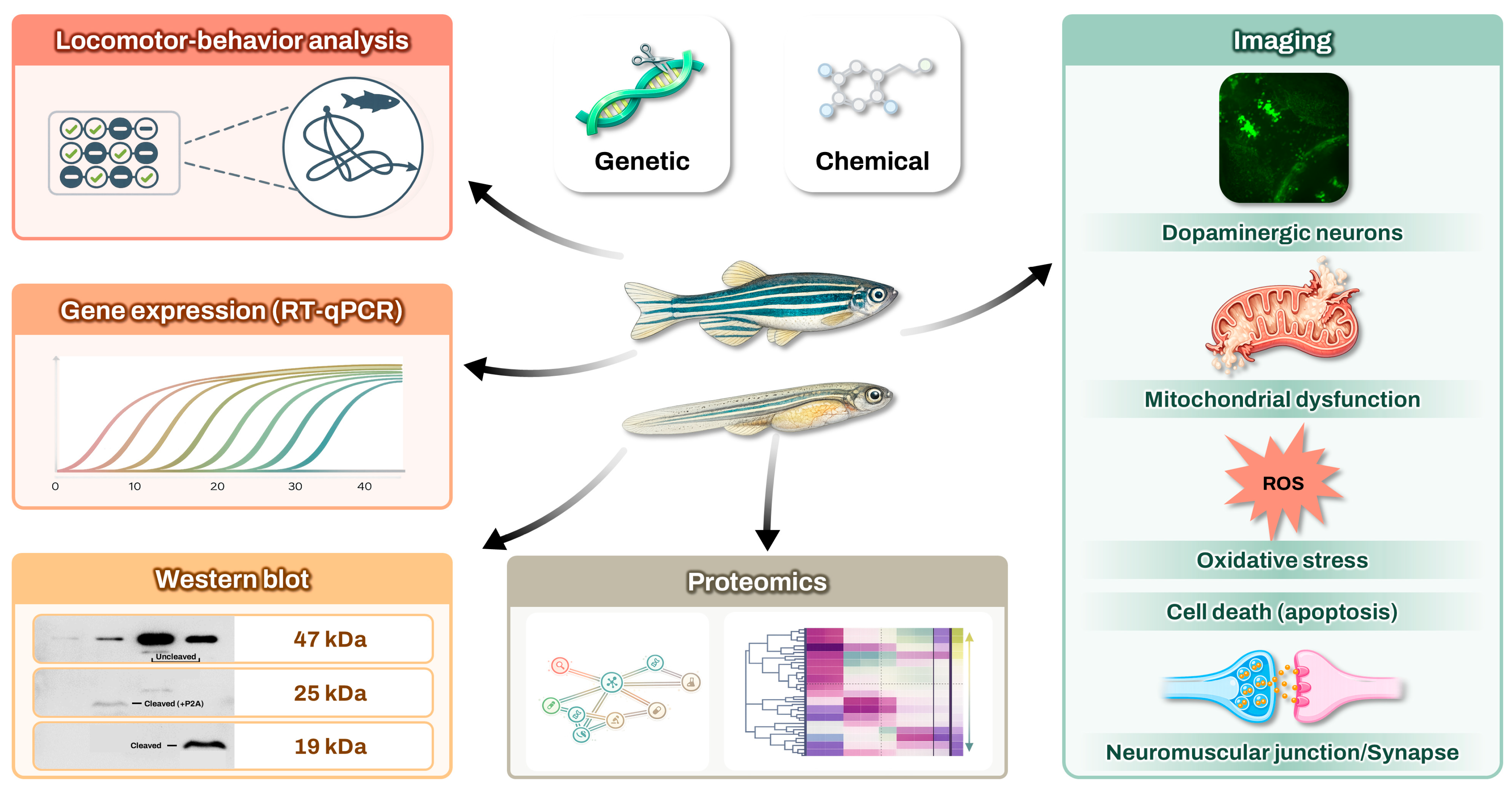
2. The Zebrafish Model for the Drug Screening of Parkinson’s Disease
3. Zebrafish Parkinson’s Disease Model
3.1. Chemical Model
3.1.1. 1-Methyl-4-Phenyl-1,2,3,6-Tetrahydropyridine (MPTP)
3.1.2. 6-Hydroxydopamine (6-OHDA)
3.1.3. Rotenone
3.1.4. Paraquat
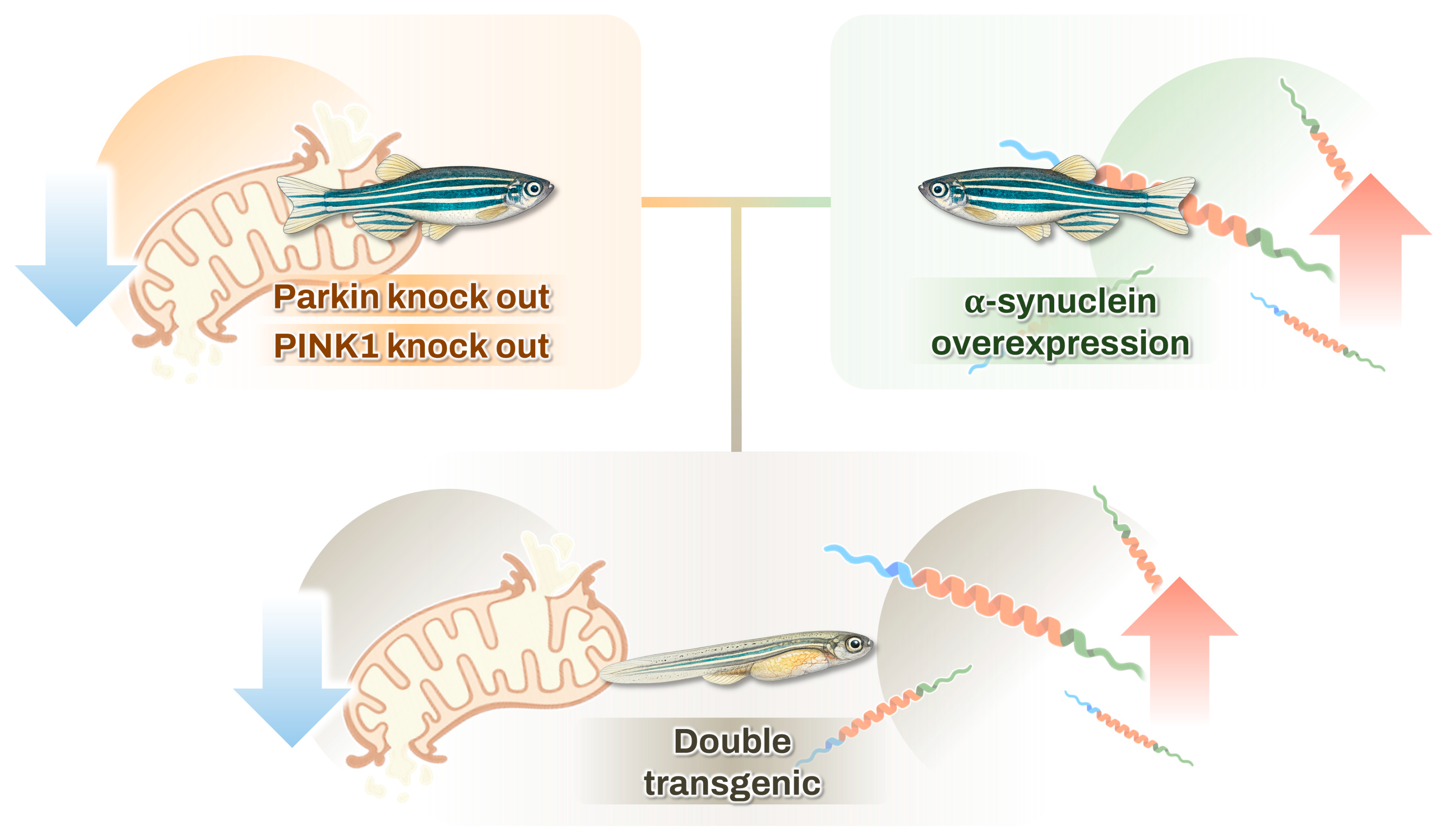
3.2. Genetic Model
3.2.1. Alpha-Synuclein (SNCA)
3.2.2. Parkin (PD Protein 2 Gene, PARK2)
3.2.3. PTEN-Induced Putative Kinase 1 (PINK1)
3.2.4. DJ-1 (PD Protein 7 Gene, PARK7)
3.2.5. Leucine-Rich Repeat Kinase 2 (LRRK2)

| Neurotoxin | Zebrafish | Dosage/ Administration Period/ Route of Administration | Locomotor- Behavior | Imaging | Additional Results | Reference |
|---|---|---|---|---|---|---|
| MPTP | Larvae | 60 µM/ 24–96 hpf/ Immersion | ↓ motility (distance, speed) | -↓ length in the subset of DA neurons -Pronounced loss and disorganization of neuronal vasculature -Significant overproduction of ROS | <RT-qPCR> -↑: αSyn, tuba1b, syn2α, peroxidation-related genes—sod1 and 2 -↓: Mitophagy-related gene—PINK1, Parkin, hoxb1a, atg7, atg12, ulk1b, beclin1, ambra1a, lc3b, antioxidant genes—gss, gsto2, gpx4a, cat | [52] |
| MPP+ | Larvae | 500 µM/ 1–5 dpf/ Immersion | -Hypokinesia -Near-complete absence of light-evoked response | <Proteomics> -Protein-protein mapping: coordinated dysregulation of DJ-1, SDHA, and multiple 26S proteasome subunits -↑: proteasome components and antioxidant proteins (early stage stress response) -↓: mitochondrial enzymes and synaptic regulators | [53] | |
| MPTP vs. MPP+ | Larvae | MPTP: 0.25 mM (LC50) MPP+: 0.05 mM (LC50)/ 3–7 dpf/ Immersion | -MPTP: ↓ ↓ locomotion -MPP+: ↓ locomotion | -MPTP: 39% DA neuron loss in vDC, Strong degeneration in clusters 8 and 13 -MPP+: 36% DA neuron loss in vDC | <RT-qPCR> -↑: p53 -↓: th1, dat -MPTP: Severe morphological defects (cardiac edema, tail curvature), Strong systemic toxicity -MPP+: No major morphological defects, More selective DA toxicity | [29] |
| 6-OHDA | Adult (6–12 months) | 10 mM (0.5 µL injection)/ single injection, analyzed at 1–7 dpi/ Intracerebroventricular injection | -Impaired olfactory responses to cadaverine (restored by 7 dpi) -No impairment of motor function | -Loss of DA periglomerular neurons in OB by injecting 6-OHDA into the dorsal telencephalic ventricle -By 7 dpi, remodeling of DA synapses in the OB (SV2 staining) -GFAP+ peaking at 3 dpi: inflammatory response -Significant ↑ Lcp1+ cells: microglial and leukocytic activation -At 1 dpi, significant ↑ TUNEL+ profiles in the OB (by 3 dpi, returned to control level) | [61] | |
| Larvae | 250 µM/ 2–4 dpf/ Immersion | -↓ locomotor activity -↑ time spent in the bottom zone | -↓ TH in whole mount immunostaining | <RT-qPCR> -↑: TNF-a and cd11b -↓: parkin and pink1 <Western blot> -↑: TNF-a and cd11b -↓: TH | [153] | |
| Rotenone | Adult (4 months) | 5 µg/L/ 28 days/ Immersion | -Impairment of locomotor activity -↑anxiety-like behavior | ↓ TH+ cells across all brain regions | <RT-qPCR> -↑: th1, th2, proinflammatory cytokines (il1a, il1b, tnfa and cox2) -↓: dat, bdnf <ELISA> -↓dopamine levels <Mitochondria function assay> -Significant resistance to complex II inhibitors (malonate and carboxin) and meclizine, compared to the control <lipid peroxidation (TBARS production)> -Significant increase in TBARS levels | [71] |
| Young adult (6 months) | 2 mg/kg/ 3 weeks/ Dissolved in sunflower oil | ↓ locomotor activity | <RT-qPCR> -↑: pink1, lrrk2, vdac, tnfa, il21, nkap, sig-1R -↓: tlr4a <Western blot> -↑: sig-1R -↓: PARK7, γSyn <Mitochondrial calcium levels inductively coupled plasma-optical emission spectrometry (ICP-OES)> -↓ calcium amount in the mitochondria. | [79] | ||
| Paraquat | Larvae | 0.04 ppm (LC50)/ 18–96 hpf/ Immersion | -↓ locomotor activity -↓ spontaneous tail coiling | ↑ apoptotic cells (acridine orange staining) with increases in the duration of exposure to paraquat | <Morphology> -Significant neurodegenerative phenotypes like bent tail structure, curved spine structure, and distorted yolk sac <Neurochemical measurement> -Significant ↓ dopamine and serotonin levels <Analysis of lipid peroxidation and glutathione level> -↑MDA ↓GSH | [92] |
| Adult (male) (0.4–0.6 g) | 10 or 20 mg/kg/ every 3 days × 6 injections/ Intraperitoneal injection | -Alterations in swimming behavior -Changes in the absolute turn angle -No significant difference in anxiety and social interaction -Impaired acquisition and consolidation of spatial memory in the Y-maze task | <RT-qPCR> -↓: dat in Pq10-treated group (no significant changes in the Pq20-treated group) <Western blot> No changes in the level of total TH protein <Liquid chromatography-tandem mass spectrometry> -Dopamine ↑ -DOPAC ↓ | [30] |
| Genes | Zebrafish | Locomotor- Behavior | Imaging | Additional Results | Reference |
|---|---|---|---|---|---|
| αSyn/SNCA | mCherry-αSyn tg larvae | basal motility deficits and anxiety traits | -↑ brain apoptotic cells (acidine orange staining) -↓ TH+ in the telencephalon and PVZ at 5 dpf -Presence of pSer129-αSyn immunopositive inclusions at 5 dpf -αSyn-positive signal co-localized with Thioflavin S in several brain areas enriched in mCherry-αSyn expression | <RT-qPCR> -↓: Syn1, Syn2a, Syn2b and Syn3 at 3dpf <Western blot> -↑: Syn IIb and Syn III at 5 dpf -Presence of high molecular weight pSer129-αSyn positive bands (phosphorylated mCherry-αSyn multimers) | [102] |
| Dendra- αSyn-wt and A53T larvae | Normal escape responses to the tail touch stimulus | -↑ cell death TUNEL -Positive Thioflavin-S staining -Significantly smaller mitochondria, ↓ mitochondrial transport, and less total displacement of mobile mitochondria in Dendra-αSyn-A53T (NeuroD:mitoRFPTag) -Dendra-αSyn clearance kinetics in vivo: changes in the clearance rate of Dendra-αSyn-A53T after inhibition of autophagic flux by ammonium chloride | <Western blot> -αSyn: equivalent level in Dendra-αSyn-wt and A53T -pS129 αSyn: significant ↑ in Dendra-αSyn-A53T compared to αSyn-wt <Morphology> -Dendra-αSyn: significant ↓ length, bent spine, and smaller heads | [104] | |
| PARKIN | MO-injected parkin KD larvae | No significant difference among wt, control MO, and Parkin-MO injected larvae | -Significant ↓ number of DC DA neurons by 20% -Significant ↓ by 50% following treatment of MPP+ -Electron microscopy: no definite morphological abnormalities of the mitochondria in parkin KD, but electron-dense material identified in the t-tubules | <Mitochondria respiratory chain function assay> -↓ complex I activity by 45% | [113] |
| Antisense gripNAs mediated parkin KD larvae | -No loss of DC DA neurons -No alteration in mitochondrial morphology (mito-GFP) -Significant ↑ basal cell death (acridine orange) -↑ cell death in response to thermal stress (Heat shock) | <RT-qPCR> -No effect on TH mRNA levels <MMP> -No alteration (JC-1) | [154] | ||
| PINK1 | MO-injected pink1 KD embryos and larvae | -↑acridine orange accumulation in the brain and throughout the body at 24 hpf -Modest ↓ TH+ cells in the brains of 2 dpf by 30% -↓ expression of reelin, Parkin -↑ fezl and Neurogenin-1 in the posterior DC -↓ slet-1 and acetylated tubulin staining in the spinal cord, suggesting loss of peripheral neurons | <Western blot> -↓: Serine 9-phosphorylated forms of GSK3 and active-catenin <Caspase 3-activity> -↑ Caspase-3 activity in MO-injected fish at 24 hpf. <MMP> -↓ (JC-1) <ROS> -Accumulation of the CM-H2DCFDA dye, in live 24 hpf <Morphology> -Long-tail, short-tail, and no-tail phenotypes (24 hpf) -Enlarged brain ventricle, slim tail-yolk extension, and curved spines (48 hpf) | [128] | |
| MO-injected pink1 KD embryos and larvae | -Impaired response to tactile stimuli -↓ swimming behavior (↓ in swimming distance and speed) | -No significant alterations in the number of DA neurons in the vDC -Altered DA neuron patterning in the vDC: located more scattered and asymmetrically further from the midline, and shortened axonal projections, or had no projections to the forebrain | <Survival> -Fewer than 20% of the morphants survived past 10 days | [129] | |
| DJ-1 | MO-injected dj-1 KD embryos and larvae | -No difference in the number of DA neurons -Significant ↓ DA neurons after exposure to H2O2, compared with WT -Significant ↓ DA neurons after exposure to proteasome inhibitor MG132, compared with WT -Marked ↑ neuronal cell death after DJ-1inactivation and MG132 exposure (TUNEL) | <RT-qPCR> -↑: SOD1 with and without exposure to H2O2, Catalase only with exposure to H2O2, p53 and Bax with and without exposure to MG132 | [136] | |
| dj-1 KO adult | <Western blot> -↓: TH in the KO brains at the late adult stage <Proteomics> -Using the young adult (3-month) brain -Dysregulated proteins involved in mitochondrial metabolism, mitophagy, stress response, redox regulation, and inflammation influenced by the lack of dj-1 <Morphology> -Lower body mass especially prevalent among male fish <In Gel Complex I Activity Assay> -↓ mitochondrial complex I activity over time | [138] | |||
| LRRK2 | MO-injected lrrk2 KD embryos and larvae | -Significant neuronal loss, including ↓ DA neurons -β-synuclein aggregation in the DC, midbrain, hindbrain, and postoptic commissure -Mis-localization of Na+/K+ ATPase protein in the apical and lateral side of the pronephric duct epithelial cells (basolateral in wt embryos) | <Western blot> -↑: β-synuclein, PARK13, and SOD1 <Morphology > -Developmental perturbations such as axis curvature defects, ocular abnormalities, and edema in the eyes, lens, and otic vesicles | [151] | |
| MO-injected lrrk2 -WD40 deletion KD embryos and larvae | ↓ swimming distance | -Loss of TH+/DAT+ DA neurons in the DC -↑ apoptosis (TUNEL) -↓ and disorganization of axon tracts, most prominently in the optic tectum (stained axonal microtubules using an acetylated-tubulin antibody) | <RT-qPCR> -↓: TH <Western blot> -↓: TH <Morphology> -Normal embryonic development, at least up to 7 dpf, without any distinguishable morphological defects, compared with LRRK KD showing embryonic lethality and severe developmental defects | [152] |
4. Investigation
4.1. Locomotor-Behavior Analysis
4.2. Imaging
4.3. Gene Expression
4.4. Western Blot and Enzyme-Linked Immunosorbent Assay (ELISA) Analysis
4.5. Proteomics
5. Future Direction
6. Conclusions
Author Contributions
Funding
Institutional Review Board Statement
Informed Consent Statement
Data Availability Statement
Conflicts of Interest
Abbreviations
| PD | Parkinson’s disease |
| αSyn | α-synuclein |
| DA | dopaminergic |
| MO | morpholino oligonucleotides |
| KD | knockdown |
| KO | knockout |
| CRISPR/Cas9 | clustered regularly interspaced short palindromic repeats-associate protein 9 |
| MPTP | 1-methyl-4-phenyl-1,2,3,6-tetrahydropyridine |
| MPP+ | 1-methyl-4-phenylpyridinium |
| DAT | dopamine transporter |
| BBB | blood–brain barrier |
| dpf | day post-fertilization |
| hpf | hour post-fertilization |
| dpi | day post-injection |
| 6-OHDA | 6-Hydroxydopamine |
| ROS | reactive oxygen species |
| MAO | monoamine oxidase |
| CNS | central nervous system |
| PQ | paraquat |
| LB | Lewy body |
| vDC | ventral diencephalon |
| SOD | superoxide dismutase |
| TH | tyrosine hydroxylase |
| Ab | antibody |
| GFP | green fluorescent protein |
| ISH | in situ hybridization |
| NMJ | neuromuscular junction |
| MMP | mitochondrial membrane potential |
| TMRM | tetramethylrhodamine methyl ester |
| TUNEL | terminal deoxynucleotidyl transferase dUTP nick-end labeling |
| RT-qPCR | reverse transcription-quantitative polymerase chain reaction |
| GSK | glycogen synthase kinase |
| UPS | ubiquitin–proteasome system |
| i.p. | intraperitoneal injection |
| MDA | malondialdehyde |
| GSH | glutathione |
| LGR | L-glutathione reduced |
| PTEN | phosphatase and tensin homolog |
| AR-JP | autosomal recessive juvenile Parkinsonism |
| AI | artificial intelligence |
References
- Kalia, L.V.; Lang, A.E. Parkinson’s disease. Lancet 2015, 386, 896–912. [Google Scholar] [CrossRef]
- Hirsch, E.C.; Jenner, P.; Przedborski, S. Pathogenesis of Parkinson’s disease. Mov. Disord. 2013, 28, 24–30. [Google Scholar] [CrossRef] [PubMed]
- Xilouri, M.; Brekk, O.R.; Stefanis, L. Autophagy and Alpha-Synuclein: Relevance to Parkinson’s Disease and Related Synucleopathies. Mov. Disord. 2016, 31, 178–192. [Google Scholar] [CrossRef]
- Ludtmann, M.H.R.; Abramov, A.Y. Mitochondrial calcium imbalance in Parkinson’s disease. Neurosci. Lett. 2018, 663, 86–90. [Google Scholar] [CrossRef]
- Schapira, A.H.; Cooper, J.M.; Dexter, D.; Clark, J.B.; Jenner, P.; Marsden, C.D. Mitochondrial complex I deficiency in Parkinson’s disease. J. Neurochem. 1990, 54, 823–827. [Google Scholar] [CrossRef]
- Kim, M.J.; Cho, S.H.; Seo, Y.; Kim, S.D.; Park, H.C.; Kim, B.J. Neuro-Restorative Effect of Nimodipine and Calcitriol in 1-Methyl 4-Phenyl 1,2,3,6 Tetrahydropyridine-Induced Zebrafish Parkinson’s Disease Model. J. Korean Neurosurg. Soc. 2024, 67, 510–520. [Google Scholar] [CrossRef] [PubMed]
- Jan, A.; Gonçalves, N.P.; Vaegter, C.B.; Jensen, P.H.; Ferreira, N. The Prion-Like Spreading of Alpha-Synuclein in Parkinson’s Disease: Update on Models and Hypotheses. Int. J. Mol. Sci. 2021, 22, 8338. [Google Scholar] [CrossRef]
- Luk, K.C.; Lee, V.M. Modeling Lewy pathology propagation in Parkinson’s disease. Park. Relat. Disord. 2014, 20, S85–S87. [Google Scholar] [CrossRef]
- Narkiewicz, J.; Giachin, G.; Legname, G. In vitro aggregation assays for the characterization of α-synuclein prion-like properties. Prion 2014, 8, 19–32. [Google Scholar] [CrossRef]
- Kitada, T.; Asakawa, S.; Hattori, N.; Matsumine, H.; Yamamura, Y.; Minoshima, S.; Yokochi, M.; Mizuno, Y.; Shimizu, N. Mutations in the parkin gene cause autosomal recessive juvenile parkinsonism. Nature 1998, 392, 605–608. [Google Scholar] [CrossRef]
- Bonifati, V.; Breedveld, G.J.; Squitieri, F.; Vanacore, N.; Brustenghi, P.; Harhangi, B.S.; Montagna, P.; Cannella, M.; Fabbrini, G.; Rizzu, P.; et al. Localization of autosomal recessive early-onset parkinsonism to chromosome 1p36 (PARK7) in an independent dataset. Ann. Neurol. 2002, 51, 253–256. [Google Scholar] [CrossRef]
- Bonifati, V.; Rizzu, P.; van Baren, M.J.; Schaap, O.; Breedveld, G.J.; Krieger, E.; Dekker, M.C.; Squitieri, F.; Ibanez, P.; Joosse, M.; et al. Mutations in the DJ-1 gene associated with autosomal recessive early-onset parkinsonism. Science 2003, 299, 256–259. [Google Scholar] [CrossRef] [PubMed]
- Valente, E.M.; Abou-Sleiman, P.M.; Caputo, V.; Muqit, M.M.; Harvey, K.; Gispert, S.; Ali, Z.; Del Turco, D.; Bentivoglio, A.R.; Healy, D.G.; et al. Hereditary early-onset Parkinson’s disease caused by mutations in PINK1. Science 2004, 304, 1158–1160. [Google Scholar] [CrossRef]
- Gandhi, S.; Wood-Kaczmar, A.; Yao, Z.; Plun-Favreau, H.; Deas, E.; Klupsch, K.; Downward, J.; Latchman, D.S.; Tabrizi, S.J.; Wood, N.W.; et al. PINK1-associated Parkinson’s disease is caused by neuronal vulnerability to calcium-induced cell death. Mol. Cell 2009, 33, 627–638. [Google Scholar] [CrossRef]
- Vijiaratnam, N.; Simuni, T.; Bandmann, O.; Morris, H.R.; Foltynie, T. Progress towards therapies for disease modification in Parkinson’s disease. Lancet Neurol. 2021, 20, 559–572. [Google Scholar] [CrossRef]
- Wang, Y.; Liu, W.; Yang, J.; Wang, F.; Sima, Y.; Zhong, Z.M.; Wang, H.; Hu, L.F.; Liu, C.F. Parkinson’s disease-like motor and non-motor symptoms in rotenone-treated zebrafish. Neurotoxicology 2017, 58, 103–109. [Google Scholar] [CrossRef]
- Bretaud, S.; MacRaild, S.; Ingham, P.W.; Bandmann, O. The influence of the zebrafish genetic background on Parkinson’s disease-related aspects. Zebrafish 2011, 8, 103–108. [Google Scholar] [CrossRef]
- Doyle, J.M.; Croll, R.P. A Critical Review of Zebrafish Models of Parkinson’s Disease. Front. Pharmacol. 2022, 13, 835827. [Google Scholar] [CrossRef]
- Barnhill, L.M.; Murata, H.; Bronstein, J.M. Studying the Pathophysiology of Parkinson’s Disease Using Zebrafish. Biomedicines 2020, 8, 197. [Google Scholar] [CrossRef] [PubMed]
- Rink, E.; Wullimann, M.F. The teleostean (zebrafish) dopaminergic system ascending to the subpallium (striatum) is located in the basal diencephalon (posterior tuberculum). Brain Res. 2001, 889, 316–330. [Google Scholar] [CrossRef] [PubMed]
- Rink, E.; Wullimann, M.F. Connections of the ventral telencephalon and tyrosine hydroxylase distribution in the zebrafish brain (Danio rerio) lead to identification of an ascending dopaminergic system in a teleost. Brain Res. Bull. 2002, 57, 385–387. [Google Scholar] [CrossRef] [PubMed]
- Ryu, S.; Holzschuh, J.; Mahler, J.; Driever, W. Genetic analysis of dopaminergic system development in zebrafish. J. Neural Transm. Suppl. 2006, 70, 61–66. [Google Scholar] [CrossRef]
- Vaz, R.L.; Outeiro, T.F.; Ferreira, J.J. Zebrafish as an Animal Model for Drug Discovery in Parkinson’s Disease and Other Movement Disorders: A Systematic Review. Front. Neurol. 2018, 9, 347. [Google Scholar] [CrossRef] [PubMed]
- Razali, K.; Othman, N.; Mohd Nasir, M.H.; Doolaanea, A.A.; Kumar, J.; Ibrahim, W.N.; Mohamed Ibrahim, N.; Mohamed, W.M.Y. The Promise of the Zebrafish Model for Parkinson’s Disease: Today’s Science and Tomorrow’s Treatment. Front. Genet. 2021, 12, 655550. [Google Scholar] [CrossRef]
- Dodiya, R.; Sharma, P.; Israni, D.; Kamal, M.A.; Greig, N.H. Zebrafish-Based Parkinson’s Disease Models: Unveiling Genetic Mechanisms and Therapeutic Pathways. CNS Neurol. Disord. Drug Targets 2025, 24, 900–920. [Google Scholar] [CrossRef]
- Rosa, J.G.S.; Lima, C.; Lopes-Ferreira, M. Zebrafish Larvae Behavior Models as a Tool for Drug Screenings and Pre-Clinical Trials: A Review. Int. J. Mol. Sci. 2022, 23, 6647. [Google Scholar] [CrossRef]
- Fernandes, A.M.; Mearns, D.S.; Donovan, J.C.; Larsch, J.; Helmbrecht, T.O.; Kölsch, Y.; Laurell, E.; Kawakami, K.; Dal Maschio, M.; Baier, H. Neural circuitry for stimulus selection in the zebrafish visual system. Neuron 2021, 109, 805–822.e806. [Google Scholar] [CrossRef]
- Lam, C.S.; Korzh, V.; Strahle, U. Zebrafish embryos are susceptible to the dopaminergic neurotoxin MPTP. Eur. J. Neurosci. 2005, 21, 1758–1762. [Google Scholar] [CrossRef]
- Kalyn, M.; Hua, K.; Mohd Noor, S.; Wong, C.E.D.; Ekker, M. Comprehensive Analysis of Neurotoxin-Induced Ablation of Dopaminergic Neurons in Zebrafish Larvae. Biomedicines 2019, 8, 1. [Google Scholar] [CrossRef] [PubMed]
- Bortolotto, J.W.; Cognato, G.P.; Christoff, R.R.; Roesler, L.N.; Leite, C.E.; Kist, L.W.; Bogo, M.R.; Vianna, M.R.; Bonan, C.D. Long-term exposure to paraquat alters behavioral parameters and dopamine levels in adult zebrafish (Danio rerio). Zebrafish 2014, 11, 142–153. [Google Scholar] [CrossRef]
- Razali, K.; Kumar, J.; Mohamed, W.M.Y. Characterizing the adult zebrafish model of Parkinson’s disease: A systematic review of dynamic changes in behavior and physiology post-MPTP administration. Front. Neurosci. 2024, 18, 1432102. [Google Scholar] [CrossRef]
- Chaoul, V.; Dib, E.Y.; Bedran, J.; Khoury, C.; Shmoury, O.; Harb, F.; Soueid, J. Assessing Drug Administration Techniques in Zebrafish Models of Neurological Disease. Int. J. Mol. Sci. 2023, 24, 14898. [Google Scholar] [CrossRef] [PubMed]
- Kalyn, M.; Ekker, M. Cerebroventricular Microinjections of MPTP on Adult Zebrafish Induces Dopaminergic Neuronal Death, Mitochondrial Fragmentation, and Sensorimotor Impairments. Front. Neurosci. 2021, 15, 718244. [Google Scholar] [CrossRef]
- Bill, B.R.; Petzold, A.M.; Clark, K.J.; Schimmenti, L.A.; Ekker, S.C. A primer for morpholino use in zebrafish. Zebrafish 2009, 6, 69–77. [Google Scholar] [CrossRef]
- Eve, A.M.; Place, E.S.; Smith, J.C. Comparison of Zebrafish tmem88a mutant and morpholino knockdown phenotypes. PLoS ONE 2017, 12, e0172227. [Google Scholar] [CrossRef]
- Rubbini, D.; Cornet, C.; Terriente, J.; Di Donato, V. CRISPR Meets Zebrafish: Accelerating the Discovery of New Therapeutic Targets. SLAS Discov. 2020, 25, 552–567. [Google Scholar] [CrossRef] [PubMed]
- Liu, J.; Zhou, Y.; Qi, X.; Chen, J.; Chen, W.; Qiu, G.; Wu, Z.; Wu, N. CRISPR/Cas9 in zebrafish: An efficient combination for human genetic diseases modeling. Hum. Genet. 2017, 136, 1–12. [Google Scholar] [CrossRef]
- Espino-Saldaña, A.E.; Rodríguez-Ortiz, R.; Pereida-Jaramillo, E.; Martínez-Torres, A. Modeling Neuronal Diseases in Zebrafish in the Era of CRISPR. Curr. Neuropharmacol. 2020, 18, 136–152. [Google Scholar] [CrossRef]
- Cornet, C.; Di Donato, V.; Terriente, J. Combining Zebrafish and CRISPR/Cas9: Toward a More Efficient Drug Discovery Pipeline. Front. Pharmacol. 2018, 9, 703. [Google Scholar] [CrossRef] [PubMed]
- Langston, J.W.; Ballard, P.; Tetrud, J.W.; Irwin, I. Chronic Parkinsonism in humans due to a product of meperidine-analog synthesis. Science 1983, 219, 979–980. [Google Scholar] [CrossRef]
- Langston, J.W. The MPTP Story. J. Park. Dis. 2017, 7, S11–S19. [Google Scholar] [CrossRef] [PubMed]
- Christensen, C.; Þorsteinsson, H.; Maier, V.H.; Karlsson, K. Multi-parameter Behavioral Phenotyping of the MPP+ Model of Parkinson’s Disease in Zebrafish. Front. Behav. Neurosci. 2020, 14, 623924. [Google Scholar] [CrossRef]
- Ramsay, R.R.; Salach, J.I.; Singer, T.P. Uptake of the neurotoxin 1-methyl-4-phenylpyridine (MPP+) by mitochondria and its relation to the inhibition of the mitochondrial oxidation of NAD+-linked substrates by MPP+. Biochem. Biophys. Res. Commun. 1986, 134, 743–748. [Google Scholar] [CrossRef]
- Nicklas, W.J.; Vyas, I.; Heikkila, R.E. Inhibition of NADH-linked oxidation in brain mitochondria by 1-methyl-4-phenyl-pyridine, a metabolite of the neurotoxin, 1-methyl-4-phenyl-1,2,5,6-tetrahydropyridine. Life Sci. 1985, 36, 2503–2508. [Google Scholar] [CrossRef]
- Wasel, O.; Freeman, J.L. Chemical and Genetic Zebrafish Models to Define Mechanisms of and Treatments for Dopaminergic Neurodegeneration. Int. J. Mol. Sci. 2020, 21, 5981. [Google Scholar] [CrossRef] [PubMed]
- Jeong, J.Y.; Kwon, H.B.; Ahn, J.C.; Kang, D.; Kwon, S.H.; Park, J.A.; Kim, K.W. Functional and developmental analysis of the blood-brain barrier in zebrafish. Brain Res. Bull. 2008, 75, 619–628. [Google Scholar] [CrossRef]
- Xie, J.; Farage, E.; Sugimoto, M.; Anand-Apte, B. A novel transgenic zebrafish model for blood-brain and blood-retinal barrier development. BMC Dev. Biol. 2010, 10, 76. [Google Scholar] [CrossRef]
- Omar, N.A.; Kumar, J.; Teoh, S.L. Parkinson’s disease model in zebrafish using intraperitoneal MPTP injection. Front. Neurosci. 2023, 17, 1236049. [Google Scholar] [CrossRef]
- Sarath Babu, N.; Murthy Ch, L.; Kakara, S.; Sharma, R.; Brahmendra Swamy, C.V.; Idris, M.M. 1-Methyl-4-phenyl-1,2,3,6-tetrahydropyridine induced Parkinson’s disease in zebrafish. Proteomics 2016, 16, 1407–1420. [Google Scholar] [CrossRef] [PubMed]
- Selvaraj, V.; Venkatasubramanian, H.; Ilango, K.; Santhakumar, K. A simple method to study motor and non-motor behaviors in adult zebrafish. J. Neurosci. Methods 2019, 320, 16–25. [Google Scholar] [CrossRef]
- Anichtchik, O.V.; Kaslin, J.; Peitsaro, N.; Scheinin, M.; Panula, P. Neurochemical and behavioural changes in zebrafish Danio rerio after systemic administration of 6-hydroxydopamine and 1-methyl-4-phenyl-1,2,3,6-tetrahydropyridine. J. Neurochem. 2004, 88, 443–453. [Google Scholar] [CrossRef]
- Ye, H.; Li, D.; Zhang, L.; Wang, Y.; Wang, C.; Jin, M.; Lin, H.; Li, P.; Sun, C.; Li, N. Epicoccin A Ameliorates PD-like Symptoms in Zebrafish: Enhancement of PINK1/Parkin-Dependent Mitophagy and Inhibition of Excessive Oxidative Stress. Mar. Drugs 2025, 23, 175. [Google Scholar] [CrossRef]
- Maleski, A.L.A.; da Cunha, E.S.F.A.; Echeverry, M.B.; Alberto-Silva, C. Integrated Behavioral and Proteomic Characterization of MPP(+)-Induced Early Neurodegeneration and Parkinsonism in Zebrafish Larvae. Int. J. Mol. Sci. 2025, 26, 6762. [Google Scholar] [CrossRef]
- Intonti, S.; Enzmann, V.; Perna, A.; Spagnolo, F.; Curcio, C.; Conedera, F.M. Comparative Analysis of T-Cell Signatures and Astroglial Reactivity in Parkinson’s Pathology Across Animal Models with Distinct Regenerative Capacities. Int. J. Mol. Sci. 2026, 27, 965. [Google Scholar] [CrossRef]
- Isik, S.; Yeman Kiyak, B.; Akbayir, R.; Seyhali, R.; Arpaci, T. Microglia Mediated Neuroinflammation in Parkinson’s Disease. Cells 2023, 12, 1012. [Google Scholar] [CrossRef] [PubMed]
- Lin, Z.; Yu, X.; Zhong, Y.; Tan, G.; Zhong, J. The role of T cells in the treatment of Parkinson’s disease. PeerJ 2025, 13, e19818. [Google Scholar] [CrossRef] [PubMed]
- Cobley, J.N.; Fiorello, M.L.; Bailey, D.M. 13 reasons why the brain is susceptible to oxidative stress. Redox Biol. 2018, 15, 490–503. [Google Scholar] [CrossRef] [PubMed]
- Burbulla, L.F.; Song, P.; Mazzulli, J.R.; Zampese, E.; Wong, Y.C.; Jeon, S.; Santos, D.P.; Blanz, J.; Obermaier, C.D.; Strojny, C.; et al. Dopamine oxidation mediates mitochondrial and lysosomal dysfunction in Parkinson’s disease. Science 2017, 357, 1255–1261. [Google Scholar] [CrossRef]
- Mazzulli, J.R.; Xu, Y.H.; Sun, Y.; Knight, A.L.; McLean, P.J.; Caldwell, G.A.; Sidransky, E.; Grabowski, G.A.; Krainc, D. Gaucher disease glucocerebrosidase and α-synuclein form a bidirectional pathogenic loop in synucleinopathies. Cell 2011, 146, 37–52. [Google Scholar] [CrossRef]
- Vijayanathan, Y.; Lim, F.T.; Lim, S.M.; Long, C.M.; Tan, M.P.; Majeed, A.B.A.; Ramasamy, K. 6-OHDA-Lesioned Adult Zebrafish as a Useful Parkinson’s Disease Model for Dopaminergic Neuroregeneration. Neurotox. Res. 2017, 32, 496–508. [Google Scholar] [CrossRef]
- Vorhees, N.W.; Groenwold, S.L.; Williams, M.T.; Putt, L.S.; Sanchez-Gama, N.; Stalions, G.A.; Taylor, G.M.; Van Dort, H.E.; Calvo-Ochoa, E. Olfactory Dysfunction in a Novel Model of Prodromal Parkinson’s Disease in Adult Zebrafish. Int. J. Mol. Sci. 2025, 26, 4474. [Google Scholar] [CrossRef]
- Caldwell, L.J.; Davies, N.O.; Cavone, L.; Mysiak, K.S.; Semenova, S.A.; Panula, P.; Armstrong, J.D.; Becker, C.G.; Becker, T. Regeneration of Dopaminergic Neurons in Adult Zebrafish Depends on Immune System Activation and Differs for Distinct Populations. J. Neurosci. 2019, 39, 4694–4713. [Google Scholar] [CrossRef] [PubMed]
- Kyritsis, N.; Kizil, C.; Zocher, S.; Kroehne, V.; Kaslin, J.; Freudenreich, D.; Iltzsche, A.; Brand, M. Acute inflammation initiates the regenerative response in the adult zebrafish brain. Science 2012, 338, 1353–1356. [Google Scholar] [CrossRef] [PubMed]
- Becker, T.; Becker, C.G. Axonal regeneration in zebrafish. Curr. Opin. Neurobiol. 2014, 27, 186–191. [Google Scholar] [CrossRef] [PubMed]
- Henchcliffe, C.; Beal, M.F. Mitochondrial biology and oxidative stress in Parkinson disease pathogenesis. Nat. Clin. Pract. Neurol. 2008, 4, 600–609. [Google Scholar] [CrossRef]
- Tanner, C.M.; Kamel, F.; Ross, G.W.; Hoppin, J.A.; Goldman, S.M.; Korell, M.; Marras, C.; Bhudhikanok, G.S.; Kasten, M.; Chade, A.R.; et al. Rotenone, paraquat, and Parkinson’s disease. Environ. Health Perspect. 2011, 119, 866–872. [Google Scholar] [CrossRef]
- Li, A.A.; Mink, P.J.; McIntosh, L.J.; Teta, M.J.; Finley, B. Evaluation of epidemiologic and animal data associating pesticides with Parkinson’s disease. J. Occup. Environ. Med. 2005, 47, 1059–1087. [Google Scholar] [CrossRef]
- Hatcher, J.M.; Pennell, K.D.; Miller, G.W. Parkinson’s disease and pesticides: A toxicological perspective. Trends Pharmacol. Sci. 2008, 29, 322–329. [Google Scholar] [CrossRef]
- Drolet, R.E.; Cannon, J.R.; Montero, L.; Greenamyre, J.T. Chronic rotenone exposure reproduces Parkinson’s disease gastrointestinal neuropathology. Neurobiol. Dis. 2009, 36, 96–102. [Google Scholar] [CrossRef]
- Pan-Montojo, F.; Anichtchik, O.; Dening, Y.; Knels, L.; Pursche, S.; Jung, R.; Jackson, S.; Gille, G.; Spillantini, M.G.; Reichmann, H.; et al. Progression of Parkinson’s disease pathology is reproduced by intragastric administration of rotenone in mice. PLoS ONE 2010, 5, e8762. [Google Scholar] [CrossRef]
- Nies, Y.H.; Lim, W.L.; Abd Karim, N.; Yahaya, M.F.; Teoh, S.L. Metallothionein II treatment mitigates rotenone-induced neurodegeneration in zebrafish models of Parkinson’s disease. Front. Pharmacol. 2025, 16, 1478013. [Google Scholar] [CrossRef]
- Singh, R.; Zahra, W.; Singh, S.S.; Birla, H.; Rathore, A.S.; Keshri, P.K.; Dilnashin, H.; Singh, S.; Singh, S.P. Oleuropein confers neuroprotection against rotenone-induced model of Parkinson’s disease via BDNF/CREB/Akt pathway. Sci. Rep. 2023, 13, 2452. [Google Scholar] [CrossRef]
- Ünal, İ.; Çalışkan-Ak, E.; Üstündağ, Ü.V.; Ateş, P.S.; Alturfan, A.A.; Altinoz, M.A.; Elmaci, I.; Emekli-Alturfan, E. Neuroprotective effects of mitoquinone and oleandrin on Parkinson’s disease model in zebrafish. Int. J. Neurosci. 2020, 130, 574–582. [Google Scholar] [CrossRef]
- Cansız, D.; Ünal, İ.; Üstündağ, Ü.V.; Alturfan, A.A.; Altinoz, M.A.; Elmacı, İ.; Emekli-Alturfan, E. Caprylic acid ameliorates rotenone induced inflammation and oxidative stress in the gut-brain axis in Zebrafish. Mol. Biol. Rep. 2021, 48, 5259–5273. [Google Scholar] [CrossRef]
- Rasheed, M.Z.; Tabassum, H.; Parvez, S. Mitochondrial permeability transition pore: A promising target for the treatment of Parkinson’s disease. Protoplasma 2017, 254, 33–42. [Google Scholar] [CrossRef]
- Chan, C.S.; Gertler, T.S.; Surmeier, D.J. Calcium homeostasis, selective vulnerability and Parkinson’s disease. Trends Neurosci. 2009, 32, 249–256. [Google Scholar] [CrossRef] [PubMed]
- Ruscher, K.; Wieloch, T. The involvement of the sigma-1 receptor in neurodegeneration and neurorestoration. J. Pharmacol. Sci. 2015, 127, 30–35. [Google Scholar] [CrossRef] [PubMed]
- Francardo, V. Sigma-1 receptor: A potential new target for Parkinson’s disease? Neural Regen. Res. 2014, 9, 1882–1883. [Google Scholar] [CrossRef] [PubMed]
- Yurtsever, İ.; Üstündağ, Ü.V.; Ünal, İ.; Ateş, P.S.; Emekli-Alturfan, E. Rifampicin decreases neuroinflammation to maintain mitochondrial function and calcium homeostasis in rotenone-treated zebrafish. Drug Chem. Toxicol. 2022, 45, 1544–1551. [Google Scholar] [CrossRef]
- Parthiban, A.; Thippeswamy, N.P.; Jayanthi, P.A.; Palaniselvam, S.; Ramachandran, S. Synergistic effect of carboxymethyl chitosan and phloroglucinol against rotenone induced Parkinson’s disease in zebrafish model. Brain Res. 2026, 1882, 150284. [Google Scholar] [CrossRef]
- Baldi, I.; Cantagrel, A.; Lebailly, P.; Tison, F.; Dubroca, B.; Chrysostome, V.; Dartigues, J.F.; Brochard, P. Association between Parkinson’s disease and exposure to pesticides in southwestern France. Neuroepidemiology 2003, 22, 305–310. [Google Scholar] [CrossRef]
- Costello, S.; Cockburn, M.; Bronstein, J.; Zhang, X.; Ritz, B. Parkinson’s disease and residential exposure to maneb and paraquat from agricultural applications in the central valley of California. Am. J. Epidemiol. 2009, 169, 919–926. [Google Scholar] [CrossRef]
- Dhillon, A.S.; Tarbutton, G.L.; Levin, J.L.; Plotkin, G.M.; Lowry, L.K.; Nalbone, J.T.; Shepherd, S. Pesticide/environmental exposures and Parkinson’s disease in East Texas. J. Agromed. 2008, 13, 37–48. [Google Scholar] [CrossRef] [PubMed]
- Dinis-Oliveira, R.J.; Remião, F.; Carmo, H.; Duarte, J.A.; Navarro, A.S.; Bastos, M.L.; Carvalho, F. Paraquat exposure as an etiological factor of Parkinson’s disease. Neurotoxicology 2006, 27, 1110–1122. [Google Scholar] [CrossRef]
- Liou, H.H.; Tsai, M.C.; Chen, C.J.; Jeng, J.S.; Chang, Y.C.; Chen, S.Y.; Chen, R.C. Environmental risk factors and Parkinson’s disease: A case-control study in Taiwan. Neurology 1997, 48, 1583–1588. [Google Scholar] [CrossRef]
- Janda, E.; Lascala, A.; Carresi, C.; Parafati, M.; Aprigliano, S.; Russo, V.; Savoia, C.; Ziviani, E.; Musolino, V.; Morani, F.; et al. Parkinsonian toxin-induced oxidative stress inhibits basal autophagy in astrocytes via NQO2/quinone oxidoreductase 2: Implications for neuroprotection. Autophagy 2015, 11, 1063–1080, Erratum in Autophagy 2017, 13, 638. [Google Scholar] [CrossRef] [PubMed]
- Dinis-Oliveira, R.J.; Duarte, J.A.; Sánchez-Navarro, A.; Remião, F.; Bastos, M.L.; Carvalho, F. Paraquat poisonings: Mechanisms of lung toxicity, clinical features, and treatment. Crit. Rev. Toxicol. 2008, 38, 13–71. [Google Scholar] [CrossRef]
- Day, B.J.; Patel, M.; Calavetta, L.; Chang, L.Y.; Stamler, J.S. A mechanism of paraquat toxicity involving nitric oxide synthase. Proc. Natl. Acad. Sci. USA 1999, 96, 12760–12765. [Google Scholar] [CrossRef]
- Rappold, P.M.; Cui, M.; Chesser, A.S.; Tibbett, J.; Grima, J.C.; Duan, L.; Sen, N.; Javitch, J.A.; Tieu, K. Paraquat neurotoxicity is mediated by the dopamine transporter and organic cation transporter-3. Proc. Natl. Acad. Sci. USA 2011, 108, 20766–20771. [Google Scholar] [CrossRef] [PubMed]
- Wang, Q.; Liu, S.; Hu, D.; Wang, Z.; Wang, L.; Wu, T.; Wu, Z.; Mohan, C.; Peng, A. Identification of apoptosis and macrophage migration events in paraquat-induced oxidative stress using a zebrafish model. Life Sci. 2016, 157, 116–124. [Google Scholar] [CrossRef]
- Nunes, M.E.; Müller, T.E.; Braga, M.M.; Fontana, B.D.; Quadros, V.A.; Marins, A.; Rodrigues, C.; Menezes, C.; Rosemberg, D.B.; Loro, V.L. Chronic Treatment with Paraquat Induces Brain Injury, Changes in Antioxidant Defenses System, and Modulates Behavioral Functions in Zebrafish. Mol. Neurobiol. 2017, 54, 3925–3934. [Google Scholar] [CrossRef]
- Nellore, J.; Nandita, P. Paraquat exposure induces behavioral deficits in larval zebrafish during the window of dopamine neurogenesis. Toxicol. Rep. 2015, 2, 950–956. [Google Scholar] [CrossRef]
- Spillantini, M.G.; Schmidt, M.L.; Lee, V.M.; Trojanowski, J.Q.; Jakes, R.; Goedert, M. Alpha-synuclein in Lewy bodies. Nature 1997, 388, 839–840. [Google Scholar] [CrossRef]
- Bellucci, A.; Mercuri, N.B.; Venneri, A.; Faustini, G.; Longhena, F.; Pizzi, M.; Missale, C.; Spano, P. Review: Parkinson’s disease: From synaptic loss to connectome dysfunction. Neuropathol. Appl. Neurobiol. 2016, 42, 77–94. [Google Scholar] [CrossRef]
- Calabresi, P.; Mechelli, A.; Natale, G.; Volpicelli-Daley, L.; Di Lazzaro, G.; Ghiglieri, V. Alpha-synuclein in Parkinson’s disease and other synucleinopathies: From overt neurodegeneration back to early synaptic dysfunction. Cell Death Dis. 2023, 14, 176. [Google Scholar] [CrossRef]
- Marques, O.; Outeiro, T.F. Alpha-synuclein: From secretion to dysfunction and death. Cell Death Dis. 2012, 3, e350. [Google Scholar] [CrossRef]
- Longhena, F.; Faustini, G.; Spillantini, M.G.; Bellucci, A. Living in Promiscuity: The Multiple Partners of Alpha-Synuclein at the Synapse in Physiology and Pathology. Int. J. Mol. Sci. 2019, 20, 141. [Google Scholar] [CrossRef]
- Mahul-Mellier, A.L.; Burtscher, J.; Maharjan, N.; Weerens, L.; Croisier, M.; Kuttler, F.; Leleu, M.; Knott, G.W.; Lashuel, H.A. The process of Lewy body formation, rather than simply α-synuclein fibrillization, is one of the major drivers of neurodegeneration. Proc. Natl. Acad. Sci. USA 2020, 117, 4971–4982. [Google Scholar] [CrossRef]
- Zhang, J.; Li, X.; Li, J.D. The Roles of Post-translational Modifications on α-Synuclein in the Pathogenesis of Parkinson’s Diseases. Front. Neurosci. 2019, 13, 381. [Google Scholar] [CrossRef]
- Konno, T.; Ross, O.A.; Puschmann, A.; Dickson, D.W.; Wszolek, Z.K. Autosomal dominant Parkinson’s disease caused by SNCA duplications. Park. Relat. Disord. 2016, 22, S1–S6. [Google Scholar] [CrossRef]
- Milanese, C.; Sager, J.J.; Bai, Q.; Farrell, T.C.; Cannon, J.R.; Greenamyre, J.T.; Burton, E.A. Hypokinesia and reduced dopamine levels in zebrafish lacking β- and γ1-synucleins. J. Biol. Chem. 2012, 287, 2971–2983. [Google Scholar] [CrossRef]
- Zini, S.; Muscò, A.; Longhena, F.; Faustini, G.; Tobia, C.; Borsani, G.; Spillantini, M.G.; Zizioli, D.; Bellucci, A. A novel stable transgenic zebrafish line expressing mCherry-tagged human alpha-synuclein in the nervous system and exhibiting all the key features of Lewy body disorders at larval stage. Neurobiol. Dis. 2025, 213, 107018. [Google Scholar] [CrossRef]
- Conway, K.A.; Harper, J.D.; Lansbury, P.T. Accelerated in vitro fibril formation by a mutant alpha-synuclein linked to early-onset Parkinson disease. Nat. Med. 1998, 4, 1318–1320. [Google Scholar] [CrossRef]
- Lopez, A.; Gorb, A.; Palha, N.; Fleming, A.; Rubinsztein, D.C. A New Zebrafish Model to Measure Neuronal α-Synuclein Clearance In Vivo. Genes 2022, 13, 868. [Google Scholar] [CrossRef]
- Subedi, A.; Macurak, M.; Gee, S.T.; Monge, E.; Goll, M.G.; Potter, C.J.; Parsons, M.J.; Halpern, M.E. Adoption of the Q transcriptional regulatory system for zebrafish transgenesis. Methods 2014, 66, 433–440. [Google Scholar] [CrossRef]
- Tanner, C.M.; Ottman, R.; Goldman, S.M.; Ellenberg, J.; Chan, P.; Mayeux, R.; Langston, J.W. Parkinson disease in twins: An etiologic study. JAMA 1999, 281, 341–346. [Google Scholar] [CrossRef]
- Imai, Y.; Soda, M.; Takahashi, R. Parkin suppresses unfolded protein stress-induced cell death through its E3 ubiquitin-protein ligase activity. J. Biol. Chem. 2000, 275, 35661–35664. [Google Scholar] [CrossRef]
- Chung, K.K.; Zhang, Y.; Lim, K.L.; Tanaka, Y.; Huang, H.; Gao, J.; Ross, C.A.; Dawson, V.L.; Dawson, T.M. Parkin ubiquitinates the alpha-synuclein-interacting protein, synphilin-1: Implications for Lewy-body formation in Parkinson disease. Nat. Med. 2001, 7, 1144–1150. [Google Scholar] [CrossRef]
- Ashrafi, G.; Schwarz, T.L. The pathways of mitophagy for quality control and clearance of mitochondria. Cell Death Differ. 2013, 20, 31–42. [Google Scholar] [CrossRef]
- Jęśko, H.; Lenkiewicz, A.M.; Wilkaniec, A.; Adamczyk, A. The interplay between parkin and alpha-synuclein; possible implications for the pathogenesis of Parkinson’s disease. Acta Neurobiol. Exp. 2019, 79, 276–289. [Google Scholar]
- Wilkaniec, A.; Strosznajder, J.B.; Adamczyk, A. Toxicity of extracellular secreted alpha-synuclein: Its role in nitrosative stress and neurodegeneration. Neurochem. Int. 2013, 62, 776–783, Erratum in Neurochem. Int. 2013, 62, 1079. [Google Scholar] [CrossRef]
- Wilkaniec, A.; Lenkiewicz, A.M.; Babiec, L.; Murawska, E.; Jęśko, H.M.; Cieślik, M.; Culmsee, C.; Adamczyk, A. Exogenous Alpha-Synuclein Evoked Parkin Downregulation Promotes Mitochondrial Dysfunction in Neuronal Cells. Implications for Parkinson’s Disease Pathology. Front. Aging Neurosci. 2021, 13, 591475. [Google Scholar] [CrossRef] [PubMed]
- Flinn, L.; Mortiboys, H.; Volkmann, K.; Köster, R.W.; Ingham, P.W.; Bandmann, O. Complex I deficiency and dopaminergic neuronal cell loss in parkin-deficient zebrafish (Danio rerio). Brain 2009, 132, 1613–1623. [Google Scholar] [CrossRef]
- Brette, F.; Orchard, C. Resurgence of cardiac t-tubule research. Physiology 2007, 22, 167–173. [Google Scholar] [CrossRef]
- Guzman, J.N.; Sanchez-Padilla, J.; Wokosin, D.; Kondapalli, J.; Ilijic, E.; Schumacker, P.T.; Surmeier, D.J. Oxidant stress evoked by pacemaking in dopaminergic neurons is attenuated by DJ-1. Nature 2010, 468, 696–700, Erratum in Nature 2015, 521, 380. [Google Scholar] [CrossRef]
- Kang, S.; Cooper, G.; Dunne, S.F.; Dusel, B.; Luan, C.H.; Surmeier, D.J.; Silverman, R.B. CaV1.3-selective L-type calcium channel antagonists as potential new therapeutics for Parkinson’s disease. Nat. Commun. 2012, 3, 1146. [Google Scholar] [CrossRef]
- Ilijic, E.; Guzman, J.N.; Surmeier, D.J. The L-type channel antagonist isradipine is neuroprotective in a mouse model of Parkinson’s disease. Neurobiol. Dis. 2011, 43, 364–371. [Google Scholar] [CrossRef] [PubMed]
- Kang, S.; Cooper, G.; Dunne, S.F.; Luan, C.H.; James Surmeier, D.; Silverman, R.B. Antagonism of L-type Ca2+ channels CaV1.3 and CaV1.2 by 1,4-dihydropyrimidines and 4H-pyrans as dihydropyridine mimics. Bioorg. Med. Chem. 2013, 21, 4365–4373. [Google Scholar] [CrossRef] [PubMed]
- Surmeier, D.J.; Halliday, G.M.; Simuni, T. Calcium, mitochondrial dysfunction and slowing the progression of Parkinson’s disease. Exp. Neurol. 2017, 298, 202–209. [Google Scholar] [CrossRef]
- Surmeier, D.J.; Schumacker, P.T.; Guzman, J.D.; Ilijic, E.; Yang, B.; Zampese, E. Calcium and Parkinson’s disease. Biochem. Biophys. Res. Commun. 2017, 483, 1013–1019. [Google Scholar] [CrossRef]
- Chang, C.C.; Cao, S.; Kang, S.; Kai, L.; Tian, X.; Pandey, P.; Dunne, S.F.; Luan, C.H.; Surmeier, D.J.; Silverman, R.B. Antagonism of 4-substituted 1,4-dihydropyridine-3,5-dicarboxylates toward voltage-dependent L-type Ca2+ channels Ca V 1.3 and Ca V 1.2. Bioorg. Med. Chem. 2010, 18, 3147–3158. [Google Scholar] [CrossRef] [PubMed]
- Weihofen, A.; Thomas, K.J.; Ostaszewski, B.L.; Cookson, M.R.; Selkoe, D.J. Pink1 forms a multiprotein complex with Miro and Milton, linking Pink1 function to mitochondrial trafficking. Biochemistry 2009, 48, 2045–2052. [Google Scholar] [CrossRef]
- Gautier, C.A.; Kitada, T.; Shen, J. Loss of PINK1 causes mitochondrial functional defects and increased sensitivity to oxidative stress. Proc. Natl. Acad. Sci. USA 2008, 105, 11364–11369. [Google Scholar] [CrossRef] [PubMed]
- Beilina, A.; Van Der Brug, M.; Ahmad, R.; Kesavapany, S.; Miller, D.W.; Petsko, G.A.; Cookson, M.R. Mutations in PTEN-induced putative kinase 1 associated with recessive parkinsonism have differential effects on protein stability. Proc. Natl. Acad. Sci. USA 2005, 102, 5703–5708. [Google Scholar] [CrossRef]
- Exner, N.; Treske, B.; Paquet, D.; Holmström, K.; Schiesling, C.; Gispert, S.; Carballo-Carbajal, I.; Berg, D.; Hoepken, H.H.; Gasser, T.; et al. Loss-of-function of human PINK1 results in mitochondrial pathology and can be rescued by parkin. J. Neurosci. 2007, 27, 12413–12418. [Google Scholar] [CrossRef]
- Poole, A.C.; Thomas, R.E.; Andrews, L.A.; McBride, H.M.; Whitworth, A.J.; Pallanck, L.J. The PINK1/Parkin pathway regulates mitochondrial morphology. Proc. Natl. Acad. Sci. USA 2008, 105, 1638–1643. [Google Scholar] [CrossRef]
- Priyadarshini, M.; Orosco, L.A.; Panula, P.J. Oxidative stress and regulation of Pink1 in zebrafish (Danio rerio). PLoS ONE 2013, 8, e81851. [Google Scholar] [CrossRef]
- Anichtchik, O.; Diekmann, H.; Fleming, A.; Roach, A.; Goldsmith, P.; Rubinsztein, D.C. Loss of PINK1 function affects development and results in neurodegeneration in zebrafish. J. Neurosci. 2008, 28, 8199–8207. [Google Scholar] [CrossRef] [PubMed]
- Xi, Y.; Ryan, J.; Noble, S.; Yu, M.; Yilbas, A.E.; Ekker, M. Impaired dopaminergic neuron development and locomotor function in zebrafish with loss of pink1 function. Eur. J. Neurosci. 2010, 31, 623–633. [Google Scholar] [CrossRef]
- Kim, R.H.; Peters, M.; Jang, Y.; Shi, W.; Pintilie, M.; Fletcher, G.C.; DeLuca, C.; Liepa, J.; Zhou, L.; Snow, B.; et al. DJ-1, a novel regulator of the tumor suppressor PTEN. Cancer Cell 2005, 7, 263–273. [Google Scholar] [CrossRef]
- Liu, H.; Wang, M.; Li, M.; Wang, D.; Rao, Q.; Wang, Y.; Xu, Z.; Wang, J. Expression and role of DJ-1 in leukemia. Biochem. Biophys. Res. Commun. 2008, 375, 477–483. [Google Scholar] [CrossRef]
- Bandopadhyay, R.; Kingsbury, A.E.; Cookson, M.R.; Reid, A.R.; Evans, I.M.; Hope, A.D.; Pittman, A.M.; Lashley, T.; Canet-Aviles, R.; Miller, D.W.; et al. The expression of DJ-1 (PARK7) in normal human CNS and idiopathic Parkinson’s disease. Brain 2004, 127, 420–430. [Google Scholar] [CrossRef]
- Rizzu, P.; Hinkle, D.A.; Zhukareva, V.; Bonifati, V.; Severijnen, L.A.; Martinez, D.; Ravid, R.; Kamphorst, W.; Eberwine, J.H.; Lee, V.M.; et al. DJ-1 colocalizes with tau inclusions: A link between parkinsonism and dementia. Ann. Neurol. 2004, 55, 113–118. [Google Scholar] [CrossRef] [PubMed]
- Neumann, M.; Müller, V.; Görner, K.; Kretzschmar, H.A.; Haass, C.; Kahle, P.J. Pathological properties of the Parkinson’s disease-associated protein DJ-1 in alpha-synucleinopathies and tauopathies: Relevance for multiple system atrophy and Pick’s disease. Acta Neuropathol. 2004, 107, 489–496. [Google Scholar] [CrossRef] [PubMed]
- Bai, Q.; Mullett, S.J.; Garver, J.A.; Hinkle, D.A.; Burton, E.A. Zebrafish DJ-1 is evolutionarily conserved and expressed in dopaminergic neurons. Brain Res. 2006, 1113, 33–44. [Google Scholar] [CrossRef]
- Bretaud, S.; Allen, C.; Ingham, P.W.; Bandmann, O. p53-dependent neuronal cell death in a DJ-1-deficient zebrafish model of Parkinson’s disease. J. Neurochem. 2007, 100, 1626–1635. [Google Scholar] [CrossRef]
- Baulac, S.; Lu, H.; Strahle, J.; Yang, T.; Goldberg, M.S.; Shen, J.; Schlossmacher, M.G.; Lemere, C.A.; Lu, Q.; Xia, W. Increased DJ-1 expression under oxidative stress and in Alzheimer’s disease brains. Mol. Neurodegener. 2009, 4, 12. [Google Scholar] [CrossRef]
- Edson, A.J.; Hushagen, H.A.; Frøyset, A.K.; Elda, I.; Khan, E.A.; Di Stefano, A.; Fladmark, K.E. Dysregulation in the Brain Protein Profile of Zebrafish Lacking the Parkinson’s Disease-Related Protein DJ-1. Mol. Neurobiol. 2019, 56, 8306–8322. [Google Scholar] [CrossRef] [PubMed]
- Solheim, N.; Pinho, B.R.; Oliveira, N.A.S.; Lima, L.P.; Børve, A.; Oliveira, J.M.A.; Fladmark, K.E. Early motor deficits, sleep dysfunction and reduction in dopaminergic neurons in a PARK7(-/-) zebrafish larval model of Parkinson’s disease. Sci. Rep. 2026, 16, 9525. [Google Scholar] [CrossRef]
- Funayama, M.; Hasegawa, K.; Kowa, H.; Saito, M.; Tsuji, S.; Obata, F. A new locus for Parkinson’s disease (PARK8) maps to chromosome 12p11.2-q13.1. Ann. Neurol. 2002, 51, 296–301. [Google Scholar] [CrossRef] [PubMed]
- Paisán-Ruíz, C.; Jain, S.; Evans, E.W.; Gilks, W.P.; Simón, J.; van der Brug, M.; López de Munain, A.; Aparicio, S.; Gil, A.M.; Khan, N.; et al. Cloning of the gene containing mutations that cause PARK8-linked Parkinson’s disease. Neuron 2004, 44, 595–600. [Google Scholar] [CrossRef]
- Funayama, M.; Hasegawa, K.; Ohta, E.; Kawashima, N.; Komiyama, M.; Kowa, H.; Tsuji, S.; Obata, F. An LRRK2 mutation as a cause for the parkinsonism in the original PARK8 family. Ann. Neurol. 2005, 57, 918–921. [Google Scholar] [CrossRef] [PubMed]
- Zimprich, A.; Biskup, S.; Leitner, P.; Lichtner, P.; Farrer, M.; Lincoln, S.; Kachergus, J.; Hulihan, M.; Uitti, R.J.; Calne, D.B.; et al. Mutations in LRRK2 cause autosomal-dominant parkinsonism with pleomorphic pathology. Neuron 2004, 44, 601–607. [Google Scholar] [CrossRef]
- Xu, E.; Boddu, R.; Abdelmotilib, H.A.; Sokratian, A.; Kelly, K.; Liu, Z.; Bryant, N.; Chandra, S.; Carlisle, S.M.; Lefkowitz, E.J.; et al. Pathological α-synuclein recruits LRRK2 expressing pro-inflammatory monocytes to the brain. Mol. Neurodegener. 2022, 17, 7. [Google Scholar] [CrossRef] [PubMed]
- Schapansky, J.; Nardozzi, J.D.; LaVoie, M.J. The complex relationships between microglia, alpha-synuclein, and LRRK2 in Parkinson’s disease. Neuroscience 2015, 302, 74–88. [Google Scholar] [CrossRef] [PubMed]
- Singh, A.; Zhi, L.; Zhang, H. LRRK2 and mitochondria: Recent advances and current views. Brain Res. 2019, 1702, 96–104. [Google Scholar] [CrossRef]
- Nguyen, H.N.; Byers, B.; Cord, B.; Shcheglovitov, A.; Byrne, J.; Gujar, P.; Kee, K.; Schüle, B.; Dolmetsch, R.E.; Langston, W.; et al. LRRK2 mutant iPSC-derived DA neurons demonstrate increased susceptibility to oxidative stress. Cell Stem Cell 2011, 8, 267–280. [Google Scholar] [CrossRef]
- Mendivil-Perez, M.; Velez-Pardo, C.; Jimenez-Del-Rio, M. Neuroprotective Effect of the LRRK2 Kinase Inhibitor PF-06447475 in Human Nerve-Like Differentiated Cells Exposed to Oxidative Stress Stimuli: Implications for Parkinson’s Disease. Neurochem. Res. 2016, 41, 2675–2692. [Google Scholar] [CrossRef] [PubMed]
- Verma, M.; Callio, J.; Otero, P.A.; Sekler, I.; Wills, Z.P.; Chu, C.T. Mitochondrial Calcium Dysregulation Contributes to Dendrite Degeneration Mediated by PD/LBD-Associated LRRK2 Mutants. J. Neurosci. 2017, 37, 11151–11165. [Google Scholar] [CrossRef]
- Smith, W.W.; Pei, Z.; Jiang, H.; Moore, D.J.; Liang, Y.; West, A.B.; Dawson, V.L.; Dawson, T.M.; Ross, C.A. Leucine-rich repeat kinase 2 (LRRK2) interacts with parkin, and mutant LRRK2 induces neuronal degeneration. Proc. Natl. Acad. Sci. USA 2005, 102, 18676–18681. [Google Scholar] [CrossRef]
- Prabhudesai, S.; Bensabeur, F.Z.; Abdullah, R.; Basak, I.; Baez, S.; Alves, G.; Holtzman, N.G.; Larsen, J.P.; Møller, S.G. LRRK2 knockdown in zebrafish causes developmental defects, neuronal loss, and synuclein aggregation. J. Neurosci. Res. 2016, 94, 717–735. [Google Scholar] [CrossRef] [PubMed]
- Sheng, D.; Qu, D.; Kwok, K.H.; Ng, S.S.; Lim, A.Y.; Aw, S.S.; Lee, C.W.; Sung, W.K.; Tan, E.K.; Lufkin, T.; et al. Deletion of the WD40 domain of LRRK2 in Zebrafish causes Parkinsonism-like loss of neurons and locomotive defect. PLoS Genet. 2010, 6, e1000914. [Google Scholar] [CrossRef] [PubMed]
- Feng, C.W.; Wen, Z.H.; Huang, S.Y.; Hung, H.C.; Chen, C.H.; Yang, S.N.; Chen, N.F.; Wang, H.M.; Hsiao, C.D.; Chen, W.F. Effects of 6-hydroxydopamine exposure on motor activity and biochemical expression in zebrafish (Danio rerio) larvae. Zebrafish 2014, 11, 227–239. [Google Scholar] [CrossRef]
- Fett, M.E.; Pilsl, A.; Paquet, D.; van Bebber, F.; Haass, C.; Tatzelt, J.; Schmid, B.; Winklhofer, K.F. Parkin is protective against proteotoxic stress in a transgenic zebrafish model. PLoS ONE 2010, 5, e11783. [Google Scholar] [CrossRef]
- Orger, M.B.; de Polavieja, G.G. Zebrafish Behavior: Opportunities and Challenges. Annu. Rev. Neurosci. 2017, 40, 125–147. [Google Scholar] [CrossRef]
- Selderslaghs, I.W.; Hooyberghs, J.; De Coen, W.; Witters, H.E. Locomotor activity in zebrafish embryos: A new method to assess developmental neurotoxicity. Neurotoxicol. Teratol. 2010, 32, 460–471. [Google Scholar] [CrossRef]
- Zhang, X.; Li, M.; Zhang, H.; Che, X.; Zhang, G.; Han, B. Chicoric acid prevents motor dysfunction in zebrafish Parkinson’s disease model through Nrf2-mediated antioxidant effect. BMC Complement. Med. Ther. 2026, 26, 68. [Google Scholar] [CrossRef]
- Beppi, C.; Straumann, D.; Bögli, S.Y. A model-based quantification of startle reflex habituation in larval zebrafish. Sci. Rep. 2021, 11, 846, Erratum in Sci. Rep. 2021, 11, 8166. [Google Scholar] [CrossRef]
- Farrell, T.C.; Cario, C.L.; Milanese, C.; Vogt, A.; Jeong, J.H.; Burton, E.A. Evaluation of spontaneous propulsive movement as a screening tool to detect rescue of Parkinsonism phenotypes in zebrafish models. Neurobiol. Dis. 2011, 44, 9–18. [Google Scholar] [CrossRef]
- Fitzgerald, J.A.; Kirla, K.T.; Zinner, C.P.; Vom Berg, C.M. Emergence of consistent intra-individual locomotor patterns during zebrafish development. Sci. Rep. 2019, 9, 13647. [Google Scholar] [CrossRef] [PubMed]
- Colwill, R.M.; Creton, R. Locomotor behaviors in zebrafish (Danio rerio) larvae. Behav. Process. 2011, 86, 222–229. [Google Scholar] [CrossRef]
- Bangeppagari, M.; Manjunath, A.; Srinivasa, A.; Lee, S.J. Tiny Fish, Big Hope: Zebrafish Unlocking Secrets to Fight Parkinson’s Disease. Biology 2025, 14, 1397. [Google Scholar] [CrossRef]
- Ashok, C.; Rajasekaran, N.K.; Jeyabalan, S.; Veeraraghavan, G.; Suresh, S.; Sugumar, R.; Jabaris, S.L.; Subramaniyan, V.; Wong, L.S. Comparative evaluation of MPTP and rotenone as inducing agents for Parkinson’s disease in adult zebrafish: Behavioural and histopathological insights. Toxicol. Rep. 2025, 15, 102084. [Google Scholar] [CrossRef]
- Stevanović, M.; Tagkalidou, N.; Multisanti, C.R.; Pujol, S.; Aljabasini, O.; Prats, E.; Faggio, C.; Porta, J.M.; Barata, C.; Raldúa, D. Zebra_K, a kinematic analysis automated platform for assessing sensitivity, habituation and prepulse inhibition of the acoustic startle response in adult zebrafish. Sci. Total Environ. 2025, 958, 178028. [Google Scholar] [CrossRef]
- Norton, W.; Bally-Cuif, L. Adult zebrafish as a model organism for behavioural genetics. BMC Neurosci. 2010, 11, 90. [Google Scholar] [CrossRef]
- Johnson, A.; Loh, E.; Verbitsky, R.; Slessor, J.; Franczak, B.C.; Schalomon, M.; Hamilton, T.J. Examining behavioural test sensitivity and locomotor proxies of anxiety-like behaviour in zebrafish. Sci. Rep. 2023, 13, 3768. [Google Scholar] [CrossRef] [PubMed]
- Ogi, A.; Licitra, R.; Naef, V.; Marchese, M.; Fronte, B.; Gazzano, A.; Santorelli, F.M. Social Preference Tests in Zebrafish: A Systematic Review. Front. Vet. Sci. 2020, 7, 590057. [Google Scholar] [CrossRef]
- Tan, J.K.; Nazar, F.H.; Makpol, S.; Teoh, S.L. Zebrafish: A Pharmacological Model for Learning and Memory Research. Molecules 2022, 27, 7374. [Google Scholar] [CrossRef] [PubMed]
- Lieschke, G.J.; Currie, P.D. Animal models of human disease: Zebrafish swim into view. Nat. Rev. Genet. 2007, 8, 353–367. [Google Scholar] [CrossRef]
- Breen, D.P.; Vuono, R.; Nawarathna, U.; Fisher, K.; Shneerson, J.M.; Reddy, A.B.; Barker, R.A. Sleep and circadian rhythm regulation in early Parkinson disease. JAMA Neurol. 2014, 71, 589–595. [Google Scholar] [CrossRef] [PubMed]
- Silva, R.F.O.; Pinho, B.R.; Santos, M.M.; Oliveira, J.M.A. Disruptions of circadian rhythms, sleep, and stress responses in zebrafish: New infrared-based activity monitoring assays for toxicity assessment. Chemosphere 2022, 305, 135449. [Google Scholar] [CrossRef]
- Nolano, M.; Provitera, V.; Estraneo, A.; Selim, M.M.; Caporaso, G.; Stancanelli, A.; Saltalamacchia, A.M.; Lanzillo, B.; Santoro, L. Sensory deficit in Parkinson’s disease: Evidence of a cutaneous denervation. Brain 2008, 131, 1903–1911. [Google Scholar] [CrossRef]
- Ketzef, M.; Spigolon, G.; Johansson, Y.; Bonito-Oliva, A.; Fisone, G.; Silberberg, G. Dopamine Depletion Impairs Bilateral Sensory Processing in the Striatum in a Pathway-Dependent Manner. Neuron 2017, 94, 855–865.e855. [Google Scholar] [CrossRef]
- Colwill, R.M.; Raymond, M.P.; Ferreira, L.; Escudero, H. Visual discrimination learning in zebrafish (Danio rerio). Behav. Process. 2005, 70, 19–31. [Google Scholar] [CrossRef]
- Braubach, O.R.; Wood, H.D.; Gadbois, S.; Fine, A.; Croll, R.P. Olfactory conditioning in the zebrafish (Danio rerio). Behav. Brain Res. 2009, 198, 190–198. [Google Scholar] [CrossRef]
- Xi, Y.; Yu, M.; Godoy, R.; Hatch, G.; Poitras, L.; Ekker, M. Transgenic zebrafish expressing green fluorescent protein in dopaminergic neurons of the ventral diencephalon. Dev. Dyn. 2011, 240, 2539–2547. [Google Scholar] [CrossRef]
- Wang, M.; Ye, H.; Jiang, P.; Liu, J.; Wang, B.; Zhang, S.; Sik, A.; Li, N.; Liu, K.; Jin, M. The alleviative effect of Calendula officinalis L. extract against Parkinson’s disease-like pathology in zebrafish via the involvement of autophagy activation. Front. Neurosci. 2023, 17, 1153889. [Google Scholar] [CrossRef] [PubMed]
- Jiao, S.; Liu, S.; Shi, R.; Kang, H.; Liu, Y.; Yan, J.; Stoika, R.; Sik, A.; Ji, X.; Jin, M. Polygalae Radix extracts show anti-Parkinson’s disease effects and reduce depression-like symptoms by modulating energy metabolism. J. Ethnopharmacol. 2026, 356, 120759. [Google Scholar] [CrossRef] [PubMed]
- Wang, W.G.; Duan, Y.M.; Xu, W.P.; Tao, L.M.; Zhang, Y.; Cheng, J.G. Cyflumetofen disrupts the blood-brain barrier and induces neurotoxicity in zebrafish larvae. Chem. Biol. Interact. 2026, 426, 111911. [Google Scholar] [CrossRef]
- Omar, N.A.; Kumar, J.; Teoh, S.L. Neuroprotective effects of Neurotrophin-3 in MPTP-induced zebrafish Parkinson’s disease model. Front. Pharmacol. 2023, 14, 1307447. [Google Scholar] [CrossRef] [PubMed]
- Son, S.M.; Siddiqi, F.H.; Lopez, A.; Ansari, R.; Tyrkalska, S.D.; Park, S.J.; Kunath, T.; Metzakopian, E.; Fleming, A.; Rubinsztein, D.C. Alpha-synuclein mutations mislocalize cytoplasmic p300 compromising autophagy, which is rescued by ACLY inhibition. Neuron 2025, 113, 1908–1924.e1913. [Google Scholar] [CrossRef]
- Lepule, K.; Sandasi, M.; Chen, W.; Viljoen, A. Neuroprotective and neurorestorative properties of Mesembryanthemum tortuosum in a Parkinson’s disease zebrafish larvae model. J. Ethnopharmacol. 2025, 353, 120314. [Google Scholar] [CrossRef] [PubMed]
- McDermott, A.; Bernier, C.; Piché, V.; Plante, I.; Patten, S.A. Exposure to an environmentally representative mixture of polybrominated diphenyl ethers (PBDEs) alters zebrafish neuromuscular development. Neurotoxicology 2024, 105, 247–256. [Google Scholar] [CrossRef]
- Brañas Casas, R.; Zuppardo, A.; Risato, G.; Dinarello, A.; Celeghin, R.; Fontana, C.; Grelloni, E.; Gilea, A.I.; Viscomi, C.; Rasola, A.; et al. Zebrafish polg2 knock-out recapitulates human POLG-disorders; implications for drug treatment. Cell Death Dis. 2024, 15, 281. [Google Scholar] [CrossRef] [PubMed]
- Ly, J.D.; Grubb, D.R.; Lawen, A. The mitochondrial membrane potential (deltapsi(m)) in apoptosis; an update. Apoptosis 2003, 8, 115–128. [Google Scholar] [CrossRef]
- Popgeorgiev, N.; Gil, C.; Berthenet, K.; Bertolin, G.; Ichim, G. Shedding light on mitochondrial outer-membrane permeabilization and membrane potential: State of the art methods and biosensors. Semin. Cell Dev. Biol. 2024, 156, 58–65. [Google Scholar] [CrossRef] [PubMed]
- Stocco, A.; Smolina, N.; Sabatelli, P.; Šileikytė, J.; Artusi, E.; Mouly, V.; Cohen, M.; Forte, M.; Schiavone, M.; Bernardi, P. Treatment with a triazole inhibitor of the mitochondrial permeability transition pore fully corrects the pathology of sapje zebrafish lacking dystrophin. Pharmacol. Res. 2021, 165, 105421. [Google Scholar] [CrossRef]
- Soman, S.K.; Bazała, M.; Keatinge, M.; Bandmann, O.; Kuznicki, J. Restriction of mitochondrial calcium overload by mcu inactivation renders a neuroprotective effect in zebrafish models of Parkinson’s disease. Biol. Open 2019, 8, bio044347. [Google Scholar] [CrossRef]
- Carneiro, P.; Pais, P.; Oliveira, I.V.; Monteiro, S.M.; Venâncio, C.; Félix, L. Amelioration of 6-OHDA-Induced Parkinson’s Symptoms in Zebrafish Larvae by an Almond Skin Acetonic Extract. Int. J. Mol. Sci. 2026, 27, 2590. [Google Scholar] [CrossRef]
- Sivandzade, F.; Bhalerao, A.; Cucullo, L. Analysis of the Mitochondrial Membrane Potential Using the Cationic JC-1 Dye as a Sensitive Fluorescent Probe. Bio Protoc. 2019, 9, e3128. [Google Scholar] [CrossRef]
- Tucker, B.; Lardelli, M. A rapid apoptosis assay measuring relative acridine orange fluorescence in zebrafish embryos. Zebrafish 2007, 4, 113–116. [Google Scholar] [CrossRef]
- Razali, K.; Mohd Nasir, M.H.; Kumar, J.; Mohamed, W.M.Y. Mitophagy: A Bridge Linking HMGB1 and Parkinson’s Disease Using Adult Zebrafish as a Model Organism. Brain Sci. 2023, 13, 1076. [Google Scholar] [CrossRef] [PubMed]
- Priyadarshini, M.; Tuimala, J.; Chen, Y.C.; Panula, P. A zebrafish model of PINK1 deficiency reveals key pathway dysfunction including HIF signaling. Neurobiol. Dis. 2013, 54, 127–138. [Google Scholar] [CrossRef]
- Zhang, Y.; Liu, T.; Li, X.; Liu, S.; Zhu, X.; Ren, Y.; Han, R.; Sun, C.; Liu, K.; Jin, M.; et al. Neuroprotective effects of idebenone in a zebrafish model of Parkinson’s disease via regulating autophagy, mitigating apoptosis and oxidative stress. Neuroscience 2026, 599, 52–64. [Google Scholar] [CrossRef]
- Qi, Y.; Liu, G.; Jin, S.; Jian, R.; Zou, Z.; Wang, C.; Zhang, Y.; Zhao, M.; Zhu, H.; Yan, P. Neuroprotective effect of acetoxypachydiol against oxidative stress through activation of the Keap1-Nrf2/HO-1 pathway. BMC Complement. Med. Ther. 2024, 24, 175. [Google Scholar] [CrossRef] [PubMed]
- Long, H.Z.; Cheng, Y.; Zhou, Z.W.; Luo, H.Y.; Wen, D.D.; Gao, L.C. PI3K/AKT Signal Pathway: A Target of Natural Products in the Prevention and Treatment of Alzheimer’s Disease and Parkinson’s Disease. Front. Pharmacol. 2021, 12, 648636. [Google Scholar] [CrossRef]
- Nakano, N.; Matsuda, S.; Ichimura, M.; Minami, A.; Ogino, M.; Murai, T.; Kitagishi, Y. PI3K/AKT signaling mediated by G protein-coupled receptors is involved in neurodegenerative Parkinson’s disease (Review). Int. J. Mol. Med. 2017, 39, 253–260. [Google Scholar] [CrossRef]
- Fujiwara, H.; Hasegawa, M.; Dohmae, N.; Kawashima, A.; Masliah, E.; Goldberg, M.S.; Shen, J.; Takio, K.; Iwatsubo, T. alpha-Synuclein is phosphorylated in synucleinopathy lesions. Nat. Cell Biol. 2002, 4, 160–164. [Google Scholar] [CrossRef]
- Kawahata, I.; Finkelstein, D.I.; Fukunaga, K. Pathogenic Impact of α-Synuclein Phosphorylation and Its Kinases in α-Synucleinopathies. Int. J. Mol. Sci. 2022, 23, 6216. [Google Scholar] [CrossRef]
- Moriya, S.; Hanazono, M.; Fukuhara, T.; Iwase, K.; Hattori, N.; Takiguchi, M. A53T mutant α-synuclein fibrils formed in macrophage are spread to neurons. Cell Mol. Life Sci. 2022, 79, 234. [Google Scholar] [CrossRef] [PubMed]
- Provost, E.; Rhee, J.; Leach, S.D. Viral 2A peptides allow expression of multiple proteins from a single ORF in transgenic zebrafish embryos. Genesis 2007, 45, 625–629. [Google Scholar] [CrossRef] [PubMed]
- Kim, J.H.; Lee, S.R.; Li, L.H.; Park, H.J.; Park, J.H.; Lee, K.Y.; Kim, M.K.; Shin, B.A.; Choi, S.Y. High cleavage efficiency of a 2A peptide derived from porcine teschovirus-1 in human cell lines, zebrafish and mice. PLoS ONE 2011, 6, e18556. [Google Scholar] [CrossRef]
- Wolburg, H.; Lippoldt, A. Tight junctions of the blood-brain barrier: Development, composition and regulation. Vasc. Pharmacol. 2002, 38, 323–337. [Google Scholar] [CrossRef]
- Sweeney, M.D.; Zhao, Z.; Montagne, A.; Nelson, A.R.; Zlokovic, B.V. Blood-Brain Barrier: From Physiology to Disease and Back. Physiol. Rev. 2019, 99, 21–78. [Google Scholar] [CrossRef] [PubMed]
- Presti-Silva, S.M.; Rodrigues-Ribeiro, L.; Gorshkov, V.; Kjeldsen, F.; Verano-Braga, T.; Pires, R.G.W. Proteomic Analysis of Substantia Nigra Reveals Molecular Insights Into the Neuroprotection Effect of Rosmarinic Acid Treatment in MPTP-Induced Mouse Model of Parkinson’s Disease. Proteom. Clin. Appl. 2025, 19, e70006. [Google Scholar] [CrossRef]
- Pickrell, A.M.; Youle, R.J. The roles of PINK1, parkin, and mitochondrial fidelity in Parkinson’s disease. Neuron 2015, 85, 257–273. [Google Scholar] [CrossRef]
- Cookson, M.R. DJ-1, PINK1, and their effects on mitochondrial pathways. Mov. Disord. 2010, 25, S44–S48. [Google Scholar] [CrossRef]
- Bi, M.; Du, X.; Jiao, Q.; Chen, X.; Jiang, H. Expanding the role of proteasome homeostasis in Parkinson’s disease: Beyond protein breakdown. Cell Death Dis. 2021, 12, 154. [Google Scholar] [CrossRef]
- Aiken, C.T.; Kaake, R.M.; Wang, X.; Huang, L. Oxidative stress-mediated regulation of proteasome complexes. Mol. Cell Proteom. 2011, 10, R110.006924. [Google Scholar] [CrossRef]
- Eisen, J.S.; Smith, J.C. Controlling morpholino experiments: Don’t stop making antisense. Development 2008, 135, 1735–1743. [Google Scholar] [CrossRef] [PubMed]
- El-Brolosy, M.A.; Kontarakis, Z.; Rossi, A.; Kuenne, C.; Günther, S.; Fukuda, N.; Kikhi, K.; Boezio, G.L.M.; Takacs, C.M.; Lai, S.L.; et al. Genetic compensation triggered by mutant mRNA degradation. Nature 2019, 568, 193–197. [Google Scholar] [CrossRef] [PubMed]
- Cosacak, M.I.; Bhattarai, P.; De Jager, P.L.; Menon, V.; Tosto, G.; Kizil, C. Single Cell/Nucleus Transcriptomics Comparison in Zebrafish and Humans Reveals Common and Distinct Molecular Responses to Alzheimer’s Disease. Cells 2022, 11, 1807. [Google Scholar] [CrossRef]
- Piwecka, M.; Rajewsky, N.; Rybak-Wolf, A. Single-cell and spatial transcriptomics: Deciphering brain complexity in health and disease. Nat. Rev. Neurol. 2023, 19, 346–362. [Google Scholar] [CrossRef] [PubMed]
- Chen, T.Y.; You, L.; Hardillo, J.A.U.; Chien, M.P. Spatial Transcriptomic Technologies. Cells 2023, 12, 2042. [Google Scholar] [CrossRef]
- Barthelson, K.; Protzman, R.A.; Snel, M.F.; Hemsley, K.; Lardelli, M. Multi-omics analyses of early-onset familial Alzheimer’s disease and Sanfilippo syndrome zebrafish models reveal commonalities in disease mechanisms. Biochim. Biophys. Acta Mol. Basis Dis. 2025, 1871, 167651. [Google Scholar] [CrossRef]
- Liu, Q.; Li, J.; Meng, Y.; Xiong, G.; Yan, M.; Lv, T.; Liu, H.; Yang, Y. Diquat-induced central nervous system injury: Serum multi-omics and zebrafish evidence for histidine-methylmalonate imbalance and neuroinflammation. Chem. Biol. Interact. 2026, 432, 112046. [Google Scholar] [CrossRef]
- Kettunen, P. Calcium Imaging in the Zebrafish. Adv. Exp. Med. Biol. 2020, 1131, 901–942. [Google Scholar] [CrossRef]
- Migault, G.; van der Plas, T.L.; Trentesaux, H.; Panier, T.; Candelier, R.; Proville, R.; Englitz, B.; Debrégeas, G.; Bormuth, V. Whole-Brain Calcium Imaging during Physiological Vestibular Stimulation in Larval Zebrafish. Curr. Biol. 2018, 28, 3723–3735.e3726. [Google Scholar] [CrossRef] [PubMed]
- Li, X.; Lin, X.; Zhang, Z.; Zhuang, Z.; Li, Y.; Luo, Y.; Pan, Y.; Luo, Q.; Chen, X. Neurotoxicity and aggressive behavior induced by anesthetic etomidate exposure in zebrafish: Insights from multi-omics and machine learning. Aquat. Toxicol. 2025, 282, 107321. [Google Scholar] [CrossRef]


| Model Category | Representative Models | Major Strengths | Major Limitations |
|---|---|---|---|
| Chemical models | MPTP/MPP+ 6-OHDA Rotenone Paraquat | rapid induction of PD-like phenotypes; relatively simple experimental procedures (e.g., immersion); facilitating high-throughput drug screening | Acute toxin-induced injury; systemic toxicity; developmental abnormalities; dose sensitivity; route-dependent variability; limited recapitulation of progressive neurodegeneration |
| Genetic models | SNCA Parkin/PARK2 PINK1 DJ-1/PARK7 LRRK2 | Familial PD-associated pathway relevance; stable transgenic and CRISPR/Cas9-based knockout models; long-term molecular alterations and protein homeostasis; mechanistic investigation of PD-associated pathways | Transient suppression in MO-based knockdown models (e.g., off-target effects and variable phenotypes); time-consuming generation and maintenance of stable lines; genetic compensation; incomplete recapitulation of late-onset human PD |
Disclaimer/Publisher’s Note: The statements, opinions and data contained in all publications are solely those of the individual author(s) and contributor(s) and not of MDPI and/or the editor(s). MDPI and/or the editor(s) disclaim responsibility for any injury to people or property resulting from any ideas, methods, instructions or products referred to in the content. |
© 2026 by the authors. Licensee MDPI, Basel, Switzerland. This article is an open access article distributed under the terms and conditions of the Creative Commons Attribution (CC BY) license.
Share and Cite
Park, H.-C.; Seo, Y.; Han, Y.J.; Cho, S.H.; Kim, M.J. Zebrafish Models of Parkinson’s Disease: From Pathogenesis to Drug Discovery. Int. J. Mol. Sci. 2026, 27, 4578. https://doi.org/10.3390/ijms27104578
Park H-C, Seo Y, Han YJ, Cho SH, Kim MJ. Zebrafish Models of Parkinson’s Disease: From Pathogenesis to Drug Discovery. International Journal of Molecular Sciences. 2026; 27(10):4578. https://doi.org/10.3390/ijms27104578
Chicago/Turabian StylePark, Hae-Chul, Yongbo Seo, Yeo Jeong Han, Su Hee Cho, and Myung Ji Kim. 2026. "Zebrafish Models of Parkinson’s Disease: From Pathogenesis to Drug Discovery" International Journal of Molecular Sciences 27, no. 10: 4578. https://doi.org/10.3390/ijms27104578
APA StylePark, H.-C., Seo, Y., Han, Y. J., Cho, S. H., & Kim, M. J. (2026). Zebrafish Models of Parkinson’s Disease: From Pathogenesis to Drug Discovery. International Journal of Molecular Sciences, 27(10), 4578. https://doi.org/10.3390/ijms27104578