This is an early access version, the complete PDF, HTML, and XML versions will be available soon.
Review

Multi-Omics Landscape of Circadian Clock Dysregulation Across the Chronic Liver Disease Spectrum


1
Yunnan Key Laboratory of Integrated Traditional Chinese and Western Medicine for Chronic Disease in Prevention and Treatment, Yunnan University of Chinese Medicine, Kunming 650500, China
2
Key Laboratory of Microcosmic Syndrome Differentiation, Yunnan University of Chinese Medicine, Kunming 650500, China
3
The First Clinical College, Yunnan University of Chinese Medicine, Kunming 650500, China
*
Authors to whom correspondence should be addressed.
These authors contributed equally to this work.
Int. J. Mol. Sci. 2026, 27(10), 4571; https://doi.org/10.3390/ijms27104571
Submission received: 18 April 2026 / Revised: 16 May 2026 / Accepted: 17 May 2026 / Published: 19 May 2026
(This article belongs to the Special Issue Advances in Omics Approaches in Chronic Metabolic Diseases)

Abstract

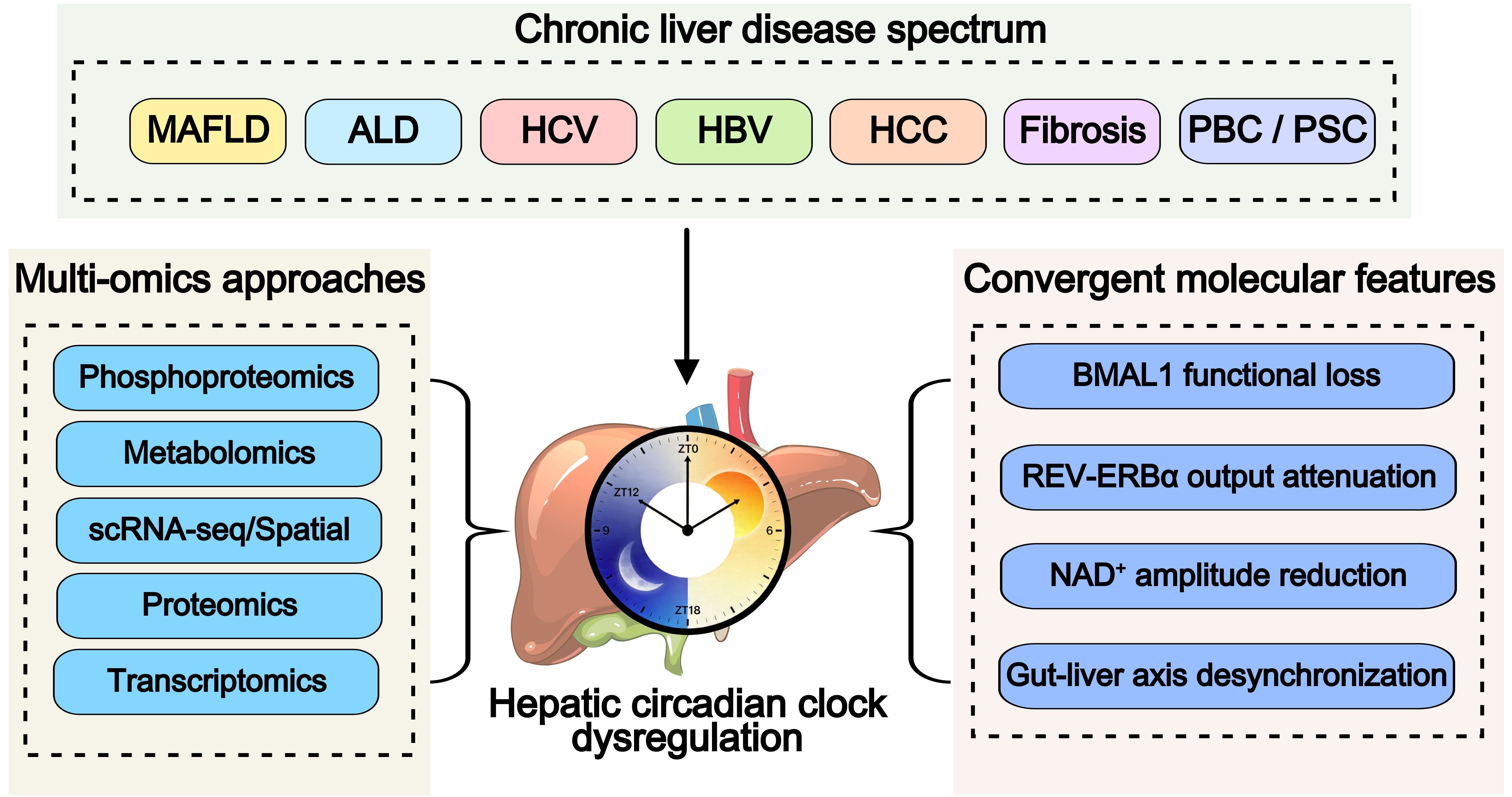
The liver circadian clock coordinates hepatic lipid metabolism, bile acid synthesis, and glucose homeostasis through interlocking transcription–translation feedback loops. Disruption of this temporal organization is increasingly recognized as a shared pathological feature across the chronic liver disease spectrum. Transcriptomic profiling alone cannot capture the full scope of circadian dysregulation. Approximately half of rhythmically abundant hepatic proteins lack correspondingly rhythmic mRNAs. Roughly 25% of hepatic phosphosites oscillate with a 24-h period. Integrating transcriptomics, proteomics, post-translational modification profiling, metabolomics, and emerging single-cell and spatial approaches is therefore necessary for an accurate account of how circadian programs are remodeled in disease. This narrative review delineates the multi-omics landscape of circadian clock dysregulation across six chronic liver disease categories. These encompass metabolic dysfunction-associated fatty liver disease (MAFLD), alcoholic liver disease (ALD), viral hepatitis, hepatocellular carcinoma (HCC), liver fibrosis, and cholestatic disease. Four molecular features recur across these contexts. BMAL1 functional downregulation, REV-ERBα oscillatory output attenuation, NAD+ oscillatory amplitude reduction, and gut–liver axis circadian desynchronization together constitute an inferential framework for hepatic circadian failure. These features represent recurring disease-associated motifs rather than an established pan-disease mechanism. The upstream mechanisms and evidence depth differ substantially by disease category. Oncogenic kinase-driven CLOCK post-translational modifications in HCC, phosphoproteomic remodeling in MAFLD, and epigenomic clock disruption persisting after HCV clearance represent findings that transcriptomics alone would not resolve. The near-complete absence of temporally resolved human tissue data remains the principal barrier to translational progress. This evidence gap limits the clinical actionability of current mechanistic findings across all disease categories. Circadian phase inference algorithms and prospective temporally designed cohort studies offer a methodologically grounded path toward clinically actionable circadian hepatology.
Keywords: circadian clocks; liver diseases; multi-omics; ARNTL transcription factors; epigenomics circadian clocks; liver diseases; multi-omics; ARNTL transcription factors; epigenomics
Graphical Abstract