This is an early access version, the complete PDF, HTML, and XML versions will be available soon.
Article

Medium Composition Determines the Dynamics of Boar In Vitro Sperm Capacitation-Associated Events

1
Department of Veterinary Sciences, Faculty of Agrobiology, Food, and Natural Resources, Czech University of Life Sciences Prague, 165 00 Prague, Czech Republic
2
Laboratory of Reproductive Biology, Institute of Biotechnology of the Czech Academy of Sciences, BIOCEV, 252 50 Vestec, Czech Republic
3
Department of Biochemistry, Faculty of Science, Charles University, 128 00 Prague, Czech Republic
4
Laboratory of Bioenergetics, Institute of Physiology, Czech Academy of Sciences, 142 00 Prague, Czech Republic
5
Department of Cell Biology, Faculty of Science, Charles University, 128 00 Prague, Czech Republic
6
Laboratory of Reproductive Physiology, Institute of Animal Biochemistry and Genetics, Centre of Biosciences, Slovak Academy of Sciences, 841 04 Bratislava, Slovakia
7
Department of Zoology, Faculty of Science, Charles University, 128 00 Prague, Czech Republic
*
Authors to whom correspondence should be addressed.
Int. J. Mol. Sci. 2026, 27(10), 4567; https://doi.org/10.3390/ijms27104567
Submission received: 19 April 2026 / Revised: 8 May 2026 / Accepted: 15 May 2026 / Published: 19 May 2026
(This article belongs to the Special Issue Advances in Spermatogenesis and Male Infertility, 2nd Edition)

Abstract

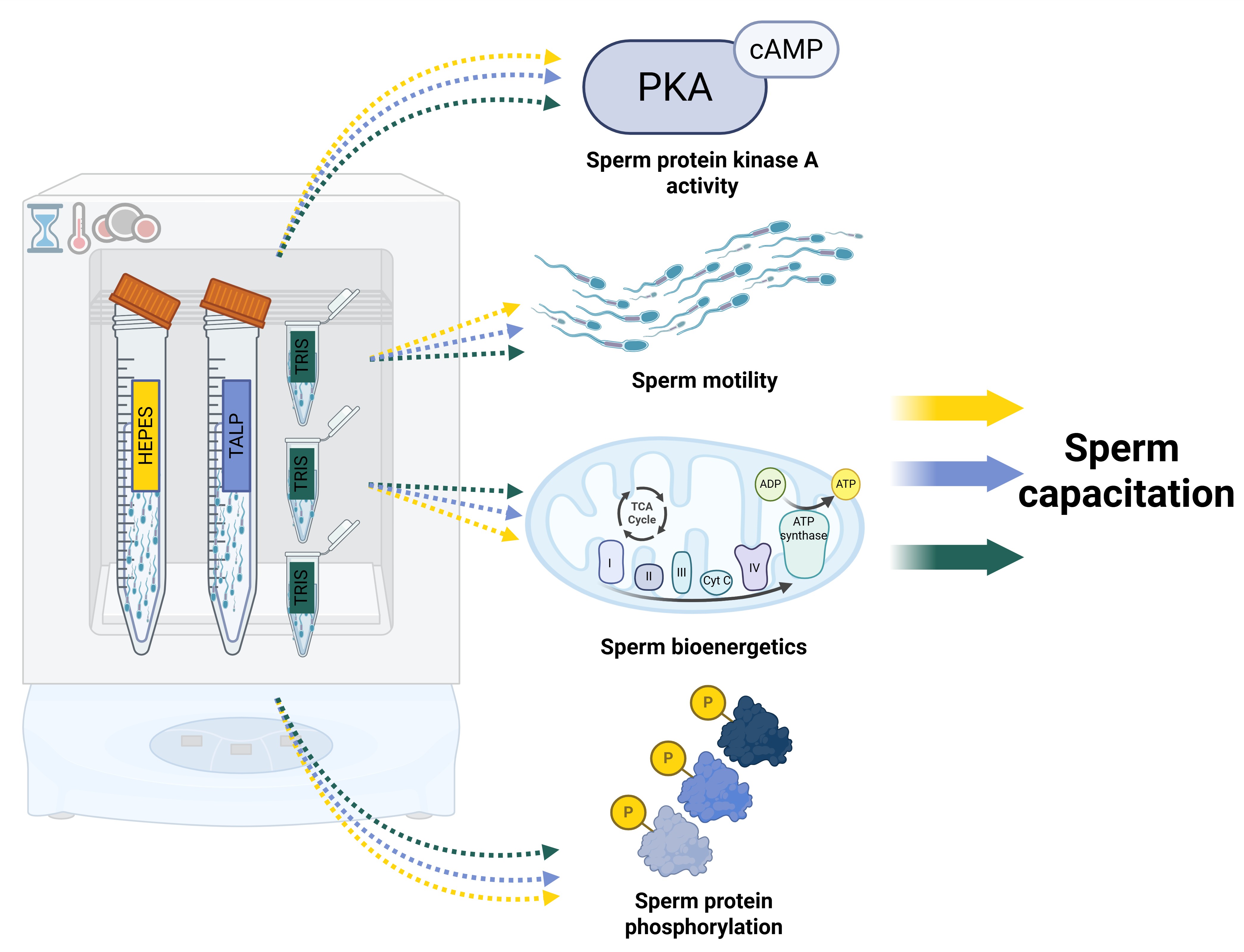
Capacitation is a key maturation process that enables spermatozoa to acquire fertilizing ability and can be induced in vitro using capacitation media. Because capacitation protocols differ markedly among laboratories, we compared three compositionally distinct Hepes-, Tris-, and TALP-based media. This study was performed in boar spermatozoa using 3–6 biological replicates of pooled ejaculates depending on the assay, with 46 ejaculate samples from 12 boars in total. The aim was to determine whether such non-standardized conditions differentially affect signaling pathways leading to capacitation and thereby influence the detection of commonly used capacitation markers. We found clear differences among the tested media. All three induced capacitation-associated events, but their functional and molecular effects were not equivalent. The Hepes-based medium supported sperm motility most effectively, increasing total and progressive motility to 60.0% and 48.7%, respectively, after 1 h of incubation and maintaining the highest motility throughout the incubation period. In contrast, the Tris-based medium maintained lower but relatively stable motility, whereas the TALP-based medium showed a rapid decline in total motility from 53.1% to 15.2% during the first hour. The TALP-based medium induced the highest and most sustained protein kinase A (PKA) activity, reaching 0.047 U/mL at 0 h and 0.040 U/mL after 3 h, whereas the Hepes- and Tris-based media showed lower and less sustained activity ranging from 0.003 to 0.030 U/mL during incubation. In addition, distinct patterns of protein tyrosine phosphorylation were observed depending on the medium used. In particular, the TALP-based medium containing bicarbonate and bovine serum albumin (BSA) and the Hepes-based medium with the highest BSA concentration were associated with the highest levels of total protein tyrosine phosphorylation. Phosphoproteomic analysis further revealed condition-specific phosphorylation events, indicating that sperm maturation is dynamically regulated by the surrounding molecular environment. In contrast, no significant differences were detected in oxidative phosphorylation or in electron transport system complexes among the tested media. These findings show that differences in capacitation media composition, particularly in bicarbonate and BSA content, can markedly alter signaling outcomes and the interpretation of capacitation markers, with important implications for reproductive technologies and experimental standardization.
Keywords: phosphotyrosine; phosphorylation; protein kinase A; motility; oxidative phosphorylation; reproduction phosphotyrosine; phosphorylation; protein kinase A; motility; oxidative phosphorylation; reproduction
Graphical Abstract