Review

Ion-Selective Electrodes for Ammonium and Nitrate Determination: Recent Advances, Trends and Perspectives


Department of Analytical Chemistry, Faculty of Chemistry, Institute of Chemical Sciences, University of Maria Curie-Skłodowska, Maria Curie-Sklodowska Sq. 3, 20-031 Lublin, Poland
*
Authors to whom correspondence should be addressed.
Int. J. Mol. Sci. 2026, 27(10), 4432; https://doi.org/10.3390/ijms27104432
Submission received: 29 March 2026 / Revised: 6 May 2026 / Accepted: 14 May 2026 / Published: 15 May 2026
(This article belongs to the Special Issue Molecular Advances in Electrochemical Materials)

Abstract

In response to increasing environmental protection requirements and the rapid advancement of analytical technologies, particular attention is being paid to the development of environmentally friendly, cost-effective, and sensitive measurement tools. One of the key challenges in modern analytics is the effective monitoring of inorganic nitrogen in the natural environment. In this review, we present a variety of ammonium and nitrate ion-selective electrodes. The review includes the years 2020–2026. It was divided into sections based on sensitivity to a given ion, as well as into subsections based on application: monitoring of soil and aquatic environments, the use of sensors for the determination of specific ions in a wide range of samples, and electrode designs that were used only in laboratory studies. A total of 64 nitrate electrodes and 22 ammonium electrodes were analyzed. Comparisons were made based on electrode type, type of internal contact, materials used to enhance ion-to-electron conductivity, and type of ionophore. Additionally, analytical parameters were compiled, including sensitivity, detection limit, linearity range, potential stability, operating pH range, and actual application scenarios. This review allows for an assessment of current trends and may serve as a basis for the design of new potentiometric sensors.

1. Introduction

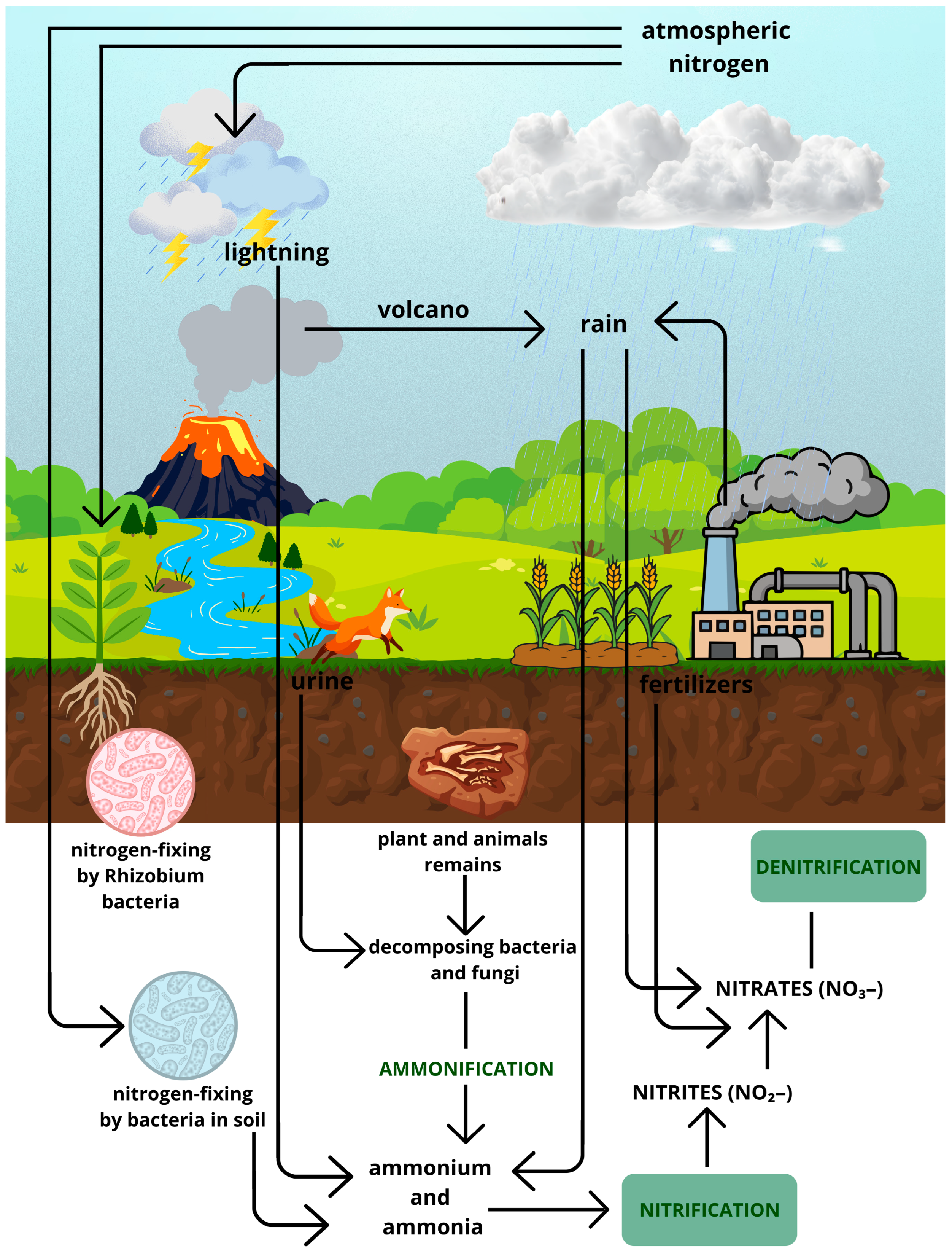
Nitrogen is one of the most important elements on our planet. Nitrogen can originate from natural sources—such as mineralization of organic matter, nitrification, denitrification, volcanic ash, and lightning—as well as from anthropogenic sources, such as intensive agriculture and increased fertilizer use, wastewater, and industrial expansion [1]. It serves many functions, but above all, it plays a key role in the biogeochemical cycle, as it is essential for the proper functioning of ecosystems [2,3]. The nitrogen cycle consists of several stages: (1) nitrogen fixation, which involves the binding of atmospheric nitrogen by cyanobacteria or bacteria such as Rhizobium, which live in symbiosis (mutualism) with the roots of leguminous plants [4]; (2) ammonification, a process involving the breakdown of organic nitrogen compounds through the decomposition by microorganisms (soil bacteria, fungi) of dead plants, animals, or manure into ammonia and ammonium ions [5,6]; (3) nitrification, a process carried out by nitrifying bacteria that oxidizes ammonia and ammonium salts into nitrites, and subsequently into nitrates, which in turn can be easily absorbed by plants [7]; (4) assimilation, a process in which plants take up NH4+ and NO3 ions, which are then used by plants as building blocks for proteins, nucleic acids, or adenosine-5′-triphosphate (ATP) [8,9]; (5) denitrification, a process carried out by denitrifying bacteria, through which nitrates from the soil can be released into the atmosphere as N2 [10]. The biogeochemical cycle of nitrogen is shown in Figure 1. Furthermore, one of nitrogen’s most important roles is that it serves as a building block of life. As elemental nitrogen, it plays a vital role as a macronutrient; it is a component of amino acids, which in turn build proteins, as well as nucleotides (the nitrogenous base is one of the components, along with pentose and the phosphate group), from which nucleic acids are formed: deoxyribonucleic acid (DNA) and ribonucleic acid (RNA). It is also a component of chlorophyll, thereby enabling photosynthesis. In plants, nitrogen is taken up in the form of ammonium and nitrate ions, where it plays a key role in the growth of roots, leaves, stems, shoots, and fruits [11,12,13].
Nitrogen in the environment occurs primarily in the form of organic nitrogen and in the form of inorganic nitrogen, which is the most easily absorbed form of nitrogen by plants. The presence of inorganic forms of nitrogen, such as nitrates or ammonium, is crucial, but unfortunately, in excess, it can do more harm than good. Above-average levels of these compounds in surface water (rivers, lakes, seas) cause excessive growth of algae and cyanobacteria, leading to water eutrophication, reducing oxygen levels in the water, and consequently causing the death of aquatic animals [14,15,16,17,18,19]. Nitrates can also contaminate groundwater, thereby reducing the quality of drinking water. According to the World Health Organization (WHO), the nitrate content in water should not exceed 50 mg/L. Nitrate pollution in water is mainly caused by the runoff of NO3-fertilizers from fields into water bodies, leaky septic tanks, and pollutants’ emissions from industrial areas [18,19]. Meanwhile, regarding ammonium, the Polish Ministry of Health states that the limit for these ions is also 50 mg/L. Excessive ammonia levels in water are often an indicator of organic contamination, such as from sewage or water treatment issues, and high levels of NH4+ ions may suggest microbiological contamination [20]. In soil, an excess of ammonium ions leads to the release of hydrogen ions, soil acidification, and the leaching of other minerals, while an excess of NO3 ions weakens plants, making them more susceptible to pests and fungal diseases [21].
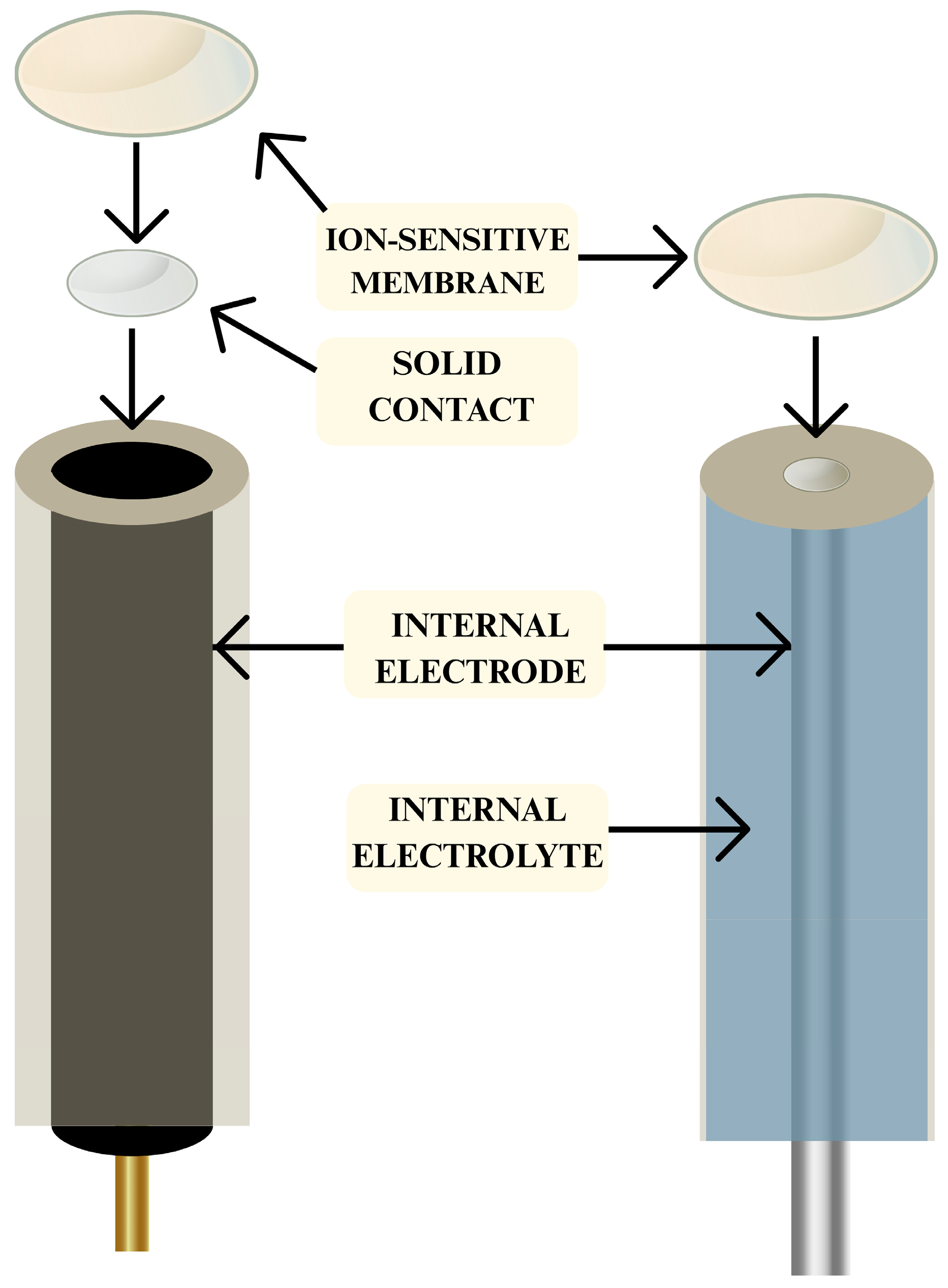
Based on the above, it is necessary to monitor aquatic ecosystems and soil for ammonium and nitrate ion levels. Research is being conducted in industry and at wastewater treatment plants, as well as in surface and groundwater; in agriculture, soil diagnostics are being carried out, which contributes to the development of intelligent and precise fertilization practices [22,23]. In addition, nitrate levels are monitored in fruits and vegetables [24], as well as in other foods where preservatives have been used, e.g., sodium nitrite in canned foods and cured meats [25]. In the case of ammonium, studies are conducted primarily in biological contexts, e.g., analysis of sweat and urine composition [26]. Classic methods used in the determination of mineral nitrogen include spectrophotometry, including the Nessler method for determining ammonium ions and the Griess method for determining nitrate (V), ion chromatography, fast flow analysis (FIA), and capillary electrophoresis [16,27]. These methods provide good results, but they have numerous limitations. They are quite expensive, and the analysis is not cost-effective, not only due to the price of the equipment used, but also because of other factors such as sample preparation time—which is often lengthy and requires sample purification—the duration of the measurement itself, and the use of expensive reagents that are frequently toxic and environmentally unfriendly. In addition, when using these methods, we cannot perform in-situ measurements. Therefore, an alternative solution is being sought, and here the problem of costly, time-consuming, and environmentally unfriendly analyses can be solved by using potentiometric sensors, namely ion-selective electrodes (ISE) [28,29,30]. The first ISE for pH measurement was developed as early as 1909 by Haber and Klemensiewicz [31]. ISEs are simple analytical tools that have been used in chemistry for decades; their operation relies on measuring the electromotive force of a cell comprising an ISE and a reference electrode (RE) [32]. They are mainly divided into liquid-contact (LCISE) and solid-contact (SCISE) electrodes, which consist of several components: an internal electrode, an ion-sensitive membrane (ISM), an internal electrolyte solution (IE) (in the case of liquid-contact electrodes (LC)), or an intermediate layer (solid contact (SC)), the so-called transducer medium (in the case of solid-contact electrodes). These media act as efficient ion-to-electron conductors, significantly enhancing charge transfer processes at the electrode interface. As a result, they contribute to improved electrochemical performance by ensuring a more stable, consistent, and reversible electrode potential over repeated cycles [29]. A diagram illustrating the appearance of the classic SC and LC electrode structures is shown in Figure 2.
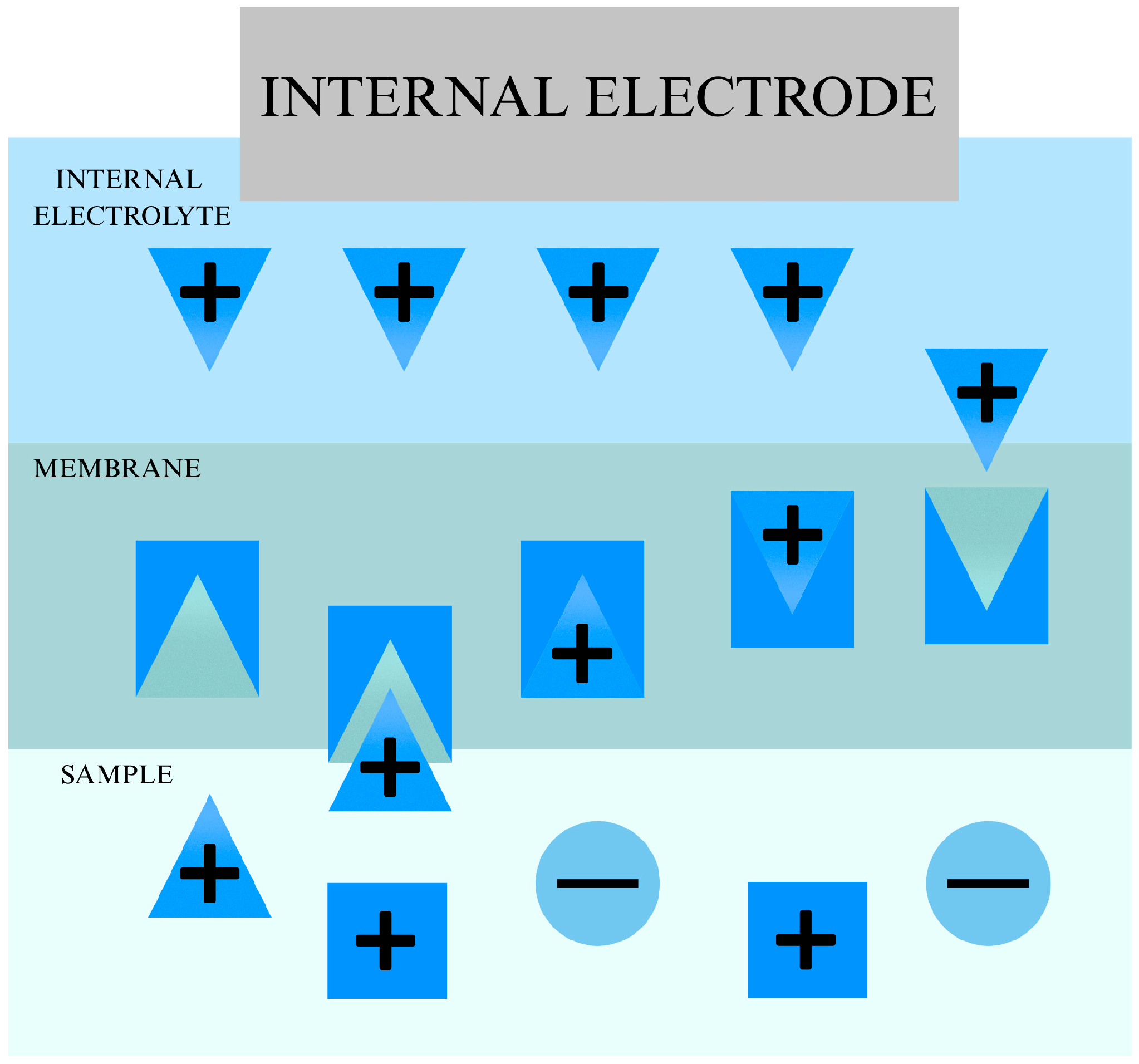
The most important component of any ion-selective electrode is the ion-sensitive membrane, which provides selectivity for a specific ion even in the presence of interfering ions. In most cases, these membranes are made of polymers. Such an ISM consists of a sensitivity-providing element, the so-called ionophore or other active substance, a plasticizer that provides flexibility, a polymer serving as the polymer matrix (mainly polyvinyl chloride (PVC)), as well as an ion exchanger—usually salts containing large lipophilic ions. Of the elements listed above, the most important is the ionophore, which gives the electrode its selectivity. It is the ionophore that selectively reacts to a specific ion. The mechanism of action of the ionophore is shown in Figure 3.
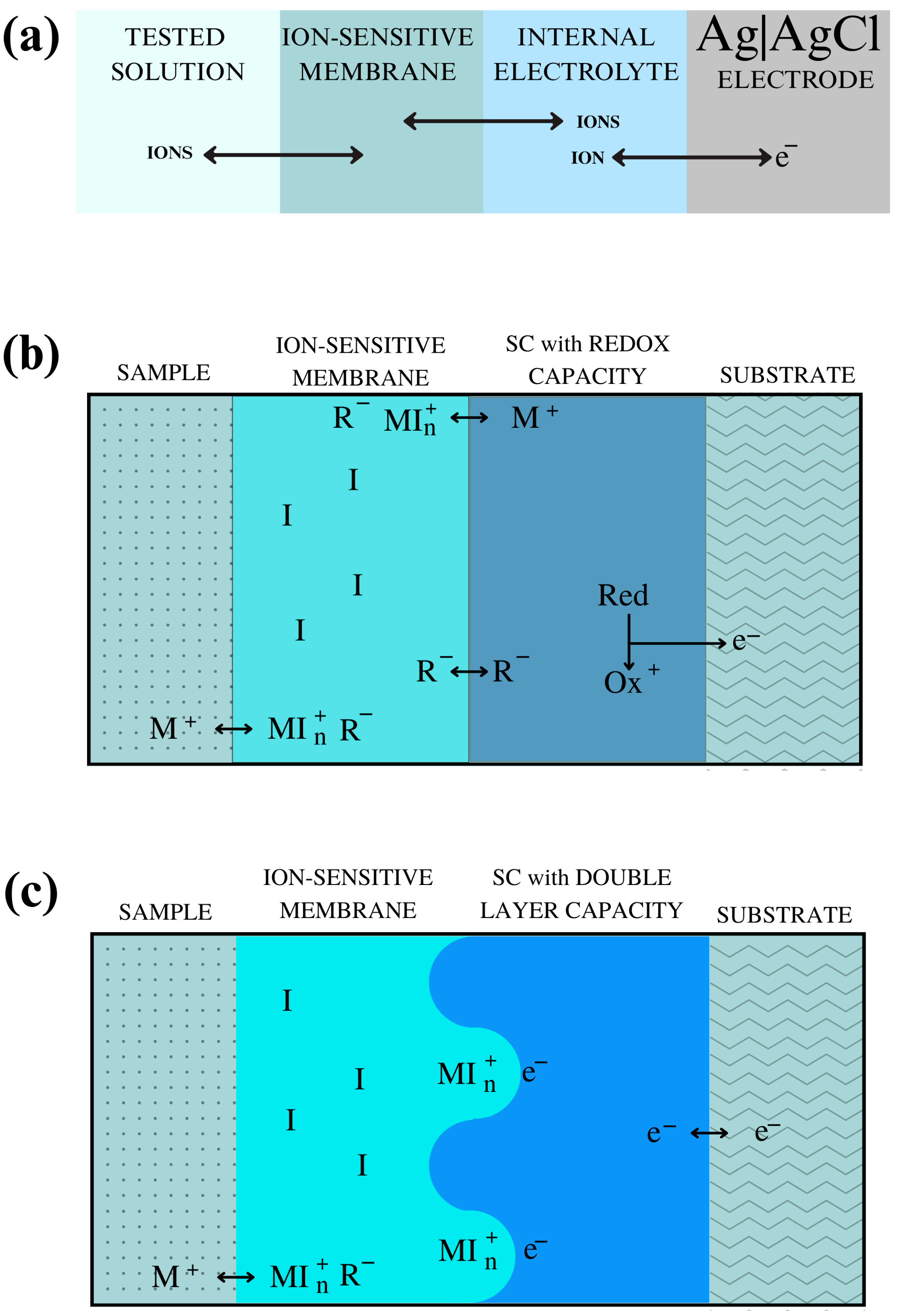
The detection process involves a charge exchange that takes place between the sample solution, the membrane, the internal electrolyte or solid contact, and the internal electrode. Depending on the electrode design, this process occurs in different ways. The mechanism of charge transport for liquid and solid contact electrodes is shown in Figure 4.
Each of these electrodes has its advantages and disadvantages. Still, observing trends in science, there is a shift away from (LC) structures, and all-solid-state or solid-contact electrodes are primarily used. This is due, among other things, to the elimination of internal electrolyte from the design of solid-contact electrodes, making storage, transport, measurements, and sensor operation simpler [33]. The elimination of IE has paved the way for a new generation of sensors—enabling their miniaturization, the creation of custom shapes, and the development of screen-printed electrode (SPE) technology [34], and also enabled the use of electrodes in field studies or in more complex structures, such as wearable sensors [35], artificial tongues [36], and multi-electrode arrays for the simultaneous detection of several ions [37]. Unfortunately, these electrodes exhibit one major drawback—relatively poor ion-to-electron conductivity resulting from differences in conductivity at the membrane–internal electrode interface. The solution to this shortcoming is the application of a layer, component, or additive to the membrane that ensures good charge transfer between the sample, the membrane, and the electrode contact [38]. Current research focuses on various design approaches and modifications to develop sensors with enhanced stability, reversibility, repeatability, sensitivity, and selectivity.
This advancement also applies to ammonium and nitrate electrodes, which are the focus of our discussion. In ammonium-selective electrodes, nonactin is the most commonly used ionophore; however, these electrodes often exhibit some cross-sensitivity to potassium ions. Conversely, the problem with nitrate electrodes is the presence of chlorides, which can interfere with the operation of NO3 ISEs. Many sensors have been developed to date, but in this paper, we will focus on the years 2020–2026. The paper collects, compiles, and describes 64 electrodes sensitive to nitrate (V) ions, along with 22 electrodes sensitive to ammonium ions.

2. Nitrate-Ion Selective Electrodes

Nitrate electrodes constitute a very broad class of potentiometric sensors. The literature describes a vast array of these sensors—ranging from solid-contact sensors to liquid-contact sensors, sensing platforms, and even commercially available sensors. In our review, we present a collection of 64 nitrate-selective electrodes developed between 2020 and 2026. These electrodes have been used to determine nitrate levels in soil and water samples, as well as for other types of measurements; alternatively, we present electrodes described solely in terms of their design and laboratory testing, without considering their practical applications. The electrodes are listed in a table and described in detail in the individual chapters. The table provides an overview of the electrodes’ construction—including the internal electrodes used, modifications to the buffer layers, and other features, as well as a summary of their analytical parameters: slope, linearity range, detection range, stability, and pH.

2.1. Determination of Nitrates in Soil

Over the past six years, 15 different sensors have been designed and subsequently used to determine nitrate (V) ions in soils. Almost all of them were solid-contact electrodes, except for one developed by the Nakao team [39]. Their work utilized an internal silver chloride electrode, which is standard for this type of setup, but it was modified from the Ag|AgCl|Cl configuration to Ag|Ag+. The internal electrolyte consists of 50 mM AgNO3 and 50 mM Mg(NO3)2. Tetraheptylammonium nitrate (THANO3) was used as the ionophore, forming a PVC-membrane (poly(vinyl) chloride) composition together with 2-nitrophenyl octyl ether (NPOE). Among the solid-contact electrodes, tridodecylmethylammonium nitrate (TDMANO3) played a significant role as an ionophore. It was used as a selectophore in three SCISEs. Two of these are based on a glassy carbon electrode, but different intermediate materials were used in each. A hybrid material consisting of a metal oxide (ZnO) and a noble metal (Pt, Au, and Ag) was used in the study [40]. The values obtained for the ZnO:Pt-modified electrode are described in Table 1. In contrast, the second research team used bimetallic selenium compounds (CoWSe2) as the transducer medium [41]. Both types of electrodes exhibited high sensitivity >61 mV/dec, as well as a detection limit in the micromolar range. The electrode modified with a hybrid material exhibited a wider linear range (LR) than the other one. Another study presenting the use of TDMANO3 involved a fully integrated potentiometric soil nitrate sensor array. This screen-printed sensor was used to monitor nitrate content in various soils cultivated with corn, cowpea, and tomato. Measurements of NO3 were performed at different depths in two soil types: clay soil and sandy loam soil [42]. This electrode exhibited a super-Nernstian slope of −81.76 mV/dec, a relatively low limit of detection (LOD), but unfortunately, a rather narrow linearity range. Quaternary ammonium salt-based (TDA+) ionophores constitute a fairly large group of compounds used in NO3-ISEs—another example is the use of tetradodecylammonium bromide (TDABr) in a PVC membrane within a glassy carbon electrode (GCE) design, with polyaniline (PANI) serving as the transducer medium [43]. A relatively high sensitivity of −58.6 mV/dec was obtained, but with a rather large deviation of 5.2 mV/dec, indicating quite low repeatability and poor long-term stability. Electrode stability in this case was defined using a relative standard deviation (RSD) of 1.2%. Sometimes TDABr is replaced by tridodecylammonium chloride (TDACl). So it was with the electrodes proposed by Fayose et al. [44]. The anion is only an accompanying anion, and the actual active component is the TDA+ cation (quaternary ammonium). During conditioning, either Br or Cl ions are replaced by NO3 ions anyway. Both of the presented electrodes were developed in a rather unconventional way—their substrate was applied to an acetate sheet of appropriate roughness by drawing a line with a B-grade pencil, and then the resulting line was covered with tape with a hole for the membrane (thus creating a matrix on which the RE, formed in the same manner, was also located). Sensitivity was not specified in any of the presented studies. Despite an LOD in the μM range, both of the presented electrodes exhibited a short linearity range. Another example of an ion exchanger is tetradodecylammonium nitrate (TDANO3), which was used in a screen-printed carbon electrode [45]. The study focused more on the determination of nitrates in various soil types than on analytical parameters—the screen-printed carbon electrode (SPCE) demonstrated measurement capabilities for NO3 ion concentrations in the range of 5 to 512 ppm. In another case, an SPCE using conductive nano-C ink (JC81) as the transducer medium employed tetraoctylammonium bromide (TOABr) as the ionophore [46]. However, compared with other electrodes—such as those based on GCE—despite a high slope of -58 mV/dec, a narrower linearity range (1 × 10⁻¹–1 × 10⁻⁴) was obtained, but with relatively good long-term stability of 0.03 μV/h. Another type of electrodes used for nitrate determination (this time in unfertilized, naturally fertilized, and chemically fertilized soil) are carbon paste electrodes (CPE) (based on carbon black (CB)) modified with hydrated iridium oxide (CB + IrO2·H2O) or hydrated ruthenium oxide and poly(3-octylthiophene-2,5-diyl) (CB + RuO2·H2O + POT) [47]. To achieve selectivity, nitrate ionophore V was used (the sensitivity of both electrodes was around 57 mV/dec, and their linearity range was five orders). The advantage of these SCISEs is undoubtedly their wide operating pH range. The other selectivity provider was the commercially available ionophore nitrate ionophore VI, which was used in the study by Baumbauer et al., where a gold screen-printed electrode was investigated [48]. In this case, a significantly weaker slope of 54.2 mV/dec was obtained with a linear range (LR) similar to that of other SPEs. However, this electrode exhibited poor repeatability as determined by the E0 parameter (E0 variation equal 12.5 mV). In addition to the aforementioned materials, PPy-NO3 is also used as an active membrane component. It was employed in electrodes coated with a composite of gold nanoparticles (AuNPs) and electrochemically reduced graphene oxide (ERGO), which served as an intermediate layer [49]. Ming et al. report that the electrode formed over 65 days achieved an average slope of 44.02 mV/dec, indicating low sensitivity. The electrode developed by the Chen research group exhibited a similar lifespan, though they do not report the sensitivity [49]. In addition to this type of electrode, a more complex system was developed, the so-called Cooperative Ion-Selective Electrode System, which, in addition to the ISE, incorporated a temperature and pH sensor into its design [50]. The sensitivity achieved here (51.63 mV/dec) is not groundbreaking, and the linearity range is narrow. However, it is worth noting that this type of design is a very good solution for in-situ measurements. In summary, the internal electrodes used included glassy carbon electrodes, paste electrodes, screen-printed substrates, and composite structures. In turn, compounds from the group of quaternary ammonium salts, i.e., TDMANO3, THANO3, TDANO3, TDACl, TDABr, TOABr, polymeric ion exchangers, i.e., PPy-NO3, as well as commercial ionophores, i.e., nitrate ionophores V and VI, were used as ionophores. The best solution turned out to be glassy carbon electrode structures modified with composites or carbon materials, which offer high stability, reproducibility, sensitivity, and a wide measurement range (both concentration and pH).

2.2. Determination of Nitrates in Water

According to World Health Organization guidelines and European Union regulations, the recommended maximum nitrate concentration in potable water is 50 mg/L. Therefore, monitoring these ions is essential, especially in drinking water. For this purpose, we can use potentiometric sensors. Table 2 provides an overview of 18 electrodes used in the analysis of various water samples. Fourteen of the presented electrodes are solid-contact ISEs, three are liquid-contact electrodes, and one is a commercial electrode. As with soil analysis, TDMANO3 is the most popular ionophore here as well, having been used in 7 sensors. Among all these SCISEs, the electrode presented by the team of Morawska et al. (60.41 mV/dec) not only exhibited the highest sensitivity but also the widest linearity range (10−1–10−6 M) [51]. In this case, a GCE coated with a composite of multi-walled carbon nanotubes (MWCNTs) and copper oxide nanoparticles (CuONPs) was used as the internal electrode. In the study [52], a similar design was presented; however, octadecyl amine-functionalized single-walled carbon nanotubes (f-SWCNTs) were used as the intermediate layer, and the analytical parameters were inferior to those of the aforementioned SCISE. Aside from GCE, a gold electrode modified with a POT and MoS2 nanocomposite was also used as the internal electrode [53]. In this case, the electrode in question exhibited lower sensitivity and a measurement range of only four orders of magnitude. Furthermore, it was characterized by a large potential shift. The LOD was determined in solutions already containing interfering ions—which is not a typical approach—and ranged between 3.23 × 10⁻⁵ and 1.65 × 10⁻⁴ M. Because of this, we were unable to directly compare these results with those reported for the other presented electrodes, due to the different method used for LOD determination. In addition to the use of the TDMANO3 ionophore on a macroelectrode scale, it is also used in membrane coating screen-printed electrodes, i.e., in the work by Darestani et al. [54], where the substrate was a hydroxylated glass slide with pencil contact pads and Cu contacts, which was then coated with a film of pristine CNT and a CNT–TPM. This is a rather interesting solution, but unfortunately, it does not yield satisfactory results in terms of electrode characterization. As the authors state in the summary of their work, a better solution for this type of electrode is to introduce cobalt(II) tert-butyl-salophen as the ionophore, which allows for maintaining a similar detection limit value, with the additional advantage of an expanded ISE operating range. A screen-printed electrode for the determination of nitrates in various types of water was also used by the research team of Thuy et al. [55]. In this case, the intermediate layer consisted not of a carbon material, as in Darestani et al. [54], but of cobalt oxide nanoparticles. This proved to be a much better solution, as a very low detection limit (1 × 10⁻⁸ M) was achieved (the lowest among electrodes using TDMANO3 as an ionophore). Thanks to the use of the intermediate layer, no water layer was observed. In addition to the above examples, TDMANO3 has been used in a polymer composite-modified paste electrode to improve the electrode’s electrical performance [56]. A drawback of this electrode is that after approximately 20 days, it significantly lost its sensitivity, with the slope value decreasing from −51.34 mV/dec to approximately −40 mV/dec. In turn, the team Hjort et al. presented a different solution—they developed a nitrate ISE based on hydrophobic laser-induced graphene (LIG) coated with a PVC membrane containing TDMANO3 [57]. Despite a relatively narrow linearity range, a response close to the Nernst equation was achieved, along with an LOD in the micromolar range. Unfortunately, this electrode, in turn, has a limited operating pH range, similar to a neutral environment (6–8). In another screen-printed design, a nitrate VI ionophore was already used—the authors modified the SPET electrode (eDAQ, ET083) with poly(tetrafluoroethylene) (PTFE) [58]. Apart from the SCISEs described above, many other designs differ significantly from one another. For example, Zhang et al. [59] propose modifying the GCE with gold nanoparticles (acting as a mediating layer) and then coating them with a membrane containing the ionophore PPy-NO3, whereas Pietrzak et al. [60] choose Ag|AgCl as the internal electrode, with the Co(Bphen)2(NO3)2(H2O)2 complex serving as the ionophore. Despite similar operating ranges, the team of Pietrzak [60] developed a more sensitive, more selective electrode capable of micro-level determinations. A rather interesting NO3-ISE solution was presented in the paper [61]. The copper wire was immersed in graphite-epoxy, and after drying the applied layer at 50 °C, a membrane containing 1,3,5-tri (p-hydroxyphenyl)benzene-based chlorotriazine pillared cage molecule (CAGE-1). A very good potentiometric response was obtained, although the working electrode undoubtedly requires improvement in sensitivity. The electrode nevertheless exhibited relatively good reversibility, selectivity, and a pH range suitable for the determination of nitrates in samples. Graphite-epoxy was also used in other electrodes, in part as a transducer medium and as a substrate, since it served as a base onto which a PVC membrane modified with 1-furoyl-3,3-diethylthiurea (a component ensuring selectivity for NO3) was subsequently applied [62]. Membrane activation was performed in various solutions, which also provided an interesting comparison and a novelty in the studies described to date; for this purpose, solutions of Pb(NO)3, KNO3, and H2O, for which slopes of −65.2, −38, and −23 mV/dec, respectively, were obtained. Typically, simpler salts, such as KNO3, are used in conditioning solutions; this was employed, for example, by Morawska et al. [51]—in their case, a high slope was obtained without the need for toxic reagents, as the use of lead compounds is not environmentally friendly and generates unnecessary waste that is difficult to dispose of. Furthermore, the resulting electrode characteristics are weaker. The electrode was used in nontypical determination of chloride ions by potentiometric titration. A significantly better approach for screen-printed electrodes intended for the determination of NO3 ions is the use of an alkyl ammonium salt—TDANO3—as the ionophore, as demonstrated by Gil et al. [63]. A commercially available CP electrode (ref. DRP-110) was modified with graphene oxide (GO) before ISM application. This resulted in good electrode response, as well as low potential drift (0.08 μV/s) and a very wide pH range (3–11). One of the more complex designs, known as ion-sensitive field-effect transistors (ISFETs), was described in a 2020 paper [64]. It is a large multisensing platform used to analyze aquarium water, sensitive to, among other things, nitrate (V). The manufacturing process involved first depositing a graphene layer onto a silica wafer, followed by a metal layer (in this case, a copper foil), which was then covered with a commercial membrane from CleanGrow. Given the complex structure of the sensing platform, very good measurement parameters were achieved, and the quality was confirmed through analytical applications. The remaining electrodes are based on an LC design—that is, one containing an internal solution acting as a charge-carrying medium/transistor. The research group of Cuartero et al. developed the so-called “electronic tongue” [36]. The ISE body was obtained from Fluke and filled with 1 × 10⁻³ M KNO3. The membrane utilized the TDMACl ionophore. Unfortunately, the paper did not include potentiometric or electrochemical results. The focus was on quantification. The same ionophore was used in a similar design, with the only difference being the IL (a mixture of KCl and KNO3 at a concentration of 1 × 10⁻² M) [65]. Despite its near-Nernstian slope, the electrode had a fairly narrow measurement range. Furthermore, the stability determined from the calibration curve is not very accurate and cannot serve as a reference for other studies that include these data. The last type of ISE, or more precisely the IoT-Based Nitrate Measurement System, was described in the paper [66]. The working electrode was a silver chloride electrode filled with a 0.01 M NaNO3 and NaCl solution. The selectivity was provided by a TDANO3-membrane. To summarize the above information, as in Section 2.1, the most effective, accurate, stable, and sensitive instruments are those using GCE [51] and the TDMANO3 ionophore [63] or Co(Bphen)2(NO3)2(H2O)2 [60]. And once again, solid-contact electrodes offer us more possibilities than liquid-contact electrodes.

2.3. Other Analytical Applications of NO3-ISEs

Nitrates are not found only in water or soil, but also in other media or solid samples. Consequently, electrodes are being developed for various applications involving environmental, industrial, plant, and medical samples. This is why the development of various measurement tools is so important; these tools will not only streamline but also facilitate the work of analysts, while providing relatively reliable and reproducible results. Table 3 presents a summary of 15 electrodes, of which only one is an LC-type electrode. These designs often utilize a TDMACl membrane, which acts as an ion exchanger. This is also the case for the electrode used by Miras et al. to determine nitrates in nutrient solutions [68]. For this purpose, a commercial ISE (Sigma 45137-1EA) was used, filled with 1 × 10⁻³ M KCl. In the case of solid-contact electrodes, ammonium alkyl salts again dominate as ionophores. TDMANO3 was used in three electrodes. Two of these were GCE electrodes modified with polyaniline nanofibers doped with NO3 (PANINFs-NO3) or Cl (PANINFs-Cl) ions [69]. Each of these electrodes achieved very good analytical performance, including an impressive linearity range (10−1–10−6) and a pH range of 4–11.5. The PANINFs-NO3 doped electrode exhibited better sensitivity, likely due to the presence of the dopant. The third electrode, based on TDMANO3, is a graphite SP electrode, which serves as a platform with RE (AgCl) [70]. Both electrodes are extremely small (1 mm), and the entire device is visually smaller than a 1-euro coin. It exhibited a good, though weaker, electrochemical response than GCE-SCISEs. The authors specify a pH range of 4 to 11; however, changes in electrode potential within this pH range are quite large (several to over a dozen millivolts), and significant discrepancies depend on the direction of the solution’s pH change (alkaline or acidic). Another ionophore from the group of alkyl ammonium salts is methyl tetradecyl dimethylamine nitrate (MTDANO3), which was used in a membrane deposited on chemically reduced graphene (CRGN), which was placed on a GCE [71]. The sensitivity of these electrodes is similar to that of the GCE-ISE presented by Pietrzak et al. However, it is worth highlighting an interesting application in the determination of NO3 in PM2.5. In the case of another ion exchanger—TDANO3—it was used in three SC electrodes. Two of them are screen-printed electrodes with a carbon substrate. One of them was enhanced with an intermediate layer of reduced graphene oxide aerogel (rGOA) [72], and the other with poly(3,4-ethylenedioxythiophene)-polyethylene glycol (PEDOT:PEG) [73]. Taking into account that, in most cases, SPEs exhibit a poorer response than, for example, glassy carbon electrodes, the Kim team has developed a groundbreaking electrode [72]. It features extremely high sensitivity, which additionally spans a wide linearity range, resulting in a low LOD (7.59 × 10⁻⁷ M). This electrode, when compared with the one developed a year later by Hao et al., performs significantly better. The third SCISE presented in this mini-review is a micro-sized all-solid-state electrode, where the reference electrode is a copper wire, and graphite serves as the transducer medium [74]. This electrode exhibits a typical response for a NO3-ISE. Unfortunately, its stability is defined only as “high” due to the slope remaining at high values. In addition to the aforementioned ammonium ion exchangers, TOANO3 was also used. It was employed in an “alternative membrane”—photocurable poly-tetrahydrofurfuryl acrylate (pTHFA) [75]. This is a rather interesting design among screen-printed electrodes, as this type of membrane has not been seen before. This membrane was applied to a PPy conductive layer previously applied to a commercial single-strip screen-printed electrode (S3PE). Despite its groundbreaking design, the results were not spectacular—average sensitivity, as well as a fairly high detection limit and linearity range. It was used to determine nitrate(V) ions in fish ponds, river water, and soil. Another type of ion exchanger involves Br anions, such as TDABr or TOABr. TDABr was incorporated into a PVC membrane, which was applied to a solid-contact chitosan and black phosphorus combined with ferric oxide (IL to GCE) [76]. TOABr, on the other hand, was part of an ISM applied directly to a DuPont 7102 carbon paste printed electrode [77]. Considering the research results presented in the publications, the GCE-type electrode outperforms the screen-printed ISE in terms of parameter values. Moving on, typical nitrate VI and V ionophores were used, respectively, in electrodes for measurements in interesting samples—blood [78] or special plant substrates [79]. The first of these electrodes is a gold electrode coated with a transducing layer in the form of thiol-functionalized reduced graphene oxide (TRGO) [78]. This type of modification resulted in a two-week longer electrode lifespan compared with the use of ordinary rGO. In the case of this ISE, special attention should be paid to the wide pH range, which allows for a broad spectrum of applications. The second electrode mentioned is a paste electrode, which is a combination of carbon black and hydrogenated ruthenium dioxide [79]. Even though the slope is lower, this electrode has the same pH range, a similar LOD as above, and an even wider linearity range. The advantage of this electrode is its high stability—the potential drift is only 0.19 mV/h. The last electrode in this section of the review is a GCE-based ISE, which this time has been enhanced with a conductive layer in the form of pericarpium granati-derived biochar with phosphoric acid activation (PGCP), which was coated with polypyrrole (PPy) to form a so-called bilayer membrane nitrate ion-selective electrode [80]. Compared with the previously described electrode, it exhibits similar properties but a narrower pH range and poorer stability. To summarize this section, we can once again clearly state that GCE-based electrodes are superior in terms of quality. They provide reproducible results, good long-term stability, are simple and inexpensive to prepare, and do not require complex designs.

2.4. NO3-ISEs Without Analytical Application

Once new sensors are developed, they are not immediately used for analytical determinations. Many studies present new solutions in the field of potentiometric sensors. Over the past 5 years, 16 types of such ISEs have been developed—the information about these electrodes is placed in Table 4. As in the previous subsections, we will begin our discussion with electrodes in which compounds from the alkylamine group were used as ion exchangers in the ISM, and once again, TDMANO3 is the most popular choice in this case. It was used in a series of electrodes, each of which had a different internal electrode. The GCE-based design was modified by applying a conductive polymer layer of PEDOT-C14 [82]. Compared with other available NO3-ISEs, this is not a standout sensor. A significantly better solution is to introduce a conductive material in the form of commercially available purified mesoporous carbon (MCB) between the silver electrode and the membrane [83]. Higher sensitivity was achieved here, with an LOD in the micromolar range. In terms of the stability of this electrode, the drift in the first 5 min was 0.8 ± 0.6 mV (on a daily scale and in relation to long-term drift, it was defined as a range of 2–10 mV/day). The screen-printed design was also popular. The paper [53] presents a comparison of two electrodes of this type. In the first case, a nanocomposite of poly(3-octylthiophene-2,5-diyl) polymer combined with MoS2 was used as the transducer medium, forming an intermediate layer between the membrane and the Au layer. The second of the studied electrodes was a graphite SPE, where PPy was used as the transport/transistor medium. The PPy electrode exhibited higher sensitivity (lasting for approximately 30 days) and stability. In the carbon electrodes screen-printed at ISM, other ion exchangers from the group of alkyl ammonium compounds were also used, namely TDANO3 [84] and TOANO3 [85]. In the first case, an additional modifier was used, which ensured better ion-to-electron conductivity in the poly(vinyl acetate) PVAc@NaNO3 electrolyte layer. As for SPE, very good sensitivity and stability of 0.73 μV/s were obtained. In the second case, however, the parameters were poorer; however, it should be noted that Goodrich et al. developed not a single electrode, but fully printed ion sensor arrays for measuring agricultural nitrogen and potassium. They presented an interesting approach using artificial intelligence (AI). Four of the SCISEs presented in this subsection utilized the nitrate ionophore V. In the paper [86], a platinum electrode was used, onto which an ion-to-electron transducer layer of manganese dioxide and poly(allylamine) (PAAm-MnO2) was applied. Despite the low sensitivity, quite good LOD and linearity ranges were achieved. Three years later, sensors with higher sensitivity and very good stability were developed [87]. In this case, the GCE electrodes were modified with carbon materials: graphene, carbon black, and carbon nanotubes. The use of graphene proved to be the best solution. In turn, nitrate ionophore VI was used in an ISM with a rather interesting design. A gold-coated plastic interdigitated working electrode was additionally coated with PPy, followed by PVC-ISM [88]. PPy-NO3 was also used as the ion exchanger. It was used in two studies—both research teams utilized a GCE onto which Ni-HAB MOF (high-capacity metal-organic framework) was deposited as an ion-to-electron transducer [89], or a gold layer deposited via Au layer-by-polymerization [90]. Both electrodes exhibited very similar characteristics, but the team led by Abdollahzadeh et al. [89]. reliably demonstrated potential drift, which was extremely low—1.3×10⁻⁴ μV/s—while the Gao team defined SCISE stability based on the slope [90]. In the case of GCE, a much more effective modification turned out to be the introduction into the ISM of a selectivity provider in the form of the Co(Bphen)2(NO3)2(H2O)2 or a nanocomposite of carbon material and ionic liquid (MWCNTs-THTDPCl). This solution ensured not only a very good slope of over 57 mV/dec, but also one of the lowest LODs among all the electrodes presented in this review. An additional advantage is the absence of a water layer, as well as a fairly wide pH range. The carbon paste electrode, which utilized an additive in the form of dry battery residues, exhibited a similar response. This is an extremely eco-friendly solution that contributes to the development of “waste management” and can be used for the disposal of battery residues. However, further work is needed on the linearity range [91]. Another carbon paste electrode, which is the last in this comparison, has a substrate consisting of a mixture of carbon paste and dipropylene glycol dimethyl ether polyethylene terephthalate (PET). It is additionally plasma-treated but exhibits poor sensitivity (−48 mV/dec), a narrow linearity range, and is one of the less promising SCISEs [92]. In summary, here too, the modification of glassy carbon electrodes is the most effective, economical, and efficient approach. Often, highly complex designs have a relatively short lifespan and require further optimization or development to achieve the desired results that could contribute to the sensor’s commercialization.

2.5. Summary of Studies on Nitrate Ion-Selective Electrodes

This chapter describes 64 electrodes, with the vast majority being solid-contact electrodes, which are more universal sensors. To enhance the sensitivity of the potentiometric sensors, polymer membranes were primarily used. For nitrate electrodes, the main types of ionophores are alkyl amine salts, which act as ion exchangers—TDMANO3 (the most popular), TDANO3, TDMACl, TDACl, TDABr, TOABr, as well as other compounds such as PPy-NO3, or commercially available ionophores—nitrate ionophores V and VI. In addition, the intermediate layers (in the case of solid-contact electrodes) were modified—not only carbon-based, but also polymeric, composite, and hybrid materials were used. Among these electrodes, those with a glassy carbon substrate were most frequently used, as well as electrodes based on screen-printing technology. The most effective solution discussed in these subsections turned out to be the use of a GCE-based electrode, which was subsequently modified in various ways with conductive layers—ranging from carbon materials, through polymers and nanoparticles, to popular composite materials. The use of composite materials, as opposed to their individual components, yielded significantly better results in terms of both performance (high sensitivity and low detection limit were achieved) and electrode potential stability. Each of the presented electrodes is unique in its own way, and 48 of them were used for practical applications.

3. Ammonium-Ion Selective Electrodes

Compared with nitrate-selective ISEs, significantly fewer electrodes sensitive to ammonium ions have been reported. In our review of studies published between 2020 and 2026, we identified 22 different sensors, all of which were of the solid-contact type, with a large proportion consisting of screen-printed electrodes. The most commonly used ionophore is nonactin. This chapter has been divided into four subsections based on their applications.

3.1. Determination of Ammonium in Soil

Determining ammonium ion levels in soil is very important. The toxic concentration of NH4 ions for plants varies and depends on the type and species of plant. Studies report a wide range of values for the ammonium ion concentration tolerated by plants, from 0.75 mM to 100 mg/L [94]. When such high concentrations persist for a very long time, they negatively affect plant growth and harm humans and animals. Monitoring itself not only serves to determine the suitability of the soil for cultivation but can also contribute to the development of a smart crop fertilization system. Therefore, the contribution of science to the development of simple, inexpensive measurement tools is essential. Table 5 presents five different electrodes used for the determination of NH4+ ions in soils. All feature an ISM with nonactin as the ionophore. Morawska et al. proposed a GCE-type electrode in which a carbon nanocomposite (MWCNTs + CNFs) was used as the transducer medium [95]. This group of electrodes achieved the highest sensitivity (58.4 mV/dec), the lowest detection limit, and the widest linearity range. The electrode’s stability was also quite good, and the SCISE showed no sensitivity to external conditions, i.e., light or the presence of gases, and had a fairly wide pH range. The next electrode has the structure already described in Section 2.1, based on an acetate sheet on which a graphite line was drawn; however, there is no description of the potentiometric properties of the proposed ISE, as the study focused on the determination of mineral nitrogen in soil [44]. Nonactin was also used in three different screen-printed electrodes—one of them had a carbon substrate [96], and the other two had a gold substrate [97,98]. Despite its fairly good stability, the carbon-printed electrode exhibited rather low sensitivity, deviating significantly from the theoretical value defined for ISEs sensitive to monovalent ions. This may be due to the fact that the ISM was additionally coated with a layer of polyacrylamide hydrogel. The next two SPEs had gold substrates. Unfortunately, the paper [97] does not provide the basic parameters describing the SCISE, and it is difficult to make a comparison based solely on the linearity range, which is de facto narrower than that in the paper [98]. The most sensitive electrode and the one best suited for measurements in real samples turned out to be the one presented by the team of Morawska et al., so once again, and in the case of the NH4-ISE, this confirms that the GCE is a very good type of internal electrode.

3.2. Determination of Ammonium in Water

As with soil, there are certain restrictions on ammonium levels in water—the maximum concentration of ammonium ions in drinking water is 0.5 mg/L (2.77 × 10⁻⁵ M). The concentration of this ion in groundwater and other water sources is strictly dependent on the environment, pollution, and the degree of soil fertilization. Therefore, environmental monitoring, including for NH4+ ion concentrations, is essential. Table 6 lists six sensors used for determining ammonium ions in water samples. All of them are solid-contact electrodes of various designs. In all cases presented in this subsection, nonactin was used as the ionophore. In ISEs where the internal electrode was glassy carbon, AgNPs@MXene [99] or the gold nanoparticle-reduced graphene oxide nanocomposite [100]. Despite lower sensitivity in the case of the first of the mentioned SCISEs, it was possible not only to lower the detection limit but also to broaden the linearity range compared with the work by Nguyen et al. published two years earlier [101]. In the case of the AgNPs@MXene-modified electrode, high sensitivity of the potential to pH changes was observed (a potential jump between −3 and 197 mV), which is undoubtedly a drawback for the analysis of real samples, as it is necessary to adjust and maintain the pH at a relatively constant level, since the electrode exhibits large potential changes when the pH changes. Another example is a screen-printed electrode created by applying two strips of copper tape to CNT-TPM, onto which ISM was then applied with nonactin as an ionophore [54]. A competing electrode is another SPE developed by the team of Kamel et al. [102]. The electrode substrate was also a copper-based conductive ink modified with a PEDOT:PSS and MWCNTs composite before membrane application. This electrode was used for in situ measurements in an aquarium containing living organisms, thus involving a large number of potential interfering factors. It exhibited near-theoretical sensitivity (59.2 mV/dec), as well as a higher LOD compared with the SPE presented in the article [54], and a narrower pH range (though sufficient for the studies conducted in the aforementioned aquatic environment). The next two electrodes were also SPEs, but with a silver substrate applied from ink. In the first, the role of the ion-to-electron transducer medium was played by a rather interesting carbon-polymer composite (graphite particles and polyvinyl butyral) [103], while the second Ag/SPE was modified by screen-printing melamine-intercalated graphene nanosheets from ink [104]. Both of the presented electrodes exhibited very good analytical parameters, and, as noted by the authors Ivanisević et al., their electrode demonstrated exceptionally high stability. In the comparison presented in this section, screen-printed electrodes and modified GCE electrodes performed at a relatively similar level; however, the GCE/AgNPs@MXene electrode is particularly noteworthy, as it achieved a very low detection limit.

3.3. Other Analytical Applications of NH4-ISEs

The applications of NH4-ISEs extend beyond analyses conducted in soil or water. Ammonium sensors have been used in wearable sensor platforms to monitor ammonium ion levels in sweat. Moreover, they have also been employed for analyses in biological samples, such as urine. In this subsection, Table 7 presents a summary of the most important parameters for a total of 8 ion-selective electrodes with solid contact in which nonactin was used as the ionophore. The first SCISE of this section appeared in the literature in 2021—an Au electrode layer was deposited on a poly(ethylene terephthalate) (PET) substrate, which was then coated with PEDOT via electrodeposition. This electrode was only part of an entire electrode array used for the simultaneous detection of several ions in fresh crude vegetable leaf juices [105]. For such a design, a very high slope was achieved, indicating high sensitivity to NH4+ ions; however, this electrode suffers from a potential drift of 2–3 mV/hour. A much better solution using this ionophore was proposed by Niemiec et al. by creating a carbon black- and ruthenium hydroxide-modified paste electrode, which was used to determine ammonium ions in plant substrates [79]. They achieved similar sensitivity but approximately 13-fold better stability and a wider linearity range. Furthermore, an LOD in the micromolar range and a wide pH range. In subsequent GCE-based sensors, various intermediate layers were used, including stannic oxide (SnO2), titanium oxide (TiO2), and manganese oxide (MnO2) (since SnO2 yielded the best results, the data for this electrode are included in the table) [106] and a three-component composite of chitosan and black phosphorus combined with ferric oxide magnetic nanoparticles [76]. Thuy et al. achieved a very low detection limit of 10−8 M, which is the best result among all ammonium electrodes presented in this review; however, they were unable to maintain the electrode’s sensitivity, which was only 47.17 mV/dec. The type of oxide used did not affect the pH range of the electrodes. A noticeable difference was observed in the aqueous layer test, where only tin oxide yielded promising results (according to the authors, due to its layer hydrophobicity). Duan et al., in turn, achieved a sensitivity 10 mV/dec higher, and the electrode exhibited significantly better stability, confirming that the use of a solid contact material in the oxide:carbon composite is promising and warrants further exploration in this area. In the determination of ammonium ions in urine, an interesting design was used involving the deposition of graphene using a CO2 laser, which was then coated with a nonactin-based membrane. The electrode exhibited average performance, but it was successfully applied in the determinations [107]. In turn, screen-printed sensors with different substrates were used to monitor the concentration of NH4+ ions in sweat. In the first case, gold nanoparticle ink (working electrode) was used, along with a CNT-doped membrane that served as both an ion-to-electron transducer layer and an ion-sensitive structure [108]. The second example is an electrode consisting of a carbon ink layer, with MWCNTs-COOH serving as the transducer medium. It was used to analyze sweat from fingertips [109]. However, compared with the two electrodes mentioned above, the best one was proposed by the research team of Hua [110]. Their sensor consists of carbon and Ag/AgCl layers on a PU-PDMS substrate, which was enriched with graphene–carbon nanotube (Gr-CNT) 3D nanomaterials. Such a sensor, already equipped with a membrane (using nonactin as an ionophore), not only exhibited nearly Nernstian response, but also the widest linearity range among the screen-printed sensors in this subsection, as well as a promising detection limit. Furthermore, it exhibited high stability. Based on the analysis of these sensors, the modified GCE [76], the paste electrode [79], and the screen-printed sensor [110] would take the top three spots in this case.

3.4. NH4-ISEs Without Analytical Applications

The culmination of the discussion on ammonium electrodes is a compilation of those that have not been used or tested in practical ammonium determination. Only three of the 22 electrodes were not used for analytical determinations. The detailed information about these ISEs is presented in Table 8. Two of the SCISEs presented here feature a GCE as the internal electrode, while the third design is quite unusual. The GCE electrodes were modified either with a single layer of copper(II)-hexacyanoferrate (CuHCF) (i.e., the so-called ISM-free design) or with the same layer additionally coated with a nonactin membrane [111]. Despite the higher sensitivity achieved for the GC/ISM-free ISE—which is quite surprising—the linearity range and the lower limit of detection were reduced compared with the ISE with an ion-sensitive membrane. Furthermore, the ISM-free electrode exhibited poorer selectivity (except for the K+ ion) compared with the GC/CuHCF/ISM electrode. However, it is worth noting that the membrane electrode exhibited drift upon solution change, which was not observed for the ISM-free ISE. Both electrodes exhibited instability under varying light conditions. The third electrode mentioned in this comparison is the unusual and visually interesting SCISE. The working electrode consists of glass fibers coated with a special layer—radially aligned carbon nanotubes (RACNT) directly grown on glass fibers (GF) via chemical vapor deposition method [112]. This electrode demonstrated good sensitivity, linearity, and LOD; however, the designs of the previously mentioned electrodes are simpler, more user-friendly, and more cost-effective.

3.5. Summary of Studies on Ammonium Ion-Selective Electrodes

The ammonium electrodes described in the above subsections comprise a group of 22 sensors. Nonactin was primarily used as the ionophore in NH4 ISE electrodes, which facilitated the comparison of these sensors but also highlights the very limited availability of such ionophores and the need to develop new compounds that interact selectively with ammonium ions. All electrodes are solid-contact electrodes, and, as with nitrate-selective electrodes, glassy carbon and screen-printed electrodes dominate as substrates. The best results, characterized by high sensitivity, were obtained using composite materials as solid contact—both for GCE and SPE substrates. For these electrodes, nearly Nernstian slope values were obtained, as well as good potential stability. Looking toward further electrode development, it is worth focusing on new composite materials that could provide comparable or even better performance for potentiometric sensors.

4. Conclusions

Environmental monitoring to protect the environment and the development of eco-friendly analytical tools are crucial in today’s era of rapid technological advancement. Due to the high risk of water, soil, or other environmental contamination caused by excessive use—primarily in heavily industrialized areas, as well as agricultural regions where vast amounts of fertilizers are applied—it is essential to monitor the concentration of increased quantities of ion compounds that are toxic. One of the best solutions in environmental measurements is the use of inexpensive and simple potentiometric sensors. For nitrate and ammonium ions, 64 and 22 sensors, respectively, have been collected over the past six years. This large number is due to the demand for this type of measurement tool. The vast majority of the electrodes listed in the table have been successfully used to analyze various types of samples—water, soil, biological samples, and plant-based materials. Among the ISEs presented, those with solid contact dominated, and GCE electrodes proved to be the most effective, simplest, and most stable analytical tool. Similar conclusions can be drawn for electrodes sensitive to ammonium ions. GCE- based electrodes stand out at the forefront, along with certain SPCE-type electrodes—offering high sensitivity, low LOD, and good stability. Often, highly complex designs yielded significantly worse results or results very similar to those of simple solutions—complex, labor-intensive projects are not always the best solution. In summary, the main trends in the development of both sensor types primarily concern solid-contact designs. In this area, the majority of research is focused on the development and implementation of new types of electroactive materials in sensor designs, which can ensure high stability of sensor readings over both the short and long term. The analysis of the presented results suggests that composite and hybrid materials exhibit the highest potential for application. Because they are obtained by combining components with different properties, it is possible to design a material with targeted parameters. In this case, the most important factors are high electrical capacitance and high hydrophobicity. These parameters are crucial for producing sensors with stable potential, thereby eliminating the need for periodic calibration. The current trend in the development of potentiometric sensors—including those selective for nitrate and ammonium ions—certainly involves the continued development of miniature sensors using screen printing and 3D printing technologies, which enable the production of low-cost, often disposable sensors integrated with a reference electrode. The miniaturization of sensors aligns well with another research trend in ion-selective electrodes, which focuses on the design and development of multi-sensor platforms for the simultaneous analysis of multiple ions. The use of such platforms will allow for the acquisition of comprehensive information about a sample while simultaneously assessing the impact of interfering ions, such as Cl ions during nitrate determination or K+ ions during ammonium ion analysis. Taking into account that the main areas of application for nitrate and ammonium sensors include the analysis of natural waters and soils, we believe that the development of these sensors will focus on creating low-cost, durable sensors with high measurement stability for real-time and continuous monitoring of samples. This is facilitated by current and future advances in the design of sensors with constant contact and the now-advanced capabilities of remote signal transmission.

Author Contributions

Conceptualization, K.M. and C.W.; methodology, K.M. and C.W.; formal analysis, K.M.; investigation, K.M.; writing—original draft preparation, K.M.; writing—review and editing, C.W.; supervision, C.W. All authors have read and agreed to the published version of the manuscript.

Funding

This research received no external funding.

Institutional Review Board Statement

Not applicable.

Informed Consent Statement

Not applicable.

Data Availability Statement

Data will be available upon request.

Conflicts of Interest

The authors declare no conflicts of interest.

Abbreviations

AgNPs@MXeneAg nanoparticles on the surface of two-dimensional transition metal car bides
AIartificial inteligence
ASSall-solid-state
ATPadenosine-5′-triphosphate
AuEGold electrode
AuNPsgold nanoparticles
CAGE-11,3,5-tri(p-hydroxyphenyl)benzene-based chlorotriazine pillared cage molecule
CBcarbon black
CNFscarbon nanofibers
CNTscarbon nanotubes
MWCNTs-COOHCarboxylated multi–walled carbon nanotubes
CoWSe2bimmetalic sellenium compounds
CPEcarbon paste electrode
CPPEcarbon paste printed electrode
CRGNchemically reduced graphene
CuHCFcopper(II)-hexacyanoferrate
CuONPscopper oxide nanoparticles
DNAdeoxyribonucleic acid
ERGOelectrochemically reduced graphene oxide
FETsfield effect transistors
FIAflow injection analysis
f-SWCNTsoctadecyl amine-functionalized single-walled carbon nanotubes
GCglassy carbon
GCEglassy carbon electrode
GDglass fiber
GOgraphite oxide
GrEgraphite electrode
IEinternal electrolyte
ISEion-selective electrode
ISFETsion sensitive field effect transistors
ISMion-selective membrane
IoTinternet of things
LCliquid contact
LCISEliquid contact ion-selective electrode
LIGlaser induced graphene
LODlimit of detection
LRlinearity range
MCBmesoporous carbon
MWCNTsmulti-walled carbon nanotubes
Ni-HAB MOFhigh-capacity metal-organic framework
NPOE2-Nitrophenyl octyl ether
PAAm-MnO2manganese dioxide and poly(allylamine) composite
PANIpolyaniline
PANINFs-Clpolyaniline doped with chloride ions
PANINFs-NO3polyaniline doped with nitrate ions
PDMSpoly(dimethylsiloxane)
PEDOTpoly(3,4-ethylenedioxythiophene)
PEGpolyethylene glycol
PETpolyethylene terephthalate
PGCPpericarpium granati-derived biochar with phosphoric acid activation
PPypolypyrrole
POTpoly(3-octylthiphene-2,5-diyl)
PSSpolystyrene sulfonate
PTFEpoly(tetrafluoroethylene)
pTHFAphotocurable poly-tetrahydrofurfuryl acrylate
PUpolyurethane
PVAcpoly(vinyl acetate)
PVCpoly(vinyl) chloride
RACNTradially aligned carbon nanotube
REreference electrode
rGOAreduced graphene oxide aerogel
RNAribonucleic acid
RSDrelative standard deviation
S3PEsingle strip screen-printed electrode
SCsolid contact
SCISEsolid contact ion-selective electrode
SPCEscreen-printed carbon electrode
SPEscreen-printed electrode
TDA+quaternary ammonium cation
TDABrtetradodecylammonium bromide
TDACltetradodecylammonium chloride
TDANO3tetradodecylammonium nitrate
TDMANO3tridodecylmethylammonium nitrate
THANO3tetraheptylammonium nitrate
THTDPClionic liquid trihexyl(tetradecyl)phosphonium chloride
TOABrtetraoctylammonium bromide
TOANO3tetraoctylammonium nitrate
TPM3-(trimethoxysilyl)propyl methacrylate
TRGOthiol-functionalized reduced graphene oxide
WHOWorld Health Organisation

References

  1. Martínez-Dalmau, J.; Berbel, J.; Ordóñez-Fernández, R. Nitrogen Fertilization. A Review of the Risks Associated with the Inefficiency of Its Use and Policy Responses. Sustainability 2021, 13, 5625. [Google Scholar] [CrossRef] [Scilit]
  2. Stein, L.Y.; Klotz, M.G. The Nitrogen Cycle. Curr. Biol. 2016, 26, R94–R98. [Google Scholar] [CrossRef] [Scilit]
  3. Stüeken, E.E.; Kipp, M.A.; Koehler, M.C.; Buick, R. The Evolution of Earth’s Biogeochemical Nitrogen Cycle. Earth Sci. Rev. 2016, 160, 220–239. [Google Scholar] [CrossRef] [Scilit]
  4. Abd-Alla, M.H.; Al-Amri, S.M.; El-Enany, A.-W.E. Enhancing Rhizobium–Legume Symbiosis and Reducing Nitrogen Fertilizer Use Are Potential Options for Mitigating Climate Change. Agriculture 2023, 13, 2092. [Google Scholar] [CrossRef] [Scilit]
  5. Grzyb, A.; Wolna-Maruwka, A.; Niewiadomska, A. The Significance of Microbial Transformation of Nitrogen Compounds in the Light of Integrated Crop Management. Agronomy 2021, 11, 1415. [Google Scholar] [CrossRef] [Scilit]
  6. Wang, C.; Wang, N.; Zhu, J.; Liu, Y.; Xu, X.; Niu, S.; Yu, G.; Han, X.; He, N. Soil Gross N Ammonification and Nitrification from Tropical to Temperate Forests in Eastern China. Funct. Ecol. 2018, 32, 83–94. [Google Scholar] [CrossRef] [Scilit]
  7. Hipkin, C.R.; Simpson, D.J.; Wainwright, S.J.; Salem, M.A. Nitrification by Plants That Also Fix Nitrogen. Nature 2004, 430, 98–101. [Google Scholar] [CrossRef] [Scilit]
  8. Qaderi, M.M.; Evans, C.C.; Spicer, M.D. Plant Nitrogen Assimilation: A Climate Change Perspective. Plants 2025, 14, 1025. [Google Scholar] [CrossRef] [Scilit]
  9. Yoneyama, T.; Suzuki, A. Light-Independent Nitrogen Assimilation in Plant Leaves: Nitrate Incorporation into Glutamine, Glutamate, Aspartate, and Asparagine Traced by 15N. Plants 2020, 9, 1303. [Google Scholar] [CrossRef] [Scilit]
  10. Abdolvand, Y.; Sadeghiamirshahidi, M.; Keenum, I. Denitrification Processes, Inhibitors, and Their Implications in Ground Improvement. Biogeotechnics 2025, 4, 100176. [Google Scholar] [CrossRef] [Scilit]
  11. Haraguchi, Y.; Shimizu, T. Microbial Amino Acid/Protein Production Using Nitrogen-Fixing Cyanobacteria without Animal- or Crop-Derived Nutrients. Cell Rep. Sustain. 2025, 2, 100409. [Google Scholar] [CrossRef] [Scilit]
  12. Kabange, N.R.; Lee, S.-M.; Shin, D.; Lee, J.-Y.; Kwon, Y.; Kang, J.-W.; Cha, J.-K.; Park, H.; Alibu, S.; Lee, J.-H. Multiple Facets of Nitrogen: From Atmospheric Gas to Indispensable Agricultural Input. Life 2022, 12, 1272. [Google Scholar] [CrossRef] [Scilit]
  13. Wang, Q.; Li, S.; Li, J.; Huang, D. The Utilization and Roles of Nitrogen in Plants. Forests 2024, 15, 1191. [Google Scholar] [CrossRef] [Scilit]
  14. Maqdasi, B.; Alhseinat, E.; Rodríguez, J.; Al-Ali, K. Ammonia Recovery from Wastewater: A Critical Review of Technologies with Emphasis on Capacitive Deionization. Chem. Eng. J. Adv. 2025, 24, 100901. [Google Scholar] [CrossRef] [Scilit]
  15. Cuartero, M.; Colozza, N.; Fernández-Pérez, B.M.; Crespo, G.A. Why Ammonium Detection Is Particularly Challenging but Insightful with Ionophore-Based Potentiometric Sensors—An Overview of the Progress in the Last 20 Years. Analyst 2020, 145, 3188–3210. [Google Scholar] [CrossRef] [Scilit]
  16. Li, D.; Xu, X.; Li, Z.; Wang, T.; Wang, C. Detection Methods of Ammonia Nitrogen in Water: A Review. TrAC Trends Anal. Chem. 2020, 127, 115890. [Google Scholar] [CrossRef] [Scilit]
  17. Clements, W.; Lee, S.-R.; Bloomer, R. Nitrate Ingestion: A Review of the Health and Physical Performance Effects. Nutrients 2014, 6, 5224–5264. [Google Scholar] [CrossRef] [Scilit]
  18. Apte, M.; Nadavade, N.; Sheikh, S.S. A Review on Nitrates’ Health Benefits and Disease Prevention. Nitric Oxide 2024, 142, 1–15. [Google Scholar] [CrossRef] [Scilit] [PubMed]
  19. Bian, Z.; Wang, Y.; Zhang, X.; Li, T.; Grundy, S.; Yang, Q.; Cheng, R. A Review of Environment Effects on Nitrate Accumulation in Leafy Vegetables Grown in Controlled Environments. Foods 2020, 9, 732. [Google Scholar] [CrossRef] [Scilit] [PubMed]
  20. Baskaran, V.; Patil, P.K.; Antony, M.L.; Avunje, S.; Nagaraju, V.T.; Ghate, S.D.; Nathamuni, S.; Dineshkumar, N.; Alavandi, S.V.; Vijayan, K.K. Microbial Community Profiling of Ammonia and Nitrite Oxidizing Bacterial Enrichments from Brackishwater Ecosystems for Mitigating Nitrogen Species. Sci. Rep. 2020, 10, 5201. [Google Scholar] [CrossRef] [Scilit]
  21. Verhamme, D.T.; Prosser, J.I.; Nicol, G.W. Ammonia Concentration Determines Differential Growth of Ammonia-Oxidising Archaea and Bacteria in Soil Microcosms. ISME J. 2011, 5, 1067–1071. [Google Scholar] [CrossRef] [Scilit]
  22. Zhang, Q.; Kang, B.; Li, J.; Ning, Y.; Zhu, J.; Li, H. District Ammonium-to-Nitrate Ratios Change Soil N Dynamics and Shape Inverse Patterns of Resource Acquisition Strategy and Biomass Production of Four Urban Greening Trees. Sci. Total Environ. 2025, 967, 178841. [Google Scholar] [CrossRef] [Scilit]
  23. Gurmesa, G.A.; Wang, A.; Li, S.; Peng, S.; de Vries, W.; Gundersen, P.; Ciais, P.; Phillips, O.L.; Hobbie, E.A.; Zhu, W.; et al. Retention of Deposited Ammonium and Nitrate and Its Impact on the Global Forest Carbon Sink. Nat. Commun. 2022, 13, 880. [Google Scholar] [CrossRef] [Scilit] [PubMed]
  24. Hasheminasab, K.S.; Cheraghi, M.; Marzi, M.; Shahbazi, K.; Beheshti, M.; Tavanamehr, A. Evaluation of Nitrate Determination Techniques in Fresh Vegetables: A Comparison of Spectrophotometric and Chromatography Methods. J. Agric. Food Res. 2025, 19, 101638. [Google Scholar] [CrossRef] [Scilit]
  25. Shakil, M.H.; Trisha, A.T.; Rahman, M.; Talukdar, S.; Kobun, R.; Huda, N.; Zzaman, W. Nitrites in Cured Meats, Health Risk Issues, Alternatives to Nitrites: A Review. Foods 2022, 11, 3355. [Google Scholar] [CrossRef] [Scilit] [PubMed]
  26. Steijlen, A.; Bastemeijer, J.; Nederhoff, R.; Jansen, K.; French, P.; Bossche, A. A New Approach for Monitoring Sweat Ammonia Levels Using a Ventilated Capsule. Eng. Proc. 2021, 10, 38. [Google Scholar] [CrossRef] [Scilit]
  27. Wang, Q.-H.; Yu, L.-J.; Liu, Y.; Lin, L.; Lu, R.; Zhu, J.; He, L.; Lu, Z.-L. Methods for the Detection and Determination of Nitrite and Nitrate: A Review. Talanta 2017, 165, 709–720. [Google Scholar] [CrossRef] [Scilit]
  28. Kim, Y.; Seo, M.; Baek, S. Ion-Selective Electrode-Based Sensors from the Macro- to the Nanoscale. Sens. Actuators Rep. 2025, 9, 100258. [Google Scholar] [CrossRef] [Scilit]
  29. Gao, L.; Tian, Y.; Gao, W.; Xu, G. Recent Developments and Challenges in Solid-Contact Ion-Selective Electrodes. Sensors 2024, 24, 4289. [Google Scholar] [CrossRef] [Scilit]
  30. Pretsch, E. The New Wave of Ion-Selective Electrodes. TrAC Trends Anal. Chem. 2007, 26, 46–51. [Google Scholar] [CrossRef]
  31. Marczewska, B.; Marczewski, K. First Glass Electrode and Its Creators F. Haber and Z. Klemensiewicz—On 100th Anniversary. Z. Für Phys. Chem. 2010, 224, 795–799. [Google Scholar] [CrossRef] [Scilit]
  32. Meyerhoff, M.E.; Opdycke, W.N. Ion-Selective Electrodes. In Advances in Clinical Chemistry; Elsevier: Amsterdam, The Netherlands, 1986; Volume 25, pp. 1–47. [Google Scholar] [CrossRef] [Scilit]
  33. Wardak, C.; Pietrzak, K.; Morawska, K.; Grabarczyk, M. Ion-Selective Electrodes with Solid Contact Based on Composite Materials: A Review. Sensors 2023, 23, 5839. [Google Scholar] [CrossRef] [Scilit] [PubMed]
  34. Trojanowicz, M. Impact of Nanotechnology on Design of Advanced Screen-Printed Electrodes for Different Analytical Applications. TrAC Trends Anal. Chem. 2016, 84, 22–47. [Google Scholar] [CrossRef] [Scilit]
  35. Kurul, F.; Aydoğan, D.; Janat, S.; Aydın Kırlangıc, I.; Kaya, H.O.; Topkaya, S.N. Wearable Sensors for Health Monitoring: Current Applications, Trends, and Future Directions. Biosens. Bioelectron. X 2026, 28, 100727. [Google Scholar] [CrossRef] [Scilit]
  36. Cuartero, M.; Ruiz, A.; Galián, M.; Ortuño, J.A. Potentiometric Electronic Tongue for Quantitative Ion Analysis in Natural Mineral Waters. Sensors 2022, 22, 6204. [Google Scholar] [CrossRef] [Scilit]
  37. Wang, C.; Yuan, H.; Duan, Z.; Xiao, D. Integrated Multi-ISE Arrays with Improved Sensitivity, Accuracy and Precision. Sci. Rep. 2017, 7, 44771. [Google Scholar] [CrossRef] [Scilit]
  38. Hashem, H.M.; Abdallah, A.B. A Rational Study of Transduction Mechanisms of Different Materials for All Solid Contact-ISEs. Sci. Rep. 2024, 14, 5405. [Google Scholar] [CrossRef] [Scilit]
  39. Nakao, E.; Kitazumi, Y.; Kano, K.; Shirai, O. Pollution Control of Nitrate-Selective Membrane by the Inner Solution and On-Site Monitoring of Nitrate Concentration in Soil. Anal. Sci. 2021, 37, 887–891. [Google Scholar] [CrossRef] [Scilit]
  40. Morawska, K.; Pietrzak, K.; Car, J.; Radičić, R.; Krstulović, N.; Wardak, C. A New Type of Nitrate Potentiometric Sensor Prepared Using Hybrid Metal Oxide/Metal Nanoparticles. Materials 2026, 19, 847. [Google Scholar] [CrossRef] [Scilit] [PubMed]
  41. Li, Y.; Pan, Y.; Xing, Y.; Cao, H.; Liu, J.; Zhang, Z.; Tian, C.; Shi, C.; Luan, F.; Zhuang, X. High-Reproducibility and -Stability All-Solid-Contact Nitrate Ion-Selective Electrode with CoWSe2 as Solid Contact for Nitrate Monitoring in Wetland Soil. ACS Sens. 2025, 10, 4162–4171. [Google Scholar] [CrossRef] [Scilit] [PubMed]
  42. Solaiman, M.; Galib, A.R.; Riam, S.Z.; Sarwar Inam, A.; Tabassum, S. Real-Time Potentiometric Sensing of Soil Nitrate: Depth-Resolved Monitoring across Plant Species with Varying Root Structures. Comput. Electron. Agric. 2025, 239, 110929. [Google Scholar] [CrossRef] [Scilit]
  43. Li, Y.; Wu, J.; Zhang, H.; Hu, J.; Li, S.; Li, L. An All-Solid-State Ion-Selective Sensor Based on Polyaniline for Nitrate-Nitrogen Detection. J. Mater. Sci. 2023, 58, 17292–17302. [Google Scholar] [CrossRef] [Scilit]
  44. Fayose, T.; Thomas, E.; Radu, T.; Dillingham, P.; Ullah, S.; Radu, A. Concurrent Measurement of Nitrate and Ammonium in Water and Soil Samples Using Ion-selective Electrodes: Tackling Sensitivity and Precision Issues. Anal. Sci. Adv. 2021, 2, 279–288. [Google Scholar] [CrossRef] [Scilit]
  45. Eldeeb, M.A.; Dhamu, V.N.; Paul, A.; Muthukumar, S.; Prasad, S. Electrochemical Soil Nitrate Sensor for In Situ Real-Time Monitoring. Micromachines 2023, 14, 1314. [Google Scholar] [CrossRef] [Scilit] [PubMed]
  46. Jiang, H.; Lai, K.; Waimin, J.F.; Tu, A.; Lai, J.; Shakouri, A.; Alam, M.A.; Rahimi, R. Manufacturing Parameter Optimization of Solid-State Nitrate Ion-Selective Sensors and Their Laboratory and Field Testing. Sens. Actuators A Phys. 2025, 393, 116810. [Google Scholar] [CrossRef] [Scilit]
  47. Niemiec, B.; Piech, R.; Paczosa-Bator, B. All-Solid-State Carbon Black Paste Electrodes Modified by Poly(3-Octylthiophene-2,5-Diyl) and Transition Metal Oxides for Determination of Nitrate Ions. Molecules 2023, 28, 4313. [Google Scholar] [CrossRef] [Scilit] [PubMed]
  48. Baumbauer, C.L.; Goodrich, P.J.; Payne, M.E.; Anthony, T.; Beckstoffer, C.; Toor, A.; Silver, W.; Arias, A.C. Printed Potentiometric Nitrate Sensors for Use in Soil. Sensors 2022, 22, 4095. [Google Scholar] [CrossRef] [Scilit]
  49. Chen, M.; Zhang, M.; Wang, X.; Yang, Q.; Wang, M.; Liu, G.; Yao, L. An All-Solid-State Nitrate Ion-Selective Electrode with Nanohybrids Composite Films for In-Situ Soil Nutrient Monitoring. Sensors 2020, 20, 2270. [Google Scholar] [CrossRef] [Scilit]
  50. Su, R.; Wu, J.; Hu, J.; Ma, L.; Ahmed, S.; Zhang, Y.; Abdulraheem, M.I.; Birech, Z.; Li, L.; Li, C.; et al. Minimalizing Non-Point Source Pollution Using a Cooperative Ion-Selective Electrode System for Estimating Nitrate Nitrogen in Soil. Front. Plant Sci. 2022, 12, 810214. [Google Scholar] [CrossRef] [Scilit] [PubMed]
  51. Morawska, K.; Malinowski, S.; Krawczyk, J.; Wardak, C. Multi-Walled Carbon Nanotubes and Copper Oxide Nanoparticles Composite Used as Transducer Medias in Nitrate Ion-Selective Electrodes. J. Electrochem. Soc. 2024, 171, 087511. [Google Scholar] [CrossRef] [Scilit]
  52. Damala, P.; Zdrachek, E.; Forrest, T.; Bakker, E. Unconditioned Symmetric Solid-Contact Electrodes for Potentiometric Sensing. Anal. Chem. 2022, 94, 11549–11556. [Google Scholar] [CrossRef] [Scilit] [PubMed]
  53. de Assis, M.B.S.; Trommer, K.; Kick, A.; Mertig, M. Stability and Reproducibility Study for the Development of a Potentiometric Nitrate Sensor for In-Situ Use. Talanta Open 2025, 12, 100556. [Google Scholar] [CrossRef] [Scilit]
  54. Darestani-Farahani, M.; Ma, F.; Patel, V.; Selvaganapathy, P.R.; Kruse, P. An Ion-Selective Chemiresistive Platform as Demonstrated for the Detection of Nitrogen Species in Water. Analyst 2023, 148, 5731–5744. [Google Scholar] [CrossRef] [Scilit]
  55. Thuy, N.T.D.; Wang, X.; Zhao, G.; Liang, T.; Zou, Z. A Co3O4 Nanoparticle-Modified Screen-Printed Electrode Sensor for the Detection of Nitrate Ions in Aquaponic Systems. Sensors 2022, 22, 9730. [Google Scholar] [CrossRef] [Scilit]
  56. Rana, M.M.; Gopalakrishnan, S.; Krishnakumar, A.; Sedaghat, S.; Sarnaik, D.; Zareei, A.; Ruffatti, M.D.; Hagaman, S.; Lehto, J.; Shakouri, A.; et al. Real-Time Monitoring of Fertilizer Runoff at the Watershed Scale Using a Low-Cost Solar-Powered Lego-like Electrochemical Water Quality Monitoring System. Comput. Electron. Agric. 2025, 232, 110064. [Google Scholar] [CrossRef] [Scilit]
  57. Hjort, R.G.; Soares, R.R.A.; Li, J.; Jing, D.; Hartfiel, L.; Chen, B.; Van Belle, B.; Soupir, M.; Smith, E.; McLamore, E.; et al. Hydrophobic Laser-Induced Graphene Potentiometric Ion-Selective Electrodes for Nitrate Sensing. Microchim. Acta 2022, 189, 122. [Google Scholar] [CrossRef] [Scilit]
  58. Fan, Y.; Huang, Y.; Linthicum, W.; Liu, F.; Beringhs, A.O.; Dang, Y.; Xu, Z.; Chang, S.-Y.; Ling, J.; Huey, B.D.; et al. Toward Long-Term Accurate and Continuous Monitoring of Nitrate in Wastewater Using Poly(Tetrafluoroethylene) (PTFE)–Solid-State Ion-Selective Electrodes (S-ISEs). ACS Sens. 2020, 5, 3182–3193. [Google Scholar] [CrossRef] [Scilit]
  59. Zhang, L.; Wei, Z.; Liu, P. An All-Solid-State NO3 Ion-Selective Electrode with Gold Nanoparticles Solid Contact Layer and Molecularly Imprinted Polymer Membrane. PLoS ONE 2020, 15, e0240173. [Google Scholar] [CrossRef] [Scilit]
  60. Pietrzak, K.; Wardak, C.; Łyszczek, R. Solid Contact Nitrate Ion-selective Electrode Based on Cobalt(II) Complex with 4,7-Diphenyl-1,10-phenanthroline. Electroanalysis 2020, 32, 724–731. [Google Scholar] [CrossRef] [Scilit]
  61. Onder, A.; Begar, F.; Kibris, E.; Buyukcakir, O.; Yildiz, U.H. Nitrate Sensing with Molecular Cage Ionophores: A Potentiometric Approach. Sens. Diagn. 2025, 4, 432–442. [Google Scholar] [CrossRef] [Scilit]
  62. Correa Fajardo, L.; Balbín Tamayo, A.I.; Enamorado Horrutiner, Y.; Lazo Fraga, A.R.; Estevas Guas, A.M. Development of Graphite-Epoxy Screen-Printed Electrodes Selective to Nitrate Ions. J. Electrochem. Sci. Eng. 2025, 15, 2751. [Google Scholar] [CrossRef] [Scilit]
  63. Gil, R.L.; Rodriguez-Lorenzo, L.; Espiña, B.; Queirós, R.B. All-Solid-State Potentiometric Sensor Based on Graphene Oxide as Ion-to-Electron Transducer for Nitrate Detection in Water Samples. Chemosensors 2024, 12, 86. [Google Scholar] [CrossRef] [Scilit]
  64. Fakih, I.; Durnan, O.; Mahvash, F.; Napal, I.; Centeno, A.; Zurutuza, A.; Yargeau, V.; Szkopek, T. Selective Ion Sensing with High Resolution Large Area Graphene Field Effect Transistor Arrays. Nat. Commun. 2020, 11, 3226. [Google Scholar] [CrossRef] [Scilit]
  65. Olmos, J.M.; Gil, L.; Ortuño, J.Á. In Situ Potentiometric Monitoring of Nitrate Removal from Aqueous Solution by Activated Carbon and Ion Exchange Resin. Micromachines 2024, 15, 1366. [Google Scholar] [CrossRef] [Scilit]
  66. Jung, D.-H.; Kim, H.-J.; Kim, J.Y.; Park, S.H.; Cho, W.J. Water Nitrate Remote Monitoring System with Self-Diagnostic Function for Ion-Selective Electrodes. Sensors 2021, 21, 2703. [Google Scholar] [CrossRef] [Scilit]
  67. Mamun, A.; Sharif, H.O.; Alazmi, A.S.; Alruwaili, M.; Bhandari, S. Nitrate Monitoring in Semi-Urban Groundwater of Northeastern Saudi Arabia. Urban Sci. 2025, 9, 444. [Google Scholar] [CrossRef] [Scilit]
  68. Miras, M.; García, M.S.; Martínez, V.; Ortuño, J.Á. Inexpensive Ion-Selective Electrodes for the Simultaneous Monitoring of Potassium and Nitrate Concentrations in Nutrient Solutions. Anal. Methods 2021, 13, 3511–3520. [Google Scholar] [CrossRef] [Scilit] [PubMed]
  69. Pietrzak, K.; Wardak, C.; Malinowski, S. Application of Polyaniline Nanofibers for the Construction of Nitrate All-Solid-State Ion-Selective Electrodes. Appl. Nanosci. 2021, 11, 2823–2835. [Google Scholar] [CrossRef] [Scilit]
  70. Paré, F.; Visús, A.; Gabriel, G.; Baeza, M. Novel Nitrate Ion-Selective Microsensor Fabricated by Means of Direct Ink Writing. Chemosensors 2023, 11, 174. [Google Scholar] [CrossRef] [Scilit]
  71. Yang, W.; Geng, L. Machine Learning Assisted Electrochemical Sensing Technology for the Detection of Nitrate Ions in PM2.5. Int. J. Electrochem. Sci. 2024, 19, 100430. [Google Scholar] [CrossRef] [Scilit]
  72. Kim, M.-Y.; Lee, J.-W.; Park, D.J.; Lee, J.-Y.; Myung, N.V.; Kwon, S.H.; Lee, K.H. Highly Stable Potentiometric Sensor with Reduced Graphene Oxide Aerogel as a Solid Contact for Detection of Nitrate and Calcium Ions. J. Electroanal. Chem. 2021, 897, 115553. [Google Scholar] [CrossRef] [Scilit]
  73. Neo, Z.H.; Seah, G.E.K.K.; Ng, S.H.; Safanama, D.; Seng, D.H.L.; Goh, S.S. Solution-Printable PEDOT Solid-Contact for Nitrate-Selective Electrodes: Enhanced Selectivity from Anion Dopant Exchange. Anal. Chem. 2022, 94, 15956–15963. [Google Scholar] [CrossRef] [Scilit]
  74. Balkanlı, N.E.; Işıldak, İ.; İnan, B.; Özer, T.; Özçimen, D. Monitoring Microalgal Growth of Chlorella Minutissima with a New All Solid-state Contact Nitrate Selective Sensor. Biotechnol. Prog. 2022, 38, e3247. [Google Scholar] [CrossRef] [Scilit]
  75. Alva, S.; Suherman, R.; Friliandita, V.; Khaerudini, D.S.; Majlan, E.H.; Abd Aziz, A.S. Preliminary Study of Poly(Tetrahydrofurfuryl Acrylate) Thin Film as a Potential Material of Ion Selective Electrodes: The Case of Nitrate Ion-Selective Electrode. Indones. J. Chem. 2020, 20, 645. [Google Scholar] [CrossRef] [Scilit]
  76. Duan, S.; Zhai, J.; Dong, H.; Liu, T.; Jin, X.; Luo, B.; Wang, X. All-Solid-State Ammonium and Nitrate Ion-Selective Electrodes Based on Black Phosphorus/Fe3O4/Chitosan Nanocomposites for Accurate Nitrogen Detection. IEEE Sens. J. 2026, 26, 1588–1598. [Google Scholar] [CrossRef] [Scilit]
  77. Saha, A.; Mi, Y.; Glassmaker, N.; Shakouri, A.; Alam, M.A. In Situ Drift Monitoring and Calibration of Field-Deployed Potentiometric Sensors Using Temperature Supervision. ACS Sens. 2023, 8, 2799–2808. [Google Scholar] [CrossRef] [Scilit]
  78. Liu, Y.; Liu, Y.; Meng, Z.; Qin, Y.; Jiang, D.; Xi, K.; Wang, P. Thiol-Functionalized Reduced Graphene Oxide as Self-Assembled Ion-to-Electron Transducer for Durable Solid-Contact Ion-Selective Electrodes. Talanta 2020, 208, 120374. [Google Scholar] [CrossRef] [Scilit] [PubMed]
  79. Niemiec, B.; Piech, R.; Paczosa-Bator, B. A Multi-Sensor for Direct and Simultaneous Monitoring of Changes in the Contents of Four Ionic Components. Molecules 2025, 30, 1118. [Google Scholar] [CrossRef] [Scilit] [PubMed]
  80. Fozia; Zhao, G.; Nie, Y.; Jiang, J.; Chen, Q.; Wang, C.; Xu, X.; Ying, M.; Hu, Z.; Xu, H. Preparation of Nitrate Bilayer Membrane Ion-Selective Electrode Modified by Pericarpium Granati-Derived Biochar and Its Application in Practical Samples. Electrocatalysis 2023, 14, 534–545. [Google Scholar] [CrossRef] [Scilit]
  81. Saha, A.; Alam, M.A. A Real-Time Self-Powered Equivalent Circuit Extraction Technique to Monitor the Degradation of a Field-Deployable ISE. ACS Sens. 2025, 10, 8966–8974. [Google Scholar] [CrossRef] [Scilit]
  82. Forrest, T.; Zdrachek, E.; Bakker, E. Thin Layer Membrane Systems as Rapid Development Tool for Potentiometric Solid Contact Ion-selective Electrodes. Electroanalysis 2020, 32, 799–804. [Google Scholar] [CrossRef] [Scilit]
  83. Zhang, Z.; Papautsky, I. Miniature Ion-selective Electrodes with Mesoporous Carbon Black as Solid Contact. Electroanalysis 2021, 33, 2143–2151. [Google Scholar] [CrossRef] [Scilit]
  84. Hong, S.; Oh, S.; Kim, E.; Park, E.; Chun, H.C.; Kim, I.T.; Kim, Y.-R. Fabrication of Screen-Printed Electrodes with Long-Term Stability for Voltammetric and Potentiometric Applications. Sens. Actuators Rep. 2024, 8, 100234. [Google Scholar] [CrossRef] [Scilit]
  85. Goodrich, P.; Poongovan, N.; Strand, E.; Schwendeman, C.; Lahann, L.; Koh, S.; Cai, Y.; Baumbauer, C.; Toor, A.; Whiting, G.; et al. Fully-Printed Ion Sensor Arrays for Measuring Agricultural Nitrogen and Potassium Concentrations Using Nernstian and AI Models. Adv. Sens. Res. 2025, 4, 2400121. [Google Scholar] [CrossRef] [Scilit]
  86. Tsuchiya, K.; Akatsuka, T.; Abe, Y.; Komaba, S. Design of All-Solid-State Chloride and Nitrate Ion-Selective Electrodes Using Anion Insertion Materials of Electrodeposited Poly(Allylamine)-MnO2 Composite. Electrochim. Acta 2021, 389, 138749. [Google Scholar] [CrossRef] [Scilit]
  87. Lenar, N.; Drużyńska, M.; Piech, R.; Paczosa-Bator, B. Ion-Selective Electrode for Nitrates Based on a Black PCV Membrane. Molecules 2024, 29, 3473. [Google Scholar] [CrossRef] [Scilit]
  88. Gettler, R.C.; Mehregan, S.; Koenig, H.D.; Kaess, A.M.; Young, M.J. Nonequilibrium Anion Detection in Solid-Contact Ion-Selective Electrodes. ACS Omega 2024, 9, 16443–16457. [Google Scholar] [CrossRef] [Scilit]
  89. Abdollahzadeh, M.; Zhu, Y.; Bayatsarmadi, B.; Vepsäläinen, M.; Razmjou, A.; Murugappan, K.; Rodopoulos, T.; Asadnia, M. Portable Multiplexed Ion-Selective Sensor for Long-Term and Continuous Irrigation Water Quality Monitoring. Comput. Electron. Agric. 2024, 227, 109455. [Google Scholar] [CrossRef] [Scilit]
  90. Gao, W.; Jing, W.; Du, Y.; Li, Z.; Liu, P.; Han, F.; Zhao, L.; Yang, Z.; Jiang, Z. Regulating the Polypyrrole Ion-Selective Membrane and Au Solid Contact Layer to Improve the Performance of Nitrate All-Solid Ion-Selective Electrodes. Micromachines 2023, 14, 855. [Google Scholar] [CrossRef] [Scilit] [PubMed]
  91. Alva, S.; Septyanda, P.; Burhanudin, A.; Khaerudini, D.S.; Jenie, S.N.A.; Sundari, R.; Suhud, K. Development of Nitrate-Ion Selective Electrode (NO3-ISE) Based on Carbon from Disposal Battery. ECS J. Solid State Sci. Technol. 2023, 12, 057010. [Google Scholar] [CrossRef] [Scilit]
  92. Sedaghat, S.; Kasi, V.; Nejati, S.; Krishnakumar, A.; Rahimi, R. Improved Performance of Printed Electrochemical Sensors via Cold Atmospheric Plasma Surface Modification. J. Mater. Chem. C Mater. 2022, 10, 10562–10573. [Google Scholar] [CrossRef] [Scilit]
  93. Pietrzak, K.; Wardak, C. Comparative Study of Nitrate All Solid State Ion-Selective Electrode Based on Multiwalled Carbon Nanotubes-Ionic Liquid Nanocomposite. Sens. Actuators B Chem. 2021, 348, 130720. [Google Scholar] [CrossRef] [Scilit]
  94. Yang, H.; Zhou, J.; Fei, J.; Ci, K.; Li, D.; Fan, J.; Wei, C.; Liang, J.; Xia, R.; Zhou, J. Soil Ammonium (NH4+) Toxicity Thresholds for Restoration Grass Species. Environ. Pollut. 2023, 318, 120869. [Google Scholar] [CrossRef] [Scilit]
  95. Morawska, K.; Malinowski, S.; Wardak, C. Enhancing Analytical Performance of Ammonium Potentiometric Sensors with Carbon Nanocomposites. Molecules 2026, 31, 759. [Google Scholar] [CrossRef] [Scilit]
  96. Fan, Y.; Wang, X.; Qian, X.; Dixit, A.; Herman, B.; Lei, Y.; McCutcheon, J.; Li, B. Enhancing the Understanding of Soil Nitrogen Fate Using a 3D-Electrospray Sensor Roll Casted with a Thin-Layer Hydrogel. Environ. Sci. Technol. 2022, 56, 4905–4914. [Google Scholar] [CrossRef] [Scilit]
  97. Eldeeb, M.A.; Dhamu, V.N.; Paul, A.; Alam, F.M.; Burgos, E.N.; Muthukumar, S.; Prasad, S. ASSERT: A Platform Technology for Rapid Electrochemical Sensing of Soil Ammonium. ACS Omega 2024, 9, 33928–33934. [Google Scholar] [CrossRef] [Scilit] [PubMed]
  98. Toor, A.; Goodrich, P.; Anthony, T.L.; Beckstoffer, C.; Jegan, H.; Silver, W.L.; Arias, A.C. Printed Potentiometric Ammonium Sensors for Agriculture Applications. ACS Omega 2024, 9, 47453–47460. [Google Scholar] [CrossRef] [Scilit] [PubMed]
  99. Li, T.; Lu, X.; Chen, H.; Cai, J.; Gao, H.; Zhu, X.; Yu, J.; Li, G. Preparation of High-performance Polymer Sensitive Membrane for Rapid and Sensitive Detection of Ammonium Ions in Aqueous Solution. J. Appl. Polym. Sci. 2025, 142, e56362. [Google Scholar] [CrossRef] [Scilit]
  100. Duy Nguyen, L.; Mau Dang, C.; Chanh Duc Doan, T. Highly Stable Ammonium Ion-Selective Electrodes Based on One-Pot Synthesized Gold Nanoparticle-Reduced Graphene Oxide as Ion-to-Electron Transducers. Microchem. J. 2023, 190, 108717. [Google Scholar] [CrossRef] [Scilit]
  101. Nguyen, V.-T.; Vo, T.-D.-H.; Tran, T.; Nguyen, T.-N.; Le, T.-N.-C.; Bui, X.-T.; Bach, L.-G. Biochar Derived from the Spent Coffee Ground for Ammonium Adsorption from Aqueous Solution. Case Stud. Chem. Environ. Eng. 2021, 4, 100141. [Google Scholar] [CrossRef] [Scilit]
  102. Kamel, A.H.; Abd-Rabboh, H.S.M. A Dual-Ion-Selective Electrode System for Real-Time Monitoring of Dissolved Ammonia. Analyst 2025, 150, 4145–4154, Correction in Analyst 2025, 150, 4457. https://doi.org/10.1039/D5AN90058A. [Google Scholar] [CrossRef] [Scilit]
  103. Ivanišević, I.; Milardović, S.; Ressler, A.; Kassal, P. Fabrication of an All-Solid-State Ammonium Paper Electrode Using a Graphite-Polyvinyl Butyral Transducer Layer. Chemosensors 2021, 9, 333. [Google Scholar] [CrossRef] [Scilit]
  104. Krivačić, S.; Boček, Ž.; Zubak, M.; Kojić, V.; Kassal, P. Flexible Ammonium Ion-Selective Electrode Based on Inkjet-Printed Graphene Solid Contact. Talanta 2024, 279, 126614. [Google Scholar] [CrossRef] [Scilit]
  105. Huang, S.-F.; Shih, W.-L.; Chen, Y.-Y.; Wu, Y.-M.; Chen, L.-C. Ion Composition Profiling and Pattern Recognition of Vegetable Sap Using a Solid-Contact Ion-Selective Electrode Array. Biosens. Bioelectron. X 2021, 9, 100088. [Google Scholar] [CrossRef] [Scilit]
  106. Thuy, N.T.D.; Han, Y.; Wang, X.; Zhao, G. Metal Oxide Nanomaterial-Modified Ion-Selective Electrodes for Detection of NH4+ in Aquaponic Systems: Electrochemical Analyses, Characterization, and Sensing Mechanism. Ionics 2024, 30, 7557–7573. [Google Scholar] [CrossRef] [Scilit]
  107. Kucherenko, I.S.; Sanborn, D.; Chen, B.; Garland, N.; Serhan, M.; Forzani, E.; Gomes, C.; Claussen, J.C. Ion-Selective Sensors Based on Laser-Induced Graphene for Evaluating Human Hydration Levels Using Urine Samples. Adv. Mater. Technol. 2020, 5, 1901037. [Google Scholar] [CrossRef] [Scilit]
  108. Zamarayeva, A.M.; Yamamoto, N.A.D.; Toor, A.; Payne, M.E.; Woods, C.; Pister, V.I.; Khan, Y.; Evans, J.W.; Arias, A.C. Optimization of Printed Sensors to Monitor Sodium, Ammonium, and Lactate in Sweat. APL Mater. 2020, 8, 100905. [Google Scholar] [CrossRef] [Scilit]
  109. Laochai, T.; Moonla, C.; Moon, J.; Sakdaphetsiri, K.; Yin, L.; Mendes, L.F.; Abbas, A.; Djassemi, O.; Seker, S.; Mahato, K.; et al. Touch–Based Potentiometric Sensors for Simultaneous Detection of Urea and Ammonium from Fingertip Sweat. Sens. Actuators B Chem. 2024, 413, 135898. [Google Scholar] [CrossRef] [Scilit]
  110. Hua, Y.; Guan, M.; Xia, L.; Chen, Y.; Mai, J.; Zhao, C.; Liao, C. Highly Stretchable and Robust Electrochemical Sensor Based on 3D Graphene Oxide–CNT Composite for Detecting Ammonium in Sweat. Biosensors 2023, 13, 409. [Google Scholar] [CrossRef] [Scilit]
  111. Xu, L.; Zhong, L.; Tang, Y.; Han, T.; Liu, S.; Sun, Z.; Bao, Y.; Wang, H.; He, Y.; Wang, W.; et al. Beyond Nonactin: Potentiometric Ammonium Ion Sensing Based on Ion-Selective Membrane-Free Prussian Blue Analogue Transducers. Anal. Chem. 2022, 94, 10487–10496. [Google Scholar] [CrossRef] [Scilit]
  112. Önder, A.; Ng, Z.K.; Tsang, S.H.; Alagappan, P.; Teo, E.H.T.; Yildiz, Ü.H. Radially Aligned Carbon Nanotube Glass Fiber Composites as Ion-Selective Microelectrodes. ACS Omega 2025, 10, 6578–6585. [Google Scholar] [CrossRef] [Scilit] [PubMed]
Figure 1. Scheme of biogeochemical nitrogen cycle.
Ijms 27 04432 g001
Figure 2. The construction of liquid contact and solid contact ISEs.
Ijms 27 04432 g002
Figure 3. The mechanism of ionophore action.
Ijms 27 04432 g003
Figure 4. The mechanism of charge transport for liquid contact ion-selective electrode (a) and solid contact with redox capacity (b) and double layer capacity (c) ion-selective electrode (e—electric charge; I—electrically neutral ionophore; M+—target ion, cation-sensitive membrane; R—hydrophobic ion, anionic site, Red—reduced form of the molecule; Ox—oxidized form of the molecule).
Ijms 27 04432 g004
Table 1. The ISEs used for nitrate detection in soil samples.
No.Electrode TypeWorking ElectrodeTransducer MediaSelectivity ProviderSlopeLimit of DetectionLinearity RangeStabilitypHReference
1SCGCECoWSe2TDMANO3−61.9 ± 0.41 × 10−61 × 10−6–7.5 × 10−22.3 ± 0.4 µV/h-[41]
2SCGCEZnO:PtTDMANO3−62.523.2 × 10−61 × 10−1–1 × 10−60.78 µV/s3–10[40]
3SC/SPECarbon inkPOT:MoS2TDMANO3−81.761.05 × 10−51.45 × 10⁻³–7.45 × 10⁻⁵--[42]
4SCGCEPANITDABr−58.6 ± 5.21.67 × 10−61 × 10−1–1 × 10⁻⁵RSD = 1.2%3.5–10[43]
5SCGraphite lineTDACl-2.14 × 10−60–1.43 × 10⁻³--[44]
6SCGraphite lineTDACl 3.1 × 10−60–3.23 × 10⁻⁴--[44]
7SC/SPESPCE-TDANO3--5–512 ppm--[45]
8SC/SPESPCEConductive nano-C ink (JC81)TOABr−58<10−610−9–2.7--[46]
9SC CPE CB + IrO2·H2ONitrate ionophore V−57.2 ± 0.210−5.22±0.051 × 10⁻¹–1 × 10−5181 µV/s (I = 10 nA)2–10[47]
10SC CPE CB + RuO2·2H2O + POTNitrate ionophore V−56.9 ± 0.110−5.15±0.051 × 10⁻¹–1 × 10−5116 µV/s (I = 10 nA)2–10[47]
11SC/SPEPrinted AuE-Nitrate ionophore VI−54.1 ± 2.1-5 × 10⁻⁵–1 × 10⁻¹E0 variation was found to be 12.5 mV-[48]
12SCGCEAuNPs + ERGOPPy-NO3-10−5.2±0.110−1–10−5--[49]
13SC-AuNPs + ERGOPPy-NO344.02----[49]
14SC Cooperative Ion-Selective Electrode
System
−51.638.06 × 10−610−5–10−2.2--[50]
15LCmodified inner electrode system from Ag|AgCl|Cl– to Ag|Ag+.50 mM AgNO3 and 50 mM Mg(NO3)2THANO3−53 ± 110−510−5–2--[39]
Table 2. NO3-ISE used for nitrate detection in aqueous samples.
No.Electrode TypeWorking ElectrodeTransducer MediaSelectivity ProviderSlopeLimit of DetectionLinearity RangeStabilitypHReference
1SCGCE(f-SWCNTs)TDMANO3−56-10−1–5 × 10⁻⁶decreasing drift 0.4–0 mV/min-[52]
2SCGCEMWCNTs + CuONPsTDMANO360.415.13 × 10−710−1–10−6 5.13 × 10−70.085 µV/s-[51]
3SCAuEPOT-MoS2TDMANO355.9 ± 0.4(3.23 × 10⁻⁵–1.65 × 10⁻⁴) a10−1–10−4--[53]
4SCpencil contact pads and Cu contactCNT and
CNT–TPM
TDMANO3-4.8 × 10−63.6 × 10−5–3.6 × 10⁻³-4–8[54]
5SC/SPESPCECo3O4NPsTDMANO3−56.81.04 × 10−810−7–10−2-3–8[55]
6SC/SPECPEPolymer compositeTDMANO3−51.34 ± 2.1 (after 20 days–40)0.19log10(M)10−1–10−5Less than 10% drift over a month-[56]
7SC-LIGTDMANO3−58.2 ± 4.26.01 × 10−65 × 10−4–1 × 10⁻¹-6–8[57]
8SC/SPESPE (eDAQ, ET083)PTFENitrate ionophore VI−58.03 (after 20 days–35)-10−0.25–10−1.75--[58]
9SCGCEAuNPsPPy-NO3−50.45.25 × 10−55.25 × 10⁻⁵–1 × 10⁻¹--[59]
10SCAg|AgClAg/AgCl/ClCo(Bphen)2(NO3)2(H2O)2−56.33.98 × 10−61 × 10−5–1 × 10⁻¹-5.4–10.6[60]
11SCCu wireGraphite-epoxyCAGE-1−50.37.5 × 10−610−1–10−5-4–9[61]
12SC/SPEGraphite-epoxy1-furoyl-3,3-diethylthiurea−65.2 ± 0.7 (activation in Pb(NO3)2)
−38 ± 1 (activation in KNO3)
−23 ± 1 (activation in H2O)
24 ± 6.0 × 10−610−2–10−4 24 ± 6.0 × 10⁻⁶-4–10[62]
13SC/SPESPCE (ref. DRP-110)GOalkyl ammonium salt−53.5 ± 2.01.9 × 10−63.0 × 10⁻⁶–10−20.3 mV/h3–11[63]
14SC/ISFETsCu foilgraphene FETsCommercial membrane cocktails (CleanGrow)56.7 ± 0.210−510−1–10−5--[64]
15LC/electronic tongueISE body (Fluka)1 × 10⁻³ M KClTDMACl-----[36]
16LCISE body0.01 M KCl and 0.01 M KNO3 MTDMACl−599.3 × 10⁻³–5 × 10⁻⁶---[65]
17LC/IoT-Based Nitrate Measurement SystemAg/AgCl0.01 M NaNO3 + 0.01 M NaClTDANO3-----[66]
18Commercial ISELAQUAtwin ion selective electrode from Horiba, Kyoto, Japan-0.8 mg/L0.8–90 mg/L--[67]
a LOD was determined in the presence of interfering ions.
Table 3. The electrodes used to determination of nitrate ions in various samples.
No.Electrode TypeWorking ElectrodeTransducer MediaSelectivity ProviderSlopeLODLinearity RangeStabilitypHSampleReference
1SCGCEPANINFs-ClTDMANO3−56.83.15 × 10−710−6–10−1 4–12.5Environmental samples[69]
2SCGCEPANINFs-NO3TDMANO3−57.81.12 × 10−610−6–10−1 4–11.5Environmental samples
3SC/SPEGrEgraphiteTDMANO3−55.4 ± 0.72.04 × 10−42.9 × 10⁻⁴–1.7 × 10⁻¹ 4.0–11.0Industrial[70]
4SCGCECRGN(MTDANO3)−57.825 × 10−60.1 mM–0.1 M--PM2.5[71]
5SC/SPESPCErGOATDANO3−59.17.59 × 10−71 × 10−6–1 × 10⁻¹ -Plant sap for example perilla leaf[72]
6SC/SPESPCE (C110)PEDOT:PEGTDANO3−55.810−60.1–1.12 × 10−690.9 µV/s (I = 10 nA)4–10Agricultural growth medium[73]
7SC/micro-sized ASSCu wiregraphiteTDANO355.5–58.55 × 10−610−1–10−5n.m.2–7Microalgal productions[74]
8SC/SPES3PEPPypTHFA (alternative membrane) and TOANO3−55.33.47 × 10−510−1–10−4--Fish ponds water, soil, river water[75]
9SCGCEChitosan, black phosphorus, ferric oxideTDABr−58.5 ± 0.510−6.2−610−1–10−60.047-Agricultural and emvironmental systems[76]
10SC/SPEDuPont 7102 CPPETOABr−57.1–60.1-10−1–10−4--Agriculture field[77]
11SCCarbon paste, dipropylene glycol dimethyl ether on a PETTOABr-----Analyzing the degradation of nitrates[81]
12SCAuETRGONitrate ionophore VI−60.0 ± 0.54 × 10−64 × 10−5–1 × 10⁻¹-2–10blood[78]
13SCCB-hydrous ruthenium dioxide paste electrodeNitrate ionophore V−51.1 ± 0.110−5.5±0.0610−1–10−50.19 mV/h2–10Plant substrates and water samples[79]
14SCGCEPGCPPPy-NO3−50.864.64 × 10−61 × 10−5–5 × 10−10.315 µV/s3.5–9.5Environmental and clinical samples[80]
15LCISE body (Sigma
45137-1EA)
1 × 10⁻³ M KClTDMACl−59.5-10−1–10−5--Nutrient solutions[68]
Table 4. The various types of NO3-ISEs without analytical application.
No.Electrode TypeWorking ElectrodeTransducer MediaSelectivity ProviderSlopeLimit of DetectionLinearity RangeStabilitypHReference
1SCGCEPEDOT-C14TDMANO3−52.210−5.51 × 10⁻¹–5 × 10⁻⁴--[82]
2SCAg wireMCBTDMANO3−54.82.5 × 10−65 × 10−5–1 × 10⁻¹²–10 mV/day-[83]
3SC/SPEAu electrodePOT-MoS2 TDMANO3−55.7-10−1–10−4--[53]
4SC/SPEGrEPPyTDMANO355.6–58.2-10−1–10−4--[53]
5SC/SPECarbon electrodePVAc@NaNO3 electrolyte layerTDANO3−58.56-10−1–10−52.61 mV/h-[84]
6SC/SPECPETOANO3−54.0 ± 0.3Loog10–4.48 ± 0.251–10−4--[85]
7SCGC discGrapheneNitrate ionophore V54.32 ± 0.392.63 × 10−610−1–10−60.065 mV/h-[87]
8SCGC discCBNitrate ionophore V−54.22 ± 0.092.95 × 10−610−1–10−60.082 mV/h-[87]
9SCGC discCNTsNitrate ionophore V−54.15 ± 0.182.31 × 10−610−1–10−60.087 mV/h-[87]
10SCPt electrodePAAm-MnO2Nitrate ionophore V−50.6−10−5.210−1–10−5.2--[86]
11SCGCENi-HAB MOFNitrate ionophore VI56.86.23 × 10−610−1–10−41.3 × 10⁻⁴ µV/h-[89]
12SCAu-coated plastic interdigitated
electrode
PPyNitrate ionophore VI−54.4 ± 1.3-0.1–10−4--[88]
13SCGCEAu layerPPy-NO3541.1 × 10−40.1–10−4--[90]
14SCGCEMWCNTs-THTDPClCo(Bphen)2(NO3)2(H2O)2−57.15 × 10−71 × 10−6–1 × 10−10.042 µV/s4.6–10.8[93]
15SC/SPEMixture of carbon paste and di propylene
glycol dimethyl ether PET substrate
-−48 ± −1.510−510−1–10−40.1 mV/day-[92]
16SCCarbon electrode (graphite rod or carbon paste containing dry battery waste)−57.3–60.83.2–6.5 × 10−50.1–10−4--[91]
Table 5. Ammonium ISEs used for soil monitoring.
No.Electrode TypeWorking ElectrodeTransducer MediaSelectivity ProviderSlopeLODLinearity RangeStabilitypHReference
1SCGCEMWCNTs:CNFsnonactin58.42.5 × 10−610−1–10−50.48 mV/h3.5–9.3[95]
2SCGraphite linenonactin-5.3 × 10−65 × 10−3–10−5--[44]
3SC/SPECarbon electrodenonactin43.04-5.5 × 10⁻⁵–6.82 × 10−30.3 mV/h-[96]
4SC/SPEAuEnonactin--0–1.8 × 10−3--[97]
5SC/SPEAuEnonactin53.6 ± 5.1 10−1–10−4--[98]
Table 6. Comparison of NH4-ISEs used for determination of ammonium ions in aqueous samples.
No.Electrode TypeWorking ElectrodeTransducer MediaSelectivity ProviderSlopeLODLinearity RangeStabilitypHReference
1SCGCEAgNPs@MXenenonactin51.685.89 × 10−710−5–10−1--[99]
2SCGCEAuNPs-rGOnonactin56.94 ± 1.573.8 × 10−610−5–10−2--[100]
3SC/SPEpencil contact pads and Cu contactsgraphenenonactin-4.8 × 10−63.6 × 10−5–3.6 × 10⁻³-4–10[54]
4SC/SPECu based conductive inkPEDOT:PSS and MWCNTsnonactin59.2<5.5 × 10−410−4–10−11.3 mV/h6–9[102]
5SC/ink printedInjected-printed Ag electrodeGrNPs and polyvinyl butyral nonactin57.34.8 × 10−610−1–10−5High stability2.5–8.5[103]
6SC/ink printedInkjet printing Aginkjet-printed melamine-intercalated graphene nanosheetsnonactin55.59 ± 0.430.88 × 10−610−1–10−6--[104]
Table 7. ISEs used for monitoring of ammonium ions in various samples.
NoElectrode TypeWorking ElectrodeTransducer MediaSelectivity ProviderSlopeLODLinearity RangeStabilitypHSampleReference
1SCGCESnO2nonactin47.171.18 × 10−810−2–10−71.3µV/s (I = 1 nA)3–8Aquaponic nutrient solutions[106]
2SCGCEChitosan, black phosphorus combined, ferric oxide magnetic nanoparticlesnonactin57.8 ± 0.110−5.410−5–10−10.064 µV/s-Agricultural and environmental systems[76]
3SCCO2 LIGnonactin513 × 10−51 × 10−4–1.5 × 10⁻¹-3.5–9.0Urine testing[107]
4SC/SPEAuNPs inkNonactin + CNTs56.2 ± 2.3-10−1–10−4--Sweat monitoring[108]
5SC/SPECarbon and Ag/AgCl layers on a PU-PDMS substrateGr-CNTsnonactin59.6 ± 1.5<10−610−1–10−6High stability-Sweat monitoring[110]
6SC/SPECarbon ink layerMWCNTs–COOHnonactin55.365.01 × 10−610–60 mM--Fingertip sweat[109]
7SCPET substrate and AuE layerPEDOTnonactin59.3-10−2–10−52–3 mV/h-Fresh crude vegetable leaf juices[105]
8SCCB-hydrous ruthenium dioxide paste electrodenonactin59.3 ± 0.110−5.09±0.0810−5–10−10.23 mV/h2–8Plant substrates[79]
Table 8. Comparison of NH4-ISEs without analytical application.
No.Electrode TypeWorking ElectrodeTransducer MediaSelectivity ProviderSlopeDetection LimitLinearity RangeStabilitypHReference
1SCGCECuHCF57.7 ± 0.24.2 × 10−510−1–5 × 10⁻⁵-4–10[111]
2SCGCECuHCFNonactin56.3 ± 0.14.5 × 10−610−1–10−6-4–10[111]
3SCGFRACNT directly grown on GFnonactin58.2 ± 0.67.5 × 10−610−1–10−5--[112]
Disclaimer/Publisher’s Note: The statements, opinions and data contained in all publications are solely those of the individual author(s) and contributor(s) and not of MDPI and/or the editor(s). MDPI and/or the editor(s) disclaim responsibility for any injury to people or property resulting from any ideas, methods, instructions or products referred to in the content.