Plant-Derived Compounds as Potential Sensitizers to Immunotherapy in Melanoma
 ,
, .jpg) , , , ,
, , , , 
Abstract
1. Introduction
2. Melanoma Immunotherapy Overview
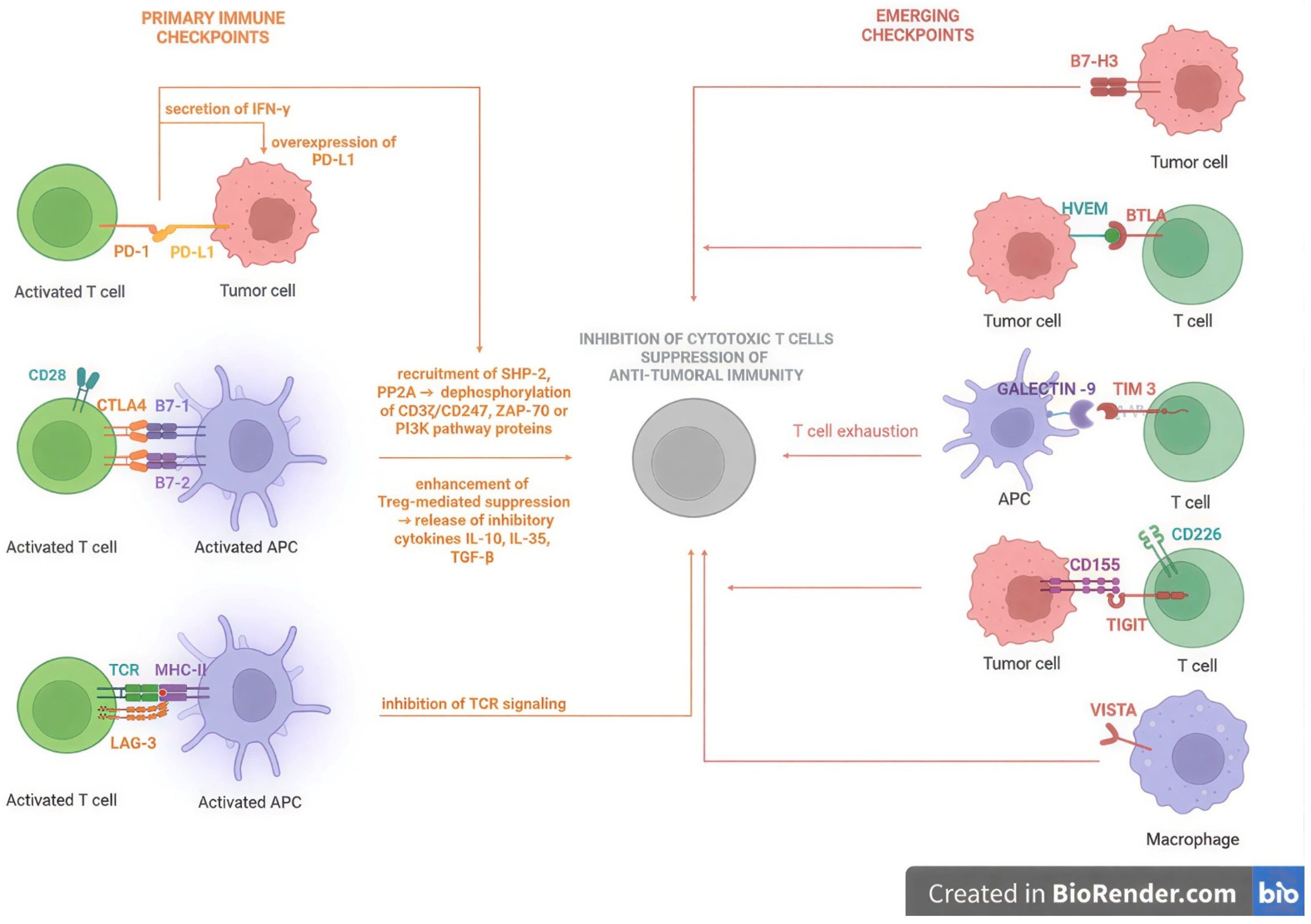
2.1. Immune Checkpoints in Melanoma
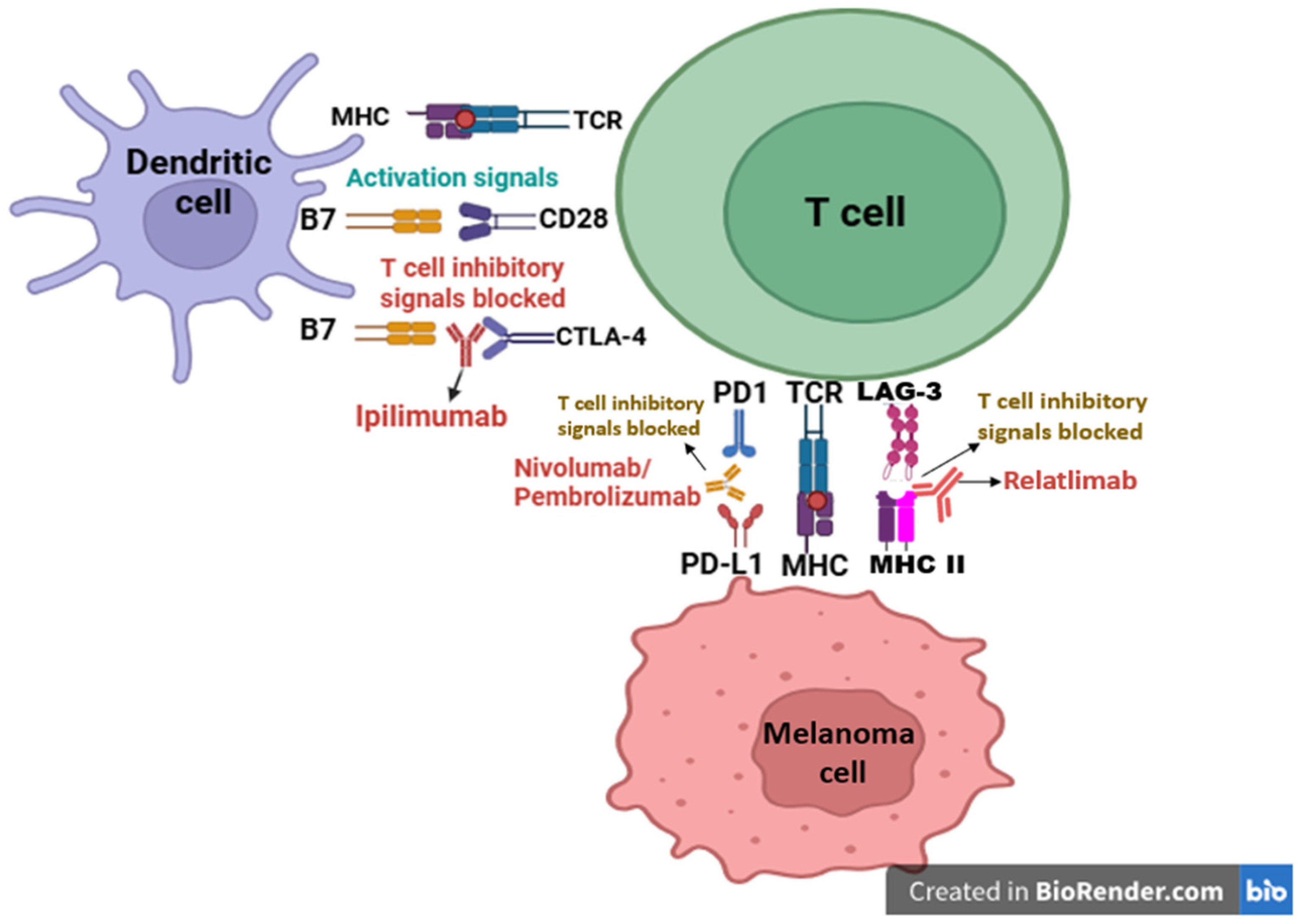
2.2. Current Immunotherapies in Melanoma
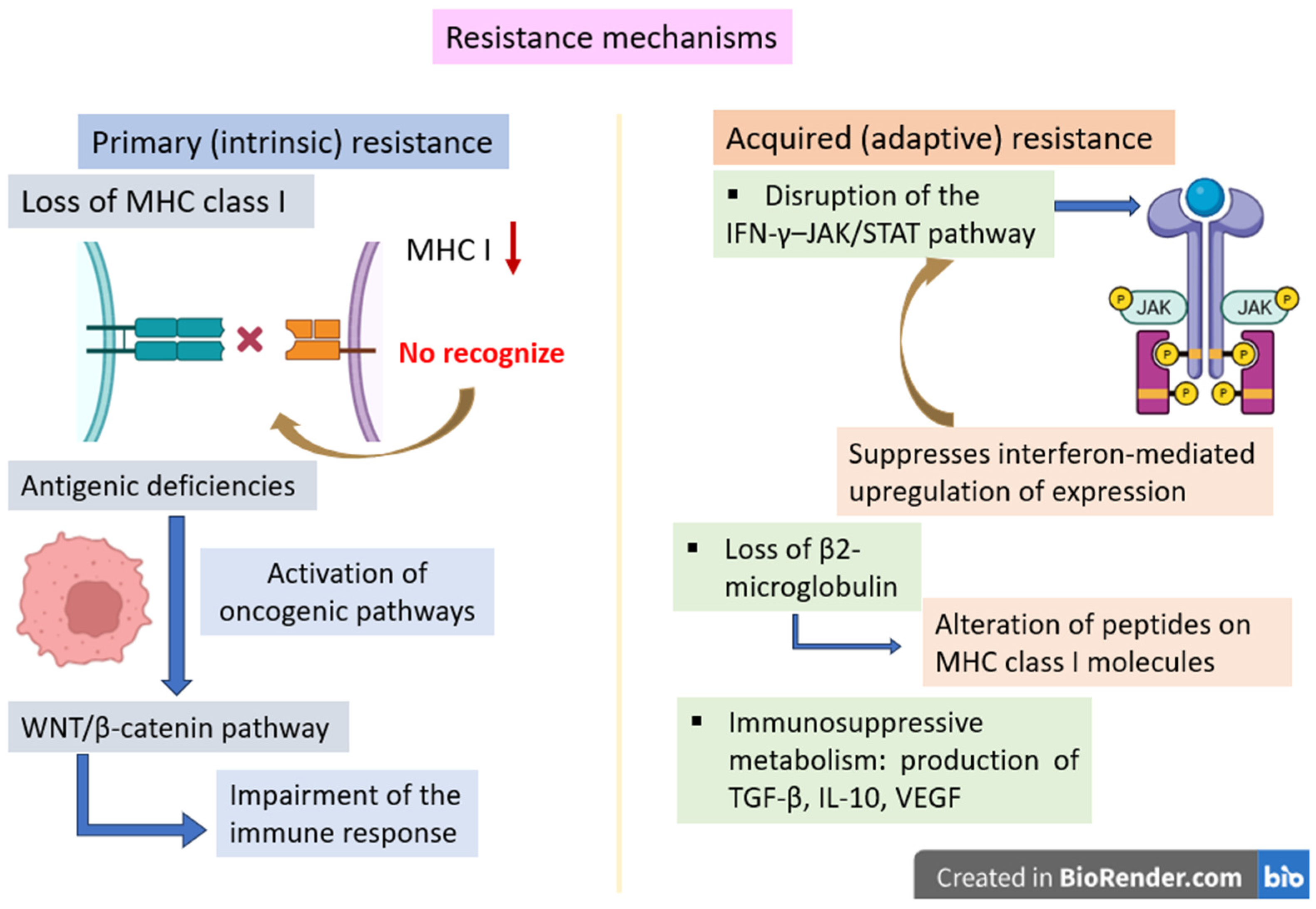
2.3. Resistance Mechanisms
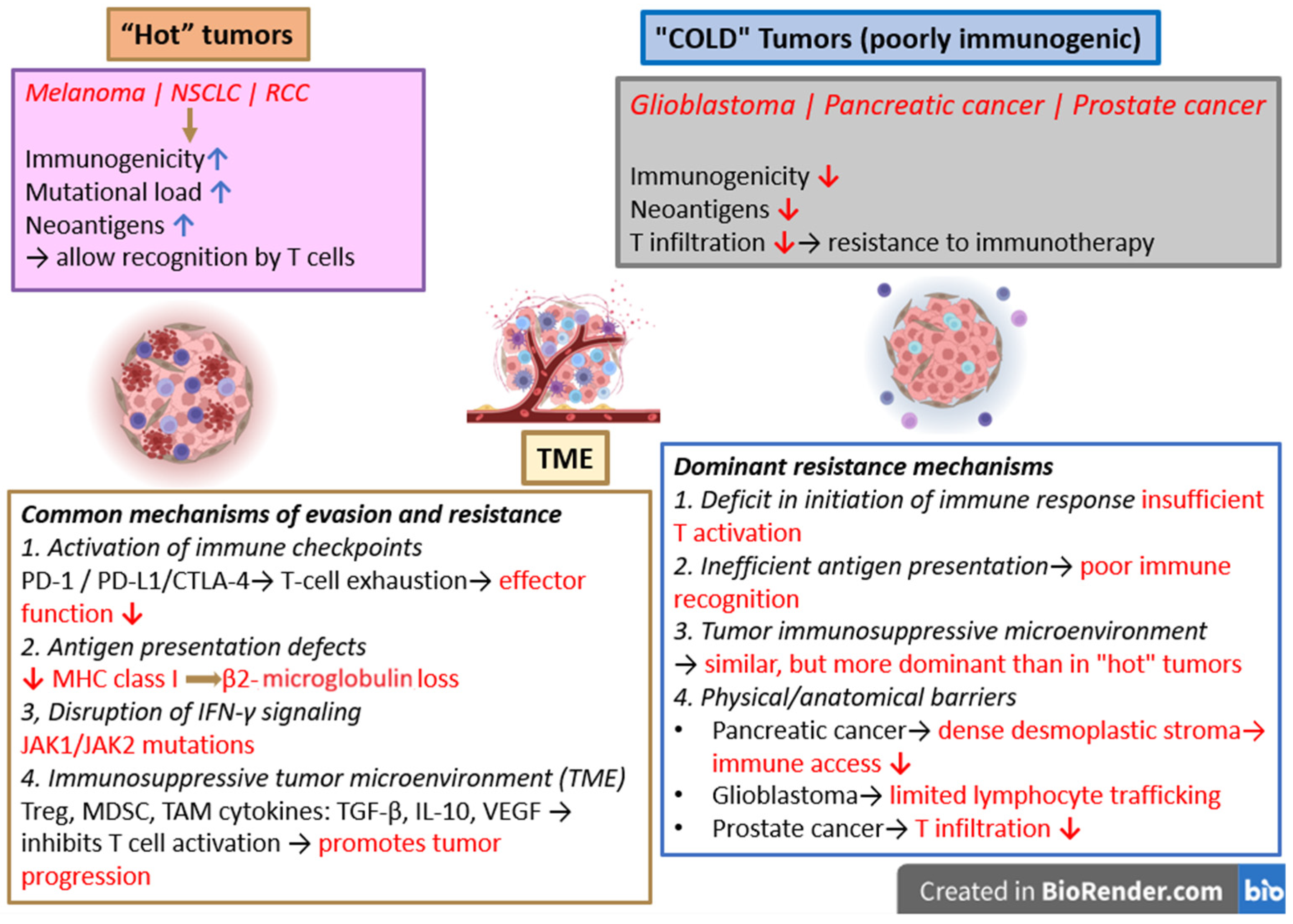
3. Comparative Assessment of Cancer Pathways Between Malignant Melanoma and Other Types of Cancers
4. Plant-Derived Compounds: Classification, Sources, and Mechanisms of Action as Potential Immunotherapy Sensitizers
4.1. Flavonoids
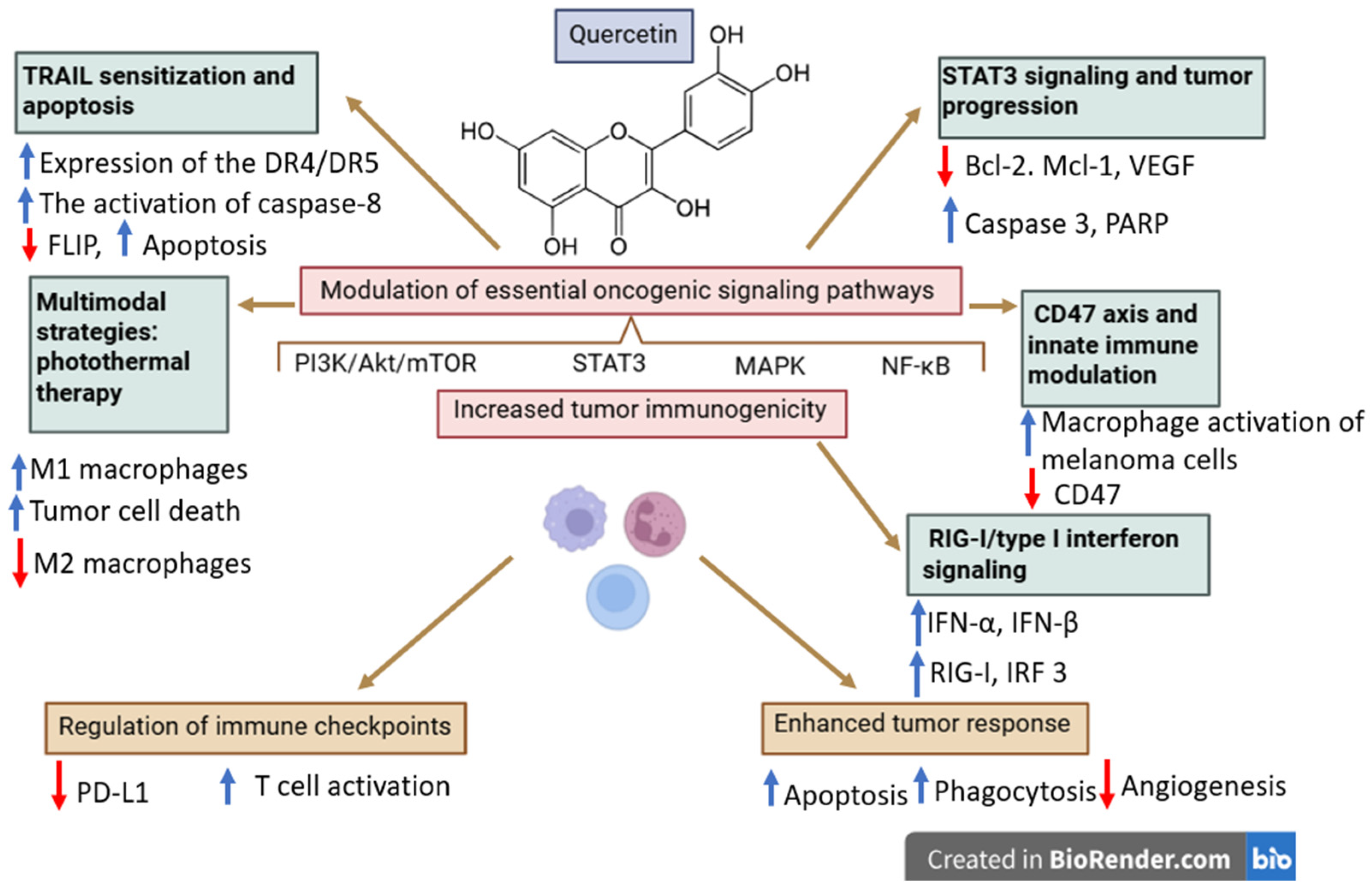
4.1.1. Quercetin
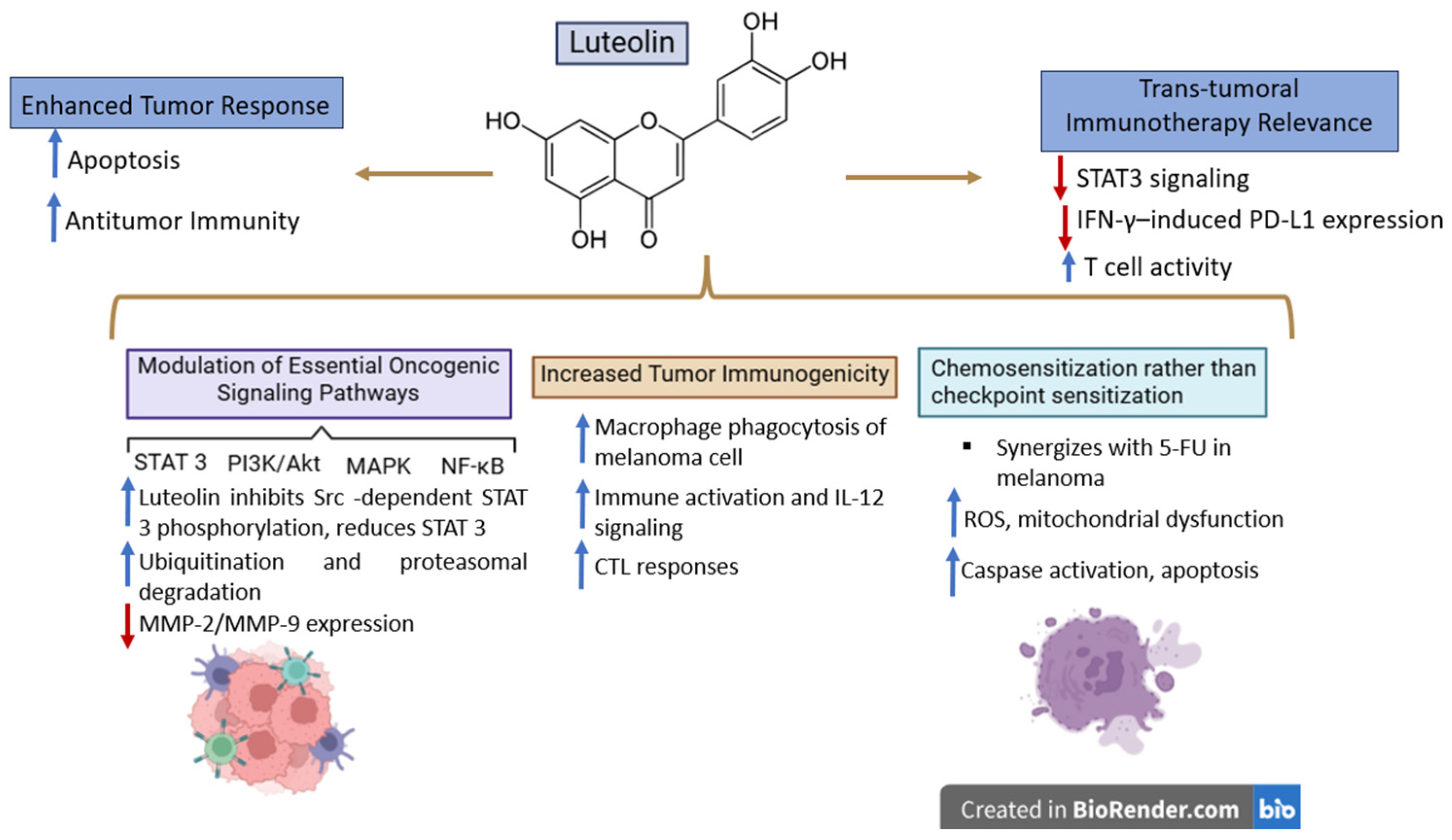
4.1.2. Luteolin
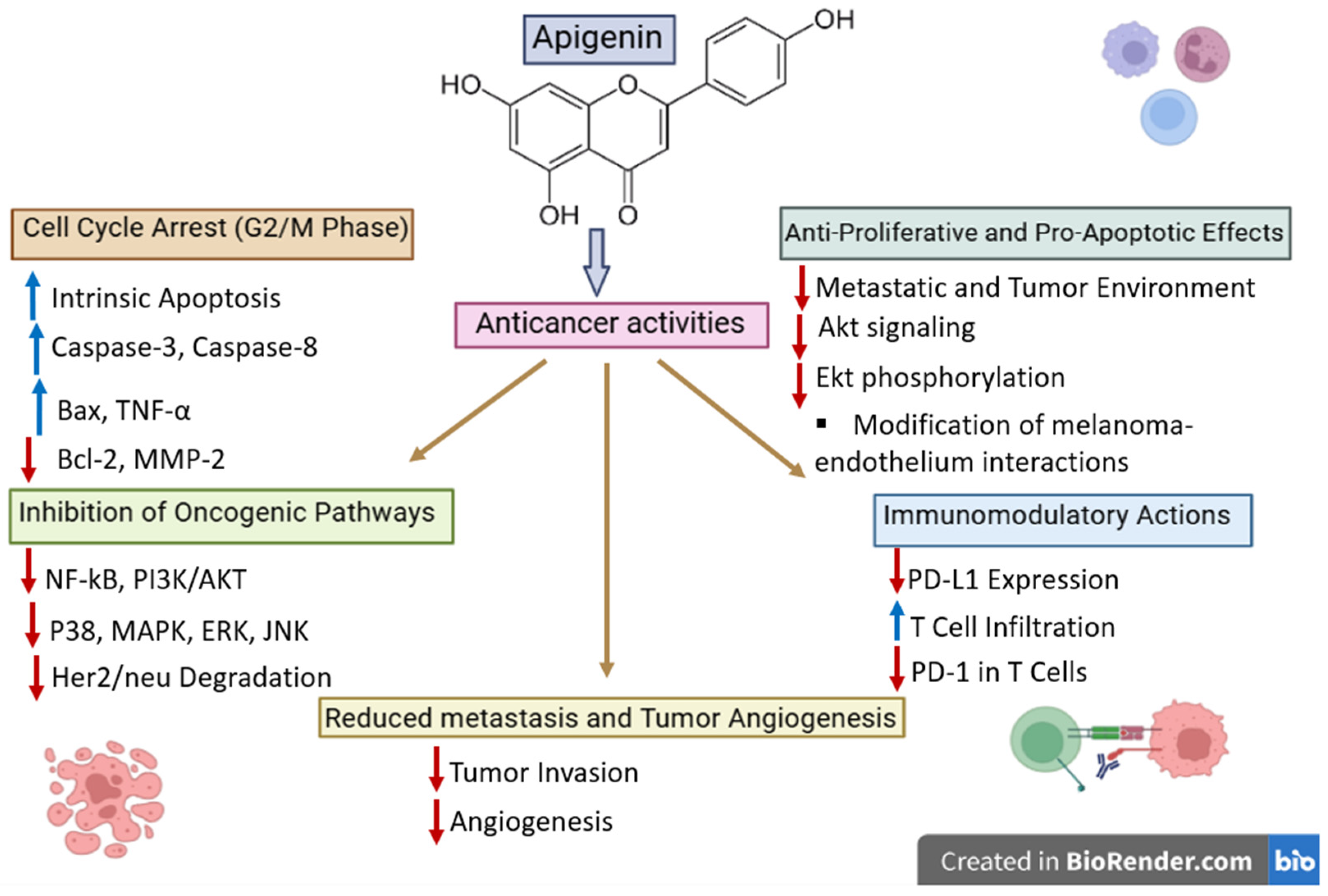
4.1.3. Apigenin
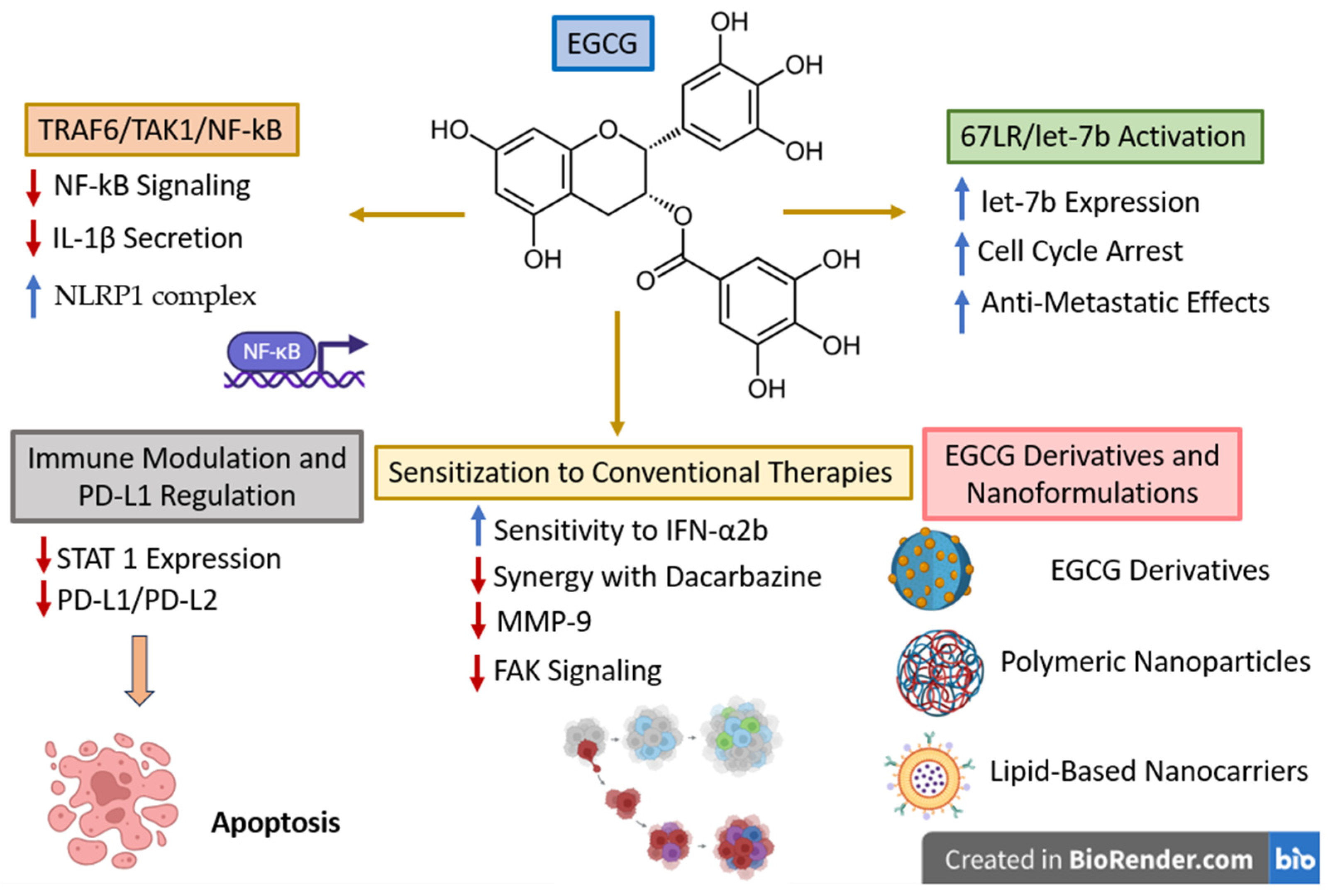
4.1.4. Epigallocatechin Gallate
4.2. Polyphenols
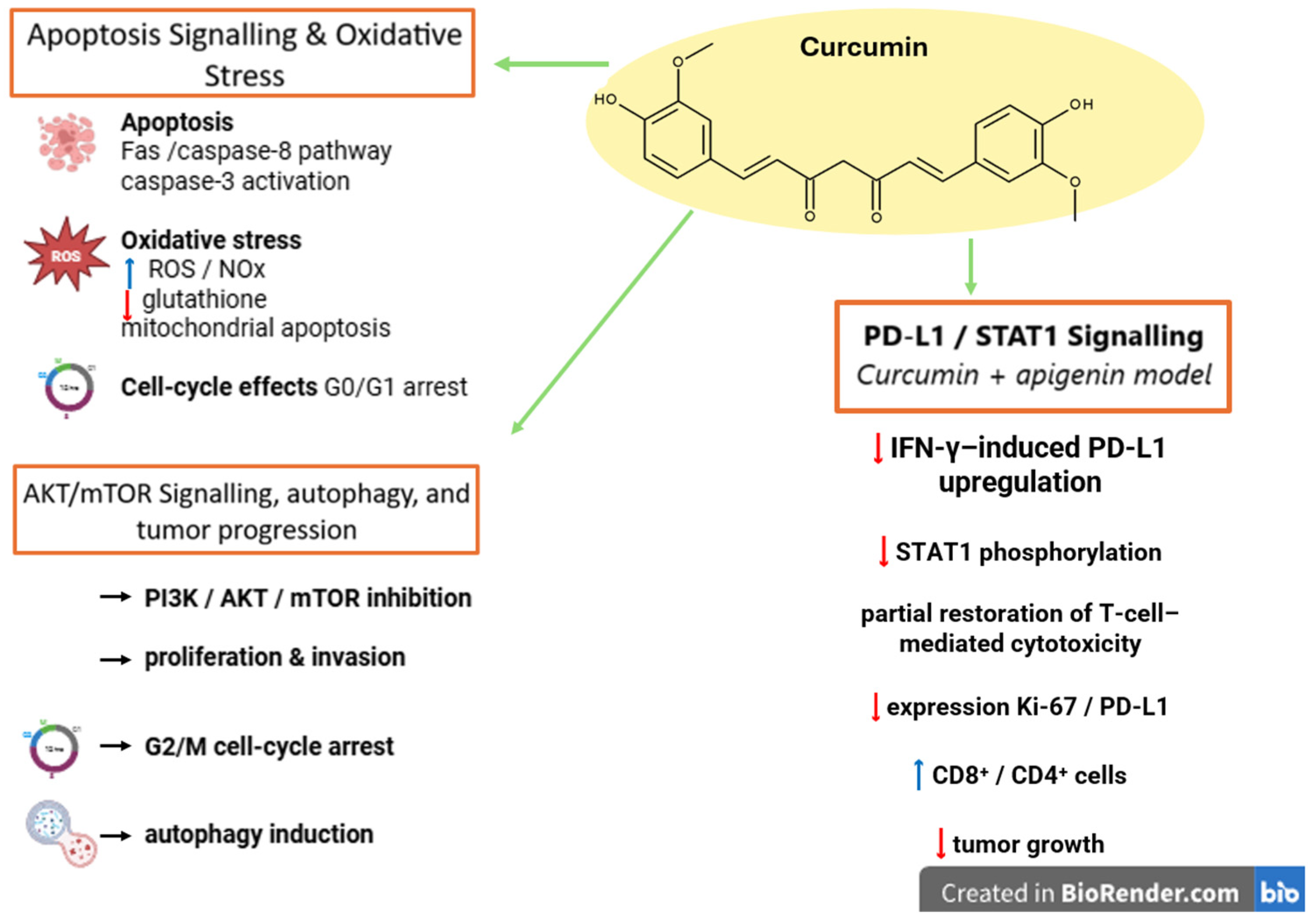
Curcumin
4.3. Alkaloids
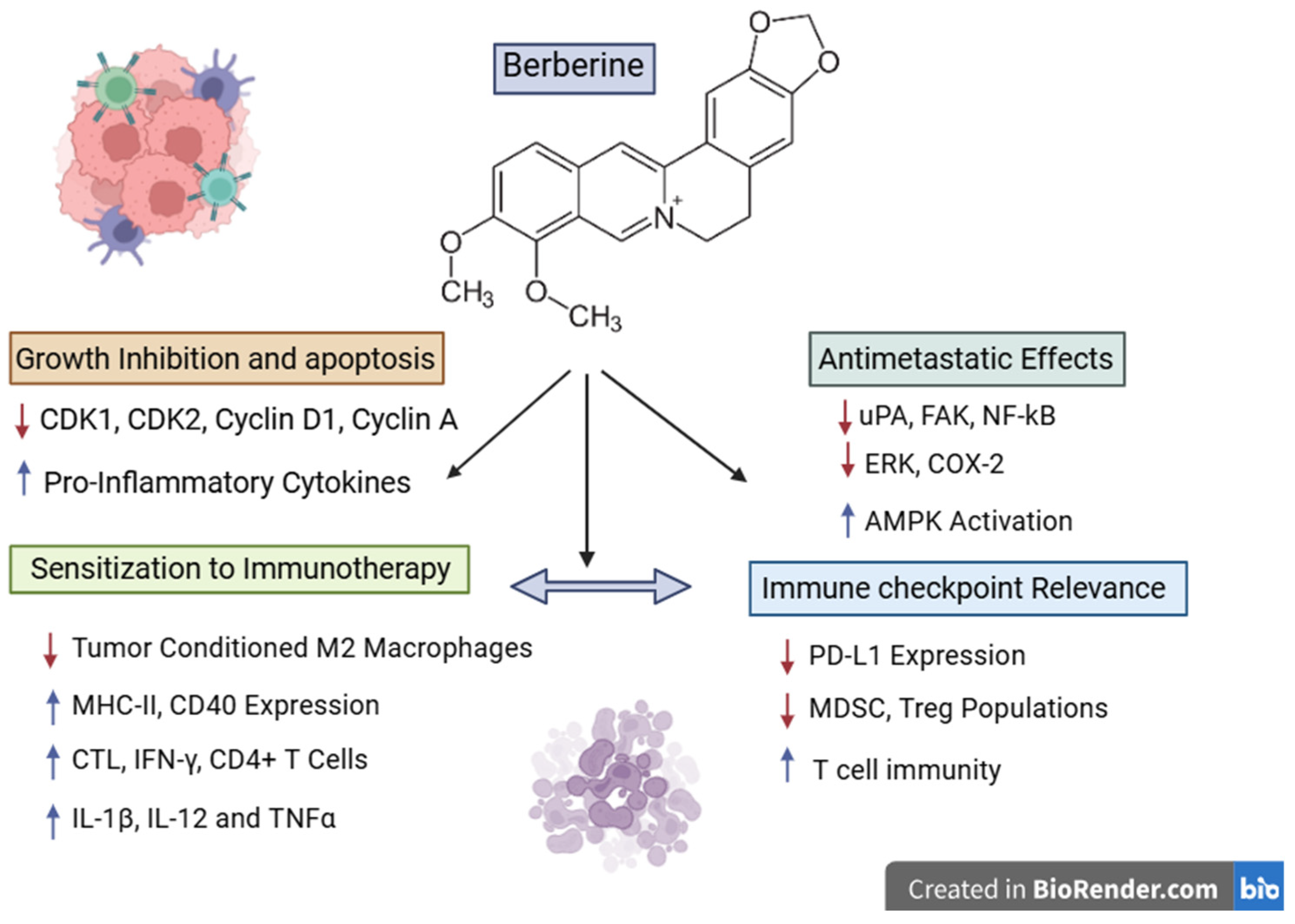
Berberine
5. Plant-Derived Compounds: Indirect or Emerging Sensitizers in Melanoma
5.1. Indirect or Emerging Sensitizers in Melanoma
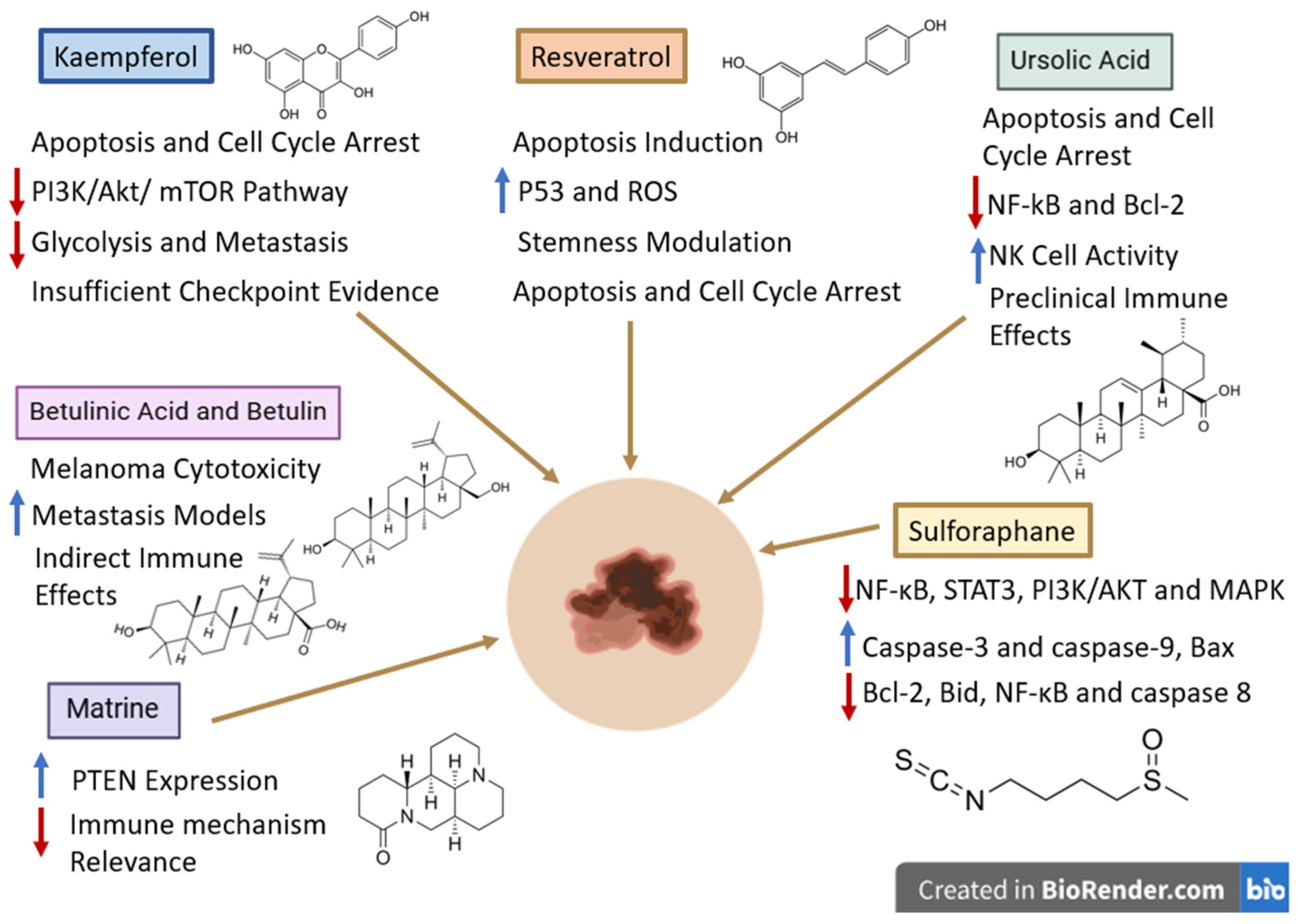
5.1.1. Kaempferol
5.1.2. Resveratrol
5.1.3. Ursolic Acid
5.1.4. Betulinic Acid and Betulin
5.1.5. Matrine
5.1.6. Sulforaphane
6. Discussion
7. Challenges and Limitations
8. Future Perspectives and Directions
9. Conclusions
Author Contributions
Funding
Data Availability Statement
Conflicts of Interest
Abbreviations
| 67LR | 67 kDa laminin receptor |
| ABC | ATP-binding cassette |
| AKT | RAC (Rho family)-alpha serine/threonine-protein kinase |
| AMPK | AMP-activated protein kinase |
| APC | Antigen-presenting cell |
| BMI-1 | B cell-specific Moloney murine leukemia virus integration site 1 |
| BRAF | B-Rapidly Accelerated Fibrosarcoma |
| BTLA | B and T lymphocyte attenuator |
| CD | Cluster of differentiation |
| CTL | Cytotoxic T lymphocyte |
| CTLA-4 | Cytotoxic T-Lymphocyte Antigen 4 |
| DAMPs | Damage-associated molecular patterns |
| DR | Death receptor |
| EGCG | Epigallocatechin 3 gallate |
| EPR | Enhanced permeability and retention |
| ERK | Extracellular signal-regulated kinase |
| EZH2 | Enhancer of zeste homolog 2 |
| FAK | Focal adhesion kinase |
| FLIP | Cellular FLICE-like inhibitory protein |
| HDAC | Histone deacetylase |
| HMGB1 | High-Mobility Group Box 1 protein |
| IFN | Interferon |
| IL | Interleukin |
| irAEs | Immune-related adverse events |
| IRF | Interferon regulatory factor |
| JAK | Janus kinase |
| LAG-3 | Lymphocyte Activation Gene-3 |
| MAPK | Mitogen-Activated Protein Kinase |
| MDSCs | Myeloid-derived suppressor cells |
| MHC I | Major histocompatibility complex I |
| MHC II | Major histocompatibility complex II |
| MMP | Matrix metalloproteinase |
| MPEG-PLA | Methoxy poly(ethylene glycol)-b-poly(L-lactide) |
| mTOR | Mechanistic target of rapamycin |
| NF-κB | Nuclear factor kappa-light-chain-enhancer of activated B cells |
| NK | Natural Killer |
| NRAS | Neuroblastoma RAS viral oncogene homolog |
| Nrf2 | Nuclear factor erythroid 2-related factor 2 |
| NSCLC | Non-small cell lung cancer |
| NQO1 | NAD(P)H quinone oxidoreductase 1 |
| OCT4 | Octamer-binding transcription factor 4 |
| ORR | Objective response rate |
| OS | Overall survival |
| PDK1 | Phosphoinositide-dependent protein kinase-1 |
| PD-L1 | Programmed Death-Ligand 1 |
| PFS | Progression-free survival PFS |
| PI3K | Phosphoinositide 3-Kinase |
| PTEN | Phosphatase and tensin homolog |
| RARβ | Retinoic acid receptor beta |
| RCC | Renal cell carcinoma |
| RIG-I | Retinoic acid-inducible gene I |
| ROS | Reactive oxygen species |
| SHP | Src homology region 2-containing phosphatase-2 |
| SIRPα | Signal Regulatory Protein alpha |
| SOX | SRY-box transcription factor |
| STAT | Signal transducer and activator of transcription |
| TAMs | Tumor-associated macrophages |
| TCR | T-cell receptor |
| TGF-β | Transforming Growth Factor-β |
| TIGIT | T-cell immunoreceptor with immunoglobulin and ITIM domain |
| TIM-3 | T-cell immunoglobulin and mucin domain-containing protein 3 |
| TME | Tumor microenvironment |
| TRAIL | Tumor Necrosis Factor-Related Apoptosis-Inducing Ligand |
| Treg | Regulatory T cells |
| VEGF | Vascular Endothelial Growth Factor |
| VISTA | V-domain Ig suppressor of T-cell activation |
| WBC | White blood cell |
| ZAP-70 | Zeta-chain-associated protein kinase 70 |
References
- Saginala, K.; Barsouk, A.; Aluru, J.S.; Rawla, P.; Barsouk, A. Epidemiology of Melanoma. Med. Sci. 2021, 9, 63. [Google Scholar] [CrossRef]
- Arnold, M.; Singh, D.; Laversanne, M.; Vignat, J.; Vaccarella, S.; Meheus, F.; Cust, A.E.; De Vries, E.; Whiteman, D.C.; Bray, F. Global Burden of Cutaneous Melanoma in 2020 and Projections to 2040. JAMA Dermatol. 2022, 158, 495–503. [Google Scholar] [CrossRef]
- Raimondi, S.; Suppa, M.; Gandini, S. Melanoma Epidemiology and Sun Exposure. Acta Derm. Venereol. 2020, 100, 5746. [Google Scholar] [CrossRef]
- Ng, M.F.; Simmons, J.L.; Boyle, G.M. Heterogeneity in Melanoma. Cancers 2022, 14, 3030. [Google Scholar] [CrossRef]
- Sosman, J.A.; Kim, K.B.; Schuchter, L.; Gonzalez, R.; Pavlick, A.C.; Weber, J.S.; McArthur, G.A.; Hutson, T.E.; Moschos, S.J.; Flaherty, K.T.; et al. Resistance to BRAF-Targeted Therapy in Melanoma. Eur. J. Cancer 2013, 49, 1297–1304. [Google Scholar]
- Al Hmada, Y.; Brodell, R.T.; Kharouf, N.; Flanagan, T.W.; Alamodi, A.A.; Hassan, S.Y.; Shalaby, H.; Hassan, S.L.; Haikel, Y.; Megahed, M.; et al. Mechanisms of Melanoma Progression and Treatment Resistance: Role of Cancer Stem-like Cells. Cancers 2024, 16, 470. [Google Scholar] [CrossRef] [PubMed]
- O’Toole, K.T.; Roan, B.M.; Hardman, T.M.; Phillips, P.P.; VanBrocklin, E.M.; Parkman, G.L.; Holmen, S.L. Unraveling the Enigma of Melanoma Brain Metastasis: New Molecular Insights and Therapeutic Directions. Int. J. Mol. Sci. 2026, 27, 2019. [Google Scholar] [CrossRef] [PubMed]
- Tarhini, A.; Kudchadkar, R.R. Predictive and On-Treatment Monitoring Biomarkers in Advanced Melanoma: Moving toward Personalized Medicine. Cancer Treat. Rev. 2018, 71, 8–18. [Google Scholar] [CrossRef]
- Akbani, R.; Akdemir, K.C.; Aksoy, B.A.; Albert, M.; Ally, A.; Amin, S.B.; Arachchi, H.; Arora, A.; Auman, J.T.; Ayala, B.; et al. The Treatment of Advanced Melanoma: Current Approaches and New Challenges. Crit. Rev. Oncol. Hematol. 2024, 196, 104276. [Google Scholar] [CrossRef]
- Robert, C.; Schachter, J.; Long, G.V.; Arance, A.; Grob, J.J.; Mortier, L.; Daud, A.; Carlino, M.S.; McNeil, C.; Lotem, M.; et al. Pembrolizumab versus Ipilimumab in Advanced Melanoma. N. Engl. J. Med. 2015, 372, 2521–2532. [Google Scholar] [CrossRef]
- Wolchok, J.D.; Chiarion-Sileni, V.; Gonzalez, R.; Grob, J.J.; Rutkowski, P.; Lao, C.D.; Cowey, C.L.; Schadendorf, D.; Wagstaff, J.; Dummer, R.; et al. Long-Term Outcomes With Nivolumab Plus Ipilimumab or Nivolumab Alone Versus Ipilimumab in Patients With Advanced Melanoma. J. Clin. Oncol. 2022, 40, 127–137. [Google Scholar] [CrossRef]
- Larkin, J.; Chiarion-Sileni, V.; Gonzalez, R.; Grob, J.J.; Cowey, C.L.; Lao, C.D.; Schadendorf, D.; Dummer, R.; Smylie, M.; Rutkowski, P.; et al. Combined Nivolumab and Ipilimumab or Monotherapy in Untreated Melanoma. N. Engl. J. Med. 2015, 373, 23–34. [Google Scholar] [CrossRef]
- Tawbi, H.A.; Schadendorf, D.; Lipson, E.J.; Ascierto, P.A.; Matamala, L.; Castillo Gutiérrez, E.; Rutkowski, P.; Gogas, H.J.; Lao, C.D.; De Menezes, J.J.; et al. Relatlimab and Nivolumab versus Nivolumab in Untreated Advanced Melanoma. N. Engl. J. Med. 2022, 386, 24–34. [Google Scholar] [CrossRef] [PubMed]
- Carlino, M.S.; Larkin, J.; Long, G.V. Immune Checkpoint Inhibitors in Melanoma. Lancet 2021, 398, 1002–1014. [Google Scholar] [CrossRef] [PubMed]
- Wolchok, J.D.; Chiarion-Sileni, V.; Rutkowski, P.; Cowey, C.L.; Schadendorf, D.; Wagstaff, J.; Queirolo, P.; Dummer, R.; Butler, M.O.; Hill, A.G.; et al. Final, 10-Year Outcomes with Nivolumab plus Ipilimumab in Advanced Melanoma. N. Engl. J. Med. 2024, 392, 11. [Google Scholar] [CrossRef]
- Jenkins, R.W.; Barbie, D.A.; Flaherty, K.T. Mechanisms of Resistance to Immune Checkpoint Inhibitors. Br. J. Cancer 2018, 118, 9–16. [Google Scholar] [CrossRef]
- Johnson, D.B.; Nebhan, C.A.; Moslehi, J.J.; Balko, J.M. Immune-Checkpoint Inhibitors: Long-Term Implications of Toxicity. Nat. Rev. Clin. Oncol. 2022, 19, 254–267. [Google Scholar] [CrossRef]
- Fletcher, K.; Johnson, D.B. Chronic Immune-Related Adverse Events Arising from Immune Checkpoint Inhibitors: An Update. J. Immunother. Cancer 2024, 12, e008591. [Google Scholar] [CrossRef] [PubMed]
- Kitano, S.; Nakayama, T.; Yamashita, M. Biomarkers for Immune Checkpoint Inhibitors in Melanoma. Front. Oncol. 2018, 8, 358729. [Google Scholar] [CrossRef]
- Atanasov, A.G.; Zotchev, S.B.; Dirsch, V.M.; Orhan, I.E.; Banach, M.; Rollinger, J.M.; Barreca, D.; Weckwerth, W.; Bauer, R.; Bayer, E.A.; et al. Natural Products in Drug Discovery: Advances and Opportunities. Nat. Rev. Drug Discov. 2021, 20, 200–216. [Google Scholar] [CrossRef]
- Song, M.; Zhu, X.; Zhao, X.; Feng, J.; Sui, X. Plant-Derived Bioactive Compounds in Inflammation-Related Cancers: Mechanisms and Therapeutic Potential. Plants 2026, 15, 575. [Google Scholar] [CrossRef]
- Kokolus, K.M.; Haley, J.S.; Koubek, E.J.; Gowda, R.; Dinavahi, S.S.; Sharma, A.; Claxton, D.F.; Helm, K.F.; Drabick, J.J.; Robertson, G.P.; et al. Schweinfurthin Natural Products Induce Regression of Murine Melanoma and Pair with Anti-PD-1 Therapy to Facilitate Durable Tumor Immunity. Oncoimmunology 2019, 8, e1539614. [Google Scholar] [CrossRef] [PubMed]
- Pei, J.; Su, Z.; Zeng, X.; Zhong, Y.; Zhang, Y.; Yang, Y.; Lu, Q.; Li, J.; Deng, Y. Protocatechuic Aldehyde Acts Synergistically with Dacarbazine to Augment DNA Double-Strand Breaks and Promote Apoptosis in Cutaneous Melanoma Cells. BMC Complement. Med. Ther. 2023, 23, 111, Correction in BMC Complement. Med. Ther. 2023, 23, 133. [Google Scholar] [CrossRef] [PubMed]
- Salgado, M.T.S.F.; Fernandes e Silva, E.; Nascimento, M.A.d.; Lopes, A.C.; Paiva, L.S.d.; Votto, A.P.d.S. Potential Therapeutic Targets of Quercetin in the Cutaneous Melanoma Model and Its Cellular Regulation Pathways: A Systematic Review. Nutr. Cancer 2023, 75, 1687–1709. [Google Scholar] [CrossRef] [PubMed]
- Mirzaei, H.; Naseri, G.; Rezaee, R.; Mohammadi, M.; Banikazemi, Z.; Mirzaei, H.R.; Salehi, H.; Peyvandi, M.; Pawelek, J.M.; Sahebkar, A. Curcumin: A New Candidate for Melanoma Therapy? Int. J. Cancer 2016, 139, 1683–1695. [Google Scholar] [CrossRef]
- Fontana, F.; Raimondi, M.; Di Domizio, A.; Moretti, R.M.; Montagnani Marelli, M.; Limonta, P. Unraveling the Molecular Mechanisms and the Potential Chemopreventive/Therapeutic Properties of Natural Compounds in Melanoma. Semin. Cancer Biol. 2019, 59, 266–282. [Google Scholar] [CrossRef]
- Dumitraș, D.A.; Andrei, S. Recent Advances in the Antiproliferative and Proapoptotic Activity of Various Plant Extracts and Constituents against Murine Malignant Melanoma. Molecules 2022, 27, 2585. [Google Scholar] [CrossRef]
- Chandra Pal, H.; Marchiony Hunt, K.; Diamond, A.; Elmets, C.A.; Afaq, F. Phytochemicals for the Management of Melanoma. Mini-Rev. Med. Chem. 2016, 16, 953–979. [Google Scholar] [CrossRef]
- Strickland, L.R.; Pal, H.C.; Elmets, C.A.; Afaq, F. Targeting Drivers of Melanoma with Synthetic Small Molecules and Phytochemicals. Cancer Lett. 2015, 359, 20–35. [Google Scholar] [CrossRef]
- Tabolacci, C.; De Vita, D.; Facchiano, A.; Bozzuto, G.; Beninati, S.; Failla, C.M.; Di Martile, M.; Lintas, C.; Mischiati, C.; Stringaro, A.; et al. Phytochemicals as Immunomodulatory Agents in Melanoma. Int. J. Mol. Sci. 2023, 24, 2657. [Google Scholar] [CrossRef]
- Dong, S.; Guo, X.; Han, F.; He, Z.; Wang, Y. Emerging Role of Natural Products in Cancer Immunotherapy. Acta Pharm. Sin. B 2022, 12, 1163–1185. [Google Scholar] [CrossRef]
- Lee, J.; Han, Y.; Wang, W.; Jo, H.; Kim, H.; Kim, S.; Yang, K.M.; Kim, S.J.; Dhanasekaran, D.N.; Song, Y.S. Phytochemicals in Cancer Immune Checkpoint Inhibitor Therapy. Biomolecules 2021, 11, 1107. [Google Scholar] [CrossRef]
- Samieefar, S.; Arasteh, O.; Yeganeh Khorasanii, N.; Abedi, F.; Hosseinzadeh, H.R.; Hosseinzadeh, H. Natural Compounds as Immune Checkpoint Inhibitors in Melanoma: A Systematic Review. Naunyn. Schmiedeberg’s Arch. Pharmacol. 2026. [Google Scholar] [CrossRef] [PubMed]
- Herrero-Sánchez, M.C.; Rodríguez-Serrano, C.; Almeida, J.; San Segundo, L.; Inogés, S.; Santos-Briz, Á.; García-Briñón, J.; Corchete, L.A.; San Miguel, J.F.; Del Cañizo, C.; et al. Targeting of PI3K/AKT/MTOR Pathway to Inhibit T Cell Activation and Prevent Graft-versus-Host Disease Development. J. Hematol. Oncol. 2016, 9, 113. [Google Scholar] [CrossRef] [PubMed]
- Galluzzi, L.; Buqué, A.; Kepp, O.; Zitvogel, L.; Kroemer, G. Immunogenic Cell Death in Cancer and Infectious Disease. Nat. Rev. Immunol. 2017, 17, 97–111. [Google Scholar] [CrossRef]
- Allen-Tejerina, A.M.; Giannakis, P.; Ho Lai Yau, T.; Hillyar, C.R.T.; Rallis, K.S. Immune Checkpoint Inhibitors in Malignant Melanoma: Anti-PD-1, Anti-CTLA-4 and Anti-LAG-3 Therapies. Curr. Oncol. Rep. 2026, 28, 23. [Google Scholar] [CrossRef]
- Sobhani, N.; Tardiel-Cyril, D.R.; Davtyan, A.; Generali, D.; Roudi, R.; Li, Y. CTLA-4 in Regulatory T Cells for Cancer Immunotherapy. Cancers 2021, 13, 1440. [Google Scholar] [CrossRef]
- Hossen, M.M.; Ma, Y.; Yin, Z.; Xia, Y.; Du, J.; Huang, J.Y.; Huang, J.J.; Zou, L.; Ye, Z.; Huang, Z. Current Understanding of CTLA-4: From Mechanism to Autoimmune Diseases. Front. Immunol. 2023, 14, 1198365. [Google Scholar] [CrossRef]
- Marasco, M.; Berteotti, A.; Weyershaeuser, J.; Thorausch, N.; Sikorska, J.; Krausze, J.; Brandt, H.J.; Kirkpatrick, J.; Rios, P.; Schamel, W.W.; et al. Molecular Mechanism of SHP2 Activation by PD-1 Stimulation. Sci. Adv. 2020, 6, eaay4458. [Google Scholar] [CrossRef] [PubMed]
- Garcia-Diaz, A.; Shin, D.S.; Moreno, B.H.; Saco, J.; Escuin-Ordinas, H.; Rodriguez, G.A.; Zaretsky, J.M.; Sun, L.; Hugo, W.; Wang, X.; et al. Interferon Receptor Signaling Pathways Regulating PD-L1 and PD-L2 Expression. Cell Rep. 2017, 19, 1189–1201. [Google Scholar] [CrossRef]
- Kreidieh, F.Y.; Tawbi, H.A. The Introduction of LAG-3 Checkpoint Blockade in Melanoma: Immunotherapy Landscape beyond PD-1 and CTLA-4 Inhibition. Ther. Adv. Med. Oncol. 2023, 15, 17588359231186027. [Google Scholar] [CrossRef]
- Aggarwal, V.; Workman, C.J.; Vignali, D.A.A. LAG-3 as the Third Checkpoint Inhibitor. Nat. Immunol. 2023, 24, 1415–1422. [Google Scholar] [CrossRef] [PubMed]
- Schatton, T.; Itoh, Y.; Martins, C.; Rasbach, E.; Singh, P.; Silva, M.; Mucciarone, K.; Heppt, M.V.; Geddes-Sweeney, J.; Stewart, K.; et al. Inhibition of Melanoma Cell-Intrinsic Tim-3 Stimulates MAPK-Dependent Tumorigenesis: Tumor Biology and Immunology. Cancer Res. 2022, 82, 3774–3784. [Google Scholar] [CrossRef]
- Tang, W.; Chen, J.; Ji, T.; Cong, X. TIGIT, a Novel Immune Checkpoint Therapy for Melanoma. Cell Death Dis. 2023, 14, 466. [Google Scholar] [CrossRef]
- Rosenbaum, S.R.; Knecht, M.; Mollaee, M.; Zhong, Z.; Erkes, D.A.; McCue, P.A.; Chervoneva, I.; Berger, A.C.; Lo, J.A.; Fisher, D.E.; et al. FOXD3 Regulates VISTA Expression in Melanoma. Cell Rep. 2020, 30, 510–524.e6. [Google Scholar] [CrossRef]
- Shen, B.; Mei, J.; Xu, R.; Cai, Y.; Wan, M.; Zhou, J.; Ding, J.; Zhu, Y. B7-H3 Is Associated with the Armored-Cold Phenotype and Predicts Poor Immune Checkpoint Blockade Response in Melanoma. Pathol.—Res. Pract. 2024, 256, 155267. [Google Scholar] [CrossRef]
- Dong, X.; Song, J.; Chen, B.; Qi, Y.; Jiang, W.; Li, H.; Zheng, D.; Wang, Y.; Zhang, X.; Liu, H. Exploration of the Prognostic and Immunotherapeutic Value of B and T Lymphocyte Attenuator in Skin Cutaneous Melanoma. Front. Oncol. 2021, 10, 592811. [Google Scholar] [CrossRef]
- Schachter, J.; Ribas, A.; Long, G.V.; Arance, A.; Grob, J.J.; Mortier, L.; Daud, A.; Carlino, M.S.; McNeil, C.; Lotem, M.; et al. Pembrolizumab versus Ipilimumab for Advanced Melanoma: Final Overall Survival Results of a Multicentre, Randomised, Open-Label Phase 3 Study (KEYNOTE-006). Lancet 2017, 390, 1853–1862. [Google Scholar] [CrossRef] [PubMed]
- Robert, C.; Carlino, M.S.; McNeil, C.; Ribas, A.; Grob, J.J.; Schachter, J.; Nyakas, M.; Kee, D.; Petrella, T.M.; Blaustein, A.; et al. Seven-Year Follow-Up of the Phase III KEYNOTE-006 Study: Pembrolizumab Versus Ipilimumab in Advanced Melanoma. J. Clin. Oncol. 2023, 41, 3998–4003. [Google Scholar] [CrossRef] [PubMed]
- Long, G.V.; Carlino, M.S.; McNeil, C.; Ribas, A.; Gaudy-Marqueste, C.; Schachter, J.; Nyakas, M.; Kee, D.; Petrella, T.M.; Blaustein, A.; et al. Pembrolizumab versus Ipilimumab for Advanced Melanoma: 10-Year Follow-up of the Phase III KEYNOTE-006 Study. Ann. Oncol. 2024, 35, 1191–1199. [Google Scholar] [CrossRef] [PubMed]
- Yiu, C.H.; Menzies, A.M.; Lu, C.Y. Real-World Outcomes of Pembrolizumab in Advanced Melanoma by Age and Sex: A National Population-Based Study. Target. Oncol. 2025, 20, 847–859. [Google Scholar] [CrossRef] [PubMed]
- Noringriis, I.M.; Donia, M.; Madsen, K.; Schmidt, H.; Haslund, C.A.; Bastholt, L.; Svane, I.M.; Ellebaek, E. Long-Term Clinical Outcome of Patients with Metastatic Melanoma and Initial Stable Disease during Anti-PD-1 Checkpoint Inhibitor Immunotherapy with Pembrolizumab. Br. J. Cancer 2025, 133, 337–345. [Google Scholar] [CrossRef]
- Zheng, D.X.; Bozym, D.J.; Tarantino, G.; Sullivan, R.J.; Liu, D.; Jenkins, R.W. Overcoming Resistance Mechanisms to Melanoma Immunotherapy. Am. J. Clin. Dermatol. 2024, 26, 77–96. [Google Scholar] [CrossRef] [PubMed]
- Zaretsky, J.M.; Garcia-Diaz, A.; Shin, D.S.; Escuin-Ordinas, H.; Hugo, W.; Hu-Lieskovan, S.; Torrejon, D.Y.; Abril-Rodriguez, G.; Sandoval, S.; Barthly, L.; et al. Mutations Associated with Acquired Resistance to PD-1 Blockade in Melanoma. N. Engl. J. Med. 2016, 375, 819–829. [Google Scholar] [CrossRef]
- Brahmer, J.R.; Long, G.V.; Hamid, O.; Garon, E.B.; Herbst, R.S.; Andre, T.; Armand, P.; Bajorin, D.; Bellmunt, J.; Burtness, B.; et al. Safety Profile of Pembrolizumab Monotherapy Based on an Aggregate Safety Evaluation of 8937 Patients. Eur. J. Cancer 2024, 199, 113530. [Google Scholar] [CrossRef] [PubMed]
- Robert, C.; Long, G.V.; Brady, B.; Dutriaux, C.; Maio, M.; Mortier, L.; Hassel, J.C.; Rutkowski, P.; McNeil, C.; Kalinka-Warzocha, E.; et al. Nivolumab in Previously Untreated Melanoma without BRAF Mutation. N. Engl. J. Med. 2015, 372, 320–330. [Google Scholar] [CrossRef]
- Larkin, J.; Chiarion-Sileni, V.; Gonzalez, R.; Grob, J.-J.; Rutkowski, P.; Lao, C.D.; Cowey, C.L.; Schadendorf, D.; Wagstaff, J.; Dummer, R.; et al. Five-Year Survival with Combined Nivolumab and Ipilimumab in Advanced Melanoma. N. Engl. J. Med. 2019, 381, 1535–1546. [Google Scholar] [CrossRef]
- Tawbi, H.A.; Forsyth, P.A.; Algazi, A.; Hamid, O.; Hodi, F.S.; Moschos, S.J.; Khushalani, N.I.; Lewis, K.; Lao, C.D.; Postow, M.A.; et al. Combined Nivolumab and Ipilimumab in Melanoma Metastatic to the Brain. N. Engl. J. Med. 2018, 379, 722–730. [Google Scholar] [CrossRef]
- Zielińska, M.K.; Ciążyńska, M.; Sulejczak, D.; Rutkowski, P.; Czarnecka, A.M. Mechanisms of Resistance to Anti-PD-1 Immunotherapy in Melanoma and Strategies to Overcome It. Biomolecules 2025, 15, 269. [Google Scholar] [CrossRef]
- Wang, T.; Ma, W.; Zou, Z.; Zhong, J.; Lin, X.; Liu, W.; Sun, W.; Hu, T.; Xu, Y.; Chen, Y. PD-1 Blockade Treatment in Melanoma: Mechanism of Response and Tumor-Intrinsic Resistance. Cancer Sci. 2025, 116, 329–337. [Google Scholar] [CrossRef]
- Schneider, B.J.; Naidoo, J.; Santomasso, B.D.; Lacchetti, C.; Adkins, S.; Anadkat, M.; Atkins, M.B.; Brassil, K.J.; Caterino, J.M.; Chau, I.; et al. Management of Immune-Related Adverse Events in Patients Treated with Immune Checkpoint Inhibitor Therapy: ASCO Guideline Update. J. Clin. Oncol. 2021, 39, 4073–4126, Correctrion in J. Clin. Oncol. 2022, 40, 315. [Google Scholar] [CrossRef] [PubMed]
- Schneider, B.J.; Lacchetti, C.; Bollin, K. Management of the Top 10 Most Common Immune-Related Adverse Events in Patients Treated With Immune Checkpoint Inhibitor Therapy. JCO Oncol. Pract. 2022, 18, 431–444. [Google Scholar] [CrossRef]
- Hughes, T.; Klairmont, M.; Sharfman, W.H.; Kaufman, H.L. Interleukin-2, Ipilimumab, and Anti-PD-1: Clinical Management and the Evolving Role of Immunotherapy for the Treatment of Patients with Metastatic Melanoma. Cancer Biol. Ther. 2021, 22, 513–526. [Google Scholar] [CrossRef]
- Eggermont, A.M.M.; Chiarion-Sileni, V.; Grob, J.J.; Dummer, R.; Wolchok, J.D.; Schmidt, H.; Hamid, O.; Robert, C.; Ascierto, P.A.; Richards, J.M.; et al. Adjuvant Ipilimumab versus Placebo after Complete Resection of High-Risk Stage III Melanoma (EORTC 18071): A Randomised, Double-Blind, Phase 3 Trial. Lancet Oncol. 2015, 16, 522–530, Correction in Lancet Oncol. 2015, 16, e262. [Google Scholar] [CrossRef]
- Eggermont, A.M.M.; Chiarion-Sileni, V.; Grob, J.J.; Dummer, R.; Wolchok, J.D.; Schmidt, H.; Hamid, O.; Robert, C.; Ascierto, P.A.; Richards, J.M.; et al. Adjuvant Ipilimumab versus Placebo after Complete Resection of Stage III Melanoma: Long-Term Follow-up Results of the European Organisation for Research and Treatment of Cancer 18071 Double-Blind Phase 3 Randomised Trial. Eur. J. Cancer 2019, 119, 1–10. [Google Scholar] [CrossRef] [PubMed]
- Weber, J.; Mandala, M.; Del Vecchio, M.; Gogas, H.J.; Arance, A.M.; Cowey, C.L.; Dalle, S.; Schenker, M.; Chiarion-Sileni, V.; Marquez-Rodas, I.; et al. Adjuvant Nivolumab versus Ipilimumab in Resected Stage III or IV Melanoma. N. Engl. J. Med. 2017, 377, 1824–1835. [Google Scholar] [CrossRef]
- Pires da Silva, I.; Ahmed, T.; Reijers, I.L.M.; Weppler, A.M.; Betof Warner, A.; Patrinely, J.R.; Serra-Bellver, P.; Allayous, C.; Mangana, J.; Nguyen, K.; et al. Ipilimumab Alone or Ipilimumab plus Anti-PD-1 Therapy in Patients with Metastatic Melanoma Resistant to Anti-PD-(L)1 Monotherapy: A Multicentre, Retrospective, Cohort Study. Lancet Oncol. 2021, 22, 836–847. [Google Scholar] [CrossRef]
- Su, J.; Fu, Y.; Cui, Z.; Abidin, Z.; Yuan, J.; Zhang, X.; Li, R.; Zhao, C. Relatlimab: A Novel Drug Targeting Immune Checkpoint LAG-3 in Melanoma Therapy. Front. Pharmacol. 2024, 14, 1349081. [Google Scholar] [CrossRef]
- Tawbi, H.A.; Hodi, F.S.; Lipson, E.J.; Schadendorf, D.; Ascierto, P.A.; Matamala, L.; Castillo Gutiérrez, E.; Rutkowski, P.; Gogas, H.; Lao, C.D.; et al. Three-Year Overall Survival With Nivolumab Plus Relatlimab in Advanced Melanoma From RELATIVITY-047. J. Clin. Oncol. 2025, 43, 1546–1552. [Google Scholar] [CrossRef]
- Ascierto, P.A.; Lipson, E.J.; Dummer, R.; Larkin, J.; Long, G.V.; Sanborn, R.E.; Chiarion-Sileni, V.; Dréno, B.; Dalle, S.; Schadendorf, D.; et al. Nivolumab and Relatlimab in Patients with Advanced Melanoma That Had Progressed on Anti-Programmed Death-1/Programmed Death Ligand 1 Therapy: Results from the Phase I/IIa RELATIVITY-020 Trial. J. Clin. Oncol. 2023, 41, 2724–2735. [Google Scholar] [CrossRef] [PubMed]
- Rolig, A.S.; Peng, X.; Sturgill, E.R.; Holay, N.; Kasiewicz, M.; Mick, C.; McGee, G.H.; Miller, W.; Koguchi, Y.; Kaufmann, J.; et al. The Response to Anti–PD-1 and Anti–LAG-3 Checkpoint Blockade Is Associated with Regulatory T Cell Reprogramming. Sci. Transl. Med. 2025, 17, eadk3702. [Google Scholar] [CrossRef]
- Long, G.V.; Garnett-Benson, C.; Dolfi, S.; Ascierto, P.A.; Guo, J.; Tarhini, A.A.; Chandra, S.; Muñoz-Couselo, E.; Del Vecchio, M.; de Melo, A.C.; et al. Adjuvant Nivolumab and Relatlimab in Stage III/IV Melanoma: The Randomized Phase 3 RELATIVITY-098 Trial. Nat. Med. 2025, 31, 4301–4309. [Google Scholar] [CrossRef]
- Paschen, A.; Melero, I.; Ribas, A. Central Role of the Antigen-Presentation and Interferon-γ Pathways in Resistance to Immune Checkpoint Blockade. Annu. Rev. Cancer Biol. 2022, 6, 85–102. [Google Scholar] [CrossRef]
- Zhao, X.; Wangmo, D.; Robertson, M.; Subramanian, S. Acquired Resistance to Immune Checkpoint Blockade Therapies. Cancers 2020, 12, 1161. [Google Scholar] [CrossRef]
- Taylor, B.C.; Balko, J.M. Mechanisms of MHC-I Downregulation and Role in Immunotherapy Response. Front. Immunol. 2022, 13, 844866. [Google Scholar] [CrossRef] [PubMed]
- Han, X.; Zhang, J.; Li, W.; Huang, X.; Wang, X.; Wang, B.; Gao, L.; Chen, H. The Role of B2M in Cancer Immunotherapy Resistance: Function, Resistance Mechanism, and Reversal Strategies. Front. Immunol. 2025, 16, 1512509. [Google Scholar] [CrossRef] [PubMed]
- Massa, C.; Wang, Y.; Marr, N.; Seliger, B. Interferons and Resistance Mechanisms in Tumors and Pathogen-Driven Diseases—Focus on the Major Histocompatibility Complex (MHC) Antigen Processing Pathway. Int. J. Mol. Sci. 2023, 24, 6736. [Google Scholar] [CrossRef]
- Wu, L.Y.; Park, S.H.; Jakobsson, H.; Shackleton, M.; Möller, A. Immune Regulation and Immune Therapy in Melanoma: Review with Emphasis on CD155 Signalling. Cancers 2024, 16, 1950. [Google Scholar] [CrossRef] [PubMed]
- Kalbasi, A.; Ribas, A. Tumour-Intrinsic Resistance to Immune Checkpoint Blockade. Nat. Rev. Immunol. 2019, 20, 25–39. [Google Scholar] [CrossRef]
- Eddy, K.; Chen, S. Overcoming Immune Evasion in Melanoma. Int. J. Mol. Sci. 2020, 21, 8984. [Google Scholar] [CrossRef]
- Kondo, M. One Niche to Rule Both Maintenance and Loss of Stemness in HSCs. Immunity 2016, 45, 1177–1179. [Google Scholar] [CrossRef]
- Yamamoto, J.; Suwa, T.; Murase, Y.; Tateno, S.; Mizutome, H.; Asatsuma-Okumura, T.; Shimizu, N.; Kishi, T.; Momose, S.; Kizaki, M.; et al. ARID2 Is a Pomalidomide-Dependent CRL4CRBN Substrate in Multiple Myeloma Cells. Nat. Chem. Biol. 2020, 16, 1208–1217. [Google Scholar] [CrossRef]
- Muto, S.; Enta, A.; Maruya, Y.; Inomata, S.; Yamaguchi, H.; Mine, H.; Takagi, H.; Ozaki, Y.; Watanabe, M.; Inoue, T.; et al. Wnt/β-Catenin Signaling and Resistance to Immune Checkpoint Inhibitors: From Non-Small-Cell Lung Cancer to Other Cancers. Biomedicines 2023, 11, 190. [Google Scholar] [CrossRef] [PubMed]
- Ribas, A.; Wolchok, J.D. Cancer Immunotherapy Using Checkpoint Blockade. Science 2018, 359, 1350–1355. [Google Scholar] [CrossRef] [PubMed]
- Guo, Z.; Yu, J.; Chen, Z.; Chen, S.; Wang, L. Immunological Mechanisms behind Anti-PD-1/PD-L1 Immune Checkpoint Blockade: Intratumoral Reinvigoration or Systemic Induction? Biomedicines 2024, 12, 764. [Google Scholar] [CrossRef]
- Haist, M.; Stege, H.; Grabbe, S.; Bros, M. The Functional Crosstalk between Myeloid-Derived Suppressor Cells and Regulatory T Cells within the Immunosuppressive Tumor Microenvironment. Cancers 2021, 13, 210. [Google Scholar] [CrossRef] [PubMed]
- Nair, R.; Somasundaram, V.; Kuriakose, A.; Krishn, S.R.; Raben, D.; Salazar, R.; Nair, P. Deciphering T-Cell Exhaustion in the Tumor Microenvironment: Paving the Way for Innovative Solid Tumor Therapies. Front. Immunol. 2025, 16, 1548234. [Google Scholar] [CrossRef]
- Park, J.; Hsueh, P.C.; Li, Z.; Ho, P.C. Microenvironment-Driven Metabolic Adaptations Guiding CD8+ T Cell Anti-Tumor Immunity. Immunity 2023, 56, 32–42. [Google Scholar] [CrossRef]
- Vu, S.H.; Vetrivel, P.; Kim, J.; Lee, M.S. Cancer Resistance to Immunotherapy: Molecular Mechanisms and Tackling Strategies. Int. J. Mol. Sci. 2022, 23, 10906. [Google Scholar] [CrossRef]
- Cui, M.; Zhou, M.; Zhou, L.; Zhou, G.; Liu, Y. Tertiary Lymphoid Structures Achieve ‘Cold’ to ‘Hot’ Transition by Remodeling the Cold Tumor Microenvironment. Biochim. Biophys. Acta—Rev. Cancer 2025, 1880, 189312. [Google Scholar] [CrossRef]
- Wang, N.; Wang, C.; Cui, S.; Zhao, K.; Zhang, J.; Zhang, L.; Jia, Y.; Kong, F. Recent Advances and Future Prospects of Immunotherapeutic Approaches in Prostate Cancer. J. Transl. Med. 2026, 24, 173. [Google Scholar] [CrossRef] [PubMed]
- Kung, H.C.; Zheng, K.W.; Zimmerman, J.W.; Zheng, L. The Tumour Microenvironment in Pancreatic Cancer—New Clinical Challenges, but More Opportunities. Nat. Rev. Clin. Oncol. 2025, 22, 969–995. [Google Scholar] [CrossRef]
- Schalper, K.A.; Rodriguez-Ruiz, M.E.; Diez-Valle, R.; López-Janeiro, A.; Porciuncula, A.; Idoate, M.A.; Inogés, S.; de Andrea, C.; López-Diaz de Cerio, A.; Tejada, S.; et al. Neoadjuvant Nivolumab Modifies the Tumor Immune Microenvironment in Resectable Glioblastoma. Nat. Med. 2019, 25, 470–476. [Google Scholar] [CrossRef]
- Silvestri, I.; Tortorella, E.; Giantulli, S.; Scarpa, S.; Sciarra, A. Immunotherapy in Prostate Cancer: Recent Advances and Future Directions. EMJ Urol. 2019, 7, 51–61. [Google Scholar] [CrossRef]
- Aghababaei, F.; Hadidi, M. Recent Advances in Potential Health Benefits of Quercetin. Pharmaceuticals 2023, 16, 1020. [Google Scholar] [CrossRef]
- Wang, G.; Wang, Y.; Yao, L.; Gu, W.; Zhao, S.; Shen, Z.; Lin, Z.; Liu, W.; Yan, T. Pharmacological Activity of Quercetin: An Updated Review. Evid.-Based Complement. Altern. Med. 2022, 2022, 3997190. [Google Scholar] [CrossRef]
- Asgharian, P.; Tazekand, A.P.; Hosseini, K.; Forouhandeh, H.; Ghasemnejad, T.; Ranjbar, M.; Hasan, M.; Kumar, M.; Beirami, S.M.; Tarhriz, V.; et al. Potential Mechanisms of Quercetin in Cancer Prevention: Focus on Cellular and Molecular Targets. Cancer Cell Int. 2022, 22, 257. [Google Scholar] [CrossRef]
- Cao, H.H.; Tse, A.K.W.; Kwan, H.Y.; Yu, H.; Cheng, C.Y.; Su, T.; Fong, W.F.; Yu, Z.L. Quercetin Exerts Anti-Melanoma Activities and Inhibits STAT3 Signaling. Biochem. Pharmacol. 2014, 87, 424–434. [Google Scholar] [CrossRef]
- Sul, O.J.; Ra, S.W. Quercetin Prevents LPS-Induced Oxidative Stress and Inflammation by Modulating NOX2/ROS/NF-KB in Lung Epithelial Cells. Molecules 2021, 26, 6949. [Google Scholar] [CrossRef] [PubMed]
- Min, Y.D.; Choi, C.H.; Bark, H.; Son, H.Y.; Park, H.H.; Lee, S.; Park, J.W.; Park, E.K.; Shin, H.I.; Kim, S.H. Quercetin Inhibits Expression of Inflammatory Cytokines through Attenuation of NF-ΚB and P38 MAPK in HMC-1 Human Mast Cell Line. Inflamm. Res. 2007, 56, 210–215. [Google Scholar] [CrossRef] [PubMed]
- Liu, Y.; Jiao, A. Flavonoids as Immunoregulators: Molecular Mechanisms in Regulating Immune Cells and Their Therapeutic Applications in Inflammatory Diseases. Front. Immunol. 2025, 16, 1703672. [Google Scholar] [CrossRef]
- Deng, H.; Wei, F.; Han, W.; Li, Y.; Xu, X.; Zhang, L.; Zhang, Y. Synergistic Chemotherapy and Immunomodulatory Effects of Quercetin in Cancer: A Review. Front. Immunol. 2025, 16, 1547992. [Google Scholar] [CrossRef]
- Turner, K.A.; Manouchehri, J.M.; Kalafatis, M. Sensitization of Recombinant Human Tumor Necrosis Factor-Related Apoptosis-Inducing Ligand-Resistant Malignant Melanomas by Quercetin. Melanoma Res. 2018, 28, 277–285. [Google Scholar] [CrossRef]
- Manach, C.; Morand, C.; Crespy, V.; Demigné, C.; Texier, O.; Régérat, F.; Rémésy, C. Quercetin Is Recovered in Human Plasma as Conjugated Derivatives Which Retain Antioxidant Properties. FEBS Lett. 1998, 426, 331–336. [Google Scholar] [CrossRef]
- Frenț, O.D.; Stefan, L.; Morgovan, C.M.; Duteanu, N.; Dejeu, I.L.; Marian, E.; Vicaș, L.; Manole, F. A Systematic Review: Quercetin—Secondary Metabolite of the Flavonol Class, with Multiple Health Benefits and Low Bioavailability. Int. J. Mol. Sci. 2024, 25, 12091. [Google Scholar] [CrossRef]
- Li, X.; He, X.; Lin, B.; Li, L.; Deng, Q.; Wang, C.; Zhang, J.; Chen, Y.; Zhao, J.; Li, X.; et al. Quercetin Limits Tumor Immune Escape through PDK1/CD47 Axis in Melanoma. Am. J. Chin. Med. 2024, 52, 541–563. [Google Scholar] [CrossRef]
- Peng, D.; Chen, L.; Sun, Y.; Sun, L.; Yin, Q.; Deng, S.; Niu, L.; Lou, F.; Wang, Z.; Xu, Z.; et al. Melanoma Suppression by Quercein Is Correlated with RIG-I and Type I Interferon Signaling. Biomed. Pharmacother. 2020, 125, 109984. [Google Scholar] [CrossRef] [PubMed]
- Jing, L.; Lin, J.; Yang, Y.; Tao, L.; Li, Y.; Liu, Z.; Zhao, Q.; Diao, A. Quercetin Inhibiting the PD-1/PD-L1 Interaction for Immune-Enhancing Cancer Chemopreventive Agent. Phyther. Res. 2021, 35, 6441–6451. [Google Scholar] [CrossRef]
- Li, L.; Zhang, M.; Liu, T.; Li, J.; Sun, S.; Chen, J.; Liu, Z.; Zhang, Z.; Zhang, L. Quercetin-Ferrum Nanoparticles Enhance Photothermal Therapy by Modulating the Tumor Immunosuppressive Microenvironment. Acta Biomater. 2022, 154, 454–466. [Google Scholar] [CrossRef] [PubMed]
- Alavi, S.; Stewart, A.J.; Kefford, R.F.; Lim, S.Y.; Shklovskaya, E.; Rizos, H. Interferon Signaling Is Frequently Downregulated in Melanoma. Front. Immunol. 2018, 9, 1414. [Google Scholar] [CrossRef] [PubMed]
- Haskins, M.M.; Kavanagh, O.N.; Sanii, R.; Khorasani, S.; Chen, J.M.; Zhang, Z.Y.; Dai, X.L.; Ren, B.Y.; Lu, T.B.; Zaworotko, M.J. Tuning the Pharmacokinetic Performance of Quercetin by Cocrystallization. Cryst. Growth Des. 2023, 23, 6059–6066. [Google Scholar] [CrossRef]
- Mirza, M.A.; Mahmood, S.; Hilles, A.R.; Ali, A.; Khan, M.Z.; Zaidi, S.A.A.; Iqbal, Z.; Ge, Y. Quercetin as a Therapeutic Product: Evaluation of Its Pharmacological Action and Clinical Applications—A Review. Pharmaceuticals 2023, 16, 1631. [Google Scholar] [CrossRef]
- Solnier, J.; Zhang, Y.; Roh, K.; Kuo, Y.C.; Du, M.; Wood, S.; Hardy, M.; Gahler, R.J.; Chang, C. A Pharmacokinetic Study of Different Quercetin Formulations in Healthy Participants: A Diet-Controlled, Crossover, Single- and Multiple-Dose Pilot Study. Evid.-Based Complement. Altern. Med. 2023, 2023, 9727539. [Google Scholar] [CrossRef]
- Tomou, E.M.; Papakyriakopoulou, P.; Saitani, E.M.; Valsami, G.; Pippa, N.; Skaltsa, H. Recent Advances in Nanoformulations for Quercetin Delivery. Pharmaceuticals 2023, 15, 1656. [Google Scholar] [CrossRef]
- Joshi, H.; Gupta, D.S.; Kaur, G.; Singh, T.; Ramniwas, S.; Sak, K.; Aggarwal, D.; Chhabra, R.S.; Gupta, M.; Saini, A.K.; et al. Nanoformulations of Quercetin for Controlled Delivery: A Review of Preclinical Anticancer Studies. Naunyn-Schmiedeberg’s Arch. Pharmacol. 2023, 396, 3443–3458. [Google Scholar] [CrossRef]
- Zang, X.; Cheng, M.; Zhang, X.; Chen, X. Quercetin Nanoformulations: A Promising Strategy for Tumor Therapy. Food Funct. 2021, 12, 6664–6681. [Google Scholar] [CrossRef]
- Homayoonfal, M.; Aminianfar, A.; Asemi, Z.; Yousefi, B. Application of Nanoparticles for Efficient Delivery of Quercetin in Cancer Cells. Curr. Med. Chem. 2023, 31, 1107–1141. [Google Scholar] [CrossRef]
- Lawson, M.K. Improvement of Therapeutic Value of Quercetin with Chitosan Nanoparticle Delivery Systems and Potential Applications. Int. J. Mol. Sci. 2023, 24, 3293. [Google Scholar] [CrossRef]
- Kapare, H.; Kanadje, S.; Bhole, R. Quercetin Nano-Formulations as a Potential Approach for Skin Cancer. Pharm. Nanotechnol. 2024, 13, 827–838. [Google Scholar] [CrossRef] [PubMed]
- Duque, M.; Renn, P.; Oliva, A.; Barros, D. Natural Plant Oil-Based Drug Delivery Systems Influence Melanoma Growth in in Vitro Studies. J. Drug Deliv. Sci. Technol. 2026, 120, 108240. [Google Scholar] [CrossRef]
- Mo, F.; Hong, M.; Chen, X.; Wang, Q.; Dong, C. Genistein Enhances Anti-PD-1 Efficacy in Melanoma by Suppressing Regulatory T Cell Differentiation and Activity. Sci. Rep. 2025, 15, 36973. [Google Scholar] [CrossRef]
- Olthof, M.R.; Hollman, P.C.H.; Vree, T.B.; Katan, M.B. Bioavailabilities of Quercetin-3-Glucoside and Quercetin-4′-Glucoside Do Not Differ in Humans. J. Nutr. 2000, 130, 1200–1203. [Google Scholar] [CrossRef]
- Graefe, E.U.; Wittig, J.; Mueller, S.; Riethling, A.K.; Uehleke, B.; Drewelow, B.; Pforte, H.; Jacobasch, G.; Derendorf, H.; Veit, M. Pharmacokinetics and Bioavailability of Quercetin Glycosides in Humans. J. Clin. Pharmacol. 2001, 41, 492–499. [Google Scholar] [CrossRef] [PubMed]
- Murota, K.; Matsuda, N.; Kashino, Y.; Fujikura, Y.; Nakamura, T.; Kato, Y.; Shimizu, R.; Okuyama, S.; Tanaka, H.; Koda, T.; et al. α-Oligoglucosylation of a Sugar Moiety Enhances the Bioavailability of Quercetin Glucosides in Humans. Arch. Biochem. Biophys. 2010, 501, 91–97. [Google Scholar] [CrossRef]
- Walle, T. Methylation of Dietary Flavones Increases Their Metabolic Stability and Chemopreventive Effects. Int. J. Mol. Sci. 2009, 10, 5002–5019. [Google Scholar] [CrossRef]
- Rashid, M.I.; Fareed, M.I.; Rashid, H.; Aziz, H.; Ehsan, N.; Khalid, S.; Ghaffar, I.; Ali, R.; Gul, A.; Rehman Hakeem, K. Flavonoids and Their Biological Secrets. Plant Hum. Health 2019, 2, 579–605. [Google Scholar] [CrossRef]
- Biasutto, L.; Marotta, E.; De Marchi, U.; Zoratti, M.; Paradisi, C. Ester-Based Precursors to Increase the Bioavailability of Quercetin. J. Med. Chem. 2006, 50, 241–253. [Google Scholar] [CrossRef]
- Lo, S.; Leung, E.; Fedrizzi, B.; Barker, D. Synthesis, Antiproliferative Activity and Radical Scavenging Ability of 5-O-Acyl Derivatives of Quercetin. Molecules 2021, 26, 1608. [Google Scholar] [CrossRef]
- Ścibior, A. Overview of Research on Vanadium-Quercetin Complexes with a Historical Outline. Antioxidants 2022, 11, 790. [Google Scholar] [CrossRef]
- Mathiyalagan, S.; Mandal, B.K. Stability Comparison of Quercetin and Its Metal Complexes and Their Biological Activity. Biointerface Res. Appl. Chem. 2021, 11, 7890–7902. [Google Scholar] [CrossRef]
- Mukherjee, A.; Mishra, S.; Kotla, N.K.; Manna, K.; Roy, S.; Kundu, B.; Bhattacharya, D.; Das Saha, K.; Talukdar, A. Semisynthetic Quercetin Derivatives with Potent Antitumor Activity in Colon Carcinoma. ACS Omega 2019, 4, 7285–7298. [Google Scholar] [CrossRef]
- Li, T.; Fu, X.; Liu, B.; Wang, X.; Li, J.; Zhu, P.; Niu, X.; Bai, J.; Liu, Y.; Lu, X.; et al. Luteolin Binds Src, Promotes STAT3 Protein Ubiquitination and Exerts Anti-Melanoma Effects in Cell and Mouse Models. Biochem. Pharmacol. 2022, 200, 115044. [Google Scholar] [CrossRef]
- Yao, X.; Jiang, W.; Yu, D.; Yan, Z. Luteolin Inhibits Proliferation and Induces Apoptosis of Human Melanoma Cells in Vivo and in Vitro by Suppressing MMP-2 and MMP-9 through the PI3K/AKT Pathway. Food Funct. 2019, 10, 703–712. [Google Scholar] [CrossRef]
- Schomberg, J.; Wang, Z.; Farhat, A.; Guo, K.L.; Xie, J.; Zhou, Z.; Liu, J.; Kovacs, B.; Liu-Smith, F. Luteolin Inhibits Melanoma Growth in Vitro and in Vivo via Regulating ECM and Oncogenic Pathways but Not ROS. Biochem. Pharmacol. 2020, 177, 114025. [Google Scholar] [CrossRef]
- Ruan, J.S.; Liu, Y.P.; Zhang, L.; Yan, L.G.; Fan, F.T.; Shen, C.S.; Wang, A.Y.; Zheng, S.Z.; Wang, S.M.; Lu, Y. Luteolin Reduces the Invasive Potential of Malignant Melanoma Cells by Targeting Β3 Integrin and the Epithelial-Mesenchymal Transition. Acta Pharmacol. Sin. 2012, 33, 1325–1331. [Google Scholar] [CrossRef]
- Tian, L.; Wang, S.; Jiang, S.; Liu, Z.; Wan, X.; Yang, C.; Zhang, L.; Zheng, Z.; Wang, B.; Li, L. Luteolin as an Adjuvant Effectively Enhances CTL Anti-Tumor Response in B16F10 Mouse Model. Int. Immunopharmacol. 2021, 94, 107441. [Google Scholar] [CrossRef]
- Gahlot, H.; Kang, S.C. Enhanced Apoptosis in Melanoma Cells via Synergistic Action of Luteolin and 5-FU Through Oxidative Stress Modulation. Appl. Biochem. Biotechnol. 2025, 197, 6765–6788. [Google Scholar] [CrossRef] [PubMed]
- Jiang, Z.B.; Wang, W.J.; Xu, C.; Xie, Y.J.; Wang, X.R.; Zhang, Y.Z.; Huang, J.M.; Huang, M.; Xie, C.; Liu, P.; et al. Luteolin and Its Derivative Apigenin Suppress the Inducible PD-L1 Expression to Improve Anti-Tumor Immunity in KRAS-Mutant Lung Cancer. Cancer Lett. 2021, 515, 36–48. [Google Scholar] [CrossRef]
- Hayasaka, N.; Shimizu, N.; Komoda, T.; Mohri, S.; Tsushida, T.; Eitsuka, T.; Miyazawa, T.; Nakagawa, K. Absorption and Metabolism of Luteolin in Rats and Humans in Relation to in Vitro Anti-Inflammatory Effects. J. Agric. Food Chem. 2018, 66, 11320–11329. [Google Scholar] [CrossRef] [PubMed]
- Ali, F.; Siddique, Y.H. Bioavailability and Pharmaco-Therapeutic Potential of Luteolin in Overcoming Alzheimer’s Disease. CNS Neurol. Disord.—Drug Targets 2019, 18, 352–365. [Google Scholar] [CrossRef] [PubMed]
- Lv, J.; Song, X.; Luo, Z.; Huang, D.; Xiao, L.; Zou, K. Luteolin: Exploring Its Therapeutic Potential and Molecular Mechanisms in Pulmonary Diseases. Front. Pharmacol. 2025, 16, 1535555. [Google Scholar] [CrossRef]
- Fu, Q.T.; Zhong, X.Q.; Chen, M.Y.; Gu, J.Y.; Zhao, J.; Yu, D.H.; Tan, F. Luteolin-Loaded Nanoparticles for the Treatment of Melanoma. Int. J. Nanomed. 2023, 18, 2053–2068. [Google Scholar] [CrossRef]
- Tawornchat, P.; Pattarakankul, T.; Palaga, T.; Intasanta, V.; Wanichwecharungruang, S. Polymerized Luteolin Nanoparticles: Synthesis, Structure Elucidation, and Anti-Inflammatory Activity. ACS Omega 2021, 6, 2846–2855. [Google Scholar] [CrossRef]
- Mod Razif, M.R.F.; Chan, S.Y.; Widodo, R.T.; Chew, Y.L.; Hassan, M.; Hisham, S.A.; Rahman, S.A.; Ming, L.C.; Tan, C.S.; Lee, S.K.; et al. Optimization of a Luteolin-Loaded TPGS/Poloxamer 407 Nanomicelle: The Effects of Copolymers, Hydration Temperature and Duration, and Freezing Temperature on Encapsulation Efficiency, Particle Size, and Solubility. Cancers 2023, 15, 3741. [Google Scholar] [CrossRef]
- Wu, G.; Li, J.; Yue, J.; Zhang, S.; Yunusi, K. Liposome Encapsulated Luteolin Showed Enhanced Antitumor Efficacy to Colorectal Carcinoma. Mol. Med. Rep. 2018, 17, 2456–2464. [Google Scholar] [CrossRef]
- Ding, L.; Chen, H.; Bi, G.; Wang, W.; Li, R. Improved Anti-Cancer Effects of Luteolin@ZIF-8 in Cervical and Prostate Cancer Cell Lines. Heliyon 2024, 10, e28232. [Google Scholar] [CrossRef]
- Çetinkaya, M.; Baran, Y. Therapeutic Potential of Luteolin on Cancer. Vaccines 2023, 11, 554. [Google Scholar] [CrossRef]
- Wu, S.; Wang, S.T.; Chen, G.Y.; Hsu, C.; Chen, Y.H.; Tsai, H.Y.; Weng, T.I.; Chen, C.L.; Wu, Y.F.; Su, N.W. Monophosphate Derivatives of Luteolin and Apigenin as Efficient Precursors with Improved Oral Bioavailability in Rats. Antioxidants 2024, 13, 1530. [Google Scholar] [CrossRef] [PubMed]
- Xu, T.; Wang, C.; Jiang, S.; Yang, T.; Wu, X. Glycosylation of Luteolin in Hydrophilic Organic Solvents and Structure-Antioxidant Relationships of Luteolin Glycosides. RSC Adv. 2022, 12, 18232–18237. [Google Scholar] [CrossRef]
- Yasuda, M.T.; Fujita, K.; Hosoya, T.; Imai, S.; Shimoi, K. Absorption and Metabolism of Luteolin and Its Glycosides from the Extract of Chrysanthemum Morifolium Flowers in Rats and Caco-2 Cells. J. Agric. Food Chem. 2015, 63, 7693–7699. [Google Scholar] [CrossRef] [PubMed]
- Wen, X.; Walle, T. Methylated Flavonoids Have Greatly Improved Intestinal Absorption and Metabolic Stability. Drug Metab. Dispos. 2006, 34, 1786–1792. [Google Scholar] [CrossRef]
- Wen, X.; Walle, T. Methylation Protects Dietary Flavonoids from Rapid Hepatic Metabolism. Xenobiotica 2006, 36, 387–397. [Google Scholar] [CrossRef]
- Kong, L.; Wu, W.; Li, C.; Ma, L.; Ma, J.; Pan, M.; Jiang, S.; Liu, W.; Xu, J.; Ma, W. Structure Modification of Luteolin and the Influence of Its Derivatives on Biological Activities. Front. Nutr. 2025, 12, 1546932. [Google Scholar] [CrossRef]
- Aprotosoaie, A.C.; Miron, A. Apigenin: Chemistry and Pharmacology. In Handbook of Dietary Flavonoids; Springer International Publishing: Cham, Switzerland, 2023; pp. 1–32. [Google Scholar] [CrossRef]
- Salehi, B.; Venditti, A.; Sharifi-Rad, M.; Kręgiel, D.; Sharifi-Rad, J.; Durazzo, A.; Lucarini, M.; Santini, A.; Souto, E.B.; Novellino, E.; et al. The Therapeutic Potential of Apigenin. Int. J. Mol. Sci. 2019, 20, 1305. [Google Scholar] [CrossRef]
- Kumar, V.; Kundu, S. Studies on Apigenin and Its Biological and Pharmacological Activity in Brain Disorders. Adv. Pharm. Bull. 2022, 12, 645. [Google Scholar] [CrossRef] [PubMed]
- Allemailem, K.S.; Almatroudi, A.; Alharbi, H.O.A.; AlSuhaymi, N.; Alsugoor, M.H.; Aldakheel, F.M.; Khan, A.A.; Rahmani, A.H. Apigenin: A Bioflavonoid with a Promising Role in Disease Prevention and Treatment. Biomedicines 2024, 12, 1353. [Google Scholar] [CrossRef] [PubMed]
- Chen, Y.H.; Wu, J.X.; Yang, S.F.; Yang, C.K.; Chen, T.H.; Hsiao, Y.H. Anticancer Effects and Molecular Mechanisms of Apigenin in Cervical Cancer Cells. Cancers 2022, 14, 1824. [Google Scholar] [CrossRef] [PubMed]
- Zhang, W.; Zhuang, X.J.; Wu, C.; Jin, Y.; Xing, J.; Hou, M.; Yang, W.; Feng, Q.; Wang, H. Apigenin Inhibits Tumor Angiogenesis by Hindering Microvesicle Biogenesis via ARHGEF1. Cancer Lett. 2024, 596, 216961. [Google Scholar] [CrossRef]
- Woo, J.S.; Choo, G.S.; Yoo, E.S.; Kim, S.H.; Lee, J.H.; Han, S.H.; Kim, H.J.; Jung, S.H.; Park, Y.S.; Kim, B.S.; et al. Apigenin Induces Apoptosis by Regulating Akt and MAPK Pathways in Human Melanoma Cell A375SM. Mol. Med. Rep. 2020, 22, 4877–4889. [Google Scholar] [CrossRef]
- Caltagirone, S.; Rossi, C.; Poggi, A.; Ranelletti, F.O.; Natali, P.G.; Brunetti, M.; Aiello, F.B.; Piantelli, M. Flavonoids Apigenin and Quercetin Inhibit Melanoma Growth and Metastatic Potential. Int. J. Cancer 2000, 87, 595–600. [Google Scholar] [CrossRef]
- Piantelli, M.; Rossi, C.; Iezzi, M.; La Sorda, R.; Iacobelli, S.; Alberti, S.; Natali, P.G. Flavonoids Inhibit Melanoma Lung Metastasis by Impairing Tumor Cells Endothelium Interactions. J. Cell. Physiol. 2006, 207, 23–29. [Google Scholar] [CrossRef] [PubMed]
- Xu, L.; Zhang, Y.; Tian, K.; Chen, X.; Zhang, R.; Mu, X.; Wu, Y.; Wang, D.; Wang, S.; Liu, F.; et al. Apigenin Suppresses PD-L1 Expression in Melanoma and Host Dendritic Cells to Elicit Synergistic Therapeutic Effects. J. Exp. Clin. Cancer Res. 2018, 37, 261. [Google Scholar] [CrossRef]
- Yang, G.; Lv, J.; Dai, M.; Zhang, Y.; Long, Y.; Wang, F.; Zaky, M.Y.; Zhang, Y.; Liu, H.; Liu, S.; et al. Apigenin Sensitizes Melanoma to Chemo/Radiotherapy and Potentiates Immune Killing by Reducing T Cell PD-1 Expression. Phytother. Res. 2026, 5, 2197–2209. [Google Scholar] [CrossRef] [PubMed]
- Chen, M.; Wang, X.; Zha, D.; Cai, F.; Zhang, W.; He, Y.; Huang, Q.; Zhuang, H.; Hua, Z.C. Apigenin Potentiates TRAIL Therapy of Non-Small Cell Lung Cancer via Upregulating DR4/DR5 Expression in a P53-Dependent Manner. Sci. Rep. 2016, 6, 35468. [Google Scholar] [CrossRef]
- Zhou, Z.; Tang, M.; Liu, Y.; Zhang, Z.; Lu, R.; Lu, J. Apigenin Inhibits Cell Proliferation, Migration, and Invasion by Targeting Akt in the A549 Human Lung Cancer Cell Line. Anticancer Drugs 2017, 28, 446–456. [Google Scholar] [CrossRef]
- Li, Y.; Chen, X.; He, W.; Xia, S.; Jiang, X.; Li, X.; Bai, J.; Li, N.; Chen, L.; Yang, B. Apigenin Enhanced Antitumor Effect of Cisplatin in Lung Cancer via Inhibition of Cancer Stem Cells. Nutr. Cancer 2021, 73, 1489–1497. [Google Scholar] [CrossRef]
- Meng, S.; Zhu, Y.; Li, J.F.; Wang, X.; Liang, Z.; Li, S.Q.; Xu, X.; Chen, H.; Liu, B.; Zheng, X.Y.; et al. Apigenin Inhibits Renal Cell Carcinoma Cell Proliferation. Oncotarget 2017, 8, 19834. [Google Scholar] [CrossRef]
- Bao, Y.; Wu, X.; Jin, X.; Kanematsu, A.; Nojima, M.; Kakehi, Y.; Yamamoto, S. Apigenin Inhibits Renal Cell Carcinoma Cell Proliferation through G2/M Phase Cell Cycle Arrest. Oncol. Rep. 2022, 47, 60. [Google Scholar] [CrossRef] [PubMed]
- Li, J.; Tan, G.; Cai, Y.; Liu, R.; Xiong, X.; Gu, B.; He, W.; Liu, B.; Ren, Q.; Wu, J.; et al. A Novel Apigenin Derivative Suppresses Renal Cell Carcinoma via Directly Inhibiting Wild-Type and Mutant MET. Biochem. Pharmacol. 2021, 190, 114620. [Google Scholar] [CrossRef]
- Sato, V.H.; Sato, H.; Sangfuang, M.; Nontakham, J.; Junyaprasert, V.B.; Teeranachaideekul, V.; Morakul, B. Enhancement of in Vitro Transcellular Absorption and in Vivo Oral Bioavailability of Apigenin by Self-Nanoemulsifying Drug Delivery Systems. Sci. Rep. 2024, 14, 32148. [Google Scholar] [CrossRef]
- Morakul, B.; Teeranachaideekul, V.; Limwikrant, W.; Junyaprasert, V.B. Dissolution and Antioxidant Potential of Apigenin Self Nanoemulsifying Drug Delivery System (SNEDDS) for Oral Delivery. Sci. Rep. 2024, 14, 8851. [Google Scholar] [CrossRef]
- Zhang, J.; Huang, Y.; Liu, D.; Gao, Y.; Qian, S. Preparation of Apigenin Nanocrystals Using Supercritical Antisolvent Process for Dissolution and Bioavailability Enhancement. Eur. J. Pharm. Sci. 2013, 48, 740–747. [Google Scholar] [CrossRef] [PubMed]
- Huang, Y.; Zhao, X.; Zu, Y.; Wang, L.; Deng, Y.; Wu, M.; Wang, H. Enhanced Solubility and Bioavailability of Apigenin via Preparation of Solid Dispersions of Mesoporous Silica Nanoparticles. Iran. J. Pharm. Res. IJPR 2019, 18, 168. [Google Scholar] [PubMed]
- Ding, S.M.; Zhang, Z.H.; Song, J.; Cheng, X.D.; Jiang, J.; Jia, X. Bin Enhanced Bioavailability of Apigenin via Preparation of a Carbon Nanopowder Solid Dispersion. Int. J. Nanomed. 2014, 9, 2327–2333. [Google Scholar] [CrossRef]
- Zhai, Y.; Guo, S.; Liu, C.; Yang, C.; Dou, J.; Li, L.; Zhai, G. Preparation and in Vitro Evaluation of Apigenin-Loaded Polymeric Micelles. Colloids Surf. A Physicochem. Eng. Asp. 2013, 429, 24–30. [Google Scholar] [CrossRef]
- Telange, D.R.; Patil, A.T.; Pethe, A.M.; Fegade, H.; Anand, S.; Dave, V.S. Formulation and Characterization of an Apigenin-Phospholipid Phytosome (APLC) for Improved Solubility, in Vivo Bioavailability, and Antioxidant Potential. Eur. J. Pharm. Sci. 2017, 108, 36–49. [Google Scholar] [CrossRef]
- Zafar, A.; Alruwaili, N.K.; Imam, S.S.; Alsaidan, O.A.; Ahmed, M.M.; Yasir, M.; Warsi, M.H.; Alquraini, A.; Ghoneim, M.M.; Alshehri, S. Development and Optimization of Hybrid Polymeric Nanoparticles of Apigenin: Physicochemical Characterization, Antioxidant Activity and Cytotoxicity Evaluation. Sensors 2022, 22, 1364. [Google Scholar] [CrossRef]
- Zafar, A.; Alruwaili, N.K.; Imam, S.S.; Hadal Alotaibi, N.; Alharbi, K.S.; Afzal, M.; Ali, R.; Alshehri, S.; Alzarea, S.I.; Elmowafy, M.; et al. Bioactive Apigenin Loaded Oral Nano Bilosomes: Formulation Optimization to Preclinical Assessment. Saudi Pharm. J. 2021, 29, 269–279. [Google Scholar] [CrossRef]
- Liu, H.; Xu, R.X.; Gao, S.; Cheng, A.X. The Functional Characterization of a Site-Specific Apigenin 4′-O-Methyltransferase Synthesized by the Liverwort Species Plagiochasma appendiculatum. Molecules 2017, 22, 759. [Google Scholar] [CrossRef]
- Zhao, Y.; Zhang, X.; Zhang, N.; Zhou, Q.; Fan, D.; Wang, M. Lipophilized Apigenin Derivatives Produced during the Frying Process as Novel Antioxidants. Food Chem. 2022, 379, 132178. [Google Scholar] [CrossRef]
- Diamantis, D.; Tsiailanis, A.D.; Papaemmanouil, C.; Nika, M.C.; Kanaki, Z.; Golic Grdadolnik, S.; Babic, A.; Tzakos, E.P.; Fournier, I.; Salzet, M.; et al. Development of a Novel Apigenin Prodrug Programmed for Alkaline-Phosphatase Instructed Self-Inhibition to Combat Cancer. J. Biomol. Struct. Dyn. 2024, 42, 8638–8659. [Google Scholar] [CrossRef]
- Liu, R.; Zhang, H.; Yuan, M.; Zhou, J.; Tu, Q.; Liu, J.J.; Wang, J. Synthesis and Biological Evaluation of Apigenin Derivatives as Antibacterial and Antiproliferative Agents. Molecules 2013, 18, 11496–11511. [Google Scholar] [CrossRef]
- Fujita, R.; Mandal, S.; Hanaya, K.; Shoji, M.; Higashibayashi, S.; Sugai, T. Site-Selective Synthesis of Acacetin and Genkwanin through Lipase-Catalyzed Deacetylation of Apigenin 5,7-Diacetate and Subsequent Methylation. Heterocycles 2019, 99, 638–648. [Google Scholar] [CrossRef]
- Zhao, L.; Pei, Y.; Zhang, G.; Li, J.; Zhu, Y.; Xia, M.; Yan, K.; Mu, W.; Han, J.; Zhang, S.; et al. Efficient Synthesis and In Vitro Hypoglycemic Activity of Rare Apigenin Glycosylation Derivatives. Molecules 2023, 28, 533. [Google Scholar] [CrossRef]
- Mokra, D.; Joskova, M.; Mokry, J. Therapeutic Effects of Green Tea Polyphenol (−)-Epigallocatechin-3-Gallate (EGCG) in Relation to Molecular Pathways Controlling Inflammation, Oxidative Stress, and Apoptosis. Int. J. Mol. Sci. 2022, 24, 340. [Google Scholar] [CrossRef] [PubMed]
- Capasso, L.; De Masi, L.; Sirignano, C.; Maresca, V.; Basile, A.; Nebbioso, A.; Rigano, D.; Bontempo, P. Epigallocatechin Gallate (EGCG): Pharmacological Properties, Biological Activities and Therapeutic Potential. Molecules 2025, 30, 654. [Google Scholar] [CrossRef]
- Zhang, J.; Lei, Z.; Huang, Z.; Zhang, X.; Zhou, Y.; Luo, Z.; Zeng, W.; Su, J.; Peng, C.; Chen, X. Epigallocatechin-3-Gallate(EGCG) Suppresses Melanoma Cell Growth and Metastasis by Targeting TRAF6 Activity. Oncotarget 2016, 7, 79557–79571. [Google Scholar] [CrossRef]
- Ellis, L.Z.; Liu, W.; Luo, Y.; Okamoto, M.; Qu, D.; Dunn, J.H.; Fujita, M. Green Tea Polyphenol Epigallocatechin-3-Gallate Suppresses Melanoma Growth by Inhibiting Inflammasome and IL-1β Secretion. Biochem. Biophys. Res. Commun. 2011, 414, 551–556. [Google Scholar] [CrossRef]
- Yamada, S.; Tsukamoto, S.; Huang, Y.; Makio, A.; Kumazoe, M.; Yamashita, S.; Tachibana, H. Epigallocatechin-3-O-Gallate up-Regulates MicroRNA-Let-7b Expression by Activating 67-KDa Laminin Receptor Signaling in Melanoma Cells. Sci. Rep. 2016, 6, 19225. [Google Scholar] [CrossRef]
- Menon, D.R.; Li, Y.; Yamauchi, T.; Osborne, D.G.; Vaddi, P.K.; Wempe, M.F.; Zhai, Z.; Fujita, M. EGCG Inhibits Tumor Growth in Melanoma by Targeting JAK-STAT Signaling and Its Downstream PD-L1/PD-L2-PD1 Axis in Tumors and Enhancing Cytotoxic T-Cell Responses. Pharmaceuticals 2021, 14, 1081. [Google Scholar] [CrossRef]
- Nihal, M.; Ahsan, H.; Siddiqui, I.A.; Mukhtar, H.; Ahmad, N.; Wood, G.S. (-)-Epigallocatechin-3-Gallate (EGCG) Sensitizes Melanoma Cells to Interferon Induced Growth Inhibition in a Mouse Model of Human Melanoma. Cell Cycle 2009, 8, 2057–2063. [Google Scholar] [CrossRef] [PubMed]
- Liu, J.D.; Chen, S.H.; Lin, C.L.; Tsai, S.H.; Liang, Y.C. Inhibition of Melanoma Growth and Metastasis by Combination with (-)-Epigallocatechin-3-Gallate and Dacarbazine in Mice. J. Cell. Biochem. 2001, 83, 631–642. [Google Scholar] [CrossRef] [PubMed]
- Dai, W.; Ruan, C.; Zhang, Y.; Wang, J.; Han, J.; Shao, Z.; Sun, Y.; Liang, J. Bioavailability Enhancement of EGCG by Structural Modification and Nano-Delivery: A Review. J. Funct. Foods 2020, 65, 103732. [Google Scholar] [CrossRef]
- Zhuang, Y.; Quan, W.; Wang, X.; Cheng, Y.; Jiao, Y. Comprehensive Review of EGCG Modification: Esterification Methods and Their Impacts on Biological Activities. Foods 2024, 13, 1232. [Google Scholar] [CrossRef]
- Minnelli, C.; Stipa, P.; Mobbili, G.; Sabbatini, S.; Romaldi, B.; Armeni, T.; Laudadio, E. Integration of Lipid-Functionalized Epigallocatechin-3-Gallate into PLGA Matrix as a Novel Polyphenol-Based Nanoantioxidant. ACS Omega 2023, 8, 48292–48303. [Google Scholar] [CrossRef]
- Landis-Piwowar, K.R.; Huo, C.; Chen, D.; Milacic, V.; Shi, G.; Tak, H.C.; Dou, Q.P. A Novel Prodrug of the Green Tea Polyphenol (−)-Epigallocatechin-3-Gallate as a Potential Anticancer Agent. Cancer Res. 2007, 67, 4303–4310. [Google Scholar] [CrossRef]
- Lei, M.; Zhao, Z.; Li, X.; Qiao, H.; Zhou, W. Bioactivity and Structure–Activity Relationship of Epigallocatechin and Epigallocatechin-3-Gallate Derivatives. Rev. Bras. Farmacogn. 2025, 35, 641–665. [Google Scholar] [CrossRef]
- Ren, B.; Zhang, L.; Zhang, M. Progress on Selective Acylation of Carbohydrate Hydroxyl Groups. Asian J. Org. Chem. 2019, 8, 1813–1823. [Google Scholar] [CrossRef]
- Wong, C.N.; Lim, Y.M.; Liew, K.B.; Chew, Y.L.; Chua, A.L.; Lee, S.K. EGCG as a Therapeutic Agent: A Systematic Review of Recent Advances and Challenges in Nanocarrier Strategies. J. Zhejiang Univ. B 2025, 26, 633–656. [Google Scholar] [CrossRef]
- Liao, B.; Ying, H.; Yu, C.; Fan, Z.; Zhang, W.; Shi, J.; Ying, H.; Ravichandran, N.; Xu, Y.; Yin, J.; et al. (−)-Epigallocatechin Gallate (EGCG)-Nanoethosomes as a Transdermal Delivery System for Docetaxel to Treat Implanted Human Melanoma Cell Tumors in Mice. Int. J. Pharm. 2016, 512, 22–31. [Google Scholar] [CrossRef]
- Subhan, M.A.; Yalamarty, S.S.K.; Filipczak, N.; Parveen, F.; Torchilin, V.P. Recent Advances in Tumor Targeting via EPR Effect for Cancer Treatment. J. Pers. Med. 2021, 11, 571. [Google Scholar] [CrossRef] [PubMed]
- Avendaño-Briseño, K.A.; Escutia-Martínez, J.; Hernández-Cruz, E.Y.; Pedraza-Chaverri, J. Antioxidant Effect of Curcumin and Its Impact on Mitochondria: Evidence from Biological Models. J. Xenobiot. 2025, 15, 139. [Google Scholar] [CrossRef] [PubMed]
- Zafar, A.; Lahori, D.; Namit, A.F.; Paxton, Z.; Ratna, N.; Thornton, D.; Ramana, K.V. Curcumin in Inflammatory Complications: Therapeutic Applications and Clinical Evidence. Int. J. Mol. Sci. 2025, 26, 9366. [Google Scholar] [CrossRef]
- Dai, C.; Lin, J.; Li, H.; Shen, J.; Shen, Z.; Wang, Y.; Velkov, T. The Natural Product Curcumin as an Antibacterial Agent: Current Achievements and Problems. Antioxidants 2022, 11, 459. [Google Scholar] [CrossRef]
- Akter, K.; Gul, K.; Mumtaz, S. Revisiting Curcumin in Cancer Therapy: Recent Insights into Molecular Mechanisms, Nanoformulations, and Synergistic Combinations. Curr. Issues Mol. Biol. 2025, 47, 716. [Google Scholar] [CrossRef]
- Hayakawa, T.; Yaguchi, T.; Kawakami, Y. Enhanced Anti-Tumor Effects of the PD-1 Blockade Combined with a Highly Absorptive Form of Curcumin Targeting STAT3. Cancer Sci. 2020, 111, 4326–4335. [Google Scholar] [CrossRef]
- Bush, J.A.; Cheung, K.J.J.; Li, G. Curcumin Induces Apoptosis in Human Melanoma Cells through a Fas Receptor/Caspase-8 Pathway Independent of P53. Exp. Cell Res. 2001, 271, 305–314. [Google Scholar] [CrossRef]
- Liao, W.; Xiang, W.; Wang, F.F.; Wang, R.; Ding, Y. Curcumin Inhibited Growth of Human Melanoma A375 Cells via Inciting Oxidative Stress. Biomed. Pharmacother. 2017, 95, 1177–1186. [Google Scholar] [CrossRef]
- Manica, D.; Silva, G.B.d.; Silva, A.P.d.; Marafon, F.; Maciel, S.F.V.d.O.; Bagatini, M.D.; Moreno, M. Curcumin Promotes Apoptosis of Human Melanoma Cells by Caspase 3. Cell Biochem. Funct. 2023, 41, 1295–1304. [Google Scholar] [CrossRef] [PubMed]
- Carneiro, M.L.B.; Porfírio, E.P.; Otake, A.H.; Chammas, R.; Báo, S.N.; Guillo, L.A. Morphological Alterations and G0/G1 Cell Cycle Arrest Induced by Curcumin in Human SK-MEL-37 Melanoma Cells. Braz. Arch. Biol. Technol. 2010, 53, 343–352. [Google Scholar] [CrossRef]
- Zhao, G.; Han, X.; Zheng, S.; Li, Z.; Sha, Y.; Ni, J.; Sun, Z.; Qiao, S.; Song, Z. Curcumin Induces Autophagy, Inhibits Proliferation and Invasion by Downregulating AKT/MTOR Signaling Pathway in Human Melanoma Cells. Oncol. Rep. 2016, 35, 1065–1074. [Google Scholar] [CrossRef]
- Xiao, Z.; Su, Z.; Han, S.; Huang, J.; Lin, L.; Shuai, X. Dual PH-Sensitive Nanodrug Blocks PD-1 Immune Checkpoint and Uses T Cells to Deliver NF-ΚB Inhibitor for Antitumor Immunotherapy. Sci. Adv. 2020, 6, eaay7785. [Google Scholar] [CrossRef]
- Sade-Feldman, M.; Jiao, Y.J.; Chen, J.H.; Rooney, M.S.; Barzily-Rokni, M.; Eliane, J.P.; Bjorgaard, S.L.; Hammond, M.R.; Vitzthum, H.; Blackmon, S.M.; et al. Resistance to Checkpoint Blockade Therapy through Inactivation of Antigen Presentation. Nat. Commun. 2017, 8, 1136. [Google Scholar] [CrossRef]
- Anand, P.; Kunnumakkara, A.B.; Newman, R.A.; Aggarwal, B.B. Bioavailability of Curcumin: Problems and Promises. Mol. Pharm. 2007, 4, 807–818. [Google Scholar] [CrossRef]
- Heger, M.; van Golen, R.F.; Broekgaarden, M.; Michel, M.C. The Molecular Basis for the Pharmacokinetics and Pharmacodynamics of Curcumin and Its Metabolites in Relation to Cancer. Pharmacol. Rev. 2014, 66, 222–307. [Google Scholar] [CrossRef]
- Wang, B.; Liu, X.; Teng, Y.; Yu, T.; Chen, J.; Hu, Y.; Liu, N.; Zhang, L.; Shen, Y. Improving Anti-Melanoma Effect of Curcumin by Biodegradable Nanoparticles. Oncotarget 2017, 8, 108624–108642. [Google Scholar] [CrossRef]
- Safavy, A.; Raisch, K.P.; Mantena, S.; Sanford, L.L.; Sham, S.W.; Krishna, N.R.; Bonner, J.A. Design and Development of Water-Soluble Curcumin Conjugates as Potential Anticancer Agents. J. Med. Chem. 2007, 50, 6284–6288. [Google Scholar] [CrossRef] [PubMed]
- Parvathy, K.S.; Negi, P.S.; Srinivas, P. Curcumin–Amino Acid Conjugates: Synthesis, Antioxidant and Antimutagenic Attributes. Food Chem. 2010, 120, 523–530. [Google Scholar] [CrossRef]
- Wan, S.B.; Yang, H.; Zhou, Z.; Cui, Q.C.; Chen, D.; Kanwar, J.; Mohammad, I.; Dou, Q.P.; Chan, T.H. Evaluation of Curcumin Acetates and Amino Acid Conjugates as Proteasome Inhibitors. Int. J. Mol. Med. 2010, 26, 447–455. [Google Scholar] [CrossRef]
- Muangnoi, C.; Jithavech, P.; Na Bhuket, P.R.; Supasena, W.; Wichitnithad, W.; Towiwat, P.; Niwattisaiwong, N.; Haworth, I.S.; Rojsitthisak, P. A Curcumin-Diglutaric Acid Conjugated Prodrug with Improved Water Solubility and Antinociceptive Properties Compared to Curcumin. Biosci. Biotechnol. Biochem. 2018, 82, 1301–1308. [Google Scholar] [CrossRef]
- Bangphumi, K.; Kittiviriyakul, C.; Towiwat, P.; Rojsitthisak, P.; Khemawoot, P. Pharmacokinetics of Curcumin Diethyl Disuccinate, a Prodrug of Curcumin, in Wistar Rats. Eur. J. Drug Metab. Pharmacokinet. 2015, 41, 777–785. [Google Scholar] [CrossRef]
- Guo, X.; Xiong, X.; Zhao, L.; Zhong, G.; Zhu, X. The Anti-Aging Mechanism of Berberine Associated with Metabolic Control. In Anti-Aging Pharmacology; Academic Press: Cambridge, MA, USA, 2023; pp. 305–327. [Google Scholar] [CrossRef]
- Rauf, A.; Abu-Izneid, T.; Khalil, A.A.; Imran, M.; Shah, Z.A.; Bin Emran, T.; Mitra, S.; Khan, Z.; Alhumaydhi, F.A.; Aljohani, A.S.M.; et al. Berberine as a Potential Anticancer Agent: A Comprehensive Review. Molecules 2021, 26, 7368. [Google Scholar] [CrossRef]
- Ren, M.; Yang, L.; Li, D.; Yang, L.; Su, Y.; Su, X. Cell Cycle Regulation by Berberine in Human Melanoma A375 Cells. Bull. Exp. Biol. Med. 2020, 169, 491–496. [Google Scholar] [CrossRef]
- Palma, T.V.; Bianchin, N.B.; de Oliveira, J.S.; Assmann, C.E.; das Neves Oliveira, M.; Schetinger, M.R.C.; Morsch, V.M.; Ulrich, H.; Pillat, M.M.; de Andrade, C.M. Berberine Increases the Expression of Cytokines and Proteins Linked to Apoptosis in Human Melanoma Cells. Mol. Biol. Rep. 2021, 49, 2037–2046. [Google Scholar] [CrossRef]
- Kim, H.S.; Kim, M.J.; Kim, E.J.; Yang, Y.; Lee, M.S.; Lim, J.S. Berberine-Induced AMPK Activation Inhibits the Metastatic Potential of Melanoma Cells via Reduction of ERK Activity and COX-2 Protein Expression. Biochem. Pharmacol. 2012, 83, 385–394. [Google Scholar] [CrossRef]
- Liu, J.F.; Lai, K.C.; Peng, S.F.; Maraming, P.; Huang, Y.P.; Huang, A.C.; Chueh, F.S.; Huang, W.W.; Chung, J.G. Berberine Inhibits Human Melanoma A375.S2 Cell Migration and Invasion via Affecting the FAK, UPA, and NF-ΚB Signaling Pathways and Inhibits PLX4032 Resistant A375.S2 Cell Migration In Vitro. Molecules 2018, 23, 2019. [Google Scholar] [CrossRef]
- Liu, Y.; Liu, X.; Zhang, N.; Yin, M.; Dong, J.; Zeng, Q.; Mao, G.; Song, D.; Liu, L.; Deng, H. Berberine Diminishes Cancer Cell PD-L1 Expression and Facilitates Antitumor Immunity via Inhibiting the Deubiquitination Activity of CSN5. Acta Pharm. Sin. B 2020, 10, 2299–2312. [Google Scholar] [CrossRef]
- Shah, D.; Challagundla, N.; Dave, V.; Patidar, A.; Saha, B.; Nivsarkar, M.; Trivedi, V.B.; Agrawal-Rajput, R. Berberine Mediates Tumor Cell Death by Skewing Tumor-Associated Immunosuppressive Macrophages to Inflammatory Macrophages. Phytomedicine 2022, 99, 153904. [Google Scholar] [CrossRef]
- Luo, Z.; Li, Q.; He, S.; Liu, S.; Lei, R.; Kong, Q.; Wang, R.; Liu, X.; Wu, J. Berberine Sensitizes Immune Checkpoint Blockade Therapy in Melanoma by NQO1 Inhibition and ROS Activation. Int. Immunopharmacol. 2024, 142, 113031. [Google Scholar] [CrossRef]
- Liang, Y.; Zheng, Y.; Zeng, Y.; Hu, C.; Si, Y.; Fan, X.; Chen, Q. Immune Checkpoint Inhibitors in Melanoma: Mechanisms, Immune Cell Interactions, and the Tumour Microenvironment. Front. Immunol. 2025, 16, 1691608. [Google Scholar] [CrossRef]
- Khoshandam, A.; Imenshahidi, M.; Hosseinzadeh, H. Pharmacokinetic of Berberine, the Main Constituent of Berberis vulgaris L.: A Comprehensive Review. Phyther. Res. 2022, 36, 4063–4079. [Google Scholar] [CrossRef]
- Ai, X.; Yu, P.; Peng, L.; Luo, L.; Liu, J.; Li, S.; Lai, X.; Luan, F.; Meng, X. Berberine: A Review of Its Pharmacokinetics Properties and Therapeutic Potentials in Diverse Vascular Diseases. Front. Pharmacol. 2021, 12, 762654. [Google Scholar] [CrossRef]
- Cheng, Z.; Chen, A.F.; Wu, F.; Sheng, L.; Zhang, H.K.; Gu, M.; Li, Y.Y.; Zhang, L.N.; Hu, L.H.; Li, J.Y.; et al. 8,8-Dimethyldihydroberberine with Improved Bioavailability and Oral Efficacy on Obese and Diabetic Mouse Models. Bioorg. Med. Chem. 2010, 18, 5915–5924. [Google Scholar] [CrossRef]
- Li, Y.H.; Li, Y.; Yang, P.; Kong, W.J.; You, X.F.; Ren, G.; Deng, H.B.; Wang, Y.M.; Wang, Y.X.; Jiang, J.D.; et al. Design, Synthesis, and Cholesterol-Lowering Efficacy for Prodrugs of Berberrubine. Bioorg. Med. Chem. 2010, 18, 6422–6428. [Google Scholar] [CrossRef]
- Lim, S.Y.; Shklovskaya, E.; Lee, J.H.; Pedersen, B.; Stewart, A.; Ming, Z.; Irvine, M.; Shivalingam, B.; Saw, R.P.M.; Menzies, A.M.; et al. The Molecular and Functional Landscape of Resistance to Immune Checkpoint Blockade in Melanoma. Nat. Commun. 2023, 14, 1516. [Google Scholar] [CrossRef]
- Calderon-Montano, J.M.; Burgos-Moron, E.; Perez-Guerrero, C.; Lopez-Lazaro, M. A Review on the Dietary Flavonoid Kaempferol. Mini-Rev. Med. Chem. 2011, 11, 298–344. [Google Scholar] [CrossRef]
- Chen, A.Y.; Chen, Y.C. A Review of the Dietary Flavonoid, Kaempferol on Human Health and Cancer Chemoprevention. Food Chem. 2013, 138, 2099–2107. [Google Scholar] [CrossRef]
- Yang, J.; Xiao, P.; Sun, J.; Guo, L. Anticancer Effects of Kaempferol in A375 Human Malignant Melanoma Cells Are Mediated via Induction of Apoptosis, Cell Cycle Arrest, Inhibition of Cell Migration and Downregulation of m-TOR/PI3K/AKT Pathway. J. BUON 2018, 23, 218–223. [Google Scholar]
- Zheng, X.; Pan, Y.; Yang, G.; Liu, Y.; Zou, J.; Zhao, H.; Yin, G.; Wu, Y.; Li, X.; Wei, Z.; et al. Kaempferol Impairs Aerobic Glycolysis against Melanoma Metastasis via Inhibiting the Mitochondrial Binding of HK2 and VDAC1. Eur. J. Pharmacol. 2022, 931, 175226. [Google Scholar] [CrossRef]
- Zhao, H.; Han, L.; Jian, Y.; Ma, Y.; Yan, W.; Chen, X.; Xu, H.; Li, L. Resveratrol Induces Apoptosis in Human Melanoma Cell through Negatively Regulating Erk/PKM2/Bcl-2 Axis. Onco-Targets Ther. 2018, 11, 8995–9006. [Google Scholar] [CrossRef]
- Heo, J.R.; Kim, S.M.; Hwang, K.A.; Kang, J.H.; Choi, K.C. Resveratrol Induced Reactive Oxygen Species and Endoplasmic Reticulum Stress-Mediated Apoptosis, and Cell Cycle Arrest in the A375SM Malignant Melanoma Cell Line. Int. J. Mol. Med. 2018, 42, 1427–1435. [Google Scholar] [CrossRef]
- Yu, X.; Sun, Z.; Nie, S.; Zhang, T.; Lu, H. Effects of Resveratrol on Mouse B16 Melanoma Cell Proliferation through the SHCBP1-ERK1/2 Signaling Pathway. Molecules 2023, 28, 7614. [Google Scholar] [CrossRef] [PubMed]
- Niles, R.M.; McFarland, M.; Weimer, M.B.; Redkar, A.; Fu, Y.M.; Meadows, G.G. Resveratrol Is a Potent Inducer of Apoptosis in Human Melanoma Cells. Cancer Lett. 2003, 190, 157–163. [Google Scholar] [CrossRef] [PubMed]
- Kanai, M.; Shinagawa, A.; Ota, M.; Virgona, N.; Yano, T. Resveratrol Can Differentiate Human Melanoma Stem-like Cells from Spheroids Treated With All-Trans Retinoic Acid. Anticancer Res. 2024, 44, 5283–5292. [Google Scholar] [CrossRef]
- Verdura, S.; Cuyàs, E.; Cortada, E.; Brunet, J.; Lopez-Bonet, E.; Martin-Castillo, B.; Bosch-Barrera, J.; Encinar, J.A.; Menendez, J.A. Resveratrol Targets PD-L1 Glycosylation and Dimerization to Enhance Antitumor T-Cell Immunity. Aging 2020, 12, 8. [Google Scholar] [CrossRef]
- Lucas, J.; Hsieh, T.C.; Halicka, H.D.; Darzynkiewicz, Z.; Wu, J.M. Upregulation of PD-L1 Expression by Resveratrol and Piceatannol in Breast and Colorectal Cancer Cells Occurs via HDAC3/P300-mediated NF-κB Signaling. Int. J. Oncol. 2018, 53, 1469–1480. [Google Scholar] [CrossRef]
- Jia, L.; Gao, Y.; Zhou, T.; Zhao, X.L.; Hu, H.Y.; Chen, D.W.; Qiao, M.X. Enhanced Response to PD-L1 Silencing by Modulation of TME via Balancing Glucose Metabolism and Robust Co-Delivery of SiRNA/Resveratrol with Dual-Responsive Polyplexes. Biomaterials 2021, 271, 120711. [Google Scholar] [CrossRef]
- Dourado, D.; Batista, F.P.R.; Philadelpho, B.O.; de Souza, M.L.; de Cerqueira e Silva, M.B.; de Grandis, R.A.; Miranda, P.A.; Colauto, N.B.; Pereira, D.T.; Formiga, F.R.; et al. Resveratrol-Loaded Attalea funifera Oil Organogel Nanoparticles: A Potential Nanocarrier against A375 Human Melanoma Cells. Int. J. Mol. Sci. 2023, 24, 12112. [Google Scholar] [CrossRef]
- Walle, T. Bioavailability of Resveratrol. Ann. N. Y. Acad. Sci. 2011, 1215, 9–15. [Google Scholar] [CrossRef]
- Kapetanovic, I.M.; Muzzio, M.; Huang, Z.; Thompson, T.N.; Mccormick, D.L.; Kapetanovic, I.M.; Muzzio, M.; Huang, Z.; Mccormick, Á.D.L.; Thompson, T.N. Pharmacokinetics, Oral Bioavailability, and Metabolic Profile of Resveratrol and Its Dimethylether Analog, Pterostilbene, in Rats. Cancer Chemother. Pharmacol. 2010, 68, 593–601. [Google Scholar] [CrossRef] [PubMed]
- Mattarei, A.; Azzolini, M.; La Spina, M.; Zoratti, M.; Paradisi, C.; Biasutto, L. Amino Acid Carbamates as Prodrugs of Resveratrol. Sci. Rep. 2015, 5, 15216. [Google Scholar] [CrossRef]
- Manu, K.A.; Kuttan, G. Ursolic Acid Induces Apoptosis by Activating P53 and Caspase-3 Gene Expressions and Suppressing NF-ΚB Mediated Activation of Bcl-2 in B16F-10 Melanoma Cells. Int. Immunopharmacol. 2008, 8, 974–981. [Google Scholar] [CrossRef]
- Harmand, P.O.; Duval, R.; Delage, C.; Simon, A. Ursolic Acid Induces Apoptosis through Mitochondrial Intrinsic Pathway and Caspase-3 Activation in M4Beu Melanoma Cells. Int. J. Cancer 2005, 114, 1–11. [Google Scholar] [CrossRef] [PubMed]
- Zhang, N.; Liu, S.; Shi, S.; Chen, Y.; Xu, F.; Wei, X.; Xu, Y. Solubilization and Delivery of Ursolic-Acid for Modulating Tumor Microenvironment and Regulatory T Cell Activities in Cancer Immunotherapy. J. Control. Release 2020, 320, 168–178. [Google Scholar] [CrossRef] [PubMed]
- Xu, H.; Piao, L.; Liu, X.; Jiang, S. nan Ursolic Acid-Enriched Kudingcha Extract Enhances the Antitumor Activity of Bacteria-Mediated Cancer Immunotherapy. BMC Complement. Med. Ther. 2022, 22, 123. [Google Scholar] [CrossRef]
- Kim, D.S.H.L.; Pezzuto, J.M.; Pisha, E. Synthesis of Betulinic Acid Derivatives with Activity against Human Melanoma. Bioorg. Med. Chem. Lett. 1998, 8, 1707–1712. [Google Scholar] [CrossRef]
- Selzer, E.; Pimentel, E.; Wacheck, V.; Schlegel, W.; Pehamberger, H.; Jansen, B.; Kodym, R. Effects of Betulinic Acid Alone and in Combination with Irradiation in Human Melanoma Cells. J. Investig. Dermatol. 2000, 114, 935–940. [Google Scholar] [CrossRef] [PubMed]
- Drag-Zalesińska, M.; Drag, M.; Poreba, M.; Borska, S.; Kulbacka, J.; Saczko, J. Anticancer Properties of Ester Derivatives of Betulin in Human Metastatic Melanoma Cells (Me-45). Cancer Cell Int. 2017, 17, 4. [Google Scholar] [CrossRef]
- Sun, X.Y.; Jia, L.Y.; Rong, Z.; Zhou, X.; Cao, L.Q.; Li, A.H.; Guo, M.; Jin, J.; Wang, Y.D.; Huang, L.; et al. Research Advances on Matrine. Front. Chem. 2022, 10, 867318. [Google Scholar] [CrossRef]
- Xiong, Z.; Pu, J. Matrine and Its Derivatives: Multi-Pathway Regulation in Cancer Therapy. Cancer Manag. Res. 2025, 17, 3285–3297. [Google Scholar] [CrossRef]
- Wei, Y.P.; Wang, X.H.; Liu, G.; Zhang, J.F.; Yang, Y.X.; Zhang, J.; Song, X.L.; Li, Z.D.; Zhao, L.D. Matrine Exerts Inhibitory Effects in Melanoma through the Regulation of MiR-19b-3p/PTEN. Int. J. Oncol. 2018, 53, 791–800. [Google Scholar] [CrossRef]
- Piro, G.; Carbone, C.; Carbognin, L.; Pilotto, S.; Ciccarese, C.; Iacovelli, R.; Milella, M.; Bria, E.; Tortora, G. Revising PTEN in the Era of Immunotherapy: New Perspectives for an Old Story. Cancers 2019, 11, 1525. [Google Scholar] [CrossRef]
- Schepici, G.; Bramanti, P.; Mazzon, E. Efficacy of Sulforaphane in Neurodegenerative Diseases. Int. J. Mol. Sci. 2020, 21, 8637. [Google Scholar] [CrossRef]
- Clarke, J.D.; Hsu, A.; Riedl, K.; Bella, D.; Schwartz, S.J.; Stevens, J.F.; Ho, E. Bioavailability and Inter-Conversion of Sulforaphane and Erucin in Human Subjects Consuming Broccoli Sprouts or Broccoli Supplement in a Cross-over Study Design. Pharmacol. Res. 2011, 64, 456–463. [Google Scholar] [CrossRef] [PubMed]
- Jang, J.Y.; Kim, D.; Lee, N.K.; Im, E.; Kim, N.D. Sulforaphane in Cancer Prevention and Therapy: A State-of-the-Art Review of Epidemiological Evidence, Molecular Mechanisms, and Translational Challenges. Int. J. Mol. Sci. 2026, 27, 2028. [Google Scholar] [CrossRef] [PubMed]
- Hamsa, T.P.; Thejass, P.; Kuttan, G. Induction of Apoptosis by Sulforaphane in Highly Metastatic B16F-10 Melanoma Cells. Drug Chem. Toxicol. 2011, 34, 332–340. [Google Scholar] [CrossRef] [PubMed]
- Thejass, P.; Kuttan, G. Antimetastatic Activity of Sulforaphane. Life Sci. 2006, 78, 3043–3050. [Google Scholar] [CrossRef]
- Thejass, P.; Kuttan, G. Modulation of Cell-Mediated Immune Response in B16F-10 Melanoma-Induced Metastatic Tumor-Bearing C57BL/6 Mice by Sulforaphane. Immunopharmacol. Immunotoxicol. 2007, 29, 173–186. [Google Scholar] [CrossRef]
- Pradhan, S.J.; Mishra, R.; Sharma, P.; Kundu, G.C. Quercetin and Sulforaphane in Combination Suppress the Progression of Melanoma through the Down-Regulation of Matrix Metalloproteinase-9. Exp. Ther. Med. 2010, 1, 915–920. [Google Scholar] [CrossRef]
- Wang, Y.; Petrikova, E.; Gross, W.; Sticht, C.; Gretz, N.; Herr, I.; Karakhanova, S. Sulforaphane Promotes Dendritic Cell Stimulatory Capacity Through Modulation of Regulatory Molecules, JAK/STAT3- and MicroRNA-Signaling. Front. Immunol. 2020, 11, 589818, Correction in Front. Immunol. 2022, 13, 975653. [Google Scholar] [CrossRef]
- Choudhari, A.S.; Mandave, P.C.; Deshpande, M.; Ranjekar, P.; Prakash, O. Phytochemicals in Cancer Treatment: From Preclinical Studies to Clinical Practice. Front. Pharmacol. 2020, 10, 497776, Correction in Front. Pharmacol. 2020, 11, 175. [Google Scholar] [CrossRef]
- ClinicalTrials.gov. Study Investigating the Ability of Plant Exosomes to Deliver Curcumin to Normal and Colon Cancer Tissue. ClinicalTrials.Gov Identifier: NCT01294072. Available online: https://clinicaltrials.gov/study/NCT01294072 (accessed on 19 April 2026).
- Bunaciu, R.P.; Yen, A. Resveratrol and Malignancies. Curr. Pharmacol. Rep. 2015, 1, 266–271. [Google Scholar] [CrossRef]
- Lekhak, N.; Bhattarai, H.K. Phytochemicals in Cancer Chemoprevention: Preclinical and Clinical Studies. Cancer Control 2024, 31, 10732748241302902. [Google Scholar] [CrossRef] [PubMed]
- ClinicalTrials.gov. Protective Effects of the Nutritional Supplement Sulforaphane on Doxorubicin-Associated Cardiac Dysfunction. ClinicalTrials.Gov Identifier: NCT03934905. Available online: https://clinicaltrials.gov/study/NCT03934905 (accessed on 19 April 2026).
- Cruz-Correa, M.; Shoskes, D.A.; Sanchez, P.; Zhao, R.; Hylind, L.M.; Wexner, S.D.; Giardiello, F.M. Combination Treatment With Curcumin and Quercetin of Adenomas in Familial Adenomatous Polyposis. Clin. Gastroenterol. Hepatol. 2006, 4, 1035–1038. [Google Scholar] [CrossRef] [PubMed]
- ClinicalTrials.gov. Testing the Bioavailability of Phytonutrients, Curcumin and Ursolic Acid. ClinicalTrials.Gov Identifier: NCT04421716. Available online: https://clinicaltrials.gov/study/NCT04421716 (accessed on 19 April 2026).
- Nemli, E.; Saricaoglu, B.; Kirkin, C.; Ozkan, G.; Capanoglu, E.; Habtemariam, S.; Sharifi-Rad, J.; Calina, D. Chemopreventive and Chemotherapeutic Potential of Betulin and Betulinic Acid: Mechanistic Insights From In Vitro, In Vivo and Clinical Studies. Food Sci. Nutr. 2024, 12, 10059–10069. [Google Scholar] [CrossRef] [PubMed]
- Fu, Y.; Ge, Y.; Yi, S.; Peng, Q.; Jiang, H.; Zhou, J. Smart Nanoparticle Delivery Systems for Curcumin: A Targeted Strategy to Enhance Anticancer Efficacy and Bioavailability. J. Mater. Sci. Mater. Med. 2026, 37, 38. [Google Scholar] [CrossRef]
- Li, X.R.; Qi, L.; Zhang, X.W.; Wei, C.; Yu, B.; Pei, T.L. Quercetin and Nano-Derivatives: Potential and Challenges in Cancer Therapy. Int. J. Nanomed. 2025, 20, 6701–6720. [Google Scholar] [CrossRef]
- Baidoo, I.; Sarbadhikary, P.; Abrahamse, H.; George, B.P. Metal-Based Nanoplatforms for Enhancing the Biomedical Applications of Berberine: Current Progress and Future Directions. Nanomedicine 2025, 20, 851–868. [Google Scholar] [CrossRef]
- Aswathy, M.; Vijayan, A.; Daimary, U.D.; Girisa, S.; Radhakrishnan, K.V.; Kunnumakkara, A.B. Betulinic Acid: A Natural Promising Anticancer Drug, Current Situation, and Future Perspectives. J. Biochem. Mol. Toxicol. 2022, 36, e23206. [Google Scholar] [CrossRef]
- Fahey, J.W.; Wade, K.L.; Stephenson, K.K.; Panjwani, A.A.; Liu, H.; Cornblatt, G.; Cornblatt, B.S.; Ownby, S.L.; Fuchs, E.; Holtzclaw, W.D.; et al. Bioavailability of Sulforaphane Following Ingestion of Glucoraphanin-Rich Broccoli Sprout and Seed Extracts with Active Myrosinase: A Pilot Study of the Effects of Proton Pump Inhibitor Administration. Nutrients 2019, 11, 1489. [Google Scholar] [CrossRef]
- Li, X.; Wang, Y.; Zhao, G.; Liu, G.; Wang, P.; Li, J.; Li, X.; Wang, Y.; Zhao, G.; Liu, G.; et al. Microorganisms—An Effective Tool to Intensify the Utilization of Sulforaphane. Foods 2022, 11, 3775. [Google Scholar] [CrossRef]







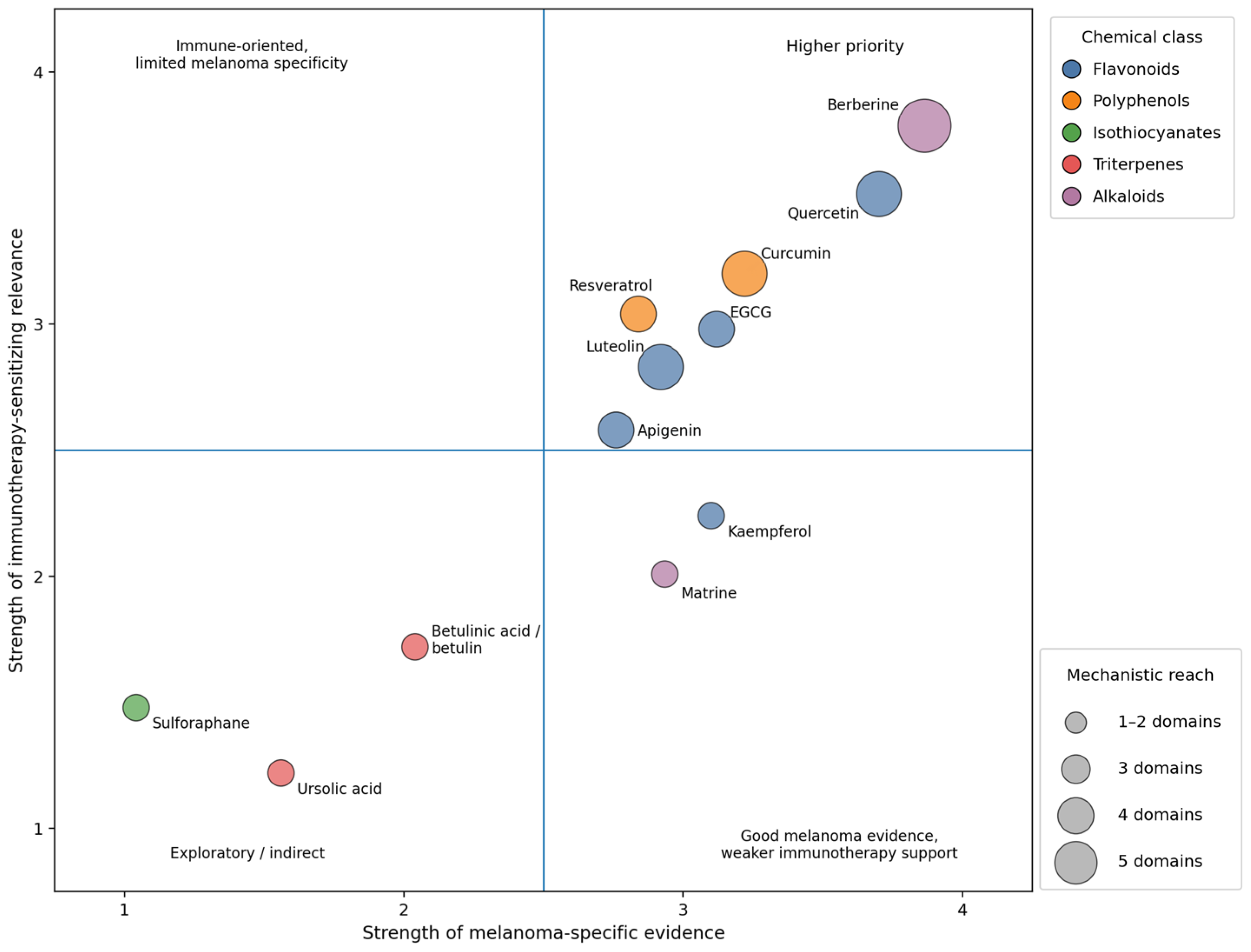
| Chemical Class | Compound | Melanoma-Specific Evidence | Immune-Relevant Evidence in Melanoma | Direct Checkpoint-Related Relevance | TME Modulation | Main Dominant Mechanisms Reported | Evidence Tier |
|---|---|---|---|---|---|---|---|
| Flavonoids | Quercetin | High | High | Moderate | High | STAT3, CD47 axis, RIG-I/type I IFN, PD-L1-associated signaling, macrophage activation | Tier 1–2 |
| Luteolin | Moderate | Moderate | Low–moderate | Moderate | STAT3, APC activation, IL-12 signaling, CTL stimulation, anti-invasive activity | Tier 2 | |
| Apigenin | Moderate | Moderate | Low | Moderate | Anti-inflammatory signaling, apoptosis/cell-cycle regulation, indirect immune support | Tier 2 | |
| EGCG | Moderate | Moderate | Low–moderate | Moderate | Redox and inflammatory signaling, microenvironment-related effects | Tier 2 | |
| Kaempferol | Moderate | Low–moderate | Low | Low–moderate | Oxidative stress and inflammatory signaling, tumor-intrinsic control | Tier 2 | |
| Polyphenols | Curcumin | Moderate | Moderate | Moderate | Moderate–high | NF-κB, STAT3, cytokine modulation, immune-context remodeling | Tier 2 |
| Resveratrol | Moderate | Moderate | Low–moderate | Moderate | Redox regulation, inflammatory signaling, adaptive immune-context effects | Tier 2 | |
| Isothiocyanates | Sulforaphane | Low | Low | Low | Low–moderate | Oxidative and inflammatory signaling modulation with limited melanoma-specific immunotherapy evidence | Tier 3 |
| Triterpenes | Ursolic acid | Low–moderate | Low | Low | Moderate | Anti-inflammatory, anti-survival, indirect immune-context effects | Tier 3 |
| Betulinic acid and betulin | Variable | Low–moderate | Low | Moderate | Broad signaling and microenvironment-associated effects | Tier 2–3 | |
| Alkaloids | Matrine | Moderate | Moderate | Low | Low–moderate | PI3K/AKT/mTOR, Wnt/β-catenin, MAPK/ERK, PTEN upregulation, anti-invasive/apoptotic activity | Tier 2–3 |
| Berberine | High | High | Moderate–high | High | Macrophage repolarization, IL-6/STAT3/IL-10 axis inhibition, immunogenic cell death, dendritic-cell maturation, anti-PD-1/anti-CTLA-4 sensitization | Tier 1 |
| Compound | Clinical Setting | Cancer Type | Phase/Status | Key Findings | Reference |
|---|---|---|---|---|---|
| Curcumin | Oral administration (high-dose) | Colorectal/ GI cancers | Phase I–II (completed) | Safe up to 8–12 g/day; low bioavailability; tissue accumulation | [273] |
| Curcumin | Curcumin + chemotherapy (gemcitabine) | Pancreatic cancer | Phase II (completed) | Improved response in subset of patients; pharmacokinetic limitation persists | [273] |
| Curcumin (nano/delivery systems) | Exosome-based delivery | Colon cancer | Phase I (ongoing) | Designed to overcome bioavailability limitations | [274] |
| EGCG (Polyphenon E) | Green tea catechin formulation | Prostate cancer/premalignant lesions | Phase II (completed) | Reduced proliferation markers; modest clinical effect | [273] |
| EGCG | Dietary supplementation | Bladder cancer | Phase II (completed) | Reduced tumor proliferation biomarkers | [273] |
| Resveratrol | Oral supplementation | Colorectal cancer | Phase I–II (completed) | ↓ Ki-67 proliferation index; metabolic effects | [275] |
| Resveratrol | Chemoprevention trials | Breast/multiple myeloma | Phase I–II (completed) | Epigenetic modulation; limited efficacy | [276] |
| Sulforaphane | Dietary/supplement | Prostate cancer | Phase II (completed) | Modulation of Nrf2 pathway and tumor biomarkers | [276] |
| Sulforaphane | Combination with chemotherapy | Breast cancer | Phase I–II (ongoing) | Evaluating protective and adjunct effects | [277] |
| Sulforaphane | Clinical evaluation | Multiple cancers (including melanoma) | Multiple trials | Limited number of trials; mainly biomarker endpoints | [276] |
| Quercetin + Curcumin | Combination therapy | Familial adenomatous polyposis | Pilot clinical study (completed) | ↓ number and size of adenomas | [278] |
| Quercetin (alone) | Limited clinical data | Non-oncology primarily | Early-stage/sparse | No robust anticancer clinical evidence | [112] |
| Apigenin/ Luteolin | - | - | - | No clinical oncology trials identified | - |
| Curcumin + Ursolic Acid | Oral supplementation | Prostate cancer | Phase I | - | [279] |
| Ursolic acid | - | - | - | No validated clinical trials in cancer | |
| Betulinic acid | Topical treatment of dysplastic nevi | Precancerous lesions (melanoma risk) | Phase I/II (suspended) | Planned evaluation of safety and efficacy; study suspended due to funding; no published results | [280] |
| Betulinic acid | Topical application (ointment, various dosing regimens) | Cutaneous metastatic melanoma | Phase I (pilot, completed) | Evaluated safety, tolerability, apoptosis; no published outcome data; concentration not reported | [280] |
Disclaimer/Publisher’s Note: The statements, opinions and data contained in all publications are solely those of the individual author(s) and contributor(s) and not of MDPI and/or the editor(s). MDPI and/or the editor(s) disclaim responsibility for any injury to people or property resulting from any ideas, methods, instructions or products referred to in the content. |
© 2026 by the authors. Licensee MDPI, Basel, Switzerland. This article is an open access article distributed under the terms and conditions of the Creative Commons Attribution (CC BY) license.
Share and Cite
Bătrîna, O.; Negrea-Ghiulai, R.; Suciu, L.; Racoviceanu, R.; Atyim, E.; Jorgovan, M.; Maksimovic, T.; Mioc, A.; Trandafirescu, C.; Șoica, C.; et al. Plant-Derived Compounds as Potential Sensitizers to Immunotherapy in Melanoma. Int. J. Mol. Sci. 2026, 27, 4423. https://doi.org/10.3390/ijms27104423
Bătrîna O, Negrea-Ghiulai R, Suciu L, Racoviceanu R, Atyim E, Jorgovan M, Maksimovic T, Mioc A, Trandafirescu C, Șoica C, et al. Plant-Derived Compounds as Potential Sensitizers to Immunotherapy in Melanoma. International Journal of Molecular Sciences. 2026; 27(10):4423. https://doi.org/10.3390/ijms27104423
Chicago/Turabian StyleBătrîna, Oana, Roxana Negrea-Ghiulai, Liana Suciu, Roxana Racoviceanu, Elisabeta Atyim, Mihaela Jorgovan, Tamara Maksimovic, Alexandra Mioc, Cristina Trandafirescu, Codruța Șoica, and et al. 2026. "Plant-Derived Compounds as Potential Sensitizers to Immunotherapy in Melanoma" International Journal of Molecular Sciences 27, no. 10: 4423. https://doi.org/10.3390/ijms27104423
APA StyleBătrîna, O., Negrea-Ghiulai, R., Suciu, L., Racoviceanu, R., Atyim, E., Jorgovan, M., Maksimovic, T., Mioc, A., Trandafirescu, C., Șoica, C., & Mioc, M. (2026). Plant-Derived Compounds as Potential Sensitizers to Immunotherapy in Melanoma. International Journal of Molecular Sciences, 27(10), 4423. https://doi.org/10.3390/ijms27104423