Immunosenescence and Bone Homeostasis: From Mechanisms of Homeostasis Disruption to Therapeutic Opportunities in Age-Related Skeletal Disorders

Abstract
1. Introduction
2. Bone Homeostasis and Immunosenescence
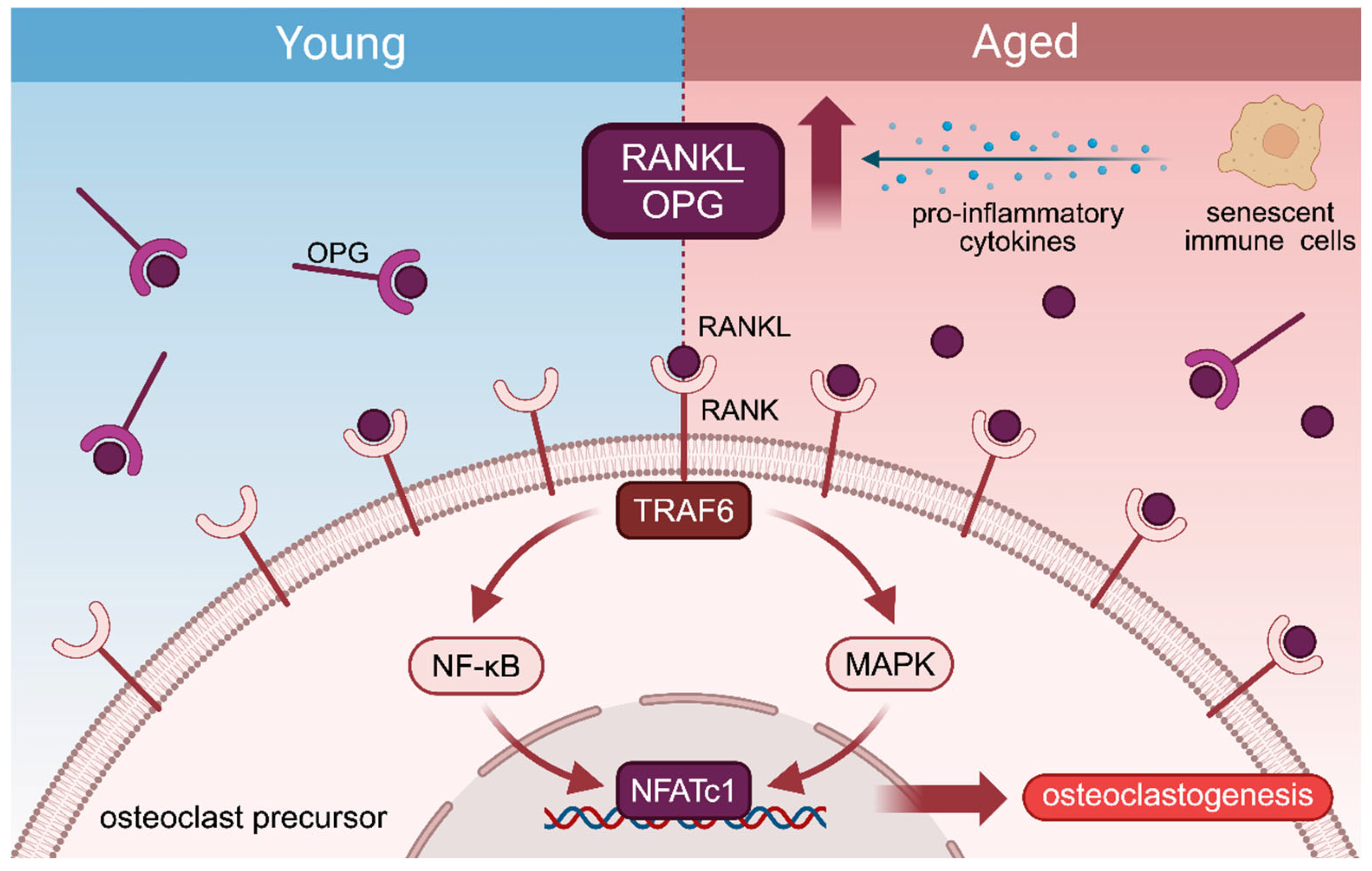
2.1. Bone Homeostasis
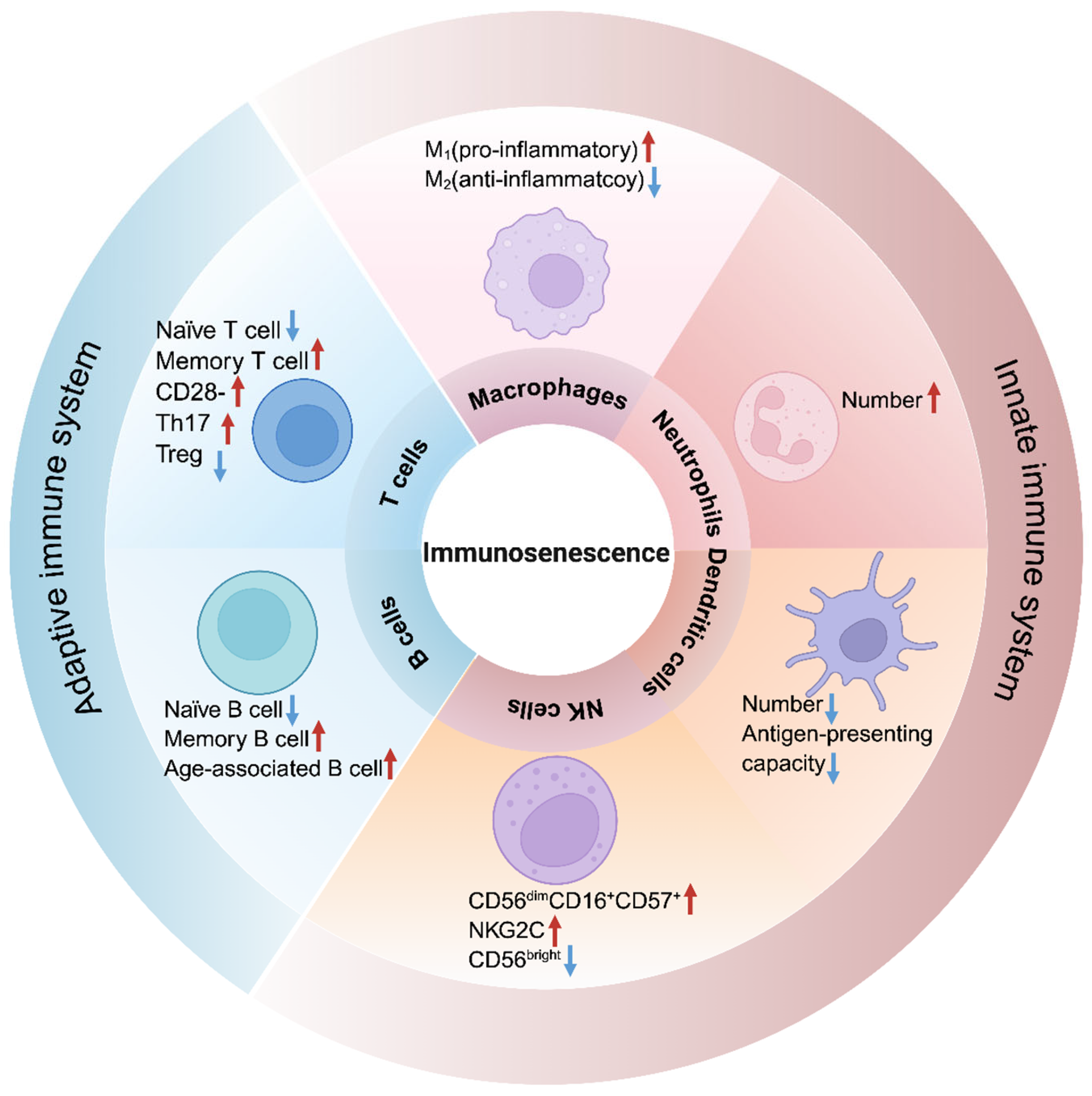
2.2. Immunosenescence
2.2.1. Macrophages
2.2.2. T Cells
2.2.3. B Cells
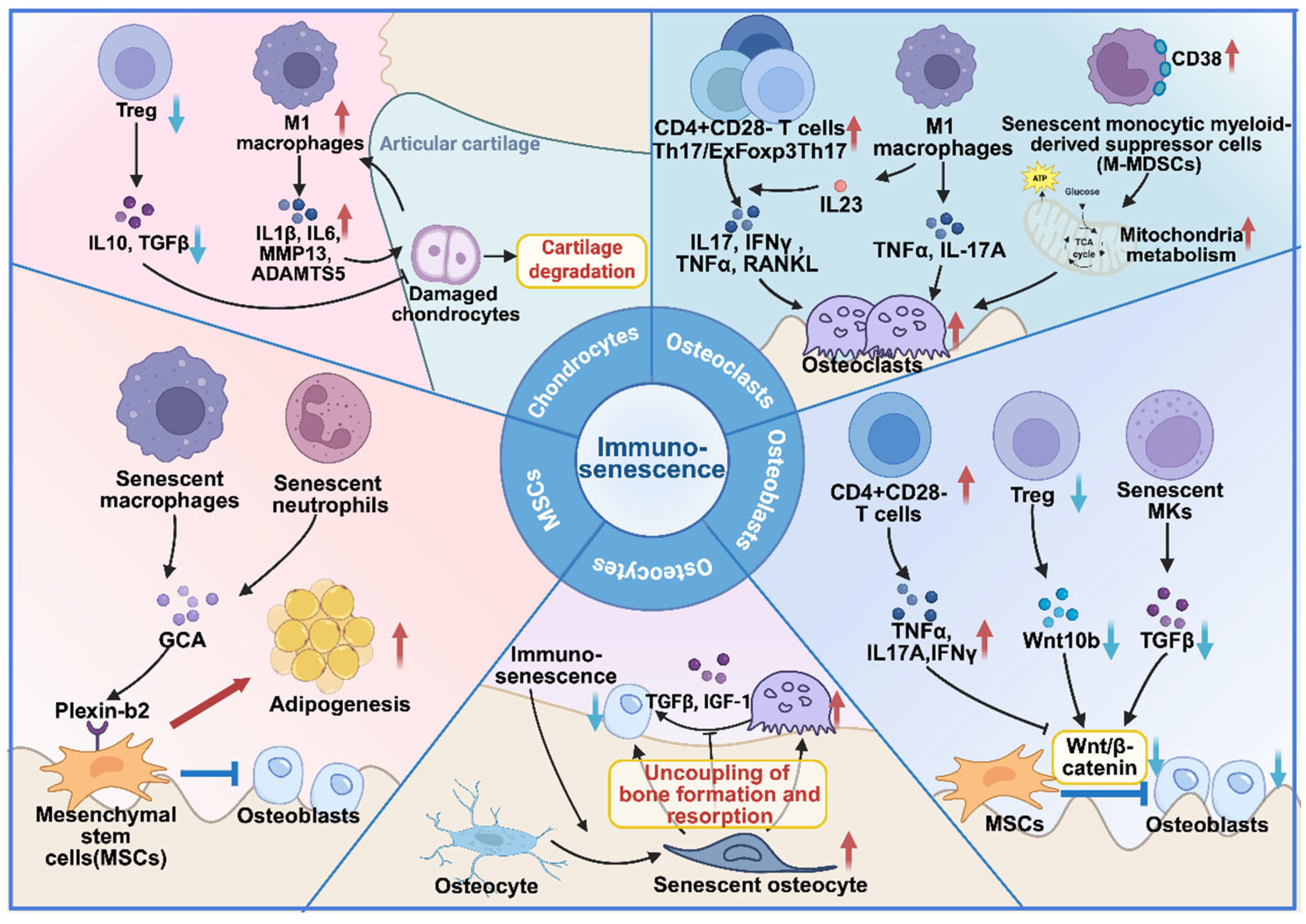
3. Immunosenescence and Its Impact on Bone-Related Cells
3.1. Mesenchymal Stem Cells
3.2. Osteoblasts
3.3. Osteocytes
3.4. Osteoclasts
3.5. Chondrocytes
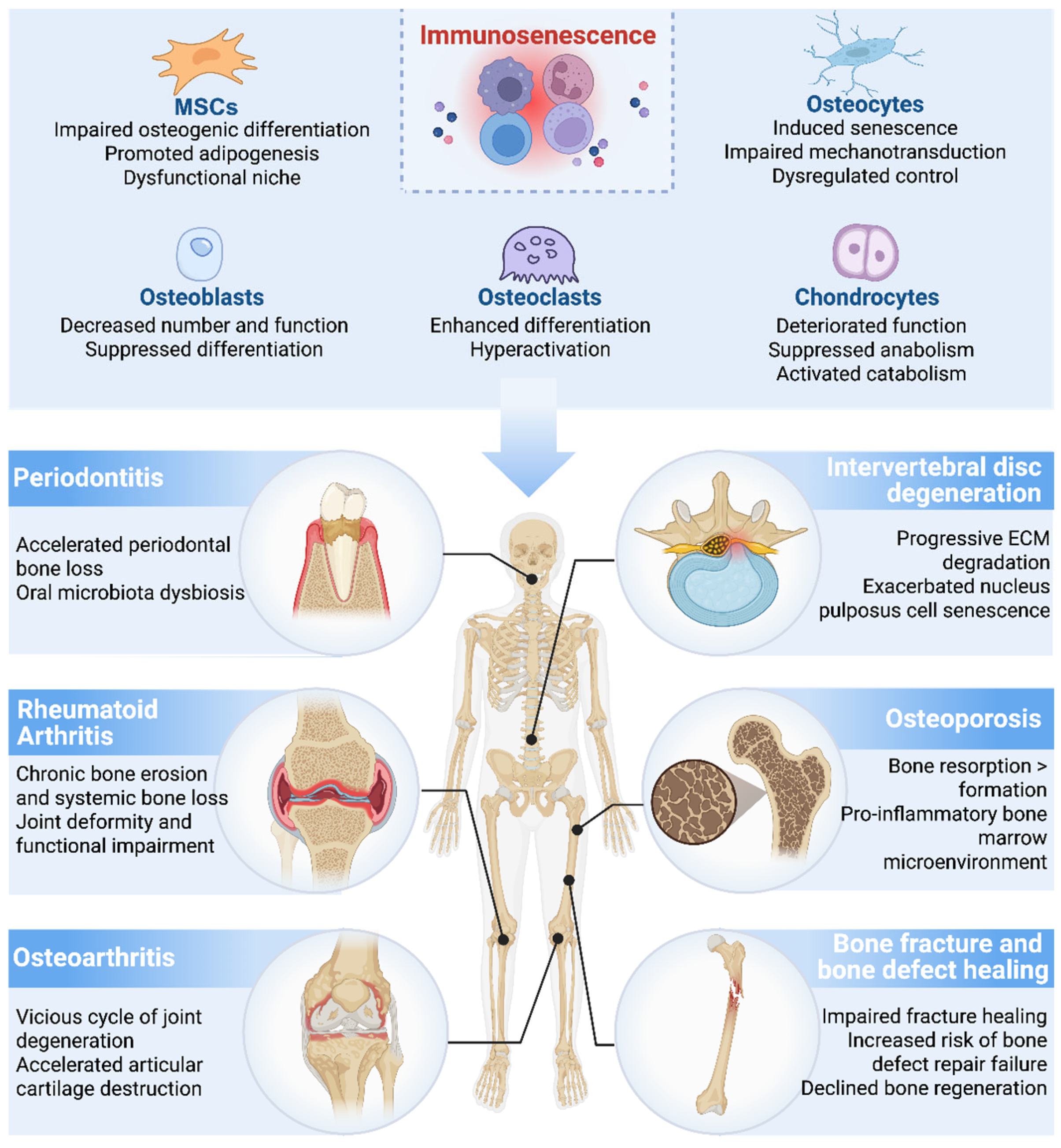
4. Roles of Immunosenescence on Bone-Related Diseases
4.1. Bone Fracture and Bone Defect Healing
4.2. Osteoarthritis and Rheumatoid Arthritis
4.2.1. Osteoarthritis (OA)
4.2.2. Rheumatoid Arthritis (RA)
4.3. Osteoporosis
4.4. Intervertebral Disc Degeneration
4.5. Periodontitis
5. Conclusions and Future Perspectives
Author Contributions
Funding
Institutional Review Board Statement
Informed Consent Statement
Data Availability Statement
Conflicts of Interest
References
- Liu, Z.; Liang, Q.; Ren, Y.; Guo, C.; Ge, X.; Wang, L.; Cheng, Q.; Luo, P.; Zhang, Y.; Han, X. Immunosenescence: Molecular Mechanisms and Diseases. Signal Transduct. Target. Ther. 2023, 8, 200. [Google Scholar] [CrossRef]
- Sato, Y. Immune Aging and Its Implication for Age-Related Disease Progression. Physiology 2025, 40, 363–373. [Google Scholar] [CrossRef]
- Sfeir, J.G.; Drake, M.T.; Khosla, S.; Farr, J.N. Skeletal Aging. Mayo Clin. Proc. 2022, 97, 1194–1208. [Google Scholar] [CrossRef]
- Morin, S.N.; Leslie, W.D.; Schousboe, J.T. Osteoporosis: A Review. JAMA 2025, 334, 894–907. [Google Scholar] [CrossRef]
- Cao, F.; Xu, Z.; Li, X.-X.; Fu, Z.-Y.; Han, R.-Y.; Zhang, J.-L.; Wang, P.; Hou, S.; Pan, H.-F. Trends and Cross-Country Inequalities in the Global Burden of Osteoarthritis, 1990–2019: A Population-Based Study. Ageing Res. Rev. 2024, 99, 102382. [Google Scholar] [CrossRef]
- Song, C.; Zhou, Y.; Cheng, K.; Liu, F.; Cai, W.; Zhou, D.; Chen, R.; Shi, H.; Fu, Z.; Chen, J.; et al. Cellular Senescence—Molecular Mechanisms of Intervertebral Disc Degeneration from an Immune Perspective. Biomed. Pharmacother. 2023, 162, 114711. [Google Scholar] [CrossRef]
- Nascimento, G.G.; Alves-Costa, S.; Romandini, M. Burden of Severe Periodontitis and Edentulism in 2021, with Projections up to 2050: The Global Burden of Disease 2021 Study. J. Periodontal Res. 2024, 59, 823–867. [Google Scholar] [CrossRef]
- Guan, S.-Y.; Zheng, J.-X.; Feng, X.-Y.; Zhang, S.-X.; Xu, S.-Z.; Wang, P.; Cai, H.-Y.; Pan, H.-F. The Impact of Population Ageing on Musculoskeletal Disorders in 204 Countries and Territories, 1990–2021: Global Burden and Healthcare Costs. Ann. Rheum. Dis. 2025, 84, 2128–2138. [Google Scholar] [CrossRef]
- Li, X.; Li, C.; Zhang, W.; Wang, Y.; Qian, P.; Huang, H. Inflammation and Aging: Signaling Pathways and Intervention Therapies. Signal Transduct. Target. Ther. 2023, 8, 239. [Google Scholar] [CrossRef]
- Fulop, T.; Larbi, A.; Pawelec, G.; Khalil, A.; Cohen, A.A.; Hirokawa, K.; Witkowski, J.M.; Franceschi, C. Immunology of Aging: The Birth of Inflammaging. Clin. Rev. Allergy Immunol. 2023, 64, 109–122. [Google Scholar] [CrossRef]
- Cheng, X.; Chen, Y.; Zhou, X.; Gu, Q.; Zhao, H.; Wan, C.; Chen, M.; Yang, H.; Shi, Q. Immunoporosis: The Hidden Link between Aging Immune Cells and Bone Fragility. J. Orthop. Transl. 2025, 53, 325–335. [Google Scholar] [CrossRef]
- Wang, Y.; Zheng, S.; Luo, Y.; Xiao, W.; Huang, C.; Li, Y. Osteoimmunology and Aging: Mechanisms, Implications, and Therapeutic Perspectives. Ageing Res. Rev. 2025, 111, 102822. [Google Scholar] [CrossRef]
- Qooja, S.; Roberts, M.J.; Fakher, N.; Demashkieh, M.; Moorthy, A.; Bishop, N.C. Is T-Cell Senescence Associated with Inflammatory Arthritis and Disease Burden? A Systematic Review. Semin. Arthritis Rheum. 2025, 73, 152757. [Google Scholar] [CrossRef]
- Nishida, Y.; Terkawi, M.A.; Matsumae, G.; Yokota, S.; Tokuhiro, T.; Ogawa, Y.; Ishizu, H.; Shiota, J.; Endo, T.; Alhasan, H.; et al. Dynamic Transcriptome Analysis of Osteal Macrophages Identifies a Distinct Subset with Senescence Features in Experimental Osteoporosis. JCI Insight 2024, 9, e182418. [Google Scholar] [CrossRef]
- Bucher, C.H.; Berkmann, J.C.; Burkhardt, L.-M.; Paschke, C.; Schlundt, C.; Lang, A.; Wolter, A.; Damerau, A.; Geissler, S.; Volk, H.-D.; et al. Local Immune Cell Contributions to Fracture Healing in Aged Individuals—A Novel Role for Interleukin 22. Exp. Mol. Med. 2022, 54, 1262–1276. [Google Scholar] [CrossRef]
- Song, C.; Zhou, D.; Chen, C.; Shen, B.; Yang, L.; Liu, F.; Chen, F.; Zeng, L.; Fu, Z.; Liu, Z. Integrating Multiple Omics Analyses to Elucidate the Macrophage-Driven “Immune Cellular Senescence Fibrosis” Axis Mechanism in Intervertebral Disc Degeneration. Int. J. Surg. 2026. online ahead of print. [Google Scholar] [CrossRef]
- Song, Y.; Chung, J. Aging Aggravates Periodontal Inflammatory Responses and Alveolar Bone Resorption by Porphyromonas Gingivalis Infection. Curr. Issues Mol. Biol. 2023, 45, 6593–6604. [Google Scholar] [CrossRef]
- Stegen, S.; Carmeliet, G. Metabolic Regulation of Skeletal Cell Fate and Function. Nat. Rev. Endocrinol. 2024, 20, 399–413. [Google Scholar] [CrossRef]
- Salhotra, A.; Shah, H.N.; Levi, B.; Longaker, M.T. Mechanisms of Bone Development and Repair. Nat. Rev. Mol. Cell Biol. 2020, 21, 696–711. [Google Scholar] [CrossRef]
- Wu, Z.; Li, W.; Jiang, K.; Lin, Z.; Qian, C.; Wu, M.; Xia, Y.; Li, N.; Zhang, H.; Xiao, H.; et al. Regulation of Bone Homeostasis: Signaling Pathways and Therapeutic Targets. MedComm (2020) 2024, 5, e657. [Google Scholar] [CrossRef]
- Wong, B.R.; Rho, J.; Arron, J.; Robinson, E.; Orlinick, J.; Chao, M.; Kalachikov, S.; Cayani, E.; Bartlett, F.S., 3rd; Frankel, W.N.; et al. TRANCE Is a Novel Ligand of the Tumor Necrosis Factor Receptor Family That Activates C-Jun N-Terminal Kinase in T Cells. J. Biol. Chem. 1997, 272, 25190–25194. [Google Scholar] [CrossRef]
- Takayanagi, H.; Kim, S.; Koga, T.; Nishina, H.; Isshiki, M.; Yoshida, H.; Saiura, A.; Isobe, M.; Yokochi, T.; Inoue, J.; et al. Induction and Activation of the Transcription Factor NFATc1 (NFAT2) Integrate RANKL Signaling in Terminal Differentiation of Osteoclasts. Dev. Cell 2002, 3, 889–901. [Google Scholar] [CrossRef]
- El-Masri, B.M.; Andreasen, C.M.; Laursen, K.S.; Kofod, V.B.; Dahl, X.G.; Nielsen, M.H.; Thomsen, J.S.; Brüel, A.; Sørensen, M.S.; Hansen, L.J.; et al. Mapping RANKL- and OPG-Expressing Cells in Bone Tissue: The Bone Surface Cells as Activators of Osteoclastogenesis and Promoters of the Denosumab Rebound Effect. Bone Res. 2024, 12, 62. [Google Scholar] [CrossRef]
- Stavri, R.; Tay, T.; Wiles, C.C.; Di Federico, E.; Boughton, O.; Ma, S.; Karunaratne, A.; Churchwell, J.H.; Bhattacharya, R.; Terrill, N.J.; et al. A Cross-Sectional Study of Bone Nanomechanics in Hip Fracture and Aging. Life 2023, 13, 1378. [Google Scholar] [CrossRef]
- Martelli, S.; Giorgi, M.; Dall’ Ara, E.; Perilli, E. Damage Tolerance and Toughness of Elderly Human Femora. Acta Biomater. 2021, 123, 167–177. [Google Scholar] [CrossRef]
- Al-Qudsy, L.; Hu, Y.-W.; Xu, H.; Yang, P.-F. Mineralized Collagen Fibrils: An Essential Component in Determining the Mechanical Behavior of Cortical Bone. ACS Biomater. Sci. Eng. 2023, 9, 2203–2219. [Google Scholar] [CrossRef]
- Møller, A.M.J.; Delaissé, J.-M.; Olesen, J.B.; Madsen, J.S.; Canto, L.M.; Bechmann, T.; Rogatto, S.R.; Søe, K. Aging and Menopause Reprogram Osteoclast Precursors for Aggressive Bone Resorption. Bone Res. 2020, 8, 27. [Google Scholar] [CrossRef]
- Yamada, T.; Fukasawa, K.; Horie, T.; Kadota, T.; Lyu, J.; Tokumura, K.; Ochiai, S.; Iwahashi, S.; Suzuki, A.; Park, G.; et al. The Role of CDK8 in Mesenchymal Stem Cells in Controlling Osteoclastogenesis and Bone Homeostasis. Stem Cell Rep. 2022, 17, 1576–1588. [Google Scholar] [CrossRef]
- Fessler, J.; Husic, R.; Schwetz, V.; Lerchbaum, E.; Aberer, F.; Fasching, P.; Ficjan, A.; Obermayer-Pietsch, B.; Duftner, C.; Graninger, W.; et al. Senescent T-Cells Promote Bone Loss in Rheumatoid Arthritis. Front. Immunol. 2018, 9, 95. [Google Scholar] [CrossRef]
- Li, C.-J.; Xiao, Y.; Sun, Y.-C.; He, W.-Z.; Liu, L.; Huang, M.; He, C.; Huang, M.; Chen, K.-X.; Hou, J.; et al. Senescent Immune Cells Release Grancalcin to Promote Skeletal Aging. Cell Metab. 2021, 33, 1957–1973.e6. [Google Scholar] [CrossRef]
- Fan, C.; Wang, W.; Yu, Z.; Wang, J.; Xu, W.; Ji, Z.; He, W.; Hua, D.; Wang, W.; Yao, L.; et al. M1 Macrophage-Derived Exosomes Promote Intervertebral Disc Degeneration by Enhancing Nucleus Pulposus Cell Senescence through LCN2/NF-κB Signaling Axis. J. Nanobiotechnol. 2024, 22, 301. [Google Scholar] [CrossRef]
- Thiyagarajan, R.; Zhang, L.; Glover, O.D.; Kwack, K.H.; Ahmed, S.; Murray, E.; Yellapu, N.K.; Bard, J.; Seldeen, K.L.; Rosario, S.R.; et al. Age-related Increase of CD38 Directs Osteoclastogenic Potential of Monocytic Myeloid-derived Suppressor Cells through Mitochondrial Dysfunction in Male Mice. Aging Cell 2024, 23, e14298. [Google Scholar] [CrossRef]
- Chen, Y.; Lin, L.; Ruan, S.; Ye, J.; Dai, Z.; Mao, G.; Xi, Y.; Wang, C.; Zhao, Q. DNA Demethylation of Promoter Region Facilitates Atoh-1-Induced Interleukin-19 Expression Activation in Bone Marrow Monocytes of Old Mice. Aging Dis. 2024, 16, 540–551. [Google Scholar] [CrossRef] [PubMed]
- Fu, Y.; Wang, B.; Alu, A.; Hong, W.; Lei, H.; He, X.; Shi, H.; Cheng, P.; Yang, X. Immunosenescence: Signaling Pathways, Diseases and Therapeutic Targets. Signal Transduct. Target. Ther. 2025, 10, 250. [Google Scholar] [CrossRef]
- Li, D.; Li, X.; Zhang, J.; Tang, Z.; Tian, A. The Immunomodulatory Effect of IL-4 Accelerates Bone Substitute Material-Mediated Osteogenesis in Aged Rats via NLRP3 Inflammasome Inhibition. Front. Immunol. 2023, 14, 1121549. [Google Scholar] [CrossRef] [PubMed]
- Chang, S.-T.; Chuang, Y.-F.; Li, A.-H.; Fan, Y.-T.; Liao, M.-R.; Chen, I.-Y.; Hung, R.-W.; Yang, T.O.; Chiu, Y.-L. Age-Dependent Immune Profile in Healthy Individuals: An Original Study, Systematic Review and Meta-Analysis. Immun. Ageing 2024, 21, 75. [Google Scholar] [CrossRef] [PubMed]
- Cui, Q.; Li, W.; Wang, D.; Wang, S.; Liu, A.; Zhang, G.; Yang, Y.; Ge, T.; He, G.; Yu, J. Immune Signature and Phagocytosis of Circulating DC Subsets in Healthy Adults during Aging. Int. Immunopharmacol. 2024, 130, 111715. [Google Scholar] [CrossRef]
- Lv, J.; Zhang, C.; Liu, X.; Gu, C.; Liu, Y.; Gao, Y.; Huang, Z.; Jiang, Q.; Chen, B.; He, D.; et al. An Aging-Related Immune Landscape in the Hematopoietic Immune System. Immun. Ageing 2024, 21, 3. [Google Scholar] [CrossRef]
- Gao, X.; Lu, C.; Wang, K.; Zheng, C.; Li, L.; Zhang, X.; Sun, B. Ceramide Complex Ameliorates Metabolically Driven Neutrophil Senescence by Regulating Apoptosis via the cGAS-STING Pathway. Int. J. Med. Sci. 2025, 22, 1124–1137. [Google Scholar] [CrossRef]
- Chen, Y.; Shu, J.; Liu, H.; Jiao, Y.; He, M.; Zha, X.; Guo, R.; Huang, C.; Liu, Z.; Li, G.; et al. The Iterative Shrinkage Thresholding Algorithm Reveals Dynamic Aging Trajectories of Human T Lymphocytes via Multidimensional Spectral Flow Cytometry Analysis. Int. Immunopharmacol. 2026, 176, 116476. [Google Scholar] [CrossRef]
- González-Osuna, L.; Sierra-Cristancho, A.; Rojas, C.; Cafferata, E.A.; Melgar-Rodríguez, S.; Cárdenas, A.M.; Vernal, R. Premature Senescence of T-Cells Favors Bone Loss During Osteolytic Diseases. A New Concern in the Osteoimmunology Arena. Aging Dis. 2021, 12, 1150. [Google Scholar] [CrossRef]
- Sugiyama, Y.; Harada, T.; Kamei, Y.; Yasuda, T.; Mashimo, T.; Nishikimi, A.; Maruyama, M. A Senolytic Immunotoxin Eliminates P16(INK4a)-Positive T Cells and Ameliorates Age-Associated Phenotypes of CD4(+) T Cells in a Surface Marker Knock-in Mouse. Exp. Gerontol. 2023, 174, 112130. [Google Scholar] [CrossRef]
- Tang, X.; Deng, B.; Zang, A.; He, X.; Zhou, Y.; Wang, D.; Li, D.; Dai, X.; Chen, J.; Zhang, X.; et al. Characterization of Age-Related Immune Features after Autologous NK Cell Infusion: Protocol for an Open-Label and Randomized Controlled Trial. Front. Immunol. 2022, 13, 940577. [Google Scholar] [CrossRef]
- Soto-Heredero, G.; Gabandé-Rodríguez, E.; Carrasco, E.; Escrig-Larena, J.I.; Gómez de Las Heras, M.M.; Delgado-Pulido, S.; Francos-Quijorna, I.; Blanco, E.M.; Fernández-Almeida, Á.; Abia, D.; et al. KLRG1 Identifies Regulatory T Cells with Mitochondrial Alterations That Accumulate with Aging. Nat. Aging 2025, 5, 799–815. [Google Scholar] [CrossRef]
- Wang, S.; Zhu, Z.; Yang, H.; Yan, Y.; Ran, L.; Yang, N.; Wang, Y.; Wu, L.; Bai, B.; Ji, W.; et al. Single-Cell Profiling Across Immune Tissues and Organs Reveals Immunosenescence Signatures in Male Rhesus Monkeys. Adv. Sci. 2026, 13, e14353. [Google Scholar] [CrossRef]
- Frasca, D.; Romero, M.; Garcia, D.; Diaz, A.; Blomberg, B.B. Hyper-Metabolic B Cells in the Spleens of Old Mice Make Antibodies with Autoimmune Specificities. Immun. Ageing 2021, 18, 9. [Google Scholar] [CrossRef]
- Yang, X.; Tang, H.; Lan, C.; He, W.; Chen, S.; Zeng, H.; Liu, D.; Wu, H.; Wang, W.; Zhang, Z. Single-Cell Analysis Reveals Multi-Faceted Features of B Cell Development, Together with Age-Associated B Cell Subpopulations. Commun. Biol. 2026, 9, 240. [Google Scholar] [CrossRef] [PubMed]
- Ratliff, M.; Alter, S.; Frasca, D.; Blomberg, B.B.; Riley, R.L. In Senescence, Age-Associated B Cells Secrete TNFα and Inhibit Survival of B-Cell Precursors. Aging Cell 2013, 12, 303–311. [Google Scholar] [CrossRef] [PubMed]
- Ma, F.; Cao, Y.; Du, H.; Braikia, F.Z.; Zong, L.; Ollikainen, N.; Bayer, M.; Qiu, X.; Park, B.; Roy, R.; et al. Three-Dimensional Chromatin Reorganization Regulates B Cell Development during Ageing. Nat. Cell Biol. 2024, 26, 991–1002. [Google Scholar] [CrossRef] [PubMed]
- Ajoolabady, A.; Pratico, D.; Tang, D.; Zhou, S.; Franceschi, C.; Ren, J. Immunosenescence and Inflammaging: Mechanisms and Role in Diseases. Ageing Res. Rev. 2024, 101, 102540. [Google Scholar] [CrossRef]
- Hou, J.; Chen, K.-X.; He, C.; Li, X.-X.; Huang, M.; Jiang, Y.-Z.; Jiao, Y.-R.; Xiao, Q.-N.; He, W.-Z.; Liu, L.; et al. Aged Bone Marrow Macrophages Drive Systemic Aging and Age-Related Dysfunction via Extracellular Vesicle-Mediated Induction of Paracrine Senescence. Nat. Aging 2024, 4, 1562–1581. [Google Scholar] [CrossRef]
- Schlundt, C.; Fischer, H.; Bucher, C.H.; Rendenbach, C.; Duda, G.N.; Schmidt-Bleek, K. The Multifaceted Roles of Macrophages in Bone Regeneration: A Story of Polarization, Activation and Time. Acta Biomater. 2021, 133, 46–57. [Google Scholar] [CrossRef]
- Mittelbrunn, M.; Kroemer, G. Hallmarks of T Cell Aging. Nat. Immunol. 2021, 22, 687–698. [Google Scholar] [CrossRef] [PubMed]
- Khan, S.; Chakraborty, M.; Wu, F.; Chen, N.; Wang, T.; Chan, Y.T.; Sayad, A.; Kotlyar, M.; Alibhai, F.J.; Woo, M.; et al. B Cells Drive CD4 T Cell Immunosenescence and Age-Associated Health Decline. Sci. Immunol. 2026, 11, eadv7615. [Google Scholar] [CrossRef] [PubMed]
- Slaets, H.; Veeningen, N.; De Keizer, P.L.J.; Hellings, N.; Hendrix, S. Are Immunosenescent T Cells Really Senescent? Aging Cell 2024, 23, e14300. [Google Scholar] [CrossRef] [PubMed]
- Chen, Y.; Yim, W.Y.; Li, C.; Wang, Z.; Hou, J.; Peng, Y.; Liu, F.; Liu, Z.; Dong, N.; Wang, Y. T Cell Senescence Induced by DNMT1 Deletion Mediates Cardiac Transplant Tolerance via Altered CDKN1A Methylation. Mol. Ther. 2026. online now. [Google Scholar] [CrossRef]
- Zebley, C.C.; Youngblood, B. Mechanisms of T Cell Exhaustion Guiding Next-Generation Immunotherapy. Trends Cancer 2022, 8, 726–734. [Google Scholar] [CrossRef]
- Greisen, S.R.; Yan, Y.; Hansen, A.S.; Venø, M.T.; Nyengaard, J.R.; Moestrup, S.K.; Hvid, M.; Freeman, G.J.; Kjems, J.; Deleuran, B. Extracellular Vesicles Transfer the Receptor Programmed Death-1 in Rheumatoid Arthritis. Front. Immunol. 2017, 8, 851. [Google Scholar] [CrossRef]
- He, R.; Xiao, C.; Lei, W.; Chen, G.; Li, Y.; Luo, O.J. Aging-Associated Transcriptional Programs in T Cells Signify Constituents of TGF-β Signaling for Immunosenescence. BMC Biol. 2025, 24, 17. [Google Scholar] [CrossRef]
- Cimé-Aké, E.; Lima, G.; Godínez-Lazarini, E.; Juárez, S.; Marín-López, H.; Flores-Hernández, D.; Flores-Hernández, I.; Gómez-Rodríguez, A.; Hernández-Ramírez, D.F.; Llorente, L.; et al. Immunosenescent and Exhausted T Cells in Systemic Lupus Erythematosus Patients with Cognitive Impairment. Clin. Immunol. 2026, 282, 110635. [Google Scholar] [CrossRef]
- Baker, E.; Montecino-Rodriguez, E.; Xu, S.; Tetradis, S.; Rouault, A.; Estrada, O.I.; Dorshkind, K. Bone Loss and TLR4 Signals Contribute Independently to B Lineage Aging. Aging Cell 2025, 24, e70267. [Google Scholar] [CrossRef]
- Bashir, B.; van Hoolwerff, M.; Benencia, F.; Duran-Ortiz, S.; List, E.O.; Kopchick, J.J.; Berryman, D.E. The Impact of Growth Hormone (GH) on Immunosenescence: Exploring the Role of B and T Cells. Pituitary 2026, 29, 30. [Google Scholar] [CrossRef]
- Tchouto, M.N.; Bucher, C.H.; Mess, A.-K.; Haas, S.; Schmidt-Bleek, K.; Duda, G.N.; Beule, D.; Milek, M. Pronounced Impairment of B Cell Differentiation during Bone Regeneration in Adult Immune Experienced Mice. Front. Immunol. 2025, 16, 1511902. [Google Scholar] [CrossRef] [PubMed]
- Wang, X.; Guo, D.; He, C.; Wang, X.; Wei, Y.; Zhang, F.; Wang, L.; Yang, Y. Clinical Application of Mesenchymal Stem Cells in Immunosenescence: A Qualitative Review of Their Potential and Challenges. Stem Cell Res. Ther. 2025, 16, 265. [Google Scholar] [CrossRef]
- Zhou, J.; Shi, Y. Mesenchymal Stem/Stromal Cells (MSCs): Origin, Immune Regulation, and Clinical Applications. Cell. Mol. Immunol. 2023, 20, 555–557. [Google Scholar] [CrossRef] [PubMed]
- Novoseletskaya, E.S.; Evdokimov, P.V.; Efimenko, A.Y. Extracellular Matrix-Induced Signaling Pathways in Mesenchymal Stem/Stromal Cells. Cell Commun. Signal. 2023, 21, 244. [Google Scholar] [CrossRef] [PubMed]
- Kan, C.; Tan, Z.; Wang, H.; Wang, W.; Yang, J.; Zhang, Y.; Lu, X.; Cheng, Q.; Chai, L.; Peng, C.; et al. Spatiotemporal Analysis of Mesenchymal Stem Cells Fate Determination by Inflammatory Niche Following Soft Tissue Injury at a Single-Cell Level. Adv. Sci. 2024, 11, 2310282. [Google Scholar] [CrossRef]
- Mahon, O.R.; Browe, D.C.; Gonzalez-Fernandez, T.; Pitacco, P.; Whelan, I.T.; Von Euw, S.; Hobbs, C.; Nicolosi, V.; Cunningham, K.T.; Mills, K.H.G.; et al. Nano-Particle Mediated M2 Macrophage Polarization Enhances Bone Formation and MSC Osteogenesis in an IL-10 Dependent Manner. Biomaterials 2020, 239, 119833. [Google Scholar] [CrossRef]
- Cai, D.; Li, Z.; Gao, W.; Liu, J.; Qi, X.; Jin, J.; Zhang, Y.; Zhang, Q.; Xiao, L.; Xiao, Y. Proinflammatory Macrophage-Targeted Nanoparticles Rejuvenate Aged Macrophages and Their Phagocytic Capacity. ACS Nano 2025, 19, 40002–40022. [Google Scholar] [CrossRef]
- Cai, W.; Mao, S.; Wang, Y.; Gao, B.; Zhao, J.; Li, Y.; Chen, Y.; Zhang, D.; Yang, J.; Yang, G. An Engineered Hierarchical Hydrogel with Immune Responsiveness and Targeted Mitochondrial Transfer to Augmented Bone Regeneration. Adv. Sci. 2024, 11, 2406287. [Google Scholar] [CrossRef]
- Zhang, Q.; Xin, M.; Yang, S.; Wu, Q.; Xiang, X.; Wang, T.; Zhong, W.; Helder, M.N.; Jaspers, R.T.; Pathak, J.L.; et al. Silica Nanocarrier-Mediated Intracellular Delivery of Rapamycin Promotes Autophagy-Mediated M2 Macrophage Polarization to Regulate Bone Regeneration. Mater. Today Bio 2023, 20, 100623. [Google Scholar] [CrossRef]
- Sun, X.; Xu, X.; Zhao, X.; Ma, J.; Wang, T.; Yue, X.; Sun, X.; Li, X.; Sun, X.; Zhang, W.; et al. Three-Dimensional Bioprinted Scaffolds Loaded with Multifunctional Magnesium-Based Metal-Organic Frameworks Improve the Senescence Microenvironment Prompting Aged Bone Defect Repair. ACS Nano 2025, 19, 22141–22162. [Google Scholar] [CrossRef]
- Wang, B.; Han, J.; Elisseeff, J.H.; Demaria, M. The Senescence-Associated Secretory Phenotype and Its Physiological and Pathological Implications. Nat. Rev. Mol. Cell Biol. 2024, 25, 958–978. [Google Scholar] [CrossRef]
- Gao, Y.; Zou, Y.; Sokolowskei, D.; Xing, X.; Tower, R.J.; Lai, Z.; Shi, J.; Zhu, L.; Zheng, Q.; James, A.W.; et al. Nr4a1 Enhances Wnt4 Transcription to Promote Mesenchymal Stem Cell Osteogenesis and Alleviates Inflammation-Inhibited Bone Regeneration. Mol. Ther. 2024, 32, 1479–1496. [Google Scholar] [CrossRef]
- Yu, B.; Chang, J.; Liu, Y.; Li, J.; Kevork, K.; Al-Hezaimi, K.; Graves, D.T.; Park, N.-H.; Wang, C.-Y. Wnt4 Signaling Prevents Skeletal Aging and Inflammation by Inhibiting Nuclear Factor-κB. Nat. Med. 2014, 20, 1009–1017, Erratum in Nat. Med. 2015, 21, 1101. https://doi.org/10.1038/nm0915-1101.. [Google Scholar] [CrossRef] [PubMed]
- Yasuda, H.; Shima, N.; Nakagawa, N.; Yamaguchi, K.; Kinosaki, M.; Mochizuki, S.; Tomoyasu, A.; Yano, K.; Goto, M.; Murakami, A.; et al. Osteoclast Differentiation Factor Is a Ligand for Osteoprotegerin/Osteoclastogenesis-Inhibitory Factor and Is Identical to TRANCE/RANKL. Proc. Natl. Acad. Sci. USA 1998, 95, 3597–3602. [Google Scholar] [CrossRef] [PubMed]
- Hu, L.; Chen, W.; Qian, A.; Li, Y.-P. Wnt/β-Catenin Signaling Components and Mechanisms in Bone Formation, Homeostasis, and Disease. Bone Res. 2024, 12, 39. [Google Scholar] [CrossRef]
- Tyagi, A.M.; Yu, M.; Darby, T.M.; Vaccaro, C.; Li, J.-Y.; Owens, J.A.; Hsu, E.; Adams, J.; Weitzmann, M.N.; Jones, R.M.; et al. The Microbial Metabolite Butyrate Stimulates Bone Formation via T Regulatory Cell-Mediated Regulation of WNT10B Expression. Immunity 2018, 49, 1116–1131.e7. [Google Scholar] [CrossRef] [PubMed]
- Bennett, C.N.; Longo, K.A.; Wright, W.S.; Suva, L.J.; Lane, T.F.; Hankenson, K.D.; MacDougald, O.A. Regulation of Osteoblastogenesis and Bone Mass by Wnt10b. Proc. Natl. Acad. Sci. USA 2005, 102, 3324–3329. [Google Scholar] [CrossRef]
- Zhou, Y.; Chen, W.; Wang, C.; Li, Y.; Al-Aroomi, O.M.A.R.A.; Xing, Y.; Chen, H.; Huang, N.; He, K.; Lin, H.; et al. Aging Impairs the Treg-Related Osteogenic Induction Process via the PGRN/EGFR/PI3K/AKT Axis. Int. J. Biol. Macromol. 2025, 331, 148224. [Google Scholar] [CrossRef]
- Yu, M.; D’Amelio, P.; Tyagi, A.M.; Vaccaro, C.; Li, J.-Y.; Hsu, E.; Buondonno, I.; Sassi, F.; Adams, J.; Weitzmann, M.N.; et al. Regulatory T Cells Are Expanded by Teriparatide Treatment in Humans and Mediate Intermittent PTH-Induced Bone Anabolism in Mice. EMBO Rep. 2018, 19, 156–171. [Google Scholar] [CrossRef]
- Maupin, K.A.; Himes, E.R.; Plett, A.P.; Chua, H.L.; Singh, P.; Ghosh, J.; Mohamad, S.F.; Abeysekera, I.; Fisher, A.; Sampson, C.; et al. Aging Negatively Impacts the Ability of Megakaryocytes to Stimulate Osteoblast Proliferation and Bone Mass. Bone 2019, 127, 452–459. [Google Scholar] [CrossRef] [PubMed]
- Zhao, W.; Qian, J.; Li, J.; Su, T.; Deng, X.; Fu, Y.; Liang, X.; Cui, H. From Death to Birth: How Osteocyte Death Promotes Osteoclast Formation. Front. Immunol. 2025, 16, 1551542. [Google Scholar] [CrossRef] [PubMed]
- Kim, H.-N.; Xiong, J.; MacLeod, R.S.; Iyer, S.; Fujiwara, Y.; Cawley, K.M.; Han, L.; He, Y.; Thostenson, J.D.; Ferreira, E.; et al. Osteocyte RANKL Is Required for Cortical Bone Loss with Age and Is Induced by Senescence. JCI Insight 2020, 5, 138815. [Google Scholar] [CrossRef]
- Gerosa, L.; Malvandi, A.M.; Malavolta, M.; Provinciali, M.; Lombardi, G. Exploring Cellular Senescence in the Musculoskeletal System: Any Insights for Biomarkers Discovery? Ageing Res. Rev. 2023, 88, 101943. [Google Scholar] [CrossRef] [PubMed]
- Aquino-Martinez, R.; Eckhardt, B.A.; Rowsey, J.L.; Fraser, D.G.; Khosla, S.; Farr, J.N.; Monroe, D.G. Senescent Cells Exacerbate Chronic Inflammation and Contribute to Periodontal Disease Progression in Old Mice. J. Periodontol. 2021, 92, 1483–1495. [Google Scholar] [CrossRef]
- Farr, J.N.; Saul, D.; Doolittle, M.L.; Kaur, J.; Rowsey, J.L.; Vos, S.J.; Froemming, M.N.; Lagnado, A.B.; Zhu, Y.; Weivoda, M.; et al. Local Senolysis in Aged Mice Only Partially Replicates the Benefits of Systemic Senolysis. J. Clin. Investig. 2023, 133, e162519. [Google Scholar] [CrossRef]
- Yamashita, A.; Tenshin, H.; Matsuki, S.; Nishino, G.; Ser-Od, S.; Saito, F.M.; Hiasa, M.; Tanaka, E. Inflammatory Cytokines Secreted from Senescent Periodontal Ligament Cells Influence the Osteocyte Network in Alveolar Bone. JBMR Plus 2026, 10, ziag014. [Google Scholar] [CrossRef]
- Gardinier, J.D.; Chougule, A.; Zhang, C. The Mechanotransduction of MLO-Y4 Cells Is Disrupted by the Senescence-Associated Secretory Phenotype of Neighboring Cells. J. Cell Physiol. 2022, 237, 2249–2257. [Google Scholar] [CrossRef]
- Marahleh, A.; Kitaura, H.; Ohori, F.; Kishikawa, A.; Ogawa, S.; Shen, W.-R.; Qi, J.; Noguchi, T.; Nara, Y.; Mizoguchi, I. TNF-α Directly Enhances Osteocyte RANKL Expression and Promotes Osteoclast Formation. Front. Immunol. 2019, 10, 2925. [Google Scholar] [CrossRef]
- Babendreyer, A.; Kieselhorst, J.; Rinkens, C.; Lyashenko, A.M.; Düsterhöft, S.; Jahr, H.; Craveiro, R.B.; Wolf, M.; Ludwig, A. Downregulation of the Metalloproteinases ADAM10 or ADAM17 Promotes Osteoclast Differentiation. Cell Commun. Signal. 2024, 22, 322. [Google Scholar] [CrossRef]
- Ponzetti, M.; Rucci, N. Updates on Osteoimmunology: What’s New on the Cross-Talk Between Bone and Immune System. Front. Endocrinol. 2019, 10, 236. [Google Scholar] [CrossRef] [PubMed]
- Kikuta, J.; Wada, Y.; Kowada, T.; Wang, Z.; Sun-Wada, G.-H.; Nishiyama, I.; Mizukami, S.; Maiya, N.; Yasuda, H.; Kumanogoh, A.; et al. Dynamic Visualization of RANKL and Th17-Mediated Osteoclast Function. J. Clin. Investig. 2013, 123, 866–873. [Google Scholar] [CrossRef]
- Fessler, J.; Raicht, A.; Husic, R.; Ficjan, A.; Schwarz, C.; Duftner, C.; Schwinger, W.; Graninger, W.B.; Stradner, M.H.; Dejaco, C. Novel Senescent Regulatory T-Cell Subset with Impaired Suppressive Function in Rheumatoid Arthritis. Front. Immunol. 2017, 8, 300. [Google Scholar] [CrossRef] [PubMed]
- Komatsu, N.; Okamoto, K.; Sawa, S.; Nakashima, T.; Oh-hora, M.; Kodama, T.; Tanaka, S.; Bluestone, J.A.; Takayanagi, H. Pathogenic Conversion of Foxp3+ T Cells into TH17 Cells in Autoimmune Arthritis. Nat. Med. 2014, 20, 62–68. [Google Scholar] [CrossRef]
- Tsukasaki, M.; Komatsu, N.; Nagashima, K.; Nitta, T.; Pluemsakunthai, W.; Shukunami, C.; Iwakura, Y.; Nakashima, T.; Okamoto, K.; Takayanagi, H. Host Defense against Oral Microbiota by Bone-Damaging T Cells. Nat. Commun. 2018, 9, 701. [Google Scholar] [CrossRef] [PubMed]
- Schloesser, D.; Lindenthal, L.; Sauer, J.; Chung, K.-J.; Chavakis, T.; Griesser, E.; Baskaran, P.; Maier-Habelsberger, U.; Fundel-Clemens, K.; Schlotthauer, I.; et al. Senescent Cells Suppress Macrophage-Mediated Corpse Removal via Upregulation of the CD47-QPCT/L Axis. J. Cell Biol. 2023, 222, e202207097. [Google Scholar] [CrossRef]
- Tan, J.; Dai, A.; Pan, L.; Zhang, L.; Wang, Z.; Ke, T.; Sun, W.; Wu, Y.; Ding, P.-H.; Chen, L. Inflamm-Aging-Related Cytokines of IL-17 and IFN-γ Accelerate Osteoclastogenesis and Periodontal Destruction. J. Immunol. Res. 2021, 2021, 9919024. [Google Scholar] [CrossRef]
- Park, S.; Baek, I.-J.; Ryu, J.H.; Chun, C.-H.; Jin, E.-J. PPARα−ACOT12 Axis Is Responsible for Maintaining Cartilage Homeostasis through Modulating de Novo Lipogenesis. Nat. Commun. 2022, 13, 3. [Google Scholar] [CrossRef]
- Peng, Z.; Sun, H.; Bunpetch, V.; Koh, Y.; Wen, Y.; Wu, D.; Ouyang, H. The Regulation of Cartilage Extracellular Matrix Homeostasis in Joint Cartilage Degeneration and Regeneration. Biomaterials 2021, 268, 120555. [Google Scholar] [CrossRef]
- Tang, S.; Zhang, C.; Oo, W.M.; Fu, K.; Risberg, M.A.; Bierma-Zeinstra, S.M.; Neogi, T.; Atukorala, I.; Malfait, A.-M.; Ding, C.; et al. Osteoarthritis. Nat. Rev. Dis. Primers 2025, 11, 10. [Google Scholar] [CrossRef] [PubMed]
- Liu, Y.; Duan, J.; Dang, Y.; Hao, R.; Wang, H.; Tan, E.; Wang, R.; Li, Y.; Zhang, S.; Wang, Y.; et al. Remodeling of Senescent Macrophages in Synovium Alleviates Trauma- and Aging-Induced Osteoarthritis. Bioact. Mater. 2026, 55, 42–56. [Google Scholar] [CrossRef] [PubMed]
- Utomo, L.; Bastiaansen-Jenniskens, Y.M.; Verhaar, J.A.N.; Van Osch, G.J.V.M. Cartilage Inflammation and Degeneration Is Enhanced by Pro-Inflammatory (M1) Macrophages in Vitro, but Not Inhibited Directly by Anti-Inflammatory (M2) Macrophages. Osteoarthr. Cartil. 2016, 24, 2162–2170. [Google Scholar] [CrossRef]
- Wang, Y.; Pu, C.; Han, Z.; Du, Y.; Chen, L.; Huang, Y.; Luo, Y.; Xiang, C.; He, J.; Chen, L.; et al. In Situ Proefferocytosis Microspheres as Macrophage Polarity Converters Accelerate Osteoarthritis Treatment. Small 2025, 21, 2405236. [Google Scholar] [CrossRef]
- Lu, Y.; Liu, L.; Pan, J.; Luo, B.; Zeng, H.; Shao, Y.; Zhang, H.; Guan, H.; Guo, D.; Zeng, C.; et al. MFG-E8 Regulated by miR-99b-5p Protects against Osteoarthritis by Targeting Chondrocyte Senescence and Macrophage Reprogramming via the NF-κB Pathway. Cell Death Dis. 2021, 12, 533. [Google Scholar] [CrossRef]
- Tsuno, H.; Tanaka, N.; Naito, M.; Ohashi, S.; Iwasawa, M.; Kadoguchi, T.; Mitomi, H.; Matsui, T.; Furukawa, H.; Fukui, N. Analysis of Proteins Released from Osteoarthritic Cartilage by Compressive Loading. Sci. Rep. 2023, 13, 18292. [Google Scholar] [CrossRef] [PubMed]
- Ou, Q.; Tang, S.; Zhu, J.; Xue, S.; Huang, H.; Zhao, Y.; Cai, Y.; Wu, C.; Chen, J.; Ruan, G.; et al. Spermidine Ameliorates Osteoarthritis via Altering Macrophage Polarization. Biochim. Biophys. Acta (BBA) Mol. Basis Dis. 2024, 1870, 167083. [Google Scholar] [CrossRef]
- Lin, Y.; Wu, H.; Wang, J.; He, W.; Hou, J.; Martin, V.T.; Zhu, C.; Chen, Y.; Zhong, J.; Yu, B.; et al. Nicotinamide Adenine Dinucleotide-Loaded Lubricated Hydrogel Microspheres with a Three-Pronged Approach Alleviate Age-Related Osteoarthritis. ACS Nano 2025, 19, 17606–17626. [Google Scholar] [CrossRef]
- Yang, K.Y.; Liao, J.; Ma, Z.; Tse, H.F.; Lu, L.; Graca, L.; Lui, K.O. Single-Cell Transcriptomics of Treg Reveals Hallmarks and Trajectories of Immunological Aging. J. Leukoc. Biol. 2024, 115, 19–35. [Google Scholar] [CrossRef]
- Nishiyama, T.; Ohyama, A.; Miki, H.; Asashima, H.; Kondo, Y.; Tsuboi, H.; Ohno, H.; Shimano, H.; Matsumoto, I. Mechanisms of Age-Related Treg Dysfunction in an Arthritic Environment. Clin. Immunol. 2024, 266, 110337. [Google Scholar] [CrossRef]
- Zheng, Y.; Liu, Q.; Goronzy, J.J.; Weyand, C.M. Immune Aging—A Mechanism in Autoimmune Disease. Semin. Immunol. 2023, 69, 101814. [Google Scholar] [CrossRef]
- Yuan, C.; Yu, X.-T.; Wang, J.; Shu, B.; Wang, X.-Y.; Huang, C.; Lv, X.; Peng, Q.-Q.; Qi, W.-H.; Zhang, J.; et al. Multi-Modal Molecular Determinants of Clinically Relevant Osteoporosis Subtypes. Cell Discov. 2024, 10, 28. [Google Scholar] [CrossRef] [PubMed]
- Xu, X.; Wang, H.; Mei, X.; Zeng, D.; Yu, Z.; Liu, S.; Li, R.; Qin, Y. “Antenna Effect”-Enhanced AuNPs@rGO Photothermal Coating Promotes 3D Printing of Osteogenic Active Scaffolds to Repair Bone Defects after Malignant Tumor Surgery. Adv. Sci. 2025, 12, e2417346. [Google Scholar] [CrossRef]
- Kannan, R.; Koh, A.J.; Kent, R.N., 3rd; Bhutada, K.; Wasi, F.; Wagner, L.; Kozloff, K.; Baker, B.M.; Roca, H.; McCauley, L.K. CCL2/CCR2 Signalling in Mesenchymal Stem/Progenitor Cell Recruitment and Fracture Healing in Mice. J. Cell. Mol. Med. 2024, 28, e70300. [Google Scholar] [CrossRef]
- Clark, D.; Brazina, S.; Yang, F.; Hu, D.; Hsieh, C.L.; Niemi, E.C.; Miclau, T.; Nakamura, M.C.; Marcucio, R. Age-related Changes to Macrophages Are Detrimental to Fracture Healing in Mice. Aging Cell 2020, 19, e13112. [Google Scholar] [CrossRef] [PubMed]
- Clark, D.; Brazina, S.; Miclau, T.; Park, S.; Hsieh, C.L.; Nakamura, M.; Marcucio, R. Age-Related Changes to Macrophage Subpopulations and TREM2 Dysregulation Characterize Attenuated Fracture Healing in Old Mice. Aging Cell 2024, 23, e14212. [Google Scholar] [CrossRef] [PubMed]
- Zou, N.-Y.; Liu, R.; Huang, M.; Jiao, Y.-R.; Wei, J.; Jiang, Y.; He, W.-Z.; Huang, M.; Xu, Y.-L.; Liu, L.; et al. Age-Related Secretion of Grancalcin by Macrophages Induces Skeletal Stem/Progenitor Cell Senescence during Fracture Healing. Bone Res. 2024, 12, 6. [Google Scholar] [CrossRef]
- Reinke, S.; Bauer, A.M.; Dahne, M.; Duda, G.; Gümbel, D.; Kleber, C.; Matziolis, G.; Märdian, S.; Osterhoff, G.; Perka, C.; et al. BioBone—A Prospective, Blinded, Multicenter Validation Study of the CD8 + Terminal Differentiated Effector Memory Cells (CD8 + TEMRA Cells) as Prognostic Biomarker for Disturbed Fracture Healing—Study Design. J. Orthop. Surg. Res. 2025, 20, 594. [Google Scholar] [CrossRef]
- Löffler, J.; Sass, F.A.; Filter, S.; Rose, A.; Ellinghaus, A.; Duda, G.N.; Dienelt, A. Compromised Bone Healing in Aged Rats Is Associated With Impaired M2 Macrophage Function. Front. Immunol. 2019, 10, 2443. [Google Scholar] [CrossRef]
- Ji, H.; Shen, G.; Liu, H.; Liu, Y.; Qian, J.; Wan, G.; Luo, E. Biodegradable Zn-2Cu-0.5Zr Alloy Promotes the Bone Repair of Senile Osteoporotic Fractures via the Immune-Modulation of Macrophages. Bioact. Mater. 2024, 38, 422–437. [Google Scholar] [CrossRef]
- Chen, Y.; Gan, W.; Cheng, Z.; Zhang, A.; Shi, P.; Zhang, Y. Plant Molecules Reinforce Bone Repair: Novel Insights into Phenol-Modified Bone Tissue Engineering Scaffolds for the Treatment of Bone Defects. Mater. Today Bio 2024, 24, 100920. [Google Scholar] [CrossRef]
- Chen, L.; Yu, C.; Xiong, Y.; Chen, K.; Liu, P.; Panayi, A.C.; Xiao, X.; Feng, Q.; Mi, B.; Liu, G. Multifunctional Hydrogel Enhances Bone Regeneration through Sustained Release of Stromal Cell-Derived Factor-1α and Exosomes. Bioact. Mater. 2023, 25, 460–471. [Google Scholar] [CrossRef]
- Dong, Y.; Shen, X.; Zhuang, Q.; Jin, S.; Song, Z.; Ling, Z.; Jiang, H. Targeting Injury-Triggered Grancalcin from Senescent Macrophages Enhances Aged Bone Healing. Acta Biomater. 2025, 212, 562–578. [Google Scholar] [CrossRef]
- Lou, P.; Lu, X.; Li, M.; Yao, Y.; Shao, X.; Shou, D.; Fan, X.; Tong, P.; Zhang, Y. Single-Cell Sequencing Reveals a Senescent Immune Landscape in Bone Marrow Lesions Inducing Articular Cartilage Damage in Osteoarthritis. Bone Res. 2025, 13, 94. [Google Scholar] [CrossRef]
- Lan, Z.; Yang, Y.; Sun, R.; Lin, X.; Xue, D.; Wu, Z.; Jin, Q. A Novel Signature of Cartilage Aging-Related Immunophenotyping Biomarkers in Osteoarthritis. Comput. Biol. Med. 2025, 187, 109816. [Google Scholar] [CrossRef] [PubMed]
- Bondeson, J.; Wainwright, S.D.; Lauder, S.; Amos, N.; Hughes, C.E. The Role of Synovial Macrophages and Macrophage-Produced Cytokines in Driving Aggrecanases, Matrix Metalloproteinases, and Other Destructive and Inflammatory Responses in Osteoarthritis. Arthritis Res. Ther. 2006, 8, R187. [Google Scholar] [CrossRef]
- Fukuda, Y.; Shimamura, M.; Etani, Y.; Noguchi, T.; Kurihara, T.; Goshima, A.; Miura, T.; Hirao, M.; Ochiai, N.; Ju, N.; et al. Receptor Activator of Nuclear Factor-Kappa B Ligand-Derived Microglia Healing Peptide 1-AcN Inhibits Osteoarthritis Progression in Mice. Arthritis Res. Ther. 2025, 27, 142. [Google Scholar] [CrossRef] [PubMed]
- Tu, B.; Fang, R.; Lu, P.; Liu, M.; Yang, S.; Hu, D.; Ruan, R.; Ning, R. Multi-Omic Profiling Reveals Age-Specific Blood Biomarkers and Aging-Driven B Cell Remodeling in Osteoarthritis. Int. J. Surg. 2025, 111, 7814–7828. [Google Scholar] [CrossRef]
- Fleischmann, R.M.; Bliddal, H.; Blanco, F.J.; Schnitzer, T.J.; Peterfy, C.; Chen, S.; Wang, L.; Feng, S.; Conaghan, P.G.; Berenbaum, F.; et al. A Phase II Trial of Lutikizumab, an Anti-Interleukin-1α/β Dual Variable Domain Immunoglobulin, in Knee Osteoarthritis Patients with Synovitis. Arthritis Rheumatol. 2019, 71, 1056–1069. [Google Scholar] [CrossRef] [PubMed]
- Kloppenburg, M.; Ramonda, R.; Bobacz, K.; Kwok, W.-Y.; Elewaut, D.; Huizinga, T.W.J.; Kroon, F.P.B.; Punzi, L.; Smolen, J.S.; Vander Cruyssen, B.; et al. Etanercept in Patients with Inflammatory Hand Osteoarthritis (EHOA): A Multicentre, Randomised, Double-Blind, Placebo-Controlled Trial. Ann. Rheum. Dis. 2018, 77, 1757–1764. [Google Scholar] [CrossRef]
- Neuhold, L.A.; Killar, L.; Zhao, W.; Sung, M.L.; Warner, L.; Kulik, J.; Turner, J.; Wu, W.; Billinghurst, C.; Meijers, T.; et al. Postnatal Expression in Hyaline Cartilage of Constitutively Active Human Collagenase-3 (MMP-13) Induces Osteoarthritis in Mice. J. Clin. Investig. 2001, 107, 35–44. [Google Scholar] [CrossRef]
- Zhao, J.; Guo, S.; Schrodi, S.J.; He, D. Molecular and Cellular Heterogeneity in Rheumatoid Arthritis: Mechanisms and Clinical Implications. Front. Immunol. 2021, 12, 790122. [Google Scholar] [CrossRef] [PubMed]
- Weyand, C.M.; Goronzy, J.J. Immune Aging in Rheumatoid Arthritis. Arthritis Rheumatol. 2025, 77, 792–804. [Google Scholar] [CrossRef] [PubMed]
- Lubberts, E.; Koenders, M.I.; van den Berg, W.B. The Role of T-Cell Interleukin-17 in Conducting Destructive Arthritis: Lessons from Animal Models. Arthritis Res. Ther. 2005, 7, 29–37. [Google Scholar] [CrossRef] [PubMed]
- Daoussis, D.; Andonopoulos, A.P.; Liossis, S.-N.C. Wnt Pathway and IL-17: Novel Regulators of Joint Remodeling in Rheumatic Diseases. Looking beyond the RANK-RANKL-OPG Axis. Semin. Arthritis Rheum. 2010, 39, 369–383. [Google Scholar] [CrossRef]
- Akiyama, M.; Wakasugi, S.; Yoshimoto, K.; Saito, K.; Ishigaki, S.; Inukai, R.; Matsuno, Y.; Alshehri, W.; Kondo, Y.; Kaneko, Y. CX3CR1(+) Age-Associated CD4(+) T Cells Contribute to Synovial Inflammation in Late-Onset Rheumatoid Arthritis. Inflamm. Regen. 2025, 45, 4. [Google Scholar] [CrossRef]
- Patlán, M.; Páez, A.; Massó, F.; Amezcua-Guerra, L.M. Relative Increase of Th17 Phenotype in Senescent CD4+CD28null T Cells from Peripheral Blood of Patients with Rheumatoid Arthritis. Clin. Exp. Rheumatol. 2021, 39, 925–926. [Google Scholar] [CrossRef]
- Genovese, M.C.; Weinblatt, M.E.; Mease, P.J.; Aelion, J.A.; Peloso, P.M.; Chen, K.; Li, Y.; Liu, J.; Othman, A.A.; Khatri, A.; et al. Dual Inhibition of Tumour Necrosis Factor and Interleukin-17A with ABT-122: Open-Label Long-Term Extension Studies in Rheumatoid Arthritis or Psoriatic Arthritis. Rheumatology 2018, 57, 1972–1981. [Google Scholar] [CrossRef]
- Zhang, X.; Miao, M.; Zhang, R.; Liu, X.; Zhao, X.; Shao, M.; Liu, T.; Jin, Y.; Chen, J.; Liu, H.; et al. Efficacy and Safety of Low-Dose Interleukin-2 in Combination with Methotrexate in Patients with Active Rheumatoid Arthritis: A Randomized, Double-Blind, Placebo-Controlled Phase 2 Trial. Signal Transduct. Target. Ther. 2022, 7, 67. [Google Scholar] [CrossRef]
- Adam, S.; Simon, N.; Steffen, U.; Andes, F.T.; Scholtysek, C.; Müller, D.I.H.; Weidner, D.; Andreev, D.; Kleyer, A.; Culemann, S.; et al. JAK Inhibition Increases Bone Mass in Steady-State Conditions and Ameliorates Pathological Bone Loss by Stimulating Osteoblast Function. Sci. Transl. Med. 2020, 12, eaay4447. [Google Scholar] [CrossRef]
- Ji, X.; Li, L.; Jiao, Y.; Cheng, H. Aging Associated Immunosenescence in Rheumatoid Arthritis Identified by Machine Learning and Single Cell Profiling. Sci. Rep. 2025, 15, 31042. [Google Scholar] [CrossRef]
- Krasselt, M.; Baerwald, C.; Wagner, U.; Rossol, M. CD56+ Monocytes Have a Dysregulated Cytokine Response to Lipopolysaccharide and Accumulate in Rheumatoid Arthritis and Immunosenescence. Arthritis Res. Ther. 2013, 15, R139. [Google Scholar] [CrossRef]
- Chen, J.; Xu, D.; Chen, B.; Jian, S.; Chen, T.; Wang, W.; Ma, Y.; Zhang, J.; Li, K.; Cai, W.; et al. Senescent Macrophages Trigger a Pro-Inflammatory Program and Promote the Progression of Rheumatoid Arthritis. Int. Immunopharmacol. 2025, 149, 114164. [Google Scholar] [CrossRef] [PubMed]
- Yao, Y.; Cai, X.; Chen, Y.; Zhang, M.; Zheng, C. Estrogen Deficiency-Mediated Osteoimmunity in Postmenopausal Osteoporosis. Med. Res. Rev. 2025, 45, 561–575. [Google Scholar] [CrossRef]
- Srivastava, R.K.; Dar, H.Y.; Mishra, P.K. Immunoporosis: Immunology of Osteoporosis-Role of T Cells. Front. Immunol. 2018, 9, 657. [Google Scholar] [CrossRef] [PubMed]
- Liao, B.; Wang, R.; Ding, M.; Wang, Y.; Xu, H.; Shangguan, L. Denosumab-Functionalized Nanoparticles Target Macrophages to Mitigate Age-Related Osteoarthritis and Osteoporosis. J. Mater. Chem. B 2026, 14, 1913–1929. [Google Scholar] [CrossRef] [PubMed]
- Wang, Y.-C.; Cai, M.-T.; Chen, M.-H.; Tung, F.-I.; Chen, M.-H.; Liu, T.-Y. Europium-Containing Nanospheres for Treating Ovariectomy-Induced Osteoporosis: Targeted Bone Remodeling and Macrophage Polarization Modulation. Int. J. Nanomed. 2024, 19, 10145–10163. [Google Scholar] [CrossRef]
- Li, A.; Kou, R.; Wang, J.; Zhang, B.; Zhang, Y.; Liu, J.; Hu, Y.; Wang, S. 2′-Fucosyllactose Ameliorates Aging-Related Osteoporosis by Restoring Gut Microbial and Innate Immune Homeostasis. J. Adv. Res. 2024, 75, 651–662. [Google Scholar] [CrossRef]
- Sun, X.; Wang, X.; Zhang, M.; Liu, S.; Zhu, Y.; He, J.; Wu, Y. Iron Oxide Nanoparticles-Driven Mitochondrial Renewal Rejuvenates the Aged Bone Marrow Niche. Biomaterials 2026, 330, 123989. [Google Scholar] [CrossRef]
- Schmitt, V.; Rink, L.; Uciechowski, P. The Th17/Treg Balance Is Disturbed during Aging. Exp. Gerontol. 2013, 48, 1379–1386. [Google Scholar] [CrossRef]
- Guo, M.; Liu, H.; Yu, Y.; Zhu, X.; Xie, H.; Wei, C.; Mei, C.; Shi, Y.; Zhou, N.; Qin, K.; et al. Lactobacillus Rhamnosus GG Ameliorates Osteoporosis in Ovariectomized Rats by Regulating the Th17/Treg Balance and Gut Microbiota Structure. Gut Microbes 2023, 15, 2190304. [Google Scholar] [CrossRef]
- Yang, W.; Wang, Y.; Mo, K.; Chen, W.; Xie, X. Single-Cell RNA Sequencing Reveals Multiple Immune Cell Subpopulations Promote the Formation of Abnormal Bone Microenvironment in Osteoporosis. Sci. Rep. 2024, 14, 29493. [Google Scholar] [CrossRef] [PubMed]
- Binch, A.L.A.; Fitzgerald, J.C.; Growney, E.A.; Barry, F. Cell-Based Strategies for IVD Repair: Clinical Progress and Translational Obstacles. Nat. Rev. Rheumatol. 2021, 17, 158–175. [Google Scholar] [CrossRef]
- Kamali, A.; Ziadlou, R.; Lang, G.; Pfannkuche, J.; Cui, S.; Li, Z.; Richards, R.G.; Alini, M.; Grad, S. Small Molecule-Based Treatment Approaches for Intervertebral Disc Degeneration: Current Options and Future Directions. Theranostics 2021, 11, 27–47. [Google Scholar] [CrossRef] [PubMed]
- Song, C.; Liu, F.; Wu, X.; Zhou, D.; Mei, Y.; Yang, C.; Yan, Q.; Liu, Z.; Chen, F. Molecular Mechanism of Macrophage Polarization Regulating the Cell Senescence of Nucleus Pulposus during Intervertebral Disc Degeneration. Int. Immunopharmacol. 2025, 149, 114131. [Google Scholar] [CrossRef] [PubMed]
- Bermudez-Lekerika, P.; Crump, K.B.; Tseranidou, S.; Nüesch, A.; Kanelis, E.; Alminnawi, A.; Baumgartner, L.; Muñoz-Moya, E.; Compte, R.; Gualdi, F.; et al. Immuno-Modulatory Effects of Intervertebral Disc Cells. Front. Cell Dev. Biol. 2022, 10, 924692. [Google Scholar] [CrossRef]
- Huang, Y.; Li, H.; Qi, L.; Wang, Z.; Liu, Z.; Wu, R.; Chen, Q.; Zhu, C.; Sun, D.; Liu, L.; et al. NanoCRISPR-Assisted Biomimetic Tissue-Equivalent Patch Regenerates the Intervertebral Disc by Inhibiting Endothelial-to-Mesenchymal Transition. Biomaterials 2025, 322, 123404. [Google Scholar] [CrossRef]
- Kang, H.; Dong, Y.; Peng, R.; Liu, H.; Guo, Q.; Song, K.; Zhu, M.; Yu, K.; Wu, W.; Li, F. Inhibition of IRE1 Suppresses the Catabolic Effect of IL-1β on Nucleus Pulposus Cell and Prevents Intervertebral Disc Degeneration in Vivo. Biochem. Pharmacol. 2022, 197, 114932. [Google Scholar] [CrossRef]
- Xu, S.; Fu, H.; Weng, S.; Gu, X.; Li, J. Derivation and Comprehensive Analysis of Ageing-Related Genes in Intervertebral Disc Degeneration for Prediction and Immunology. Mech. Ageing Dev. 2023, 211, 111794. [Google Scholar] [CrossRef]
- Suyama, K.; Sakai, D.; Watanabe, M. The Role of IL-17-Mediated Inflammatory Processes in the Pathogenesis of Intervertebral Disc Degeneration and Herniation: A Comprehensive Review. Front. Cell Dev. Biol. 2022, 10, 857164. [Google Scholar] [CrossRef]
- Liu, Y.; Qu, Y.; Liu, L.; Zhao, H.; Ma, H.; Si, M.; Cheng, L.; Nie, L. PPAR-γ Agonist Pioglitazone Protects against IL-17 Induced Intervertebral Disc Inflammation and Degeneration via Suppression of NF-κB Signaling Pathway. Int. Immunopharmacol. 2019, 72, 138–147. [Google Scholar] [CrossRef] [PubMed]
- Li, J.; Nie, L.; Zhao, Y.; Zhang, Y.; Wang, X.; Wang, S.; Liu, Y.; Zhao, H.; Cheng, L. IL-17 Mediates Inflammatory Reactions via P38/c-Fos and JNK/c-Jun Activation in an AP-1-Dependent Manner in Human Nucleus Pulposus Cells. J. Transl. Med. 2016, 14, 77. [Google Scholar] [CrossRef] [PubMed]
- Francisco, V.; Pino, J.; González-Gay, M.Á.; Lago, F.; Karppinen, J.; Tervonen, O.; Mobasheri, A.; Gualillo, O. A New Immunometabolic Perspective of Intervertebral Disc Degeneration. Nat. Rev. Rheumatol. 2022, 18, 47–60. [Google Scholar] [CrossRef] [PubMed]
- Han, N.; Liu, Y.; Du, J.; Xu, J.; Guo, L.; Liu, Y. Regulation of the Host Immune Microenvironment in Periodontitis and Periodontal Bone Remodeling. Int. J. Mol. Sci. 2023, 24, 3158. [Google Scholar] [CrossRef]
- Zeng, J.; Huang, J.; He, J.; Tan, J.; Duan, M.; Song, Y.; Yang, L. Integrative Transcriptomic and Machine Learning Analysis Identifies Key Senescence-Associated Secretory Phenotype Genes Associated With Immune Dysregulation in Periodontitis. Hum. Mutat. 2025, 2025, 3637248. [Google Scholar] [CrossRef]
- Guo, Z.; Wang, G.; Wu, B.; Chou, W.-C.; Cheng, L.; Zhou, C.; Lou, J.; Wu, D.; Su, L.; Zheng, J.; et al. DCAF1 Regulates Treg Senescence via the ROS Axis during Immunological Aging. J. Clin. Investig. 2020, 130, 5893–5908. [Google Scholar] [CrossRef]
- Wang, Y.; Nakagawa, M.; Luo, C.; Kanda, R.; Matsushima, Y.; Nishiura, A.; Honda, Y. Cellular Senescence of RANKL(+) Osteoblasts and Th17 Cells in Severe Periodontitis with Occlusal Trauma. J. Prosthodont. Res. 2025, 69, 533–542. [Google Scholar] [CrossRef]
- Ebersole, J.L.; Kirakodu, S.S.; Orraca, L.; Gonzalez Martinez, J.; Gonzalez, O.A. Gingival Transcriptomics of Follicular T Cell Footprints in Progressing Periodontitis. Clin. Exp. Immunol. 2021, 204, 373–395. [Google Scholar] [CrossRef]
- Ebersole, J.L.; Al-Sabbagh, M.; Dawson, D.R., 3rd. Heterogeneity of Human Serum Antibody Responses to P. Gingivalis in Periodontitis: Effects of Age, Race/Ethnicity, and Sex. Immunol. Lett. 2020, 218, 11–21. [Google Scholar] [CrossRef]
- Ribeiro, F.V.; Pino, D.S.; Franck, F.C.; Benatti, B.B.; Tenenbaum, H.; Davies, J.E.; Pimentel, S.P.; Casarin, R.C.; Cirano, F.R.; Casati, M.Z. Resveratrol Inhibits Periodontitis-Related Bone Loss in Rats Subjected to Cigarette Smoke Inhalation. J. Periodontol. 2017, 88, 788–798. [Google Scholar] [CrossRef]
- Moutsopoulos, N.M.; Zerbe, C.S.; Wild, T.; Dutzan, N.; Brenchley, L.; DiPasquale, G.; Uzel, G.; Axelrod, K.C.; Lisco, A.; Notarangelo, L.D.; et al. Interleukin-12 and Interleukin-23 Blockade in Leukocyte Adhesion Deficiency Type 1. N. Engl. J. Med. 2017, 376, 1141–1146. [Google Scholar] [CrossRef]
- Pacheco, C.M.F.; Maltos, K.L.M.; Shehabeldin, M.S.; Thomas, L.L.; Zhuang, Z.; Yoshizawa, S.; Verdelis, K.; Gaffen, S.L.; Garlet, G.P.; Little, S.R.; et al. Local Sustained Delivery of Anti-IL-17A Antibodies Limits Inflammatory Bone Loss in Murine Experimental Periodontitis. J. Immunol. 2021, 206, 2386–2392. [Google Scholar] [CrossRef]
- Rattanaprukskul, K.; Xia, X.-J.; Jiang, M.; Albuquerque-Souza, E.; Bandyopadhyay, D.; Sahingur, S.E. Molecular Signatures of Senescence in Periodontitis: Clinical Insights. J. Dent. Res. 2024, 103, 800–808. [Google Scholar] [CrossRef]
- Yu, B.; Wang, C. Osteoporosis and Periodontal Diseases—An Update on Their Association and Mechanistic Links. Periodontol. 2000 2022, 89, 99–113. [Google Scholar] [CrossRef]
- Albuquerque-Souza, E.; Crump, K.E.; Rattanaprukskul, K.; Li, Y.; Shelling, B.; Xia-Juan, X.; Jiang, M.; Sahingur, S.E. TLR9 Mediates Periodontal Aging by Fostering Senescence and Inflammaging. J. Dent. Res. 2022, 101, 1628–1636. [Google Scholar] [CrossRef]
- Akkaoui, J.; Yamada, C.; Duarte, C.; Ho, A.; Vardar-Sengul, S.; Kawai, T.; Movila, A. Contribution of Porphyromonas Gingivalis Lipopolysaccharide to Experimental Periodontitis in Relation to Aging. Geroscience 2021, 43, 367–376. [Google Scholar] [CrossRef]
- Zhan, J.; Kang, J.; Wei, Y.; Xiao, T.; Fang, H.; Li, L.; Yuan, Y.; Zhang, Y.; Zhang, J.; Tian, A. Pexidartinib Inhibits Macrophage Senescence Through Glycolysis in Periodontitis Microenvironment. Int. Dent. J. 2025, 75, 100843. [Google Scholar] [CrossRef] [PubMed]
- Wu, Y.; Dong, G.; Xiao, W.; Xiao, E.; Miao, F.; Syverson, A.; Missaghian, N.; Vafa, R.; Cabrera-Ortega, A.A.; Rossa, C.J.; et al. Effect of Aging on Periodontal Inflammation, Microbial Colonization, and Disease Susceptibility. J. Dent. Res. 2016, 95, 460–466. [Google Scholar] [CrossRef] [PubMed]
- Wang, H.; Divaris, K.; Pan, B.; Li, X.; Lim, J.-H.; Saha, G.; Barovic, M.; Giannakou, D.; Korostoff, J.M.; Bing, Y.; et al. Clonal Hematopoiesis Driven by Mutated DNMT3A Promotes Inflammatory Bone Loss. Cell 2024, 187, 3690–3711.e19. [Google Scholar] [CrossRef] [PubMed]
- Ebersole, J.L.; Nagarajan, R.; Kirakodu, S.; Gonzalez, O.A. Oral Microbiome and Gingival Gene Expression of Inflammatory Biomolecules With Aging and Periodontitis. Front. Oral. Health 2021, 2, 725115. [Google Scholar] [CrossRef]
- Shehabeldin, M.; Gao, J.; Cho, Y.; Chong, R.; Tabib, T.; Li, L.; Smardz, M.; Gaffen, S.L.; Diaz, P.I.; Lafyatis, R.; et al. Therapeutic Delivery of CCL2 Modulates Immune Response and Restores Host-Microbe Homeostasis. Proc. Natl. Acad. Sci. USA 2024, 121, e2400528121. [Google Scholar] [CrossRef]
- Hu, H.; Yao, Y.; Liu, F.; Luo, L.; Liu, J.; Wang, X.; Wang, Q. Integrated Microbiome and Metabolomics Revealed the Protective Effect of Baicalin on Alveolar Bone Inflammatory Resorption in Aging. Phytomedicine 2024, 124, 155233. [Google Scholar] [CrossRef]
- Franceschi, C.; Campisi, J. Chronic Inflammation (Inflammaging) and Its Potential Contribution to Age-Associated Diseases. J. Gerontol. Ser. A Biol. Sci. Med. Sci. 2014, 69, S4–S9. [Google Scholar] [CrossRef]
- Zhang, L.; Luo, Y.; Shen, H.-L. Enhancing the Effectiveness of Immunotherapy in Rheumatoid Arthritis by Delaying Immunosenescence Triggered by Fibroblast-like Synoviocytes. J. Orthop. Surg. Res. 2025, 20, 87. [Google Scholar] [CrossRef]
- Adamopoulos, I.E.; Choi, Y.; Takayanagi, H. Novel Insights and Recent Progress in Osteoimmunology. Trends Immunol. 2025, 46, 192–194. [Google Scholar] [CrossRef] [PubMed]
- Kell, L.; Jones, E.J.; Gharahdaghi, N.; Wilkinson, D.J.; Smith, K.; Atherton, P.J.; Simon, A.K.; Cox, L.S.; Alsaleh, G. Rapamycin Exerts Its Geroprotective Effects in the Ageing Human Immune System by Enhancing Resilience Against DNA Damage. Aging Cell 2026, 25, e70364. [Google Scholar] [CrossRef] [PubMed]
- Khan, A.O.; Rodriguez-Romera, A.; Reyat, J.S.; Olijnik, A.-A.; Colombo, M.; Wang, G.; Wen, W.X.; Sousos, N.; Murphy, L.C.; Grygielska, B.; et al. Human Bone Marrow Organoids for Disease Modeling, Discovery, and Validation of Therapeutic Targets in Hematologic Malignancies. Cancer Discov. 2023, 13, 364–385. [Google Scholar] [CrossRef] [PubMed]
- Schell, B.; Zhao, L.-P.; M’Sibih, I.; Kalogeraki, M.; Kergaravat, C.; Lereclus, E.; Fenaux, P.; Adès, L.; Toubert, A.; Espéli, M.; et al. Modeling Mesenchymal Stromal Cell Support to Hematopoiesis within a Novel 3D Artificial Marrow Organoid System. Sci. Rep. 2025, 15, 23603. [Google Scholar] [CrossRef]
- Smith, K.W.Y.; Fung, S.L.; Wu, H.-F.; Chiesa, I.; Vozzi, G.; De Maria, C.; Gottardi, R. Developing an in Vitro Osteochondral Micro-Physiological System for Modeling Cartilage-Bone Crosstalk in Arthritis. Front. Immunol. 2025, 16, 1495613. [Google Scholar] [CrossRef]
- Qi, L.; He, Y.; Sviercovich, A.; Mei, X.; Chen, E.; Xia, Y.; Conboy, M.J.; Conboy, I.M.; Stahl, A. Human Microphysiological Systems of Aging Recreate the in Vivo Process Expediting Evaluation of Anti-Geronic Strategies. Nat. Biomed. Eng. 2026. online ahead of print. [Google Scholar] [CrossRef]
- Hu, Y.; Zhang, H.; Wang, S.; Cao, L.; Zhou, F.; Jing, Y.; Su, J. Bone/Cartilage Organoid on-Chip: Construction Strategy and Application. Bioact. Mater. 2023, 25, 29–41. [Google Scholar] [CrossRef]
- Tan, J.H.L.; Hwang, Y.Y.; Chin, H.X.; Liu, M.; Tan, S.Y.; Chen, Q. Towards a Better Preclinical Cancer Model—Human Immune Aging in Humanized Mice. Immun. Ageing 2023, 20, 49. [Google Scholar] [CrossRef]



| Immune Cell Subset | Category | Specific Change | References |
|---|---|---|---|
| Macrophages | Subset Distribution | M1/M2 ratio ↑ | [35] |
| Functional Changes | Antigen-presenting function ↓; Phagocytic activity ↓ | [12] | |
| Surface Marker | MHC class II ↓, TLRs ↓ | [12] | |
| NK cells | Subset Distribution | NK cell percentage (CD3−CD56+CD16+) ↑; CD56dim/CD56bright ratio ↑ | [36] |
| Dendritic Cells | Subset Distribution | cDC1, cDC2 percentage ↓; pDC percentage (trend) ↓ | [37] |
| Functional Changes | Phagocytic activity (cDC2) ↓ | [37] | |
| Surface Marker | CD32+ cDC2 ↓ | [37] | |
| Neutrophils | Subset Distribution | Neutrophil count (myeloid bias) ↑ | [38] |
| Functional Changes | Apoptosis ↓ | [39] | |
| Metabolic Changes | mtDNA leakage ↑; Glycolysis ↑ (Hif1α ↑) | [38,39] | |
| T cells | Subset Distribution | Naïve T cells ↓; CD28− memory T cells ↑ | [40] |
| Cytokines | TNFα, IL17A, IL6, IL1β, IFNγ ↑ | [40,41] | |
| Surface Marker | CD28, CD27 ↓; p16, CD57, KLRG1 ↑; PD1, TIM3 ↑ | [40,42,43,44] | |
| B cells | Subset Distribution | Naïve B cells ↓; Aging-associated B cells (ABCs) ↑ | [45,46] |
| Cytokines | TNFα (ABCs) ↑; S100A8/A9 (senescent B cells) ↑ | [46,47] | |
| Surface Marker | CD11c (ABCs) ↑ | [48] | |
| Epigenetic Changes | Large-scale 3D chromatin reorganization silences key regulators such as Ebf1 | [49] | |
| All immune cells | Telomere length ↓; SA-β-gal ↑ | [34,50] |
| Target Skeletal Cell | Model System | Immunosenescent Cell and State | Key Molecules | Signaling Pathways | Impact on Bone/Cartilage Homeostasis | Potential Interventions and Therapeutic Effects | References |
|---|---|---|---|---|---|---|---|
| MSCs/Osteoprogenitors | Mouse calvarial defect | Macrophages (Aged) | dimethyl itaconate (DMI) | NA | Osteogenic differentiation ↓ | DMI-releasing material: Induced M2 polarization and mitochondrial transfer, improved repair | [70] |
| Mouse calvarial defect | Macrophages (Pro-inflammatory/M1) | IL6, IL1β, TNFα | mTOR/Autophagy | Osteogenic differentiation ↓, Bone regeneration impaired | Rapamycin-loaded silica nanocarriers (R@HSNs): Targeted delivery to macrophages induces autophagy-mediated M2 polarization, promoting osteogenesis and bone repair | [71] | |
| Aged rat calvarial defect | Macrophages (Aged, SASP ↑) | ROS; SASP factors | Nrf2 | BMSC senescence ↑, Osteogenesis ↓ | 3D-bioprinted Mg-Ce-MOF scaffolds: Scavenge ROS, reduce SASP, release Mg2+ to activate Nrf2, delay BMSC senescence, and promote M2 macrophage polarization | [72] | |
| Aged mouse model | Macrophages (Aged, SASP ↑) | Grancalcin (GCA) | Plexin B2 | Osteogenesis ↓; Adipogenesis ↑ | GCA-neutralizing antibodies: Enhanced healing in aged models | [30] | |
| Osteoblast | Aged mouse calvarial defect model | Tregs (Senescent) | Progranulin (PGRN) ↓ | PGRN/EGFR/PI3K/AKT | Osteogenic induction of osteoblast precursors impaired | Recombinant PGRN (rPGRN) supplementation: Restored the osteo-inductive capacity of senescent Tregs | [80] |
| Aged mouse model | Megakaryocytes (Aged) | TGFβ ↓ | NA | Osteoblast proliferation and differentiation ↓ | TGFβ restoration: Stimulated osteoblast precursor activity | [82] | |
| Osteoclasts | Human RA/OP patients | Senescent T cells (CD4+CD28− & CD4+CD28−FoxP3+ subsets) | RANKL, TNFα ↑ | RANKL/RANK/NFATc1 | Osteoclastogenesis ↑, Bone loss ↑ | RANKL inhibition; Anti-TNF therapy | [29] |
| Ligature-induced periodontitis rat model | Immune cells (Inflammaging) | IL17, IFNγ ↑ | RANKL/NFATc1 | Enhances osteoclastogenesis (RANKL-dependent), exacerbates alveolar bone loss | Neutralizing IL17/IFNγ: Reduced inflammation and bone loss | [98] | |
| Aged mouse model | M-MDSCs (Aged) | CD38 ↑ | Metabolic reprogramming (↑mitochondrial respiration & glucose metabolism) | Osteoclastogenic potential ↑ | CD38 inhibitor (78c): Reduced metabolic hyperactivity and inhibited osteoclastogenic potential of aged M-MDSCs | [32] | |
| Chondrocytes and Cartilage | Mouse trauma- and aging-induced OA model | Synovial Macrophages (Senescent, M1) | SASP factors | p53/senescence pathway; STAT3/ADAM17/MerTK | Cartilage degeneration ↑ | Senotherapeutic nanoparticle (pCQ/SOD): Clears senescent macrophages, promotes M2 repolarization, alleviates synovitis and cartilage degradation | [102] |
| Mouse DMM-induced OA model | Synovial Macrophages (M1) | NA | ERK/NF-κB (in macrophages) | Cartilage degradation ↑ | Spermidine (SPD) treatment: Inhibits ERK/NF-κB in macrophages, promotes M2 polarization, and indirectly protects cartilage | [107] | |
| Aged mouse model | Synovial Macrophages (Aged, metabolic dysfunction) | NA | Metabolic reprogramming | Disrupts chondrocyte metabolic balance, promotes catabolism, exacerbates synovitis | NAD+-loaded lubricated hydrogel microspheres (NAD@NPs@HM): Reprograms macrophage metabolism to promote M2 repolarization, alleviating synovitis and cartilage catabolism | [108] |
| Disease | Model System | Immunosenescent Cell Type | Key Molecules | Signaling Pathways | Effector Bone/Cartilage Cell | Impact on Bone Homeostasis | Potential Interventions and Therapeutic Effects | References |
|---|---|---|---|---|---|---|---|---|
| Fracture/Bone Defect | Aged mouse fracture model; Trem2 KO mouse | Macrophages (Aged, pro-inflammatory) | TREM2 ↓ | NA | Healing microenvironment and osteoprogenitors | Impaired fracture healing, inflammatory dysregulation | Targeting TREM2: Potential to restore macrophage function and improve healing (based on KO phenotype) | [116] |
| Young vs. aged rat osteotomy model | Macrophages (Aged, M2 polarization ↓) | M2 macrophage markers (e.g., CD206) ↓ | NA | Angiogenesis and subsequent osteogenesis | Angiogenesis ↓, Bone regeneration ↓, Fibrosis ↑ | Local transplantation of CD14+ macrophage precursors: Partially rescued bone regeneration and angiogenesis in aged rats | [119] | |
| Aged osteoporotic rat tibial fracture model | Macrophages (Aged, M1-prone microenvironment) | NA | Wnt/β-catenin | BMSCs, Osteoclasts | Bone regeneration impaired | Biodegradable Zn-2Cu-0.5Zr alloy implants: Release Zn2+ to promote macrophage M2 polarization, creating a pro-osteogenic immune microenvironment and improving fracture healing | [120] | |
| Aged mouse fracture model; myeloid-specific Gca knockout | Macrophages (Senescent) | GCA | Plexin-B2/Arg2-mediated mitochondrial dysfunction | Skeletal Stem/Progenitor Cells (SSPCs) | SSPC senescence ↑, Fracture healing impaired | GCA-neutralizing antibody (GCA-NAb): Enhanced fracture healing in aged mice | [117] | |
| Aged rat cranial defect model (with bone substitute) | Macrophages (Aged, M1 phenotype ↑) | NLRP3 inflammasome (activated) | JAK/STAT6 (in macrophages) | Osteoclasts (via NLRP3); Osteoprogenitors | Bone regeneration impaired | Local IL4 delivery: Promotes M2 macrophage polarization via JAK/STAT6, suppresses NLRP3 inflammasome activation, and improves bone regeneration in aged rats | [35] | |
| Aged mouse tooth extraction socket healing model | Macrophages (Senescent, within injury site) | GCA | PlxnB2-Arg2 axis (mitochondrial dysfunction) | BMSCs | BMSC senescence ↑, Jawbone healing impaired | GelMA hydrogel delivering GCA-neutralizing antibody (GCA-NAb): Enhanced jawbone healing in aged mice | [123] | |
| Osteoarthritis (OA) | Human OA patients (multi-omics and validation) | B cells (Aged/disease-specific subsets, activated) | NA | Altered differentiation & metabolic reprogramming | Chondrocytes | Cartilage damage ↑ | 1. Blood biomarkers (MAPK1, MAP3K8, ING1, LDLR, NUP153): Non-invasive diagnostic tool, especially for elderly OA. 2. Targeting age-specific B cell subsets: Potential immunomodulatory strategy for elderly OA. | [128] |
| Human LORA patients and healthy controls (blood, LN, synovium) | CD4+ T cells (CX3CR1+ cytotoxic, age-associated ‘ThA’ subset) | CX3CR1, Granzyme B (GZMB) | NA | Synovial tissue and joint structures | Synovitis ↑, Joint destruction ↑ | 1. Anti-TNF/IL6 therapy; Targeting CX3CR1 (e.g., E6011). 2. Avoid abatacept. Potential to reduce disease activity in LORA and addresses a treatment-resistant subset (PD-1+CD38+). | [136] | |
| Rheumatoid Arthritis (RA) | H2O2/BLM-induced senescent macrophage model; Mouse synovial fibroblast (MSF) co-culture | Macrophages (Senescent, M1-polarized) | IL17 ↑ | HK3-mediated histone H3K14 lactylation | Synovial Fibroblasts | Synovial fibroblast proliferation and invasion ↑, joint destruction ↑ | Targeting senescent macrophages via HK3 knockdown: Reduces H3K14 lactylation and M1 polarization, thereby inhibiting synovial fibroblast activation. | [143] |
| Natural aging mice; LPS-stimulated RAW 264.7 cells | Macrophages (Primed by gut dysbiosis and barrier disruption, M1 phenotype ↑) | TLR4 | TLR4/MyD88/NF-κB | Osteoclasts; Osteoblasts | Bone resorption ↑, Bone formation ↓ | 2′-Fucosyllactose (2′-FL) dietary intervention: Inhibits TLR4/MyD88/NF-κB signaling, reduces M1 macrophage polarization, restores gut microbiota homeostasis, and ameliorates bone loss in aged mice. | [148] | |
| Osteoporosis | Bone marrow monocytes (BMMs) from old mice | Osteoclast precursors (Aged BMMs) | IL19 ↑ | Epigenetic regulation | Osteoclasts | Osteoclast differentiation ↑, bone loss ↑ | Targeting IL19 or its epigenetic regulation: e.g., increasing IL19 promoter methylation to reduce IL19 expression and inhibit osteoclastogenesis. | [33] |
| Aged osteoporotic mouse model; KGM-PEG-SPIONs-functionalized scaffolds | Macrophages (Senescent, mitochondrial dysfunction) | NA | Autophagy activation and Fe–S cluster biogenesis | BMSCs | BMSC osteogenic differentiation ↓, bone formation impaired | Functional Fe3O4 nanoparticles (KGM-PEG-SPIONs): enhance mitochondrial quality, reprogram senescent macrophages toward M2 | [149] | |
| Intervertebral Disc Degeneration (IVDD) | Rat acupuncture IVDD model; LPS-induced NPC degeneration model | Macrophages (M1-polarized) | Lipocalin-2 (LCN2) | LCN2/NF-κB | Nucleus Pulposus Cells (NPCs) | NPC senescence ↑, ECM degradation ↑, IVDD progression ↑ | GW4869 (exosome inhibitor): Blocks M1 macrophage-derived exosomal LCN2 to inhibit NF-κB-mediated NPC senescence | [31] |
| Human degenerated disc tissue; Cultured human nucleus pulposus (NP) cells | T cells (Th17) | IL17 | NF-κB | NPCs | ECM degradation ↑ (Collagen II, Aggrecan ↓), Inflammation ↑ | Pioglitazone (PPAR-γ agonist): Activates PPAR-γ to inhibit NF-κB signaling, suppressing inflammation and ECM catabolism in NP cells | [161] | |
| Periodontitis | Ligature-induced periodontitis mouse model; Pg-LPS-stimulated RAW264.7 cells | Macrophages (Senescent) | SASPs | CSF-1R-mediated glycolytic reprogramming | Osteoclasts | Alveolar bone resorption ↑ | Pexidartinib (PLX3397): Inhibits CSF-1R, suppresses glycolysis, and reduces macrophage senescence, thereby attenuating periodontal bone loss. | [177] |
| Clinical samples; Young/aged WT and TLR9−/− mice; BMDMs ex vivo | Macrophages (within an inflammaging/senescence microenvironment) | TLR9, S100A8/A9 | NF-κB, p16INK4a/p19ARF senescence axis | Osteoclasts | Alveolar bone resorption ↑ | Targeting TLR9 (e.g., inhibitors or genetic ablation): Attenuates inflammaging/senescence and alveolar bone resorption in aged subjects. | [175] | |
| Dnmt3aR878H/+ bone marrow transplantation mouse model | Dysfunctional immune cells (e.g., Tregs, Th17, neutrophils) due to CHIP | IL17 ↑ | Epigenetic reprogramming, mTOR signaling | Osteoclasts | Alveolar bone loss ↑; Arthritis bone erosion ↑ | Rapamycin (mTOR inhibitor): Inhibits clonal expansion and inflammatory bone loss. | [179] |
Disclaimer/Publisher’s Note: The statements, opinions and data contained in all publications are solely those of the individual author(s) and contributor(s) and not of MDPI and/or the editor(s). MDPI and/or the editor(s) disclaim responsibility for any injury to people or property resulting from any ideas, methods, instructions or products referred to in the content. |
© 2026 by the authors. Licensee MDPI, Basel, Switzerland. This article is an open access article distributed under the terms and conditions of the Creative Commons Attribution (CC BY) license.
Share and Cite
Jiang, F.; Dong, B.; Wang, Y.; Xiong, Y. Immunosenescence and Bone Homeostasis: From Mechanisms of Homeostasis Disruption to Therapeutic Opportunities in Age-Related Skeletal Disorders. Int. J. Mol. Sci. 2026, 27, 4322. https://doi.org/10.3390/ijms27104322
Jiang F, Dong B, Wang Y, Xiong Y. Immunosenescence and Bone Homeostasis: From Mechanisms of Homeostasis Disruption to Therapeutic Opportunities in Age-Related Skeletal Disorders. International Journal of Molecular Sciences. 2026; 27(10):4322. https://doi.org/10.3390/ijms27104322
Chicago/Turabian StyleJiang, Fuhan, Bowen Dong, Yijue Wang, and Yi Xiong. 2026. "Immunosenescence and Bone Homeostasis: From Mechanisms of Homeostasis Disruption to Therapeutic Opportunities in Age-Related Skeletal Disorders" International Journal of Molecular Sciences 27, no. 10: 4322. https://doi.org/10.3390/ijms27104322
APA StyleJiang, F., Dong, B., Wang, Y., & Xiong, Y. (2026). Immunosenescence and Bone Homeostasis: From Mechanisms of Homeostasis Disruption to Therapeutic Opportunities in Age-Related Skeletal Disorders. International Journal of Molecular Sciences, 27(10), 4322. https://doi.org/10.3390/ijms27104322