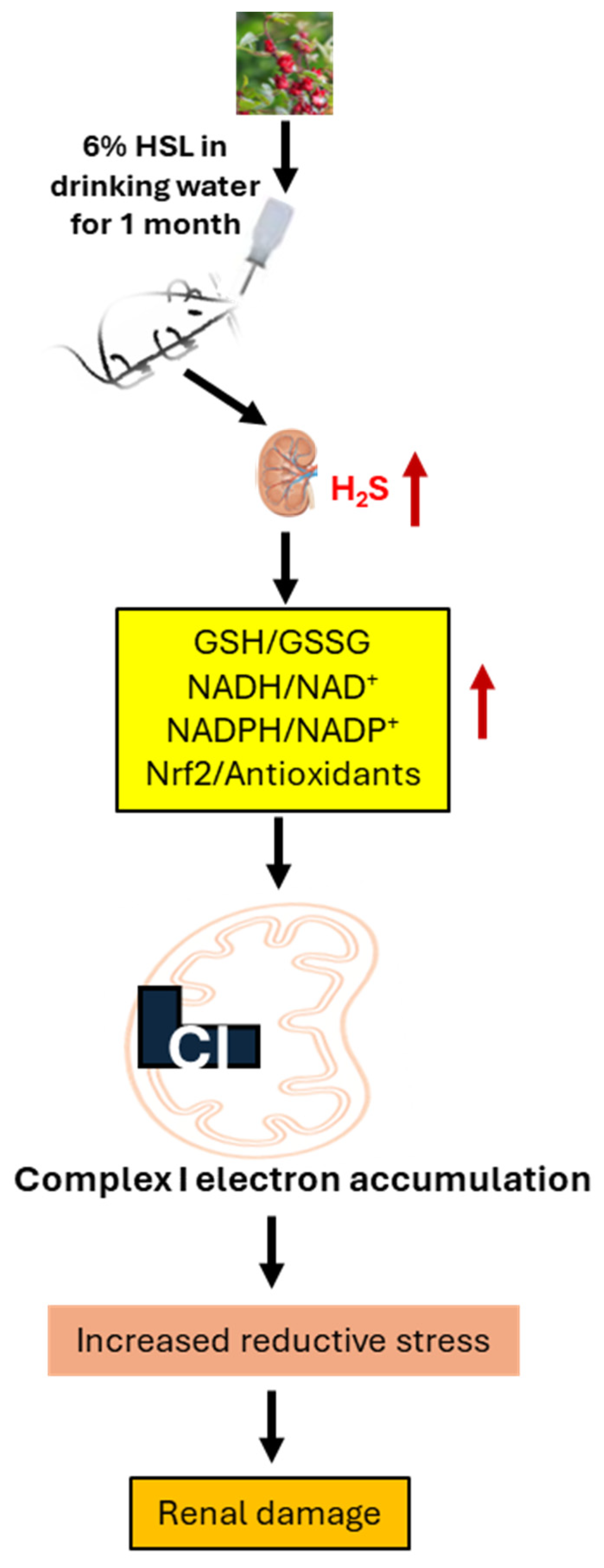
Over-Intake of Plant-Derived Antioxidants, H2S Generation, and Reductive Stress. Comment on Manzano-Pech et al. The Chronic Elevated Consumption of Hibiscus sabdariffa Linnaeus Results in Kidney Damage Associated with Excess H2S. Int. J. Mol. Sci. 2026, 27, 2190



Author Contributions
Funding
Conflicts of Interest
References
- Jaeschke, H.; Kleinwaechter, C.; Wendel, A. NADH-dependent reductive stress and ferritin-bound iron in allyl alcohol-induced lipid peroxidation in vivo: The protective effect of vitamin E. Chem. Biol. Interact. 1992, 81, 57–68. [Google Scholar] [CrossRef] [PubMed]
- Lloret, A.; Fuchsberger, T.; Giraldo, E.; Vina, J. Reductive Stress: A New Concept in Alzheimer’s Disease. Curr. Alzheimer Res. 2016, 13, 206–211. [Google Scholar] [CrossRef]
- Fisher, D.; Mentor, S. Antioxidant-induced reductive stress has untoward consequences on the brain microvasculature. Neural Regen. Res. 2017, 12, 743–744. [Google Scholar] [CrossRef] [PubMed]
- Farhana, A.; Guidry, L.; Srivastava, A.; Singh, A.K.; Hondalus, M.K.; Steyn, J.C. Reductive stress in microbes: Implications for understanding Mycobacterium tuberculosis disease and persistence. In Advances in Microbial Physiology; Elsevier: Amsterdam, The Netherlands, 2010; pp. 45–64. [Google Scholar]
- Dawson, T.L.; Gores, G.J.; Nieminen, A.L.; Herman, B.; Lemasters, J.J. Mitochondria as a source of reactive oxygen species during reductive stress in rat hepatocytes. Am. J. Physiol. 1993, 264, C961–C967. [Google Scholar] [CrossRef] [PubMed]
- Mercola, J. Reductive stress and mitochondrial dysfunction: The hidden link in chronic disease. Free Radic. Biol. Med. 2025, 233, 118–131. [Google Scholar] [CrossRef]
- Yan, L.J. Pathogenesis of Chronic Hyperglycemia: From Reductive Stress to Oxidative Stress. J. Diabetes Res. 2014, 2014, 137919. [Google Scholar] [CrossRef]
- Yan, L.J.; Levine, R.L.; Sohal, R.S. Oxidative damage during aging targets mitochondrial aconitase. Proc. Natl. Acad. Sci. USA 1997, 94, 11168–11172. [Google Scholar] [CrossRef]
- Rajasekaran, N.S.; Connell, P.; Christians, E.S.; Yan, L.J.; Taylor, R.P.; Orosz, A.; Zhang, X.Q.; Stevenson, T.J.; Peshock, R.M.; Leopold, J.A.; et al. Human alpha B-crystallin mutation causes oxido-reductive stress and protein aggregation cardiomyopathy in mice. Cell 2007, 130, 427–439. [Google Scholar] [CrossRef]
- Mentor, S.; Fisher, D. Aggressive Antioxidant Reductive Stress Impairs Brain Endothelial Cell Angiogenesis and Blood Brain Barrier Function. Curr. Neurovasc Res. 2017, 14, 71–81. [Google Scholar] [CrossRef]
- Tilton, R.G. Diabetic vascular dysfunction: Links to glucose-induced reductive stress and VEGF. Microsc. Res. Tech. 2002, 57, 390–407. [Google Scholar] [CrossRef]
- Xie, H.B.; Cammarato, A.; Rajasekaran, N.S.; Zhang, H.; Suggs, J.A.; Lin, H.C.; Bernstein, S.I.; Benjamin, I.J.; Golic, K.G. The NADPH metabolic network regulates human alphaB-crystallin cardiomyopathy and reductive stress in Drosophila melanogaster. PLoS Genet. 2013, 9, e1003544. [Google Scholar] [CrossRef] [PubMed]
- Zhang, H.; Limphong, P.; Pieper, J.; Liu, Q.; Rodesch, C.K.; Christians, E.; Benjamin, I.J. Glutathione-dependent reductive stress triggers mitochondrial oxidation and cytotoxicity. FASEB J. 2012, 26, 1442–1451. [Google Scholar] [CrossRef]
- Yan, L.J. NADH/NAD(+) Redox Imbalance and Diabetic Kidney Disease. Biomolecules 2021, 11, 730. [Google Scholar] [CrossRef] [PubMed]
- Hernandez-Cruz, E.Y.; Aparicio-Trejo, O.E.; Hammami, F.A.; Bar-Shalom, D.; Tepel, M.; Pedraza-Chaverri, J.; Scholze, A. N-acetylcysteine in Kidney Disease: Molecular Mechanisms, Pharmacokinetics, and Clinical Effectiveness. Kidney Int. Rep. 2024, 9, 2883–2903. [Google Scholar] [CrossRef] [PubMed]
- Ma, W.X.; Li, C.Y.; Tao, R.; Wang, X.P.; Yan, L.J. Reductive Stress-Induced Mitochondrial Dysfunction and Cardiomyopathy. Oxid. Med. Cell. Longev. 2020, 2020, 5136957. [Google Scholar] [CrossRef]
- Luo, M.; Ma, X.; Ye, J. Reductive stress—A common metabolic feature of obesity and cancer. Acta Pharm. Sin. B 2024, 14, 5181–5185. [Google Scholar] [CrossRef]
- Manzano-Pech, L.; Soto, M.E.; Castrejon-Tellez, V.; Soria-Castro, E.; Guarner-Lans, V.; Caballero-Chacon, S.; Martinez-Memije, R.; Torres-Narvaez, J.C.; El-Hafidi, M.; Perez-Torres, I. The Chronic Elevated Consumption of Hibiscus sabdariffa Linnaeus Results in Kidney Damage Associated with Excess H2S. Int. J. Mol. Sci. 2026, 27, 2190. [Google Scholar] [CrossRef]
- Manzano-Pech, L.; Soto, M.E.; Castrejon-Tellez, V.; Guarner-Lans, V.; Perez-Flores, A.A.; Caballero-Chacon, S.; Martinez-Memije, R.; Rubio-Ruiz, M.E.; Rodriguez-Fierros, F.L.; Torres-Narvaez, J.C.; et al. Impaired Renal Function Due to Reductive Stress Is Associated with Excessive Consumption of Hibiscus sabdariffa Linnaeus. Antioxidants 2025, 14, 984. [Google Scholar] [CrossRef]
- Ravi; Kumar, A.; Bhattacharyya, S.; Singh, J. Thiol reductive stress activates the hypoxia response pathway. EMBO J. 2023, 42, e114093. [Google Scholar] [CrossRef]
- Hanna, D.; Kumar, R.; Banerjee, R. A Metabolic Paradigm for Hydrogen Sulfide Signaling via Electron Transport Chain Plasticity. Antioxid. Redox Signal 2023, 38, 57–67. [Google Scholar] [CrossRef]
- Hildebrandt, T.M. Modulation of sulfide oxidation and toxicity in rat mitochondria by dehydroascorbic acid. Biochim. Biophys. Acta 2011, 1807, 1206–1213. [Google Scholar] [CrossRef]
- Li, Y.; Guo, X.; Li, S.; Wei, X.; Li, T. Transcriptomic characterization of the aberrant alternative splicing in skeletal muscles of sarcopenia patients. Sci. Rep. 2026, 16, 5334. [Google Scholar] [CrossRef] [PubMed]
- Wang, Y.J.; Gaul, D.S.; Gorica, E.; Pahla, J.; Wang, Z.; Mohammed, S.A.; Dahlby, T.; Dietrich, E.; Osto, E.; Gariani, K.; et al. NAD+ boosting increases atherosclerotic plaques and inflammation in Apoe knockout mice. Atherosclerosis 2025, 404, 119188. [Google Scholar] [CrossRef] [PubMed]
- Stromland, O.; Diab, J.; Ferrario, E.; Sverkeli, L.J.; Ziegler, M. The balance between NAD+ biosynthesis and consumption in ageing. Mech. Ageing Dev. 2021, 199, 111569. [Google Scholar] [CrossRef] [PubMed]
- Ji, L.L. Protein Acetylation and NAD+ Homeostasis in Aging Muscle. Adv. Exp. Med. Biol. 2025, 1478, 421–443. [Google Scholar] [CrossRef]

Disclaimer/Publisher’s Note: The statements, opinions and data contained in all publications are solely those of the individual author(s) and contributor(s) and not of MDPI and/or the editor(s). MDPI and/or the editor(s) disclaim responsibility for any injury to people or property resulting from any ideas, methods, instructions or products referred to in the content. |
© 2026 by the authors. Licensee MDPI, Basel, Switzerland. This article is an open access article distributed under the terms and conditions of the Creative Commons Attribution (CC BY) license.
Share and Cite
Nguyen, J.T.; Pham, P.P.; Yan, L.-J. Over-Intake of Plant-Derived Antioxidants, H2S Generation, and Reductive Stress. Comment on Manzano-Pech et al. The Chronic Elevated Consumption of Hibiscus sabdariffa Linnaeus Results in Kidney Damage Associated with Excess H2S. Int. J. Mol. Sci. 2026, 27, 2190. Int. J. Mol. Sci. 2026, 27, 4285. https://doi.org/10.3390/ijms27104285
Nguyen JT, Pham PP, Yan L-J. Over-Intake of Plant-Derived Antioxidants, H2S Generation, and Reductive Stress. Comment on Manzano-Pech et al. The Chronic Elevated Consumption of Hibiscus sabdariffa Linnaeus Results in Kidney Damage Associated with Excess H2S. Int. J. Mol. Sci. 2026, 27, 2190. International Journal of Molecular Sciences. 2026; 27(10):4285. https://doi.org/10.3390/ijms27104285
Chicago/Turabian StyleNguyen, Johnny Thai, Phuong Phoebe Pham, and Liang-Jun Yan. 2026. "Over-Intake of Plant-Derived Antioxidants, H2S Generation, and Reductive Stress. Comment on Manzano-Pech et al. The Chronic Elevated Consumption of Hibiscus sabdariffa Linnaeus Results in Kidney Damage Associated with Excess H2S. Int. J. Mol. Sci. 2026, 27, 2190" International Journal of Molecular Sciences 27, no. 10: 4285. https://doi.org/10.3390/ijms27104285
APA StyleNguyen, J. T., Pham, P. P., & Yan, L.-J. (2026). Over-Intake of Plant-Derived Antioxidants, H2S Generation, and Reductive Stress. Comment on Manzano-Pech et al. The Chronic Elevated Consumption of Hibiscus sabdariffa Linnaeus Results in Kidney Damage Associated with Excess H2S. Int. J. Mol. Sci. 2026, 27, 2190. International Journal of Molecular Sciences, 27(10), 4285. https://doi.org/10.3390/ijms27104285