Article

Phenotypic and Genetic Characteristics of blaIMP-6-Harboring Enterobacterales Isolates Lacking blaCTX-M-2 in Japan


1
Department of Microbiology and Infectious Diseases, Nara Medical University, 840 Shijo-cho, Kashihara-shi 6348521, Nara, Japan
2
Department of Bacteriology, BML Inc., 1361-1 Matoba, Kawagoe 3501101, Saitama, Japan
*
Author to whom correspondence should be addressed.
Int. J. Mol. Sci. 2026, 27(10), 4269; https://doi.org/10.3390/ijms27104269
Submission received: 20 January 2026 / Revised: 17 April 2026 / Accepted: 1 May 2026 / Published: 11 May 2026

Abstract

Carbapenemase-producing Enterobacterales (CPE) is a global threat. IMP-6, a prevalent carbapenemase in western Japan, is mostly disseminated via CTX-M-2 extended-spectrum β-lactamase (ESBL) co-producing Enterobacterales. However, the existence and characteristics of Enterobacterales harboring blaIMP-6 without blaCTX-M-2 remain unclear. We analyzed the phenotypic and genetic characteristics of clinical blaIMP-6-harboring Enterobacterales isolates, focusing on those lacking blaCTX-M-2. Overall, 220 blaIMP-6-harboring isolates collected from 76 Japanese hospitals between 2014 and 2021 were characterized by antimicrobial susceptibility, presence of CTX-M-type ESBLs, plasmid incompatibility, plasmid transfer experiments, and genome sequencing and analysis. Among these, 203 co-harbored blaCTX-M-2 group, with 90% of them demonstrating high conjugation frequency and broad-spectrum resistance to β-lactams. Of the remaining 17 isolates, nine lacked blaCTX-M, while eight co-harbored blaCTX-M-1 group (n = 2) or blaCTX-M-9 group (n = 6). Eleven isolates carried nontransferable plasmids with genetic structures distinct from those of blaIMP-6 and blaCTX-M-2 co-encoding plasmids, including eight non-incompatibility N plasmids. Fifteen isolates carried only blaIMP-6-encoding plasmids; two carried plasmids with blaIMP-6 and blaCTX-M (blaCTX-M-27 or blaCTX-M-65). This novel study revealed that blaIMP-6 can exist without blaCTX-M-2 on diverse, often nontransferable plasmids, suggesting distinct, lower dissemination pathways compared to those of epidemic blaCTX-M-2 co-carrying plasmids and highlighting previously overlooked plasmids that necessitate close monitoring.

1. Introduction

Enterobacterales are Gram-negative bacteria commonly found in the gastrointestinal tract in healthy individuals; however, it can cause a broad spectrum of severe infections [1,2]. Carbapenemases hydrolyze third-generation cephalosporins and carbapenems [3]. Carbapenemase-producing Enterobacterales (CPE) represent an important threat to global health because of limited therapy options and high mortality rates, and CPE outbreaks have been reported worldwide [4,5]. The most frequently detected carbapenemases among Enterobacterales are Klebsiella pneumoniae carbapenemase (KPC), New Delhi metallo-β-lactamase (NDM), imipenemase (IMP), Verona integron-encoded metallo-β-lactamase (VIM), and oxacillinase (OXA)-48-like enzymes [6]. Carbapenemases are generally categorized into three classes according to the Ambler classification system: Class A (KPC), Class B (NDM, IMP, and VIM), and Class D (OXA-48-like enzymes) [2]. These classes differ with regard to each enzyme’s primary protein structure; specifically, Class B carbapenemases require at least one zinc ion at their active site to facilitate the breakdown of the β-lactam ring [2]. The first IMP-type carbapenemase was found in a clinical Enterobacterales isolate from Japan during plasmid-mediated dissemination in 1993, and outbreaks of IMP producers have been reported in not only Asia but also Europe and the Americas [5,7,8,9]. In Japan, CPE are isolated at a significantly low frequency; however, the isolates predominantly harbor IMP-type carbapenemases, particularly IMP-1 or IMP-6 [10,11].
Carbapenemases show regional differences; IMP-1 is predominant in eastern Japan, whereas IMP-6 is dominant in western Japan [10,11]. The first IMP-6-producing Serratia marcescens isolate was reported in 1996 [12]. IMP-6-producing Enterobacterales isolates have only been reported in Japan [10,11,13,14,15,16]. IMP-6-producing Pseudomonas aeruginosa isolates have been reported in South Korea and China [17,18,19,20]. blaIMP-6 differs from blaIMP-1 due to an A640G single-base mutation that results in an S214G amino acid substitution. Because of this substitution, the enzymatic activity of IMP-6 for meropenem is significantly higher than that for imipenem, whereas the activity of IMP-1 for meropenem is almost identical to that for imipenem [12,21]. Over 70% of blaIMP-6-harboring Escherichia coli isolates isolated in 2011 were susceptible to not only imipenem but also meropenem [10]; however, blaIMP-6-harboring Enterobacterales can show the inoculum size effect for meropenem [22]. The inoculum size effect is the phenomenon in which the minimum inhibitory concentration (MIC) of an antibiotic increases significantly as the number of bacteria increases. IMP-6 shows weak enzymatic activity to penicillins and monobactams; however, most IMP-6 producers co-harbor cefotaximase-Munich-2 (CTX-M-2) extended-spectrum β-lactamase (ESBL) and consequently show broad-spectrum resistance to β-lactams, including penicillins, third-generation cephalosporins, and monobactams [12,14,15,16,23]. CTX-M-type ESBLs were first reported in the late 1980s and have been recognized as the most globally disseminated ESBL group since the early 2000s [24,25,26]. ESBLs can be clustered into five groups (1, 2, 8, 9, and 25) based on their sequence alignments [24]. Among ESBLs, the CTX-M-9 group, including CTX-M-14 and CTX-M-27, has been isolated mainly in Japan [27,28,29]. However, IMP-6 producers have been reported to encode blaIMP-6 and blaCTX-M-2 on plasmids [12,14,15,16,23,28].
Although CPE isolation rates are very low in Japan, the prevalence of blaIMP-6-harboring Enterobacterales, which was associated with the spread of plasmids, was reported in Osaka, western Japan [7,23,30]. Most plasmids were highly homologous to the pKPI-6 plasmid, an incompatibility group N (IncN) plasmid encoding both blaIMP-6 as the second cassette of a class 1 integron and blaCTX-M-2 [16], and they showed a high conjugation frequency [7]. IncN plasmids are one of the most frequent broad-host-range plasmids and are regulated by the gene encoding the replicase protein [31]. The first reported isolate encoded blaIMP-6 on an IncW plasmid [32]; however, the most recently reported clinical isolates harbored blaIMP-6 and blaCTX-M-2 encoded on IncN plasmids [16,33]. Although blaIMP-6, encoded on IncFIA plasmids, was observed among the clinical isolates identified in Osaka [7], there is little information regarding such isolates and other types that may exist.
In this study, we aimed to address the limited understanding about blaIMP-6-harboring Enterobacterales lacking blaCTX-M-2. We investigated clinical isolates harboring only blaIMP-6 or co-harboring blaCTX-M variants other than blaCTX-M-2 and analyzed their phenotypic and genetic characteristics. Through a systematic comparison of blaIMP-6-harboring Enterobacterales lacking blaCTX-M-2 with blaCTX-M-2 co-harboring isolates, we sought to elucidate the differences in antimicrobial susceptibility, plasmid features, and potential dissemination patterns.

2. Results

2.1. Characteristics of blaIMP-6-Harboring Enterobacterales

Among the 220 blaIMP-6-harboring Enterobacterales, 203 co-harbored blaCTX-M-2 group (blaCTX-M-2 [n = 189], blaCTX-M-35 [n = 11], blaCTX-M-200 [n = 2], blaCTX-M-271 [n = 1]) (Table 1). All 203 isolates were resistant to ampicillin and cefotaxime (Table S1). Regarding carbapenem susceptibility, all 203 isolates were susceptible to imipenem, and a large majority (150/203) were susceptible to meropenem (Table S1). Most isolates (185/203) successfully transferred both blaIMP-6 and blaCTX-M-2 group genes to recipient strains via conjugation (Table 1). PCR-based analysis of resistance genes and replicon typing of the transconjugants demonstrated that these genes were co-located on IncN plasmids. Whole-genome sequencing of representative isolates supported the co-encoding of blaIMP-6 and blaCTX-M-2 group genes on IncN plasmids further. The mean log10 conjugation frequency of these 185 isolates was —3.7 with a 95% confidence interval (CI) of −3.9 to −3.6 (Table S1). All these transconjugants were also resistant to ampicillin and cefotaxime and susceptible to imipenem, whereas 144 were susceptible to meropenem. All 18 nontransferable isolates (blaCTX-M-2 [n = 17], blaCTX-M-200 [n = 1]) carried IncN plasmids.
The other 17 isolates did not co-harbor blaCTX-M-2; among them, nine did not harbor any blaCTX-M genes, while the remaining eight co-harbored blaCTX-M-1 group (n = 2) or blaCTX-M-9 group (n = 6) (Table 1). The antimicrobial susceptibility of the 17 isolates is shown in Table 1. Almost all (16/17) were resistant to ampicillin, and all were resistant to cefotaxime. Regarding carbapenem susceptibility, all were susceptible to imipenem, and a majority (10/17) were susceptible to meropenem. Among the 17 isolates, one non-harboring blaCTX-M and five co-harboring blaCTX-M-3 (n = 1) or blaCTX-M-14 (n = 4) transferred only blaIMP-6-encoding IncN plasmids (Table 1). The mean log10 conjugation frequency of these six isolates was −4.3 with a 95% CI of −5.2 to −3.3 (Table 1). All six transconjugants were non-resistant (susceptible or intermediate) to ampicillin, resistant to cefotaxime, and susceptible to imipenem, and five of the transconjugants were non-resistant to meropenem (Table 1). Among the 11 nontransferable blaCTX-M-2 group non-harboring isolates, only three carried IncN plasmids; the other isolates harbored various incompatibility groups (Table 1). These tendencies were identical for E. coli, K. pneumoniae, and Enterobacter cloacae complex.

2.2. Genomic Structures of blaIMP-6 and blaCTX-M-2 Co-Encoding Plasmids

Whole-genome sequencing analysis was performed on two representative blaCTX-M-2 co-harboring isolates: transferable NR1442 (biosample accession no. SAMD00898392) and nontransferable NR481 (biosample accession no. SAMD01824540). These isolates were randomly selected from the 203 blaCTX-M-2 group co-harboring isolates. Both blaCTX-M-2 group co-encoding IncN plasmids had a conserved, almost complete pKPI-6 locus (accession no. AB616660) regardless of transferability. The Class 1 integron region contained blaIMP-6, the downstream region of ISEcp1 contained blaCTX-M-2, and the conjugal transfer system of the IncN plasmids was conserved.

2.3. Genomic Structures of Only blaIMP-6-Encoding Plasmids

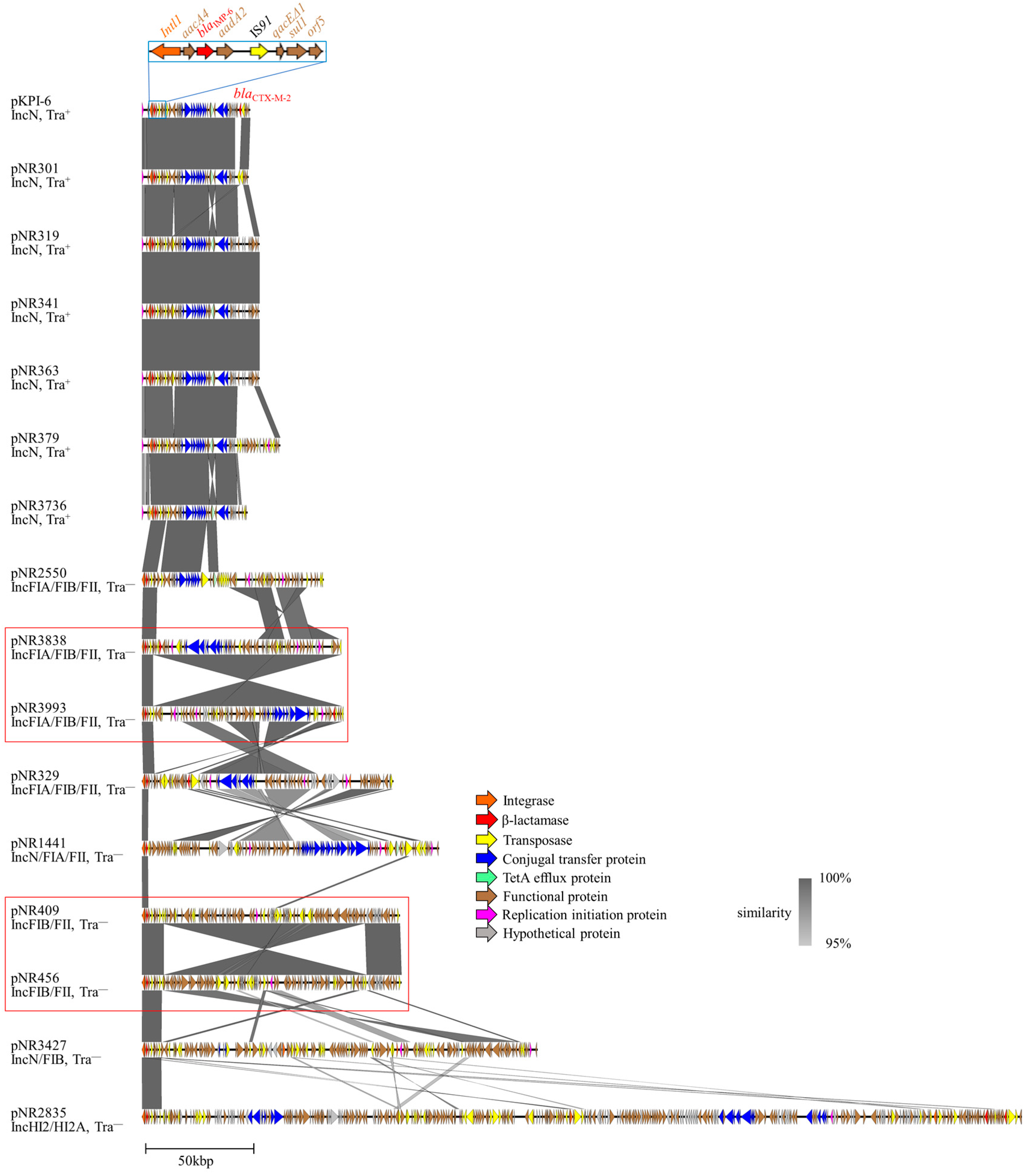
Among 17 blaCTX-M-2 group non-harboring isolates, 15 carried only blaIMP-6-encoding plasmids (Table S2), while the remaining carried plasmids co-encoding blaIMP-6 and blaCTX-M (blaCTX-M-27 or blaCTX-M-65), which were analyzed separately. The accession numbers and characteristics of the 15 only blaIMP-6-encoding plasmids are summarized in Table S2 as a supplement to Figure 1. Among these 15 isolates, nine did not harbor blaCTX-M, while the remaining six co-harbored blaCTX-M (blaCTX-M-3 [n = 1], blaCTX-M-15 [n = 1], blaCTX-M-14 [n = 4]) on plasmids other than those encoding blaIMP-6 or chromosome (Table 1). The structural analysis revealed that six transferable plasmids were homologous to pKPI-6, except for the region surrounding blaCTX-M-2 (Figure 1). Regarding the other nine nontransferable plasmids, the genomic structures of the blaIMP-6 plasmids and pKPI-6 shared the surrounding region of the class 1 integron containing blaIMP-6 in common; however, the rest of the genomic structures were diverse (Figure 1). Despite significant differences in genomic structure, the MICs of the isolates harboring only blaIMP-6 were similar to those of the isolates co-harboring the blaCTX-M-2 group (Table 1). Inversions occurred on the plasmids between pNR409 and pNR456 and between pNR3838 and pNR3993 (Figure 1). We observed an additional IS26 element insertion in pNR456 and pNR3993 and IS26 elements at both ends of the inversion region. Each pair of isolates was collected from different patients in the same hospital at intervals of at least months.

2.4. Genomic Structure of the blaIMP-6 and blaCTX-M-27 Co-Encoding Plasmid

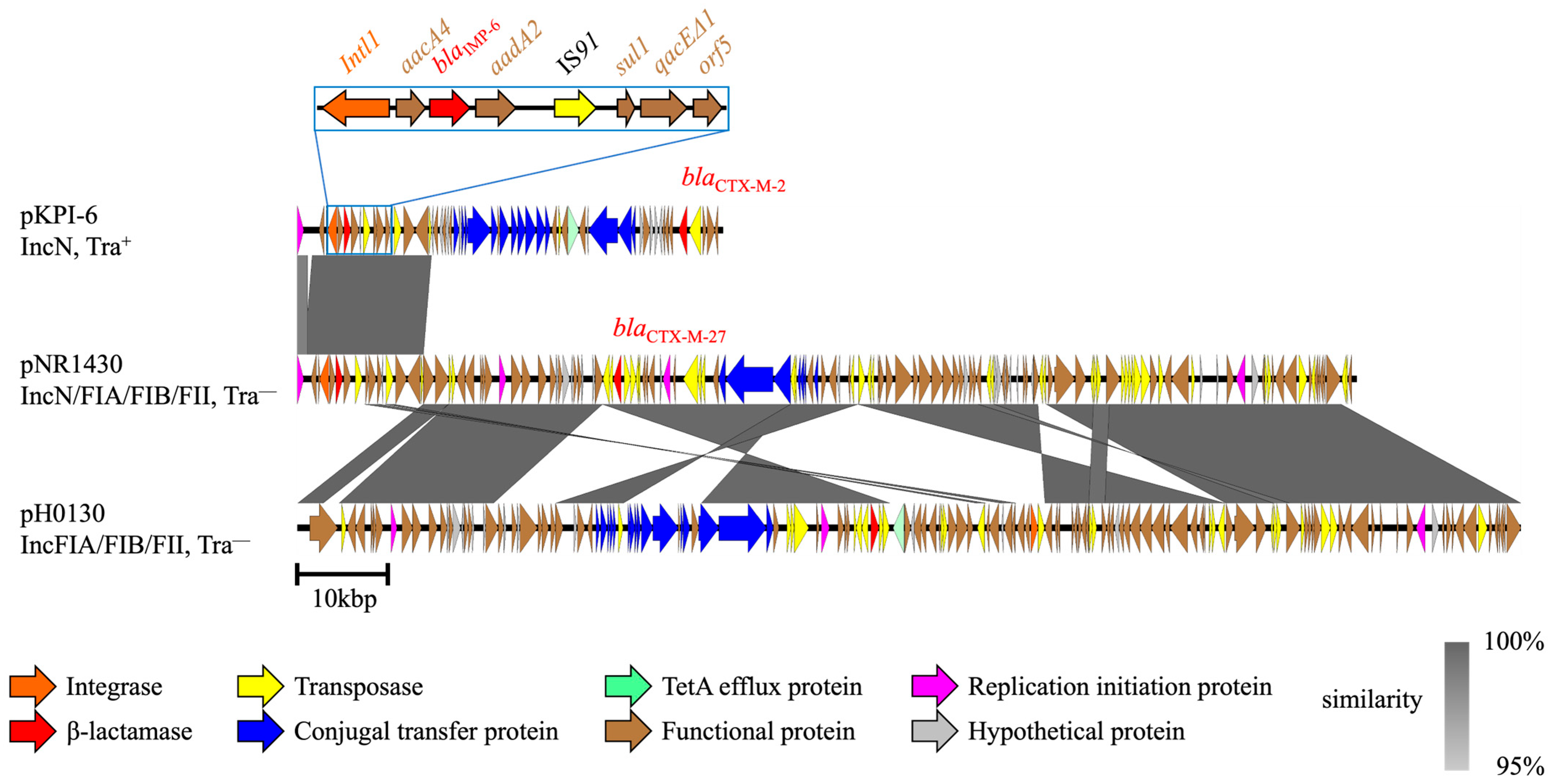
Whole-genome sequencing of the nontransferable NR1430 isolate co-harboring blaIMP-6 and blaCTX-M-27 revealed that the resistance genes were on a single plasmid (Figure 2). The plasmid and pKPI-6 were IncN plasmids and shared only the region around the class 1 integron (ca. 14 kb), including blaIMP-6 encoded by pKPI-6. The rest of the genomic structure (ca. 103 kb), including blaCTX-M-27, differed from that of pKPI-6. Basic local alignment search tool (BLAST) v2.13.0 plasmid sequence alignment showed that the most similar reference plasmid was pH0130 (GenBank accession number LC520281, E. coli isolated from Japan in 2016, 90% query coverage, 100% identity). Despite significant differences in genomic structure, the MIC of NR1430 was similar to those of blaCTX-M-2 group co-harboring isolates (Table 1).

2.5. Genomic Structure of the blaIMP-6 and blaCTX-M-65 Co-Encoding Plasmid

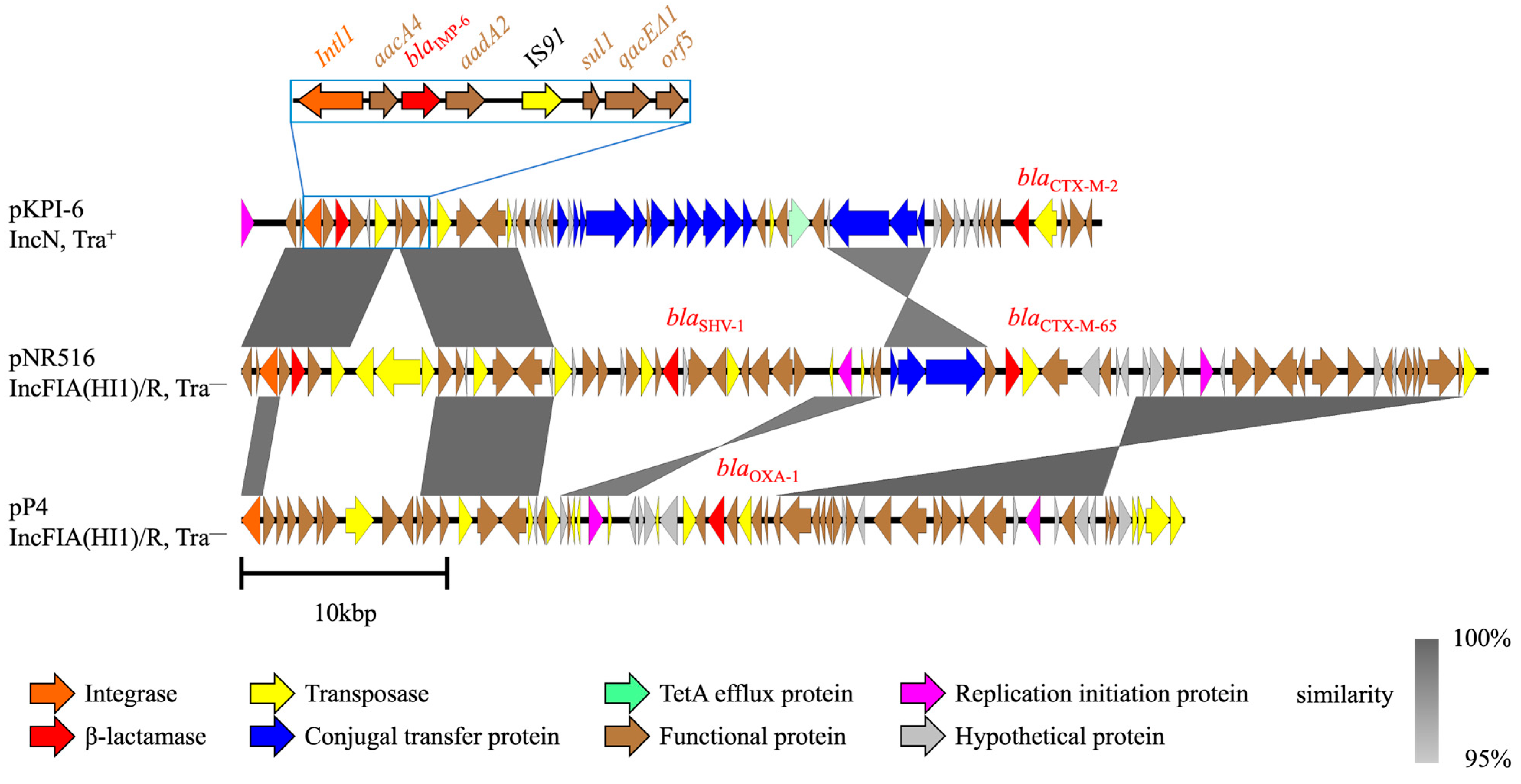
Whole-genome sequencing of the nontransferable NR516 isolate harboring blaIMP-6 and blaCTX-M-65 revealed that the resistance genes were on a single plasmid (Figure 3). The plasmid was not an IncN plasmid but rather an IncFIA(HI1)/R plasmid; however, the plasmid and pKPI-6 shared a region around the class 1 integron containing blaIMP-6 and several other genes (ca. 12 kb). The remaining genomic structure (ca. 56 kb), including blaCTX-M-65, differed from that of pKPI-6, and no homologous blaCTX-M-65-encoding plasmid was observed. BLAST plasmid sequence alignment showed that the most similar reference plasmid was pP4 (GenBank accession number OW968322, E. coli isolated from Spain in 2018, 85% query coverage, 100% identity). Despite the differences in genomic structure, the MIC of NR516 was similar to those of blaCTX-M-2 group co-harboring isolates (Table 1).
Table 1. Characteristics of 220 blaIMP-6-harboring Enterobacterales isolates from 76 hospitals in Japan.
Co-Harboring
CTX-M Genes a
(No. of Isolates)
Species b
(Isolates or No. of Isolates)
Donor Isolates bTransconjugants b
MIC or MIC50 (µg/mL)Incompatibility Group f,gConjugation Frequency log10 (T/D)(Transferability)Co-Harboring
CTX-M Genes b
Incompatibility
Group of blaIMP-6
Encoding Plasmids g
MIC or MIC50 (µg/mL) h
ABPCCTXCAZIPMMEPMMean95%CIABPCCTXCAZIPMMEPM
CTX-M-2
group (203)
CTX-M-2EC (95)>256128320.251N, others−3.7−3.9 to −3.4(83/95)CTX-M-2N>256128160.250.25
CTX-M-2KP (90)>25664320.251N, others−3.8−4.0 to −3.6(85/90)CTX-M-2N>256256320.250.5
CTX-M-2ECC (4)>2562562560.52N, others−3.5−6.3 to −0.7(4/4)CTX-M-2N>2562562560.52
CTX-M-35EC (9)>256641280.1251N, others−3.9−4.2 to −3.5(9/9)CTX-M-35N>256321280.250.25
CTX-M-35KP (NR498)>25664>2560.1252N−3.5--(1/1)CTX-M-35N>25664>2560.1252
CTX-M-35KP (NR519)>25664>2560.1251N−3.7--(1/1)CTX-M-35N>25664>2560.250.5
CTX-M-200EC (NR293)>25664320.1250.5N, FIA, FIB, F−3.2--(1/1)CTX-M-200N>25616160.1250.5
CTX-M-200EC (NR322)>2561680.1250.125N, FIA, Fnt--(0/1)nt------
CTX-M-271EC (NR3900)>25664640.1254N, others−2.5--(1/1)CTX-M-271N>2566480.1254
CTX-M-1
group (2)
CTX-M-3EC (NR3736)>256256640.250.5N, FIB, I1-Iγ, Y, F−4.4--(1/1)-N1632640.51
CTX-M-15EC (NR1441)>2561281280.1252N, FIA, FIInt--(0/1)nt------
CTX-M-9
group (6)
CTX-M-14EC (NR301)>2566480.251N, FIA, F−5.1--(1/1)-N648160.250.25
CTX-M-14EC (NR319)>256128320.1250.5N, FIA, FIB, F−3.0--(1/1)-N432320.1250.5
CTX-M-14EC (NR341)>256128640.54N, FIA, FIB, F−4.2--(1/1)-N864320.54
CTX-M-14EC (NR363)>2561281280.54N, FIA, FIB, F−3.4--(1/1)-N16641280.52
CTX-M-27EC (NR1430)>25664>2560.251N, FIA, FIB, FIInt--(0/1)nt------
CTX-M-65KP (NR516)>256>2563214FIA(HI1), Rnt--(0/1)nt------
Non-CTX-M (9)-EC (NR379) c>256256>2560.58N, FIA, A/C−5.3--(1/1)-N, FIA41680.250.25
-EC (NR2550)8880.58FIA, FIB, FIInt--(0/1)nt------
-EC (NR3838)256880.1250.25FIA, FIB, FIInt--(0/1)nt- -----
-EC (NR3993)256480.1250.25FIA, FIB, FIInt--(0/1)nt------
-EC (NR329)>256128640.252FIA, FIB, FIInt--(0/1)nt------
-KP (NR3427)3232160.251N, FIBnt--(0/1)nt------
-KP (NR409) d6416160.1250.5FIB, FIInt--(0/1)nt------
-KP (NR456) d1288160.250.5FIB, FIInt--(0/1)nt------
-ECC (NR2835) e>25664>2560.50.5HI2, HI2Ant--(0/1)nt------
a Underlined co-harboring CTX-M genes are located on plasmids other than those encoding blaIMP-6 or chromosome. b Abbreviations: ABPC, ampicillin; CTX, cefotaxime; CAZ, ceftazidime; IPM, imipenem; MEPM, meropenem; EC, Escherichia coli; ECC, Enterobacter cloacae complex; KP, Klebsiella pneumoniae; nt, not transferred; CI, confidence interval; T, initial number of transconjugants; D, initial number of donors. c Isolates harboring OXA-10. d Isolates harboring SHV-11. e Isolates harboring SHV-12. f Underlined incompatibility groups are blaIMP-6-encoding plasmids identified using whole-genome sequencing analysis. g Others include FIA, FIB, 1-Iγ, or Y. h The MICs for the recipient strain E. coli J53 are as follows: AMP, 4 µg/mL; CTX, ≤0.063 µg/mL; CAZ, 0.25 µg/mL; IPM, ≤0.063 µg/mL; and MEM, ≤0.063 µg/mL.
Figure 3. Genetic structure of the blaIMP-6 and blaCTX-M-65 co-encoding plasmid pNR516. Linear alignments of pNR516 (AP040228) with reference plasmids pKPI-6 (AB616660) and pP4 (OW968322). Blue box: structure of a class 1 integron (In722) containing blaIMP-6, which is the same as that of pKPI-6. pNR516 has the same genomic content as In722 except for qacED1. The pP4 reference plasmid is most similar to pNR516. Abbreviations: Tra+, transferable; Tra, nontransferable.
Ijms 27 04269 g003

3. Discussion

In this study, we provide novel insights into the diversity of blaIMP-6-harboring Enterobacterales lacking blaCTX-M-2, which have been largely overlooked in previous studies focusing on epidemic blaCTX-M-2 co-encoding IncN plasmids. Consistent with the results described by previous reports, the majority of the blaIMP-6-harboring Enterobacterales in our nationwide collection co-harbored blaCTX-M-2 (189/220). In addition, a small subset (n = 14) carried variants of the blaCTX-M-2 group, such as blaCTX-M-35, blaCTX-M-200, and blaCTX-M-271 (accession no. LC844998), which likely originated from blaCTX-M-2 through single-base mutations (http://www.bldb.eu/ (accessed on 23 February 2025)). Importantly, we identified and characterized a distinct minority population of blaIMP-6-harboring isolates (n = 17) that either lacked blaCTX-M or co-harbored blaCTX-M-1 or blaCTX-M-9 group genes instead of blaCTX-M-2, thus highlighting previously underappreciated genetic diversity within this lineage.
Regarding phenotypic characteristics, most isolates (160/220) were susceptible to both imipenem and meropenem regardless of the presence of blaCTX-M. These isolates were susceptible to carbapenems but might be clinically resistant in vivo because of inoculum size effects [22]. Up to 55.6% of patients with in vitro initial tests showing susceptible KPC-type carbapenemase producers treated with carbapenems experienced clinical or microbiological failure [34], and a similar failure could occur with IMP-6 producers. The European Committee on Antimicrobial Susceptibility Testing (EUCAST) guidelines recommend a MIC screening cut-off of >0.125 mg/L for meropenem and the observation of synergy only with dipicolinic acid for metallo-β-lactamase detection; however, these guidelines included too many applicable isolates. Moreover, three of the isolates might have been overlooked even following the EUCAST recommendation because of the susceptibility of meropenem (MIC ≤ 0.125 mg/L). The detection of such susceptible carbapenemase producers by routine testing using culture-based methods is challenging; therefore, active surveillance is recommended for patients at high risk of carrying carbapenemase producers, including those undergoing major surgery, requiring invasive medical devices, or being treated in environments with suboptimal hand hygiene compliance [23]. A loop-mediated isothermal amplification method and amplification refractory mutation system PCR to distinguish blaIMP-6 from blaIMP-1 probably play an important role in rapid and highly sensitive detection of the producers [35,36]. Regarding blaCTX-M genes co-harboring isolates, most isolates (154/211) were susceptible to meropenem, and all showed broad-spectrum resistance to β-lactams. Similarly, most of the isolates harboring only blaIMP-6 (6/9) were susceptible to meropenem; however, all six showed broad-spectrum resistance to β-lactams. Although 10 of 19 isolates subjected to genetic structure analysis harbored ardK, which represses blaIMP-6 transcription by binding the regulatory element [37], no regulatory element was located upstream of blaIMP-6. Therefore, the meropenem susceptibility of these isolates seemed to have no relationship with ardK.
Among the 203 isolates co-harboring the blaCTX-M-2 group, 185 were transferable with high conjugation frequency, as the blaIMP-6 and blaCTX-M-2 groups were encoded on IncN plasmids. The high conjugation frequency of the plasmids and broad-spectrum resistance were consistent with previously reported features of blaCTX-M-2 group co-harboring isolates [7,14,16,23]. These features were presumed to contribute to the high isolation rate of blaCTX-M-2 group co-harboring isolates in this study and its dissemination across species. However, even though they carried IncN plasmids, 18 isolates did not transfer. Analysis of the genetic structure of one nontransferable isolate (NR481) revealed that its plasmid was highly homologous to that of one transferable isolate (NR1442). This suggests that chromosomal factors may influence the loss of transferability. However, as we analyzed the genetic structure of only one nontransferable isolate, further comprehensive research is needed to fully elucidate these mechanisms. In contrast, most blaCTX-M-2 group non-harboring isolates harbored blaIMP-6 on nontransferable plasmids (11/17), suggesting that the plasmids were less disseminated than blaCTX-M-2 group co-encoding plasmids. The nontransferable plasmids must explain the low isolation rate of blaCTX-M-2 group non-harboring isolates in this study. During the prevalence study in Osaka, blaCTX-M-2 non-harboring isolates were detected [7]. However, unlike the isolates in the current study, these isolates were transferable.
Regarding genetic characteristics, we evaluated the genomic structural similarities and differences between blaCTX-M-2 co-encoding and non-encoding plasmids. We revealed that while all 19 analyzed plasmids shared a conserved integron structure, the dissemination of blaIMP-6 is driven by two distinct trajectories: its widespread expansion via a highly conserved IncN plasmid and its simultaneous mobilization into diverse nontransferable plasmids (such as IncF) (Table 2). For the 19 analyzed plasmids, all blaIMP-6 were encoded as the second cassette of the class 1 integron on plasmids (Table 2), similarly to pKPI-6. Furthermore, all plasmids encoded a derivative of aacA4 as the first cassette of the class 1 integron and aadA2 as the third cassette of the class 1 integron, similarly to pKPI-6. In contrast, the plasmid of the original blaIMP-6-harboring isolate encoded blaIMP-6 as the first cassette and a hypothetical protein as the second cassette of class 1 integron [12]. Thus, the plasmids in this study and those of the original isolate probably originated from different evolutionary pathways. IMP-6-producing Pseudomonas aeruginosa isolates reported in South Korea encoded blaIMP-6 as the first cassette [20]; therefore, there appears to be no relation between isolates in this study and the previously reported isolates.
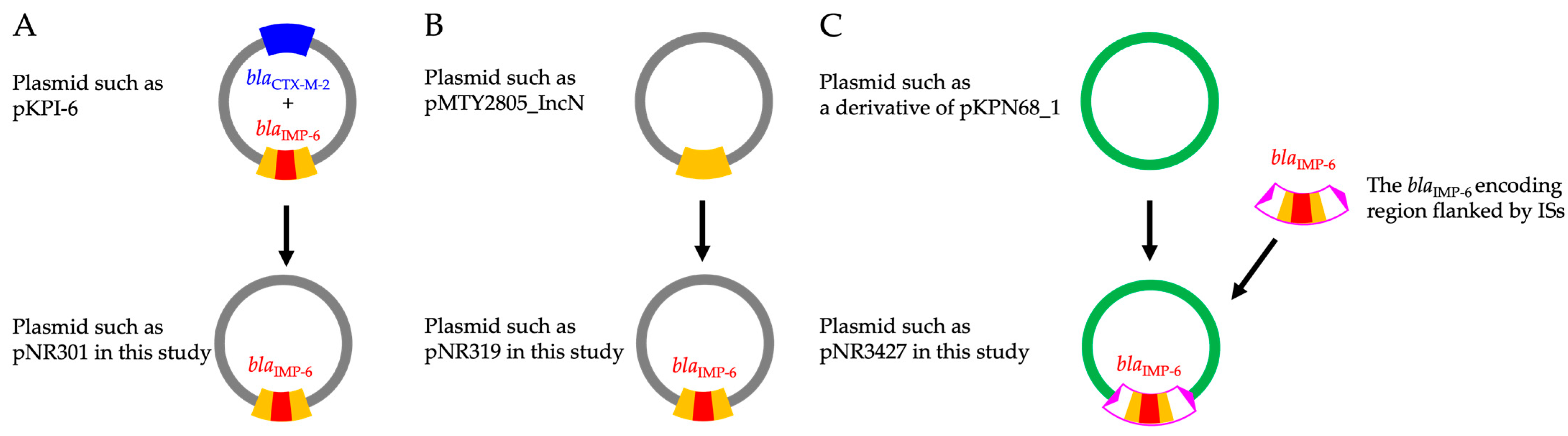
The two analyzed blaCTX-M-2 co-encoding IncN plasmids were similar to pKPI-6, including the region surrounding blaIMP-6 and the conjugal transfer system regardless of transferability (Table 2). Therefore, the homologous conjugal transfer system appears to provide the necessary conditions for the high isolation rate of blaCTX-M-2 group co-harboring isolates and the high dissemination risk in this study. Among the 17 blaCTX-M-2 group non-encoding plasmids, six transferable plasmids encoded only blaIMP-6 on IncN plasmids. The plasmids were highly homologous to pKPI-6, except for the region surrounding blaCTX-M-2 [16], suggesting that the plasmids were likely disseminated via conjugation. It is difficult to determine the transferable plasmid that came first—blaCTX-M-2 co-encoding (Figure 4A) or only blaIMP-6-encoding (Figure 4B)—because some plasmids with genomic structures where blaCTX-M-2 can be inserted had blaIMP-6, while others did not [38].
Furthermore, this is the first study to demonstrate the diversity of genomic structures and replicon types among nontransferable blaCTX-M-2 group non-encoding plasmids (only blaIMP-6 [n = 9], blaCTX-M-27 [n = 1], blaCTX-M-65 [n = 1]) (Table 2). The nine nontransferable only blaIMP-6-encoding plasmids showed different genomic structures and sizes (Table S3). Moreover, the replicon types were classified into seven groups (Table S3), suggesting that each plasmid was independently derived. Two pairs with the same replicon type (NR409 and NR456, and NR3838 and NR3993) demonstrated an inversion, probably caused by intramolecular IS26 transposition (Figure 1) [39]. Moreover, using the BLAST database, we identified the reference plasmids with high similarity to each nontransferable blaIMP-6-encoding plasmid (Table S3). Comparison with the reference plasmids suggests three evolutionary pathways of only blaIMP-6-encoding plasmids. The first pathway involves deletion of the blaCTX-M-2 region from a blaCTX-M-2 co-encoding plasmid such as pKPI-6 (Figure 4A). The second pathway involves the integration of blaIMP-6 into an existing class 1 integron structure (Figure 4B). This scenario is supported by isolates where nonhomologous regions relative to the reference plasmid were confined within the integron structure. The third pathway involves the insertion of a larger genetic module region harboring blaIMP-6, as a transposon flanked by insertion sequence (IS) elements, into an existing plasmid (Figure 4C). This pathway is considered unique and different from the one proposed for blaCTX-M-2 co-encoding plasmids, as evidenced by cases where the non-homologous regions extended beyond the integron structure into the adjacent surrounding sequences. Two of the reference plasmids encoded blaIMP-6 as the second cassette of the class 1 integron (Table S3). However, no reference plasmid was available to suggest a base substitution between blaIMP-6 and blaIMP-1 as for the relationship between pKPI-6, which encodes blaIMP-6, and pKPI-1, which encodes blaIMP-1 (96% query coverage, 100% identity). Some blaCTX-M-2 group non-encoding plasmids isolated during the prevalence study in Osaka showed high similarity to each other [7], and the most similar plasmid in this study to those plasmids was pNR1441 (80% query coverage, 99.98% identity).
In addition, we newly characterized plasmids co-encoding blaIMP-6 and blaCTX-M (blaCTX-M-27 or blaCTX-M-65). The genetic structure of blaIMP-6 and blaCTX-M-27 co-encoding IncN plasmid was homologous to pH0130 except for the region surrounding blaIMP-6, including blaCTX-M-27 (Figure 2). The region surrounding blaIMP-6 flanked by ISs was likely to be inserted into a derivative of pH0130; however, the mechanism is unknown. The region surrounding blaIMP-6 flanked by ISs encompasses not only the class 1 integron but also additional genes that are identical to those found in blaCTX-M-2 co-encoding plasmids (Figure 2). Given that the blaCTX-M-27 co-encoding plasmid harbors this conserved region, it is highly probable that the plasmid emerged subsequent to blaCTX-M-2 co-encoding plasmids, likely through acquisition of this conserved region. The model is likely the same as that shown in Figure 4C. H0130 and the isolate with an unknown genetic structure that co-harbors blaIMP-6 and blaCTX-M-27 have been isolated in Japan [15,40]. Furthermore, CTX-M-27 confers a high MIC for ceftazidime [41], consistent with the features of the blaIMP-6 and blaCTX-M-27 co-harboring isolate in this study (Table 1). Moreover, CTX-M-27 is the predominant CTX-M subtype of ESBL isolated in Japan [28,29]. These characteristics of CTX-M-27 appear to involve the emergence of blaIMP-6 and blaCTX-M-27 co-encoding plasmids; therefore, continuous monitoring of these plasmids is needed. Similarly, we reported the genomic structure of the blaIMP-6 and blaCTX-M-65 co-encoding IncFIA(HI1)/R plasmid. Regarding the genomic structure, except for the region surrounding blaIMP-6, including blaCTX-M-65 (Figure 3), we observed no homologous blaCTX-M-65 encoding plasmid, indicating that the plasmid was newly emerged.
This study presents some limitations. First, it was conducted using a limited variety of isolates from Japan. To assess the characteristics of blaIMP-6-harboring Enterobacterales, global strains must be evaluated. Second, we performed genome sequencing and analysis for only two of 203 Enterobacterales isolates co-harboring blaIMP-6 and blaCTX-M-2. With regard to the genetic structure of plasmids, the remaining isolates may have structures that are different from those of these two isolates; however, the isolates probably had the same structure because they showed high conjugation frequency given that they were encoded on IncN plasmids. In contrast, other genetic components such as chromosomal backgrounds and endogenous resistance genes likely harbor variations among individual isolates. A comprehensive whole-genome sequencing analysis of the entire cohort would be required for accurate characterization of these features.

4. Materials and Methods

4.1. Bacterial Isolates and Antibacterial Susceptibility Testing

A total of 220 non-redundant, clinical blaIMP-6-harboring Enterobacterales isolates, including 119 E. coli isolates, 96 K. pneumoniae isolates, and five E. cloacae complex isolates, were collected from 76 hospitals in Japan from 2014 to 2021 (Table S1). Species identification for each isolate was verified using the MicroScan WalkAway system (Siemens Healthineers Diagnostics, Tokyo, Japan), MALDI Biotyper (Bruker Daltonics, Billerica, MA, USA), or VITEK (bioMérieux, Marcy l’Étoile, France) at each hospital. All isolates were screened on the basis of a ceftazidime MIC ≥ 8 μg/mL using the MicroScan WalkAway system, VITEK, DPS192iX (Eiken Chemical Co., Ltd., Tokyo, Japan), or IA20MIC mkII (Eiken Chemical Co., Ltd., Tokyo, Japan). The carbapenem inactivation method was used to screen for carbapenemase production as previously described [42]. The MIC of the collected isolates was evaluated using the agar dilution method according to the Clinical and Laboratory Standards Institute guidelines [26]. E. coli ATCC 29522 was used for quality control.

4.2. Polymerase Chain Reaction (PCR) Identification and Sequencing of β-Lactamase Genes

blaIMP-6 was detected and confirmed using PCR and DNA sequencing, respectively [35]. The presence of CTX-M-type ESBLs was determined using PCR and sequencing. blaCTX-M genes were detected using PCR with CTX-M-1, CTX-M-2, CTX-M-8, CTX-M-9, and CTX-M-25 group-specific primers [43]. The amplified PCR products were confirmed using DNA sequencing. Sequence alignment and analysis were performed using BLAST (https://blast.ncbi.nlm.nih.gov/Blast.cgi (accessed on 20 June 2022)).

4.3. Plasmid Transfer Experiment and Replicon Typing

The transferability of 220 blaIMP-6-harboring Enterobacterales isolates was investigated in conjugation experiments using CPE as the donor and sodium azide-resistant E. coli J53 as the recipient, as previously described [44]. Luria–Bertani broth cultures of donor strains and the recipient E. coli J53 strain at exponential-phase growth were mixed at a ratio of 1:1 by volume and then incubated overnight at 37 °C. Then, we selected transconjugants on Luria–Bertani agar plates containing cefpodoxime (8 µg/mL) and sodium azide (100 µg/mL). The conjugation frequency was expressed as the log10 ratio of transconjugants to donors, as described previously [45]. For transferable isolates, the mean conjugation frequency and its 95% CI were calculated based on these log-transformed values. The transfer of resistance genes carried by the recipient strains was verified using PCR. Plasmid incompatibility was identified using PCR-based replicon typing [46].

4.4. Genome Sequencing and Analysis

The previously uncharacterized genetic structures of all 17 blaCTX-M-2 non-harboring isolates were investigated by genome sequencing, as little information about their plasmid structures and genetic backgrounds is available. In contrast, of the blaCTX-M-2 group co-harboring isolates, two representative isolates were selected for genome sequencing to assess the genomic structural similarities and differences between blaCTX-M-2 co-encoding and non-encoding plasmids, because blaCTX-M-2-harboring isolates carry highly conserved IncN plasmids similarly to pKPI-6. The selection was based on the predominant genotype (blaCTX-M-2) and incompatibility group (IncN), sharing the same characteristics as pKPI-6. For variations in dissemination, one transferable (E. coli NR1442) and one nontransferable isolate (K. pneumoniae NR481) each were randomly selected from the predominant species: E. coli and K. pneumoniae. DNA was extracted from each isolate using the magLEAD 6gC (Precision System Science Co., Ltd., Chiba, Japan) and sequenced using MiSeq (Illumina, San Diego, CA, USA), MinION (Oxford Nanopore Technologies, Oxford, UK), and Sanger sequencing. After read trimming and quality filtering, hybrid de novo assemblies of Illumina and Nanopore reads were generated using Unicycler v0.5.0 [47] or QIAGEN CLC Genomics Workbench 24.0 (QIAGEN, Aarhus, Denmark). The assembled sequences were annotated using DFAST v1.6.0 with standard settings [48,49] and the BLAST algorithm. Antimicrobial resistance genes and plasmid replicon types were detected using ResFinder 4.1 [50] and PlasmidFinder 2.1 (https://cge.food.dtu.dk/services/PlasmidFinder/ (accessed on 4 August 2022)), respectively. The genomic structures were compared using Easyfig, v2.2.2.

5. Conclusions

In conclusion, our findings revealed the phenotypic and genotypic characteristics of blaIMP-6-harboring Enterobacterales isolated in Japan. With regard to phenotypic characteristics, although Enterobacterales harboring blaIMP-6 without blaCTX-M-2 were isolated at a low frequency, they existed and mostly carried nontransferable blaIMP-6-encoding plasmids. With regard to genetic characteristics, to our knowledge, this is the first study to report that the characteristics of blaIMP-6-harboring Enterobacterales without blaCTX-M-2 exhibited diversity and were different from those of Enterobacterales co-harboring blaCTX-M-2. Furthermore, we identified the genetic structures of plasmids encoding new combinations of blaIMP-6 and blaCTX-M (blaCTX-M-27 or blaCTX-M-65). These isolates must have been previously overlooked because of the lower dissemination; therefore, close monitoring is required. As other combinations may exist or appear, continued analyses and further laboratory experiments will provide deeper insights into the evolutionary paths of blaIMP-6-harboring Enterobacterales.

Supplementary Materials

The following supporting information can be downloaded at: https://www.mdpi.com/article/10.3390/ijms27104269/s1.

Author Contributions

Conceptualization, R.N. and H.Y.; Methodology, K.Y., R.N., R.K., K.S. and Y.S.; Validation, R.N., A.N., Y.S. and H.Y.; Formal Analysis, K.Y., A.N., R.K., K.S. and Y.S.; Investigation, K.Y., A.N., R.K., K.S., M.W., R.S. and M.O.; Resources, R.S., M.O. and H.Y.; Data Curation, K.Y., A.N., R.K., K.S., M.W., Y.S., R.S. and M.O.; Writing—Original Draft Preparation, K.Y.; Writing—Review and Editing, K.Y., R.N., A.N., R.K., K.S., M.W., Y.S., R.S., M.O. and H.Y.; Visualization, K.Y. and R.N.; Supervision, R.N., Y.S. and H.Y.; Project Administration, R.N. and H.Y.; Funding Acquisition, H.Y. All authors have read and agreed to the published version of the manuscript.

Funding

This research was funded by JSPS KAKENHI, grant number 22K08606.

Institutional Review Board Statement

Not applicable.

Informed Consent Statement

Not applicable.

Data Availability Statement

The genome sequencing data presented in this study are deposited under BioProject accession number PRJDB20582.

Acknowledgments

We thank the staff of the Department of Microbiology and Infectious Diseases at Nara Medical University for their technical support.

Conflicts of Interest

Authors Ryuji Sakata and Miho Ogawa were employed by the company BML Inc. The remaining authors declare that the research was conducted in the absence of any commercial or financial relationships that could be construed as potential conflicts of interest.

Abbreviations

The following abbreviations are used in this manuscript:
CPEcarbapenemase-producing Enterobacterales
KPCKlebsiella pneumoniae carbapenemase
IMPimipenemase
CTX-M-2cefotaximase-Munich-2
ESBLextended-spectrum β-lactamase
IncNincompatibility group N
MICsminimum inhibitory concentrations
BLASTbasic local alignment search tool
EUCASTEuropean Committee on Antimicrobial Susceptibility Testing
PCRpolymerase chain reaction

References

  1. Moreira de Gouveia, M.I.; Bernalier-Donadille, A.; Jubelin, G. Enterobacteriaceae in the human gut: Dynamics and ecological roles in health and disease. Biology 2024, 13, 142. [Google Scholar] [CrossRef] [PubMed]
  2. Rabaan, A.A.; Eljaaly, K.; Alhumaid, S.; Albayat, H.; Al-Adsani, W.; Sabour, A.A.; Alshiekheid, M.A.; Al-Jishi, J.M.; Khamis, F.; Alwarthan, S.; et al. An overview on phenotypic and genotypic characterisation of carbapenem-resistant Enterobacterales. Medicina 2022, 58, 1675. [Google Scholar] [CrossRef]
  3. Tufa, T.B.; Mackenzie, C.R.; Orth, H.M.; Wienemann, T.; Nordmann, T.; Abdissa, S.; Hurissa, Z.; Schönfeld, A.; Bosselmann, M.; Häussinger, D.; et al. Prevalence and characterization of antimicrobial resistance among gram-negative bacteria isolated from febrile hospitalized patients in central Ethiopia. Antimicrob. Resist. Infect. Control 2022, 11, 8. [Google Scholar] [CrossRef] [PubMed]
  4. Ma, J.; Song, X.; Li, M.; Yu, Z.; Cheng, W.; Yu, Z.; Zhang, W.; Zhang, Y.; Shen, A.; Sun, H.; et al. Global spread of carbapenem-resistant Enterobacteriaceae: Epidemiological features, resistance mechanisms, detection and therapy. Microbiol. Res. 2023, 266, 127249. [Google Scholar] [CrossRef]
  5. Suay-García, B.; Pérez-Gracia, M.T. Present and future of carbapenem-resistant Enterobacteriaceae (CRE) infections. Antibiotics 2019, 8, 122. [Google Scholar] [CrossRef]
  6. Eichenberger, E.M.; Thaden, J.T. Epidemiology and mechanisms of resistance of extensively drug resistant gram-negative bacteria. Antibiotics 2019, 8, 37. [Google Scholar] [CrossRef] [PubMed]
  7. Abe, R.; Akeda, Y.; Sugawara, Y.; Takeuchi, D.; Matsumoto, Y.; Motooka, D.; Yamamoto, N.; Kawahara, R.; Tomono, K.; Fujino, Y.; et al. Characterization of the plasmidome encoding carbapenemase and mechanisms for dissemination of carbapenem-resistant Enterobacteriaceae. mSystems 2020, 5, e00759-20. [Google Scholar] [CrossRef]
  8. Vezina, B.; Morampalli, B.R.; Nguyen, H.A.; Gomez-Simmonds, A.; Peleg, A.Y.; Macesic, N. The rise and global spread of IMP carbapenemases (1996-2023): A genomic epidemiology study. Nat. Commun. 2025, 17, 183. [Google Scholar] [CrossRef]
  9. Ito, H.; Arakawa, Y.; Ohsuka, S.; Wacharotayankun, R.; Kato, N.; Ohta, M. Plasmid-mediated dissemination of the metallo-beta-lactamase gene blaIMP among clinically isolated strains of Serratia marcescens. Antimicrob. Agents Chemother. 1995, 39, 824–829. [Google Scholar] [CrossRef]
  10. Yano, H.; Ogawa, M.; Endo, S.; Kakuta, R.; Kanamori, H.; Inomata, S.; Ishibashi, N.; Aoyagi, T.; Hatta, M.; Gu, Y.; et al. High frequency of IMP-6 among clinical isolates of metallo-β-lactamase-producing Escherichia coli in Japan. Antimicrob. Agents Chemother. 2012, 56, 4554–4555. [Google Scholar] [CrossRef]
  11. Hirabayashi, A.; Yahara, K.; Kajihara, T.; Sugai, M.; Shibayama, K. Geographical distribution of Enterobacterales with a carbapenemase IMP-6 phenotype and its association with antimicrobial use: An analysis using comprehensive national surveillance data on antimicrobial resistance. PLoS ONE 2020, 15, e0243630. [Google Scholar] [CrossRef]
  12. Yano, H.; Kuga, A.; Okamoto, R.; Kitasato, H.; Kobayashi, T.; Inoue, M. Plasmid-encoded metallo-beta-lactamase (IMP-6) conferring resistance to carbapenems, especially meropenem. Antimicrob. Agents Chemother. 2001, 45, 1343–1348. [Google Scholar] [CrossRef]
  13. Ohno, Y.; Nakamura, A.; Hashimoto, E.; Matsutani, H.; Abe, N.; Fukuda, S.; Hisashi, K.; Komatsu, M.; Nakamura, F. Molecular epidemiology of carbapenemase-producing Enterobacteriaceae in a primary care hospital in Japan, 2010–2013. J. Infect. Chemother. 2017, 23, 224–229. [Google Scholar] [CrossRef] [PubMed]
  14. Shigemoto, N.; Kuwahara, R.; Kayama, S.; Shimizu, W.; Onodera, M.; Yokozaki, M.; Hisatsune, J.; Kato, F.; Ohge, H.; Sugai, M. Emergence in Japan of an imipenem-susceptible, meropenem-resistant Klebsiella pneumoniae carrying blaIMP-6. Diagn. Microbiol. Infect. Dis. 2012, 72, 109–112. [Google Scholar] [CrossRef] [PubMed]
  15. Kishi, R.; Nakano, R.; Nakano, A.; Harimoto, T.; Taniguchi, R.; Ando, S.; Suzuki, Y.; Yamaguchi, K.; Kitagawa, D.; Horiuchi, S.; et al. Prevalence of carbapenem-resistant Enterobacterales with blaIMP-6 predominance in hospitals from 2018 to 2021 in Nara, Japan. JAC-Antimicrob. Resist. 2024, 6, dlae135. [Google Scholar] [CrossRef] [PubMed]
  16. Kayama, S.; Shigemoto, N.; Kuwahara, R.; Oshima, K.; Hirakawa, H.; Hisatsune, J.; Jove, T.; Nishio, H.; Yamasaki, K.; Wada, Y.; et al. Complete nucleotide sequence of the IncN plasmid encoding IMP-6 and CTX-M-2 from emerging carbapenem-resistant Enterobacteriaceae in Japan. Antimicrob. Agents Chemother. 2015, 59, 1356–1359. [Google Scholar] [CrossRef]
  17. Yoo, J.S.; Yang, J.W.; Kim, H.M.; Byeon, J.; Kim, H.S.; Yoo, J.I.; Chung, G.T.; Lee, Y.S. Dissemination of genetically related IMP-6-producing multidrug-resistant Pseudomonas aeruginosa ST235 in South Korea. Int. J. Antimicrob. Agents 2012, 39, 300–304. [Google Scholar] [CrossRef]
  18. Ryoo, N.H.; Lee, K.; Lim, J.B.; Lee, Y.H.; Bae, I.K.; Jeong, S.H. Outbreak by meropenem-resistant Pseudomonas aeruginosa producing IMP-6 metallo-beta-lactamase in a Korean hospital. Diagn. Microbiol. Infect. Dis. 2009, 63, 115–117. [Google Scholar] [CrossRef]
  19. Chen, Y.; Sun, M.; Wang, M.; Lu, Y.; Yan, Z. Dissemination of IMP-6-producing Pseudomonas aeruginosa ST244 in multiple cities in China. Eur. J. Clin. Microbiol. Infect. Dis. 2014, 33, 1181–1187. [Google Scholar] [CrossRef]
  20. Cho, H.H.; Kwon, K.C.; Sung, J.Y.; Koo, S.H. Prevalence and genetic analysis of multidrug-resistant Pseudomonas aeruginosa ST235 isolated from a hospital in Korea, 2008–2012. Ann. Clin. Lab. Sci. 2013, 43, 414–419. [Google Scholar]
  21. Yamamoto, K.; Tanaka, H.; Kurisu, G.; Nakano, R.; Yano, H.; Sakai, H. Structural insights into the substrate specificity of IMP-6 and IMP-1 metallo-β-lactamases. J. Biochem. 2022, 173, 21–30. [Google Scholar] [CrossRef]
  22. Ogawa, Y.; Nakano, R.; Kasahara, K.; Mizuno, T.; Hirai, N.; Nakano, A.; Suzuki, Y.; Kakuta, N.; Masui, T.; Yano, H.; et al. Comparison of the inoculum size effects of antibiotics on IMP-6 beta-lactamase-producing Enterobacteriaceae co-harboring plasmid-mediated quinolone resistance genes. PLoS ONE 2019, 14, e0225210. [Google Scholar] [CrossRef] [PubMed]
  23. Yamagishi, T.; Matsui, M.; Sekizuka, T.; Ito, H.; Fukusumi, M.; Uehira, T.; Tsubokura, M.; Ogawa, Y.; Miyamoto, A.; Nakamori, S.; et al. A prolonged multispecies outbreak of IMP-6 carbapenemase-producing Enterobacterales due to horizontal transmission of the IncN plasmid. Sci. Rep. 2020, 10, 4139. [Google Scholar] [CrossRef]
  24. Castanheira, M.; Simner, P.J.; Bradford, P.A. Extended-spectrum β-lactamases: An update on their characteristics, epidemiology and detection. JAC Antimicrob. Resist. 2021, 3, dlab092. [Google Scholar] [CrossRef] [PubMed]
  25. Bevan, E.R.; Jones, A.M.; Hawkey, P.M. Global epidemiology of CTX-M β-lactamases: Temporal and geographical shifts in genotype. J. Antimicrob. Chemother. 2017, 72, 2145–2155. [Google Scholar] [CrossRef]
  26. CLSI. Performance Standards for Antimicrobial Susceptibility Testing, 35th ed.; CLSI supplement M100; Clinical and Laboratory Standards Institute: Berwyn, PA, USA, 2025. [Google Scholar]
  27. Matsumura, Y.; Johnson, J.R.; Yamamoto, M.; Nagao, M.; Tanaka, M.; Takakura, S.; Ichiyama, S. CTX-M-27- and CTX-M-14-producing, ciprofloxacin-resistant Escherichia coli of the H30 subclonal group within ST131 drive a Japanese regional ESBL epidemic. J. Antimicrob. Chemother. 2015, 70, 1639–1649. [Google Scholar] [CrossRef]
  28. Matsumura, Y.; Pitout, J.D.; Gomi, R.; Matsuda, T.; Noguchi, T.; Yamamoto, M.; Peirano, G.; DeVinney, R.; Bradford, P.A.; Motyl, M.R.; et al. Global Escherichia coli sequence type 131 clade with blaCTX-M-27 Gene. Emerg. Infect. Dis. 2016, 22, 1900–1907. [Google Scholar] [CrossRef] [PubMed]
  29. Kayama, S.; Yahara, K.; Sugawara, Y.; Kawakami, S.; Kondo, K.; Zuo, H.; Kutsuno, S.; Kitamura, N.; Hirabayashi, A.; Kajihara, T.; et al. National genomic surveillance integrating standardized quantitative susceptibility testing clarifies antimicrobial resistance in Enterobacterales. Nat. Commun. 2023, 14, 8046. [Google Scholar] [CrossRef]
  30. Yamamoto, N.; Asada, R.; Kawahara, R.; Hagiya, H.; Akeda, Y.; Shanmugakani, R.K.; Yoshida, H.; Yukawa, S.; Yamamoto, K.; Takayama, Y.; et al. Prevalence of, and risk factors for, carriage of carbapenem-resistant Enterobacteriaceae among hospitalized patients in Japan. J. Hosp. Infect. 2017, 97, 212–217. [Google Scholar] [CrossRef]
  31. García-Fernández, A.; Villa, L.; Moodley, A.; Hasman, H.; Miriagou, V.; Guardabassi, L.; Carattoli, A. Multilocus sequence typing of IncN plasmids. J. Antimicrob. Chemother. 2011, 66, 1987–1991. [Google Scholar] [CrossRef]
  32. Yano, H.; Kuga, A.; Irinoda, K.; Okamoto, R.; Kobayashi, T.; Inoue, M. Presence of genes for beta-lactamases of two different classes on a single plasmid from a clinical isolate of Serratia marcescens. J. Antibiot. 1999, 52, 1135–1139. [Google Scholar] [CrossRef] [PubMed][Green Version]
  33. Yonekawa, S.; Mizuno, T.; Nakano, R.; Nakano, A.; Suzuki, Y.; Asada, T.; Ishii, A.; Kakuta, N.; Tsubaki, K.; Mizuno, S.; et al. Molecular and epidemiological characteristics of carbapenemase-producing Klebsiella pneumoniae clinical isolates in Japan. mSphere 2020, 5, e00490-20. [Google Scholar] [CrossRef]
  34. Weisenberg, S.A.; Morgan, D.J.; Espinal-Witter, R.; Larone, D.H. Clinical outcomes of patients with Klebsiella pneumoniae carbapenemase-producing K. pneumoniae after treatment with imipenem or meropenem. Diagn. Microbiol. Infect. Dis. 2009, 64, 233–235. [Google Scholar] [CrossRef] [PubMed]
  35. Nakano, A.; Nakano, R.; Suzuki, Y.; Saito, K.; Kasahara, K.; Endo, S.; Yano, H. Rapid identification of blaIMP-1 and blaIMP-6 by multiplex amplification refractory mutation system PCR. Ann. Lab. Med. 2018, 38, 378–380. [Google Scholar] [CrossRef]
  36. Gou, T.; Liang, Y.; Li, L. Loop-Mediated Isothermal Amplification (LAMP) for Rapid and Sensitive Detection of Carbapenemase Genes in CRE: A Diagnostic Validation Study. Infect. Drug Resist. 2025, 18, 6647–6654. [Google Scholar] [CrossRef]
  37. Segawa, T.; Sekizuka, T.; Suzuki, S.; Shibayama, K.; Matsui, M.; Kuroda, M. The plasmid-encoded transcription factor ArdK contributes to the repression of the IMP-6 metallo-β-lactamase gene blaIMP-6, leading to a carbapenem-susceptible phenotype in the blaIMP-6-positive Escherichia coli strain A56-1S. PLoS ONE 2018, 13, e0208976. [Google Scholar] [CrossRef] [PubMed]
  38. Ikegaya, K.; Aoki, K.; Komori, K.; Ishii, Y.; Tateda, K. Analysis of the stepwise acquisition of blaCTX-M-2 and subsequent acquisition of either blaIMP-1 or blaIMP-6 in highly conserved IncN-pST5 plasmids. JAC Antimicrob. Resist. 2023, 5, dlad106. [Google Scholar] [CrossRef]
  39. Varani, A.; He, S.; Siguier, P.; Ross, K.; Chandler, M. The IS6 family, a clinically important group of insertion sequences including IS26. Mob. DNA 2021, 12, 11. [Google Scholar] [CrossRef]
  40. Matsuo, N.; Nonogaki, R.; Hayashi, M.; Wachino, J.I.; Suzuki, M.; Arakawa, Y.; Kawamura, K. Characterization of blaCTX-M-27/F1:A2:B20 plasmids harbored by Escherichia coli sequence type 131 sublineage C1/H30R isolates spreading among elderly Japanese in nonacute-care settings. Antimicrob. Agents Chemother. 2020, 64, e00202-20. [Google Scholar] [CrossRef]
  41. Bonnet, R.; Recule, C.; Baraduc, R.; Chanal, C.; Sirot, D.; De Champs, C.; Sirot, J. Effect of D240G substitution in a novel ESBL CTX-M-27. J. Antimicrob. Chemother. 2003, 52, 29–35. [Google Scholar] [CrossRef]
  42. van der Zwaluw, K.; de Haan, A.; Pluister, G.N.; Bootsma, H.J.; de Neeling, A.J.; Schouls, L.M. The carbapenem inactivation method (CIM), a simple and low-cost alternative for the Carba NP test to assess phenotypic carbapenemase activity in gram-negative rods. PLoS ONE 2015, 10, e0123690. [Google Scholar] [CrossRef] [PubMed]
  43. Dallenne, C.; Da Costa, A.; Decre, D.; Favier, C.; Arlet, G. Development of a set of multiplex PCR assays for the detection of genes encoding important beta-lactamases in Enterobacteriaceae. J. Antimicrob. Chemother. 2010, 65, 490–495. [Google Scholar] [CrossRef]
  44. Nakano, R.; Okamoto, R.; Nakano, Y.; Kaneko, K.; Okitsu, N.; Hosaka, Y.; Inoue, M. CFE-1, a novel plasmid-encoded AmpC beta-lactamase with an ampR gene originating from Citrobacter freundii. Antimicrob. Agents Chemother. 2004, 48, 1151–1158. [Google Scholar] [CrossRef] [PubMed]
  45. Alderliesten, J.B.; Duxbury, S.J.N.; Zwart, M.P.; de Visser, J.; Stegeman, A.; Fischer, E.A.J. Effect of donor-recipient relatedness on the plasmid conjugation frequency: A meta-analysis. BMC Microbiol. 2020, 20, 135. [Google Scholar] [CrossRef] [PubMed]
  46. Carattoli, A.; Bertini, A.; Villa, L.; Falbo, V.; Hopkins, K.L.; Threlfall, E.J. Identification of plasmids by PCR-based replicon typing. J. Microbiol. Methods 2005, 63, 219–228. [Google Scholar] [CrossRef]
  47. Wick, R.R.; Judd, L.M.; Gorrie, C.L.; Holt, K.E. Unicycler: Resolving bacterial genome assemblies from short and long sequencing reads. PLoS Comput. Biol. 2017, 13, e1005595. [Google Scholar] [CrossRef]
  48. Tanizawa, Y.; Fujisawa, T.; Nakamura, Y. DFAST: A flexible prokaryotic genome annotation pipeline for faster genome publication. Bioinformatics 2018, 34, 1037–1039. [Google Scholar] [CrossRef]
  49. Tanizawa, Y.; Fujisawa, T.; Kaminuma, E.; Nakamura, Y.; Arita, M. DFAST and DAGA: Web-based integrated genome annotation tools and resources. Biosci. Microbiota Food Health 2016, 35, 173–184. [Google Scholar] [CrossRef]
  50. Bortolaia, V.; Kaas, R.S.; Ruppe, E.; Roberts, M.C.; Schwarz, S.; Cattoir, V.; Philippon, A.; Allesoe, R.L.; Rebelo, A.R.; Florensa, A.F.; et al. ResFinder 4.0 for predictions of phenotypes from genotypes. J. Antimicrob. Chemother. 2020, 75, 3491–3500. [Google Scholar] [CrossRef]
Figure 1. Comparisons of only blaIMP-6-encoding plasmids with structurally similar plasmids. Linear alignment of only blaIMP-6-encoding plasmids to a reference plasmid, pKPI-6 (AB616660). See Table S2 in the Supplemental Material for the accession numbers of the blaIMP-6-encoding plasmids in this study. Blue box: structure of the class 1 integron (In722) containing blaIMP-6 present in all plasmids; red boxes: homologous but partially inverted plasmids. Abbreviations: Tra+, transferable; Tra, nontransferable.
Ijms 27 04269 g001
Figure 2. Genetic structure of the blaIMP-6 and blaCTX-M-27 co-encoding plasmid pNR1430. Linear alignments of pNR1430 (AP040187) with reference plasmids pKPI-6 (AB616660) and pH0130 (LC520281). Blue box: structure of a class 1 integron (In722) containing blaIMP-6, which is the same as that of pKPI-6. blaCTX-M-27. Additionally, the surrounding region is similar to that of pH0130. Abbreviations: Tra+, transferable; Tra, nontransferable.
Ijms 27 04269 g002
Figure 4. Proposed evolutionary pathways of only blaIMP-6-encoding plasmids. Schematic representations illustrate the hypothesized transitions of genetic structures. The orange box indicates the integron structure. The pink box indicates the region flanked by ISs, and the pink triangles indicate ISs. (A) Proposed pathway of an only blaIMP-6-encoding plasmid via the subsequent deletion of the blaCTX-M-2 region, assuming a blaCTX-M-2 co-encoding plasmid as an ancestor (representative comparison between pNR301 and pKPI-6: 96% query coverage, 99.88% identity). (B) Proposed pathway of an only blaIMP-6-encoding plasmid via insertion of a blaIMP-6-carrying gene cassette into a class 1 integron, assuming a blaCTX-M non-encoding plasmid as an ancestor (representative comparison between pNR319 and pMTY2805_IncN (AP026533): 86% query coverage, 99.97% identity). (C) Proposed pathways and only blaIMP-6-encoding plasmid via insertion of the region flanked by ISs. The other region was highly homologous to a blaCTX-M gene non-encoding plasmid (representative comparison between pNR3427 and pKPN68_1 (CP128681): 100% query coverage, 99.99% identity). Abbreviations: IS, insertion sequence.
Ijms 27 04269 g004
Table 2. Phenotypic and genetic characteristics of three types of blaIMP-6-encoding plasmids.
blaCTX-M-2 Group
Co-Encoding Plasmids (n = 203)
Only blaIMP-6 Co-Encoding Plasmids (n = 15)blaCTX-M-27 (n = 1) or blaCTX-M-65 (n = 1)
Co-Encoding Plasmids
Coding region of blaIMP-6The second cassette of class 1 integron
TransferabilityAlmost always transferableOften nontransferableNontransferable
Incompatibility groupNVarious replicon typesblaCTX-M-27: N, FIA, FIB, FII
blaCTX-M-65: FIA(HI1), R
A reference plasmid
with a similar genetic structure
pKPI-6No common reference plasmid
Disclaimer/Publisher’s Note: The statements, opinions and data contained in all publications are solely those of the individual author(s) and contributor(s) and not of MDPI and/or the editor(s). MDPI and/or the editor(s) disclaim responsibility for any injury to people or property resulting from any ideas, methods, instructions or products referred to in the content.