Review

Polymorphism in the TLR Adaptors of the Toll Signalling Pathway for Use in Livestock Breeding for Health Traits


by
Karel Novák
1,* and
Kalifa Samaké
2
1
Department of Genetics and Breeding of Farm Animals, Institute of Animal Science, Přátelství 815, Uhříněves, 104 00 Prague, Czech Republic
2
Department of Genetics and Microbiology, Charles University, Viničná 7, 128 43 Prague, Czech Republic
*
Author to whom correspondence should be addressed.
Int. J. Mol. Sci. 2026, 27(10), 4264; https://doi.org/10.3390/ijms27104264
Submission received: 1 March 2026 / Revised: 30 April 2026 / Accepted: 6 May 2026 / Published: 11 May 2026
(This article belongs to the Special Issue Molecular Progression of Genetics in Breeding of Farm Animals)

Abstract

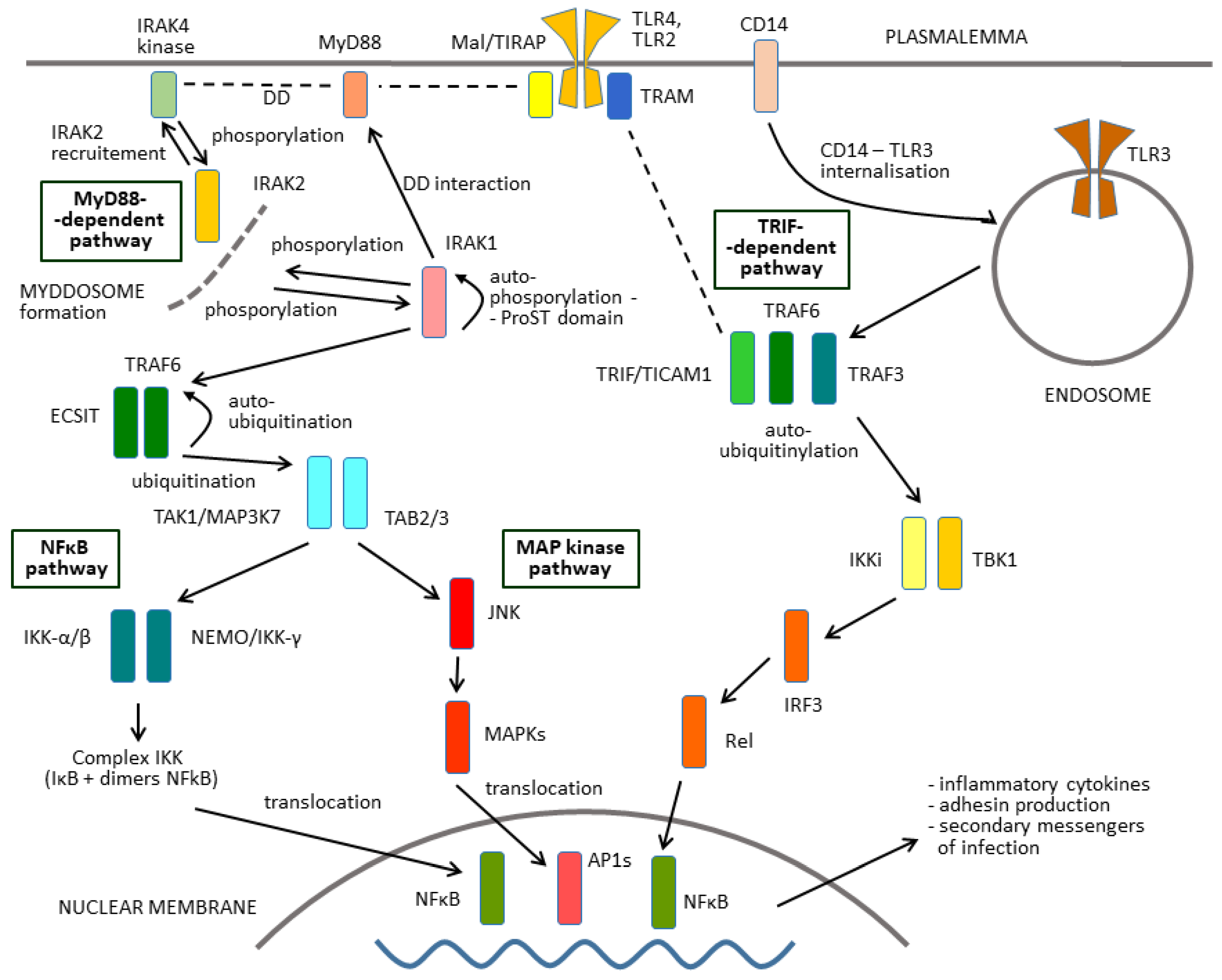
Infections in animal production industries can be reduced through targeted breeding of animals with genetically enhanced disease resistance. This type of breeding should be based on a thorough understanding of host defence and its underlying mechanisms. The genes controlling the components of the innate immune system represent a primary target. Their function is highly sensitive to any mutational changes in their structure, which has been optimised through long-term evolution. A source of variability is provided by the polymorphism in the genes encoding components of the Toll signalling pathway as one of the main subsystems of innate immunity. The associated set of genes comprises the group of TLR genes encoding the so-called Toll-like receptors (TLRs), as well as genes encoding other key components of the Toll signalling pathway. Specific attention is paid to the genes encoding the crucial interactors of Toll-like receptors, namely the adaptor MyD88 and other adaptors containing the TIR region. Due to the extremely high evolutionary conservation of this region, any structural variation is expected to have functional consequences on the organismal level. The study of the TLR adaptor MyD88, as well as other related adaptors, has been underestimated in farm animal species, as evidenced by the limited number of research outputs. However, this contrasts with the numerous published functional associations for these genes in human medicine. Such a disparity suggests that further research in this direction in farm animal species may yield novel and important findings in the future.
Keywords: cattle; health traits; immunogenetics; NGS; bioinformatics; genotyping; SNP; functional prediction cattle; health traits; immunogenetics; NGS; bioinformatics; genotyping; SNP; functional prediction