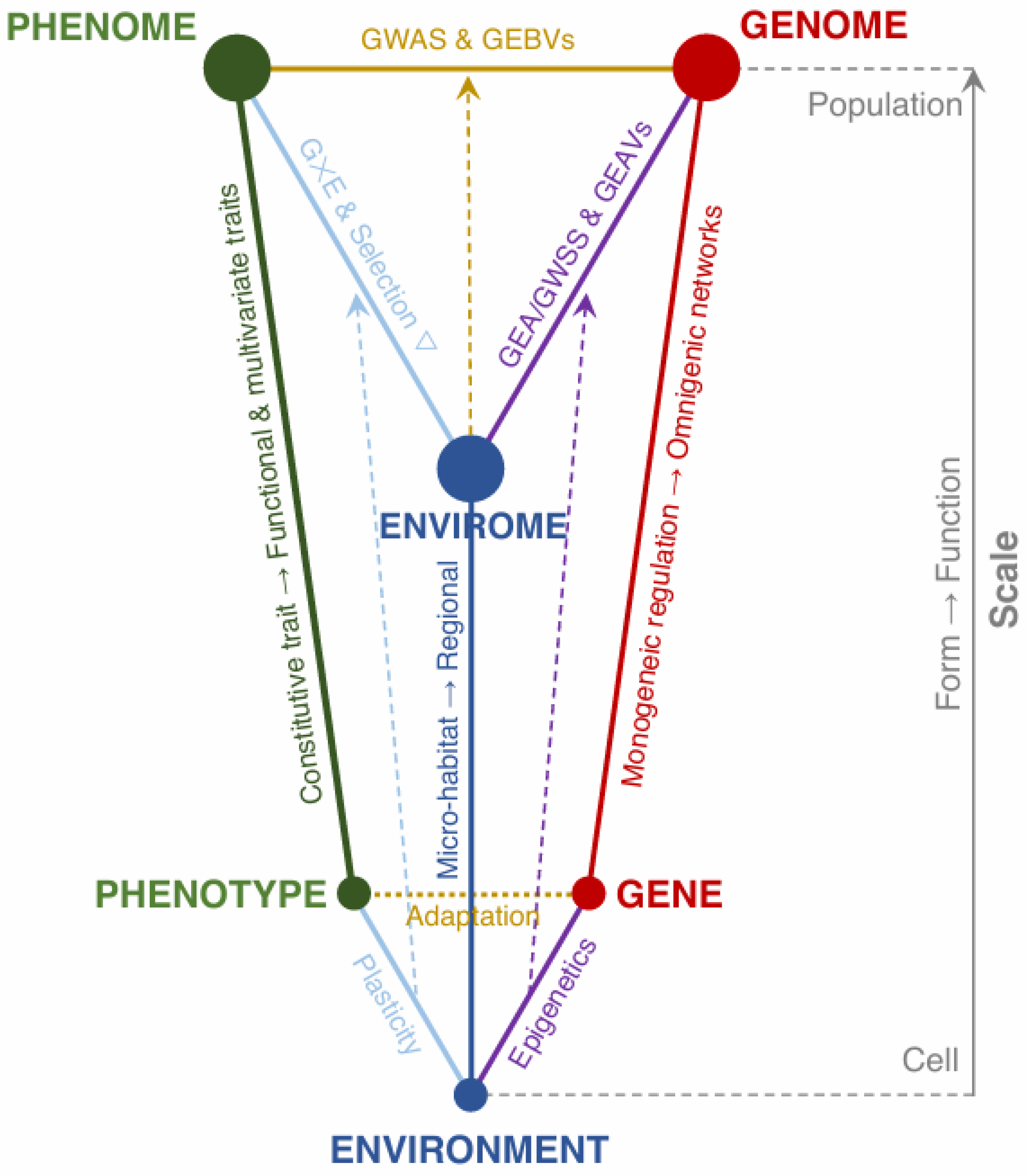
Leveraging Genetic Diversity for Abiotic Stress Tolerance


1. Molecular and Transcriptomic Bases of Abiotic Stress Responses
2. Transitioning from Functional Bases to Targeted Gene Editing
3. Plastic and Adaptive Responses for Climate-Resilient Breeding
4. Leveraging Abiotic Stress Tolerance in Natural Populations
5. Perspectives
6. Conclusions
Funding
Institutional Review Board Statement
Informed Consent Statement
Data Availability Statement
Acknowledgments
Conflicts of Interest
References
- Hultgren, A.; Carleton, T.; Delgado, M.; Gergel, D.R.; Greenstone, M.; Houser, T.; Hsiang, S.; Jina, A.; Kopp, R.E.; Malevich, S.B.; et al. Impacts of climate change on global agriculture accounting for adaptation. Nature 2025, 642, 644–652. [Google Scholar] [CrossRef]
- Merchuk-Ovnat, L.; Silberman, R.; Laiba, E.; Maurer, A.; Pillen, K.; Faigenboim, A.; Fridman, E. Genome scan identifies flowering-independent effects of barley HsDry2.2 locus on yield traits under water deficit. J. Exp. Bot. 2018, 69, 1765–1779. [Google Scholar] [CrossRef] [PubMed]
- Leon-Garcia, I.V.; Lasso, E. High heat tolerance in plants from the Andean highlands: Implications for paramos in a warmer world. PLoS ONE 2019, 14, e0224218. [Google Scholar] [CrossRef]
- Gottfried, M.; Pauli, H.; Futschik, A.; Akhalkatsi, M.; Barančok, P.; Benito Alonso, J.L.; Coldea, G.; Dick, J.; Erschbamer, B.; Fernández Calzado, M.a.R.; et al. Continent-wide response of mountain vegetation to climate change. Nat. Clim. Change 2012, 2, 111–115. [Google Scholar] [CrossRef]
- Rumpf, S.B.; Hulber, K.; Klonner, G.; Moser, D.; Schutz, M.; Wessely, J.; Willner, W.; Zimmermann, N.E.; Dullinger, S. Range dynamics of mountain plants decrease with elevation. Proc. Natl. Acad. Sci. USA 2018, 115, 1848–1853. [Google Scholar] [CrossRef]
- Fragata, I.; Lopes-Cunha, M.; Barbaro, M.; Kellen, B.; Lima, M.; Santos, M.A.; Faria, G.S.; Santos, M.; Matos, M.; Simoes, P. How much can history constrain adaptive evolution? A real-time evolutionary approach of inversion polymorphisms in Drosophila subobscura. J. Evol. Biol. 2014, 27, 2727–2738. [Google Scholar] [CrossRef]
- Chala, D.; Brochmann, C.; Psomas, A.; Ehrich, D.; Gizaw, A.; Masao, C.A.; Bakkestuen, V.; Zimmermann, N.E. Good-bye to tropical alpine plant giants under warmer climates? Loss of range and genetic diversity in Lobelia rhynchopetalum. Ecol. Evol. 2016, 6, 8931–8941. [Google Scholar] [CrossRef]
- Valladares, F.; Matesanz, S.; Guilhaumon, F.; Araujo, M.B.; Balaguer, L.; Benito-Garzon, M.; Cornwell, W.; Gianoli, E.; van Kleunen, M.; Naya, D.E.; et al. The effects of phenotypic plasticity and local adaptation on forecasts of species range shifts under climate change. Ecol. Lett. 2014, 17, 1351–1364. [Google Scholar] [CrossRef]
- Gutaker, R.M.; Purugganan, M.D. Adaptation and the Geographic Spread of Crop Species. Annu. Rev. Plant Biol. 2023, 75, 679–706. [Google Scholar] [CrossRef]
- Varshney, R.K.; Barmukh, R.; Roorkiwal, M.; Qi, Y.; Kholova, J.; Tuberosa, R.; Reynolds, M.P.; Tardieu, F.; Siddique, K.H.M. Breeding custom-designed crops for improved drought adaptation. Adv. Genet. 2021, 2, e202100017. [Google Scholar] [CrossRef]
- Migicovsky, Z. Genomic resources for crop wild relatives are critical for perennial fruit breeding and conservation. Am. J. Bot. 2025, 112, e70068. [Google Scholar] [CrossRef]
- Gomez-Fernandez, A. Reconstructing the evolutionary history of herbaceous crops through trait-based ecology. Am. J. Bot. 2025, 112, e70107. [Google Scholar] [CrossRef]
- Branch, H.A. The sleeping giant needs coffee: Overlooked areas for integrating plant ecophysiology and evolutionary biology. Am. J. Bot. 2026, 113, e70164. [Google Scholar] [CrossRef] [PubMed]
- Cortinovis, G.; Di Vittori, V.; Bellucci, E.; Bitocchi, E.; Papa, R. Adaptation to novel environments during crop diversification. Curr. Opin. Plant Biol. 2020, 56, 203–217. [Google Scholar] [CrossRef]
- Kristensen, T.N.; Ketola, T.; Kronholm, I. Adaptation to environmental stress at different timescales. Ann. N. Y. Acad. Sci. 2018, 1476, 5–22. [Google Scholar] [CrossRef]
- Cortés, A.J. Abiotic Stress Tolerance Boosted by Genetic Diversity in Plants. Int. J. Mol. Sci. 2024, 25, 5367. [Google Scholar] [CrossRef]
- Razgour, O.; Forester, B.; Taggart, J.B.; Bekaert, M.; Juste, J.; Ibanez, C.; Puechmaille, S.J.; Novella-Fernandez, R.; Alberdi, A.; Manel, S. Considering adaptive genetic variation in climate change vulnerability assessment reduces species range loss projections. Proc. Natl. Acad. Sci. USA 2019, 116, 10418–10423. [Google Scholar] [CrossRef]
- Ibáñez, I.; Primack, R.B.; Miller-Rushing, A.J.; Ellwood, E.; Higuchi, H.; Lee, S.D.; Kobori, H.; Silander, J.A. Forecasting phenology under global warming. Philos. Trans. R. Soc. B Biol. Sci. 2010, 365, 3247–3260. [Google Scholar]
- Cotto, O.; Wessely, J.; Georges, D.; Klonner, G.; Schmid, M.; Dullinger, S.; Thuiller, W.; Guillaume, F. A dynamic eco-evolutionary model predicts slow response of alpine plants to climate warming. Nat. Commun. 2017, 8, 15399. [Google Scholar] [CrossRef] [PubMed]
- Jay, F.; Manel, S.; Alvarez, N.; Durand, E.Y.; Thuiller, W.; Holderegger, R.; Taberlet, P.; François, O. Forecasting changes in population genetic structure of alpine plants in response to global warming. Mol. Ecol. 2012, 21, 2354–2368. [Google Scholar] [CrossRef] [PubMed]
- Botkin, D.B.; Saxe, H.; Araújo, M.B.; Betts, R.; Bradshaw, R.H.W.; Cedhagen, T.; Chesson, P.; Dawson, T.P.; Etterson, J.R.; Faith, D.P.; et al. Forecasting the Effects of Global Warming on Biodiversity. BioScience 2007, 57, 227–236. [Google Scholar] [CrossRef]
- Cortés, A.J.; López-Hernández, F.; Blair, M.W. Crop Modeling for Future Climate Change Adaptation. In Digital Agriculture: A Solution for Sustainable Food and Nutritional Security; Priyadarshan, P.M., Jain, S.M., Suprasanna, P., Al-Khayri, J.M., Eds.; Springer International Publishing: Cham, Switzerland, 2024; pp. 625–639. [Google Scholar]
- Barghi, N.; Hermisson, J.; Schlötterer, C. Polygenic adaptation: A unifying framework to understand positive selection. Nat. Rev. Genet. 2020, 21, 769–781. [Google Scholar] [CrossRef]
- Peng, B.; Guan, K.; Tang, J.; Ainsworth, E.A.; Asseng, S.; Bernacchi, C.J.; Cooper, M.; Delucia, E.H.; Elliott, J.W.; Ewert, F.; et al. Towards a multiscale crop modelling framework for climate change adaptation assessment. Nat. Plants 2020, 6, 338–348. [Google Scholar] [CrossRef]
- Benitez-Alfonso, Y.; Soanes, B.K.; Zimba, S.; Sinanaj, B.; German, L.; Sharma, V.; Bohra, A.; Kolesnikova, A.; Dunn, J.A.; Martin, A.C.; et al. Enhancing climate change resilience in agricultural crops. Curr. Biol. 2023, 33, R1246–R1261. [Google Scholar] [CrossRef] [PubMed]
- Cortés, A.J.; Cornille, A.; Yockteng, R. Evolutionary Genetics of Crop-Wild Complexes. Genes 2022, 13, 1. [Google Scholar] [CrossRef]
- Weigel, D.; Nordborg, M. Population Genomics for Understanding Adaptation in Wild Plant Species. Annu. Rev. Genet. 2015, 49, 315–338. [Google Scholar] [CrossRef] [PubMed]
- Castaneda-Alvarez, N.P.; Khoury, C.K.; Achicanoy, H.A.; Bernau, V.; Dempewolf, H.; Eastwood, R.J.; Guarino, L.; Harker, R.H.; Jarvis, A.; Maxted, N.; et al. Global conservation priorities for crop wild relatives. Nat. Plants 2016, 2, 16022. [Google Scholar] [CrossRef]
- Cortés, A.J.; Barnaby, J.Y. Editorial: Harnessing genebanks: High-throughput phenotyping and genotyping of crop wild relatives and landraces. Front. Plant Sci. 2023, 14, 1149469. [Google Scholar] [CrossRef] [PubMed]
- Parmesan, C.; Hanley, M.E. Plants and climate change: Complexities and surprises. Ann. Bot. 2015, 116, 849–864. [Google Scholar] [CrossRef]
- Alsos, I.G.; Ehrich, D.; Thuiller, W.; Eidesen, P.B.; Tribsch, A.; Schönswetter, P.; Lagaye, C.; Taberlet, P.; Brochmann, C. Genetic consequences of climate change for northern plants. Proc. R. Soc. B Biol. Sci. 2012, 279, 2042–2051. [Google Scholar] [CrossRef] [PubMed]
- Jump, A.S.; Penuelas, J. Running to stand still: Adaptation and the response of plants to rapid climate change. Ecol. Lett. 2005, 8, 1010–1020. [Google Scholar] [CrossRef] [PubMed]
- Wang, Q.; Wu, J.; Di, G.; Zhao, Q.; Gao, C.; Zhang, D.; Wang, J.; Shen, Z.; Han, W. Identification of Cold Tolerance Transcriptional Regulatory Genes in Seedlings of Medicago sativa L. and Medicago falcata L. Int. J. Mol. Sci. 2024, 25, 10345. [Google Scholar] [CrossRef]
- Mizoia, J.; Shinozakib, K.; Yamaguchi-Shinozaki, K. AP2/ERF family transcription factors in plant abiotic stress responses. Biochim. Et Biophys. Acta 2012, 1819, 86–96. [Google Scholar] [CrossRef] [PubMed]
- Yang, C.-Y.; Hsu, F.-C.; Li, J.-P.; Wang, N.-N.; Shih, M.-C. The AP2/ERF transcription factor AtERF73/HRE1 modulates ethylene responses during hypoxia in Arabidopsis. Plant Physiol. 2011, 156, 202–212. [Google Scholar] [CrossRef]
- Qi, W.; Sun, F.; Wang, Q.; Chen, M.; Huang, Y.; Feng, Y.; Luo, X.; Yang, J. Rice ethylene-response AP2/ERF factor OsEATB restricts internode elongation by down-regulating a gibberellin biosynthetic gene. Plant Physiol. 2011, 157, 216–228. [Google Scholar] [CrossRef]
- Yu, Z.X.; Li, J.X.; Yang, C.Q.; Hu, W.L.; Wang, L.J.; Chen, X.Y. The Jasmonate-Responsive AP2/ERF Transcription Factors AaERF1 and AaERF2 Positively Regulate Artemisinin Biosynthesis in Artemisia annua L. Mol. Plant 2011, 5, 353–365. [Google Scholar] [CrossRef] [PubMed]
- Zhuang, J.; Xiong, A.S.; Peng, R.H.; Gao, F.; Zhu, B.; Zhang, J.A.; Fu, X.Y.; Jin, X.F.; Chen, J.M.; Zhang, Z.; et al. Analysis of Brassica rapa ESTs: Gene discovery and expression patterns of AP2/ERF family genes. Mol. Biol. Rep. 2010, 37, 2485–2492. [Google Scholar] [CrossRef]
- Licausi, F.; Giorgi, F.M.; Zenoni, S.; Osti, F.; Pezzotti, M.; Perata, P. Genomic and transcriptomic analysis of the AP2/ERF superfamily in Vitis vinifera. BMC Genom. 2010, 11, 719. [Google Scholar] [CrossRef]
- O’Rourke, J.A.; Graham, M.A. Investigating the Role of Known Arabidopsis Iron Genes in a Stress Resilient Soybean Line. Int. J. Mol. Sci. 2024, 25, 11480. [Google Scholar] [CrossRef]
- Khunsanit, P.; Plaimas, K.; Chadchawan, S.; Buaboocha, T. Profiling of Key Hub Genes Using a Two-State Weighted Gene Co-Expression Network of ‘Jao Khao’ Rice under Soil Salinity Stress Based on Time-Series Transcriptome Data. Int. J. Mol. Sci. 2024, 25, 11086. [Google Scholar] [CrossRef] [PubMed]
- Zhao, Y.; Chen, S.; Qin, M.; Shui, K.; Li, R.; Yang, B.; Liu, J.; Chen, Z. Genome-Wide Identification of FCS-Like Zinc Finger (FLZ) Family Genes in Three Brassica Plant Species and Functional Characterization of BolFLZs in Chinese Kale Under Abiotic Stresses. Int. J. Mol. Sci. 2024, 25, 12907. [Google Scholar] [CrossRef]
- López-Hernández, F.; Roda, F.; Cortés, A.J. Machine Learning and Pangenomics: Revolutionizing Plant Breeding for a Sustainable Future. In Plant Breeding 2050; Priyadarshan, P.M., Ortiz, R., Eds.; Springer: Singapore, 2025; pp. 509–523. [Google Scholar]
- Reichstein, M.; Bahn, M.; Mahecha, M.D.; Kattge, J.; Baldocchi, D.D. Linking plant and ecosystem functional biogeography. Proc. Natl. Acad. Sci. USA 2014, 111, 13697–13702. [Google Scholar] [CrossRef]
- Zhao, X.; Han, X.; Lu, X.; Yang, H.; Wang, Z.Y.; Chai, M. Genome-Wide Identification and Characterization of the Msr Gene Family in Alfalfa under Abiotic Stress. Int. J. Mol. Sci. 2023, 24, 9638. [Google Scholar] [CrossRef]
- Wang, H.; Yu, J.; Zhu, B.; Gu, L.; Wang, H.; Du, X.; Zeng, T.; Tang, H. The SbbHLH041-SbEXPA11 Module Enhances Cadmium Accumulation and Rescues Biomass by Increasing Photosynthetic Efficiency in Sorghum. Int. J. Mol. Sci. 2023, 24, 13061. [Google Scholar] [CrossRef]
- Huang, X.; Qiu, X.; Wang, Y.; Abubakar, A.S.; Chen, P.; Chen, J.; Chen, K.; Yu, C.; Wang, X.; Gao, G.; et al. Genome-Wide Investigation of the NAC Transcription Factor Family in Apocynum venetum Revealed Their Synergistic Roles in Abiotic Stress Response and Trehalose Metabolism. Int. J. Mol. Sci. 2023, 24, 4578. [Google Scholar] [CrossRef]
- López-Hernández, F.; Cortés, A.J. Transcriptomic Signatures of Somaclonal Variation. In Plant Transcriptomics and Epitranscriptomics; Springer: Singapore, 2026; pp. 135–153. [Google Scholar]
- Lembrechts, J.J.; Lenoir, J. Microclimatic conditions anywhere at any time! Glob. Change Biol. 2020, 26, 337–339. [Google Scholar] [CrossRef] [PubMed]
- Abdelaziz, M.; Anderson, J.T.; Rochford, M.E.; Bemmels, J.B.; Jameel, M.I.; Denney, D.A. Small spaces, big impacts: Contributions of micro-environmental variation to population persistence under climate change. AoB Plants 2020, 12, plaa005. [Google Scholar] [CrossRef]
- Du, H.; Liang, Z.; Cortés, A.J. Editorial: Evolution of crop genomes and epigenomes, volume II. Front. Plant Sci. 2025, 16, 1623554. [Google Scholar] [CrossRef]
- Cortés, A.J. Unlocking genebanks for climate adaptation. Nat. Clim. Change 2025, 15, 590–592. [Google Scholar] [CrossRef]
- Myburg, A.A.; Hussey, S.G.; Wang, J.P.; Street, N.R.; Mizrachi, E. Systems and Synthetic Biology of Forest Trees: A Bioengineering Paradigm for Woody Biomass Feedstocks. Front. Plant Sci. 2019, 10, 775. [Google Scholar] [CrossRef] [PubMed]
- Ma, Y.; Zhong, M.; Li, J.; Jiang, Y.; Zhou, X.; Justice Ijeoma, C.; Tang, X.; Chen, S.; Cao, S. Genome Identification and Evolutionary Analysis of LBD Genes and Response to Environmental Factors in Phoebe bournei. Int. J. Mol. Sci. 2023, 24, 12581. [Google Scholar] [CrossRef]
- Bohra, A.; Kilian, B.; Sivasankar, S.; Caccamo, M.; Mba, C.; McCouch, S.R.; Varshney, R.K. Reap the crop wild relatives for breeding future crops. Trends Biotechnol. 2021, 40, 412–431. [Google Scholar] [CrossRef]
- Imran, S.; Ono, S.; Horie, R.; Katsuhara, M.; Horie, T. Chloride-Transporting OsHKT1;1 Splice Variants and Their Expression Profiles Under Salinity Stress in Rice. Int. J. Mol. Sci. 2026, 27, 1178. [Google Scholar] [CrossRef]
- Fan, S.; Jia, L.; Wu, J.; Zhao, Y. Harnessing the Potential of CRISPR/Cas in Targeted Alfalfa Improvement for Stress Resilience. Int. J. Mol. Sci. 2025, 26, 3311. [Google Scholar] [CrossRef] [PubMed]
- Doudna, J.A.; Charpentier, E. Genome editing. The new frontier of genome engineering with CRISPR-Cas9. Science 2014, 346, 1258096. [Google Scholar] [CrossRef] [PubMed]
- Rodríguez-Leal, D.; Lemmon, Z.H.; Man, J.; Bartlett, M.E.; Lippman, Z.B. Engineering Quantitative Trait Variation for Crop Improvement by Genome Editing. Cell 2017, 171, 470–480.e478. [Google Scholar] [CrossRef] [PubMed]
- Barrero, L.S.; Willmann, M.R.; Craft, E.J.; Akther, K.M.; Harrington, S.E.; Garzon-Martinez, G.A.; Glahn, R.P.; Piñeros, M.A.; McCouch, S.R. Identifying genes associated with abiotic stress tolerance suitable for CRISPR/Cas9 editing in upland rice cultivars adapted to acid soils. Plant Direct 2022, 6, e469. [Google Scholar] [CrossRef]
- Li, R.; Liu, C.; Zhao, R.; Wang, L.; Chen, L.; Yu, W.; Zhang, S.; Sheng, J.; Shen, L. CRISPR/Cas9-Mediated SlNPR1 mutagenesis reduces tomato plant drought tolerance. BMC Plant Biol. 2019, 19, 38. [Google Scholar] [CrossRef]
- Wang, L.; Chen, L.; Li, R.; Zhao, R.; Yang, M.; Sheng, J.; Shen, L. Reduced Drought Tolerance by CRISPR/Cas9-Mediated SlMAPK3 Mutagenesis in Tomato Plants. J. Agric. Food Chem. 2017, 65, 8674–8682. [Google Scholar] [CrossRef]
- Robinson, J.M.; Hodgson, R.; Krauss, S.L.; Liddicoat, C.; Malik, A.A.; Martin, B.C.; Mohr, J.J.; Moreno-Mateos, D.; Munoz-Rojas, M.; Peddle, S.D.; et al. Opportunities and challenges for microbiomics in ecosystem restoration. Trends Ecol. Evol. 2023, 38, 1189–1202. [Google Scholar] [CrossRef]
- Park, D.S.; Willis, C.G.; Xi, Z.; Kartesz, J.T.; Davis, C.C.; Worthington, S. Machine Learning Predicts Large Scale Declines in Native Plant Phylogenetic Diversity. New Phytol. 2020, 227, 1544–1556. [Google Scholar] [CrossRef]
- Guo, H.; Nie, C.Y.; Li, Z.; Kang, J.; Wang, X.L.; Cui, Y.N. Physiological and Transcriptional Analyses Provide Insight into Maintaining Ion Homeostasis of Sweet Sorghum under Salt Stress. Int. J. Mol. Sci. 2023, 24, 11045. [Google Scholar] [CrossRef] [PubMed]
- Wirojsirasak, W.; Songsri, P.; Jongrungklang, N.; Tangphatsornruang, S.; Klomsa-Ard, P.; Ukoskit, K. A Large-Scale Candidate-Gene Association Mapping for Drought Tolerance and Agronomic Traits in Sugarcane. Int. J. Mol. Sci. 2023, 24, 12801. [Google Scholar] [CrossRef]
- Ravelombola, W.; Dong, L.; Barickman, T.C.; Xiong, H.; Manley, A.; Cason, J.; Pham, H.; Zia, B.; Mou, B.; Shi, A. Genetic Architecture of Salt Tolerance in Cowpea (Vigna unguiculata (L.) Walp.) at Seedling Stage Using a Whole Genome Resequencing Approach. Int. J. Mol. Sci. 2023, 24, 15281. [Google Scholar] [CrossRef]
- Brautigam, K.; Vining, K.J.; Lafon-Placette, C.; Fossdal, C.G.; Mirouze, M.; Marcos, J.G.; Fluch, S.; Fraga, M.F.; Guevara, M.A.; Abarca, D.; et al. Epigenetic regulation of adaptive responses of forest tree species to the environment. Ecol. Evol. 2013, 3, 399–415. [Google Scholar] [CrossRef]
- Parra-Londono, S.; López-Hernández, F.; Montoya, G.; Henao-Rojas, J.C.; Ossa-Ossa, G.A.; Cortés, A.J. Merging Phenotypic Stability Analysis and Genomic Prediction for Multi-Environment Breeding in Capsicum spp. Agronomy 2025, 15, 2690. [Google Scholar] [CrossRef]
- López-Hernández, F.; Burbano-Erazo, E.; León-Pacheco, R.I.; Cordero-Cordero, C.C.; Villanueva-Mejía, D.F.; Tofiño-Rivera, A.P.; Cortés, A.J. Multi-Environment Genome-Wide Association Studies of Yield Traits in Common Bean (Phaseolus vulgaris L.) × Tepary Bean (P. acutifolius A. Gray) Interspecific Advanced Lines in Humid and Dry Colombian Caribbean Subregions. Agronomy 2023, 13, 1396. [Google Scholar] [CrossRef]
- Arnold, P.A.; Kruuk, L.E.B.; Nicotra, A.B. How to analyse plant phenotypic plasticity in response to a changing climate. New Phytol. 2019, 222, 1235–1241. [Google Scholar] [CrossRef]
- Tognetti, R. Adaptation to climate change of dioecious plants: Does gender balance matter? Tree Physiol. 2012, 32, 1321–1324. [Google Scholar] [CrossRef][Green Version]
- Chuine, I. Why does phenology drive species distribution? Philos. Trans. R. Soc. Lond. B Biol. Sci. 2010, 365, 3149–3160. [Google Scholar] [CrossRef] [PubMed]
- Valladares, F.; Niinemets, U. Shade Tolerance, a Key Plant Feature of Complex Nature and Consequences. Annu. Rev. Ecol. Evol. Syst. 2008, 39, 237–257. [Google Scholar] [CrossRef]
- Franks, S.J.; Weis, A.E. A change in climate causes rapid evolution of multiple life-history traits and their interactions in an annual plant. J. Evol. Biol. 2008, 21, 1321–1334. [Google Scholar] [CrossRef]
- Bai, X.; Qiao, P.; Liu, H.; Shang, Y.; Guo, J.; Dai, K. Genome-wide identification of the E-class gene family in wheat: Evolution, expression, and interaction. Front. Plant Sci. 2024, 15, 1419437. [Google Scholar] [CrossRef]
- Jezkova, T.; Wiens, J.J. Rates of change in climatic niches in plant and animal populations are much slower than projected climate change. Proc. Biol. Sci. 2016, 283, 20162104. [Google Scholar] [CrossRef]
- Franks, S.J.; Weis, A.E. Climate change alters reproductive isolation and potential gene flow in an annual plant. Evol. Appl. 2009, 2, 481–488. [Google Scholar] [CrossRef]
- Bedoya-Londoño, S.; Cañas-Gutiérrez, G.P.; Cortés, A.J. Breeding Without Breeding: Enabling Indirect Selection Schemes for Tropical Tree Improvement. In Genomics Based Approaches for Tropical Tree Improvement and Conservation; Springer: Singapore, 2025; pp. 19–42. [Google Scholar]
- Arenas, S.; Cortés, A.J.; Jaramillo-Correa, J.P. Toward a Genomic-Enabled Selection in Natural Tree Populations for Long-Term Management and Conservation. In Genomics Based Approaches for Tropical Tree Improvement and Conservation; Springer: Singapore, 2025; pp. 243–278. [Google Scholar]
- Lachmuth, S.; Capblancq, T.; Keller, S.; Fitzpatrick, M. Assessing uncertainty in genomic offset forecasts from landscape genomic models (and implications for restoration and assisted migration). Front. Ecol. Evol. 2023, 11, 1155783. [Google Scholar] [CrossRef]
- López-Hernández, F.; Villanueva-Mejía, D.F.; Tofiño-Rivera, A.P.; Cortés, A.J. Genomic prediction of adaptation in common bean (Phaseolus vulgaris L.) × Tepary bean (P. acutifolius A. Gray) hybrids. Int. J. Mol. Sci. 2025, 26, 7370. [Google Scholar] [CrossRef]
- Arenas, S.; Djabali, Y.; Rincent, R.; Cubry, P.; Martin, M.L.; Blein-Nicolas, M.; Laplaze, L.; Schneider, H.; Grondin, A. Modeling plant phenotypic plasticity and its underlying genetic architecture: A comparative study. J. Exp. Bot. 2025, 76, 2239–2251. [Google Scholar] [CrossRef] [PubMed]
- Reyer, C.P.; Leuzinger, S.; Rammig, A.; Wolf, A.; Bartholomeus, R.P.; Bonfante, A.; de Lorenzi, F.; Dury, M.; Gloning, P.; Abou Jaoude, R.; et al. A plant’s perspective of extremes: Terrestrial plant responses to changing climatic variability. Glob. Change Biol. 2013, 19, 75–89. [Google Scholar] [CrossRef]
- Bedoya-Canas, L.E.; López-Hernández, F.; Cortés, A.J. Climate change adaptation of high-elevation Polylepis forests. Forests 2024, 15, 811. [Google Scholar] [CrossRef]
- Arenas, S.; Cortés, A.J. Unveiling the Genomic Architecture of Phenotypic Plasticity Using Multiple GWAS Approaches Under Contrasting Conditions of Water Availability: A Model for Barley. Int. J. Mol. Sci. 2026, 27, 652. [Google Scholar] [CrossRef]
- Campbell, Q.; Castañeda-Álvarez, N.; Domingo, R.; Bishop-von Wettberg, E.; Runck, B.; Nandkangré, H.; Halpin-McCormick, A.; Fumia, N.; Neyhart, J.; Kilian, B.; et al. Prioritizing parents from global genebanks to breed climate-resilient crops. Nat. Clim. Change 2025, 15, 673–681. [Google Scholar] [CrossRef]
- Yin, X.; Gao, Q.; Wang, F.; Liu, W.; Luo, Y.; Zhong, S.; Feng, J.; Bai, R.; Chen, L.; Dai, X.; et al. Marker-Assisted Selection of Jacalin-Related Lectin Genes OsJRL45 and OsJRL40 Derived from Sea Rice 86 Enhances Salt Tolerance in Rice. Int. J. Mol. Sci. 2024, 25, 10912. [Google Scholar] [CrossRef]
- McCouch, S. Diversifying Selection in Plant Breeding. PLoS Biol. 2004, 2, 1507–1512. [Google Scholar] [CrossRef] [PubMed]
- Lasky, J.R.; Josephs, E.B.; Morris, G.P. Genotype-environment associations to reveal the molecular basis of environmental adaptation. Plant Cell 2023, 35, 125–138. [Google Scholar] [CrossRef] [PubMed]
- López-Hernández, F.; Rosero-Alpala, M.G.; Rosero, A.; Cortés, A.J. Projected Shifts in Colombian Sweet Potato Germplasm Under Climate Change. Horticulturae 2025, 11, 1080. [Google Scholar] [CrossRef]
- Juma, I.; Valencia, J.B.; Cortés, A.J. Predicting Suitable Regions for Avocado (Persea americana Mill.) Tree Cultivation in Tanzania. Horticulturae 2025, 12, 24. [Google Scholar] [CrossRef]
- Cañas-Gutierrez, G.P.; López-Hernandez, F.; Cortés, A.J. Whole Genome Resequencing of 205 Avocado Trees Unveils the Genomic Patterns of Racial Divergence in the Americas. Int. J. Mol. Sci. 2025, 26, 10353. [Google Scholar] [CrossRef]
- Cortés, A.J.; Hussein, J.M.; Juma, I. Genomic Diversity of Avocado in the Morogoro Region and Southern Highlands of Tanzania. Int. J. Mol. Sci. 2026, 27, 3083. [Google Scholar] [CrossRef] [PubMed]
- Ramírez-Gil, J.G.; López-Hernandez, F.; Conejo-Rodriguez, D.F.; Henao-Rojas, J.C.; Quiroga-Benavides, K.E.; Cortés, A.J.; Chacón-Sanchez, M.I. GermVersity: A free and user-friendly interface to enhance the visualization and analysis of genebank data. PLoS ONE 2026, 21, e0340826. [Google Scholar] [CrossRef]
- Breed, M.F.; Harrison, P.A.; Blyth, C.; Byrne, M.; Gaget, V.; Gellie, N.J.C.; Groom, S.V.C.; Hodgson, R.; Mills, J.G.; Prowse, T.A.A.; et al. The potential of genomics for restoring ecosystems and biodiversity. Nat. Rev. Genet. 2019, 20, 615–628. [Google Scholar] [CrossRef] [PubMed]
- Aitken, S.N.; Yeaman, S.; Holliday, J.A.; Wang, T.; Curtis-McLane, S. Adaptation, migration or extirpation: Climate change outcomes for tree populations. Evol. Appl. 2008, 1, 95–111. [Google Scholar] [CrossRef] [PubMed]
- Aitken, S.N.; Whitlock, M.C. Assisted Gene Flow to Facilitate Local Adaptation to Climate Change. Annu. Rev. Ecol. Evol. Syst. 2013, 44, 367–388. [Google Scholar] [CrossRef]
- Aitken, S.N.; Bemmels, J.B. Time to get moving: Assisted gene flow of forest trees. Evol. Appl. 2016, 9, 271–290. [Google Scholar] [CrossRef]
- Li, H.; Sun, Z.; Li, W.; Yin, X.; Xu, X.; Zhang, X.; Yan, X.; Wang, X.; Li, Y.; Ma, A. Research on Cold Resistance of Kandelia obovata Transplanted to Zhoushan Area at the mRNA Level. Int. J. Mol. Sci. 2025, 27, 429. [Google Scholar] [CrossRef]
- Fick, A.; Swart, V.; Bombarely, A.; van den Berg, N. Comparative transcriptional analysis of Persea americana MYB, WRKY and AP2/ERF transcription factors following Phytophthora cinnamomi infection. Mol. Plant Pathol. 2024, 25, e13453. [Google Scholar] [CrossRef]
- Seo, P.J.; Lee, S.B.; Suh, M.C.; Park, M.-J.; Go, Y.S.; Park, C.-M. The MYB96 Transcription Factor Regulates Cuticular Wax Biosynthesis under Drought Conditions in Arabidopsis. Plant Cell Online 2011, 23, 1138–1152. [Google Scholar] [CrossRef]
- Galbiati, M.; Matus, J.; Francia, P.; Rusconi, F.; Cañón, P.; Medina, C.; Conti, L.; Cominelli, E.; Tonelli, C.; Arce-Johnson, P. The grapevine guard cell-related VvMYB60 transcription factor is involved in the regulation of stomatal activity and is differentially expressed in response to ABA and osmotic stress. BMC Plant Biol. 2011, 11, 142. [Google Scholar] [CrossRef] [PubMed]
- Mellway, R.D.; Tran, L.T.; Prouse, M.B.; Campbell, M.M.; Constabel, C.P. The Wound-, Pathogen-, and Ultraviolet B-Responsive MYB134 Gene Encodes an R2R3 MYB Transcription Factor That Regulates Proanthocyanidin Synthesis in Poplar. Plant Physiol. 2009, 150, 924–941. [Google Scholar] [CrossRef]
- Cortés, A.J. Omics Technologies in Molecular Biology. Int. J. Mol. Sci. 2026, 27, 3349. [Google Scholar] [CrossRef]
- Cortés, A.J.; Castillejo, M.Á.; Yockteng, R. ‘Omics’ Approaches for Crop Improvement. Agronomy 2023, 13, 1401. [Google Scholar] [CrossRef]
- Kholova, J.; Urban, M.O.; Bavorova, M.; Ceccarelli, S.; Cosmas, L.; Desczka, S.; Grando, S.; Lensink, R.; Nchanji, E.; Pavlik, J.; et al. Promoting new crop cultivars in low-income countries requires a transdisciplinary approach. Nat. Plants 2024, 10, 1610–1613. [Google Scholar] [CrossRef]
- McCouch, S.; Navabi, K.; Abberton, M.; Anglin, N.L.; Barbieri, R.L.; Baum, M.; Bett, K.; Booker, H.; Brown, G.L.; Bryan, G.J.; et al. Mobilizing crop biodiversity. Mol. Plant 2020, 13, 1341–1344. [Google Scholar] [CrossRef]
- Spindel, J.E.; McCouch, S.R. When more is better: How data sharing would accelerate genomic selection of crop plants. New Phytol. 2016, 212, 814–826. [Google Scholar] [CrossRef]
- Khaipho-Burch, M.; Cooper, M.; Crossa, J.; Leon, N.d.; Holland, J.; Lewis, R.; McCouch, S.; Murray, S.C.; Rabbi, I.; Ronald, P.; et al. Scale up trials to validate modified crops’ benefits. Nature 2023, 621, 470–473. [Google Scholar] [CrossRef] [PubMed]
- VanWallendael, A.; Lowry, D.B.; Hamilton, J.A. One hundred years into the study of ecotypes, new advances are being made through large-scale field experiments in perennial plant systems. Curr. Opin. Plant Biol. 2022, 66, 102152. [Google Scholar] [CrossRef] [PubMed]
- Barrett, R.D.H.; Hoekstra, H.E. Molecular spandrels: Tests of adaptation at the genetic level. Nat. Rev. Genet. 2011, 12, 767–780. [Google Scholar] [CrossRef]
- Manolio, T.A.; Collins, F.S.; Cox, N.J.; Goldstein, D.B.; Hindorff, L.A.; Hunter, D.J.; McCarthy, M.I.; Ramos, E.M.; Cardon, L.R.; Chakravarti, A.; et al. Finding the missing heritability of complex diseases. Nature 2009, 461, 747–753. [Google Scholar] [CrossRef]
- Maher, B. The case of the missing heritability. Nature 2008, 456, 18–21. [Google Scholar] [CrossRef]
- Boyle, E.A.; Li, Y.I.; Pritchard, J.K. An Expanded View of Complex Traits: From Polygenic to Omnigenic. Cell 2017, 169, 1177–1186. [Google Scholar] [CrossRef]
- Zavafer, A.; Bates, H.; Mancilla, C.; Ralph, P.J. Phenomics: Conceptualization and importance for plant physiology. Trends Plant Sci. 2023, 28, 1004–1013. [Google Scholar] [CrossRef] [PubMed]
- Feng, J.; Dan, X.; Cui, Y.; Gong, Y.; Peng, M.; Sang, Y.; Ingvarsson, P.K.; Wang, J. Integrating evolutionary genomics of forest trees to inform future tree breeding amid rapid climate change. Plant Commun. 2024, 5, 101044. [Google Scholar] [CrossRef] [PubMed]
- Jaramillo, C.; Rueda, M.J.; Mora, G. Cenozoic plant diversity in the neotropics. Science 2006, 311, 1893–1896. [Google Scholar] [CrossRef]
- Varshney, R.K. The Plant Genome special issue: Advances in genomic selection and application of machine learning in genomic prediction for crop improvement. Plant Genome 2021, 14, e20178. [Google Scholar] [CrossRef]
- Schrider, D.R.; Kern, A.D. Supervised Machine Learning for Population Genetics: A New Paradigm. Trends Genet. 2018, 34, 301–312. [Google Scholar] [CrossRef]
- Libbrecht, M.W.; Noble, W.S. Machine learning applications in genetics and genomics. Nat. Rev. Genet. 2015, 16, 321–332. [Google Scholar] [CrossRef]
- Ma, C.; Zhang, H.H.; Wang, X. Machine learning for Big Data analytics in plants. Trends Plant Sci. 2014, 19, 798–808. [Google Scholar] [CrossRef]
- Monyak, T.; Morris, G.P. Epistatic fitness landscapes emerge from parallel adaptive walks in breeding network metapopulations. bioRxiv 2026. [Google Scholar] [CrossRef]
- Peláez, D.; Aguilar, P.A.; Mercado, M.; López-Hernández, F.; Guzmán, M.; Burbano-Erazo, E.; Denning-James, K.; Medina, C.I.; Blair, M.W.; De Vega, J.J.; et al. Genotype selection, and seed uniformity and multiplication to ensure common bean (Phaseolus vulgaris L.) var. Liborino. Agronomy 2022, 12, 2285. [Google Scholar] [CrossRef]
- Lemmon, Z.H.; Reem, N.T.; Dalrymple, J.; Soyk, S.; Swartwood, K.E.; Rodriguez-Leal, D.; Eck, J.V.; Lippman, Z.B. Rapid improvement of domestication traits in an orphan crop by genome editing. Nat. Plants 2018, 4, 766–770. [Google Scholar] [CrossRef]
- Laitinen, R.A.E. Importance of phenotypic plasticity in crop resilience. J. Exp. Bot. 2024, 75, 670–673. [Google Scholar] [CrossRef]
- Callister, A.N.; Costa-Neto, G.; Bradshaw, B.P.; Elms, S.; Crossa, J.; Brawner, J.T. Enviromic prediction enables the characterization and mapping of Eucalyptus globulus Labill breeding zones. Tree Genet. Genomes 2024, 20, 3. [Google Scholar] [CrossRef]
- Heinemann, A.B.; Costa-Neto, G.; Fritsche-Neto, R.; da Matta, D.H.; Fernandes, I.K. Enviromic prediction is useful to define the limits of climate adaptation: A case study of common bean in Brazil. Field Crops Res. 2022, 286, 108628. [Google Scholar] [CrossRef]
- Resende, R.T.; Piepho, H.P.; Rosa, G.J.M.; Silva-Junior, O.B.; Silva, F.F.e.; Resende, M.D.V.d.; Grattapaglia, D. Enviromics in breeding: Applications and perspectives on envirotypic-assisted selection. Theor. Appl. Genet. 2021, 134, 95–112. [Google Scholar] [CrossRef] [PubMed]
- Costa-Neto, G.; Fritsche-Neto, R. Enviromics: Bridging different sources of data, building one framework. Crop Breed. Appl. Biotechnol. 2021, 21, e393521S393512. [Google Scholar] [CrossRef]
- Crossa, J.; Fritsche-Neto, R.; Montesinos-Lopez, O.A.; Costa-Neto, G.; Dreisigacker, S.; Montesinos-Lopez, A.; Bentley, A.R. The Modern Plant Breeding Triangle: Optimizing the Use of Genomics, Phenomics, and Enviromics Data. Front. Plant Sci. 2021, 12, 651480. [Google Scholar] [CrossRef]
- Cooper, M.; Messina, C.D. Can We Harness “Enviromics” to Accelerate Crop Improvement by Integrating Breeding and Agronomy? Front. Plant Sci. 2021, 12, 735143. [Google Scholar] [CrossRef]
- Costa-Neto, G.; Crossa, J.; Fritsche-Neto, R. Enviromic assembly increases accuracy and reduces costs of the genomic prediction for yield plasticity. bioRxiv 2021. [Google Scholar] [CrossRef]
- Costa-Neto, G.; Crossa, J.; Fritsche-Neto, R. Enviromic Assembly Increases Accuracy and Reduces Costs of the Genomic Prediction for Yield Plasticity in Maize. Front. Plant Sci. 2021, 12, 717552. [Google Scholar] [CrossRef]
- Costa-Neto, G.; Galli, G.; Carvalho, H.F.; Crossa, J.; Fritsche-Neto, R.; de Koning, D.J. EnvRtype: A software to interplay enviromics and quantitative genomics in agriculture. G3 2021, 11, jkab040. [Google Scholar] [CrossRef] [PubMed]
- Costa-Neto, G.; Fritsche-Neto, R.; Crossa, J. Nonlinear kernels, dominance, and envirotyping data increase the accuracy of genome-based prediction in multi-environment trials. Heredity 2020, 126, 92–106. [Google Scholar] [CrossRef] [PubMed]


| Species Group | Study Goal | Sampling | Omics Technologies | Key Findings | Reference |
|---|---|---|---|---|---|
| Cultivated alfalfa (Medicago sativa) & its wild relative (Medicago falcata) | Assess cold tolerance mechanisms in cultivated and wild seedlings | Expression screening 24 h and 120 h after low-temperature (4 °C) | RNA-seq | Wild M. falcata has broader transcriptional response with more DEGs | Wong et al. [33] |
| Soybean (Glycine max) | Validate three iron deficiency response genes (i.e., FIT, HY5 and PYE) | Iron-deficit-tolerant Swedish line Fiskeby III (PI 438471) | Virus-induced gene silencing and RNA-seq | Silencing FIT and HY5 does not compromise iron deficiency tolerance | O’Rourke and Graham [40] |
| Rice (Oryza sativa) | Dissect the molecular bases of salinity tolerance in rice | Salt-tolerant Thai variety ‘Jao Khao’ | RNA-seq libraries sampled across six time points (0–48 h) | A total of 1950 variable and 111 hub genes linked with the salt tolerance | Khunsanit et al. [41] |
| Chinese kale (Brassica oleracea L. var. alboglabra) | Characterize abiotic stress response of FCS-like zinc finger (FLZ) genes | Chinese kale (B. oleracea), cabbage (B. rapa) and black mustard (B. nigra) | Phylogenomic, expression analyses, and protein–protein assays | FLZ proteins interact with central energy-sensing kinases (SnRK1) | Zhao et al. [42] |
| Rice (Oryza sativa) | Study variation in the sodium transporter OsHKT1;1 for salt tolerance | Two splicing variants across three heterologous systems | Subcellular localization and expression analyses | Splicing variants differ in ion selectivity and transport efficiency | Imran et al. [56] |
| Alfalfa (Medicago sativa) | Review CRISPR/Cas in alfalfa for abiotic stress tolerance | Literature review | Genomics and transcriptomics | Systems-level genome editing benefits abiotic stress tolerance | Fan et al. [57] |
| Barley (Hordeum vulgare) | Reconstruct the genomic bases of plasticity to drought stress | Genotypes (1277) evaluated under well-watered vs. drought conditions | Five plasticity indices and four genome-wide association study (GWAS) | Drought stress plasticity is genetically and environment-dependent | Arenas and Cortés [86] |
| Rice (Oryza sativa) | Validate two genes (OsJRL45 and OsJRL40) for salt stress tolerance | Salt stress-adapted “Sea Rice 86” and recombinant inbred lines (RILs) | RT-qPCR, yeast two-hybrid and bimolecular fluorescence | Marker-assisted introgression in RILs enhances salt tolerance | Yin et al. [88] |
| Mangrove (Kandelia obovata) | Examine cold tolerance in a cold-sensitive mangrove species | Cold-sensitive population transplanted to higher-latitude climates | RNA-seq | Genetic and post-transcriptional mechanisms underlie cold adaptation | Li et al. [100] |
Disclaimer/Publisher’s Note: The statements, opinions and data contained in all publications are solely those of the individual author(s) and contributor(s) and not of MDPI and/or the editor(s). MDPI and/or the editor(s) disclaim responsibility for any injury to people or property resulting from any ideas, methods, instructions or products referred to in the content. |
© 2026 by the author. Licensee MDPI, Basel, Switzerland. This article is an open access article distributed under the terms and conditions of the Creative Commons Attribution (CC BY) license.
Share and Cite
Cortés, A.J. Leveraging Genetic Diversity for Abiotic Stress Tolerance. Int. J. Mol. Sci. 2026, 27, 4258. https://doi.org/10.3390/ijms27104258
Cortés AJ. Leveraging Genetic Diversity for Abiotic Stress Tolerance. International Journal of Molecular Sciences. 2026; 27(10):4258. https://doi.org/10.3390/ijms27104258
Chicago/Turabian StyleCortés, Andrés J. 2026. "Leveraging Genetic Diversity for Abiotic Stress Tolerance" International Journal of Molecular Sciences 27, no. 10: 4258. https://doi.org/10.3390/ijms27104258
APA StyleCortés, A. J. (2026). Leveraging Genetic Diversity for Abiotic Stress Tolerance. International Journal of Molecular Sciences, 27(10), 4258. https://doi.org/10.3390/ijms27104258