Phenylalanine Ammonia-Lyase as a Key Enzyme in Tea Plant Resistance to Herbivory

 and
and
Abstract
1. Introduction
2. Results
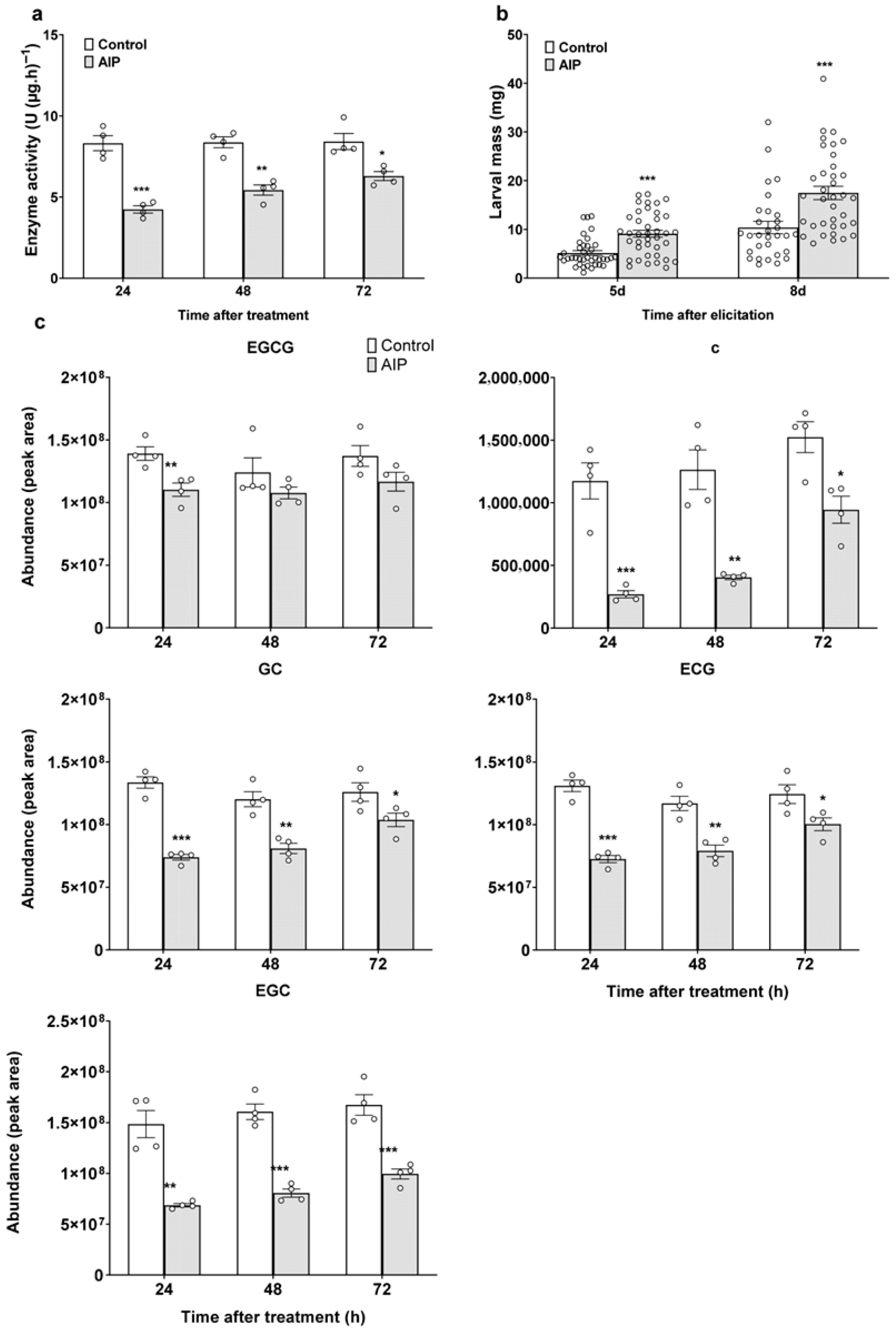
2.1. PAL Enhances Tea Plant Resistance to E. grisescens by Regulating Catechins Accumulation
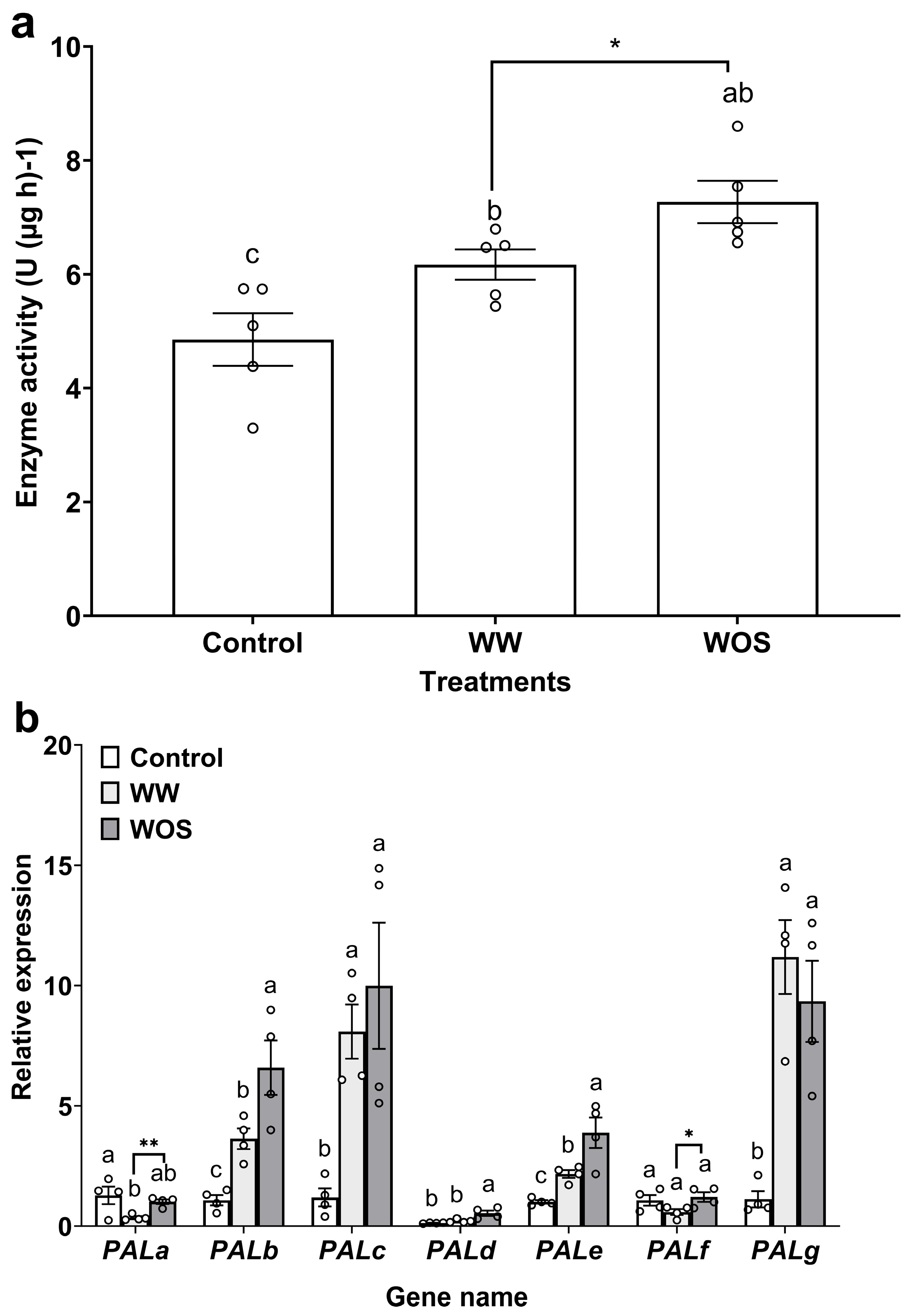
2.2. CsPALb and CsPALd Are Key Candidates in Tea Plant Resistance to E. grisescens
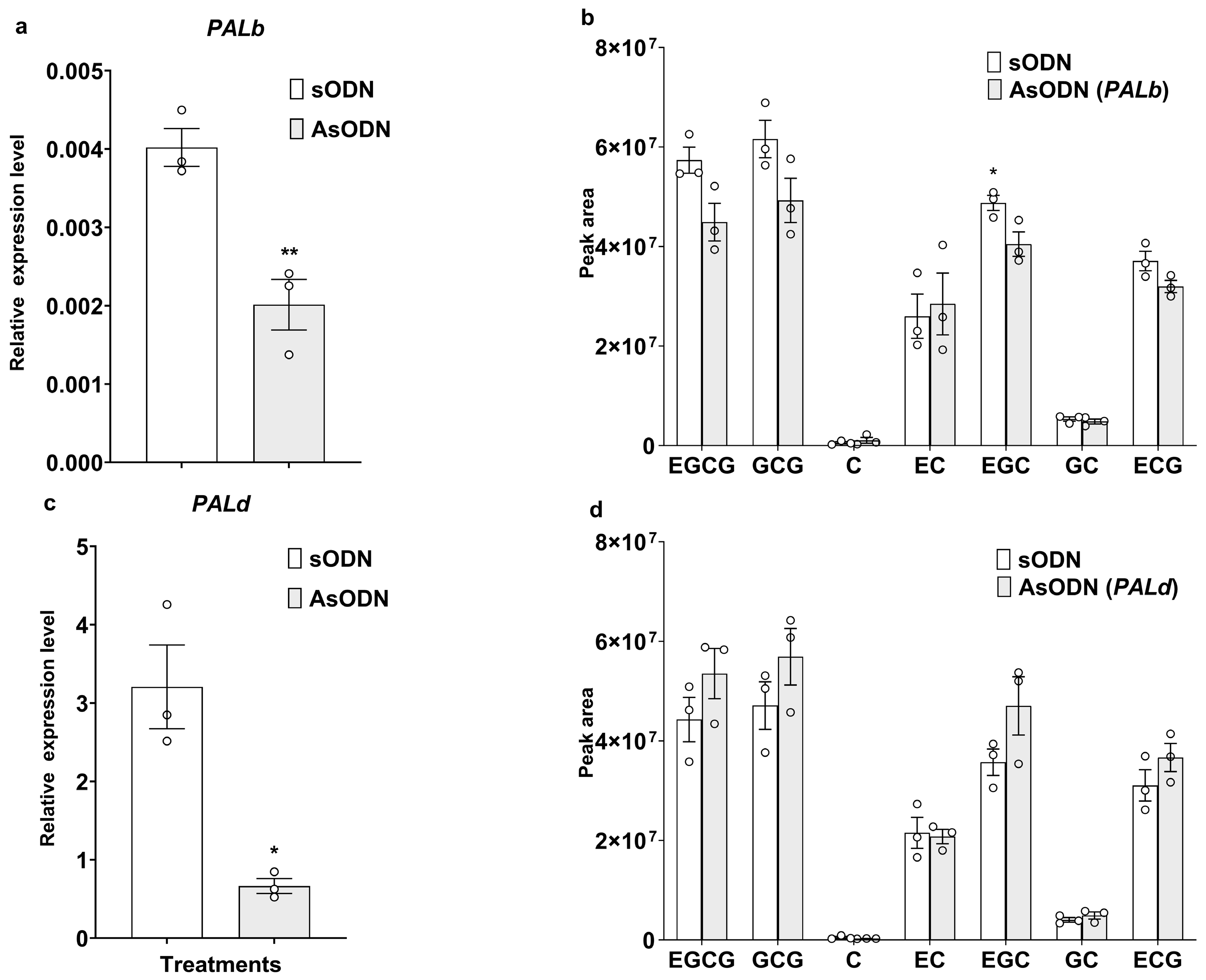
2.3. Differential Effects of CsPALb and CsPALd Silencing on Catechins Metabolism
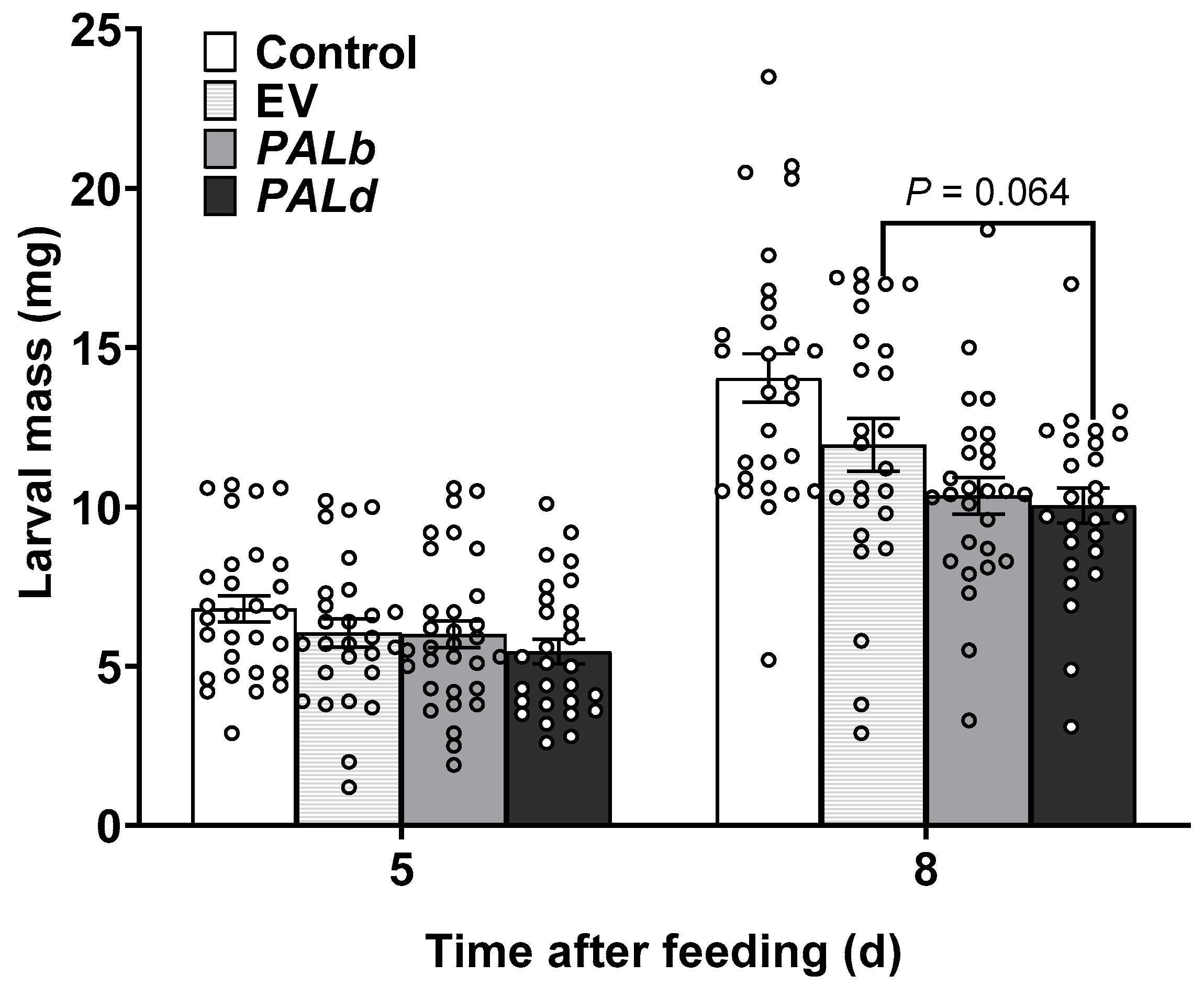
2.4. CsPALb and CsPALd Overexpression Enhances Tobacco Resistance to Spodoptera Litura
3. Discussion
4. Materials and Methods
4.1. Plants and Insects
4.2. Herbivore Performance Bioassays
4.3. Plants Treatment
4.4. Measurement of Phenylalanine Ammonia-Lyase Activity
4.5. Catechins Analysis
4.6. RNA Extraction and Quantitative Real-Time PCR Analysis
4.7. AsODN-Mediated Knockdown of CsPALb/d Expression in Camellia sinensis
4.8. Construction of CsPALb/d-GFP and Transient Expression in N. tabacum
4.9. Statistical Analysis
Supplementary Materials
Author Contributions
Funding
Institutional Review Board Statement
Informed Consent Statement
Data Availability Statement
Conflicts of Interest
References
- Scott, A.; Stephenson, J.; Chaloner, W.G. Interaction and Coevolution of Plants and Arthropods during the Palaeozoic and Mesozoic. Philos. Trans. R. Soc. B 1992, 335, 129–165. [Google Scholar] [CrossRef] [Scilit]
- Liu, Y.; Shi, J.; Patra, B.; Singh, S.; Wu, X.; Lyu, R.; Liu, X.; Li, Y.; Wang, Y.; Zhou, X. Transcriptional Reprogramming Deploys a Compartmentalized ‘Timebomb’ to Fend Off Chewing Herbivores. Plant Cell Environ. 2025, 48, 3236–3256. [Google Scholar] [CrossRef] [Scilit]
- Shoji, T.; Umemoto, N.; Saito, K. Genetic Divergence in Transcriptional Regulators of Defense Metabolism: Insight into Plant Domestication and Improvement. Plant Mol. Biol. 2022, 109, 401–411. [Google Scholar] [CrossRef] [Scilit]
- Jeong, H.J.; Nam, B.E.; Jeong, S.J.; Lee, G.; Kim, S.G.; Kim, J.G. Primary Metabolic Response of Aristolochia contorta to Simulated Specialist Herbivory under Elevated CO2 Conditions. Plants 2024, 13, 1456. [Google Scholar] [CrossRef] [Scilit]
- Chakraborty, S.; Mahapatra, S.; Hooi, A.; Tejabhushan, B.; Alam, S.H.; Kashyap, P.L. Unveiling the Role of Phenol and Defense Related Enzymes in Host Resistance to Spot Blotch × Wheat Pathosystem. Cereal Res. Commun. 2025, 53, 2401–2417. [Google Scholar] [CrossRef] [Scilit]
- Li, X.; Zhang, J.; Lin, S.; Xing, Y.; Zhang, X.; Ye, M.; Chang, Y.; Guo, H.; Sun, X. (+)-Catechin, Epicatechin and Epigallocatechin Gallate are Important Inducible Defensive Compounds against Ectropis grisescens in Tea Plants. Plant Cell Environ. 2021, 45, 496–511. [Google Scholar] [CrossRef] [Scilit]
- Rabeh, K.; Hnini, M.; Oubohssaine, M. A Comprehensive Review of Transcription Factor-Mediated Regulation of Secondary Metabolites in Plants under Environmental Stress. Stress Biol. 2025, 5, 15. [Google Scholar] [CrossRef] [Scilit]
- Yang, Z.; Duan, X.; Jin, S.; Li, X.; Chen, Z.; Ren, B.; Sun, X. Regurgitant Derived from the Tea Geometrid Ectropis obliqua Suppresses Wound-Induced Polyphenol Oxidases Activity in Tea Plants. J. Chem. Ecol. 2013, 39, 744–751. [Google Scholar] [CrossRef] [Scilit] [PubMed]
- Ye, M.; Liu, M.; Erb, M.; Glauser, G.; Zhang, J.; Li, X.; Sun, X. Indole Primes Defence Signalling and Increases Herbivore Resistance in Tea Plants. Plant Cell Environ. 2021, 44, 1165–1177. [Google Scholar] [CrossRef] [Scilit]
- Tyagi, S.; Shah, A.N.S.M.; Karthik, K.; Rathinam, M.; Rai, V.; Chaudhary, N.; Sreevathsa, R. Reactive Oxygen Species in Plants: An Invincible Fulcrum for Biotic Stress Mitigation. Appl. Microbiol. Biotechnol. 2022, 106, 5945–5955. [Google Scholar] [CrossRef] [Scilit]
- Luo, M.; Li, B.; Jander, G.; Zhou, S.Q. Non-Volatile Metabolites Mediate Plant Interactions with Insect Herbivores. Plant J. 2023, 114, 1164–1177. [Google Scholar] [CrossRef] [Scilit]
- Lavhale, S.G.; Kalunke, R.M.; Giri, A.P. Structural, Functional and Evolutionary Diversity of 4-Coumarate-CoA Ligase in Plants. Planta 2018, 248, 1063–1078. [Google Scholar] [CrossRef] [Scilit]
- Perkowski, M.C.; Warpeha, K.M. Phenylalanine Roles in the Seed-to-Seedling Stage: Not Just an Amino Acid. Plant Sci. 2019, 289, 110223. [Google Scholar] [CrossRef] [Scilit]
- Kong, J.Q. Phenylalanine Ammonia-Lyase, a Key Component Used for Phenylpropanoids Production by Metabolic Engineering. RSC Adv. 2015, 5, 62587–62603. [Google Scholar] [CrossRef] [Scilit]
- Dong, N.Q.; Lin, H.X. Contribution of Phenylpropanoid Metabolism to Plant Development and Plant-Environment Interactions. J. Integr. Plant Biol. 2021, 63, 180–209. [Google Scholar] [CrossRef] [Scilit] [PubMed]
- Wang, Y.K.; Song, S.Y.; Zhang, W.X.; Deng, Q.W.; Feng, Y.L.; Tao, M.; Kang, M.N.; Zhang, Q.; Yang, L.J.; Wang, X.Y.; et al. Deciphering Phenylalanine-Derived Salicylic Acid Biosynthesis in Plants. Nature 2025, 645, 208–217. [Google Scholar] [CrossRef] [Scilit]
- Li, W.X.; Wen, Y.; Lai, S.Y.; Kong, D.X.; Wang, H.Y.; Gao, L.P.; Xia, T.; Jiang, X.L. Accumulation Patterns of Flavonoids during Multiple Development Stages of Tea Seedlings. Beverage Plant Res. 2024, 4, e013. [Google Scholar] [CrossRef] [Scilit]
- Kaur, A.; Sharma, K.; Pawar, S.V.; Sembi, J.K. Genome-Wide Characterization of PAL, C4H, and 4CL Genes Regulating the Phenylpropanoid Pathway in Vanilla planifolia. Sci. Rep. 2025, 15, 10714. [Google Scholar] [CrossRef] [Scilit] [PubMed]
- Suárez, D.F.P.; Fonseca, J.D.V.; Althoff, B.D.M.C.; Di Piero, R.M. Antioxidant Mechanisms, Phenylpropanoid Pathway and Photosynthetic Responses in Pepper Cultivars: Insights into Resistance to Xanthomonas euvesicatoria pv. euvesicatoria. J. Phytopathol. 2025, 173, e70047. [Google Scholar] [CrossRef] [Scilit]
- Timofeeva, T.A.; Bubnova, A.N.; Shagdarova, B.T.; Varlamov, V.P.; Kamionskaya, A.M. Phenylalanine Ammonia-Lyase-Mediated Differential Response of Tomato (Solanum lycopersicum L.) Cultivars with Different Stress Tolerance to Treatment with Low-Molecular-Weight Chitosan. Agronomy 2024, 14, 386. [Google Scholar] [CrossRef] [Scilit]
- Zhu, B.; Zhang, Y.J.; Gao, R.; Wu, Z.H.; Zhang, W.; Zhang, C.; Zhang, P.H.; Ye, C.; Yao, L.B.; Jin, Y.; et al. Complete Biosynthesis of Salicylic Acid from Phenylalanine in Plants. Nature 2025, 645, 218–227. [Google Scholar] [CrossRef] [Scilit]
- Pallas, J.A.; Paiva, N.L.; Lamb, C.; Dixon, R.A. Tobacco Plants Epigenetically Suppressed in Phenylalanine Ammonia-Lyase Expression Do Not Develop Systemic Acquired Resistance in Response to Infection by Tobacco Mosaic Virus. Plant J. 1996, 10, 281–293. [Google Scholar] [CrossRef] [Scilit]
- Jin, Q.; Yao, Y.; Cai, Y.P.; Lin, Y. Molecular Cloning and Sequence Analysis of a Phenylalanine Ammonia-Lyase Gene from dendrobium. PLoS ONE 2013, 8, e62352. [Google Scholar] [CrossRef] [Scilit]
- Liu, X.-B.; Lewis, S.D.; Ward, Z.; LaClair, C.; Michel, L.V. Probing the Effect of Pal-Peptidoglycan Interaction on Pal Release from Escherichia coli. FASEB J. 2019, 33, 631.27. [Google Scholar] [CrossRef] [Scilit]
- Solekha, R.; Susanto, F.A.; Joko, T.; Nuringtyas, T.R.; Purwestri, Y.A. Phenylalanine Ammonia Lyase (PAL) Contributes to the Resistance of Black Rice against Xanthomonas oryzae pv. oryzae. J. Plant Pathol. 2020, 102, 359–365, Correction in J. Plant Pathol. 2020, 102, 367.. [Google Scholar] [CrossRef] [Scilit]
- Zhai, K.R.; Deng, Y.W.; Liang, D.; Tang, J.; Liu, J.; Yan, B.X.; Yin, X.; Lin, H.; Chen, F.D.; Yang, D.Y.; et al. RRM Transcription Factors Interact with NLRs and Regulate Broad-Spectrum Blast Resistance in Rice. Mol. Cell 2019, 74, 996–1009. [Google Scholar] [CrossRef] [Scilit] [PubMed]
- Yao, X.W.; Liang, X.; Chen, Q.; Liu, Y.; Wu, C.L.; Wu, M.F.; Shui, J.; Qiao, Y.; Zhang, Y.; Geng, Y. MePAL6 Regulates Lignin Accumulation to Shape Cassava Resistance against Two-Spotted Spider Mite. Front. Plant Sci. 2023, 13, 1067695. [Google Scholar] [CrossRef] [Scilit]
- Rawal, H.C.; Singh, N.K.; Sharma, T.R. Conservation, Divergence, and Genome-Wide Distribution of PAL and C4H Gene Families in Plants. Int. J. Genom. 2013, 2013, 678969. [Google Scholar]
- Yan, F.; Li, H.Z.; Zhao, P. Genome-Wide Identification and Transcriptional Expression of the PAL Gene Family in Common Walnut (Juglans regia L.). Genes 2019, 10, 46. [Google Scholar] [CrossRef] [Scilit]
- Zhou, H.J.; Liu, H.Z.; Ma, J.Y.; Yue, M.; Wang, Y.L.; Zhao, P.; Chen, Z.K. Genome-Wide Identification, Transcriptome Dynamics, and Expression Regulation of the Key Lignin Biosynthesis Gene Families PAL and CAD in Black Walnut Shell. BMC Plant Biol. 2025, 25, 859. [Google Scholar] [CrossRef] [Scilit]
- Yu, J.Y.; Zhang, K.Y.; Wang, Y.J.; Zhai, X.T.; Wan, X.C. Flavor Perception and Health Benefits of Tea. Adv. Food Nutr. Res. 2023, 106, 129–218. [Google Scholar] [PubMed]
- Luo, Z.X.; Li, Z.Q.; Cai, X.M.; Bian, L.; Chen, Z.M. Evidence of Premating Isolation Between Two Sibling Moths: Ectropis grisescens and Ectropis obliqua (Lepidoptera: Geometridae). J. Econ. Entomol. 2017, 110, 2364–2370. [Google Scholar] [CrossRef] [Scilit] [PubMed]
- Li, J.H.; Jian, G.J.; Qian, J.J.; Xue, J.H.; Liu, C.S.; Jia, Y.X.; Zhou, B.; Tang, J.C.; Yang, J.; Zeng, L.T. Emission pattern and anti-insect function of indole from tea plants (Camellia sinensis) attacked by tea geometrids. Beverage Plant Res. 2024, 4, e003. [Google Scholar] [CrossRef] [Scilit]
- Lin, S.; Dong, Y.; Li, X.; Xing, Y.; Liu, M.; Sun, X. JA-Ile-Macrolactone 5b Induces Tea Plant (Camellia sinensis) Resistance to Both Herbivore Ectropis obliqua and Pathogen Colletotrichum camelliae. Int. J. Mol. Sci. 2020, 21, 1828. [Google Scholar] [CrossRef] [Scilit] [PubMed]
- Zhang, X.; Ran, W.; Li, X.; Zhang, J.; Ye, M.; Lin, S.; Liu, M.; Sun, X. Exogenous Application of Gallic Acid Induces the Direct Defense of Tea Plant Against Ectropis obliqua Caterpillars. Front. Plant Sci. 2022, 13, 833489. [Google Scholar] [CrossRef] [Scilit]
- Wu, Y.; Wang, W.; Li, Y.; Dai, X.; Ma, G.; Xing, D.; Zhu, M.; Gao, L.; Xia, T. Six Phenylalanine Ammonia-Lyases from Camellia sinensis: Evolution, Expression, and Kinetics. Plant Physiol. Biochem. 2017, 118, 413–421. [Google Scholar] [CrossRef] [Scilit]
- He, P.; Chen, G.L.; Li, S.; Wang, J.; Ma, Y.F.; Pan, Y.F.; He, M. Evolution and Functional Analysis of Odorant-Binding Proteins in Three Rice Planthoppers: Nilaparvata lugens, Sogatella furcifera, and Laodelphax striatellus. Pest Manag. Sci. 2019, 75, 1606–1620. [Google Scholar] [CrossRef] [Scilit]
- Zon, J.; Amrhein, N. Inhibitors of Phenylalanine Ammonia-Lyase: 2-Aminoindan-2-phosphonic Acid and Related Compounds. Liebigs Ann. Chem. 1992, 1992, 625–628. [Google Scholar] [CrossRef] [Scilit]
- He, J.; Liu, Y.Q.; Yuan, D.D.; Duan, M.J.; Liu, Y.L.; Shen, Z.J.; Yang, C.Y.; Qiu, Z.Y.; Liu, D.M.; Wen, P.Z.; et al. An R2R3 MYB transcription factor confers brown planthopper resistance by regulating the phenylalanine ammonia-lyase pathway in rice. Proc. Natl. Acad. Sci. USA 2020, 117, 271–277. [Google Scholar] [CrossRef] [Scilit]
- Shine, M.B.; Xiao, X.; Kachroo, P.; Kachroo, A. Signaling Mechanisms Underlying Systemic Acquired Resistance to Microbial Pathogens. Plant Sci. 2019, 279, 81–86. [Google Scholar] [CrossRef] [Scilit]
- Wang, M.L.; Yuan, Y.P.; Zhao, Y.K.; Hu, Z.; Zhang, S.S.; Luo, J.R.; Jiang, C.Z.; Zhang, Y.L.; Sun, D.Y. PhWRKY30 activates salicylic acid biosynthesis to positively regulate antiviral defense response in petunia. Hortic. Res. 2025, 12, uhaf013. [Google Scholar] [CrossRef] [Scilit]
- Bolwell, G.P.; Dixon, R.A. Membrane-Bound Hydroxylases in Elicitor-Treated Bean Cells: Rapid Induction of the Synthesis of Prolyl Hydroxylase and a Putative Cytochrome P-450. Eur. J. Biochem. 1986, 159, 163–169. [Google Scholar] [CrossRef] [Scilit] [PubMed]
- ISO 14502-2:2005; Determination of Substances Characteristic of Green and Black Tea—Part 2: Content of Catechins in Green Tea—Method Using High-Performance Liquid Chromatography. International Organization for Standardization (ISO): Geneva, Switzerland, 2005.
- Zhai, Q.; Zhang, X.; Wu, F.; Feng, H.; Deng, L.; Xu, L.; Zhang, M.; Wang, Q.; Li, C. Transcriptional Mechanism of Jasmonate Receptor COI1-Mediated Delay of Flowering Time in Arabidopsis. Plant Cell 2015, 27, 2814–2828. [Google Scholar] [CrossRef] [Scilit] [PubMed]


Disclaimer/Publisher’s Note: The statements, opinions and data contained in all publications are solely those of the individual author(s) and contributor(s) and not of MDPI and/or the editor(s). MDPI and/or the editor(s) disclaim responsibility for any injury to people or property resulting from any ideas, methods, instructions or products referred to in the content. |
© 2025 by the authors. Licensee MDPI, Basel, Switzerland. This article is an open access article distributed under the terms and conditions of the Creative Commons Attribution (CC BY) license.
Share and Cite
Wang, R.; Chai, Z.; Yu, Y.; Qian, X.; Wang, J.; Sun, X.; Zhang, X. Phenylalanine Ammonia-Lyase as a Key Enzyme in Tea Plant Resistance to Herbivory. Int. J. Mol. Sci. 2026, 27, 113. https://doi.org/10.3390/ijms27010113
Wang R, Chai Z, Yu Y, Qian X, Wang J, Sun X, Zhang X. Phenylalanine Ammonia-Lyase as a Key Enzyme in Tea Plant Resistance to Herbivory. International Journal of Molecular Sciences. 2026; 27(1):113. https://doi.org/10.3390/ijms27010113
Chicago/Turabian StyleWang, Ran, Zhichao Chai, Yongchen Yu, Xiaona Qian, Jia Wang, Xiaoling Sun, and Xin Zhang. 2026. "Phenylalanine Ammonia-Lyase as a Key Enzyme in Tea Plant Resistance to Herbivory" International Journal of Molecular Sciences 27, no. 1: 113. https://doi.org/10.3390/ijms27010113
APA StyleWang, R., Chai, Z., Yu, Y., Qian, X., Wang, J., Sun, X., & Zhang, X. (2026). Phenylalanine Ammonia-Lyase as a Key Enzyme in Tea Plant Resistance to Herbivory. International Journal of Molecular Sciences, 27(1), 113. https://doi.org/10.3390/ijms27010113