Review

High Mobility Group A1 Chromatin Keys: Unlocking the Genome During MPN Progression

Departments of Medicine (Hematology), Oncology, Pathology and Institute for Cellular Engineering, The Johns Hopkins University School of Medicine, Baltimore, MD 21205, USA
*
Author to whom correspondence should be addressed.
Int. J. Mol. Sci. 2025, 26(5), 2125; https://doi.org/10.3390/ijms26052125
Submission received: 7 November 2024 / Revised: 11 February 2025 / Accepted: 18 February 2025 / Published: 27 February 2025
(This article belongs to the Section Molecular Genetics and Genomics)

Abstract

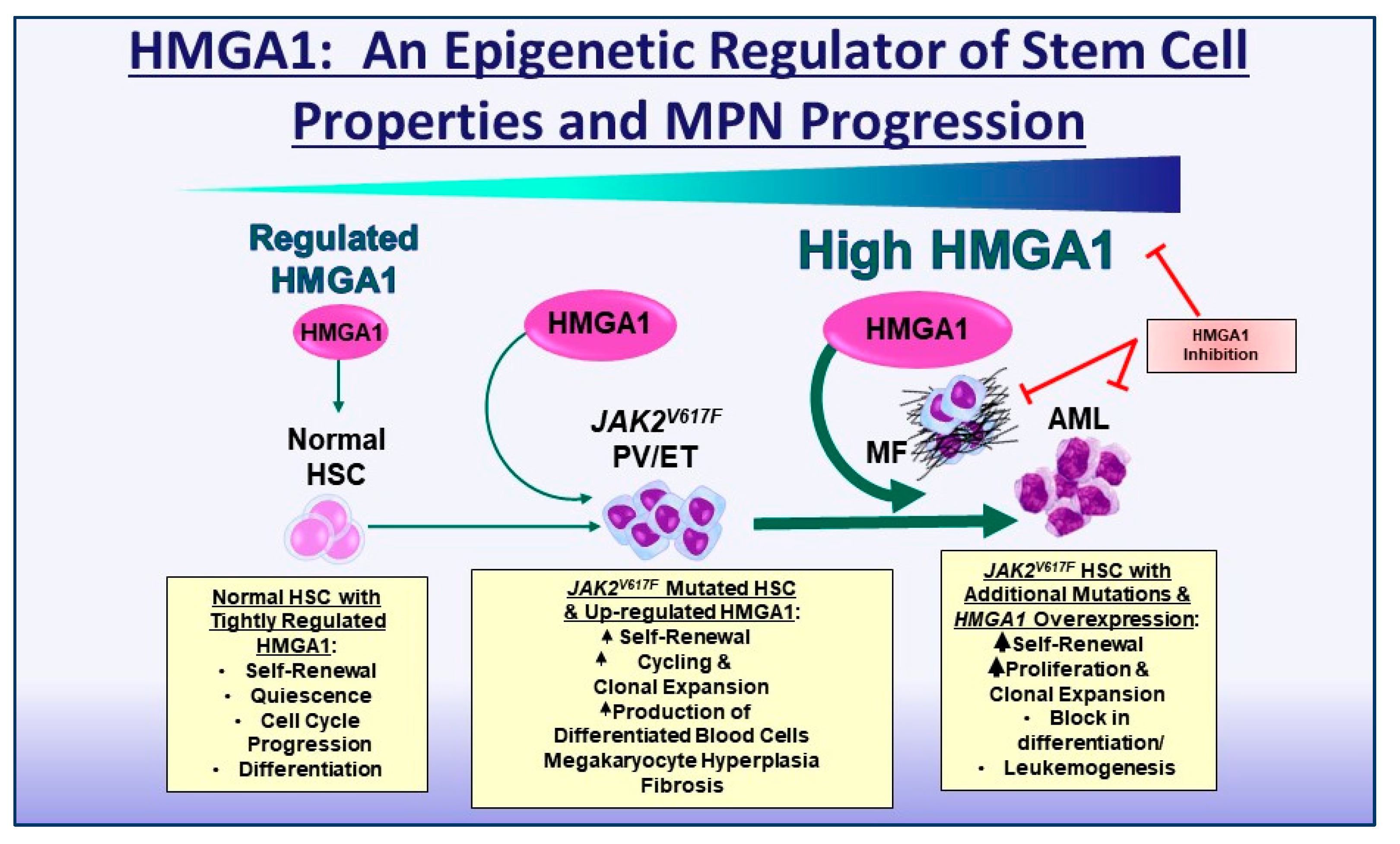
Patients with chronic, indolent myeloproliferative neoplasms (MPNs) are at risk for transformation to highly lethal leukemia, although targetable mechanisms driving progression remain elusive. We discovered that the High Mobility Group A1 (HMGA1) gene is up-regulated with MPN progression in patients and required for evolution into myelofibrosis (MF) or acute myeloid leukemia (AML) in preclinical models. HMGA1 encodes the HMGA1 epigenetic regulators that modulate the chromatin state during embryogenesis and tissue regeneration. While HMGA1 is silenced in most differentiated cells, it becomes aberrantly re-expressed in JAK2 mutant (JAK2-V617F) MPN, with the highest levels after transformation to secondary MF or AML. Here, we review recent work highlighting HMGA1 function in MPN progression. Though underlying mechanisms continue to emerge, increasing evidence suggests that HMGA1 functions as a “chromatin key” required to “unlock” regions of the genome involved in clonal expansion and progression in MPN. Together, these findings illuminate HMGA1 as a driver of MPN progression and a promising therapeutic target.
Keywords: High Mobility Group A1 (HMGA1); epigenetic regulator; MPN progression; chromatin keys; transcriptional networks High Mobility Group A1 (HMGA1); epigenetic regulator; MPN progression; chromatin keys; transcriptional networks