Generation of a scFv Derived from an IgM-Producing Hybridoma for the Detection of REST Expression in Premalignant Lesions and Invasive Squamous Cell Carcinoma

 , , , , and
Abstract
1. Introduction
2. Results
2.1. scFv Construction
2.2. scFv Cloning and Expression
2.3. Evaluation of the Biological Activity of the REST scFv
2.4. Utility of the scFv in the Detection of Squamous Intraepithelial Lesions
3. Discussion
4. Materials and Methods
4.1. Cell Culture of IgM-Producing Hybridomas
4.2. RNA Extraction from Hybridomas
4.3. Construction of scFv
4.4. Cloning and Expression of scFv in a Bacterial System
4.5. Purification of scFv
4.6. Enzyme-Linked Immunosorbent Assay (ELISA)
4.7. Dot Blots
4.8. Immunoprecipitation
4.9. Electrophoresis and Western Blot
4.10. Sample Collection
4.11. Biotinylation of scFv
4.12. Immunocytochemistry and Immunohistochemistry
4.13. Statistical Analysis
5. Conclusions
Supplementary Materials
Author Contributions
Funding
Institutional Review Board Statement
Informed Consent Statement
Data Availability Statement
Acknowledgments
Conflicts of Interest
References
- Sung, H.; Ferlay, J.; Siegel, R.L.; Laversanne, M.; Soerjomataram, I.; Jemal, A.; Bray, F. Global Cancer Statistics 2020: GLOBOCAN Estimates of Incidence and Mortality Worldwide for 36 Cancers in 185 Countries. CA A Cancer J. Clin. 2021, 71, 209–249. [Google Scholar] [CrossRef]
- Stumbar, S.E.; Stevens, M.; Feld, Z. Cervical Cancer and Its Precursors: A Preventative Approach to Screening, Diagnosis, and Management. Prim. Care Clin. Off. Pract. 2019, 46, 117–134. [Google Scholar] [CrossRef] [PubMed]
- Smith, E.R.; George, S.H.; Kobetz, E.; Xu, X.-X. New Biological Research and Understanding of Papanicolaou’s Test. Diagn. Cytopathol. 2018, 46, 507–515. [Google Scholar] [CrossRef] [PubMed]
- Vahedpoor, Z.; Behrashi, M.; Khamehchian, T.; Abedzadeh-Kalahroudi, M.; Moravveji, A.; Mohmadi-Kartalayi, M. Comparison of the Diagnostic Value of the Visual Inspection with Acetic Acid (VIA) and Pap Smear in Cervical Cancer Screening. Taiwan J. Obstet. Gynecol. 2019, 58, 345–348. [Google Scholar] [CrossRef]
- Cortés-Sarabia, K.; Alarcón-Romero, L.d.C.; Flores-Alfaro, E.; Illades-Aguiar, B.; Vences-Velázquez, A.; Mendoza-Catalán, M.Á.; Navarro-Tito, N.; Valdés, J.; Moreno-Godínez, M.E.; Ortuño-Pineda, C. Significant Decrease of a Master Regulator of Genes (REST/NRSF) in High-Grade Squamous Intraepithelial Lesion and Cervical Cancer. Biomed. J. 2021, 44, S171–S178. [Google Scholar] [CrossRef]
- Kong, Q.-R.; Xie, B.-T.; Zhang, H.; Li, J.-Y.; Huang, T.-Q.; Wei, R.-Y.; Liu, Z.-H. RE1-Silencing Transcription Factor (REST) Is Required for Nuclear Reprogramming by Inhibiting Transforming Growth Factor β Signaling Pathway. J. Biol. Chem. 2016, 291, 27334–27342. [Google Scholar] [CrossRef]
- Zhao, Y.; Zhu, M.; Yu, Y.; Qiu, L.; Zhang, Y.; He, L.; Zhang, J. Brain REST/NRSF Is Not Only a Silent Repressor but Also an Active Protector. Mol. Neurobiol. 2017, 54, 541–550. [Google Scholar] [CrossRef]
- Chang, Y.-T.; Lin, T.-P.; Campbell, M.; Pan, C.-C.; Lee, S.-H.; Lee, H.-C.; Yang, M.-H.; Kung, H.-J.; Chang, P.-C. REST Is a Crucial Regulator for Acquiring EMT-like and Stemness Phenotypes in Hormone-Refractory Prostate Cancer. Sci. Rep. 2017, 7, 42795. [Google Scholar] [CrossRef]
- Wagoner, M.P.; Gunsalus, K.T.W.; Schoenike, B.; Richardson, A.L.; Friedl, A.; Roopra, A. The Transcription Factor REST Is Lost in Aggressive Breast Cancer. PLoS. Genet. 2010, 6, e1000979. [Google Scholar] [CrossRef] [PubMed]
- Cortés-Sarabia, K.; Medina-Flores, Y.; Alarcón-Romero, L.D.C.; Mata-Ruíz, O.; Vences-Velázquez, A.; Rodríguez-Ruíz, H.A.; Valdés, J.; Ortuño-Pineda, C. Production and Characterization of Monoclonal Antibodies against the DNA Binding Domain of the RE1-Silencing Transcription Factor. J. Biochem. 2019, 166, 393–402. [Google Scholar] [CrossRef]
- Gu, X.; Jia, X.; Feng, J.; Shen, B.; Huang, Y.; Geng, S.; Sun, Y.; Wang, Y.; Li, Y.; Long, M. Molecular Modeling and Affinity Determination of scFv Antibody: Proper Linker Peptide Enhances Its Activity. Ann. Biomed. Eng. 2010, 38, 537–549. [Google Scholar] [CrossRef] [PubMed]
- Orlandi, R.; Güssow, D.H.; Jones, P.T.; Winter, G. Cloning Immunoglobulin Variable Domains for Expression by the Polymerase Chain Reaction. Proc. Natl. Acad. Sci. USA 1989, 86, 3833–3837. [Google Scholar] [CrossRef]
- Pan, K.; Wang, H.; Zhang, H.; Liu, H.; Lei, H.; Huang, L.; Sun, Y. Production and Characterization of Single Chain Fv Directed against Β2-Agonist Clenbuterol. J. Agric. Food Chem. 2006, 54, 6654–6659. [Google Scholar] [CrossRef]
- Huston, J.S.; Levinson, D.; Mudgett-Hunter, M.; Tai, M.S.; Novotný, J.; Margolies, M.N.; Ridge, R.J.; Bruccoleri, R.E.; Haber, E.; Crea, R. Protein Engineering of Antibody Binding Sites: Recovery of Specific Activity in an Anti-Digoxin Single-Chain Fv Analogue Produced in Escherichia Coli. Proc. Natl. Acad. Sci. USA 1988, 85, 5879–5883. [Google Scholar] [CrossRef]
- Gibson, D.G.; Young, L.; Chuang, R.-Y.; Venter, J.C.; Hutchison, C.A.; Smith, H.O. Enzymatic Assembly of DNA Molecules up to Several Hundred Kilobases. Nat. Methods 2009, 6, 343–345. [Google Scholar] [CrossRef]
- Sleight, S.C.; Bartley, B.A.; Lieviant, J.A.; Sauro, H.M. In-Fusion BioBrick Assembly and Re-Engineering. Nucleic Acids Res. 2010, 38, 2624–2636. [Google Scholar] [CrossRef] [PubMed]
- Riaño-Umbarila, L.; Contreras-Ferrat, G.; Olamendi-Portugal, T.; Morelos-Juárez, C.; Corzo, G.; Possani, L.D.; Becerril, B. Exploiting Cross-Reactivity to Neutralize Two Different Scorpion Venoms with One Single Chain Antibody Fragment. J. Biol. Chem. 2011, 286, 6143–6151. [Google Scholar] [CrossRef]
- Sotelo, P.H.; Collazo, N.; Zuñiga, R.; Gutiérrez-González, M.; Catalán, D.; Ribeiro, C.H.; Aguillón, J.C.; Molina, M.C. An Efficient Method for Variable Region Assembly in the Construction of scFv Phage Display Libraries Using Independent Strand Amplification. mAbs 2012, 4, 542–550. [Google Scholar] [CrossRef][Green Version]
- Lefranc, M.-P.; Giudicelli, V.; Duroux, P.; Jabado-Michaloud, J.; Folch, G.; Aouinti, S.; Carillon, E.; Duvergey, H.; Houles, A.; Paysan-Lafosse, T.; et al. IMGT®, the International ImMunoGeneTics Information System® 25 Years On. Nucleic Acids Res. 2015, 43, D413–D422. [Google Scholar] [CrossRef]
- Ramm, K.; Plückthun. The Periplasmic Folding Assistant Skp Is Required for High Yield of Functional Antibody Fragment in Escherichia Coli. J. Biol. Chem. 2001, 276, 1696–1703. [Google Scholar]
- Montoya, R.; Deckerman, P.; Guler, M.O. Protein Recognition Methods for Diagnostics and Therapy. BBA Adv. 2025, 7, 100149. [Google Scholar] [CrossRef]
- Iqbal, H.; Akins, D.R.; Kenedy, M.R. Co-Immunoprecipitation for Identifying Protein-Protein Interactions in Borrelia Burgdorferi. Methods Mol. Biol. 2018, 1690, 47–55. [Google Scholar] [CrossRef]
- Notkins, A.L. Polyreactivity of Antibody Molecules. Trends Immunol. 2004, 25, 174–179. [Google Scholar] [CrossRef]
- Santa Cruz Biotechnology NRSF Anticuerpo (F-3) | SCBT–Santa Cruz Biotechnology. Available online: https://www.scbt.com/es/p/nrsf-antibody-f-3 (accessed on 23 January 2025).
- Navabi, P.; Ganjalikhany, M.R.; Jafari, S.; Dehbashi, M.; Ganjalikhani-Hakemi, M. Designing and Generating a Single-Chain Fragment Variable (scFv) Antibody against IL2Rα (CD25): An in Silico and in Vitro Study. Iran J. Basic Med. Sci. 2021, 24, 360–368. [Google Scholar] [CrossRef] [PubMed]
- Shimojo, M.; Hersh, L.B. Characterization of the REST/NRSF-Interacting LIM Domain Protein (RILP): Localization and Interaction with REST/NRSF. J. Neurochem. 2006, 96, 1130–1138. [Google Scholar] [CrossRef] [PubMed]
- Gardella, B.; Dominoni, M.; Pasquali, M.F.; Melito, C.; Fiandrino, G.; Cesari, S.; La Verde, M.; Spinillo, A. Low-Grade Cervical Intraepithelial Neoplasia (CIN1) Evolution: Analysis of Opportunistic Preventive Vaccination Role. Vaccines 2023, 11, 284. [Google Scholar] [CrossRef] [PubMed]
- Diamant, I.; Clarke, D.J.B.; Evangelista, J.E.; Lingam, N.; Ma’ayan, A. Harmonizome 3.0: Integrated Knowledge about Genes and Proteins from Diverse Multi-Omics Resources. Nucleic Acids Res. 2025, 53, D1016–D1028. [Google Scholar] [CrossRef]
- Rubin, C.I.; Atweh, G.F. The Role of Stathmin in the Regulation of the Cell Cycle. J. Cell Biochem. 2004, 93, 242–250. [Google Scholar] [CrossRef]
- González-González, R.; Ortiz-Sarabia, G.; Molina-Frechero, N.; Salas-Pacheco, J.M.; Salas-Pacheco, S.M.; Lavalle-Carrasco, J.; López-Verdín, S.; Tremillo-Maldonado, O.; Bologna-Molina, R. Epithelial–Mesenchymal Transition Associated with Head and Neck Squamous Cell Carcinomas: A Review. Cancers 2021, 13, 3027. [Google Scholar] [CrossRef]
- Liu, H.; Weng, J.; Huang, C.L.-H.; Jackson, A.P. Voltage-Gated Sodium Channels in Cancers. Biomark Res. 2024, 12, 70. [Google Scholar] [CrossRef]
- Dudás, J.; Bitsche, M.; Schartinger, V.; Falkeis, C.; Sprinzl, G.M.; Riechelmann, H. Fibroblasts Produce Brain-Derived Neurotrophic Factor and Induce Mesenchymal Transition of Oral Tumor Cells. Oral Oncol. 2011, 47, 98–103. [Google Scholar] [CrossRef] [PubMed]
- Hu, H.; Takano, N.; Xiang, L.; Gilkes, D.M.; Luo, W.; Semenza, G.L. Hypoxia-Inducible Factors Enhance Glutamate Signaling in Cancer Cells. Oncotarget 2014, 5, 8853–8868. [Google Scholar] [CrossRef] [PubMed]
- Indo, S.; Orellana-Serradell, O.; Torres, M.J.; Castellón, E.A.; Contreras, H.R. Overexpression of REST Represses the Epithelial–Mesenchymal Transition Process and Decreases the Aggressiveness of Prostate Cancer Cells. Int. J. Mol. Sci. 2024, 25, 3332. [Google Scholar] [CrossRef]
- Huang, S.; Wa, Q.; Pan, J.; Peng, X.; Ren, D.; Li, Q.; Dai, Y.; Yang, Q.; Huang, Y.; Zhang, X.; et al. Transcriptional Downregulation of miR-133b by REST Promotes Prostate Cancer Metastasis to Bone via Activating TGF-β Signaling. Cell Death Dis. 2018, 9, 779. [Google Scholar] [CrossRef]
- Li, J.; Zhou, Y.; Su, Z.; Li, X.; Zhang, L.; Li, S. A Cell-Penetrating Peptide Improves Anti-HER2 Single-Chain Variable Fragment Internalization and Antitumor Activity against HER2-Positive Breast Cancer In Vitro and In Vivo. Molecules 2024, 29, 1247. [Google Scholar] [CrossRef]
- Simonović, M.; Ostojić, S.; Micić, D.; Djurdjić, P.; Mix, T.; Kuzmanović, Č.; Jelovac, D. Biotin as a Structural Component in the Detection of Small Model Antigens in BLA-S-ELISA. Nat. Prod. Res. 2025, 39, 3547–3551. [Google Scholar] [CrossRef]
- Haugland, R.P.; You, W.W. Coupling of Antibodies with Biotin. Methods Mol. Biol. 2008, 418, 13–24. [Google Scholar] [CrossRef] [PubMed]



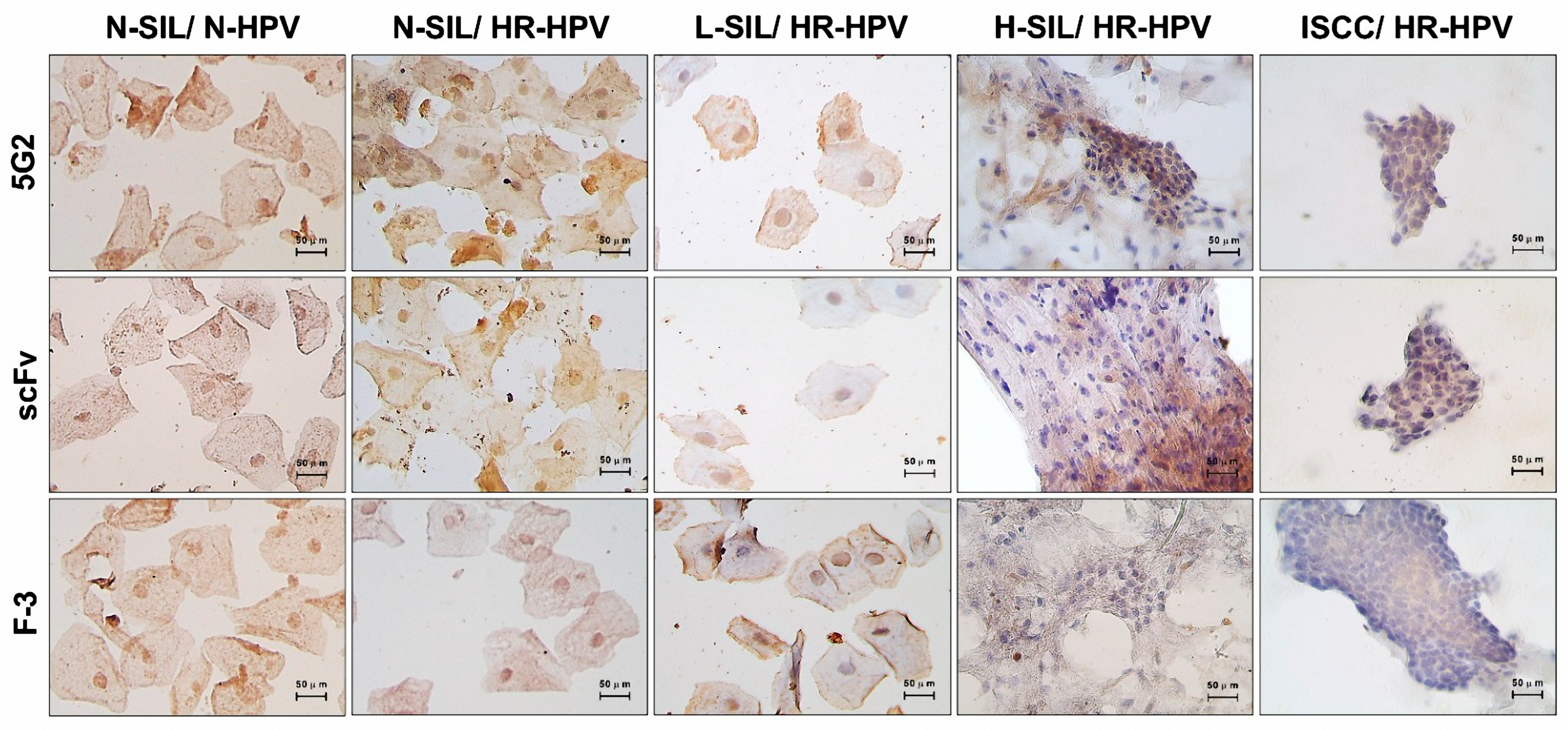
| Evaluation Criteria | Non SIL/Non HPV n = 25 (%) | Non SIL/HPV-HR n = 25 (%) | L-SIL/HPV-HR n = 25 (%) | H-SIL/HPV-HR n = 25 (%) | ISCC n = 25 (%) | p * |
|---|---|---|---|---|---|---|
| 5G2 | ||||||
| Expression level | ||||||
| Negative | 0 | 0 | 4 (16) | 0 | 25 (100) | |
| Mild | 1 (4) | 3 (12) | 5 (20) | 16 (64) | 0 | <0.001 |
| Moderate | 4 (16) | 19 (76) | 16 (64) | 9 (36) | 0 | |
| Intense | 20 (80) | 3 (12) | 0 | 0 | 0 | |
| Location | ||||||
| Negative | 0 | 0 | 4 (16) | 0 | 25 (100) | |
| Nucleus | 1 (4) | 2 (8) | 0 | 0 | 0 | |
| Cytoplasm | 0 | 0 | 0 | 25 (100) | 0 | <0.001 |
| Nucleus–Cytoplasm | 24 (96) | 23 (92) | 21 (84) | 0 | 0 | |
| ScFv | ||||||
| Expression level | ||||||
| Negative | 0 | 0 | 1 (4) | 0 | 15 (60) | |
| Mild | 0 | 0 | 0 | 20 (80) | 10 (40) | <0.001 |
| Moderate | 2 (8) | 22 (88) | 24 (96) | 5 (20) | 0 | |
| Intense | 23 (92) | 3 (12) | 0 | 0 | 0 | |
| Location | ||||||
| Negative | 0 | 0 | 1 (4) | 0 | 15 (60) | |
| Nucleus | 0 | 0 | 0 | 0 | 0 | |
| Cytoplasm | 0 | 0 | 0 | 25 (100) | 10 (40) | <0.001 |
| Nucleus–Cytoplasm | 25 (100) | 25 (100) | 24 (96) | 0 | 0 | |
| F-3 | ||||||
| Expression level | ||||||
| Negative | 0 | 0 | 2 (8) | 0 | 12 (48) | |
| Mild | 0 | 4 (16) | 10 (40) | 18 (72) | 13 (52) | <0.001 |
| Moderate | 4 (16) | 20 (80) | 13 (52) | 7 (28) | 0 | |
| Intense | 21 (84) | 1 (4) | 0 | 0 | 0 | |
| Location | ||||||
| Negative | 0 | 0 | 2 (8) | 0 | 12 (48) | |
| Nucleus | 0 | 0 | 0 | 0 | 0 | |
| Cytoplasm | 0 | 0 | 0 | 25 (100) | 13 (52) | <0.001 |
| Nucleus–Cytoplasm | 25 (100) | 25 (100) | 23 (92) | 0 | 0 |
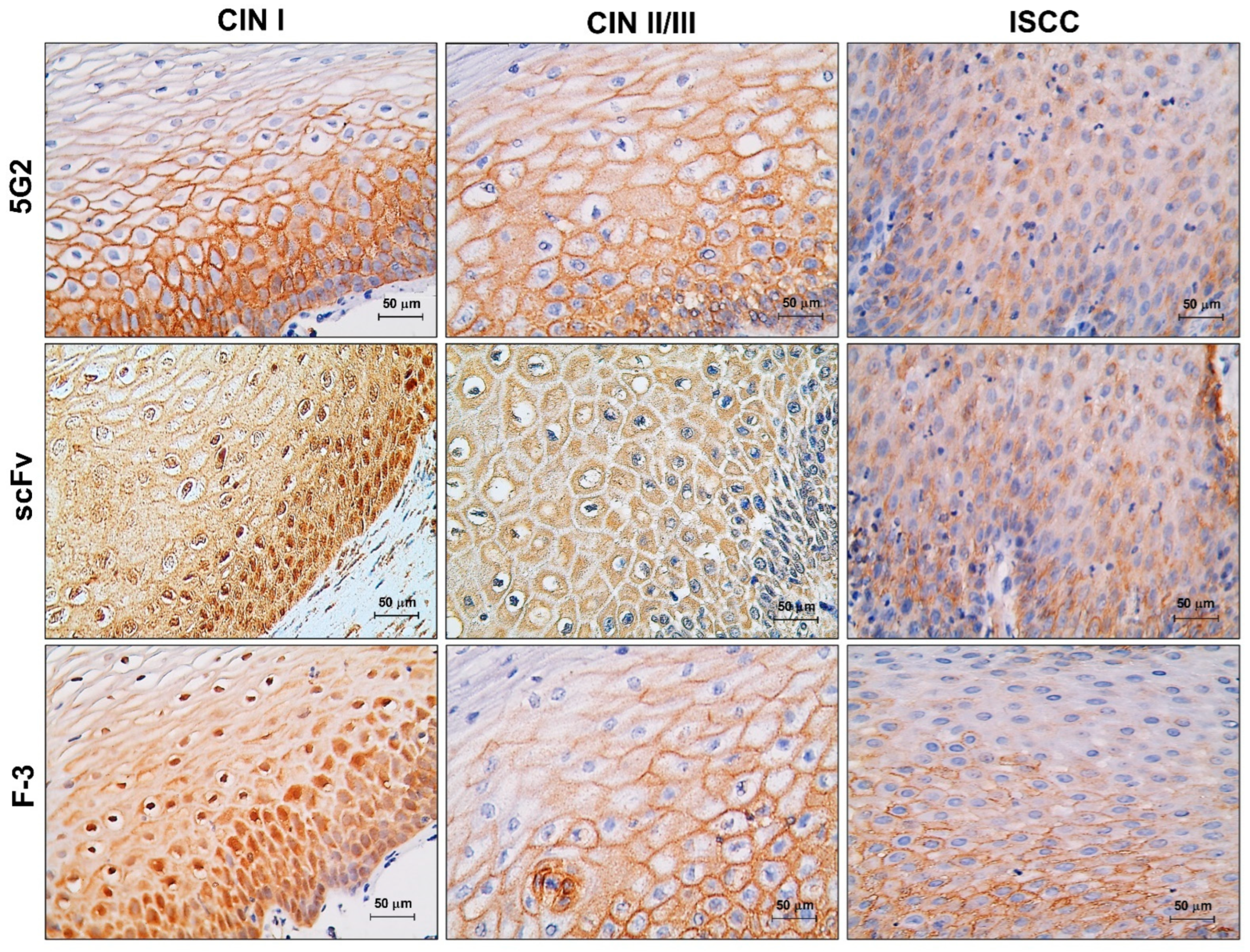
| Evaluation Criteria | CIN I n = 25 (%) | CIN II/III n = 25 (%) | ISCC n = 10 (%) | p * |
|---|---|---|---|---|
| 5G2 | ||||
| Expression level | ||||
| 0 | 0 | 7 (28) | 0 | |
| 1+ | 0 | 0 | 0 | <0.001 |
| 2+ | 4 (16) | 0 | 0 | |
| 3+ | 21 (84) | 18 (72) | 0 | |
| Tumor nests in the stroma Location | 10 (100) | |||
| Negative | 0 | 7 (28) | ||
| Nucleus | 0 | 0 | 0 | <0.001 |
| Cytoplasm | 22 (88) | 18 (72) | 10 (100) | |
| Nucleus–Cytoplasm | 3 (12) | 0 | 0 | |
| scFv | ||||
| Expression level | ||||
| 0 | 0 | 0 | 0 | |
| 1+ | 0 | 0 | 0 | <0.001 |
| 2+ | 5 (20) | 0 | 0 | |
| 3+ | 20 (80) | 25 (100) | 0 | |
| Tumor nests in the stroma Location | 10 (100) | |||
| Negative | 0 | 0 | 0 | |
| Nucleus | 0 | 0 | 0 | <0.001 |
| Cytoplasm | 0 | 25 (100) | 10 (100) | |
| Nucleus–Cytoplasm | 25 (100) | 0 | 0 | |
| F-3 | ||||
| Expression level | ||||
| 0 | 0 | 0 | 0 | |
| 1+ | 0 | 0 | 0 | <0.001 |
| 2+ | 4 (16) | 0 | 0 | |
| 3+ | 21 (84) | 25 (100) | 0 | |
| Tumor nests in the stroma Location | 10 (100) | |||
| Negative | 0 | 0 | 0 | |
| Nucleus | 0 | 0 | 0 | <0.001 |
| Cytoplasm | 0 | 25 (100) | 10 (100) | |
| Nucleus–Cytoplasm | 25 (100) | 0 | 0 |
Disclaimer/Publisher’s Note: The statements, opinions and data contained in all publications are solely those of the individual author(s) and contributor(s) and not of MDPI and/or the editor(s). MDPI and/or the editor(s) disclaim responsibility for any injury to people or property resulting from any ideas, methods, instructions or products referred to in the content. |
© 2025 by the authors. Licensee MDPI, Basel, Switzerland. This article is an open access article distributed under the terms and conditions of the Creative Commons Attribution (CC BY) license (https://creativecommons.org/licenses/by/4.0/).
Share and Cite
Rodríguez-Nava, C.; Cortés-Sarabia, K.; Riaño-Umbarila, L.; Becerril-Luján, B.; Medina-Flores, Y.; Mata-Ruíz, O.; Lloret-Sánchez, L.; Illades-Aguiar, B.; Alarcón-Romero, L.d.C.; Ortuño-Pineda, C. Generation of a scFv Derived from an IgM-Producing Hybridoma for the Detection of REST Expression in Premalignant Lesions and Invasive Squamous Cell Carcinoma. Int. J. Mol. Sci. 2025, 26, 11946. https://doi.org/10.3390/ijms262411946
Rodríguez-Nava C, Cortés-Sarabia K, Riaño-Umbarila L, Becerril-Luján B, Medina-Flores Y, Mata-Ruíz O, Lloret-Sánchez L, Illades-Aguiar B, Alarcón-Romero LdC, Ortuño-Pineda C. Generation of a scFv Derived from an IgM-Producing Hybridoma for the Detection of REST Expression in Premalignant Lesions and Invasive Squamous Cell Carcinoma. International Journal of Molecular Sciences. 2025; 26(24):11946. https://doi.org/10.3390/ijms262411946
Chicago/Turabian StyleRodríguez-Nava, Cynthia, Karen Cortés-Sarabia, Lidia Riaño-Umbarila, Baltazar Becerril-Luján, Yolanda Medina-Flores, Olga Mata-Ruíz, Lourdes Lloret-Sánchez, Berenice Illades-Aguiar, Luz del Carmen Alarcón-Romero, and Carlos Ortuño-Pineda. 2025. "Generation of a scFv Derived from an IgM-Producing Hybridoma for the Detection of REST Expression in Premalignant Lesions and Invasive Squamous Cell Carcinoma" International Journal of Molecular Sciences 26, no. 24: 11946. https://doi.org/10.3390/ijms262411946
APA StyleRodríguez-Nava, C., Cortés-Sarabia, K., Riaño-Umbarila, L., Becerril-Luján, B., Medina-Flores, Y., Mata-Ruíz, O., Lloret-Sánchez, L., Illades-Aguiar, B., Alarcón-Romero, L. d. C., & Ortuño-Pineda, C. (2025). Generation of a scFv Derived from an IgM-Producing Hybridoma for the Detection of REST Expression in Premalignant Lesions and Invasive Squamous Cell Carcinoma. International Journal of Molecular Sciences, 26(24), 11946. https://doi.org/10.3390/ijms262411946