Epigenetic Mechanisms in Autoimmune Thyroid Diseases: Bridging Research and Clinical Applications

Abstract
1. Introduction
2. The Role of DNA Methylation in AITD
3. The Role of Histone Modification in AITD
4. The Role of Non-Coding RNA in AITD
4.1. Emerging Role of microRNA in AITD
4.2. Emerging Role of lncRNA in AITD
4.3. Emerging Role of Other ncRNA in AITD
5. Conclusions and Perspectives
Author Contributions
Funding
Institutional Review Board Statement
Informed Consent Statement
Data Availability Statement
Conflicts of Interest
Abbreviations
| AITD | Autoimmune Thyroid Disease |
| EAT | Experimental Autoimmune Thyroiditis |
| EOM | Extraocular Muscles |
| GD | Graves’ Disease |
| GO | Graves’ Ophthalmopathy |
| HT | Hashimoto’s Thyroiditis |
| TAO | Thyroid-Associated Ophthalmopathy |
| TED | Thyroid Eye Disease |
| 5-mC | 5-Methylcytosine |
| DNMT | DNA Methyltransferase |
| DNMT1 | DNA Methyltransferase 1 |
| DNMT3A/B | DNA Methyltransferase 3A/3B |
| HAT | Histone Acetyltransferase |
| HDAC | Histone Deacetylase |
| HDACI | Histone Deacetylase Inhibitor |
| HDM | Histone Demethylase |
| HMT | Histone Methyltransferase |
| H3K4me3 | Histone H3 Lysine 4 trimethylation |
| H3K9me2 | Histone H3 Lysine 9 dimethylation |
| H3K27me3 | Histone H3 Lysine 27 trimethylation |
| SAM | S-adenosyl-L-methionine |
| T4 | Thyroxine |
| Tg | Thyroglobulin |
| TPO | Thyroid Peroxidase |
| TR | Thyroid hormone Receptor |
| TSH | Thyrotropin/Thyroid-Stimulating Hormone |
| TSHR | TSH Receptor |
| CCL5 | C-C Motif Chemokine Ligand 5 |
| cTfh | Circulating T follicular helper cell |
| CXCL8 | C-X-C Motif Chemokine Ligand 8 |
| ICAM-1 | Intercellular Adhesion Molecule-1 |
| IFN-γ | Interferon-gamma |
| IL-2RA | Interleukin-2 Receptor Alpha Chain |
| IL-6 | Interleukin-6 |
| PBMC | Peripheral Blood Mononuclear Cells |
| STAT3 | Signal Transducer and Activator of Transcription 3 |
| Tfh | T follicular helper cell |
| Th1 | T helper 1 cell |
| Th17 | T helper 17 cell |
| Treg | Regulatory T cell |
| TGAb | Thyroglobulin Antibodies |
| TPOAb | Thyroid Peroxidase Antibodies |
| TRAb | TSH Receptor Antibodies |
| ceRNA | Competitive Endogenous RNA |
| circRNA | Circular RNA |
| lncRNA | Long non-coding RNA |
| miRNA | MicroRNA |
| mRNA | Messenger RNA |
| ncRNA | Non-coding RNA |
| pre-miRNA | Precursor microRNA |
| pri-miRNA | Primary microRNA |
| RBP | RNA-Binding Protein |
| RISC | RNA-Induced Silencing Complex |
| siRNA | Small Interfering RNA |
| CRISPR | Clustered Regularly Interspaced Short Palindromic Repeats |
| FDA | U.S. Food and Drug Administration |
| RNAi | RNA Interference |
| HAS | Hyaluronan Synthase |
| PDGF-BB | Platelet-Derived Growth Factor-BB |
References
- Daramjav, N.; Takagi, J.; Iwayama, H.; Uchino, K.; Inukai, D.; Otake, K.; Ogawa, T.; Takami, A. Autoimmune Thyroiditis Shifting from Hashimoto’s Thyroiditis to Graves’ Disease. Medicina 2023, 59, 757. [Google Scholar] [CrossRef]
- Ranđelović, K.; Jukić, T.; Kuna, A.T.; Sušić, T.; Hanžek, M.; Štajduhar, A.; Vatavuk, Z.; Vicković, I.P. Hashimoto’s Thyroiditis and Dry Eye Disease. J. Clin. Med. 2025, 14, 1710. [Google Scholar] [CrossRef] [PubMed]
- Zhang, H.; Tong, W.; Zeng, W.; Luo, H.; Zhang, L.; Feng, J.; Xiao, Y.; Wang, G. Persistent symptoms in euthyroid Hashimoto’s thyroiditis: Current hypotheses and emerging management strategies. Front. Endocrinol. 2025, 16, 1627787. [Google Scholar] [CrossRef]
- Chaker, L.; Papaleontiou, M. Hypothyroidism: A Review. JAMA 2025, 334, 1750–1760. [Google Scholar] [CrossRef] [PubMed]
- Manocchio, N.; Magro, V.M.; Massaro, L.; Sorbino, A.; Ljoka, C.; Foti, C. Hashimoto’s Encephalopathy: Clinical Features, Therapeutic Strategies, and Rehabilitation Approaches. Biomedicines 2025, 13, 726. [Google Scholar] [CrossRef] [PubMed]
- Wiersinga, W.M.; Poppe, K.G.; Effraimidis, G. Hyperthyroidism: Aetiology, pathogenesis, diagnosis, management, complications, and prognosis. Lancet Diabetes Endocrinol. 2023, 11, 282–298. [Google Scholar] [CrossRef] [PubMed]
- Lanzolla, G.; Marinò, M.; Menconi, F. Graves ‘disease: Latest understanding of pathogenesis and treatment options. Nat. Rev. Endocrinol. 2024, 20, 647–660. [Google Scholar] [CrossRef] [PubMed]
- Chaker, L.; Cooper, D.S.; Walsh, J.P.; Peeters, R.P. Hyperthyroidism. Lancet 2024, 403, 768–780. [Google Scholar] [CrossRef]
- Vargas-Uricoechea, H.; Nogueira, J.P.; Pinzón-Fernández, M.V.; Schwarzstein, D. The Usefulness of Thyroid Antibodies in the Diagnostic Approach to Autoimmune Thyroid Disease. Antibodies 2023, 12, 48. [Google Scholar] [CrossRef]
- Zhao, R.; Gu, J.; Zhao, H.; Wang, Z.; Liu, X.; Yuan, C.; Zheng, X.; Yang, T.; Xu, X.; Cai, Y. Expression of integrin al-pha4beta1 and alpha4beta7 on B cells correlates with autoimmune responses in Graves’ disease. Int. Immunopharmacol. 2024, 142 Pt B, 113218. [Google Scholar] [CrossRef]
- Kravchenko, V.; Zakharchenko, T. Thyroid hormones and minerals in immunocorrection of disorders in autoimmune thyroid diseases. Front. Endocrinol. 2023, 14, 1225494. [Google Scholar] [CrossRef]
- Xie, P.; Shen, L.; Peng, R.; Wang, Y.; Yin, Q.; Chen, X.; Jin, Z.; Ning, G.; Wang, W.; Wang, S.; et al. Effects of Low-dose Methotrexate with Methimazole in Patients with Graves’ Disease: Results of a Randomized Clinical Trial. J. Clin. Endocrinol. Metab. 2024, 110, 489–497. [Google Scholar] [CrossRef] [PubMed]
- Abdi, H.; Amouzegar, A.; Azizi, F. Antithyroid Drugs. Iran. J. Pharm. Res. 2019, 18 (Suppl. S1), 1–12. [Google Scholar] [CrossRef] [PubMed]
- Yavuz, S.; Puckett, Y. Iodine-131 Uptake Study. In StatPearls; StatPearls Publishing: Treasure Island, FL, USA, 2023. [Google Scholar]
- Patel, A.; Kosmacek, E.A.; Fisher, K.W.; Goldner, W.; Oberley-Deegan, R.E. MnTnBuOE-2-PyP treatment protects from radioactive iodine (I-131) treatment-related side effects in thyroid cancer. Radiat. Environ. Biophys. 2019, 59, 99–109. [Google Scholar] [CrossRef]
- Kahaly, G.J. Management of Graves Thyroidal and Extrathyroidal Disease: An Update. J. Clin. Endocrinol. Metab. 2020, 105, 3704–3720. [Google Scholar] [CrossRef]
- Szklarz, M.; Gontarz-Nowak, K.; Matuszewski, W.; Bandurska-Stankiewicz, E. Iron: Not Just a Passive Bystander in AITD. Nutrients 2022, 14, 4682. [Google Scholar] [CrossRef]
- Li, Y. Modern epigenetics methods in biological research. Methods 2021, 187, 104–113. [Google Scholar] [CrossRef]
- Shalaby, S.M.; Mackawy, A.M.H.; Atef, D.M.; Atef, R.M.; Saeed, J. Promoter methylation and expression of intercellular adhesion molecule 1 gene in blood of autoimmune thyroiditis patients. Mol. Biol. Rep. 2019, 46, 5345–5353. [Google Scholar] [CrossRef] [PubMed]
- Faustino, L.C.; Li, C.W.; Stefan-Lifshitz, M.; Kim, K.; Clarke, O.B.; Tomer, Y. A Novel Mouse Model of Autoimmune Thyroiditis Induced by Immunization with Adenovirus Containing Full-Length Thyroglobulin cDNA: Implications to Genetic Studies of Thyroid Autoimmunity. Thyroid 2020, 30, 1338–1345. [Google Scholar] [CrossRef]
- Liang, J.; Liang, G.; Liu, Z.; Cai, H. Associations of GWAS-Supported Non-MHC Genes with Autoimmune Thyroiditis in Patients with Type 1 Diabetes. Diabetes Metab. Syndr. Obes. Targets Ther. 2021, 14, 3017–3026. [Google Scholar] [CrossRef]
- Wang, Y.; Ma, X.-M.; Wang, X.; Sun, X.; Wang, L.-J.; Li, X.-Q.; Liu, X.-Y.; Yu, H.-S. Emerging Insights Into the Role of Epigenetics and Gut Microbiome in the Pathogenesis of Graves’ Ophthalmopathy. Front. Endocrinol. 2022, 12, 788535. [Google Scholar] [CrossRef]
- Cai, T.-T.; Muhali, F.-S.; Song, R.-H.; Qin, Q.; Wang, X.; Shi, L.-F.; Jiang, W.-J.; Xiao, L.; Li, D.-F.; Zhang, J.-A. Genome-wide DNA methylation analysis in Graves’ disease. Genomics 2015, 105, 204–210. [Google Scholar] [CrossRef]
- Mazloumi, Z.; Farahzadi, R.; Rafat, A.; Asl, K.D.; Karimipour, M.; Montazer, M.; Movassaghpour, A.A.; Dehnad, A.; Charoudeh, H.N. Effect of aberrant DNA methylation on cancer stem cell properties. Exp. Mol. Pathol. 2022, 125, 104757. [Google Scholar] [CrossRef] [PubMed]
- Kyrgios, I.; Giza, S.; Fragou, A.; Tzimagiorgis, G.; Galli-Tsinopoulou, A. DNA hypermethylation of PTPN22 gene promoter in children and adolescents with Hashimoto thyroiditis. J. Endocrinol. Investig. 2020, 44, 2131–2138. [Google Scholar] [CrossRef]
- Cai, T.; Qin, Q.; Song, R.; Zhao, J.; Wang, G.; Zhang, J. Identifying and Validating Differentially Methylated Regions in Newly Diagnosed Patients with Graves’ Disease. DNA Cell Biol. 2021, 40, 482–490. [Google Scholar] [CrossRef]
- Limbach, M.; Saare, M.; Tserel, L.; Kisand, K.; Eglit, T.; Sauer, S.; Axelsson, T.; Syvänen, A.-C.; Metspalu, A.; Milani, L.; et al. Epigenetic profiling in CD4+ and CD8+ T cells from Graves’ disease patients reveals changes in genes associated with T cell receptor signaling. J. Autoimmun. 2016, 67, 46–56. [Google Scholar] [CrossRef] [PubMed]
- Guo, Q.; Wu, D.; Yu, H.; Bao, J.; Peng, S.; Shan, Z.; Guan, H.; Teng, W. Alterations of Global DNA Methylation and DNA Methyltransferase Expression in T and B Lymphocytes from Patients with Newly Diagnosed Autoimmune Thyroid Diseases After Treatment: A Follow-Up Study. Thyroid 2018, 28, 377–385. [Google Scholar] [CrossRef]
- Ramos-Leví, A.M.; Marazuela, M. Pathogenesis of thyroid autoimmune disease: The role of cellular mechanisms. Endocrinol. Nutr. 2016, 63, 421–429. [Google Scholar] [CrossRef]
- González-Amaro, R.; Marazuela, M. T regulatory (Treg) and T helper 17 (Th17) lymphocytes in thyroid autoimmunity. Endocrine 2016, 52, 30–38. [Google Scholar] [CrossRef]
- Coppedè, F. Epigenetics and Autoimmune Thyroid Diseases. Front. Endocrinol. 2017, 8, 149. [Google Scholar] [CrossRef] [PubMed]
- Dottore, G.R.; Lanzolla, G.; Comi, S.; Menconi, F.; Mencacci, L.C.; Dallan, I.; Marcocci, C.; Marinò, M. Insights Into the Role of DNA Methylation and Gene Expression in Graves Orbitopathy. J. Clin. Endocrinol. Metab. 2023, 108, e160–e168. [Google Scholar] [CrossRef]
- Bui, T.M.; Wiesolek, H.L.; Sumagin, R. ICAM-1: A master regulator of cellular responses in inflammation, injury resolution, and tumorigenesis. J. Leukoc. Biol. 2020, 108, 787–799. [Google Scholar] [CrossRef]
- Wang, X.; Liu, W.; Rui, Z.; Zheng, W.; Tan, J.; Li, N.; Yu, Y. Immunotherapy with a biologically active ICAM-1 mAb and an siRNA targeting TSHR in a BALB/c mouse model of Graves’ disease. Endokrynol. Polska 2021, 72, 592–600. [Google Scholar] [CrossRef]
- Chen, Y.; Liu, J.; Ren, B.; Zhou, Z.; He, Y.; Li, F.; Jin, M.; Liu, L.; Wang, X.; Shen, H. Validation of DNA methylation and transcriptional characteristics in CCL5 and CXCL8 genes in autoimmune thyroiditis with varying iodine levels. Sci. Rep. 2025, 15, 6006. [Google Scholar] [CrossRef]
- Jiang, Y.; Mu, K.; Huang, Z.; Zhang, X.; Wang, Y.; Xu, W.; Song, R.; Zhang, J. Th17-associated cytokine gene hypometh-ylation reflects epigenetic dysregulation in graves’ disease. Front. Immunol. 2025, 16, 1635883. [Google Scholar] [CrossRef]
- Lafontaine, N.; Wilson, S.G.; Walsh, J.P. DNA Methylation in Autoimmune Thyroid Disease. J. Clin. Endocrinol. Metab. 2023, 108, 604–613. [Google Scholar] [CrossRef] [PubMed]
- Xu, W.; Wang, Y.; Li, G.; Yang, Y.; Zhang, J.; Mu, K.; Li, N.; Zhang, J. Epigenetic landscape of IL-10 in Graves’ disease: Site-specific DNA methylation alterations and their associations with immune dysregulation. Expert Rev. Clin. Immunol. 2025, 21, 1297–1305. [Google Scholar] [CrossRef] [PubMed]
- Liu, T.; Zhang, D.; Ouyang, W.; Li, R.; Wang, S.; Liu, W. Identification and functional characterization of hub genes CLTA, EDIL3, HAPLN1, and HIP1 as diagnostic biomarkers and therapeutic targets in thyroid cancer and Hashimoto’s thyroiditis. Clin. Exp. Med. 2025, 25, 162. [Google Scholar] [CrossRef] [PubMed]
- Kyrgios, I.; Fragou, A.; Kotanidou, E.P.; Mouzaki, K.; Efraimidou, S.; Tzimagiorgis, G.; Galli-Tsinopoulou, A. DNA methylation analysis within the IL2RA gene promoter in youth with autoimmune thyroid disease. Eur. J. Clin. Investig. 2020, 50, e13199. [Google Scholar] [CrossRef] [PubMed]
- Field, J.; Fox, A.; A Jordan, M.; Baxter, A.G.; Spelman, T.; Gresle, M.; Butzkueven, H.; Kilpatrick, T.J.; Rubio, J.P. Interleukin-2 receptor-alpha proximal promoter hypomethylation is associated with multiple sclerosis. Genes Immun. 2017, 18, 59–66. [Google Scholar] [CrossRef]
- Ohtani, H.; Inoue, N.; Iwatani, Y.; Takeno, Y.; Arakawa, Y.; Hidaka, Y.; Watanabe, M. Effect of DNA methylation at the CTLA4 gene on the clinical status of autoimmune thyroid diseases. Clin. Immunol. 2024, 267, 110338. [Google Scholar] [CrossRef]
- Hirai, N.; Watanabe, M.; Inoue, N.; Kinoshita, R.; Ohtani, H.; Hidaka, Y.; Iwatani, Y. Association of IL6 gene methylation in peripheral blood cells with the development and prognosis of autoimmune thyroid diseases. Autoimmunity 2019, 52, 251–255. [Google Scholar] [CrossRef]
- Hashimoto, H.; Watanabe, M.; Inoue, N.; Hirai, N.; Haga, E.; Kinoshita, R.; Hidaka, Y.; Iwatani, Y. Association of IFNG gene methylation in peripheral blood cells with the development and prognosis of autoimmune thyroid diseases. Cytokine 2019, 123, 154770. [Google Scholar] [CrossRef]
- Dottore, G.R.; Bucci, I.; Lanzolla, G.; Dallan, I.; Sframeli, A.; Torregrossa, L.; Casini, G.; Basolo, F.; Figus, M.; Nardi, M.; et al. Genetic Profiling of Orbital Fibroblasts from Patients with Graves’ Orbitopathy. J. Clin. Endocrinol. Metab. 2021, 106, e2176–e2190. [Google Scholar] [CrossRef]
- Kinoshita, R.; Inoue, N.; Iwatani, Y.; Noguchi, Y.; Hidaka, Y.; Watanabe, M. Methylation levels of the IL10 gene in peripheral blood are related to the intractability of Graves’ disease. Clin. Immunol. 2024, 263, 110196. [Google Scholar] [CrossRef]
- Zhou, Z.; Liu, J.; Chen, Y.; Ren, B.; Wan, S.; Chen, Y.; He, Y.; Wei, Q.; Gao, H.; Liu, L.; et al. Genome-wide DNA methylation pattern in whole blood of patients with Hashimoto thyroiditis. Front. Endocrinol. 2023, 14, 1259903. [Google Scholar] [CrossRef] [PubMed]
- Singh, P.; Bhadada, S.K.; Arya, A.K.; Saikia, U.N.; Sachdeva, N.; Dahiya, D.; Kaur, J.; Brandi, M.L.; Rao, S.D. Aberrant Epigenetic Alteration of PAX1 Expression Contributes to Parathyroid Tumorigenesis. J. Clin. Endocrinol. Metab. 2021, 107, e783–e792. [Google Scholar] [CrossRef] [PubMed]
- Klemm, S.L.; Shipony, Z.; Greenleaf, W.J. Chromatin accessibility and the regulatory epigenome. Nat. Rev. Genet. 2019, 20, 207–220. [Google Scholar] [CrossRef]
- Neganova, M.E.; Klochkov, S.G.; Aleksandrova, Y.R.; Aliev, G. Histone modifications in epigenetic regulation of cancer: Perspectives and achieved progress. Semin. Cancer Biol. 2022, 83, 452–471. [Google Scholar] [CrossRef] [PubMed]
- Kim, T.H.; Nosella, M.L.; Bolik-Coulon, N.; Harkness, R.W.; Huang, S.K.; Kay, L.E. Correlating histone acetylation with nucleosome core particle dynamics and function. Proc. Natl. Acad. Sci. USA 2023, 120, e2301063120. [Google Scholar] [CrossRef]
- Haga, E.; Inoue, N.; Iwatani, Y.; Arakawa, Y.; Morita, E.; Hashimoto, H.; Noguchi, Y.; Hidaka, Y.; Watanabe, M. Intrain-dividual variation in histone acetylation and its impact on autoimmune thyroid diseases. Endocr. J. 2023, 70, 1169–1174. [Google Scholar] [CrossRef] [PubMed]
- Yan, N.; Zhou, J.-Z.; Zhang, J.-A.; Cai, T.; Zhang, W.; Wang, Y.; Muhali, F.-S.; Guan, L.; Song, R.-H. Histone hypoacetylation and increased histone deacetylases in peripheral blood mononuclear cells from patients with Graves’ disease. Mol. Cell. Endocrinol. 2015, 414, 143–147. [Google Scholar] [CrossRef]
- Sacristán-Gómez, P.; Serrano-Somavilla, A.; González-Amaro, R.; Martínez-Hernández, R.; Marazuela, M. Analysis of Expression of Different Histone Deacetylases in Autoimmune Thyroid Disease. J. Clin. Endocrinol. Metab. 2021, 106, 3213–3227. [Google Scholar] [CrossRef]
- Jambhekar, A.; Dhall, A.; Shi, Y. Roles and regulation of histone methylation in animal development. Nat. Rev. Mol. Cell Biol. 2019, 20, 625–641. [Google Scholar] [CrossRef] [PubMed]
- Susetyo, A.; Ishii, S.; Fujiwara, Y.; Amano, I.; Koibuchi, N. Histone Deacetylase 3 Inhibitor Alleviates Cerebellar Defects in Perinatal Hypothyroid Mice by Stimulating Histone Acetylation and Transcription at Thyroid Hormone-Responsive Gene Loci. Int. J. Mol. Sci. 2022, 23, 7869. [Google Scholar] [CrossRef]
- Chang, Q.; Yin, D.; Li, H.; Du, X.; Wang, Z.; Liu, Y.; Zhang, J. HDAC6-specific inhibitor alleviates hashimoto’s thyroiditis through inhibition of Th17 cell differentiation. Mol. Immunol. 2022, 149, 39–47. [Google Scholar] [CrossRef]
- He, K.; Cao, X.; Deng, X. Histone methylation in epigenetic regulation and temperature responses. Curr. Opin. Plant Biol. 2021, 61, 102001. [Google Scholar] [CrossRef]
- Kyriacou, A.; Tziaferi, V.; Toumba, M. Stress, Thyroid Dysregulation, and Thyroid Cancer in Children and Adolescents: Proposed Impending Mechanisms. Horm. Res. Paediatr. 2022, 96, 44–53. [Google Scholar] [CrossRef] [PubMed]
- Yan, N.; Mu, K.; An, X.-F.; Li, L.; Qin, Q.; Song, R.-H.; Yao, Q.-M.; Shao, X.-Q.; Zhang, J.-A. Aberrant Histone Methylation in Patients with Graves’ Disease. Int. J. Endocrinol. 2019, 2019, 1454617. [Google Scholar] [CrossRef] [PubMed]
- Xu, Y.; Hu, J.; Fan, Y.; Sun, L.; Shen, N.; Jin, Q.; Zhang, L.; Zhang, J.; Zhang, F.; Chen, H. LSD1 induces H3 K9 demeth-ylation to promote adipogenesis in thyroid-associated ophthalmopathy. Epigenet. Chromatin 2025, 18, 28. [Google Scholar] [CrossRef] [PubMed]
- Gomez, S.; Tabernacki, T.; Kobyra, J.; Roberts, P.; Chiappinelli, K.B. Combining epigenetic and immune therapy to over-come cancer resistance. Semin. Cancer Biol. 2020, 65, 99–113. [Google Scholar] [CrossRef]
- Wang, Q.; Sun, S.; Sun, G.; Han, B.; Zhang, S.; Zheng, X.; Chen, L. Histone modification inhibitors: An emerging frontier in thyroid Cancer therapy. Cell Signal. 2025, 131, 111703. [Google Scholar] [CrossRef]
- Ekronarongchai, S.; Palaga, T.; Saonanon, P.; Pruksakorn, V.; Hirankarn, N.; van Hagen, P.M.; Dik, W.A.; Virakul, S. Histone Deacetylase 4 Controls Extracellular Matrix Production in Orbital Fibroblasts from Graves’ Ophthalmopathy Patients. Thyroid 2021, 31, 1566–1576. [Google Scholar] [CrossRef]
- Lu, X.; Sun, J.; Liu, T.; Zhang, H.; Shan, Z.; Teng, W. Changes in histone H3 lysine 4 trimethylation in Hashimoto’s thyroiditis. Arch. Med. Sci. 2019, 18, 153–163. [Google Scholar] [CrossRef] [PubMed]
- Li, F.; Zhou, J. G-quadruplexes from non-coding RNAs. J. Mol. Med. 2023, 101, 621–635. [Google Scholar] [CrossRef]
- Plotnikova, O.; Baranova, A.; Skoblov, M. Comprehensive Analysis of Human microRNA-mRNA Interactome. Front. Genet. 2019, 10, 933. [Google Scholar] [CrossRef] [PubMed]
- Yin, L.; Zeng, C.; Yao, J.; Shen, J. Emerging Roles for Noncoding RNAs in Autoimmune Thyroid Disease. Endocrinology 2020, 161, bqaa053. [Google Scholar] [CrossRef]
- Martínez-Hernández, R.; Marazuela, M. MicroRNAs in autoimmune thyroid diseases and their role as biomarkers. Best Pract. Res. Clin. Endocrinol. Metab. 2023, 37, 101741. [Google Scholar] [CrossRef]
- Saevarsdottir, S.; Bjarnadottir, K.; Markusson, T.; Berglund, J.; Olafsdottir, T.A.; Halldorsson, G.H.; Rutsdottir, G.; Gunnarsdottir, K.; Arnthorsson, A.O.; Lund, S.H.; et al. Start codon variant in LAG3 is associated with decreased LAG-3 expression and increased risk of autoimmune thyroid disease. Nat. Commun. 2024, 15, 5748. [Google Scholar] [CrossRef] [PubMed]
- Tabasi, F.; Hasanpour, V.; Sarhadi, S.; Kaykhaei, M.A.; Pourzand, P.; Heravi, M.; Langari, A.A.; Bahari, G.; Taheri, M.; Hashemi, M.; et al. Association of miR-499 Polymorphism and Its Regulatory Networks with Hashimoto Thyroiditis Susceptibility: A Population-Based Case-Control Study. Int. J. Mol. Sci. 2021, 22, 10094. [Google Scholar] [CrossRef]
- Mustafa, R.; Mens, M.M.J.; van Hilten, A.; Huang, J.; Roshchupkin, G.; Huan, T.; Broer, L.; van Meurs, J.B.J.; Elliott, P.; Levy, D.; et al. A comprehensive study of genetic regulation and disease associations of plasma circulatory microRNAs using population-level data. Genome Biol. 2024, 25, 276. [Google Scholar] [CrossRef] [PubMed]
- Zou, Y.; Chen, B. Long non-coding RNA HCP5 in cancer. Clin. Chim. Acta 2021, 512, 33–39. [Google Scholar] [CrossRef] [PubMed]
- Mirzaei, R.; Zamani, F.; Hajibaba, M.; Rasouli-Saravani, A.; Noroozbeygi, M.; Gorgani, M.; Hosseini-Fard, S.R.; Jalalifar, S.; Ajdarkosh, H.; Abedi, S.H.; et al. The pathogenic, therapeutic and diagnostic role of exosomal microRNA in the autoimmune diseases. J. Neuroimmunol. 2021, 358, 577640. [Google Scholar] [CrossRef] [PubMed]
- Hou, X.; Yin, S.; Ren, R.; Liu, S.; Yong, L.; Liu, Y.; Li, Y.; Zheng, M.; Kunos, G.; Gao, B.; et al. Myeloid-Cell-Specific IL-6 Signaling Promotes MicroRNA-223-Enriched Exosome Production to Attenuate NAFLD-Associated Fibrosis. Hepatology 2021, 74, 116–132. [Google Scholar] [CrossRef]
- Pacífico, C.; Ricci, S.; Sajovitz, F.; Castillo-Lopez, E.; Rivera-Chacon, R.; Petri, R.M.; Zebeli, Q.; Reisinger, N.; Kreuzer-Redmer, S. Bovine rumen epithelial miRNA-mRNA dynamics reveals post-transcriptional regulation of gene expression upon transition to high-grain feeding and phytogenic supplementation. Genomics 2022, 114, 110333. [Google Scholar] [CrossRef]
- Wei, L.; He, Y.; Bi, S.; Li, X.; Zhang, J.; Zhang, S. miRNA-199b-3p suppresses growth and progression of ovarian cancer via the CHK1/E-cadherin/EMT signaling pathway by targeting ZEB1. Oncol. Rep. 2020, 45, 569–581. [Google Scholar] [CrossRef] [PubMed]
- Qin, Q.; Wang, X.; Yan, N.; Song, R.-H.; Cai, T.-T.; Zhang, W.; Guan, L.-J.; Muhali, F.-S.; Zhang, J.-A. Aberrant expression of miRNA and mRNAs in lesioned tissues of Graves’ disease. Cell. Physiol. Biochem. 2015, 35, 1934–1942. [Google Scholar] [CrossRef] [PubMed]
- Zheng, L.; Zhuang, C.; Wang, X.; Ming, L. Serum miR-146a, miR-155, and miR-210 as potential markers of Graves’ disease. J. Clin. Lab. Anal. 2018, 32, e22266. [Google Scholar] [CrossRef] [PubMed]
- Liu, R.; Ma, X.; Xu, L.; Wang, D.; Jiang, X.; Zhu, W.; Cui, B.; Ning, G.; Lin, D.; Wang, S. Differential microRNA expression in peripheral blood mononuclear cells from Graves’ disease patients. J. Clin. Endocrinol. Metab. 2012, 97, E968–E972. [Google Scholar] [CrossRef]
- Hiratsuka, I.; Yamada, H.; Munetsuna, E.; Hashimoto, S.; Itoh, M. Circulating MicroRNAs in Graves’ Disease in Relation to Clinical Activity. Thyroid 2016, 26, 1431–1440. [Google Scholar] [CrossRef]
- Martínez-Hernández, R.; Sampedro-Núñez, M.; Serrano-Somavilla, A.; Ramos-Leví, A.M.; de la Fuente, H.; Triviño, J.C.; Sanz-García, A.; Sánchez-Madrid, F.; Marazuela, M. A MicroRNA Signature for Evaluation of Risk and Severity of Autoimmune Thyroid Diseases. J. Clin. Endocrinol. Metab. 2018, 103, 1139–1150. [Google Scholar] [CrossRef] [PubMed]
- Zhu, J.; Zhang, Y.; Zhang, W.; Zhang, W.; Fan, L.; Wang, L.; Liu, Y.; Liu, S.; Guo, Y.; Wang, Y.; et al. MicroRNA-142-5p contributes to Hashimoto’s thyroiditis by targeting CLDN1. J. Transl. Med. 2016, 14, 166. [Google Scholar] [CrossRef] [PubMed]
- Yao, Q.; Wang, X.; He, W.; Song, Z.; Wang, B.; Zhang, J.; Qin, Q. Circulating microRNA-144-3p and miR-762 are novel biomarkers of Graves’ disease. Endocrine 2019, 65, 102–109. [Google Scholar] [CrossRef]
- Braun, J.; Hoang-Vu, C.; Dralle, H.; Hüttelmaier, S. Downregulation of microRNAs directs the EMT and invasive potential of anaplastic thyroid carcinomas. Oncogene 2010, 29, 4237–4244. [Google Scholar] [CrossRef]
- Lafta, A.A.; Risan, F.A.; Aubaid, S.H. Inflammatory and miRNA-based signatures in Hashimoto’s thyroiditis and non-immune hypothyroidism. J. Immunoass. Immunochem. 2025, 46, 619–636. [Google Scholar] [CrossRef]
- Liu, W.; Ma, C.; Li, H.-Y.; Chen, L.; Yuan, S.-S.; Li, K.-J. MicroRNA-146a downregulates the production of hyaluronic acid and collagen I in Graves’ ophthalmopathy orbital fibroblasts. Exp. Ther. Med. 2020, 20, 38. [Google Scholar] [CrossRef]
- Woeller, C.F.; Roztocil, E.; Hammond, C.; Feldon, S.E. TSHR Signaling Stimulates Proliferation Through PI3K/Akt and Induction of miR-146a and miR-155 in Thyroid Eye Disease Orbital Fibroblasts. Investig. Opthalmol. Vis. Sci. 2019, 60, 4336–4345. [Google Scholar] [CrossRef]
- Yu, B.; Wang, Y.; Jin, J.; Liu, J.; Huang, Y.; Wang, Y.; Zhu, C.; Li, Y.; Li, B.; Sun, J.; et al. CD34+ Orbital Fibroblasts Contribute to the Pathogenesis of Thyroid Eye Disease via miR-182-5p. J. Clin. Endocrinol. Metab. 2024, 110, 2631–2644. [Google Scholar] [CrossRef]
- He, L.; Zhang, Y.; Song, G.; Ge, Q.; Wei, R.; Mou, P. Reduced microRNA-5572 in thyroid eye disease orbital fibroblasts promotes fibrosis by targeting F2RL2. Exp. Eye Res. 2025, 259, 110565. [Google Scholar] [CrossRef]
- Liu, S.; Yi, J.; Lu, S.; Cao, J.; Xie, B.; Tan, Y.; Xiong, W. The miR-320a/PRDX3 Axis Alleviates the Oxidative Stress and Fibrotic Alterations in Fibroblasts in Thyroid Eye Disease. Investig. Opthalmol. Vis. Sci. 2025, 66, 41. [Google Scholar] [CrossRef] [PubMed]
- Seyhan, A.A. Trials and Tribulations of MicroRNA Therapeutics. Int. J. Mol. Sci. 2024, 25, 1469. [Google Scholar] [CrossRef] [PubMed]
- Shah, M.Y.; Calin, G.A. MicroRNAs as therapeutic targets in human cancers. Wiley Interdiscip. Rev. RNA 2014, 5, 537–548. [Google Scholar] [CrossRef]
- Ho, P.T.B.; Clark, I.M.; Le, L.T.T. MicroRNA-Based Diagnosis and Therapy. Int. J. Mol. Sci. 2022, 23, 7167. [Google Scholar] [CrossRef]
- Datta, N.; Johnson, C.; Kao, D.; Gurnani, P.; Alexander, C.; Polytarchou, C.; Monaghan, T.M. MicroRNA-based therapeutics for inflammatory disorders of the microbiota-gut-brain axis. Pharmacol. Res. 2023, 194, 106870. [Google Scholar] [CrossRef]
- Kalfert, D.; Ludvikova, M.; Pesta, M.; Ludvik, J.; Dostalova, L.; Kholová, I. Multifunctional Roles of miR-34a in Cancer: A Review with the Emphasis on Head and Neck Squamous Cell Carcinoma and Thyroid Cancer with Clinical Implications. Diagnostics 2020, 10, 563. [Google Scholar] [CrossRef]
- Dahariya, S.; Paddibhatla, I.; Kumar, S.; Raghuwanshi, S.; Pallepati, A.; Gutti, R.K. Long non-coding RNA: Classification, biogenesis and functions in blood cells. Mol. Immunol. 2019, 112, 82–92. [Google Scholar] [CrossRef]
- Xing, C.; Sun, S.-G.; Yue, Z.-Q.; Bai, F. Role of lncRNA LUCAT1 in cancer. Biomed. Pharmacother. 2021, 134, 111158. [Google Scholar] [CrossRef]
- Zhang, P.; Wu, S.; He, Y.; Li, X.; Zhu, Y.; Lin, X.; Chen, L.; Zhao, Y.; Niu, L.; Zhang, S.; et al. LncRNA-Mediated Adipogenesis in Different Adipocytes. Int. J. Mol. Sci. 2022, 23, 7488. [Google Scholar] [CrossRef] [PubMed]
- DiStefano, J.K.; Gerhard, G.S. Long Noncoding RNAs and Human Liver Disease. Annu. Rev. Pathol. Mech. Dis. 2022, 17, 1–21. [Google Scholar] [CrossRef]
- Engreitz, J.M.; Haines, J.E.; Perez, E.M.; Munson, G.; Chen, J.; Kane, M.; McDonel, P.E.; Guttman, M.; Lander, E.S. Local regulation of gene expression by lncRNA promoters, transcription and splicing. Nature 2016, 539, 452–455. [Google Scholar] [CrossRef] [PubMed]
- Engreitz, J.M.; Ollikainen, N.; Guttman, M. Long non-coding RNAs: Spatial amplifiers that control nuclear structure and gene expression. Nat. Rev. Mol. Cell Biol. 2016, 17, 756–770. [Google Scholar] [CrossRef]
- Cao, H.L.; Liu, Z.J.; Huang, P.L.; Yue, Y.L.; Xi, J.N. lncRNA-RMRP promotes proliferation, migration and invasion of bladder cancer via miR-206. Eur. Rev. Med. Pharmacol. Sci. 2019, 23, 1012–1021. [Google Scholar] [CrossRef] [PubMed]
- Nandwani, A.; Rathore, S.; Datta, M. LncRNA H19 inhibition impairs endoplasmic reticulum-mitochondria contact in hepatic cells and augments gluconeogenesis by increasing VDAC1 levels. Redox Biol. 2023, 69, 102989. [Google Scholar] [CrossRef] [PubMed]
- Gupta, R.A.; Shah, N.; Wang, K.C.; Kim, J.; Horlings, H.M.; Wong, D.J.; Tsai, M.-C.; Hung, T.; Argani, P.; Rinn, J.L.; et al. Long non-coding RNA HOTAIR reprograms chromatin state to promote cancer metastasis. Nature 2010, 464, 1071–1076. [Google Scholar] [CrossRef] [PubMed]
- Shi, M.; Zhou, R.; Shen, W.; Liang, Y.; Zhang, Y.; Liu, L.; Shao, R.; Fang, Y.; Zhao, C.; Wu, L. LncRNA ENST00000581911 Regulates Extraocular Muscle Remodeling by Interacting With KHSRP in Thyroid Eye Disease. Investig. Opthalmol. Vis. Sci. 2025, 66, 46. [Google Scholar] [CrossRef]
- Zhao, Y.; Xu, L.; Wang, Q.; Li, C.; Zhang, T.; Xing, S.; Yu, X. LINC01061 triggers inflammation and inflammasome ac-tivation in autoimmune thyroiditis via microRNA-612/BRD4 axis. Int. Immunopharmacol. 2022, 111, 109050. [Google Scholar] [CrossRef] [PubMed]
- Christensen, N.J.; Habekost, G.; Bratholm, P. Decrease in TSH Receptor Autoantibodies during Antithyroid Treatment: Relationship with a Long Noncoding Heg RNA and Cdk1 mRNA in Mononuclear Cells. ISRN Endocrinol. 2011, 2011, 287052. [Google Scholar] [CrossRef]
- Peng, H.; Liu, Y.; Tian, J.; Ma, J.; Tang, X.; Rui, K.; Tian, X.; Mao, C.; Lu, L.; Xu, H.; et al. The Long Noncoding RNA IFNG-AS1 Promotes T Helper Type 1 Cells Response in Patients with Hashimoto’s Thyroiditis. Sci. Rep. 2015, 5, 17702. [Google Scholar] [CrossRef]
- Li, Y.-N.; Shen, J.; Feng, Y.; Zhang, Y.; Wang, Y.; Ren, X. The relationship of peripheral blood lncRNA-PVT1 and miR-146a levels with Th17/Treg cytokines in patients with Hashimoto’s thyroiditis and their clinical significance. Biomol. Biomed. 2024, 24, 1170–1177. [Google Scholar] [CrossRef]
- Li, X.; Yang, L.; Chen, L.-L. The Biogenesis, Functions, and Challenges of Circular RNAs. Mol. Cell 2018, 71, 428–442. [Google Scholar] [CrossRef]
- Liang, Y.; Liu, N.; Yang, L.; Tang, J.; Wang, Y.; Mei, M. A Brief Review of circRNA Biogenesis, Detection, and Function. Curr. Genom. 2021, 22, 485–495. [Google Scholar] [CrossRef]
- Zhang, W.; He, Y.; Zhang, Y. CircRNA in ocular neovascular diseases: Fundamental mechanism and clinical potential. Pharmacol. Res. 2023, 197, 106946. [Google Scholar] [CrossRef]
- Li, Z.; Xu, Q.; Xiao, F.; Cui, Y.; Jiang, J.; Zhou, Q.; Yan, J.; Sun, Y.; Li, M. Transcriptomic profiling and machine learning reveal novel RNA signatures for enhanced molecular characterization of Hashimoto’s thyroiditis. Sci. Rep. 2025, 15, 677. [Google Scholar] [CrossRef]
- Bai, X.; Huang, M.; Chen, X.; Cai, Q.; Jiang, Z.; Chen, L.; Huang, H. Microarray profiling and functional analysis reveal the regulatory role of differentially expressed plasma circular RNAs in Hashimoto’s thyroiditis. Immunol. Res. 2022, 70, 331–340. [Google Scholar] [CrossRef]
- Xiong, S.; Peng, H.; Ding, X.; Wang, X.; Wang, L.; Wu, C.; Wang, S.; Xu, H.; Liu, Y. Circular RNA Expression Profiling and the Potential Role of hsa_circ_0089172 in Hashimoto’s Thyroiditis via Sponging miR125a-3p. Mol. Ther. Nucleic Acids 2019, 17, 38–48. [Google Scholar] [CrossRef]
- Sun, Y.; Wang, W.; Tang, Y.; Wang, D.; Li, L.; Na, M.; Jiang, G.; Li, Q.; Chen, S.; Zhou, J. Microarray profiling and func-tional analysis of differentially expressed plasma exosomal circular RNAs in Graves’ disease. Biol. Res. 2020, 53, 32. [Google Scholar] [CrossRef]
- Jiang, Z.; Huang, L.; Cai, H.; Bo, L.; Chen, L.; Yang, X.; Huang, H. Circular RNA circPHF16 enhances IL-17A expression and secretion by sequestering miR-378a-3p to activate the IL6ST axis in Graves’ disease. Cytokine 2024, 181, 156681. [Google Scholar] [CrossRef] [PubMed]
- Lam, J.K.W.; Chow, M.Y.T.; Zhang, Y.; Leung, S.W.S. siRNA Versus miRNA as Therapeutics for Gene Silencing. Mol. Ther. Nucleic Acids 2015, 4, e252. [Google Scholar] [CrossRef] [PubMed]
- Fakhr, E.; Zare, F.; Teimoori-Toolabi, L. Precise and efficient siRNA design: A key point in competent gene silencing. Cancer Gene Ther. 2016, 23, 73–82. [Google Scholar] [CrossRef] [PubMed]
- Friedrich, M.; Aigner, A. Therapeutic siRNA: State-of-the-Art and Future Perspectives. BioDrugs 2022, 36, 549–571. [Google Scholar] [CrossRef]
- Martínez-Hernández, R.; Serrano-Somavilla, A.; Ramos-Leví, A.; Sampedro-Nuñez, M.; Lens-Pardo, A.; De Nova, J.L.M.; Triviño, J.C.; González, M.U.; Torné, L.; Casares-Arias, J.; et al. Integrated miRNA and mRNA expression profiling identifies novel targets and pathological mechanisms in autoimmune thyroid dis-eases. EBioMedicine 2019, 50, 329–342. [Google Scholar] [CrossRef]
- Wang, Z.; Fan, X.; Zhang, R.; Lin, Z.; Lu, T.; Bai, X.; Li, W.; Zhao, J.; Zhang, Q. Integrative analysis of mRNA and miRNA array data reveals the suppression of retinoic acid pathway in regulatory T cells of Graves’ disease. J. Clin. Endocrinol. Metab. 2014, 99, E2620–E2627. [Google Scholar] [CrossRef] [PubMed]
- Thiel, J.; Alter, C.; Luppus, S.; Eckstein, A.; Tan, S.; Führer, D.; Pastille, E.; Westendorf, A.M.; Buer, J.; Hansen, W. Mi-croRNA-183 and microRNA-96 are associated with autoimmune responses by regulating T cell activation. J. Autoimmun. 2019, 96, 94–103. [Google Scholar] [CrossRef] [PubMed]
- Liu, Y.; Wang, X.; Luan, W.; Zou, J.; Xing, J.; Wang, S.; Peng, H. MiR-29a-3p negatively regulates circulating Tfh memory cells in patients with Graves’ disease by targeting ICOS. Immunol. Res. 2022, 71, 173–184. [Google Scholar] [CrossRef]
- Li, J.; Cai, Y.; Sun, X.; Yao, D.; Xia, J. MiR-346 and TRAb as Predicative Factors for Relapse in Graves’ Disease Within One Year. Horm. Metab. Res. 2017, 49, 180–184. [Google Scholar] [CrossRef]
- Tatulashvili, S.; Baudry, C.; Sadoul, J.L.; Bihan, H. New perspectives for the diagnosis and prognosis of Graves’ disease. Ann. d’Endocrinol. 2018, 79, S31–S39. [Google Scholar] [CrossRef] [PubMed]
- Martínez-Hernández, R.; de la Fuente, H.; Lamana, A.; Sampedro-Núñez, M.; Ramos-Levi, A.; Serrano-Somavilla, A.; García-Vicuña, R.; Ortiz, A.M.; Daudén, E.; Llamas-Velasco, M.; et al. Utility of circulating serum miRNA profiles to evaluate the potential risk and severity of immune-mediated inflammatory disorders. J. Autoimmun. 2020, 111, 102472. [Google Scholar] [CrossRef]
- Yin, X.; Ge, J.; Ge, X.; Gao, J.; Su, X.; Wang, X.; Zhang, Q.; Wang, Z. MiR-363-5p modulates regulatory T cells through STAT4-HSPB1-Notch1 axis and is associated with the immunological abnormality in Graves’ disease. J. Cell. Mol. Med. 2021, 25, 9364–9377. [Google Scholar] [CrossRef]
- Bernecker, C.; Halim, F.; Lenz, L.; Haase, M.; Nguyen, T.; Ehlers, M.; Vordenbaeumen, S.; Schott, M. microRNA expres-sions in CD4+ and CD8+ T-cell subsets in autoimmune thyroid diseases. Exp. Clin. Endocrinol. Diabetes 2014, 122, 107–112. [Google Scholar] [CrossRef] [PubMed][Green Version]
- Zadeh-Vakili, A.; Faam, B.; Afgar, A.; Razmpoosh, E.; Zarkesh, M.; Amouzegar, A. A systematic review of dysregulated microRNAs in Hashimoto’s thyroiditis. Endocrine 2024, 84, 800–811. [Google Scholar] [CrossRef] [PubMed]
- Liu, Y.; Cui, X.; Wang, S.; Liu, J.; Zhao, N.; Huang, M.; Qin, J.; Li, Y.; Shan, Z.; Teng, W. Elevated MicroRNA-326 Levels Regulate the IL-23/IL-23R/Th17 Cell Axis in Hashimoto’s Thyroiditis by Targeting a Disintegrin and Metalloprotease 17. Thyroid 2020, 30, 1327–1337. [Google Scholar] [CrossRef] [PubMed]
- Tokić, S.; Štefanić, M.; Glavaš-Obrovac, L.; Kishore, A.; Navratilova, Z.; Petrek, M. miR-29a-3p/T-bet Regulatory Circuit Is Altered in T Cells of Patients with Hashimoto’s Thyroiditis. Front. Endocrinol. 2018, 9, 264. [Google Scholar] [CrossRef] [PubMed]
- Yao, Q.; Song, Z.; Wang, B.; Jia, X.; Song, R.; Zhang, J. Identification of lncRNA and mRNA Expression Profile in Relapsed Graves’ Disease. Front. Cell Dev. Biol. 2021, 9, 756560. [Google Scholar] [CrossRef] [PubMed]
- Liu, Y.; Zou, J.; Xu, J.; Wang, X.; Xing, J.; Wang, L.; Peng, H. Comprehensive Analysis of lncRNA Expression Profile and the Potential Role of ENST00000604491 in Graves’ Disease. J. Immunol. Res. 2022, 2022, 8067464. [Google Scholar] [CrossRef] [PubMed]
- Wu, L.; Zhou, R.; Diao, J.; Chen, X.; Huang, J.; Xu, K.; Ling, L.; Xia, W.; Liang, Y.; Liu, G.; et al. Differentially expressed circular RNAs in orbital adipose/connective tissue from patients with thyroid-associated ophthalmopathy. Exp. Eye Res. 2020, 196, 108036. [Google Scholar] [CrossRef]
- Liu, Y.; Wang, X.; Xu, J.; Xu, Q.; Xing, J.; Zou, J.; Wang, S.; Peng, H. Circular RNA CircZNF644 Facilitates Circulating Follicular Helper T Cells Response in Patients with Graves’ Disease. J. Immunol. Res. 2024, 2024, 9527268. [Google Scholar] [CrossRef]



| Disease | Sample Source | Disorder | Function | Effects in AITD |
|---|---|---|---|---|
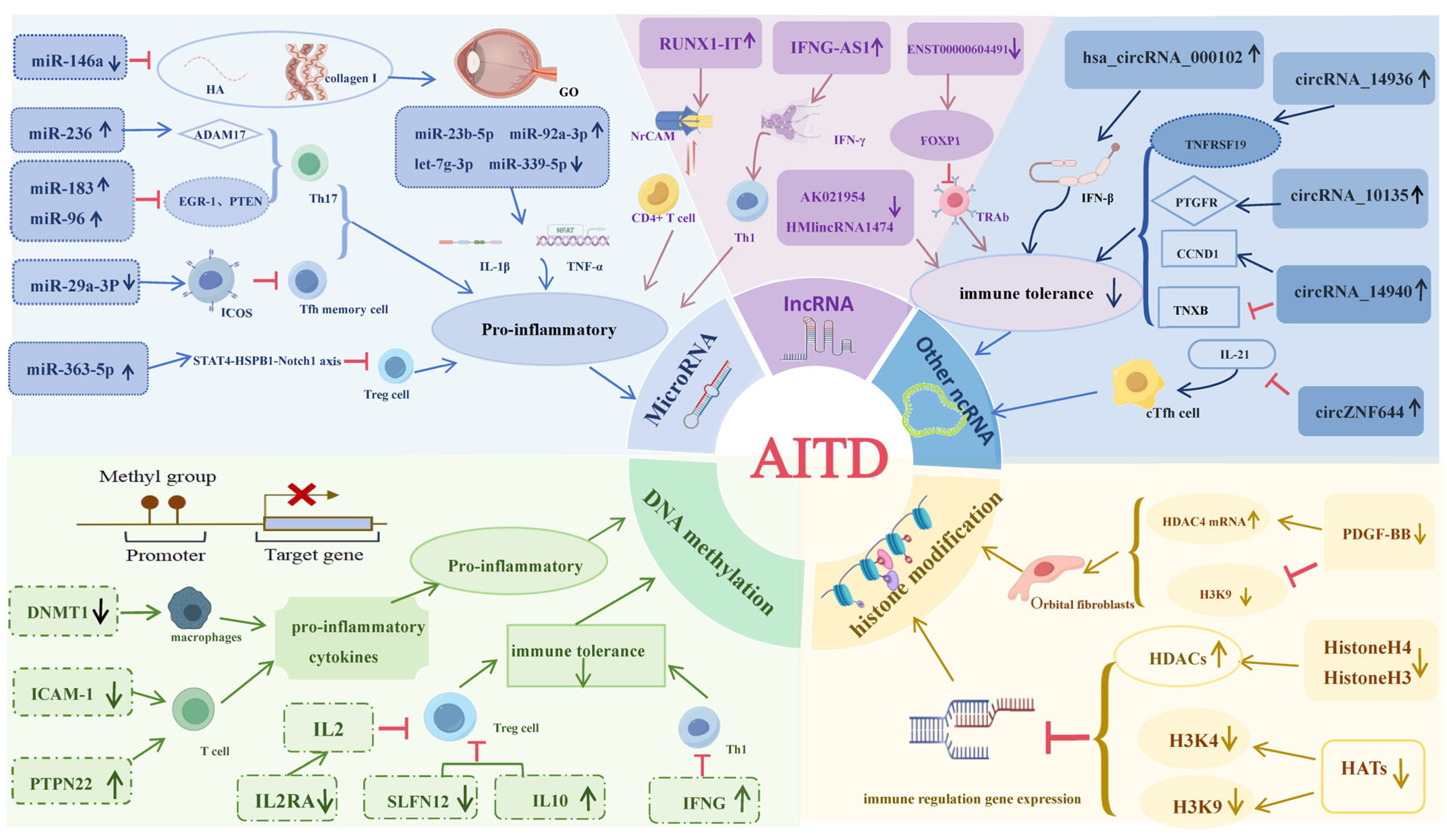
| HT [25] | PBMC | PTPN22 methylation increased | Gene underexpression disrupts immune regulation, leading to loss of immune tolerance, immune dysfunction, and excessive inflammation. | Pathogenesis |
| GD [40] | T cells | IL2RA methylation significantly decreased | Treg and immune tolerance, it disrupts the balance of the immune system, increasing the risk of GD in adolescents. | Clinic treatment |
| GD\HT [35] | Thyroid tissue | CCL5 and CXCL8 methylation decreased | May serve as epigenetic markers and bioindicators of AITD. | Disease markers |
| GD\HT [41] | PBMC | ICAM-1 methylation decreased | High ICAM-1 gene expression exacerbates the immune response in AITD. | Clinic treatment |
| GD\HT [42] | PBMC | CTLA4 methylation decreased | Gene overexpression inhibits T cell activation, affecting immune regulation. | Pathogenesis |
| GD\HT [43] | PBMC | IL6 methylation levels decreased | Gene overexpression worsens disease progression. | Pathogenesis |
| GD\HT [44] | PBMC | IFNG methylation increased | IFNG is related to the pathogenesis and prognosis of AITD, helpful in distinguishing refractory GD patients. | Disease markers |
| GO [45] | Fibroblasts | HAS significantly increased methylation | Decreased HAS gene expression reduces inflammation, alleviating AITD. | Clinic treatment |
| GD [46] | PBMC | IL10 methylation increased | Reduced production of IL10 affects immune cell proliferation, reducing inflammation. | Clinic treatment |
| HT [47] | PBMC | SLFN12 methylation decreased | High expression of SLFN12 disrupts immune tolerance, enhances immune activation, and promotes the development of AITD. | Pathogenesis |
| Disease | Sample Source | Disorder | Function | Effect in AITD |
|---|---|---|---|---|
| GD\HT [52] | PBMC | Histone H3 significantly decreased acetylation level | Uncontrolled immune response leading to intensified immune system attack on the thyroid, resulting in thyroid dysfunction | Disease markers, target therapy |
| GD [53] | PBMC | Histone H4 significantly decreased acetylation level | Inhibition of genes related to immune cell function, further exacerbating immune response and inflammation | Target therapy |
| GO [64] | Orbital fibroblasts | PDGF-BB significantly increased HDAC4 mRNA expression, low H3K9 acetylation | Stimulated induction of orbital fibroblast activation plays a key role in the pathogenesis of GO | Target therapy |
| GD [59] | PBMC | H3K4, H3K9 significantly decreased histone methylation | Loosening chromatin structure, allowing the activation and expression of inhibited genes | Pathogenesis |
| HT [65] | Thyroid tissue | Enriched H3K4me3 increase | Upregulation of genes related to immune, inflammation, and thyroid function, further intensifying self-immune and inflammatory responses | Pathogenesis |
| Disease | Sample Source | Expression | Function | Effect in AITD |
|---|---|---|---|---|
| GD [121] | Orbital Fibroblasts | Upregulation of miR-146a | Significant regulatory function in orbital fibroblasts | Clinic treatment |
| GD [84] | PBMC | Upregulation of miR-23b-5p and miR-92a-3p, downregulation of let-7g-3p and miR-339-5p | Potential biological targets for predicting GD treatment prognosis and disease resistance | Clinic treatment |
| GD\HT [122] | Ciliary Tissue | Upregulation of miR-21-5p, miR-146b-3p, miR-5571-3p, and miR-6503-3p | Upregulated expression positively correlated with ciliary growth in thyroid cells, indicating potential therapeutic targets for AITD | Clinic treatment |
| GD [123] | Tregs | Upregulation of miR-30a-5p, miR-181a, miR-636 | Significant reduction in the number and immune suppressive function of Tregs in initial GD patients | Clinic treatment |
| GD [124] | Peripheral T Cells | Upregulation of miR-183, miR-96 | Increased production of pathogenic cytokines in Th17 cells during development | Pathogenesis |
| GD [125] | Tfh Memory Cells | Downregulation of miR-29a-3p | Limitation of circulating Tfh memory cell response in GD patients | Clinic treatment |
| GD [82] | Serum | Upregulation of miR-210, downregulation of miR-182, miR-155, miR-146a | Potential new biomarkers for diagnosing GD | Disease markers |
| GD [126] | Serum | Upregulation of miR-346, downregulation of TRAb | Predictive factors for Graves’ Disease recurrence | Disease markers |
| GD [87] | Plasma | Downregulation of miR-144-3p, upregulation of miR-762 | Biomarkers for GD diagnosis | Disease markers |
| GD [127] | Thyroid Tissue | Downregulation of miR-21-5b, miR-19-1538, hsa-miR-182-5p; upregulation of 19-15038, hsa-miR-27a-3p, miR-Let7d-5p | Biomarkers for predicting GD recurrence or severity | Disease markers |
| GD [128] | Serum Samples | Upregulation of miR-19a, miR-143 | Biomarkers for development risk and/or severity | Disease markers |
| GD [129] | Peripheral Treg Cells | Upregulation of miR-363-5p | Inhibiting proliferation, differentiation, and function of Treg cells through STAT4-HSPB1-Notch1 axis | Clinic treatment |
| GD [83] | PBMC | Downregulation of miR-154-3p, miR-376b-3p, miR-431-3p | Potential new biomarkers for GD and therapeutic targets | Clinic treatment |
| GD [130] | CD4+ T cells and CD8+ T cells | Downregulation of miR-200a-3p and miR-200a-5p in CD4+ T cells and CD8+ T cells; downregulation of miR-155-5p and miR-155-3p in CD8+ T cells | Novel biomarkers for GD | Disease markers |
| HT [131] | Serum | Upregulation of miR-146a, miR-142, miR-301 | Prognostic biomarkers and Clinic treatment | Disease markers |
| HT [132] | PBMC | Upregulation of microRNA-326 | Potential molecular mechanism of miR-326 targeting ADAM17 to promote Th17 cell proliferation in HT patients in vitro | Pathogenesis |
| HT [133] | T cells | Downregulation of miR-29a-3p | Prognostic biomarkers and therapeutic targets | Disease markers |
| GD [134] | CD4+ T cells | Significant reduction in expression of NONHSAT093153.2, NONHSAT118924.2, NONHSAT209004.1 | Potential biomarkers for recurrent GD | Disease markers |
| GD [135] | PBMC | Significant downregulation of ENST00000604491 | Potential biomarker for diagnosing GD through regulation of FOXP1 in Treg cell modulation | Disease markers |
| GD [135] | PBMC | Decreased expression of AK021954, AB075506, HMlincRNA1474 | Potential new biomarkers for GD and therapeutic targets | Clinic treatment |
| GD [99] | CD4+ T cells | Most significant upregulation of RUNX1-IT1 and NrCAM | Provides new research directions for clinical treatment of GD | Clinic treatment |
| HT [108] | Th1 Cells | Increased expression of IFNG-AS1 | Enhanced expression contributes to Th1 cell response in HT patients and may be involved in the pathogenesis of HT | Disease markers |
| HT [115] | PBMC | significantly increased expression of hsa_circ_0089172 | Potential diagnostic biomarker for HT | Disease markers |
| GD [116] | Serum Exosomes | significantly increased expression of hsa_circRNA_000102 | Provides new insights into the pathogenesis and treatment of GD | Pathogenesis |
| GD/GO [136] | Orbital Fat/Connective Tissue | Increased expression of circRNA_14936 and circRNA_14940, decreased expression of circRNA_12367 | Differential expression of circRNAs may provide new insights into the pathogenesis of TAO | Pathogenesis |
| GD [117] | PBMC | Upregulation of circPHF16 | Potential target for developing new strategies for the diagnosis and treatment of GD, providing a theoretical basis for clinical treatment methods for GD | Clinic treatment |
| GD [137] | PBMC | Upregulation of circZNF644 | Key feature of GD development, potential diagnostic biomarker | Disease markers |
Disclaimer/Publisher’s Note: The statements, opinions and data contained in all publications are solely those of the individual author(s) and contributor(s) and not of MDPI and/or the editor(s). MDPI and/or the editor(s) disclaim responsibility for any injury to people or property resulting from any ideas, methods, instructions or products referred to in the content. |
© 2025 by the authors. Licensee MDPI, Basel, Switzerland. This article is an open access article distributed under the terms and conditions of the Creative Commons Attribution (CC BY) license (https://creativecommons.org/licenses/by/4.0/).
Share and Cite
Xiao, S.; Hu, Y.; Wang, X.; Yu, H. Epigenetic Mechanisms in Autoimmune Thyroid Diseases: Bridging Research and Clinical Applications. Int. J. Mol. Sci. 2025, 26, 11823. https://doi.org/10.3390/ijms262411823
Xiao S, Hu Y, Wang X, Yu H. Epigenetic Mechanisms in Autoimmune Thyroid Diseases: Bridging Research and Clinical Applications. International Journal of Molecular Sciences. 2025; 26(24):11823. https://doi.org/10.3390/ijms262411823
Chicago/Turabian StyleXiao, Shouxia, Yuelin Hu, Xin Wang, and Hongsong Yu. 2025. "Epigenetic Mechanisms in Autoimmune Thyroid Diseases: Bridging Research and Clinical Applications" International Journal of Molecular Sciences 26, no. 24: 11823. https://doi.org/10.3390/ijms262411823
APA StyleXiao, S., Hu, Y., Wang, X., & Yu, H. (2025). Epigenetic Mechanisms in Autoimmune Thyroid Diseases: Bridging Research and Clinical Applications. International Journal of Molecular Sciences, 26(24), 11823. https://doi.org/10.3390/ijms262411823