Helicobacter pylori Across Continents: Contrasts in Epidemiology, Genetics, Clinical Impact, and Management Between East and West


Abstract
1. Introduction
2. Epidemiology and Prevalence
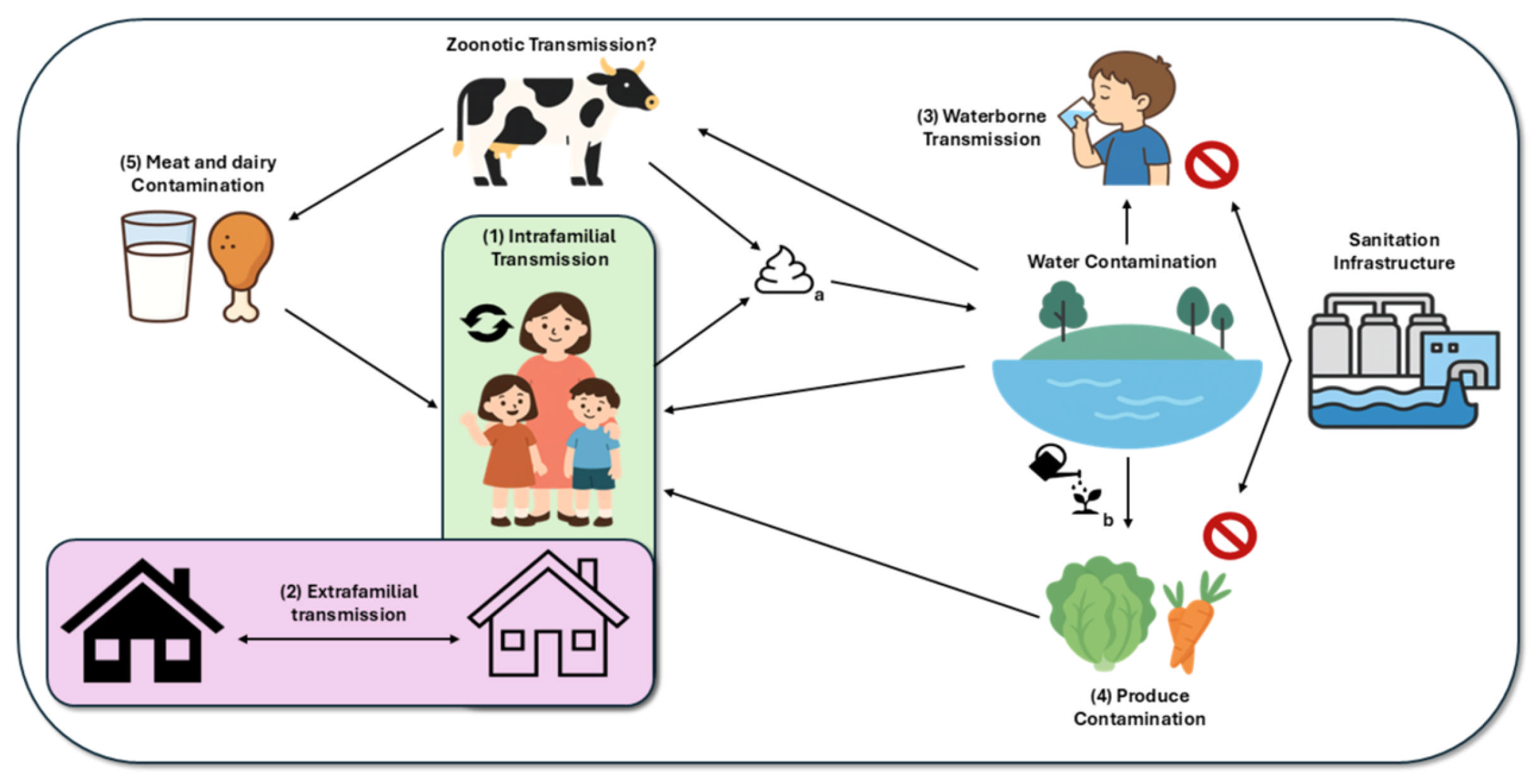
3. Transmission and Reinfection
3.1. Gastro-Oral Transmission
3.2. Oral–Oral Transmission
3.3. Fecal–Oral Transmission
3.4. Waterborne Transmission
3.5. Foodborne Transmission
3.6. Familial vs. Horizontal Transmission
3.7. Recurrence
3.8. East–West Differences in H. pylori Transmission and Recurrence
4. Genetic Diversity and Population Structure
4.1. Global Phylogeography and Lineage Diversity
4.2. Virulence Gene Profiles
4.3. Microevolution and Genomic Plasticity
4.4. Clinical Implications
5. Disease Burden and Clinical Patterns
5.1. Peptic Ulcer Disease
5.2. Gastric Cancer
- Strain Virulence: East Asian cagA variants, characterized by ABD-type structures containing the EPIYA-D motif, and VacA with the s1/m1 genotype—both of which are more prevalent in Asia—are associated with increased oncogenic potential [83].
5.3. MALT Lymphoma
5.4. Gastritis and Histopathology
5.5. Extra-Gastric Manifestations
- Iron-Deficiency Anemia (IDA): Multiple meta-analyses and clinical studies have confirmed a strong association between H. pylori infection and unexplained IDA, particularly in children and women of reproductive age. Eradication therapy has been shown to be able to improve hemoglobin levels in responsive cases [137,138].
- Vitamin B12 Deficiency: Chronic H. pylori-induced gastritis can impair intrinsic factor production and parietal cell function, leading to malabsorption of vitamin B12. A prospective cohort study demonstrated that eradication of H. pylori alone significantly improved serum B12 levels and corrected anemia in affected individuals [137,138,140].
- Metabolic and Cardiovascular Associations: Although still a field with limited and evolving evidence, H. pylori infection has been linked to metabolic syndrome, insulin resistance, and cardiovascular disease through mechanisms such as low-grade systemic inflammation and molecular mimicry [138,141,142].
5.6. Diagnostic Approaches and Treatment Strategies for H. pylori-Associated Diseases
6. Diagnostic Approaches
6.1. Histopathology
6.2. Culture
6.3. Rapid Urease Test
6.4. Urea Breath Test
6.5. Stool Antigen Tests
6.6. Antibody Detection Tests
6.7. Molecular Methods
6.8. Post-Treatment Testing
6.9. East vs. West Diagnostic Strategies
7. Antibiotic Resistance and Treatment Strategies
7.1. Antibiotic Resistance in the West and the East
7.2. Guidelines for H. pylori Eradication in the West and the East
7.2.1. General Aspects
7.2.2. Eradication Therapy in the West
7.2.3. Eradication in the East: China, Japan, and Korea
8. Conclusions
Author Contributions
Funding
Institutional Review Board Statement
Informed Consent Statement
Data Availability Statement
Conflicts of Interest
References
- Hooi, J.K.Y.; Lai, W.Y.; Ng, W.K.; Suen, M.M.Y.; Underwood, F.E.; Tanyingoh, D.; Malfertheiner, P.; Graham, D.Y.; Wong, V.W.S.; Wu, J.C.Y.; et al. Global Prevalence of Helicobacter pylori Infection: Systematic Review and Meta-Analysis. Gastroenterology 2017, 153, 420–429. [Google Scholar] [CrossRef] [PubMed]
- Marshall, B.J.; Warren, J.R. Unidentified curved bacilli in the stomach of patients with gastritis and peptic ulceration. Lancet 1984, 1, 1311–1315. [Google Scholar] [CrossRef] [PubMed]
- Suerbaum, S.; Michetti, P. Helicobacter pylori infection. N. Engl. J. Med. 2002, 347, 1175–1186. [Google Scholar] [CrossRef]
- IARC. Schistosomes, Liver Flukes and Helicobacter pylori; IARC Working Group on the Evaluation of Carcinogenic Risks to Humans: Lyon, France, 1994; Volume 61, pp. 177–240. [Google Scholar]
- Li, Y.; Choi, H.; Leung, K.; Jiang, F.; Graham, D.Y.; Leung, W.K. Global prevalence of Helicobacter pylori infection between 1980 and 2022: A systematic review and meta-analysis. Lancet Gastroenterol. Hepatol. 2023, 8, 553–564. [Google Scholar] [CrossRef]
- Bray, F.; Ferlay, J.; Soerjomataram, I.; Siegel, R.L.; Torre, L.A.; Jemal, A. Global cancer statistics 2018: GLOBOCAN estimates of incidence and mortality worldwide for 36 cancers in 185 countries. CA Cancer J. Clin. 2018, 68, 394–424, Erratum in CA Cancer J. Clin. 2020, 70, 313. https://doi.org/10.3322/caac.21609. [Google Scholar] [CrossRef]
- de Martel, C.; Georges, D.; Bray, F.; Ferlay, J.; Clifford, G.M. Global burden of cancer attributable to infections in 2018: A worldwide incidence analysis. Lancet Glob. Health 2020, 8, e180–e190. [Google Scholar] [CrossRef]
- Franceschi, F.; Tortora, A.; Gasbarrini, G.; Gasbarrini, A. Helicobacter pylori and extragastric diseases. Helicobacter 2014, 19 (Suppl. S1), 52–58. [Google Scholar] [CrossRef]
- Shirani, M.; Pakzad, R.; Haddadi, M.H.; Akrami, S.; Asadi, A.; Kazemian, H.; Moradi, M.; Kaviar, V.H.; Zomorodi, A.R.; Khoshnood, S.; et al. The global prevalence of gastric cancer in Helicobacter pylori-infected individuals: A systematic review and meta-analysis. BMC Infect. Dis. 2023, 23, 543. [Google Scholar] [CrossRef]
- Yamaoka, Y. Mechanisms of disease: Helicobacter pylori virulence factors. Nat. Rev. Gastroenterol. Hepatol. 2010, 7, 629–641. [Google Scholar] [CrossRef]
- Malfertheiner, P.; Megraud, F.; O’Morain, C.A.; Gisbert, J.P.; Kuipers, E.J.; Axon, A.T.; Bazzoli, F.; Gasbarrini, A.; Atherton, J.; Graham, D.Y.; et al. Management of Helicobacter pylori infection—The Maastricht V/Florence Consensus Report. Gut 2017, 66, 6–30. [Google Scholar] [CrossRef]
- Thung, I.; Aramin, H.; Vavinskaya, V.; Gupta, S.; Park, J.Y.; Crowe, S.E.; Valasek, M.A. Review article: The global emergence of Helicobacter pylori antibiotic resistance. Aliment. Pharmacol. Ther. 2016, 43, 514–533. [Google Scholar] [CrossRef]
- Cutler, A.F.; Prasad, V.M. Long-term follow-up of Helicobacter pylori serology after successful eradication. Am. J. Gastroenterol. 1996, 91, 85–88. [Google Scholar] [PubMed]
- Gantuya, B.; Bolor, D.; Oyuntsetseg, K.; Erdene-Ochir, Y.; Sanduijav, R.; Davaadorj, D.; Tserentogtokh, T.; Azzaya, D.; Uchida, T.; Matsuhisa, T.; et al. New observations regarding Helicobacter pylori and gastric cancer in Mongolia. Helicobacter 2018, 23, e12491. [Google Scholar] [CrossRef] [PubMed]
- Ueda, J.; Gosho, M.; Inui, Y.; Matsuda, T.; Sakakibara, M.; Mabe, K.; Nakajima, S.; Shimoyama, T.; Yasuda, M.; Kawai, T.; et al. Prevalence of Helicobacter pylori infection by birth year and geographic area in Japan. Helicobacter 2014, 19, 105–110. [Google Scholar] [CrossRef] [PubMed]
- Wang, C.; Nishiyama, T.; Kikuchi, S.; Inoue, M.; Sawada, N.; Tsugane, S.; Lin, Y. Changing trends in the prevalence of H. pylori infection in Japan (1908–2003): A systematic review and meta-regression analysis of 170,752 individuals. Sci. Rep. 2017, 7, 15491. [Google Scholar] [CrossRef]
- Thjodleifsson, B.; Asbjornsdottir, H.; Sigurjonsdottir, R.B.; Gislason, D.; Olafsson, I.; Cook, E.; Gislason, T.; Jogi, R.; Janson, C. Seroprevalence of Helicobacter pylori and cagA antibodies in Iceland, Estonia and Sweden. Scand. J. Infect. Dis. 2007, 39, 683–689. [Google Scholar] [CrossRef]
- Varga, M.G.; Butt, J.; Blot, W.J.; Le Marchand, L.; Haiman, C.A.; Chen, Y.; Wassertheil-Smoller, S.; Tinker, L.F.; Peek, R.M., Jr.; Potter, J.D.; et al. Racial Differences in Helicobacter pylori CagA Sero-prevalence in a Consortium of Adult Cohorts in the United States. Cancer Epidemiol. Biomark. Prev. 2020, 29, 2084–2092. [Google Scholar] [CrossRef]
- Brown, H.; Cantrell, S.; Tang, H.; Epplein, M.; Garman, K.S. Racial Differences in Helicobacter pylori Prevalence in the US: A Systematic Review. Gastro Hep Adv. 2022, 1, 857–868. [Google Scholar] [CrossRef]
- den Hollander, W.J.; Holster, I.L.; den Hoed, C.M.; van Deurzen, F.; van Vuuren, A.J.; Jaddoe, V.W.; Hofman, A.; Perez Perez, G.I.; Blaser, M.J.; Moll, H.A.; et al. Ethnicity is a strong predictor for Helicobacter pylori infection in young women in a multi-ethnic European city. J. Gastroenterol. Hepatol. 2013, 28, 1705–1711. [Google Scholar] [CrossRef]
- Shah, S.C.; Halvorson, A.E.; Lee, D.; Bustamante, R.; McBay, B.; Gupta, R.; Denton, J.; Dorn, C.; Wilson, O.; Peek, R., Jr.; et al. Helicobacter pylori Burden in the United States According to Individual Demographics and Geography: A Nationwide Analysis of the Veterans Healthcare System. Clin. Gastroenterol. Hepatol. 2024, 22, 42.e26–50.e26. [Google Scholar] [CrossRef]
- Chiang, T.H.; Chang, W.J.; Chen, S.L.; Yen, A.M.; Fann, J.C.; Chiu, S.Y.; Chen, Y.R.; Chuang, S.L.; Shieh, C.F.; Liu, C.Y.; et al. Mass eradication of Helicobacter pylori to reduce gastric cancer incidence and mortality: A long-term cohort study on Matsu Islands. Gut 2021, 70, 243–250. [Google Scholar] [CrossRef] [PubMed]
- Chey, W.D.; Howden, C.W.; Moss, S.F.; Morgan, D.R.; Greer, K.B.; Grover, S.; Shah, S.C. ACG Clinical Guideline: Treatment of Helicobacter pylori Infection. Am. J. Gastroenterol. 2024, 119, 1730–1753. [Google Scholar] [CrossRef]
- Wang, L.; Li, Z.; Tay, C.Y.; Marshall, B.J.; Gu, B.; Tian, Y.; Dai, X.; Du, H.; Dai, Q.; Feng, C.; et al. Multicentre, cross-sectional surveillance of Helicobacter pylori prevalence and antibiotic resistance to clarithromycin and levofloxacin in urban China using the string test coupled with quantitative PCR. Lancet Microbe 2024, 5, e512–e513. [Google Scholar] [CrossRef] [PubMed]
- Ren, S.; Cai, P.; Liu, Y.; Wang, T.; Zhang, Y.; Li, Q.; Gu, Y.; Wei, L.; Yan, C.; Jin, G. Prevalence of Helicobacter pylori infection in China: A systematic review and meta-analysis. J. Gastroenterol. Hepatol. 2022, 37, 464–470. [Google Scholar] [CrossRef] [PubMed]
- Tytgat, G.N. Endoscopic transmission of Helicobacter pylori. Aliment. Pharmacol. Ther. 1995, 9 (Suppl. S2), 105–110. [Google Scholar]
- Parsonnet, J.; Shmuely, H.; Haggerty, T. Fecal and oral shedding of Helicobacter pylori from healthy infected adults. JAMA 1999, 282, 2240–2245. [Google Scholar] [CrossRef]
- Janzon, A.; Bhuiyan, T.; Lundgren, A.; Qadri, F.; Svennerholm, A.M.; Sjoling, A. Presence of high numbers of transcriptionally active Helicobacter pylori in vomitus from Bangladeshi patients suffering from acute gastroenteritis. Helicobacter 2009, 14, 237–247. [Google Scholar] [CrossRef]
- Perry, S.; de la Luz Sanchez, M.; Yang, S.; Haggerty, T.D.; Hurst, P.; Perez-Perez, G.; Parsonnet, J. Gastroenteritis and transmission of Helicobacter pylori infection in households. Emerg. Infect. Dis. 2006, 12, 1701–1708. [Google Scholar] [CrossRef]
- Luzza, F.; Mancuso, M.; Imeneo, M.; Contaldo, A.; Giancotti, L.; Pensabene, L.; Doldo, P.; Liberto, M.C.; Strisciuglio, P.; Foca, A.; et al. Evidence favouring the gastro-oral route in the transmission of Helicobacter pylori infection in children. Eur. J. Gastroenterol. Hepatol. 2000, 12, 623–627. [Google Scholar] [CrossRef]
- Chow, T.K.; Lambert, J.R.; Wahlqvist, M.L.; Hsu-Hage, B.H. Helicobacter pylori in Melbourne Chinese immigrants: Evidence for oral-oral transmission via chopsticks. J. Gastroenterol. Hepatol. 1995, 10, 562–569. [Google Scholar] [CrossRef]
- Albenque, M.; Tall, F.; Dabis, F.; Megraud, F. Epidemiological study of Helicobacter pylori transmission from mother to child in Africa. Rev. Esp. Enferm. Dig. 1990, 78 (Suppl. S1), A48. [Google Scholar]
- Duan, M.; Li, Y.; Liu, J.; Zhang, W.; Dong, Y.; Han, Z.; Wan, M.; Lin, M.; Lin, B.; Kong, Q.; et al. Transmission routes and patterns of helicobacter pylori. Helicobacter 2023, 28, e12945. [Google Scholar] [CrossRef]
- Anand, P.S.; Kamath, K.P.; Gandhi, A.P.; Shamim, M.A.; Padhi, B.K.; Das, S. Dental plaque as an extra-gastric reservoir of Helicobacter pylori: A systematic review and meta-analysis. Arch. Oral Biol. 2025, 170, 106126. [Google Scholar] [CrossRef]
- Mao, X.; Jakubovics, N.S.; Bachle, M.; Buchalla, W.; Hiller, K.A.; Maisch, T.; Hellwig, E.; Kirschneck, C.; Gessner, A.; Al-Ahmad, A.; et al. Colonization of Helicobacter pylori in the oral cavity—An endless controversy? Crit. Rev. Microbiol. 2021, 47, 612–629. [Google Scholar] [CrossRef]
- Kabir, S. Detection of Helicobacter pylori in faeces by culture, PCR and enzyme immunoassay. J. Med. Microbiol. 2001, 50, 1021–1029. [Google Scholar] [CrossRef] [PubMed]
- Gisbert, J.P.; de la Morena, F.; Abraira, V. Accuracy of monoclonal stool antigen test for the diagnosis of H. pylori infection: A systematic review and meta-analysis. Am. J. Gastroenterol. 2006, 101, 1921–1930. [Google Scholar] [CrossRef] [PubMed]
- Momtaz, H.; Souod, N.; Dabiri, H.; Sarshar, M. Study of Helicobacter pylori genotype status in saliva, dental plaques, stool and gastric biopsy samples. World J. Gastroenterol. 2012, 18, 2105–2111. [Google Scholar] [CrossRef] [PubMed]
- Bui, D.; Brown, H.E.; Harris, R.B.; Oren, E. Serologic Evidence for Fecal-Oral Transmission of Helicobacter pylori. Am. J. Trop. Med. Hyg. 2016, 94, 82–88. [Google Scholar] [CrossRef] [PubMed]
- Ankarklev, J.; Hestvik, E.; Lebbad, M.; Lindh, J.; Kaddu-Mulindwa, D.H.; Andersson, J.O.; Tylleskar, T.; Tumwine, J.K.; Svard, S.G. Common coinfections of Giardia intestinalis and Helicobacter pylori in non-symptomatic Ugandan children. PLoS Negl. Trop. Dis. 2012, 6, e1780. [Google Scholar] [CrossRef]
- Kubota-Aizawa, S.; Matsubara, Y.; Kanemoto, H.; Mimuro, H.; Uchida, K.; Chambers, J.; Tsuboi, M.; Ohno, K.; Fukushima, K.; Kato, N.; et al. Transmission of Helicobacter pylori between a human and two dogs: A case report. Helicobacter 2021, 26, e12798. [Google Scholar] [CrossRef]
- Shaaban, S.I.; Talat, D.; Khatab, S.A.; Nossair, M.A.; Ayoub, M.A.; Ewida, R.M.; Diab, M.S. An investigative study on the zoonotic potential of Helicobacter pylori. BMC Vet. Res. 2023, 19, 16. [Google Scholar] [CrossRef] [PubMed]
- Nurgalieva, Z.Z.; Malaty, H.M.; Graham, D.Y.; Almuchambetova, R.; Machmudova, A.; Kapsultanova, D.; Osato, M.S.; Hollinger, F.B.; Zhangabylov, A. Helicobacter pylori infection in Kazakhstan: Effect of water source and household hygiene. Am. J. Trop. Med. Hyg. 2002, 67, 201–206. [Google Scholar] [CrossRef]
- Ahmed, K.S.; Khan, A.A.; Ahmed, I.; Tiwari, S.K.; Habeeb, A.; Ahi, J.D.; Abid, Z.; Ahmed, N.; Habibullah, C.M. Impact of household hygiene and water source on the prevalence and transmission of Helicobacter pylori: A South Indian perspective. Singap. Med. J. 2007, 48, 543–549. [Google Scholar]
- Cellini, L.; Campli, E.D.; Grande, R.; Bartolomeo, S.D.; Prenna, M.; Pasquantonio, M.S.; Pane, L. Detection of Helicobacter pylori associated with zooplankton. Aquat. Microb. Ecol. 2005, 40, 115–120. [Google Scholar] [CrossRef]
- Santiago, P.; Moreno, Y.; Ferrus, M.A. Identification of Viable Helicobacter pylori in Drinking Water Supplies by Cultural and Molecular Techniques. Helicobacter 2015, 20, 252–259. [Google Scholar] [CrossRef] [PubMed]
- Lu, Y.; Redlinger, T.E.; Avitia, R.; Galindo, A.; Goodman, K. Isolation and genotyping of Helicobacter pylori from untreated municipal wastewater. Appl. Environ. Microbiol. 2002, 68, 1436–1439. [Google Scholar] [CrossRef]
- Boehnke, K.F.; Eaton, K.A.; Valdivieso, M.; Baker, L.H.; Xi, C. Animal Model Reveals Potential Waterborne Transmission of Helicobacter pylori Infection. Helicobacter 2015, 20, 326–333. [Google Scholar] [CrossRef]
- Boehnke, K.F.; Eaton, K.A.; Fontaine, C.; Brewster, R.; Wu, J.; Eisenberg, J.N.S.; Valdivieso, M.; Baker, L.H.; Xi, C. Reduced infectivity of waterborne viable but nonculturable Helicobacter pylori strain SS1 in mice. Helicobacter 2017, 22, e12391. [Google Scholar] [CrossRef]
- Hopkins, R.J.; Vial, P.A.; Ferreccio, C.; Ovalle, J.; Prado, P.; Sotomayor, V.; Russell, R.G.; Wasserman, S.S.; Morris, J.G., Jr. Seroprevalence of Helicobacter pylori in Chile: Vegetables may serve as one route of transmission. J. Infect. Dis. 1993, 168, 222–226. [Google Scholar] [CrossRef]
- Quaglia, N.C.; Dambrosio, A. Helicobacter pylori: A foodborne pathogen? World J. Gastroenterol. 2018, 24, 3472–3487. [Google Scholar] [CrossRef]
- Saeidi, E.; Sheikhshahrokh, A. vacA Genotype Status of Helicobacter pylori Isolated from Foods with Animal Origin. Biomed. Res. Int. 2016, 2016, 8701067. [Google Scholar] [CrossRef]
- Momtaz, H.; Dabiri, H.; Souod, N.; Gholami, M. Study of Helicobacter pylori genotype status in cows, sheep, goats and human beings. BMC Gastroenterol. 2014, 14, 61. [Google Scholar] [CrossRef]
- Papiez, D.; Konturek, P.C.; Bielanski, W.; Plonka, M.; Dobrzanska, M.; Kaminska, A.; Szczyrk, U.; Bochenek, A.; Wierzchos, E. Prevalence of Helicobacter pylori infection in Polish shepherds and their families. Dig. Liver Dis. 2003, 35, 10–15. [Google Scholar] [CrossRef]
- Vale, F.F.; Vitor, J.M. Transmission pathway of Helicobacter pylori: Does food play a role in rural and urban areas? Int. J. Food Microbiol. 2010, 138, 1–12. [Google Scholar] [CrossRef]
- Kivi, M.; Johansson, A.L.; Reilly, M.; Tindberg, Y. Helicobacter pylori status in family members as risk factors for infection in children. Epidemiol. Infect. 2005, 133, 645–652. [Google Scholar] [CrossRef] [PubMed]
- Kivi, M.; Tindberg, Y.; Sorberg, M.; Casswall, T.H.; Befrits, R.; Hellstrom, P.M.; Bengtsson, C.; Engstrand, L.; Granstrom, M. Concordance of Helicobacter pylori strains within families. J. Clin. Microbiol. 2003, 41, 5604–5608. [Google Scholar] [CrossRef] [PubMed]
- Goodman, K.J.; Correa, P. Transmission of Helicobacter pylori among siblings. Lancet 2000, 355, 358–362. [Google Scholar] [CrossRef]
- Weyermann, M.; Rothenbacher, D.; Brenner, H. Acquisition of Helicobacter pylori infection in early childhood: Independent contributions of infected mothers, fathers, and siblings. Am. J. Gastroenterol. 2009, 104, 182–189. [Google Scholar] [CrossRef]
- Konno, M.; Fujii, N.; Yokota, S.; Sato, K.; Takahashi, M.; Sato, K.; Mino, E.; Sugiyama, T. Five-year follow-up study of mother-to-child transmission of Helicobacter pylori infection detected by a random amplified polymorphic DNA fingerprinting method. J. Clin. Microbiol. 2005, 43, 2246–2250. [Google Scholar] [CrossRef]
- Schwarz, S.; Morelli, G.; Kusecek, B.; Manica, A.; Balloux, F.; Owen, R.J.; Graham, D.Y.; van der Merwe, S.; Achtman, M.; Suerbaum, S. Horizontal versus Familial Transmission of Helicobacter pylori. PLoS Pathog. 2008, 4, e1000180. [Google Scholar] [CrossRef]
- Hu, Y.; Wan, J.H.; Li, X.Y.; Zhu, Y.; Graham, D.Y.; Lu, N.H. Systematic review with meta-analysis: The global recurrence rate of Helicobacter pylori. Aliment. Pharmacol. Ther. 2017, 46, 773–779. [Google Scholar] [CrossRef] [PubMed]
- Xu, L.; Li, X.T.; Ur-Rahman, I.; Zhang, C.; Qi, Y.B.; Hu, R.B.; Li, K.; Awadh, A.M.; Ma, J.; Xiao, W.; et al. Global H. pylori recurrence, recrudescence, and re-infection status after successful eradication in pediatric patients: A systematic review and meta-analysis. J. Gastroenterol. 2024, 59, 668–681. [Google Scholar] [CrossRef] [PubMed]
- Okimoto, T.; Murakami, K.; Sato, R.; Miyajima, H.; Nasu, M.; Kagawa, J.; Kodama, M.; Fujioka, T. Is the recurrence of Helicobacter pylori infection after eradication therapy resultant from recrudescence or reinfection, in Japan. Helicobacter 2003, 8, 186–191. [Google Scholar] [CrossRef] [PubMed]
- Take, S.; Mizuno, M.; Ishiki, K.; Imada, T.; Okuno, T.; Yoshida, T.; Yokota, K.; Oguma, K.; Kita, M.; Okada, H.; et al. Reinfection rate of Helicobacter pylori after eradication treatment: A long-term prospective study in Japan. J. Gastroenterol. 2012, 47, 641–646. [Google Scholar] [CrossRef]
- Gisbert, J.P.; Luna, M.; Gomez, B.; Herrerias, J.M.; Mones, J.; Castro-Fernandez, M.; Sanchez-Pobre, P.; Cosme, A.; Olivares, D.; Pajares, J.M. Recurrence of Helicobacter pylori infection after several eradication therapies: Long-term follow-up of 1000 patients. Aliment. Pharmacol. Ther. 2006, 23, 713–719. [Google Scholar] [CrossRef]
- Kim, S.Y.; Hyun, J.J.; Jung, S.W.; Koo, J.S.; Yim, H.J.; Lee, S.W. Helicobacter pylori recurrence after first- and second-line eradication therapy in Korea: The problem of recrudescence or reinfection. Helicobacter 2014, 19, 202–206. [Google Scholar] [CrossRef]
- Niv, Y.; Hazazi, R. Helicobacter pylori recurrence in developed and developing countries: Meta-analysis of 13C-urea breath test follow-up after eradication. Helicobacter 2008, 13, 56–61. [Google Scholar] [CrossRef]
- van der Ende, A.; van der Hulst, R.W.; Dankert, J.; Tytgat, G.N. Reinfection versus recrudescence in Helicobacter pylori infection. Aliment. Pharmacol. Ther. 1997, 11 (Suppl. S1), 55–61. [Google Scholar] [CrossRef]
- Li, D.; Jiang, S.F.; Lei, N.Y.; Shah, S.C.; Corley, D.A. Effect of Helicobacter pylori Eradication Therapy on the Incidence of Noncardia Gastric Adenocarcinoma in a Large Diverse Population in the United States. Gastroenterology 2023, 165, 391.e2–401.e2. [Google Scholar] [CrossRef]
- Ng, E.K.; Lam, Y.H.; Sung, J.J.; Yung, M.Y.; To, K.F.; Chan, A.C.; Lee, D.W.; Law, B.K.; Lau, J.Y.; Ling, T.K.; et al. Eradication of Helicobacter pylori prevents recurrence of ulcer after simple closure of duodenal ulcer perforation: Randomized controlled trial. Ann. Surg. 2000, 231, 153–158. [Google Scholar] [CrossRef]
- Moodley, Y.; Linz, B.; Yamaoka, Y.; Windsor, H.M.; Breurec, S.; Wu, J.Y.; Maady, A.; Bernhoft, S.; Thiberge, J.M.; Phuanukoonnon, S.; et al. The peopling of the Pacific from a bacterial perspective. Science 2009, 323, 527–530. [Google Scholar] [CrossRef] [PubMed]
- Tomb, J.F.; White, O.; Kerlavage, A.R.; Clayton, R.A.; Sutton, G.G.; Fleischmann, R.D.; Ketchum, K.A.; Klenk, H.P.; Gill, S.; Dougherty, B.A.; et al. The complete genome sequence of the gastric pathogen Helicobacter pylori. Nature 1997, 388, 539–547, Erratum in Nature 1997, 389, 412. https://doi.org/10.1038/38792. [Google Scholar] [CrossRef] [PubMed]
- Thorell, K.; Munoz-Ramirez, Z.Y.; Wang, D.; Sandoval-Motta, S.; Boscolo Agostini, R.; Ghirotto, S.; Torres, R.C.; HpGP Research Network; Falush, D.; Camargo, M.C.; et al. The Helicobacter pylori Genome Project: Insights into H. pylori population structure from analysis of a worldwide collection of complete genomes. Nat. Commun. 2023, 14, 8184. [Google Scholar] [CrossRef] [PubMed]
- Falush, D.; Wirth, T.; Linz, B.; Pritchard, J.K.; Stephens, M.; Kidd, M.; Blaser, M.J.; Graham, D.Y.; Vacher, S.; Perez-Perez, G.I.; et al. Traces of human migrations in Helicobacter pylori populations. Science 2003, 299, 1582–1585. [Google Scholar] [CrossRef]
- Linz, B.; Balloux, F.; Moodley, Y.; Manica, A.; Liu, H.; Roumagnac, P.; Falush, D.; Stamer, C.; Prugnolle, F.; van der Merwe, S.W.; et al. An African origin for the intimate association between humans and Helicobacter pylori. Nature 2007, 445, 915–918. [Google Scholar] [CrossRef]
- Jin, Q.Y.; Torres, R.C.; Yang, C.; He, L.H.; Liu, Z.C.; Li, W.Q.; Liu, W.D.; Zhang, L.F.; Falush, D.; Zhang, Y.; et al. Population structure of Helicobacter pylori and antibiotic resistance-associated variants in a high-risk area of gastric cancer. J. Clin. Microbiol. 2025, 63, e0003325. [Google Scholar] [CrossRef]
- Cover, T.L.; Dooley, C.P.; Blaser, M.J. Characterization of and human serologic response to proteins in Helicobacter pylori broth culture supernatants with vacuolizing cytotoxin activity. Infect. Immun. 1990, 58, 603–610. [Google Scholar] [CrossRef]
- Crabtree, J.E.; Taylor, J.D.; Wyatt, J.I.; Heatley, R.V.; Shallcross, T.M.; Tompkins, D.S.; Rathbone, B.J. Mucosal IgA recognition of Helicobacter pylori 120 kDa protein, peptic ulceration, and gastric pathology. Lancet 1991, 338, 332–335. [Google Scholar] [CrossRef]
- Covacci, A.; Censini, S.; Bugnoli, M.; Petracca, R.; Burroni, D.; Macchia, G.; Massone, A.; Papini, E.; Xiang, Z.; Figura, N.; et al. Molecular characterization of the 128-kDa immunodominant antigen of Helicobacter pylori associated with cytotoxicity and duodenal ulcer. Proc. Natl. Acad. Sci. USA 1993, 90, 5791–5795. [Google Scholar] [CrossRef]
- Tummuru, M.K.; Cover, T.L.; Blaser, M.J. Cloning and expression of a high-molecular-mass major antigen of Helicobacter pylori: Evidence of linkage to cytotoxin production. Infect. Immun. 1993, 61, 1799–1809. [Google Scholar] [CrossRef]
- Hatakeyama, M. Oncogenic mechanisms of the Helicobacter pylori CagA protein. Nat. Rev. Cancer 2004, 4, 688–694. [Google Scholar] [CrossRef]
- Zhou, W.; Yamazaki, S.; Yamakawa, A.; Ohtani, M.; Ito, Y.; Keida, Y.; Higashi, H.; Hatakeyama, M.; Si, J.; Azuma, T. The diversity of vacA and cagA genes of Helicobacter pylori in East Asia. FEMS Immunol. Med. Microbiol. 2004, 40, 81–87. [Google Scholar] [CrossRef]
- Pan, Z.J.; van der Hulst, R.W.; Feller, M.; Xiao, S.D.; Tytgat, G.N.; Dankert, J.; van der Ende, A. Equally high prevalences of infection with cagA-positive Helicobacter pylori in Chinese patients with peptic ulcer disease and those with chronic gastritis-associated dyspepsia. J. Clin. Microbiol. 1997, 35, 1344–1347. [Google Scholar] [CrossRef]
- Danesh, J.; Whincup, P.; Walker, M.; Lennon, L.; Thomson, A.; Appleby, P.; Hawkey, C.; Atherton, J.C. High prevalence of potentially virulent strains of Helicobacter pylori in the general male British population. Gut 2000, 47, 23–25. [Google Scholar] [CrossRef]
- Abe, T.; Kodama, M.; Murakami, K.; Matsunari, O.; Mizukami, K.; Inoue, K.; Uchida, M.; Okimoto, T.; Fujioka, T.; Uchida, T.; et al. Impact of Helicobacter pylori CagA diversity on gastric mucosal damage: An immunohistochemical study of East-Asian-type CagA. J. Gastroenterol. Hepatol. 2011, 26, 688–693. [Google Scholar] [CrossRef]
- Choi, K.D.; Kim, N.; Lee, D.H.; Kim, J.M.; Kim, J.S.; Jung, H.C.; Song, I.S. Analysis of the 3′ variable region of the cagA gene of Helicobacter pylori isolated in Koreans. Dig. Dis. Sci. 2007, 52, 960–966. [Google Scholar] [CrossRef] [PubMed]
- Matsunari, O.; Shiota, S.; Suzuki, R.; Watada, M.; Kinjo, N.; Murakami, K.; Fujioka, T.; Kinjo, F.; Yamaoka, Y. Association between Helicobacter pylori virulence factors and gastroduodenal diseases in Okinawa, Japan. J. Clin. Microbiol. 2012, 50, 876–883. [Google Scholar] [CrossRef]
- Cortes, M.C.; Yamakawa, A.; Casingal, C.R.; Fajardo, L.S.; Juan, M.L.; De Guzman, B.B.; Bondoc, E.M.; St. Luke’s Helicobacter pylori Study Group; Mahachai, V.; Yamazaki, Y.; et al. Diversity of the cagA gene of Helicobacter pylori strains from patients with gastroduodenal diseases in the Philippines. FEMS Immunol. Med. Microbiol. 2010, 60, 90–97. [Google Scholar] [CrossRef] [PubMed]
- Uchida, T.; Miftahussurur, M.; Pittayanon, R.; Vilaichone, R.K.; Wisedopas, N.; Ratanachu-Ek, T.; Kishida, T.; Moriyama, M.; Yamaoka, Y.; Mahachai, V. Helicobacter pylori Infection in Thailand: A Nationwide Study of the CagA Phenotype. PLoS ONE 2015, 10, e0136775. [Google Scholar] [CrossRef]
- Higashi, H.; Tsutsumi, R.; Fujita, A.; Yamazaki, S.; Asaka, M.; Azuma, T.; Hatakeyama, M. Biological activity of the Helicobacter pylori virulence factor CagA is determined by variation in the tyrosine phosphorylation sites. Proc. Natl. Acad. Sci. USA 2002, 99, 14428–14433. [Google Scholar] [CrossRef] [PubMed]
- Atherton, J.C.; Cao, P.; Peek, R.M., Jr.; Tummuru, M.K.; Blaser, M.J.; Cover, T.L. Mosaicism in vacuolating cytotoxin alleles of Helicobacter pylori. Association of specific vacA types with cytotoxin production and peptic ulceration. J. Biol. Chem. 1995, 270, 17771–17777. [Google Scholar] [CrossRef] [PubMed]
- Gerhard, M.; Lehn, N.; Neumayer, N.; Boren, T.; Rad, R.; Schepp, W.; Miehlke, S.; Classen, M.; Prinz, C. Clinical relevance of the Helicobacter pylori gene for blood-group antigen-binding adhesin. Proc. Natl. Acad. Sci. USA 1999, 96, 12778–12783. [Google Scholar] [CrossRef] [PubMed]
- Zhao, Q.; Song, C.; Wang, K.; Li, D.; Yang, Y.; Liu, D.; Wang, L.; Zhou, N.; Xie, Y. Prevalence of Helicobacter pylori babA, oipA, sabA, and homB genes in isolates from Chinese patients with different gastroduodenal diseases. Med. Microbiol. Immunol. 2020, 209, 565–577. [Google Scholar] [CrossRef] [PubMed]
- Yamaoka, Y.; Kodama, T.; Gutierrez, O.; Kim, J.G.; Kashima, K.; Graham, D.Y. Relationship between Helicobacter pylori iceA, cagA, and vacA status and clinical outcome: Studies in four different countries. J. Clin. Microbiol. 1999, 37, 2274–2279. [Google Scholar] [CrossRef]
- Yahara, K.; Kawai, M.; Furuta, Y.; Takahashi, N.; Handa, N.; Tsuru, T.; Oshima, K.; Yoshida, M.; Azuma, T.; Hattori, M.; et al. Genome-wide survey of mutual homologous recombination in a highly sexual bacterial species. Genome Biol. Evol. 2012, 4, 628–640. [Google Scholar] [CrossRef]
- Kennemann, L.; Didelot, X.; Aebischer, T.; Kuhn, S.; Drescher, B.; Droege, M.; Reinhardt, R.; Correa, P.; Meyer, T.F.; Josenhans, C.; et al. Helicobacter pylori genome evolution during human infection. Proc. Natl. Acad. Sci. USA 2011, 108, 5033–5038. [Google Scholar] [CrossRef]
- Didelot, X.; Nell, S.; Yang, I.; Woltemate, S.; van der Merwe, S.; Suerbaum, S. Genomic evolution and transmission of Helicobacter pylori in two South African families. Proc. Natl. Acad. Sci. USA 2013, 110, 13880–13885. [Google Scholar] [CrossRef]
- Falush, D.; Kraft, C.; Taylor, N.S.; Correa, P.; Fox, J.G.; Achtman, M.; Suerbaum, S. Recombination and mutation during long-term gastric colonization by Helicobacter pylori: Estimates of clock rates, recombination size, and minimal age. Proc. Natl. Acad. Sci. USA 2001, 98, 15056–15061. [Google Scholar] [CrossRef]
- Ochman, H.; Elwyn, S.; Moran, N.A. Calibrating bacterial evolution. Proc. Natl. Acad. Sci. USA 1999, 96, 12638–12643. [Google Scholar] [CrossRef]
- Milkman, R.; Bridges, M.M. Molecular evolution of the Escherichia coli chromosome. III. Clonal frames. Genetics 1990, 126, 505–517. [Google Scholar] [CrossRef]
- Gerrits, M.M.; van Vliet, A.H.; Kuipers, E.J.; Kusters, J.G. Helicobacter pylori and antimicrobial resistance: Molecular mechanisms and clinical implications. Lancet Infect. Dis. 2006, 6, 699–709. [Google Scholar] [CrossRef]
- Nguyen, A.N.T.; Woods, L.C.; Gorrell, R.; Ramanan, S.; Kwok, T.; McDonald, M.J. Recombination resolves the cost of horizontal gene transfer in experimental populations of Helicobacter pylori. Proc. Natl. Acad. Sci. USA 2022, 119, e2119010119. [Google Scholar] [CrossRef]
- Taylor, D.E.; Ge, Z.; Purych, D.; Lo, T.; Hiratsuka, K. Cloning and sequence analysis of two copies of a 23S rRNA gene from Helicobacter pylori and association of clarithromycin resistance with 23S rRNA mutations. Antimicrob. Agents Chemother. 1997, 41, 2621–2628. [Google Scholar] [CrossRef]
- Alkharsah, K.R.; Aljindan, R.Y.; Alamri, A.M.; Alomar, A.I.; Al-Quorain, A.A. Molecular characterization of Helicobacter pylori clinical isolates from Eastern Saudi Arabia. Saudi Med. J. 2022, 43, 1128–1135. [Google Scholar] [CrossRef]
- Okamoto, T.; Yoshiyama, H.; Nakazawa, T.; Park, I.D.; Chang, M.W.; Yanai, H.; Okita, K.; Shirai, M. A change in PBP1 is involved in amoxicillin resistance of clinical isolates of Helicobacter pylori. J. Antimicrob. Chemother. 2002, 50, 849–856. [Google Scholar] [CrossRef]
- Heep, M.; Rieger, U.; Beck, D.; Lehn, N. Mutations in the beginning of the rpoB gene can induce resistance to rifamycins in both Helicobacter pylori and Mycobacterium tuberculosis. Antimicrob. Agents Chemother. 2000, 44, 1075–1077. [Google Scholar] [CrossRef]
- Hays, C.; Burucoa, C.; Lehours, P.; Tran, C.T.; Leleu, A.; Raymond, J. Molecular characterization of Helicobacter pylori resistance to rifamycins. Helicobacter 2018, 23, e12451. [Google Scholar] [CrossRef] [PubMed]
- Lam, S.K. Differences in peptic ulcer between East and West. Best Pract. Res. Clin. Gastroenterol. 2000, 14, 41–52. [Google Scholar] [CrossRef] [PubMed]
- McColl, K.E.; el-Omar, E.; Gillen, D. Helicobacter pylori gastritis and gastric physiology. Gastroenterol. Clin. N. Am. 2000, 29, 687–703. [Google Scholar] [CrossRef] [PubMed]
- Malfertheiner, P. The intriguing relationship of Helicobacter pylori infection and acid secretion in peptic ulcer disease and gastric cancer. Dig. Dis. 2011, 29, 459–464. [Google Scholar] [CrossRef]
- Hamashima, C.; Systematic Review Group and Guideline Development Group for Gastric Cancer Screening Guidelines. Update version of the Japanese Guidelines for Gastric Cancer Screening. Jpn. J. Clin. Oncol. 2018, 48, 673–683. [Google Scholar] [CrossRef] [PubMed]
- Luu, X.Q.; Lee, K.; Jun, J.K.; Suh, M.; Choi, K.S. Socioeconomic inequality in organized and opportunistic screening for gastric cancer: Results from the Korean National Cancer Screening Survey 2009–2022. Front. Public Health 2023, 11, 1256525. [Google Scholar] [CrossRef] [PubMed]
- Sutton, P.; Boag, J.M. Status of vaccine research and development for Helicobacter pylori. Vaccine 2019, 37, 7295–7299. [Google Scholar] [CrossRef] [PubMed]
- Sun, M.; Liu, E.; Yang, L.; Cao, H.; Han, M. A scoping review of worldwide guidelines for diagnosis and treatment of Helicobacter pylori infection. Syst. Rev. 2025, 14, 107. [Google Scholar] [CrossRef]
- Kusters, J.G.; van Vliet, A.H.; Kuipers, E.J. Pathogenesis of Helicobacter pylori infection. Clin. Microbiol. Rev. 2006, 19, 449–490. [Google Scholar] [CrossRef]
- Yuan, X.Y.; Yan, J.J.; Yang, Y.C.; Wu, C.M.; Hu, Y.; Geng, J.L. Helicobacter pylori with East Asian-type cagPAI genes is more virulent than strains with Western-type in some cagPAI genes. Braz. J. Microbiol. 2017, 48, 218–224. [Google Scholar] [CrossRef]
- Wirth, H.P.; Yang, M. Different Pathophysiology of Gastritis in East and West? A Western Perspective. Inflamm. Intestig. Dis. 2016, 1, 113–122. [Google Scholar] [CrossRef]
- Suzuki, H.; Mori, H. Different Pathophysiology of Gastritis between East and West? An Asian Perspective. Inflamm. Intestig. Dis. 2016, 1, 123–128. [Google Scholar] [CrossRef]
- Duncan, S.S.; Valk, P.L.; McClain, M.S.; Shaffer, C.L.; Metcalf, J.A.; Bordenstein, S.R.; Cover, T.L. Comparative genomic analysis of East Asian and non-Asian Helicobacter pylori strains identifies rapidly evolving genes. PLoS ONE 2013, 8, e55120. [Google Scholar] [CrossRef]
- Lu, H.; Wu, J.Y.; Beswick, E.J.; Ohno, T.; Odenbreit, S.; Haas, R.; Reyes, V.E.; Kita, M.; Graham, D.Y.; Yamaoka, Y. Functional and intracellular signaling differences associated with the Helicobacter pylori AlpAB adhesin from Western and East Asian strains. J. Biol. Chem. 2007, 282, 6242–6254. [Google Scholar] [CrossRef]
- Basso, D.; Zambon, C.F.; Letley, D.P.; Stranges, A.; Marchet, A.; Rhead, J.L.; Schiavon, S.; Guariso, G.; Ceroti, M.; Nitti, D.; et al. Clinical relevance of Helicobacter pylori cagA and vacA gene polymorphisms. Gastroenterology 2008, 135, 91–99. [Google Scholar] [CrossRef]
- El-Omar, E.M.; Carrington, M.; Chow, W.H.; McColl, K.E.; Bream, J.H.; Young, H.A.; Herrera, J.; Lissowska, J.; Yuan, C.C.; Rothman, N.; et al. Interleukin-1 polymorphisms associated with increased risk of gastric cancer. Nature 2000, 404, 398–402, Erratum in Nature 2001, 412, 99. https://doi.org/10.1038/35083631. [Google Scholar] [CrossRef] [PubMed]
- El-Omar, E.M.; Rabkin, C.S.; Gammon, M.D.; Vaughan, T.L.; Risch, H.A.; Schoenberg, J.B.; Stanford, J.L.; Mayne, S.T.; Goedert, J.; Blot, W.J.; et al. Increased risk of noncardia gastric cancer associated with proinflammatory cytokine gene polymorphisms. Gastroenterology 2003, 124, 1193–1201. [Google Scholar] [CrossRef] [PubMed]
- Figueiredo, C.; Machado, J.C.; Pharoah, P.; Seruca, R.; Sousa, S.; Carvalho, R.; Capelinha, A.F.; Quint, W.; Caldas, C.; van Doorn, L.J.; et al. Helicobacter pylori and interleukin 1 genotyping: An opportunity to identify high-risk individuals for gastric carcinoma. J. Natl. Cancer Inst. 2002, 94, 1680–1687. [Google Scholar] [CrossRef] [PubMed]
- Jia, Z.F.; Zhang, S.L.; Cao, X.Y.; Zhou, B.S.; Jiang, J. Interaction between Helicobacter pylori and host genetic variants in gastric carcinogenesis. Future Oncol. 2016, 12, 2127–2134. [Google Scholar] [CrossRef]
- Persson, C.; Canedo, P.; Machado, J.C.; El-Omar, E.M.; Forman, D. Polymorphisms in inflammatory response genes and their association with gastric cancer: A HuGE systematic review and meta-analyses. Am. J. Epidemiol. 2011, 173, 259–270. [Google Scholar] [CrossRef]
- Morson, B.C.; Sobin, L.H.; Grundmann, E.; Johansen, A.; Nagayo, T.; Serck-Hanssen, A. Precancerous conditions and epithelial dysplasia in the stomach. J. Clin. Pathol. 1980, 33, 711–721. [Google Scholar] [CrossRef]
- Ferlay, E.M.J.; Lam, F.; Laversanne, M.; Colombet, M.; Mery, L.; Piñeros, M.; Znaor, A.; Soerjomataram, I.; Bray, F. Global Cancer Observatory: Cancer Today. 2024. Available online: https://gco.iarc.fr/en (accessed on 7 September 2025).
- Natsume, H.; Szczepaniak, K.; Yamada, H.; Iwashita, Y.; Gedek, M.; Suto, J.; Ishino, K.; Kasajima, R.; Matsuda, T.; Manirakiza, F.; et al. Non-CpG sites preference in G:C > A:T transition of TP53 in gastric cancer of Eastern Europe (Poland, Romania and Hungary) compared to East Asian countries (China and Japan). Genes Environ. 2023, 45, 1. [Google Scholar] [CrossRef]
- Yao, K.; Uedo, N.; Kamada, T.; Hirasawa, T.; Nagahama, T.; Yoshinaga, S.; Oka, M.; Inoue, K.; Mabe, K.; Yao, T.; et al. Guidelines for endoscopic diagnosis of early gastric cancer. Dig. Endosc. 2020, 32, 663–698. [Google Scholar] [CrossRef]
- Alaggio, R.; Amador, C.; Anagnostopoulos, I.; Attygalle, A.D.; Araujo, I.B.O.; Berti, E.; Bhagat, G.; Borges, A.M.; Boyer, D.; Calaminici, M.; et al. The 5th edition of the World Health Organization Classification of Haematolymphoid Tumours: Lymphoid Neoplasms. Leukemia 2022, 36, 1720–1748, Erratum in Leukemia 2023, 37, 1944–1951. https://doi.org/10.1038/s41375-023-01962-5. [Google Scholar] [CrossRef]
- Wundisch, T.; Mosch, C.; Neubauer, A.; Stolte, M. Helicobacter pylori eradication in gastric mucosa-associated lymphoid tissue lymphoma: Results of a 196-patient series. Leuk. Lymphoma 2006, 47, 2110–2114. [Google Scholar] [CrossRef] [PubMed]
- Huh, J. Epidemiologic overview of malignant lymphoma. Korean J. Hematol. 2012, 47, 92–104. [Google Scholar] [CrossRef] [PubMed]
- Wee, H.L.; Canfell, K.; Chiu, H.M.; Choi, K.S.; Cox, B.; Bhoo-Pathy, N.; Simms, K.T.; Hamashima, C.; Shen, Q.; Chua, B.; et al. Cancer screening programs in South-east Asia and Western Pacific. BMC Health Serv. Res. 2024, 24, 102. [Google Scholar] [CrossRef] [PubMed]
- Toyoshima, O.; Nishizawa, T. Kyoto classification of gastritis: Advances and future perspectives in endoscopic diagnosis of gastritis. World J. Gastroenterol. 2022, 28, 6078–6089. [Google Scholar] [CrossRef]
- Tsay, F.W.; Hsu, P.I.H. H. pylori infection and extra-gastroduodenal diseases. J. Biomed. Sci. 2018, 25, 65. [Google Scholar] [CrossRef]
- Gravina, A.G.; Priadko, K.; Ciamarra, P.; Granata, L.; Facchiano, A.; Miranda, A.; Dallio, M.; Federico, A.; Romano, M. Extra-Gastric Manifestations of Helicobacter pylori Infection. J. Clin. Med. 2020, 9, 3887. [Google Scholar] [CrossRef]
- Stasi, R.; Sarpatwari, A.; Segal, J.B.; Osborn, J.; Evangelista, M.L.; Cooper, N.; Provan, D.; Newland, A.; Amadori, S.; Bussel, J.B. Effects of eradication of Helicobacter pylori infection in patients with immune thrombocytopenic purpura: A systematic review. Blood 2009, 113, 1231–1240. [Google Scholar] [CrossRef]
- Kaptan, K.; Beyan, C.; Ural, A.U.; Cetin, T.; Avcu, F.; Gulsen, M.; Finci, R.; Yalcin, A. Helicobacter pylori—Is it a novel causative agent in Vitamin B12 deficiency? Arch. Intern. Med. 2000, 160, 1349–1353. [Google Scholar] [CrossRef]
- Hsieh, M.C.; Wang, S.S.; Hsieh, Y.T.; Kuo, F.C.; Soon, M.S.; Wu, D.C. Helicobacter pylori infection associated with high HbA1c and type 2 diabetes. Eur. J. Clin. Investig. 2013, 43, 949–956. [Google Scholar] [CrossRef]
- Goni, E.; Franceschi, F. Helicobacter pylori and extragastric diseases. Helicobacter 2016, 21 (Suppl. S1), 45–48. [Google Scholar] [CrossRef]
- Pasceri, V.; Cammarota, G.; Patti, G.; Cuoco, L.; Gasbarrini, A.; Grillo, R.L.; Fedeli, G.; Gasbarrini, G.; Maseri, A. Association of virulent Helicobacter pylori strains with ischemic heart disease. Circulation 1998, 97, 1675–1679. [Google Scholar] [CrossRef]
- Singh, R.K.; McMahon, A.D.; Patel, H.; Packard, C.J.; Rathbone, B.J.; Samani, N.J. Prospective analysis of the association of infection with CagA bearing strains of Helicobacter pylori and coronary heart disease. Heart 2002, 88, 43–46. [Google Scholar] [CrossRef] [PubMed]
- Gabrielli, M.; Santoliquido, A.; Cremonini, F.; Cicconi, V.; Candelli, M.; Serricchio, M.; Tondi, P.; Pola, R.; Gasbarrini, G.; Pola, P.; et al. CagA-positive cytotoxic H. pylori strains as a link between plaque instability and atherosclerotic stroke. Eur. Heart J. 2004, 25, 64–68. [Google Scholar] [CrossRef] [PubMed]
- Kimura, K.; Takemoto, T. An Endoscopic Recognition of the Atrophic Border and its Significance in Chronic Gastritis. Endoscopy 1969, 1, 87–97. [Google Scholar] [CrossRef]
- Yao, K. Magnifying endoscopy for the diagnosis of early gastric cancer: Establishment of technique, diagnostic system, and scientific evidence from Japan. Dig. Endosc. 2022, 34 (Suppl. S2), 50–54. [Google Scholar] [CrossRef]
- Muto, M.; Yao, K.; Kaise, M.; Kato, M.; Uedo, N.; Yagi, K.; Tajiri, H. Magnifying endoscopy simple diagnostic algorithm for early gastric cancer (MESDA-G). Dig. Endosc. 2016, 28, 379–393, Erratum in Dig. Endosc. 2016, 28, 630. https://doi.org/10.1111/den.12685. [Google Scholar] [CrossRef]
- Ezoe, Y.; Muto, M.; Uedo, N.; Doyama, H.; Yao, K.; Oda, I.; Kaneko, K.; Kawahara, Y.; Yokoi, C.; Sugiura, Y.; et al. Magnifying narrowband imaging is more accurate than conventional white-light imaging in diagnosis of gastric mucosal cancer. Gastroenterology 2011, 141, 2017–2025.e3. [Google Scholar] [CrossRef]
- Gotoda, T.; Yamamoto, H.; Soetikno, R.M. Endoscopic submucosal dissection of early gastric cancer. J. Gastroenterol. 2006, 41, 929–942. [Google Scholar] [CrossRef]
- Isomoto, H.; Shikuwa, S.; Yamaguchi, N.; Fukuda, E.; Ikeda, K.; Nishiyama, H.; Ohnita, K.; Mizuta, Y.; Shiozawa, J.; Kohno, S. Endoscopic submucosal dissection for early gastric cancer: A large-scale feasibility study. Gut 2009, 58, 331–336. [Google Scholar] [CrossRef]
- Hatta, W.; Gotoda, T.; Oyama, T.; Kawata, N.; Takahashi, A.; Yoshifuku, Y.; Hoteya, S.; Nakagawa, M.; Hirano, M.; Esaki, M.; et al. Correction: A Scoring System to Stratify Curability after Endoscopic Submucosal Dissection for Early Gastric Cancer: “eCura system”. Am. J. Gastroenterol. 2019, 114, 1925–1926, Erratum in Am. J. Gastroenterol. 2017, 112, 874–881. https://doi.org/10.1038/ajg.2017.95. [Google Scholar] [CrossRef] [PubMed]
- Ning, F.L.; Zhang, N.N.; Zhao, Z.M.; Du, W.Y.; Zeng, Y.J.; Abe, M.; Pei, J.P.; Zhang, C.D. Global, Regional, and National Burdens with Temporal Trends of Early-, Intermediate-, and Later-Onset Gastric Cancer from 1990 to 2019 and Predictions up to 2035. Cancers 2022, 14, 5417. [Google Scholar] [CrossRef]
- Zhao, Z.; Li, H.; Pan, X.; Shen, C.; Mu, M.; Yin, X.; Liao, J.; Cai, Z.; Zhang, B. Optimal reconstruction methods after distal gastrectomy for gastric cancer: A protocol for a systematic review and network meta-analysis update. Syst. Rev. 2024, 13, 19. [Google Scholar] [CrossRef] [PubMed]
- Pimentel-Nunes, P.; Libanio, D.; Bastiaansen, B.A.J.; Bhandari, P.; Bisschops, R.; Bourke, M.J.; Esposito, G.; Lemmers, A.; Maselli, R.; Messmann, H.; et al. Endoscopic submucosal dissection for superficial gastrointestinal lesions: European Society of Gastrointestinal Endoscopy (ESGE) Guideline—Update 2022. Endoscopy 2022, 54, 591–622. [Google Scholar] [CrossRef] [PubMed]
- Al-Haddad, M.A.; Elhanafi, S.E.; Forbes, N.; Thosani, N.C.; Draganov, P.V.; Othman, M.O.; Ceppa, E.P.; Kaul, V.; Feely, M.M.; Sahin, I.; et al. American Society for Gastrointestinal Endoscopy guideline on endoscopic submucosal dissection for the management of early esophageal and gastric cancers: Methodology and review of evidence. Gastrointest. Endosc. 2023, 98, 285–305.e38. [Google Scholar] [CrossRef] [PubMed]
- Umar, Z.; Tang, J.W.; Marshall, B.J.; Tay, A.C.Y.; Wang, L. Rapid diagnosis and precision treatment of Helicobacter pylori infection in clinical settings. Crit. Rev. Microbiol. 2025, 51, 369–398. [Google Scholar] [CrossRef]
- Wang, Y.K.; Kuo, F.C.; Liu, C.J.; Wu, M.C.; Shih, H.Y.; Wang, S.S.; Wu, J.Y.; Kuo, C.H.; Huang, Y.K.; Wu, D.C. Diagnosis of Helicobacter pylori infection: Current options and developments. World J. Gastroenterol. 2015, 21, 11221–11235. [Google Scholar] [CrossRef]
- Chinese Society of Gastroenterology, Chinese Study Group on Helicobacter pylori; Liu, W.Z.; Xie, Y.; Cheng, H.; Lu, N.H.; Hu, F.L.; Zhang, W.D.; Zhou, L.Y.; Chen, Y.; Zeng, Z.R.; et al. Fourth Chinese National Consensus Report on the management of Helicobacter pylori infection. J. Dig. Dis. 2013, 14, 211–221. [Google Scholar] [CrossRef]
- Lan, H.C.; Chen, T.S.; Li, A.F.; Chang, F.Y.; Lin, H.C. Additional corpus biopsy enhances the detection of Helicobacter pylori infection in a background of gastritis with atrophy. BMC Gastroenterol. 2012, 12, 182. [Google Scholar] [CrossRef]
- Weston, A.P.; Campbell, D.R.; Hassanein, R.S.; Cherian, R.; Dixon, A.; McGregor, D.H. Prospective, multivariate evaluation of CLOtest performance. Am. J. Gastroenterol. 1997, 92, 1310–1315. [Google Scholar]
- Gatta, L.; Vakil, N.; Ricci, C.; Osborn, J.F.; Tampieri, A.; Perna, F.; Miglioli, M.; Vaira, D. Effect of proton pump inhibitors and antacid therapy on 13C urea breath tests and stool test for Helicobacter pylori infection. Am. J. Gastroenterol. 2004, 99, 823–829. [Google Scholar] [CrossRef]
- Braden, B. Diagnosis of Helicobacter pylori infection. BMJ 2012, 344, e828. [Google Scholar] [CrossRef] [PubMed]
- Alihosseini, S.; Jaberinezhad, M.; SadeghpourHeravi, F.; Ghotaslou, R.; Ebrahimzadeh Leylabadlo, H. Invasive and non-invasive Helicobacter pylori diagnostic methods in Iran. Gene Rep. 2020, 20, 100749, Erratum in Gene Rep. 2021, 24, 101039. https://doi.org/10.1016/j.genrep.2021.101039. [Google Scholar] [CrossRef]
- Urgessa, N.A.; Geethakumari, P.; Kampa, P.; Parchuri, R.; Bhandari, R.; Alnasser, A.R.; Akram, A.; Kar, S.; Osman, F.; Mashat, G.D.; et al. A Comparison Between Histology and Rapid Urease Test in the Diagnosis of Helicobacter Pylori in Gastric Biopsies: A Systematic Review. Cureus 2023, 15, e39360. [Google Scholar] [CrossRef]
- Malfertheiner, P.; Camargo, M.C.; El-Omar, E.; Liou, J.M.; Peek, R.; Schulz, C.; Smith, S.I.; Suerbaum, S. Helicobacter pylori infection. Nat. Rev. Dis. Primers 2023, 9, 19. [Google Scholar] [CrossRef]
- Makristathis, A.; Hirschl, A.M.; Megraud, F.; Bessede, E. Review: Diagnosis of Helicobacter pylori infection. Helicobacter 2019, 24 (Suppl. S1), e12641. [Google Scholar] [CrossRef]
- Sabbagh, P.; Mohammadnia-Afrouzi, M.; Javanian, M.; Babazadeh, A.; Koppolu, V.; Vasigala, V.R.; Nouri, H.R.; Ebrahimpour, S. Diagnostic methods for Helicobacter pylori infection: Ideals, options, and limitations. Eur. J. Clin. Microbiol. Infect. Dis. 2019, 38, 55–66. [Google Scholar] [CrossRef]
- Cardos, A.I.; Maghiar, A.; Zaha, D.C.; Pop, O.; Fritea, L.; Miere Groza, F.; Cavalu, S. Evolution of Diagnostic Methods for Helicobacter pylori Infections: From Traditional Tests to High Technology, Advanced Sensitivity and Discrimination Tools. Diagnostics 2022, 12, 508. [Google Scholar] [CrossRef]
- Bosch, D.E.; Krumm, N.; Wener, M.H.; Yeh, M.M.; Truong, C.D.; Reddi, D.M.; Liu, Y.; Swanson, P.E.; Schmidt, R.A.; Bryan, A. Serology Is More Sensitive Than Urea Breath Test or Stool Antigen for the Initial Diagnosis of Helicobacter pylori Gastritis When Compared With Histopathology. Am. J. Clin. Pathol. 2020, 154, 255–265. [Google Scholar] [CrossRef]
- Megraud, F. Advantages and disadvantages of current diagnostic tests for the detection of Helicobacter pylori. Scand. J. Gastroenterol. Suppl. 1996, 215, 57–62. [Google Scholar] [CrossRef]
- Oluwasola, A.O. Comparative Study of Methods of Diagnosis of Helicobacter pylori Infection in Ibadan, Nigeria. Niger. J. Gastroenterol. Hepatol. 2011, 3, 31–38. [Google Scholar]
- Ansari, S.; Yamaoka, Y. Current understanding and management of Helicobacter pylori infection: An updated appraisal. F1000Research 2018, 7, 721. [Google Scholar] [CrossRef]
- Calvet, X.; Sanchez-Delgado, J.; Montserrat, A.; Lario, S.; Ramirez-Lazaro, M.J.; Quesada, M.; Casalots, A.; Suarez, D.; Campo, R.; Brullet, E.; et al. Accuracy of diagnostic tests for Helicobacter pylori: A reappraisal. Clin. Infect. Dis. 2009, 48, 1385–1391. [Google Scholar] [CrossRef] [PubMed]
- Mujtaba, A.; Ibrahim, M.S.; Parveen, S.; Sarwar, N.; Alsagaby, S.A.; Raza, M.A.; Abdelgawad, M.A.; Ghoneim, M.M.; El-Ghorab, A.H.; Selim, S.; et al. Comparative Analysis of Diagnostic Techniques for Helicobacter pylori Infection: Insights for Effective Therapy. J. Cell. Mol. Med. 2025, 29, e70487. [Google Scholar] [CrossRef] [PubMed]
- Thaker, Y. Helicobacter Pylori: A Review of Epidemiology, Treatment, and Management. J. Clin. Gastroenterol. Treat. 2017, 2, 1–5. [Google Scholar] [CrossRef] [PubMed]
- Batts, K.P.; Ketover, S.; Kakar, S.; Krasinskas, A.M.; Mitchell, K.A.; Wilcox, R.; Westerhoff, M.; Rank, J.; Gibson, J.; Mattia, A.R.; et al. Appropriate use of special stains for identifying Helicobacter pylori: Recommendations from the Rodger C. Haggitt Gastrointestinal Pathology Society. Am. J. Surg. Pathol. 2013, 37, e12–e22. [Google Scholar] [CrossRef]
- Lee, J.Y.; Kim, N. Diagnosis of Helicobacter pylori by invasive test: Histology. Ann. Transl. Med. 2015, 3, 10. [Google Scholar] [CrossRef]
- Janulaityte-Gunther, D.; Gunther, T.; Pavilonis, A.; Kupcinskas, L. What Bizzozero never could imagine—Helicobacter pylori today and tomorrow. Medicina 2003, 39, 542–549. [Google Scholar]
- Ashton-Key, M.; Diss, T.C.; Isaacson, P.G. Detection of Helicobacter pylori in gastric biopsy and resection specimens. J. Clin. Pathol. 1996, 49, 107–111. [Google Scholar] [CrossRef]
- Hartman, D.J.; Owens, S.R. Are routine ancillary stains required to diagnose Helicobacter infection in gastric biopsy specimens? An institutional quality assurance review. Am. J. Clin. Pathol. 2012, 137, 255–260. [Google Scholar] [CrossRef]
- Godbole, G.; Megraud, F.; Bessede, E. Review: Diagnosis of Helicobacter pylori infection. Helicobacter 2020, 25 (Suppl. S1), e12735. [Google Scholar] [CrossRef]
- Patel, S.K.; Pratap, C.B.; Verma, A.K.; Jain, A.K.; Dixit, V.K.; Nath, G. Pseudomonas fluorescens-like bacteria from the stomach: A microbiological and molecular study. World J. Gastroenterol. 2013, 19, 1056–1067. [Google Scholar] [CrossRef]
- Patel, S.K.; Pratap, C.B.; Jain, A.K.; Gulati, A.K.; Nath, G. Diagnosis of Helicobacter pylori: What should be the gold standard? World J. Gastroenterol. 2014, 20, 12847–12859. [Google Scholar] [CrossRef]
- Syrjanen, K.J.; Sipponen, P.; Harkonen, M.; Peetsalu, A.; Korpela, S. Accuracy of the GastroPanel test in the detection of atrophic gastritis. Eur. J. Gastroenterol. Hepatol. 2015, 27, 102–104. [Google Scholar] [CrossRef][Green Version]
- El-Zimaity, H.M.; Graham, D.Y. Evaluation of gastric mucosal biopsy site and number for identification of Helicobacter pylori or intestinal metaplasia: Role of the Sydney System. Hum. Pathol. 1999, 30, 72–77. [Google Scholar] [CrossRef]
- Chey, W.D.; Wong, B.C.; Practice Parameters Committee of the American College of Gastroenterology. American College of Gastroenterology Guideline on the Management of Helicobacter pylori Infection. Am. J. Gastroenterol. 2007, 102, 1808–1825. [Google Scholar] [CrossRef]
- Lash, J.G.; Genta, R.M. Adherence to the Sydney System guidelines increases the detection of Helicobacter gastritis and intestinal metaplasia in 400738 sets of gastric biopsies. Aliment. Pharmacol. Ther. 2013, 38, 424–431. [Google Scholar] [CrossRef]
- Yang, Y.X.; Brill, J.; Krishnan, P.; Leontiadis, G.; Adams, M.A.; Dorn, S.D.; Dudley-Brown, S.L.; Flamm, S.L.; Gellad, Z.F.; Gruss, C.B.; et al. American Gastroenterological Association Institute Guideline on the Role of Upper Gastrointestinal Biopsy to Evaluate Dyspepsia in the Adult Patient in the Absence of Visible Mucosal Lesions. Gastroenterology 2015, 149, 1082–1087. [Google Scholar] [CrossRef]
- Benoit, A.; Hoyeau, N.; Flejou, J.F. Diagnosis of Helicobacter pylori infection on gastric biopsies: Standard stain, special stain or immunohistochemistry? Ann. Pathol. 2018, 38, 363–369. [Google Scholar] [CrossRef]
- Bazin, T.; Nchare Mfondi, A.; Julie, C.; Emile, J.F.; Raymond, J.; Lamarque, D. Contribution of genetic amplification by PCR for the diagnosis of Helicobacter pylori infection in patients receiving proton pump inhibitors. United Eur. Gastroenterol. J. 2018, 6, 1267–1273. [Google Scholar] [CrossRef]
- Noh, C.K.; Lee, G.H.; Park, J.W.; Roh, J.; Han, J.H.; Lee, E.; Park, B.; Lim, S.G.; Shin, S.J.; Cheong, J.Y.; et al. Diagnostic accuracy of “sweeping” method compared to conventional sampling in rapid urease test for Helicobacter pylori detection in atrophic mucosa. Sci. Rep. 2020, 10, 18483. [Google Scholar] [CrossRef]
- Wan, W.; Wang, L.; Liu, Y.; Hu, Y. Improving the detection of Helicobacter pylori in biopsies of chronic gastritis: A comparative analysis of H&E, methylene blue, Warthin-Starry, immunohistochemistry, and quantum dots immunohistochemistry. Front. Oncol. 2023, 13, 1229871. [Google Scholar] [CrossRef]
- Tian, X.Y.; Zhu, H.; Zhao, J.; She, Q.; Zhang, G.X. Diagnostic performance of urea breath test, rapid urea test, and histology for Helicobacter pylori infection in patients with partial gastrectomy: A meta-analysis. J. Clin. Gastroenterol. 2012, 46, 285–292. [Google Scholar] [CrossRef]
- Hirschl, A.M.; Makristathis, A. Methods to detect Helicobacter pylori: From culture to molecular biology. Helicobacter 2007, 12 (Suppl. 2), 6–11. [Google Scholar] [CrossRef]
- Ramis, I.B.; de Moraes, E.P.; Fernandes, M.S.; Mendoza-Sassi, R.; Rodrigues, O.; Juliano, C.R.; Scaini, C.J.; da Silva, P.E. Evaluation of diagnostic methods for the detection of Helicobacter pylori in gastric biopsy specimens of dyspeptic patients. Braz. J. Microbiol. 2012, 43, 903–908. [Google Scholar] [CrossRef]
- Yu, L.; Luo, L.; Long, X.; Liang, X.; Ji, Y.; Chen, Q.; Song, Y.; Li, X.; Graham, D.Y.; Lu, H. Susceptibility-guided therapy for Helicobacter pylori infection treatment failures. Ther. Adv. Gastroenterol. 2019, 12, 1756284819874922. [Google Scholar] [CrossRef]
- Holmes, K.P.; Fang, J.C.; Jackson, B.R. Cost-effectiveness of six strategies for Helicobacter pylori diagnosis and management in uninvestigated dyspepsia assuming a high resource intensity practice pattern. BMC Health Serv. Res. 2010, 10, 344. [Google Scholar] [CrossRef]
- McNulty, C.A.; Lehours, P.; Megraud, F. Diagnosis of Helicobacter pylori Infection. Helicobacter 2011, 16 (Suppl. S1), 10–18. [Google Scholar] [CrossRef]
- Perez-Perez, G.I. Accurate diagnosis of Helicobacter pylori. Culture, including transport. Gastroenterol. Clin. N. Am. 2000, 29, 879–884. [Google Scholar] [CrossRef]
- Vazirzadeh, J.; Falahi, J.; Moghim, S.; Narimani, T.; Rafiei, R.; Karbasizadeh, V. Molecular Assessment of Resistance to Clarithromycin in Helicobacter pylori Strains Isolated from Patients with Dyspepsia by Fluorescent In Situ Hybridization in the Center of Iran. Biomed. Res. Int. 2020, 2020, 2304173. [Google Scholar] [CrossRef]
- Megraud, F.; Lehours, P. Helicobacter pylori detection and antimicrobial susceptibility testing. Clin. Microbiol. Rev. 2007, 20, 280–322. [Google Scholar] [CrossRef]
- Hutton, M.L.; Kaparakis-Liaskos, M.; Ferrero, R.L. The use of AlbuMAX II® as a blood or serum alternative for the culture of Helicobacter pylori. Helicobacter 2012, 17, 68–76. [Google Scholar] [CrossRef]
- Leszczynska, K.; Namiot, A.; Namiot, Z.; Leszczynska, J.K.; Jakoniuk, P.; Chilewicz, M.; Namiot, D.B.; Kemona, A.; Milewski, R.; Bucki, R. Patient factors affecting culture of Helicobacter pylori isolated from gastric mucosal specimens. Adv. Med. Sci. 2010, 55, 161–166. [Google Scholar] [CrossRef]
- Saniee, P.; Shahreza, S.; Siavoshi, F. Negative Effect of Proton-pump Inhibitors (PPIs) on Helicobacter pylori Growth, Morphology, and Urease Test and Recovery after PPI Removal—An In vitro Study. Helicobacter 2016, 21, 143–152. [Google Scholar] [CrossRef]
- Dahlen, G.; Hassan, H.; Blomqvist, S.; Carlen, A. Rapid urease test (RUT) for evaluation of urease activity in oral bacteria in vitro and in supragingival dental plaque ex vivo. BMC Oral Health 2018, 18, 89. [Google Scholar] [CrossRef]
- Laine, L.; Chun, D.; Stein, C.; El-Beblawi, I.; Sharma, V.; Chandrasoma, P. The influence of size or number of biopsies on rapid urease test results: A prospective evaluation. Gastrointest. Endosc. 1996, 43, 49–53. [Google Scholar] [CrossRef]
- Perna, F.; Ricci, C.; Gatta, L.; Bernabucci, V.; Cavina, M.; Miglioli, M.; Vaira, D. Diagnostic accuracy of a new rapid urease test (Pronto Dry), before and after treatment of Helicobacter pylori infection. Minerva Gastroenterol. Dietol. 2005, 51, 247–254. [Google Scholar]
- Laine, L.; Lewin, D.; Naritoku, W.; Estrada, R.; Cohen, H. Prospective comparison of commercially available rapid urease tests for the diagnosis of Helicobacter pylori. Gastrointest. Endosc. 1996, 44, 523–526. [Google Scholar] [CrossRef]
- Yousfi, M.M.; el-Zimaity, H.M.; Genta, R.M.; Graham, D.Y. Evaluation of a new reagent strip rapid urease test for detection of Helicobacter pylori infection. Gastrointest. Endosc. 1996, 44, 519–522. [Google Scholar] [CrossRef]
- Vaira, D.; Holton, J.; Cairns, S.; Polydorou, A.; Falzon, M.; Dowsett, J.; Salmon, P.R. Urease tests for Campylobacter pylori: Care in interpretation. J. Clin. Pathol. 1988, 41, 812–813. [Google Scholar] [CrossRef]
- Vaira, D.; Vakil, N.; Gatta, L.; Ricci, C.; Perna, F.; Saracino, I.; Fiorini, G.; Holton, J. Accuracy of a new ultrafast rapid urease test to diagnose Helicobacter pylori infection in 1000 consecutive dyspeptic patients. Aliment. Pharmacol. Ther. 2010, 31, 331–338. [Google Scholar] [CrossRef]
- Osaki, T.; Mabe, K.; Hanawa, T.; Kamiya, S. Urease-positive bacteria in the stomach induce a false-positive reaction in a urea breath test for diagnosis of Helicobacter pylori infection. J. Med. Microbiol. 2008, 57, 814–819. [Google Scholar] [CrossRef]
- Brandi, G.; Biavati, B.; Calabrese, C.; Granata, M.; Nannetti, A.; Mattarelli, P.; Di Febo, G.; Saccoccio, G.; Biasco, G. Urease-positive bacteria other than Helicobacter pylori in human gastric juice and mucosa. Am. J. Gastroenterol. 2006, 101, 1756–1761. [Google Scholar] [CrossRef]
- Iwamuro, M.; Murayama, S.Y.; Nakamura, M.; Hamada, K.; Tanaka, T.; Okada, H. Helicobacter suis-Associated Gastritis Mimicking Conventional H. pylori-Associated Atrophic Gastritis. Case Rep. Gastrointest. Med. 2022, 2022, 4254605. [Google Scholar] [CrossRef]
- Katelaris, P.; Hunt, R.; Bazzoli, F.; Cohen, H.; Fock, K.M.; Gemilyan, M.; Malfertheiner, P.; Mégraud, F.; Piscoya, A.; Quach, D.; et al. Helicobacter pylori World Gastroenterology Organization Global Guideline. J. Clin. Gastroenterol. 2023, 57, 111–126. [Google Scholar] [CrossRef]
- Best, L.M.; Takwoingi, Y.; Siddique, S.; Selladurai, A.; Gandhi, A.; Low, B.; Yaghoobi, M.; Gurusamy, K.S. Non-invasive diagnostic tests for Helicobacter pylori infection. Cochrane Database Syst. Rev. 2018, 3, CD012080. [Google Scholar] [CrossRef]
- Ferwana, M.; Abdulmajeed, I.; Alhajiahmed, A.; Madani, W.; Firwana, B.; Hasan, R.; Altayar, O.; Limburg, P.J.; Murad, M.H.; Knawy, B. Accuracy of urea breath test in Helicobacter pylori infection: Meta-analysis. World J. Gastroenterol. 2015, 21, 1305–1314. [Google Scholar] [CrossRef]
- Leal, Y.A.; Flores, L.L.; Fuentes-Panana, E.M.; Cedillo-Rivera, R.; Torres, J. 13C-urea breath test for the diagnosis of Helicobacter pylori infection in children: A systematic review and meta-analysis. Helicobacter 2011, 16, 327–337. [Google Scholar] [CrossRef]
- Guarner, J.; Kalach, N.; Elitsur, Y.; Koletzko, S. Helicobacter pylori diagnostic tests in children: Review of the literature from 1999 to 2009. Eur. J. Pediatr. 2010, 169, 15–25. [Google Scholar] [CrossRef]
- Abd Rahim, M.A.; Johani, F.H.; Shah, S.A.; Hassan, M.R.; Abdul Manaf, M.R. 13C-Urea Breath Test Accuracy for Helicobacter pylori Infection in the Asian Population: A Meta-Analysis. Ann. Glob. Health 2019, 85, 110. [Google Scholar] [CrossRef]
- Miftahussurur, M. Noninvasive Helicobacter pylori Diagnostic Methods in Indonesia. Gut Liver 2020, 14, 553–559. [Google Scholar] [CrossRef]
- Mattar, R.; Villares, C.A.; Marostegam, P.F.; Chaves, C.E.; Pinto, V.B.; Carrilho, F.J. Low dose capsule based 13c-urea breath test compared with the conventional 13c-urea breath test and invasive tests. Arq. Gastroenterol. 2014, 51, 133–138. [Google Scholar] [CrossRef]
- Laine, L.; Estrada, R.; Trujillo, M.; Knigge, K.; Fennerty, M.B. Effect of proton-pump inhibitor therapy on diagnostic testing for Helicobacter pylori. Ann. Intern. Med. 1998, 129, 547–550. [Google Scholar] [CrossRef]
- Chey, W.D.; Chathadi, K.V.; Montague, J.; Ahmed, F.; Murthy, U. Intragastric acidification reduces the occurrence of false-negative urea breath test results in patients taking a proton pump inhibitor. Am. J. Gastroenterol. 2001, 96, 1028–1032. [Google Scholar] [CrossRef]
- Rektorschek, M.; Weeks, D.; Sachs, G.; Melchers, K. Influence of pH on metabolism and urease activity of Helicobacter pylori. Gastroenterology 1998, 115, 628–641. [Google Scholar] [CrossRef]
- Vorhendi, N.; Soos, A.; Anne Engh, M.; Tinusz, B.; Szakacs, Z.; Pecsi, D.; Miko, A.; Sarlos, P.; Hegyi, P.; Eross, B. Accuracy of the Helicobacter pylori diagnostic tests in patients with peptic ulcer bleeding: A systematic review and network meta-analysis. Ther. Adv. Gastroenterol. 2020, 13, 1756284820965324. [Google Scholar] [CrossRef]
- Capurso, G.; Carnuccio, A.; Lahner, E.; Panzuto, F.; Baccini, F.; Delle Fave, G.; Annibale, B. Corpus-predominant gastritis as a risk factor for false-negative 13C-urea breath test results. Aliment. Pharmacol. Ther. 2006, 24, 1453–1460. [Google Scholar] [CrossRef]
- Furuta, T.; Baba, S.; Yamade, M.; Uotani, T.; Kagami, T.; Suzuki, T.; Tani, S.; Hamaya, Y.; Iwaizumi, M.; Osawa, S.; et al. High incidence of autoimmune gastritis in patients misdiagnosed with two or more failures of H. pylori eradication. Aliment. Pharmacol. Ther. 2018, 48, 370–377. [Google Scholar] [CrossRef]
- Qiu, E.; Li, Z.; Han, S. Methods for detection of Helicobacter pylori from stool sample: Current options and developments. Braz. J. Microbiol. 2021, 52, 2057–2062. [Google Scholar] [CrossRef]
- Coelho, L.G.V.; Marinho, J.R.; Genta, R.; Ribeiro, L.T.; Passos, M.; Zaterka, S.; Assumpcao, P.P.; Barbosa, A.J.A.; Barbuti, R.; Braga, L.L.; et al. Ivth Brazilian Consensus Conference on Helicobacter Pylori Infection. Arq. Gastroenterol. 2018, 55, 97–121. [Google Scholar] [CrossRef]
- Deguchi, R.; Matsushima, M.; Suzuki, T.; Mine, T.; Fukuda, R.; Nishina, M.; Ozawa, H.; Takagi, A. Comparison of a monoclonal with a polyclonal antibody-based enzyme immunoassay stool test in diagnosing Helicobacter pylori infection after eradication therapy. J. Gastroenterol. 2009, 44, 713–716. [Google Scholar] [CrossRef]
- da Silva-Etto, J.M.K.; Mattar, R.; Villares-Lopes, C.A.; Marques, S.B.; Carrilho, F.J. Evaluation of diagnostic accuracy of two rapid stool antigen tests using an immunochromatographic assay to detect Helicobacter pylori. Clin. Biochem. 2017, 50, 959–962. [Google Scholar] [CrossRef] [PubMed]
- Zhou, X.; Su, J.; Xu, G.; Zhang, G. Accuracy of stool antigen test for the diagnosis of Helicobacter pylori infection in children: A meta-analysis. Clin. Res. Hepatol. Gastroenterol. 2014, 38, 629–638. [Google Scholar] [CrossRef] [PubMed]
- Manes, G.; Balzano, A.; Iaquinto, G.; Ricci, C.; Piccirillo, M.M.; Giardullo, N.; Todisco, A.; Lioniello, M.; Vaira, D. Accuracy of the stool antigen test in the diagnosis of Helicobacter pylori infection before treatment and in patients on omeprazole therapy. Aliment. Pharmacol. Ther. 2001, 15, 73–79. [Google Scholar] [CrossRef] [PubMed]
- Garza-Gonzalez, E.; Perez-Perez, G.I.; Maldonado-Garza, H.J.; Bosques-Padilla, F.J. A review of Helicobacter pylori diagnosis, treatment, and methods to detect eradication. World J. Gastroenterol. 2014, 20, 1438–1449. [Google Scholar] [CrossRef]
- Karami, N.; Talebkhan, Y.; Saberi, S.; Esmaeili, M.; Oghalaie, A.; Abdirad, A.; Mostafavi, E.; Hosseini, M.E.; Mohagheghi, M.A.; Mohammadi, M. Seroreactivity to Helicobacter pylori antigens as a risk indicator of gastric cancer. Asian Pac. J. Cancer Prev. 2013, 14, 1813–1817. [Google Scholar] [CrossRef]
- Pak, K.; Junga, Z.; Mertz, A.; Singla, M. The Patterns and Associated Cost of Serologic Testing for Helicobacter pylori in the U.S. Military Health System. Mil. Med. 2020, 185, e1417–e1419, Erratum in Mil. Med. 2020, 185, e2201. https://doi.org/10.1093/milmed/usaa216. [Google Scholar] [CrossRef]
- Michel, A.; Waterboer, T.; Kist, M.; Pawlita, M. Helicobacter pylori multiplex serology. Helicobacter 2009, 14, 525–535. [Google Scholar] [CrossRef]
- Yao, P.; Kartsonaki, C.; Butt, J.; Jeske, R.; de Martel, C.; Plummer, M.; Guo, Y.; Clark, S.; Walters, R.G.; Chen, Y.; et al. Helicobacter pylori multiplex serology and risk of non-cardia and cardia gastric cancer: A case-cohort study and meta-analysis. Int. J. Epidemiol. 2023, 52, 1197–1208. [Google Scholar] [CrossRef]
- Butt, J.; Varga, M.G.; Wang, T.; Tsugane, S.; Shimazu, T.; Zheng, W.; Abnet, C.C.; Yoo, K.Y.; Park, S.K.; Kim, J.; et al. Smoking, Helicobacter Pylori Serology, and Gastric Cancer Risk in Prospective Studies from China, Japan, and Korea. Cancer Prev. Res. 2019, 12, 667–674. [Google Scholar] [CrossRef]
- Cai, H.; Ye, F.; Michel, A.; Murphy, G.; Sasazuki, S.; Taylor, P.R.; Qiao, Y.L.; Park, S.K.; Yoo, K.Y.; Jee, S.H.; et al. Helicobacter pylori blood biomarker for gastric cancer risk in East Asia. Int. J. Epidemiol. 2016, 45, 774–781. [Google Scholar] [CrossRef]
- Jemilohun, A.; Otegbayo, J. Helicobacter pylori infection: Past, present and future. Pan Afr. Med. J. 2016, 23, 216. [Google Scholar] [CrossRef]
- Ueda, J.; Okuda, M.; Nishiyama, T.; Lin, Y.; Fukuda, Y.; Kikuchi, S. Diagnostic accuracy of the E-plate serum antibody test kit in detecting Helicobacter pylori infection among Japanese children. J. Epidemiol. 2014, 24, 47–51. [Google Scholar] [CrossRef] [PubMed]
- Costa, L.; das Gracas Carvalho, M.; La Guardia Custodio Pereira, A.C.; Teixeira Neto, R.G.; Andrade Figueiredo, L.C.; Barros-Pinheiro, M. Diagnostic Methods for Helicobacter pylori. Med. Princ. Pract. 2024, 33, 173–184. [Google Scholar] [CrossRef] [PubMed]
- Monteiro, L.; de Mascarel, A.; Sarrasqueta, A.M.; Bergey, B.; Barberis, C.; Talby, P.; Roux, D.; Shouler, L.; Goldfain, D.; Lamouliatte, H.; et al. Diagnosis of Helicobacter pylori infection: Noninvasive methods compared to invasive methods and evaluation of two new tests. Am. J. Gastroenterol. 2001, 96, 353–358. [Google Scholar] [CrossRef]
- Kosunen, T.U.; Seppala, K.; Sarna, S.; Sipponen, P. Diagnostic value of decreasing IgG, IgA, and IgM antibody titres after eradication of Helicobacter pylori. Lancet 1992, 339, 893–895. [Google Scholar] [CrossRef]
- Hirschl, A.M.; Brandstatter, G.; Dragosics, B.; Hentschel, E.; Kundi, M.; Rotter, M.L.; Schutze, K.; Taufer, M. Kinetics of specific IgG antibodies for monitoring the effect of anti-Helicobacter pylori chemotherapy. J. Infect. Dis. 1993, 168, 763–766. [Google Scholar] [CrossRef]
- Tanaka, S.; Goto, A.; Yamagishi, K.; Iwasaki, M.; Yamaji, T.; Shimazu, T.; Iso, H.; Muraki, I.; Yasuda, N.; Saito, I.; et al. Long-term Response of Helicobacter pylori Antibody Titer After Eradication Treatment in Middle-aged Japanese: JPHC-NEXT Study. J. Epidemiol. 2023, 33, 1–7. [Google Scholar] [CrossRef]
- Yang, S.; Rothman, R.E. PCR-based diagnostics for infectious diseases: Uses, limitations, and future applications in acute-care settings. Lancet Infect. Dis. 2004, 4, 337–348. [Google Scholar] [CrossRef]
- Rimbara, E.; Sasatsu, M.; Graham, D.Y. PCR detection of Helicobacter pylori in clinical samples. In PCR Detection of Microbial Pathogens; Methods in Molecular Biology; Humana Press: Totowa, NJ, USA, 2013; Volume 943, pp. 279–287. [Google Scholar] [CrossRef]
- Dus, I.; Dobosz, T.; Manzin, A.; Loi, G.; Serra, C.; Radwan-Oczko, M. Role of PCR in Helicobacter pylori diagnostics and research—New approaches for study of coccoid and spiral forms of the bacteria. Postepy Hig. Med. Dosw. Online 2013, 67, 261–268. [Google Scholar] [CrossRef]
- Saez, J.; Belda, S.; Santibanez, M.; Rodriguez, J.C.; Sola-Vera, J.; Galiana, A.; Ruiz-Garcia, M.; Brotons, A.; Lopez-Girona, E.; Girona, E.; et al. Real-time PCR for diagnosing Helicobacter pylori infection in patients with upper gastrointestinal bleeding: Comparison with other classical diagnostic methods. J. Clin. Microbiol. 2012, 50, 3233–3237. [Google Scholar] [CrossRef]
- Lehours, P.; Megraud, F. Helicobacter pylori molecular diagnosis. Expert Rev. Mol. Diagn. 2011, 11, 351–355. [Google Scholar] [CrossRef] [PubMed]
- Gill, P.; Alvandi, A.H.; Abdul-Tehrani, H.; Sadeghizadeh, M. Colorimetric detection of Helicobacter pylori DNA using isothermal helicase-dependent amplification and gold nanoparticle probes. Diagn. Microbiol. Infect. Dis. 2008, 62, 119–124. [Google Scholar] [CrossRef] [PubMed]
- Kalali, B.; Formichella, L.; Gerhard, M. Diagnosis of Helicobacter pylori: Changes towards the Future. Diseases 2015, 3, 122–135. [Google Scholar] [CrossRef] [PubMed]
- Roth, D.E.; Velapatino, B.; Gilman, R.H.; Su, W.W.; Berg, D.E.; Cabrera, L.; Garcia, E. A comparison of a string test-PCR assay and a stool antigen immunoassay (HpSA) for Helicobacter pylori screening in Peru. Trans. R. Soc. Trop. Med. Hyg. 2001, 95, 398–399. [Google Scholar] [CrossRef]
- Amirhooshang, A.; Ramin, A.; Ehsan, A.; Mansour, R.; Shahram, B. High frequency of Helicobacter pylori DNA in drinking water in Kermanshah, Iran, during June–November 2012. J. Water Health 2014, 12, 504–512. [Google Scholar] [CrossRef]
- Atapoor, S.; Safarpoor Dehkordi, F.; Rahimi, E. Detection of Helicobacter pylori in Various Types of Vegetables and Salads. Jundishapur J. Microbiol. 2014, 7, e10013. [Google Scholar] [CrossRef]
- Whitmire, J.M.; Merrell, D.S. Successful culture techniques for Helicobacter species: General culture techniques for Helicobacter pylori. In Helicobacter Species; Methods in Molecular Biology; Humana Press: Totowa, NJ, USA, 2012; Volume 921, pp. 17–27. [Google Scholar] [CrossRef]
- Schweizer, H.P. Understanding efflux in Gram-negative bacteria: Opportunities for drug discovery. Expert Opin. Drug Discov. 2012, 7, 633–642. [Google Scholar] [CrossRef]
- Ramirez-Lazaro, M.J.; Lario, S.; Casalots, A.; Sanfeliu, E.; Boix, L.; Garcia-Iglesias, P.; Sanchez-Delgado, J.; Montserrat, A.; Bella-Cueto, M.R.; Gallach, M.; et al. Real-time PCR improves Helicobacter pylori detection in patients with peptic ulcer bleeding. PLoS ONE 2011, 6, e20009. [Google Scholar] [CrossRef]
- Li, H.; Shen, Y.; Song, X.; Tang, X.; Hu, R.; Marshall, B.J.; Tang, H.; Benghezal, M. Need for standardization and harmonization of Helicobacter pylori antimicrobial susceptibility testing. Helicobacter 2022, 27, e12873. [Google Scholar] [CrossRef]
- Li, Y.; Lv, T.; He, C.; Wang, H.; Cram, D.S.; Zhou, L.; Zhang, J.; Jiang, W. Evaluation of multiplex ARMS-PCR for detection of Helicobacter pylori mutations conferring resistance to clarithromycin and levofloxacin. Gut Pathog. 2020, 12, 35. [Google Scholar] [CrossRef]
- Zhao, Y.; Li, Y.; Luan, Z.; Ma, C.; Yang, L.; Zhang, W.; Shi, C. Establishment of a TaqMan-MGB probe multiplex real-time PCR system for one-step levofloxacin and clarithromycin resistant Helicobacter pylori detection. J. Microbiol. Methods 2022, 192, 106393. [Google Scholar] [CrossRef]
- Binmaeil, H.; Hanafiah, A.; Mohamed Rose, I.; Raja Ali, R.A. Development and Validation of Multiplex Quantitative PCR Assay for Detection of Helicobacter pylori and Mutations Conferring Resistance to Clarithromycin and Levofloxacin in Gastric Biopsy. Infect. Drug Resist. 2021, 14, 4129–4145. [Google Scholar] [CrossRef]
- Lauener, F.N.; Imkamp, F.; Lehours, P.; Buissonniere, A.; Benejat, L.; Zbinden, R.; Keller, P.M.; Wagner, K. Genetic Determinants and Prediction of Antibiotic Resistance Phenotypes in Helicobacter pylori. J. Clin. Med. 2019, 8, 53. [Google Scholar] [CrossRef]
- Han, X.; Yu, X.; Gao, X.; Wang, X.; Tay, C.Y.; Wei, X.; Lai, B.; Marshall, B.J.; Zhang, X.; Chua, E.G. Quantitative PCR of string-test collected gastric material: A feasible approach to detect Helicobacter pylori and its resistance against clarithromycin and levofloxacin for susceptibility-guided therapy. Helicobacter 2023, 28, e12985. [Google Scholar] [CrossRef]
- Dominguez-Bello, M.G.; Cienfuentes, C.; Romero, R.; Garcia, P.; Gomez, I.; Mago, V.; Reyes, N.; Gueneau de Novoa, P. PCR detection of Helicobacter pylori in string-absorbed gastric juice. FEMS Microbiol. Lett. 2001, 198, 15–16. [Google Scholar] [CrossRef] [PubMed]
- Leong, R.W.; Lee, C.C.; Ling, T.K.; Leung, W.K.; Sung, J.J. Evaluation of the string test for the detection of Helicobacter pylori. World J. Gastroenterol. 2003, 9, 309–311. [Google Scholar] [CrossRef] [PubMed]
- Wang, S.W.; Yu, F.J.; Lo, Y.C.; Yang, Y.C.; Wu, M.T.; Wu, I.C.; Lee, Y.C.; Jan, C.M.; Wang, W.M.; Wu, D.C. The clinical utility of string-PCR test in diagnosing Helicobacter pylori infection. Hepatogastroenterology 2003, 50, 1208–1213. [Google Scholar] [PubMed]
- Sugano, K.; Tack, J.; Kuipers, E.J.; Graham, D.Y.; El-Omar, E.M.; Miura, S.; Haruma, K.; Asaka, M.; Uemura, N.; Malfertheiner, P. Kyoto global consensus report on Helicobacter pylori gastritis. Gut 2015, 64, 1353–1367. [Google Scholar] [CrossRef]
- El-Serag, H.B.; Kao, J.Y.; Kanwal, F.; Gilger, M.; LoVecchio, F.; Moss, S.F.; Crowe, S.E.; Elfant, A.; Haas, T.; Hapke, R.J.; et al. Houston Consensus Conference on Testing for Helicobacter pylori Infection in the United States. Clin. Gastroenterol. Hepatol. 2018, 16, 992.e6–1002.e6, Erratum in Clin. Gastroenterol. Hepatol. 2019, 17, 801. https://doi.org/10.1016/j.cgh.2019.01.006. [Google Scholar] [CrossRef]
- Veijola, L.; Myllyluoma, E.; Korpela, R.; Rautelin, H. Stool antigen tests in the diagnosis of Helicobacter pylori infection before and after eradication therapy. World J. Gastroenterol. 2005, 11, 7340–7344. [Google Scholar] [CrossRef]
- Vaira, D.; Vakil, N.; Menegatti, M.; van’t Hoff, B.; Ricci, C.; Gatta, L.; Gasbarrini, G.; Quina, M.; Pajares Garcia, J.M.; van Der Ende, A.; et al. The stool antigen test for detection of Helicobacter pylori after eradication therapy. Ann. Intern. Med. 2002, 136, 280–287. [Google Scholar] [CrossRef]
- Malfertheiner, P.; Megraud, F.; Rokkas, T.; Gisbert, J.P.; Liou, J.M.; Schulz, C.; Gasbarrini, A.; Hunt, R.H.; Leja, M.; O’Morain, C.; et al. Management of Helicobacter pylori infection: The Maastricht VI/Florence consensus report. Gut 2022, 71, 1724–1762. [Google Scholar] [CrossRef] [PubMed]
- Liu, W.Z.; Xie, Y.; Lu, H.; Cheng, H.; Zeng, Z.R.; Zhou, L.Y.; Chen, Y.; Wang, J.B.; Du, Y.Q.; Lu, N.H.; et al. Fifth Chinese National Consensus Report on the management of Helicobacter pylori infection. Helicobacter 2018, 23, e12475. [Google Scholar] [CrossRef] [PubMed]
- Liou, J.M.; Malfertheiner, P.; Lee, Y.C.; Sheu, B.S.; Sugano, K.; Cheng, H.C.; Yeoh, K.G.; Hsu, P.I.; Goh, K.L.; Mahachai, V.; et al. Screening and eradication of Helicobacter pylori for gastric cancer prevention: The Taipei global consensus. Gut 2020, 69, 2093–2112. [Google Scholar] [CrossRef] [PubMed]
- Choi, I.J. Gastric cancer prevention in the Republic of Korea. In Population-Based Helicobacter pylori Screen-and-Treat Strategies for Gastric Cancer Prevention: Guidance on Implementation; Park, J.Y., Ed.; IARC Working Group Reports: Lyon, France, 2025. [Google Scholar]
- Gisbert, J.P.; Calvet, X. Helicobacter pylori “Test-and-Treat” Strategy for Management of Dyspepsia: A Comprehensive Review. Clin. Transl. Gastroenterol. 2013, 4, e32. [Google Scholar] [CrossRef]
- Chen, X.Z.; Huang, C.Z.; Hu, W.X.; Liu, Y.; Yao, X.Q. Gastric Cancer Screening by Combined Determination of Serum Helicobacter pylori Antibody and Pepsinogen Concentrations: ABC Method for Gastric Cancer Screening. Chin. Med. J. 2018, 131, 1232–1239. [Google Scholar] [CrossRef]
- Boldbaatar, G.; Khasag, O.; Tserenchimed, S.; Khurelbaatar, T.; Jargalsaikhan, B. IDDF2023-ABS-0226 Initial results of screening program in mongolia where burdening high gastric cancer. Gut 2023, 72, A19–A20. [Google Scholar] [CrossRef]
- Chey, W.D.; Leontiadis, G.I.; Howden, C.W.; Moss, S.F. ACG Clinical Guideline: Treatment of Helicobacter pylori Infection. Am. J. Gastroenterol. 2017, 112, 212–239. [Google Scholar] [CrossRef]
- Schulz, C.; Liou, J.M.; Alboraie, M.; Bornschein, J.; Campos Nunez, C.; Coelho, L.G.; Quach, D.T.; Fallone, C.A.; Chen, Y.C.; Gerhard, M.; et al. Helicobacter pylori antibiotic resistance: A global challenge in search of solutions. Gut 2025, 74, 1561–1570. [Google Scholar] [CrossRef]
- Murakami, K.; Sakurai, Y.; Shiino, M.; Funao, N.; Nishimura, A.; Asaka, M. Vonoprazan, a novel potassium-competitive acid blocker, as a component of first-line and second-line triple therapy for Helicobacter pylori eradication: A phase III, randomised, double-blind study. Gut 2016, 65, 1439–1446. [Google Scholar] [CrossRef]
- Furuta, T.; Yamade, M.; Kagami, T.; Uotani, T.; Suzuki, T.; Higuchi, T.; Tani, S.; Hamaya, Y.; Iwaizumi, M.; Miyajima, H.; et al. Dual Therapy with Vonoprazan and Amoxicillin Is as Effective as Triple Therapy with Vonoprazan, Amoxicillin and Clarithromycin for Eradication of Helicobacter pylori. Digestion 2020, 101, 743–751. [Google Scholar] [CrossRef] [PubMed]
- Suzuki, S.; Gotoda, T.; Kusano, C.; Ikehara, H.; Ichijima, R.; Ohyauchi, M.; Ito, H.; Kawamura, M.; Ogata, Y.; Ohtaka, M.; et al. Seven-day vonoprazan and low-dose amoxicillin dual therapy as first-line Helicobacter pylori treatment: A multicentre randomised trial in Japan. Gut 2020, 69, 1019–1026. [Google Scholar] [CrossRef] [PubMed]
- Kakiuchi, T. Effectiveness of vonoprazan-based regimens compared with proton pump inhibitor-based regimens as first-line Helicobacter pylori agents. Front. Pharmacol. 2023, 14, 1216433. [Google Scholar] [CrossRef] [PubMed]
- Jiang, G.; Luo, M.; Zheng, P.; Cong, Y.; Feng, Y.; Zhou, F. Eradication rate and safety of vonoprazan-amoxicillin dual therapy for Helicobacter pylori eradication: A randomized controlled trial. Scand. J. Gastroenterol. 2024, 59, 1229–1233. [Google Scholar] [CrossRef]
- Waldum, H.; Fossmark, R. Eradication of Helicobacter pylori by a potassium-competitive acid blocker alone? Scand. J. Gastroenterol. 2025, 60, 10–12. [Google Scholar] [CrossRef]
- Savoldi, A.; Carrara, E.; Graham, D.Y.; Conti, M.; Tacconelli, E. Prevalence of Antibiotic Resistance in Helicobacter pylori: A Systematic Review and Meta-analysis in World Health Organization Regions. Gastroenterology 2018, 155, 1372–1382.e1317. [Google Scholar] [CrossRef]
- Al-Eraky, D.M.; Helmy, O.M.; Ragab, Y.M.; Abdul-Khalek, Z.; El-Seidi, E.A.; Ramadan, M.A. Prevalence of CagA and antimicrobial sensitivity of H. pylori isolates of patients with gastric cancer in Egypt. Infect. Agents Cancer 2018, 13, 24. [Google Scholar] [CrossRef]
- Asaad, A.M.; El-Azab, G.; Abdelsameea, E.; Elbahr, O.; Kamal, A.; Abdel-Samiee, M.; Abdelfattah, A.; Abdallah, H.; Maher, D.; El-Refaie, A.; et al. Susceptibility patterns and virulence genotypes of Helicobacter pylori affecting eradication therapy outcomes among Egyptian patients with gastroduodenal diseases. World J. Gastroenterol. 2023, 29, 2950–2960. [Google Scholar] [CrossRef]
- Gunnarsdottir, A.I.; Gudjonsson, H.; Hardardottir, H.; Jonsdottir, K.D.; Bjornsson, E.S. Antibiotic susceptibility of Helicobacter pylori in Iceland. Infect. Dis. 2017, 49, 647–654. [Google Scholar] [CrossRef]
- Kato, M.; Ota, H.; Okuda, M.; Kikuchi, S.; Satoh, K.; Shimoyama, T.; Suzuki, H.; Handa, O.; Furuta, T.; Mabe, K.; et al. Guidelines for the management of Helicobacter pylori infection in Japan: 2016 Revised Edition. Helicobacter 2019, 24, e12597. [Google Scholar] [CrossRef]
- Chen, J.; Li, P.; Huang, Y.; Guo, Y.; Ding, Z.; Lu, H. Primary Antibiotic Resistance of Helicobacter pylori in Different Regions of China: A Systematic Review and Meta-Analysis. Pathogens 2022, 11, 786. [Google Scholar] [CrossRef] [PubMed]
- Okimoto, T.; Ando, T.; Sasaki, M.; Ono, S.; Kobayashi, I.; Shibayama, K.; Chinda, D.; Tokunaga, K.; Nakajima, S.; Osaki, T.; et al. Antimicrobial-resistant Helicobacter pylori in Japan: Report of nationwide surveillance for 2018–2020. Helicobacter 2024, 29, e13028. [Google Scholar] [CrossRef] [PubMed]
- Lee, J.H.; Ahn, J.Y.; Choi, K.D.; Jung, H.Y.; Kim, J.M.; Baik, G.H.; Kim, B.W.; Park, J.C.; Jung, H.K.; Cho, S.J.; et al. Nationwide antibiotic resistance mapping of Helicobacter pylori in Korea: A prospective multicenter study. Helicobacter 2019, 24, e12592. [Google Scholar] [CrossRef]
- Ho, J.J.C.; Navarro, M.; Sawyer, K.; Elfanagely, Y.; Moss, S.F. Helicobacter pylori Antibiotic Resistance in the United States Between 2011 and 2021: A Systematic Review and Meta-Analysis. Am. J. Gastroenterol. 2022, 117, 1221–1230. [Google Scholar] [CrossRef] [PubMed]
- Moayyedi, P.; Lacy, B.E.; Andrews, C.N.; Enns, R.A.; Howden, C.W.; Vakil, N. ACG and CAG Clinical Guideline: Management of Dyspepsia. Am. J. Gastroenterol. 2017, 112, 988–1013, Erratum in Am. J. Gastroenterol. 2017, 112, 1484. https://doi.org/10.1038/ajg.2017.238. [Google Scholar] [CrossRef]
- Wauters, L.; Dickman, R.; Drug, V.; Mulak, A.; Serra, J.; Enck, P.; Tack, J.; ESNM FD Consensus Group; Accarino, A.; Barbara, G.; et al. United European Gastroenterology (UEG) and European Society for Neurogastroenterology and Motility (ESNM) consensus on functional dyspepsia. United Eur. Gastroenterol. J. 2021, 9, 307–331. [Google Scholar] [CrossRef]
- Beresniak, A.; Malfertheiner, P.; Franceschi, F.; Liebaert, F.; Salhi, H.; Gisbert, J.P. Helicobacter pylori “Test-and-Treat” strategy with urea breath test: A cost-effective strategy for the management of dyspepsia and the prevention of ulcer and gastric cancer in Spain—Results of the Hp-Breath initiative. Helicobacter 2020, 25, e12693. [Google Scholar] [CrossRef]
- Wenzhen, Y.; Yumin, L.; Quanlin, G.; Kehu, Y.; Lei, J.; Donghai, W.; Lijuan, Y. Is antimicrobial susceptibility testing necessary before first-line treatment for Helicobacter pylori infection? Meta-analysis of randomized controlled trials. Intern. Med. 2010, 49, 1103–1109. [Google Scholar] [CrossRef]
- Nyssen, O.P.; Espada, M.; Gisbert, J.P. Empirical vs. Susceptibility-Guided Treatment of Helicobacter pylori Infection: A Systematic Review and Meta-Analysis. Front. Microbiol. 2022, 13, 913436. [Google Scholar] [CrossRef]
- Koivisto, T.T.; Rautelin, H.I.; Voutilainen, M.E.; Niemela, S.E.; Heikkinen, M.; Sipponen, P.I.; Farkkila, M.A. Primary Helicobacter pylori resistance to metronidazole and clarithromycin in the Finnish population. Aliment. Pharmacol. Ther. 2004, 19, 1009–1017. [Google Scholar] [CrossRef]
- Storskrubb, T.; Aro, P.; Ronkainen, J.; Wreiber, K.; Nyhlin, H.; Bolling-Sternevald, E.; Talley, N.J.; Engstrand, L.; Agreus, L. Antimicrobial susceptibility of Helicobacter pylori strains in a random adult Swedish population. Helicobacter 2006, 11, 224–230. [Google Scholar] [CrossRef] [PubMed]
- Petersen, A.M.; Gjode, P.; Vinge, O.D.; Jensen, S.; Krogfelt, K.A. Helicobacter pylori antimicrobial resistance and risk factors in Denmark 1998-2004: No need for concern? Helicobacter 2006, 11, 210–211. [Google Scholar] [CrossRef] [PubMed]
- Larsen, A.L.; Ragnhildstveit, E.; Moayeri, B.; Eliassen, L.; Melby, K.K. Resistance rates of metronidazole and other antibacterials in Helicobacter pylori from previously untreated patients in Norway. APMIS 2013, 121, 353–358. [Google Scholar] [CrossRef] [PubMed]
- Nyssen, O.P.; McNicholl, A.G.; Megraud, F.; Savarino, V.; Oderda, G.; Fallone, C.A.; Fischbach, L.; Bazzoli, F.; Gisbert, J.P. Sequential versus standard triple first-line therapy for Helicobacter pylori eradication. Cochrane Database Syst. Rev. 2016, 2016, CD009034. [Google Scholar] [CrossRef]
- Nyssen, O.P.; Perez-Aisa, A.; Castro-Fernandez, M.; Pellicano, R.; Huguet, J.M.; Rodrigo, L.; Ortun, J.; Gomez-Rodriguez, B.J.; Pinto, R.M.; Areia, M.; et al. European Registry on Helicobacter pylori management: Single-capsule bismuth quadruple therapy is effective in real-world clinical practice. United Eur. Gastroenterol. J. 2021, 9, 38–46. [Google Scholar] [CrossRef]
- Nyssen, O.P.; Bordin, D.; Tepes, B.; Perez-Aisa, A.; Vaira, D.; Caldas, M.; Bujanda, L.; Castro-Fernandez, M.; Lerang, F.; Leja, M.; et al. European Registry on Helicobacter pylori management (Hp-EuReg): Patterns and trends in first-line empirical eradication prescription and outcomes of 5 years and 21 533 patients. Gut 2021, 70, 40–54. [Google Scholar] [CrossRef]
- Howden, C.W.; Graham, D.Y. Recent Developments Pertaining to H. pylori Infection. Am. J. Gastroenterol. 2021, 116, 1–3. [Google Scholar] [CrossRef]
- Cho, J.H.; Jin, S.Y. Current guidelines for Helicobacter pylori treatment in East Asia 2022: Differences among China, Japan, and South Korea. World J. Clin. Cases 2022, 10, 6349–6359. [Google Scholar] [CrossRef]
- Deguchi, H.; Uda, A.; Murakami, K. Current Status of Helicobacter pylori Diagnosis and Eradication Therapy in Japan Using a Nationwide Database. Digestion 2020, 101, 441–449. [Google Scholar] [CrossRef]
- Kiyotoki, S.; Nishikawa, J.; Sakaida, I. Efficacy of Vonoprazan for Helicobacter pylori Eradication. Intern. Med. 2020, 59, 153–161. [Google Scholar] [CrossRef]
- Chen, H.; Dang, Y.; Zhou, X.; Liu, B.; Liu, S.; Zhang, G. Tailored Therapy Versus Empiric Chosen Treatment for Helicobacter pylori Eradication: A Meta-Analysis. Medicine 2016, 95, e2750. [Google Scholar] [CrossRef]
- Kim, B.J.; Lee, H.; Lee, Y.C.; Jeon, S.W.; Kim, G.H.; Kim, H.S.; Sung, J.K.; Lee, D.H.; Kim, H.U.; Park, M.I.; et al. Ten-Day Concomitant, 10-Day Sequential, and 7-Day Triple Therapy as First-Line Treatment for Helicobacter pylori Infection: A Nationwide Randomized Trial in Korea. Gut Liver 2019, 13, 531–540. [Google Scholar] [CrossRef]
- Jung, H.K.; Kang, S.J.; Lee, Y.C.; Yang, H.J.; Park, S.Y.; Shin, C.M.; Kim, S.E.; Lim, H.C.; Kim, J.H.; Nam, S.Y.; et al. Evidence-Based Guidelines for the Treatment of Helicobacter pylori Infection in Korea 2020. Gut Liver 2021, 15, 168–195. [Google Scholar] [CrossRef]


| Diagnostic Method | Invasiveness | Principle | Sample Type | Advantages | Disadvantages/Limitations |
|---|---|---|---|---|---|
| Histopathology | Invasive | Microscopic detection of H. pylori and gastric pathology | Gastric biopsy | Enables detailed assessment of gastric mucosa | Requires biopsy and expert interpretation; expensive; false negatives with low bacterial load |
| Culture | Invasive | Growth of H. pylori on selective media | Gastric biopsy | Allows for antibiotic susceptibility testing and strain typing | Technically demanding; slow; requires specialized lab and fresh samples; false negatives with low bacterial load; false negatives with recent PPI/antibiotic use |
| Rapid Urease Test (RUT) | Invasive | Detection of urease enzyme activity | Gastric biopsy | Simple, rapid, inexpensive | False positives from other urease-producing bacteria; false negatives with recent PPI/antibiotic use |
| Urea Breath Test (UBT) | Non-invasive | Urease-mediated hydrolysis of labeled urea (13C or 14C) | Exhaled breath | Non-invasive, useful for both diagnosis and post-treatment assessment | Affected by recent antibiotic or PPI use and GI bleeding |
| Stool Antigen Test (SAT) | Non-invasive | Detection of H. pylori antigens in stools | Stool | Simple, non-invasive, useful for post-treatment assessment; unaffected by PPIs (newer monoclonal assays) | Requires proper sample storage; patient reluctance; affected by PPIs, antibiotics, GI bleeding |
| Serology (IgG/IgA) | Non-invasive | Detection of antibodies against H. pylori in serum | Serum, saliva, urine | Inexpensive; widely available; unaffected by gastric bleeding or PPI use; can support risk stratification (multiplex serology) | Cannot distinguish active from past infection; false positives post-eradication |
| Molecular Methods | Invasive/Non-invasive | Amplification of target genes, detection of mutations (e.g., vacA, cagA, ureA, 23S rRNA) | Biopsy, saliva, stool, gastric juice | Sometimes non-invasive, highly sensitive and specific, allows for susceptibility testing, strain typing, and detects resistance mutations | Expensive; need for skilled personnel; risk of false positives from non-viable DNA |
| Clarithromycin | Levofloxacin | Metronidazole | Amoxicillin | Tetracycline | |
|---|---|---|---|---|---|
| Western Europe (Germany, France, and UK) | 12–22% | 13–23% | 17–62% | 0–3.5% | 0–0.5% |
| North America (USA, and Canada) | 17–19% | 43% | 29–35% | 1% | 2% |
| -China | 34% | 35% | 78% | 3% | 2% |
| -Japan | 36% | lack of data | 4% | 3% | lack of data |
| -Korea | 18% | 37% | 30% | 10% | 0% |
| Egypt | 40–52% | 20% | 100% | 82–95% | 17–42% |
| Iceland | 9% | 4% | 1% | 0% | 0% |
Disclaimer/Publisher’s Note: The statements, opinions and data contained in all publications are solely those of the individual author(s) and contributor(s) and not of MDPI and/or the editor(s). MDPI and/or the editor(s) disclaim responsibility for any injury to people or property resulting from any ideas, methods, instructions or products referred to in the content. |
© 2025 by the authors. Licensee MDPI, Basel, Switzerland. This article is an open access article distributed under the terms and conditions of the Creative Commons Attribution (CC BY) license (https://creativecommons.org/licenses/by/4.0/).
Share and Cite
Namikawa, K.; Purisevic, F.L.; Thorsteinsson, J.B.; Bjornsson, E.S. Helicobacter pylori Across Continents: Contrasts in Epidemiology, Genetics, Clinical Impact, and Management Between East and West. Int. J. Mol. Sci. 2025, 26, 11408. https://doi.org/10.3390/ijms262311408
Namikawa K, Purisevic FL, Thorsteinsson JB, Bjornsson ES. Helicobacter pylori Across Continents: Contrasts in Epidemiology, Genetics, Clinical Impact, and Management Between East and West. International Journal of Molecular Sciences. 2025; 26(23):11408. https://doi.org/10.3390/ijms262311408
Chicago/Turabian StyleNamikawa, Ken, Fehima L. Purisevic, Jon B. Thorsteinsson, and Einar S. Bjornsson. 2025. "Helicobacter pylori Across Continents: Contrasts in Epidemiology, Genetics, Clinical Impact, and Management Between East and West" International Journal of Molecular Sciences 26, no. 23: 11408. https://doi.org/10.3390/ijms262311408
APA StyleNamikawa, K., Purisevic, F. L., Thorsteinsson, J. B., & Bjornsson, E. S. (2025). Helicobacter pylori Across Continents: Contrasts in Epidemiology, Genetics, Clinical Impact, and Management Between East and West. International Journal of Molecular Sciences, 26(23), 11408. https://doi.org/10.3390/ijms262311408