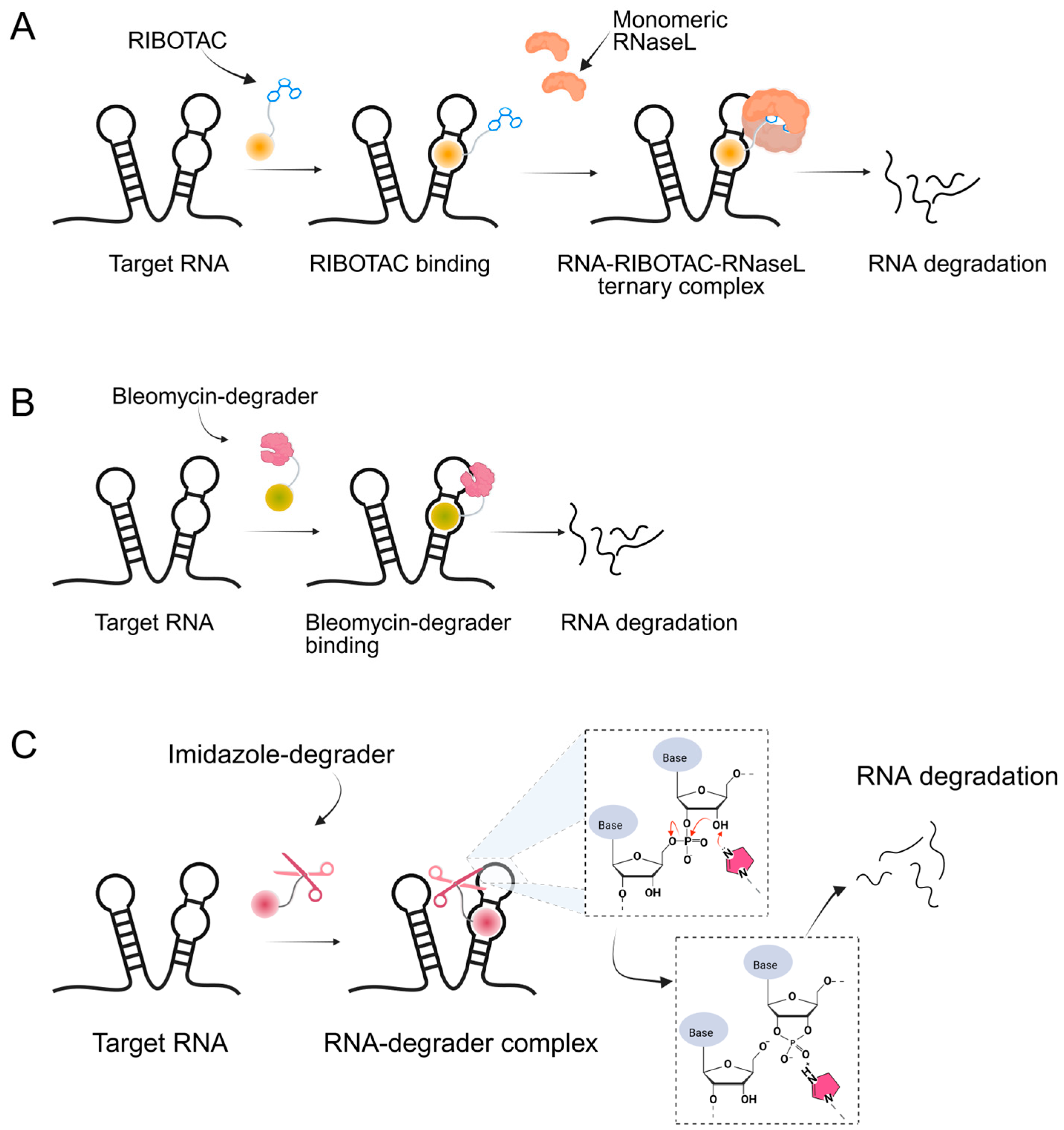


Targeted RNA Degradation as a Promising Therapeutic Strategy



Abstract
1. Introduction
1.1. Targeting RNAs as Promising Therapeutic Strategy
1.2. Therapeutic Strategies to Target RNA with Oligonucleotides
1.3. Therapeutic Strategies to Target RNA with Small Molecules
2. RIBOTAC
2.1. RIBOTACs Targeting microRNAs
2.2. RIBOTACs Targeting mRNAs
2.3. RIBOTACs Targeting Viral RNAs
3. Bleomycin Conjugated Degraders
4. Deglyco-Bleomycin Conjugated Degraders
5. Imidazole Conjugated Degraders
6. Discussion
6.1. Comparative Analysis for Small-Molecule RNA Degraders
6.2. Current Unmet Needs for RIBOTAC
7. Conclusions and Future Perspective
Author Contributions
Funding
Institutional Review Board Statement
Informed Consent Statement
Data Availability Statement
Acknowledgments
Conflicts of Interest
Abbreviations
| 2DCS | Two-Dimensional Combinatorial Screening |
| ADAM10 | A Disintegrin and Metalloproteinase Domain-Containing Protein-10 |
| AH | Attenuator Hairpin |
| ALS | Amylotrophic Lateral Sclerosis |
| ARIBOTAC | Aptamer-Ribonuclease Targeting Chimera |
| ASO | Anti-sense Oligonucleotide |
| CNBP | CCHC-type zinc finger nucleic acid binding protein |
| cRGD | cyclic Arginyl-glycyl-aspartic acid |
| CUTA | CutA divalent cation tolerance homolog protein |
| DEL | DNA-Encoded Library |
| DM1 | Myotonic Dystrophy type 1 |
| DM2 | Myotonic Dystrophy type 2 |
| DMPK | Dystrophia Myotonica Protein Kinase gene |
| DPR | Dipeptide Repeat protein |
| FOXO1 | Forkhead box protein O1 |
| FSE | Frameshifting Element |
| FTD | Frontotemporal Dementia |
| HOTAIR | HOX Transcript Antisense Intergenic RNA |
| HUVEC | Human Umbilical Vein Endothelial Cells |
| IDP | Intrinsically Disordered Protein |
| INFORNA | Info-RNA |
| iPSC | Induced pluripotent stem cell |
| IRE | Iron Responsive Element |
| IRES | Internal Ribosomal Entry Site |
| iRIBOTAC | inducible Ribonuclease Targeting Chimera |
| KRAS | Kirsten Rat Sarcoma viral oncogene homolog |
| LGALS1 | Lectin, Galactoside-Binding, Soluble, 1 (Galectin-1) |
| MALAT1 | Metastasis-Associated Lung Adenocarcinoma Transcript 1 |
| MBNL1 | Muscleblind-Like Splicing Regulator 1 |
| NEAT1 | Nuclear Paraspeckle Assembly Transcript 1 |
| NQO1 | NAD(P)H:quinone oxidoreductase 1 |
| NRAS | Neuroblastoma RAS viral (v-ras) oncogene homolog |
| ORF1b | Open Reading Frame-1b |
| PDCD4 | Programmed Cell Death 4 |
| PINAD | Proximity-Induced Nucleic Acid Degrader |
| PNA | Peptide Nucleic Acid |
| PRNP | Prion Protein |
| PROTAC | Proteolysis-Targeting Chimera |
| QSOX1 | Quiescin Sulfhydryl Oxidase 1 |
| QSOX1-b | Quiescin/sulfhydryl oxidase 1b |
| RIBOTAC | Ribonuclease Targeting Chimera |
| RISC | RNA-induced Silencing Complex |
| RTK | Receptor Protein Kinase |
| SARS-CoV-2 | Severe Acute Respiratory Syndrome Coronavirus 2 |
| SNCA | alpha-synuclein |
| SNHG5 | Small Nucleolar RNA Host Gene 5 |
| SOCS1 | Suppressor of Cytokine Signaling 1 |
| TAR | Trans-Activation Response element |
| TaRiboTAC | Tumor microenvironment-activated Ribonuclease Targeting Chimera |
| Tat | Trans-Activator of Transcription |
| UTR | Untranslated Region |
| VHL | Von Hippel–Lindau |
| XIST | X-inactive specific transcript |
References
- Zamft, B.; Bintu, L.; Ishibashi, T.; Bustamante, C. Nascent RNA structure modulates the transcriptional dynamics of RNA polymerases. Proc. Natl. Acad. Sci. USA. 2012, 109, 8948–8953. [Google Scholar] [CrossRef] [PubMed]
- Mustoe, A.M.; Corley, M.; Laederach, A.; Weeks, K.M. Messenger RNA Structure Regulates Translation Initiation: A Mechanism Exploited from Bacteria to Humans. Biochemistry 2018, 57, 3537–3539. [Google Scholar] [CrossRef]
- Warf, M.B.; Berglund, J.A. Role of RNA structure in regulating pre-mRNA splicing. Trends Biochem. Sci. 2010, 35, 169–178. [Google Scholar] [CrossRef]
- Liu, N.; Dai, Q.; Zheng, G.; He, C.; Parisien, M.; Pan, T. N6-methyladenosine-dependent RNA structural switches regulate RNA–protein interactions. Nature 2015, 518, 560–564. [Google Scholar] [CrossRef]
- Hangauer, M.J.; Vaughn, I.W.; McManus, M.T. Pervasive Transcription of the Human Genome Produces Thousands of Previously Unidentified Long Intergenic Noncoding RNAs. PLoS Genet. 2013, 9, e1003569. [Google Scholar] [CrossRef]
- Cheetham, S.W.; Gruhl, F.; Mattick, J.S.; Dinger, M.E. Long noncoding RNAs and the genetics of cancer. Br. J. Cancer 2013, 108, 2419–2425. [Google Scholar] [CrossRef]
- Rodgers, G.; Austin, C.; Anderson, J.; Pawlyk, A.; Colvis, C.; Margolis, R.; Baker, J. Glimmers in illuminating the druggable genome. Nat. Rev. Drug Discov. 2018, 17, 301–302. [Google Scholar] [CrossRef]
- Rhim, J.; Baek, W.; Seo, Y.; Kim, J.H. From Molecular Mechanisms to Therapeutics: Understanding MicroRNA-21 in Cancer. Cells 2022, 11, 2791. [Google Scholar] [CrossRef] [PubMed]
- Xu, W.-D.; Feng, S.-Y.; Huang, A.-F. Role of miR-155 in inflammatory autoimmune diseases: A comprehensive review. Inflamm. Res. 2022, 71, 1501–1517. [Google Scholar] [CrossRef] [PubMed]
- Li, X.J.; Ren, Z.J.; Tang, J.H. MicroRNA-34a: A potential therapeutic target in human cancer. Cell Death Dis. 2014, 5, e1327. [Google Scholar] [CrossRef]
- Statello, L.; Guo, C.-J.; Chen, L.-L.; Huarte, M. Gene regulation by long non-coding RNAs and its biological functions. Nat. Rev. Mol. Cell Biol. 2021, 22, 96–118, Erratum in Nat. Rev. Mol. Cell Biol. 2021, 22, 159. [Google Scholar] [CrossRef] [PubMed]
- Dong, P.; Xiong, Y.; Yue, J.; Hanley, S.J.B.; Kobayashi, N.; Todo, Y.; Watari, H. Long Non-coding RNA NEAT1: A Novel Target for Diagnosis and Therapy in Human Tumors. Front. Genet. 2018, 9, 471. [Google Scholar] [CrossRef] [PubMed]
- Fathi Dizaji, B. Strategies to target long non-coding RNAs in cancer treatment: Progress and challenges. Egypt. J. Med. Hum. Genet. 2020, 21, 41. [Google Scholar] [CrossRef]
- Rich, A.; Davies, D.R. A new two stranted helical structure: Polyadenylic Acid and Polyuridylic Acid. J. Am. Chem. Soc. 1956, 78, 3548–3549. [Google Scholar] [CrossRef]
- Roehr, B. Fomivirsen approved for CMV retinitis. J. Int. Assoc. Physicians AIDS Care 1998, 4, 14–16. [Google Scholar]
- Adams, D.; Gonzalez-Duarte, A.; O’Riordan, W.D.; Yang, C.-C.; Ueda, M.; Kristen, A.V.; Tournev, I.; Schmidt, H.H.; Coelho, T.; Berk, J.L.; et al. Patisiran, an RNAi Therapeutic, for Hereditary Transthyretin Amyloidosis. N. Engl. J. Med. 2018, 379, 11–21. [Google Scholar] [CrossRef]
- Garrelfs, S.F.; Frishberg, Y.; Hulton, S.A.; Koren, M.J.; O’Riordan, W.D.; Cochat, P.; Deschênes, G.; Shasha-Lavsky, H.; Saland, J.M.; Hoff, W.G.v.t.; et al. Lumasiran, an RNAi Therapeutic for Primary Hyperoxaluria Type 1. N. Engl. J. Med. 2021, 384, 1216–1226. [Google Scholar] [CrossRef]
- Lamb, Y.N. Inclisiran: First Approval. Drugs 2021, 81, 389–395, Erratum in Drugs 2021, 81, 1129. [Google Scholar] [CrossRef]
- Brazil, R. Peptide Nucleic Acids Promise New Therapeutics and Gene Editing Tools. ACS Cent. Sci. 2023, 9, 3–6. [Google Scholar] [CrossRef]
- Howe, J.A.; Wang, H.; Fischmann, T.O.; Balibar, C.J.; Xiao, L.; Galgoci, A.M.; Malinverni, J.C.; Mayhood, T.; Villafania, A.; Nahvi, A.; et al. Selective small-molecule inhibition of an RNA structural element. Nature 2015, 526, 672–677. [Google Scholar] [CrossRef]
- Childs-Disney, J.L.; Yang, X.; Gibaut, Q.M.R.; Tong, Y.; Batey, R.T.; Disney, M.D. Targeting RNA structures with small molecules. Nat. Rev. Drug Discov. 2022, 21, 736–762. [Google Scholar] [CrossRef]
- Jones, D.; Metzger, H.J.; Schatz, A.; Waksman, S.A. Control of Gram-Negative Bacteria in Experimental Animals by Streptomycin. Science 1944, 100, 103–105. [Google Scholar] [CrossRef]
- Parsons, J.; Castaldi, M.P.; Dutta, S.; Dibrov, S.M.; Wyles, D.L.; Hermann, T. Conformational inhibition of the hepatitis C virus internal ribosome entry site RNA. Nat. Chem. Biol. 2009, 5, 823–825. [Google Scholar] [CrossRef]
- Davila-Calderon, J.; Patwardhan, N.N.; Chiu, L.-Y.; Sugarman, A.; Cai, Z.; Penutmutchu, S.R.; Li, M.-L.; Brewer, G.; Hargrove, A.E.; Tolbert, B.S. IRES-targeting small molecule inhibits enterovirus 71 replication via allosteric stabilization of a ternary complex. Nat. Commun. 2020, 11, 4775. [Google Scholar] [CrossRef]
- Disney, M.D.; Labuda, L.P.; Paul, D.J.; Poplawski, S.G.; Pushechnikov, A.; Tran, T.; Velagapudi, S.P.; Wu, M.; Childs-Disney, J.L. Two-Dimensional Combinatorial Screening Identifies Specific Aminoglycoside−RNA Internal Loop Partners. J. Am. Chem. Soc. 2008, 130, 11185–11194. [Google Scholar] [CrossRef]
- Costales, M.G.; Suresh, B.; Vishnu, K.; Disney, M.D. Targeted Degradation of a Hypoxia-Associated Non-coding RNA Enhances the Selectivity of a Small Molecule Interacting with RNA. Cell Chem. Biol. 2019, 26, 1180–1186.e5. [Google Scholar] [CrossRef] [PubMed]
- Disney, M.D.; Winkelsas, A.M.; Velagapudi, S.P.; Southern, M.; Fallahi, M.; Childs-Disney, J.L. Inforna 2.0: A Platform for the Sequence-Based Design of Small Molecules Targeting Structured RNAs. ACS Chem. Biol. 2016, 11, 1720–1728. [Google Scholar] [CrossRef] [PubMed]
- Costales, M.G.; Aikawa, H.; Li, Y.; Childs-Disney, J.L.; Abegg, D.; Hoch, D.G.; Pradeep Velagapudi, S.; Nakai, Y.; Khan, T.; Wang, K.W.; et al. Small-molecule targeted recruitment of a nuclease to cleave an oncogenic RNA in a mouse model of metastatic cancer. Proc. Natl. Acad. Sci. USA 2020, 117, 2406–2411, Correction in Proc. Natl. Acad. Sci. USA 2020, 119, e2204149119. [Google Scholar] [CrossRef]
- Haniff, H.S.; Knerr, L.; Liu, X.; Crynen, G.; Boström, J.; Abegg, D.; Adibekian, A.; Lekah, E.; Wang, K.W.; Cameron, M.D.; et al. Design of a small molecule that stimulates vascular endothelial growth factor A enabled by screening RNA fold–small molecule interactions. Nat. Chem. 2020, 12, 952–961. [Google Scholar] [CrossRef] [PubMed]
- Rebouillat, D.; Hovnanian, A.; Marié, I.; Hovanessian, A.G. The 100-kDa 2′,5′-Oligoadenylate Synthetase Catalyzing Preferentially the Synthesis of Dimeric pppA2′p5′A Molecules Is Composed of Three Homologous Domains. J. Biol. Chem. 1999, 274, 1557–1565. [Google Scholar] [CrossRef]
- Tong, Y.; Lee, Y.; Liu, X.; Childs-Disney, J.L.; Suresh, B.M.; Benhamou, R.I.; Yang, C.; Li, W.; Costales, M.G.; Haniff, H.S.; et al. Programming inactive RNA-binding small molecules into bioactive degraders. Nature 2023, 618, 169–179. [Google Scholar] [CrossRef] [PubMed]
- Bonet-Aleta, J.; Maehara, T.; Craig, B.A.; Bernardes, G.J.L. Small Molecule RNA Degraders. Angew. Chem. Int. Ed. 2024, 63, e202412925. [Google Scholar] [CrossRef] [PubMed]
- Angelbello, A.J.; Rzuczek, S.G.; Mckee, K.K.; Chen, J.L.; Olafson, H.; Cameron, M.D.; Moss, W.N.; Wang, E.T.; Disney, M.D. Precise small-molecule cleavage of an r(CUG) repeat expansion in a myotonic dystrophy mouse model. Proc. Natl. Acad. Sci. USA 2019, 116, 7799–7804. [Google Scholar] [CrossRef]
- Mikutis, S.; Rebelo, M.; Yankova, E.; Gu, M.; Tang, C.; Coelho, A.R.; Yang, M.; Hazemi, M.E.; Pires de Miranda, M.; Eleftheriou, M.; et al. Proximity-Induced Nucleic Acid Degrader (PINAD) Approach to Targeted RNA Degradation Using Small Molecules. ACS Cent. Sci. 2023, 9, 892–904. [Google Scholar] [CrossRef]
- Mikutis, S.; Bernardes, G.J.L. Technologies for Targeted RNA Degradation and Induced RNA Decay. Chem. Rev. 2024, 124, 13301–13330. [Google Scholar] [CrossRef]
- Costales, M.G.; Matsumoto, Y.; Velagapudi, S.P.; Disney, M.D. Small Molecule Targeted Recruitment of a Nuclease to RNA. J. Am. Chem. Soc. 2018, 140, 6741–6744. [Google Scholar] [CrossRef]
- Zhang, P.; Liu, X.; Abegg, D.; Tanaka, T.; Tong, Y.; Benhamou, R.I.; Baisden, J.; Crynen, G.; Meyer, S.M.; Cameron, M.D.; et al. Reprogramming of Protein-Targeted Small-Molecule Medicines to RNA by Ribonuclease Recruitment. J. Am. Chem. Soc. 2021, 143, 13044–13055. [Google Scholar] [CrossRef]
- Meyer, S.M.; Tanaka, T.; Zanon, P.R.A.; Baisden, J.T.; Abegg, D.; Yang, X.; Akahori, Y.; Alshakarchi, Z.; Cameron, M.D.; Adibekian, A.; et al. DNA-Encoded Library Screening To Inform Design of a Ribonuclease Targeting Chimera (RiboTAC). J. Am. Chem. Soc. 2022, 144, 21096–21102. [Google Scholar] [CrossRef]
- Liu, X.; Haniff, H.S.; Childs-Disney, J.L.; Shuster, A.; Aikawa, H.; Adibekian, A.; Disney, M.D. Targeted Degradation of the Oncogenic MicroRNA 17-92 Cluster by Structure-Targeting Ligands. J. Am. Chem. Soc. 2020, 142, 6970–6982. [Google Scholar] [CrossRef]
- Fang, Y.; Wu, Q.; Wang, F.; Liu, Y.; Zhang, H.; Yang, C.; Zhu, Z. Aptamer-RIBOTAC Strategy Enabling Tumor-Specific Targeted Degradation of MicroRNA for Precise Cancer Therapy. Small Methods 2024, 9, 2400349. [Google Scholar] [CrossRef] [PubMed]
- Zhang, Y.; Zhu, J.; Qiu, L.; Lv, Z.; Zhao, Z.; Ren, X.; Guo, Y.; Chen, Y.; Li, M.; Fan, Y.; et al. Stimulus-activated ribonuclease targeting chimeras for tumor microenvironment activated cancer therapy. Nat. Commun. 2025, 16, 1288. [Google Scholar] [CrossRef]
- Thakur, C.S.; Jha, B.K.; Dong, B.; Das Gupta, J.; Silverman, K.M.; Mao, H.; Sawai, H.; Nakamura, A.O.; Banerjee, A.K.; Gudkov, A.; et al. Small-molecule activators of RNase L with broad-spectrum antiviral activity. Proc. Natl. Acad. Sci. USA 2007, 104, 9585–9590. [Google Scholar] [CrossRef]
- Choi, Y.J.; Kim, H.S.; Park, S.H.; Kim, B.-S.; Kim, K.H.; Lee, H.J.; Song, H.S.; Shin, D.-Y.; Lee, H.Y.; Kim, H.-G.; et al. Phase II Study of Dovitinib in Patients with Castration-Resistant Prostate Cancer (KCSG-GU11-05). Cancer Res. Treat. 2018, 50, 1252–1259. [Google Scholar] [CrossRef]
- Hsu, T.I.; Hsu, C.H.; Lee, K.H.; Lin, J.T.; Chen, C.S.; Chang, K.C.; Su, C.Y.; Hsiao, M.; Lu, P.J. MicroRNA-18a is elevated in prostate cancer and promotes tumorigenesis through suppressing STK4 in vitro and in vivo. Oncogenesis 2014, 3, e99. [Google Scholar] [CrossRef]
- Kong, W.; He, L.; Richards, E.J.; Challa, S.; Xu, C.X.; Permuth-Wey, J.; Lancaster, J.M.; Coppola, D.; Sellers, T.A.; Djeu, J.Y.; et al. Upregulation of miRNA-155 promotes tumour angiogenesis by targeting VHL and is associated with poor prognosis and triple-negative breast cancer. Oncogene 2014, 33, 679–689. [Google Scholar] [CrossRef]
- Bush, J.A.; Aikawa, H.; Fuerst, R.; Li, Y.; Ursu, A.; Meyer, S.M.; Benhamou, R.I.; Chen, J.L.; Khan, T.; Wagner-Griffin, S.; et al. Ribonuclease recruitment using a small molecule reduced c9ALS/FTD r(G4C2) repeat expansion in vitro and in vivo ALS models. Sci. Transl. Med. 2021, 13, eabd5991. [Google Scholar] [CrossRef]
- Tong, Y.; Gibaut, Q.M.R.; Rouse, W.; Childs-Disney, J.L.; Suresh, B.M.; Abegg, D.; Choudhary, S.; Akahori, Y.; Adibekian, A.; Moss, W.N.; et al. Transcriptome-Wide Mapping of Small-Molecule RNA-Binding Sites in Cells Informs an Isoform-Specific Degrader of QSOX1 mRNA. J. Am. Chem. Soc. 2022, 144, 11620–11625. [Google Scholar] [CrossRef]
- Tong, Y.; Su, X.; Rouse, W.; Childs-Disney, J.L.; Taghavi, A.; Zanon, P.R.A.; Kovachka, S.; Wang, T.; Moss, W.N.; Disney, M.D. Transcriptome-Wide, Unbiased Profiling of Ribonuclease Targeting Chimeras. J. Am. Chem. Soc. 2024, 146, 21525–21534. [Google Scholar] [CrossRef] [PubMed]
- Tong, Y.; Zhang, P.; Yang, X.; Liu, X.; Zhang, J.; Grudniewska, M.; Jung, I.; Abegg, D.; Liu, J.; Childs-Disney, J.L.; et al. Decreasing the intrinsically disordered protein α-synuclein levels by targeting its structured mRNA with a ribonuclease-targeting chimera. Proc. Natl. Acad. Sci. USA 2024, 121, e2306682120. [Google Scholar] [CrossRef] [PubMed]
- Zhang, Y.; Wang, L.; Wang, F.; Chu, X.; Jiang, J.-H. G-Quadruplex mRNAs Silencing with Inducible Ribonuclease Targeting Chimera for Precision Tumor Therapy. J. Am. Chem. Soc. 2024, 146, 15815–15824. [Google Scholar] [CrossRef] [PubMed]
- Haniff, H.S.; Tong, Y.; Liu, X.; Chen, J.L.; Suresh, B.M.; Andrews, R.J.; Peterson, J.M.; O’Leary, C.A.; Benhamou, R.I.; Moss, W.N.; et al. Targeting the SARS-CoV-2 RNA Genome with Small Molecule Binders and Ribonuclease Targeting Chimera (RIBOTAC) Degraders. ACS Cent. Sci. 2020, 6, 1713–1721. [Google Scholar] [CrossRef] [PubMed]
- Beck, J.; Poulter, M.; Hensman, D.; Jonathan, D.R.; Mahoney, C.J.; Adamson, G.; Campbell, T.; Uphill, J.; Borg, A.; Fratta, P.; et al. Large C9orf72 Hexanucleotide Repeat Expansions Are Seen in Multiple Neurodegenerative Syndromes and Are More Frequent Than Expected in the UK Population. Am. J. Hum. Genet. 2013, 92, 345–353. [Google Scholar] [CrossRef]
- Wang, Z.-F.; Ursu, A.; Childs-Disney, J.L.; Guertler, R.; Yang, W.-Y.; Bernat, V.; Rzuczek, S.G.; Fuerst, R.; Zhang, Y.-J.; Gendron, T.F.; et al. The Hairpin Form of r(G4C2)exp in c9ALS/FTD Is Repeat-Associated Non-ATG Translated and a Target for Bioactive Small Molecules. Cell Chem. Biol. 2019, 26, 179–190.e12. [Google Scholar] [CrossRef]
- Umezawa, H.; Maeda, K.; Takeuchi, T.; Okami, Y. New antibiotics, bleomycin A and B. J. Antibiot. 1966, 19, 200–209. [Google Scholar]
- Benhamou, R.I.; Angelbello, A.J.; Andrews, R.J.; Wang, E.T.; Moss, W.N.; Disney, M.D. Structure-Specific Cleavage of an RNA Repeat Expansion with a Dimeric Small Molecule Is Advantageous over Sequence-Specific Recognition by an Oligonucleotide. ACS Chem. Biol. 2020, 15, 485–493. [Google Scholar] [CrossRef]
- Gibaut, Q.M.R.; Akahori, Y.; Bush, J.A.; Taghavi, A.; Tanaka, T.; Aikawa, H.; Ryan, L.S.; Paegel, B.M.; Disney, M.D. Study of an RNA-Focused DNA-Encoded Library Informs Design of a Degrader of a r(CUG) Repeat Expansion. J. Am. Chem. Soc. 2022, 144, 21972–21979. [Google Scholar] [CrossRef]
- Suresh, B.M.; Tong, Y.; Abegg, D.; Adibekian, A.; Childs-Disney, J.L.; Disney, M.D. Altering the Cleaving Effector in Chimeric Molecules that Target RNA Enhances Cellular Selectivity. ACS Chem. Biol. 2023, 18, 2385–2393. [Google Scholar] [CrossRef] [PubMed]
- Angelbello, A.J.; Defeo, M.E.; Glinkerman, C.M.; Boger, D.L.; Disney, M.D. Precise Targeted Cleavage of a r(CUG) Repeat Expansion in Cells by Using a Small-Molecule–Deglycobleomycin Conjugate. ACS Chem. Biol. 2020, 15, 849–855. [Google Scholar] [CrossRef] [PubMed]
- Benhamou, R.I.; Angelbello, A.J.; Wang, E.T.; Disney, M.D. A Toxic RNA Catalyzes the Cellular Synthesis of Its Own Inhibitor, Shunting It to Endogenous Decay Pathways. Cell Chem. Biol. 2020, 27, 223–231.e4. [Google Scholar] [CrossRef]
- Boger, D.L.; Cai, H. Bleomycin: Synthetic and Mechanistic Studies. Angew. Chem. Int. Ed. 1999, 38, 448–476. [Google Scholar] [CrossRef]
- Raines, R.T. Ribonuclease A. Chem. Rev. 1998, 98, 1045–1066. [Google Scholar] [CrossRef]
- Martin, C.; Bonnet, M.; Patino, N.; Azoulay, S.; Di Giorgio, A.; Duca, M. Design, Synthesis, and Evaluation of Neomycin-Imidazole Conjugates for RNA Cleavage. ChemPlusChem 2022, 87, e202200250. [Google Scholar] [CrossRef] [PubMed]
- Tamkovich, N.; Koroleva, L.; Kovpak, M.; Goncharova, E.; Silnikov, V.; Vlassov, V.; Zenkova, M. Design, RNA cleavage and antiviral activity of new artificial ribonucleases derived from mono-, di- and tripeptides connected by linkers of different hydrophobicity. Bioorg. Med. Chem. 2016, 24, 1346–1355. [Google Scholar] [CrossRef] [PubMed]
- Meyer, S.M.; Kovachka, S.; Wang, T.; Cameron, M.D.; Childs-Disney, J.L.; Disney, M.D. Linker Optimization Enhances the Potency of Ribonuclease-Targeting Chimeras in Cancer Models. J. Med. Chem. 2025, 68, 12881–12903. [Google Scholar] [CrossRef] [PubMed]
- Pettersson, M.; Crews, C.M. PROteolysis TArgeting Chimeras (PROTACs)—Past, present and future. Drug Discov. Today Technol. 2019, 31, 15–27. [Google Scholar] [CrossRef]


| RNA Degrader | Target RNA | Structure | DC50 a | In Vivo | Ref. |
|---|---|---|---|---|---|
| RIBOTAC-2 | Pri-miR-96 |  | 20 nM | 200 nM | [36] |
| miR-21-RIBOTAC | Pre-miR-21 |  | ~50 nM | 10 mg/kg | [28] |
| Dovitinib-RIBOTAC | Pre-miR-21 |  | ~5 µM | 56 mg/kg | [37] |
| RIBOTAC 7 | Pre-miR-21 |  | ~5 μM | - | [38] |
| 7 | miR-17-92 cluster |  | ~500 nM | - | [39] |
| pre-miR-155 RIBOTAC | Pre-miR-155 |  | 100 nM | 1 mg/kg | [31] |
| 4A-ASO-AS | miR-210-3p |  | 100 nM | - | [40] |
| 4A-ASO155-AS | miR-155-5p |  | 50 nM | 5 mg/kg | [40] |
| RIBOTAC21-BA | Pre-miR-21 |  | ~50 nM | - | [41] |
| RNA Degrader | Target RNA | Structure | DC50 a | In Vivo | Ref. |
|---|---|---|---|---|---|
| r(G4C2)exp-targeting RIBOTAC (7) | C9orf72 HRE |  | 500 nM | 33 nmol | [46] |
| F1-RIBOTAC | QSOX1-a mRNA |  | 20 µM | - | [47] |
| F3-RIBOTAC | LGALS1 mRNA |  | 10 µM | - | [48] |
| JUN-RIBOTAC | JUN mRNA | 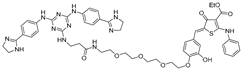 | 2 µM | - | [31] |
| c-MYC-RIBOTAC | c-MYC mRNA | 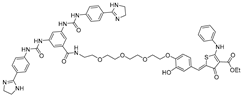 | 10 µM | - | [31] |
| Syn-RIBOTAC | SNCA mRNA |  | 2 µM | - | [49] |
| iRIBOTAC | G-Quadruplex |  | 5.2 µM | 100 µM (100 µL) | [50] |
| C5-RIBOTAC b | SARS-CoV-2-FSE |  | ~8 µM | - | [51] |
| RNA Degrader | Target RNA | Structure | DC50 a | In Vivo | Ref. |
|---|---|---|---|---|---|
| Cugamycin | r(CUG)exp |  | 2 µM | 10 mg/kg | [33] |
| Compound 2 | r(CCUG)exp | 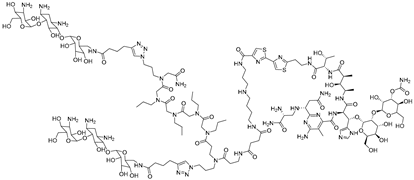 | ~5 μM | - | [55] |
| DEL1-Bleo | r(CUG)exp |  | >10 μM | - | [56] |
| Compound 5 | miR 17-92 Cluster | 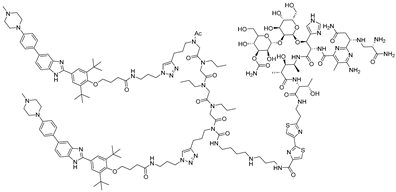 | ~500 nM | - | [39] |
| Compound 3 | Pre-miR-372 | 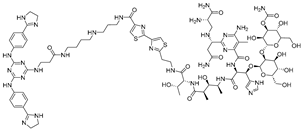 | >2 μM | - | [57] |
| Deglyco-Cugamycinb | r(CUG)exp |  | >1 µM | - | [58] |
| RNA Degrader | Target RNA | Structure | DC50 a | In Vivo | Ref. |
|---|---|---|---|---|---|
| Compound 3,4 | HIV-1 TAR RNA |  | ~0.5 μM | - | [62] |
| PDS-imi6 | G-quadruplex of SARS-Cov-2 RNA |  | 0.75 µM | - | [34] |
| MTDB-imi6 | Pseudoknot of SARS-CoV-2 RNA |  | 2 µM | 25 mg/kg | [34] |
| Modality | Mechanism | Preferred Cleavage Site | Recruiter | Pros | Cons | Stage |
|---|---|---|---|---|---|---|
| RIBOTAC | Enzymatic cleavage by RNase L recruitment |
|
|
| Depends on the RNase L expression | Pre-clinical |
| Bleomycin-conjugated degrader | Direct scission by oxidative cleavage |
|
| Potent cleavage |
| Early pre-clinical |
| Imidazole-conjugated degrader | Direct phospho diester Backbone cleavage |
| Imidazole |
| Low selectivity | Early pre-clinical |
Disclaimer/Publisher’s Note: The statements, opinions and data contained in all publications are solely those of the individual author(s) and contributor(s) and not of MDPI and/or the editor(s). MDPI and/or the editor(s) disclaim responsibility for any injury to people or property resulting from any ideas, methods, instructions or products referred to in the content. |
© 2025 by the authors. Licensee MDPI, Basel, Switzerland. This article is an open access article distributed under the terms and conditions of the Creative Commons Attribution (CC BY) license (https://creativecommons.org/licenses/by/4.0/).
Share and Cite
Komachankandy, S.; Lee, Y. Targeted RNA Degradation as a Promising Therapeutic Strategy. Int. J. Mol. Sci. 2025, 26, 10767. https://doi.org/10.3390/ijms262110767
Komachankandy S, Lee Y. Targeted RNA Degradation as a Promising Therapeutic Strategy. International Journal of Molecular Sciences. 2025; 26(21):10767. https://doi.org/10.3390/ijms262110767
Chicago/Turabian StyleKomachankandy, Sivakumar, and Yeongju Lee. 2025. "Targeted RNA Degradation as a Promising Therapeutic Strategy" International Journal of Molecular Sciences 26, no. 21: 10767. https://doi.org/10.3390/ijms262110767
APA StyleKomachankandy, S., & Lee, Y. (2025). Targeted RNA Degradation as a Promising Therapeutic Strategy. International Journal of Molecular Sciences, 26(21), 10767. https://doi.org/10.3390/ijms262110767