Article

Deep Sequencing Analysis of Hepatitis C Virus Subtypes and Resistance-Associated Substitutions in Genotype 4 Patients Resistant to Direct-Acting Antiviral (DAA) Treatment in Egypt


by
Damir Garcia-Cehic
1,2,3,†,
Asmaa Mosbeh
4,5,†,
Heba A. Gad
5,6,
Asmaa Ibrahim Gomaa
7,
Marta Ibañez Lligoña
2,3,
Josep Gregori
2,3,
Sergi Colomer-Castell
2,3,
Carolina Campos
2,3,
Francisco Rodriguez-Frias
2,3,
Juan Ignacio Esteban
2,3,8,
Mohamed S. Kohla
5,7,
Mohamed Helmy Abdel-Rahman
4,5,9,10,* and
Josep Quer
2,3,11,*
1
Department of Radiation Oncology, University of Cincinnati, College of Medicine, Cincinnati, OH 45267, USA
2
Liver Diseases-Viral Hepatitis, Liver Unit, Vall d’Hebron Institut de Recerca (VHIR), Vall d’Hebron Barcelona Hospital Campus, 08035 Barcelona, Spain
3
Centro de Investigación Biomédica en Red de Enfermedades Hepáticas y Digestivas (CIBERehd), Instituto de Salud Carlos III, 28029 Madrid, Spain
4
Department of Pathology, National Liver Institute, Menoufia University, Menoufia Governorate 6131567, Egypt
5
Sustainable Sciences Institute Collaborative Research Center, Menoufia University, Menoufia Governorate 6131567, Egypt
6
Molecular Diagnostic Unit, New Kasr El-Ainy Teaching Hospital, Cairo University, Giza Governorate 12613, Egypt
7
Department of Hepatology, National Liver Institute, Menoufia University, Menoufia Governorate 6131567, Egypt
8
Medicine Department, Universitat Autònoma de Barcelona, 08193 Bellaterra, Spain
9
Department of Ophthalmology, The Ohio State University, Columbus, OH 43210, USA
10
Division of Human Genetics, The Ohio State University, Columbus, OH 43210, USA
11
Biochemistry and Molecular Biology Department, Universitat Autònoma de Barcelona, 08193 Bellaterra, Spain
*
Authors to whom correspondence should be addressed.
These authors contributed equally to this work.
Int. J. Mol. Sci. 2025, 26(21), 10649; https://doi.org/10.3390/ijms262110649
Submission received: 24 September 2025 / Revised: 28 October 2025 / Accepted: 31 October 2025 / Published: 31 October 2025

Abstract

Egypt has the highest global prevalence of hepatitis C virus (HCV), with genotype 4 (G4) in over 94% of cases. Direct-acting antivirals (DAAs) yield sustained virologic response (SVR) rates above 95%. Second-generation DAAs are recommended for patients with virological failure, achieving over 90% eradication. This study aimed to classify and evaluate the pattern of HCV resistance-associated substitutions (RASs) in patients who failed DAA treatment in Egypt. A total of 1778 chronically infected HCV patients from Egypt’s Nile Delta were enrolled (2016–2018). Among them, 37 relapsed, and high-quality serum samples from 22 patients were available, including 6 cases with pre- and post-treatment samples. Next-generation sequencing (NGS) was performed for HCV subtyping and RAS identification. Among the 22 analyzed cases, 21 (95.4%) were G4: 11 were classified as subtype G4a, seven G4o, and three G4m. One patient (4.5%) was identified as G1g. One case shifted from G4a pre- to G4o post-treatment, suggesting reinfection. The RAS pattern in rare G4 subtypes (G4m/G4o) differs from the G4a subtype. The combination of L28M/L30S mutations was detected in 8/11 G4a samples; in contrast, RASs in G4o were characterized by T30S or Y93C/H/N/S substitutions. Notably, some substitutions identified as RASs may represent fixed polymorphisms in regional viral populations, such as those in Egypt’s Nile Delta. HCV subtypes significantly influence the RAS pattern, particularly within the NS5A region, after DAA-treatment failure. The RAS pattern differs among G4 subtypes, particularly in rare ones, predisposing patients to resistance and underscoring the importance of NGS in regional populations to optimize treatment strategies.

1. Introduction

Hepatitis C virus (HCV) infection is a public health concern in many countries, and still a major cause of liver-related morbidity and mortality despite the advances in the treatments with combination of direct-acting antivirals (DAAs). Globally, approximately 1.5 million patients are newly infected every year, with a global prevalence of 0.8% in the general population. Currently, at least 58 million patients are chronically infected with HCV, leading to significant mortality due to cirrhosis and hepatocellular carcinoma [1].
Although DAAs have revolutionized HCV therapy with high rates of sustained virologic response [2], therapeutic failure still occurs in a small proportion of patients, almost always due to the selection of resistance-associated substitutions (RASs) [3]. The presence and type of RASs determine the effectiveness of subsequent rescue regimens, as virologic failure leads to an altered viral landscape dominated by resistant variants, complicating future treatment options [4,5].
In 2015, the rate of HCV infection among adults in Egypt was 7%, the highest in the world, and accounted for 7.6% of the country’s mortality [6]. To address this significant public health challenge, Egypt established a national HCV control strategy and developed an HCV prevention and treatment system [7]. In partnership with GILEAD, Egypt introduced a countrywide campaign to eliminate hepatitis C, resulting in testing of over 60 million people and treatment of more than 4.1 million people, aiming at providing treatment to over 250,000 chronically infected patients annually [8,9]. Most of these treatments were based on Sofosbuvir-containing regimens (targeting the NS5B polymerase) combined with NS5A inhibitors such as Daclatasvir, Ledipasvir, or Ombitasvir. Retreatment strategies for HCV are particularly hampered in cases of multidrug resistance, which challenges the possibility to switch DAA class [3,10], leading healthcare providers to prescribe rescue treatments based on these RASs [5,10,11,12,13,14,15,16]. After treatment failure, RASs in non-structural proteins NS3 and NS5B often become undetectable within months after stopping therapy, while NS5A RASs can persist for years [10] and negatively impact retreatment outcomes in patients previously treated with NS5A inhibitors [10,11]. Consequently, resistance-associated substitutions (RASs) in the NS5A region are the most likely to emerge in cases of virologic failure.
A systematic review of HCV genotypes in Egypt revealed limited diversity considering genotypes, with genotype 4 (G4) being dominant, with 92.5% of cases (12.1% subtype G4a and 82.3% unknown G4 subtypes). G1 accounted for 3.6% of cases and mixed infections were present in 3.2% of cases [6]. Globally, HCV-G4 accounts for 8–16.8% of all HCV cases, making it the third most common genotype, especially in lower-income countries [12,13].
Despite this apparent predominance, distinguishing among G4 subtypes (such as G4a, G4d, and G4o) is essential, since each exhibit characteristic mutations that may influence the natural prevalence of polymorphisms, the genetic barrier to resistance, and ultimately the response to DAAs. Nevertheless, there is a lack of information about the efficacy of the DAAs on different G4 subtypes other than G4a.
This study aimed to characterize and identify resistance-associated substitutions (RASs) and potential mutational patterns related to specific subtypes of HCV genotype 4. This approach seeks to improve the understanding of subtype-related resistance mechanisms and their impact on treatment outcomes.

2. Results

A total of 9,296,676 reads passed quality controls, with the number of reads per amplicon and sample ranging from 3824 to 244,682 (Supplementary Table S1). Twenty-two patients (cases) were included in the study, with six providing both pre- and a post-treatment samples, increasing the total number of NGS-subtyped samples to 28.
Among the 22 patients who experienced treatment failure with DAA-based regimens, 21 (95.4%) were identified with HCV genotype 4, and one (4.5%) with HCV genotype 1. High-resolution HCV subtyping using NGS revealed that 11 out of the 22 (50%) were classified as subtype G4a, seven (31.8%) as G4o, and three (13.6%) as G4m. The single genotype 1 was classified as G1g.
Raw data from all patients and targeted regions have been submitted to the GenBank Sequence Read Archive database with the project number “PRJNA1036116”. A full report including all substitutions is provided in Figure 1, Figure 2 and Figure 3, Table 1 and Table S1.
At treatment failure, all viral genomes corresponding to G4a samples exhibit at least one mutation at the amino acid positions 28 and 30 of the NS5A region. All the observed substitutions have been previously associated with resistance to DAAs (Figure 1a,b). Substitution L28M was present in 8 out of 11 G4a samples (72.7%), conferring resistance to Daclatasvir (DCV) (fold-change (FC) = 10), Elbasvir (EBR), and Ledipasvir (LDV) (FC = 100). Additionally, L30S was detected in 9 out of 11 (81.8%) and confers resistance to EBR (FC = 4). The presence of an S at position 30 of NS5A region, independently of the original amino acid, has also been associated to resistance to DCV (FC = 150–157) and LDV (FC = 100) [14]. Interestingly, the combination of RASs L28M + L30S were identified in 8 out of 11 cases (72.7%), and their co-occurrence in the same viral genome confers a higher resistance to LDV treatment (FC = 5000). Of note in sample R005, the RAS L30S was detected in a minority of sequences (4.6%), but we also detected RAS Y93H. Combination of RASs L30S and Y93H leads to more resistance to LDV (FC = 900,000). Alone, the Y93H substitution confers resistance to DCV (FC = 45–169), EBR (FC = 7.5), LDV (FC = 1000), and OMB. Sample R037 showed the substitution 30R, that has been associated with resistance in G4a samples to DCV (FC = 10), LDV (FC = 50), and VEL (FC = 2) [14].
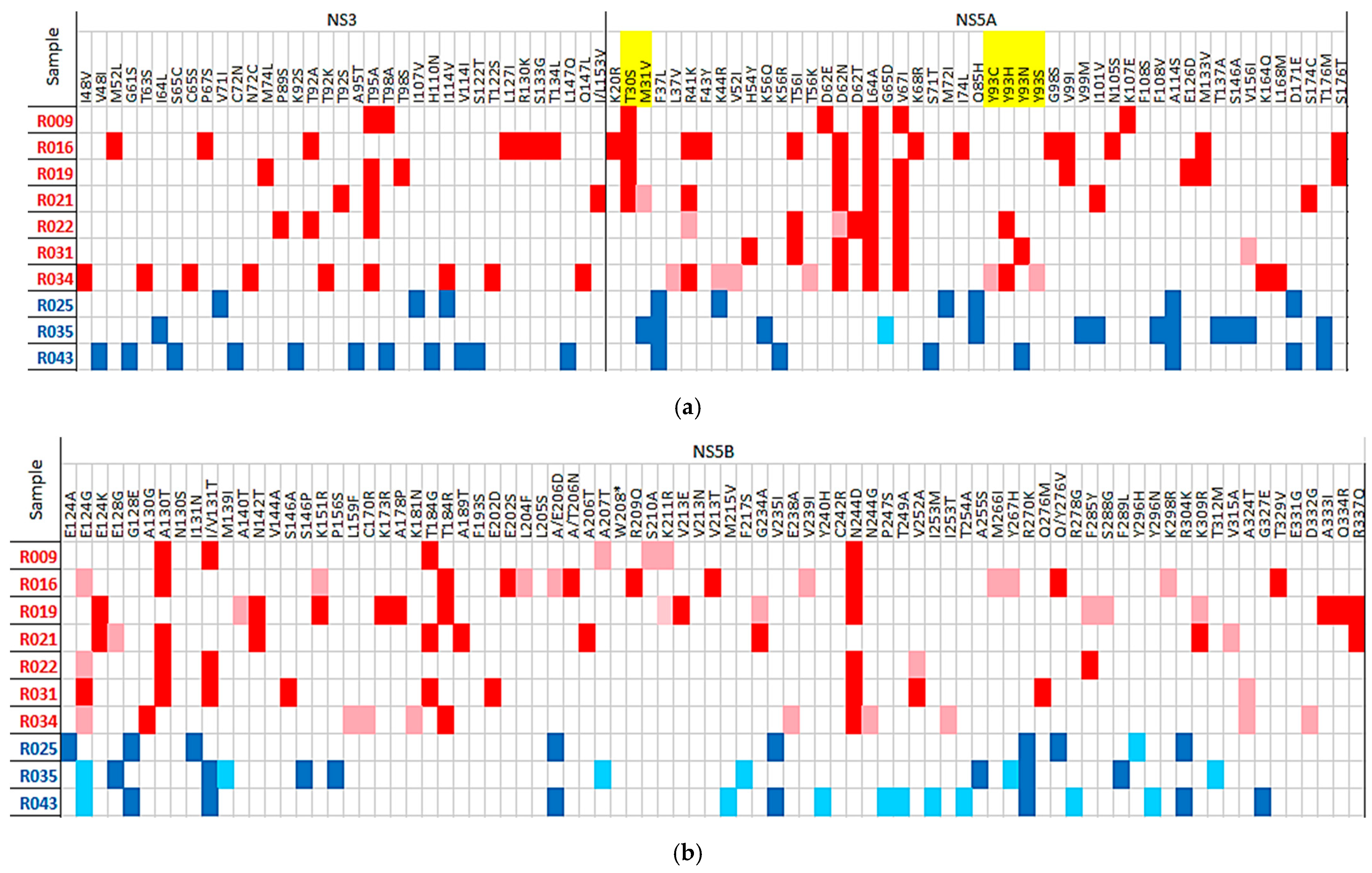
Since there is limited information on RASs in genotypes 4 other than G4a, we relied on DAA-RAS data for G4a and G4d as references to analyze substitutions found in G4o and G4m subtypes (Figure 2a,b). Except for sample R025 from G4m, which did not exhibit any known RASs among the three regions analyzed, all other samples showed at least one RAS in the NS5A targeted region. Among the G4o samples, we identified two distinct groups: one with samples showing only T30S (4 out of 7), and the other with samples showing substitution C/H/N/S at amino acid Y93 (3 out of 7). The remaining two G4m samples had at least one RAS in the NS5A targeted region; one sample had the RAS M31V, while the other has the RAS Y93N.
In all G4 samples, no confirmed RASs were found in the other two-targeted regions (NS3 and NS5B). The only exception was sample R027 (G4a), where the RAS E237G at the NS5B region was detected as a minor variant, representing only 1%, 2491 reads of a total of 244,682 reads.
For the G1g sample, RAS Q30R (present at a frequency of 79.6%) was detected at the NS5A region, and no other RASs were found at any other region, based on comparison with validated data for G1a and G1b.
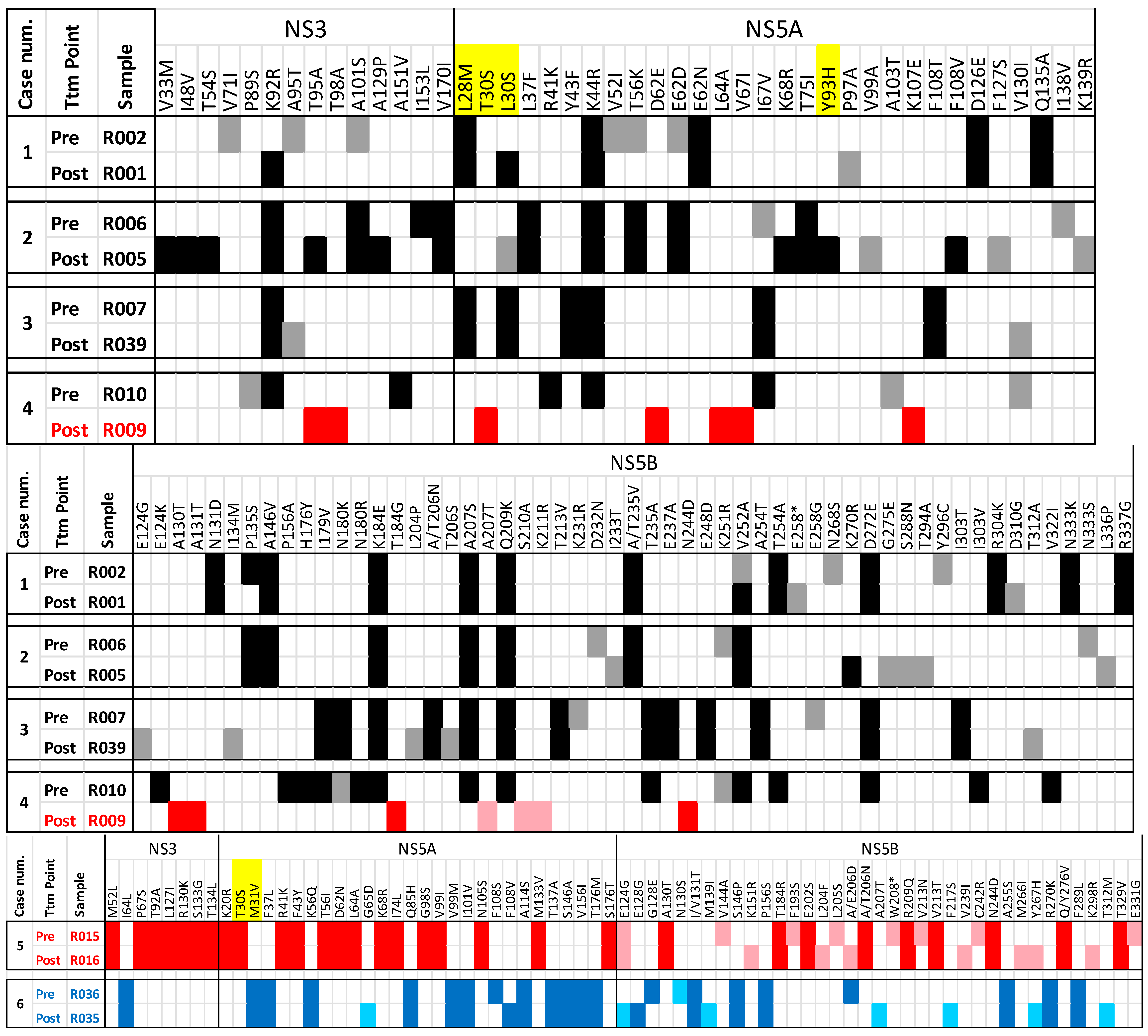
When comparing cases with both pre- and post-treatment samples, we can rule out case number 4 (samples R010 and R009) as being the same infection, as high-resolution HCV subtyping reveals different subtype classifications: G4a in the pre-treatment sample and G4o in the post-treatment sample, suggesting that this is not a case of relapse, but a new infection. This is further supported by the lack of correlation in the substitution’s profiles between the two samples. Therefore, sample R010 will not be considered the naïve sample corresponding to the relapse case represented by R009.
Except for case number 2, which was treated with PTV/r/OMB/RBV for 24 weeks, all other cases were treated with DCV/SOF with or without RBV for 12 weeks (Table 1). Regardless of the treatment received, RASs associated with antivirals used for NS5A region were prevalent in all cases: L28M, L/T30S, and M31V to Daclatasvir (DCV) and Y93H to Ombitasvir (OMB), even in those cases where RAS was not detected due to a very low frequency at the pre-treatment sample viral population, like in cases 1 and 2.
Interestingly, in 2 out of 22 treatment failures (R037 G4a and R025 G4o), no RASs were detected in any of the three targeted regions. Several explanations are discussed at the end of next section.
Moreover, in post-treatment samples from patients infected with G4a, several substitutions were detected in a majority of cases (ranging from 6 to all 12 patients), with a frequency of 50% or higher, and in many cases, reaching 100% (Table 2a). Interestingly, some of these substitutions, such as L28M and L30S, which have previously been identified as RASs, were found in 8 and 7 out of 12 patients, respectively, after treatment (Table 2b). Notably, L28M alone, as well as the combined L28M + L30S substitutions, were already present in pre-treatment samples (Supplementary Table S1) from patients R002 and R007, respectively, suggesting that these RASs might be prevalent in G4a patients living in the Nile Delta Region in Egypt.
This indicates that, in addition to the mentioned RAS, other substitutions may need to be considered as polymorphisms specific to this geographic region.

3. Discussion

Recent guidelines recommend a combination of second-generation DAAs for patients with virological failure after prior DAAs treatment, with virological cure rates above 98% [15]. However, in resource-limited settings, due to the high cost of these regimens, alternative approaches should be considered. This could involve first-generation DAA regimens, in addition to Sofosbuvir and Ribavirin, for extended durations [16]. The selection of this rescue therapy should be based on the RASs identified during the initial DDA therapy, making resistance testing a cornerstone of personalized treatment strategies to optimize responses.
The use of high-resolution methodologies, such as deep sequencing, facilitates accurate subtype classification [17], and identification of RASs in patients who experienced virological DAA-treatment failure, thereby guiding successful retreatment strategies [3].
As expected, the most prevalent HCV subtype among our Egyptian patients was G4. Notably, half of the patients were classified as subtype G4a, while the other half belonged to rare subtypes G4o and G4m, for which little information has been published.
In our cohort of 22 patients, no RASs were detected in the NS3 region, and only one minor variant was found in NS5B. Consistent with other studies [18], RASs predominantly occurred in the NS5A across G4 subtypes, with subtype-specific patterns emerging post-treatment, highlighting the need for continued RAS monitoring in rare subtypes. The finding of RAS mutations predominantly in NS5A is particularly relevant in our cohort of genotype 4 patients treated with DCV, as most of these mutations confer resistance to DCV. Furthermore, this observation may explain why, when treatment involves two inhibitors and one is compromised by the presence of RASs in circulating virions, the therapeutic regimen effectively depends on a single active inhibitor and treatment is predisposed to failure.
Many substitutions appeared in 50% or more (including 100%) of the reads for most patients. It is important to clarify that these substitutions are reported in comparison to GenBank reference sequences, which may have been sourced from different geographic locations. In this study, we specifically studied a cohort of patients from the Nile Delta Region in Egypt. For G4a samples, it is possible that some amino acid positions we identified as substitutions may, in fact, be polymorphisms that have become fixed in the viral population of this region, as previously shown for G1a, G1b, and G3a in other locations [19,20,21,22]. In consequence, if these mutations are associated with antiviral resistance, it suggests that patients carrying these specific variants could be more likely to show resistance to the antivirals commonly used to treat G4a infections that lack these particular resistance-associated substitutions. This explanation may also apply to the rare G4 variants (G4o and G4m) that have limited or no prior reports in the literature, as some mutations could confer cross-resistance between different subtypes. Therefore, it is crucial to emphasize that NGS should be performed in local and/or regional populations when designing global treatment strategies, especially because any mutant present at frequencies greater than 1% could be clinically relevant for treatment outcomes [22]. Alternatively, some treatment recommendations based on global data may not be universally effective, as the circulation of certain variants in specific regions might render the virus in those areas resistant to particular antivirals.
In our study with patients that had failed DAAs, very few RASs have been reported in the NS5B region; only one minor variant (E237G) associated with SOF resistance was found in one patient. Actually, HCV G4 clearly shows very few RASs at baseline in the NS5B region [23]. Since most NS5B mutations reduce viral fitness, RASs are often outcompeted by wild-type variants after treatment ends, reverting to undetectable levels with population sequencing [24,25]. However, in full-length HCV genotype 4a infectious culture systems, it has been shown that the principal resistant substitution to SOF, NS5B-S282T, showed relatively high fitness and stability [26], suggesting that more studies with human plasma samples collected at the end of treatment (EOT) would be of great interest to clarify this issue and to assess the reversion of such NS5B-RASs after several weeks after OFT. It is important to note that the post-treatment samples included in this study were collected 12w after end-of-treatment, which aligns with international guidelines recommending HCV-RNA testing at this time point to determine whether sustained virological response has been achieved or if relapse has occurred. During these 12w, low-fitness variants gradually decline in frequency as they are outcompeted by higher-fitness variants, potentially becoming too rare to be detected even with high-resolution sequencing methods. However, if the mutant (i.e., the sequence carrying the RAS) persists, any rescue treatment using the same antiviral to which the mutant is resistant is doomed to fail [27]. Hence, as previously suggested, it is crucial to perform deep sequencing at the end of treatment to detect these variants before they become too rare to be detected [27].
This study had several limitations, including the absence of pre-treatment samples for comparison with post-failure samples, small sample size (particularly for rare subtypes), selection bias (40% exclusion rate), and limited sequencing coverage restricted to specific genomic regions. Additionally, we were unable to collect follow-up samples to study whether RAS mutations observed at failure were fixed or transient. In two out of 22 treatment failures, no RAS was detected in any of the targeted regions. There are several alternative explanations. One possibility is that the resistance substitution exhibits very low fitness and, although selected during therapy, viral mutants carrying this substitution are not maintained as predominant in the quasispecies after treatment stopping, making them undetectable even by deep sequencing. Another explanation could be that treatment failure involves mutations at sensitive positions that have not been previously reported, such as residues affecting protein structure or positions causing allosteric effects that alter drug binding efficiency. Finally, we recently reported that the QS maturity is directly associated with antiviral resistance, even in the absence of resistance-associated substitutions. In this context, QS maturity evolves continuously during chronic HCV infection, towards a flat-like structure that has been linked to higher rates of antiviral treatment failure, even in the absence of RASs in the viral genomes [28].

4. Materials/Patients and Methods

A total of 1778 patients with chronic HCV infection were enrolled in a biobanking study at the National Liver Institute Sustainable Sciences Institute Collaborative Research Center (NLISSICRC), National Liver Institute, Menoufia University in Egypt, between 2016 and 2018 from the Nile Delta Region (Egypt). Among these patients, 37 experienced DAA-treatment failure, evidenced by detectable HCV RNA 12 weeks after treatment (SVR12), confirmed by quantitative PCR (qPCR) using the Artus HCV QS-RGQ (Qiagen, Hilden Germany). Only high-quality serum samples, meeting our inclusion criteria, were considered for further analysis, specifically 22 out of the 37 patients, with six cases providing both pre- and post-treatment samples, resulting in a total of 28 patients (Table 1). The collected serum samples were stored frozen at the National Liver Institute Sustainable Sciences Institute Collaborative Research Centre (NLISSICRC).
Inclusion criteria for this study were as follows: availability of sufficient high-quality serum for viral titer assessment, documented relapse after primary treatment confirmed by qRT-PCR, and viral loads exceeding 1 × 10⁵ International Units (IU) as amplification of samples with lower viral loads could produce duplicate sequences, introducing bias in the detection of viral population mutations rates. Biobanking and viral load assessment was carried out at the NLISSICRC. Patients adhered to a daily regimen of medications specified by the National Committee for viral hepatitis control (NCCVH), which included Sofosbuvir (SOF) (400 mg), Ombitasvir (OMB) (25 mg), and Paritaprevir (150 mg). Ribavirin (RBV) dosage was adjusted according to the patient’s weight and cirrhosis status. The cohort consisted of 12 males and 10 females, aged 23 to 67 years (Table 1). Samples were sent frozen to the Vall d’Hebron Institut of Research (VHIR) at the Vall d’Hebron Barcelona Hospital Campus for NGS analysis.
HCV-RNA was manually extracted from 140 µL of serum using a QIAmp Viral RNA Mini Kit (Qiagen, Hilden, Germany). All samples were subjected to high-resolution HCV subtyping based on next-generation sequencing (NGS) of the NS5B region [17]. This high-throughput methodology allows accurate classification of subtypes and enables the design of subtype-specific primers (Table 3), minimizing bias when amplifying the regions of interest targeted by DAAs. Therefore, we amplified the three DAA-targeted genomic regions of HCV (NS3, NS5A, and NS5B) [22,29] using a two-step RT-PCR-Nested amplification protocol [22,30]. The nucleotide and amino acid positions were referenced using the full-length genome sequence H77 (accession number AF009606) [30]. The amplified products were deep sequenced using the Illumina MiSeq platform (Illumina, San Diego, CA, USA). An in-house R script was used to analyze the raw data and obtain a report of all substitutions present at the three targeted regions [18,22,29]. Quality filters for NGS reads were as follows: First, paired-end reads were overlapped with Flash, setting a minimum overlap of 20pb and a maximum of 10% differences, obtaining reads fully covering the amplicon. Next, reads with over 5% bp with a Phred score below Q30 were filtered out ensuring high quality in the reads and full coverage of the amplicon [3,18,29].

5. Conclusions

This study contributes novel insights by including a substantial number of samples from rarer HCV subtypes G4m and G4o. Our findings suggest that HCV subtypes may influence the pattern of RASs in the NS5A region following DAA-treatment failure. Deep sequencing techniques are crucial for accurate subtype classification and RASs identification, aiding in the design of effective rescue treatments.

Supplementary Materials

The following supporting information can be downloaded at: https://www.mdpi.com/article/10.3390/ijms262110649/s1.

Author Contributions

A.M.: samples collection and processing, methodology, funding acquisition, data analysis, writing original draft; D.G.-C.: methodology, visualization, data curation and analysis, writing original draft; H.A.G.: sample processing, methodology, data analysis, writing original draft; A.I.G. patients’ enrollment and follow-up, draft review; M.I.L.: software analysis, data curation, validation; J.G.: software, formal analysis, data curation, validation; S.C.-C.: methodology, data visualization; C.C.: methodology, data visualization; F.R.-F.: data analysis review final manuscript; J.I.E.: resources, validation; M.S.K.: oversaw patients’ enrollment, patients follow-up, review final manuscript and editing; M.H.A.-R.: conceptualization, funding acquisition, mentoring A.M., writing original draft and review final manuscript; J.Q.: conceptualization, methodology, validation, supervision, project administration, writing original draft and review final manuscript. All authors have read and agreed to the published version of the manuscript.

Funding

The NLISSICRC biobank and molecular laboratory was established and supported by grants from the Sustainable Sciences Institute, San Francisco, California, USA. This work has been supported by Gilead Corporate Grants (04562)—Identifying Hepatitis C Genotyping 4—National Liver Institute, Menoufia University, and Gilead’s biomedical research project GLD21/00006. This study was partially supported also by Centro para el Desarrollo Tecnológico Industrial (CDTI) from the Spanish Ministry of Economy and Business, grant number IDI-20200297; Project PI19/00301, PI22/00258 funded by Instituto de Salud Carlos III (ISCIII) and cofounded by the European Union. S.C.-C has received support from Spanish Ministry of Education grant FPU21/04150. M.I.-L. received the support of a fellowship from “La Caixa” Foundation (ID 100010434), whose code is “LCF/BQ/DR23/12000020”, and C.C. has a predoctoral fellowship from VHIR.

Institutional Review Board Statement

The study received the approval of the Ethics Committee of the National Liver Institute (code number 0051/2012 from 20 September 2016).

Informed Consent Statement

All participants signed the corresponding consent.

Data Availability Statement

The genomic nucleotide sequences included in this study have been deposited into GenBank Sequence Read Archive database with the project number “PRJNA1036116”.

Acknowledgments

A special recognition goes to Sameera Ezzat, co-founder of the NLISSICRC and its biobank, who co-mentored Mosbeh and Gad for the grant obtained from Gilead. Tragically, she passed away before the conclusion of this research, and her invaluable support will always be remembered.

Conflicts of Interest

The authors declare no conflicts of interest. The content is solely the responsibility of the authors and does not necessarily represent the Gilead corporate.

Abbreviations

VHIRVall d’Hebron Institut de Recerca
DAAsDirect-Acting Antivirals
HCVHepatitis C Virus
RASResistance-Associated Substitutions
SVRSustained Virologic Response
DCVDaclatasvir
EBRElbasvir
LDVLedipasvir
OMBOmbitasvir
PTV/rParitaprevir/Ritonavir
RBVRibavirin
SOFSofosbuvir

References

  1. World Health Organization (WHO). Hepatitis C; World Health Organization: Geneva, Switzerland, 2023. [Google Scholar]
  2. Asselah, T.; Marcellin, P.; Schinazi, R.F. Treatment of Hepatitis C Virus Infection with Direct-Acting Antiviral Agents: 100% Cure? Liver Int. Off. J. Int. Assoc. Study Liver 2018, 38 (Suppl. S1), 7–13. [Google Scholar] [CrossRef]
  3. Chen, Q.; Perales, C.; Soria, M.E.; García-Cehic, D.; Gregori, J.; Rodríguez-Frías, F.; Buti, M.; Crespo, J.; Calleja, J.L.; Tabernero, D.; et al. Deep-Sequencing Reveals Broad Subtype-Specific HCV Resistance Mutations Associated with Treatment Failure. Antivir. Res. 2020, 174, 104694. [Google Scholar] [CrossRef]
  4. Inzaule, S.; Easterbrook, P.; Latona, A.; Ford, N.P.; Irving, W.; Matthews, P.C.; Vitoria, M.; Duncombe, C.; Giron, A.; McCluskey, S.; et al. Prevalence of Drug Resistance Associated Substitutions in Persons with Chronic Hepatitis C Infection and Virological Failure Following Initial or Re-Treatment with Pan-Genotypic Direct-Acting Antivirals: A Systematic Review and Meta-Analysis. Clin. Infect. Dis. 2024, 79, 1437–1446. [Google Scholar] [CrossRef] [PubMed]
  5. Perera, H.; Imsirovic, H.; Macphail, G.; Webster, D.; Fraser, C.; Borgia, S.; Liu, H.; Lee, S.; Feld, J.J.; Cooper, C. Resistance-Associated Substitution Testing Trends and Impact on HCV Treatment Outcomes in Canada: A CanHepC-CANUHC Analysis. J. Viral Hepat. 2025, 32, e14058. [Google Scholar] [CrossRef]
  6. Kouyoumjian, S.P.; Chemaitelly, H.; bu-Raddad, L.J. Characterizing Hepatitis C Virus Epidemiology in Egypt: Systematic Reviews, Meta-Analyses, and Meta-Regressions. Sci. Rep. 2018, 8, 1661. [Google Scholar] [CrossRef]
  7. Hassanin, A.; Kamel, S.; Waked, I.; Fort, M. Egypt’s Ambitious Strategy to Eliminate Hepatitis C Virus: A Case Study. Glob. Health Sci. Pract. 2021, 9, 187–200. [Google Scholar] [CrossRef]
  8. Egyptian Ministry of Health and Population. Plan of Action for the Prevention, Care & Treatment of Viral Hepatitis, Egypt 2014–2018; Egyptian Ministry of Health and Population: Cairo, Egypt, 2014.
  9. Egyptian Economic and Social Justice Unit. HCV Treatment in Egypt Why Cost Remains a Challenge; Egyptian Economic and Social Justice Unit: Cairo, Egypt, 2014. [Google Scholar]
  10. Sarrazin, C.; Dvory-Sobol, H.; Svarovskaia, E.S.; Doehle, B.P.; Pang, P.S.; Chuang, S.M.; Ma, J.; Ding, X.; Afdhal, N.H.; Kowdley, K.V.; et al. Prevalence of Resistance-Associated Substitutions in HCV NS5A, NS5B, or NS3 and Outcomes of Treatment with Ledipasvir and Sofosbuvir. Gastroenterology 2016, 151, 501–512. [Google Scholar] [CrossRef] [PubMed]
  11. Lawitz, E.; Flamm, C.; Yang, J.C.; Pang, P.S.; Zhu, Y.; Svarovskaia, E.; McHutchison, J.G.; Wyles, D.; Pockros, P. Retreatment of Patients Who Failed 8 or 12 Weeks of Ledipasvir/Sofosbuvir-Based Regimens with Ledipasvir/Sofosbuvir for 24 Weeks. J. Hepatol. 2015, 62, S192. [Google Scholar] [CrossRef]
  12. Petruzziello, A.; Marigliano, S.; Loquercio, G.; Cozzolino, A.; Cacciapuoti, C. Global Epidemiology of Hepatitis C Virus Infection: An up-Date of the Distribution and Circulation of Hepatitis C Virus Genotypes. World J. Gastroenterol. 2016, 22, 7824–7840. [Google Scholar] [CrossRef] [PubMed]
  13. Brzdęk, M.; Dobrowolska, K.; Flisiak, R.; Zarębska-Michaluk, D. Genotype 4 Hepatitis C Virus-a Review of a Diverse Genotype. Adv. Med. Sci. 2023, 68, 54–59. [Google Scholar] [CrossRef]
  14. Sorbo, M.C.; Cento, V.; Di, V.M.; Howe, A.Y.M.; Garcia, F.; Perno, C.F.; Ceccherini-Silberstein, F. Hepatitis C Virus Drug Resistance Associated Substitutions and Their Clinical Relevance: Update 2018. Drug Resist. 2018, 37, 17–39, Erratum in Drug Resist. 2018, 40, 40–41. [Google Scholar] [CrossRef]
  15. Pawlotsky, J.M.; Negro, F.; Aghemo, A.; Berenguer, M.; Dalgard, O.; Dusheiko, G.; Marra, F.; Puoti, M.; Wedemeyer, H.; European Association for the Study of the Liver. EASL Recommendations on Treatment of Hepatitis C: Final Update of the Series(☆). J. Hepatol. 2020, 73, 1170–1218, Erratum in J. Hepatol. 2023, 78, 452. [Google Scholar] [CrossRef]
  16. Sarrazin, C. Treatment Failure with DAA Therapy: Importance of Resistance. J. Hepatol. 2021, 74, 1472–1482. [Google Scholar] [CrossRef] [PubMed]
  17. Quer, J.; Gregori, J.; Rodriguez-Frias, F.; Buti, M.; Madejon, A.; Perez-del-Pulgar, S.; Garcia-Cehic, D.; Casillas, R.; Blasi, M.; Homs, M.; et al. High-Resolution Hepatitis C Virus Subtyping Using NS5B Deep Sequencing and Phylogeny, an Alternative to Current Methods. J. Clin. Microbiol. 2015, 53, 219–226, Erratum in J. Clin. Microbiol. 2016, 54, 1933. [Google Scholar] [CrossRef] [PubMed]
  18. Amer, F.; Yousif, M.M.; Hammad, N.M.; Garcia-Cehic, D.; Gregori, J.; Rando-Segura, A.; Nieto-Aponte, L.; Esteban, J.I.; Rodriguez-Frias, F.; Quer, J. Deep-Sequencing Study of HCV G4a Resistancea Ssociated Substitutions in Egyptian Patients Failing DAA Treatment. Infect. Drug Resist. 2019, 12, 2799–2807. [Google Scholar] [CrossRef]
  19. Kyuregyan, K.K.; Kichatova, V.S.; Karlsen, A.A.; Isaeva, O.V.; Solonin, S.A.; Petkov, S.; Nielsen, M.; Isaguliants, M.G.; Mikhailov, M.I. Factors Influencing the Prevalence of Resistance-Associated Substitutions in NS5A Protein in Treatment-Naive Patients with Chronic Hepatitis C. Biomedicines 2020, 8, 80. [Google Scholar] [CrossRef]
  20. Malta, F.; Gaspareto, K.V.; Lisboa-Neto, G.; Carrilho, F.J.; Mendes-Correa, M.C.; Pinho, J.R.R. Prevalence of Naturally Occurring NS5A Resistance-Associated Substitutions in Patients Infected with Hepatitis C Virus Subtype 1a, 1b, and 3a, Co-Infected or Not with HIV in Brazil. BMC Infect. Dis. 2017, 17, 716. [Google Scholar] [CrossRef]
  21. Harrington, P.R.; Komatsu, T.E.; Deming, D.J.; Donaldson, E.F.; O’Rear, J.J.; Naeger, L.K. Impact of Hepatitis C Virus Polymorphisms on Direct-Acting Antiviral Treatment Efficacy: Regulatory Analyses and Perspectives. Hepatology 2018, 67, 2430–2448. [Google Scholar] [CrossRef] [PubMed]
  22. Perales, C.; Chen, Q.; Soria, M.E.; Gregori, J.; Garcia-Cehic, D.; Nieto-Aponte, L.; Castells, L.; Imaz, A.; Llorens-Revull, M.; Domingo, E.; et al. Baseline Hepatitis C Virus Resistance-Associated Substitutions Present at Frequencies Lower than 15% May Be Clinically Significant. Infect. Drug Resist. 2018, 11, 2207–2210. [Google Scholar] [CrossRef]
  23. Di Stefano, M.; Ismail, M.H.; Leitner, T.; Faleo, G.; Elmnan Adem, S.A.; Elamin, M.O.M.E.; Eltreifi, O.; Alwazzeh, M.J.; Fiore, J.R.; Santantonio, T.A. Genetic Subtypes and Natural Resistance Mutations in HCV Genotype 4 Infected Saudi Arabian Patients. Viruses 2021, 13, 1832. [Google Scholar] [CrossRef]
  24. Dietz, J.; Müllhaupt, B.; Buggisch, P.; Graf, C.; Peiffer, K.-H.; Matschenz, K.; Schattenberg, J.M.; Antoni, C.; Mauss, S.; Niederau, C.; et al. Long-Term Persistence of HCV Resistance-Associated Substitutions after DAA Treatment Failure. J. Hepatol. 2023, 78, 57–66. [Google Scholar] [CrossRef]
  25. Di Stefano, M.; Faleo, G.; Farhan Mohamed, A.M.; Morella, S.; Bruno, S.R.; Tundo, P.; Fiore, J.R.; Santantonio, T.A. Resistance Associated Mutations in HCV Patients Failing DAA Treatment. New Microbiol. 2021, 44, 12–18. [Google Scholar]
  26. Pham, L.V.; Pedersen, M.S.; Fahnøe, U.; Fernandez-Antunez, C.; Humes, D.; Schønning, K.; Ramirez, S.; Bukh, J. HCV Genome-Wide Analysis for Development of Efficient Culture Systems and Unravelling of Antiviral Resistance in Genotype 4. Gut 2022, 71, 627–642. [Google Scholar] [CrossRef] [PubMed]
  27. Domingo, E.; Ruiz-Jarabo, C.M.; Sierra, S.; Arias, A.; Pariente, N.; Baranowski, E.; Escarmis, C. Emergence and Selection of RNA Virus Variants: Memory and Extinction. Virus Res. 2002, 82, 39–44. [Google Scholar] [CrossRef] [PubMed]
  28. Gregori, J.; Colomer-Castell, S.; Ibañez-Lligoña, M.; Garcia-Cehic, D.; Campos, C.; Buti, M.; Riveiro-Barciela, M.; Andrés, C.; Piñana, M.; González-Sánchez, A.; et al. In-Host Flat-like Quasispecies: Characterization Methods and Clinical Implications. Microorganisms 2024, 12, 1011. [Google Scholar] [CrossRef]
  29. Soria, M.E.; Gregori, J.; Chen, Q.; Garcia-Cehic, D.; Llorens, M.; de Avila, A.I.; Beach, N.M.; Domingo, E.; Rodriguez-Frias, F.; Buti, M.; et al. Pipeline for Specific Subtype Amplification and Drug Resistance Detection in Hepatitis C Virus. BMC.Infect Dis. 2018, 18, 446. [Google Scholar] [CrossRef] [PubMed]
  30. Kuiken, C.; Combet, C.; Bukh, J.; Shin, I.; Deleage, G.; Mizokami, M.; Richardson, R.; Sablon, E.; Yusim, K.; Pawlotsky, J.M.; et al. A Comprehensive System for Consistent Numbering of HCV Sequences, Proteins and Epitopes. Hepatology 2006, 44, 1355–1361. [Google Scholar] [CrossRef]
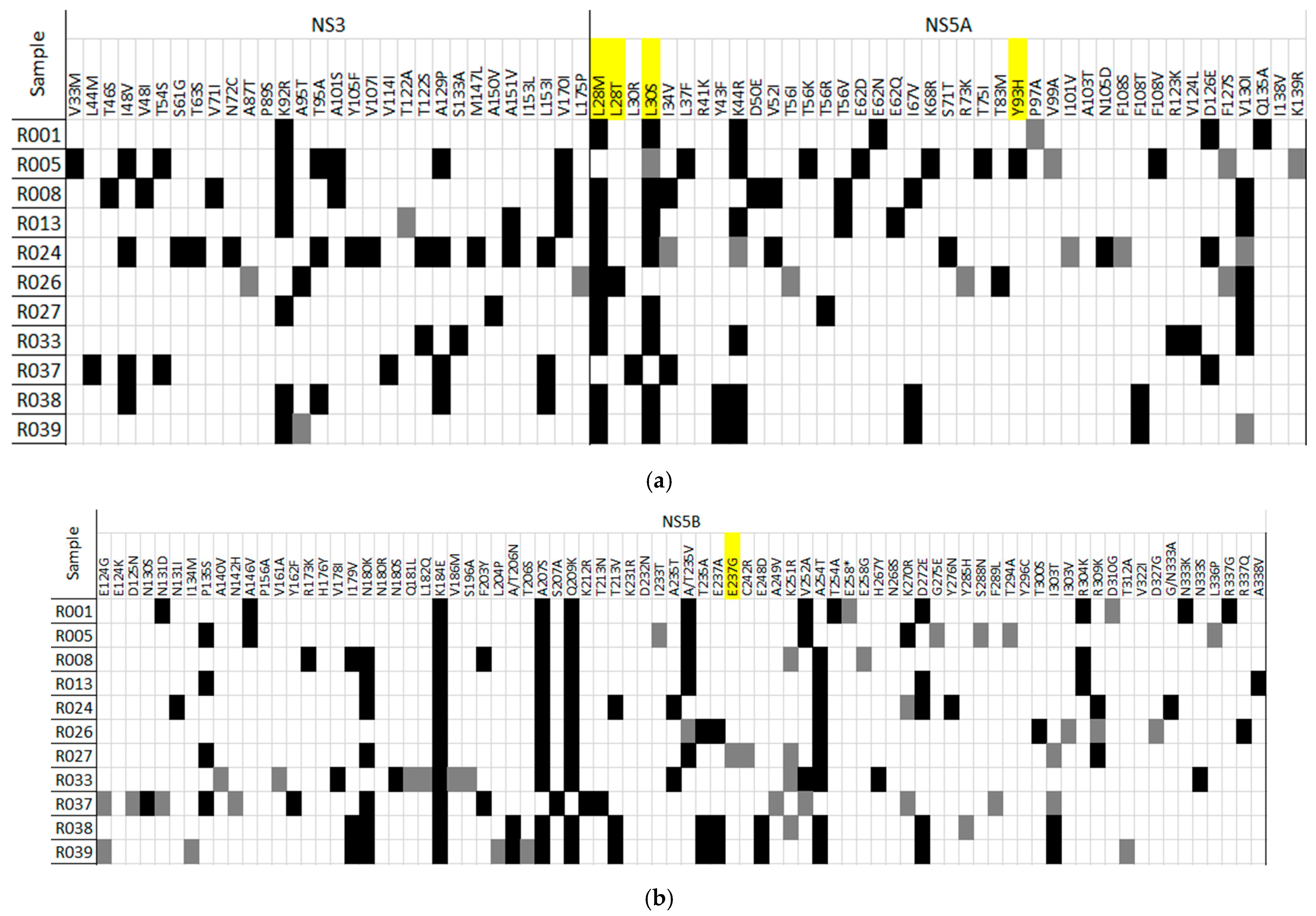
Figure 1. (a) G4a post-treatment samples substitutions detected at targeted regions from the NS3 and NS5A. In yellow, substitutions corresponding to G4 RASs according to Sorbo MC et al. [14]. In black, substitutions represented at the consensus sequence and in grey, mutations detected as minor variants. (b) G4a post-treatment samples substitutions detected at targeted region from the NS5B. In yellow, substitutions corresponding to G4 RASs according to Sorbo MC et al. [14]. In black, substitutions represented at the consensus sequence and in grey, mutations detected as minor variants.
Ijms 26 10649 g001
Figure 2. (a) G4m (blue) and G4o (red) post-treatment samples substitutions detected at targeted regions from the NS3 and NS5A. In yellow, substitutions corresponding to G4 RASs according to Sorbo MC et al. 2018 [14]. Minor variants are represented with a light color corresponding to subtype. (b) G4m (blue) and G4o (red) post-treatment samples substitutions detected at targeted region from the NS5B. In yellow, substitutions corresponding to G4 RASs according to Sorbo MC et al. [14]. Minor variants are represented with a light color corresponding to subtype.
Ijms 26 10649 g002
Figure 3. Pre- and post-treatment cases substitutions comparison. In yellow, substitutions corresponding to G4 RASs according to Sorbo MC et al. [14]. Minor variants are represented with a lighter color corresponding to subtype: black (G4a), red (G4o), and blue (G4m).
Ijms 26 10649 g003
Table 1. Sample clinical description and cases pre/post-treatment identification. Abbreviations: DCV, Daclatasvir; SOF, Sofosbuvir; VEL, Velpatasvir; VOX, Voxilaprevir; RBV, Ribavirin; PAR, Paritaprevir; OMB, Ombitasvir.
SamplesCaseAgeGenderSubtypeViral Load (IU)First TreatmentTreatment PeriodSecond Treatment. Final Decision
R001 Pre & R002 Post154Female4a5.80 × 105
3.51 × 10⁶
SOF/DCV12 weeksSOF/VEL/VOX
R007 Pre & R039 Post323Male4a5.49 × 106
1.95 × 10⁶
SOF/DCV12 weeksSOF/VEL/VOX
R010 Pre & R009 Post460Male4a/4o2.23 × 107
9.17 × 10⁶
SOF/DCV12 weeksSOF/VEL/VOX
R015 Pre & R016 Post565Male4o7.31 × 105
7.01 × 10⁵
SOF/DCV12 weeksSOF/VEL/VOX
R036 Pre & R035 Post646Female4m5.82 × 106
1.16 × 10⁶
SOF/DCV12 weeksSOF/VEL/VOX
R037 64Male4a3.70 × 105SOF/DCV12 weeksSOF/VEL/VOX
R038 53Male4a2.00 × 106SOF/DCV12 weeksSOF/VEL/VOX
R043 49Male4m2.88 × 105SOF/DCV12 weeksSOF/VEL/VOX
R033 51Female4a1.74 × 106SOF/DCV12 weeksSOF/VEL/VOX
R034 62Male4o1.12 × 106SOF/DCV12 weeksSOF/VEL/VOX
R027 47Female4a6.32 × 106SOF/DCV12 weeksSOF/VEL/VOX
R025 56Male4m1.44 × 107SOF/DCV12 weeksSOF/VEL/VOX
R008 58Female4a9.46 × 105SOF/DCV12 weeksSOF/VEL/VOX
R019 60Male4o5.76 × 105SOF/DCV12 weeksSOF/VEL/VOX
R022 49Female4o4.66 × 106SOF/DCV12 weeksSOF/VEL/VOX
R029 49Female1g4.39 × 106SOF/DCV/RBV12 weeksSOF/VEL/VOX
R031 53Male4o4.24 × 106SOF/DCV/RBV12 weeksSOF/VEL/VOX
R006 Pre & R005 Post260Female4a1.89 × 106
1.76 × 10⁵
SOF/PAR/OMB/RBV24 weeksSOF/VEL/VOX
R013 42Female4a2.91 × 106SOF/PAR/OMB/RBV24 weeksSOF/VEL/VOX
R021 67Male4o2.86 × 106SOF/PAR/OMB/RBV24 weeksSOF/VEL/VOX
R026 60Male4a1.26 × 106SOF/PAR/OMB/RBV24 weeksSOF/VEL/VOX
R024 45Female4a6.57 × 106SOF/PAR/OMB/RBV24 weeksSOF/VEL/VOX
Table 2. Number of post-treatment patients showing prevalent mutations in the cohort. (a) refers to substitutions with frequencies higher or equal to 50% found in six or more patients, whilst (b) refers to substitutions observed in positions that have been previously associated with resistance (RAS), in any number of patients in the cohort.
(a)HCV Region/PositionAmino Acid SubstitutionNo. of Patients (%)Amino Acid Position
Substitutions with frequencies >= to 50% in six or more patientsNS3K92R792
NS5AL28M828
NS5AL30S730
NS5AK44R744
NS5B1N180K7180
NS5B1K184E12184
NS5B1A207S11207
NS5B1Q209K11209
NS5B1A254T9254
NS5B2D272E6272
(b)HCV RegionAmino Acid SubstitutionNum. PatientsRAS Position
Substitutions with frequencies >= to 50% at RAS positionsNS3T54S154
NS3T122S2122
NS3V170I3170
NS5AL28M828
NS5AL28T128
NS5AL30S730
NS5AL30R130
NS5AE62D162
NS5AE62N162
NS5AE62Q162
Table 3. Specific RT-PCR-Nested primers for DAA-targeted regions.
GenotypeRegionOligo5′ PositionSequence
RT-PCRG4aNS3Fw3391CAGAAACATCMAAGGGGTGGAGACT
Rv4004CTGRGGCACYGCDGGGGGTGT
NS5AFw6230GATCAATGAAGATTGYTCCACYCCAT
Rv6879GTGATGGGTCTGTCARCATGGA
NS5BFw7952CCACATCARCTCCGTGTGG
Rv8650GGGGGAGCCGAGTAYCTCGT
G4m/G4oNS3Fw3412TGGAGRCTYCTYGCYCCYAT
Rv4064ACYTTRGTGCTCTTGCCGCT
NS5AFw6217AGACGYCTYCACMAGTGGATYAAYGA
Rv6989CABGTGGCYTTCARDGATGGRGC
NS5BFw7952CCACATCARCTCCGTGTGG
Rv8631TCATRGCCTCCGTGAAGGC
G1gNS3Fw3354CGCAGGGGYAGGGAAGT
Rv4008AGGTCTGRGGYACGGCTG
NS5AFw6213AGGCGACTYCACACRTGGAT
Rv6879GTGATGGRTCTGTGAGCATRGACG
NS5BFw7952CCACATCAACTCCGTGTGG
Rv8638GGGRGCGGAGTACCTGGT
NestedG4aNS3Fw3490GGGACACCAATGARAATTGTGGT
Rv3982GARTTGTCAGTGAACACTGGTGATC
NS5AFw6299CGTGCTGAGTGACTTCAAGACGTGGCT
Rv6735GGTGTAGYCTGAYGCCGTCYA
NS5B1Fw7952CCACATCARCTCCGTGTGG
Rv8409CCCACRTAGAGTCTYTCTGTGAG
NS5B2Fw8254CNTAYGAYACCMGNTGYTTTGACTC
Rv8641GARTAYCTGGTCATAGCNTCCGTGAA
G4m/G4oNS3Fw3481AGCCTYACYGGCARRGAYACCAATG
Rv3983TTGTCRGTRAAVACYGGRGACCTCAT
NS5AFw6288TGGGTYTGCACYGTHYTRAGTGACT
Rv6811CCVACYACRAAMGWGTTGAGGCC
NS5B1Fw7952CCACATCARCTCCGTGTGG
Rv8409TGCTGTTRTACATSGGRCCRCC
NS5B2Fw8254CNTAYGAYACCMGNTGYTTTGACTC
Rv8641GARTAYCTGGTCATAGCNTCCGTGAA
G1gNS3Fw3486GGCCGVGAYAAMAACMMGGTGG
Rv3988GGGGTRGAATTGTCMGTGWAHACDGG
NS5AFw6282TGGGACTGGAHTGCAYGGT
Rv6729GGCGYACCCCRTCYASCT
NS5B1Fw7952CCACATCAACTCCGTGTGG
Rv8389CCGACGTACARTCTCTCRGTGAG
NS5B2Fw8254CNTAYGAYACCMGNTGYTTTGACTC
Rv8641GARTAYCTGGTCATAGCNTCCGTGAA
Disclaimer/Publisher’s Note: The statements, opinions and data contained in all publications are solely those of the individual author(s) and contributor(s) and not of MDPI and/or the editor(s). MDPI and/or the editor(s) disclaim responsibility for any injury to people or property resulting from any ideas, methods, instructions or products referred to in the content.