Review

Audiovestibular Dysfunction in Patients with Hashimoto’s Disease: A Systematic Review

1
Prospect Clinic for Otorhinolaryngology & Neurology, Kaohsiung 811, Taiwan
2
Department of Otorhinolaryngology, E-Da Cancer Hospital, I-Shou University, Kaohsiung 824, Taiwan
3
Department of Psychiatry, Kaohsiung Chang Gung Memorial Hospital and Chang Gung University College of Medicine, Kaohsiung 833, Taiwan
4
Department of Psychiatry, Tri-Service General Hospital, School of Medicine, National Defense Medical Center, Taipei 114, Taiwan
5
Institute of Brain Science, National Yang Ming Chiao Tung University, Taipei 112, Taiwan
6
Department of Psychiatry, Beitou Branch, Tri-Service General Hospital, School of Medicine, National Defense Medical Center, Taipei 112, Taiwan
7
Department of Psychiatry, National Defense Medical Center, Taipei 114, Taiwan
8
Institute of Biomedical Sciences, National Sun Yat-sen University, Kaohsiung 804, Taiwan
9
Department of Internal Medicine, E-Da Dachang Hospital, I-Shou University, Kaohsiung 807, Taiwan
10
Institute of Precision Medicine, National Sun Yat-sen University, Kaohsiung 804, Taiwan
*
Authors to whom correspondence should be addressed.
These authors contributed equally to this work.
These authors also contributed equally to this work.
Int. J. Mol. Sci. 2025, 26(10), 4703; https://doi.org/10.3390/ijms26104703
Submission received: 20 March 2025 / Revised: 1 May 2025 / Accepted: 9 May 2025 / Published: 14 May 2025
(This article belongs to the Special Issue Hearing Loss: Molecular Biological Insights)

Abstract

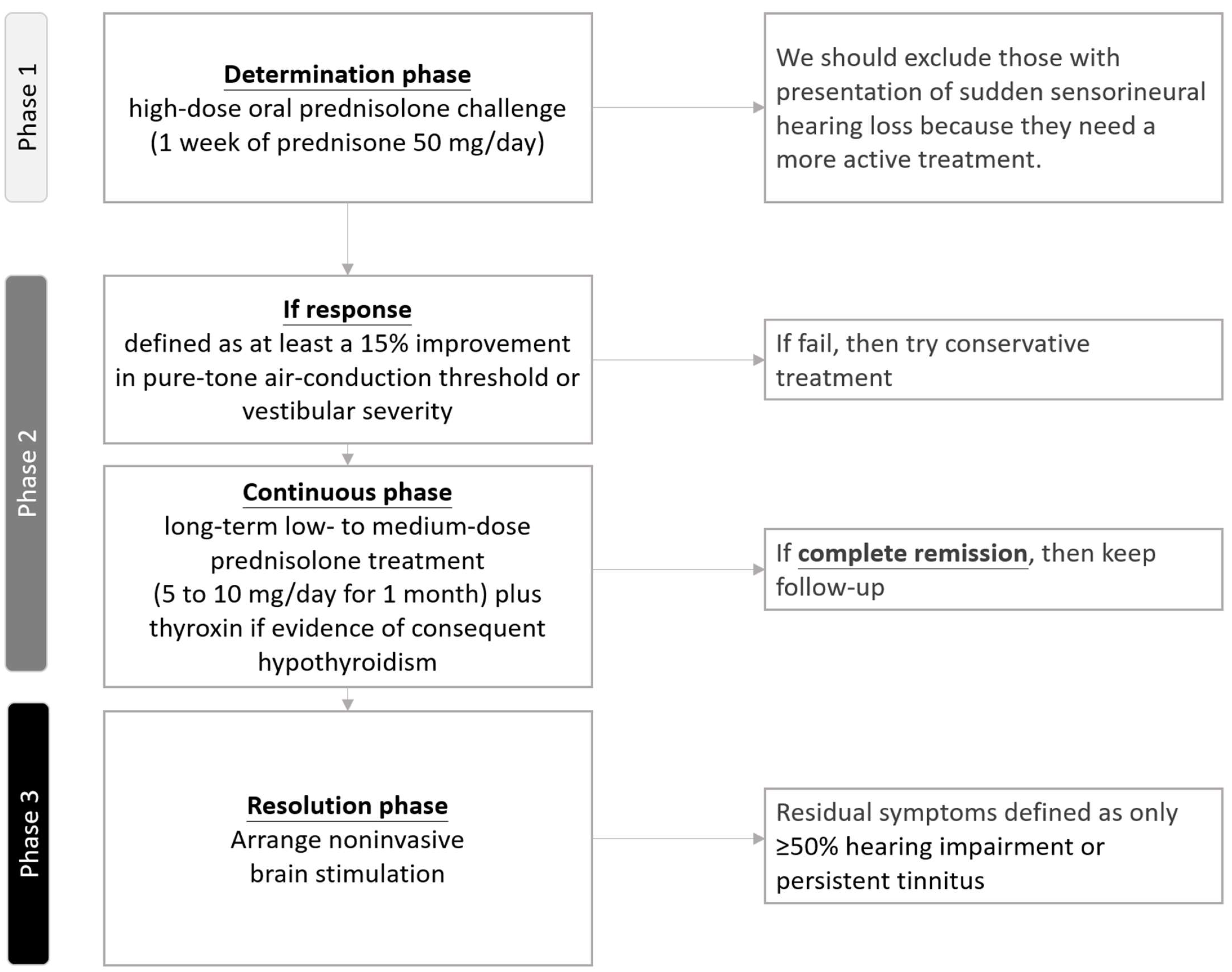
Although the inner ear is considered an immune-privileged organ because of the blood–labyrinth barrier, accumulating evidence has revealed an unexpected relation between Hashimoto’s disease and inner ear damage manifesting as audiovestibular dysfunction. Hashimoto’s disease can simultaneously affect both the auditory and vestibular systems, either through direct autoantibody attacks or through metabolic dysfunction associated with hypothyroidism. Currently, there is no consensus regarding tests or treatments for audiovestibular dysfunction related to Hashimoto’s disease. In this review, we summarize the currently available evidence regarding the characteristics, pathophysiology, diagnostic approaches, and treatment of audiovestibular dysfunction in patients with Hashimoto’s disease. Furthermore, we propose a specific steroid-plus-thyroxine treatment protocol to manage audiovestibular dysfunction associated with Hashimoto’s disease. This condition may respond to adequate treatment, potentially allowing reversibility if it is recognized and managed in a timely manner. Conversely, delayed diagnosis or failure to recognize the subtle presentation of audiovestibular dysfunction in patients with Hashimoto’s disease may lead to progressive hearing loss, immobility, and reduced quality of life. Based on the updated evidence in our review and our modified treatment protocol, we aim to provide new insights and therapeutic directions for clinicians managing audiovestibular dysfunction in patients with Hashimoto’s disease. Trial registration: PROSPERO CRD420250652982.
Keywords: Hashimoto’s disease; cochleopathy; vestibular dysfunction; sensorineural hearing loss; treatment Hashimoto’s disease; cochleopathy; vestibular dysfunction; sensorineural hearing loss; treatment