Review

Sweet Aging: Glycocalyx and Galectins in CNS Aging and Neurodegenerative Disorders

1
Epilepsy Center, Department of Clinical Science, Faculty of Medicine, Lund University, 22184 Lund, Sweden
2
Department of Cell Biology and Molecular Medicine, University of Szeged, H-6720 Szeged, Hungary
*
Author to whom correspondence should be addressed.
Int. J. Mol. Sci. 2025, 26(10), 4699; https://doi.org/10.3390/ijms26104699
Submission received: 9 April 2025 / Revised: 7 May 2025 / Accepted: 12 May 2025 / Published: 14 May 2025

Abstract

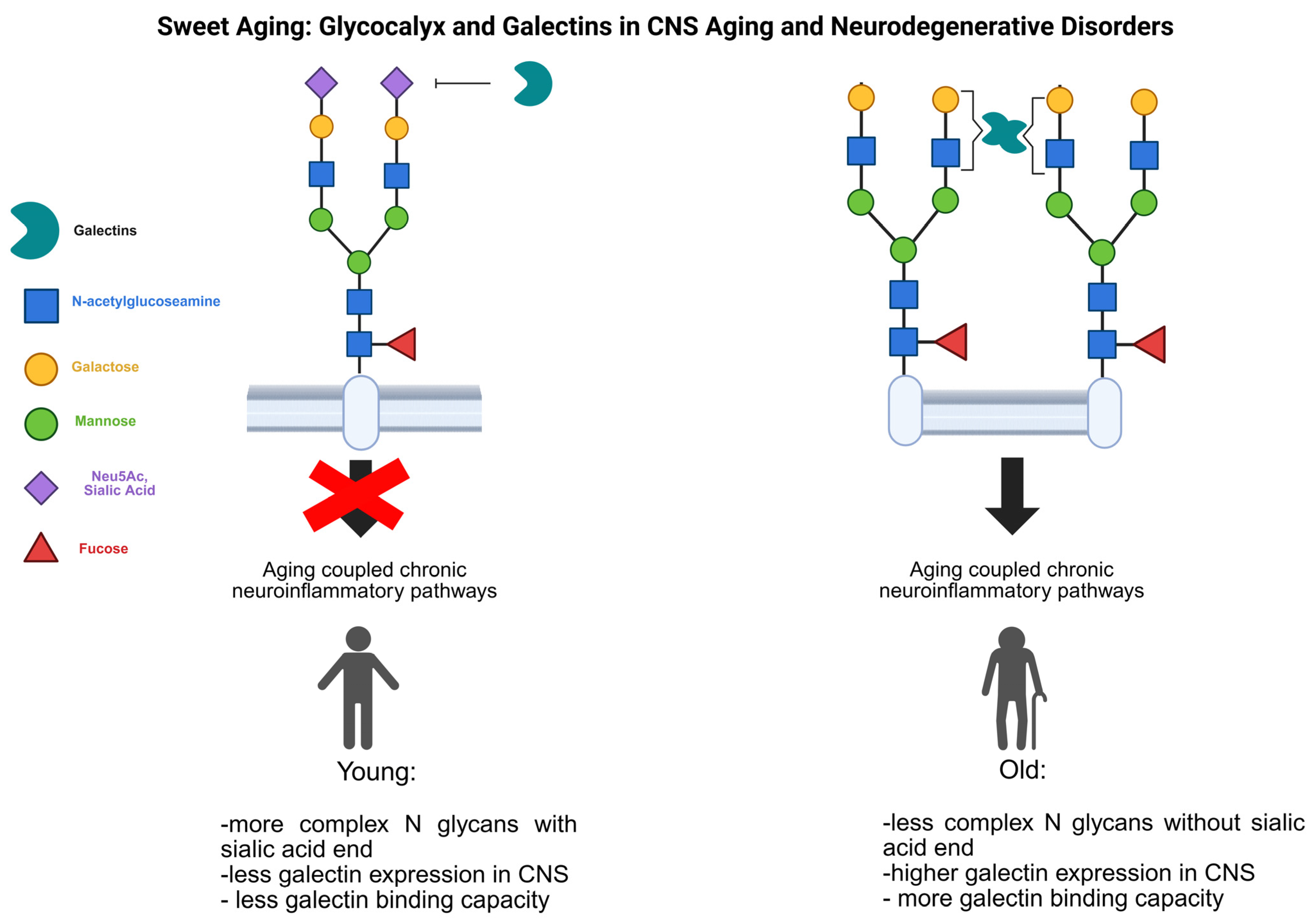
Aging and aging-related neurodegenerative disorders, such as Alzheimer’s disease, are characterized by chronic inflammation that progressively damages nervous tissue within the central nervous system (CNS). In addition to cytokines, lectin-like carbohydrate recognition molecules play a critical role in modifying cellular communication during inflammation. Among these, galectins—particularly anti-inflammatory galectin-1 and pro-inflammatory galectin-3—stand out due to their immunological functions and specificity for N-acetyllactosamine structures. Almost every cell type within the CNS can express and recognize galectins, influencing various essential cellular functions. N-acetyllactosamines, the ligand structures recognized by galectins, are found beneath sialylated termini in protein-linked oligosaccharides. During aging, protein-linked oligosaccharide structures become shorter, exposing N-acetyllactosamines on protein surfaces, which enhances their availability as binding sites for galectins. Genomic studies indicate that the number of galectin-1- and galectin-3-expressing microglial cells increases with age- or age-related disease (Alzheimer’s disease), reflecting an aging-associated rise in galectin concentrations within the CNS. This increase parallels a rise in free N-acetyllactosamine-like ligands, suggesting that galectin-N-acetyllactosamine interactions gain prominence and play a more significant role in aging-related CNS disorders. Understanding these interactions and their molecular implications offers potential avenues for targeted therapeutic strategies in combating aging-related CNS inflammation and neurodegeneration.
Keywords: aging; galectins; neuroinflammation; glycan–lectin interaction aging; galectins; neuroinflammation; glycan–lectin interaction