Brief Report

Pulsating Extremely Low-Frequency Electromagnetic Fields Influence Differentiation of Mouse Neural Stem Cells towards Astrocyte-like Phenotypes: In Vitro Pilot Study


by
Jasmina Isaković
1,*,†,
Filip Slatković
1,‡,
Denis Jagečić
2,3,
Dražen Juraj Petrović
2,3,4 and
Dinko Mitrečić
2,3
1
Omnion Research International d.o.o., 10000 Zagreb, Croatia
2
Laboratory for Stem Cells, Croatian Institute for Brain Research, University of Zagreb School of Medicine, 10000 Zagreb, Croatia
3
Department of Histology and Embryology, University of Zagreb School of Medicine, 10000 Zagreb, Croatia
4
Genos d.o.o., Laboratory for Glycobiology, 10000 Zagreb, Croatia
*
Author to whom correspondence should be addressed.
Current address: School of Medicine, European University Cyprus—Frankfurt Branch, Im Vogelsgesang 3, 60488 Frankfurt, Germany.
Current address: Occyo GMBH, Bleichenweg 13b, 6020 Innsbruck, Austria.
Int. J. Mol. Sci. 2024, 25(7), 4038; https://doi.org/10.3390/ijms25074038
Submission received: 29 February 2024 / Revised: 26 March 2024 / Accepted: 3 April 2024 / Published: 4 April 2024
(This article belongs to the Special Issue The Role of Glial Cells in Health and Disease)

Abstract

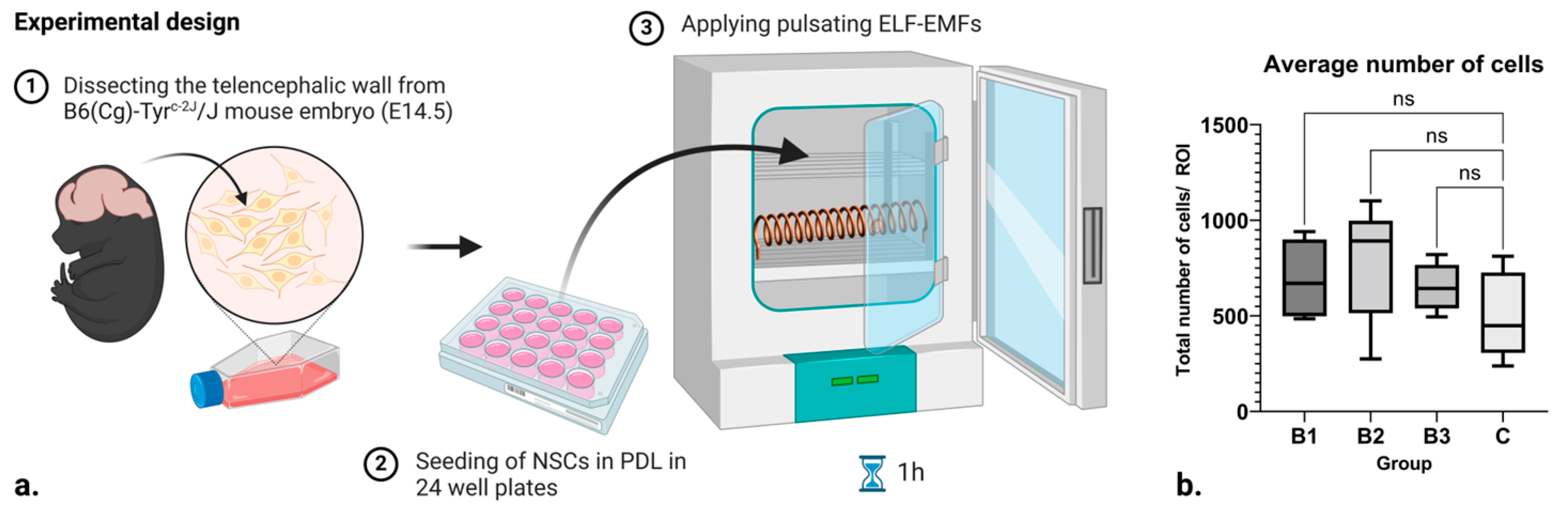
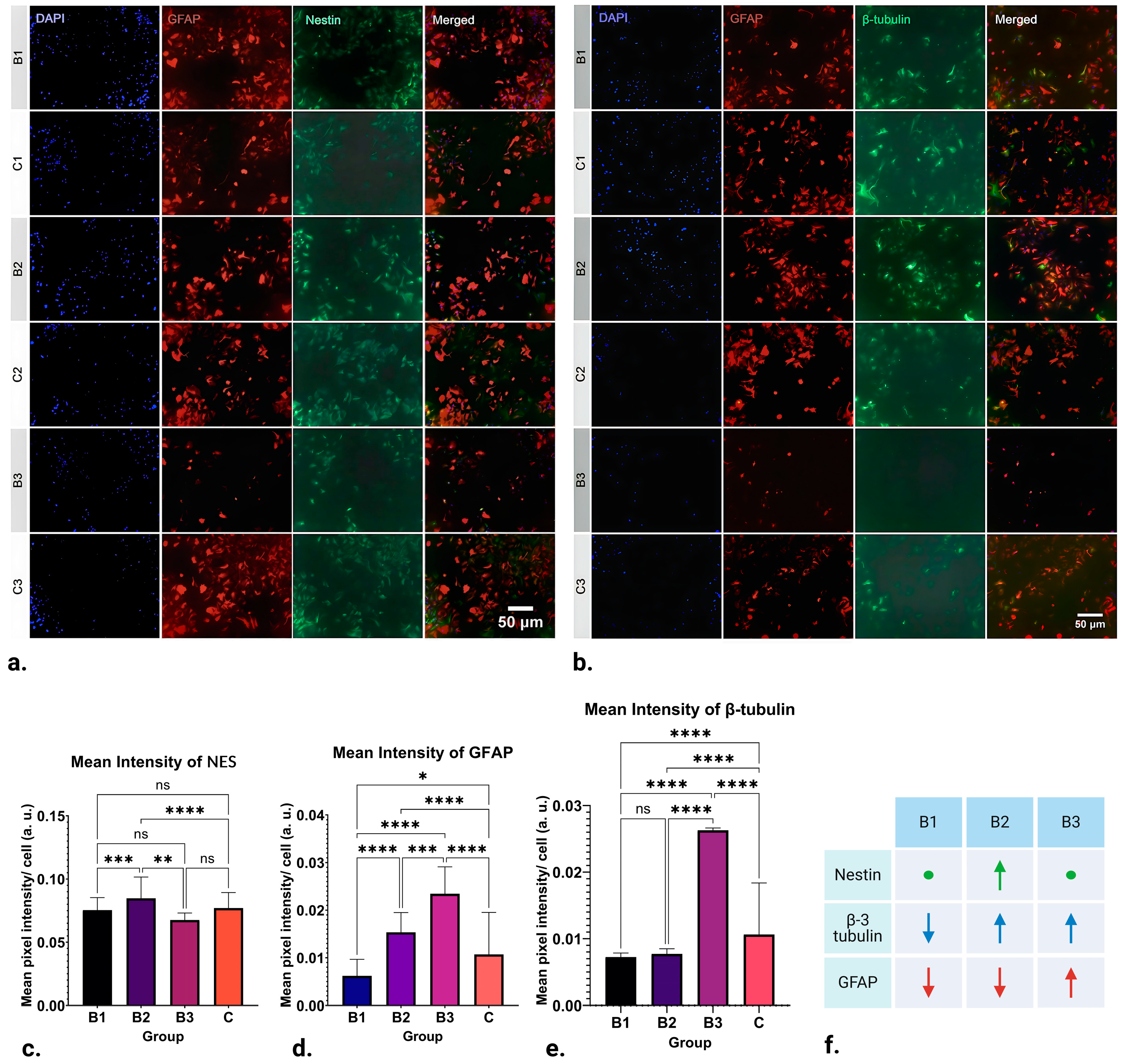
Even though electromagnetic fields have been reported to assist endogenous neurogenesis, little is known about the exact mechanisms of their action. In this pilot study, we investigated the effects of pulsating extremely low-frequency electromagnetic fields on neural stem cell differentiation towards specific phenotypes, such as neurons and astrocytes. Neural stem cells isolated from the telencephalic wall of B6(Cg)-Tyrc-2J/J mouse embryos (E14.5) were randomly divided into three experimental groups and three controls. Electromagnetic field application setup included a solenoid placed within an incubator. Each of the experimental groups was exposed to 50Hz ELF-EMFs of varied strengths for 1 h. The expression of each marker (NES, GFAP, β-3 tubulin) was then assessed by immunocytochemistry. The application of high-strength ELF-EMF significantly increased and low-strength ELF-EMF decreased the expression of GFAP. A similar pattern was observed for β-3 tubulin, with high-strength ELF-EMFs significantly increasing the immunoreactivity of β-3 tubulin and medium- and low-strength ELF-EMFs decreasing it. Changes in NES expression were observed for medium-strength ELF-EMFs, with a demonstrated significant upregulation. This suggests that, even though ELF-EMFs appear to inhibit or promote the differentiation of neural stem cells into neurons or astrocytes, this effect highly depends on the strength and frequency of the fields as well as the duration of their application. While numerous studies have demonstrated the capacity of EMFs to guide the differentiation of NSCs into neuron-like cells or β-3 tubulin+ neurons, this is the first study to suggest that ELF-EMFs may also steer NSC differentiation towards astrocyte-like phenotypes.
Keywords: extremely low-frequency electromagnetic fields; neural stem cells; differentiation; astrocytes; neurons; neuroregeneration extremely low-frequency electromagnetic fields; neural stem cells; differentiation; astrocytes; neurons; neuroregeneration