Article

Implementing a New Algorithm for Reinterpretation of Ambiguous Variants in Genetic Dilated Cardiomyopathy


by
Alexandra Pérez-Serra
1,2,†,
Rocío Toro
3,4,†,
Estefanía Martinez-Barrios
5,6,7,
Anna Iglesias
1,2,
Anna Fernandez-Falgueras
1,2,8,
Mireia Alcalde
1,2,
Mónica Coll
1,2,
Marta Puigmulé
1,2,
Bernat del Olmo
1,2,
Ferran Picó
1,2,
Laura Lopez
1,2,
Elena Arbelo
2,5,9,
Sergi Cesar
5,6,7,
Coloma Tiron de Llano
8,
Alipio Mangas
3,4,10,
Josep Brugada
2,5,9,
Georgia Sarquella-Brugada
5,6,7,11,
Ramon Brugada
1,2,8,11,*,‡ and
Oscar Campuzano
1,2,11,*,‡
1
Cardiovascular Genetics Center, Institut d’Investigació Biomèdica de Girona (IDIBGI-CERCA), Parc Hospitalari Martí i Julià, Edifici M2, 17190 Salt, Spain
2
Centro de Investigación Biomédica en Red Enfermedades Cardiovasculares (CIBERCV), 28029 Madrid, Spain
3
Medicine Department, School of Medicine, Cadiz University, 11003 Cadiz, Spain
4
Research Unit, Biomedical Research and Innovation Institute of Cadiz (INiBICA), Puerta del Mar University Hospital, 11009 Cadiz, Spain
5
European Reference Network for Rare, Low Prevalence and Complex Diseases of the Heart (ERN GUARD-Heart), 1105 AZ Amsterdam, The Netherlands
6
Pediatric Arrhythmias, Inherited Cardiac Diseases and Sudden Death Unit, Cardiology Department, Sant Joan de Déu Hospital de Barcelona, 08950 Barcelona, Spain
7
Arrítmies Pediàtriques, Cardiologia Genètica i Mort Sobtada, Malalties Cardiovasculars en el Desenvolupament, Institut de Recerca Sant Joan de Déu, Esplugues de Llobregat, 08950 Barcelona, Spain
8
Cardiology Service, Hospital Josep Trueta, University of Girona, 17007 Girona, Spain
9
Arrhythmias Unit, Hospital Clinic, University of Barcelona-IDIBAPS, 08036 Barcelona, Spain
10
Internal Medicine Department, Puerta del Mar University Hospital, School of Medicine, University of Cadiz, 11009 Cadiz, Spain
11
Medical Science Department, School of Medicine, University of Girona, 17003 Girona, Spain
*
Authors to whom correspondence should be addressed.
Both equally contributed as co-first authors.
Both equally contributed as co-senior authors.
Int. J. Mol. Sci. 2024, 25(7), 3807; https://doi.org/10.3390/ijms25073807
Submission received: 19 February 2024 / Revised: 13 March 2024 / Accepted: 27 March 2024 / Published: 29 March 2024
(This article belongs to the Special Issue Advances in Human Hereditary Diseases: Genetics and Genomics Research)

Abstract

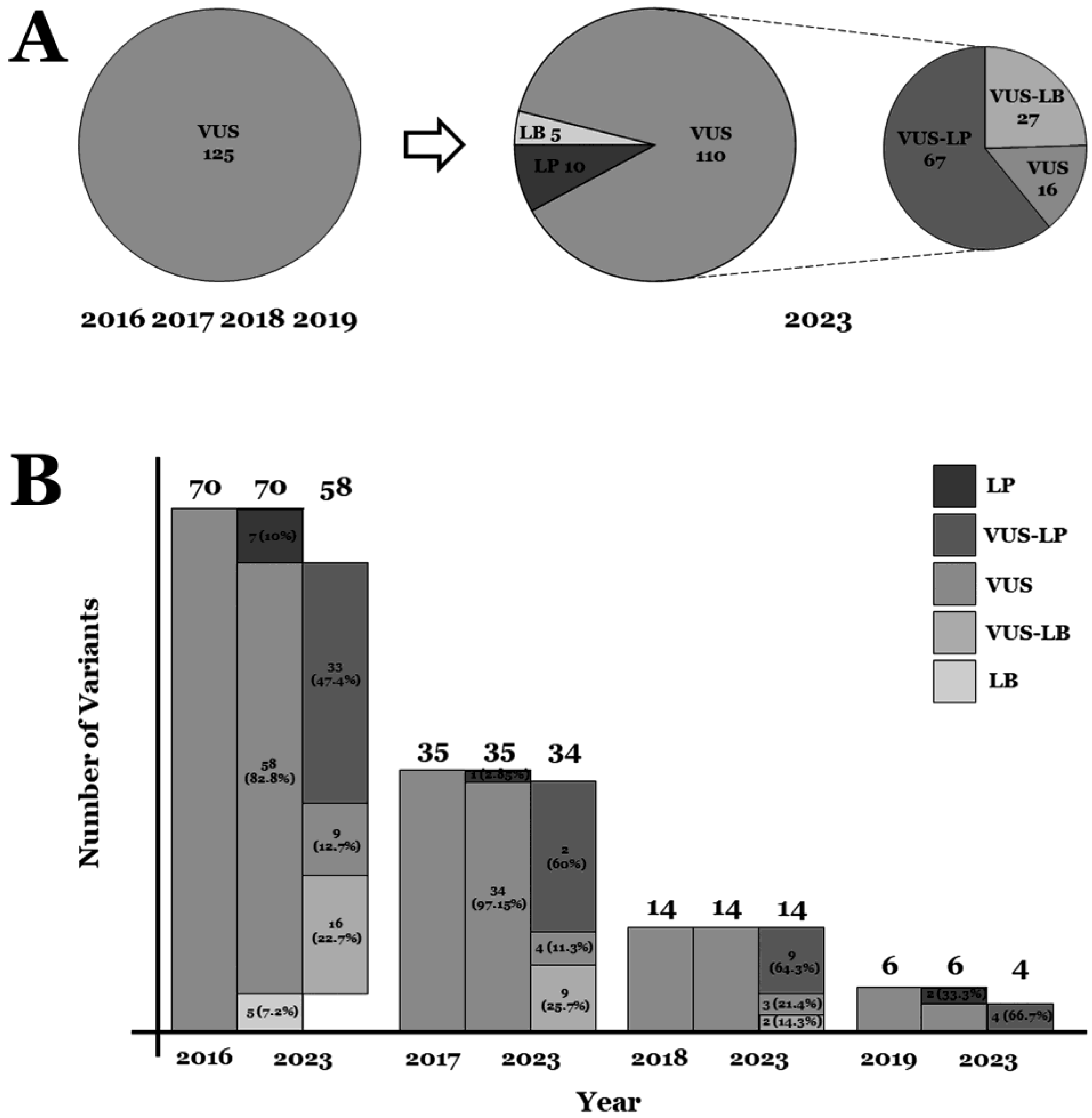
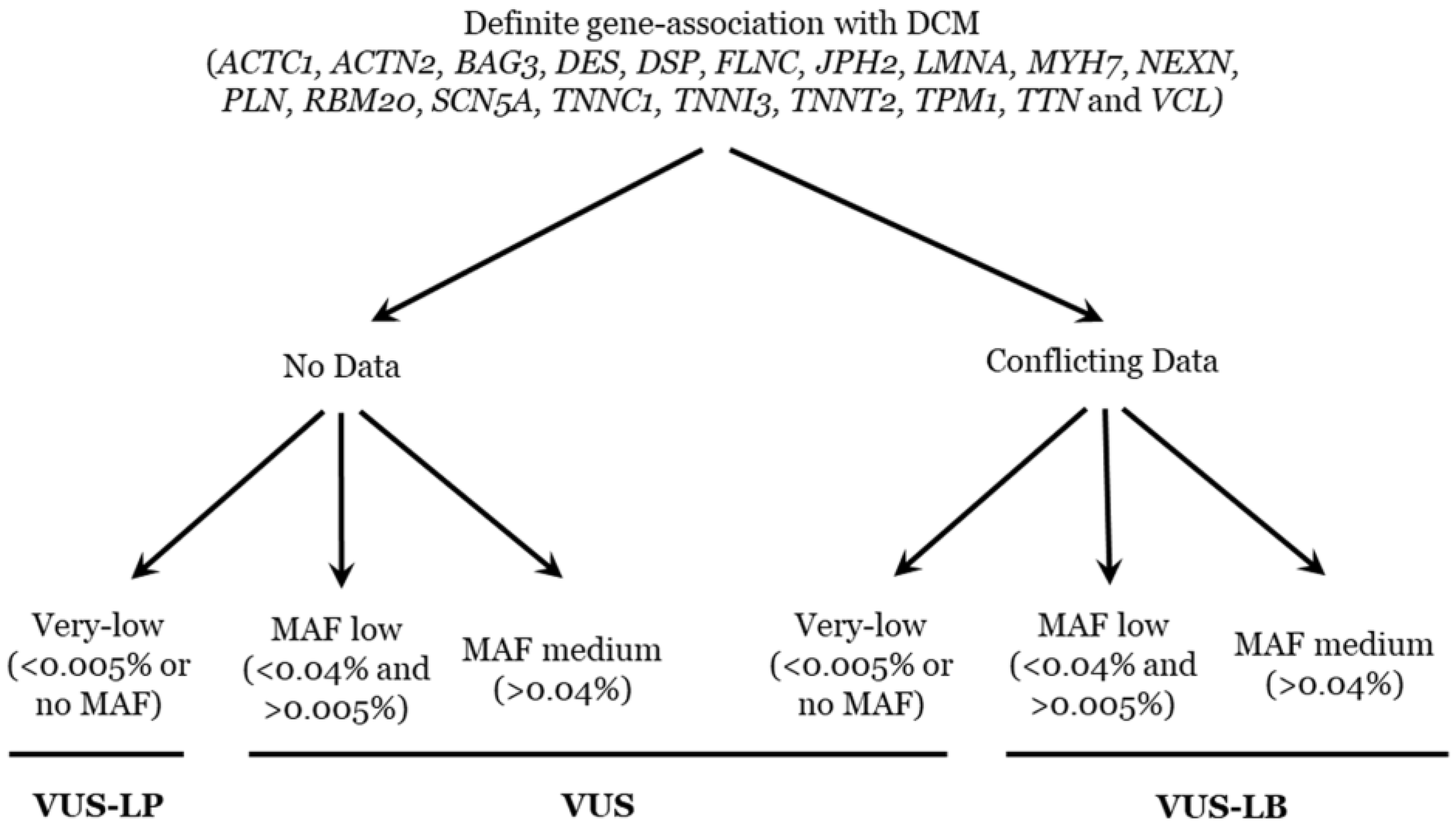
Dilated cardiomyopathy is a heterogeneous entity that leads to heart failure and malignant arrhythmias. Nearly 50% of cases are inherited; therefore, genetic analysis is crucial to unravel the cause and for the early identification of carriers at risk. A large number of variants remain classified as ambiguous, impeding an actionable clinical translation. Our goal was to perform a comprehensive update of variants previously classified with an ambiguous role, applying a new algorithm of already available tools. In a cohort of 65 cases diagnosed with dilated cardiomyopathy, a total of 125 genetic variants were classified as ambiguous. Our reanalysis resulted in the reclassification of 12% of variants from an unknown to likely benign or likely pathogenic role, due to improved population frequencies. For all the remaining ambiguous variants, we used our algorithm; 60.9% showed a potential but not confirmed deleterious role, and 24.5% showed a potential benign role. Periodically updating the population frequencies is a cheap and fast action, making it possible to clarify the role of ambiguous variants. Here, we perform a comprehensive reanalysis to help to clarify the role of most of ambiguous variants. Our specific algorithms facilitate genetic interpretation in dilated cardiomyopathy.
Keywords: sudden cardiac death; dilated cardiomyopathy; genetics; interpretation sudden cardiac death; dilated cardiomyopathy; genetics; interpretation