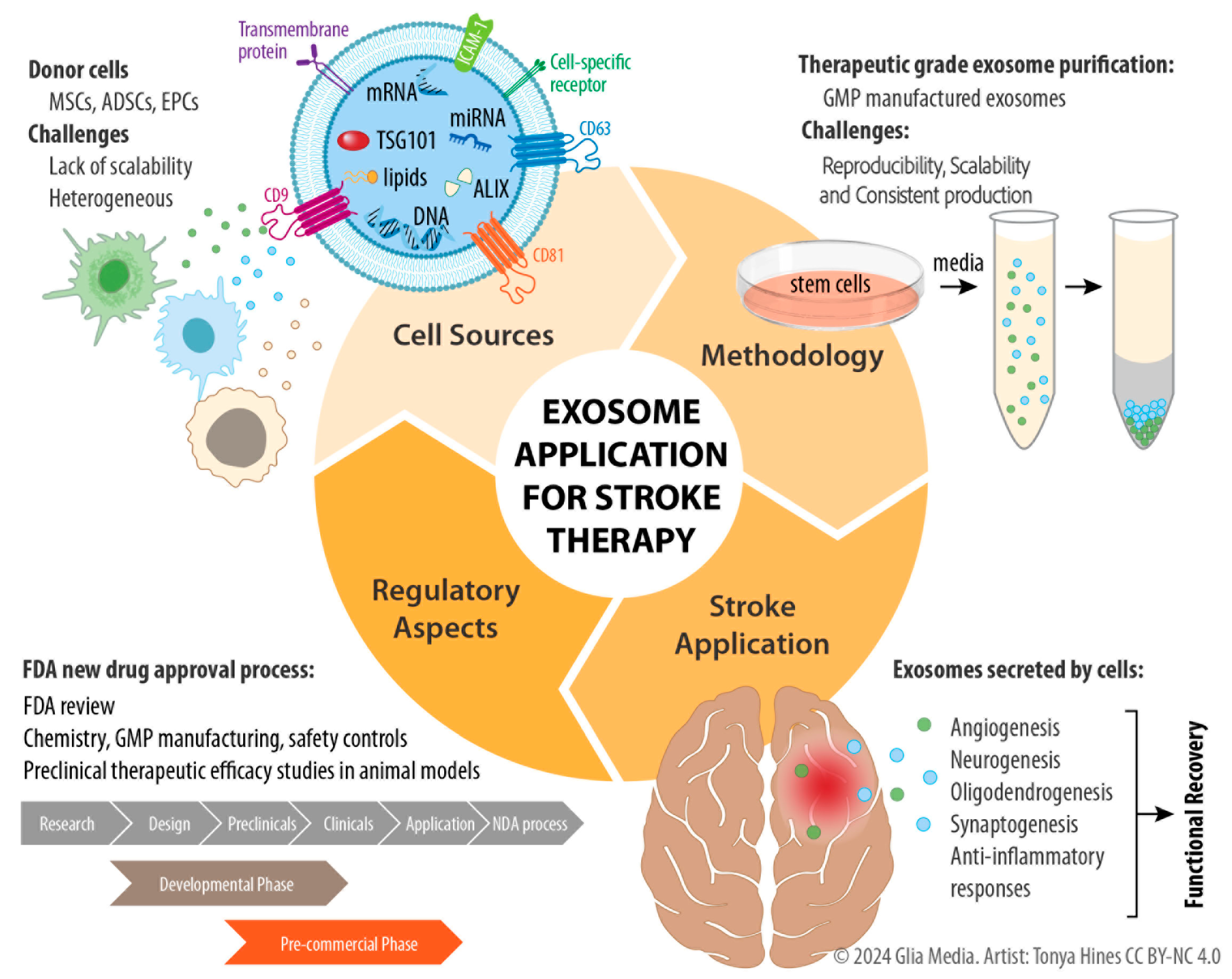
Emerging Roles of Exosomes in Stroke Therapy

 , , , and
Abstract
1. Introduction
2. Exosomes and Their Potential Role in Therapy
3. Therapeutic Potential for Stroke: Stem Cells versus Exosomes
4. Purification Methods and Characterization of Exosomes
5. Exosome Application in Stroke Therapy
5.1. Stroke Animal Models
5.2. Source of Exosomes in Stroke Therapy
5.3. Delivery of Exosomes in Stroke Therapy
5.4. Biodistribution
5.5. Functional Improvement
5.6. Infarct Volume
5.7. Histological Findings
5.8. Mechanism of Action

| Studies | Source of Exosomes | Animal Models | Purification Methods | Characterization | Administration Dose | Administration Route | Evaluation Methods and Times for Observation |
|---|---|---|---|---|---|---|---|
| Xin et al. [61] | Rat bone marrow mesenchymal stem cells (BM-MSCs) | Adult male Wistar rat transient (2 h) MCAO model | Ultracentrifugation | Expression of Alix | 100 µg total protein of MSC-derived exosomes | Intravenous (IV) injection at 24 h after stroke | Neurologic severity score (NSS) and foot-fault test at 1, 3, 7, 14, 21 and 28 days |
| Doeppner et al. [20] | Human BM-MSCs | 10-week-old mice transient MCAO | Polyethyleneglycol (PEG) precipitation and ultracentrifugation | Expression of TSG101 and CD81 | 2 × 10⁶ BMSC-EV | Intravenous injection at 24 h after stroke at 3 consecutive time points (24 h, 3 and 5 days) after stroke | Rotarod, corner test and tightrope test, neurologic severity score (NSS) at 7, 14, and 28 days after stroke |
| Ophelders et al. [19] | Human MSCs | Ovine model of preterm hypoxia-ischemia (HI) min in sheep fetuses at 102 days of gestation. | Polyethylene glycol (PEG) and low-speed centrifugation | Particle size (99–123 nm) and expression of CD81 and TSG101 | 2.0 × 10⁷ MSC-EV | Intravenous injection 2 consecutive time points, at 1 h and h4 days post-HI | (1) Baroreceptor reflex on days 0–6 post-HI, (2) Collect seizure burden data continuously until 7 days’ post-HI |
| Lee et al. [22] | Human adipose MSCs (AD-MSC) exposed to normal rat brain extract (NBE-MSCs), stroke-injured rat brain extract (SBE-MSCs) or not exposed to any extract MSCs | Permanent MCA stroke model in male Sprague-Dawley rats | Ultracentrifugation | N/A | 0.2 mg EV/kg rat body weight | the common carotid artery injection 48 h after stroke | Neurologic function (open field, foot fault, beam balance, prehensile traction and torso-twisting) at 0-, 3- and 7-days post-MV injection |
| Chen et al. [62] | ADSCs and ADSC-exosomes isolated from xenogenic pigs | Mini pigs using the KISOTM System | Ultracentrifugation | Particle size (30–90 nm) using TEM and expression of CD63, TSG101 and ß-catenin | 300 µg exosomes | Intravenous injection at 3 h after stroke | (1) Sensorimotor functional (Corner Test) studies on day 0, 1, 3, 7, 14 and 28 after stroke, (2) MRI on days 3 and 28 post-stroke and (3) euthanized 60 days after stroke. |
| Otero-Ortega et al. [69] | ADMSCs obtained from allogeneic adipose tissue of Sprague-Dawley rats | Ischemic stroke in adult male rats by injection of 1 μL of endothelin-1 or of 0.5 U collagenase type IV into the striatum | miRCURY Exosome Isolation Kit | Particle size (<100 nm) using NanoSight and by the expression of CD81 and Alix | 100 µg EV | Intravenous injection at 24 h after stroke | (1) Behavior studies (beam walk, rotarod, modified Rogers test) at 48 h, 7 and 28 days after stroke and (2) MRI imaging performed 7 and 28 days after stroke. |
| Webb et al. [21] | Human NSCs and human MSCs differentiated from the H9 hESCs | Thromboembolic model of stroke in aged mice. | Ultracentrifugation | Particle size (<300 nm) using NanoSight and expression of CD63 and CD81 | three dose regiment of EV with 2.7 × 10¹¹ EV | Intravenous injection at 2, 14, and 38 h post-stroke | (1) Cerebral Doppler measurements at 6 and 38 h post-injection (2) novel object recognition (NOR) testing to test Episodic memory |
| Xiao et al. [16] | Endothelial cells exposed to ischemia (6 h)- reperfusion (24 h) in vitro | Transient remote ischemic preconditioning cerebral I/R (MCAO/R) in parallel to remote ischemic preconditioning (RIP) by temporary clamping of the femoral artery using adult male and female Sprague-Dawley rats | Ultracentrifugation | Particle size (40–100 nm) with a JEOL-1010 TEM and expression of CD63, HSP70 and TSG101 by immunohistochemistry, Western blot and flow cytometry | NA | NA | NA |
| Han et al. [68] | BMSCs from Wistar rat | Intracerebral hemorrhage (ICH) in adult male Wistar rats | ExoQuick exosome isolation | BCA Protein assay and qNano nanopore-based exosome detection system Alix by Western blot, and electron microscopy | 100 μg protein of MSC-derived exosomes | Intravenous injection at 24 h post-ICN | Modified Morris water maze (mMWM), modified Neurological Severity Score (mNSS), and social odor–based novelty recognition tests at days 1, 7, 14, 21 and 25 |
| Huang et al. [63] | (1) rat adipose-derived mesenchymal stem cells (ADSCs) isolated from rat (2) Pigment epithelium-derived factor (PEDF)-overexpressing ADSCs | MCAO model using adult male Sprague-Dawley rats | Ultracentrifugation | Expression of CD9, CD63, CD81, and TSC101 | 100 μg of EVs per kg | Intravenous injection | Oxygen-glucose deprivation (OGD) experiments |
| Jiang et al. [64] | miR30d-5p overexpressing rat ADSCs | MCAO model using adult male Sprague-Dawley rats | Ultracentrifugation | Size distribution of ADs-Exos, Nanosizer™ technology (Malvern Instruments, Malvern, UK), transmission electron microscopy (TEM), specific exosome markers CD9, CD63, CD81, and TSC101 | 80 μg of EVs | Intravenous injection | N/A |
| Geng et al. [67] | Human MI ADSCs (Age: 57–69 year- old) and miR-126 loaded ADSCs | MCAO model using 8–12 weeks Sprague-Dawley rats | ExoQuickTM Exosome Precipitation Solution | N/A | N/A | Intravenous injection | Foot-fault test and a modified neurologic severity score (mNSS) at days 1, 3, 7, and 14 post-stroke |
| Liu et al. [65] | Enkephalin overexpressing rat BMSCs | MCAO model using 8–12 weeks Sprague-Dawley rats | Ultracentrifugation | cryo-electron microscopy (cryo-EM) analysis, Nanoparticle tracking analysis, specific exosome markers HSP70, CD63, and TSC101 | N/A | Intravenous injection at 12 h post-stroke | NSS test and inclined board test at 1 and 3 weeks |
| Moon et al. [66] | Rat MSCs (p4) or fibroblasts | MCAO model using Sprague-Dawley rats | Ultracentrifugation | NTA analysis, TEM | 10, 30, 100, or 300 μg rMSC-EVs | Intravenous injection at 24 h post-stroke | (1) mNSS test days 1, 7 and 14 after stroke, and (2) The cylinder and ladder rung walking tests at 28 days post-injury |
| Tian et al. [59] | Neural progenitor cells with RGD-C1C2-fusion | MCAO model using C57BL/6 mice (8 weeks old) | Ultracentrifugation | NTA analysis, TEM | 100 μg (2.5–3.7 × 10¹⁰) | Intravenous injection at 1 h of MCAO and 12 h of reperfusion | N/A |
| Yang et al. [51] | Hypoxic pre-treated mouse ADSCs | MCAO model using C57BL/6 mice | Ultracentrifugation | TEM and light scattering utilizing Nanosizer (Malvern Instruments, Malvern, UK). | N/A | 1 day postoperatively via an intraperitoneal injection. | Sensorimotor functional recovery prior to MCAO and 3, 5, 7, and 10 days post-MCAO was measured Rotarod exam (IITC Life Science, Woodland Hills, CA, USA) to define sensorimotor coordination, the adhesive removal test |
| Jiang X et al. [96] | Hypoxic preconditioning of neural stem cells (NSCs) | MCAO model using C57BL/6 mice | Ultracentrifugation | BCA protein assay kit, TEM; Nano ZS90 for size and zeta potential; CD9 and CD63 were analyzed via Western Blot; CXCR4 measured using ELISA | 10 µg EV | Intravenous injection at 1 Day after MCAO procedure | Complex motor ability on mNSS adhesive removal test, ladder rung task weekly until day 28th |
| Li et al. [100] | M2 microglia | MCAO model using C57BL/6 mice | ExoQuickTC kit from System Biosciences, Palo Alto, CA, USA. | TEM, Western blot, PKH26 red fluorescent cell linke. | M2-Exos (100 μg/mL) EV | Intravenous injection at 2 h after MCAO | Neuronal apoptosis analysis in the MCAO/R model |
| Hong et al. [97] | UC-MSCs | MCAO model using 8 weeks male Sprague Dawley rats | Ultracentrifugation | TEM, Western blot for CD63, Alix, and TSG101 | 50 μg EV | Intravenous injection at 4 h after MCAO once a day per 3 days | Neurologic at 2, 4, and 8 h after the onset of occlusion and then daily until sacrifice. |
| Wang et al. [101] | Bone Marrow-Derived Mesenchymal Stem Cells (BMSCs) | MCAO male SD Rats | Ultracentrifugation exosome isolation kit from Umibio, Shanghai, China | TEM, Western blot, and NTA | 200 µg EV | Intravenous injection at the beginning of reperfusion | Coronal brain section analysis for TTC staining |
| Zhang et al. [95] | NSCs | MCAO male C57BL/6 mice (age: 7–8 weeks, weight: 22–24 g) | Ultracentrifugation | TEM and NTA (Malvern Nano ZS90) | NSC (5 × 10⁵ NSCs in 5 μL PBS) NSC + Exo (5 × 10⁵ NSCs with 10 μg exosomes in 5 μL PBS) | lateral ventricle injection at 7 days post-MCAO Stereoscopic apparatus (RWD, Shenzhen, China). For (AP + 0, ML-1, DV-2.25 mm) | (1)_TTC staining at 1 and 7 days post-MCAO/R. (2) Measurement of reactive oxygen species (ROS) and inflammation at 3 days post-treatment. (3) Behavioral assessments (balance beam, ladder rung, rotarod, modified neurological severity score) conducted at 0–8 weeks post-treatment. (4) Histological examinations performed at 8 weeks post-treatment. MRI for infarct volume |
| Xiao et al. [17] | Bone marrow mesenchymal stem cells (BMSCs) | MCAO C57BL/6 mice (male, 8-week) | Total Exosome Isolation reagent from Thermo Fisher Scientific | TEM, Western blot, NTA | 100 µg EV | Intravenous injection Once per day for 3 days after MCAO | Neurological evaluations using neurological scoring system. |
| Studies | Therapeutic Outcomes | Mechanism of Action |
|---|---|---|
| Xin et al. [61] | Enhanced NSS, synaptic plasticity, neurogenesis, and angiogenesis | (1) Bielschowsky silver and Luxol fast blue staining: Increased neurite remodeling and (2) increased synaptophysin immunoreactivity, increased number of BrdU+/Dcx+ cells and BrdU+/vWF+ cells in IBZ * |
| Doeppner et al. [20] | Improved neurological impairment and brain remodeling, comparing to 1 × 10⁶ MSC, peripheral lymphodemia was reversed no infiltrating monocytes, macrophages, lymphocytes, dendritic cells or neutrophils into the brain | (1) Neuroangiogenesis at 28 days post-stroke: increased NeuN+ cell density, NeuN+/BrdU+ cell number, Dcx+/BrdU+ cell number and CD31/BrdU+ cell number; (2) Reversed peripheral lymphodemia at D6, no infiltrating monocytes, macrophages, lymphocytes, dendritic cells or neutrophils into the brain |
| Ophelders et al. [19] | Reduced baroreflex sensitivity | (1) Myelin basic protein expression: Reduced white matter injury and (2) IBA-1 immunoreactivity: no impact the normal microglial response to HI |
| Lee et al. [22] | Reduced infarct volume and improvement in neurologic function was similar in animals treated with either MV isolated from MSC exposed to normal rat brain extract or extract from rat brain after stroke | (1) Increased number of DCX+ cells in the ipsilateral ** SVZ, increased alpha-smooth muscle actin and reduced GFAP+ cells, (2) Increase in the anti-inflammatory cytokines IL-10 and TSG-6 and attenuation of the pro-inflammatory factors TNF-alpha and progranulin |
| Chen et al. [62] | (1) Sensorimotor function: No difference between treatments of ADSC, ADSC-EV and combination, (2) MRI and histological studies: greatest reduced infarct volumes in the ADMSC plus exosome group, (3) Biodistribution at 60 days: no exosomes or ADMSC | Inflammation, edema, fibrosis, necrosis and apoptosis: greatest reduction in the ADMSC plus exosome group |
| Otero-Ortega et al. [69] | (1) Significant improvement in the behavioral tests at 28 days and (2) MRI: a decrease in lesion size and improved mean axial diffusivity at 28 days (No difference in functional outcome or MRI at 24 h and 7 days after treatment. (3) Biodistribution: EV found in the brain, lung, liver, and spleen 24 h after administration | Extracellular vesicles (EVs) proteome analysis: hydrolase activity, tubulin binding, protein kinase regulator activity, kinase regulator activity, and catalytic activity promoting white matter repair after stroke |
| Webb et al. [21] | (1) Significant functional improvements of sensorimotor tests (i.e., balance beam walking, the number of footfalls, hanging wire, and tail suspension performance and declarative memory 14 days post-TEMCAO in aged rodents, (2) reduced infarct volumes (TTC staining), and (3) Biodistribution: the presence of EV in the brain infarct area at 1 h after injection and still present in the liver, lungs, and spleen at 24 h after injection | Circulating M2 macrophages and T regulatory cells analysis: Promoted tissue repair and reduced inflammation by modulating immune responses and facilitated communication between cells in the CNS |
| Xiao et al. [16] | Reduced infarct volumes using TTC-staining | Reduced the rate of apoptosis through downregulation of Bax and caspase-3 and upregulation of Bcl-2 in SH-SY5Y nerve cells |
| Han et al. [68] | Significant improvement in the neurological function of spatial learning and motor recovery measured at 26–28 days by mMWM and starting at day 14 by mNSS | Increased newly generated endothelial cells in the hemorrhagic boundary zone, neuroblasts and mature neurons in the subventricular zone, and myelin in the striatum without altering the lesion volume. (1) EBA staining for mature vascular detection, (2) DCX, TUJ1, and MAP2 for neurogenesis and (3) BrdU-positive, indicating that there were newly generated neuroblasts (BrdU-DCX, BrdU-TUJ1) and newly generated immature neurons (BrdU-MAP2) around the hematoma and the SVZ. |
| Huang et al. [63] | Suppressed MCAO-induced cerebral injury (TTC staining 3 days after MCAO). | Activated autophagy and suppressing neuronal apoptosis. |
| Jiang et al. [64] | Reduced the cerebral injury area of infarction at day 3 post-stroke | Increased anti-inflammatory cytokines IL-4, IL-10. Suppression of autophagy (Beclin-1 and Atg5) and inflammatory factors, TNF-a, IL-6 and iNOS |
| Geng et al. [67] | MiR-126 exosomes: significant reduction ischemic stroke and MCAO rats Improved functional recovery | Significant increase of the expression of vWF (an endothelial cell marker) and doublecortin (a neuroblasts marker), suppression of microglial cell by Iba1. Decrease of neuron cell death (TUNEL) and increase of cell proliferation. |
| Liu et al. [65] | Exosomes crossed the blood-brain barrier Improvement of the neurological score. | Reduction of Neurons Injury: LDH, p53, caspase-3, and NO. Improvement of brain neuron density at days 3 and 7: NeuN. |
| Moon et al. [66] | Biodistribution: larger amounts of hMSCs were trapped within the lung after injection and rMSC-EVs accumulated in the infarcted hemisphere in a dose-dependent manner (30–300 μg), but not in the lung and liver. | Promoted neurogenesis and angiogenesis: miRNA-184 and miRNA-210 Ki-67 (proliferating cells), DCX (immature progenitor neurons), and vWF (angiogenesis) of both ipsilateral and contralateral hemispheres, 14 days after tMCAO. significantly increased coexpression of Ki-67 and DCX in the subventricular zone (SVZ) of both the contralateral and ipsilateral hemispheres |
| Tian et al. [59] | Biodistribution: NIRF imaging at 24 h. Accumulation of undecorated EVReN or Scr-EVReN in the liver, followed by the ischemic brain and then the spleens and lungs, whereas the RGD-EVReN had a significantly stronger signal in the ischemic brain | Strong suppression of the inflammatory response (TNFa, IL1b and IL-6). RNA sequencing revealed a set of 7 miRNAs packaged in the EVs inhibited MAPK, an inflammation related pathway. |
| Yang et al. [51] | Improved cognitive function by decreasing neuronal damage in the hippocampus after cerebral infarction. | Delivery of circ-Rps5, downstream targets, SIRT7 and miR-124-3p, which promoted M2 microglia/macrophage polarization |
| Jiang X et al. [17] | (1) Survival Improvement: MCAO mice treated with hypoxia-preconditioned exosomes (H-EXO) showed a 25% increase in survival compared to standard exosome treatment. (2) Motor Function Recovery: H-EXO-treated mice exhibited superior motor function recovery, outperforming standard exosome treatment in neurological severity scores and behavioral tests. (3) Sensory Acuity and Motor Ability: H-EXO significantly enhanced sensory acuity recovery, restoration of complex motor abilities, and early recovery in ladder-crossing tests. (4) Infarct Volume Reduction: H-EXO treatment resulted in a substantial reduction in infarct volume relative to the whole brain, as observed through MRI and TTC staining. (5) Pathological Examination: Pathological examination revealed that H-EXO reduced spongy tissue, widened cell gaps, and protected neurons, showcasing improved ischemic brain repair capacity. | miR-216a-5p and miR612: upregulated in hypoxic stem cell-derived exosomes, providing stronger neuroprotection. Hypoxia-inducible factor-1a (HIF-1a): increased MSC-derived exosomes, leading to enhanced vascularization of endothelial cells. |
| Li et al. [100] | OIP5-AS1 reduced cerebral infarct size, brain edema and mNSS scores in MCAO/R mice. M2 microglia-derived exosomal OIP5-AS1 alleviated neuronal apoptosis in the MCAO/R model. | OIP5-AS1 can alleviate MCAO/R-induced brain damage via the pyroptosis-related proteins indicating that OIP5-AS1 could inhibit the expression of pyroptotic proteins. OIP5-AS1 attenuates neuron damage by reducing the protein stability of TXNIP, thereby inhibiting neuron pyroptosis and reducing CIRI. |
| Hong et al. [97] | MSC-derived exosomes ameliorated cerebral I/R injury via enhancing circBBS2 expression. circBBS2 served as an endogenous sponger of miR-494 to upregulate SLC7A11, resulting in ferroptosis inhibition. | UC-MSC-derived exosomes protected against H/R-induced ferroptosis in SH-SY5Y cells via delivering circBBS2. |
| Wang et al. [101] | Infarct volume was decreased more evidently for miR-193b-5p. | miR-193b-5p, which is overexpressed in bone marrow mesenchymal stem cell-derived exosomes. These exosomes mediate the activation of the AIM2 inflammasome and induce cell pyroptosis, a form of programmed cell death. The exosomes are absorbed by OGD/R-induced PC12 cells and ischemic penumbra of cerebral tissue, influencing the inflammatory response and cell death associated with ischemic stroke. |
| Zhang et al. [95] | Combination therapy (NSCs and exosomes) significantly reduces tissue loss compared to NSC treatment alone. Exosomes further decrease neuronal loss in the postlesional hemisphere. Combination therapy superior therapeutic effects compared to individual treatments. Improved motor function and reduced brain infarction in MCAO/R mice. Accelerated and enhanced therapeutic effects with the addition of NSC-derived exosomes. | Delivery of miRNAs to recipient cells and brain tissues, which then regulate the expression of target genes such as STAT3, PTPN1, and CHUK. |
| Xiao et al. [17] | BMSC-derived exosomes contribute to functional recovery after ischemic stroke by promoting angiogenesis and reducing neuronal cell damage. BMSC-derived exosome-mediated mitigation of OGD/R-caused cell injury and reduced angiogenesis was dependent on Egr2. Exosomes carrying Egr2 can mitigate brain damage caused by MCAO/R in mice, offering a promising avenue for exosome-based ischemic stroke therapy. | Transferring mRNAs and microRNAs, exosomes with overexpressed microRNA-138-5p from BMSCs can confer neuroprotection to astrocytes after ischemic stroke by inhibiting LCN2. Exosomes derived from BMSCs with overexpressed CXCR4 promote the activation of microvascular endothelial cells during cerebral ischemia/reperfusion injury. Role of Egr2 in this process, which binds to the promoter of SIRT6, enhancing its expression. Increased SIRT6 then suppresses Notch signaling, leading to improved outcomes in cell injury and angiogenesis under OGD/R conditions. |
6. Clinical Trials and a Perspective on Potential Future Directions for Exosome Therapy in Stroke
7. Conclusions
Author Contributions
Funding
Institutional Review Board Statement
Informed Consent Statement
Acknowledgments
Conflicts of Interest
References
- Mauldin, P.D.; Simpson, K.N.; Palesch, Y.Y.; Spilker, J.S.; Hill, M.D.; Khatri, P.; Broderick, J.P.; Interventional Management of Stroke (III). Design of the economic evaluation for the Interventional Management of Stroke (III) trial. Int. J. Stroke 2008, 3, 138–144. [Google Scholar] [CrossRef] [PubMed]
- Tsao, C.W.; Aday, A.W.; Almarzooq, Z.I.; Alonso, A.; Beaton, A.Z.; Bittencourt, M.S.; Boehme, A.K.; Buxton, A.E.; Carson, A.P.; Commodore-Mensah, Y.; et al. Heart Disease and Stroke Statistics—2022 Update: A Report From the American Heart Association. Circulation 2022, 145, e153–e639. [Google Scholar] [PubMed]
- Adeoye, O.; Hornung, R.; Khatri, P.; Kleindorfer, D. Recombinant tissue-type plasminogen activator use for ischemic stroke in the United States: A doubling of treatment rates over the course of 5 years. Stroke 2011, 42, 1952–1955. [Google Scholar] [CrossRef]
- Levine, D.A.; Duncan, P.W.; Nguyen-Huynh, M.N.; Ogedegbe, O.G. Interventions Targeting Racial/Ethnic Disparities in Stroke Prevention and Treatment. Stroke 2020, 51, 3425–3432. [Google Scholar] [CrossRef]
- Cruz-Flores, S.; Rabinstein, A.; Biller, J.; Elkind, M.S.; Griffith, P.; Gorelick, P.B.; Howard, G.; Leira, E.C.; Morgenstern, L.B.; Ovbiagele, B.; et al. Racial-ethnic disparities in stroke care: The American experience: A statement for healthcare professionals from the American Heart Association/American Stroke Association. Stroke 2011, 42, 2091–2116. [Google Scholar] [CrossRef]
- Ikeme, S.; Kottenmeier, E.; Uzochukwu, G.; Brinjikji, W. Evidence-Based Disparities in Stroke Care Metrics and Outcomes in the United States: A Systematic Review. Stroke 2022, 53, 670–679. [Google Scholar] [CrossRef]
- Qureshi, A.I.; Baskett, W.I.; Huang, W.; Shyu, D.; Myers, D.; Raju, M.; Lobanova, I.; Suri, M.F.K.; Naqvi, S.H.; French, B.R.; et al. Acute Ischemic Stroke and COVID-19: An Analysis of 27,676 Patients. Stroke 2021, 52, 905–912. [Google Scholar] [CrossRef]
- Eberhardt, N.; Noval, M.G.; Kaur, R.; Amadori, L.; Gildea, M.; Sajja, S.; Das, D.; Cilhoroz, B.; Stewart, O.; Fernandez, D.M.; et al. SARS-CoV-2 infection triggers pro-atherogenic inflammatory responses in human coronary vessels. Nat. Cardiovasc. Res. 2023, 2, 899–916. [Google Scholar] [CrossRef] [PubMed]
- Kuriakose, D.; Xiao, Z. Pathophysiology and Treatment of Stroke: Present Status and Future Perspectives. Int. J. Mol. Sci. 2020, 21, 7609. [Google Scholar] [CrossRef]
- Welsh, J.A.; Goberdhan, D.C.I.; O’Driscoll, L.; Buzas, E.I.; Blenkiron, C.; Bussolati, B.; Cai, H.; Di Vizio, D.; Driedonks, T.A.P.; Erdbrugger, U.; et al. Minimal information for studies of extracellular vesicles (MISEV2023): From basic to advanced approaches. J. Extracell. Vesicles 2024, 13, e12404. [Google Scholar] [CrossRef]
- Crescitelli, R.; Lasser, C.; Szabo, T.G.; Kittel, A.; Eldh, M.; Dianzani, I.; Buzas, E.I.; Lotvall, J. Distinct RNA profiles in subpopulations of extracellular vesicles: Apoptotic bodies, microvesicles and exosomes. J. Extracell. Vesicles 2013, 2, 20677. [Google Scholar] [CrossRef]
- Jakob, P.; Landmesser, U. Role of microRNAs in stem/progenitor cells and cardiovascular repair. Cardiovasc. Res. 2012, 93, 614–622. [Google Scholar] [CrossRef]
- Chen, H.S.; Tong, H.S.; Zhao, Y.; Hong, C.Y.; Bin, J.P.; Su, L. Differential Expression Pattern of Exosome Long Non-Coding RNAs (lncRNAs) and MicroRNAs (miRNAs) in Vascular Endothelial Cells Under Heat Stroke. Med. Sci. Monit. 2018, 24, 7965–7974. [Google Scholar] [CrossRef]
- Chen, J.; Chopp, M. Exosome Therapy for Stroke. Stroke 2018, 49, 1083–1090. [Google Scholar] [CrossRef]
- Xin, H.; Katakowski, M.; Wang, F.; Qian, J.Y.; Liu, X.S.; Ali, M.M.; Buller, B.; Zhang, Z.G.; Chopp, M. MicroRNA cluster miR-17-92 Cluster in Exosomes Enhance Neuroplasticity and Functional Recovery After Stroke in Rats. Stroke 2017, 48, 747–753. [Google Scholar] [CrossRef]
- Xiao, B.; Chai, Y.; Lv, S.; Ye, M.; Wu, M.; Xie, L.; Fan, Y.; Zhu, X.; Gao, Z. Endothelial cell-derived exosomes protect SH-SY5Y nerve cells against ischemia/reperfusion injury. Int. J. Mol. Med. 2017, 40, 1201–1209. [Google Scholar] [CrossRef]
- Xiao, R.; Wang, Q.; Peng, J.; Yu, Z.; Zhang, J.; Xia, Y. BMSC-Derived Exosomal Egr2 Ameliorates Ischemic Stroke by Directly Upregulating SIRT6 to Suppress Notch Signaling. Mol. Neurobiol. 2023, 60, 1–17. [Google Scholar] [CrossRef]
- Otero-Ortega, L.; Alonso-Lopez, E.; Perez-Mato, M.; Laso-Garcia, F.; Gomez-de Frutos, M.C.; Diekhorst, L.; Garcia-Bermejo, M.L.; Conde-Moreno, E.; Fuentes, B.; de Lecinana, M.A.; et al. Circulating Extracellular Vesicle Proteins and MicroRNA Profiles in Subcortical and Cortical-Subcortical Ischaemic Stroke. Biomedicines 2021, 9, 786. [Google Scholar] [CrossRef]
- Ophelders, D.R.; Wolfs, T.G.; Jellema, R.K.; Zwanenburg, A.; Andriessen, P.; Delhaas, T.; Ludwig, A.K.; Radtke, S.; Peters, V.; Janssen, L.; et al. Mesenchymal Stromal Cell-Derived Extracellular Vesicles Protect the Fetal Brain After Hypoxia-Ischemia. Stem Cells Transl. Med. 2016, 5, 754–763. [Google Scholar] [CrossRef]
- Doeppner, T.R.; Herz, J.; Gorgens, A.; Schlechter, J.; Ludwig, A.K.; Radtke, S.; de Miroschedji, K.; Horn, P.A.; Giebel, B.; Hermann, D.M. Extracellular Vesicles Improve Post-Stroke Neuroregeneration and Prevent Postischemic Immunosuppression. Stem Cells Transl. Med. 2015, 4, 1131–1143. [Google Scholar] [CrossRef]
- Webb, R.L.; Kaiser, E.E.; Scoville, S.L.; Thompson, T.A.; Fatima, S.; Pandya, C.; Sriram, K.; Swetenburg, R.L.; Vaibhav, K.; Arbab, A.S.; et al. Human Neural Stem Cell Extracellular Vesicles Improve Tissue and Functional Recovery in the Murine Thromboembolic Stroke Model. Transl. Stroke Res. 2018, 9, 530–539. [Google Scholar] [CrossRef]
- Lee, J.Y.; Kim, E.; Choi, S.M.; Kim, D.W.; Kim, K.P.; Lee, I.; Kim, H.S. Microvesicles from brain-extract-treated mesenchymal stem cells improve neurological functions in a rat model of ischemic stroke. Sci. Rep. 2016, 6, 33038. [Google Scholar] [CrossRef]
- Pignataro, G. Emerging Role of microRNAs in Stroke Protection Elicited by Remote Postconditioning. Front. Neurol. 2021, 12, 748709. [Google Scholar] [CrossRef]
- Martinez, M.C.; Andriantsitohaina, R. Microparticles in angiogenesis: Therapeutic potential. Circ. Res. 2011, 109, 110–119. [Google Scholar] [CrossRef]
- De Jong, O.G.; Van Balkom, B.W.; Schiffelers, R.M.; Bouten, C.V.; Verhaar, M.C. Extracellular vesicles: Potential roles in regenerative medicine. Front. Immunol. 2014, 5, 608. [Google Scholar] [CrossRef]
- Xian, X.; Gong, Q.; Li, C.; Guo, B.; Jiang, H. Exosomes with Highly Angiogenic Potential for Possible Use in Pulp Regeneration. J. Endod. 2018, 44, 751–758. [Google Scholar] [CrossRef]
- Maguire, G. Stem cell therapy without the cells. Commun. Integr. Biol. 2013, 6, e26631. [Google Scholar] [CrossRef]
- Zhang, H.C.; Liu, X.B.; Huang, S.; Bi, X.Y.; Wang, H.X.; Xie, L.X.; Wang, Y.Q.; Cao, X.F.; Lv, J.; Xiao, F.J.; et al. Microvesicles derived from human umbilical cord mesenchymal stem cells stimulated by hypoxia promote angiogenesis both in vitro and in vivo. Stem Cells Dev. 2012, 21, 3289–3297. [Google Scholar] [CrossRef]
- Vickers, K.C.; Remaley, A.T. Lipid-based carriers of microRNAs and intercellular communication. Curr. Opin. Lipidol. 2012, 23, 91–97. [Google Scholar] [CrossRef]
- Alvarez-Erviti, L.; Seow, Y.; Yin, H.; Betts, C.; Lakhal, S.; Wood, M.J. Delivery of siRNA to the mouse brain by systemic injection of targeted exosomes. Nat. Biotechnol. 2011, 29, 341–345. [Google Scholar] [CrossRef]
- Haney, M.J.; Klyachko, N.L.; Zhao, Y.; Gupta, R.; Plotnikova, E.G.; He, Z.; Patel, T.; Piroyan, A.; Sokolsky, M.; Kabanov, A.V.; et al. Exosomes as drug delivery vehicles for Parkinson’s disease therapy. J. Control Release 2015, 207, 18–30. [Google Scholar] [CrossRef]
- Conlan, R.S.; Pisano, S.; Oliveira, M.I.; Ferrari, M.; Mendes Pinto, I. Exosomes as Reconfigurable Therapeutic Systems. Trends Mol. Med. 2017, 23, 636–650. [Google Scholar] [CrossRef]
- Chen, A.; Wang, H.; Su, Y.; Zhang, C.; Qiu, Y.; Zhou, Y.; Wan, Y.; Hu, B.; Li, Y. Exosomes: Biomarkers and Therapeutic Targets of Diabetic Vascular Complications. Front. Endocrinol. 2021, 12, 720466. [Google Scholar] [CrossRef]
- Castano, C.; Novials, A.; Parrizas, M. Exosomes and diabetes. Diabetes Metab. Res. Rev. 2019, 35, e3107. [Google Scholar] [CrossRef]
- Chen, B.; Sun, Y.; Zhang, J.; Zhu, Q.; Yang, Y.; Niu, X.; Deng, Z.; Li, Q.; Wang, Y. Human embryonic stem cell-derived exosomes promote pressure ulcer healing in aged mice by rejuvenating senescent endothelial cells. Stem Cell Res. Ther. 2019, 10, 142. [Google Scholar] [CrossRef]
- Dalirfardouei, R.; Jamialahmadi, K.; Jafarian, A.H.; Mahdipour, E. Promising effects of exosomes isolated from menstrual blood-derived mesenchymal stem cell on wound-healing process in diabetic mouse model. J. Tissue Eng. Regen. Med. 2019, 13, 555–568. [Google Scholar] [CrossRef]
- Chen, N.; Newcomb, J.; Garbuzova-Davis, S.; Davis Sanberg, C.; Sanberg, P.R.; Willing, A.E. Human Umbilical Cord Blood Cells Have Trophic Effects on Young and Aging Hippocampal Neurons in Vitro. Aging Dis. 2010, 1, 173–190. [Google Scholar]
- Nagai, N.; Kawao, N.; Okada, K.; Okumoto, K.; Teramura, T.; Ueshima, S.; Umemura, K.; Matsuo, O. Systemic transplantation of embryonic stem cells accelerates brain lesion decrease and angiogenesis. Neuroreport 2010, 21, 575–579. [Google Scholar] [CrossRef]
- Huang, W.; Mo, X.; Qin, C.; Zheng, J.; Liang, Z.; Zhang, C. Transplantation of differentiated bone marrow stromal cells promotes motor functional recovery in rats with stroke. Neurol. Res. 2013, 35, 320–328. [Google Scholar] [CrossRef]
- Zhou, F.; Gao, S.; Wang, L.; Sun, C.; Chen, L.; Yuan, P.; Zhao, H.; Yi, Y.; Qin, Y.; Dong, Z.; et al. Human adipose-derived stem cells partially rescue the stroke syndromes by promoting spatial learning and memory in mouse middle cerebral artery occlusion model. Stem Cell Res. Ther. 2015, 6, 92. [Google Scholar] [CrossRef]
- Petrou, P.; Kassis, I.; Levin, N.; Paul, F.; Backner, Y.; Benoliel, T.; Oertel, F.C.; Scheel, M.; Hallimi, M.; Yaghmour, N.; et al. Beneficial effects of autologous mesenchymal stem cell transplantation in active progressive multiple sclerosis. Brain 2020, 143, 3574–3588. [Google Scholar] [CrossRef] [PubMed]
- Bhasin, A.; Srivastava, M.V.; Mohanty, S.; Bhatia, R.; Kumaran, S.S.; Bose, S. Stem cell therapy: A clinical trial of stroke. Clin. Neurol. Neurosurg. 2013, 115, 1003–1008. [Google Scholar] [CrossRef]
- Doeppner, T.R.; Hermann, D.M. Stem cell-based treatments against stroke: Observations from human proof-of-concept studies and considerations regarding clinical applicability. Front. Cell Neurosci. 2014, 8, 357. [Google Scholar] [CrossRef] [PubMed]
- Chiu, T.L.; Baskaran, R.; Tsai, S.T.; Huang, C.Y.; Chuang, M.H.; Syu, W.S.; Harn, H.J.; Lin, Y.C.; Chen, C.H.; Huang, P.C.; et al. Intracerebral transplantation of autologous adipose-derived stem cells for chronic ischemic stroke: A phase I study. J. Tissue Eng. Regen. Med. 2022, 16, 3–13. [Google Scholar] [CrossRef] [PubMed]
- Doeppner, T.R.; Ewert, T.A.; Tonges, L.; Herz, J.; Zechariah, A.; ElAli, A.; Ludwig, A.K.; Giebel, B.; Nagel, F.; Dietz, G.P.; et al. Transduction of neural precursor cells with TAT-heat shock protein 70 chaperone: Therapeutic potential against ischemic stroke after intrastriatal and systemic transplantation. Stem Cells 2012, 30, 1297–1310. [Google Scholar] [CrossRef] [PubMed]
- Lee, R.H.; Pulin, A.A.; Seo, M.J.; Kota, D.J.; Ylostalo, J.; Larson, B.L.; Semprun-Prieto, L.; Delafontaine, P.; Prockop, D.J. Intravenous hMSCs improve myocardial infarction in mice because cells embolized in lung are activated to secrete the anti-inflammatory protein TSG-6. Cell Stem Cell 2009, 5, 54–63. [Google Scholar] [CrossRef] [PubMed]
- Scheibe, F.; Klein, O.; Klose, J.; Priller, J. Mesenchymal stromal cells rescue cortical neurons from apoptotic cell death in an in vitro model of cerebral ischemia. Cell Mol. Neurobiol. 2012, 32, 567–576. [Google Scholar] [CrossRef] [PubMed]
- Chen, L.; Tredget, E.E.; Wu, P.Y.; Wu, Y. Paracrine factors of mesenchymal stem cells recruit macrophages and endothelial lineage cells and enhance wound healing. PLoS ONE 2008, 3, e1886. [Google Scholar] [CrossRef] [PubMed]
- Hsieh, J.Y.; Wang, H.W.; Chang, S.J.; Liao, K.H.; Lee, I.H.; Lin, W.S.; Wu, C.H.; Lin, W.Y.; Cheng, S.M. Mesenchymal stem cells from human umbilical cord express preferentially secreted factors related to neuroprotection, neurogenesis, and angiogenesis. PLoS ONE 2013, 8, e72604. [Google Scholar] [CrossRef] [PubMed]
- Han, Y.; Yang, J.; Fang, J.; Zhou, Y.; Candi, E.; Wang, J.; Hua, D.; Shao, C.; Shi, Y. The secretion profile of mesenchymal stem cells and potential applications in treating human diseases. Signal Transduct. Target. Ther. 2022, 7, 92. [Google Scholar] [CrossRef]
- Yang, H.; Tu, Z.; Yang, D.; Hu, M.; Zhou, L.; Li, Q.; Yu, B.; Hou, S. Exosomes from hypoxic pre-treated ADSCs attenuate acute ischemic stroke-induced brain injury via delivery of circ-Rps5 and promote M2 microglia/macrophage polarization. Neurosci. Lett. 2022, 769, 136389. [Google Scholar] [CrossRef] [PubMed]
- Hu, X.; Pan, J.; Li, Y.; Jiang, Y.; Zheng, H.; Shi, R.; Zhang, Q.; Liu, C.; Tian, H.; Zhang, Z.; et al. Extracellular vesicles from adipose-derived stem cells promote microglia M2 polarization and neurological recovery in a mouse model of transient middle cerebral artery occlusion. Stem Cell Res. Ther. 2022, 13, 21. [Google Scholar] [CrossRef] [PubMed]
- Wang, T.; Li, T.; Niu, X.; Hu, L.; Cheng, J.; Guo, D.; Ren, H.; Zhao, R.; Ji, Z.; Liu, P.; et al. ADSC-derived exosomes attenuate myocardial infarction injury by promoting miR-205-mediated cardiac angiogenesis. Biol. Direct 2023, 18, 6. [Google Scholar] [CrossRef] [PubMed]
- Wang, Y.; Niu, H.; Li, L.; Han, J.; Liu, Z.; Chu, M.; Sha, X.; Zhao, J. Anti-CHAC1 exosomes for nose-to-brain delivery of miR-760-3p in cerebral ischemia/reperfusion injury mice inhibiting neuron ferroptosis. J. Nanobiotechnol. 2023, 21, 109. [Google Scholar] [CrossRef] [PubMed]
- Marei, H.E.; Hasan, A.; Rizzi, R.; Althani, A.; Afifi, N.; Cenciarelli, C.; Caceci, T.; Shuaib, A. Potential of Stem Cell-Based Therapy for Ischemic Stroke. Front. Neurol. 2018, 9, 34. [Google Scholar] [CrossRef] [PubMed]
- Doeppner, T.R.; Kaltwasser, B.; Teli, M.K.; Sanchez-Mendoza, E.H.; Kilic, E.; Bahr, M.; Hermann, D.M. Post-stroke transplantation of adult subventricular zone derived neural progenitor cells--A comprehensive analysis of cell delivery routes and their underlying mechanisms. Exp. Neurol. 2015, 273, 45–56. [Google Scholar] [CrossRef] [PubMed]
- Bexell, D.; Gunnarsson, S.; Tormin, A.; Darabi, A.; Gisselsson, D.; Roybon, L.; Scheding, S.; Bengzon, J. Bone marrow multipotent mesenchymal stroma cells act as pericyte-like migratory vehicles in experimental gliomas. Mol. Ther. 2009, 17, 183–190. [Google Scholar] [CrossRef] [PubMed]
- Xiong, Y.; Mahmood, A.; Chopp, M. Emerging potential of exosomes for treatment of traumatic brain injury. Neural Regen. Res. 2017, 12, 19–22. [Google Scholar] [CrossRef] [PubMed]
- Tian, T.; Cao, L.; He, C.; Ye, Q.; Liang, R.; You, W.; Zhang, H.; Wu, J.; Ye, J.; Tannous, B.A.; et al. Targeted delivery of neural progenitor cell-derived extracellular vesicles for anti-inflammation after cerebral ischemia. Theranostics 2021, 11, 6507–6521. [Google Scholar] [CrossRef] [PubMed]
- Hiltbrunner, S.; Larssen, P.; Eldh, M.; Martinez-Bravo, M.J.; Wagner, A.K.; Karlsson, M.C.; Gabrielsson, S. Exosomal cancer immunotherapy is independent of MHC molecules on exosomes. Oncotarget 2016, 7, 38707–38717. [Google Scholar] [CrossRef]
- Xin, H.; Li, Y.; Liu, Z.; Wang, X.; Shang, X.; Cui, Y.; Zhang, Z.G.; Chopp, M. MiR-133b promotes neural plasticity and functional recovery after treatment of stroke with multipotent mesenchymal stromal cells in rats via transfer of exosome-enriched extracellular particles. Stem Cells 2013, 31, 2737–2746. [Google Scholar] [CrossRef]
- Chen, K.H.; Chen, C.H.; Wallace, C.G.; Yuen, C.M.; Kao, G.S.; Chen, Y.L.; Shao, P.L.; Chen, Y.L.; Chai, H.T.; Lin, K.C.; et al. Intravenous administration of xenogenic adipose-derived mesenchymal stem cells (ADMSC) and ADMSC-derived exosomes markedly reduced brain infarct volume and preserved neurological function in rat after acute ischemic stroke. Oncotarget 2016, 7, 74537–74556. [Google Scholar] [CrossRef]
- Huang, X.; Ding, J.; Li, Y.; Liu, W.; Ji, J.; Wang, H.; Wang, X. Exosomes derived from PEDF modified adipose-derived mesenchymal stem cells ameliorate cerebral ischemia-reperfusion injury by regulation of autophagy and apoptosis. Exp. Cell Res. 2018, 371, 269–277. [Google Scholar] [CrossRef]
- Jiang, M.; Wang, H.; Jin, M.; Yang, X.; Ji, H.; Jiang, Y.; Zhang, H.; Wu, F.; Wu, G.; Lai, X.; et al. Exosomes from MiR-30d-5p-ADSCs Reverse Acute Ischemic Stroke-Induced, Autophagy-Mediated Brain Injury by Promoting M2 Microglial/Macrophage Polarization. Cell Physiol. Biochem. 2018, 47, 864–878. [Google Scholar] [CrossRef]
- Liu, Y.; Fu, N.; Su, J.; Wang, X.; Li, X. Rapid Enkephalin Delivery Using Exosomes to Promote Neurons Recovery in Ischemic Stroke by Inhibiting Neuronal p53/Caspase-3. Biomed. Res. Int. 2019, 2019, 4273290. [Google Scholar] [CrossRef]
- Moon, G.J.; Sung, J.H.; Kim, D.H.; Kim, E.H.; Cho, Y.H.; Son, J.P.; Cha, J.M.; Bang, O.Y. Application of Mesenchymal Stem Cell-Derived Extracellular Vesicles for Stroke: Biodistribution and MicroRNA Study. Transl. Stroke Res. 2019, 10, 509–521. [Google Scholar] [CrossRef]
- Geng, W.; Tang, H.; Luo, S.; Lv, Y.; Liang, D.; Kang, X.; Hong, W. Exosomes from miRNA-126-modified ADSCs promotes functional recovery after stroke in rats by improving neurogenesis and suppressing microglia activation. Am. J. Transl. Res. 2019, 11, 780–792. [Google Scholar] [PubMed]
- Han, Y.; Seyfried, D.; Meng, Y.; Yang, D.; Schultz, L.; Chopp, M.; Seyfried, D. Multipotent mesenchymal stromal cell-derived exosomes improve functional recovery after experimental intracerebral hemorrhage in the rat. J. Neurosurg. 2018, 131, 290–300. [Google Scholar] [CrossRef] [PubMed]
- Otero-Ortega, L.; Laso-Garcia, F.; Gomez-de Frutos, M.D.; Rodriguez-Frutos, B.; Pascual-Guerra, J.; Fuentes, B.; Diez-Tejedor, E.; Gutierrez-Fernandez, M. White Matter Repair After Extracellular Vesicles Administration in an Experimental Animal Model of Subcortical Stroke. Sci. Rep. 2017, 7, 44433. [Google Scholar] [CrossRef] [PubMed]
- Jeppesen, D.K.; Hvam, M.L.; Primdahl-Bengtson, B.; Boysen, A.T.; Whitehead, B.; Dyrskjot, L.; Orntoft, T.F.; Howard, K.A.; Ostenfeld, M.S. Comparative analysis of discrete exosome fractions obtained by differential centrifugation. J. Extracell. Vesicles 2014, 3, 25011. [Google Scholar] [CrossRef]
- Liu, J.; Chen, Y.; Pei, F.; Zeng, C.; Yao, Y.; Liao, W.; Zhao, Z. Extracellular Vesicles in Liquid Biopsies: Potential for Disease Diagnosis. Biomed. Res. Int. 2021, 2021, 6611244. [Google Scholar] [CrossRef] [PubMed]
- Helwa, I.; Cai, J.; Drewry, M.D.; Zimmerman, A.; Dinkins, M.B.; Khaled, M.L.; Seremwe, M.; Dismuke, W.M.; Bieberich, E.; Stamer, W.D.; et al. A Comparative Study of Serum Exosome Isolation Using Differential Ultracentrifugation and Three Commercial Reagents. PLoS ONE 2017, 12, e0170628. [Google Scholar] [CrossRef]
- Tauro, B.J.; Greening, D.W.; Mathias, R.A.; Ji, H.; Mathivanan, S.; Scott, A.M.; Simpson, R.J. Comparison of ultracentrifugation, density gradient separation, and immunoaffinity capture methods for isolating human colon cancer cell line LIM1863-derived exosomes. Methods 2012, 56, 293–304. [Google Scholar] [CrossRef]
- Nordin, J.Z.; Lee, Y.; Vader, P.; Mager, I.; Johansson, H.J.; Heusermann, W.; Wiklander, O.P.; Hallbrink, M.; Seow, Y.; Bultema, J.J.; et al. Ultrafiltration with size-exclusion liquid chromatography for high yield isolation of extracellular vesicles preserving intact biophysical and functional properties. Nanomedicine 2015, 11, 879–883. [Google Scholar] [CrossRef] [PubMed]
- Oeyen, E.; Van Mol, K.; Baggerman, G.; Willems, H.; Boonen, K.; Rolfo, C.; Pauwels, P.; Jacobs, A.; Schildermans, K.; Cho, W.C.; et al. Ultrafiltration and size exclusion chromatography combined with asymmetrical-flow field-flow fractionation for the isolation and characterisation of extracellular vesicles from urine. J. Extracell. Vesicles 2018, 7, 1490143. [Google Scholar] [CrossRef]
- Kim, J.Y.; Rhim, W.K.; Yoo, Y.I.; Kim, D.S.; Ko, K.W.; Heo, Y.; Park, C.G.; Han, D.K. Defined MSC exosome with high yield and purity to improve regenerative activity. J. Tissue Eng. 2021, 12, 20417314211008626. [Google Scholar] [CrossRef] [PubMed]
- Monguio-Tortajada, M.; Galvez-Monton, C.; Bayes-Genis, A.; Roura, S.; Borras, F.E. Extracellular vesicle isolation methods: Rising impact of size-exclusion chromatography. Cell Mol. Life Sci. 2019, 76, 2369–2382. [Google Scholar] [CrossRef]
- McNamara, R.P.; Zhou, Y.; Eason, A.B.; Landis, J.T.; Chambers, M.G.; Willcox, S.; Peterson, T.A.; Schouest, B.; Maness, N.J.; MacLean, A.G.; et al. Imaging of surface microdomains on individual extracellular vesicles in 3-D. J. Extracell. Vesicles 2022, 11, e12191. [Google Scholar] [CrossRef]
- Thery, C.; Witwer, K.W.; Aikawa, E.; Alcaraz, M.J.; Anderson, J.D.; Andriantsitohaina, R.; Antoniou, A.; Arab, T.; Archer, F.; Atkin-Smith, G.K.; et al. Minimal information for studies of extracellular vesicles 2018 (MISEV2018): A position statement of the International Society for Extracellular Vesicles and update of the MISEV2014 guidelines. J Extracell Vesicles 2018, 7, 1535750. [Google Scholar] [CrossRef]
- Snyder, O.L.; Campbell, A.W.; Christenson, L.K.; Weiss, M.L. Improving Reproducibility to Meet Minimal Information for Studies of Extracellular Vesicles 2018 Guidelines in Nanoparticle Tracking Analysis. J. Vis. Exp. 2021, 177, e63059. [Google Scholar]
- Witwer, K.W.; Goberdhan, D.C.; O’Driscoll, L.; Thery, C.; Welsh, J.A.; Blenkiron, C.; Buzas, E.I.; Di Vizio, D.; Erdbrugger, U.; Falcon-Perez, J.M.; et al. Updating MISEV: Evolving the minimal requirements for studies of extracellular vesicles. J. Extracell. Vesicles 2021, 10, e12182. [Google Scholar] [CrossRef] [PubMed]
- Chen, C.C.; Liu, L.; Ma, F.; Wong, C.W.; Guo, X.E.; Chacko, J.V.; Farhoodi, H.P.; Zhang, S.X.; Zimak, J.; Segaliny, A.; et al. Elucidation of Exosome Migration across the Blood-Brain Barrier Model In Vitro. Cell Mol. Bioeng. 2016, 9, 509–529. [Google Scholar] [CrossRef] [PubMed]
- Otero-Ortega, L.; Laso-Garcia, F.; Gomez-de Frutos, M.; Fuentes, B.; Diekhorst, L.; Diez-Tejedor, E.; Gutierrez-Fernandez, M. Role of Exosomes as a Treatment and Potential Biomarker for Stroke. Transl. Stroke Res. 2019, 10, 241–249. [Google Scholar] [CrossRef] [PubMed]
- Tian, T.; Zhang, H.X.; He, C.P.; Fan, S.; Zhu, Y.L.; Qi, C.; Huang, N.P.; Xiao, Z.D.; Lu, Z.H.; Tannous, B.A.; et al. Surface functionalized exosomes as targeted drug delivery vehicles for cerebral ischemia therapy. Biomaterials 2018, 150, 137–149. [Google Scholar] [CrossRef]
- Zhang, K.; Cheng, K. Stem cell-derived exosome versus stem cell therapy. Nat. Rev. Bioeng. 2023, 1, 608–609. [Google Scholar] [CrossRef] [PubMed]
- Zhang, Z.G.; Buller, B.; Chopp, M. Exosomes—Beyond stem cells for restorative therapy in stroke and neurological injury. Nat. Rev. Neurol. 2019, 15, 193–203. [Google Scholar] [CrossRef] [PubMed]
- Zheng, Q.; Zhang, S.; Guo, W.Z.; Li, X.K. The Unique Immunomodulatory Properties of MSC-Derived Exosomes in Organ Transplantation. Front. Immunol. 2021, 12, 659621. [Google Scholar] [CrossRef] [PubMed]
- Sacco, R.L.; Chong, J.Y.; Prabhakaran, S.; Elkind, M.S. Experimental treatments for acute ischaemic stroke. Lancet 2007, 369, 331–341. [Google Scholar] [CrossRef] [PubMed]
- Gladstone, D.J.; Black, S.E.; Hakim, A.M.; Heart and Stroke Foundation of Ontario Centre of Excellence in Stroke Recovery. Toward wisdom from failure: Lessons from neuroprotective stroke trials and new therapeutic directions. Stroke 2002, 33, 2123–2136. [Google Scholar] [CrossRef] [PubMed]
- Cheng, Y.D.; Al-Khoury, L.; Zivin, J.A. Neuroprotection for ischemic stroke: Two decades of success and failure. NeuroRx 2004, 1, 36–45. [Google Scholar] [CrossRef]
- Richard Green, A.; Odergren, T.; Ashwood, T. Animal models of stroke: Do they have value for discovering neuroprotective agents? Trends Pharmacol. Sci. 2003, 24, 402–408. [Google Scholar] [CrossRef] [PubMed]
- Fisher, M.; Feuerstein, G.; Howells, D.W.; Hurn, P.D.; Kent, T.A.; Savitz, S.I.; Lo, E.H.; STAIR Group. Update of the stroke therapy academic industry roundtable preclinical recommendations. Stroke 2009, 40, 2244–2250. [Google Scholar] [CrossRef] [PubMed]
- Xiao, J.; Nan, Z.; Motooka, Y.; Low, W.C. Transplantation of a novel cell line population of umbilical cord blood stem cells ameliorates neurological deficits associated with ischemic brain injury. Stem Cells Dev. 2005, 14, 722–733. [Google Scholar] [CrossRef] [PubMed]
- Lee, J.; Sternberg, H.; Bignone, P.A.; Murai, J.; Malik, N.N.; West, M.D.; Larocca, D. Clonal and Scalable Endothelial Progenitor Cell Lines from Human Pluripotent Stem Cells. Biomedicines 2023, 11, 2777. [Google Scholar] [CrossRef] [PubMed]
- Zhang, R.; Mao, W.; Niu, L.; Bao, W.; Wang, Y.; Wang, Y.; Zhu, Y.; Yang, Z.; Chen, J.; Dong, J.; et al. NSC-derived exosomes enhance therapeutic effects of NSC transplantation on cerebral ischemia in mice. Elife 2023, 12, e84493. [Google Scholar] [CrossRef] [PubMed]
- Jiang, X.-C.; Wu, H.-H.; Tabata, Y.; Gao, J.-Q. Biological nano agent produced by hypoxic preconditioning stem cell for stroke treatment. Nano Res. 2023, 16, 7413–7421. [Google Scholar] [CrossRef]
- Hong, T.; Zhao, T.; He, W.; Xia, J.; Huang, Q.; Yang, J.; Gu, W.; Chen, C.; Zhang, N.; Liu, Y.; et al. Exosomal circBBS2 inhibits ferroptosis by targeting miR-494 to activate SLC7A11 signaling in ischemic stroke. FASEB J. 2023, 37, e23152. [Google Scholar] [CrossRef]
- Pan, Q.; He, C.; Liu, H.; Liao, X.; Dai, B.; Chen, Y.; Yang, Y.; Zhao, B.; Bihl, J.; Ma, X. Microvascular endothelial cells-derived microvesicles imply in ischemic stroke by modulating astrocyte and blood brain barrier function and cerebral blood flow. Mol. Brain 2016, 9, 63. [Google Scholar] [CrossRef] [PubMed]
- Lee, B.C.; Kang, I.; Yu, K.R. Therapeutic Features and Updated Clinical Trials of Mesenchymal Stem Cell (MSC)—Derived Exosomes. J. Clin. Med. 2021, 10, 711. [Google Scholar] [CrossRef]
- Li, Z.; Pang, Y.; Hou, L.; Xing, X.; Yu, F.; Gao, M.; Wang, J.; Li, X.; Zhang, L.; Xiao, Y. Exosomal OIP5-AS1 attenuates cerebral ischemia-reperfusion injury by negatively regulating TXNIP protein stability and inhibiting neuronal pyroptosis. Int. Immunopharmacol. 2023, 127, 111310. [Google Scholar] [CrossRef]
- Wang, Y.; Chen, H.; Fan, X.; Xu, C.; Li, M.; Sun, H.; Song, J.; Jia, F.; Wei, W.; Jiang, F.; et al. Bone marrow mesenchymal stem cell-derived exosomal miR-193b-5p reduces pyroptosis after ischemic stroke by targeting AIM2. J. Stroke Cerebrovasc. Dis. 2023, 32, 107235. [Google Scholar] [CrossRef] [PubMed]
- West, M.D.; Sargent, R.G.; Long, J.; Brown, C.; Chu, J.S.; Kessler, S.; Derugin, N.; Sampathkumar, J.; Burrows, C.; Vaziri, H.; et al. The ACTCellerate initiative: Large-scale combinatorial cloning of novel human embryonic stem cell derivatives. Regen. Med. 2008, 3, 287–308. [Google Scholar] [CrossRef] [PubMed]

Disclaimer/Publisher’s Note: The statements, opinions and data contained in all publications are solely those of the individual author(s) and contributor(s) and not of MDPI and/or the editor(s). MDPI and/or the editor(s) disclaim responsibility for any injury to people or property resulting from any ideas, methods, instructions or products referred to in the content. |
© 2024 by the authors. Licensee MDPI, Basel, Switzerland. This article is an open access article distributed under the terms and conditions of the Creative Commons Attribution (CC BY) license (https://creativecommons.org/licenses/by/4.0/).
Share and Cite
Larson, A.; Natera-Rodriguez, D.E.; Crane, A.; Larocca, D.; Low, W.C.; Grande, A.W.; Lee, J. Emerging Roles of Exosomes in Stroke Therapy. Int. J. Mol. Sci. 2024, 25, 6507. https://doi.org/10.3390/ijms25126507
Larson A, Natera-Rodriguez DE, Crane A, Larocca D, Low WC, Grande AW, Lee J. Emerging Roles of Exosomes in Stroke Therapy. International Journal of Molecular Sciences. 2024; 25(12):6507. https://doi.org/10.3390/ijms25126507
Chicago/Turabian StyleLarson, Anthony, Dilmareth E. Natera-Rodriguez, Andrew Crane, Dana Larocca, Walter C. Low, Andrew W. Grande, and Jieun Lee. 2024. "Emerging Roles of Exosomes in Stroke Therapy" International Journal of Molecular Sciences 25, no. 12: 6507. https://doi.org/10.3390/ijms25126507
APA StyleLarson, A., Natera-Rodriguez, D. E., Crane, A., Larocca, D., Low, W. C., Grande, A. W., & Lee, J. (2024). Emerging Roles of Exosomes in Stroke Therapy. International Journal of Molecular Sciences, 25(12), 6507. https://doi.org/10.3390/ijms25126507