


Abstract
The biologically active compound 3-aminopropylsilatrane (a compound with a pentacoordinated silicon atom) underwent an aza-Michael reaction with various acrylates and other Michael acceptors. Depending on the molar ratio, the reaction yielded Michael mono- or diadducts (11 examples) containing functional groups (silatranyl, carbonyl, nitrile, amino, etc.). These compounds were characterized via IR and NMR spectroscopy, mass spectrometry, X-ray diffraction, and elemental analysis. Calculations (using in silico, PASS, and SwissADMET online software) revealed that the functionalized (hybrid) silatranes were bioavailable, druglike compounds that exhibited pronounced antineoplastic and macrophage-colony-stimulating activity. The in vitro effect of silatranes on the growth of pathogenic bacteria (Listeria, Staphylococcus, and Yersinia) was studied. It was found that the synthesized compounds exerted inhibitory and stimulating effects in high and low concentrations, respectively.
1. Introduction
It is common knowledge that both the introduction of a silicon atom into an organic molecule and the isosteric substitutions of carbon for silicon can change and improve the physical and chemical properties of a compound, as well as their biological, physiological, and pharmacological activities [1,2,3]. For instance, sila-isosteres exhibit better stability, lipophilicity, bioavailability, efficiency, and safety compared with their analogs. Generally, the strategy of bio-sila-isosterism has promising outcomes, and Si-containing structures can become highly effective agents against severe diseases, such as hypertension, diabetes mellitus, HIV, and cancer [4,5,6,7,8,9,10,11,12,13,14,15,16].
Over the last few decades, bioorganosilicon chemistry has witnessed a number of breakthrough results [17,18]. This is also true of intra-complex compounds of pentacoordinated silicon and silatranes R-Si(OCH2CH2)3N. It should be emphasized that, depending on the R substituent and as a result of the presence of an intramolecular coordinate bond (Si←N) and a unique tricyclic structure, silatranes exhibit high and diverse physiological and pharmacological activities, including antifungal, antimicrobial, antiparasitic, and anticancer properties [19,20,21,22,23,24,25,26].
To enhance the pharmacological activity of drugs, molecular hybridization (MH) is employed. According to this method, the synthesis of a chemical compound involves the combination of two pharmacophoric units into one molecule [27,28,29,30]. It is known that the MG strategy can be applied to the combination of silatranes with other pharmacophores [31,32,33,34,35,36,37].
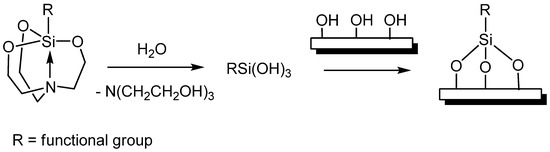
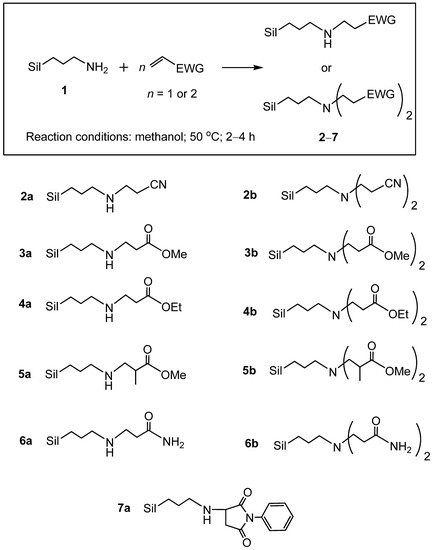
In addition, silatranes possess special physical–chemical properties. For example, as a result of their slow and controlled hydrolysis, they can, ideally, modify (functionalize) glass, polymer, metal, and other surfaces, in contrast to the associated alkoxysilanes (Scheme 1) [38,39,40].
Scheme 1.
Modification (functionalization) of surfaces via 1-organylsilatranes.
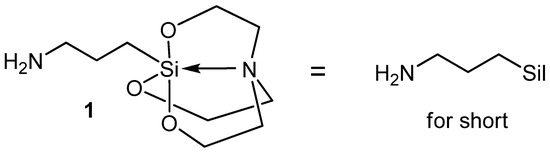
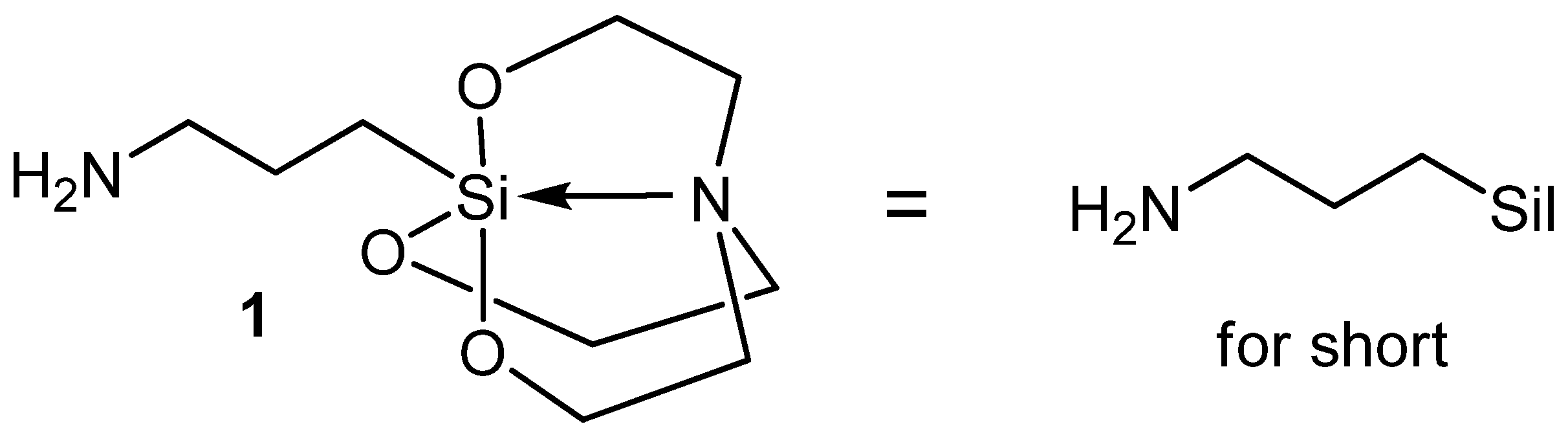
Thus, silatranes are very promising compounds for agriculture, medicine, and industry. The above properties are true for commercially available 3-aminopropylsilatrane, NH2-(CH2)3-Si(OCH2CH2)3N (1) (Figure 1) [25].
Figure 1.
Chemical structures of 3-aminopropylsilatrane (1).
The widely known practice of adding amines to alkenes (hydroamination), in particular the aza-Michael reaction, which features 100% atom efficiency, meets the requirements of “green” chemistry. It also represents the shortest route to, for example, amino acids and aminoketones, as well as their derivatives, which serve as precursors to the synthesis of various biologically active substances (Scheme 2) [41,42,43].
Scheme 2.
Aza-Michael reaction.
Some aminoalkoxysilanes tolerate the Aza-Michael reaction [44,45]. However, to the best of our knowledge, only one study has reported that 3-aminopropylsilatrane participates in this process [46].
In the present paper, we found that a Michael donor, 3-aminopropylsilatrane 1, successfully underwent chemical modification (hybridization) via the addition of various alkenes (Michael acceptors), including those that were biologically active. In addition, we evaluated the effect of the synthesized compounds on the growth of microorganisms.
This study focused on:
- (1)
- The aza-Michael reaction of 3-aminopropylsilatrane (1) with various alkenes;
- (2)
- The synthesis and characterization of new 3-aminopropylsilatrane derivatives using IR and NMR spectroscopy and mass and X-ray spectrometry;
- (3)
- An in silico investigation of their physical–chemical/pharmacokinetic properties, as well as in vitro evaluations of the inhibitory/stimulating effects on the Gram-positive and Gram-negative pathogenic microorganisms Listeria, Staphylococcus, and Yersinia.
2. Results and Discussions
2.1. Synthesis
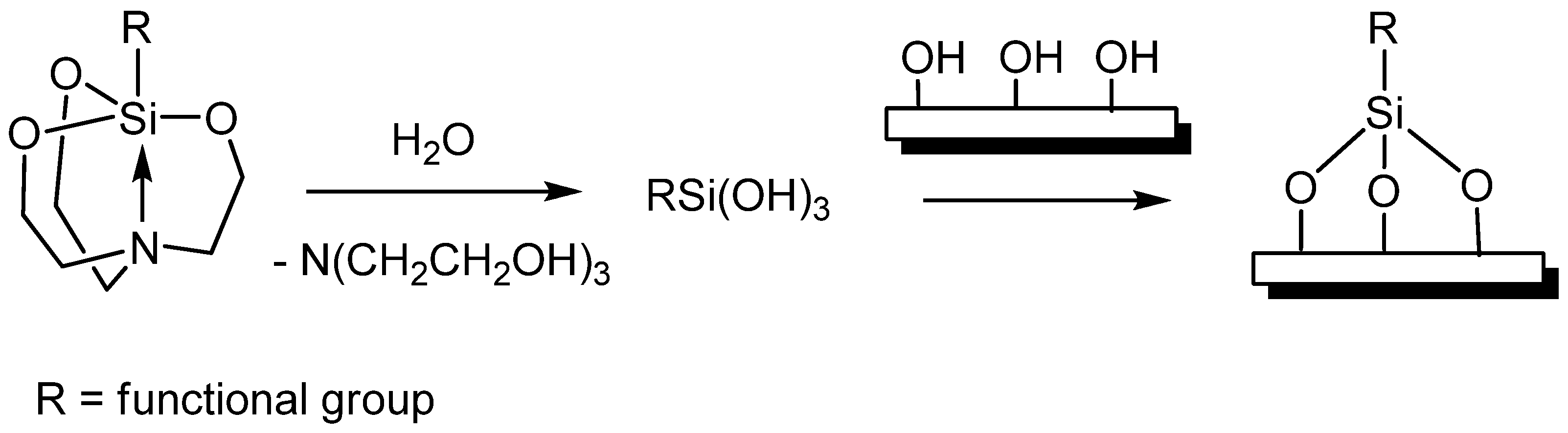
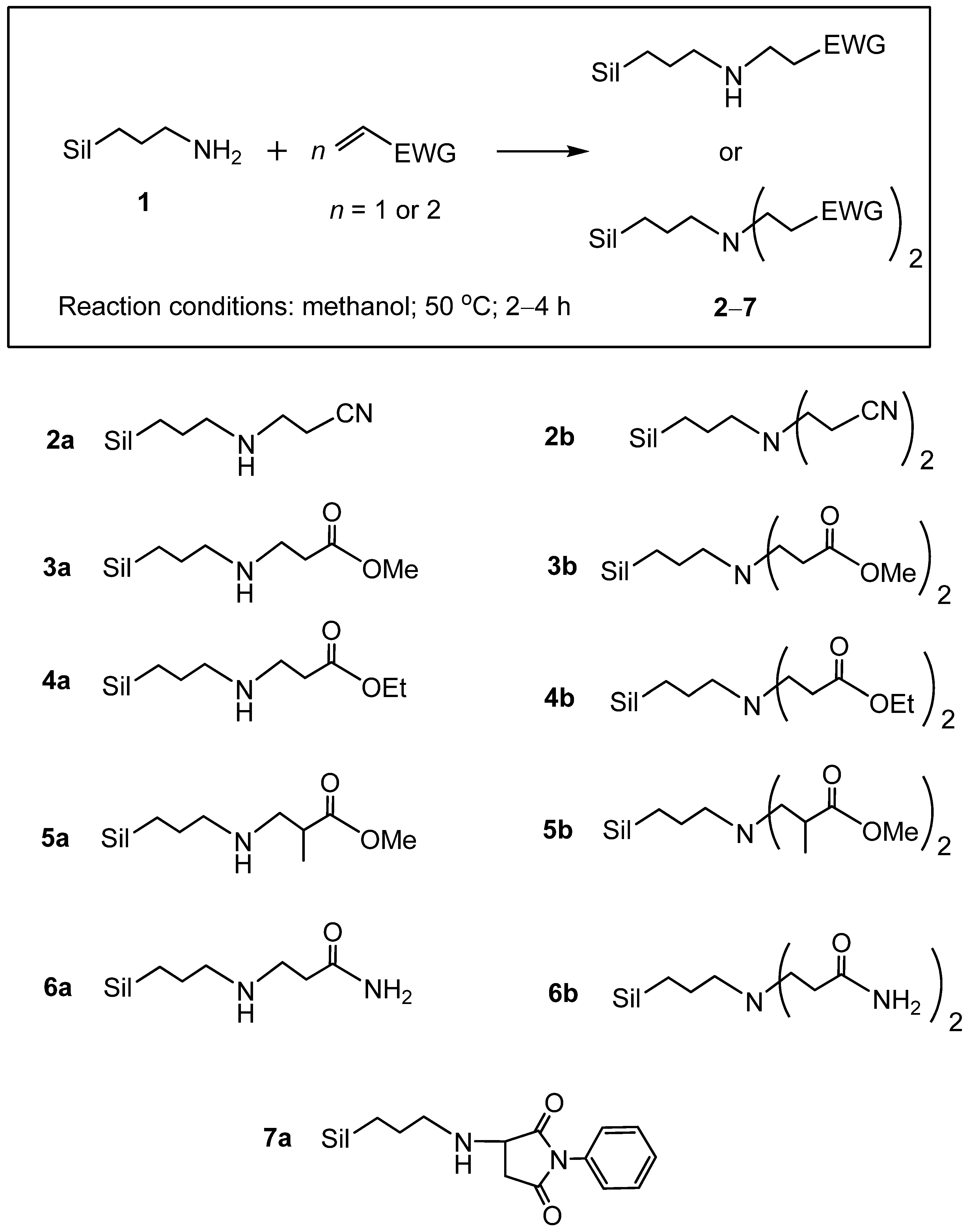
3-Aminopropylsilatrane 1 was synthesized according to the published procedure [24,25,26,46]. The synthesis of new silatrane derivatives 2–7 is shown in Scheme 3. The target mono-adducts (a) and diadducts (b) were obtained via the aza-Michael reaction of 1 with electron-deficient alkenes: acrylonitrile, methylacrylate, ethylacrylate, methyl(meth)acrylate, acrylamide, and N-phenylmaleimide.
Scheme 3.
Synthesis of 3-aminopropylsilatrane derivatives 2–7 (EWG: electron withdrawing group).
To determine the optimum conditions for the process, a number of model experiments were carried out. Among the varied parameters were the ratio of silatrane 1 and acrylonitrile (AN), solvents, temperature, and time. The reaction conditions and the yields of adducts 2a and 2b are given in Table 1.
Table 1.
Synthesis of silatranes 2a and 2b: optimization of the reaction conditions.
As is seen from Table 1, the best conditions for the synthesis of 2a and 2b (99% and 90% yield, respectively) were: methanol as a solvent; 50 °C; 2 h (entry 7 and 8). Notably, diadduct 2b was formed in the highest yield (99%) in the presence of a small excess of AN for 4 h (entry 9).
The product yields and melting points of silatranes 2–7 are presented in Table 2.
Table 2.
Yields, melting points of silatranes 2–7 (reaction conditions: methanol; 50 °C; 2–4 h).
Water is known to be efficiently employed as a solvent in the aza-Michael reaction [41]. However, in our case, in the presence of water, adducts were formed in 0% yield. For N-phenylmaleimide, methanol was not suitable because the reaction yielded by-products. Therefore, we used chloroform.
Notably, the reaction of 1 with methyl(meth)acrylate yielded adducts 5a, 5b, and 7a in low yields, while the formation of a diadduct with N-phenylmaleimide was not observed at all, likely due to steric factors.
Thus, the aza-Michael reaction of silatrane 1 with diverse acrylates was studied. It was shown that the interaction proceeded easily and quickly to yield the corresponding mono- or diadducts in high (or good) yields.
At the same time, the reaction of silatrane 1 directly with acrylic acid furnished a mixture of Michael adducts and salt, CH2=CH-COO−·N+H3-(CH2)3-Si(OCH2CH2)3N. Unfortunately, all attempts to separate this mixture failed.
2.2. Spectroscopic and Spectrometric Studies
2.2.1. IR Spectroscopy
Silatranes 2–7 were investigated using IR spectroscopy (thin film). The IR spectra were recorded at 4000–500 cm−1 (Varian 3100). The spectra of silatranes 2–7 show characteristic absorption bands of the silatranyl group at 584–588 cm−1 (N→Si), 763–770 cm−1, 1090–1103 cm−1 (Si-O) and 2925–2939 (νs CH2) [19,21]. The spectra of mono-adducts 2a–7a contain absorption bands (νs C-NH) and (νs NH) at 1392–1421 cm−1 and 3310–3447 cm−1, respectively [46]. In the spectra of silatranes 2a and 2b, characteristic absorption bands (C≡N) are observed at 2190–2196 cm−1. The spectra of carbonyl-containing mono- and diadducts (silatranes 3–7) display characteristic absorption bands (C=O) at 1671–1736 cm−1.
2.2.2. NMR Spectroscopy
The NMR (1H, 13C, 29Si, and 15N) spectra of all compounds were recorded at room temperature. The 1H NMR spectra show characteristic triplets of the silatranyl moiety, representing NCH2 and OCH2 groups in the regions of 2.73–2.79 ppm and 3.69–3.76 ppm (J = 5.9 Hz), respectively [19,21]. The spectra of all silatranes 2–7 exhibit multiplets of the SiCH2, CH2, and NCH2 groups of the propyl moiety at 0.30–0.41 ppm, 1.46–1.61 ppm, and 2.41–2.52 ppm, respectively. In the spectra of all compounds, multiplets of the CH2, and CH2N groups of ethyl moiety are observed at 2.47–2.52 ppm and 2.84–2.90 ppm, respectively.
In the 13C NMR spectra of the synthesized compounds, peaks of the silatranyl moiety carbons (NCH2 and OCH2) are detected at 50.59–51.21 ppm and 56.30–57.86 ppm, respectively. The spectra of all silatranes show peaks of the propyl moiety carbons (SiCH2, CH2, and NCH2) at 12.80–13.89 ppm, 16.19–24.22 ppm, and 25.15–33.89 ppm, respectively, as well peaks of the ethyl moiety carbons (CH2 and CH2N) at 52.61–53.01 ppm and 54.01–54.22 ppm, respectively. The spectra of silatranes 2a and 2b contain peaks of the nitrile group (C≡N) at 118.42–135.20 ppm. The spectra of carbonyl-containing silatranes display peaks at 173.27–176.53 ppm.
The 15N NMR spectra show nitrogen signals at ∼−135 ppm (C≡N), −250 ppm (NH), −340 ppm (N), and −360 ppm (NSilatran).
The 29Si NMR spectra of all compounds contain peaks of the silatranyl moiety at ∼−85 ppm. Such δ values indicate an intramolecular transannular Si←N dative bond [19,21].
2.2.3. Mass Spectrometry
High-resolution mass spectra of silatranes 2a and 2b were recorded with acetonitrile or methanol as a solvent and perfluorobutyric acid (HFBA) as an ionizing agent. The main ion fragments confirmed the structure of the compounds. The mass spectrum of sample 2a contained the main peak in the form of the [M + H]+ ion. The theoretical m/z value is 286.158695; in practice, 286.15876 was obtained. The error was 0.2 ppm. The mass spectrum of silatrane 2b is registered in the form of the ion [M + H]+ with m/z 339.18498 (theoretical m/z value is 339.185244); the error is 0.8 ppm.
2.2.4. X-ray Spectrometry
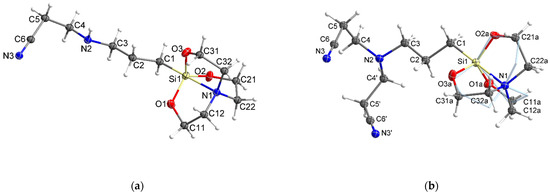
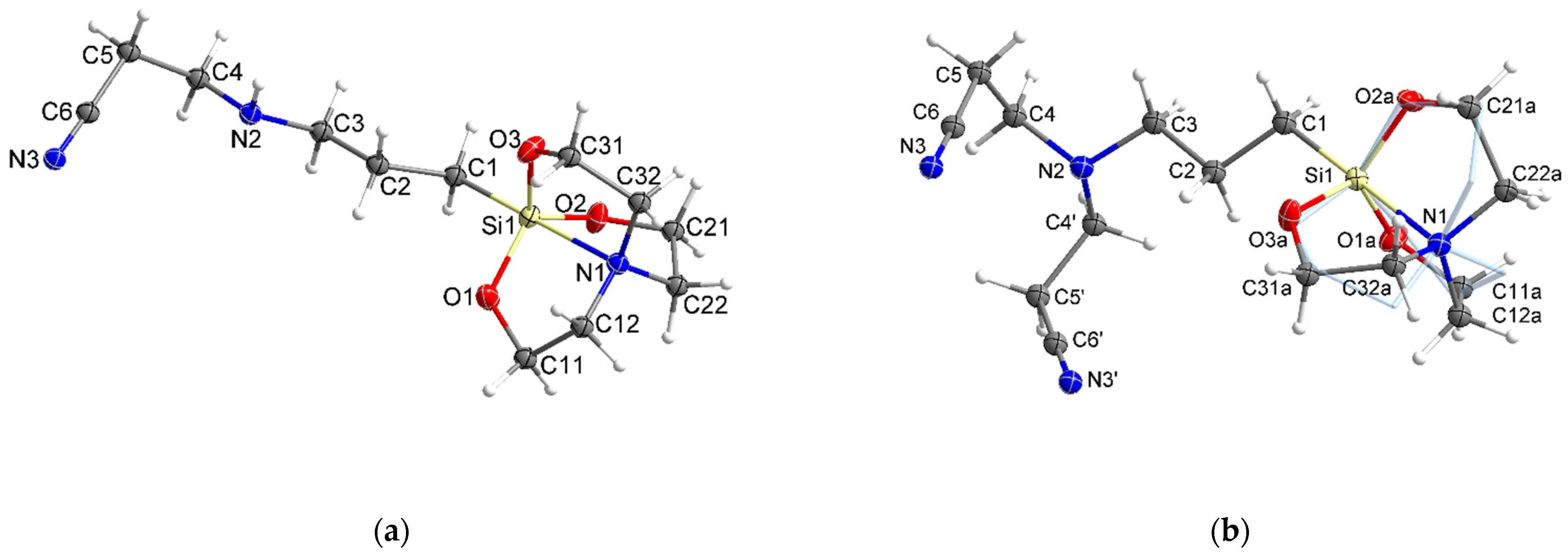
X-ray crystallography. Single crystals of 2a and 2b were grown from CHCl3 solution. The molecular structures are depicted in Figure 2. The selected bonds lengths and angles are given in Table 3.
Figure 2.
Molecular structure of compounds 2a (a) and 2b (b). Atomic displacements for non-hydrogen atoms are shown at 50% probability. An alternative conformation of the silatrane fragment (Oxb, Cxxb) of 2b is indicated with pale blue sticks.
Table 3.
Selected bond lengths and angles for compounds 2a and 2b. Estimated standard deviations for the bonds and angles do not exceed 2 × 10⁻³Å and 0.15°.
2.3. Study of Biological Activity
Before examining the biological, physiological, and pharmacological activity of compounds in vitro, it is always useful to evaluate their physicochemical properties in silico.
2.3.1. In Silico Evaluation of Physicochemical and Pharmacokinetic Properties as Well as Pharmacological Activity
Bioavailability of the obtained compounds 2–7 was evaluated using the Lipinski rule [47]. The ADME (absorption, distribution, metabolism, and excretion) properties were studied using SwissADME online software (http://www.swissadme.ch accessed on 20 April 2023). The calculations show that the properties of the synthesized silatranes agree with the Lipinski rule: M.W. < 500, lipophilicity (octanol–water partition coefficient, Log p < 5), a number of hydrogen bond acceptors, HBA < 10 and a number of hydrogen bond donors, HBD < 5) and can be considered as druglike products [47].
Compounds 2–7 are highly soluble in water (3–4 mg/mL or 7–8 mol/L) and possess gastrointestinal absorption (score—High) as well as bioavailability (0.55) properties. Probable pharmacological activity profiles of silatranes 2–7 were studied in silico using PASS 2.0 software [48,49]. The calculated screening showed that the obtained silatranes exhibit pronounced antineoplastic activity (probability 98–99%). Compounds 2–7 can inhibit the activity of specific enzymes, such as saccharopepsin (75–77%), gluconate 2-dehydrogenase (70–75%), and CDP-glycerol glycerophosphotransferase (70%). On the other hand, these silatranes can stimulate macrophage colonies (probability, 80%).
Thus, the values calculated using SwissADME and PASS confirm that the synthesized silatranes are good candidates for further research.
2.3.2. Study of the Inhibitory/Stimulating Effect on Microorganisms In Vitro
Silatranes are known to affect the growth and development of animals, insects, plants and microorganisms. In particular, they can stimulate or inhibit the growth of some fungi and bacteria [21,25]. The available data indicate that silatranes induce changes in the metabolic systems of microorganisms, which increase or decrease the resistance of bacteria.
The membranotropism of silatranes, determined by their high lipid solubility (see, for example, Section 2.3.1), water solubility, bioavailability, and the ability to penetrate through cell membranes due to the interaction with polar groups of proteins and lipids are valuable properties of these compounds in the mechanism of biological activity. In addition, the substituent at the silicon atom plays an important significant role [23,25,31,32,33,34]. Finally, the biological activity of silatranes may depend on the concentration of the active substance, as well as on the type of microorganism.
Microbiological studies were carried out in the Irkutsk Antiplague Research Institute of Siberia and Far East (IARI). Test cultures were pathogenic Gram-positive and Gram-negative bacterial strains (from the IARI collection). Gram-positive stains included causative agent of listeriosis, Listeria monocytogenes 766 and infectious agent, Staphylococcus aureus ATCC 6538-P (FDA 209-P). Gram-negative strains were causative agent of yersiniosis, Yersinia enterocolitica 03 628/1; causative agent of scarletlike fever, Yersinia pseudotuberculosis 223; and causative agent of plague, Yersinia pestis EV NIIEG (Collection of Research Institute of Epidemiology and Hygiene). Test strains were cultivated on Hottinger’s agar (HA).
To begin with, we evaluated the effect of selected silatranes 2a, 2b, 4a, 5a, and 7a at a concentration of 400–200 μg/mL on the growth of microorganisms using a method of broth serial dilution and a method of diffusion into agar [50]. It was shown that the studied compounds insignificantly inhibited the growth of all microorganisms (Inhibition Index—II by an average of 33.7 ± 9.5%). At a lower concentration (100 µg/mL), silatranes 2a, 2b, 4a, 5a, and 7a even more weakly inhibited the growth of test strains L. monocytogenes, Y. pestis, Y. enterocolitica, and Y. pseudotuberculosis (II by an average of 16.2 ± 8.5 %). In the experiments using the diffusion method into HA, no zones of inhibition were observed.
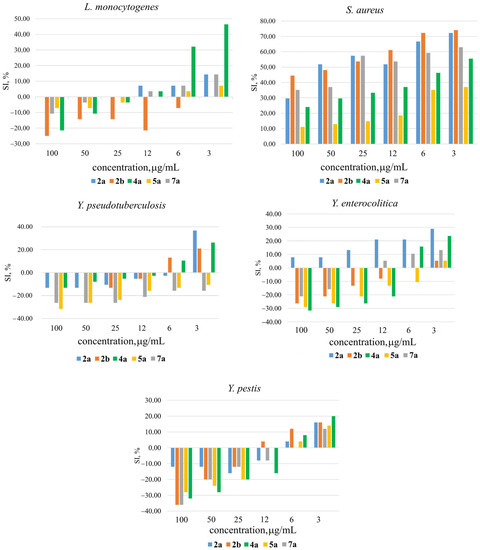
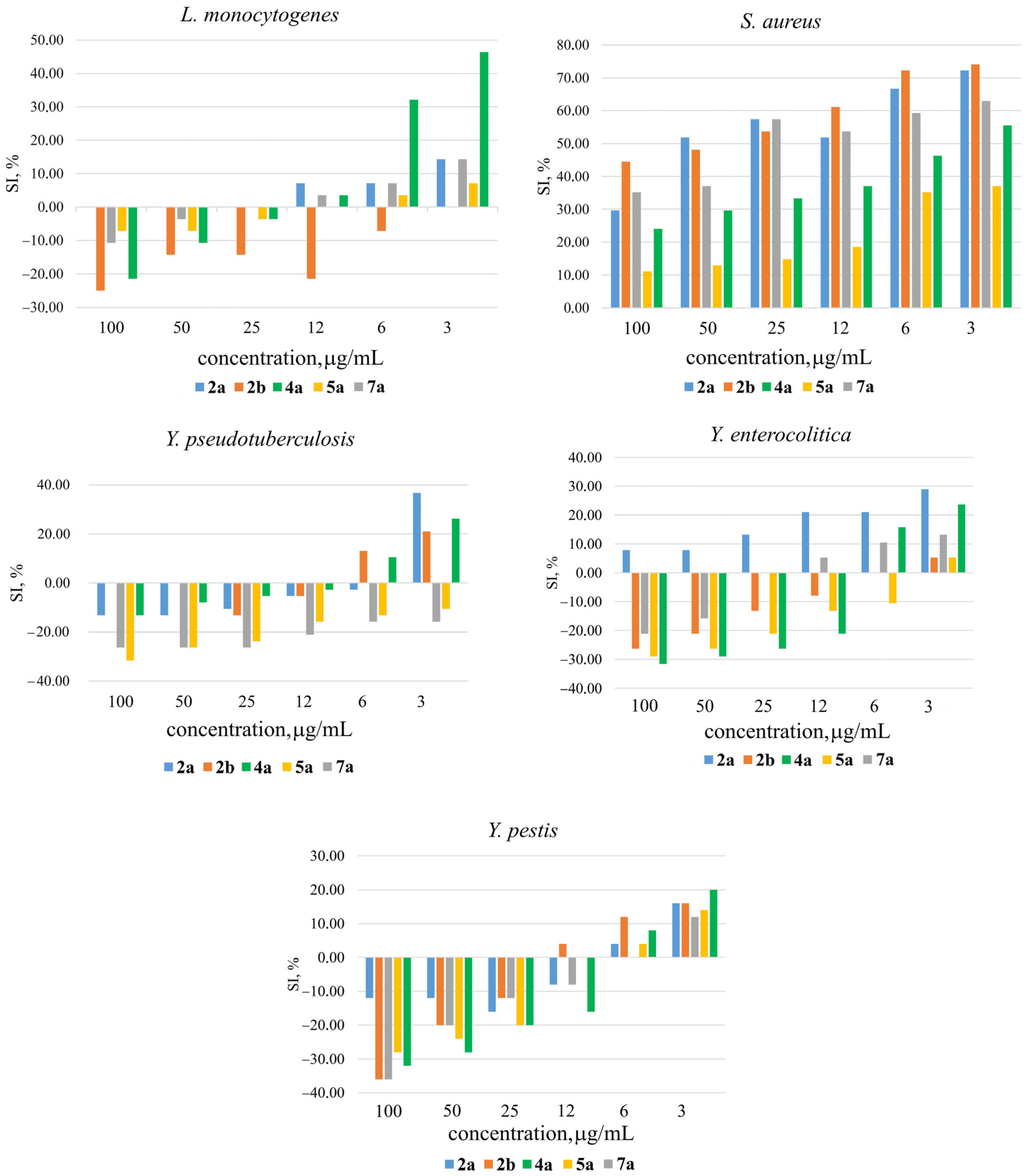
When the concentration of samples was consistently decreased further (up to 6 and up to 3 µg/mL), we serendipitously found that the tested silatranes exerted non-inhibitory, but stimulating, activity (Stimulation Index, SI, up to 76%) (Table 4 and Figure 3).
Table 4.
Stimulating activity of silatranes 2a, 2b, 4a, 5a, and 7a (concentration 6–3 µg/mL).
Figure 3.
Inhibitory/stimulating effect of silatranes 2a, 2b, 4a, 5a, and 7a.
As shown in Table 4 and Figure 3, mono-2a and diadduct 2b bearing nitrile groups (C≡N) showed the best stimulatory activity with respect to Gram-positive microorganisms (S. aureus). Notably, compound 2a turned out to be much more efficient. Amino-acid-like silatranes 4a, 5a, and 7a were active against Gram-negative Yersinia organisms. At the same time, the more branched compounds, 5a and 7a, were less effective.
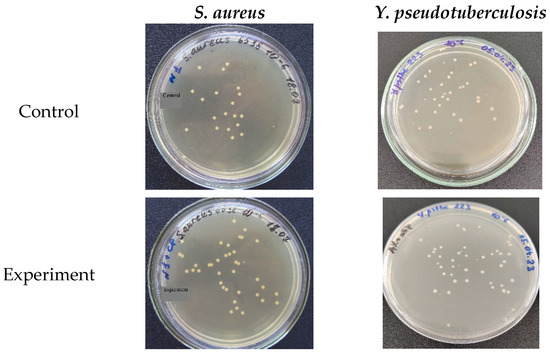
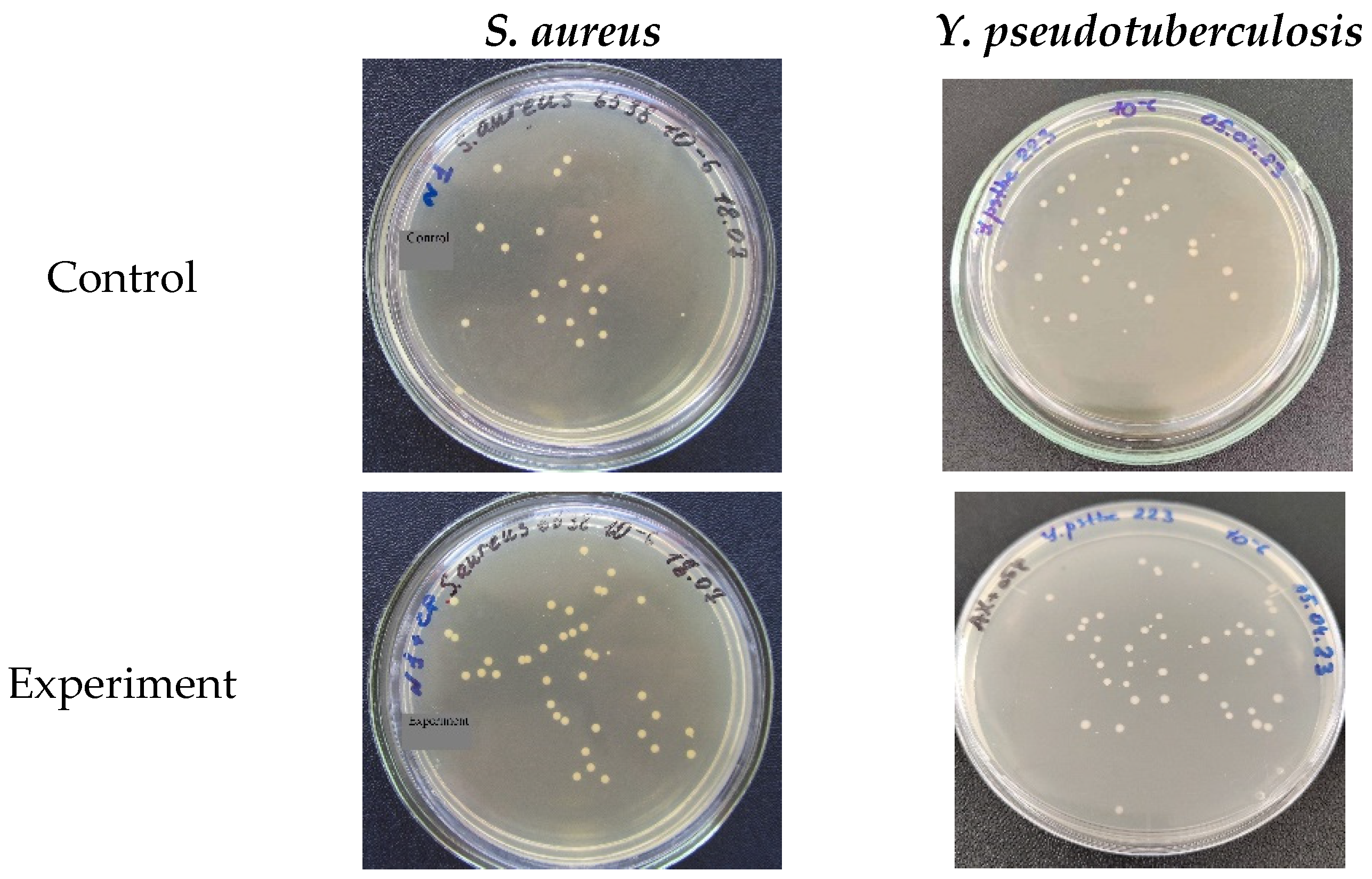
Sample 4a, which exhibits stimulating activity against all studied microorganisms, was selected for further experiments. Figure 4 shows the growth properties of S. aureus and Y. pseudotuberculosis cultivated on the HA nutrient medium without (control) and with (experiment) the addition of 4a.
Figure 4.
Growth properties of S. aureus (after 24 h) and Y. pseudotuberculosis (after 48 h) cultivated on Hottinger’s agar (control) and on Hottinger’s agar with silatrane 4a (experiment); dilution of 10−6.
The data in Figure 4 also confirm that the cultivation of microorganisms on HA with the addition of silatrane 4a was ~2 times more effective than with the control.
Thus, the synthesized silatranes can be used as a promising stimulating agents and bacterial biomass growth promoters for the accelerated analysis and diagnosis of diseases caused by Listeria, Staphylococcus, Yersinia, and other pathogens.
3. Materials and Methods
3.1. Chemistry
The organic solvents were dried and purified using standard procedures. Acrylonitrile, methylacrylate, ethylacrylate, methyl(meth)acrylate, acrylamide, and N-phenylmaleimide were purchased from Sigma Aldrich.
Target compounds 2–7 were isolated in pure form via recrystallization from a mixture of chloroform/hexane (1:3).
IR spectra were registered on a Varian 3100 FTIR spectrometer in the 4000–400 cm−1 range with the sample as a thin film or tablet (KBr).
1H, 13C, and 15N NMR spectra were performed in CDCl3 at room temperature on Bruker DPX-400 and AV-400 spectrometers (400.13, 100.61, and 40.56 MHz, respectively).
Chemical shifts were referred to TMS (1H and 13C) and nitromethane (15N).
Mass spectra were recorded on HR-TOF-ESI-MS Agilent 6210 equipment with the registration mode of positive ions with acetonitrile as a solvent (in case of poor solubility via ultrasound) and 0.1% perfluorobutyric acid as an ionizing agent.
To perform X-ray diffraction analysis, single crystals of compounds 2a and 2b were grown via the slow evaporation of chloroform solutions at room temperature. The X-ray diffraction data were collected with a Bruker D8 VENTURE diffractometer (PHOTON III CMOS detector, Mo IµS3.0 X-ray source, Montel mirror-focused MoKα radiation λ = 0.71073 Å, N2-flow cryostat) via 0.5° ω- and φ-scan techniques. Data were corrected for absorption effects using the multi-scan method (SADABS) [51]. The structure was solved and refined using the Bruker SHELXTL Software Package (Sheldrick, 2008) [52].
The major non-H atoms were located from the electron density map and refined in anisotropic approximation. The positions of minor conformation (ca. 13% occupancy) of the disordered silotrane fragment in the 2b crystal structure and all H atoms of ordered parts of the structures were located from the difference electron density map. The atoms of the minor conformation were refined isotropically with equal atomic displacements (EADP) and restraints on the similarity of equivalent bond distances (SADI). The H atom located on N2 in 2a was refined without geometrical restraints; the other H atoms were refined in the riding model. Isotropic displacements of the H atoms were assigned as 1.2Ueq of the pivot atoms.
Crystal data, data collection, and structure refinement details are summarized in Table 5. Atomic coordinates, bond lengths, bond angles, and atomic displacement parameters for the crystal structures of 2a and 2b have been deposited with the Cambridge Crystallographic Data Centre (CCDC) with deposition numbers CCDC 2263862 and 2263863. These data can be obtained free of charge from the CCDC via URL: https://www.ccdc.cam.ac.uk/structures/ (accessed on 18 May 2023).
Table 5.
Crystal data and structure refinement for compounds 2a and 2b.
Elemental analysis was performed on a Thermo Scientific Flash 2000 Elemental Analyzer (Thermo Fisher Scientific Inc., Milan, Italy). Melting points were determined on a Kofler Hot-Stage Microscope PolyTherm A apparatus (Wagner & Munz GmbH, München, Germany).
General Procedure for the Synthesis of Silatranes 2–7.
A mixture of silatrane 1 (1 mmol) and corresponding acrylate (1 or 2 mmol) in 10 mL of methanol was stirred at 50 °C for 2 h in an inert atmosphere (N2) or in air. The solvent was removed under reduced pressure. The residue was washed many times with ether, dried, and the products 2–7 were obtained. If necessary, the resulting powder or oil was recrystallized from a mixture of chloroform/hexane (1:3).
3.1.1. Silatrane 2a
The product was recrystallized from a chloroform/hexane (1:3) mixture at 4 °C, 24 h. Needle crystals.
Anal. calc. for C12H23N3O3Si (%): C, 50.49; H, 8.12; N, 14.72. Found (%): C, 50.68; H, 8.09;
N, 14.89.
IR (ν, cm−1): 585 (N→Si), 763, 1101 (Si-O), 1416 (νs C-NH), 2190 (C≡N), 2925 (νs CH2),
3310 (νs NH).
1H-NMR (CDCl3, 400 MHz), δ (ppm): 0.35–0.39 (m, 2H, SiCH2); 1.52–1.56 (m, 2H, SiCH2CH2); 2.44 (t, J = 5.5 Hz, 2H, CH2CN); 2.58–2.63 (m, 2H, SiCH2CH2CH2); 2.76 (t, J = 5.3 Hz, 6H, NCH2); 2.87–2.91 (m, 2H, CH2CH2CN); 3.61 (br.s, 1H, NH); 3.71 (t, J = 5.3 Hz, 6H, OCH2).
13C-NMR (CDCl3, 100 MHz), δ (ppm): 13.36 (SiCH2); 18.77 (CH2CN); 25.15 (SiCH2CH2); 44.97 (CH2CH2CN); 51.20 (NCH2); 52.33 (SiCH2CH2CH2); 57.83 (OCH2); 118.99 (CN).
15N-NMR (CDCl3, 40 MHz), δ (ppm): −359.6 (NSil); −343.4 (NH); −135.2 (CN).
HR-MS: m/z = 286.15876 [(M + H), 100].
3.1.2. Silatrane 2b
The product was recrystallized from a chloroform/hexane (1:3) mixture at 4 °C, 24 h.
Large transparent crystals.
Anal. calc. for C15H26N4O3Si (%): C, 53.23; H, 7.74; N, 16.55. Found (%): C, 53.54; H, 7.58; N, 16.69.
IR (ν, cm−1): 584 (N→Si), 764, 1103 (Si-O), 2196 (C≡N), 2930 (νs CH2).
1H-NMR (CDCl3, 400 MHz), δ (ppm): 0.35–0.39 (m, 2H, SiCH2); 1.52–1.56 (m, 2H, SiCH2CH2); 2.40–2.46 (m, 6H, CH2CN, SiCH2CH2CH2); 2.78 (t, J = 5.3 Hz, 6H, NCH2); 2.80–2.86 (m, 4H, CH2CH2CN); 3.74 (t, J = 5.3 Hz, 6H, OCH2).
13C-NMR (CDCl3, 100 MHz), δ (ppm): 13.22 (SiCH2); 18.05 (CH2CN); 24.63 (SiCH2CH2); 47.92 (CH2CH2CN); 51.25 (NCH2); 57.07 (SiCH2CH2CH2); 57.80 (OCH2); 118.92 (CN).
15N-NMR (CDCl3, 40 MHz), δ (ppm): −359.6 (NSil); −341.4 (NH); −135.3 (CN).
HR-MS: m/z = 339.18498 [(M + H), 100].
3.1.3. Silatrane 3a
Anal. calc. for C13H26N2O5Si (%): C, 49.03; H, 8.23; N, 8.79. Found (%): C, 50.15; H, 8.12;
N, 8.96.
IR (ν, cm−1): 586 (N→Si), 764, 1100 (Si-O), 1419 (νs C-NH), 1736 (C=O), 2933 (νs CH2), 3447 (νs NH).
1H-NMR (CDCl3, 400 MHz), δ (ppm): 0.26–0.28 (m, 2H, SiCH2); 1.46–1.50 (m, 2H, SiCH2CH2); 2.48–2.52 (m, 2H, SiCH2CH2CH2); 2.52 (t, J = 6.6 Hz, 2H, CH2CH2CO); 2.77 (t, J = 5.3 Hz, 6H, NCH2); 2.84 (t, J = 6.6 Hz, 2H, CH2CH2CO); 3.22 (br.s, 1H, NH); 3.60 (s, 3H, OMe); 3.75 (t, J = 5.3 Hz, 6H, OCH2).
13C-NMR (CDCl3, 100 MHz), δ (ppm): 13.61 (SiCH2); 25.35 (SiCH2CH2); 34.92 (CH2CH2CO); 46.18 (CH2CH2CO); 51.28 (NCH2); 51.36 (OMe); 52.74 (SiCH2CH2CH2); 57.79 (OCH2); 173.32 (CO).
15N-NMR (CDCl3, 40 MHz), δ (ppm): −359.3 (NSil); −342.2 (NH).
3.1.4. Silatrane 3b
Anal. calc. for C17H32N2O7Si (%): C, 50.47; H, 7.97; N, 6.92. Found (%): C, 50.54; H, 7.74;
N, 6.99.
IR (ν, cm−1): 587 (N→Si), 764, 1090 (Si-O), 1721 (C=O), 2936 (νs CH2).
1H-NMR (CDCl3, 400 MHz), δ (ppm): 0.25–0.29 (m, 2H, SiCH2); 1.44–1.48 (m, 2H, SiCH2CH2); 2.35–2.37 (m, 2H, SiCH2CH2CH2); 2.41 (t, J = 6.6 Hz, 4H, CH2CH2CO); 2.73 (t, J = 6.6 Hz, 4H, CH2CH2CO); 2.76 (t, J = 5.3 Hz, 6H, NCH2); 3.62 (s, 6H, OMe); 3.74 (t, J = 5.3 Hz, 6H, OCH2).
13C-NMR (CDCl3, 100 MHz), δ (ppm): 13.55 (SiCH2); 24.80 (SiCH2CH2); 32.70 (CH2CH2CO); 49.21 (CH2CH2CO); 51.22 (NCH2); 51.38 (OMe); 57.28 (SiCH2CH2CH2); 57.81 (OCH2); 173.27 (CO).
15N-NMR (CDCl3, 40 MHz), δ (ppm): −359.4 (NSil); −339.9 (NCH2).
3.1.5. Silatrane 4a
Anal. calc. for C14H28N2O5Si (%): C, 50.57; H, 8.49; N, 8.42. Found (%): C, 50.75; H, 8.26;
N, 8.69.
IR (ν, cm−1): 588 (N→Si), 768, 1098 (Si-O), 1421 (νs C-NH), 1720 (C=O), 2925 (νs CH2), 3430 (νs NH).
1H-NMR (CDCl3, 400 MHz), δ (ppm): 0.26–0.28 (m, 2H, SiCH2); 1.25 (t, J = 7.1 Hz, 3H, OCH2CH3); 1.45–1.49 (m, 2H, SiCH2CH2); 2.48 (t, J = 6.6 Hz, 2H, CH2CH2CO); 2.50–2.54 (m, 2H, SiCH2CH2CH2); 2.78 (t, J = 5.3 Hz, 6H, NCH2); 2.89 (t, J = 6.6 Hz, 2H, CH2CH2CO); 3.10 (br.s, 1H, NH); 3.75 (t, J = 5.3 Hz, 6H, OCH2); 4.13 (q, J = 7.1 Hz, 2H, OCH2CH3).
13C-NMR (CDCl3, 100 MHz), δ (ppm): 13.20 (SiCH2); 13.82 (OCH2CH3); 25.32 (SiCH2CH2); 34.52 (CH2CH2CO); 47.12 (CH2CH2CO); 51.22 (NCH2); 52.63 (SiCH2CH2CH2); 57.75 (OCH2); 59.72 (OCH2CH3); 172.13 (CO).
15N-NMR (CDCl3, 40 MHz), δ (ppm): −359.7 (NSil); −343.2 (NH).
3.1.6. Silatrane 4b
Anal. calc. for C19H36N2O7Si (%): C, 52.75; H, 8.38; N, 6.48. Found (%): C, 52.94; H, 8.21;
N, 6.59.
IR (ν, cm−1): 587 (N→Si), 770, 1100 (Si-O), 1717 (C=O) 2930 (νs CH2).
1H-NMR (CDCl3, 400 MHz), δ (ppm): 0.26–0.28 (m, 2H, SiCH2); 1.25 (t, J = 7.1 Hz, 6H, OCH2CH3); 1.45–1.49 (m, 2H, SiCH2CH2); 2.37–2.41 (m, 2H, SiCH2CH2CH2); 2.44 (t, J = 6.6 Hz, 4H, CH2CH2CO); 2.76 (t, J = 5.3 Hz, 6H, NCH2); 2.75 (t, J = 6.6 Hz, 4H, CH2CH2CO); 3.77 (t, J = 5.3 Hz, 6H, OCH2); 4.11 (q, J = 7.1 Hz, 4H, OCH2CH3).
13C-NMR (CDCl3, 100 MHz), δ (ppm): 13.25 (SiCH2); 13.85 (OCH2CH3); 24.90 (SiCH2CH2); 32.48 (CH2CH2CO); 49.27 (CH2CH2CO); 51.27 (NCH2); 57.71 (SiCH2CH2CH2); 57.73 (OCH2); 59.83 (OCH2CH3); 172.22 (CO).
15N-NMR (CDCl3, 40 MHz), δ (ppm): −359.9 (NSil); −341.5 (NCH2).
3.1.7. Silatrane 5a
Anal. calc. for C14H28N2O5Si (%): C, 50.57; H, 8.49; N, 8.42. Found (%): C, 50.68; H, 8.32;
N, 8.63.
IR (ν, cm−1): 583 (N→Si), 756, 1097 (Si-O), 1456 (νs C-NH), 1726 (C=O), 2924 (νs CH2), 3435 (νs NH).
1H-NMR (CDCl3, 400 MHz), δ (ppm): 0.28–0.31 (m, 2H, SiCH2); 1.07 (d, J = 6.7 Hz, 3H, CHCH3); 1.47–1.52 (m, 2H, SiCH2CH2); 2.50–2.54 (m, 3H, CH2CHCH3, SiCH2CH2CH2); 2.55–2.59 (m, 1H, CHCH3); 2.73 (t, J = 5.3 Hz, 6H, NCH2); 2.75–2.79 (m, 1H, CH2CHCH3); 3.10 (br.s, 1H, NH); 3.60 (s, 3H, OCH3); 3.69 (t, J = 5.3 Hz, 6H, OCH2).
13C-NMR (CDCl3, 100 MHz), δ (ppm): 13.43 (SiCH2); 15.32 (CHCH3); 25.28 (SiCH2CH2); 40.13 (CHCH3); 52.66 (CH2CHCH3); 51.21 (NCH2); 51.56 (OCH3); 53.21 (SiCH2CH2CH2); 57.86 (OCH2); 176.53 (CO).
15N-NMR (CDCl3, 40 MHz), δ (ppm): −359.7 (NSil); −343.6 (NH).
3.1.8. Silatrane 5b
Anal. calc. for C19H36N2O7Si (%): C, 52.75; H, 8.38; N, 6.48. Found (%): C, 52.88; H, 8.27;
N, 6.54.
IR (ν, cm−1): 587 (N→Si), 770, 1100 (Si-O), 1715 (C=O) 2935 (νs CH2).
1H-NMR (CDCl3, 400 MHz), δ (ppm): 0.28–0.31 (m, 2H, SiCH2); 1.05 (d, J = 6.7 Hz, 6H, CHCH3); 1.47–1.52 (m, 2H, SiCH2CH2); 2.35–2.39 (m, 2H, SiCH2CH2CH2); 2.46–2.49 (m, 2H, CH2CHCH3); 2.50–2.53 (m, 2H, CHCH3); 2.71 (t, J = 5.3 Hz, 6H, NCH2); 2.63–2.66 (m, 2H, CH2CHCH3); 3.58 (s, 6H, OCH3); 3.71 (t, J = 5.3 Hz, 6H, OCH2).
13C-NMR (CDCl3, 100 MHz), δ (ppm): 13.49 (SiCH2); 15.30 (CHCH3); 24.83 (SiCH2CH2); 39.15 (CHCH3); 54.31 (CH2CHCH3); 51.23 (NCH2); 51.52 (OCH3); 58.06 (SiCH2CH2CH2); 57.89 (OCH2); 176.68 (CO).
15N-NMR (CDCl3, 40 MHz), δ (ppm): −359.7 (NSil); −340.2 (NCH2).
3.1.9. Silatrane 6a
Anal. calc. for C12H25N3O4Si (%): C, 47.49; H, 8.30; N, 13.85. Found (%): C, 47.61; H, 8.19; N, 13.97.
IR (ν, cm−1): 586 (N→Si), 770, 1100 (Si-O), 1419 (νs C-NH), 1671 (C=O), 2930 (νs CH2), 3194 (NH2), 3317 (νs NH).
1H-NMR (CDCl3, 400 MHz), δ (ppm): 0.28–0.31 (m, 2H, SiCH2); 1.46–1.50 (m, 2H, SiCH2CH2); 2.52–2.56 (m, 2H, SiCH2CH2CH2); 2.63 (t, J = 6.3 Hz, 2H, CH2CH2CO); 2.77 (t, J = 5.3 Hz, 6H, NCH2); 2.87 (t, J = 6.3 Hz, 2H, CH2CH2CO); 3.15 (br.s, 1H, NH); 3.75 (t, J = 5.3 Hz, 6H, OCH2); 5.52 (br.s., 1H, NH2); 7.84 (br.s., 1H, NH2).
13C-NMR (CDCl3, 100 MHz), δ (ppm): 13.31 (SiCH2); 25.11 (SiCH2CH2); 35.27 (CH2CH2CO); 45.26 (CH2CH2CO); 51.28 (NCH2); 51.88 (SiCH2CH2CH2); 57.79 (OCH2); 175.62 (CO).
15N-NMR (CDCl3, 40 MHz), δ (ppm): −359.9 (NSil); −342.7 (NH); −267.3 (NH2).
3.1.10. Silatrane 6b
Anal. calc. for C19H36N2O7Si (%): C, 48.11; H, 8.07; N, 14.96. Found (%): C, 48.31; H, 7.92; N, 15.12.
IR (ν, cm−1): 587 (N→Si), 770, 1100 (Si-O), 1681 (C=O), 2931 (νs CH2).
1H-NMR (CDCl3, 400 MHz), δ (ppm): 0.28–0.31 (m, 2H, SiCH2); 1.44–1.48 (m, 2H, SiCH2CH2); 2.40–2.44 (m, 2H, SiCH2CH2CH2); 2.46 (t, J = 6.3 Hz, 4H, CH2CH2CO); 2.73 (t, J = 6.3 Hz, 4H, CH2CH2CO); 2.76 (t, J = 5.3 Hz, 6H, NCH2); 3.74 (t, J = 5.3 Hz, 6H, OCH2); 6.10 (br.s., 2H, NH2); 7.63 (br.s., 2H, NH2).
13C-NMR (CDCl3, 100 MHz), δ (ppm): 13.34 (SiCH2); 24.83 (SiCH2CH2); 33.14 (CH2CH2CO); 49.37 (CH2CH2CO); 51.22 (NCH2); 57.12 (SiCH2CH2CH2); 57.81 (OCH2); 175.83 (CO).
15N-NMR (CDCl3, 40 MHz), δ (ppm): −359.2 (NSil); −339.4 (NCH2); −267.3 (NH2).
3.1.11. Silatrane 7a
Anal. calc. for C18H25N3O5Si (%): C, 55.22; H, 6.44; N, 10.73. Found (%): C, 55.45; H, 6.28; N, 10.91.
IR (ν, cm−1): 582 (N→Si), 759, 1097 (Si-O), 1391 (νs C-NH), 1712 (C=O), 2932 (νs CH2), 3467 (νs NH).
1H-NMR (CDCl3, 400 MHz), δ (ppm): 0.38–0.41 (m, 2H, SiCH2); 1.52–1.56 (m, 2H, SiCH2CH2); 2.23 (br.s, 1H, NH); 2.62–2.66 (m, 3H, SiCH2CH2CH2, CH2CH); 2.73 (t, J = 5.3 Hz, 6H, NCH2); 2.99 (dd, J = 17.8 Hz, J = 8.3 Hz, 1H, CH2CH); 3.69 (t, J = 5.3 Hz, 6H, OCH2); 3.89 (dd, J = 8.3 Hz, J = 5.6 Hz, 1H, CH2CH); 7.20–7.24 (m, 2H. Ph); 7.42–7.48 (m, 3H, Ph).
13C-NMR (CDCl3, 100 MHz), δ (ppm): 13.47 (SiCH2); 24.95 (SiCH2CH2); 36.38 (CH2CH); 50.54 (SiCH2CH2CH2); 50.82 (NCH2); 56.02 (CH2CH); 57.50 (OCH2); 126.32; 128.43; 128.97; 131.68 (Ph); 174.60 (CO); 177.04 (CO).
15N-NMR (CDCl3, 40 MHz), δ (ppm): −359.5 (NSil); −337.6 (NH); −192.4 (NPh).
3.2. Biology
Bacterial Strains; Microbiology Testing
Test cultures included pathogenic Gram-positive and Gram-negative bacterial strains (Collection of Irkutsk Antiplague Research Institute of Siberia and Far East, IARI): Listeria monocytogenes 766, Staphylococcus aureus ATCC 6538-P (FDA 209-P), Yersinia enterocolitica 03 628/1, Yersinia pseudotuberculosis 223, and Yersinia pestis EV. Test strains Staphylococcus and Yersinia were cultivated on Hottinger’s agar (HA) at (28 ± 1) °C for 48 h. Listeria were grown on an HA or Hottinger’s broth with 1% glucose (Himedia, India, pH 7.2) and incubated for 24 h at (37 ± 1) °C.
To determine the sensitivity of microorganisms to the selected silatranes 2a, 2b, 4a, 5a, and 7a, the diffusion method and the method of serial dilutions in broth were used [50]. Growth medium (100 μL) containing 400–3.125 μg mL−1 of test compounds (in H2O) was added to a 96-well microtiter plate. Culture suspensions were diluted to the 0.5 McFarland standard (1.5 × 10⁸ CFU mL−1). The microbial suspension was diluted to 1:10 (up to 1 × 10⁵ CFU mL−1), and 50 μL was added to each well. The plates were incubated for 24 h and the optical density (OD) was measured at λ = 490 nm (xMark Spectrophotometer 1681150, Bio-Rad, Foster City, CA, USA). As a negative control, the growth medium was used without the addition of test compounds. The standard aminoglycoside antibiotic Gentamicin (positive control) was used for comparison.
The inhibitory/stimulating effect of silatranes was determined by measuring the optical density (OD) after 24–48 h of incubation. The results were obtained on an automatic reader for the xMark microplate according to a unified method and expressed as an Inhibition/Stimulation index (II/SI) value of microorganism growth, which was calculated as the ratio of the OD values in the experimental (ODexp) and control (ODcontr) samples and expressed as a percentage by the following formula: II (SI) = ODexp − ODcontr/ODcontr × 100%.
The specific activity of nutrient media (germination coefficient, medium sensitivity, growth rate, and cultural–morphological properties of microorganisms) was assessed using a complex of microbiological methods. From a suspension of 1 × 10⁹ CFU/mL, 10-fold dilutions (10−3–10−8) were prepared; 0.1 mL of culture suspension from dilutions 10−6 and 10−7 were inoculated three times per Petri dish with a nutrient medium. The suspension was evenly distributed over the surface of the HA plate. The nutrient medium without the addition of silatranes was used as a control. Inoculation plates were examined after 16, 24, and 48 h of incubation at a temperature corresponding to the microorganism.
On HA after incubation, colonies of microorganism test strains were counted, and the germination coefficient, Cger, was determined according to the formula: Cger = Ns/Ncontr, where Ns is the number of colonies on HA with the addition of silatranes, and Ncontr is the number of colonies on the control nutrient medium. The acceptance criterion for the experimental culture medium was if the germination coefficient was 0.5–2, it was considered suitable for use when compared with the control culture medium.
All results were processed using statistically standard methods in the Microsoft Excel 14.0 software package. Data were expressed as the arithmetic mean (M) and standard deviation (s). Differences were taken as significant at a significance level of p < 0.05.
4. Conclusions
In conclusion, it is found that the aza-Michael reaction of 3-aminopropylsilatrane with various acrylates, depending on the reagent ratio, yields the corresponding mono- and diadducts. This reaction proceeds under mild conditions to afford the functionalized silatranes in high yields. The structures of the target compounds were characterized using FT-IR, NMR spectroscopy, high-resolution mass spectrometry, X-ray diffraction, and elemental analysis.
In silico computational screening of the synthesized silatranes using SwissADME and PASS 2.0 software revealed that these compounds are synthetically accessible, bioavailable, are druglike, and exhibit antineoplastic (probability 98–99%) and macrophage colony stimulating (probability 80%) activity.
The in vitro study demonstrated that silatranes at low concentrations (3–6 µg/mL) exhibit a pronounced stimulating effect (up to 76%) on the growth of pathogenic microorganisms (Listeria, Staphylococcus, and Yersinia) and can be used as biomass growth stimulants for accelerated analysis and express diagnostics of diseases caused by these bacteria.
In general, silatranes had a selective effect on the studied bacteria. These data inspire the further identification of specific drugs or their analogues that can be used as effective inhibitors or stimulators of the vital activity of microorganisms, and their optimal concentrations.
Author Contributions
E.N.O.: Synthesis; I.A.U.: Analysis: Data collection, Characterization (FT-IR, NMR, Mass spectra); V.Y.K.: Analysis: Data collection, Characterization (X-ray crystallography); S.V.L.: Analysis: Data collection, Characterization (Biological activity); S.N.A.: Directing Supervision: Discussion, Article writing. All authors have read and agreed to the published version of the manuscript.
Funding
This study was supported by RSF and the Government of the Irkutsk region (project No. 23-26-10007).
Institutional Review Board Statement
Not applicable.
Informed Consent Statement
Not applicable.
Data Availability Statement
The data presented in this study are available from the authors upon reasonable request.
Acknowledgments
The main results were obtained using the equipment of Baikal Analytical Center of Collective Use of A.E. Favorsky Irkutsk Institute of Chemistry SB RAS, Shared Research Facilities for Physical and Chemical Ultramicroanalysis of Limnological Institute SB RAS and Irkutsk Antiplague Research Institute of Siberia and Far East. The authors thank the XRD Facility of NIIC SB RAS for the XRD data collection.
Conflicts of Interest
The authors declare no conflict of interest.
References
- Franz, A.K.; Wilson, S.O. Organosilicon molecules with medicinal applications. J. Med. Chem. 2013, 56, 388–405. [Google Scholar] [CrossRef] [Scilit] [PubMed]
- Fujii, S.; Hashimoto, Y. Progress in the medicinal chemistry of silicon: C/Si exchange and beyond. Future Med. Chem. 2017, 9, 485–505. [Google Scholar] [CrossRef] [Scilit] [PubMed]
- Ramesh, R.; Reddy, D.S. Quest for Novel Chemical Entities through Incorporation of Silicon in Drug Scaffolds. J. Med. Chem. 2018, 61, 3779–3798. [Google Scholar] [CrossRef] [Scilit] [PubMed]
- Lazareva, N.F.; Lazarev, I.M. Drug design based on the carbon/silicon switch strategy. Russ. Chem. Bull. 2015, 64, 1221–1232. [Google Scholar] [CrossRef] [Scilit]
- Panayides, J.-L.; Mathieu, V.; Banuls, L.M.Y.; Apostolellis, H.; Dahan-Farkas, N.; Davids, H.; Harmse, L.; Rey, M.E.C.; Green, I.R.; Pelly, S.C.; et al. Synthesis and in vitro growth inhibitory activity of novel silyl- and tritylmodified nucleosides. Bioorg. Med. Chem. 2016, 24, 2716–2724. [Google Scholar] [CrossRef] [Scilit] [PubMed]
- Perestelo, N.R.; Llanos, G.G.; Reyes, C.P.; Amesty, A.; Sooda, K.; Afshinjavid, S.; Jiménez, I.A.; Javid, F.; Bazzocchi, I.L. Expanding the Chemical Space of Withaferin A by Incorporating Silicon to Improve Its Clinical Potential on Human Ovarian Carcinoma Cells. J. Med. Chem. 2019, 62, 4571–4585. [Google Scholar] [CrossRef] [Scilit]
- Kleemiss, F.; Justies, A.; Duvinage, D.; Watermann, P.; Ehrke, E.; Sugimoto, K.; Fugel, M.; Malaspina, L.A.; Dittmer, A.; Kleemiss, T.; et al. Sila-Ibuprofen. J. Med. Chem. 2020, 63, 12614–12622. [Google Scholar] [CrossRef] [Scilit]
- Fanelli, R.; Chastel, A.; Previti, S.; Hindié, E.; Vimont, D.; Zanotti-Fregonara, P.; Fernandez, P.; Garrigue, P.; Lamare, F.; Schollhammer, R.; et al. Silicon-Containing Neurotensin Analogues as Radiopharmaceuticals for NTS1-Positive Tumors Imaging. Bioconjugate Chem. 2020, 31, 2339–2349. [Google Scholar] [CrossRef] [Scilit]
- Liu, B.; Gai, K.; Qin, H.; Wang, J.; Liu, X.; Cao, Y.; Lu, Q.; Lu, D.; Chen, D.; Shen, H.; et al. Discovery of a Silicon-Containing Pan-Genotype Hepatitis C Virus NS5A Inhibitor. J. Med. Chem. 2020, 63, 5312–5323. [Google Scholar] [CrossRef] [Scilit]
- Kulkarni, A.S.; Ramesh, R.; Walia, S.; Sayyad, S.I.; Gathalkar, G.B.; Balamkundu, S.; Joshi, M.; Sen, A.; Reddy, D.S. Identification of a Novel Series of Potent Organosilicon Mosquito Repellents. ACS Omega 2021, 6, 31236–31243. [Google Scholar] [CrossRef] [Scilit]
- Wei, G.; Huang, M.-W.; Wang, W.-J.; Wu, Y.; Mei, S.-F.; Zhou, L.-M.; Mei, L.-C.; Zhu, X.-L.; Yang, G.-F. Expanding the Chemical Space of Succinate Dehydrogenase Inhibitors via the Carbon–Silicon Switch Strategy. J. Agricult. Food Chem. 2021, 69, 3965–3971. [Google Scholar] [CrossRef] [Scilit] [PubMed]
- Zhou, C.; Wang, X.; Quan, X.; Cheng, J.; Li, Z.; Maienfisch, P. Silicon-Containing Complex II Acaricides─Design, Synthesis, and Pharmacological Optimization. J. Agricult. Food Chem. 2022, 70, 11063–11074. [Google Scholar] [CrossRef] [Scilit] [PubMed]
- Kobayashi, T.; Nishino, S.; Miura, M.; Hirano, K. Synthesis of β-Silyl-α-amino Acid Derivatives by Cu-Catalyzed Regio- and Enantioselective Silylamination of α,β-Unsaturated Esters. Org. Lett. 2022, 24, 14181422. [Google Scholar] [CrossRef] [Scilit]
- El-Hussieny, M.; Mansour, S.T.; Hashem, A.I.; Fouad, M.A.; Abd-El-Maksoud, M.A. Design, synthesis, and biological evaluation of new heterocycles bearing both silicon and phosphorus as potent MMP-2 inhibitors. J. Chin. Chem. Soc. 2022, 69, 1908–1923. [Google Scholar] [CrossRef] [Scilit]
- Kitel, R.; Byczek-Wyrostek, A.; Hopko, K.; Kasprzycka, A.; Walczak, K. Effect of Selected Silyl Groups on the Anticancer Activity of 3,4-Dibromo-5-Hydroxy-Furan-2(5H)-One Derivatives. Pharmaceuticals 2021, 14, 1079. [Google Scholar] [CrossRef] [Scilit]
- Liu, T.; Yang, M.; He, J.; Li, S.; Zhang, Y. Direct synthesis of sila-benzoazoles through hydrosilylation and rearrangement cascade reaction of benzoazoles and silanes. Nat. Commun. 2023, 14, 703. [Google Scholar] [CrossRef] [Scilit]
- Voronkov, M.G.; Zelchan, G.I.; Lukevits, E.Y. Kreminii i zhizn’. Biokhimiya, farmakologiya i toksikologia soedinenii kremniya. In Silicon and Life. Biochemistry, Pharmacology, and Toxicology of Silicon Compounds; Zinatne: Riga, Latvia, 1978; 587p. (In Russian) [Google Scholar]
- Frampton, M.B.; Zelisko, P.M. Organosilicon Biotechnology. Silicon 2009, 1, 147–163. [Google Scholar] [CrossRef] [Scilit]
- Pestunovich, V.; Kirpichenko, S.; Voronkov, M. Silatranes and their tricyclic analogs. Chem. Org. Silicon Compd. 1998, 2, 1447–1537. [Google Scholar] [CrossRef] [Scilit]
- Voronkov, M.G.; Baryshok, V.P. Atranes As a New Generation of Biologically Active Substances. Her. Russ. Acad. Sci. 2010, 80, 514–521. [Google Scholar] [CrossRef] [Scilit]
- Puri, J.K.; Singh, R.; Chanal, V.K. Silatranes: A review on their synthesis, structure, reactivity and applications. Chem. Soc. Rev. 2011, 40, 1791–1840. [Google Scholar] [CrossRef] [Scilit]
- Voronkov, M.G.; Belyaeva, V.V.; Abzaeva, K.A. Basicity of silatranes (Review). Chem. Heterocycl. Comp. 2012, 47, 1330–1338. [Google Scholar] [CrossRef] [Scilit]
- Adamovich, S.N. New atranes and similar ionic complexes. Synthesis, structure, properties. Appl. Organomet. Chem. 2019, 33, e4940. [Google Scholar] [CrossRef] [Scilit]
- Dumitriu, A.-M.-C.; Cazacu, M.; Shova, S.; Turta, C.; Simionescu, B.C. Synthesis and structural characterization of 1-(3-aminopropyl)silatrane and some new derivatives. Polyhedron 2012, 33, 119–126. [Google Scholar] [CrossRef] [Scilit]
- Adamovich, S.N.; Oborina, E.N.; Nalibayeva, A.M.; Rozentsveig, I.B. 3-Aminopropylsilatrane and Its Derivatives: A Variety of Applications. Molecules 2022, 27, 3549. [Google Scholar] [CrossRef] [Scilit]
- Zaltariov, M.-F.; Turtoi, M.; Peptanariu, D.; Macsim, A.-M.; Clima, L.; Cojocaru, C.; Vornicu, N.; Ciubotaru, B.-I.; Bargan, A.; Calin, M.; et al. Chemical Attachment of 5-Nitrosalicylaldimine Motif to Silatrane Resulting in an Organic–Inorganic Structure with High Medicinal Significance. Pharmaceutics 2022, 14, 2838. [Google Scholar] [CrossRef] [Scilit]
- Viegas, C., Jr.; Danuello, A.; da Silva Bolzani, V.; Barreiro, E.J.; Fraga, C.A.M. Molecular Hybridization: A Useful Tool in the Design of New Drug Prototypes. Curr. Med. Chem. 2007, 14, 1829–1852. [Google Scholar] [CrossRef] [Scilit]
- Ivasiv, V.; Albertini, C.; Goncalves, A.E.; Rossi, M.; Bolognesi, M.L. Molecular Hybridization as a Tool for Designing Multitarget Drug Candidates for Complex Diseases. Curr. Top. Med. Chem. 2019, 19, 1694–1711. [Google Scholar] [CrossRef] [Scilit]
- Shang, H.; Li, L.; Ma, L.; Tian, Y.; Jia, H.; Zhang, T.; Yu, M.; Zou, Z. Design and Synthesis of Molecular Hybrids of Sophora Alkaloids and Cinnamic Acids as Potential Antitumor Agents. Molecules 2020, 25, 1168. [Google Scholar] [CrossRef] [Scilit]
- Ebenezer, O.; Singh-Pillay, A.; Koorbanally, N.A.; Singh, P. Antibacterial evaluation and molecular docking studies of pyrazole–thiosemicarbazones and their pyrazole–thiazolidinone conjugates. Mol. Divers. 2021, 25, 191–204. [Google Scholar] [CrossRef] [Scilit]
- Adamovich, S.N.; Kondrashov, E.V.; Ushakov, I.A.; Shatokhina, N.S.; Oborina, E.N.; Vashchenko, A.V.; Belovezhets, L.A.; Rozentsveig, I.B.; Verpoort, F. Isoxazole derivatives of silatrane: Synthesis, characterization, in silico ADME profile, prediction of potential pharmacological activity and evaluation of antimicrobial action. Appl. Organomet. Chem. 2020, 34, e5976. [Google Scholar] [CrossRef] [Scilit]
- Adamovich, S.N.; Sadykov, E.K.; Ushakov, I.A.; Oborina, E.N.; Belovezhets, L.A. Antibacterial activity of new silatrane pyrrole-2-carboxamide hybrids. Mendeleev Commun. 2021, 31, 204–206. [Google Scholar] [CrossRef] [Scilit]
- Adamovich, S.N.; Ushakov, I.A.; Oborina, E.N.; Vashchenko, A.V. Silatrane-sulfonamide hybrids: Synthesis, characterization, and evaluation of biological activity. J. Organomet. Chem. 2022, 957, 122150. [Google Scholar] [CrossRef] [Scilit]
- Adamovich, S.N.; Ushakov, I.A.; Oborina, E.N.; Vashchenko, A.V.; Rozentsveig, I.B.; Verpoort, F. Synthesis, structure and biological activity of hydrometallatranes. J. Mol. Liquids 2022, 358, 119213. [Google Scholar] [CrossRef] [Scilit]
- Singh, G.; Singh, A.; Singh, J.; Aulakh, D.; Wriedt, M.; Espinosa, C.; Esteban, M.A.; Sehgal, R.; Goyal, K.; Sinha, S. First synthesis of pyrene-functionalized silatranes for mechanistic insights into their potential anti-parasitic and anti-oxidation activities. New J. Chem. 2017, 41, 15165–15172. [Google Scholar] [CrossRef] [Scilit]
- Singh, G.; Arora, A.; Mangat, S.S.; Rani, S.; Kaur, H.; Goyal, K.; Sehgal, R.; Maurya, I.K.; Tewari, R.; Choquesillo-Lazarte, D.; et al. Design, synthesis and biological evaluation of chalconyl blended triazole allied organosilatranes as giardicidal and trichomonacidal agents. Eur. J. Med. Chem. 2016, 108, 287–300. [Google Scholar] [CrossRef] [Scilit]
- Singh, G.; Arora, A.; Kalra, P.; Maurya, I.K.; Ruizc, C.E.; Estebanc, M.A.; Sinha, S.; Goyal, K.; Sehgal, R. A strategic approach to the synthesis of ferrocene appended chalcone linked triazole allied organosilatranes: Antibacterial, antifungal, antiparasitic and antioxidant studies. Bioorg. Med. Chem. 2019, 27, 188–195. [Google Scholar] [CrossRef] [Scilit] [PubMed]
- Lee, T.-J.; Chau, L.-K.; Huang, C.-J. Controlled Silanization: High Molecular Regularity of Functional Thiol Groups on Siloxane Coatings. Langmuir 2020, 36, 5935–5943. [Google Scholar] [CrossRef] [Scilit]
- Geibel, C.; Theiner, J.; Wolter, M.; Kramer, M.; Lindner, W.; Lämmerhofer, M. Controllable organosilane monolayer density of surface bonding using silatranes for thiol functionalization of silica particles for liquid chromatography and validation of microanalytical method for elemental composition determination. J. Chromatogr. A. 2021, 1653, 46241. [Google Scholar] [CrossRef] [Scilit]
- Troiano, J.L.; Crabtree, R.H.; Gary, W.; Brudvig, G.W. Optimization of Surface Loading of the Silatrane Anchoring Group on TiO2. ACS Appl. Mater. Interfaces 2022, 14, 6582–6589. [Google Scholar] [CrossRef] [Scilit]
- Rulev, A.Y. Aza-Michael reaction: Achievements and prospects. Russ. Chem. Rev. 2011, 80, 197–219. [Google Scholar] [CrossRef] [Scilit]
- Sanchez-Rosello, M.; Acena, J.L.; Simon-Fuentes, A.; del Pozo, C. A general overview of the organocatalytic intramolecular aza-Michael reaction. Chem. Soc. Rev. 2014, 43, 7430–7453. [Google Scholar] [CrossRef] [Scilit]
- Beletskaya, I.P.; Najera, C.; Yus, M. Catalysis and regioselectivity in hydrofunctionalization reactions of unsaturated carbon bonds. Part II. Hydroamination. Russ. Chem. Rev. 2020, 89, 1074–1114. [Google Scholar] [CrossRef] [Scilit]
- Genest, A.; Portinha, D.; Fleury, E.; Ganachaud, F. The aza-Michael reaction as an alternative strategy to generate advanced silicon-based (macro)molecules and materials. Progress Polymer Sci. 2017, 72, 61–110. [Google Scholar] [CrossRef] [Scilit]
- Feng, L.; Zhu, S.; Zhang, W.; Mei, K.; Wang, H.; Feng, S. Preparation and Characterization of Functional Alkoxysilanes via Catalyst-Free Aza-Michael Reaction. ChemistrySelect 2017, 2, 3721–3724. [Google Scholar] [CrossRef] [Scilit]
- Singh, G.; Saroa, A.; Tewari, R.; Kaur, P. Aza-Michael Addition of γ-Aminopropylsilatranes to Substituted N-Phenylmaleimides: Design and Synthesis of a Heterocyclic Amine Receptor and Their Preliminary Antimicrobial Studies. Silicon 2017, 9, 495–501. [Google Scholar] [CrossRef] [Scilit]
- Lipinski, C.A.; Lombardo, F.; Dominy, B.W.; Feeney, P.J. Experimental and computational approaches to estimate solubility and permeability in drug discovery and development settings. Adv. Drug Deliv. Rev. 2001, 46, 3–26. [Google Scholar] [CrossRef] [Scilit] [PubMed]
- Prediction of Activity Spectra for Substances. Available online: http://www.pharmaexpert.ru/PASSOnline/ (accessed on 20 April 2023).
- Poroikov, V.V.; Filimonov, D.A.; Gloriozova, T.A.; Lagunin, A.A.; Druzhilovskiy, D.S.; Rudik, A.V.; Stolbov, L.A.; Dmitriev, A.V.; Tarasova, O.A.; Ivanov, S.M.; et al. Computer-aided prediction of biological activity spectra for organic compounds: The possibilities and limitations. Russ. Chem. Bull. 2019, 68, 2143–2154. [Google Scholar] [CrossRef] [Scilit]
- Kowalska-Krochmal, B.; Dudek-Wicher, R. The minimum inhibitory concentration of antibiotics: Methods, interpretation, clinical relevance. Pathogens 2021, 10, 165. [Google Scholar] [CrossRef] [Scilit]
- Sheldrick, G.M. Crystal structure refinement with SHELXL. Acta Cryst. Sect. C Struct. Chem. 2015, 71, 3–8. [Google Scholar] [CrossRef] [Scilit]
- Sheldrick, G.M. A short history of SHELX. Acta Cryst. 2008, 64, 112–122. [Google Scholar] [CrossRef] [Scilit]



Disclaimer/Publisher’s Note: The statements, opinions and data contained in all publications are solely those of the individual author(s) and contributor(s) and not of MDPI and/or the editor(s). MDPI and/or the editor(s) disclaim responsibility for any injury to people or property resulting from any ideas, methods, instructions or products referred to in the content. |
© 2023 by the authors. Licensee MDPI, Basel, Switzerland. This article is an open access article distributed under the terms and conditions of the Creative Commons Attribution (CC BY) license (https://creativecommons.org/licenses/by/4.0/).