Article

Photodynamic Therapy of Up-Conversion Nanomaterial Doped with Gold Nanoparticles
1
Beijing Key Laboratory of Electrochemical Process and Technology of Materials, Beijing University of Chemical Technology, Beijing 100029, China
2
State Key Laboratory of Organic-Inorganic Composites, Beijing University of Chemical Technology, Beijing 100029, China
*
Authors to whom correspondence should be addressed.
Int. J. Mol. Sci. 2022, 23(8), 4279; https://doi.org/10.3390/ijms23084279
Submission received: 6 March 2022 / Revised: 23 March 2022 / Accepted: 23 March 2022 / Published: 13 April 2022
(This article belongs to the Collection State-of-the-Art Materials Science in China)

Abstract

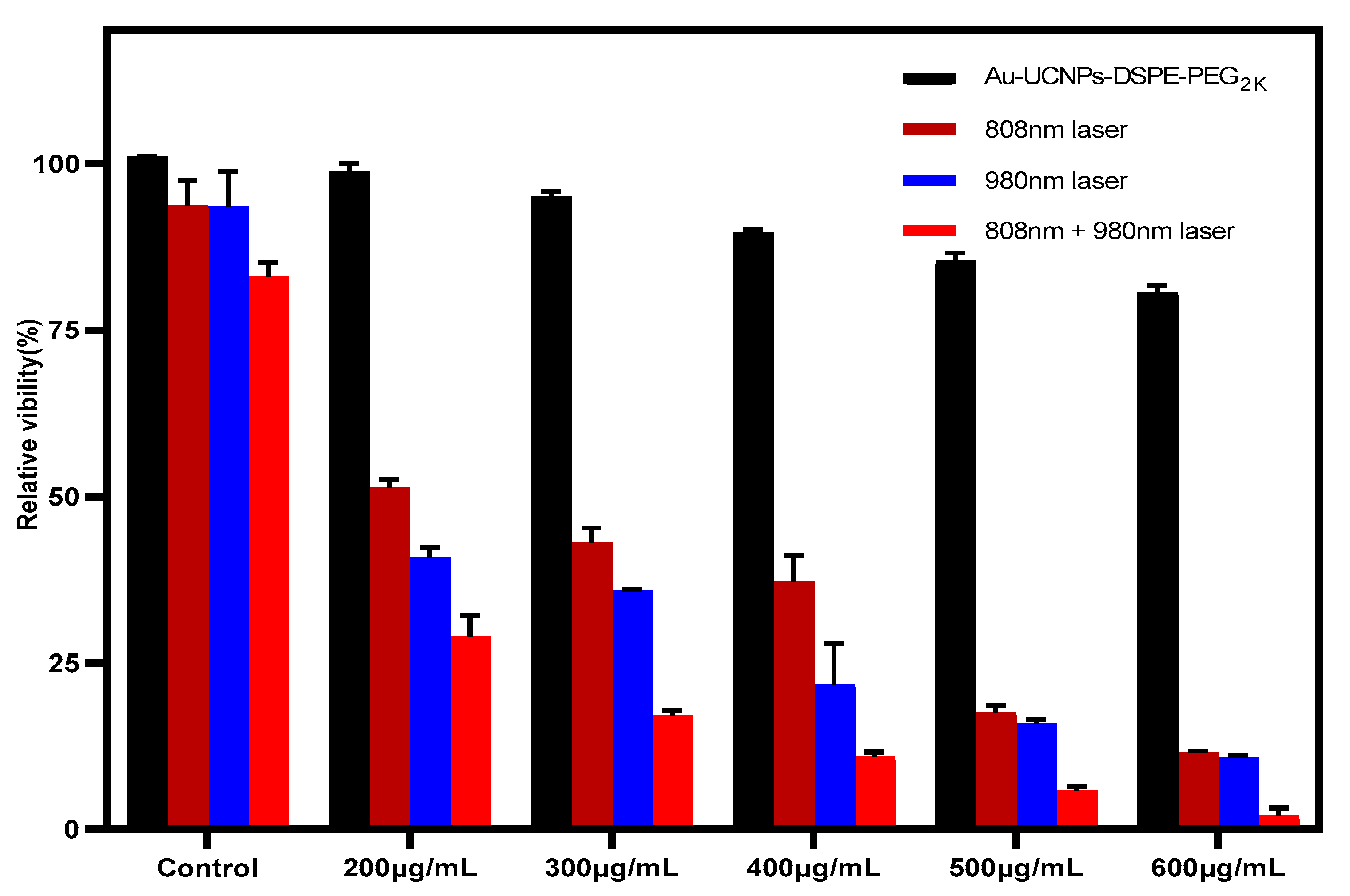
Two key concerns exist in contemporary cancer chemotherapy: limited therapeutic efficiency and substantial side effects in patients. In recent years, researchers have been investigating the revolutionary cancer treatment techniques of photodynamic therapy (PDT) and photothermal therapy (PTT) proposed by many scholars. A photothermal treatment of cancer was synthesized using the hydrothermal method which has high photothermal conversion efficiency and can generate reactive oxygen species (ROS) in cells. Photothermal treatment of tumors has a good short-term effect and photodynamic therapy lasts longer. However, both PTT and PDT have their inevitable shortcomings and it is difficult to completely eradicate a tumor using a single mode of treatment. PTT and PDT synergistic treatment not only inherits the advantages of low toxicity and side effects of phototherapy but also enables the two treatment methods to complement each other. It is an effective strategy to improve curative effects and reduce toxic and side effects. Furthermore, gold doped UCNPs have an exceptionally high target recognition for tumor cells. The gold doped UCNPs, in particular, are non-toxic to normal tissues, endowing the as-prepared medications with outstanding therapeutic efficacy and exceptionally low side effects. These findings may encourage the creation of fresh, effective imaging-guided approaches to meet the goal of photothermal cancer therapy.
Keywords: up-conversion; nanomaterials; photodynamic; photothermal up-conversion; nanomaterials; photodynamic; photothermal