


Emerging Antiarrhythmic Drugs for Atrial Fibrillation

Abstract
1. Introduction
2. Characteristics and Mechanisms of AF
2.1. Variability in AF Phenotypes
2.2. General Mechanisms of AF
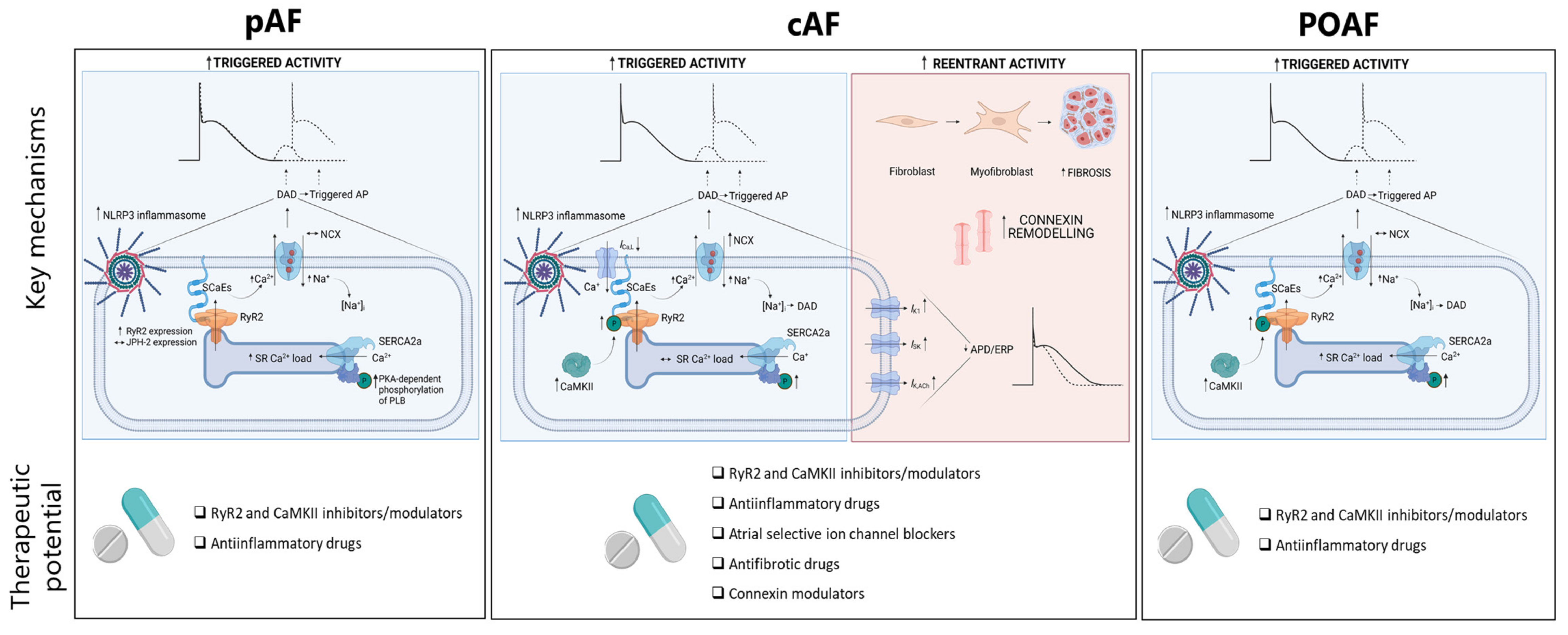
2.3. Fundamental Mechanism of pAF
2.4. Fundamental Mechanisms of cAF
2.5. Fundamental Mechanisms of POAF
3. Novel Pharmacological Approaches for AF Management
3.1. Targeting Ectopic Activity
3.1.1. RyR2-Channel Blockers
3.1.2. RyR2-Channel Modulators
3.1.3. CaMKII Inhibitors
3.2. Targeting ERP/APD Changes
3.2.1. ISK Channel Blockers
3.2.2. TASK-1 Channel Blockers
3.2.3. IKur and IK,ACh Channel Blockers
3.3. Targeting Upstream Mechanisms
3.3.1. Targeting Atrial Profibrotic Signaling
3.3.2. Targeting Atrial Inflammatory Signaling
4. Challenges and Future Perspectives of Antiarrhythmic Drug Development
5. Conclusions
Funding
Conflicts of Interest
References
- Lip, G.Y.; Fauchier, L.; Freedman, S.B.; Van Gelder, I.; Natale, A.; Gianni, C.; Nattel, S.; Potpara, T.; Rienstra, M.; Tse, H.F.; et al. Atrial fibrillation. Nat. Rev. Dis. Primers 2016, 2, 16016. [Google Scholar] [CrossRef] [PubMed]
- Wolf, P.A.; Abbott, R.D.; Kannel, W.B. Atrial fibrillation as an independent risk factor for stroke: The Framingham Study. Stroke 1991, 22, 983–988. [Google Scholar] [CrossRef] [PubMed]
- Wang, T.J.; Larson, M.G.; Levy, D.; Vasan, R.S.; Leip, E.P.; Wolf, P.A.; D’Agostino, R.B.; Murabito, J.M.; Kannel, W.B.; Benjamin, E.J. Temporal relations of atrial fibrillation and congestive heart failure and their joint influence on mortality: The Framingham Heart Study. Circulation 2003, 107, 2920–2925. [Google Scholar] [CrossRef] [PubMed]
- Hohnloser, S.H.; Crijns, H.J.; van Eickels, M.; Gaudin, C.; Page, R.L.; Torp-Pedersen, C.; Connolly, S.J. Effect of dronedarone on cardiovascular events in atrial fibrillation. N. Engl. J. Med. 2009, 360, 668–678. [Google Scholar] [CrossRef]
- Kirchhof, P.; Camm, A.J.; Goette, A.; Brandes, A.; Eckardt, L.; Elvan, A.; Fetsch, T.; van Gelder, I.C.; Haase, D.; Haegeli, L.M.; et al. Early Rhythm-Control Therapy in Patients with Atrial Fibrillation. N. Engl. J. Med. 2020, 383, 1305–1316. [Google Scholar] [CrossRef]
- Marrouche, N.F.; Brachmann, J.; Andresen, D.; Siebels, J.; Boersma, L.; Jordaens, L.; Merkely, B.; Pokushalov, E.; Sanders, P.; Proff, J.; et al. Catheter Ablation for Atrial Fibrillation with Heart Failure. N. Engl. J. Med. 2018, 378, 417–427. [Google Scholar] [CrossRef]
- Andrade, J.; Khairy, P.; Dobrev, D.; Nattel, S. The clinical profile and pathophysiology of atrial fibrillation: Relationships among clinical features, epidemiology, and mechanisms. Circ. Res. 2014, 114, 1453–1468. [Google Scholar] [CrossRef]
- Heijman, J.; Guichard, J.B.; Dobrev, D.; Nattel, S. Translational Challenges in Atrial Fibrillation. Circ. Res. 2018, 122, 752–773. [Google Scholar] [CrossRef]
- Heijman, J.; Hohnloser, S.H.; Camm, A.J. Antiarrhythmic drugs for atrial fibrillation: Lessons from the past and opportunities for the future. Europace 2021, 23, ii14–ii22. [Google Scholar] [CrossRef]
- Heijman, J.; Algalarrondo, V.; Voigt, N.; Melka, J.; Wehrens, X.H.; Dobrev, D.; Nattel, S. The value of basic research insights into atrial fibrillation mechanisms as a guide to therapeutic innovation: A critical analysis. Cardiovasc. Res. 2016, 109, 467–479. [Google Scholar] [CrossRef]
- Dan, G.A.; Dobrev, D. Antiarrhythmic drugs for atrial fibrillation: Imminent impulses are emerging. Int. J. Cardiol. Heart Vasc. 2018, 21, 11–15. [Google Scholar] [CrossRef] [PubMed]
- Heijman, J.; Voigt, N.; Nattel, S.; Dobrev, D. Cellular and molecular electrophysiology of atrial fibrillation initiation, maintenance, and progression. Circ. Res. 2014, 114, 1483–1499. [Google Scholar] [CrossRef] [PubMed]
- Hermans, A.N.L.; Pluymaekers, N.; Lankveld, T.A.R.; van Mourik, M.J.W.; Zeemering, S.; Dinh, T.; den Uijl, D.W.; Luermans, J.; Vernooy, K.; Crijns, H.; et al. Clinical utility of rhythm control by electrical cardioversion to assess the association between self-reported symptoms and rhythm status in patients with persistent atrial fibrillation. Int. J. Cardiol. Heart Vasc. 2021, 36, 100870. [Google Scholar] [CrossRef] [PubMed]
- Mehall, J.R.; Kohut, R.M., Jr.; Schneeberger, E.W.; Merrill, W.H.; Wolf, R.K. Absence of correlation between symptoms and rhythm in “symptomatic” atrial fibrillation. Ann. Thorac. Surg. 2007, 83, 2118–2121. [Google Scholar] [CrossRef] [PubMed]
- Reiffel, J.A. When Silence Isn’t Golden: The Case of “Silent” Atrial Fibrillation. J. Innov. Card. Rhythm Manag. 2017, 8, 2886–2893. [Google Scholar] [CrossRef][Green Version]
- Hindricks, G.; Potpara, T.; Dagres, N.; Arbelo, E.; Bax, J.J.; Blomström-Lundqvist, C.; Boriani, G.; Castella, M.; Dan, G.A.; Dilaveris, P.E.; et al. 2020 ESC Guidelines for the diagnosis and management of atrial fibrillation developed in collaboration with the European Association for Cardio-Thoracic Surgery (EACTS): The Task Force for the diagnosis and management of atrial fibrillation of the European Society of Cardiology (ESC) Developed with the special contribution of the European Heart Rhythm Association (EHRA) of the ESC. Eur. Heart J. 2021, 42, 373–498. [Google Scholar] [CrossRef]
- Mathew, J.P.; Fontes, M.L.; Tudor, I.C.; Ramsay, J.; Duke, P.; Mazer, C.D.; Barash, P.G.; Hsu, P.H.; Mangano, D.T. A multicenter risk index for atrial fibrillation after cardiac surgery. JAMA 2004, 291, 1720–1729. [Google Scholar] [CrossRef]
- Ahlsson, A.; Fengsrud, E.; Bodin, L.; Englund, A. Postoperative atrial fibrillation in patients undergoing aortocoronary bypass surgery carries an eightfold risk of future atrial fibrillation and a doubled cardiovascular mortality. Eur. J. Cardiothorac. Surg. 2010, 37, 1353–1359. [Google Scholar] [CrossRef]
- Steinberg, B.A.; Zhao, Y.; He, X.; Hernandez, A.F.; Fullerton, D.A.; Thomas, K.L.; Mills, R.; Klaskala, W.; Peterson, E.D.; Piccini, J.P. Management of postoperative atrial fibrillation and subsequent outcomes in contemporary patients undergoing cardiac surgery: Insights from the Society of Thoracic Surgeons CAPS-Care Atrial Fibrillation Registry. Clin. Cardiol. 2014, 37, 7–13. [Google Scholar] [CrossRef]
- Melduni, R.M.; Schaff, H.V.; Bailey, K.R.; Cha, S.S.; Ammash, N.M.; Seward, J.B.; Gersh, B.J. Implications of new-onset atrial fibrillation after cardiac surgery on long-term prognosis: A community-based study. Am. Heart J. 2015, 170, 659–668. [Google Scholar] [CrossRef]
- Dobrev, D.; Aguilar, M.; Heijman, J.; Guichard, J.B.; Nattel, S. Postoperative atrial fibrillation: Mechanisms, manifestations and management. Nat. Rev. Cardiol. 2019, 16, 417–436. [Google Scholar] [CrossRef] [PubMed]
- Haïssaguerre, M.; Jaïs, P.; Shah, D.C.; Takahashi, A.; Hocini, M.; Quiniou, G.; Garrigue, S.; Le Mouroux, A.; Le Métayer, P.; Clémenty, J. Spontaneous initiation of atrial fibrillation by ectopic beats originating in the pulmonary veins. N. Engl. J. Med. 1998, 339, 659–666. [Google Scholar] [CrossRef] [PubMed]
- Higa, S.; Lo, L.W.; Chen, S.A. Catheter Ablation of Paroxysmal Atrial Fibrillation Originating from Non-pulmonary Vein Areas. Arrhythmia Electrophysiol. Rev. 2018, 7, 273–281. [Google Scholar] [CrossRef] [PubMed]
- Nattel, S.; Burstein, B.; Dobrev, D. Atrial remodeling and atrial fibrillation: Mechanisms and implications. Circul. Arrhythmia Electrophysiol. 2008, 1, 62–73. [Google Scholar] [CrossRef] [PubMed]
- Landstrom, A.P.; Dobrev, D.; Wehrens, X.H.T. Calcium Signaling and Cardiac Arrhythmias. Circ. Res. 2017, 120, 1969–1993. [Google Scholar] [CrossRef] [PubMed]
- Heijman, J.; Muna, A.P.; Veleva, T.; Molina, C.E.; Sutanto, H.; Tekook, M.; Wang, Q.; Abu-Taha, I.H.; Gorka, M.; Künzel, S.; et al. Atrial Myocyte NLRP3/CaMKII Nexus Forms a Substrate for Postoperative Atrial Fibrillation. Circ. Res. 2020, 127, 1036–1055. [Google Scholar] [CrossRef]
- Dobrev, D.; Voigt, N.; Wehrens, X.H. The ryanodine receptor channel as a molecular motif in atrial fibrillation: Pathophysiological and therapeutic implications. Cardiovasc. Res. 2011, 89, 734–743. [Google Scholar] [CrossRef]
- Zeng, J.; Rudy, Y. Early afterdepolarizations in cardiac myocytes: Mechanism and rate dependence. Biophys. J. 1995, 68, 949–964. [Google Scholar] [CrossRef]
- Heijman, J.; Linz, D.; Schotten, U. Dynamics of Atrial Fibrillation Mechanisms and Comorbidities. Annu. Rev. Physiol. 2021, 83, 83–106. [Google Scholar] [CrossRef]
- Shih, T.; Ledezma, K.; McCauley, M.; Rehman, J.; Galanter, W.L.; Darbar, D. Impact of traditional risk factors for the outcomes of atrial fibrillation across race and ethnicity and sex groups. Int. J. Cardiol. Heart Vasc. 2020, 28, 100538. [Google Scholar] [CrossRef]
- Linz, D.; Dobrev, D. Sleep apnea and atrial fibrillation: Update 2020. Int. J. Cardiol. Heart Vasc. 2020, 31, 100681. [Google Scholar] [CrossRef] [PubMed]
- Daoud, E.G.; Bogun, F.; Goyal, R.; Harvey, M.; Man, K.C.; Strickberger, S.A.; Morady, F. Effect of atrial fibrillation on atrial refractoriness in humans. Circulation 1996, 94, 1600–1606. [Google Scholar] [CrossRef] [PubMed]
- Franz, M.R.; Karasik, P.L.; Li, C.; Moubarak, J.; Chavez, M. Electrical remodeling of the human atrium: Similar effects in patients with chronic atrial fibrillation and atrial flutter. J. Am. Coll. Cardiol. 1997, 30, 1785–1792. [Google Scholar] [CrossRef]
- Kostin, S.; Klein, G.; Szalay, Z.; Hein, S.; Bauer, E.P.; Schaper, J. Structural correlate of atrial fibrillation in human patients. Cardiovasc. Res. 2002, 54, 361–379. [Google Scholar] [CrossRef]
- Platonov, P.G.; Mitrofanova, L.B.; Orshanskaya, V.; Ho, S.Y. Structural abnormalities in atrial walls are associated with presence and persistency of atrial fibrillation but not with age. J. Am. Coll. Cardiol. 2011, 58, 2225–2232. [Google Scholar] [CrossRef]
- Ohtani, K.; Yutani, C.; Nagata, S.; Koretsune, Y.; Hori, M.; Kamada, T. High prevalence of atrial fibrosis in patients with dilated cardiomyopathy. J. Am. Coll. Cardiol. 1995, 25, 1162–1169. [Google Scholar] [CrossRef]
- Boldt, A.; Wetzel, U.; Lauschke, J.; Weigl, J.; Gummert, J.; Hindricks, G.; Kottkamp, H.; Dhein, S. Fibrosis in left atrial tissue of patients with atrial fibrillation with and without underlying mitral valve disease. Heart 2004, 90, 400–405. [Google Scholar] [CrossRef]
- Allessie, M.; Ausma, J.; Schotten, U. Electrical, contractile and structural remodeling during atrial fibrillation. Cardiovasc. Res. 2002, 54, 230–246. [Google Scholar] [CrossRef]
- Nattel, S.; Dobrev, D. Electrophysiological and molecular mechanisms of paroxysmal atrial fibrillation. Nat. Rev. Cardiol. 2016, 13, 575–590. [Google Scholar] [CrossRef]
- Voigt, N.; Heijman, J.; Wang, Q.; Chiang, D.Y.; Li, N.; Karck, M.; Wehrens, X.H.T.; Nattel, S.; Dobrev, D. Cellular and molecular mechanisms of atrial arrhythmogenesis in patients with paroxysmal atrial fibrillation. Circulation 2014, 129, 145–156. [Google Scholar] [CrossRef]
- Voigt, N.; Li, N.; Wang, Q.; Wang, W.; Trafford, A.W.; Abu-Taha, I.; Sun, Q.; Wieland, T.; Ravens, U.; Nattel, S.; et al. Enhanced sarcoplasmic reticulum Ca2+ leak and increased Na+-Ca2+ exchanger function underlie delayed afterdepolarizations in patients with chronic atrial fibrillation. Circulation 2012, 125, 2059–2070. [Google Scholar] [CrossRef] [PubMed]
- Neef, S.; Dybkova, N.; Sossalla, S.; Ort, K.R.; Fluschnik, N.; Neumann, K.; Seipelt, R.; Schöndube, F.A.; Hasenfuss, G.; Maier, L.S. CaMKII-dependent diastolic SR Ca2+ leak and elevated diastolic Ca2+ levels in right atrial myocardium of patients with atrial fibrillation. Circ. Res. 2010, 106, 1134–1144. [Google Scholar] [CrossRef] [PubMed]
- Purohit, A.; Rokita, A.G.; Guan, X.; Chen, B.; Koval, O.M.; Voigt, N.; Neef, S.; Sowa, T.; Gao, Z.; Luczak, E.D.; et al. Oxidized Ca2+/calmodulin-dependent protein kinase II triggers atrial fibrillation. Circulation 2013, 128, 1748–1757. [Google Scholar] [CrossRef] [PubMed]
- Chelu, M.G.; Sarma, S.; Sood, S.; Wang, S.; van Oort, R.J.; Skapura, D.G.; Li, N.; Santonastasi, M.; Müller, F.U.; Schmitz, W.; et al. Calmodulin kinase II-mediated sarcoplasmic reticulum Ca2+ leak promotes atrial fibrillation in mice. J. Clin. Investig. 2009, 119, 1940–1951. [Google Scholar] [CrossRef]
- Mitrofanova, L.B.; Orshanskaya, V.; Ho, S.Y.; Platonov, P.G. Histological evidence of inflammatory reaction associated with fibrosis in the atrial and ventricular walls in a case-control study of patients with history of atrial fibrillation. Europace 2016, 18, iv156–iv162. [Google Scholar] [CrossRef]
- Hocini, M.; Ho, S.Y.; Kawara, T.; Linnenbank, A.C.; Potse, M.; Shah, D.; Jaïs, P.; Janse, M.J.; Haïssaguerre, M.; De Bakker, J.M. Electrical conduction in canine pulmonary veins: Electrophysiological and anatomic correlation. Circulation 2002, 105, 2442–2448. [Google Scholar] [CrossRef]
- Nattel, S. Paroxysmal atrial fibrillation and pulmonary veins: Relationships between clinical forms and automatic versus re-entrant mechanisms. Can. J. Cardiol. 2013, 29, 1147–1149. [Google Scholar] [CrossRef]
- Ehrlich, J.R.; Cha, T.J.; Zhang, L.; Chartier, D.; Melnyk, P.; Hohnloser, S.H.; Nattel, S. Cellular electrophysiology of canine pulmonary vein cardiomyocytes: Action potential and ionic current properties. J. Physiol. 2003, 551, 801–813. [Google Scholar] [CrossRef]
- Ozgen, N.; Dun, W.; Sosunov, E.A.; Anyukhovsky, E.P.; Hirose, M.; Duffy, H.S.; Boyden, P.A.; Rosen, M.R. Early electrical remodeling in rabbit pulmonary vein results from trafficking of intracellular SK2 channels to membrane sites. Cardiovasc. Res. 2007, 75, 758–769. [Google Scholar] [CrossRef]
- Qi, X.Y.; Diness, J.G.; Brundel, B.J.; Zhou, X.B.; Naud, P.; Wu, C.T.; Huang, H.; Harada, M.; Aflaki, M.; Dobrev, D.; et al. Role of small-conductance calcium-activated potassium channels in atrial electrophysiology and fibrillation in the dog. Circulation 2014, 129, 430–440. [Google Scholar] [CrossRef]
- Pandit, S.V.; Berenfeld, O.; Anumonwo, J.M.; Zaritski, R.M.; Kneller, J.; Nattel, S.; Jalife, J. Ionic determinants of functional reentry in a 2-D model of human atrial cells during simulated chronic atrial fibrillation. Biophys. J. 2005, 88, 3806–3821. [Google Scholar] [CrossRef] [PubMed]
- Saljic, A.; Jespersen, T.; Buhl, R. Anti-arrhythmic investigations in large animal models of atrial fibrillation. Br. J. Pharmacol. 2021, 179, 838–858. [Google Scholar] [CrossRef] [PubMed]
- Buhl, R.; Hesselkilde, E.M.; Carstensen, H.; Fenner, M.F.; Jespersen, T.; Tfelt-Hansen, J.; Michael Sattler, S. Detection of atrial fibrillation with implantable loop recorders in horses. Equine Vet. J. 2021, 53, 397–403. [Google Scholar] [CrossRef] [PubMed]
- Buhl, R.; Nissen, S.D.; Winther, M.L.K.; Poulsen, S.K.; Hopster-Iversen, C.; Jespersen, T.; Sanders, P.; Carstensen, H.; Hesselkilde, E.M. Implantable loop recorders can detect paroxysmal atrial fibrillation in Standardbred racehorses with intermittent poor performance. Equine Vet. J. 2021, 53, 955–963. [Google Scholar] [CrossRef] [PubMed]
- Linz, D.; Hesselkilde, E.; Kutieleh, R.; Jespersen, T.; Buhl, R.; Sanders, P. Pulmonary vein firing initiating atrial fibrillation in the horse: Oversized dimensions but similar mechanisms. J. Cardiovasc. Electrophysiol. 2020, 31, 1211–1212. [Google Scholar] [CrossRef] [PubMed]
- Schotten, U.; Verheule, S.; Kirchhof, P.; Goette, A. Pathophysiological mechanisms of atrial fibrillation: A translational appraisal. Physiol. Rev. 2011, 91, 265–325. [Google Scholar] [CrossRef]
- Luo, X.; Pan, Z.; Shan, H.; Xiao, J.; Sun, X.; Wang, N.; Lin, H.; Xiao, L.; Maguy, A.; Qi, X.Y.; et al. MicroRNA-26 governs profibrillatory inward-rectifier potassium current changes in atrial fibrillation. J. Clin. Investig. 2013, 123, 1939–1951. [Google Scholar] [CrossRef]
- Voigt, N.; Trausch, A.; Knaut, M.; Matschke, K.; Varró, A.; Van Wagoner, D.R.; Nattel, S.; Ravens, U.; Dobrev, D. Left-to-right atrial inward rectifier potassium current gradients in patients with paroxysmal versus chronic atrial fibrillation. Circul. Arrhythmia Electrophysiol. 2010, 3, 472–480. [Google Scholar] [CrossRef]
- Girmatsion, Z.; Biliczki, P.; Bonauer, A.; Wimmer-Greinecker, G.; Scherer, M.; Moritz, A.; Bukowska, A.; Goette, A.; Nattel, S.; Hohnloser, S.H.; et al. Changes in microRNA-1 expression and IK1 up-regulation in human atrial fibrillation. Heart Rhythm 2009, 6, 1802–1809. [Google Scholar] [CrossRef]
- Dobrev, D.; Wettwer, E.; Kortner, A.; Knaut, M.; Schüler, S.; Ravens, U. Human inward rectifier potassium channels in chronic and postoperative atrial fibrillation. Cardiovasc. Res. 2002, 54, 397–404. [Google Scholar] [CrossRef]
- Caballero, R.; de la Fuente, M.G.; Gómez, R.; Barana, A.; Amorós, I.; Dolz-Gaitón, P.; Osuna, L.; Almendral, J.; Atienza, F.; Fernández-Avilés, F.; et al. In humans, chronic atrial fibrillation decreases the transient outward current and ultrarapid component of the delayed rectifier current differentially on each atria and increases the slow component of the delayed rectifier current in both. J. Am. Coll. Cardiol. 2010, 55, 2346–2354. [Google Scholar] [CrossRef] [PubMed]
- González de la Fuente, M.; Barana, A.; Gómez, R.; Amorós, I.; Dolz-Gaitón, P.; Sacristán, S.; Atienza, F.; Pita, A.; Pinto, Á.; Fernández-Avilés, F.; et al. Chronic atrial fibrillation up-regulates β1-Adrenoceptors affecting repolarizing currents and action potential duration. Cardiovasc. Res. 2013, 97, 379–388. [Google Scholar] [CrossRef] [PubMed]
- Dobrev, D.; Graf, E.; Wettwer, E.; Himmel, H.M.; Hála, O.; Doerfel, C.; Christ, T.; Schüler, S.; Ravens, U. Molecular basis of downregulation of G-protein-coupled inward rectifying K+ current (IK,ACh) in chronic human atrial fibrillation: Decrease in GIRK4 mRNA correlates with reduced I(K,ACh) and muscarinic receptor-mediated shortening of action potentials. Circulation 2001, 104, 2551–2557. [Google Scholar] [CrossRef] [PubMed]
- Voigt, N.; Friedrich, A.; Bock, M.; Wettwer, E.; Christ, T.; Knaut, M.; Strasser, R.H.; Ravens, U.; Dobrev, D. Differential phosphorylation-dependent regulation of constitutively active and muscarinic receptor-activated IK,ACh channels in patients with chronic atrial fibrillation. Cardiovasc. Res. 2007, 74, 426–437. [Google Scholar] [CrossRef] [PubMed]
- Dobrev, D.; Friedrich, A.; Voigt, N.; Jost, N.; Wettwer, E.; Christ, T.; Knaut, M.; Ravens, U. The G protein-gated potassium current I(K,ACh) is constitutively active in patients with chronic atrial fibrillation. Circulation 2005, 112, 3697–3706. [Google Scholar] [CrossRef] [PubMed]
- Makary, S.; Voigt, N.; Maguy, A.; Wakili, R.; Nishida, K.; Harada, M.; Dobrev, D.; Nattel, S. Differential protein kinase C isoform regulation and increased constitutive activity of acetylcholine-regulated potassium channels in atrial remodeling. Circ. Res. 2011, 109, 1031–1043. [Google Scholar] [CrossRef]
- Bosch, R.F.; Zeng, X.; Grammer, J.B.; Popovic, K.; Mewis, C.; Kühlkamp, V. Ionic mechanisms of electrical remodeling in human atrial fibrillation. Cardiovasc. Res. 1999, 44, 121–131. [Google Scholar] [CrossRef]
- Grammer, J.B.; Bosch, R.F.; Kühlkamp, V.; Seipel, L. Molecular remodeling of Kv4.3 potassium channels in human atrial fibrillation. J. Cardiovasc. Electrophysiol. 2000, 11, 626–633. [Google Scholar] [CrossRef]
- Brundel, B.J.; Van Gelder, I.C.; Henning, R.H.; Tieleman, R.G.; Tuinenburg, A.E.; Wietses, M.; Grandjean, J.G.; Van Gilst, W.H.; Crijns, H.J. Ion channel remodeling is related to intraoperative atrial effective refractory periods in patients with paroxysmal and persistent atrial fibrillation. Circulation 2001, 103, 684–690. [Google Scholar] [CrossRef]
- Van Wagoner, D.R.; Pond, A.L.; McCarthy, P.M.; Trimmer, J.S.; Nerbonne, J.M. Outward K+ current densities and Kv1.5 expression are reduced in chronic human atrial fibrillation. Circ. Res. 1997, 80, 772–781. [Google Scholar] [CrossRef]
- Workman, A.J.; Kane, K.A.; Rankin, A.C. The contribution of ionic currents to changes in refractoriness of human atrial myocytes associated with chronic atrial fibrillation. Cardiovasc. Res. 2001, 52, 226–235. [Google Scholar] [CrossRef]
- Skibsbye, L.; Poulet, C.; Diness, J.G.; Bentzen, B.H.; Yuan, L.; Kappert, U.; Matschke, K.; Wettwer, E.; Ravens, U.; Grunnet, M.; et al. Small-conductance calcium-activated potassium (SK) channels contribute to action potential repolarization in human atria. Cardiovasc. Res. 2014, 103, 156–167. [Google Scholar] [CrossRef] [PubMed]
- Li, M.L.; Li, T.; Lei, M.; Tan, X.Q.; Yang, Y.; Liu, T.P.; Pei, J.; Zeng, X.R. Increased small conductance calcium-activated potassium channel (SK2 channel) current in atrial myocytes of patients with persistent atrial fibrillation. Zhonghua Xin Xue Guan Bing Za Zhi 2011, 39, 147–151. [Google Scholar] [PubMed]
- Yu, T.; Deng, C.; Wu, R.; Guo, H.; Zheng, S.; Yu, X.; Shan, Z.; Kuang, S.; Lin, Q. Decreased expression of small-conductance Ca2+-activated K+ channels SK1 and SK2 in human chronic atrial fibrillation. Life Sci. 2012, 90, 219–227. [Google Scholar] [CrossRef]
- Ling, T.Y.; Wang, X.L.; Chai, Q.; Lau, T.W.; Koestler, C.M.; Park, S.J.; Daly, R.C.; Greason, K.L.; Jen, J.; Wu, L.Q.; et al. Regulation of the SK3 channel by microRNA-499--potential role in atrial fibrillation. Heart Rhythm 2013, 10, 1001–1009. [Google Scholar] [CrossRef]
- Darkow, E.; Nguyen, T.T.; Stolina, M.; Kari, F.A.; Schmidt, C.; Wiedmann, F.; Baczkó, I.; Kohl, P.; Rajamani, S.; Ravens, U.; et al. Small Conductance Ca2+-Activated K+ (SK) Channel mRNA Expression in Human Atrial and Ventricular Tissue: Comparison Between Donor, Atrial Fibrillation and Heart Failure Tissue. Front. Physiol. 2021, 12, 650964. [Google Scholar] [CrossRef]
- Diness, J.G.; Bentzen, B.H.; Sørensen, U.S.; Grunnet, M. Role of Calcium-activated Potassium Channels in Atrial Fibrillation Pathophysiology and Therapy. J. Cardiovasc. Pharmacol. 2015, 66, 441–448. [Google Scholar] [CrossRef]
- Schmidt, C.; Wiedmann, F.; Voigt, N.; Zhou, X.B.; Heijman, J.; Lang, S.; Albert, V.; Kallenberger, S.; Ruhparwar, A.; Szabó, G.; et al. Upregulation of K(2P)3.1 K+ Current Causes Action Potential Shortening in Patients With Chronic Atrial Fibrillation. Circulation 2015, 132, 82–92. [Google Scholar] [CrossRef]
- Schmidt, C.; Wiedmann, F.; Zhou, X.B.; Heijman, J.; Voigt, N.; Ratte, A.; Lang, S.; Kallenberger, S.M.; Campana, C.; Weymann, A.; et al. Inverse remodelling of K2P3.1 K+ channel expression and action potential duration in left ventricular dysfunction and atrial fibrillation: Implications for patient-specific antiarrhythmic drug therapy. Eur. Heart J. 2017, 38, 1764–1774. [Google Scholar] [CrossRef]
- Qi, X.Y.; Yeh, Y.H.; Xiao, L.; Burstein, B.; Maguy, A.; Chartier, D.; Villeneuve, L.R.; Brundel, B.J.; Dobrev, D.; Nattel, S. Cellular signaling underlying atrial tachycardia remodeling of L-type calcium current. Circ. Res. 2008, 103, 845–854. [Google Scholar] [CrossRef]
- Qi, X.Y.; Vahdati Hassani, F.; Hoffmann, D.; Xiao, J.; Xiong, F.; Villeneuve, L.R.; Ljubojevic-Holzer, S.; Kamler, M.; Abu-Taha, I.; Heijman, J.; et al. Inositol Trisphosphate Receptors and Nuclear Calcium in Atrial Fibrillation. Circ. Res. 2021, 128, 619–635. [Google Scholar] [CrossRef] [PubMed]
- Hove-Madsen, L.; Llach, A.; Bayes-Genís, A.; Roura, S.; Rodriguez Font, E.; Arís, A.; Cinca, J. Atrial fibrillation is associated with increased spontaneous calcium release from the sarcoplasmic reticulum in human atrial myocytes. Circulation 2004, 110, 1358–1363. [Google Scholar] [CrossRef] [PubMed]
- Vest, J.A.; Wehrens, X.H.; Reiken, S.R.; Lehnart, S.E.; Dobrev, D.; Chandra, P.; Danilo, P.; Ravens, U.; Rosen, M.R.; Marks, A.R. Defective cardiac ryanodine receptor regulation during atrial fibrillation. Circulation 2005, 111, 2025–2032. [Google Scholar] [CrossRef] [PubMed]
- Wehrens, X.H.; Lehnart, S.E.; Huang, F.; Vest, J.A.; Reiken, S.R.; Mohler, P.J.; Sun, J.; Guatimosim, S.; Song, L.S.; Rosemblit, N.; et al. FKBP12.6 deficiency and defective calcium release channel (ryanodine receptor) function linked to exercise-induced sudden cardiac death. Cell 2003, 113, 829–840. [Google Scholar] [CrossRef]
- Wehrens, X.H.; Lehnart, S.E.; Reiken, S.R.; Deng, S.X.; Vest, J.A.; Cervantes, D.; Coromilas, J.; Landry, D.W.; Marks, A.R. Protection from cardiac arrhythmia through ryanodine receptor-stabilizing protein calstabin2. Science 2004, 304, 292–296. [Google Scholar] [CrossRef]
- El-Armouche, A.; Boknik, P.; Eschenhagen, T.; Carrier, L.; Knaut, M.; Ravens, U.; Dobrev, D. Molecular determinants of altered Ca2+ handling in human chronic atrial fibrillation. Circulation 2006, 114, 670–680. [Google Scholar] [CrossRef]
- Uemura, N.; Ohkusa, T.; Hamano, K.; Nakagome, M.; Hori, H.; Shimizu, M.; Matsuzaki, M.; Mochizuki, S.; Minamisawa, S.; Ishikawa, Y. Down-regulation of sarcolipin mRNA expression in chronic atrial fibrillation. Eur. J. Clin. Investig. 2004, 34, 723–730. [Google Scholar] [CrossRef]
- Shanmugam, M.; Molina, C.E.; Gao, S.; Severac-Bastide, R.; Fischmeister, R.; Babu, G.J. Decreased sarcolipin protein expression and enhanced sarco(endo)plasmic reticulum Ca2+ uptake in human atrial fibrillation. Biochem. Biophys. Res. Commun. 2011, 410, 97–101. [Google Scholar] [CrossRef]
- Molina, C.E.; Abu-Taha, I.H.; Wang, Q.; Roselló-Díez, E.; Kamler, M.; Nattel, S.; Ravens, U.; Wehrens, X.H.T.; Hove-Madsen, L.; Heijman, J.; et al. Profibrotic, Electrical, and Calcium-Handling Remodeling of the Atria in Heart Failure Patients With and Without Atrial Fibrillation. Front. Physiol. 2018, 9, 1383. [Google Scholar] [CrossRef]
- Wittköpper, K.; Fabritz, L.; Neef, S.; Ort, K.R.; Grefe, C.; Unsöld, B.; Kirchhof, P.; Maier, L.S.; Hasenfuss, G.; Dobrev, D.; et al. Constitutively active phosphatase inhibitor-1 improves cardiac contractility in young mice but is deleterious after catecholaminergic stress and with aging. J. Clin. Investig. 2010, 120, 617–626. [Google Scholar] [CrossRef]
- Nattel, S. Molecular and Cellular Mechanisms of Atrial Fibrosis in Atrial Fibrillation. JACC. Clin. Electrophysiol. 2017, 3, 425–435. [Google Scholar] [CrossRef] [PubMed]
- Vasquez, C.; Benamer, N.; Morley, G.E. The cardiac fibroblast: Functional and electrophysiological considerations in healthy and diseased hearts. J. Cardiovasc. Pharmacol. 2011, 57, 380–388. [Google Scholar] [CrossRef] [PubMed]
- Malone, J.K.; Meacham, J.E.; Ryan, P.J.; Roudebush, C.; Boyce, P.A. The hyperglycemic hyperosmolar syndrome. Indiana Med. J. Indiana State Med. Assoc. 1988, 81, 766–768. [Google Scholar]
- Li, N.; Brundel, B. Inflammasomes and Proteostasis Novel Molecular Mechanisms Associated With Atrial Fibrillation. Circ. Res. 2020, 127, 73–90. [Google Scholar] [CrossRef]
- Wang, X.; Chen, X.; Dobrev, D.; Li, N. The crosstalk between cardiomyocyte calcium and inflammasome signaling pathways in atrial fibrillation. Pflug. Arch. Eur. J. Physiol. 2021, 473, 389–405. [Google Scholar] [CrossRef] [PubMed]
- Yao, C.; Veleva, T.; Scott, L., Jr.; Cao, S.; Li, L.; Chen, G.; Jeyabal, P.; Pan, X.; Alsina, K.M.; Abu-Taha, I.D.; et al. Enhanced Cardiomyocyte NLRP3 Inflammasome Signaling Promotes Atrial Fibrillation. Circulation 2018, 138, 2227–2242. [Google Scholar] [CrossRef]
- Scott, L., Jr.; Fender, A.C.; Saljic, A.; Li, L.; Chen, X.; Wang, X.; Linz, D.; Lang, J.; Hohl, M.; Twomey, D.; et al. NLRP3 inflammasome is a key driver of obesity-induced atrial arrhythmias. Cardiovasc. Res. 2021, 117, 1746–1759. [Google Scholar] [CrossRef]
- Swartz, M.F.; Fink, G.W.; Sarwar, M.F.; Hicks, G.L.; Yu, Y.; Hu, R.; Lutz, C.J.; Taffet, S.M.; Jalife, J. Elevated pre-operative serum peptides for collagen I and III synthesis result in post-surgical atrial fibrillation. J. Am. Coll. Cardiol. 2012, 60, 1799–1806. [Google Scholar] [CrossRef]
- Swartz, M.F.; Fink, G.W.; Lutz, C.J.; Taffet, S.M.; Berenfeld, O.; Vikstrom, K.L.; Kasprowicz, K.; Bhatta, L.; Puskas, F.; Kalifa, J.; et al. Left versus right atrial difference in dominant frequency, K+ channel transcripts, and fibrosis in patients developing atrial fibrillation after cardiac surgery. Heart Rhythm 2009, 6, 1415–1422. [Google Scholar] [CrossRef]
- Wang, G.D.; Shen, L.H.; Wang, L.; Li, H.W.; Zhang, Y.C.; Chen, H. Relationship between integrated backscatter and atrial fibrosis in patients with and without atrial fibrillation who are undergoing coronary bypass surgery. Clin. Cardiol. 2009, 32, E56–E61. [Google Scholar] [CrossRef]
- Wyse, D.G.; Waldo, A.L.; DiMarco, J.P.; Domanski, M.J.; Rosenberg, Y.; Schron, E.B.; Kellen, J.C.; Greene, H.L.; Mickel, M.C.; Dalquist, J.E.; et al. A comparison of rate control and rhythm control in patients with atrial fibrillation. N. Engl. J. Med. 2002, 347, 1825–1833. [Google Scholar] [CrossRef] [PubMed]
- Van Gelder, I.C.; Hagens, V.E.; Bosker, H.A.; Kingma, J.H.; Kamp, O.; Kingma, T.; Said, S.A.; Darmanata, J.I.; Timmermans, A.J.; Tijssen, J.G.; et al. A comparison of rate control and rhythm control in patients with recurrent persistent atrial fibrillation. N. Engl. J. Med. 2002, 347, 1834–1840. [Google Scholar] [CrossRef] [PubMed]
- Nattel, S.; Sager, P.T.; Hüser, J.; Heijman, J.; Dobrev, D. Why translation from basic discoveries to clinical applications is so difficult for atrial fibrillation and possible approaches to improving it. Cardiovasc. Res. 2021, 117, 1616–1631. [Google Scholar] [CrossRef] [PubMed]
- Zimetbaum, P. Antiarrhythmic drug therapy for atrial fibrillation. Circulation 2012, 125, 381–389. [Google Scholar] [CrossRef] [PubMed]
- Greiser, M.; Kerfant, B.G.; Williams, G.S.; Voigt, N.; Harks, E.; Dibb, K.M.; Giese, A.; Meszaros, J.; Verheule, S.; Ravens, U.; et al. Tachycardia-induced silencing of subcellular Ca2+ signaling in atrial myocytes. J. Clin. Investig. 2014, 124, 4759–4772. [Google Scholar] [CrossRef]
- Watanabe, H.; Chopra, N.; Laver, D.; Hwang, H.S.; Davies, S.S.; Roach, D.E.; Duff, H.J.; Roden, D.M.; Wilde, A.A.; Knollmann, B.C. Flecainide prevents catecholaminergic polymorphic ventricular tachycardia in mice and humans. Nat. Med. 2009, 15, 380–383. [Google Scholar] [CrossRef]
- Verrier, R.L.; Bortolotto, A.L.; Silva, B.A.; Marum, A.A.; Stocco, F.G.; Evaristo, E.; de Antonio, V.Z.; Silva, A.C.; Belardinelli, L. Accelerated conversion of atrial fibrillation to normal sinus rhythm by pulmonary delivery of flecainide acetate in a porcine model. Heart Rhythm 2018, 15, 1882–1888. [Google Scholar] [CrossRef]
- Faggioni, M.; Savio-Galimberti, E.; Venkataraman, R.; Hwang, H.S.; Kannankeril, P.J.; Darbar, D.; Knollmann, B.C. Suppression of spontaneous ca elevations prevents atrial fibrillation in calsequestrin 2-null hearts. Circul. Arrhythmia Electrophysiol. 2014, 7, 313–320. [Google Scholar] [CrossRef]
- Parikh, A.; Mantravadi, R.; Kozhevnikov, D.; Roche, M.A.; Ye, Y.; Owen, L.J.; Puglisi, J.L.; Abramson, J.J.; Salama, G. Ranolazine stabilizes cardiac ryanodine receptors: A novel mechanism for the suppression of early afterdepolarization and torsades de pointes in long QT type 2. Heart Rhythm 2012, 9, 953–960. [Google Scholar] [CrossRef]
- Carstensen, H.; Kjær, L.; Haugaard, M.M.; Flethøj, M.; Hesselkilde, E.Z.; Kanters, J.K.; Pehrson, S.; Buhl, R.; Jespersen, T. Antiarrhythmic Effects of Combining Dofetilide and Ranolazine in a Model of Acutely Induced Atrial Fibrillation in Horses. J. Cardiovasc. Pharmacol. 2018, 71, 26–35. [Google Scholar] [CrossRef]
- Carstensen, H.; Hesselkilde, E.Z.; Haugaard, M.M.; Flethøj, M.; Carlson, J.; Pehrson, S.; Jespersen, T.; Platonov, P.G.; Buhl, R. Effects of dofetilide and ranolazine on atrial fibrillatory rate in a horse model of acutely induced atrial fibrillation. J. Cardiovasc. Electrophysiol. 2019, 30, 596–606. [Google Scholar] [CrossRef] [PubMed]
- Zhou, Q.; Xiao, J.; Jiang, D.; Wang, R.; Vembaiyan, K.; Wang, A.; Smith, C.D.; Xie, C.; Chen, W.; Zhang, J.; et al. Carvedilol and its new analogs suppress arrhythmogenic store overload-induced Ca2+ release. Nat. Med. 2011, 17, 1003–1009. [Google Scholar] [CrossRef]
- Maruyama, M.; Xiao, J.; Zhou, Q.; Vembaiyan, K.; Chua, S.K.; Rubart-von der Lohe, M.; Lin, S.F.; Back, T.G.; Chen, S.R.; Chen, P.S. Carvedilol analogue inhibits triggered activities evoked by both early and delayed afterdepolarizations. Heart Rhythm 2013, 10, 101–107. [Google Scholar] [CrossRef]
- Zhang, J.; Zhou, Q.; Smith, C.D.; Chen, H.; Tan, Z.; Chen, B.; Nani, A.; Wu, G.; Song, L.S.; Fill, M.; et al. Non-β-blocking R-carvedilol enantiomer suppresses Ca2+ waves and stress-induced ventricular tachyarrhythmia without lowering heart rate or blood pressure. Biochem. J. 2015, 470, 233–242. [Google Scholar] [CrossRef]
- Avula, U.M.R.; Hernandez, J.J.; Yamazaki, M.; Valdivia, C.R.; Chu, A.; Rojas-Pena, A.; Kaur, K.; Ramos-Mondragón, R.; Anumonwo, J.M.; Nattel, S.; et al. Atrial Infarction-Induced Spontaneous Focal Discharges and Atrial Fibrillation in Sheep: Role of Dantrolene-Sensitive Aberrant Ryanodine Receptor Calcium Release. Circul. Arrhythmia Electrophysiol. 2018, 11, e005659. [Google Scholar] [CrossRef] [PubMed]
- Pabel, S.; Mustroph, J.; Stehle, T.; Lebek, S.; Dybkova, N.; Keyser, A.; Rupprecht, L.; Wagner, S.; Neef, S.; Maier, L.S.; et al. Dantrolene reduces CaMKIIδC-mediated atrial arrhythmias. Europace 2020, 22, 1111–1118. [Google Scholar] [CrossRef]
- Hartmann, N.; Pabel, S.; Herting, J.; Schatter, F.; Renner, A.; Gummert, J.; Schotola, H.; Danner, B.C.; Maier, L.S.; Frey, N.; et al. Antiarrhythmic effects of dantrolene in human diseased cardiomyocytes. Heart Rhythm 2017, 14, 412–419. [Google Scholar] [CrossRef] [PubMed]
- Shan, J.; Xie, W.; Betzenhauser, M.; Reiken, S.; Chen, B.X.; Wronska, A.; Marks, A.R. Calcium leak through ryanodine receptors leads to atrial fibrillation in 3 mouse models of catecholaminergic polymorphic ventricular tachycardia. Circ. Res. 2012, 111, 708–717. [Google Scholar] [CrossRef]
- Zhang, J.; Liang, R.; Wang, K.; Zhang, W.; Zhang, M.; Jin, L.; Xie, P.; Zheng, W.; Shang, H.; Hu, Q.; et al. Novel CaMKII-δ Inhibitor Hesperadin Exerts Dual Functions to Ameliorate Cardiac Ischemia/Reperfusion Injury and Inhibit Tumor Growth. Circulation 2022. [Google Scholar] [CrossRef]
- Mustroph, J.; Drzymalski, M.; Baier, M.; Pabel, S.; Biedermann, A.; Memmel, B.; Durczok, M.; Neef, S.; Sag, C.M.; Floerchinger, B.; et al. The oral Ca/calmodulin-dependent kinase II inhibitor RA608 improves contractile function and prevents arrhythmias in heart failure. ESC Heart Fail. 2020, 7, 2871–2883. [Google Scholar] [CrossRef]
- Diness, J.G.; Kirchhoff, J.E.; Speerschneider, T.; Abildgaard, L.; Edvardsson, N.; Sørensen, U.S.; Grunnet, M.; Bentzen, B.H. The K(Ca)2 Channel Inhibitor AP30663 Selectively Increases Atrial Refractoriness, Converts Vernakalant-Resistant Atrial Fibrillation and Prevents Its Reinduction in Conscious Pigs. Front. Pharmacol. 2020, 11, 159. [Google Scholar] [CrossRef]
- Bentzen, B.H.; Bomholtz, S.H.; Simó-Vicens, R.; Folkersen, L.; Abildgaard, L.; Speerschneider, T.; Muthukumarasamy, K.M.; Edvardsson, N.; Sørensen, U.S.; Grunnet, M.; et al. Mechanisms of Action of the KCa2-Negative Modulator AP30663, a Novel Compound in Development for Treatment of Atrial Fibrillation in Man. Front. Pharmacol. 2020, 11, 610. [Google Scholar] [CrossRef] [PubMed]
- Wiedmann, F.; Beyersdorf, C.; Zhou, X.B.; Kraft, M.; Paasche, A.; Jávorszky, N.; Rinné, S.; Sutanto, H.; Büscher, A.; Foerster, K.I.; et al. Treatment of atrial fibrillation with doxapram: TASK-1 potassium channel inhibition as a novel pharmacological strategy. Cardiovasc. Res. 2021. [Google Scholar] [CrossRef] [PubMed]
- Lee, K.W.; Everett, T.H.; Rahmutula, D.; Guerra, J.M.; Wilson, E.; Ding, C.; Olgin, J.E. Pirfenidone prevents the development of a vulnerable substrate for atrial fibrillation in a canine model of heart failure. Circulation 2006, 114, 1703–1712. [Google Scholar] [CrossRef] [PubMed]
- De Oliveira, F.L.; Araújo-Jorge, T.C.; de Souza, E.M.; de Oliveira, G.M.; Degrave, W.M.; Feige, J.J.; Bailly, S.; Waghabi, M.C. Oral administration of GW788388, an inhibitor of transforming growth factor beta signaling, prevents heart fibrosis in Chagas disease. PLoS Negl. Trop. Dis. 2012, 6, e1696. [Google Scholar] [CrossRef]
- Ferreira, R.R.; Abreu, R.D.S.; Vilar-Pereira, G.; Degrave, W.; Meuser-Batista, M.; Ferreira, N.V.C.; da Cruz Moreira, O.; da Silva Gomes, N.L.; Mello de Souza, E.; Ramos, I.P.; et al. TGF-β inhibitor therapy decreases fibrosis and stimulates cardiac improvement in a pre-clinical study of chronic Chagas’ heart disease. PLoS Negl. Trop. Dis. 2019, 13, e0007602. [Google Scholar] [CrossRef]
- Tan, S.M.; Zhang, Y.; Connelly, K.A.; Gilbert, R.E.; Kelly, D.J. Targeted inhibition of activin receptor-like kinase 5 signaling attenuates cardiac dysfunction following myocardial infarction. Am. J. Physiol. Heart Circ. Physiol. 2010, 298, H1415–H1425. [Google Scholar] [CrossRef]
- Harada, M.; Luo, X.; Qi, X.Y.; Tadevosyan, A.; Maguy, A.; Ordog, B.; Ledoux, J.; Kato, T.; Naud, P.; Voigt, N.; et al. Transient receptor potential canonical-3 channel-dependent fibroblast regulation in atrial fibrillation. Circulation 2012, 126, 2051–2064. [Google Scholar] [CrossRef]
- Li, L.Y.; Lou, Q.; Liu, G.Z.; Lv, J.C.; Yun, F.X.; Li, T.K.; Yang, W.; Zhao, H.Y.; Zhang, L.; Bai, N.; et al. Sacubitril/valsartan attenuates atrial electrical and structural remodelling in a rabbit model of atrial fibrillation. Eur. J. Pharmacol. 2020, 881, 173120. [Google Scholar] [CrossRef]
- Künzel, S.R.; Hoffmann, M.; Weber, S.; Künzel, K.; Kämmerer, S.; Günscht, M.; Klapproth, E.; Rausch, J.S.E.; Sadek, M.S.; Kolanowski, T.; et al. Diminished PLK2 Induces Cardiac Fibrosis and Promotes Atrial Fibrillation. Circ. Res. 2021, 129, 804–820. [Google Scholar] [CrossRef]
- Adam, O.; Theobald, K.; Lavall, D.; Grube, M.; Kroemer, H.K.; Ameling, S.; Schäfers, H.J.; Böhm, M.; Laufs, U. Increased lysyl oxidase expression and collagen cross-linking during atrial fibrillation. J. Mol. Cell. Cardiol. 2011, 50, 678–685. [Google Scholar] [CrossRef] [PubMed]
- Wu, Q.; Liu, H.; Liao, J.; Zhao, N.; Tse, G.; Han, B.; Chen, L.; Huang, Z.; Du, Y. Colchicine prevents atrial fibrillation promotion by inhibiting IL-1β-induced IL-6 release and atrial fibrosis in the rat sterile pericarditis model. Biomed. Pharmacother. Biomed. Pharmacother. 2020, 129, 110384. [Google Scholar] [CrossRef] [PubMed]
- De Jesus, N.M.; Wang, L.; Lai, J.; Rigor, R.R.; Francis Stuart, S.D.; Bers, D.M.; Lindsey, M.L.; Ripplinger, C.M. Antiarrhythmic effects of interleukin 1 inhibition after myocardial infarction. Heart Rhythm 2017, 14, 727–736. [Google Scholar] [CrossRef] [PubMed]
- Aschar-Sobbi, R.; Izaddoustdar, F.; Korogyi, A.S.; Wang, Q.; Farman, G.P.; Yang, F.; Yang, W.; Dorian, D.; Simpson, J.A.; Tuomi, J.M.; et al. Increased atrial arrhythmia susceptibility induced by intense endurance exercise in mice requires TNFα. Nat. Commun. 2015, 6, 6018. [Google Scholar] [CrossRef]
- Hwang, H.S.; Hasdemir, C.; Laver, D.; Mehra, D.; Turhan, K.; Faggioni, M.; Yin, H.; Knollmann, B.C. Inhibition of cardiac Ca2+ release channels (RyR2) determines efficacy of class I antiarrhythmic drugs in catecholaminergic polymorphic ventricular tachycardia. Circul. Arrhythmia Electrophysiol. 2011, 4, 128–135. [Google Scholar] [CrossRef]
- Hilliard, F.A.; Steele, D.S.; Laver, D.; Yang, Z.; Le Marchand, S.J.; Chopra, N.; Piston, D.W.; Huke, S.; Knollmann, B.C. Flecainide inhibits arrhythmogenic Ca2+ waves by open state block of ryanodine receptor Ca2+ release channels and reduction of Ca2+ spark mass. J. Mol. Cell. Cardiol. 2010, 48, 293–301. [Google Scholar] [CrossRef]
- Kryshtal, D.O.; Blackwell, D.J.; Egly, C.L.; Smith, A.N.; Batiste, S.M.; Johnston, J.N.; Laver, D.R.; Knollmann, B.C. RYR2 Channel Inhibition Is the Principal Mechanism of Flecainide Action in CPVT. Circ. Res. 2021, 128, 321–331. [Google Scholar] [CrossRef]
- Kannankeril, P.J.; Moore, J.P.; Cerrone, M.; Priori, S.G.; Kertesz, N.J.; Ro, P.S.; Batra, A.S.; Kaufman, E.S.; Fairbrother, D.L.; Saarel, E.V.; et al. Efficacy of Flecainide in the Treatment of Catecholaminergic Polymorphic Ventricular Tachycardia: A Randomized Clinical Trial. JAMA Cardiol. 2017, 2, 759–766. [Google Scholar] [CrossRef]
- Stocco, F.G.; Evaristo, E.; Silva, A.C.; de Antonio, V.Z.; Pfeiffer, J.; Rangachari, N.; Belardinelli, L.; Verrier, R.L. Comparative Pharmacokinetic and Electrocardiographic Effects of Intratracheal and Intravenous Administration of Flecainide in Anesthetized Pigs. J. Cardiovasc. Pharmacol. 2018, 72, 129–135. [Google Scholar] [CrossRef]
- Crijns, H.; Elvan, A.; Al-Windy, N.; Tuininga, Y.S.; Badings, E.; Aksoy, I.; Van Gelder, I.C.; Madhavapeddi, P.; Camm, A.J.; Kowey, P.R.; et al. Open-Label, Multicenter Study of Flecainide Acetate Oral Inhalation Solution for Acute Conversion of Recent-Onset, Symptomatic Atrial Fibrillation to Sinus Rhythm. Circul. Arrhythmia Electrophysiol. 2022, 15, e010204. [Google Scholar] [CrossRef]
- Gal, P.; Klaassen, E.S.; Bergmann, K.R.; Saghari, M.; Burggraaf, J.; Kemme, M.J.B.; Sylvest, C.; Sørensen, U.; Bentzen, B.H.; Grunnet, M.; et al. First Clinical Study with AP30663—A K(Ca) 2 Channel Inhibitor in Development for Conversion of Atrial Fibrillation. Clin. Transl. Sci. 2020, 13, 1336–1344. [Google Scholar] [CrossRef] [PubMed]
- Krisai, P.; Blum, S.; Schnabel, R.B.; Sticherling, C.; Kühne, M.; von Felten, S.; Ammann, P.; Pruvot, E.; Albert, C.M.; Conen, D. Canakinumab After Electrical Cardioversion in Patients With Persistent Atrial Fibrillation: A Pilot Randomized Trial. Circul. Arrhythmia Electrophysiol. 2020, 13, e008197. [Google Scholar] [CrossRef] [PubMed]
- Deftereos, S.; Giannopoulos, G.; Kossyvakis, C.; Efremidis, M.; Panagopoulou, V.; Kaoukis, A.; Raisakis, K.; Bouras, G.; Angelidis, C.; Theodorakis, A.; et al. Colchicine for prevention of early atrial fibrillation recurrence after pulmonary vein isolation: A randomized controlled study. J. Am. Coll. Cardiol. 2012, 60, 1790–1796. [Google Scholar] [CrossRef] [PubMed]
- Zarpelon, C.S.; Netto, M.C.; Jorge, J.C.; Fabris, C.C.; Desengrini, D.; Jardim Mda, S.; Silva, D.G. Colchicine to Reduce Atrial Fibrillation in the Postoperative Period of Myocardial Revascularization. Arq. Bras. De Cardiol. 2016, 107, 4–9. [Google Scholar] [CrossRef]
- Tabbalat, R.A.; Hamad, N.M.; Alhaddad, I.A.; Hammoudeh, A.; Akasheh, B.F.; Khader, Y. Effect of ColchiciNe on the InciDence of Atrial Fibrillation in Open Heart Surgery Patients: END-AF Trial. Am. Heart J. 2016, 178, 102–107. [Google Scholar] [CrossRef]
- Imazio, M.; Brucato, A.; Ferrazzi, P.; Rovere, M.E.; Gandino, A.; Cemin, R.; Ferrua, S.; Belli, R.; Maestroni, S.; Simon, C.; et al. Colchicine reduces postoperative atrial fibrillation: Results of the Colchicine for the Prevention of the Postpericardiotomy Syndrome (COPPS) atrial fibrillation substudy. Circulation 2011, 124, 2290–2295. [Google Scholar] [CrossRef]
- Imazio, M.; Brucato, A.; Ferrazzi, P.; Pullara, A.; Adler, Y.; Barosi, A.; Caforio, A.L.; Cemin, R.; Chirillo, F.; Comoglio, C.; et al. Colchicine for prevention of postpericardiotomy syndrome and postoperative atrial fibrillation: The COPPS-2 randomized clinical trial. JAMA 2014, 312, 1016–1023. [Google Scholar] [CrossRef]
- Bessissow, A.; Agzarian, J.; Shargall, Y.; Srinathan, S.; Neary, J.; Tandon, V.; Finley, C.; Healey, J.S.; Conen, D.; Rodseth, R.; et al. Colchicine for Prevention of Perioperative Atrial Fibrillation in patients undergoing lung resection surgery: A pilot randomized controlled study. Eur. J. Cardiothorac. Surg. 2018, 53, 945–951. [Google Scholar] [CrossRef]
- Antzelevitch, C.; Belardinelli, L.; Zygmunt, A.C.; Burashnikov, A.; Di Diego, J.M.; Fish, J.M.; Cordeiro, J.M.; Thomas, G. Electrophysiological effects of ranolazine, a novel antianginal agent with antiarrhythmic properties. Circulation 2004, 110, 904–910. [Google Scholar] [CrossRef]
- Tarapués, M.; Cereza, G.; Arellano, A.L.; Montané, E.; Figueras, A. Serious QT interval prolongation with ranolazine and amiodarone. Int. J. Cardiol. 2014, 172, e60–e61. [Google Scholar] [CrossRef]
- McTavish, D.; Campoli-Richards, D.; Sorkin, E.M. Carvedilol. A review of its pharmacodynamic and pharmacokinetic properties, and therapeutic efficacy. Drugs 1993, 45, 232–258. [Google Scholar] [CrossRef] [PubMed]
- Yancy, C.W.; Jessup, M.; Bozkurt, B.; Butler, J.; Casey, D.E., Jr.; Colvin, M.M.; Drazner, M.H.; Filippatos, G.S.; Fonarow, G.C.; Givertz, M.M.; et al. 2017 ACC/AHA/HFSA Focused Update of the 2013 ACCF/AHA Guideline for the Management of Heart Failure: A Report of the American College of Cardiology/American Heart Association Task Force on Clinical Practice Guidelines and the Heart Failure Society of America. J. Card. Fail. 2017, 23, 628–651. [Google Scholar] [CrossRef] [PubMed]
- Packer, M.; Fowler, M.B.; Roecker, E.B.; Coats, A.J.; Katus, H.A.; Krum, H.; Mohacsi, P.; Rouleau, J.L.; Tendera, M.; Staiger, C.; et al. Effect of carvedilol on the morbidity of patients with severe chronic heart failure: Results of the carvedilol prospective randomized cumulative survival (COPERNICUS) study. Circulation 2002, 106, 2194–2199. [Google Scholar] [CrossRef] [PubMed]
- Dargie, H.J. Effect of carvedilol on outcome after myocardial infarction in patients with left-ventricular dysfunction: The CAPRICORN randomised trial. Lancet 2001, 357, 1385–1390. [Google Scholar] [CrossRef] [PubMed]
- Reiken, S.; Wehrens, X.H.; Vest, J.A.; Barbone, A.; Klotz, S.; Mancini, D.; Burkhoff, D.; Marks, A.R. Beta-blockers restore calcium release channel function and improve cardiac muscle performance in human heart failure. Circulation 2003, 107, 2459–2466. [Google Scholar] [CrossRef]
- Mochizuki, M.; Yano, M.; Oda, T.; Tateishi, H.; Kobayashi, S.; Yamamoto, T.; Ikeda, Y.; Ohkusa, T.; Ikemoto, N.; Matsuzaki, M. Scavenging free radicals by low-dose carvedilol prevents redox-dependent Ca2+ leak via stabilization of ryanodine receptor in heart failure. J. Am. Coll. Cardiol. 2007, 49, 1722–1732. [Google Scholar] [CrossRef]
- Harrison, G.G. Control of the malignant hyperpyrexic syndrome in MHS swine by dantrolene sodium. Br. J. Anaesth. 1975, 47, 62–65. [Google Scholar] [CrossRef]
- Glahn, K.P.E.; Bendixen, D.; Girard, T.; Hopkins, P.M.; Johannsen, S.; Rüffert, H.; Snoeck, M.M.; Urwyler, A. Availability of dantrolene for the management of malignant hyperthermia crises: European Malignant Hyperthermia Group guidelines. Br. J. Anaesth. 2020, 125, 133–140. [Google Scholar] [CrossRef]
- Kobayashi, S.; Bannister, M.L.; Gangopadhyay, J.P.; Hamada, T.; Parness, J.; Ikemoto, N. Dantrolene stabilizes domain interactions within the ryanodine receptor. J. Biol. Chem. 2005, 280, 6580–6587. [Google Scholar] [CrossRef]
- Kobayashi, S.; Yano, M.; Suetomi, T.; Ono, M.; Tateishi, H.; Mochizuki, M.; Xu, X.; Uchinoumi, H.; Okuda, S.; Yamamoto, T.; et al. Dantrolene, a therapeutic agent for malignant hyperthermia, markedly improves the function of failing cardiomyocytes by stabilizing interdomain interactions within the ryanodine receptor. J. Am. Coll. Cardiol. 2009, 53, 1993–2005. [Google Scholar] [CrossRef]
- Oo, Y.W.; Gomez-Hurtado, N.; Walweel, K.; van Helden, D.F.; Imtiaz, M.S.; Knollmann, B.C.; Laver, D.R. Essential Role of Calmodulin in RyR Inhibition by Dantrolene. Mol. Pharmacol. 2015, 88, 57–63. [Google Scholar] [CrossRef] [PubMed]
- Zamiri, N.; Massé, S.; Ramadeen, A.; Kusha, M.; Hu, X.; Azam, M.A.; Liu, J.; Lai, P.F.; Vigmond, E.J.; Boyle, P.M.; et al. Dantrolene improves survival after ventricular fibrillation by mitigating impaired calcium handling in animal models. Circulation 2014, 129, 875–885. [Google Scholar] [CrossRef] [PubMed]
- Roden, D.M.; Knollmann, B.C. Dantrolene: From better bacon to a treatment for ventricular fibrillation. Circulation 2014, 129, 834–836. [Google Scholar] [CrossRef] [PubMed][Green Version]
- Lehnart, S.E.; Wehrens, X.H.; Laitinen, P.J.; Reiken, S.R.; Deng, S.X.; Cheng, Z.; Landry, D.W.; Kontula, K.; Swan, H.; Marks, A.R. Sudden death in familial polymorphic ventricular tachycardia associated with calcium release channel (ryanodine receptor) leak. Circulation 2004, 109, 3208–3214. [Google Scholar] [CrossRef]
- Shan, J.; Betzenhauser, M.J.; Kushnir, A.; Reiken, S.; Meli, A.C.; Wronska, A.; Dura, M.; Chen, B.X.; Marks, A.R. Role of chronic ryanodine receptor phosphorylation in heart failure and β-adrenergic receptor blockade in mice. J. Clin. Investig. 2010, 120, 4375–4387. [Google Scholar] [CrossRef]
- Zhang, Y.; Qi, Y.; Li, J.J.; He, W.J.; Gao, X.H.; Zhang, Y.; Sun, X.; Tong, J.; Zhang, J.; Deng, X.L.; et al. Stretch-induced sarcoplasmic reticulum calcium leak is causatively associated with atrial fibrillation in pressure-overloaded hearts. Cardiovasc. Res. 2021, 117, 1091–1102. [Google Scholar] [CrossRef] [PubMed]
- Camors, E.; Valdivia, H.H. CaMKII regulation of cardiac ryanodine receptors and inositol triphosphate receptors. Front. Pharmacol. 2014, 5, 101. [Google Scholar] [CrossRef]
- Kreusser, M.M.; Lehmann, L.H.; Keranov, S.; Hoting, M.O.; Oehl, U.; Kohlhaas, M.; Reil, J.C.; Neumann, K.; Schneider, M.D.; Hill, J.A.; et al. Cardiac CaM Kinase II genes δ and γ contribute to adverse remodeling but redundantly inhibit calcineurin-induced myocardial hypertrophy. Circulation 2014, 130, 1262–1273. [Google Scholar] [CrossRef]
- Pellicena, P.; Schulman, H. CaMKII inhibitors: From research tools to therapeutic agents. Front. Pharmacol. 2014, 5, 21. [Google Scholar] [CrossRef]
- Westra, J.; Brouwer, E.; van Roosmalen, I.A.; Doornbos-van der Meer, B.; van Leeuwen, M.A.; Posthumus, M.D.; Kallenberg, C.G. Expression and regulation of HIF-1alpha in macrophages under inflammatory conditions; significant reduction of VEGF by CaMKII inhibitor. BMC Musculoskelet. Disord. 2010, 11, 61. [Google Scholar] [CrossRef]
- Neef, S.; Mann, C.; Zwenger, A.; Dybkova, N.; Maier, L.S. Reduction of SR Ca2+ leak and arrhythmogenic cellular correlates by SMP-114, a novel CaMKII inhibitor with oral bioavailability. Basic Res. Cardiol. 2017, 112, 45. [Google Scholar] [CrossRef] [PubMed]
- Yan, Y.; Skarsfeldt, M.A.; Diness, J.G.; Bentzen, B.H. Small conductance calcium activated K(+) channel inhibitor decreases stretch induced vulnerability to atrial fibrillation. Int. J. Cardiol. Heart Vasc. 2021, 37, 100898. [Google Scholar] [CrossRef] [PubMed]
- Rahm, A.K.; Gramlich, D.; Wieder, T.; Müller, M.E.; Schoeffel, A.; El Tahry, F.A.; Most, P.; Heimberger, T.; Sandke, S.; Weis, T.; et al. Trigger-Specific Remodeling of K(Ca)2 Potassium Channels in Models of Atrial Fibrillation. Pharm. Pers. Med. 2021, 14, 579–590. [Google Scholar] [CrossRef]
- Hongyuan, B.; Xin, D.; Jingwen, Z.; Li, G.; Yajuan, N. Apamin-Sensitive Small Conductance Calcium-Activated Potassium Channels were Negatively Regulated by Captopril in Volume-Overload Heart Failure Rats. J. Membr. Biol. 2016, 249, 429–436. [Google Scholar] [CrossRef] [PubMed]
- Reiffel, J.A.; Camm, A.J.; Belardinelli, L.; Zeng, D.; Karwatowska-Prokopczuk, E.; Olmsted, A.; Zareba, W.; Rosero, S.; Kowey, P. The HARMONY Trial: Combined Ranolazine and Dronedarone in the Management of Paroxysmal Atrial Fibrillation: Mechanistic and Therapeutic Synergism. Circul. Arrhythmia Electrophysiol. 2015, 8, 1048–1056. [Google Scholar] [CrossRef]
- Heijman, J.; Ghezelbash, S.; Dobrev, D. Investigational antiarrhythmic agents: Promising drugs in early clinical development. Expert Opin. Investig. Drugs 2017, 26, 897–907. [Google Scholar] [CrossRef]
- Edwards, G.; Leszczynski, S.O. A double-blind trial of five respiratory stimulants in patients in acute ventilatory failure. Lancet 1967, 290, 226–229. [Google Scholar] [CrossRef]
- Yost, C.S. A new look at the respiratory stimulant doxapram. CNS Drug Rev. 2006, 12, 236–249. [Google Scholar] [CrossRef]
- Camm, A.J.; Dorian, P.; Hohnloser, S.H.; Kowey, P.R.; Tyl, B.; Ni, Y.; Vandzhura, V.; Maison-Blanche, P.; de Melis, M.; Sanders, P. A randomized, double-blind, placebo-controlled trial assessing the efficacy of S66913 in patients with paroxysmal atrial fibrillation. Eur. Heart J. Cardiovasc. Pharmacother. 2019, 5, 21–28. [Google Scholar] [CrossRef]
- Ravens, U.; Wettwer, E. Ultra-rapid delayed rectifier channels: Molecular basis and therapeutic implications. Cardiovasc. Res. 2011, 89, 776–785. [Google Scholar] [CrossRef]
- Christ, T.; Wettwer, E.; Voigt, N.; Hála, O.; Radicke, S.; Matschke, K.; Várro, A.; Dobrev, D.; Ravens, U. Pathology-specific effects of the IKur/Ito/IK,ACh blocker AVE0118 on ion channels in human chronic atrial fibrillation. Br. J. Pharmacol. 2008, 154, 1619–1630. [Google Scholar] [CrossRef] [PubMed]
- Hashimoto, N.; Yamashita, T.; Tsuruzoe, N. Tertiapin, a selective IK,ACh blocker, terminates atrial fibrillation with selective atrial effective refractory period prolongation. Pharmacol. Res. 2006, 54, 136–141. [Google Scholar] [CrossRef] [PubMed]
- Hashimoto, N.; Yamashita, T.; Tsuruzoe, N. Characterization of in vivo and in vitro electrophysiological and antiarrhythmic effects of a novel IK,ACh blocker, NIP-151: A comparison with an IKr-blocker dofetilide. J. Cardiovasc. Pharmacol. 2008, 51, 162–169. [Google Scholar] [CrossRef] [PubMed]
- Walfridsson, H.; Anfinsen, O.G.; Berggren, A.; Frison, L.; Jensen, S.; Linhardt, G.; Nordkam, A.C.; Sundqvist, M.; Carlsson, L. Is the acetylcholine-regulated inwardly rectifying potassium current a viable antiarrhythmic target? Translational discrepancies of AZD2927 and A7071 in dogs and humans. Europace 2015, 17, 473–482. [Google Scholar] [CrossRef]
- Sobota, V.; Gatta, G.; van Hunnik, A.; van Tuijn, I.; Kuiper, M.; Milnes, J.; Jespersen, T.; Schotten, U.; Verheule, S. The Acetylcholine-Activated Potassium Current Inhibitor XAF-1407 Terminates Persistent Atrial Fibrillation in Goats. Front. Pharmacol. 2020, 11, 608410. [Google Scholar] [CrossRef]
- Fenner, M.F.; Carstensen, H.; Dalgas Nissen, S.; Melis Hesselkilde, E.; Scott Lunddahl, C.; Adler Hess Jensen, M.; Loft-Andersen, A.V.; Sattler, S.M.; Platonov, P.; El-Haou, S.; et al. Effect of selective I(K,ACh) inhibition by XAF-1407 in an equine model of tachypacing-induced persistent atrial fibrillation. Br. J. Pharmacol. 2020, 177, 3778–3794. [Google Scholar] [CrossRef]
- Podd, S.J.; Freemantle, N.; Furniss, S.S.; Sulke, N. First clinical trial of specific IK,ACh blocker shows no reduction in atrial fibrillation burden in patients with paroxysmal atrial fibrillation: Pacemaker assessment of BMS 914392 in patients with paroxysmal atrial fibrillation. Europace 2016, 18, 340–346. [Google Scholar] [CrossRef]
- Yue, L.; Xie, J.; Nattel, S. Molecular determinants of cardiac fibroblast electrical function and therapeutic implications for atrial fibrillation. Cardiovasc. Res. 2011, 89, 744–753. [Google Scholar] [CrossRef]
- Eghbali, M.; Tomek, R.; Woods, C.; Bhambi, B. Cardiac fibroblasts are predisposed to convert into myocyte phenotype: Specific effect of transforming growth factor beta. Proc. Natl. Acad. Sci. USA 1991, 88, 795–799. [Google Scholar] [CrossRef]
- Heimer, R.; Bashey, R.I.; Kyle, J.; Jimenez, S.A. TGF-beta modulates the synthesis of proteoglycans by myocardial fibroblasts in culture. J. Mol. Cell. Cardiol. 1995, 27, 2191–2198. [Google Scholar] [CrossRef]
- Villarreal, F.J.; Lee, A.A.; Dillmann, W.H.; Giordano, F.J. Adenovirus-mediated overexpression of human transforming growth factor-beta 1 in rat cardiac fibroblasts, myocytes and smooth muscle cells. J. Mol. Cell. Cardiol. 1996, 28, 735–742. [Google Scholar] [CrossRef] [PubMed]
- Dobaczewski, M.; Gonzalez-Quesada, C.; Frangogiannis, N.G. The extracellular matrix as a modulator of the inflammatory and reparative response following myocardial infarction. J. Mol. Cell. Cardiol. 2010, 48, 504–511. [Google Scholar] [CrossRef] [PubMed]
- Leask, A. TGFbeta, cardiac fibroblasts, and the fibrotic response. Cardiovasc. Res. 2007, 74, 207–212. [Google Scholar] [CrossRef] [PubMed]
- Frangogiannis, N.G. Transforming growth factor-β in myocardial disease. Nat. Rev. Cardiol. 2022. [Google Scholar] [CrossRef]
- Saadat, S.; Noureddini, M.; Mahjoubin-Tehran, M.; Nazemi, S.; Shojaie, L.; Aschner, M.; Maleki, B.; Abbasi-Kolli, M.; Rajabi Moghadam, H.; Alani, B.; et al. Pivotal Role of TGF-β/Smad Signaling in Cardiac Fibrosis: Non-coding RNAs as Effectual Players. Front. Cardiovasc. Med. 2020, 7, 588347. [Google Scholar] [CrossRef]
- Verheule, S.; Sato, T.; Everett, T.; Engle, S.K.; Otten, D.; Rubart-von der Lohe, M.; Nakajima, H.O.; Nakajima, H.; Field, L.J.; Olgin, J.E. Increased vulnerability to atrial fibrillation in transgenic mice with selective atrial fibrosis caused by overexpression of TGF-beta1. Circ. Res. 2004, 94, 1458–1465. [Google Scholar] [CrossRef]
- Kim, E.S.; Keating, G.M. Pirfenidone: A review of its use in idiopathic pulmonary fibrosis. Drugs 2015, 75, 219–230. [Google Scholar] [CrossRef]
- Clapham, D.E. TRP channels as cellular sensors. Nature 2003, 426, 517–524. [Google Scholar] [CrossRef]
- Du, J.; Xie, J.; Zhang, Z.; Tsujikawa, H.; Fusco, D.; Silverman, D.; Liang, B.; Yue, L. TRPM7-mediated Ca2+ signals confer fibrogenesis in human atrial fibrillation. Circ. Res. 2010, 106, 992–1003. [Google Scholar] [CrossRef]
- Jia, T.; Wang, X.; Tang, Y.; Yu, W.; Li, C.; Cui, S.; Zhu, J.; Meng, W.; Wang, C.; Wang, Q. Sacubitril Ameliorates Cardiac Fibrosis Through Inhibiting TRPM7 Channel. Front. Cell Dev. Biol. 2021, 9, 760035. [Google Scholar] [CrossRef]
- Sutanto, H.; Dobrev, D.; Heijman, J. Angiotensin Receptor-Neprilysin Inhibitor (ARNI) and Cardiac Arrhythmias. Int. J. Mol. Sci. 2021, 22, 8994. [Google Scholar] [CrossRef] [PubMed]
- Mochizuki, M.; Lorenz, V.; Ivanek, R.; Della Verde, G.; Gaudiello, E.; Marsano, A.; Pfister, O.; Kuster, G.M. Polo-Like Kinase 2 is Dynamically Regulated to Coordinate Proliferation and Early Lineage Specification Downstream of Yes-Associated Protein 1 in Cardiac Progenitor Cells. J. Am. Heart Assoc. 2017, 6, e005920. [Google Scholar] [CrossRef] [PubMed]
- Li, J.; Ma, W.; Wang, P.Y.; Hurley, P.J.; Bunz, F.; Hwang, P.M. Polo-like kinase 2 activates an antioxidant pathway to promote the survival of cells with mitochondrial dysfunction. Free Radic. Biol. Med. 2014, 73, 270–277. [Google Scholar] [CrossRef] [PubMed]
- Ma, S.; Charron, J.; Erikson, R.L. Role of Plk2 (Snk) in mouse development and cell proliferation. Mol. Cell. Biol. 2003, 23, 6936–6943. [Google Scholar] [CrossRef] [PubMed]
- Bergman, R.; Parkes, M. Systematic review: The use of mesalazine in inflammatory bowel disease. Aliment. Pharmacol. Ther. 2006, 23, 841–855. [Google Scholar] [CrossRef]
- Mishra, R.; Cool, B.L.; Laderoute, K.R.; Foretz, M.; Viollet, B.; Simonson, M.S. AMP-activated protein kinase inhibits transforming growth factor-beta-induced Smad3-dependent transcription and myofibroblast transdifferentiation. J. Biol. Chem. 2008, 283, 10461–10469. [Google Scholar] [CrossRef]
- Sharma, K. Obesity, oxidative stress, and fibrosis in chronic kidney disease. Kidney Int. Suppl. 2014, 4, 113–117. [Google Scholar] [CrossRef]
- Hecker, L.; Logsdon, N.J.; Kurundkar, D.; Kurundkar, A.; Bernard, K.; Hock, T.; Meldrum, E.; Sanders, Y.Y.; Thannickal, V.J. Reversal of persistent fibrosis in aging by targeting Nox4-Nrf2 redox imbalance. Sci. Transl. Med. 2014, 6, 231ra247. [Google Scholar] [CrossRef]
- Burkewitz, K.; Zhang, Y.; Mair, W.B. AMPK at the nexus of energetics and aging. Cell Metab. 2014, 20, 10–25. [Google Scholar] [CrossRef]
- Salminen, A.; Kaarniranta, K. AMP-activated protein kinase (AMPK) controls the aging process via an integrated signaling network. Ageing Res. Rev. 2012, 11, 230–241. [Google Scholar] [CrossRef]
- Foretz, M.; Guigas, B.; Bertrand, L.; Pollak, M.; Viollet, B. Metformin: From mechanisms of action to therapies. Cell Metab. 2014, 20, 953–966. [Google Scholar] [CrossRef] [PubMed]
- Rangarajan, S.; Bone, N.B.; Zmijewska, A.A.; Jiang, S.; Park, D.W.; Bernard, K.; Locy, M.L.; Ravi, S.; Deshane, J.; Mannon, R.B.; et al. Metformin reverses established lung fibrosis in a bleomycin model. Nat. Med. 2018, 24, 1121–1127. [Google Scholar] [CrossRef] [PubMed]
- Ostropolets, A.; Elias, P.A.; Reyes, M.V.; Wan, E.Y.; Pajvani, U.B.; Hripcsak, G.; Morrow, J.P. Metformin Is Associated With a Lower Risk of Atrial Fibrillation and Ventricular Arrhythmias Compared With Sulfonylureas: An Observational Study. Circul. Arrhythmia Electrophysiol. 2021, 14, e009115. [Google Scholar] [CrossRef] [PubMed]
- Al-U’datt, D.; Allen, B.G.; Nattel, S. Role of the lysyl oxidase enzyme family in cardiac function and disease. Cardiovasc. Res. 2019, 115, 1820–1837. [Google Scholar] [CrossRef] [PubMed]
- Avendano, G.F.; Agarwal, R.K.; Bashey, R.I.; Lyons, M.M.; Soni, B.J.; Jyothirmayi, G.N.; Regan, T.J. Effects of glucose intolerance on myocardial function and collagen-linked glycation. Diabetes 1999, 48, 1443–1447. [Google Scholar] [CrossRef] [PubMed]
- Ridker, P.M.; Everett, B.M.; Thuren, T.; MacFadyen, J.G.; Chang, W.H.; Ballantyne, C.; Fonseca, F.; Nicolau, J.; Koenig, W.; Anker, S.D.; et al. Antiinflammatory Therapy with Canakinumab for Atherosclerotic Disease. N. Engl. J. Med. 2017, 377, 1119–1131. [Google Scholar] [CrossRef]
- Molad, Y. Update on colchicine and its mechanism of action. Curr. Rheumatol. Rep. 2002, 4, 252–256. [Google Scholar] [CrossRef]
- Misawa, T.; Takahama, M.; Kozaki, T.; Lee, H.; Zou, J.; Saitoh, T.; Akira, S. Microtubule-driven spatial arrangement of mitochondria promotes activation of the NLRP3 inflammasome. Nat. Immunol. 2013, 14, 454–460. [Google Scholar] [CrossRef]
- Imazio, M.; Nidorf, M. Colchicine and the heart. Eur. Heart J. 2021, 42, 2745–2760. [Google Scholar] [CrossRef]
- Deftereos, S.; Giannopoulos, G.; Panagopoulou, V.; Bouras, G.; Raisakis, K.; Kossyvakis, C.; Karageorgiou, S.; Papadimitriou, C.; Vastaki, M.; Kaoukis, A.; et al. Anti-inflammatory treatment with colchicine in stable chronic heart failure: A prospective, randomized study. JACC Heart Fail. 2014, 2, 131–137. [Google Scholar] [CrossRef]
- Ni, L.; Scott, L., Jr.; Campbell, H.M.; Pan, X.; Alsina, K.M.; Reynolds, J.; Philippen, L.E.; Hulsurkar, M.; Lagor, W.R.; Li, N.; et al. Atrial-Specific Gene Delivery Using an Adeno-Associated Viral Vector. Circ. Res. 2019, 124, 256–262. [Google Scholar] [CrossRef] [PubMed]
- Stocker, M. Ca2+-activated K+ channels: Molecular determinants and function of the SK family. Nat. Rev. Neurosci. 2004, 5, 758–770. [Google Scholar] [CrossRef] [PubMed]
- Bertan, F.; Wischhof, L.; Sosulina, L.; Mittag, M.; Dalügge, D.; Fornarelli, A.; Gardoni, F.; Marcello, E.; Di Luca, M.; Fuhrmann, M.; et al. Loss of Ryanodine Receptor 2 impairs neuronal activity-dependent remodeling of dendritic spines and triggers compensatory neuronal hyperexcitability. Cell Death Differ. 2020, 27, 3354–3373. [Google Scholar] [CrossRef] [PubMed]
- Zalcman, G.; Federman, N.; Romano, A. CaMKII Isoforms in Learning and Memory: Localization and Function. Front. Mol. Neurosci. 2018, 11, 445. [Google Scholar] [CrossRef]
- Backs, J.; Stein, P.; Backs, T.; Duncan, F.E.; Grueter, C.E.; McAnally, J.; Qi, X.; Schultz, R.M.; Olson, E.N. The gamma isoform of CaM kinase II controls mouse egg activation by regulating cell cycle resumption. Proc. Natl. Acad. Sci. USA 2010, 107, 81–86. [Google Scholar] [CrossRef]
- Beckendorf, J.; van den Hoogenhof, M.M.G.; Backs, J. Physiological and unappreciated roles of CaMKII in the heart. Basic Res. Cardiol. 2018, 113, 29. [Google Scholar] [CrossRef]

| Compound | Target | Mode of Action | Study | Animal | Antiarrhythmic Effects |
|---|---|---|---|---|---|
| Flecainide | RyR2 channels | Reduces open probability of RyR2 channels by an open-state blocking mechanism that increases Ca2+ spark mass, but reduces frequency of RyR2-mediated cell-wide Ca2+ waves. The antiarrhythmic properties of flecainide can also largely be attributed to its the Nav1.5 blocking effect | Watanabe et al. (2009) [106] | Mouse | Flecainide prevents arrhythmias in a mouse model of CPVT by inhibiting RyR2-mediated Ca2+-release events |
| ↓DADs | Verrier et al. (2018) [107] | Pig | Inhalable flecainide causes rapid (3.5–6.5 min) AF cardioversion | ||
| R-propafenone | RyR2 channels | Reduces open probability of RyR2 channels by an open-state blocking mechanism that increases Ca2+ spark mass, but reduces frequency of RyR2-mediated cell-wide Ca2+ waves. The antiarrhythmic properties of flecainide can also largely be attributed to its the Nav1.5 blocking effect | Faggioni et al. (2014) [108] | Mouse | R-propafenone prevents AF induction in calsequestrin 2 knockout mice |
| ↓DADs | In vitro | R-propafenone reduces frequency, amplitude and propagation speed of Ca2+ waves in isolated atrial myocytes from calsequestrin 2 knockout mice. In the same cells, R-propafenone reduces the incidence of pacing induced spontaneous Ca2+ waves and prevents triggered beats | |||
| Ranolazine | RyR2 channels | Reduces open probability of RyR2 channels, desensitizes Ca2+-dependent RyR2 activation and prevents cytosolic Ca2+ oscillations. The antiarrhythmic properties of flecainide can also largely be attributed to its the Nav1.5 blocking effect | Parikh et al. (2012) [109] | Rabbit | Ranolazine suppresses EADs in Langendorff-perfused rabbit hearts |
| ↓EADs | Carstensen et al. (2018) [110] Carstensen et al. (2019) [111] | Horse | Ranolazine displays a 25% cardioversion rate in horses with acutely induced AF and does not change the atrial ERP. Ranolazine reduces the atrial fibrillatory just before cardiversion | ||
| Carvedilol, R-carvedilol, Carvedilol analogues: VK-II-86, VK-II-36, CS-I-34 and CS-I-59 | RyR2 channels | Dual effect caused by β-AR block and antioxidant actions that reduce phosphorylation and oxidation of RyR2, along with an open state channel block, all decreasing RyR2-mediated Ca2+-release events | Zhou et al. (2011) [112] | Mouse | Analogues prevent stress-induced VT in RyR2-mutated mice |
| Maruyama et al. (2014) [113] | Mouse Rabbit | VK-II-36 inhibits VTs by preventing EADs and DADs in Langendorff-perfused hearts | |||
| ↓EADs and DADs | Zhang et al. (2015) [114] | Mouse | R-carvedilol suppresses spontaneous Ca2+ waves and CPVT in RyR2-mutated mice | ||
| Dantrolene | RyR2 channels | Stabilizes the close-state of RyR2 channels by improving the interaction between the N-terminal and central domains and by enhancing the binding between calmodulin and RyR2 | Avula et al. (2018) [115] | Sheep | Dantrolene suppresses spontaneous AF episode in AMI sheeps |
| Pabel et al. (2020) [116] | Mouse | Dantrolene suppresses AF inducibility in mice overexpressing CaMKIIδC | |||
| ↓EADs and DADs | Hartmann et al. (2017) [117] | In vitro | Dantrolene reduces SR Ca2+ spark frequency and diastolic SR Ca2+ leak in human atrial AF and ventricular HF cardiomyocytes, but does not affect the APD in these cardiomyocytes | ||
| Rycal S107 | RyR2 channels | Stabilizes the interaction between calstabin2 (FKBP12.6) and RyR2, reducing open probability of RyR2 | Shan et al. (2012) [118] | [119] Mouse | S107 reduces diastolic SR Ca2+ leak and decreases AF inducibility |
| ↓DADs | |||||
| Rimacalib (SMP-114) | CaMKII | ATP-competitive CaMKII inhibitor | No preclinical studies focusing on rimacalib and atrial arrhythmias | ||
| Hesperadin | CaMKIIδ | ATP-competitive CaMKIIδ-inhibitor. | Zhang et al. (2022) [119] | Mouse | Hesperadin improves I/R- and overexpressed CaMKII-δ9-induced myocardial damage and HF in mice and stem cell-derived cardiomyocytes |
| RA608 | CaMKII | ATP-competitive CaMKII inhibitor. Reduces SR Ca2+ leak, diastolic tension and increased SR Ca2+ content | Mustroph et al. (2020) [120] | Mouse | Oral RA608 significantly reduces inducibility of atrial and ventricular arrhythmias in CaMKIIδ transgenic mice 4 h after administration |
| In vitro | RA608 reduced SR Ca2+ leak, diastolic tension and increased SR Ca2+ content | ||||
| AP30663 | SK channels | SK channel inhibitor | Diness et al. (2020) [121] | Pig | AP30663 cardioverts vernakalant-resistant AF and prevents AF reinduction |
| ↑ERP | |||||
| ↓Substrate for re-entry | Bentzen et al. (2020) [122] | Guinea pig Rat | AP30663 prolongs atrial ERP in isolated guinea pig hearts and anaesthetized rats | ||
| Doxapram | TASK-1 channels | TASK-1 channel inhibitor | Wiedmann et al. (2021) [123] | Pig | Doxapram cardioverts induced AF and prevents occurrence of inducible AF. Doxapram given daily prevents AF induced shortening of atrial ERP |
| ↑APD and ↑ERP | |||||
| ↓Substrate for re-entry | |||||
| Pirfenidone | TGF-β1 | TGF-β1 inhibitor reducing fibroblast activation, atrial fibrosis and structural remodeling | Lee et al. (2006) [124] | Canine | Pirfenidone attenuates the arrhythmogentic left atrium remodeling by reducing conduction heterogeneity and atrial fibrosis, thereby decreasing duration of inducible AF |
| ↓Substrate for re-entry | |||||
| GW788388 | TGF-β receptor-1 | Selective TGF-β receptor-1/ALK5 inhibitor. Reduction in structural remodeling. | Oliveira et al. (2012) [125] Ferreira et al. (2019) [126] | Mouse | GW788388 reverses the loss of Cx43 and reduces cardiac fibrosis in models of Chagas’ heart disease |
| ↓Substrate for re-entry | Tan et al. (2009) [127] | Rat | GW788388 attenuates systolic dysfunction, phosphorylated Smad2, and reduces α-SMA and collagen I in a rat model of MI | ||
| Pyrazole-3 | TRPC3 | TRPC3 inhibitor preventing fibroblast proliferation and atrial fibrosis | Harada et al. (2012) [128] | Canine | Pyrazole-3 suppresses AF, increases ERP, and reduces fibroblast proliferation and atial fibrosis |
| ↓Substrate for re-entry | |||||
| LBQ657 (a sacubitril metabolite) | TRMP7 | TRPM7 inhibitor preventing fibroblast proliferation and atrial fibrosis | Li et al. (2020) [129] | Rabbit | LBQ657 reverses atrial enlargement, fibrosis, atrial ERP shortening and decreasesAF inducibility. It decreases collagen I and III, NT-proBNP, ST2, calcineurin, and prevents the downregulation of Cav1.2 |
| ↓Substrate for re-entry | |||||
| Mesalazine | ERK | Inhibitor of ERK-phosphorylation | Künzel et al. (2021) [130] | Mouse | Mesalazine normalizes OPN expression and prevents atrial fibrosis and dilation PLK2 knockout mice |
| ↓Substrate for re-entry | |||||
| Metformin | AMPK | Activates AMPK and inhibits differentiation of fibroblasts, thereby reducing cardiac fibrosis | No preclinical studies focusing on metformin and atrial arrhythmias | ||
| ↓Substrate for re-entry | |||||
| Statins | Rac1/LOX | HMG-CoA reductase inhibitor. Inhibits Rac1 activation | Adam et al. (2011) [131] | Mouse | Statin reduces LOX expression, deposition of insoluable collagen and collagen cross-linking |
| ↓Substrate for re-entry | |||||
| MCC950 | NLRP3 inflammasome | Inhibits ASC oligomerization and NLRP3 assembly | Yao et al. (2018) [96] | Mouse | MCC950 attenuates spontaneous premature atrial contractions and incidence of inducible AF in knock-in mice with cardiomyocyte-restricted NLRP3 activation |
| ↓Atrial ectopy and ↓Substrate for re-entry | |||||
| Colchicine | NLRP3 inflammasome | Microtubuli disruption preventing NLRP3 inflammasome assembly | Wu et al. (2020) [132] | Rat | Colchicine reduces the duration of inducible AF and prevents AF reinduction in rats with sterile pericarditis, along with a reduction in neutrophil infiltration, expression of IL-6, TGF-β, and TNF-α, atrial fibrosis and fibrosis-related genes, and signaling molecules (STAT3, P38, and AKT) |
| ↓Substrate for re-entry | |||||
| Canakinumab | IL-1β | Neutralizing monoclonal IL-1β antibody | No preclinical studies focusing on canakinumab and atrial arrhythmias | ||
| ↓Substrate for re-entry (?) | |||||
| Rilonacept | IL-1 receptor | IL-1 decoy receptor | No preclinical studies focusing on rilonacept and atrial arrhythmias | ||
| ↓Substrate for re-entry (?) | |||||
| Anakinra | IL-1 receptor | IL-1R antagonist | De Jesus et al. (2017) [133] | Mouse | Anakinra improves conduction velocity, decreases APD and APD dispersion, Ca2+ alternans and prevents pacing induced ventricular arrhythmia in a MI model. Anakinra also preserves the Cx43 expression and increased SERCA expression in the model |
| ↓Substrate for re-entry (?) | |||||
| Etanercept | TNFα | TNFα decoy receptor inhibitor. | Aschar-Sobbi et al. (2015) [134] | Mice | Etanercept abolishes exercise-induced NFκB-driven increases in gene transcription and reduces atrial fibrosis and the susceptibility to AF |
| ↓Substrate for re-entry | |||||
| Compound | Study | Aim | Patient Cohort | Outcomes | Adverse Events | Potential Use in AF |
|---|---|---|---|---|---|---|
| Flecainide acetate | NCT03539302 INSTANT Crijens et al. (2022) [140] | Inhalation of flecainide for cardioversion of recent onset symptomatic AF | 101 patients with symptomatic AF | 48% cardioversion rate within 90 min | Cardiac adverse events were uncommon including post-conversion pause, bradycardia and AFL. Extra-cardiac adverse events were mild and transient and included cough, throat, pain, throat irritation | POAF, pAF |
| Flecainide acetate | NCT05039359 RESTORE-1 | Inhalation of flecainide for cardioversion of recent onset symptomatic AF | Recruiting | Phase 2 ongoing | See above | POAF, pAF |
| R-propafenone | NCT02710669 | Comparison of R- and S- propafenone for prevention of AF recurrence following AF ablation procedure | Terminated (study halted/terminated prematurely due to COVID) | Terminated | Terminated | POAF, pAF |
| AP30663 (SK channel blocker) | NCT04571385 Gal et al. (2020) [141] | Evaluating the efficacy and safety of AP30663 for AF cardioversion | 47 healthy male volunteers | Phase 1 completed Phase 2 ongoing | Phase 1: Concentration dependent increase in the QTc interval (+18.8 ± 4.3 ms for highest dose) | POAF, pAF, cAF |
| Doxapram (TASK-1 channel blocker) | 2018-002979-17 DOCTOS | Use of doxapram as a new antiarrhythmic drug for atrial-selective AF therapy | Recruiting | Phase 1 and 2 ongoing | Trial ongoing | POAF, pAF, cAF |
| Canakinumab | NCT01805960 CONVERT-AF Krisai et al. (2020) [142] | Use for canakinumab for the prevention of recurrent AF after electrical cardioversion in patients with persistent AF | 24 patients (11 placebo and 13 receiving canakinumab) | Canakinumab caused a trend of non-significant reduction in AF recurrence rate | One infection-related hospitalization | pAF, cAF |
| Metformin | NCT04625946 | Metformin for prevention of recurrent atrial arrhythmias after ablation | Recruiting | Phase 4 ongoing | Trial ongoing | pAF, cAF |
| NCT03603912 TRIM-AF | Metformin and/or lifestyle/risk factor modifications to reduce AF burden and AF progression | Recruiting | Phase 4 ongoing | Trial ongoing | pAF, cAF | |
| NCT02931253 | Metformin as an upstream therapy for AF prevention after catheter ablation | Terminated (recruitment issues: enrollment expectations not met) | Terminated | Terminated | pAF, cAF | |
| Colchicine | Deftereos et al. (2012) [143] | Colchicine for prevention of AF recurrence following PVI | 161 (80 placebo and 81 receiving colchicine) | Colchicine reduces recurrence of AF at 3-month follow-up (16% occurrence in colchicine group vs. 33.5% in placebo group) | Gastrointestinal adverse effects | POAF, pAF |
| Zarpelon et al. (2016) [144] | Colchicine for prevention of POAF in patients undergoing myocardial revascularization | 140 (71 placebo and 69 receiving colchicine) | Colchicine does not reduce the incidence of POAF (7% occurrence in colchicine group vs. 13% in placebo group p = ns). | Postoperative infection (26.8% in the colchicine group vs. 8.7% in the placebo group p = 0.007) | POAF, pAF | |
| NCT03021343 END-AF Tabbalat et al. (2016) [145] | Colchicine for prevention of AF in patients undergoing open heart surgery | 360 patients (181 placebo and 179 receiving colchicine) | Colchicine does not reduce the incidence of POAF (14% occurrence in colchicine group vs. 20% in placebo group p = ns). | Gastrointestinal adverse effects | POAF, pAF | |
| COPPS-POAF Imazio et al. (2011) [146] | Colchicine for prevention of POAF | 360 (180 placebo and 180 receiving colchicine) | Colchicine reduced POAF (12% occurrence in colchicine group vs. 22% in placebo group p = 0.021) | Gastrointestinal adverse effects (p = 0.082) | POAF, pAF | |
| NCT01552187 COPPS-2 Imazio et al. (2014) [147] | Colchicine for prevention of post-pericardiotomy syndrome and POAF | 360 patients (180 placebo and 180 receiving colchicine) | Colchicine reduced post-pericardiotomy syndrome, but not the development of POAF (33.9% occurrence in colchicine group vs. 41.7% in placebo group p = ns) | Gastrointestinal adverse effects | POAF, pAF | |
| NCT01985425 COP-AF Pilot Bessissow et al. (2018) [148] | Colchicine for prevention of perioperative AF in patients undergoing open heart surgery | 100 patients (51 placebo and 49 receiving colchicine) | New AF/flutter occurred in 5 (10.2%) patients in the colchicine group and 7 (13.7%) patients in the placebo group (p = 0.76) | Few (nausea and vomiting) and similar in both groups | POAF, pAF | |
| NCT03310125 COP-AF | Colchicine for prevention of perioperative AF in patients undergoing open heart surgery | Recruiting | Phase 3 ongoing | Trial ongoing | POAF, pAF | |
| NCT04224545 COCS | Colchicine for prevention of AF after cardiac surgery in the early post-operative phase | Recruiting | Phase 4 ongoing | Trial ongoing | POAF, pAF | |
| NCT04155879 | Colchicine for prevention of AF recurrence following electrical or pharmacological cardioversion | Not yet recruiting | Not yet recruiting | Not yet recruiting | POAF, pAF | |
| NCT04160117 IMPROVE-PVI Pilot | Colchicine for improvement of patient related outcomes after AF catheter ablation | Recruiting | Phase 2 ongoing | Trial ongoing | POAF, pAF | |
| NCT04906720 PAPERS | Colchicine for reduction in post-AF ablation induced pericarditis and reduction in POAF | Recruiting | Phase 2 ongoing | Trial ongoing | POAF, pAF | |
| NCT04870424 Co-STAR | Colchicine for prevention of new-onset AF after transcatheter aortic valve implantation | Recruiting | Phase 3 ongoing | Trial ongoing | POAF, pAF | |
| NCT02260206 | Colchicine for prevention of AF recurrence after acute pericardial effusion following catheter ablation | Status unknown | Status unknown | Status unknown | POAF, pAF | |
| NCT02177266 | Colchicine for prevention of post-pericardiotomy syndrome and AF | Terminated (difficulties in patient recruitment) | Terminated | Terminated | POAF, pAF | |
| NCT03015831 END-AFLD | Colchicine for prevention of POAF following cardiac surgery | Terminated (statistical analysis of interim data showed no benefit of colchicine) | Terminated | Terminated | POAF, pAF | |
| NCT02582190 COPPER-AF | Colchicine for prevention of AF recurrence post electrical cardioversion | Withdrawn (investigational medicinal product supplies) | Withdrawn | Withdrawn | POAF, pAF |
Publisher’s Note: MDPI stays neutral with regard to jurisdictional claims in published maps and institutional affiliations. |
© 2022 by the authors. Licensee MDPI, Basel, Switzerland. This article is an open access article distributed under the terms and conditions of the Creative Commons Attribution (CC BY) license (https://creativecommons.org/licenses/by/4.0/).
Share and Cite
Saljic, A.; Heijman, J.; Dobrev, D. Emerging Antiarrhythmic Drugs for Atrial Fibrillation. Int. J. Mol. Sci. 2022, 23, 4096. https://doi.org/10.3390/ijms23084096
Saljic A, Heijman J, Dobrev D. Emerging Antiarrhythmic Drugs for Atrial Fibrillation. International Journal of Molecular Sciences. 2022; 23(8):4096. https://doi.org/10.3390/ijms23084096
Chicago/Turabian StyleSaljic, Arnela, Jordi Heijman, and Dobromir Dobrev. 2022. "Emerging Antiarrhythmic Drugs for Atrial Fibrillation" International Journal of Molecular Sciences 23, no. 8: 4096. https://doi.org/10.3390/ijms23084096
APA StyleSaljic, A., Heijman, J., & Dobrev, D. (2022). Emerging Antiarrhythmic Drugs for Atrial Fibrillation. International Journal of Molecular Sciences, 23(8), 4096. https://doi.org/10.3390/ijms23084096

