Article

Generative Adversarial Networks for Creating Synthetic Nucleic Acid Sequences of Cat Genome
1
Department of Computer Engineering, Jeju National University, Jeju 63243, Korea
2
Veterinary Internal Medicine, Kyungpook National University, Daegu 41566, Korea
3
Department of Computer Engineering, Institute of Information Science & Technology, Jeju National University, Jeju 63243, Korea
*
Author to whom correspondence should be addressed.
Int. J. Mol. Sci. 2022, 23(7), 3701; https://doi.org/10.3390/ijms23073701
Submission received: 8 February 2022 / Revised: 23 March 2022 / Accepted: 25 March 2022 / Published: 28 March 2022
(This article belongs to the Special Issue Deep Learning and Machine Learning in Bioinformatics)

Abstract

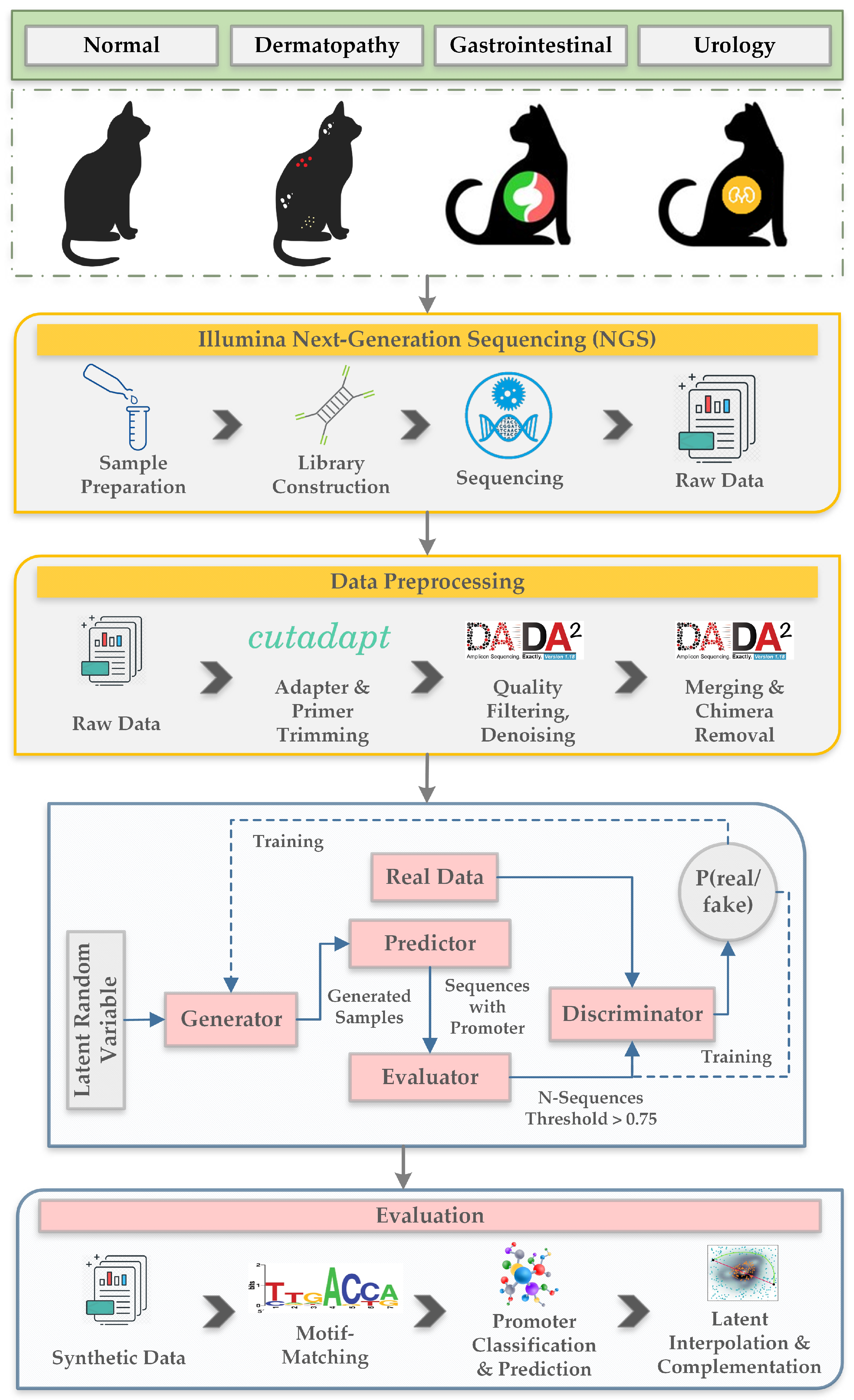
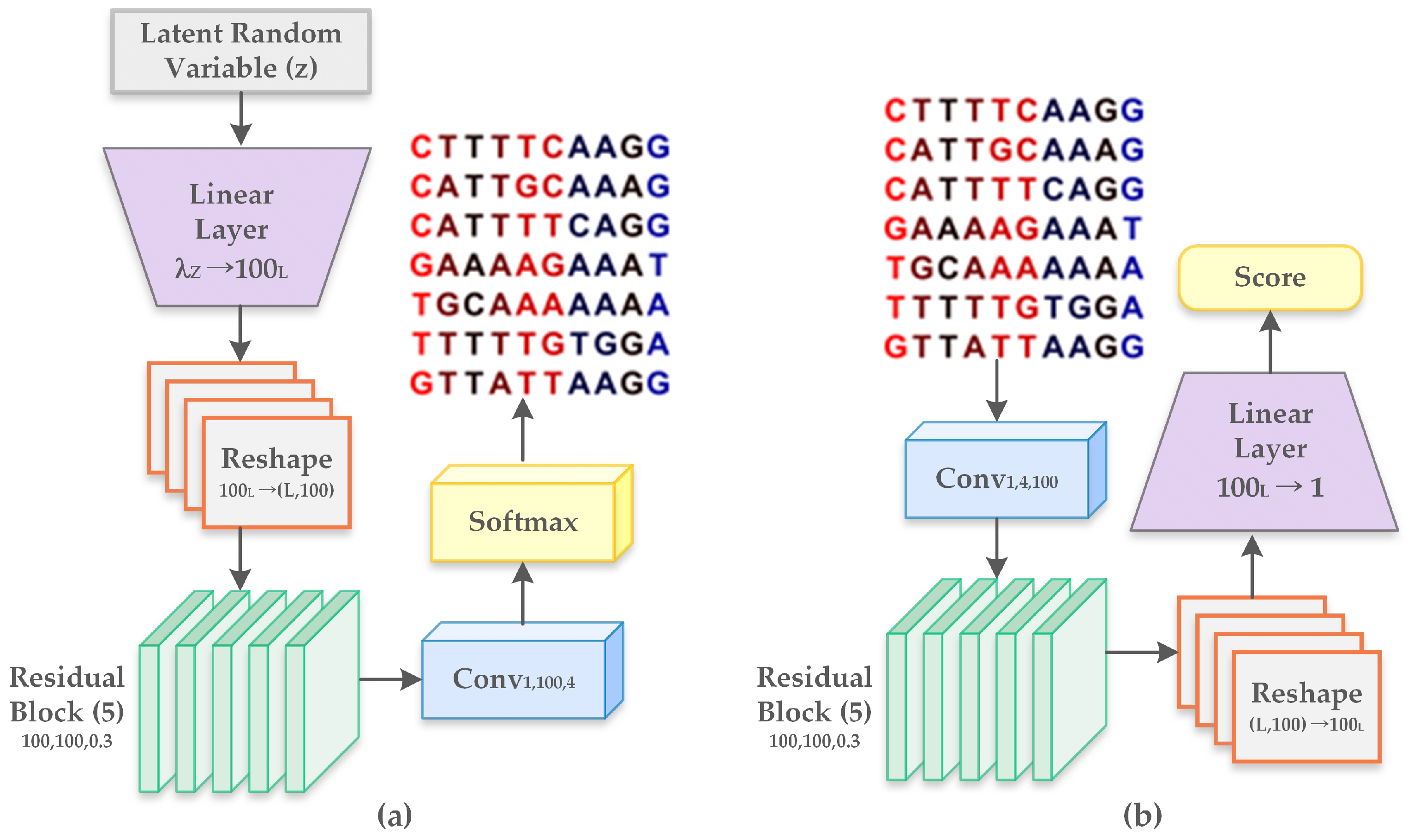
Nucleic acids are the basic units of deoxyribonucleic acid (DNA) sequencing. Every organism demonstrates different DNA sequences with specific nucleotides. It reveals the genetic information carried by a particular DNA segment. Nucleic acid sequencing expresses the evolutionary changes among organisms and revolutionizes disease diagnosis in animals. This paper proposes a generative adversarial networks (GAN) model to create synthetic nucleic acid sequences of the cat genome tuned to exhibit specific desired properties. We obtained the raw sequence data from Illumina next generation sequencing. Various data preprocessing steps were performed using Cutadapt and DADA2 tools. The processed data were fed to the GAN model that was designed following the architecture of Wasserstein GAN with gradient penalty (WGAN-GP). We introduced a predictor and an evaluator in our proposed GAN model to tune the synthetic sequences to acquire certain realistic properties. The predictor was built for extracting samples with a promoter sequence, and the evaluator was built for filtering samples that scored high for motif-matching. The filtered samples were then passed to the discriminator. We evaluated our model based on multiple metrics and demonstrated outputs for latent interpolation, latent complementation, and motif-matching. Evaluation results showed our proposed GAN model achieved 93.7% correlation with the original data and produced significant outcomes as compared to existing models for sequence generation.
Keywords: synthetic genome; generative adversarial networks; nucleic acid sequences; WGAN-GP; cat genome; promoter prediction; promoter classification; motif matching synthetic genome; generative adversarial networks; nucleic acid sequences; WGAN-GP; cat genome; promoter prediction; promoter classification; motif matching