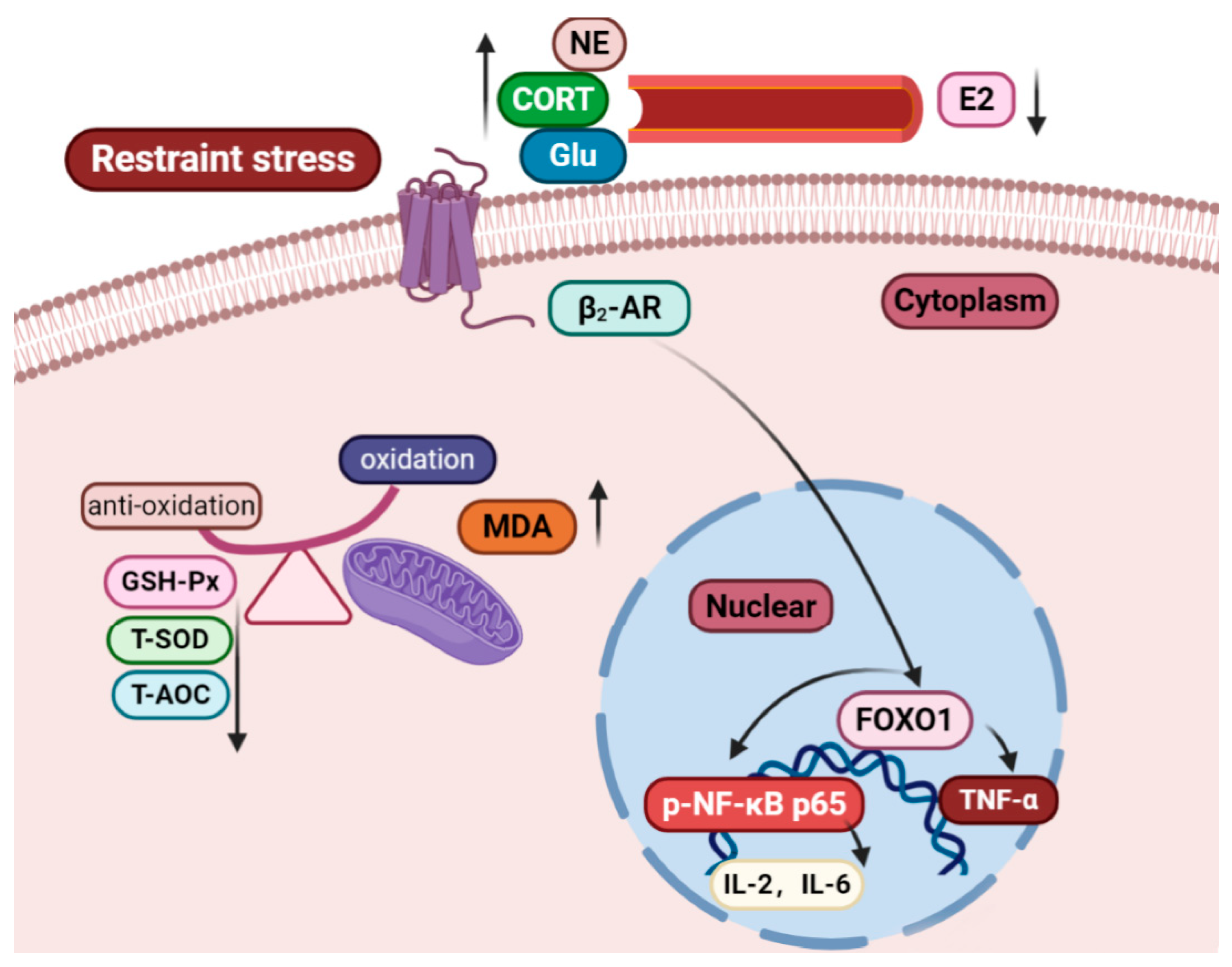
The Role of the FOXO1/β2-AR/p-NF-κB p65 Pathway in the Development of Endometrial Stromal Cells in Pregnant Mice under Restraint Stress


Abstract
Share and Cite
Lu, J.; Chen, Y.; Wang, Z.; Cao, J.; Dong, Y. The Role of the FOXO1/β2-AR/p-NF-κB p65 Pathway in the Development of Endometrial Stromal Cells in Pregnant Mice under Restraint Stress. Int. J. Mol. Sci. 2021, 22, 1478. https://doi.org/10.3390/ijms22031478
Lu J, Chen Y, Wang Z, Cao J, Dong Y. The Role of the FOXO1/β2-AR/p-NF-κB p65 Pathway in the Development of Endometrial Stromal Cells in Pregnant Mice under Restraint Stress. International Journal of Molecular Sciences. 2021; 22(3):1478. https://doi.org/10.3390/ijms22031478
Chicago/Turabian StyleLu, Jiayin, Yaoxing Chen, Zixu Wang, Jing Cao, and Yulan Dong. 2021. "The Role of the FOXO1/β2-AR/p-NF-κB p65 Pathway in the Development of Endometrial Stromal Cells in Pregnant Mice under Restraint Stress" International Journal of Molecular Sciences 22, no. 3: 1478. https://doi.org/10.3390/ijms22031478
APA StyleLu, J., Chen, Y., Wang, Z., Cao, J., & Dong, Y. (2021). The Role of the FOXO1/β2-AR/p-NF-κB p65 Pathway in the Development of Endometrial Stromal Cells in Pregnant Mice under Restraint Stress. International Journal of Molecular Sciences, 22(3), 1478. https://doi.org/10.3390/ijms22031478