Review

ROS-Activated Ion Channels in Plants: Biophysical Characteristics, Physiological Functions and Molecular Nature

by
Vadim Demidchik
1,2,3
1
Department of Horticulture, School of Food Science and Engineering, Foshan University, Foshan 528000, China
2
Department of Plant Cell Biology and Bioengineering, Biological Faculty, Belarusian State University, 4 Independence Avenue, 220030 Minsk, Belarus
3
Russian Academy of Sciences, Komarov Botanical Institute, 2 Professora Popova Street, 197376 St. Petersburg, Russia
Int. J. Mol. Sci. 2018, 19(4), 1263; https://doi.org/10.3390/ijms19041263
Submission received: 3 December 2017 / Revised: 2 April 2018 / Accepted: 3 April 2018 / Published: 23 April 2018
(This article belongs to the Special Issue Plasma-Membrane Transport)

Abstract

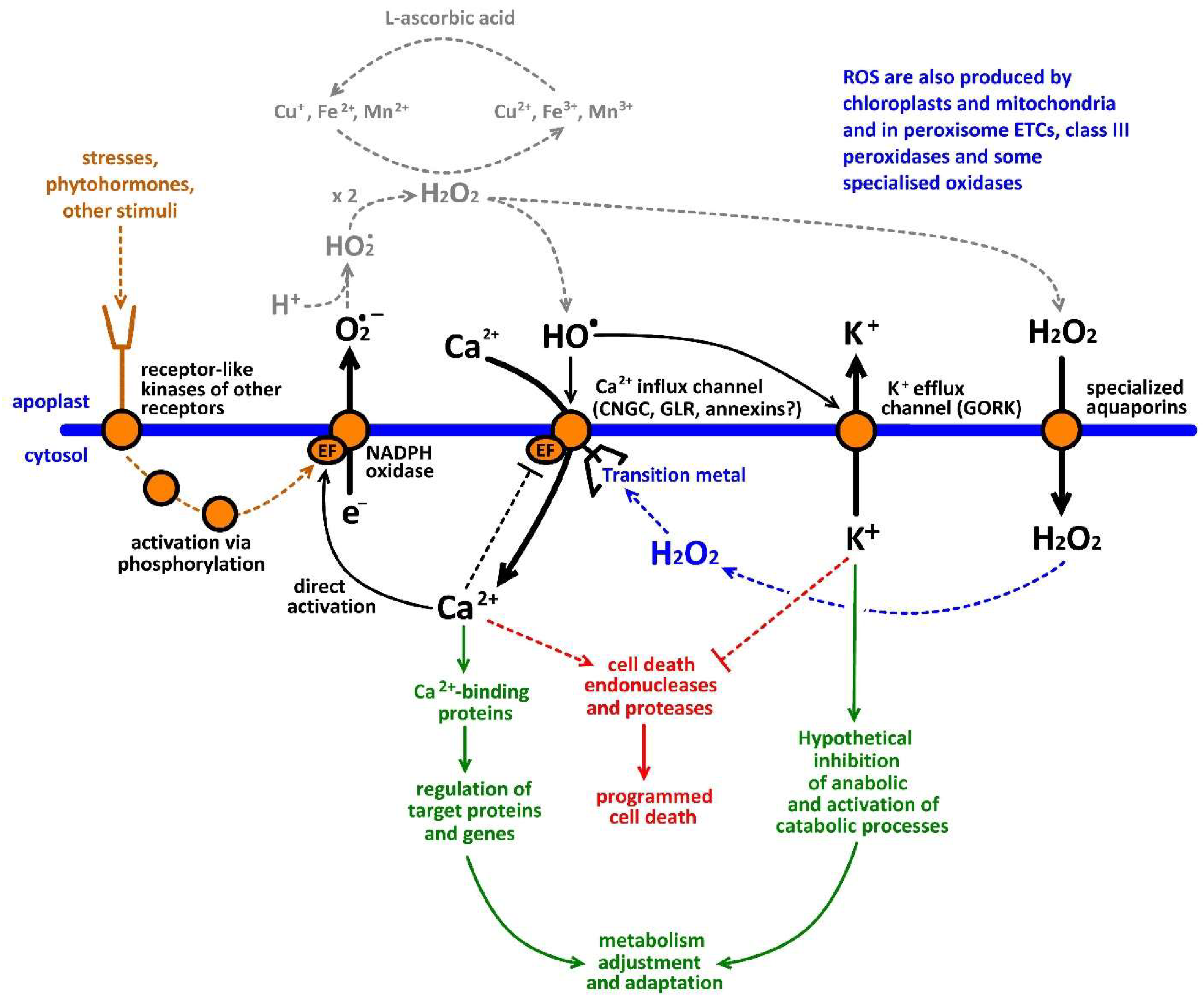
Ion channels activated by reactive oxygen species (ROS) have been found in the plasma membrane of charophyte Nitella flixilis, dicotyledon Arabidopsis thaliana, Pyrus pyrifolia and Pisum sativum, and the monocotyledon Lilium longiflorum. Their activities have been reported in charophyte giant internodes, root trichoblasts and atrichoblasts, pollen tubes, and guard cells. Hydrogen peroxide and hydroxyl radicals are major activating species for these channels. Plant ROS-activated ion channels include inwardly-rectifying, outwardly-rectifying, and voltage-independent groups. The inwardly-rectifying ROS-activated ion channels mediate Ca2+-influx for growth and development in roots and pollen tubes. The outwardly-rectifying group facilitates K+ efflux for the regulation of osmotic pressure in guard cells, induction of programmed cell death, and autophagy in roots. The voltage-independent group mediates both Ca2+ influx and K+ efflux. Most studies suggest that ROS-activated channels are non-selective cation channels. Single-channel studies revealed activation of 14.5-pS Ca2+ influx and 16-pS K+ efflux unitary conductances in response to ROS. The molecular nature of ROS-activated Ca2+ influx channels remains poorly understood, although annexins and cyclic nucleotide-gated channels have been proposed for this role. The ROS-activated K+ channels have recently been identified as products of Stellar K+ Outward Rectifier (SKOR) and Guard cell Outwardly Rectifying K+ channel (GORK) genes.
Keywords: reactive oxygen species; ROS; ion channels; calcium signaling; potassium ions; electrolyte leakage; copper ions; hydroxyl radicals; plant growth regulation; plant stress physiology reactive oxygen species; ROS; ion channels; calcium signaling; potassium ions; electrolyte leakage; copper ions; hydroxyl radicals; plant growth regulation; plant stress physiology