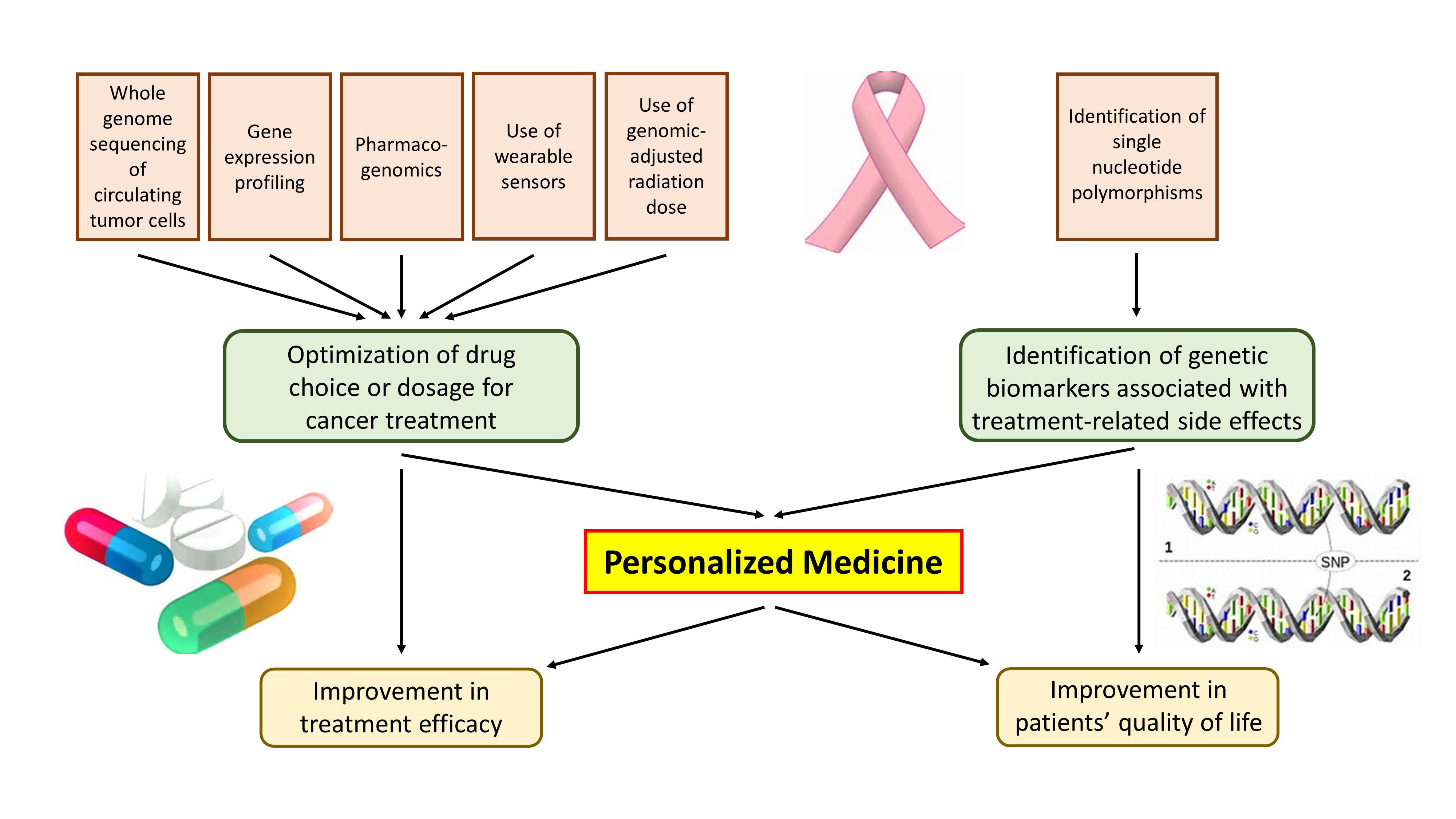
Novel Strategies on Personalized Medicine for Breast Cancer Treatment: An Update


Abstract
1. Introduction
2. Side Effects of Current Cancer Therapies Reduce the Quality of Life (QOL) of Breast Cancer Patients and Survivors
2.1. Premature Menopause or Chemotherapy-Induced Menopause (CIM)
2.2. Chemotherapy-Induced Peripheral Neuropathy (CIPN)
2.3. Cognitive Dysfunction
2.4. Depression
2.5. Pain
3. Recommended Strategies of Personalized Medicine Development in Improving the Efficacy of Chemotherapy
3.1. Use of Gene Expression Profiling Techniques in the Optimization of Drug Choice for Cancer Treatment
3.2. Monitoring of Circulating Tumor Cells
3.3. Use of Pharmacogenomics in Predicting Response to Chemotherapeutic Drugs
3.4. Use of MicroRNA in Triggering Drug Release
3.5. Use of Biomedical Engineering Tools in Intervention Design
3.6. The Use of Genomic-Adjusted Radiation Dose (GARD) in Optimizing Radiation Dose in Radiotherapy
4. Recommended Strategies of Personalized Medicine Development in Improving the QOL of Patients Undergoing Chemotherapy
4.1. Targeting Premature Menopause and CIM
4.2. Targeting CIPN
4.3. Targeting Cognitive Dysfunction
4.4. Targeting Depressive Symptoms
4.5. Targeting Pain
4.6. Additional Targets for Personalized Therapies
5. Conclusions
Acknowledgments
Author Contributions
Conflicts of Interest
References
- Globocan 2012: Estimated Cancer Incidence, Mortality and Prevalence Worldwide in 2012. Available online: http://globocan.iarc.fr/Pages/fact_sheets_population.aspx (accessed on 22 September 2017).
- Inic, Z.; Zegarac, M.; Inic, M.; Markovic, I.; Kozomara, Z.; Djurisic, I.; Inic, I.; Pupic, G.; Jancic, S. Difference between Luminal A and Luminal B Subtypes According to Ki-67, Tumor Size, and Progesterone Receptor Negativity Providing Prognostic Information. Clin. Med. Insights Oncol. 2014, 8, 107–111. [Google Scholar] [CrossRef] [Scilit] [PubMed]
- Munagala, R.; Aqil, F.; Gupta, R.C. Promising molecular targeted therapies in breast cancer. Indian J. Pharmacol. 2011, 43, 236–245. [Google Scholar] [CrossRef] [Scilit] [PubMed]
- Masoud, V.; Pages, G. Targeted therapies in breast cancer: New challenges to fight against resistance. World J. Clin. Oncol. 2017, 8, 120–134. [Google Scholar] [CrossRef] [Scilit] [PubMed]
- Wallington, M.; Saxon, E.B.; Bomb, M.; Smittenaar, R.; Wickenden, M.; McPhail, S.; Rashbass, J.; Chao, D.; Dewar, J.; Talbot, D.; et al. 30-day mortality after systemic anticancer treatment for breast and lung cancer in England: A population-based, observational study. Lancet Oncol. 2016, 17, 1203–1216. [Google Scholar] [CrossRef] [Scilit]
- Spencer, K.; Morris, E.; Dugdale, E.; Newsham, A.; Sebag-Montefiore, D.; Turner, R.; Hall, G.; Crellin, A. 30 day mortality in adult palliative radiotherapy—A retrospective population based study of 14,972 treatment episodes. Radiother. Oncol. 2015, 115, 264–271. [Google Scholar] [CrossRef] [Scilit] [PubMed]
- Rossi, A.; Torri, V.; Garassino, M.C.; Porcu, L.; Galetta, D. The impact of personalized medicine on survival: Comparisons of results in metastatic breast, colorectal and non-small-cell lung cancers. Cancer Treat. Rev. 2014, 40, 485–494. [Google Scholar] [CrossRef] [Scilit] [PubMed]
- Dey, N.; Williams, C.; Leyland-Jones, B.; De, P. Mutation matters in precision medicine: A future to believe in. Cancer Treat. Rev. 2017, 55, 136–149. [Google Scholar] [CrossRef] [Scilit] [PubMed]
- Smith, B.; Agarwal, P.; Bhowmick, N.A. MicroRNA applications for prostate, ovarian and breast cancer in the era of precision medicine. Endocr.-Relat. Cancer 2017, 24, R157–R172. [Google Scholar] [CrossRef] [Scilit] [PubMed]
- Anastasiadi, Z.; Lianos, G.D.; Ignatiadou, E.; Harissis, H.V.; Mitsis, M. Breast cancer in young women: An overview. Updates Surg. 2017, 69, 313–317. [Google Scholar] [CrossRef] [Scilit] [PubMed]
- McVeigh, T.P.; Kerin, M.J. Clinical use of the Oncotype DX genomic test to guide treatment decisions for patients with invasive breast cancer. Breast Cancer (Dove Med. Press) 2017, 9, 393–400. [Google Scholar] [CrossRef] [Scilit] [PubMed]
- Lheureux, S.; Denoyelle, C.; Ohashi, P.S.; De Bono, J.S.; Mottaghy, F.M. Molecularly targeted therapies in cancer: A guide for the nuclear medicine physician. Eur. J. Nucl. Med. Mol. Imaging 2017, 44, 41–54. [Google Scholar] [CrossRef] [Scilit] [PubMed]
- Alwi, Z.B. The Use of SNPs in Pharmacogenomics Studies. Malays. J. Med. Sci. 2005, 12, 4–12. [Google Scholar] [PubMed]
- Bettaieb, A.; Paul, C.; Plenchette, S.; Shan, J.; Chouchane, L.; Ghiringhelli, F. Precision medicine in breast cancer: Reality or utopia? J. Transl. Med. 2017, 15, 139. [Google Scholar] [CrossRef] [Scilit] [PubMed]
- Bernier, J. Precision medicine for early breast cancer radiotherapy: Opening up new horizons? Crit. Rev. Oncol. Hematol. 2017, 113, 79–82. [Google Scholar] [CrossRef] [Scilit] [PubMed]
- Talens, F.; Jalving, M.; Gietema, J.A.; van Vugt, M.A. Therapeutic targeting and patient selection for cancers with homologous recombination defects. Expert Opin. Drug Discov. 2017, 12, 565–581. [Google Scholar] [CrossRef] [Scilit] [PubMed]
- Bhattacharya, P.; Abderrahman, B.; Jordan, V.C. Opportunities and challenges of long term anti-estrogenic adjuvant therapy: Treatment forever or intermittently? Expert Rev. Anticancer Ther. 2017, 17, 297–310. [Google Scholar] [CrossRef] [Scilit] [PubMed]
- Kayl, A.E.; Meyers, C.A. Side-effects of chemotherapy and quality of life in ovarian and breast cancer patients. Curr. Opin. Obstet. Gynecol. 2006, 18, 24–28. [Google Scholar] [CrossRef] [Scilit] [PubMed]
- So, W.K.W.; Chow, K.M.; Chan, H.Y.L.; Choi, K.C.; Wan, R.W.M.; Mak, S.S.S.; Chan, C.W.H. Quality of life and most prevalent unmet needs of Chinese breast cancer survivors at one year after cancer treatment. Eur. J. Oncol. Nurs. 2014, 18, 323–328. [Google Scholar] [CrossRef] [Scilit] [PubMed]
- Sullivan, C.W.; Leutwyler, H.; Dunn, L.B.; Cooper, B.A.; Paul, S.M.; Levine, J.D.; Hammer, M.; Conley, Y.P.; Miaskowski, C.A. Stability of Symptom Clusters in Patients with Breast Cancer Receiving Chemotherapy. J. Pain Symptom Manag. 2017. [Google Scholar] [CrossRef] [Scilit] [PubMed]
- Klemp, J.R.; Myers, J.S.; Fabian, C.J.; Kimler, B.F.; Khan, Q.J.; Sereika, S.M.; Stanton, A.L. Cognitive functioning and quality of life following chemotherapy in pre-and peri-menopausal women with breast cancer. Support. Care Cancer 2017, 1–9. [Google Scholar] [CrossRef] [Scilit] [PubMed]
- Oh, H.; Seo, Y.; Jeong, H.; Seo, W. The identification of multiple symptom clusters and their effects on functional performance in cancer patients. J. Clin. Nurs. 2012, 21, 2832–2842. [Google Scholar] [CrossRef] [Scilit] [PubMed]
- So, W.K.W.; Leung, D.Y.P.; Ho, S.S.M.; Lai, E.T.L.; Sit, J.W.H.; Chan, C.W.H. Associations between social support, prevalent symptoms and health-related quality of life in Chinese women undergoing treatment for breast cancer: A cross-sectional study using structural equation modelling. Eur. J. Oncol. Nurs. 2013, 17, 442–448. [Google Scholar] [CrossRef] [Scilit] [PubMed]
- Rosenberg, S.M.; Partridge, A.H. Premature menopause in young breast cancer: Effects on quality of life and treatment interventions. J. Thorac. Dis. 2013, 5, S55–S61. [Google Scholar] [CrossRef] [Scilit] [PubMed]
- Dohou, J.; Mouret-Reynier, M.A.; Kwiatkowski, F.; Arbre, M.; Herviou, P.; Pouget, M.; Abrial, C.; Penault-Llorca, F. A retrospective study on the onset of menopause after chemotherapy: Analysis of data extracted from the jean perrin comprehensive cancer center database concerning 345 young breast cancer patients diagnosed between 1994 and 2012. Oncology 2017, 92, 255–263. [Google Scholar] [CrossRef] [Scilit] [PubMed]
- Archer, D.F. Premature menopause increases cardiovascular risk. Climacteric 2009, 12, 26–31. [Google Scholar] [CrossRef] [Scilit] [PubMed]
- Myrehaug, S.; Pintilie, M.; Tsang, R.; Mackenzie, R.; Crump, M.; Chen, Z.; Sun, A.; Hodgson, D.C. Cardiac morbidity following modern treatment for Hodgkin lymphoma: Supra-additive cardiotoxicity of doxorubicin and radiation therapy. Leuk. Lymphoma 2008, 49, 1486–1493. [Google Scholar] [CrossRef] [Scilit] [PubMed]
- Harris, S.R. Differentiating the causes of spontaneous rib fracture after breast cancer. Clin. Breast Cancer 2016, 16, 431–436. [Google Scholar] [CrossRef] [Scilit] [PubMed]
- Knobf, M.T.; Jeon, S.; Smith, B.; Harris, L.; Thompson, S.; Stacy, M.R.; Insogna, K.; Sinusas, A.J. The Yale Fitness Intervention Trial in female cancer survivors: Cardiovascular and physiological outcomes. Heart Lung 2017, 46, 375–381. [Google Scholar] [CrossRef] [Scilit] [PubMed]
- Nourmoussavi, M.; Pansegrau, G.; Popesku, J.; Hammond, G.L.; Kwon, J.S.; Carey, M.S. Ovarian ablation for premenopausal breast cancer: A review of treatment considerations and the impact of premature menopause. Cancer Treat. Rev. 2017, 55, 26–35. [Google Scholar] [CrossRef] [Scilit] [PubMed]
- Winters-Stone, K.M.; Hilton, C.; Luoh, S.W.; Jacobs, P.; Faithfull, S.; Horak, F.B. Comparison of physical function and falls among women with persistent symptoms of chemotherapy-induced peripheral neuropathy. J. Clin. Oncol. 2016, 34, 130. [Google Scholar] [CrossRef] [Scilit]
- Winters-Stone, K.M.; Horak, F.; Jacobs, P.G.; Trubowitz, P.; Dieckmann, N.F.; Stoyles, S.; Faithfull, S. Falls, functioning, and disability among women with persistent symptoms of chemotherapy-induced peripheral neuropathy. J. Clin. Oncol. 2017, 35, 2604–2612. [Google Scholar] [CrossRef] [Scilit] [PubMed]
- Schraa, S.J.; Frerichs, K.A.; Agterof, M.J.; Hunting, J.C.B.; Los, M.; de Jong, P.C. Relative dose intensity as a proxy measure of quality and prognosis in adjuvant chemotherapy for breast cancer in daily clinical practice. Eur. J. Cancer 2017, 79, 152–157. [Google Scholar] [CrossRef] [Scilit] [PubMed]
- Cheng, K.K.F.; Wong, E.M.C.; Ling, W.M.; Chan, C.W.H.; Thompson, D.R. Measuring the symptom experience of Chinese cancer patients: A validation of the Chinese Version of the Memorial Symptom Assessment Scale. J. Pain Symptom Manag. 2009, 37, 44–57. [Google Scholar] [CrossRef] [Scilit] [PubMed]
- Libert, Y.; Dubruille, S.; Borghgraef, C.; Etienne, A.M.; Merckaert, I.; Paesmans, M.; Reynaert, C.; Roos, M.; Slachmuylder, J.L.; Vandenbossche, S.; et al. Vulnerabilities in older patients when cancer treatment is initiated: Does a cognitive impairment impact the two-year survival? PLoS ONE 2016, 11, e0159734. [Google Scholar] [CrossRef] [Scilit] [PubMed]
- Ahles, T.A.; Saykin, A.J. Candidate mechanisms for chemotherapy-induced cognitive changes. Nat. Rev. Cancer 2007, 7, 192–201. [Google Scholar] [CrossRef] [Scilit] [PubMed]
- Purkayastha, D.; Venkateswaran, C.; Nayar, K.; Unnikrishnan, U.G. Prevalence of depression in breast cancer patients and its association with their quality of life: A cross-sectional observational study. Indian J. Palliat. Care 2017, 23, 268–273. [Google Scholar] [CrossRef] [Scilit] [PubMed]
- Ho, S.S.M.; So, W.K.W.; Leung, D.Y.P.; Lai, E.T.L.; Chan, C.W.H. Anxiety, depression and quality of life in Chinese women with breast cancer during and after treatment: A comparative evaluation. Eur. J. Oncol. Nurs. 2013, 17, 877–882. [Google Scholar] [CrossRef] [Scilit] [PubMed]
- Boyette-Davis, J.A.; Walters, E.T.; Dougherty, P.M. Mechanisms involved in the development of chemotherapy-induced neuropathy. Pain Manag. 2015, 5, 285–296. [Google Scholar] [CrossRef] [Scilit] [PubMed]
- Leysen, L.; Beckwée, D.; Nijs, J.; Pas, R.; Bilterys, T.; Vermeir, S.; Adriaenssens, N. Risk factors of pain in breast cancer survivors: A systematic review and meta-analysis. Support. Care Cancer 2017. [Google Scholar] [CrossRef] [Scilit] [PubMed]
- Crombag, M.R.; Joerger, M.; Thürlimann, B.; Schellens, J.H.; Beijnen, J.H.; Huitema, A.D. Pharmacokinetics of selected anticancer drugs in elderly cancer patients: Focus on breast cancer. Cancers (Basel) 2016, 8, 6. [Google Scholar] [CrossRef] [Scilit] [PubMed]
- Ashdown, M.L.; Robinson, A.P.; Yatomi-Clarke, S.L.; Ashdown, M.L.; Allison, A.; Abbott, D.; Markovic, S.N.; Coventry, B.J. Chemotherapy for late-stage cancer patients: Meta-analysis of complete response rates. F1000Res 2015, 4, 232. [Google Scholar] [CrossRef] [Scilit] [PubMed]
- De Bruin, E.C.; Whiteley, J.L.; Corcoran, C.; Kirk, P.M.; Fox, J.C.; Armisen, J.; Lindemann, J.P.O.; Schiavon, G.; Ambrose, H.J.; Kohlmann, A. Accurate detection of low prevalence AKT1 E17K mutation in tissue or plasma from advanced cancer patients. PLoS ONE 2017, 12, e0175779. [Google Scholar] [CrossRef] [Scilit] [PubMed]
- Fruman, D.A.; Rommel, C. PI3K and cancer: Lessons, challenges and opportunities. Nat. Rev. Drug Discov. 2014, 13, 140–156. [Google Scholar] [CrossRef] [Scilit] [PubMed]
- Xu, B.; Krie, A.; De, P.; Williams, C.; Elsey, R.; Klein, J.; Leyland-Jones, B. Utilizing tumor and plasma liquid biopsy in treatment decision making for an estrogen receptor-positive advanced breast cancer patient. Cureus 2017, 9, e1408. [Google Scholar] [CrossRef] [Scilit] [PubMed]
- Rudolph, M.; Anzeneder, T.; Schulz, A.; Beckmann, G.; Byrne, A.T.; Jeffers, M.; Pena, C.; Politz, O.; Köchert, K.; Vonk, R.; et al. AKT1 (E17K) mutation profiling in breast cancer: Prevalence, concurrent oncogenic alterations, and blood-based detection. BMC Cancer 2016, 16, 622. [Google Scholar] [CrossRef] [Scilit] [PubMed]
- Andersen, J.N.; Sathyanarayanan, S.; Di Bacco, A.; Chi, A.; Zhang, T.; Chen, A.H.; Dolinski, B.; Kraus, M.; Roberts, B.; Arthur, W.; et al. Pathway-based identification of biomarkers for targeted therapeutics: Personalized oncology with PI3K pathway inhibitors. Sci. Transl. Med. 2010, 2, 43ra55. [Google Scholar] [CrossRef] [Scilit] [PubMed]
- Matikas, A.; Foukakis, T.; Bergh, J. Tackling endocrine resistance in ER-positive HER2-negative advanced breast cancer: A tale of imprecision medicine. Crit. Rev. Oncol. Hematol. 2017, 114, 91–101. [Google Scholar] [CrossRef] [Scilit] [PubMed]
- Turnbull, A.K.; Arthur, L.M.; Renshaw, L.; Larionov, A.A.; Kay, C.; Dunbier, A.K.; Thomas, J.S.; Dowsett, M.; Sims, A.H.; Dixon, J.M. Accurate prediction and validation of response to endocrine therapy in breast cancer. J. Clin. Oncol. 2015, 33, 2270–2278. [Google Scholar] [CrossRef] [Scilit] [PubMed]
- Smith, I.; Procter, M.; Gelber, R.D.; Guillaume, S.; Feyereislova, A.; Dowsett, M.; Goldhirsch, A.; Untch, M.; Mariani, G.; Baselga, J.; et al. HERA study team. 2-year follow-up of trastuzumab after adjuvant chemotherapy in HER2-positive breast cancer: A randomised controlled trial. Lancet 2007, 369, 29–36. [Google Scholar] [CrossRef] [Scilit]
- Timmer, M.; Werner, J.M.; Röhn, G.; Ortmann, M.; Blau, T.; Cramer, C.; Stavrinou, P.; Krischek, B.; Mallman, P.; Goldbrunner, R. Discordance and conversion rates of progesterone-, estrogen-, and her2/neu-receptor status in primary breast cancer and brain metastasis mainly triggered by hormone therapy. Anticancer Res. 2017, 37, 4859–4865. [Google Scholar] [PubMed]
- Shachar, S.S.; Fried, G.; Drumea, K.; Shafran, N.; Bar-Sela, G. Physicians’ considerations for repeat biopsy in patients with recurrent metastatic breast cancer. Clin. Breast Cancer 2016, 16, e43–e48. [Google Scholar] [CrossRef] [Scilit] [PubMed]
- Chen, W.; Li, X.; Zhu, L.; Liu, J.; Xu, W.; Wang, P. Preclinical and clinical applications of specific molecular imaging for HER2-positive breast cancer. Cancer Biol. Med. 2017, 14, 271–280. [Google Scholar] [CrossRef] [Scilit] [PubMed]
- Nie, H.; Shu, H.; Vartak, R.; Milstein, A.C.; Mo, Y.; Hu, X.; Fang, H.; Shen, L.; Ding, Z.; Lu, J.; et al. Mitochondrial common deletion, a potential biomarker for cancer occurrence, is selected against in cancer background: A meta-analysis of 38 studies. PLoS ONE 2013, 8, e67953. [Google Scholar] [CrossRef] [Scilit] [PubMed]
- Shen, L.; Fang, H.; Chen, T.; He, J.; Zhang, M.; Wei, X.; Xin, Y.; Jiang, Y.; Ding, Z.; Ji, J.; et al. Evaluating mitochondrial DNA in cancer occurrence and development. Ann. N. Y. Acad. Sci. 2010, 1201, 26–33. [Google Scholar] [CrossRef] [Scilit] [PubMed]
- Singh, K.K.; Russell, J.; Sigala, B.; Zhang, Y.; Williams, J.; Keshav, K.F. Mitochondrial DNA determines the cellular response to cancer therapeutic agents. Oncogene 1999, 18, 6641–6646. [Google Scholar] [CrossRef] [Scilit] [PubMed]
- Guerra, F.; Perrone, A.M.; Kurelac, I.; Santini, D.; Ceccarelli, C.; Cricca, M.; Zamagni, C.; De Iaco, P.; Gasparre, G. Mitochondrial DNA mutation in serous ovarian cancer: Implications for mitochondria-coded genes in chemoresistance. J. Clin. Oncol. 2012, 30, e373–e378. [Google Scholar] [CrossRef] [Scilit] [PubMed]
- Hosokawa, Y.; Masaki, N.; Takei, S.; Horikawa, M.; Matsushita, S.; Sugiyama, E.; Ogura, H.; Shiiya, N.; Setou, M. Recurrent triple-negative breast cancer (TNBC) tissues contain a higher amount of phosphatidylcholine (32:1) than non-recurrent TNBC tissues. PLoS ONE 2017, 12, e0183724. [Google Scholar] [CrossRef] [Scilit] [PubMed]
- Secreto, G.; Muti, P.; Sant, M.; Meneghini, E.; Krogh, V. Medical ovariectomy in menopausal breast cancer patients with high testosterone levels. Endocr. Relat. Cancer 2017, 24, C21–C29. [Google Scholar] [CrossRef] [Scilit] [PubMed]
- Pachmann, K.; Camara, O.; Kroll, T.; Gajda, M.; Gellner, A.K.; Wotschadlo, J.; Runnebaum, I.B. Efficacy control of therapy using circulating epithelial tumor cells (CETC) as “liquid biopsy”: Trastuzumab in HER2/neu-positive breast carcinoma. J. Cancer Res. Clin. Oncol. 2011, 137, 1317–1327. [Google Scholar] [CrossRef] [Scilit] [PubMed]
- Gulbahce, N.; Magbanua, M.J.M.; Chin, R.; Agarwal, M.R.; Luo, X.; Liu, J.; Hayden, D.M.; Mao, Q.; Ciotlos, S.; Li, Z.; et al. Quantitative whole genome sequencing of circulating tumor cells enables personalized combination therapy of metastatic cancer. Cancer Res. 2017, 77, 4530–4541. [Google Scholar] [CrossRef] [Scilit] [PubMed]
- Wheler, J.J.; Atkins, J.T.; Janku, F.; Moulder, S.L.; Stephens, P.J.; Yelensky, R.; Valero, V.; Miller, V.; Kurzrock, R.; Meric-Bernstam, F. Presence of both alterations in FGFR/FGF and PI3K/AKT/mTOR confer improved outcomes for patients with metastatic breast cancer treated with PI3K/AKT/mTOR inhibitors. Oncoscience 2016, 3, 164–172. [Google Scholar] [CrossRef] [Scilit] [PubMed]
- De Souza, J.A.; Olopadem, O.I. CYP2D6 genotyping and tamoxifen: An unfinished story in the quest for personalized medicine. Semin. Oncol. 2011, 38, 263–273. [Google Scholar] [CrossRef] [Scilit] [PubMed]
- Rae, J.M.; Sikora, M.J.; Henry, N.L.; Li, L.; Kim, S.; Oesterreich, S.; Skaar, T.C.; Nguyen, A.T.; Desta, Z.; Storniolo, A.M.; et al. COBRA investigators. Cytochrome P450 2D6 activity predicts discontinuation of tamoxifen therapy in breast cancer patients. Pharm. J. 2009, 9, 258–264. [Google Scholar] [CrossRef] [Scilit]
- Marcath, A.L.; Deal, A.M.; Van Wieren, E.; Danko, W.; Walko, C.M.; Ibrahim, J.G.; Weck, K.E.; Jones, D.R.; Desta, Z.; McLeod, H.L.; et al. Comprehensive assessment of cytochromes P450 and transporter genetics with endoxifen concentration during tamoxifen treatment. Pharm. Genom. 2017, 27, 402–409. [Google Scholar] [CrossRef] [Scilit] [PubMed]
- Macfarlane, L.A.; Murphy, P.R. MicroRNA: Biogenesis, function and role in cancer. Curr. Genom. 2010, 11, 537–561. [Google Scholar] [CrossRef] [Scilit] [PubMed]
- Yang, F.; Zhang, T.T.; Li, S.S.; Song, P.; Zhang, K.; Guan, Q.Y.; Kang, B.; Xu, J.J.; Chen, H.Y. Endogenous microRNA-triggered and real-time monitored drug release via cascaded energy transfer payloads. Anal. Chem. 2017, 89, 10239–10247. [Google Scholar] [CrossRef] [Scilit] [PubMed]
- Kleinhans, R.; Brischwein, M.; Wang, P.; Becker, B.; Demmel, F.; Schwarzenberger, T.; Zottmann, M.; Wolf, P.; Niendorf, A.; Wolf, B. Sensor-based cell and tissue screening for personalized cancer chemotherapy. Med. Biol. Eng. Comput. 2012, 50, 117–126. [Google Scholar] [CrossRef] [Scilit] [PubMed]
- Zu, X.L.; Guppy, M. Cancer metabolism: Facts, fantasy, and fiction. Biochem. Biophys. Res. Commun. 2004, 313, 459–465. [Google Scholar] [CrossRef] [Scilit] [PubMed]
- Michard, F. A sneak peek into digital innovations and wearable sensors for cardiac monitoring. J. Clin. Monit. Comput. 2017, 31, 253–259. [Google Scholar] [CrossRef] [Scilit] [PubMed]
- Nass, N.; Sel, S.; Ignatov, A.; Roessner, A.; Kalinski, T. Oxidative stress and glyoxalase I activity mediate dicarbonyl toxicity in MCF-7 mamma carcinoma cells and a tamoxifen resistant derivative. Biochim. Biophys. Acta 2016, 1860, 1272–1280. [Google Scholar] [CrossRef] [Scilit] [PubMed]
- Naha, P.C.; Lau, K.C.; Hsu, J.C.; Hajfathalian, M.; Mian, S.; Chhour, P.; Uppuluri, L.; McDonald, E.S.; Maidment, A.D.; Cormode, D.P. Gold silver alloy nanoparticles (GSAN): An imaging probe for breast cancer screening with dual-energy mammography or computed tomography. Nanoscale 2016, 8, 13740–13754. [Google Scholar] [CrossRef] [Scilit] [PubMed]
- Scott, J.G.; Berglund, A.; Schell, M.J.; Mihaylov, I.; Fulp, W.J.; Yue, B.; Welsh, E.; Caudell, J.J.; Ahmed, K.; Strom, T.S.; et al. A genome-based model for adjusting radiotherapy dose (GARD): A retrospective, cohort-based study. Lancet Oncol. 2017, 18, 202–211. [Google Scholar] [CrossRef] [Scilit]
- Spratt, D.E.; Wahl, D.R.; Lawrence, T.S. Genomic-adjusted radiation dose. Lancet Oncol. 2017, 18, e127. [Google Scholar] [CrossRef] [Scilit]
- Cheng, H.; Sit, J.W.H.; Chan, C.W.H.; So, W.K.W.; Choi, K.C.; Cheng, K.K.F. Social support and quality of life among Chinese breast cancer survivors: Findings from a mixed methods study. Eur. J. Oncol. Nurs. 2013, 17, 788–796. [Google Scholar] [CrossRef] [Scilit] [PubMed]
- Okeke, T.; Anyaehie, U.; Ezenyeaku, C. Premature menopause. Ann. Med. Health Sci. Res. 2013, 3, 90–95. [Google Scholar] [CrossRef] [Scilit] [PubMed]
- Abrahamson, P.E.; Tworoger, S.S.; Aiello, E.J.; Bernstein, L.; Ulrich, C.M.; Gilliland, F.D.; Stanczyk, F.Z.; Baumgartner, R.; Baumgartner, K.; et al. Associations between the CYP17, CYPIB1, COMT and SHBG polymorphisms and serum sex hormones in post-menopausal breast cancer survivors. Breast Cancer Res. Treat. 2007, 105, 45–54. [Google Scholar] [CrossRef] [Scilit] [PubMed]
- Riancho, J.A.; Valero, C.; Zarrabeitia, M.T.; García-Unzueta, M.T.; Amado, J.A.; González-Macías, J. Genetic polymorphisms are associated with serum levels of sex hormone binding globulin in postmenopausal women. BMC Med. Genet. 2008, 9, 112. [Google Scholar] [CrossRef] [Scilit] [PubMed]
- Cordts, E.B.; Santos, A.A.; Peluso, C.; Bianco, B.; Barbosa, C.P.; Christofolini, D.M. Risk of premature ovarian failure is associated to the PvuII polymorphism at estrogen receptor gene ESR1. J. Assist. Reprod. Genet. 2012, 29, 1421–1425. [Google Scholar] [CrossRef] [Scilit] [PubMed]
- Swain, S.M.; Jeong, J.H.; Wolmark, N. Amenorrhea from breast cancer therapy—Not a matter of dose. N. Engl. J. Med. 2010, 363, 2268–2270. [Google Scholar] [CrossRef] [Scilit] [PubMed]
- Kus, T.; Aktas, G.; Kalender, M.E.; Demiryurek, A.T.; Ulasli, M.; Oztuzcu, S.; Sevinc, A.; Kul, S.; Camci, C. Polymorphism of CYP3A4 and ABCB1 genes increase the risk of neuropathy in breast cancer patients treated with paclitaxel and docetaxel. Onco Targets Ther. 2016, 9, 5073–5080. [Google Scholar] [CrossRef] [Scilit] [PubMed]
- Sundar, R.; Jeyasekharan, A.D.; Pang, B.; Soong, R.C.; Kumarakulasinghe, N.B.; Ow, S.G.; Ho, J.; Lim, J.S.; Tan, D.S.; Wilder-Smith, E.P.; et al. Low levels of NDRG1 in nerve tissue are predictive of severe paclitaxel-induced neuropathy. PLoS ONE 2016, 11, e0164319. [Google Scholar] [CrossRef] [Scilit] [PubMed]
- Lam, S.W.; Frederiks, C.N.; van der Straaten, T.; Honkoop, A.H.; Guchelaar, H.J.; Boven, E. Genotypes of CYP2C8 and FGD4 and their association with peripheral neuropathy or early dose reduction in paclitaxel-treated breast cancer patients. Br. J. Cancer 2016, 115, 1335–1342. [Google Scholar] [CrossRef] [Scilit] [PubMed]
- Loh, K.P.; Janelsins, M.C.; Mohile, S.G.; Holmes, H.M.; Hsu, T.; Inouye, S.K.; Karuturi, M.S.; Kimmick, G.G.; Lichtman, S.M.; Magnuson, A.; et al. Chemotherapy-related cognitive impairment in older patients with cancer. J. Geriatr. Oncol. 2016, 7, 270–280. [Google Scholar] [CrossRef] [Scilit] [PubMed]
- Myers, J.S.; Koleck, T.A.; Sereika, S.M.; Conley, Y.P.; Bender, C.M. Perceived cognitive function for breast cancer survivors: Association of genetic and behaviorally related variables for inflammation. Support. Care Cancer 2017, 25, 2475–2484. [Google Scholar] [CrossRef] [Scilit] [PubMed]
- Fiorentino, L.; Rissling, M.; Liu, L.; Ancoli-Israel, S. The symptom cluster of sleep, fatigue and depressive symptoms in breast cancer patients: Severity of the problem and treatment options. Drug Discov. Today Dis. Model. 2011, 8, 167–173. [Google Scholar] [CrossRef] [Scilit] [PubMed]
- Thornton, L.M.; Andersen, B.L.; Blakely, W.P. The pain, depression, and fatigue symptom cluster in advanced breast cancer: Covariation with the hypothalamic-pituitary-adrenal axis and the sympathetic nervous system. Health Psychol. 2010, 29, 333–337. [Google Scholar] [CrossRef] [Scilit] [PubMed]
- Dooley, L.N.; Ganz, P.A.; Cole, S.W.; Crespi, C.M.; Bower, J.E. Val66Met BDNF polymorphism as a vulnerability factor for inflammation-associated depressive symptoms in women with breast cancer. J. Affect. Disord. 2016, 197, 43–50. [Google Scholar] [CrossRef] [Scilit] [PubMed]
- Smith, H.R. Depression in cancer patients: Pathogenesis, implications and treatment (Review). Oncol. Lett. 2015, 9, 1509–1514. [Google Scholar] [CrossRef] [Scilit] [PubMed]
- DiSipio, T.; Rye, S.; Newman, B.; Hayes, S. Incidence of unilateral arm lymphoedema after breast cancer: A systematic review and meta-analysis. Lancet Oncol. 2013, 14, 500–515. [Google Scholar] [CrossRef] [Scilit]
- Ryu, E.; Yim, S.Y.; Do, H.J.; Lim, J.Y.; Yang, E.J.; Shin, M.J.; Lee, S.M. Risk of secondary lymphedema in breast cancer survivors is related to serum phospholipid fatty acid desaturation. Support. Care Cancer 2016, 24, 3767–3774. [Google Scholar] [CrossRef] [Scilit] [PubMed]
- Galley, H.F.; McCormick, B.; Wilson, K.L.; Lowes, D.A.; Colvin, L.; Torsney, C. Melatonin limits paclitaxel-induced mitochondrial dysfunction in vitro and protects against paclitaxel-induced neuropathic pain in the rat. J. Pineal Res. 2017, 63. [Google Scholar] [CrossRef] [Scilit] [PubMed]
- Ozben, T. Antioxidant supplementation on cancer risk and during cancer therapy: An update. Curr. Top. Med. Chem. 2015, 15, 170–178. [Google Scholar] [CrossRef] [Scilit] [PubMed]
- D’Andrea, G.M. Use of antioxidants during chemotherapy and radiotherapy should be avoided. CA Cancer J. Clin. 2005, 55, 319–321. [Google Scholar] [CrossRef] [Scilit] [PubMed]
- Lissoni, P.; Meregalli, S.; Nosetto, L.; Barni, S.; Tancini, G.; Fossati, V.; Maestroni, G. Increased survival time in brain glioblastomas by a radioneuroendocrine strategy with radiotherapy plus melatonin compared to radiotherapy alone. Oncology 1996, 53, 43–46. [Google Scholar] [CrossRef] [Scilit] [PubMed]
- Misirlioglu, C.H.; Erkal, H.; Elgin, Y.; Ugur, I.; Altundag, K. Effect of concomitant use of pentoxifylline and alpha-tocopherol with radiotherapy on the clinical outcome of patients with stage IIIB non-small cell lung cancer: A randomized prospective clinical trial. Med. Oncol. 2006, 23, 185–189. [Google Scholar] [CrossRef] [Scilit]
- Rizvi, S.; Raza, S.T.; Ahmed, F.; Ahmad, A.; Abbas, S.; Mahdi, F. The role of vitamin e in human health and some diseases. Sultan Qaboos Univ. Med. J. 2014, 14, e157–e165. [Google Scholar] [PubMed]
- Araki, T.; Sasaki, Y.; Milbrandt, J. Increased nuclear NAD biosynthesis and SIRT1 activation prevent axonal degeneration. Science 2004, 305, 1010–1013. [Google Scholar] [CrossRef] [Scilit] [PubMed]
- Hamity, M.V.; White, S.R.; Walder, R.Y.; Schmidt, M.S.; Brenner, C.; Hammond, D.L. Nicotinamide riboside, a form of vitamin B3 and NAD+ precursor, relieves the nociceptive and aversive dimensions of paclitaxel-induced peripheral neuropathy in female rats. Pain 2017, 158, 962–972. [Google Scholar] [CrossRef] [Scilit] [PubMed]
- Wang, X.; Zhang, Z.F.; Zheng, G.H.; Wang, A.M.; Sun, C.H.; Qin, S.P.; Zhuang, J.; Lu, J.; Ma, D.F.; Zheng, Y.L. The inhibitory effects of purple sweet potato color on hepatic inflammation is associated with restoration of NAD+ levels and attenuation of NLRP3 inflammasome activation in high-fat-diet-treated mice. Molecules 2017, 22, E1315. [Google Scholar] [CrossRef] [Scilit] [PubMed]
- Makari-Judson, G.; Braun, B.; Jerry, D.J.; Mertens, W.C. Weight gain following breast cancer diagnosis: Implication and proposed mechanisms. World J. Clin. Oncol. 2014, 5, 272–282. [Google Scholar] [CrossRef] [Scilit] [PubMed]
- Sadim, M.; Xu, Y.; Selig, K.; Paulus, J.; Uthe, R.; Agarwl, S.; Dubin, I.; Oikonomopoulou, P.; Zaichenko, L.; McCandlish, S.A.; et al. A prospective evaluation of clinical and genetic predictors of weight changes in breast cancer survivors. Cancer 2017, 123, 2413–2421. [Google Scholar] [CrossRef] [Scilit] [PubMed]
- Loughney, L.; West, M.A.; Kemp, G.J.; Grocott, M.P.; Jack, S. Exercise intervention in people with cancer undergoing neoadjuvant cancer treatment and surgery: A systematic review. Eur. J. Surg. Oncol. 2016, 42, 28–38. [Google Scholar] [CrossRef] [Scilit] [PubMed]

| Breast Cancer Type | ER | HER2 | Ki-67 | PR |
|---|---|---|---|---|
| Luminal A | Positive | Negative | Low level | High level |
| Luminal B | Positive | Negative | High level | Low level |
| HER2-positive | Negative | Over-expressed | Unclear | Negative |
| Triple negative | Negative | Negative | Unclear | Negative |
© 2017 by the authors. Licensee MDPI, Basel, Switzerland. This article is an open access article distributed under the terms and conditions of the Creative Commons Attribution (CC BY) license (http://creativecommons.org/licenses/by/4.0/).
Share and Cite
Chan, C.W.H.; Law, B.M.H.; So, W.K.W.; Chow, K.M.; Waye, M.M.Y. Novel Strategies on Personalized Medicine for Breast Cancer Treatment: An Update. Int. J. Mol. Sci. 2017, 18, 2423. https://doi.org/10.3390/ijms18112423
Chan CWH, Law BMH, So WKW, Chow KM, Waye MMY. Novel Strategies on Personalized Medicine for Breast Cancer Treatment: An Update. International Journal of Molecular Sciences. 2017; 18(11):2423. https://doi.org/10.3390/ijms18112423
Chicago/Turabian StyleChan, Carmen W. H., Bernard M. H. Law, Winnie K. W. So, Ka Ming Chow, and Mary M. Y. Waye. 2017. "Novel Strategies on Personalized Medicine for Breast Cancer Treatment: An Update" International Journal of Molecular Sciences 18, no. 11: 2423. https://doi.org/10.3390/ijms18112423
APA StyleChan, C. W. H., Law, B. M. H., So, W. K. W., Chow, K. M., & Waye, M. M. Y. (2017). Novel Strategies on Personalized Medicine for Breast Cancer Treatment: An Update. International Journal of Molecular Sciences, 18(11), 2423. https://doi.org/10.3390/ijms18112423