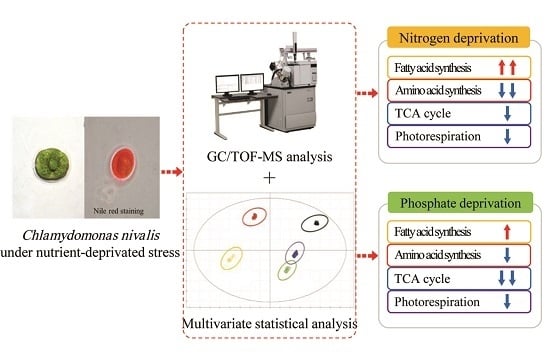
Global Metabolic Regulation of the Snow Alga Chlamydomonas nivalis in Response to Nitrate or Phosphate Deprivation by a Metabolome Profile Analysis


Abstract
Share and Cite
Lu, N.; Chen, J.-H.; Wei, D.; Chen, F.; Chen, G. Global Metabolic Regulation of the Snow Alga Chlamydomonas nivalis in Response to Nitrate or Phosphate Deprivation by a Metabolome Profile Analysis. Int. J. Mol. Sci. 2016, 17, 694. https://doi.org/10.3390/ijms17050694
Lu N, Chen J-H, Wei D, Chen F, Chen G. Global Metabolic Regulation of the Snow Alga Chlamydomonas nivalis in Response to Nitrate or Phosphate Deprivation by a Metabolome Profile Analysis. International Journal of Molecular Sciences. 2016; 17(5):694. https://doi.org/10.3390/ijms17050694
Chicago/Turabian StyleLu, Na, Jun-Hui Chen, Dong Wei, Feng Chen, and Gu Chen. 2016. "Global Metabolic Regulation of the Snow Alga Chlamydomonas nivalis in Response to Nitrate or Phosphate Deprivation by a Metabolome Profile Analysis" International Journal of Molecular Sciences 17, no. 5: 694. https://doi.org/10.3390/ijms17050694
APA StyleLu, N., Chen, J.-H., Wei, D., Chen, F., & Chen, G. (2016). Global Metabolic Regulation of the Snow Alga Chlamydomonas nivalis in Response to Nitrate or Phosphate Deprivation by a Metabolome Profile Analysis. International Journal of Molecular Sciences, 17(5), 694. https://doi.org/10.3390/ijms17050694