Review

A Proteogenomic Approach to Understanding MYC Function in Metastatic Medulloblastoma Tumors
1
Multiple Sclerosis Department, Florey Institute of Neuroscience and Mental Health, Melbourne, VIC 3052, Australia
2
Center for Cancer and Immunology Research, Children’s National Medical Center, Washington, DC 20010, USA
*
Author to whom correspondence should be addressed.
Int. J. Mol. Sci. 2016, 17(10), 1744; https://doi.org/10.3390/ijms17101744
Submission received: 1 July 2016 / Revised: 23 September 2016 / Accepted: 10 October 2016 / Published: 19 October 2016
(This article belongs to the Special Issue Advances in Proteomic Research)

Abstract

Brain tumors are the leading cause of cancer-related deaths in children, and medulloblastoma is the most prevalent malignant childhood/pediatric brain tumor. Providing effective treatment for these cancers, with minimal damage to the still-developing brain, remains one of the greatest challenges faced by clinicians. Understanding the diverse events driving tumor formation, maintenance, progression, and recurrence is necessary for identifying novel targeted therapeutics and improving survival of patients with this disease. Genomic copy number alteration data, together with clinical studies, identifies c-MYC amplification as an important risk factor associated with the most aggressive forms of medulloblastoma with marked metastatic potential. Yet despite this, very little is known regarding the impact of such genomic abnormalities upon the functional biology of the tumor cell. We discuss here how recent advances in quantitative proteomic techniques are now providing new insights into the functional biology of these aggressive tumors, as illustrated by the use of proteomics to bridge the gap between the genotype and phenotype in the case of c-MYC-amplified/associated medulloblastoma. These integrated proteogenomic approaches now provide a new platform for understanding cancer biology by providing a functional context to frame genomic abnormalities.
Keywords: medulloblastoma; MYC; quantitative proteomics medulloblastoma; MYC; quantitative proteomics
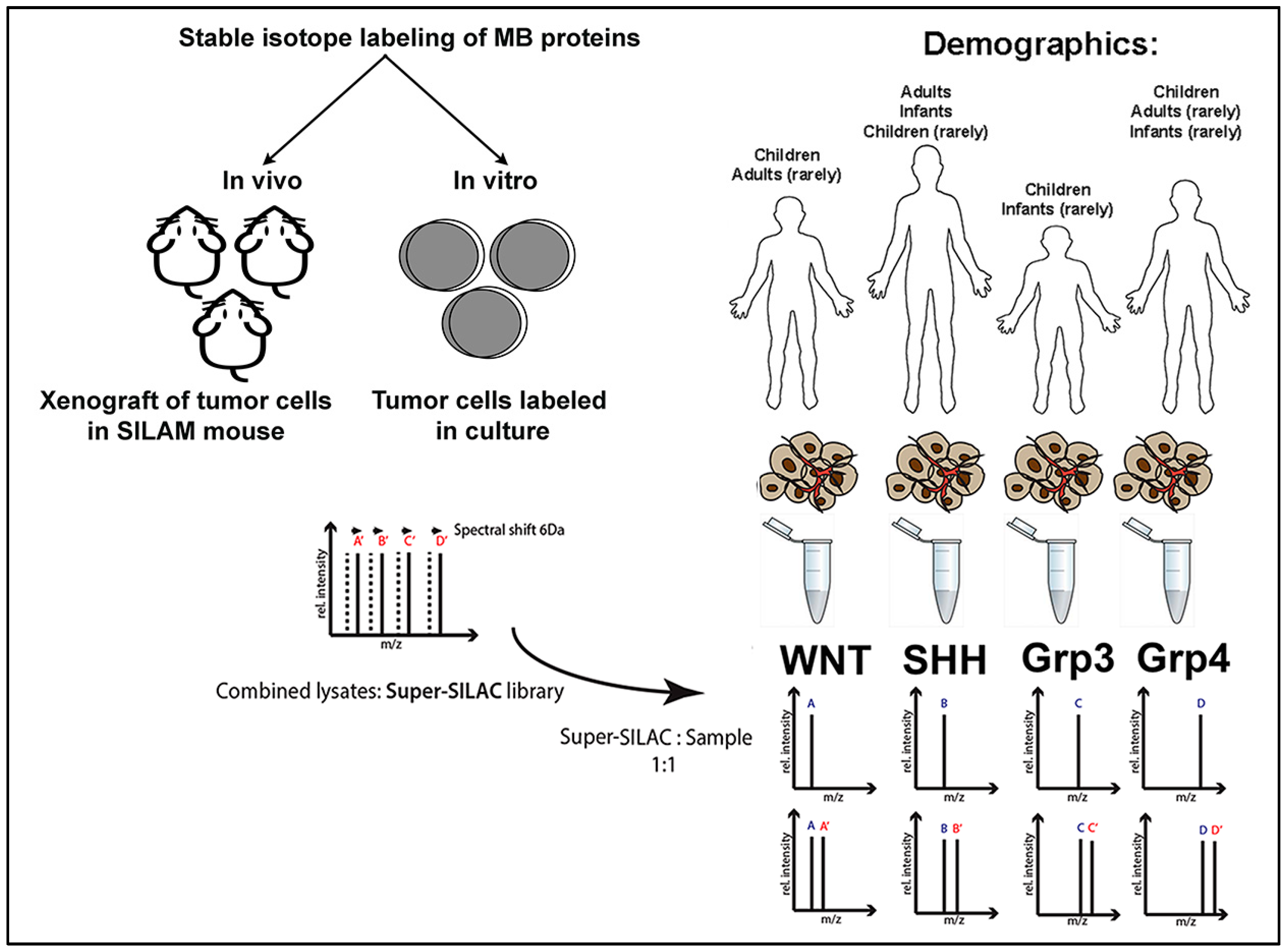
Graphical Abstract